Posted in Essay, General Interest, Guest Writer

Colin never disappoints. I think you will enjoy this thought provoking piece with which we restart “Into the Bardo.” For the foreseable future, this site will be a simple digest of some of the finest work to be found online and which I think you will enjoy. It’s a slow start, but I hope a good one. Jamie Dedes

Colin Blundell's avatarcolinblundell

The dynamic concept of the Figure of Eight was introduced in my Blog ‘Somatic Markers’ dated 16th November.

The bottom half of the Figure of Eight represents the ground of our being—core self—that which we can become more aware of in meditative exercises of one kind or another: the rush of blood in the ears, the crackling of knee joints, the tingling in the right big toe (notice it now…), the sense of suspension in the limbs when you imagine that all motion has been stopped, the place we go to when listening to the slow movement of a Mozart Piano Concerto—α-wave intelligence.

The ascent into the top half of the Figure of Eight takes us into β-wave intelligence which is needed to sustain everyday living during which there’s a tendency to forget that everything depends on the natural functioning of the Core Self where the laws of one’s own…

View original post 953 more words

Posted in Essay, Guest Writer

THE ACT OF INVISIBILITY

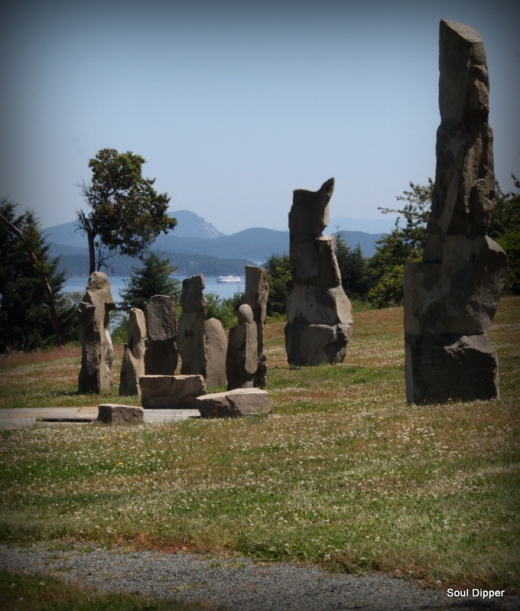
Stones, balanced with mortar-less perfection, stand on the hillside and silently watch the ferry slip through its island laden path.

THE ACT OF INVISIBILITY

by

AMY NORA DOYLE (SoulDipper)

Into the Bardo Contributing Writer

Yesterday, a professional musician read aloud The Prayer of St. Francis.  The man wasn’t performing for the crowd.  He was reading as though the prayer had been written for him.

The intonations and musicality of his voice lured me into loving the words.  I questioned the opposites contained in the prayer.   Are they better served verbally?  Or silently?

Does an effective “channel” speak love or just show it somehow?  How is it easiest to receive vibes of pardon, faith, hope, light, and joy?  Is it best to transmit consolation, understanding and love with an act of invisibility?

People who personify the virtues listed in St. Francis’ prayer are rare, but Susan Boyle came to mind.  Did she have years of invisibility?  Did it magnify her beauty?

The prayer says, “It is in dying that we are born…”  Being, instead of being seen, disciplines the ego and makes room for giving.

I wanted to know:  How can I construct my own invisibility?

This question first arose in the early 1970s in London, Ontario.  I joined the London Little Theater Group and was given the role of a seductive secretary in a murder mystery.  I was overjoyed until I realized my character was murdered in the first minute of the first act.  My only lines were repeats of phrases spoken by my lover/boss.  I was taking shorthand while he dictated a letter.  I didn’t even have to do a dying scene.  The lights went out, a shot was fired and when the stage was lit again, weeks had passed.

That kind of invisibility was easy.  The mystery revolved around my character and I didn’t have to do a thing.  I sat bored and impatient backstage, waiting for the end of the performance so I could do curtain call with the rest of the cast.

Stan, a professional actor who had retired in London, was a small, quiet man with powerful stage presence.  His role in the play suited him – a quiet, polite, detective who matched the cunning of a yet-to-be-famous Columbo.  His role required a deftness that caused players, and certainly audiences to forget he was on stage.

“How will Stan ever be invisible on stage?” I asked the director.

“It’s one of the most challenging roles for any actor,” he said.  “It’ll be especially tough for Stan because everyone likes to watch him.”

“Does that mean the other players have to do a good job of distracting the audience?”

“That’s important, but Stan can’t count on that.  What if the other players don’t pull that off?  The story relies on his shadowy observations and impeccably timed responses.”

During rehearsals, I popped in, did my one minute on stage and left.  I didn’t have a chance to ask Stan about invisibility.  He was continuously engaged with fellow cast members.

We had a packed house each night of both weekends.  I wanted to watch Stan in action, but had to stay backstage.  It wasn’t until the cast party that I finally had a chance to pose my question.

“Stan, apparently you mastered invisibility every night.  I’d love to know how to do it.  Is it the opposite of acting?”

“It’s a wonderful and artful challenge.  It’s customized with each play, each cast and each setting.”

“But how do you do it?” I asked.

“I think myself into a state of not being available.  I’m absolutely still.  I don’t draw attention to my character in any way.  I work with the timing of the other actors as I blend in with the scenery, the movements, and the mood.  I imagine myself small until it’s time to step back into the spotlight – big as life.”

“So…you are turning your visibility off and on in accordance with what’s around you?”

“Yes.  For me, being invisible requires more acting than being center stage.  It’s draining.  It is the most intense, yet rewarding, acting I have done. It’s terrifically fulfilling.”

Here I was, yesterday, listening to a professional musician invisibly read a prayer.  I listened to Susan Boyle sing the St. Francis prayer with the power of coming out “big”.  I remembered a gifted actor teaching the art of invisibility.

Am I any closer to knowing how to channel the virtues named as opposites in the prayer?

I’ll have to see how invisible I can be.  However,I’ve learned one thing.  An act of invisibility is a supreme act of giving.  Self-willed or not.  Both have purpose.

Can you become invisible?

© 2012, photograph and essay, Amy Nora Doyle, All rights reserved

AMY NORA DOYLE ( souldipper) ~ has been blogging since 2010, always write-on-target with the topics she chooses to address and her not insignificant gift of story. She is appreciated as much for her insightful comments on blogs as she is for her indefatigable efforts applied consistently to the subject and spirit of the sacred. Amy is also an intuitive. Amy’s work in the ground of the sacred derives from “a life-changing trip to an incredible country, South Africa, the longing in my soul to release concepts about the magnificence of ordinary life has blown the typical writing blocks, corks and stoppers.” The inspired and inspiring Amy lives with her cat in a house on an island in Canada. Be sure to stop and visit her on your trips around the blogospher.

Posted in Essay, Guest Writer, Uncategorized

THE AGE OF DISCONTINUITY AND THE CHINESE SHI

Shakti Ghosal

Fluidity and discontinuity are central to the reality in which we live. (1990), Mary Catherine Bateson (b. 1939), American writer and cultural anthropologist

THE AGE OF DISCONTINUITY AND THE CHINESE SHI

by

Shakti Ghosal (ESGEE musings)

 The other day, I sat leafing through the yellowing pages of that half a century old Peter Drucker classic, ‘The Age of Discontinuity’. This book never ceases to amaze me at the prescient feeling it can generate even after so many decades. Drucker of course could not have envisioned the internet and today’s information flows but his book does ask the question, “As technology becomes ubiquitous, how would we need to cope?” He also challenged us “to be prepared for the complexities”. Big discontinuities that he saw so many years back……. as yet unresolved.

Since the dawn of history, Mankind has experienced discontinuities brought in by adoption of learnt skills and technology. As the first human learnt how to seed and grow plants, Mankind did a makeover from a wandering lifestyle to that of settlers on land. Then with the successive arrivals of the steam engine and electricity, the agrarian lifestyle started morphing into industrial clusters and an associated urban way of life.

And so has been the cycle. A periodic massive disruption of the way we live, the way we work, the way we trade, all leading to a discontinuity. But always, Mankind returned back to stability. Adjusting back into the equilibrium of a new socio-economic format, till the next bout of discontinuity.

But methinks we now have reached a different arena. A space and time where technologies are no longer stabilizing. If at all, they seem to be changing at a faster and faster pace. One needs to just see what is happening to computing, information and communication to appreciate this.

As I reflect, I am left wondering if we are facing the mother of all discontinuities, a shift to a world without stability. A world in which extreme social and economic disruptions become the norm. Be it the ongoing financial turmoil in the global markets. Be it increasing volatility in commodity prices. Be it companies losing out their leadership positions at an increasing rate. Be it product life cycles becoming shorter and shorter. I wonder if these indeed be the symptoms of a world becoming increasingly unstable.

So how do we, the individuals, cope with such constant discontinuities and loss of stability? Wired as we are to cherish stability and continuity in life, how do we retain our balance and sanity?

I think of the Chinese concept of Shi. Simply put it signifies a propensity based on situation. So whenever there is the propensity to play out to an extreme, there also occurs the tendency to self correct and reverse course. And herein lies the magic of Shi- embodying the spirit of dancing in the moment.

Shi is a belief. It promotes lightness and a dynamic view of our world. In Shi, everything is in a state of becoming. So as we focus on the flows and the lightness of the moment, we lose our obsession with discrete people, objects or situations. Shi allows a holistic appreciation of the complex webs of relationships among people, objects and the broader environment.

In a world fast losing traditional reference points, the future may well belong to those who adopt a Shi mindset. Those who embrace the lightness of relationships and flows rather than the heaviness of resource ownership. I believe it would be these ‘dancers of the moment’ who would lead the world in this era of uncertainty and discontinuity.

Acknowledgements:

1  The Age of Discontinuity: Guidelines to our changing society

by Peter F Drucker,1969.

2.   The Propensity of Things: Toward a History of Efficacy in China

by Francois Julien,1999.

© 2012, Shakti Ghosal, All rights reserved

Shakti Ghosal ~ has been blogging (ESGEE musgings) since September 30, 2011. He was born at New Delhi, India. Shakti is an Engineer and  Management Post Graduate from IIM, Bangalore. Apart from Management theory, Shakti remains fascinated with diverse areas ranging from World History and Economic trends to Human Psychology and Development.

A senior management professional, Shakti has been professionally involved for over twenty-five years at both international and India centric levels spanning diverse business areas and verticals. With a strong bias towards action and results, Shakti remains passionate about team empowerment and process improvement.

Shakti currently resides in the beautiful city of Muscat in Oman with wife Sanchita, a doctorate and an educationist. They are blessed with two lovely daughters, Riya and Piya.

Posted in Essay, Guest Writer

RAY BRADBURY FLYING UP AMONG THE STARS …

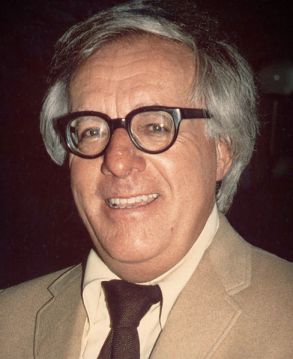
RAY DOUGLAS BRADBURY (1920-2012), American Writer

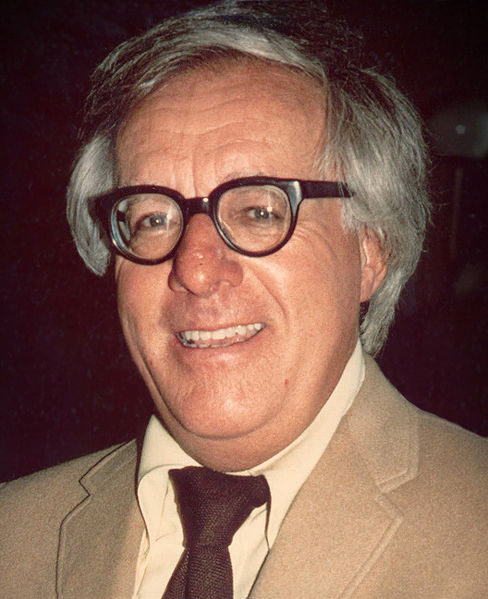
While there were many salutes to Ray Bradbury upon his death on June 5th, I encountered none as charming and well-targeted as Colin’s.  J.D.

RAY BRADBURY:

InFLYING  UP AMONG THE STARS

by

Colin Blundell (colinblundell)

Forty years ago, I began teaching ‘English’ to 11-16 year-olds in a comprehensive school in a suburb of Luton, Bedfordshire UK—Stopsley High School. A class of 4th year boys was well on the way to defeating me till I discovered that reading Ray Bradbury short stories to them was a really good way of keeping them quiet for a whole lesson and even inspiring them to think and write. Ray Bradbury was the key that opened doors for these boys who had mostly been rejected by the system they found themselves enslaved by. Admittedly, by report, some of them later did a stretch in prison but not a few of them went on to get degrees, to become teachers and hold responsible jobs in local industry. I have sadly lost touch with all of them.

The short story that seemed to have the most immediate effect, and the one I always associate with that period of my life, was The Murderer from The Golden Apples of the Sun (1953). It was the story that perhaps meant most to me, one I could put my heart and soul into the reading thereof.

Music moved with him in the white halls. He passed an office door: ‘The Merry Widow Waltz’. Another door: ‘Afternoon of a Faun’. A third: ‘Kiss Me Again’. He turned into a cross corridor: ‘The Sword Dance’ buried him in cymbals, drums, pots, pans, knives, forks, thunder, and tin lightning. All washed away as he hurried through an anteroom where a secretary sat nicely stunned by Beethovens Fifth. He moved himself before her eyes like a hand; she didnt see him. His wrist radio buzzed.
“Yes?”
“This is Lee, Dad. Don’t forget about my allowance.”
“Yes, son, yes. Im busy.”
“Just didnt want you to forget, Dad,” said the wrist radio. Tchaikovsky’s ‘Romeo and Juliet’ swarmed about the voice and flushed into the long halls.

Where are we? What’s going on? Forty years back there was no such thing as a mobile phone; the wrist radio is part of Ray Bradbury’s accurately terrifying vision of the future, which is now: the mobile phone is a symbol for the way life for many people seems to be threaded on messages from an imagined other place, messages, usually of no real consequence, that materialise to interrupt life while it is being lived, to divert attention from the concentrated flow of existence.

Once upon a time, you were able to move from experience to experience without the feeling that at any moment your flow was going to be interrupted by messages from an outer space which is not yours; life has changed and with it consciousness—it’s no longer a direct relationship between you and mountain, river, birdsong, zebra, touch of skin, and sensation of wind but something mediated by a mechanical drive to make contact with somebody to express the connection in some dull-witted way, or have it interrupted by somebody else’s account of their own experience of zebras and so on…

I do not remember that piped music was everywhere when I was growing up (I don’t think it was) but it’s more or less impossible to avoid the intrusiveness of the assault on the ears nowadays. The person with the switch assumes that it’s OK to bombard us with Muzak; most people don’t notice that it is washing over them—it’s the mechanical norm.

One might just consider oneself lucky to have Beethoven’s Fifth or L’après-midi d’un faune swarming about the long halls of the supermarket rather than the latest pop-crap but on the whole, instead of having others impose their banal choices on me, I prefer to organise my own listening schedule just when I want it to happen and not otherwise.

Ray Bradbury is simplistically referred to as a Science Fiction writer but it’s more the case that he is of that fraternity that seems to be plugged into the way things are going in fact rather than as fiction—those who are sufficiently tuned into human trends and weaknesses to understand where things are heading. H.G. Wells was another member of the clan.

“Prisoner delivered to Interview Chamber Nine.”
He unlocked the chamber door, stepped in, heard the door lock behind him.
“Go away,” said the prisoner, smiling. The psychiatrist was shocked by that smile. A very sunny, pleasant warm thing, a thing that shed bright light upon the room. Dawn among the dark hills. High noon at midnight, that smile. The blue eyes sparkled serenely above that display of self-assured dentistry.
“I’m here to help you,” said the psychiatrist, frowning. Something was wrong with the room. He had hesitated the moment he entered. He glanced around. The prisoner laughed. “If you’re wondering why it’s so quiet in here, I just kicked the radio to death.”

At length we find that our hero is Mr Albert Brock, who calls himself ‘The Murderer’. The psychiatrist, who intends to put him right, deems him violent, but Brock says that his violence is only towards ‘machines that yak-yak-yak…’

He quickly demonstrates his murderous intentions.

“Before we start…” He moved quietly and quickly to detach the wrist radio from the doctor’s arm. He tucked it in his teeth like a walnut, gritted, heard it crack, handed it back to the appalled psychiatrist as if he had done them both a favour. “That’s better.”

I often feel like doing this to mobile phones and other beeping implements on trains when my quiet reading is interrupted by them.

Deviant Behaviour

The psychiatrist asks Brock to talk about his deviant behaviour.

“Fine. The first victim, or one of the first, was my telephone. Murder most foul. I shoved it in the kitchen Insinkerator! Stopped the disposal unit in mid-swallow. Poor thing strangled to death. After that I shot the television set! … Fired six shots right through the cathode. Made a beautiful tinkling crash, like a dropped chandelier…”
“Suppose you tell me when you first began to hate the telephone.”

Because the telephone used to upset me as a child and because I would still rather not talk over the telephone I used to read the following explanation to my classes with extreme relish and rhetorical gusto, loudly and at increasing speed.

“It frightened me as a child. Uncle of mine called it the Ghost Machine. Voices without bodies. Scared the living hell out of me. Later in life I was never comfortable. Seemed to me a phone was an impersonal instrument. If it felt like it, it let your personality go through its wires. If it didn’t want to, it just drained your personality away until what slipped through at the other end was some cold fish of a voice, all steel, copper, plastic, no warmth, no reality.
It’s easy to say the wrong things on telephones; the telephone changes your meaning on you. First thing you know, you’ve made an enemy. Then, of course, the telephone’s such a convenient thing; it just sits there and demands you call someone who doesn’t want to be called. Friends were always calling, calling, calling me. Hell, I hadn’t any time of my own. When it wasn’t the telephone it was the television, the radio, the phonograph. When it wasn’t the television or radio or the phonograph it was motion pictures at the corner theatre, motion pictures projected, with commercials on low-lying cumulus clouds. It doesn’t rain rain any more, it rains soapsuds. When it wasn’t High-Fly Cloud advertisements, it was music by Mozzek in every restaurant; music and commercials on the buses I rode to work. When it wasn’t music, it was inter-office communications, and my horror chamber of a radio wrist watch on which my friends and my wife phoned every five minutes. What is there about such ‘conveniences’ that makes them so temptingly convenient? The average man thinks, Here I am, time on my hands, and there on my wrist is a wrist telephone, so why not just buzz old Joe up, eh? …I love my friends, my wife, humanity, very much, but when one minute my wife calls to say, “Where are you now, dear?” and a friend calls and says, “Got the best off-colour joke to tell you. Seems there was a guy…”

The climax came when Brock ‘…poured a paper cup of water into the intercommunications system’ at his office which shorted the electrics and had everybody running around not knowing what to do with themselves. Then Brock ‘got the idea at noon of stomping my wrist radio on the sidewalk. A shrill voice was just yelling out of it at me, This is People’s Poll Number Nine. What did you eat for lunch? I kicked the Jesus out of the wrist radio!’

A Solitary Revolution

Brock decided to ‘start a solitary revolution, deliver man from certain ‘conveniences’… Convenient for anybody who, out of boredom or aimlessness wanted a diversion.. “Having a shot of whisky now. Thought you’d want to know…” Convenient for my office, so when I’m in the field with my radio car there’s no moment when I’m not in touch…’

Why on earth should we ever wish to be ‘in touch’ with people, with contacts, with a million or so connections on the Internet, with ‘friends’ on Facebook? Why do we feel a need to communicate our insignificant ideas to anybody who will, we imagine, click in on a regular basis? Why am I writing this?

We are living the Twentieth Century illusion of total connectedness; we imagine an audience; we think we are making something happen. We are not. All that’s happened is that our concept of the world has changed; we like to think that we are all in it together—it could well be that this has affected the shape of ‘consciousness’ itself.

Why is it that the bosses imagine now that they can extend the working day 24 hours a day, 7 days a week by  constantly having workers ‘in touch’? We let them get away with it.

In touch! There’s a slimy phrase. Touch, hell. Gripped! Pawed, rather. Mauled and massaged and pounded by FM voices. You can’t leave your car without checking in: “Have stopped to visit gas-station men’s room.” “Okay, Brock, step on it!” “Brock, what took you so long?” “Sorry, sir.” “Watch it next time, Brock.” “Yes, sir!”

Brock progressed his one-man revolution by spooning a quart of French chocolate ice cream—chosen because it was his favourite flavour— into the car radio transmitter.

The psychiatrist asked what happened next.

Silence

“Silence happened next. God, it was beautiful. That car radio cackling all day, Brock go here, Brock go there, Brock check in, Brock check out, okay Brock, hour lunch, lunch over, Brock, Brock, Brock… I just rode around feeling of the silence. It’s a big bolt of the nicest, softest flannel ever made. Silence. A whole hour of it. I just sat in my car, smiling, feeling of that flannel with my ears. I felt drunk with Freedom!”

Then Brock rented himself a ‘portable diathermy machine’. Now, if ever there was a sensible invention this is one. Often, especially on trains, I’ve thought to myself, “If only I had a  ‘portable diathermy machine’, I could turn it on and silence all the inane chat, all the music blasting out of half-wit headphones, all the tapping and beeping that so disturbs me…”

I’ve even thought of trying to invent something that would do the trick. I once met a man who said he could help though there might be issues of legality. Brock, c’est Moi, I thought.

In the story, the effect of Brock’s murderous impulses was striking.

“There sat all the tired commuters with their wrist radios, talking to their wives, saying, ‘Now I’m at Forty-third, now I’m at Forty-fourth, here I am at Forty-ninth, now turning at Sixty-first.”

“I’m on the train…”

“One husband cursing, ‘Well, get out of that bar, damn it, and get home and get dinner started, I’m at Seventieth!’ And the transit-system radio playing Tales from the Vienna Woods, a canary singing words about a first-rate wheat cereal. Then—I switched on my diathermy! Static! Interference! All wives cut off from husbands grousing about a hard day at the office. All husbands cut off from wives who had just seen their children break a window! The Vienna Woods chopped down, the canary mangled! Silence! A terrible, unexpected silence. The bus inhabitants faced with having to converse with each other. Panic! Sheer, animal panic!”
“The police seized you?”
“The bus had to stop. After all, the music was being scrambled, husbands and wives were out of touch with reality. Pandemonium, riot, and chaos. Squirrels chattering in cages! A trouble unit arrived, triangulated on me instantly, had me reprimanded, fined, and home, minus my diathermy machine, in jig time.”

The psychiatrist, namby-pamby liberal democrat, suggests that Brock could have joined a club for gadget-haters, got up a petition, asked for a change in the law… Brock says he did all these things and more but he still found himself in an undemonstrative minority. The psychiatrist says that the majority rules.

“But they went too far. If a little music and ‘keeping in touch’ was charming, they figured a lot would be ten times as charming. I went wild! I got home to find my wife hysterical. Why ? Because she had been completely out of touch with me for half a day. Remember, I did a dance on my wrist radio? Well, that night I laid plans to murder my house… It’s one of those talking, singing, humming, weather-reporting, poetry-reading, novel-reciting, jingle-jangling, rockaby-crooning-when-you-go-to bed houses. A house that screams opera to you in the shower and teaches you Spanish in your sleep. One of those blathering caves where all kinds of electronic Oracles make you feel a trifle larger than a thimble, with stoves that say, ‘I’m apricot pie, and I’m done,’ or ‘I’m prime roast beef, so baste me!’ and other nursery gibberish like that. With beds that rock you to sleep and shake you awake. A house that barely tolerates humans, I tell you. A front door that barks: ‘You’ve mud on your feet, sir!’ And an electronic vacuum hound that snuffles around after you from room to room, inhaling every fingernail or ash you drop. Jesus God… ”

The psychiatrist suggests he minds his language.

“Next morning early I bought a pistol. I purposely muddied my feet. I stood at our front door. The front door shrilled, ‘Dirty feet, muddy feet! Wipe your feet! Please be neat!’ I shot the damn thing in its keyhole! I ran to the kitchen, where the stove was just whining, ‘Turn me over!’ In the middle of a mechanical omelet I did the stove to death. Oh, how it sizzled and screamed, ‘I’m shorted!’…  Then I went in and shot the television, that insidious beast, that Medusa, which freezes a billion people to stone every night, staring fixedly, that Siren which called and sang and promised so much and gave, after all, so little…”

Having been arrested for destroying other people’s property, Brock was sent to the Office of Mental Health to be straightened out by a psychiatrist. Brock is unrepentant and says he’d do it all over again. The psychiatrist checks that he’s ready to take the consequences

“This is only the beginning,” said Mr. Brock. “I’m the vanguard of the small public which is tired of noise and being taken advantage of and pushed around and yelled at, every moment music, every moment in touch with some voice somewhere, do this, do that, quick, quick, now here, now there. You’ll see. The revolt begins. My name will go down in history!”

He’s prepared to admit that all gadgets were initially dedicated to making life less of a drudgery.

They were almost toys, to be played with, but people got too involved, went too far, and got wrapped up in a pattern of social behaviour and couldn’t get out, couldn’t admit they were in, even.

The gadgets have now become an unquestioned part of life. The next generation grows up with all the e-things and cannot understand old fogies like me wanting to, as they might see it, put the clock back.

Brock points out the irony that he ‘…got world-wide coverage on TV, radio, films… That was five days ago. A billion people know about me now. Check your financial columns. Any day now. Maybe to-day. Watch for a sudden spurt, a rise in sales for French chocolate ice cream!

Brock looks forward to spending six months in jail, free from noise of any kind.

The psychiatrist’s diagnosis announced over the tannoy system is that Brock seemed convivial but ‘…completely disorientated’ refusing ‘… to accept the simplest realities of his environment and work with them…’

A Story to Shape the Soul

Re-reading Ray Bradbury’s brilliant short story on the day I heard of his death at 91, I realise, not for the first time, how much it has shaped my being; my disgust with the way the world is now, my refusal to compromise, my sense of horror at the way people are sucked into A Influences and diverted by gadgetry from the things that really matter: the life of the soul, responses to Nature and all that comes under the heading of Understanding properly nurtured by Knowledge and Being… Indiscriminate working with the realities of one’s environment means giving in to crass stupidity, mass resignation to the way things are fostered by Big Business brain-washing and the endless traps of Capitalism.

Accept nothing unless it nurtures the soul. Verify everything for yourself, says Gurdjieff…

Brock walks cheerfully to prison looking forward to a nice ‘bolt’ of silence. Meanwhile for the psychiatrist normal life resumes…

Three phones rang. A duplicate wrist radio in his desk drawer buzzed like a wounded grasshopper. The intercom flashed a pink light and click-clicked. Three phones rang. The drawer buzzed. Music blew in through the open door. The psychiatrist, humming quietly, fitted the new wrist radio to his wrist, flipped the intercom, talked a moment, picked up one telephone, talked, picked up another telephone, talked, picked up the third telephone, talked, touched the wrist-radio button, talked calmly and quietly, his face cool and serene, in the middle of the music and the lights flashing, the two phones ringing again, and his hands moving, and his wrist radio buzzing, and the intercoms talking, and voices speaking from the ceiling. And he went on quietly this way through the remainder of a cool, air-conditioned, and long afternoon; telephone, wrist radio, intercom, telephone, wrist radio, intercom, telephone, wrist radio, intercom, telephone, wrist radio, intercom, telephone, wrist radio, intercom, telephone, wrist radio…

End of a Story…

What I would dearly love to know is whether The Murderer penetrated the soul’s of the lads I taught all those years ago as much as it has penetrated mine. Amongst others, Paul, Martin Chris, Richard, Stephen, John and also Chris & Pete who went off to swim unwillingly amongst the stars in the 1970’s.

If any of you should chance to read this, please get in touch, as they say…

Colin Blundell ~ (colinblundell) warns us that if we’re into sound-bites, we’re going to be disappointed. His writing is generous, informative, and covers the range: poetry, fiction, and philosophical tomes. When he isn’t writing he is busy making music and hand-made paperback books, painting watercolours, and going on long-distance motorbike treks. He’s left off being a wage-slave in 1991. He is now an independently teaching Neuro-Linguistic Programming (NLP), Accelerated Learning, Steven Covey’s Seven Habits, Change Management, Problem-solving and Time Management, and the art and practice of the Enneagram.

Posted in Essay, General Interest, Guest Writer

THE STORY OF A WAR AND A QUIET MAN

Normandy American Cemetery

“My army buddy, Jack Oliver, attended boot camp with Uncle Lewis.  He helped me understand that my father was as much a victim of the war as my uncle.  When the War Department tallies the casualties, it counts the dead, the wounded, the missing in action.  But no one ever takes into account the broken hearts and broken families left by the wayside in the wake of war.  If they did, perhaps they would stop sending our children off to fight and die.” Naomi Baltuck

REMEMBERING UNCLE LEWIS

by

Naomi Baltuck (Writing Between the Lines)

One of my earliest memories is of dinner at Grandma Rose’s house.  Her towels, furniture, and closets smelled of mothballs; she even stored her silverware in mothballs.  Mostly, though, I recall standing on Grandma’s couch to study the framed collage of black and white photographs on her wall.  I recognized my father, but knew the other boy in the pictures only by name, and by heart.

Uncle Lewis was my father’s only sibling, younger than my dad by ten years.  We never met, and Daddy never spoke of him.  But they were best friends.  In one picture Lewis was laughing, having been surprised on the toilet by my father with his camera.  The brothers teased Grandma too.  Lewis would yell, “Harry, stop hitting me!”  Grandma would rush in, and scold my father for picking on his brother.  Undaunted, they’d laugh and repeat, until Grandma caught on.

Soon after the attack on Pearl Harbor, Lewis was drafted into the infantry, a shy studious eighteen year old who had never kissed a girl.  My father joined up as an officer.  He pulled a few strings to get Lewis transferred into the 30th ‘Old Hickory’ Division, so the brothers could cross the Atlantic on the same ship.  Lewis wrote letters and post cards home, often addressed to their dog ‘Peanuts.’

“Hey, Peanuts, tell Pa to eat his spinach!”   From the ship he wrote, “Harry and his buddies sneaked me into their cabin.  They gave me chocolate and let me play with their puppy.  Don’t tell anyone, or we’ll all catch it.  They smuggled the pup on board, and officers shouldn’t fraternize with enlisted men…”

While serving in Africa, Italy, England, France, and Germany, Harry was safely behind the front lines.  But Lewis was sent to Normandy two days after the D-Day invasion.  He fought in the hedgerows of France, and in Holland.  “The Dutch ran into the streets and passed out everything from soup to nuts.  As we marched out of there in the middle of the night, you could hear the clink of cognac, whiskey, and wine bottles in the guys’ jackets, amidst all the cursing and the roar of the Jerrys’ planes overhead.”  

To his parents Lewis wrote, “Dear Ma and Pa, today I saw General Eisenhower drive by.”  Or, “Kronk said the war can’t last.  It just can’t.  And he said it with such an angelic look on his face, I believe him!”

But to my father he wrote, “You should see the bruise from where a bullet passed through my shirt, Brub.  It was a close call.”  Or, “They took Julian away.  It’s so lonely here, Brub.  He’s the reason I wouldn’t take that promotion to sergeant.  We dug in together, took care of each other when things got rough.  I don’t know how bad he’s hurt; I just hope he makes it, and escapes this Hell.  Pray for me, Brub. Pray for me.”

On September 20, 1944, the day before his company attacked the Siegfried Line, Staff Sergeant Lewis Baltuck was killed by the blast of a shell.  Twenty years old, he had hardly begun to live.  He was survived by his parents, his dog Peanuts, and his brother Harry.  He never had the time or the opportunity to fall in love and marry.  He left no children to mourn for him—only the Bronze Star and the bronzed baby booties Grandma kept on her bookshelf until the day she died, more than forty years after her son’s death.

Harry married, had seven children, and built his own little house in Detroit.  But for the rest of his life he suffered acutely from the unspeakable burden of depression and Survivor’s Guilt.  When Grandpa Max died, my father became the sole caretaker of his widowed mother.  There was no one to share that burden with, to joke with or jolly her along.  Worst of all, crazed with grief, Grandma Rose blamed Harry for Lewis’s death.

I envied those kids who grew up with cousins to play with, and uncles who cared about them.  Uncle Lewis would’ve been that kind of uncle, and my father would have been a different man, without that black cloud to live under.  When Daddy died in 1965, we lost our connection to my father’s extended family, and our ties to our paternal cultural heritage were nearly lost as well.  But it does no good to dwell on the past or to speculate on what might have been.

Uncle Lewis was right about one thing.  War is Hell.  The price it exacts is impossible to tally, and can never be repaid.  When a soldier is killed, one heart stops beating, but many more are broken.  The wounds inflicted upon whole families are so deep that the scars can still be felt after generations.

I swear my uncle’s little bronze baby booties will never end up on the bargain shelf at the Salvation Army Thrift Store, like so many others I have seen there.  How sad to think that such precious keepsakes might be tossed into the giveaway because no one remembers or cares about the one whose little feet filled them.

I attended the 60th reunion of the Old Hickory Division in Nashville in search of someone who knew my uncle.  I met only one man who remembered him…“a quiet man who didn’t say much, but when he did speak, he was always worth listening to.”

I tell my children that story, and many others about their Great Uncle Lewis.  I am confident he will be cherished and remembered, not just for his tragic death, but for his joyful life.

© 2012, essay and family photos, Naomi Baltuck, All rights reserved

Photo credit ~ Normandy American Cemetery: I doctored this (taken in 2010) so that the original colors would not lend a dissonant note to the post. The photo was taken by Harald Bishoff and uploaded to Wikipedia under Creative Commons Attribution-Share Alike 3.0 Unported. J.D.

Naomi Baltuck ~ has been blogging (Writing Between the Lines) since December 2011. She shares her days and her thoughts in the true spirit of weblog, a dairy of sorts. Her posts are perfectly executed works of art: careful and caring, symmetrical and clear. Her interests are eclectic but her family is certainly her center. We are proud to have her as a contributing writer. J.D.

Posted in Essay, Guest Writer

Gratitude by any other name is still gratitude. A bit different from our usual style but still in the spirit of “Into the Bardo:” we share this blog post with thanks to to Chris (Introspections During Quiet Time) who wrote it. J.D.

Introspections During Quiet Time's avatarDuring Quiet Time

Image

I truly enjoy the small things in life. The other day one of these things (I call them “little wins”) happened and it got me to thinking about the little wins that we all get and about what mine are specifically. So, these are just the little things that somehow can turn a bad day around on a dime:

  • I can’t stress how excited I get when I grab a soda from one of the vending machines or coolers at a supermarket and I pop it open, only to find it is partially frozen! It’s like having built in ice cubes. I also love when a couple of pieces of ice come out when you are taking a drink and you have to crunch the ice as loud as possible. Why? because. That’s why!
  • I enjoy playing basketball and making shots from half court is sweet but when I am…

View original post 762 more words

Posted in Essay, Jamie Dedes

GREAT ACTS OF LOVE

PEARL BUCK (1892 – 1973)

American Novelist and Humanitarian

Pulitzer Prize, 1932

Nobel Prize for Literature, 1938

I give you the books I’ve made,

Body and soul, bled and flayed.

Yet the essence they contain

In one poem is made plain,

In one poem is made clear:

On this earth, through far or near,

Without love there’s only fear.

Essence by Pearl Buck

GREAT ACTS OF LOVE

by

Jamie Dedes

I view Pearl Buck, whom I started reading when I was twelve, as a sort of spiritual mother. You can imagine my joy then to find a copy of her one book of poetry in a used bookstore. It is the only book she wrote that I had not read. It sat dusty and torn and – while clearly once well-loved by someone – it was now hidden in an out-of-the-way place, untouched and unrecognized for its simple beauty.

In brief, eloquent, deft strokes, Ms. Buck’s poems do indeed express the great message of both her work as a novelist and writer and as a humanitarian  …

“WITHOUT LOVE THERE IS ONLY FEAR”


Born on June 28, 1892 in Virginia, Pearl Buck was the daughter of missionaries. She grew up in China and spoke Chinese before she ever spoke English. She was a prolific writer with most of her books inspired by her experiences in Asia. In the 1920s, before the publication of her books, her stories and essays began appearing in influential American and Chinese publications.

Of Ms. Buck’s novels, The Good Earth is the most well-known. It was her second novel and became a best seller. She also wrote a number of nonfiction books including memoir and a cookbook. Her poetry collection, Words of Love, was published in 1974, a year after her death. It is now out of print.  It is gracefully illustrated by Jeanyee Wong and was published by The John Day Company, the publishing firm founded by Ms. Buck’s second husband, Richard Walsh.

Throughout her career, Ms. Buck wrote heroically, acutely, and compassionately of women’s rights, immigration issues, mixed-race children, adoption… and, of course, China. She was blacklisted in the 50s for her political and social views. But Ms. Buck’s life was not just about words of love. It was about great acts of love.

Most of Pearl Buck’s humanitarian work was toward mitigating the poverty and discrimination suffered by children.Ms. Buck founded Welcome House, Inc, which was the first international interracial adoption agency. She adopted – if I remember correctly  – ten children herself. Her initial efforts to help mixed-race children were inspired by their rejection in Asia, especially in Korea. There mixed-race children fathered and left behind by American soldiers were barred from any social, educational, and civic privileges, as were the mothers of mixed-race children. Today Ms. Buck’s books still stand as ambassadors of her love and humanity and as introductions to China before Mao.

Here Anchee Min, Chinese-American author, discusses her reasons for writing Pearl of China, a fictionalized account of Pearl Buck’s life.

© 2012, essay, Jamie Dedes, All rights reserved

Ms. Buck’s photograph is in the public domain.

Video posted to YouTube by  .

Posted in Essay, Guest Writer

A WORLD OF DIFFERENCE

Early Azaleas

I am pleased to welcome my friend Michael Watson, a shaman and gifted healer to Into the Bardo.   He and I go back many years as friends, colleagues, and fellow therapists in Vermont. It is so nice to see that our minds continue to follow similar tracks.  Shared here with gratitude, Rob.

A World of Difference:

ON SEEING AND BEING SEEN

by

Michael Watson (Dreaming the World)

The cold returned this past week, and many trees and flowers seem to have taken a deep breath and halted their rush into Spring. Were the maple sugaring season ongoing, these would have been perfect sugaring days and the sugar houses would be boiling madly. (The warmth of a couple of weeks ago stopped the sugar season short.) Now, there is an air of expectancy in the natural world, a quickening and watchfulness, for we are in April, and returning warmth and renewing rains become daily more likely.

The seasonal round brings comfort and a sense of belonging. Maple sugaring gear is cleaned and put away. A few people have made it into their gardens, preparing for the warm season to come. Neighbors, yard and garden tools in hand,  wave to one another. “This sure is weird weather, ain’t it,” echoes down the block. A few daffodils have burst into bloom in south-facing flower gardens, some making their way indoors to adorn tables.  Throughout the neighborhood there is shared business and meaning.

Last week, in class, I showed the Bill Moyers interview with Bill T. JonesStill Here. The video, from 1994, follows the MacArthur Award winning choreographer as he morns the loss of his mate, faces mortality via an AIDS diagnosis, and creates his groundbreaking dance, Still/Here. The video addresses many topics our culture still finds difficult, and does so with refreshing directness: death, terminal illness, homosexuality, loss, and race, among others.

The real focus of the film is difference, a too-hot-to-handle concern in many cultures. Difference is a form of social glue, allowing us to identify ourselves in opposition to the other. It is also the source of creativity, innovation, and adventure, as well as some of our most threatening taboos. The tensions between these functions are played out daily in our cultures, our personal relationships, and our inner worlds. For many people around the world, accepting new technologies, no matter how socially disruptive, has become easier than accepting differences among human beings.

Of course, issues of difference demand attention in the therapy setting. Whether we sit with couples struggling with disagreements about how to manage daily life, young women critical of their body image, or youth and adults who carry labels of major mental illness and wrestle with unique experiences of the world, the underlying concerns are those of difference and acceptability. Always the questions held deep inside include, “Am I loveable as I am?” and “Am I safe?” These are not simple questions.

A walk in the forest offers the opportunity to see difference. No two plants of the same species are identical.  Life history and microecology play an enormous role in the development of each individual. From the point of view of the forest, each is perfect. Only through the gaze of other organisms do individual plants acquire differentiated value. When humans are involved, value is most likely culturally ascribed. Persons of diverse cultures may well read the worth of an individual plant differently from one another, as may individuals of separate species.

Ideally, psychotherapy offers persons the opportunity to challenge internalized or culturally enacted views of  difference in relationship to her or his life. In the process, it may place any number of subversive, liberatory tools at the disposal of those seeking help. Such therapy seeks to provide a space for the successful re-authoring of those stories that isolate and demean on the basis of rubrics of difference. In order to do so, patients are encouraged to challenge the authority of many voices, within and without. Yet, no one can successfully create a rewarding life alone; we each need others to witness and affirm our acts of courage and self authoring.  The therapist is a necessary, yet usually insufficient witness.

Would you share with us your healing stories of seeing, and of being seen by others?

Michael Watson ~ has been blogging (Dreaming the World) since September of 2009. He is a shamanic practitioner, psychotherapist, educator, and artist of First Nations* (Mixed Eastern Woodlands, Cherokee, and Lakota Sioux) and European (British Isles) descent. He lives and works in Burlington, Vermont.

Michael’s teachers and his teachers teachers were shamans. His work is influenced by both the traditions of the First Nations* and contemporary Western traditions. It reflects a strong sense of “connection to the forces and processes of Nature.”  The greater objective of his work is to “support others in developing intimate, transformative relationships with both Self, and the natural world.”

* First Nations – the indigineous peoples of the North America. 

Posted in Essay, Jamie Dedes, Writing

THE HAPPY HOBBYIST: Personal Blogging Explored

PERSONAL BLOGGING HAPPINESS

by

Jamie Dedes

THE GREAT JOY OF THE BLOGGING HOBBY: IT COMBINES CREATIVITY WITH SOCIAL NETWORKING AND SELF-EDUCATION. The operative word in that statement is “joy.” I should know. I enjoy blogging so much that I have five personal blogs and one collaborative blog (this one), and they are all for fun, not money. (Ads are WordPress ads, not mine or ours.)

As I write this, WordPress.com alone hosts 72,467,611 sites with over 351 million people viewing more than 2.5 billion pages each month. WordPress.com users produce about 500,000 new posts and 400,000 new comments on an average day. While not all of these are personal (hobbyist) blogs, it’s probably safe to guess that most are.  [Those stats found HERE.]

UNDER THE MICROSCOPE

professional view:

the study that inspired this post

Hobbyist Bloggers Are Us:  Personal blogging is a mostly American phenomenon, but it’s a recreational pastime that is gaining participation across the globe.

Cumulatively we are such a big chunk of humanity producing so much work and using computers for so many hours that we are the subject of disdain and admiration, debates and studies. One study by Computers in Human Behavior published in Science Direct is: Who Blogs? Personality Predictors of Bloggers*.

Using five measures of the NEO Personality Inventory, two sociological studies of American bloggers determined that individual differences based on the Big Five factors [neuroticism, extraversion, agreeableness, openness to experience, and conscientiousness] can predict who among us is likely to blog. It may not surprise you to learn that “openness to new experience” is a trait those of us who gravitate to blogging are likely to have. It might dismay you to learn that “high in neuroticism” is also one of our traits.

NONPROFESSIONAL OPINION

this would be me: I beg to differ

My best nonprofessional (I’m not a social scientist) and totally biased opinion about who blogs and why: My perception is that it is an outlet for the creative impulse, sharing information, and networking with people who have the same interests. This is an admittedly narrow view: My focus is writers and poets, amateur and professional. I don’t generally read mommy blogs or web journals or other such.

As an inveterate reader of blogs, bloggers seem to be as rich with family and friends and spiritual support as any other group with which I’m involved, but they are often solitary when it comes to an interest in poetry, reading, photography or art and so on. Even when they live in a densely populated area, there may be no access to poetry groups, writers’ groups, or book clubs. Blogs then become a meeting place for these shared interests. While we could share our poems, essays, or fiction with family and friends, this sharing may not be well-received and anyway – why?  The idea of constantly pulling out our poems or other creative efforts to show at every gathering doesn’t necessarily appeal. It feels rather like the creative version of multilevel marketing wherein you display whatever you’re selling, corner your best friends, and impose on them to buy.

It is also clear that some bloggers are using their blogs to practice their English skills, hone their writing skills, and get feedback on their work. For writers (amateur or professional) there is no better discipline than forcing oneself to produce consistently and on schedule.  Blogging provides a good structure for this. It is also an excellent place to test our more creative experiments.

VALUE ADDED

whole world living

Bloggers often engage in whole-world living. With a growing international base, what an education to visit the sites of people around the world who are just regular folks – like neighbors – and not personalities, politicians, or commercial interests. The perspective from the ground is refreshing, informative, and sometimes inspiring. There are heroes everywhere.

HONOR AMONG BLOGGERS

to paraphrase John Locke, access is not license

Just my opinion ~ Personal pride and honor as well as respect for the original creative works of others – often born of long hard hours – dictates courtesy when reblogging or otherwise introducing a work: acknowledgement, link backs, by lines, and copyrights protections are always in order regardless of circumstance.

I am proud of our blogging community where, except in very rare cases, you will find refined moral compass, personal dignity, and the rights and concerns of others are respected. Professionalism (used here in the sense of competence and conduct, not occupation) is always in order for personal bloggers like us as well as the pro-bloggers.

BALANCE

Close you computer and go for a stroll:

advice for writers from Garrison Keillor

BLOG ON – HAPPY BLOGGERS!

* Guadagno, R. E. et al., Who blogs? Personality predictors of blogging, Computers in Human Behavior (2007), doi:10.1016/j.chb.2007.09.001

·

Illustration courtesy of morgueFile.

Video uploaded to YouTube by .

Posted in Essay, Guest Writer, Spiritual Practice

KAREN ARMSTRONG – A CHARTER FOR COMPASSION GROWS

KAREN ARMSTRONG (b. 1944), British Author, Commentator, Academic

Charter for Compassion

“Karen Armstrong is a former Catholic nun who left the convent to study literature, becoming one of the most provocative and original thinkers on the role of religion in the modern world, and a leading international authority on faiths, religious fundamentalism and monotheism.

Her poignant and captivating talks have sparked worldwide debate and healthy discussion. Her bestselling books, including Twelve Steps to a Compassionate Life and A History of God, examine the differences and the profound similarities between Christianity, Islam, and Judaism, and their impact on world events.

In 2008, she was awarded the TED Prize in recognition and support of her call for a council of religious and spiritual leaders to draw up a “Charter for Compassion” that applies shared moral priorities to foster greater global understanding based on the principles of justice and respect. The project has grown to a considerable international following, and a network of Compassionate Cities is emerging that endorse the Charter and find ways to implement it practically, realistically and creatively.

As a speaker and writer, she asserts that all major religions embrace the core principle of compassion and the Golden Rule, and also emphasizes that many of today’s religions bear similar strains of fundamentalism borne of frustration with contemporary life and current events.”     ( –  Official Biography of Karen Armstrong.)

KAREN ARMSTRONG – A CHARTER FOR COMPASSION GROWS

by

Amy Nora Doyle (souldipper)

Contribution Writer, Into the Bardo

On our tiny island, a group recently finished its study of Karen’s book,“Twelve Steps to A Compassionate Life”.  The same group seized an opportunity, on March 22, to share a live video of Ms. Armstrong accepting a prestigious award from the Simon  Fraser University in Vancouver.  In recognition of her exceptional work with Compassion, Vancouver dedicated 12 days in which to dialogue about compassion, in a variety of ways, throughout the city.

The Charter for Compassion begins:

“The principle of compassion lies at the heart of all religious, ethical and spiritual traditions, calling us always to treat all others as we wish to be treated ourselves. Compassion impels us to work tirelessly to alleviate the suffering of our fellow creatures, to dethrone ourselves from the centre of our world and put another there, and to honour the inviolable sanctity of every single human being, treating everybody, without exception, with absolute justice, equity and respect.”

(The complete Charter is available here.)

.

Karen Armstrong – Simon Fraser University – March 22, 2012

.

Those of us who watched Ms. Armstrong’s acceptance of the SFU award, discussed, at its completion, how we envisioned enhancing compassion in our community.   Though time may provide a more profound conclusion, most of us agreed that Compassion is an inner condition through which each of us may filter our actions and exchanges throughout the community.  In support of this commitment, the local book club, one of 500 worldwide, will again offer a study of Karen’s 12 steps to compassion.

Our group may have been influenced by the Rev. Alisdair Smith, Deacon and Business Chaplain for Christ Church Cathedral in Vancouver.  As he introduced Karen, he shared a phenomenal story about a dear friend – a woman who suffers from severe bouts of depression.  She gave Alisdair permission to share her story with us.

In my words:

The depression became severe enough that the woman knew she had to go to the hospital.  With all the courage, will and determination she could muster, she called an ambulance.

A male attendant rode quietly beside her in the back of the ambulance.  As the vehicle wound its way through traffic, the man remained silent, but dutifully attended to any concern for comfort or safety.

After some time, he turned to face her.  He held her hand and looked into her eyes.  He said, “We are almost at the hospital. I want to tell you that while I have been in your presence, I have discerned that you are a very creative, kind  and intelligent woman.

Therefore, when we arrive, I will step out of this ambulance and wait for you to take my hand so you may step down on your own.  We will walk together to Emergency and you will hold your head high with the dignity that is yours to claim.  There is no reason or need to be or feel embarrassed.

Are you willing?”

The woman did exactly as he suggested.  Her life was transformed.

Though she is still plagued with depression, it only takes a moment to reflect on this incredible act of compassion, performed by a stranger, that dispelled and diminished the degree of debilitating power that depression would otherwise demand.

I watched Karen Armstrong’s Ted Talk in 2008.  I became a member of the Charter for Compassion in 2009.  I committed to being a compassionate person.

Big deal, I thought.  That’s not doing much for the Charter.

I found out it is.

Especially if we each do our best with every opportunity that inevitably comes our way.

I keep forgetting about the hummingbird and the forest fire.

© 2012, essay – Amy Nora Doyle, All rights reserved

© photos ~ courtesy of A Charter for Compassion, all rights reserved, used here under fair use

♥ ♥ ♥ ♥

If you have the time for this 22 minute video, you might find it gratifying to hear Ms. Armstrong’s TED award acceptance. J.D.

Posted in Essay, Jamie Dedes, Spiritual Practice

COMPASSION AT THE CORE


1st Row: Christian CrossJewish Star of DavidHindu Aumkar

2nd Row: Islamic Star and crescentBuddhist Wheel of DharmaShinto Torii

3rd Row: Sikh KhandaBahá’í starJain Ahimsa Symbol

COMPASSION AT THE CORE

by

Jamie Dedes

“Compassion is the pillar of world peace.” H.H. 14th Dalai Lama, A Human Approach to World Peace

The peaceful path of compassion is at the core of all the wisdom traditions, the conduits by which grace flows into our lives. If our species is to overcome current conflicts and truly be at peace with ourselves, we must tread the compassionate path and we must do it with bone and muscle as well as heart and mind. It must be a path where service and meditation converge.

In the Summa Theologiae, the great work of St. Thomas Aquinas, he suggests just that. He defines mercy (a virtue) as “the compassion in our hearts for another person’s misery, a compassion which drives us to do what we can to help him.” He describes mercy as having two aspects “affective” – or emotional – and “effective,” which is positive action.

We all have something to teach. We all have something to learn ~

People from varied traditions come to Buddhism – not to convert – but to learn the meditative skills that Buddhism teaches. Buddhists also have lessons to learn from other religions:

“…many Buddhists are interested in learning social service from Christianity. Many Christian traditions emphasize that their monks and nuns be involved in teaching, in hospital work, caring for the elderly, for orphans, and so on . . .  Buddhists can learn social service from the Christians.” H.H. 14th Dalai Lama, The Buddhist View toward Other Religions

Meditative practice is central to Buddhism. Along with devotions (prayers and religious observance), action (good works) is central to Christianity and the other Abrahamic traditions, which is not to imply that there are no meditative practices or that inward practice is more important than outward action. Rather, each has its place and they are complementary. Our meditative practices enhance tranquility, ensuring that our good works are appropriate and done in the right spirit.

A compassionate heart is moved to embrace and not to judge. A compassionate hand is moved to work and to sacrifice for the greater good. Selflessness, well-seated in compassion, implies action that both materially and spiritually benefits others. The Dalai Lama and Thích Nhất Hạnh, social activists as well as spiritual leaders, are the very breath of compassion and they and the people in the organizations they lead endlessly provide selfless service and share spiritual solace with all.

Buddhism in the West is a relatively new practice. To my knowledge it is only recently that American Buddhists have organized for relief efforts with Buddhist Global Relief (BGR), which in its short life has implemented quite a number of effective projects. The main mission of BGR is hunger, not simply addressing it in its immediacy but also advocating for changes within our global food systems that will ensure social justice and ecological sustainability. BGR was started by American Buddhist monk and scholar, the Ven. Bhikkhu Bodhi, calling attention to the “narrowly inward focus of American Buddhism” and its neglect of social engagement. Moslems, Jews, and Christians have long-standing organizations for global relief and social activism.

It is healing grace when social services are delivered on a nonsectarian basis and without the expectation of conversion. The Koran admonishes (2:257): “Let there be no compulsion in religion.”

We’re each born into a path or choose (or forego) one. Our devotion to one religion shouldn’t prevent respect for the others. Abū al-Muġīṭ Husayn Manṣūr al-Ḥallāğ (Mansur Al-Hallaj, 858-922), the Persian Sufi teacher and poet wrote from his own perspective:

“My heart has opened into every form. It is a pasture for gazelles, a cloister for Christian monks, a temple for idols, the Ka’ba of the pilgrim, the tables of the Torah and the book for Koran. I practice the religion of Love. In whatever directions its caravans advance, the religion of Love shall be my religion and my faith.”

Maybe we humans will come as close to peace and perfection as we can when we combine the “specialties” of Buddhism and the Abrahamic traditions ~

Compassion without meditation can result in cruelty and confusion. Compassion without action is insufficient to address concerns of the human condition.

Orthodox Christianity offers us guidelines for corporal (material) works of mercy:

  • feed the hungry
  • give drink to the thirsty
  • clothe the naked
  • house the homeless
  • visit the sick
  • engage in conscientious activism
  • bury the dead

The guidelines for spiritual works of mercy are:

  • share insight with the spiritually curious
  • counsel the fearful
  • provide brotherly support for those who live unwisely
  • bear wrongs patiently
  • forgive offenses willingly
  • comfort those who are suffering
  • pray (unify with the Ineffable) for the welfare of the living and the dead

In the ideal, these guidelines are not simply implemented in the privacy of our own prayers and meditations or with detachment in supporting civic and religious charities, but one-to-one in our everyday lives and in a spirit of unity. Mystical Judaism teaches us that: “Kindness gives to another. Compassion knows no other.”

There are 114 chapters in the Islamic scriptures, the Koran. Each begins with the principled: Bismillah ir-Rahman ir-Rahim (In the name of God, most Gracious, most Compassionate). This reminds me of the classical Christian ideal expressed in the Koinḗ Greek agápē, the love of Christ or God for humankind. I suspect it is also – like agápē – a call to action: to live in harmony with the Divine and all creation, that is to live with grace and mercy.

Charity, self-control, and compassion are the central virtues of Hinduism. Ahimsa (do no harm) is part of the Hindu ideal of compassion. This implies action, not just abstinence.

Perhaps this wisdom from an unknown saint or bodhisattva provides us the best advice for our own peace of heart and our species’ survival ~

“The true happiness that man has searched for since the dawn of time, that inner gold that awaits any person who holds compassionately the key of generosity: Do something for your fellow-man … and you shall truly have the gold.”

Gratitude is compassion’s fulcrum ~

“The roots of all goodness lie in the soil of appreciation for goodness.” H.H. 14th Dalai Lama

Gratitude is also the emotion that compels us to give back by caring compassionately for our fellow humans and providing responsible and loving stewardship of the animals who are our companions in nature and this mother earth that sustains us. This does, of course, preclude war which is a danger to all living things.

Expressing gratitude in some way to those who are kind and caring is what nurtures their gift of compassion so that the giver can continue to give and also learn to receive. The natural law of balance is then honored.

May our compassionate paths be fully human and traveled quietly, without pronouncement, conceit, sectarianism, or self-righteousness. May our compassion be a thing of the heart and mind -yes! – but also bolstered with bone and muscle and seasoned with gratitude. May all sentient beings find peace.

© 2012, essay, Jamie Dedes All rights reserved

 Illustration ~ religious symbols by Rusus via Wikipedia and released into the public domain

Posted in Essay, General Interest, Jamie Dedes, Writing

INTERNATIONAL WOMEN’S DAY: Celebrating and Empowering Women

CELEBRATING WOMEN
·
by
·
Jamie Dedes 
·
INTERNATIONAL WOMEN’S DAY is on March 8. If you are searching for blogging themes this month (festivities are month-long and not restricted to the one day), you’ve got them here. This global event creates space to celebrate economic, political, and social contributions of women. Governments, organizations, charities, and women’s groups choose themes that reflect gender issues, which may have a global or a local focus. No reason why you can’t choose a theme for a post or poem that relates to issues most significant to you. Or, you can stick with a theme that is the focus in your community. You’ll find the themes listed in the blog roll HERE along with lists of events in your area. Some of the themes being explored this year are:
  • Empower Rural Women – End Hunger and Poverty (United Nations)
  • Connecting Girls, Inspiring Futures (International Women’s Day 2012 Website)
  • Equal pay for work of equal value (European Parliament)
  • Strong Leadership. Strong Women. Strong World: Equality (Canada)
  • Unite to End Violence Against Women (Australia, UNIFEM)
  • Our Women, Our State (Australia, Queensland Government Office for Women
  • Sharing the Caring for the Future (Australia, WA Department for Communities)
  • Success in Globally Integrated Enterprise (USA, Woment@ IBM)
  • Women’s Voices and Influence (UK, Doncaster Council)
  • Stretch Yourself: Achieving 50:50 in the boardroom by 2020 (UK, Accenture)
  • Bridging the Generational Gap (UK, Doncaster Council: Women’s Voices and Influence)
For more information on this event link to International Women’s Day 2012.
·
♥ ♥ ♥
·
AND SINCE WE ARE CELEBRATING WOMEN, WHY NOT TWO OF OUR OWN?: Two poets and writers in our blogging community recently had new books accepted for publication. They are Victoria C. Slotto (an Into the Bardo contributing writer) and Heather Grace Stewart. Congratulations ladies!
·
Meet and greet Victoria on March 21 if you are in Southern California:
  • Victoria will be at a book fair in Rancho Mirage on March 21st at the Rancho Mirage Library 10AM to 2PM.
·
If you live in Quebec, mark your calendar’s for Heather’s launch party in May.
  • Carry On Dancing Launch Party  May 8, 2012: 4873 St. Laurent Blvd. Doors open 8:30 p.m. Bar & coffee bar Music by Kimberly Beyea & Jim Bland. Can’t wait to celebrate with you! Details HERE.
·
♥ ♥ ♥
·

Related articles on International Women’s Day:

Posted in Essay, Jamie Dedes

OUR ORIGINAL ASTRONAUTS

Miss Baker

In Huntsville, Ala., there is an unusual grave site where, instead of flowers, people sometimes leave bananas.

The gravestone reads: “Miss Bakersquirrel monkey, first U.S. animal to fly in space and return alive. May 28, 1959.”

Fifty years ago, when Baker made her famous flight, she had some company in the nose cone of the Jupiter ballistic missile: a rhesus monkey named Able.MORE [National Public Radio (NPR)May 28, 2009]

OUR ORIGINAL ASTRONAUTS

by

Jamie Dedes

One day when I was looking for a photograph of a squirrel monkey to post on The Cat’s MeowI found one on Wikipedia along with a photograph of Miss Baker, one of our earliest astronauts. I hadn’t thought about our monkey astronauts in years, but I do remember reading about them as a youngster and feeling angry that they were used without having a choice in the matter. Miss Baker (an eleven-ounce Peruvian-born squirrel monkey) and her companion, Able (a seven-pound American-born rhesus), were the first to come back alive. Miss Baker lived to be twenty-seven and died of kidney failure. Able died four days after the landing. She developed an infection after having an electrode removed.  Able is preserved and on display at the Smithsonian‘s National Air and Space Museum. I find this disturbing. Am I the only one?

The U.S. wasn’t the only country to shoot animals into space. Russia and France did. The Russians and the Americans sent up mice as well as monkeys.

Δ

A sweet little squirrel monkey

enjoying the relative freedom of the Fuji Safari Park in Japan.

Δ

© 2011, 2012 Jamie Dedes, All rights reserved

Video uploaded to YouTube by .

Photo credits ~ Grave stone by Ms. Miserable via Find a Grave. The photo of Able on her couch in display at the National Air and Space Museum is by RadioFan (talk) under the terms of the GNU Free Documentation License via Wikipedia. The monkey in Fuji Safari Park is in the public domain and via Wikipedia. Ms. Baker’s photo is in the public domain and via the U.S. Federal Governent.

Posted in Essay, Jamie Dedes

ELDER POWER: Growing Strong in Broken Places

ELDER POWER:

Growing Strong in Broken Places

by

Jamie Dedes

Authors, like coins, grow dear as they grow old; It is the rust we value, not the gold. – Alexander Pope

Originally published in the now defunct California Woman.

I come to this place of Elder Power through the experience of a chronic, potentially life-threatening illness. Illness is many things. It is a mentor, not chosen, not welcome, but a mentor nonetheless. It is a challenge that often breaks the bonds of affection, the temper of the spine, and the sharpness of the mind. It is a reminder to everyone involved of his or her fragility and mortality. Everyone is touched: family, friends, and colleagues. Everyone is changed and the good or ill of it is largely choice

My family and friends want me to help others by writing from a more clinical perspective, but it seems to me that the clinical lessons are less important than the life lessons. It is the life lessons that give us the strength to keep going, that are the true value to be shared, and that make us elders. To me “elder” implies more than “senior” or “senior citizen,” which I see as demographic terms for people who have reached retirement age. A senior is someone who has merely put in time, while elder is about attitude and state of mind. Elder implies one who has learned a few things along the way.

As a writer, it is the life lessons, not the clinical ones, which inspire and inform my work. I have learned, for example, that all humans are in process and therefore imperfect; and that, no matter what our differences are, the most important things are to remain open to communication and to accept and release our own follies and those of others. I have learned that neither illness nor threat of death preclude joy. I have learned that people who are joyful rarely do harm to themselves or others. I have learned that fear of death has to be directly addressed and then firmly put aside in favor of the business of living. As the saying goes: “It’s not over until it’s over.” Until then, we have responsibilities to others and ourselves. The only real difference between someone who has a life- threatening illness and someone who doesn’t is that the former is no longer in denial.

“If people bring so much courage to this world, “ wrote Hemingway in A Farewell to Arms, “the world has to kill them to break them. The world beaks everyone, and afterward, many are strong at the broken places. But those that will not break, it kills. It kills the very good and the very brave and the very gentle impartially. If you are none of these it will kill you too but there will be no special hurry.”

I am not good, or brave, or particularly gentle. Sometimes I let it all get me down. I descend into fear. I am impatient with process, with taking meds and going for seemingly endless tests and doctors’ appointments. Maybe that’s why I’ve outlived my original expiration date by ten years. My mother used to say, “Only the good die young.” My best quality may be that under my protective shell of intractability, I actually am willing to be broken and reformed. I suppose only time will tell if I have grown “strong at the broken places.”

So, here I stand, after twelve years of battle, at the dawn of a bright new day in a body that is now significantly disabled and quite a bit older. It’s still a good morning and a good body. I recognize I once dealt with a worse handicap than my current disabilities. That handicap is commonly referred to as “youth.” I survived. Maturity on the other hand is a true boon, a gift to savor and enjoy with layers of luxurious nuance I had not anticipated. I do not long for my youth. I love my graying hair. I love my wrinkles and the loose skin on my neck. I love the mild deformity of my feet. These things remind me that I am still here after all. I will not dye my hair, though I have. I will not get chemical injections or cosmetic surgery. I will not use rejuvenating grooming products that have been tested on defenseless animals. I am inspired by civil-rights-era African-Americans who sported Afros, said essentially “this is who we are and what we look like,” and chanted “black is beautiful.” I am graying. I am wrinkled. It’s all lovely and lyrical and makes me smile. It’s about ripeness, not rottenness. It’s honesty: what you see is what you get. Aging is beautiful. With maturity, one finds character refined and perspective broadened, energy expands and compassion flowers. The experience of joy comes more easily.

As survivors, we owe it to those who have gone on, to live in gratitude for this gift of a long life. How ungrateful and what an insult it is to them for us to bemoan our maturity and yearn for our youth as we so often do. What an incredible waste of time and energy such yearning is. Many don’t survive childhood in their impoverished and war-torn areas. Some others don’t survive childhood due to congenital or other diseases. My sister died by her own hand when she was twenty-seven. I have a wonderful, talented, smart friend in her mid-thirties who will pass within three months from this writing. Like you, I have relatives and friends who didn’t make it to fifty, much less sixty or seventy. All things considered, aging is a gift not a curse.

Some of our power comes from our sheer numbers. I read somewhere that we are some six hundred million strong worldwide. In each of our countries, we represent a huge political constituency, a lucrative market, and an enormous fount of energy, experience, and expertise. If that isn’t power in this modern world, what is? What a force for peace we could be. Some of our power comes from consciousness. We are awake now. We have learned how to live in the moment and how to live joyfully, hugely. That alone is a lesson to share. Some of our power comes from more time and focus. Many of us are retired or semi- retired or on disability, or soon will be. Implicit in that is the time to keep abreast of issues in our communities, countries, and our world. We can take the time and make the effort to get accurate information, to analyze carefully, and to share appropriately; that is, in a well considered, non-inflammatory, non-sensational manner. We can act with grit and grace.

Let us show that we are strong in the broken places. Let those of us who have this gift of long life seize on it and ply our elder power. Let’s live with joy, do good, and have fun. Most of all let us be generous with our love. Soon enough, when the time is ripe, our bodies will return to the earth. Our spirits will go wherever spirits go. The river of earthly life will continue to flow. Our children will see us reflected in the eyes of their children. Our grandchildren will strain to hear our voices in rustling leaves and breezes that whisper to them in the night. They will seek us out in moonlight and the warmth of the sun, in the roar of the oceans and the gentle meandering of a lazy brook. They will find us in the good earth and in the good hearts of the lives we’ve touched with concern and compassion.

© 2009  photo and essay, Jamie Dedes All rights reserved

Posted in Essay, Jamie Dedes

TIMES OF WAR, CHANCE FOR PEACE

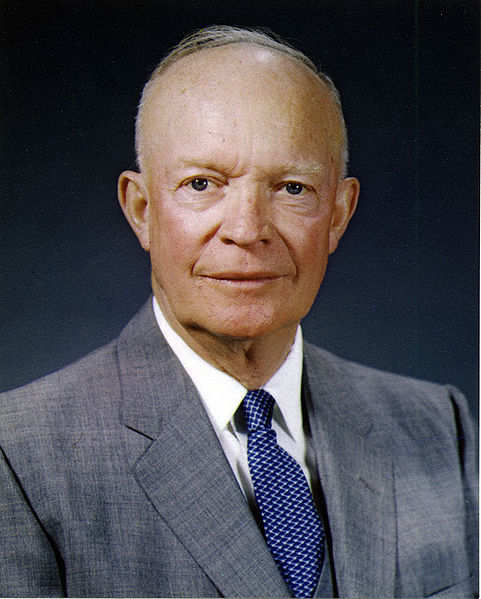
DWIGHT D. EISENHOWER (1890-1969)

34TH PRESIDENT OF THE UNITED STATES

In office 1953 -1961

TIMES OF WAR, CHANCE FOR PEACE

by

Jamie Dedes

“Every gun that is made, every warship launched, every rocket fired, signifies in the final sense a theft from those who hunger and are not fed, those who are cold and not clothed … “ Dwight D. Eisenhower, 34th President of the United States of American (1953-1961)

That quote is from Eisenhower’s speech, A Chance for Peace, delivered in 1953 three months after he took office and on the occasion of the death of Joseph Stalin, Premier of the Soviet Union (1941 to 1953). The “just peace” that the world hoped for in 1945 at the end of World War II had not materialized. While the Korean War was coming to a close, the Cold War-era military conflicts in Indochina (Vietnam, Laos, and Cambodia) were slowly escalating. The United States would have advisory troops in Vietnam in 1954. The armed conflict in that region of the world would continue long past Eisenhower’s administration with U.S. involvement escalating in the 1960s and continuing until the Fall of Saigon in 1975.

Since the end of the Second World War and the Korean War, violent conflict continues unabated with thirteen wars (defined as 1,000 or more deaths per year) currently, including the War in Afghanistan and the Yemeni and Syrian uprisings of 2011. Smaller scale conflicts resulting in fewer than 1,000 deaths per year have been rife and in 2011 include the Sudan-SPLM-N conflict, the Yemeni al-Qaeda crackdown, and the 2011 clashes in Southern Sudan. Genocides didn’t end either. We’ve had eight genocides since the Holocaust of WWII. The number of rebel groups is now over one-hundred, which probably errs on the light side. Conflicts rise from economic and social instability, which could be addressed if we invested in butter, not guns. Even in 1953, Eisenhower pointed out that war isn’t sustainable:

This world in arms is not spending money alone.

It is spending the sweat of its laborers, the genius of its scientists, the hopes of its children.

The cost of one modern heavy bomber is this: a modern brick school in more than 30 cities.

It is two electric power plants, each serving a town of 60,000 population. It is two fine, fully equipped hospitals.

It is some fifty miles of concrete pavement.

We pay for a single fighter plane with a half million bushels of wheat.

We pay for a single destroyer with new homes that could have housed more than 8,000 people.

If governments don’t recognize that Earth and her people cannot be sustained by war, many of their citizens do. One modern peaceful protest for a sustainable world is of interest to all of us who read, write, and love both poetry and peace. It is 100 Thousand Poets for Change, which held its first world-wide rally on September 24, 2011 with 700 events in 550 cities representing 95 participating countries united to promote peaceful environmental, social, and political change. Poets, writers, artists, musicians, and photographers the world over demonstrated in solidarity. The next global event is scheduled for September 29, 2012. Throughout the year small, local events are delivered at a various venues. By invitation, 100 Thousand Poets for Change was at the Sharjah (an Arab Emirate) International Book Fair, which ran through November 27.  MujeebJaihoon reports, “From time immemorial, poetry has built better bridges between people than those with bricks and stones. And these bridges do not get old or obsolete…” [Change Is Born in the Womb of Poetry]

In A Chance for Peace Eisenhower pointed out, “No people on earth can be held, as a people, to be an enemy, for all humanity shares the common hunger for peace and fellowship and justice.” We do hunger, individually and collectively. Perhaps our chance for peace starts with you and me. Poem on …

© 2011 essay, Jamie Dedes All rights reserved

The photograph of Eisenhower is in the public domain

Posted in Essay, Jamie Dedes

POET ACTIVISTS IN SOLIDARITY


“From time immemorial, poetry has built better bridges between people than those with bricks and stones. And these bridges do not get old or obsolete … ” [Change Is Born in the Womb of Poetry]  MujeebJaihoon


POET ACTIVISTS IN SOLIDARITY

by

Jamie Dedes

After much resistance, I finally joined Facebook under my name HERE and created a page for Into the Bardo HERE. Facebook is yet another something that can consume too much time, but it’s also a gold mine of information and introductions to talented, responsible folks from around the world. Through poet-Friend connections I recently received an invitation to participate in:
100 THOUSAND POETS OF THE WORLD (100 Thousand Poets for Change) – This puts me in mind of Sam Hamill‘s Poets Against the War, when hundreds of poets marched and read outside the White House in protest against the war in Iraq. That was a well-defined effort. In this case the first question that comes to mind is “What kind of change?” 

The first order of change is for poets, writers, artists, anybody, to actually get together to create and perform, educate and demonstrate, simultaneously, with other communities around the world. This will change how we see our local community and the global community. We have all become incredibly alienated in recent years. We hardly know our neighbors down the street let alone our creative allies who live and share our concerns in other countries. We need to feel this kind of global solidarity. I think it will be empowering.  Excerpt from the press release of March 2011 announcing the the first 100 Poets for Change global event that was held on September 24, 2011. The next global event is scheduled for September 29, 2012.

100 Thousand Poets for Change is a unified effort among activist poets, artists, photographers, and musicians working toward a sustainable world through simultaneous events held across the globe, basically consciousness raising and peaceful protest. This September under the umbrella of  100 Thousand Poets for Change, 700 events were held in 550 cities representing 95 participating countries united to promote environmental, social, and political change. That’s pretty amazing and down-right gratifying. 100 Thousand Poets for Change is not getting the press that the Occupy movement is getting, but it is striking by virtue of its size, support, and sustainability.

Bob Holman and Margery Snyder, in an article on About.com said, “the beauty of the concept of 100 Thousand Poets for Change is that it is completely decentralized and completely inclusive.”  All those involved are hoping, through their actions and events, to seize and redirect the political and social dialogue of the day and turn the narrative of civilization towards peace and sustainability.

Throughout the year, there are also small local events. Even as you read here today, the Sharjah International Book Fair is in progress will run  through November 27. 100 Thousand Poets for Change was invited to participate and is actively doing so.

If this effort sounds like something that interests you as a poet and/or citizen of the world, check out the website HERE.

POETS AGAINST THE WAR started in 2003 by Sam Hamill is now defunct, but all the poems have been placed in a university archive. I was honored to find that two of mine are included. Sadly the web domain has been assumed by others for advertising. However, there is a bound collection of some of the original poems, Sam Hamill, Poets Against the War.

Δ

AUDRE LORDE (1934 – 1992)

Caribbean-American poet, writer, activist

trying to make power out of hatred and destruction

trying to heal my dying son with kisses

Power by Audre Lorde, The Collected Poems of Audre Lorde

NOTABLE AND QUOTABLE

“[Poetry begins] that process by which we insure the future because we know so much more than we understand. We must first examine our feelings for questions, because all the rest has been programmed. We have been taught how to understand, and in terms that will insure not creativity, but the status quo. If we are looking for something which is new and something which is vital, we must look first into the chaos within ourselves. That will help us in the directions that we need to go–that’s why our poetry is so essential, is so vital. Now whether poetry has the responsibility to effect social change . . . it doesn’t really matter. As we get in touch with the things that we feel are intolerable, in our lives, they become more and more intolerable. If we just once dealt with how much we hate most of what we do, there would be no holding us back from changing it. This is true with any kind of movement. This is the way in which the philosopher/Queen, the poet-warrior leads.” Audra Lorde in an interview Karla Hammond, American Poetry Review, March-April 1980

©  Jamie Dedes, 2011 All rights reserved

photo credit ~ Audra Lorde (1980) by K. Kendall via Wikipedia and licensed under Creative Commons Attribution 2.0 Generic.

Posted in Essay, Jamie Dedes

CHRISTOPHER HITCHINS: Life, Death, and Deathbed Conversions

CHRISTOPHER HITCHINS (b. 1949)

English-American journalist and author

In the course of a forty-year career, Christopher Hitchins, famous (or notorious, depending on your view) for his atheism has dismayed a lot of believers of one persuasion or another. Last year he was diagnosed with a terminal cancer. Many have wondered if on his deathbed he would become an eleventh-hour convert. Here in an interview with CNN’s Anderson Cooper, Hitchens discusses his thoughts and feelings about life and death. It’s an interesting addition to the on-again off-again discussions on this blog of illness, dying, and death. I found two things particularly striking: 1.) Hitchins willingness to accept culpability for his illness as a result of his chosen life-style, which included cigarettes and alcohol. 2.) Hitchins’ mother committed suicide and Cooper’s brother did. The two men agreed that there’s no closure. Having had a suicide in own family, I find I agree with them.  Jamie Dedes

If you click on the video, it will take you to YouTube where you can view it.

Photo credit ~ Christopher Hitchens by Omaraty009 via Wikipedia under the Creative Commons Attritution-Share Alike 3.0 Unported license.

Video uploaded to YouTube by 

Posted in Essay, Guest Writer

THE LOVELORN PEACOCK

THE LOVELORN PEACOCK

by

Gayle Walters Rose (BodhiRose)

Gayle’s cute story of the unrequited love of a bird of a different feather … (Editor’s Note)

In the summer of 1971, I moved from my hometown of Orlando (Florida, U.S.A.) down to Miami to help start an ashram there.  A friend and I were part of an organization that taught yoga, meditation, vegetarian diet and a lifestyle of disciplined, spiritual practice.  He had been dispatched from the main center in Orlando, some months prior to start yoga classes down south and had showed up at my door one day to ask if I would move there and help him.  I thought to myself, sure – why not – it would be an adventure.

He had rented a small house in Coconut Grove on shady, coconut tree-lined Kumquat Street and I took up residence in one of the tiny bedrooms when I arrived.  Right down the street was another communal compound of people making a home together in a large, two story house.

It was a cool time to live in Miami.  There were neat little head shops, and many hippie-type stores that sold candles, incense, clothing, books, etc. and some great health food stores and even restaurants that were completely vegetarian.  It was all new to me but I was in my element!

Before long we had gatherings of like-minded people coming nightly for our yoga classes and life was humming along.

Part of the charming quaintness of Coconut Grove was the community of peacocks that freely roamed the neighborhood streets.  You could hear their ear-piercing calls from blocks away but I never tired of spotting them walking down the road, perched in a tree, or up on someone’s roof.

One male peacock in particular started frequenting the small, enclosed courtyard in front of our house.  Soon he started showing an unhealthy interest in me.  Whenever I would arrive or depart the house, and if he happened to be outside, he would approach me with his feathers spectacularly displayed and “shake” them at me.  This bird was courting me!  With his feathers held straight up, he was just about as tall as I was.  Whatever direction I took, he would get face-to-face with me and “shimmy”.  I became a bit intimidated by this…yikes!  He was extremely insistent:I took to running past him to get in or out of the house but, after some time, I believe he finally realized that his love for me would remain unrequited and he moved on elsewhere to find a more suitable partner.

·

© story/essay ~ Gayle Walters Rose (Bodirose), 2011 All rights reserved

Photo credit ~ morgueFile