JAMIE DEDES ~ My worldly tags are poet and writer. For the past five years I’ve blogged at The Poet by Day,the journey in poem, formerly titled Musing by Moonlight. Through the gift of poetry (mine and that of others), I enter sacred space.
This was written to honor the courage and strength of a young woman who is being jumped-out of a gang. She is doing it for her child and for God. Perpetua was an early Christian martyr who, while imprisoned, kept her child with her for a time. She was imprisoned for the sake of her belief in the Christ-child. This young woman is being jumped-out for the sake of her child. We know of Perpetua because she was educated enough to keep a diary. There are fragments of this diary in existence today. She stayed with her child in prison until she was done nursing him. At that time, he was taken away from her and given to her family to raise.
Gangs and the fear they create are a scourge and it breaks my heart. If we could lift people out of poverty and the resultant system failures (failure of healthcare, failure of education) these kids, who join gangs by the age of 7 or 8, might have a shot at turning life around. In the long run, it is much cheaper to educate someone than it is to imprison them. In the US, there are approximately 800,000 gang members. El Salvador has at least 50,000 while Mexico is at 100,000 at least. There are about 90,000 in Japan and over 160,000 in China. Italy has at least 25,000. (Source: Wikipedia). This is a world-wide problem with real, heart-breaking consequences.
TERRI STEWART is Into the Bardo’s Sunday chaplain, senior content editor, and site co-administrator. She comes from an eclectic background and considers herself to be grounded in contemplation and justice. She is the Director and Founder of the Youth Chaplaincy Coalition that serves youth affected by the justice system. As a graduate of Seattle University’s School of Theology and Ministry, she earned her Master’s of Divinity and a Post-Master’s Certificate in Spiritual Direction with honors and is a rare United Methodist student in the Jesuit Honor Society, Alpha Sigma Nu. She is a contributing author to the Abingdon Worship Annual.
This is why you were born, to pass me by, DNA of our ancestors, it’s your turn to fly, to be the center, the triumph, the culmination.
Though not quite zero at bone and marrow, you ~ are a merry new story, adhering to Conrad’s dictum, with shocks and surprises in every line and chapter.
Your book, your life, your metaphor, wearing truth as your dermis, seeking tears, not blood, and like all good art you changed me for the better,
having read you, I’ll never be the same. So time, My Heart, time now to fly, to leave this nest, the generations on which you stand, this is why you were born, now it’s your turn to fly …
Note: Conrad’s dictum is that the writer’s first responsibility is to help the reader see.
The great American novelist and educator, Toni Morrison, once wrote that it is the job of parents to provide their children both safe harbor and wings. This poem was written some time ago to convince myself, not my son. He did what son’s naturally do.
Time has seen our roles reverse in some ways. My son has the most generous heart and has had my back for thirteen years, ushering me to my pulmonologist/critical care specialist and through sundry procedures and surgeries (always my advocate), moving me to new digs each time I have to downsize, taking me home with him when I couldn’t be left alone, keeping me in computers and tech toys. Yet, our children are our children. As Naomi said yesterday in Part I, “. . . long after they’ve gone gray, long after they are elderly orphans…they will still be our babies. “
From my vantage point as my mother’s daughter and my son’s mother, I’ve learned that making family is just another kind of love story, one in which love is not circumscribed. As we pass this love along to succeeding generations, it grows in depth and breadth. We are better people for it and the whole world becomes a better place. In the end, even mom’s are given wings and the nest in never truly empty when love remains to fill in the spaces.
JAMIE DEDES is a poet and the founder of Into the Bardo. She is aformer freelance feature writer and columnist whose topic specialties were employment, vocational training, and business. She finds the blessing of medical retirement to be opportunity to play: to indulge in writing poetry, creative nonfiction, and fiction.
Jamie’s primary playground is The Poet by Day, the journey in poem (formerly Musing by Moonlight) where at any time you can read five of her most recent poems along with a growing collection of Sunday posts on poetry, poets, and writers. She finds inspiration everywhere and in everyone. Her work is informed by the values of the multicultural/multiracial environment and classical Eastern and Roman Christianity in which she was raised as well as by a more recent introduction to Buddhism. Jamie has an abiding faith in the value of a life of the mind and spirit to heal and in the inestimable value of art and music, poetry and writing as spiritual practice.
In my faith tradition, Jesus is crucified on the cross. He cries out, “Father, Father, why have you forsaken me?” This is a reference to Psalm 22 which explores emotions of abandonment, anger, and finding hope. I have used this methodology to express the anger and hope that I find for the youth that I work with who are affected by incarceration.
One night when I was working in detention (re: jail for kids), I heard story after story of hopelessness. It came to me that these youth were torn apart by their parents, by the education system, by poverty, by global issues beyond my understanding. One youth was going home the next day. To a crack addicted mother. Why couldn’t he go to his dad? His dad smuggles guns into the country and was a high placed gang member. He was certain he would be dead if he lived with his dad. So to his mom he goes. Where she will offer him drugs and he will become hooked. Again. He said, “I do not have the strength to say no to my mother.”
Another youth, noticably affected with psychological and educational challenges, was from Somalia. He was living with his auntie here. In Somalia, he had seen his parents dragged from their home, his mother raped, and both parents killed in front of him. But instead of investing in mental health centers, we have invested in mental health courts. This young man, clearly with a minimum of PTSD, will be locked up where the focus is on “treatment” (in this setting that means that they admit to crime and say they are sorry) not on therapy.
This makes me so mad! So my heart cries out to all who have let down these children. Let me say it again–children. But in order to do this work, I needed to discover why. The below poem was my journey through the anger to discovering how I can possibly continue to find hope and love in a system that is hopeless and loveless. It is also my way of putting words to the stories that the youth tell. And my own story.
where were you
when the embryo
hatched and was formed
by blood-spattered hyenas
tearing hope from
limb to limb and
laughing gleefully
at the mockery
where were you
when the embryo
fell and love
offered a hit
of a crack pipe
covered in symbols
flashing through
the ghetto offering
escape from the
desolate heat
the hands that
should be reaching
out are cut off at
the wrists bleeding
sanctimonious tripe
in defiance of the call
to love the
least , lost, and lonely
while sentencing each
embryo to death
guilty rings through
the room as we
continue to bleed the
embryo out with
ignorance born of
fear and shame and
the lie of the only way
being my way standing
on the corner shouting
belligerently to
repent or die
revelation rings through
the cosmos as the
embryo marches the
guilty to sheol while
silent tears are birthed
wresting the stumbling
breath of hope into a
silent scream reaching
to the ramparts and
calling forth the final
battle fought with
easter lilies
TERRI STEWART is Into the Bardo’s Sunday chaplain, senior content editor, and site co-administrator. She comes from an eclectic background and considers herself to be grounded in contemplation and justice. She is the Director and Founder of the Youth Chaplaincy Coalition that serves youth affected by the justice system. As a graduate of Seattle University’s School of Theology and Ministry, she earned her Master’s of Divinity and a Post-Master’s Certificate in Spiritual Direction with honors and is a rare United Methodist student in the Jesuit Honor Society, Alpha Sigma Nu. She is a contributing author to the Abingdon Worship Annual.
it must be painful for them to write, those poets in tough-times and hard places
where blood and tears and poverty contaminate the air, stain the sidewalks, and consume the people
the blood must be soul-sick and rusted and tasting of acid, not salt, and the poems meant to heal the writer and stroke the cheeks of the wounded, to dry their eyes and gently kiss their gray heads
to poem under such conditions must be like walking shoeless on glass shards
perhaps the most sacred thing in the dream-time meadow of poets’ desire is light
can you awaken to meet the Divine on the battlefield, in the camps, in government housing or in the ghettos?
if so, you are a saint, not simply a lyrist
2.
in my small world, my civilized world, people fall asleep reading or after making love or playing in the yard with their children
if they wander it is through books and planned travel
there are luxuries
there is food
there is cleanliness and paper on which to write
no bombs are dropping
there is almost certain dignity
3.
in San Francisco we walk along the beach at night, near the Cliff House
we walk to the sound of the waves, the sound of the Universe chanting its praise
our feet are bare and relish the comfort of cool sand
the air is clear and cold and easy to breathe, tasting of salt and smelling of sea life
here is a pristine moment of peace
i want to bequeath this peace to you, to everyone, as though it were a cherished heirloom
it is really a birthright
i want to plunge into the waters and gather the oceans to offer as sacramental wine in my cupped hands
i want to braid the seaweed into garlands for everyone to wear, hanging over their hearts, a symbol of affection
i want to collect pine cones from the trees that congregate along the coast and feed them to the children to remind them to love the earth and all its creatures, themselves included, and to say …
do not make war in your heart or upon your mother’s body
JAMIE DEDES ~ My worldly tags are poet and writer. For the past five years I’ve blogged at The Poet by Day,the journey in poem, formerly titled Musing by Moonlight. Through the gift of poetry (mine and that of others), I enter sacred space.
One of the most difficult things that humans do is make meaning from their current situation. In seminary, we were asked to do any assignment called, “This I Believe.” I still treasure the product of that assignment and will share it below. If you’re curious about the origins of the meaning of the word belief in Christian Biblical literature, there is a brief summary here. Regardless, here are a few questions to ponder and be thoughtful about –
What is belief?
How is belief lived out in your life?
Does belief evolve over time?
If belief evolves over time, what does that mean?
Could your belief be a particular window into the world?
Or is your belief the only particular window into the world?
windows
as i look behind
i see a path of aged stone
worn away at the edges
cementing to its neighbor
existing since the
apple flew from the tree
as i look ahead
i see tangles and brambles
and flowers and warmth
and my foot reaches out
as the stone peeks
through the grasses
for a moment
while i hesitantly
test the ground
of all being
as i place my foot
down on the rock
the path is solid and
the tangles and brambles
dissolve into nothing
as the daisies lean towards
the sun gesturing
for me to proceed
as i look up
i see a mansion
welcoming me with
the scent of lavender
and love
calling out like
mama greeting me
after a long summer
away at camp
as i reach the door
i turn the handle
shaking and trembling
with fear and awe
standing at the portal
that leads to
a new place of belonging
as i step forward
realizing this is home
my ragged teddy bear
is waiting for me
on the worn chair
joy glinting off his
button eye
Papa! Mama!
i am home!
“In the garden, child.”
as i look out
i suddenly notice
the windows
each stained to create
a beautiful invitation
of loving encouragement
and lively warmth
leading to the garden
as i run from window
to window i am stunned
by the rainbow of promise
that dances before
my eyes
until i see him
and i am caught
by his image
as love overwhelms me
and my heart dances
and the garden glistens
through the
tears in my eyes
as i peek into the garden
i see Papa waiting for me
and my hand reaches out
to touch the beauty of
him and passes
through the glass
holding me in surprise
while i walk through the
window into the light
enraptured with him
i run to Papa
and leap into His arms
knocking Him back and
He receives me with
a chuckle and twirls
me headily through the
clouds with laughter
born of love and
grace.
Terri Stewart, May, 2009
…
Post and photo, Terri Stewart, (c) 2013 All Rights Reserved
…
TERRI STEWART is Into the Bardo’s Sunday chaplain, senior content editor, and site co-administrator. She comes from an eclectic background and considers herself to be grounded in contemplation and justice. She is the Director and Founder of the Youth Chaplaincy Coalition that serves youth affected by the justice system. As a graduate of Seattle University’s School of Theology and Ministry, she earned her Master’s of Divinity and a Post-Master’s Certificate in Spiritual Direction with honors and is a rare United Methodist student in the Jesuit Honor Society, Alpha Sigma Nu. She is a contributing author to the Abingdon Worship Annual.
I’ve written poems for my mother, my sister, my grandfather, friends, my husband—even my dogs. Today I’m aware that this would-be poet has thus far under-achieved when it comes to reflecting on the role of my fathers (yes, that’s plural) in my life. And yet, they’ve been a central, loving, constant presence. I’ve been blessed.
It’s not exactly true that I’ve ignored them. The man who gave me life, I never knew. He was killed in World War II when I was three months old, leaving my mother a 22-year old war widow. In the interest of brevity, here’s a link to the poem I wrote the year that the anniversary of his death coincided with Easter Sunday.
During the subsequent years, we lived with my maternal grandparents and it was easy to call my grandfather Daddy as soon as I decided it was okay to talk. The man was a wonder, a civil engineer for the Los Angeles Flood Control, quiet, brilliant and loving. He sang baritone, and I remember sitting on his shoulders at Christmas Midnight Mass while he sang “Oh, Holy Night” to the accompaniment of my concert-pianist/organist grandmother. Come to think of it, I wrote of him, years ago, as well, here.
Daddy numero trois came into our lives when I was seven and my mother remarried. He brought along a sister my age—both of whom have now left us. When he died, twelve years ago, I was in the midst of a significant health crisis. I put grief on hold, as I did the desire to pay tribute to this loving, generous man who became as much a father to me as any DNA could assure. So now I’m on a mission.
In the meantime, I turn to poets of all times who have written works that sing of fatherhood—its tenderness and tulmult, its caring and curse. Though I chose to tell my story in glowing terms, we know that life is not always painted in gentle tones of watercolor. Sometimes the rage of red and black might slash across the paper. Often colder tones prevail. Yet, for most of us, something emerges that stays true and evolves throughout a lifetime, washed with a bit of hope and forgiveness.
Today, let me share three poems (or snippets of the one not yet in the public domain) that cover the role of fathers in our lives.
On My First Son by Ben Jonson
Farewell, thou child of my right hand, and joy; My sin was too much hope of thee, lov’d boy. Seven years thou’wert lent to me, and I thee pay, Exacted by thy fate, on the just day. O, could I lose all father now! For why Will man lament the state he should envy? To have so soon ‘scap’d world’s and flesh’s rage, And, if no other misery, yet age? Rest in soft peace, and, ask’d, say here doth lie Ben Jonson his best piece of poetry. For whose sake, henceforth, all his vows be such, As what he loves may never like too much.
Public Domain
English: English playwright, poet, and actor Ben Jonson (1572-1637) by George Vertue (1684-1786) after Gerard van Honthorst (1590-1656) (Photo credit: Wikipedia)
In this first poem, 17th century poet, Ben Johnson, writes of the death of his first-born son, Benjamin, who died on his 7th birthday. Note that the Hebrew name, Benjamin, translates as “child of the right hand.” The almost stoic tone of this work is deceptive. Johnson mollifies his grief, keeping emotion in check, deriving lessons on detachment. Yes that second-to-the-last couplet belies the true strength of his loss. Often, less is more effective.
***
Those Winter Sundays by Robert Hayden
Sundays too my father got up early and put his clothes on in the blueblack cold, then with cracked hands that ached from labor in the weekday weather made banked fires blaze. No one ever thanked him…
…What did I know, what did I know of love’s austere and lonely offices?
Copyrighted, Excerpts
Photo Credit: Nachi.org
***
Contemporary poet, Robert Hayden, wrote this poem from the point of view of a son who understand, too late, the real meaning of the love his father showed. Because of copyright considerations, I have only quoted small portions of the poem, which I beg you to read in its entirety.
The boy recalls that the father called him when the room was warm, gave him the shoes he had polished. And he remembers as well, “fearing the angers of that cold house.” Every detail in the poem speaks of cold and darkness. He uses monosyllabic words and internal rhyme to create the sounds of almost-alienation, but in the end we have a portrait of love that is silent and devoted to the duties of fatherhood.
To Her Father with Some Verses by Anne Bradstreet
Most truly honoured, and as truly dear, If worth in me or ought I do appear, Who can of right better demand the same Than may your worthy self from whom it came? The principal might yield a greater sum, Yet handled ill, amounts but to this crumb; My stock’s so small I know not how to pay, My bond remains in force unto this day; Yet for part payment take this simple mite, Where nothing’s to be had, kings loose their right. Such is my debt I may not say forgive, But as I can, I’ll pay it while I live; Such is my bond, none can discharge but I, Yet paying is not paid until I die.
Public Domain
Second edition title page of Anne Bradstreet’s poems (Photo credit: Wikipedia)
And I suppose I should end this on a more positive note with 17th century poetess’ Anne Bradstreet’s tribute to her father. Yes, we do own them a debt of gratitude. After all, where where would we be without them. Um, I guess we wouldn’t.
If you want more, I suggest stopping over at The Poetry Foundation’s Website and browsing a bit. I strongly recommend taking a moment to read Dylan Thomas’ well-known Villanelle: Do Not Go Gentle Into that Good Night, and My Papa’s Waltz by Theodore Roethke, also a Villanelle.
SHARE YOUR FATHER’S DAY POEM:
If you are reading this post on my personal blog and care to link in your own Father’s Day poem, access Mr. Linky at the bottom of this post and add your name and the direct URL of your poem. I will look forward to reading it there, and you may want to browse other’s submissions.
If you’re reading this post on Into the Bardo and would like to join in, go this post on MY BLOG. Hope to see you there!
I do plan to write one for Daddy #3—it’s long overdue.
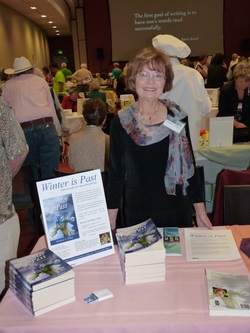
Victoria and Dave SlottoVictoria at the Palm Springs Writer’s Expo March 2012
VICTORIA C. SLOTTO (Victoria C. Slotto, Author: Fiction, Poetry and Writing Prompts) ~ a Contributing Writer to Into the Bardo ,attributes her writing influences to her spirituality, her dealings with grief and loss, and nature. Having spent twenty-eight years as a nun, Victoria left the convent but continued to work as a nurse in the fields of death and dying, Victoria has seen and experienced much. A result of Victoria’s life experience is the ability to connect with readers on an intimate level. She resides in Reno, Nevada, with her husband and two dogs and spends several months of the year in Palm Desert, California.
Winter is Past is her first novel. It was published in 2012 by Lucky Bat Books. She has a second novel in process and also a poetry chapbook. Victoria is also an accomplished blogger and poet who has assumed a leadership role in d’Verse Poet’s Pub. You can read more ofher fine poetry HERE.
No hesitation to break the silences,
to unite others with his verses, to
pierce sleep with the sharpened lance
of his reason, weaving his stanzas
and schemes into the warp and weft
of a marriage, with a single purpose ~ Peace. He tore at the knotted rhizome
and adventitious roots of hate and
despair, pressing on for the renewed
rootedness of hope and its fresh bright
blooms of honesty and courage, it was
his job to husband the survival of the
most refined proclivities of the heart
He planted his poems as seed in the
fertile ground of our best sensibilities
JAMIE DEDES ~ My worldly tags are poet and writer. For the past five years I’ve blogged at The Poet by Day,the journey in poem, formerly titled Musing by Moonlight. Through the gift of poetry (mine and that of others), I enter sacred space.
The video was uploaded to YouTube by tomasisms and is the work of Andrea Dorfman. The poem was written by Tanya Davis, poet, writer, musician. Thank you to Michael Yost (Michael’s Lair) for sharing this one with us.
I’m beginning to live with future tense
once more expanding my conjugations
to will and shall and verbs like hope the ones
I’ve been afraid to say out loud no sense
tempting the subjunctive when a sequence
of events in future perfect beckons
besieged still by emotional demons
I wobble precariously the pretense
of the conditional implying that
the ground could give way any minute and
I’d be plummeting through the past again
insecure disillusioned railing at
imperfect while trying to stop and stand
on the crust of could-be despite was-then
MARILYNN MAIR~ of Celebrating a Year is known as the “angel of the tremolo” and “the first lady of mandolin”. Marilynn is Professor of Music at Roger Williams University, Bristol, Rhode Island. Her most recent CDs are Meu Bandolim and Enigmatica. Her most recent book is Brazilian Choro – A Method for Mandolin. For more of Marilynn’s story, link HERE. Marilynn Mair is a contributing writer to Into the Bardo.
پاس په كمر ولاړه ګله! نصيب دچايي اوبه زه درخيژومه
O Flower that you grow on the mountain side;
The duty to water you belongs to me, but to whom would you belong?
ستا به د ګلو دوران تير شۍ زما به پاته شۍ دزړه سوۍ داغونه
The blooming season of your beauty will pass;
But the scorched patches on my heart will always remain fresh.
Zarmina’s parents at her grave. She was a poet who died after setting herself on fire. Photo by Seasmus Murphy, 2012, Courtesy of the Pulitzer Center on Crisis Reporting
This month The Poetry Foundation, publisher of Poetry magazine, published its June 2013 issue, Landays. The issue is dedicated entirely to poetry composed by and circulated among Afghan women.
After learning the story of a teenage girl, Zarmina, who was forbidden to write poems and burned herself in protest, poet and journalist Eliza Griswold and photographer and filmmaker Seamus Murphy journeyed to Afghanistan to investigate the impact of the girl’s death, as well as the role that poetry plays in the lives of contemporary Pashtuns. A year later, Griswold and Murphy returned to Afghanistan to study the effects of more than a decade of U.S. military involvement on the culture and lives of Afghan women. In the course of this work, Griswold collected a selection of landays, or two-line poems. These poems are accompanied by Murphy’s photographs from the same period and are presented in the June 2013 issue of Poetry.
My pains grow as my life dwindles,
I will die with a heart full of hope.
A report on death and love by Eliza Grizwold and Seamus Murphy, a project of the Pulitzer Center on Crisis Reporting
Griswold describes the characteristics of a landay in her introduction:
“Twenty-two syllables: nine in the first line, thirteen in the second. The poem ends with the sound “ma” or “na.” Sometimes they rhyme, but more often not. In Pashto, they lilt internally from word to word in a kind of two-line lullaby that belies the sharpness of their content, which is distinctive not only for its beauty, bawdiness, and wit, but also for the piercing ability to articulate a common truth about war, separation, homeland, grief, or love.
Landays are centuries-old custom among Afghans, traditionally passed along in the oral tradition, and passed down through generations. The topics of the landays included in the June 2013 issue run the gamut—love, marriage, war, the status of women, drones, politics, courage, nature, and the Internet. Sometimes humorous, sometimes heartbreaking, these captivating two-line poems offer unique insight into the contemporary life of the more than twenty million Pashtun women who span the border between Afghanistan and Pakistan.”
*****
About Poetry
Founded in Chicago by Harriet Monroe in 1912, Poetry is the oldest monthly devoted to verse in the English-speaking world. Monroe’s “Open Door” policy, set forth in Volume 1 of the magazine, remains the most succinct statement of Poetry’s mission: to print the best poetry written today, in whatever style, genre, or approach. The magazine established its reputation early by publishing the first important poems of T.S. Eliot, Ezra Pound, Marianne Moore, Wallace Stevens, H.D., William Carlos Williams, Carl Sandburg, and other now-classic authors. In succeeding decades it has presented—often for the first time—works by virtually every major contemporary poet.
The entire June 2013 issue is available online as of June 3 HERE. Digital copies of the June issue of Poetry magazine, as well as a digital subscription, are also available.
The June 2013 issue of Poetry is accompanied by an exhibition at the Poetry Foundation gallery in Chicago, Shame Every Rose: Images of Afghanistan, which will feature a selection of Seamus Murphy’s photographs. The exhibition will run from June through August 2013 and is free and open to the public.
About the Poetry Foundation
The Poetry Foundation, publisher of Poetry magazine, is an independent literary organization committed to a vigorous presence for poetry in our culture. It exists to discover and celebrate the best poetry and to place it before the largest possible audience. The Poetry Foundation seeks to be a leader in shaping a receptive climate for poetry by developing new audiences, creating new avenues for delivery, and encouraging new kinds of poetry through innovative literary prizes and programs. For more information, please visit http://www.poetryfoundation.org.
About Everything Afghanistan
“Afghanistan’s recent history is a story of war and civil unrest. A country once prosperous now suffers from enormous poverty, a lack of skilled and educated workers, a crumbling infrastructure, and widespread land mines. It’s being heard about in the news every day but the media approaches this country from its dark side only. Here at Everything Afghanistan we try to show the world the other side of this war torn country. Despite years of bloodshed and destruction, there is still so much beauty that remains unseen.
Here we post about Afghan related things, from politics and events to its culture and traditions. This blog is against the US invasion of Afghanistan.” Amina jalalzei, a.k.a. Vicoden
About Mirman Baheer, the Ladies Literary Society
“Over 300 members of Mirman Baheer, the Ladies Literary Society, stretch across the provinces of Afghanistan. Women write and recite landai, two-line folk poems that can be funny, sexy, raging or tragic and have traditionally dealt with love and grief. For many women, these poems allow them to express themselves free of social constraints and obligations. 5 out of 100 women in Afghanistan graduate from high school, and most are married by the age of 16. This kind of expression is looked down upon in society, forcing the women writing to keep their craft a secret.” The Pulitzer Center on Crisis Reporting
Meetings of the poetry society are held in Kabul, but with 8 out of 10 Afghanistan women residing in rural areas, many women call in to the meetings. Zarmina Shehadi was one of those callers. She lit herself on fire two years ago. Her family denies her suicide, claiming that she lit herself on fire to get warm after a bath. “She was a good girl, an uneducated girl. Our girls don’t want to go to school,” her mother said. Zarmina is the most recent of Afghanistan’s poet-martyrs.
About the Pultizer Center on Crisis Reporting
The Pulitzer Center on Crisis Reporting is an innovative award-winning non-profit journalism organization dedicated to supporting the independent international journalism that U.S. media organizations are increasingly less able to undertake. The Center focuses on under-reported topics, promoting high-quality international reporting and creating platforms that reach broad and diverse audiences. MORE
The Pulitzer Center will present I Am the Begger of the World, a reading and film screening event, on July 30, 2013, at Culture Project in New York City and on Wednesday, July 31, 2013, at the Corcoran Gallery of Art in Washington, DC. Farrar, Straus and Giroux will release I Am the Beggar of the World: Landays from Contemporary Afghanistanin spring 2014.
The primary narrative content for this post is courtesy of The Poetry Foundation.
Examples of Pashto Landay, A form of Afghan poetry courtesy of Everything Afghanistan
“I will die …” Landry courtesy of the Pulitzer Center on Crisis Reporting
Photo credit ~ Seamus Murphy for The Pulitzer Center on Crisis Reporting Video by Seamus Murphy for the Pulitzer Center on Crisis Reporting
aunt bea said i’ve figured out why people don’t believe in global warming it’s got the wrong name people see and hear about ice floes into homes superstorms around the world these hot and cold flashes of weather make people say you call that global warming we need a name that matches the symptoms the earth is experiencing a term that conveys the extremes of the earth’s moods and the difficult times ahead for mankind i’m recommending global menopause there’s a term even a politician will be able to comprehend
This is Charlie’s first post with us as a part of our core creative team. If you missed his complete profile the other day, it is posted HERE. Jamie
CHARLES W. MARTIN, Ph.D. (Reading Between the Minds) ~ Throughout Charlie’s educational training and career in speech and language therapy, he maintained a devotion to the arts (literature/poetry, the theater, music and photography). He was a published poet before he completed his graduate work. Since his retirement in 2010, he has turned his full attention to his poetry and photography. He publishes a poem and a photographic art piece each day on his blog. Charlie has been blogging since January 31, 2010. He is hugely popular for his poetry, his ethic, and his support of other poets and bloggers.
Recently Charlie self-published a book of poetry entitled The Hawk Chroniclesand will soon publish another book called A Bea in Your Bonnet: First Sting. The Hawk Chronicles is available through both Lulu and Amazon. In The Hawk Chronicles, Charlieprovides a personification of his resident hawk with poems and photos taken over a two year period. By invitation Charlie has shown his photographs in local businesses that display the works of outstanding artists.
CHARLES W. MARTIN (slpmartin) — earned his Ph.D. in Speech and Language Pathology with an emphasis in statistics. His credentials allowed him to pursue a career that included teaching, research and administration in university settings, treating patients and providing administrative leadership in clinical settings. Charlie worked as a speech pathologist professional in the public schools where he diagnosed and treated communication disorders caused by a wide range of health conditions and contextual factors. Charlie brought passion to each of his professional positions but he was always focused on mentoring his students and improving the quality of life for his clients and patients.
Throughout Charlie’s educational training and career he maintained a devotion to the arts (literature/poetry, the theater, music and photography). He was a published poet before he completed his graduate work. Since his retirement in 2010, he has turned his full attention to his poetry and photography. He publishes a poem and a photographic art piece each day at Read Between the Minds, Poetry, Photograph and Random Thoughts of Life. Charlie has been blogging since January 31, 2010. He is hugely popular for his poetry, his ethic, and his support of other poets and bloggers. His was the first blog I followed when I started blogging and for a long time his was the only blog I followed.
Charlie has self-published a book of poetry entitled The Hawk Chroniclesand will soon publish another book called A Bea in Your Bonnet: First Sting. The Hawk Chronicles is available through both Lulu and Amazon. In The Hawk Chronicles, Charlieprovides a personification of his resident hawk with poems and photos taken over a two year period.
By invitation Charlie has shown his photos in local businesses that display the works of outstanding artists.
In a statement on his blog, Charlie discusses the role of poetry and poems in man’s history:
“Poetry has the power to make us aware of what is hidden in the shadows…those places that we seldom see or want to see…the poet’s voice scrapes away the facade of an issue and lays bare for all to see what has been denied. By providing a voice to these mute realities, poets have throughout history altered the course of events by enlightening readers and encouraging them to take action to stop wars, halt injustice, and to reach out to their fellow man. Like those poets who have proceeded me, I am motivated by the same desire to bring about the social changes necessary to enhance the quality of life for those around me and around the world and to give voice to those who cannot speak for themselves.”
Charlie has contributed to Bardo in the past and joins us now as a part of our core team. On Friday, Charles will introduce Aunt Bea to Bardo readers for the first time. I know you will love Aunt Bea and Charlie.
A warm welcome to the blogosphere’s premier poet of conscience, Charles W. Martin.
“And Caesar’s spirit, raging for revenge, With Atë by his side come hot from hell, Shall in these confines with a monarch’s voice Cry “Havoc!” and let slip the dogs of war, That this foul deed shall smell above the earth With carrion men, groaning for burial.”
Julius Caesar Act 3, scene 1
we have need of gods
an ancient irony
like blood that needs heat
to sweat out the mysteries
to rage in revenge
to reconcile sacrifice
to repel condemnation
to simmer our gratitude
for the many wonders
as misunderstood
as all the horrors
relieve us we pray
in our righteous moments
from the sins of others their guns, their bombs their swords of hate
lives and livelihoods cut short
in genocides renamed –
semantics play large
in wars of loathing
and vile justifications
relieve us we pray
from children killing children
from executions in the street
from brothers killing brothers
from sisters unleashed
like the dogs of war
like a belly full of cancer
like an aorta swelling
our gods cry ‘havoc’
in traps set by rulers
by teachers at schools
and in places of worship
by parents at dinner table
our legs immobilized
like wolves ensnared
we chew at our feet
attempts at freedom
cripple and break us
and everywhere
mouthing lies
groaning in denial
bowing to gutter rats
scraping to vultures
the false gods of our making
Photo credit ~ the “Ludovisi Ares”, Ares- the Greek God of War and Bloodlust via Wikipedia by Marie-Lan Nguyen and generously released into the public domain.
JAMIE DEDES ~ My worldly tags are poet and writer. For the past five years I’ve blogged at The Poet by Day,the journey in poem, formerly titled Musing by Moonlight. Through the gift of poetry (mine and that of others), I enter sacred space.
Don’t ask me how, don’t ask me why
But energy will never die
It merely changes shape and form
Regardless of faith and decorum
All things are bound by this dharma
This my friend is part of Karma
We will die and in death disperse
Seeds upon wind of universe
On what ground those seeds settle and grow
Is something no one can really know
Some say angels with halos and wings
But we know nothing of these things
There is more to elephant than just tusk
And our bodies no more than mortal husk
It is the fruit that it contains
That baffles our little birdbrains
It confounds the fool as it does the wise
Because energy never dies
TIMOTHY JAMES “TJ” THERIEN (Liars, Hypocrites & The Development of Human Emotions) ~ is a guest writer today on Into the Bardo. He has been blogging since November 2012 and has already garnered a significant and loyal following. He says in another poem “I am not a writer … I am possessed by unseen spirit/And my hand is so moved/Words dictated to me by inner voice/Muse speaks when she wants to speak…” That sounds an awful lot like work coming from sacred space. TJ tells us that he was born 1968 in Toronto, Ontario, Canada and current resides in The Eastern Townships, Quebec, Canada. He’s lived briefly in Calgary, Alberta, Canada, and Parry Sound, Ontario Canada. He participates in Poet’s Corner. His “About” is posted HERE.
The leaves of an elm splash
dappled sunlight on the forest
floor. A chill lingers in the
air so we share hot chocolate
from a thermos, pour the creamy
liquid into insulated mugs.
Age does not prevent her
from sprawling on the earth
she loves so passionately.
She leans against the tree’s
stout trunk, says, “I’m yours.”
My mouth is dry like when
the dentist stuffs it full of
cotton rolls. Disbelief numbs
me till she laughs—a sound
as real as songs of her beloved
birds that sing their prayers
in unison from the surrounding
branches and marshy meadows.
“I’m yours,” she says again,
reminding me I’m here to do
the interview I’ve wished for,
nurtured in my imagination
since I discovered her.
“Your life,” I coax, knowing
that but a single word suffices.
As for myself I swung the door open and there was The wordless singing world. And I ran for my life.
“You ran to it?”
“Yes, immersed myself in beauty.” While on and on the sparrow sings.
“And aging? If you don’t mind, that is.”
In the deep fall, don’t you imagine the leaves think how comfortable it will be to touch the earth…?”
…and what shall I wish for myself but, being so struck by the lightning of years to live with what is left, loving.
“Any regrets?”
There wasn’t time enough for all the wonderful things I could think of to do
In a single day…
“If you could choreograph your death?”
…Maybe on a midsummer night’s eve, And without fanfare.
“About death?”
So it is if the heart has devoted itself to love, there is not a single inch of emptiness. Gladness gleams all the way to the grave.
“And after?”
If there’s a temple, I haven’t found it yet, I simply go on drifting, in the heaven of grass and the weeds.
She takes her leave.
I watch her walk across the fields,
stopping to listen
or to follow the flight of a heron.
She’s alone now
with Percy her dog
and memories of having lived well.
I would do just about anything to spend an hour with Mary Oliver, a poet who has touched my life and my writing so deeply. This is an imagined interview. The responses in italics are all snippets of her poetry chosen from New and Selected Poems, Volume Two.
– Victoria C. Slotto
Victoria and Dave SlottoVictoria at the Palm Springs Writer’s Expo March 2012
VICTORIA C. SLOTTO (Victoria C. Slotto, Author: Fiction, Poetry and Writing Prompts) ~ a Contributing Writer to Into the Bardo ,attributes her writing influences to her spirituality, her dealings with grief and loss, and nature. Having spent twenty-eight years as a nun, Victoria left the convent but continued to work as a nurse in the fields of death and dying, Victoria has seen and experienced much. A result of Victoria’s life experience is the ability to connect with readers on an intimate level. She resides in Reno, Nevada, with her husband and two dogs and spends several months of the year in Palm Desert, California.
Winter is Past is her first novel. It was published in 2012 by Lucky Bat Books. She has a second novel in process and also a poetry chapbook. Victoria is also an accomplished blogger and poet who has assumed a leadership role in d’Verse Poet’s Pub. You can read more ofher fine poetry HERE.
The fence we walked between the years
Did balance us serene;
It was a place half in the sky where
In the green of leaf and promising of peach
We’d reach our hands to touch and almost touch the sky,
If we could reach and touch, we said,
‘Twould teach us not to, never to, be dead.
We ached and almost touched that stuff;
Our reach was never quite enough.
If only we had taller been,
And touched God’s cuff, His hem,
We would not have to sleep away and go with them
Who’ve gone before,
Who, short as we, stood tall as they could stand
And hoped by stretching thus to keep their land,
Their home, their hearth, their flesh and soul.
But they, like us, were standing in a hole.
O, Thomas, will a Race one day stand really tall
Across the Void, across the Universe and all?
And measured out with rocket fire,
At last put Adam’s finger forth
As on the Sistine Ceiling,
And God’s hand come down the other way
To measure Man and find him Good,
And Gift him with Forever’s Day?
I work for that.
Short man. Large dream. I send my rockets forth between my ears,
Hoping an inch of Good is worth a pound of years.
Aching to hear a voice cry back along the universal Mall:
We’ve reached Alpha Centauri!
We’re tall, O God, we’re tall!
– Ray Bradbury
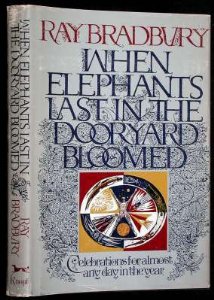
Ray Bradbury’s When Elephants Last in the Doorway Bloomed is a collection of poems in which he writes wistfully about childhood and about inventors, scientist, and explorers, often using religious imagery.
Consider doors. We enter or exit through doors. Sometimes we just look at doors. They lead towards something or away from something.
“As long as you are performing prayer, you are knocking on Allah’s door. And whoever knocks on Allah’s door [constantly], He will open it.” -Ibn Al-Qayyim Al-Jawzi
“The doors we open and close each day decide the lives we live.” -Flora Whittemore
“A man who does not plan long ahead will find trouble right at his door” -Confucius
“Ask, and it will be given to you; seek, and you will find; knock, and it will be opened to you.” Matthew 7:7, Christian Scripture
“In oneself lies the whole world and if you know how to look and learn, the door is there and the key is in your hand. Nobody on earth can give you either the key or the door to open, except yourself.” -Jiddu Krishnamurti
“Knowledge of what is does not open the door directly to what should be.” -Albert Einstein
Lots of thought has been given to doors! Now it is our turn to consider doors. I would like to offer up a lectio divina experience. Lectio divina is an ancient way of “being present to a text in a heart-centered way.” (Christine Valters Paintner) It is a way of meditating or praying. When we use the lectio divina technique, we see the words we read as living, breathing essence. It becomes an encounter with the sacred. There are four primary movements of lectio (and sorry if this is repeat news!)…
Read (lectio): Read and listen for a word or phrase that creates energy within your body
Reflect (meditatio): Read again and savor the words, delve into them, use your senses to experience them
Respond (oratio): Read again and listen for the invitation coming from the text
Rest (contemplatio): Rest, be still.
Go slowly and be present. I offer you a poem from Rumi.
Lectio:
The breeze at dawn has secrets to tell you. Don’t go back to sleep.
You must ask for what you really want. Don’t go back to sleep.
People are going back and forth across the doorsill where the two worlds touch.
The door is round and open. Don’t go back to sleep.
From Essential Rumi by Coleman Barks
…
Meditatio:
The breeze at dawn has secrets to tell you. Don’t go back to sleep.
You must ask for what you really want. Don’t go back to sleep.
People are going back and forth across the doorsill where the two worlds touch.
The door is round and open. Don’t go back to sleep.
…
Oratio:
The breeze at dawn has secrets to tell you. Don’t go back to sleep.
You must ask for what you really want. Don’t go back to sleep.
People are going back and forth across the doorsill where the two worlds touch.
The door is round and open. Don’t go back to sleep.
TERRI STEWART is Into the Bardo’s Sunday Chaplain, Senior Content Editor, and Site Co-administrator. She comes from an eclectic background and considers herself to be grounded in contemplation and justice. She is the Director and Founder of the Youth Chaplaincy Coalition that serves youth affected by the justice system. As a recent graduate of Seattle University’s School of Theology and Ministry, she earned her Master’s of Divinity and a Post-Master’s Certificate in Spiritual Direction with honors and is a rare United Methodist student in the Jesuit Honor Society, Alpha Sigma Nu. She is a contributing author to the Abingdon Worship Annual.
_-_La_Nuit_(1883).jpg "William-Adolphe_Bouguereau_(1825-1905)_-_La_Nuit_(1883)")
 JAMIE DEDES ~ My worldly tags are poet and writer. For the past five years I’ve blogged at The Poet by Day,the journey in poem, formerly titled Musing by Moonlight. Through the gift of poetry (mine and that of others), I enter sacred space.













 TERRI STEWART is Into the Bardo’s Sunday Chaplain, Senior Content Editor, and Site Co-administrator. She comes from an eclectic background and considers herself to be grounded in contemplation and justice. She is the Director and Founder of the Youth Chaplaincy Coalition that serves youth affected by the justice system. As a recent graduate of Seattle University’s School of Theology and Ministry, she earned her Master’s of Divinity and a Post-Master’s Certificate in Spiritual Direction with honors and is a rare United Methodist student in the Jesuit Honor Society, Alpha Sigma Nu. She is a contributing author to the Abingdon Worship Annual.
 The BeZine
