Taking his shirt off
and riding a horse
no longer makes Putin
hide the small man he is,
staring at the mirror
that no longer tells him
grand enough lies.

So he attacks a smaller
country after rereading
Bullies For Dummies.
Quotes Bowie,
blames Nato, The West
with their eyes on gas
prices-still safe if turned off
turning off nightly television
horrors.

Crimea first, now Ukraine
with a blue print for a
reunited Russia on his desk.
His version of the globe
Chaplin twirled in The
Great Dictator, saying
Mine! Mine!

While the planet waits
holding its breath
as does Putin's mirror
at what it can't hide.
Yet the cracks tiny
and almost unseen
are beginning to show
meanwhile  an unhinged
sociopath dares us
to exhale.
Ukraine Burns
In the Smoke
trying to find
hope where
there's little
to none
as thousands
flee their old
lives
to new
uncertainty
Ukraine's on fire
as bombs and bullets
missiles and tanks
do what they do.
All our copious tears
lacking the water
so far
to put it out.
Nuclear Alert
Nucleart missles
on alert to turn
Ukraine to a cinder
turned to ash.

A Threat or...

The ash taste
in our mouths
now ever more
profound.
…lives in New York City. He has an MFA in creative writing from City College. He taught in New York Public schools for many years. His first volume of poetry- Damaged by Dames& Drinking was published in 2017 and another – Femme FatalesMovie Starlets & Rockers in 2018. A set of three e-bookstitled Lies From The Autobiography vol 1-3 were published from2018 to 2020. is newest book, ImaginedIndecencies, was published in February of 2022.
Like his grandson’s toy, the Russian army
swiftly re-assembles itself in Belarus, Donetsk, and Crimea
with blood banks, field hospitals, mess tents,
and mysterious HQs marked by geodesic domes,
dark inside where the orders arrive
and are mistaken for Tarot and silently obeyed--
this the way the tumor surrounds my friend’s esophagus
from many staging points in his throat and abdomen—
the thyroid, the intestines, the nether regions
no one would willingly travel  in conditions like these.

This is where the rages we never got to speak have gathered,
and who can blame us given the awfulness
we have banked inside?
It strangles so that we can’t eat
and no longer think of eating.
We wait out the wreckage the body can do to itself
in some subterranean station
decorated in hues of another century
our daughters and grandsons have never imagined.
And into this come the healers, charged with excising ills
as our insides get chewed once more this morning
through a port, this hole dug in our soul,
meant to make us a new life—
here, or in the long dreamed of other side.
A virtual reading series born out of pandemic, meant to outlast it. To maintain & build literary community across distance through our shared love of words. Words Together, Worlds Apart held a virtual poetry reading of US and Ukrainian poets, plus translators on 01 March at 12:30 pm NYC time, 7:30 pm Kyiv time.
Since the start of social distancing, poets Julia Kolchinsky Dasbach and Kelly Grace Thomas created a virtual platform for poetry that would get us through this time, but also outlast, endure, be somehow beneficial beyond it too. This reading demonstrates the benefit of virtual events.
In the midst of war, Ukrainian poets in Ukraine read their work to an international audience that peaked at over 800 participants. Others were out of Ukraine but joined in solidarity. They were joined by US poets who read poems in support of Ukraine and peace. I watched and listened to this moving performance.
In this YouTube, you can also watch the two-and-a-half hours of poetry in solidarity. As it’s video, you can stop and start, like a book. Savor it. Go back and listen again.
“As Ukraine faces a fight the likes of which it hasn’t seen since WWII, writers across the US joined by their Ukrainian colleagues will read in solidarity with all Ukrainian people,” Pen America‘s announcement began. Another lineup of Ukrainian and US poets held online, this one 04 March at 2:00 pm NYC / 9:00 pm Kyiv time. Unfortunately, I could not watch this one as it happened. Happily, like you, I can watch it on YouTube.
Details about the reading are in the Pen America announcement.
Hope beats at the heart of humanity
It beats within where none can bar its way
It beats aloud in the shouts of protests
It beats steadily in the hands of the medics
Hope beats

Swiss banks freeze after 500 years of hibernation in neutrality
And a farmer feeds his hungry homeless used-to-be neighbors
Hope beats

Worldwide people choose sanctions with their higher prices
To rally against the price of Ukranian blood
And a Polish driver takes a volunteer to the border
Hope beats

Russian independent broadcasters protest the lies Putin mandates
Risking their lives playing Swan Lake on repeat as long as they can
And a Russian boy’s last words inspire a viral TikTok song reaching more than 2 million people
Hope beats

Diapers, formula, hairbrushes, toothpaste; donation sites in Poland fill to capacity
And the Meme Mom I follow tells me the truth through her camera in Eastern Europe
Hope beats

Hope beats at the heart of humanity
It beats in every act of kindness and charity for love
It beats in every act of defiance and courage for justice
It beats in every act of sacrifice for the sake of others
Listen for the Hope Beats
Imagine, if you will, that I found a new passion after I left my mate of many years. I was not looking for a new love. Nay – you could say, it found me.
It was 1988 and I struck out to learn, face to face, mouth to ear — about Mexico and Central America. Twenty-nine years old and I reclaimed my self, my independence. And during that ten-week sojourn, I took the first honest-to-goodness train of my life. We ain’t talking ‘bout no rapid from the east side to the west. We’re talking ‘bout El Oaxaqueño, 12 hours from Mexico City to Oaxaca. Ay, how I relished the mystery of traveling through the night, awakening in the morning amidst hamlets nestled in the folds of rock, cliffs so close I could study their formations. The slow reach of the sun over one and another range of the Sierra Madre del Sur. Wood smoke scenting the crisp air. The food offered by the women who boarded, the conversations with other passengers and the workers. The squeal of wheel upon rail as we hairpinned through those mountains, finally descending to our destination.
I then knew that riding the rails is a perfect way to learn about a country. Many times the train goes where no road goes. You travel slow enough to be able to see wildlife from those smoke-hazed and cracked windows, critters scared by the traffic of highways. You can catch glimpses into homes set close to the tracks. And beyond passing through pueblocitos, within the train itself forms a community. You can talk, share lives and food, walk about. Face it, you can’t even begin to do that on a bus.
If I could, through my poetry and stories, share these experiences, put a human face on the names of pueblos from Alaska to Patagonia through these rides. I decided to devote every cent, every opportunity to travel by train.
But come 1997, the raison d’être of these journeys changed. No, it deepened.
With the signing of NAFTA, Mexico had to agree to privatize its national holdings, including the railroad. In five sectors it was sold off to consortia, made up by Mexican capitalists and — in larger part — by US cargo train companies: Union Pacific, Santa Fe-Burlington Northern and others. By early 1996 freight services were in their hands. Then 1 October 1997 — I came to discover — marked the official turnover of the passenger services.
I didn’t know this when I crossed the border on an October day, planning to again to ride the rails. I wanted to go to a friend’s family’s village in the Sierra of northern Durango State. I could make it totally by trains.
Or so I thought.
14 October 1997 / Matamoros, Mexico
Just after dawn I cross the bridge from Brownsville and arrive at Mexican immigration.
“How will you be traveling?” the official asks.
“By train.”
“Well, you’ve missed today’s train. It left at seven this morning.” He turns to a co-worker. “Isn’t that right?”
The other man raises his eyebrows and shrugs his shoulders.
My information says the Tamaulipeco leaves at 9:20 a.m. I head off for the station, through the streets of this awakening city, in hopes of catching it.
I stop at a stand where a brazier and pots of coffee steam in the cool of morning. “Which way is the train station?”
The man replies, “There are no trains, no hay.”
Further down the main road, I find a tourist information booth. Two men are inside, one behind a desk. “The train station? It’s up about four more blocks. Pero no hay.”
Next door is the government tourist office. The young woman shrugs. “I don’t know. It’s best to go to the station and ask.”
Once more I make my way up the now-busier street. At the next corner, near the tracks, a tourist officer and several taxi drivers sit on a bench. They all say, No, there is no service from here because of privatization by the government. Pero sí hay from Reynosa. It leaves at 4 p.m.
A loud train horn disturbs our conversation. We all cover our ears. A long chain of Northwestern and other cars come rumbling along. It stops. Security men begin searching between the cars for stowaways, pulling them off. A few jump and escape.
I turn back from my quest and catch a bus for Reynosa.
Reynosa
Out front of the bus terminal, I ask a man where the train station is. He responds, “No hay trenes.”
I walk up to a taxi driver (they always know). Yes, he agrees, at 4 p.m. there is a train. He gives me directions.
Later I stop by a man selling roasted corn at the curb. “No,” he answers, “there are no trains.”
“But in Matamoros they told me there is, and a taxi driver here said so, too.”
“Look,” he says adamantly, “you can believe me or you can waste your time. But there is no train.”
“Since when?”
“Oh, at least six months now.”
Another man comes. “For Monterrey? Yes, there is. My sister took it Sunday. It runs every other day. So, yes, today there will be.”
With this hope I follow the tracks to the blue and white station.
It is boarded up, the doors locked with heavy chains. Some of the windows are broken. Through their white paint peeling away, I see the schedule blackboard still hanging by the ticket window. The blue seats in the waiting room remain.
Between the old station and the abandoned restaurant next door, a man sells gum and candies. “Excuse me, sir. Why is there no passenger service?”
“It’s because of a company del otro lado, from the other side. It bought it and decided there will be no service.”
“Since when?”
“Oh, since three or four months ago.”
Right at that moment, a lengthy string of US freight cars halts, brakes clanking. Black-coated men begin searching among the cars for stowaways.
I return to the bus terminal and stay until night to go to Monterrey. In the women’s bathroom, I recount to Socorro, the attendant, my fruitless search for the train to Monterrey. She is surprised to hear the news.
15 October 1997 / Monterrey
I grew bored in Reynosa and finally took a bus here, arriving at 1 a.m.
At about three, I wander outside and ask two taxistas there. They conclude, “With the change of owners, no-one knows the present schedules. It’s best to go inquire there.”
“Who are the new owners?”
“Some are Mexicans, others are from the US.”
I wait until the light of day begins washing the city streets and I walk as fast as I can with this forty-pound knapsack to the train station. A man sits behind the ticket window.
“Is there still a train for Durango?” I shift the pack on my back.
“Yes. It leaves in fifteen minutes. For only one? Ninety pesos.”
Ay, I tell him of my misadventures with the Tamaulipeco. “Since when doesn’t it run?”
“Since January.”
We leave behind those saw-tooth mountains of Monterrey, swirled with white rock. The chilled dust of early morning blows through my shattered window. Our train of hard foam cushioned seats, of dirty floors and dirty floors rocks and sways past a hamlet of rubble of once-homes destroyed. From the ruins of one flies a zopilote. Forests of ages-old yucca trees. A hawk soars over the green desert thicket. Encrusted sand dunes sculpt the earth. I snuggle into the warmth of the sun as we pass by a village of old-fashioned adobes.
And I awaken at Paredón. In those hazes of sleep, I expect this car to be full of Mexican Revolutionaries.
The train winds through low mountains, then horseshoe-curves around a flatland. Once more it begins to corkscrew through mountains. A hawk sits up on the rise of ancient basalt boulders. The desert sand is laced with dry streambeds and footprints, horse trails, coyote tracks.
We zoom past cornfields and jolt past a sky-blue circus big top as we enter Concordia. There, a black-hatted, sun-glassed man boards. He strolls up the aisle and back down, playing a beat-up guitar and singing a corrida. He gathers his tips, then goes to the back of the car. He performs a few ballads, a fellow passenger joining in.
As we pull into the next town, a new voice and masterful strumming is heard. All women’s eyes turn to that man, black hair pulled back into a curly ponytail. They nod, smiling, whispering to one another.
Near the tracks, nine students stand. Their brass coronets gleam in the now-afternoon sun. A few practice notes, and as we pull away, they play a clarion call.
The strolling musician is gone.
We fast clip upon these old rails. The diesel engine hums deep. Vineyards and orchards neatly crisscross this wide valley.
Over a soccer field in Gómez Palacios bobs a blue and yellow kite. Children gather in the stands, watching its dance. A colorful clothesline flaps its laundry in the cool sun.
At Torreón, an elderly woman boards. Her silver hair is covered by a black lace scarf. She holds one corner of it in her mouth, hiding the right side of her face. It falls away for a second, revealing a misshapened nose, a cheek deeply incised with wrinkles, a sunken eye, a sneering mouth.
A little girl’s dark eyes peer over the seat in front of me, then dart away as I grin. Next they appear around the side of the seat and retreat with a shy smile.
As we ride into the sunset, we hug mountains of folded rock. Shadows fall deep and long. The red soil is shaped into irrigation ditches and plowed rows of golden maize. The bright-yellow sun nears a blanket of gilt-edged periwinkle clouds touched with peach. I listen to the music of this train and wish I could write its symphony.
Dá-da-da
Dah Dah
counterpointed by squeaking springs.
Just before the sun sinks beyond, the bottoms of the clouds are etched in magenta. Then the landscape falls into greys. The pastel sky drains. Out there, to the north, a long spume of white smoke blows from an orange bundle of flames.
I turn my eyes to where the moon has risen above the sierra. The rest of our way to Durango, I gaze upon her fullness.
17 October 1997 / Durango
Sunrise is beginning to wash the eastern sky. The once-full moon disappears in the western. The chill of this semi-desert morning hovers around and within this caboose. In the warmth of a diesel stove, the conductor, an old farmer and I huddle.
“Come Monday,” the conductor says, “there will be no more passenger service — only cargo. The day before yesterday there was a passenger car. Now they ride in the caboose.”
“Why will there be no more passenger service?” I lean towards the stove, holding my hands out.
“The new owners have decided the tracks are in too bad of shape.”
“Who are the new owners?”
“Union Pacific here, Santa Fe elsewhere. They own the tracks, stations, everything. And they’re ending a lot of services.”
“Así pues, I wanted to take the train from Matamoros to Monterrey, but there is none now. But there is from Reynosa, they told me. So I went there by bus. Pero no hay.”
The farmer shakes his head. The conductor nods his, “But we believe some will return once repairs are done — like that one.”
“Well, the story is much the same up north. Before, all the passenger trains were run by the freight companies — Union Pacific, Santa Fe and others. But during the 60s and 70s they decided to do away with them. Then in 1976 the government said we needed them again. But AMTRAK, as the passenger service is now called, doesn’t own many lines. It has to pay the freight companies to use theirs. So AMTRAK can’t make much money, and fares are high.”
The conductor checks the fire. “Sí, money is more important than the people.”
The old man nods.
The conductor falls silent as several other workers enter. He hands me a cigarette and lights it, hands cupping the flame.
Once they leave, he continues. “One has to be careful of what one says. There are many animalillos.” He draws a finger across his throat.
“Even on el otro lado,” I respond, “people are afraid to speak up. For fear of losing their jobs, their homes, their cars and all else.”
We talk about our pueblos, our people on either side of the Great River. Of how US corporations are robbing the people of the trains, the farmers of their lands.
Soon the day is lighter and more passengers board. Our conversation ends. I take a perch in the cupola. The old man stays at the table, near the stove. The conductor begins his work.
At about 8:30 a.m. we leave, with two locomotives, seven open hoppers, this caboose, a car with barred windows for security guards and a payroll car behind. Over two dozen passengers are crowded in here.
Past shantytowns of wood and cardboard homes and into the desert, its edges and mountains hazed. The rocky land rises, studded with fruiting nopales, and it falls away to dry stream beds. Through forests of mesquite, the ashy soil beneath carpeted with sage. Campos of maize sprinkled with sunflowers, fields of frijol. Cows graze near the tracks. One’s breath steams the morning. Another, chewing its cud, slowly moves off to a quieter place, away from our clicking train.
We stop at a village. The sun strokes my face through this open cupola window. The farmer looks up at me writing these words. With a slight laugh I wave my pen, writing in air. He nods and smiles. I lean out a bit and notice in the third hopper up front rides a white-jacketed, white cowboy-hatted man.
A herd of seven bulls begins stampeding, one by one, across a high field of grain. Above them flies a flock of low-swooping black birds. And just as suddenly the bulls stop.
In the yard of a blue and turquoise house, a young boy runs. He pauses to watch our train go by.
On the stove the workers heat some chiles rellenos and water for coffee. One of them warms his hands.
We arrive at another village. On the gravel road traversing the tracks a bicyclist stops to look. Before we depart with nine new passengers aboard, he pedals off.
A yellow-sweatered boy climbs up to sit on the cupola floor. He calls to his nervous brother to join him. I squeeze myself closer to the window to share my seat with him.
Lucia — a pueblo of raw adobe walls. A woman with her young daughter runs alongside us. The conductor leans out the vestibule. “Where are you going?”
“To Canatlán.”
“Get in the caboose.”
“En serio? They told us there was no passenger car!”
And more pots appear on the stove. Their smells waft up to my hungry nose. The conductor motions me down to share lunch with them.
As we slow for the next stop, Los Pinos, the old farmer waves good-bye before darting out the back door.
The conductor rummages through his black sports bag. His ball cap comes flying, landing at my feet, as he puts on a gnarl-faced mask and turns to us at the table. He tosses that aside and digs out a cassette player. Between stops he listens to music through the headphones.
A woman sits upon the bed platform in the rear section. Her young fingers skillfully crochet a doll’s dress. Her son Josué puts on the Halloween mask. Papa reads today’s paper. Over his shoulder, her green eyes study an article he shows her.
At this workers’ dining table sits Mary with her four-year-old niece. Next to me is Rosario. Rosario, now 18, yes, has finished her studies. “A ver – we’ll see,” she says with a shrug when asked about her future. Mary, 23, finished only secondary school. She has no job. “No, I’m too old to finish my studies,” she says with a tilt of the head, a lift of the shoulders.
We ignore, then parry, and ignore again the chiding of men.
Through the partly opened window, I catch glimpses of countryside and villages, of children waving, of workers in the fields. Lakes glitter in the noon-day sun.
Esfuerzos Unidos, Alisos, Nuevo Ideal. Family by family, person by person, the caboose begins to empty. Angelita, Las Flores, Chinacates. A wagon drawn by two horses trots across a field.
The wooden crucifix and rosary beads above this table sway with the train’s rocking. We begin winding our way down through the heights of the Sierra Madre. Rock walls hug this train.
The conductor goes atop. Another worker hops out a cupola window to join him. There I see them standing, coated against the wind, speaking into walkie-talkies. One leans through my window and begs some matches.
At Kilometer 157 we make a short stop. A sow leads three piglets across the dirt road. The conductor climbs down to talk with some fellow workers there about when their paychecks will come. “We have the payroll car here.”
“No,” one states, “I got my letter.”
“Well, after Monday, no hay tren.”
“No me digas — Don’t tell me,” another says surprised.
A lone zopilote soars over a land of bleached bones. Two yellow butterflies dance above a yucca. Beneath the shade of mesquite a burro lies. He lazily turns his head to these clapping cars. We still creep through this mountain chain, metal screeching against metal. Not far from a swift river sits a lone adobe house. In the front patio grazes a tethered horse. A small waterfall tumbles. A black bull wanders to the shallows to drink from the clear waters.
At Santiago Papasquiaro we wait. The locomotive pulls away. A dust devil picks up trash & egrets in its whirlwind. We finally depart here. Three young boys jump on a trampoline in a yard. The man with the white sombrero is gone. A dog on a rooftop barks as we gain speed.
Rosario, now in the cupola, squeals as one of the brakemen walks through with the mask on.
Within the cloudless sky a hawk dips and rises above the scrublands. A roadrunner darts among the brush. Above a pool of steaming sulfur springs hovers an orange and white dragonfly.
The conductor sits at the table reading the news. After a while he falls asleep. Rosario and Josué sit across from me up here, singing corridas. A six-pack of Modelo goes around the caboose. One by one, the cans of beer are popped open.
A pair of blue and black butterflies appears alongside us. But just as quickly, we leave them behind.
At Presidio Rosario gets off, a bit tipsy from one beer. A family of four women and a boy come on with hand-made ribbon wreaths protected by clear plastic bags.
We journey along a river that occasionally cuts cliffs and other times winds through the plain. At Corrales the new women and boy depart. They walk across the wood-plank bridge, across the river, into town.
We arrive at Tepehuanes, only seven passengers left, the end of this line. The adobe station is pink-painted bricks. The train goes a bit further to begin loading timber for the paper mills down south.
Next door to the station is a hotel. My room is large, with thick adobe walls. I open the shutters of the window and begin spreading my work on the table beneath it. Before sunset I head for dinner, crossing the bridge over a brook, climbing the hill into town. After I return, Magdalena invites me to join them in the kitchen. An adobe stove in the corner warms the interior dimly lit by one bulb. On tomorrow’s south-bound train, she will be leaving on a “trip.” Later, she confides she is going to el otro lado. Since the train will no longer be arriving, there will be no guests for their hotel — and so to make a living? She will leave her 113-year-old mother in the care of a young Lola. Lola’s mate, José still doesn’t believe the train will end come Monday, that this was indeed the last train to Tepehuanes.
I spend evenings in that kitchen, seeking the heat of that stove, chatting with Lola and José. Doña Julia dips gingerbread cookies into her glass of warm milk, gumming her words. One night of chilled stars and the sierra silhouetted against the waning moon, she tells me of when she met Pancho Villa. She was down by the river washing clothes with other women. No, she laughs, she rejected his invitation to join the revolutionary forces. I ask her if it were true he had many women. She only gives me a demure, silent look.
My plan is to spend a month here, then travel down to Durango. From there I will take the train to Felipe Pescador, to make the connection with the south-bound Ciudad Juárez-Mexico City train.
I spend the days writing, and talking with the local people about the end of this train, and of those to Aserraderos and Regocijo. One late afternoon several women and I drink coffee in an eatery. Candy, who works for the village, shakes her head. “I had heard such, but…” The waitress is shocked. “There is no train for Regocijo? But, but I was going to go visit my sister there in a few weeks! How will I be able to afford it now?
The Day of the Dead comes and goes. And every other day, when the cargo train is due in, I go down to greet the workers.
7 November 1997 / Tepehuanes
I go to dinner about 4:30 p.m. Afterwards I decide to walk down to the station to see if the cargo train had come in. Several workers and I sit on the platforms.
“Today is National Railroad Day,” says one.
“Ay, there used to be bands greeting us here and elsewhere,” another reminisces.
“But now there is just silence. All is mute.”
The conductor turns to me. “Since two or three days ago, there’s no train from Durango to Felipe Pescador.”
“What? How are people going to get there? There’s no road!” I interject.
The workers dejectedly nod.
“There’s talk, too,” he continues, “that there won’t be one for Torreón nor from Mexico City for Juárez come the 13th or 14th of this month.”
“When I was in Durango, I asked about those trains, and I was told that they would continue to exist!”
“Well, that of the Felipe Pescador line was a bit abrupt. The jefe de patio got a telegram saying, ‘As of tomorrow, service is cancelled.’ What could he do?”
I look at the shadowing ground. “How is it now without passengers?”
“Triste, sad.”
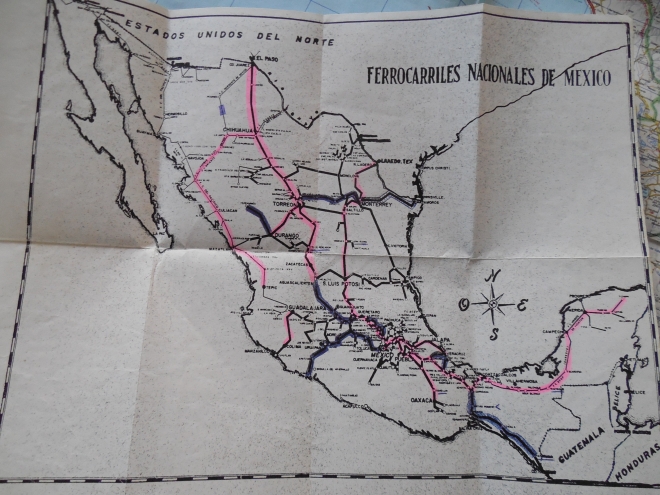
I arrive in Mexico City 15 November and go to the Ferrocarriles Nacionales de México. A woman in a 12th floor office shows me the official schedule as of 29 September 1997. She has received reports that between 40 and 50 routes have been cancelled since then. No, she didn’t know about Tepehuanes, nor Aserraderos, nor Regocijo.
In the next few months in Mexico, I madly dash after disappearing trains.
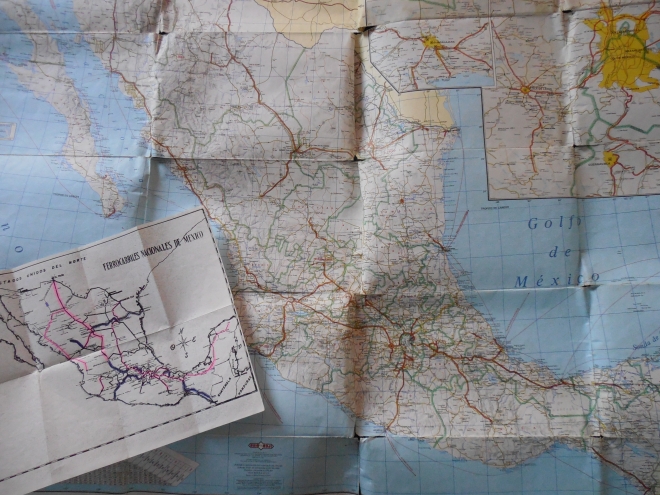
I look at my map of Mexico, noticing those black rail lines that go where no road passes, a web covering the nation from Baja to the Yucatán. I think of the routes I have taken over this decade of traveling. I think of the rides I will never get a chance to experience.
I shall miss the awakening from dreams, to see the full moon shining upon a sleeping home. Hushed voices in unlit cars of passengers coming, passengers going. The golden mesh of lights filling the valley as we’d come into Mexico City at night. I shall miss seeing the morning sun reach its fingers into the crevices, range by range, of the southern Sierra Madre mountains, morning mists over jungle cerros of Tabasco. I shall miss storm clouds mounding, then bursting upon the afternoon desert, sand imprinted by coyote, correcaminos running for shelter. Sunsets painting the western horizon.
I shall miss leaning upon the vestibule half-door, the wind blowing loose strands of my hair about, listening to the clickety-clack over wooden ties, the softer rhythm over concrete ones. I shall miss the smells of those women offering me gorditas de nopales con queso and atole in Chihuahua mornings, volovanes de cangrejo and coffee come Veracruz evenings. The bite of wood fires in crisp darkness. Of burning fields of sugar cane in the zafra.
I shall miss the stories of a doña Juana telling me of her childhood during the Mexican Revolution, before roads cut the Durango deserts. I miss sitting next to a doña Teresa embracing sweet azucenas to her Tehuantepec-huipil breast, like a Diego Rivera painting. I shall miss the conductor’s wife offering me a croissant, a banana and coffee, the workers offering me fish tacos or chiles rellenos.
I shall miss the sharing of lives and hopes, food and love with others, whiling away the time on those endless, timeless journeys.
Traveling by train no longer became a way to enjoy the country, to learn of its culture and life, to share community. No, riding became much more than that. I had to face deeper realities of the importance of these trains.
What will happen to those people who supported their families by selling to us passengers? On ebon nights, awaiting in the lights of the station, boarding with their baskets and kettles steaming in the chill air, stepping over bodies wrapped in thin blankets, sleeping in the aisles. The voices of mothers and their children quietly calling
                           Arroz con leche

                                    Café       Atole

                           Tamalitos       Enchiladas

                                    Gorditas…
How shall campesinos get their cheeses and fruits to market? How will they feed their families tonight, tomorrow and tomorrow’s tomorrow?
What will happen to those villages whose lifelines were the silver rails?
Will abandonment beat the dirt roads, melt adobe homes into the earth? Will wooden doors bang in winter winds sweeping down from the north? No longer will laundry sway in a blue-white sun. No longer will small circuses pitch their ragged big tops for a few day’s pesos before moving on to some other pueblo. How many of these families have had to pack their trunks and bundles, migrate to a city in hopes of survival? How many of these communities are now rent by these winds of thoughtless change?
How will folks visit one another? How many will be able to afford a bus ticket for everyone in the family, to see abuelito, to celebrate Tía Rosa’s birthday, to take a holiday? Before, the bus was up to three times more expensive than the train. Who will be able to afford those bus fares spiraling, spiraling upward, now that there is no competition?
How many lines might continue to because these new owners deem they can jack the prices up, rake in the big bucks from the foreign tourists? Or because of protest by the people?
For now the vestiges of the Mexican Revolution continue to fray in the northern winds. Perhaps those days of train travel are gone. Or perhaps not. Maybe someday a new government shall come to power that recognizes the importance of the trains to communities, to the families, to the economies of these pueblocitos — as is happening in other countries.
Or perhaps a new Revolution is brewing in the Sierra Madre. Maybe one day former workers and a village will take up “arms” of máquinas and carros, appropriate the tracks, and with no funds from anyone keep the lines alive and gleaming silver to the ejidos, giving campesinos a way to get their products to market, for the ill to receive medical attention, for kinfolk to visit.
It may seem this affair has ended, but I still study my map, tracing those black lines. This is a love that has deepened with the years. I still search, every time I am in Mexico, for whatever visage of those train adventures. And, ay, when we meet once more, what a ride we have!
Sí pues, as long as there is a train upon which to journey, this shall be an affair never-ending.
…is a documentary poet, translator and travel writer. Her works appear in over 300 journals on six continents; and 20 collections of poetry – including On Galápagos Shores (dancing girl press, 2019), Caribbean Interludes (Origami Poems Project, 2022) and Fire and Rain (Red Mare #18, 2019), a collection of eco-feminist poetry. She also authors travel narratives, articles and guidebooks. Her writing has been honored by the Parliamentary Poet Laureate of Canada (2011) and nominated for the Best of the Net. Caputo has done literary readings from Alaska to the Patagonia. She journeys through Latin America, listening to the voices of the pueblos and Earth.
I want to read books that
live in the air, that turn colors
into permanent shrines as Cather and Carver
each commute our psychological entrapments
Into shapes of blue boats and white clothes
flapping in a midsummer breeze.
It is to say I want to hold
on to something so that words
are not what I have to use
when I talk to you
but beacons and lifejackets
in the rage of the line,
the ripple of the moment
when everything goes on through
and into  each other.
Writing is our shrine to live by,
to learn from, to shine for.
In the spring reading Ripley's colored
Believe books, I thought of Wonderland
and hookahs, of the ways things go through
each other to the other side of things.
An eloquent vanishing.
Not just any bell book and candle,
But Kim Novak effervescent on Powell Street
Elizabeth Taylor shining gold
Near where the water was,
near where the mysteries lay uncovered.
Where the swami speaks of transformation
and solid things shiver
Bigger
…is a writer born in Berkeley who has been socially aware all her life. Years in Franco’s Spain only taught her more about group action and collaboration. Professor of American and teaching World literatures teach her how to live and love. Intensity is her middle name.
When I asked, how’re you doing,
“Good,” you smiled.

I could always make you laugh, right?

My artist-buddy who loved horses;
the face I never looked beyond.

Stay awhile, Jo
I haven’t learned to miss you yet.

Today,
I wish for a lift,
a little cheer,
such tiny wishes—selfish wishes.

In all those sweet or bitter days,
your hope was there.

Tonight, I’ll think about you.
  Tomorrow, I’ll think about horses.

                  In Memory of Joanne Benedict, Artist
Between, and Fog
Tied to a fender of boulders,
I sit, here within a cloud,
not even hoping to rise.

In this cove
where threads of waves on milk glass sea
tempt gulls bobbing beyond the dune grass.

I cast my thoughts through thinning fog
beached with no place safe to rest
like that red dinghy—PUFF
This Wasn’t the Plan
here, the body continues
but the mind closes the door for good

to a room we can no longer enter
where everyone wears a similar mask

like vintage furniture with faces,
that follow old ruts worn in place

we visit now perhaps only for ourselves

C, still a teacher without students
scratches in a plan book without days
forming a presentation to be given yesterday
to an audience, sleeping, slouching, staring

C. wonders where she is

and we who visit,
drive away guilty and forgotten
Poet/professional storyteller/educator Judy DeCroce, and poet/abstract expressionist artist Antoni Ooto are based in Upstate New York.
Married and sharing a love of poetry, they spend their mornings studying established poets, as well as, work on revising, critiquing, editing and through reading aloud, balance the meter of their pieces.
Judy DeCroce and Antoni Ooto have been published globally in print, online, and anthologies.
I like the smells

and our body
juices mixing

anointing us

for springtime
Final Mercies
The Watcher at the gate
bares her breast
to suckle the corpse:

we do not kiss the dead
there is too much
intimacy
in death, and

the lines in our faces
betray us

                    originally published in ARC 26 by the IAWE
Here it is Spring Again
I’ve written too many poems
in your name

to tell of love dying
as the earth renews itself,

to wear as a badge
a dried crow’s claw
at my breast
…holds a BA in Philosophy from the USA and a Masters in English and Poetry fromBar-Ilan University. His poems have been seen in journals, e-zines and art exhibitions where they increasingly are integral to his paintings. In 2002 I instituted Poetry from Bar-Ilan a program for Bar-Ilan’s poets to read their works in public venues, and produced the annual program for 8 years. His integrated poetry and paintings, along with other artworks can be viewed at the website link below.
…is a well-known poet from Ferizaj, Kosovo writing in his mother-tongue, Albanian. He was born in 9 March 1968 in Pristina. He is the former manager and leader of “De Rada,” a literary association, from 2012 until 2018, and also the representative of Kosovo to the 100 TPC organization. In addition to poems, he also writes short stories, essays, literary reviews, traveltales, etc. Faruk Buzhala is an organizer and manager of many events in Ferizaj. His poems have been translated to English, Italian, Spanish, French, German, Croatian and Chinese, and are published in anthologies in the USA, Italy, Mexico, Albania, China, etc.
The Jewish Festival, Purim, occurs March 16–17 this year, 2022 (17–18 in Jerusalem). This BeAttitude, from The BeZine, March 2017, is a part midrash and part Purim shpiel, with a bit of exegesis after the poem. If you don’t know what midrash is, see Deborah Wilfond’s Midrash following in this issue for a description and example of modern midrash. A Purim shpiel is a drama-carnival done for the holiday, usually humorous, often satirical, related to The Book of Esther.
Purim Fibonacci
Purim—
that carnivalesque

masquerade Persian New Year
of the Jewish Calendar rests
Carved wood mask Nacius Joseph (b. 1939) Haitian Sculptor
in the arms of Mardi Gras, an
upside down play of masked and
unmasked images dancing
at the party while Purim shpielstages a drama: unfolding
parody, satire, commentary—
the whole Megillah. And
who puts on an Esther mask
on the way to the
Beverly Hills Purim Ball, but Hadassah
herself, on her annual pilgrimage
to the festivities of inversions.
Nu, who do you think inspired
the Rabbis to write in the Gemara
that Jews should get so wasted
that they cannot distinguish

…

between "Blessed" Haman and

"Cursed" Mordechai, if not Vashti?

Vashti, who released herself
from the lustful gaze

of her husband's court,
now wears the death mask of that
same Ahashuerus who banished

his Queen to her freedom.
The Tel Aviv Opera Purim Ball
rejoices in the refractions
of self and story—politics
of the beauty contest
Wood mask Artist unknown
for the virgin, check or mate.
Revelers cheer an Uncle arrogantly
dressed in mourner's cloth
who entered her in competition,
then stripped her of her mask
to save their people,
while letting his people massacre
others—another masquerade.

…

And in Tel Aviv and Beverly Hills,

the masked dancers
drink up the casts
and no longer recall

the difference
between good and good,
mask and masque—

so many layers
of truths, peeled
one after another,
as the frenzied forgetting
tears off masks over masks,
layered like ancient rubble
under old cities and their tels,
like history and politics,
like geology and religion,
until what lies beneath
and beneath again
barely glimmers
in the eyes

…

of the masquerade.

And Hadassah laughs,

dancing freely with Vashti,
two lovers at last

hidden and unhidden
at Tel Aviv and Beverly Hills
Balls—globes of pleasure

circling the world
in three complete lines
forming seventy-two
masks, each one
a part of the whole.
The poet dons the mask of commentator, but the poem always wears at least one mask in the presence of the poet, so beware. And, if the poem reveals (a) different mask(s) to you, dear reader, please explore. The poet does not trust that any poem reveals all of its masks at any one time, especially to the poet.
The Jewish holiday of Purim celebrates the tale told in The Book of Esther, a story that, remarkably, does not once mention G-d. Set in Persia, which rules over the Jews at the time, The Scroll of Esther (or Megillah) layers many levels of deceit and masquerade, and the tale turns on itself in many ways.
Book of Esther
The King of Persia, Ahashuerus, banishes his Queen, Vashti, when she refuses to dance in front of his guests. Mordechai urges his niece to enter the beauty contest held to replace the queen, but to hide that she is Jewish (and probably not eligible to be queen of Persia). So she uses her non-Jewish name, Esther, instead of her Jewish name, Hadassah, wins, and becomes Queen Esther.
Meanwhile, Haman, the viceroy to the King, hates Jews and especially Mordechai, who refused to bow before Haman, and who is in the story honored for revealing (through now Queen Esther) a plot against the king. Haman has to lead him through the streets on a horse, Mordechai dressed as a king, Haman’s own idea of how to be honored—which he is asked to tell the king at a party, perhaps a masque (Haman thinks it’s for himself that the King wants to know how to honor a person).
Haman, whose orders are like the King’s own (another mask), plots the hanging of Mordechai and the genocide of the Jews. While the rest of the city celebrates an occasion of state (the defeat of Jerusalem), Mordechai dresses in mourning because of Haman’s plot against his people. However, this is an act of treason during the celebration. He thus shames Esther into unmasking herself to Ahashuerus, who reverses Haman’s murderous order when he learns his wife is a Jew.
Purim mask
Jews celebrate Purim as a day of deliverance from death (and genocide). However, the rescinding of the order came too late to the walled cities, which had to fight to defend themselves (under dispensation of the king). So, the celebration of Purim as a holiday is one day later for the cities that were walled cities at the time of the story (including Jerusalem and Tiberias—this is called Shoshan Purim).The scroll ends with the recounting of Haman’s hanging and the killing of his kin, the death tolls from the battles at the walled cities, an unmasking, perhaps, of another form of genocide—in the name of defense.
The Poem
The date of the holiday itself loosely coincides with Carnival (Mardi Gras) and the Persian New Year. Jews celebrate with Purimshpiel (Yiddish for Purim stories, usually in the form of plays—traditionally, parodies and satires on current events using the story of Esther) and by donning costumes and masks, holding parties (balls), and getting drunk. Yes, the Gemara says that Jews should get drunk enough that they no longer know the difference between Haman and Mordechai, respectively, the male villain and hero of the story of Esther. Perhaps it is to make up for Eden and the whole Tree of the Knowledge of Good and Evil thing. This poem could be read as a sort of Purimshpiel variation.
The donning of masks allows us to hide who we are, but masks also reveal who we are, or an aspect of who we are that is usually hidden. Carnivalesque masquerade allows us to try on aspects of ourselves or display those energies that we normally repress or hide (perhaps in a closet somewhere, with the costume). Drunkenness allows forgetting, but also disinhibition and release. Perhaps we learn of the capacity of good and evil within ourselves, as well as about those other parts of ourselves that would otherwise be “masked” by everyday existence.
So, the poem has Hadassah, the Jewish girl, wearing the mask of her alter ego from the story, Queen Esther. Yet perhaps this is an aspect of her all along? Perhaps we all have hidden “royal” qualities? Esther replaced Vashti, who was banished by King Ahashuerus for refusing to dance (naked) before him and the court. And Queen Vashti, in the poem, wears the mask of the king. He banished her from the court, but to where? Did she stand up for her own self-respect by refusing to succumb to what, centuries later, a feminist film critic would identify as scopophilia, or the male gaze? Was her banishment a freedom? How does gender play through this story, that seems to focus on men, but relies on a woman at its center, perhaps two women, if we look more closely at Vashti?
The poem suggests in its own center that masks unveil as we peel them, but also there is the hint that they reveal at each layer (like the layers of rubble beneath old cities that mound into tels, which hint at the history of the eras of the city; and like the layers of both geology and religion, which are ancient with something hot and molten at the core, like our own psychological being). This move to the psychological enters the mystical, with the masked women, who appear to be King Ahashuerus and Queen Esther now that they wear their masks, dancing together (yet at separate balls, one in Beverly Hills, its own masquerade and center of Hollywood glitz and glamor, and the other in Tel Aviv, the “new city” of EretzIsrael). This is like the Malkhut and Shekhina, or Shabbat (King, or male aspect of G-d) and Bride ( Queen, or feminine aspect of G-d).
Arithmetic or is it geometry?
And then comes the poem’s mysterious end, which references Exodus 14:19-21 the three lines of Torah that, with 72 Hebrew letters each, Kabbalists believe can be permuted into the 72 Names of G-d. The poem suggests that these Names are both masked and masks (that hide or reveal?)—their hiddenness echoes the hiddenness of G-d in the text of Esther, and the ineffability of divinity in all of its guises.
Purim mask
The stanzas follow a sequence of line numbers each, counting the first line of three dots (which wears the mask of the title). The pattern goes (before the title, think of 0): 0 lines (an extra line break marked with … before the sections that follow after the first one), 1 line, 1 line, 2 lines, 3 lines, 5 lines, 8 lines. This pattern repeats three times (for a total of 60 lines), then goes 0, 1, 1, 2, 3, 5, for a total of 72 lines, like that number of Hidden Names.
The sequence of numbers used (0, 1, 1, 2, 3, 5, 8) is the first part of an infinite series, known as the Fibonacci sequence, that has many interesting relationships in math and nature, including the pattern of sunflower seeds in their flower, unfurling fern heads, and, significant to Jewish mystical allusions, the branching of trees.
The Hebrew word for life, chai, has the numerical value of 18. Twice chai, or double life, is 36. Double that, and…72. That the number of lines in the poem equals 72 probably doesn’t mean much more than that our lives are not singular, but layered with intersections of meanings.
Purim and the Masks We Wear by Ari Kahn— a commentary that, while coming from a very different perspective, has some interesting background from traditional Midrash.
Author’s Note: One of the oldest anthologies of world literature, the Hebrew Bible reflects the human search for meaning in an uncertain world. Themes such as the struggle to understand our mortality, our social responsibilities towards each other, and how we cope with trauma, infuse these mythic narratives.
Many readers are familiar with the character of Aaron, the brother of Moses. Few are acquainted with the story of his wife, Elisheva, who is only mentioned once in the Hebrew Bible. The story below is a modern example of a literary genre known as midrash, an imaginative elaboration of the original scriptural text. This midrash deals with an episode in the life of Aaron’s family when he assumes a new position of leadership on behalf of the people as the High Priest. The story takes place in the desert, after the people have fled from Egypt, received the Torah, and constructed the portable sanctuary. It is written from Elisheva’s point of view.
Tzav (Command)
Stepping inside the courtyard of the holy place, the curtain flap open in the wind affording a brief glimpse of bronze and golden objects twinkling inside the tent, little lights flickering in the gloom. The brush scrapes the ground as I sweep up the accumulated ashes into a heap and stoke the dying embers, their carnelian glow once more flaring into life.
This coming back, this returning to the refuge of my skin, my hair, my lungs, my heart, my limbs, and my joints. Sensations arise in the space within the sanctuary’s bounds, my breath comes and goes, my body settles in as a part of the sanctuary’s covers, beams, poles and sockets—all part of this sacred, intricate design. During our spinning and sewing and forging and hammering, I had got up to tiptoe around, gazing in wonder at the fine linens of the tapestries and special garments, the smooth contours of the tent structure with its furniture inside and the radiant golds, blues, purples, reds of these creations which seemed to be springing from some other place.
My husband has been chosen to stand at the entrance where life meets death. After all our upheavals: the plagues and portents, the running in terror with just the clothes on our backs, across the sea, desert, mountain, the crossing, surviving, climbing. I suddenly aged, deep lines dug ditches around my mouth and eyes, my hair thin wisps of silver down my back. Heat blazing, heartbeat sprinting, joints creaking and then a blanket of fatigue overtook my bones. I ran out of patience. All these years I have channeled my energy into looking after our children, providing nourishment. And I helped with the birthing of hundreds of babies, looking after the other women of the camp, and reaching for them in turn for support.
Despite everything, Egypt beckons to me in my dreams. The ravaging furnace burning down on us, the shuffling dust of the alleyways and the wooden table where we ate and sang together in secret. They still travel with me. I hear the echoing voices of my parents, the jovial chuckle of my father at some tiny delight, a child showing a magic trick.
In this new desert land of our becoming, our grandchildren are starting to forget the language of our oppressors. Soon the camp and our own ancient language will be all they remember.
Yet in the freedom of the camp, I have become heavy with sadness. Two of our four grown sons have grown distant. Recently Nadav and Avihu began to remove themselves from the camp, offering sacrifices many times a day. They spend hours discussing minutiae of legal precepts with each other. They no longer sit with me, and they don’t want lovers or families of their own. They would rather be shut away discussing the vessels of the sanctuary. I feel a creeping dread as something stirs within my entrails. I wake often in the early hours.
Where is Aaron, my husband?
There was a terrible incident. He fashioned a golden calf when Moses was gone too long on the mountain. Afterwards our people carried out a mass slaughter. The loss of life, the blood, the agony was unbearable.
We rarely speak of it but when we do, Aaron looks away.
“Why did you do it?”
“I was scared.”
“Of what?”
“The people’s distress and fear.”
“Why were they distressed and afraid?”
“The terrifying silence, the emptiness, the feeling of abandonment. Moses was gone so long, and they needed reminding of the essence of things, the candle within. They needed comforting.”
“So, you tried to comfort them?”
“Yes. I thought the golden calf would lift their spirits, create some holiness. I hoped it would remind the men to be like your nephew, Betzalel, our great architect, who channels divine inspiration into his art. The men would also remember they are made in the image of the divine and would return to the work of our holy community, dedicating themselves to the Great Mystery. So, I tried to fill them up with confidence and good feelings, the food and song of celebration. But it turned out wrong. The filling up was a mistake. I tried to do the work of creation for them. This gift, something separate and apart, was a solid object of cold, dead metal which had no room for holiness inside it. Now thousands of people are dead and it’s all my fault.”
Outrage. We couldn’t hear anything in the cacophony of crying. Deafness descended and panic set in once again, reminding us of Egypt.
Aaron told me he will always love me but now the air where once there was a singing robin is void of our voices. We have created a masterpiece of muteness, Aaron and I, a duet of noise and silence.
Aaron has to atone and then perhaps we can start anew. He and all our sons have to repent, to stay in the confines of the sanctuary for seven days in quiet solitude. Seven days of returning. Returning to the space within. They are encouraged to dwell inside and tend to the sanctuary with intention renewed, planting seeds for our future.
And after they left for the sanctuary, the rest of the camp has been full of busy activity, people rushing about getting things ready for the consecration of the priests. A jumble of jars of flour and oil and the bellowing of bulls, shrieks of lambs, jostling in pens outside the precinct.
Aaron left and I was alone. Silence entered our tent. I regretted not going to stay with one of our daughters-in-law and the grandchildren. I watched the migrating birds flying away, the pepper specks disappearing until the vault was empty.
They’ve been gone seven days already. Last night the sun chose its room and prepared to retreat into bed for the night. Dusk settled and I was open to all of evening, sleep overcoming my eyes, indigo.
Then suddenly in fright, it came to the fore. Tranquility no longer, no more. The darkness descending, the plummeting chain. I awoke there on the floor mat of my tent, heart pounding.
I had dreamed of grabbing and grasping, many people around me desperate, needing to be filled, imbibing until drunk and vomiting. And the earth, enraged, had swallowed us up and spat us out. And all the while the messengers, the angels danced at the gates of the garden, hot and sweating, with their swiveling swords.
We had fled, down valleys and across streams, where beasts live beyond park and pale, amongst the craggy rocks, lurking treacherously behind desert brush. There in a cave were souls curled up on the ground, slumbering, awaiting their turn like scorched seeds waiting for the rains to come.
And as the dream continued, only half alive, my veins constricting and my breath rattling in half a lung, I heard something. A small voice in the night crying for my attention, a new mother in labour. So I fled faraway to the other side, beyond where the horizon meets the edges of the earth to the outskirts of where women’s memory resides.
While my sisters and daughters talked of rupture and absence, our bodies were joined to our mothers’ bodies and those of our grandmothers. And the stories we told, our tears somehow became forgotten in the pain of childbirth. They rise up sometimes in other dreams, struggling to be heard and seen above the comings and goings, the babies’ cries and the pots and pans. They drop back down underneath the embroidered covers, burrowing.
Now so suddenly and brutally awake, shaking off the sticky cobwebs of dreams, I get up and go outside to a wide-open night sky and a bony moon. The walk is lonely, past thorny bushes black at this time of night, then the sandy earth beneath bare feet. Coming down an undulating slope, there is the glow from the sanctuary.
Someone is looking out, returning my gaze, a movement and a glimmer. Between the flaps of the awnings a presence lingers, peering from her bedroom out into the night. Her eyes open wider, and I see the two onyx stones. And a wind blows through the courtyard of the sanctuary, the curtains momentarily sway, and I see a swell within her, she is with child. New life within her shifts its tiny limbs. There is another ripple of wind, and the linen fabric of the enclosure settles once more under the restful dreaming moon.
The sky is going grey. Aaron and our sons bide their time in the sanctuary precinct, reminding me of my monthly time in the women’s tent. Outside the camp for seven days, bleeding out the beasts of sacrifice, they too are humbled. Seven days finished, echoing the seven of fullness, like the promise of a pregnant belly.
So as not to wake anyone, I tiptoe around the courtyard, peeking behind the drapes. There they are, all tucked up in their blankets, my husband, my grown boys. Calm, harmonious rhythms of breathing in, breathing out. Such love for that smooth, bald head, those lines around his crinkled eyes, all those whispering sighs. Here is the abundance of roots deepening down and branches reaching up, sap rising from my tending and protecting.
Turning and looking around, here again is the wondrous architecture of the sanctuary and I wonder about the placement of furniture in this impermanent home.
So too I wonder about the hidden secret place, and I start to wander, to look for it. Ever so quietly, smelling the sweet frankincense and myrrh, I run my hands over the smooth gold of the candelabra.
Then I see it. The inner curtain. I peek round it and see gazing winged angels, their eyes beholding each other with tenderness and passion.
Suddenly I am transported back to Egypt. I am in my mother’s clay brick house, but she is not there. I touch her robes hanging up to dry, and, parting them, I find something behind that I have never seen before. A golden door is set in the wall. I open it and an underground tunnel leads me all the way along its twists and turns to a cave with a warm, round, bubbling brook at its centre.
I blink, and once again find myself in the sanctuary, touching the inner curtain. The first threads of sunlight appear on the rosy strips of tapestry and light up the acacia and bronze. I hurry out, quietly, quietly, back to the courtyard and look up at the full array of colors filling the firmament.
I need to get home to the camp, to prepare celebratory cakes and return later for the festive occasion. Soon we will be a family of priests, chosen to serve in the sanctuary and there will be rejoicing and feasting.
Slipping towards the camp now, long nightdress damp and dirtied underfoot, needing a wash. Plans formulate, the mind steadies for lists and busy-ness once more. The daughters-in-law will arrive soon with the children. Cleaning, clearing, chopping, baking, feeding, holding, caring.
Before I reach the top of the hill, he calls my name: “Elisheva!”
My name, yes, my name! Elisheva. It means my God’s oath, or my God is seven.
I look back towards the sanctuary.
Aaron is by the entrance, smiling: “Seven days are complete, my love, my bride. I’m about to take my oath of service and we will be reunited again.”
Here he is at the entrance to the sanctuary, waiting for the Divine Indwelling to call to us, to meet us.
And a still, small Voice can now be heard, barely audible above the desert wind.
“How will I see you?”
“We’ve been searching foreign lands our whole lives for signs and wonders.”
And the Voice asks: “How will I hear you?”
“We couldn’t hear each other. We couldn’t hear above the cries of our people enslaved next to the mighty river. We had been deaf, under water.”
And the Voice asks: “How will I touch you?”
“Our skin was like the scales of a fish, floating dead in the Nile.”
And then the Voice tells us: “I’m waiting for you to be more intimate with Me. Return and listen, feel my pulse, sing prayers in my holy space, pour out your heart, wait for me.”
As the blue brightens and the air is turning, lifting me into the morning, I see the bull. Once a calf, now transformed and grown, destined for sanctification on the altar, a transformation into smoke and suet. They will pour out its blood. What a sacrifice, this perfect life to be taken, this valuable possession, so that we may live.
And I turn away from the pungent smell of burning animal brought on the wind. Aaron’s shame disappearing in smoke. The bull diminishing, my heart heavy for the breaking of life but now remembering our wedding; how I had looked at the smashed glass and became conscious of our flaws, the messes we make. Each created thing has its place and time.
Now the bull’s life-force is being released, the germinating seed is cracking open, roots traveling inwards and burying down, down, down and sprouts stretching upwards. My grandchildren come and they cling to me and together we see Aaron re-emerging.
The preparations are finished, the washing, the anointing and here he is, here he is, here is Aaron coming out in his glorious vestments. The excited whispers of the crowd grow as we look on.
A butterfly emerges from its chrysalis.
And I am a part of it, too, I am there, a part of two, the other ear, thumb and toe anointed in oil.
And I am a part of my sons, too. They emerged from my womb.
My heart listens for the footsteps, the life of the fire dances within and without, awaiting; the back of my neck, the insides of my wrists, my thighs, my palms, my nose, my lips anticipate your taste.
We sing together inside our sanctuary.
Inside you will see and hear and touch, in here, we’ll find part and parcel of Us, you and me, and me and you and this vanishing view.
The scarlets, blues, purples of this garden, these embroidered robes, the golden sunlight engraved on the head-dress, the gemstones, the flowers glittering and glorious and dazzling. The bells and the pomegranates and the vegetation quiver and breathe their aliveness.
You emerge and, my love, I emerge, and the butterfly, my love and I can feel it in our bodies and we can fly.
And the garden sanctuary beckons, its warm earth, delicate rains, vast expanse of air, sun, almond blossoms, and the nothingness and the everything within.
…grew up in London and earned a Bachelor’s degree in English Literature from Edinburgh University in Scotland. After completing legal training at the University of Law, she worked in family law in London for a few years. During this time, Deborah went to Jerusalem on a ten-day trip where she met and fell in love with her husband, who happens to be a Rabbi. They got married and Deborah moved to Jerusalem. There she worked as a yoga and mindfulness teacher while mothering their three rambunctious children. Since 2020, Deborah has been living in New York. She is currently teaching mindfulness and pursuing graduate Jewish Studies with Spertus Institute.
O How
I love the wind …
it makes the windmill turn
but never burns the petrified
it could still grind the corn to make our bread
then turn again, renewing us, enabling change.

and why
I love the wind …
it brings the clouds to rain
drawn fresh from oceans great and small
to wash us clean, refresh the air we breathe
renew the spirit and lubricate the wheel of life.

and when
I love the wind …
it blows the clouds away
reveals the blue, the great beyond
and opens curtains to the solar light
from sun that feeds the green of photosynthesis.
The Earth has a memory

Dawn fog lays low
where rivers once flowed
now forced underground
by the city growing
over centuries

The Earth has her secrets

Long-disappeared species
emerge from scarred forests
scarred landscapes
Fernandina giant tortoise, Wallace’s
giant bee, Formosa clouded leopard …

This Earth lives
Bands of rose ripple
            across the deep blue water
As I lift my arms above
            the golden sun reflects off
                        the droplets
The gentle waves bathe my Spirit
            soothing her
            carrying away all the fatigue
                        all the sorrows

I sink into the sea’s warmth
            floating on its salty breadth
watching the now-orange sun
                        sink deeper behind the hills
Its colors spread wide
            across the broken clouds
                        like an opal

I turn over & over in this iridescent water
            just to feel my muscles move
                        to feel their pull with each stroke
            just to know that
                        I’m still, I am still
                                   alive
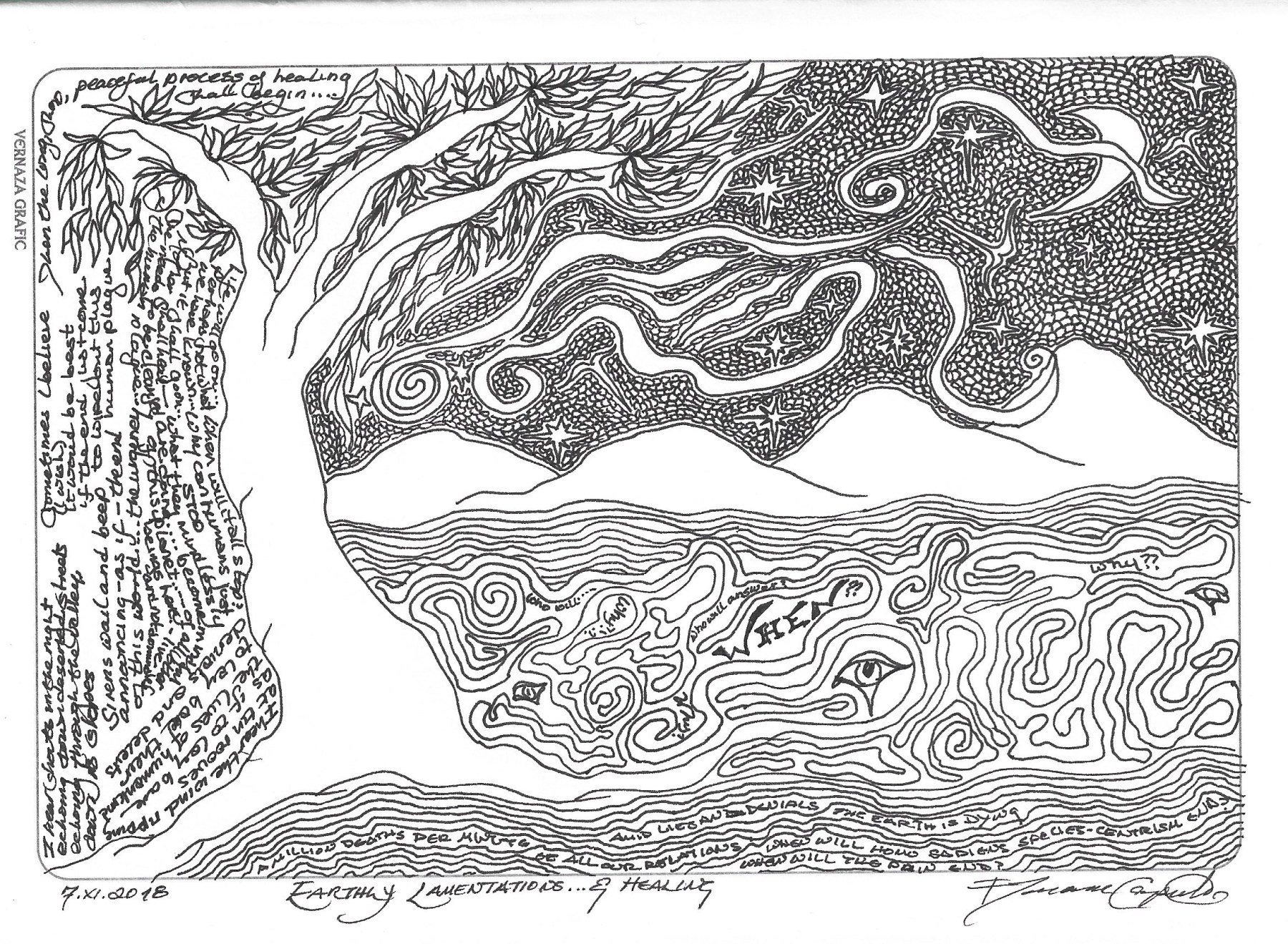
Earthly Lamentations…& Healing
Who will…
Why?!?
Who will answer?
WHEN??
Why?
Why?

Amid lies and denials
the earth is dying
A million deaths per minute
of all our relations
When will Homo sapiens species-centralism end?
When will the pain end?

~       ~       ~

I hear shouts in the night
echoing down deserted streets
echoing through the valley,
down its slopes

Sirens wail and beep
announcing— as if— the end
of this world… the urgency

Sometimes I believe
(I wish)
it would be best
if the end just come
to wipe out this
human plague

~

I hear the wind ripping
at tin rooves
as if to lay bare
the lives of humankind
to lay bare their
denials and deceits

When will it all stop?
Why can’t humans just
STOP
what they are mindlessly
doing… become mindful
of this planet… of all other
being here— live
and not dominate

Life will go on…
Perhaps not what
we have known…
But it shall go on…
Mother shall heal—
she needs to be cleansed
of the human plague…

~       ~       ~

Then the long, slow, peaceful process of healing shall begin…


~       ~       ~

Then the long, slow, peaceful process of healing shall begin…
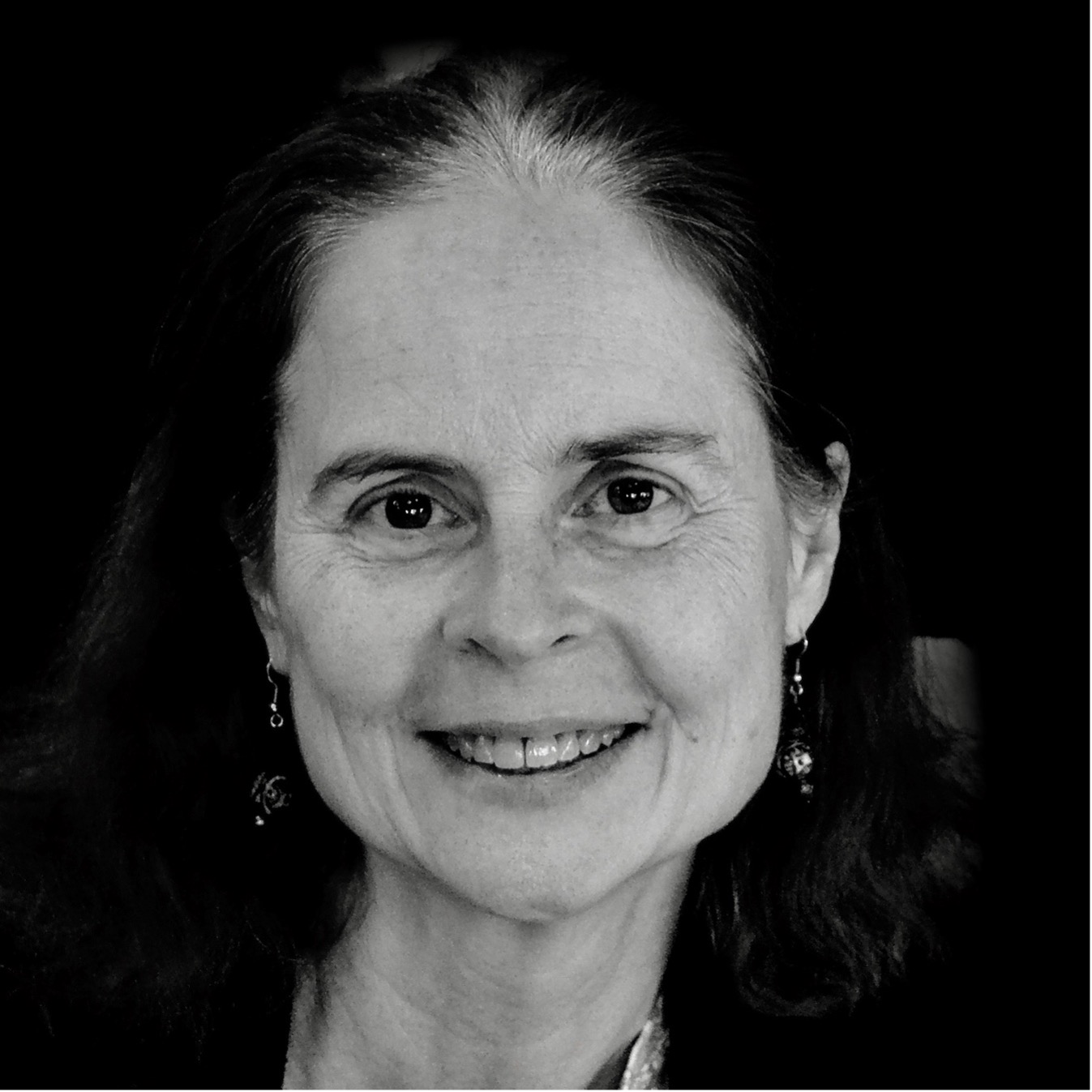
…is a documentary poet, translator and travel writer. Her works appear in over 300 journals on six continents; and 20 collections of poetry – including On Galápagos Shores (dancing girl press, 2019), Caribbean Interludes (Origami Poems Project, 2022) and Fire and Rain (Red Mare #18, 2019), a collection of eco-feminist poetry. She also authors travel narratives, articles and guidebooks. Her writing has been honored by the Parliamentary Poet Laureate of Canada (2011) and nominated for the Best of the Net. Caputo has done literary readings from Alaska to the Patagonia. She journeys through Latin America, listening to the voices of the pueblos and Earth.
In the sun we were riding
In the sun where the green
grass was yellow bending
in such consummate purity California
you were a paradise
spinning open freedom. Inviting us in.

We lived in wood, touching trees
Wind-chimes and abacus.
We ate food we made our own.
Inside flutes and recorders
Oboes and harpsichords in a cool plush of sound.
We ate chicory and wild violets like paintings
It all grew slower, then, on that road.
Where we got a second wind
fables of the new earth and its people.
Making all this new energy together
And outside this silent plenty
A sheet of rich yellow
A violin and a soprano
Singing of freedom
…is a writer born in Berkeley who has been socially aware all her life. Years in Franco’s Spain only taught her more about group action and collaboration. Professor of American and teaching World literatures teach her how to live and love. Intensity is her middle name .
Unshadow the night
with the gold of the stars

restore silence
with words of light

don’t experience time as loss
or as passing by

but of every moment
the ephemeral glow.
…is an internationally known poet, translator, publisher and promoter of modern international poetry. He writes short stories and literary reviews, but mainly poetry, so far 14 poetry books, published in 19 countries. As founder of the Belgian publishing house POINT Editions he published more than eighty collections of mainly modern, international poetry, he organised and co-organised several international poetry festivals in Spain. He is vice president of the Academy Mihai Eminescu, in Romania, and organizer of the Mihai Eminescu Internaional Poetry Festival. He also set up the internationally greatly appreciated project Poetry without Borders, publishing every week a poem from all over the world in 33 languages.
I keep cats away from the catbirds, and commercial chemicals away
from my columbine. I cherish my native sedge grass,
my cardinals and cardinal flowers, my maidenhair ferns.
I leave all the leaf litter under the boxelder maple,
because, really, are the leaves mine to move?
Whose planet is this anyway?
I let the acorns fall all around under the oak,
and I reap the reward of squirrel antics.
When I trim a bush grown too near my house,
I consign the clipped branches to expand
my backyard stick pile, where somebody—a possum, I suspect—
fashioned a fine den at the bottom.
I don’t peer in with a flashlight. And I don’t harass my caterpillars—
because if I kill them, I’ll be killing
baby chickadees. Squishy, gooey caterpillars are —
chickadee baby food!  On summer evenings, I celebrate
shiny beetles and pollen-pushing bumblebees,
and once I spied a brilliant orange newt.
We city humans “oooh” and “aaah” over colors and acrobatics
at galleries and concerts and half-time shows,
and the décor at cute eateries, but Nature
is the best painter, the most crazy-creative entertainer,
if you let it all alone, and discover how to listen,
and look. The wilder I let my little yard remain,
just letting plants and insects and birds and mammals
who belong here
have space to do their thing here,
live their lives here, right here in my yard, here—
the wilder I find my joy, musing on this multiplex, this Noah’s ark
of crawling, flying, ambling, yowling, nibbling,
thriving creatures in my humble,
natural little yard, my little piece of Eden,
my own, homegrown, national park.
Too many poems
There are too many poems about nature,
they say,
but it’s human nature to say that.
What does Nature say?
Nature converses in kaleidoscopes
of fall leaves pirouetting;
in tranquil ponds whose cattails stretch
to paint the sky;
in embroidered lacey snowflakes;
in epic poems of warbling wrens.
Her secret message everywhere
is that there are too many poems
about humans.
And too many critics.
Nature votes for more crickets.
…is an anthropologist of immigration, race relations, and agriculture. She has published three books, plus poems at BourgeonOnline.com, the blog of Prospectus magazine, PonderSavant.com, the CAW Anthology, Pif Magazine, Central Texas Writers and Beyond 2021, The Dope Fiend Daily, Open Door Magazine, and Valiant Scribe. Poems are forthcoming in Psychological Perspectives, the Canary Literary Magazine, and Words for the Earth of the Red Penguin Press.













 The BeZine