Our Evolving

img_2466

“It gets to seem as if way back in the Garden of Eden after the Fall, Adam and Eve had begged the Lord to forgive them and He, in his boundless exasperation had said, ‘All right, then. Stay. Stay in the Garden. Get civilized. Procreate. Muck it up.’ And they did.”  —Diane Arbus 


surfacing from mother-sea, we came ~
we came shape-shifting and sighing,
living before the prescient moon and
under the life-giving sun, we climbed
mountains and marched into valleys

short-lived, we camped by the riverside,
we slept in caves, we cleared the forest,
built cities that domesticated us

we became sophisticated, forgot our
rootedness in the archives of heaven,
our shared destiny with the Earth, we
forsook our history and the stars,
invented math, maps and compasses,
governments, borders and ownership

we built great ships to sail the oceans,
to drum across the sky and away to outer
realms and other planets, we mislaid our
true stories and, in ignorance suckled on
prefabricated values, these streamed
from cold fires that stoked insecurities ~
we confused wants and needs, hungered
for the sake of our own stupidity
and someone else’s greed

© 2017, Jamie Dedes

Silent Life

Except for the scratching of my pen
I lead a quiet, almost silent life
on D Street, the second floor –
In a small, one-bedroom apartment with
Tibetan prayer flags flying on the door.
I overlook a courtyard with trees and grass and
children playing, heads stuffed with dreams.

It’s a quiet almost silent life I lead in a
second floor walk-up with a tiny kitchen.
Trees rise outside the door, birch, palm
and the raucous crows are taking over.
Still, there are sweet gentle gray doves
and a chickadee or two, maybe three.
Our resident squirrel visits, watching
through my window from his birch.

Such a quiet, tranquil life I lead here
where no bombs drop on aching roofs,
no soldiers march in heavy boots,
no occupying army enters uninvited. We
fear not for the safety of children at play
or adults walking by on daily rounds.

I lead a quiet almost silent life, but for news
squeezed between ads for haute couture,
pre-fabricated foods, and Saturday’s sales.
Reports are of tortured deaths in foreign lands
presented in measured tones, spanning a heartbeat
followed by the vapid gossip that passes for news,
delivered with breathless detailed analyses

I lead a mostly quiet almost silent life
but for the scratching of my poet’s pen.
Scratching, scratching and trying –
Trying to make sense of it all, and
Like the gentle dove, softly –
trying to make a difference.

© 2010, Jamie Dedes

How I Park My Car

No room
for big cars
cigarette smoking women
or bourbon sipping
old men–
the page has turned on us.

Some days
I talk to old men
who don’t breathe
gray-skinned women
who only
exhale…
and anxiety ridden children
who never learned
how to spit properly.
They’re all hated
by somebody.
Me too
I guess.

I park my car
anywhere I want
two spaces sometimes.
Go inside, order up a double
straight, on the rocks
sit at the window, sip
think about a different time
a different kind of noise
wonder how the world
got so goddamn quiet.

first appeared: Medusa’s Kitchen, 2.22.2019

© 2019, Bill Gainer

Awake at Night


After Wendell Barry

Lying awake images of Yemeni children
Syrian babies, Ebola ridden souls, the hopelessness
the helplessness, ravaged by man-made tsunami of wars
innocent lives pitted against grace and goodness
of humanity. I lay awake, look into the dark hoping
for the earth and mankind to heal.

Dreaming, waking, tossing, turning,
awake, cogitating, restless mind spooling
as the earth spins on its axis, the Universe
is at peace, its ritual goes on apace, no change.

© 2019, Leela Soma

Places I Have Never Been


I’ve never been in the hull of a slave ship
chained and starving, drinking my urine
lying in my excrement.

I’ve never been forced to leave
my homeland, my family, my tribe,
enslaved by those who saw me as subhuman.

I’ve never picked cotton fifteen hours a day
under the whip of overseers who
raped me when the sun went down

and when I was emancipated, hung me from a
lynching tree, torched my home and family
denied my right to vote.

I’ve never moved north for higher ground
to neighborhoods depleted of dollars and hope,
goods and services, red-lined out of moving up.

I’ve never been called nigger, refused a table, watched
my children in their Sunday best internalize the word
while I struck them to teach obedience so they could live.
.
I’ve never attended sub-par segregated schools
or at college worked harder, scored higher
for less recognition, offered fewer jobs at lower pay.

I’ve never been profiled by police
because they saw a violent criminal
easy to spot, hair-trigger ready.

I’ve never endured my success to the highest office
being questioned, called illegitimate, in a country
that my people love in spite of it’s hatred of my kind.

I’ve never been anywhere
without the cloak
of my white skin.

Unraveling privilege is
unrelenting
without merit
transformative.

© 2019, Ellen Woods

In Infinitum Terrae

Living in the moment, or with awareness of the here and now can be a good thing. It allows us to appreciate what we have at any given time. It comes with a caveat, though — you have to be aware of the reality of both the individual moments which create your lifespan and keep an eye towards the future. You can drift and dream through life, if you’re lucky enough, but that won’t help you when real life problems arise and you hit an iceberg sometime in the nebulous future. It also doesn’t help others connected to you, whether by blood, acquaintance or species-specific commonality (i.e. family, friends or simply fellow human beings). That’s not even counting the plants and animals.

Image borrowed from http://westwoodgrove.org

In other words, you have to be willing to be aware of not just yourself, and how you fit into the universe, but how connected everyone and everything else is that shares this planet with you. You have to be willing to care about them, too, and look at a future where they can survive, too. Believe it or not, living in the moment doesn’t mean that you are the center of the universe. And yet…your actions do directly and indirectly affect the planet and all of its inhabitants.

weareallone

Worst case scenario, we completely strip the earth of all valuable resources and damage the atmosphere to a point where the sun’s radiation fries the planet and everything on it because we humans didn’t do enough in the time we had available to stop it. Why wouldn’t we stop it and save the only planet we have? Do you really want to give up
The Mountains…?aerial-shot-backlit-beautiful-2132180

The Forests…?bridge-cascade-environment-358457

The Beaches…?4k-wallpaper-afterglow-beach-2120624

They all go away unless we humans start taking Climate Change seriously. The plants and animals don’t have a voice or a choice. Will humans care enough about the future of their own existence to finally give a damn before it’s too late?

This quarter’s BeZine theme is “Toward a Sustainable Earth” and is a worthy goal for all of us. And, while humans are to blame for a lot of the planet’s woes, they’re also coming up with good ideas all the time to repair the damage we’ve done and be more eco-friendly going forward. Here are a few lists to give you hope (and inspiration?):

Top 13 Sustainable Inventions Shaping the 21st Century

10 Sustainable Inventions Changing the World

The Best Sustainable Inventions

10 Cool Inventions and Innovations Helping to Save the Planet

I hope if you’ve read this far, you’ll decide to join us in being aware of how your own actions (or inaction) are affecting the planet, and maybe look at how you can be more sustainable, too. 🙂 If we all do a little, we really can do a lot!

In Infinitum Terrae

© 2019, Corina Ravenscraft

Bird Brains

A few years ago, our friend Pat gave us a funky little birdhouse resembling a camera.

We never expected anyone to occupy it, but to our delight, recently a pair of Bewick’s Wrens took up residence.

They built a nest, and a week ago, the eggs hatched. Now, when a parent approaches to feed the nestlings, they all peep, “Me, me, me!”

Both parents share childcare, feeding the babies…

…and changing diapers too. The nestlings poop into mucus bags resembling pea-sized white balloons, nature’s zip-locs, which contain the mess until their parents remove it. Eco-friendly disposable diapers!


Day after day, from sunrise until sunset, rain or shine, the ‘wrents’ forage for insects for their young. Every five minutes or so, they bring food and remove the fecal sack on the way out, keeping the nest clean. They’re averaging over 300 deliveries per day!

How can such fragile creatures, weighing no more than 3 or 4 ounces, sustain such a grueling pace?  Not once, but twice each season, Bewick’s Wrens produce a brood.

Once common back east, they’ve all but disappeared east of the Mississippi. Pesticides took their toll, and loss of habitat. Conditions changed, other populations moved in. House Wrens expanded their territory into that of the Bewick’s Wren, and aggressively destroyed the eggs and nests of Bewick’s Wrens.

Illustration of Bewick’s Wren by J. G. Keulemans, 1881.

A subspecies, Guadalupe Bewick’s Wren, native to Guadalupe Island, Mexico, went extinct in the 1890s, due to habitat destruction.  The San Clemente Bewick’s Wren died out in the 1940’s, due to habitat destruction by feral goats, and cats.  In California, development of canyons has caused a sharp decline in the Bewick’s Wren population.

When I saw omnivorous crows and Stellar’s Jays swoop in, I moved my office to the dining room table, where I could keep watch and shoo them away.  So much can happen, and so quickly. Babies can fall from the nest. A brood can fall prey to a cat, a snake, an invasion of wasps.  A parent can be snatched by a Cooper’s Hawk.

Last week, one of my own little Bewick’s Wrens was caught by my neighbor’s cat, who took it home via the cat door.  My neighbor saved and released the wren before it was harmed. I was relieved that it returned to its nest. If birds feel threatened by lurking predators, including humans, they sometimes abandon the nest, leaving the babies to starve.  It seems harsh, but instinct drives them to protect themselves, so they might live to breed again, and perpetuate the species.

The balance between survival and destruction is precarious.  Driven by their survival instinct, they make tough choices, and work themselves half to death to ensure the survival of the species, if not their brood.  Ironically, we call them ‘birdbrains’, and claim to be the intelligent ones.

We’ve overpopulated this planet, yet instead of conserving our resources, we’re tearing through them like there’s no tomorrow.  Instead of protecting the future of our young, we tilt at windmills; but some countries are embracing them.  Iceland gets 100% of its energy from renewable resources.  99% of Costa Rica’s, and 98% of Norway’s energy is clean and renewable. Those socially responsible governments have taken the lead, right across the high ground, and shown the whole world that it can be done.

While humanity teeters on the brink of self-destruction, other governments are taking action, but in the United States, our corrupt leaders ignore grave warnings of virtually every climate scientist in the world.  This administration behaves like common looters, greedily stuffing their own pockets, while the building they were hired to protect burns all around them.

In a BBC interview, scientific genius, the late Stephen Hawking, said that pollution, coupled with greed and stupidity, was the biggest threat to the human race, and that climate change would be humanity’s extinction event. “With the development of militarized technology and weapons of mass destruction…the best chance for the survival of the human race might be independent colonies in space.”

But what if, instead, we could be tireless caregivers, make those tough choices, those sacrifices, and be willing to do whatever it takes to ensure the survival of the species–all of them?  What if we could think like a bird that gets spit out by a cat and flies straight back to defend its nest?  Unlike birds, people can’t just pick up and go make a new nest; we have only this one small planet to call home.  Unlike people, even birds know better than to foul their own nest.


All words and images ©2019 Naomi Baltuck


Three Pillars of Just and Stable Societies

“In trying to explain this linkage, I was inspired by a traditional African tool that has three legs and a basin to sit on. To me the three legs represent three critical pillars of just and stable societies. The first leg stands for democratic space, where rights are respected, whether they are human rights, women’s rights, children’s rights, or environmental rights. The second represents sustainable and equitable management and resources. And the third stands for cultures of peace that are deliberately cultivated within communities and nations. The basin, or seat, represents society and its prospects for development. Unless all three legs are in place, supporting the seat, no society can thrive. Neither can its citizens develop their skills and creativity. When one leg is missing, the seat is unstable; when two legs are missing, it is impossible to keep any state alive; and when no legs are available, the state is as good as a failed state. No development can take place in such a state either. Instead, conflict ensues.”

© Wangari Maathai, Unbowed: A Memoir

Photo credit ~ Kingkongphoto & Celebrity Photos from Laurel, Maryland, USA – Wangari Maathai 2004 Nobel Peace prize winner – under CC BY-SA 2.0

In Unbowed, Nobel Prize winner Wangari Maathai recounts her extraordinary journey from her childhood in rural Kenya to the world stage. When Maathai founded the Green Belt Movement in 1977, she began a vital poor people’s environmental movement, focused on the empowerment of women, that soon spread across Africa. Persevering through run-ins with the Kenyan government and personal losses, and jailed and beaten on numerous occasions, Maathai continued to fight tirelessly to save Kenya’s forests and to restore democracy to her beloved country. Infused with her unique luminosity of spirit, Wangari Maathai’s remarkable story of courage, faith, and the power of persistence is destined to inspire generations to come.


The Green Belt Movement (GBM) is an indigenous, grassroots, non-governmental organization based in Nairobi, Kenya that takes a holistic approach to a development by focusing on environmental conservation, community development and capacity building. Professor Wangari Maathai established the organization in 1977, under the auspices of the National Council of Women of Kenya. MORE

Two Reminders

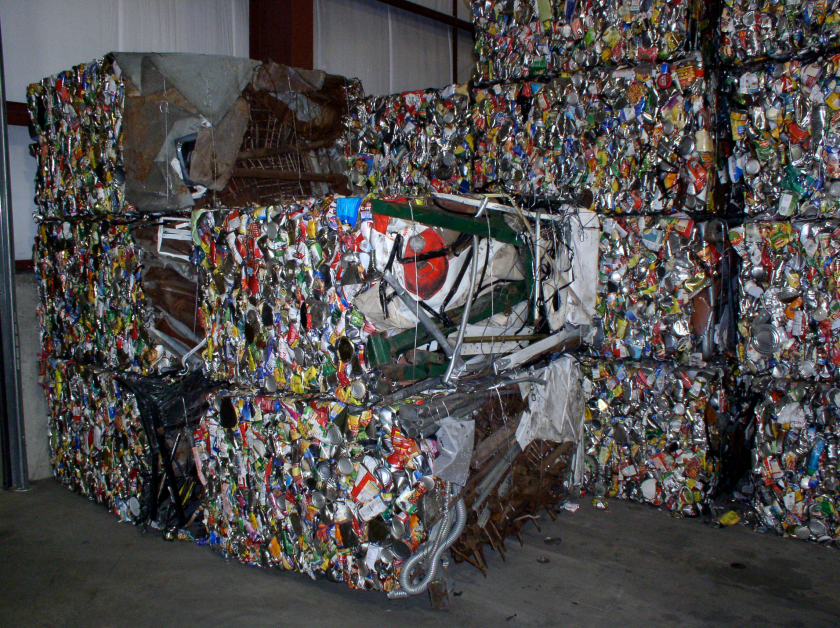
courtesy of blahedo under CC BY-SA 2.5 license

Recycling Cans

Recycling cans on Earth Day

And throughout the year

Helps our environment

And sustains life

Now and in the future.

*****

Staying In The Know

The green grass can be sustained

With thought and consideration.

The earth as a whole,

Will be a better place,

If we stay “in the know.”

© 2019, Mary Bone

Fiqoo the Farmer and the March of the Water Drops

Fiqoo, the village farmer, wasted a lot of water. The other farmers knew about it but they could not do anything because Fiqoo would get very angry and start shouting. As a consequence, water became more and more scarce by the day.
The people said, “The crops will not grow and we all will die if we don’t start saving water today.”  The Water Drops, terrified of the situation, gave an emergency call and got all their friends together. Out came the tin cans, the spades, the buckets, the only clay water container called Gharra and his buddies.

The plan was to start a March to Save the Water. They would march together up to the fields to try and convince the farmer.

When Fiqoo saw them coming he knew that it was something serious. He did not shout but was alert and concerned. “Fiqoo Babaji, we must save water in the village. The crops need it. They will not grow and all life will be in grave danger. You must stop running water when the earth is sufficiently saturated.”

“Oh, I do! I do but sometimes I go to sleep and feel so lazy.”

“No water. No crops. No crops, no food. No food, no people, no animals, no insects. No nothing!”

The chorus grew louder and louder.

“STOP. Stop, yelled Fiqoo. I promise I will take care. I’ll never waste water again.

“Sign! Sign! Sign an Agreement the citizenry demanded and everyone was happy when the agreement was signed and adhered to.

The village was finally on way to water sufficiency. There was a ray of hope for the future.

Lesson: Together we can solve problems and together we can save for our needs

Saving water must be encouraged

© 2019, Anjum Wasim Dar

China and India Lead the Way in Greening

China and India Lead the Way in Greening

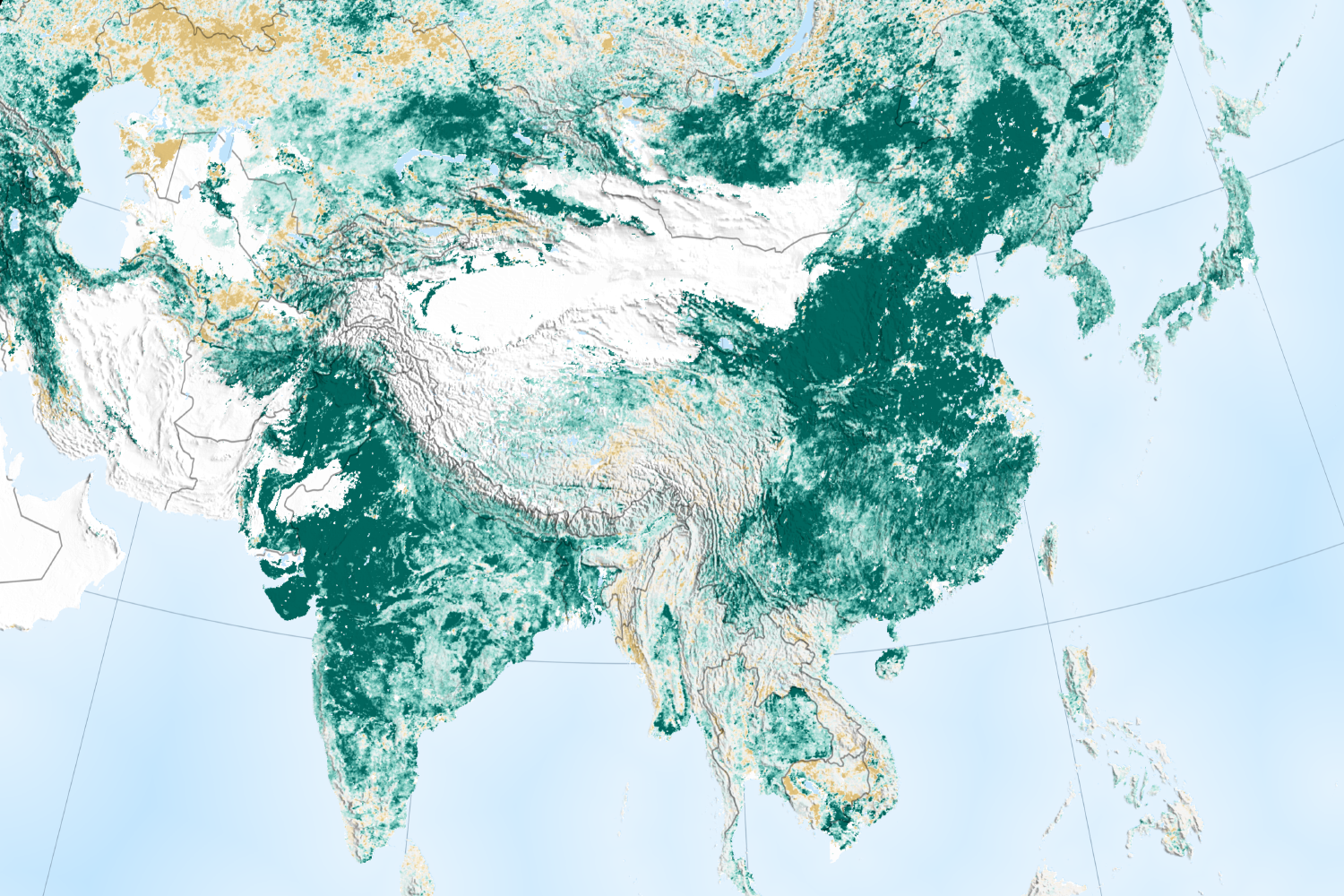
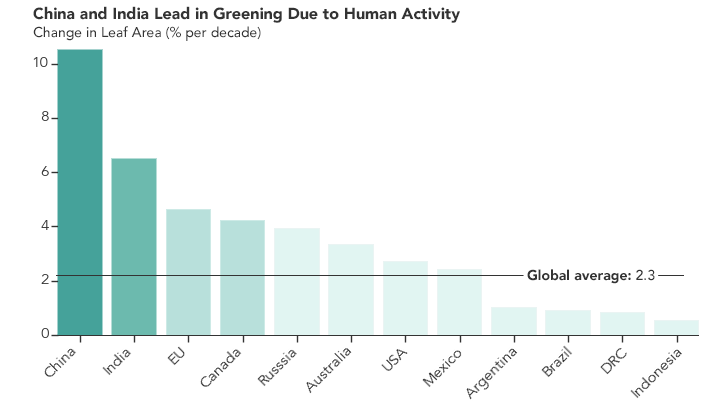
The world is literally a greener place than it was twenty years ago, and data from NASA satellites has revealed a counterintuitive source for much of this new foliage. A new study shows that China and India—the world’s most populous countries—are leading the increase in greening on land. The effect comes mostly from ambitious tree-planting programs in China and intensive agriculture in both countries.

Ranga Myneni of Boston University and colleagues first detected the greening phenomenon in satellite data from the mid-1990s, but they did not know whether human activity was a chief cause. They then set out to track the total amount of Earth’s land area covered by vegetation and how it changed over time.

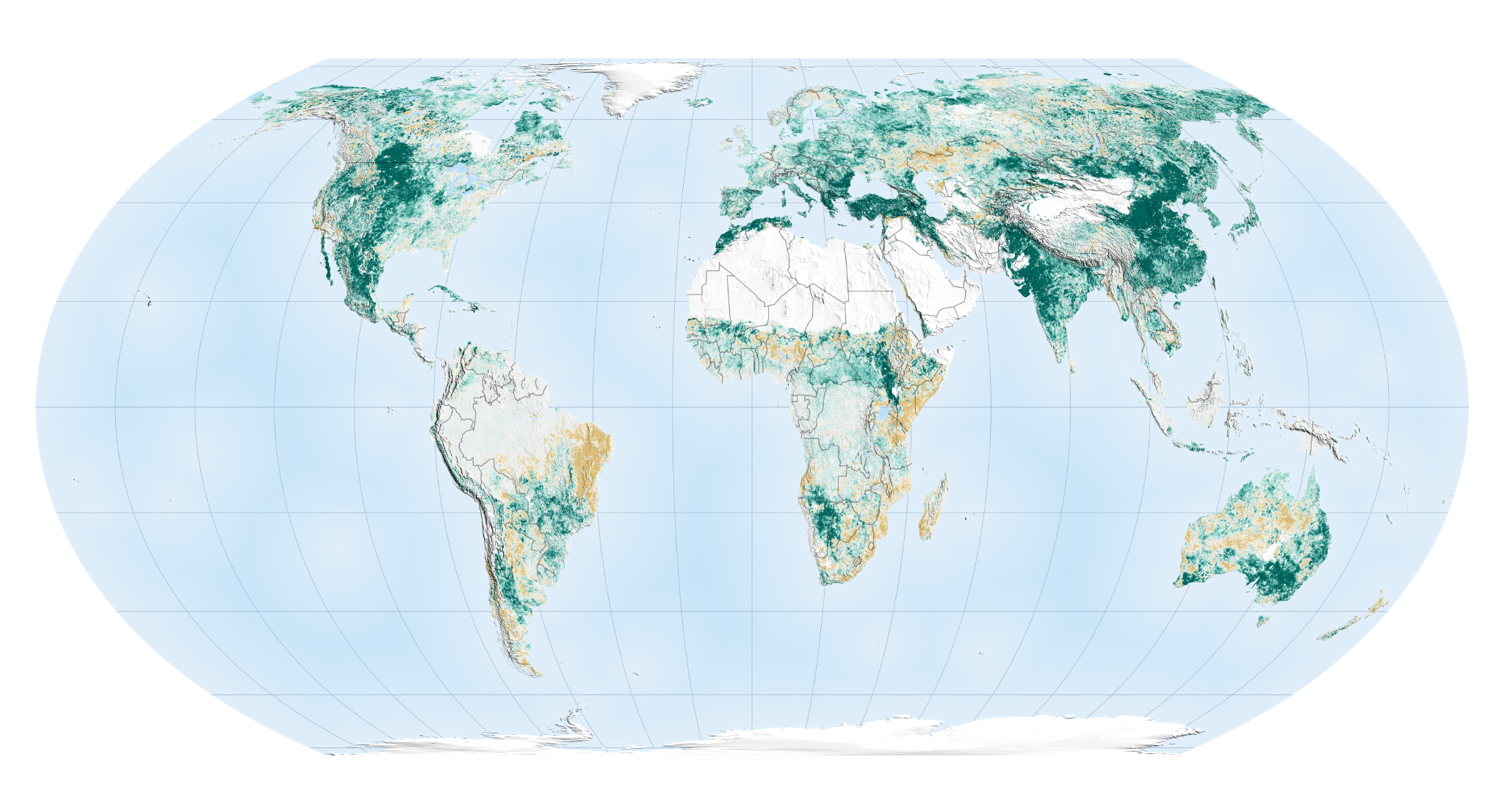
The research team found that global green leaf area has increased by 5 percent since the early 2000s, an area equivalent to all of the Amazon rainforests. At least 25 percent of that gain came in China. Overall, one-third of Earth’s vegetated lands are greening, while 5 percent are growing browner. The study was published on February 11, 2019, in the journal Nature Sustainability.

The maps on this page show the increase or decrease in green vegetation—measured in average leaf area per year—in different regions of the world between 2000 and 2017. Note that the maps are not measuring the overall greenness, which explains why the Amazon and eastern North America do not stand out, among other forested areas.

“China and India account for one-third of the greening, but contain only 9 percent of the planet’s land area covered in vegetation,” said lead author Chi Chen of Boston University. “That is a surprising finding, considering the general notion of land degradation in populous countries from overexploitation.”

This study was made possible thanks to a two-decade-long data record from the Moderate Resolution Imaging Spectroradiometer (MODIS) instruments on NASA’s Terra and Aqua satellites. An advantage of MODIS is the intensive coverage they provide in space and time: the sensors have captured up to four shots of nearly every place on Earth, every day, for the past 20 years.

“This long-term data lets us dig deeper,” said Rama Nemani, a research scientist at NASA’s Ames Research Center and a co-author of the study. “When the greening of the Earth was first observed, we thought it was due to a warmer, wetter climate and fertilization from the added carbon dioxide in the atmosphere. Now with the MODIS data, we see that humans are also contributing.”

China’s outsized contribution to the global greening trend comes in large part from its programs to conserve and expand forests (about 42 percent of the greening contribution). These programs were developed in an effort to reduce the effects of soil erosion, air pollution, and climate change.

Another 32 percent of the greening change in China, and 82 percent in India, comes from intensive cultivation of food crops. The land area used to grow crops in China and India has not changed much since the early 2000s. Yet both countries have greatly increased both their annual total green leaf area and their food production in order to feed their large populations. The agricultural greening was achieved through multiple cropping practices, whereby a field is replanted to produce another harvest several times a year. Production of grains, vegetables, fruits and more have increased by 35 to 40 percent since 2000.

How the greening trend may change in the future depends on numerous factors. For example, increased food production in India is facilitated by groundwater irrigation. If the groundwater is depleted, this trend may change. The researchers also pointed out that the gain in greenness around the world does not necessarily offset the loss of natural vegetation in tropical regions such as Brazil and Indonesia. There are consequences for sustainability and biodiversity in those ecosystems beyond the simple greenness of the landscape.

Nemani sees a positive message in the new findings. “Once people realize there is a problem, they tend to fix it,” he said. “In the 1970s and 80s in India and China, the situation around vegetation loss was not good. In the 1990s, people realized it, and today things have improved. Humans are incredibly resilient. That’s what we see in the satellite data.”

Some data courtesy of Chen et al.,(2019). Story by Abby Tabor, NASA Ames Research Center, with Mike Carlowicz, Earth Observatory.

The Great Green Wall of Africa

As of March 2019, 15% of the wall is complete with significant gains made in Nigeria, Senegal and Ethiopia.¹ In Senegal, over 11 million trees had been planted. Nigeria has restored 12 million acres of degraded land and Ethiopia has reclaimed 37 million acres.²

  1. Corbley, McKinley (2019-03-31). “Dozens of Countries Have Been Working to Plant ‘Great Green Wall’ – and It’s Holding Back Poverty”. Good News Network.
  2. Puiu, Tibi (2019-04-03). “More than 20 African countries are planting a 8,000-km-long ‘Great Green Wall. ZME Science. Retrieved 2019-04-16.

Planet: Safe, Clean, Healthy

Logo for the United Nations Environmental Programme / fair use

The UN Environment Program website gives detailed information about Sustainability; the challenge taken was to make the planet safer and sustainable for humans and other living beings.  The result in 2015 was the adoption of seventeen goals with specific objectives to be achieved by 2030. These were adopted by the international community as a way to address sustainability issues and environmental injustice.

The Goals are :
1. No poverty
2. Zero Hunger
3. Good Health and Well Being
4. Quality Education
5. Gender Equality
6. Clean Water and Sanitation
7. Affordable and Clean Energy
8. Decent Work and Economic Growth
9. Industry  Innovation and Infrastructure
10. Reduced Inequalities
11. Sustainable Cities and Communities
12. Sustainable Consumption and Production
13. Climate Action
14. Life Below Water
15. Life on Land
16. Peace Justice and Strong Institutions
17. Partnerships for the Goals


Sustainable development is a way for people to use resources without the resources running out. This is the term used in a document entitled “Our Common Future”, otherwise known as the Brundtland Report.  Sustainable development –


“meets the needs of the present without compromising the ability of future generations to meet their own needs.”


“The three main pillars of sustainable development include economic growth, environmental protection, and social equality. While many people agree that each of these three ideas contribute to the overall idea of sustainability, it is difficult to find evidence of equal levels of initiatives for the three pillars in countries’ policies worldwide. With the overwhelming number of countries that put economic growth on the forefront of sustainable development, it is evident that the other two pillars have been suffering, especially with the overall well being of the environment in a dangerously unhealthy state.


The Brundtland Commission report puts forth a conceptual framework that many nations agree with and want to try to make a difference with in their countries, but it has been difficult to change these concepts about sustainability into concrete actions and programs. Implementing sustainable development globally is still a challenge. Because of the Brundtland Commission’s efforts, progress has been made.


“After releasing their report, Our Common Future, the Brundtland Commission called for an international meeting to take place where more concrete initiatives and goals could be mapped out. This meeting was held in Rio de Janeiro, Brazil. A comprehensive plan of action, known as Agenda 21, came out of the meeting. Agenda 21 entailed actions to be taken globally, nationally, and locally in order to make life on Earth more sustainable going into the future.


Economic Growth is the pillar that most groups focus on when attempting to attain more sustainable efforts and development. In trying to build their economies, many countries focus their efforts on resource extraction, which leads to unsustainable efforts for environmental protection as well as economic growth sustainability. While the Commission was able to help to change the association between economic growth and resource extraction, the total worldwide consumption of resources is projected to increase in the future. So much of the natural world has already been converted into human use that the focus cannot simply remain on economic growth and omit the ever-growing problem of environmental sustainability. Agenda 21 reinforces the importance of finding ways to generate economic growth without hurting the environment. Through various trade negotiations such as improving access to markets for exports of developing countries, Agenda 21 looks to increase economic growth sustainability in countries that need it most.


Environmental Protection has become more important to government and businesses over the last 20 years, leading to great improvements in the number of people willing to invest in green technologies. For the second year in a row in 2010, the United States and Europe added more power capacity from renewable sources such as wind and solar. In 2011 the efforts continue with 45 new wind energy projects beginning in 25 different states. The focus on environmental protection has transpired globally as well, including a great deal of investment in renewable energy power capacity. Eco-city development occurring around the world helps to develop and implement water conservation, smart grids with renewable energy sources, LED street lights and energy efficient building. The consumption gap remains, consisting of the fact that “roughly 80 percent of the natural resources used each year are consumed by about 20 percent of the world’s population”. This level is striking and still needs to be addressed now and throughout the future.


The Social Equality and Equity as pillars of sustainable development focus on the social well-being of people. The growing gap between incomes of rich and poor is evident throughout the world with the incomes of the richer households increasing relative to the incomes of middle – or lower-class households.This is attributed partly to the land distribution patterns in rural areas where majority live from land. Global inequality has been declining, but the world is still extremely unequal, with the richest 1% of the world’s population owning 40% of the world’s wealth and the poorest 50% owning around 1%. The Brundtland Commission made a significant impact trying to link environment and development and thus, go away from the idea of environmental protection whereby some scholars saw environment as something of its sake. The Commission has thus reduced the number of people living on less than a dollar a day to just half of what it used to be, as many can approach the environment and use it. These achievements can also be attributed to economic growth in China and India. MORE [Wikipedia]

*****

Transportation is a key in addressing clean-air challenges. It drives economic activity and is fundamental to human welfare, but it has a negative impact on the environment and human health.
Transport activity is increasing around the world as economies grow, which means that the sector’s emissions are also on the rise. That’s largely because 95 per cent of the world’s transport energy still comes from fossil fuels. To achieve this goal the use of bicycles and electric cars is advised.
My visits to the once peaceful tourist hill station of Abbottabad reveals the considerable increase in the number of vehicles in the city. Roads were cleaner emptier and quieter in the 1980s even but gradually the population registered a substantial increase and so did the transport. Now in the current decade it has been declared as the Gateway to China under the CPEC (China Pakistan Economic Corridor) program, resulting in more traffic and transport means.
Bicycling is not possible due to the heavy traffic and hilly areas but electric cars may replace those running on petrol.
The UN  program on Transport encourages the following measures:
1.Share the road
2.Electric mobility
3.Global Clean Ports
4.Global Fuel Economy Initiative
5. Partnership for Clean Fuels and Vehicles.
*****
Village Cycling in Sri Lanka courtesy of Anton Croos under CC BY-SA 3.0
A short Note on Cycling
Cycling leads to a longer and healthier life.


Cycling is popular for a variety of reasons. It helps to reduce the risk of diabetes, some forms of cancer, cardiovascular diseases and depression. Research from the United Kingdom found that cycling to work is linked with a 45 per cent lower risk of developing cancer, and a 46 per cent lower risk of cardiovascular disease, compared to commuting by car or public transport.


The health benefits of cycling daily rather than taking a car for short trips outweigh the risks of inhalation of air pollutants. Daily exercise prolongs life expectancy by approximately 3.4 years whereas inhalation of polluted air reduces life expectancy by 1 to 40 days. Regular cycling boosts physical fitness and is an efficient way to prevent obesity.For further information please visit: Cycling, A Better Mode of Transport.


Compiled by Anjum Wasim Dar

UNESCO’s Man and the Biosphere Programme to designate new Biosphere Reserves

SeaWiFS Global Biosphere September 1997 – August 1998; This composite image gives an indication of the magnitude and distribution of global primary production, of both oceanic (mg/m3chlorophyll a) and terrestrial (normalized difference land vegetation index), see Normalized Difference Vegetation Index (NVDI) / Public Domain

New Biosphere Reserves will be designated during the forthcoming annual session of the International Coordinating Council (ICC) of UNESCO’s Man and the Biosphere (MAB) Programme on 19 June at UNESCO’s Headquarters.

The 34-member MAB-ICC, is the governing body of the intergovernmental MAB Programme, established in 1971 to establish a scientific basis to improve relationships between people and their environments and contribute to sustainable development. It will hold its 31st session in Paris from 17 to 21 June.

Participants will review recent developments concerning the Programme and examine applications to join the World Network of Biosphere Reserves, which currently numbers 686 sites in 122 countries, including 20 transboundary sites. Biosphere reserves are sites of recognized importance for conservation of biological and cultural diversity that aim to foster positive social transformations and to work as instruments of practical implementation of the Sustainable Development Goals through voluntary engagement.

During the session, the ICC will also announce the laureates of the MAB Young Scientists Awards and of the Michel Batisse Award for Biosphere Reserve Management.

A number of side events will also take place during the session:

  • 17 June, 12.40-1.15pm, opening of two exhibitions, “Our Biosphere, Our Future. Local Actions for the Sustainable Development Goals” and “Forest Art in Biosphere Reserves and in Natural Protected Areas”
  • 19 June, 6.15 to 7 pm, presentation of exhibition on biosphere reserves’ goods and service
  • 20 June, 3pm to 4.15 pm, panel on biosphere reserves and peace, organized by the Republic of Korea and the MAB Programme
  • 20 June, 6pm, Jane Goodall Institute presentation on 60 years of research at the Gombe Masito Ugalla Biosphere Reserve (United Republic of Tanzania) and environmental conservation initiatives at the site, followed by roundtable discussion.

Editor’s Note: As we go to publication, I am awaiting a response from UNESCO on how you might register or get tickets to this event should you be interested.  I’ll incorporate that info into this post when it comes in, so check back later. Thank you! / J.D.

Box

We are listening to the Old Voices,
from the Meat Time, before the Water Tap
was drilled and capped ‘in the last days’ they say,
deep into the rocks. They talk of water as though
it could be made to run freely without a click-stop.
They say that Tap used to mean a long hose, metal
like the ragged sharps the runners dodge around,
that water could be made to pour out of, just pour
and pour, like the sand in the sand bath; that long ago,
for thousands of years, there was no thought
of the Water Tap.

We are listening to the Recording
of the last ones, the Artists. They tell us about
‘sheep in fields of green’, ‘luscious’ they say it was,
like the eyes feel drinking the shift of sand at sun up
and that these sheep grew a coat over their skin. ‘Wool’.
They say it could be cut off and used to cover a man,
to make him look and feel not as he is. These were animals,
bred for clothes, even for food, and many more than sheep –
hundreds of different kinds. That was the Meat Time,
before scrubbing for roots and picking off the bugs
from our skin.

They say they tried to save it all:
water, metal, ‘plastic’, all that was more than roots,
they tried to save it but the End Rain came too soon
and all they could do, the Artists, was leave us The Words
to tell us, for each lost thing, how it might be made again.
They talk as though there was more than this one story, this
one Box in the sand telling of rain and how it was water.
They say there were animals that leapt and swung in the air,
like the bugs hop, and they were called ‘birds’. ‘Beautiful,’
they say, ‘how they would always begin to sing again
after the end of rain’.

© 2016, Anne Stewart

from ‘Only Here till Friday’, Bibliotecha Universalis (Bucharest), Eng/Sp, 2016.

Cutie

Ascultăm Vechile Voci,
din Vremea Cărnii, înainte ca Robinetul de Apă
să fie forat și astupat ‘în ultimele zile’, spun ei,
adânc în pietre. Vorbesc despre apă de parcă
ar putea fi făcută să curgă fără sistem de oprire.
Ei spun că Robinet însemna un furtun lung, metalic
precum coțcarii zdrențăroși evitați de contrabandiști,
că apa poate fi făcută să scurgă din, doar să scurgă
și să scurgă, ca nisipul în baia de nisip; că odinioară
timp de sute de ani, nu exista gând
despre Robinetul de Apă.

Ascultăm Înregistrarea
ultimilor, Artiștii. Ne spun despre
‘oi pe câmpuri verzi’, ’seducător’ spun că era,
ca ochii savurând mișcarea nisipului la răsărit
și că aceste oi fac blană peste piele. ’Lână’.
Ei spun că putea fi tăiată și folosită să acopere un om,
ca să pară și să se simptă altfel decât e. Acestea erau animale,
crescute pentru haine, chiar pentru hrană și nu doar oi –
sute de diferite feluri. Aia a fost Vremea Cărnii,
înainte de a trudi pentru rădăcini și de a culege gândacii
de pe pielea noastră.

Ei spun că au încercat să salveze tot:
apă, metal, ’plastic’, tot ce era mai mult decât rădăcini,
au încercat să salveze, dar Potopul a venit prea repede
și tot ce-au putut face, Artiștii, a fost să ne lase Cuvintele
să ne spună, pentru fiece lucru pierdut, cum ar putea fi refăcut.
Ei vorbesc de parcă ar fi mai mult decât această poveste, această
Cutie în nisip spunând despre ploaie și cum era apă.
Ei spun că erau animale care săreau și se avântau în aer,
cum saltă gândacii și li se spunea ’păsări’. ’Frumos,’
spun ei, ’cum întotdeauna începeau iar a cânta
după sfârșitul ploii’.

© 2016, Anne Stewart

from ‘Only Here till Friday’, Bibliotecha Universalis (Bucharest), Eng/Sp, 2016.

Thinking green would just be there …

Those sweet Pacific blues
made me take fertile
for granted,

thinking that green
would just be there
and it seemed
even the eucalyptus
felt a bit unique,
stolen of, standing out in
its starkly brown bare bark.

For a time,
everything was whole
growing out into itself:
live oaks and Kentucky grasses
and we were all going on forever
somehow;

for years it seemed like some kind Heaven
favored us in those paradise days.
how I took them for granted,
how I felt protected and enhanced,
how it rounded out my wheezes,
how it was classical beauty,
solid in that clear light.

But dirt oozed in with McCarthy, Strontium-90
and the bombing bomb teething death.
Contaminations in the air.
A damnation took over the earth damnedly.
New smoke and blights and fires. The air soot crazy.
Oil wells leaking dredge. The balance tilted.
And we paradise kids went deep sea fishing for more,
catching the most wonderful people:
Burl Ives, Pete Seeger, Malvina Reynolds, Paul Robson, Joan Baez,
all with hope in their arts
that we might live
in camaraderie with the stars’ light
as bright as the sequoias ranged high.

It is we rebels who must lust after our land,
lust without greed,
lust ever for change
to cleanse the world, scourge its filths
with our Pacific-blue kindness.

© 2019, Linda Chown

The Smell of Wood, The Scorch of Fire

stumpsthis rough-barked sequoia stump, sitting in majesty
in its coastal home, victim of wildfire, burned down
to its gnarly roots, its nicks, holes and char, eons
of scars, life seemingly cut off, goddess snake alive
inside the concentric circles, the smell of wood and
scorch of fire, at the verge of our infinity, in its truth ~

pristine.

rugged.

pulsing.

haunted by the geometry of limbs, the calculus of green,
the algebraic eloquence of a world within a world  ~

present.

essential.

primal.

it sings to itself in the marrow of our bones

© 2014, Jamie Dedes

Photo credit ~Bay Nature.org: “The Bay Nature Institute, based in Berkeley, California, is dedicated to educating the people of the San Francisco Bay Area about, and celebrating the beauty of, the surrounding natural world. We do so with the aim of inspiring residents to explore and preserve the diverse and unique natural heritage of the region, and of nurturing productive relationships among the many organizations and individuals working towards these same goals.” Read more HERE.