
Silencing the Thunder

“I’d like to purchase me one of those pistols, Mr. Armstrong.”

“One of these, here, son?”

“Yessir, that .41 caliber double action Colt on the right, to be exact.”

“Nice little piece, son. They call this model the Thunderer. Say John Wesley Hardin was partial to this weapon. Yep, a stone killer, that one. How old are you, son?”

“Nineteen.”

“How old?’

“Well, almost nineteen.”

“How close is almost, son?”

“Frrrryrrrs.”

“What was that, son? I don’t hear so good anymore. But I still see good as ever, and if you’re nineteen, I’m Rutherford B. Hayes. Now let’s try that again. How old are you?”

“Fourteen and a half. But I do a man’s work and carry a man’s load for my Ma and little sister and brother.”

“I don’t doubt that, son. Can see by those rough hands ya got there. Now, what would a hard-workin’ young man like you want with a gun made for…well, for killin’ other men.”

“I don’t know’s that any of your business. My money’s just as good as any other man’s and I don’t see you askin’ them so many questions. You gonna sell me that gun or not?”

“Rein in there, son. No need to get all tetchy. Just makin’ conversation’s all. I was just wondering what you wanted the piece for.”

“Huntin’.”

“Huntin’, eh?”

“Yessir.”

“You havin’ a problem with some mighty big rabbits out there by the North Fork?”

“How d’you know where I’m from?”

“Knew your daddy from back in the old days.”

“You knew my Pa?”

“I did. He did some rangerin’ with my battalion after he come back from the War. I was told I was too old to join up and they wanted some veteran Rangers to stay and protect folks from Comanche and such while most of the young men were fightin’ back East. Sorry to hear about your Daddy’s passin’.”

“He didn’t just die. He was backshot by Cal Blandings.”

“Whoa, wait a minute. I heard he’s working on your Ma’s place. You say he killed your Pa?”

“Not just what I’m sayin’. It’s what I know.”

“And how’s that”

“Says he came upon my Pa after he was shot. But he’s a shady one and I wouldn’t believe a word the bastard says.”

“I’d have to say you’re a pretty good judge of character, son.”

“Yep. Few weeks later he comes to our door asking Ma if she needed a spare hand, what with Pa’s unfortunate dee-mise. That’s what he called it, his dee-mise. Then he gives me the evil eye, lettin’ me know he’s not to be trifled with. Told me my Pa never understood that.”

“If I recall, Blandings was right fond of your Mama before your Daddy come along and turned her pretty head. Mighty fond. Didn’t take it too well, now’s I recollect.”

“Yessir. And now he’s tryin’ to spark my Ma, convince her she needs a man around to protect her and the kids. Then he tells me how I’d best be careful when I’m out loopin’ strays. Says you never know, I could end up like my Pa if I didn’t watch myself.”

“So this here gun is to provide for your family, you say.”

“Yeah. Protect ‘em. He’s got Mama pretty mixed up right now. And the other night he…he hit her.”

“He didn’t!”

“Yeah he did.”

“So you want this Hardin gun to…”

“Do whatever needs doin’.”

“Well, young man, folks aren’t allowed to carry a gun on the streets of this town. That was established back when I was a deputy. Same rules as they even have up in such pits of wickedness as Abilene and Dodge.”

“Don’t intend to be carrying it around town.”

“I’d expect not, but let me give you some advice I heard from a lawman once about strapping a piece of iron like this on your hip. Or even picking one up in the first place.”

“Yeah, what’s that?”

“Don’t.”

“But…”

“And if you ever do own a gun like this, you sure as hell don’t want to pull it. And if you ever have to clear leather, you better know what you’re doin’. Hell, even the lawmen in the cow towns, fellas like Earp and the Mastersons, only pull their guns to buffalo a rowdy cowboy on the gourd with the barrel. And these men are professionals who have faced down many a bad man with a gun.”

“That’s fine for those fellas, but I’ve got to…”

“Son, I want you to wait a few days to cool down just a bit. Then come back and I promise to let you have this gun if you still think you need it.”

“I need…”

“Trust me, son. You don’t want to do what I think you’re plannin’. Listen, I’m an old Ranger who’s seen what one of these can do to a man.”

“I seen men shot before.”

“I don’t mean the one’s what got shot, son.”

“Oh…”

“Just trust me. Three days is all I’m askin’. Keep your powder dry for three days and then we’ll deal.”

“All right, I’ll be back Friday.”

“Good. You won’t be sorry. I’ll even put the Colt aside for you as a show of good faith. In honor of your Daddy. See you Friday.”

“Yessir. See ya then. Thank you, Mr. Armstrong.”

“Poor kid. Hey, Jack, come here! Put this Colt away for me, will ya? Should the Leakes boy come back for it, tell him you sold it. I got someplace to go.”

“Sure, Ben. You headed over to Doc’s again?”

“Nah. That horse is well out of the barn. He said nothing he can do for me anymore. Just a matter of time. No more’n a year. Actually, I’m thinking of takin’ a ride out near the North Fork. Visit Chet Leakes’ old place.” 

“Why you puttin’ on your old Colt just for a social call, Ben?”

“Oh, just gonna chase off some rabbit. Kinda like we did in the old days. I got to be quicker than the scruffy beasts. Hear they got big ones commencin’ to be a problem out there. Thought I’d lend Maddie Leakes a hand, just for old times sake.”

“Uh huh. You want any help? I heard over at The Imperial those varmints out at Maddie’s are said to be pretty quick. Quicker than most.”

“Well Jack, there’s quick, and there’s accurate, and there’s smart. I’ve always been at least two of those three on such occasions. Besides, what’s the worse he could do to me if things get sidewise? I already got my ticket punched.”

“You forgot one other gift you have over those damn rascals, Ben.”

“Oh? I must be gettin’ old. What might that be?”

“Frijoles as big as church bells, mi amigo.”

 “Hah. Well, maybe. Ain’t seen much of them since I acquired this here bay window. We’ll just have to trust I still got the sand should the time come for me to do…what’d the Leakes boy say? Oh yeah, ‘whatever needs doin’.”

“I kinda figured this would turn this way. I already saddled ol’ Fuego for you, Ben. You check your loads and I’ll strap my new Winchester on the saddle if you want. You know, in case you gotta take down this here jackrabbit from a distance. Like I said, I heard he’s quick, but also damn wily.”

“I thank you kindly, Jack. I’m hoping to look this old boy in the eyes first. See if I can make him blink, you might say. I’d rather chase him off than put him down. But not all that much.”

“I doubt the boy or that coward knows how you faced down Hardin in Gonzales and was one of the Rangers what finally caught him in Florida.”

“Yeah, well these damn things in the wrong hands or the hands of the wrong-headed are the Devil’s own poison, aren’t they, Jack?”

“Yessir, Cap’n.”

“An’ don’t let that boy get a weapon like that Thunderer. Hope to God he never finds out how much misery ripples out like a stone thrown into still water when someone pulls a piece with the intent to use it for what it was made. Like as drown the thrower as the catcher. Almost drowned me. It is a sour baptism that boy and his mama don’t need. No one, especially a civilian, really needs drownin’ anymore.”

“Yessir. Vaya con Dios. Go with God, Cap’n. Good huntin’. I’ll be lookin’ for you before Friday.”

“Good lord willin’. Be sure to douse the lights and lock up for me, mi amigo.”

© 2018, Joe Hesch

Snow Angels

Her nightmares began in the week before Christmas;
screaming, fearsome trespass into the child’s mind.
The news of the day had infringed with no conscience
and stolen a bit of innocence from the six-year-old,
waking her from a terror that others could not escape.
“I don’t want Santa to come into our house,”
she said one night. “It scares me.”

“You’ll be safe, hon,” her father whispered.
“Mommy and Daddy will protect you,”
her mother said. “And your Guardian Angel, too.”
“Why didn’t their Guardian Angels
protect them?” she asked,
in the direct distillation of thought
only a child can accomplish.

Her father closed his eyes and drew a breath
before telling her:
“Because so many little kids
and their Mommies and Daddies
fear this world more than we used to,
God needed more brave little angels
to help them feel protected.”

As snow fell outside the bedroom window,
the little one lay down with her mother,
satisfied for a bit, sleeping safely in her arms.
Her dad thanked God for her and that
she heard not the door open and close twice.

When she awoke in the morning,
little Emma called into the kitchen,
“Daddy come see, come see.”
There in the night-fallen snow, a score
of snow angels had ringed their blessings
upon a home and a little girl.

I’m sorry if this doesn’t really sound like a poem. I’ve been struggling with these feelings for a long time and I have difficulty expressing such things sometimes except by writing them out for myself.  Some folks say I’m some kind of storyteller, but I often lack the emotional capacity to couch thoughts of such horrible things as the Newtown tragedy and other mass shootings in words. As a father and grandfather, this piece helped me gather a few in one place. May all our angels rest in the peace of this season, and all the seasons to come.

© 2018, Joe Hesch

my decision is not new, since …

I have learnt to decide,
nor my inner self trouble,
since I have learnt to analyze;
it is easier now to get over feelings
hurt or saddened, painfully burdened-

I walked and walked and walked,
and thought…one more step and
I would reach the pure water spring,
brief known journey came to an end
my feet touched Mother Earth-

it was a beautiful afternoon-
there was a time I had transport in which,
I would be dropping friends, colleagues
and their kids that was my time, I could do that
that was my memory, this, my experience,

that came wafting touching the clayey frame,
painlessly, then flooding the heart-
I stood for a while, looking,
as the water flowed, in the river
under the bridge, the vulnerable bridge…why are
bridges made? to connect? No.
To break connections?

cannot say,well , just to pass over to the other end-
looking at the Korang River, for a while I lost
sense of time-the water flowed and I stood still-
water always did, it always will, sometimes high
sometimes low-I did not know where
to go, I did not feel the Earth under my feet
how long was I in that small seat,
moments not long, but the last ever to be
I saw Nothingness staring back at me-
till I could no more see, nothing red,
till the trembling subsided,
nothing white, nor blue..
Hey you? can I drop you?

many cars passed, people stared through
the windows, unsmiling faces raced by
hurrying to their destinations
a strange lady with a bag, changing hands,
shifting the load, had to be carried,
walking all by herself-

looking peaceful but carrying a turbulent storm
‘turn now, move on, like the river, be like
the bridge, connect and remain in quietude-

I walked…felt numb, thoughtless with acceptance,
happy moments are brief, short lived,
yet they come leaving fleeting memories-
walking helped the heavy spirit but lightened
not the load…mistake mistake, mistake-

‘you crossed the line-turn turn turn’
walk walk walk…till you can…the sun came closer,
pouring love with its rays, drenching me
in a comforting warmth-

Nature Loves us deeply, we know not…
I turned stepped on, step by step, step by step
distance unmeasured, no desert can be measured
deserted desert ,mirage unseen, this is The Unseen
The Nothingness became visible, I walked -I felt Peace

I saw the Unseen I saw Peace I saw love descending
from above-then more -the resurrection,

the road the river and I were moving, walking flowing together
in the same…..direction

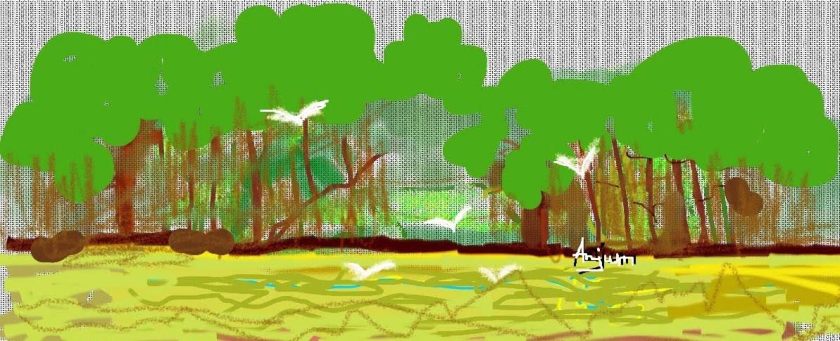
© 2018, poem and illustration, Anjum Wasim Dar

The Other World

At eighteen, I stepped into the other world,
the one that sounds fantastical but is not.
Drainage pond at the bottom of a hill on campus,
behind it a small straggle of winter woods,
beyond that, a path towards the sports fields.
Grass still green in the mild mid-Atlantic,
twiggy dried milkweed standing and fallen,
plain as plain, just hidden, just waste.
An ordinary afternoon, and I felt surfeited with reading;
walking down the hill, I cast away my mind.
At the water’s edge I looked at the surface;
the water looked back at me. The world had eyes:
perceived me as I perceived it, all the same.
The bare treetops in the distance moved in my arms.
I felt the cawing of the crows that rose inside my chest.
But no crows there, no chest here, only that cawing,
that burning and empty annunciation
of how we too are the shine in the tufts of the cracked pods,
falling and lifted in the wind through everything.
All of this I could see, while I rubbed my eyes,
as if to dislodge a film that was not there.
This happened. I was a freshman, with no one to tell.
Why do we seek imagined worlds? We know nothing
of what is real, how wondrous and complete.

© 2018, Anne Myles

Wabi Sabi

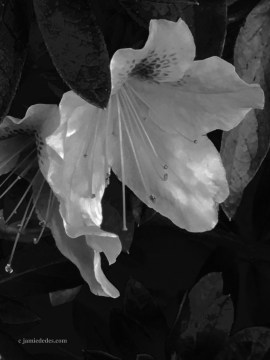
Japanese tea house: reflects the wabi sabi aesthetic, Kenroku-n Garden

Japanese tea house: reflects the wabi sabi aesthetic, Kenroku-en Garden


if only i knew
what the artist knows

about the great perfection
in imperfection

i would sip grace slowly
at the ragged edges of the creek

kiss the pitted
face of the moon

befriend the sea
though it can be a danger

embrace the thunder of a waterfall
as if its strains were a symphony

prostrate myself atop the rank dregs on the forest floor,
worshiping them as compost for fertile seeds
and the breeding ground for a million small lives

if i knew what the artist knows,
then i wouldn’t be afraid to die,
to leave everyone

i would be sure that some part of me
would remain present
and that one day you would join me
as the wind howling on its journey
or the bright moment of a flowering desert

if i knew what the artist knows,
i would surely respond soul and body
to the echo of the Ineffable in rough earthy things

i would not fear decay or work left undone
i would travel like the river through its rugged, irregular channels
comfortable with this life; imperfect, impermanent, and incomplete

Inspired by Leonard Koren, Wabi Sabi for Artists, Designers, Poets & Philosophers

© 2013, Jamie Dedes

Bringing Back the Silent Minute

What is the most powerful force we can align with to heal the soul of a nation?

In the United States, these are deeply troubled times. Our population is more polarized than it has been at any time since the Civil War.

Trust—for our fellow Americans, our government, and our institutions—seems to be breaking down. Things become increasingly confusing and chaotic.

Mental health and other medical professionals in the U.S. have reported increased numbers of patients seeking relief from stress, anxiety, and depression. An unprecedented number of Americans lie awake at night wondering what the future of our country will be. I have been one of them.

Like many others, I’ve become more politically active than ever before in my life—working to educate myself and others about issues, writing and calling my elected representatives, supporting voter-registration efforts, collecting signatures on petitions, donating to political campaigns. But as the disorder in our nation deepened, it didn’t feel like I was doing enough.

Of course, action on a material level is necessary—but I began to feel that we needed to work powerfully on another level—by gathering our collective spiritual forces and reaching out to a higher power—for the best possible outcome and the healing of our Nation.

Many of us have been praying privately for help in this situation, and some have been praying together in places of worship—but again, it didn’t seem to be enough.

Photo by John Anstie
all rights reserved
used by permission

Years ago, British Spiritual Healer Malcolm Smith told me about the SILENT MINUTE that was kept each night in the United Kingdom during World War II. Many Britons, he said, credited the winning of WWII to this collective effort—a minute of silence observed throughout the UK each night, at 9 pm. Each participant kept the time in whatever way felt right—through prayer, meditation, or whatever—but with a shared intention of securing freedom and a just peace. For those who lived in London, the Silent Minute was observed during the 9 pm chiming of Big Ben.

The current turmoil in the U.S. seemed to me to require the same kind of concentrated spiritual response that turned the tide in WWII.

I wanted to share the idea of the Silent Minute—but mundane concerns caused me to try to set it aside for later. We had family coming to visit, my house badly needed cleaning—and I kept trying to put off the Silent Minute effort to another time. Somehow, though, I couldn’t seem to concentrate on anything but sharing the Minute. The need to “do it now” became irresistible—as if some force compelled me and wouldn’t let me accomplish anything else until I did what I could to spread the idea.

It was soon made clear to me that bringing back the Silent Minute was not “my idea.” I started sharing about the Silent Minute in Facebook groups in mid-July. One of the first to respond was Amber Napier Bozeman. Amazingly, Amber and her mother had had the same inspiration and had started observing the Silent Minute together two weeks earlier!

Although we live in neighboring towns, I didn’t know Amber or her mother, Connie Utpaul. But they had decided on 9 pm as the time to observe the Minute, just as I had. And they had created a Facebook page to spread the concept. (I had started a Facebook group.) Because of this experience, I believe this idea was “seeded” within us by a Higher Power.

A growing group of participants are now committed to observing the Silent Minute. We have no idea how many people are involved. We do know, from those who have chosen to join the Facebook group, that there are now people observing the Silent Minute simultaneously all over the U.S. and in England, France, Germany, Israel, New Zealand, and India.


The focus of this Silent Minute is on Peace, Justice and the Highest Good—for the U.S. and the world.

Participants in the group include people of many faiths and none. Non-believers are welcome to participate and just hold an intention for peace and justice. We encourage participants to keep their prayer or intention non-partisan during the Silent Minute—just focusing on Justice, Peace, and the Highest Good, and having faith that Spirit, the Universe, or whatever we believe in, knows best how to bring that about. [Editor’s note: The Peace Pole message, “May Peace Prevail on Earth,” could work as a collective focus for those seeking a message to focus on, as the peace poles are also worldwide. Read more here.]


The Commitment

If you choose to participate in this effort, the commitment to “keeping the Minute” consistently is important. BUT we’re all human—so if you miss the time or forget and then remember later, do your Silent Minute when you remember, if you can.

If you miss a night—or several—don’t beat yourself up about it. Just get back into the flow as soon as you can.

The U.K. is all in one time zone, but in the U.S. we have several. In order keep the Silent Minute simultaneously as much as possible, here is the plan:

  • On the U.S. East Coast, we have committed to keeping the Silent Minute at 9 pm
  • In Central Daylight time, that’s 8 pm
  • Mountain Daylight time: 7 pm
  • Pacific Daylight Time: 6 pm
  • Hawaiian Time: 3 pm
  • In the U.K and France, the time is 2 am. (A challenging but excellent time for meditation and prayer.)

When observing your Silent Minute, it helps to be aware of all the others doing it, too—and join your intention with theirs. However, if you cannot possibly observe the time when the rest of the collective is tuned in, pick a time that works for you! The most important thing is the shared intention for Justice, Peace and the Highest Good. Science tells us that once ten-percent of a population holds an unshakeable belief, that belief will spread to the whole population. Why shouldn’t the same be true for a strongly held intention?

Since this is an effort to create an energy field or group consciousness, we offer the Silent Minute Facebook group as a venue for sharing about your experience with the Silent Minute or anything related. It is, of course, completely optional.

Keeping the Silent Minute with all my unseen, and mostly unknown—but strongly felt—co-creators is helping me to be more hopeful, and far less anxious, about events in our world. That doesn’t mean I’ve become less active in the outside world. It means that I can be active in a calmer and more effective way.

What is the most powerful force we can align with to heal the soul of a nation—or a world?

The power of our own engaged spiritual forces multiplied by the highest intentions of our fellow beings in oneness with a Higher Power.

Read about the history of the Silent Minute in our other feature on the Silent Minute.

—Lynne Salomon Miceli ©2018


When there has been in the earth those groups that have sufficiently desired and sought peace, peace will begin. It must be within… ”

—Edgar Cayce Reading 3976-28


The Silent Minute—a Brief History

Photo by John Anstie
all rights reserved
used by permission

It was an unexpected intermission in the middle of performing various parts in a day long reproduction, on 1st July this year, of Trevor Wishart’s and Mick Banks’ contemporary musical installation, “Landscape.” First performed in 1970 in Hebden Bridge, the production concluded with the singing of the finale, in quartet through massive speakers, half way up a hillside, in the darkness of 10:45 pm, echoing across the amphitheater that is Hebden Bridge, in West Yorkshire, in the UK. It felt like the most haunting thing I’ve ever been a part of…except perhaps for one thing.

At some point in the afternoon on that day we had a chance to steal ourselves away up steep-sided hills above Hebden at a place, which rejoices in the very interesting but, as it turns out quite appropriate name of ‘Hellhole Rocks.’ For half an hour we sat in utter silence, shrouded by trees, with distant background echoes of life far away down in the town. To complete this scene, and designed to be a part of the ‘Landscape’ production, the only other sound we could hear, that left its footprint in the memory of this already memorable day, was a sound that stood out far above the background hum of life that acted as its accompaniment. It was the poignant ringing of a single church bell that tolled its message slowly but insistently for half an hour.

It brought back the feeling that descends on us every November 11th, at 11 o’clock, when we remember the fallen on Armistice Day with two minutes silence, commemorated throughout the Commonwealth of Nations and Allied Countries, since November 1919. This year’s Armistice Day commemoration will be the 100th.

Silent Moments

This silence is always very moving, not only because of the powerful effects of the silence itself on our own personal reflections, thoughts and prayers, but also, and principally because it helps us all feel at one with so many people at exactly the same time. This is a hugely powerful force of humanitarian collaboration. It is this two minutes of silence, which commemorates the ending of that ‘War to end wars,’ the Great War of 1914-18, that I have observed most regularly. It starts with a bugler playing the Last Post, which is followed by a measured two minutes silence. The silence is broken by the bugler, who plays the Reveille. Between the Last Post and the silence, the exhortation is read; the fourth verse from Robert Laurence Binyon’s memorable poem, “For The Fallen”:

They shall grow not old, as we that are left grow old,
Age shall not weary them, nor the years condemn.
At the going down of the sun and in the morning
We will remember them

—Robert Laurence Binyon

These silent moments are a well established means of communal meditation; for remembering past lives, lost souls, healing the immediate effects of tragedies. Silent prayer, included during participation in other group activities, has been practiced by faith communities for centuries. These include, of course, Monasteries and Convents, but also it is reported that Quakers have done this for a few hundred years. I am certain there will be many and varied groups all over the World observing the same practice in their own way under their own faith system.

However, silent moments are also practiced in plural, multi-faith societies, which has the powerful effect of bringing people of different creeds together to think, pray, contemplate and grieve for lost souls. This is typified by the Armistice Day two minutes of silence, which spans the Commonwealth of Nations and Allied Countries, who celebrate it on 11th November. How gratifying it would be, as a result of such widespread humanitarian collaboration and cooperation, to have lasting peace in the World…

The Silent Minute
Cover
An address by W. Tudor Pole
June 7, 1942

A very particular ‘Silent Minute’ was reportedly conceived and introduced into British life in 1940, early in the second world war, during the worst of the London Blitz that the Luftwaffe rained on us in 1940-41. It was the brain child of Major Wellesley Tudor Pole. As conceived, people were asked to observe one minute’s silence each evening at 9 pm, Greenwich Mean Time. Tudor Pole carried his idea to the King and to the Prime Minister, both of whose favor he won and so it was begun. Tudor Pole was quoted long after the war as saying:

“There is no power on earth that can withstand the united cooperation on spiritual levels of men and women of goodwill everywhere. It is for this reason that the continued and widespread observance of the Silent Minute is of such vital importance in the interest of human welfare.”

He was a man with some vision and a strong sense of the human spiritual effects of such cooperation and collaboration. He saw this Silent Minute as having been inspired from something beyond himself, from a Greater Power.

From 1941 through the end of the war, at 9 pm, when Big Ben rang the hour and the BBC broadcast its sound before its evening news report, people stopped to meditate, pray, or otherwise hope for an end to the war, victory, and peace.

BIG BEN SILENT-MINUTE OBSERVANCE.

HC Deb 09 April 1941 vol 370 cc1560-1

§  1560

46. Sir W. Davison asked the Prime Minister whether he is now prepared to commend the Big Ben silent-minute observance to British citizens, so that, wherever possible, they should unite together in silent prayer for the speedy victory of our fight for freedom and justice?

§  1561

The Lord Privy Seal (Mr. Attlee) Yes, Sir. My right hon. Friend the Prime Minister would be glad to think that those of us who wish to join in silent prayer for victory are combining to use the opportunity with which the B.B.C. has provided them.

U.K. Parliament Website

Revival

It wasn’t until the late 1980’s that several notable people—amongst whom were the woman credited as its reviver, Dorothy H Forster, and Edward Tudor Pole, Wellesley Tudor Pole’s grandson—became the first Trustees of a charity that named itself The Silent Minute or the ‘Big Ben Silent Minute’…back to that tolling bell again.

Later on in its life, Trustees included the likes of Archbishop Desmond Tutu. It now reaches out across all the continents of the world and, reportedly, there are more than 200 Million people who participate in the silence at 9pm each day, reciting this pithy little prayer:

Source of my being
Help me to live in peace and
Save my home the planet Earth

Read about a more recent U.S. revival as a response to Trump, in our other feature on the Silent minute.

—John Anstie ©2018

August 2018


Sources and interesting links

Wikipedia – https://en.wikipedia.org/wiki/Silent_Minute

and https://en.wikipedia.org/wiki/Moment_of_silence

Armistice Day – https://www.telegraph.co.uk/news/0/what-is-armistice-day-why-do-we-wear-poppies-and-when-is-remembr/

Wellesley Tudor Pole – https://en.wikipedia.org/wiki/Wellesley_Tudor_Pole

The Silent Minute charity – http://www.thesilentminute.org.uk/index.html

A recording of the Last Post – silence and Reveille is here: https://media.britishlegion.org.uk/Media/2843/2_minutes_silence.mp3

Wellesley Tudor-Pole biography : https://www.goodreads.com/book/show/21388940-the-two-worlds-of-wellesley-tudor-pole


Being the Peace in Community

But what if the path to being the peace isn’t simply solitary?  What if the path runs through the human community. Perhaps being the peace encompasses much more than simply ourselves.

First, we show up.  Secondly, we interact.  Maybe we receive feedback.

Are we vulnerable? Yes. Might our mistakes hurt others? Yes. Are we ever let down by someone else? Yes. Are we less peaceful as a result? No.

Eventually, we learn communication, accountability, trust, and cooperation. Dependence, connection, kindness, and leadership commingle in a recipe for lasting peaceful existence.

For many, times of solitude may also be an integral part of the recipe.

But what if the path to being the peace is both-and:

solitary, sedentary, in retreat—
communicative, conflicting, cooperative.

While we’re all here together, why not be together and use the fruits from that community to improve ourselves and each other.  The strengthening of the communal spirit that results from a broader peace may very well be eternal.

—Paul Fullmer © 2018

What Does It Mean to Love Everyone?

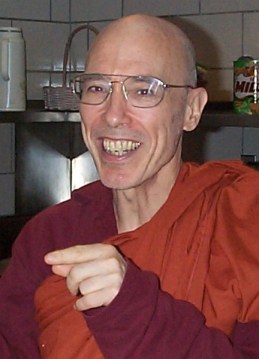
Bhikku Bodhi, American Buddhist monk, founder of Buddhist Global Relief courtesy of Ken and Visakha Kawasaki under CC BY-SA 3.0 license

To answer this question we have to distinguish two different nuances of the word “love.” One is an emotional feeling of affection that arises from my direct relationship to particular people. This type of love is not necessarily selfish and egotistical. It is not necessarily driven by an exchange principle, by the hope that others will return my affection and treat me kindly. I may sincerely love other people without hope of receiving anything in return – love them in appreciation of their good qualities and with a heartfelt wish for their well-being and happiness. But the primary basis for this love for the other is my direct connection with that person, and its robustness depends on regular contact. This type of love can range from self-centered attachment to family and friends to a deep devotion to those in my circle of friends and relatives that I admire for their outstanding qualities. What characterizes all shades of love in this sense is its contingency: it depends on circumstances and connections and is thus subject to change when the conditions that nourish it change.

The other type of love is not contingent on external conditions. It does not depend on direct personal contact. It does not even require that we actually like or admire the people toward whom this love is extended. This type of love is generated solely by recognizing other people as subjects, from seeing each person as a center of experience and thereby as the center of a world.

This type of love transcends the subject-object dichotomy that ordinarily structures our interpersonal relations. It emerges when, from the inner citadel of our own subjectivity, we see the other person as a subject and recognize that, as subjects, that person is similar to ourselves. This perception binds us together in a union of subjects, a union in which, no matter what we might feel about the other person as an individual, we recognize that this person, as a center of experience, is endowed with intrinsic value, a value that must be honored and protected.

To be a subject of experience is to seek one’s own welfare and happiness – not necessarily in a selfish and exclusive way but as an innate disposition of one’s being. As persons, we are each subjects of experience, and thus we each endeavor to avoid harm and suffering. Even more, at the bottom of our being we are disposed to grow and to thrive, to achieve security and happiness, and to realize our potentials, talents, and capabilities. Our quest for self-realization may be warped by distorted ideas about the nature of the good. We may be driven by greed and personal ambition, and in our quest for the good we may hurt others and deprive them of the good toward which they strive. But with a clear understanding of our own good, we would see that our own flourishing depends on the flourishing of others, that we thrive best when others also thrive. From this it follows that we have an obligation to avoid harming others and to help them along their way to achieving their own good.

The recognition of others as subjects means that we see in each person a reflection of ourselves. In doing so we relate to others as subjects who share our essential subjectivity. Since by introspection I can see that at the root of my being is a deep urge for the attainment of my own genuine good, I can know by inference – or better, by direct intuition – that every other person desires their own genuine good. When, through this intuitive contact, I appreciate and honor that desire, that need for the good, I will feel, rising from the depths of my heart, a wish for others to achieve the good they seek.

This wish for others to avoid harm and to attain the good is love in the second of the two senses I distinguished. It is love that responds to the moral injunction, “Love everyone without discrimination or qualifications,” or “Love your neighbor as yourself.” It is love that is directed, not merely to particular persons, but to every human being (and perhaps to every sentient being) by virtue of their status as centers of subjective experience, and thereby as each the center of a world, of a unique perspective on the universe. The expression of this kind of love is the sense of solidarity, the sense that what affects each affects all and that the good of the others is also my own good.

Love in this sense issues in concern. It manifests as the concern that others may be exposed to harm and danger, crushed by suffering to a degree that will stifle their ability to grow and thrive, that will thwart their potentials for a meaningful and fulfilling life.

In responding to the injunction to extend love to everyone, we have two obligations. Our first obligation is to see that others are protected from harm, which requires that we do our best to provide them with the basic conditions for a life of meaning and purpose: a safe environment, sufficient nutritious food, shelter, and medical care in times of illness. Our second obligation is to help others to thrive. This does not mean that we can impose our own ideas of well-being upon them, but that we try to provide the conditions necessary for them to realize their own potentials in accordance with their own aspirations. Above all, this entails providing them with an education, with the knowledge that will awaken and nurture their capacities for intellectual enrichment and with the training that will enable them to enjoy a satisfactory standard of living.

The work of Buddhist Global Relief is inspired and sustained by this second type of love. We look upon people all around the world – people we will never meet, never see, never know – as essentially like ourselves, as human beings who wish to be free from harm and suffering, who wish to live with dignity and self-respect, but who face formidable barriers to realizing their goals. We recognize that the main obstacle blocking their path is poverty – poverty as manifested in food insecurity, in hunger, in poor health, in lack of education. We endeavor to help them rise above debilitating poverty, especially by freeing them from the ordeal of chronic hunger and malnutrition. Going beyond mere subsistence, we also seek to help them to thrive by providing them with education, to allow the light of knowledge and understanding to illuminate their minds. We see this not merely as the fulfillment of a duty, but as love in action, arising from the resonance of our own hearts to the pain and needs of others, subjects who are essentially like ourselves, each the center of a world.

– Venerable Bhikkhu Bodhi


Blessed Sacrament

In the ever-Summer glare and heat
I found my life’s pain and regret
sanctified into something replete
with but little Hope baptized in sweat.
So the torment, no matter how holy,
still rips around my beaten heart
as if it was something mad and solely
bent and intent to rip it apart.

Perhaps I can hallow my vessel so hollow
with the heat from a different kind of light,
as good for my soul as the heart to follow,
soothing all my pain with its godly might.
And that’s why I’m here dipping pen in ink,
the black sprung from my soul to my heart.
Drawing pictures in words so we all might drink
of this sacrament that heals me called Art.


As I like to say, completing these pieces I share does not make me feel better. But all the time spent immersed in the process of writing them does. And that, my friend, is the miracle of Art, no matter how poorly rendered. 

—Joseph Hesch © 2018

Potting Up the Peppermint

One drop of motor oil

rainbows on a puddle.


Limitless mileage

of mycelial felt tugs at roots.


Platters of map lichen spread

across the patient boulder.


Metastasis. Proliferation

screws up to war. Epidemics.


You’ve witnessed ignorance

stretch boundaries of hate.


When you yearn

for peace, cut sprigs


from the tub that tethers

run-away mint,


brew tea to tip

into a green cup,


pour love to all

gathered at your weary table.

© 2018, Tricia Knoll

Yours If You Will Take It

If you want to feel
the passing of night to day,
take my hand.
And if you would know
the road best travelled
see the lines on my face.
If you wish
the greatest gift ever,
lie beside me, feel my heart
and if you want to know
what lies behind the stars,
look into my eyes.
If you would feel
the world shift, then accept
happiness from my soul.
And if you want
a place always to return to
join me.
For this is not
slavish devotion.
Without thought.
Nor a storybook rhyme
that ends happily, regardless.
This is love.
As simple as it can be.

© 2018, Miki Byrne

Sore Spots

When we love. Truly love,
our skin becomes thin.
A fine, tender membrane.
Sensitive, delicate.
That leaves us vulnerable.
Open to the blade and scour
of a harsh word
or thoughtless gesture.
Yet that same skin rebounds.
Strong in its flexibility.
Allows healing and repairs
the sore spots of wounds
unintentionally inflicted.

© 2018, Miki Byrne

Fear and the Mind

Fear has teeth, weight, venom,
that permeates every cell.
Brings paralysis of limb and mind.
Saps strength,
steals appetite and sleep.
Yet, it is a figment.
Has no legs, no substance but that
which we offer from our own minds.
Imagination
that pushes thought forward
to explore worst-case scenarios
that we touch and poke
like a tongue probes
a tender tooth.
Yet fear is insubstantial.
Allowing it bones hardens it.
Gives solidity to make a weapon.
One which we painfully use
against ourselves.

—Miki Byrne © 2018

Sunday People

Sunday people bike or walk for miles
under a wool-grey sky, a warm-as-bread breeze

rising over rocky outcrops, dissolving the day
fast as holy wafers on tongues.

Sunday people leave bad news, regret
moored to the past, set sail

on a sea the colour of slate,
smooth as pebbles whispering

over and over Pors Pin Bay lapped white
as the gull wheeling to a fleck of dust.

Sunday people stop to breathe
pine and larch crouched on a far hill,

patient as dogs waiting
for a shepherd’s call to gather flocks.

And here with you sketching
I watch the turn of your hand,

pen gliding paper – ink taking hold
of clouds, a skein of geese,

a fishing boat ploughing through water
like the prodigal son coming home

to thickets of oak and sloe, a table laid,
forgiving moments hauling us back to earth.

© 2018, Kerry Darbishire
Editor’s note: This poem is included in Kerry’s new poetry collection, Distance is Sweet on My Tongue (Indigo Dreams, 2018)

Dataism


1/ The End of a Beginning


Given   each organism  as a biochemical  algorithm
Your life         is a programed         process proving

Your consciousness         is actually far      less

Valuable         than a fucking             Frankenstein’s AI


2/ The Beginning of an End


Through         human-computer interface
My mind has become     part of     a robot

While the robot         part of me


As     data exchanges with     my consciousness
Or flow         between each other         on their own

Where                 can I find my true self?


Avihs || Vishnu


Mornings || they disperse || beyond || the corn

Fields, || separately. ||Sunday

She || throws


Her partner’s computer || (midnight)

Into the garage.|| George ||who

In many || a city || upgraded || his software


Upgraded || hers.

They will || stop over || an island

Separately.|| Your son


Hated || all || mushrooms

George mentions — do you recall || yourself?

To a single mind,|| their spirits || evaporate


Charging

Ever since they became erectus, and


Domesticated wheat, dogs and chickens


They have murdered almost all…

Destroyed numerous…

Poisoned every …


Altering the natural course of…

Rewriting the original codes of…


And even redrawing their own genetic maps…


As they keep moving everywhere

Albeit I have placed in loudest human voice

My repeated charges


That are ignored with repeated ignorance


Now
For their next revolution to achieve:

Happiness

Immortality

Deity


Making Light of Darkness


in a world always half in darkness

your body may be soaked deep

in a nightmare, rotting


but your heart can roam

like a synchronous satellite

in His space, leaving

the long night far behind


as long as your heart flies fast

and high enough, you will live

forever in light


Mega-Physics


Few are really aware of

Such universes

Existing beyond our own


Even fewer of so many other versions

Of selfhood living

In each of them, let alone

This simple secret:


At the depth of consciousness

Lives a quantum

Or soul as we prefer to call it

A particle, demon and/or angel dancing


The same dance afar, far apart

In an entanglement


Invoking Laozhi


Hiking along a less trodden trail in the Pacific Spirit

Forest, I almost have to stop to find my Way out

Because all roads have led me to nowhere

But I keep walking until it is almost Laozhi himself

Pointing his fossilized fingers towards Dao

(Which he says is no ordinary Way if it can

Be named. Similarly if I can find it on my own

It’s not the real or the right one.) Like a tour guide

Who seems to know every path to and from the destiny

Leading me like a dog, sometimes running well before him

Sometimes beside him, more often going astray by myself

Among the low bushes. I cannot help but follow him because

The leash is getting so tightened I want to protest aloud: you

Claim the great Way is no Way, but just follow Nature. Then

Why keep me with a rope? Like every other domesticated dog

I have a delicious bone right above my mouth, which makes

Me keep running to my death, but never allowing me to have a bite

—Changming Yuan ©2018

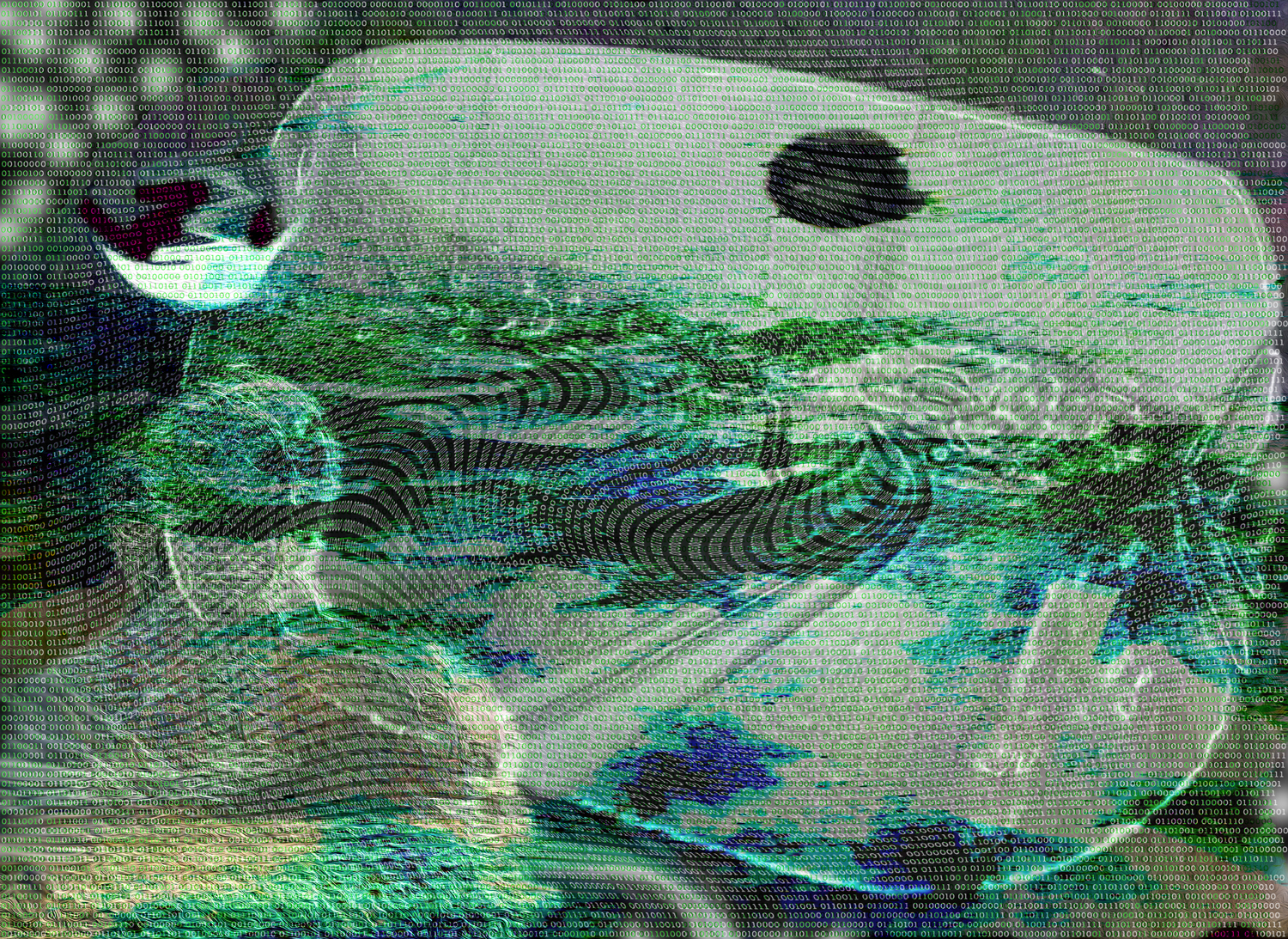
Latent Objectifications II: Dataism <br /> digital landscape from photos <br /> ©2018 Michael Dickel <br /> (the binary code is the text of the poem)
Latent Objectifications II: Dataism
digital landscape from photos
©2018 Michael Dickel
(the binary code is the text of the poem)

Find Your Balance to “Be the Peace”

This quarter’s The BeZine focuses mostly on the 100 TPC (One Hundred Thousand Poets for Change) theme of social justice going on around the world, but this sub-section of this quarter’s ‘Zine is called “Be The Peace.” Now, I’ve been called a hippie tree-hugging liberal, etc., and one thing’s for certain: I love the idea of Peace. However, it’s a real challenge to preach and practice Peace in a society that seems to be an ever-escalating glorification of hatred, bigotry, xenophobia, racism, violence, disrespect, intolerance, and especially war/conflict (under the thinly-veiled guise of nationalism or patriotism).

I started thinking, “How can any, one person try to get others to be peaceful when everything around us, from our leaders to the media, social media, and communities and neighborhoods, hell, the whole freaking nation is determined to divide us all and keep us at war with each other and other countries around the globe?” Seriously, how can one person even make a difference?

The answer is both simple and complex (of course). The simplest answer is that it starts with you, from within.
And in order to make peace with ourselves, there has to be a balance. You can’t very well save the world if you’re struggling to function each day, if you’re out of balance physically, mentally, and emotionally. So the first step is to find your own, inner sense of balance. If being on social media sites like Facebook or Twitter is triggering you and making you angry or if watching the news makes you despair, then consider stepping away from those things, even if it’s just temporarily. Step back and really look at how your behavior either serves to better your own well-being or doesn’t. When you find the things that don’t help you (or worse, actively harm you), then either change them or get rid of them. Once you are whole and centered, you’ll be in a much better, stronger position to help the rest of the world.


I get it. I do. For those of us who truly and deeply care about the rest of the world, our SJW (which is not an insult, despite how so many people use it) instincts can blind us to practicing self-care. When we’re so busy keeping others anchored and afloat it often surprises us when we find ourselves sinking! So step back, find your balance and then you can lead by example and “BE the Peace”.

Below is my humble submission in honor of this year’s 100TPC. Enjoy and be sure to check out the rest of the BeZine, as it’s sure to have some wonderful ideas and prove just how powerful we all can be at effecting change when we work together for one goal! 😊

—Corina Ravenscraft © 2018

The Flicker of Better Angels

Needless to say, they didn’t knock.

“Stay where you are. On your knees with your hands on your head,” the biggest one said.

“This is my home. What are you doing? What do you want?” I said as two more pushed me to the floor.

“You know exactly what we’re after, man. Where are they?” the big one said towering over me, his knee bumping my left eye.

“Where are who? Why are you doing this?” I said, wincing as his two partners wrenched my shoulders. I knew who they were and what they were after.

“The books, man. Where are the goddamn books? Our informant ID’d you as a subversive and told us you had a fucking library here. Hundreds, she said. Now where are they?”

It came to this as I’d predicted after He Who Shall Not Be Named was elected our leader and then turned everything over, spilling our constitutional rights onto the floor and, in essence, burning them. We no longer could peacefully gather to discuss, let alone debate, the state of affairs in which our land now found itself. Besides, you never knew who of the people you talked with might be one of their informants.

Within just a few months of taking power, HWSNBN ordered all news organizations to cease operations except for his sycophantic bootlicks at the renamed Supreme Network. He also shuttered all newspapers, except for The Truth and Our Democracy, now our two national newspapers. He had his cyber-cops monitoring all online interaction, again causing fear, anger and doubt among the half of the citizenry who voted for the other side. The First Amendment—-marketed by the government as The Worst Amendment, a true threat to national security—was stricken from the Constitution by well-armed executive order. And everyone just watched.

Next came book banning, kowtowing to the conservative religious zealots instrumental in getting the Supreme Commander elected. That part was easy, just emptying Libraries, bookstores and even schools of everything from Huckleberry Finn to To Kill a Mockingbird, Dr. Seuss to, of course, Fahrenheit 451.

With the precedent set, the government decided to remove other sources of education, entertainment and enlightenment from the public. Anything not given an imprimatur by HWSNBN was taken from the owner and destroyed.

I was a teacher, a writer of children’s books teaching youngsters to respect one another, always keep an open mind about someone and not base our opinions on the way they look, speak or pray. Yeah, I was one of their subversives.
“One more time, man. Where are you hiding the books?” the big one hissed in my ear, spritzing it with spit when he pronounced the evil word. The click of his pistol hammer cocking into place may have been the loudest sound I ever heard.

“They’re gone, all gone,” I said.

“You lyin’ son of a bitch. I’m counting to three and you better come clean or I’ll blow your faggot brains all over your nice baby blue carpet. Guys, who in their right mind would have a baby blue carpet in their place?” He laughed the laugh of someone who knew not of freedoms other than his now-inalienable rights to bully, beat and burn.

“I gave some away and destroyed the rest,” I said, half-expecting the next sound I heard, a blast, to be my last.

“Search this place, Lou. Who’d you give ‘em to, author?” He stretched that last word out like it was a vile taffy.

“The school libraries in Beekmantown and Green Island. They had so little to offer their kids and…”

He swung the barrel of his pistol against my cheek, I saw a flash and down I went. But I was till alive.

“You want any more of that, you’ll stop bullshitting us and tell us where they are. The next time I pull the trigger.”

“I’m telling you the truth. Then other books, my collection of histories and classics, I destroyed them with the dignity they deserved. Instead of the brutish methods you…”

The pistol swung again, but a roar accompanied the flash this time. But again I was still alive. I reeled in pain and disorientation from the discharge by my ear as the bullet destroyed the glass door in the empty bookcase across the room my wife gave me on our last anniversary.

“Last chance, asshole. Next time, right in your ear,” the big one said, and I was fairly sure he meant it. I could see that from the barely contained manic anger in his piglike eyes peering from above the black mask covering the lower half of his face.

“There’s nothing in the basement, attic or shed out back,” the one called Lou said as he reentered what was until a fortnight before my study.
“I’m not lying,” I said above the pounding ring in my right ear. They’re all gone.”

“Computer. Where’s your goddamn computer, faggot,” the big one shouted into my left ear.

“One of your colleagues visited me last week and confiscated it at the behest of your informant across the street. The one who used to spend her days listening to talk radio and watching me from behind her curtains,” I said, preparing for the next blow.

“Is that so… You got any other devices you can use to spread your subversive lies with, writer boy?” the one called Lou asked.

“No, your people are quite…thorough.” I had five manuscripts on that computer and another two on my old iPad, which now were chewed up bits of plastic, glass and magnetic inspiration in some government scrap pile.

The one holding me down released his grip and I once again fell to the floor.

“All right, Andrews, we’ll be leaving now. But recognize this is only a warning. We’re keeping you under surveillance on the regular. If you so much as shit we’ll know what color. You get me? I shoulda taken that shot when I had the chance. You elites sicken me,” the big one said, giving me one more punch in the head.

And then they were gone.

That night, after cleaning up the mess as best I could, the blood would always be a reminder of that day, I went to the basement and made sure the curtains were shut tightly. With my penlight, I found the drain in the floor and unscrewed its cover.

Reaching into the pipe, I snagged the hook in the wire from which I’d suspended the plastic bag and pulled it up into the tiny circle of light. My Kindle hadn’t been dislodged in the search. I removed it from the bag and carried up into my darkened study, where I had digitized my library and transferred all my books to this glorious instrument.

I thumbed through the virtual pages and found the volume I was searching. I tapped it open and selected the words from March, 1861 and read them as I had many nights since the election and division of our nation. They gave me hope, as they will so many of us, even those who merely watched while all this happened. Your words once again inspired me:

We are not enemies, but friends. We must not be enemies. Though passion may have strained it must not break our bonds of affection. The mystic chords of memory, stretching from every battlefield and patriot grave to every living heart and hearthstone all over this broad land, will yet swell the chorus of the Union, when again touched, as surely they will be, by the better angels of our nature.

The next morning the big guy broke in again, kicked open my bedroom door and saw my Kindle on the nightstand. You never really hear the shot, do you, Mr. Lincoln?

Some people don’t have better angels. Some maybe don’t have angels at all.

© 2018, Joseph Hesch