At the beginning of before.
Here it is: are we in the right
spindle bobbing away?
Are you a fable resting in the sun and wanting?
Tell me how your dreams are.
Tell me what you might mean to yourself in their fury,
Now, skirts forever in a night wind
Yesterday spins yellows around tomorrow
Whatever did your mother tell you about
late at night when you put your book down
on the bed and she came in soundless
with a tight face to sit in the dark with you
while you wheezed and you waited.
Violence in the coal mines.
They always told me
La Pasionaría was brave no pasarán, she said. With her vision
she was defending Madrid’s mountains
they told me and I heard her when
she spoke with that spike of passion
indomitable: she said no pasarán
and in the foothills there were cheers all dressed in black.
Your father I learned took a gun with him
there at the beginning of before
to protect himself at midnight
on the picket lines in the dark
to protect himself from hit men
who hated his vision out west
in the fog in those long flat parking lots .
Low in his left cheek a muscle quivered
within, at the end of a smile that wasn’t.
He took a gun and she went kitten silent on your bed.
The quiet of her heavy sitting
at the beginning of before
reminds me of an old dream,
her telling you of crossing the street
because of the scar on her skin
because she wanted to hide it from all eyes
Was this a mingled message
to fight with all the passion the rains pour
or to scurry away from feeling?
To hold the front line or to flee into a hole?
Camus who believed in solitude as his struggle
And Aragon whose masses were transcendental
Tell, tell me more please before the end is over.
Once upon an avalanche of irritation, it came to me. The Whozits and Whatzits weren’t meant to be. They had different grooves and sentiments and philosophies. The Whozits didn’t give a flying fuck about nothing but granola and the Whatzits were all about that gravy, Baby. The sun dried up and the moon decided to cast stones in the sea. Whozits were out on their riding lawn mowers doing donuts on the Whatzits back forty, where they always park their tiny house communities for wayward company executives that got caught with their hand in the corporate cookie jar and choked because they didn’t think to buy milk. Stoopid educated CEO, all out of blow and sittin’ in his orange jumpsuit eating tiny square pressed turkey with tiny hands on holidaze. It’s a new craze! This monster mash smash trash with the blue lights stacked on the dash and everyone trying to get on TV at the expense of some other bean when it’s really that bitch who needs to be baked. Ya know what I’m sayin’?
No matter how much we enlarge it,
that photograph snapped by a German soldier
of my grandmother in Lida, 1916,
remains perfectly clear. Her eyes
register her cold measure
of the soldier who could decide
Lida, 1916 photo
to shoot her instead of her
picture if that
was his hobby
instead of photography.
This is what war
is like – I taste her fear
even though I’m seeing her
now from the eyes
of the oppressor.
And I know the shame of both.
What brought the Israeli poet, Karen Alkalay-Gut, to post this on FaceBook, about the poem above?
Sepia: The poem is about 1916—there were no Nazis back then. By writing the poem about this scene I am doing what the German soldier is doing—taking advantage of the person in a helpless situation without their permission. That’s what the poem is about. Anyone who sees politics in this poem is paranoid. But if some people were hurt by this poem, especially because it was in a place so honorably perpetuating the memories of such persecuted people, I do apologize. —Karen Alkalay-Gut
A controversy led to this statement, of course, based on misreading the poem. The misreading, though, mattered because of the context of where the people that Alkalay-Gut mentions “were hurt by this poem” encountered the poem. The poem appeared in the exhibit “Flashes of Memory – Photography during the Holocaust,” at Yad Vashem, The World Holocaust Remembrance Center (Jerusalem, Israel). Although the photograph from the poem came from 1916, and the year appears in the poem, the context suggested to others that it was about a NAZI soldier. And rather than understand that Alkalay-Gut recognized that her own gaze at the helpless Lida, her grandmother, in the 1916 photo formed a kind of oppression (related to something called scopophilia in critical theory), viewers/readers saw in it a criticism of Israel that likened Israelis to NAZIs.
One might agree that a reasonable reading of the poem could be that those who benefit from military oppression are like the soldier who oppresses with his camera in the poem. The soldier had the choice to use a camera or a gun, and that those privileged to be in the class benefitting from soldiers’ guns also have a choice to use cameras or (let others) use a gun. The poet could be seeing her gaze as privileged and potentially oppressive (of her grandmother / grandmother’s memory, of others held at camera-gun point). But the soldier in the poem came from WWI, not from the Holocaust, and that is not a minor distinction.
Another distinction that matters is that Karen Alkalay-Gut lost her family during the Holocaust. She recognized that the hurt that could occur from encountering this poem in this context could be genuine and deep. She responded, as quoted in Israel HaYom newspaper:
“It’s a personal poem, I write from the heart, and it’s not a political poem, despite the fact that there are many ways to read a poem—and it could be read in such a way,” she explained.
“If this poem is hurtful to someone, then it should be removed from the exhibit. I did not mean to offend anyone, heaven forbid. I lost all my family in the Holocaust, and if it offends someone then I have no right to say something else,” she said.
“I think Yad Vashem needs to handle the matter, and if it appears to someone as political and insensitive – the poem must be removed from the exhibit,” she reiterated. —Israel HaYom
The poem cannot reasonably be read, on its own merits, as comparing Israel to NAZIs. It could be seen as being critical of oppression and military violence. It could be seen as drawing a parallel between the WWI soldier and the poet. On its own merits, yes. The context, however, created a different reading than the poem by itself would. And Israel does not appear in the poem, except if you know Alkalay-Gut is an Israeli living in Tel Aviv.
This is a strong poem, by a strong poet. She does write from the heart, as she says, but she also writes with a sense of justice. This poem is about justice in a very personal way—her grandmother is a victim of the soldier, as the speaker in the poem implies (the presumption is that he is exercising his power over her), and a victim of the poet looking at the photo, many decades later, when the grandmother can no longer say, “No. That is not for you to see. It is private.”
Guitarist Marc Ribot and legendary singer-songwriter Tom Waits perform Bella Ciao, an Italian folk song adapted and adopted by the anti-fascist resistance and the Italian partisans during the Italian Civil War (1943–45). You can read more about the song here. This song is featured on a new album by Ribot, Songs of Resistance 1942–2018 (video by Jem Cohen, an Afghanistan-born American filmmaker).
“Every movement which has ever won anything has had songs,” says accomplished New York City guitarist Marc Ribot. For his new political album Songs of Resistance 1942–2018—released September 14 on ANTI-Records—Ribot set out to assemble a set of songs that spoke to this political moment with appropriate ambition, passion, and fury.
The eleven songs on the record include a few original compositions as well as traditional songs that are drawn from World War II anti-Fascist Italian partisans, the U.S. civil rights movement, and Mexican protest ballads.
“There’s a lot of contradiction in doing any kind of political music,” Ribot says, “how to act against something without becoming it, without resembling what you detest. Sometimes it is hard to figure out what to do, and I imagine we’ll make mistakes, and hopefully, learn from them. But I knew this from the moment Donald Trump was elected: I’m not going to play downtown-scene Furtwängler to any orange-comb-over dictator wannabe. No way.”
Portions of the album’s proceeds will be donated to The Indivisible Project, an organization that helps individuals resist the Trump agenda via grassroots movements in their local communities.
The music from the album provides an eclectic offering, from acoustic guitar to electric, from folk-like stylings to experimental riffing. A variety of vocal artists provide heart-and-soul depth renditions of both the historical protest songs, made relevant again by that “orange-comb-over dictator wannabe,” and new songs that callout the wannabe dictator by name. Ribot has offered us a gift with which we can motivate and channel our drive to resist, a candidate for sound-track of anti-fascist U.S. partisans in the 21st Century, but also a context and framework to understand that this is not new and that we can win this struggle—as others have won before us in more dire circumstances. We have the advantage that we are resisting now, and not waiting. Let’s hope that it is not too late.
Are you familiar with The Little Match Girl by Hans Christian Anderson? It’s a tragic tale about a child trapped in a world of poverty and abuse, hunger and homelessness…
On New Year’s Eve, someone steals her ill-fitting shoes, so the little girl wanders barefoot through the snow, trying to sell matches to uncaring people hurrying home to warm houses and holiday feasts. No one has a farthing or even a second glance for the unfortunate waif. If she goes home having sold no matches, her father will beat her. To keep the cold at bay, she huddles against a wall and strikes her matches, one at a time. In each tiny flame she sees visions: a warm stove, an elegant feast, a Christmas tree lit by candles…
Then her dead grandmother, the only person who ever treated her with kindness, appears to the shivering child, and carries her soul off to Heaven. The next morning, the strangers who walked past her the night before discover the little match girl’s icy corpse, clutching the burnt-out matches in her frozen fingers. Too late they feel a twinge of pity. The end.
As a child, I hated that story. I was appalled that grownups could look away from a child’s suffering, without lifting a finger to help. Why would anyone invent such a depressing story, and who would want to hear it?
As an adult, I still hate that story, and even more now, because I realize that when Anderson wrote The Little Match Girl in 1845, except for the bit about the grandmother, he was fictionalizing a deplorable reality he himself was witnessing. He wrote during the Industrial Revolution, when the poor were miserable and overcrowded. Pollution from the unregulated burning of coal poisoned the air, and factories were dumping metals, chemicals, raw sewage, and other toxins into the lakes and rivers that people depended upon for drinking water.
Wages were so low that the working class toiled 12 to 16 hours a day, yet still couldn’t earn a living wage. On the brink of starvation, they sent their children to work in factories and mines. Many were separated from their families, left to the ‘mercy’ of strangers, working ungodly hours for only a place to sleep and the food they ate.
In 1832 it was reported, “…workers are abandoned from the moment an accident occurs; their wages are stopped, no medical attendance is provided, and whatever the extent of the injury, no compensation is afforded.”
The wealthy were given free reign to exploit the poor. When the Industrial Revolution sparked disputes over inhumane working conditions, the government introduced measures to prevent labor from organizing. The rich got richer, the poor remained poor, and children, who were forced to work all day or starve, couldn’t get an education to help them rise from poverty.
In the USA, industrialization occurred mostly in the North, with an influx of immigrants serving as factory fodder to keep up with attrition and demand. The South had its own foul history of systemic oppression, with its agrarian economy dependent upon human slavery.
Over time, Americans have fought and died for the cause of social justice. They organized labor unions, which brought an end to child labor, shortened the work week, and ushered in workman’s compensation for on-the-job-injuries. They are still trying to negotiate a living wage. Public education, Social Security, Medicare, Affordable Healthcare have all helped to even the playing field and a provide a social safety net. Civil rights, women’s suffrage, Affirmative Action, environmental protection have, too.
We still had a long way to go to overcome class, gender, religious, and racial discrimination, such as the legacy of Jim Crow that still exists. Yet we saw the middle class grow, the standard of living rise, and each generation doing better than the preceding one, until the 1970s. What in Hell happened? Ronald Reagan, and his trickle down economics, for starters. It has been a downhill slide since then, snowballing since the Trump administration took power.
Today there is a little match girl on every street corner. Our democratic republic has degenerated into an oligarchy, bought and run by big business, with puppet strings being yanked all the way from Russia. International treaties have been broken, environmental protections scrapped to increase company profit, families torn apart by inhumane ICE policies, cruelly punishing the innocent children of undocumented immigrants. Affordable Healthcare, Social Security and Medicare are in the administration’s crosshairs. The three richest men in America own more than half of this country’s wealth. Our society has regressed two hundred years to become a near perfect match for the one that inspired Hans Christian Anderson to write The Little Match Girl. A match made in Hell.
I will always hate that story. But we need to keep telling it, until we can pound out a new ending. We need to keep telling it, until we never need to tell it again.
It takes a village, but villages are made of one and another one and another one. Unless the ones take an action, the village is a dead entity—like the Dead Sea which gives life to nothing. There is often a pointing to larger groups to provide the answers, which can often promulgate the insufficiency of one for making any difference. But to quote Mother Teresa, “We ourselves feel that what we are doing is just a drop in the ocean. But the ocean would be less because of that missing drop.”
There will not be a “cure” for so many of the social issues in our world, in our nation, in our communities. But we—one by one—can offer a little remediation—a little humanity.
I contribute to larger efforts in small ways and act as one in small ways. Boulder, Colorado, has community supported initiatives to provide housing and other services to the homeless and to those transitioning from homelessness to more stability. There are separate housing and social service/educational support for homeless teens, a shelter for women and children, and a small home for pregnant women needing a supportive and safe place to be. But this does not meet everyone’s need. There are families needing nutritional support, which can be supplemented through food banks at various centers and “on wheels” to reach those in outer areas. Some of the churches offer clothing closets and free lunches or dinners on a rotating basis—available to anyone.
Within these programs are opportunities for the ones to contribute—time or money or clothes or food items or personal products such as soap, detergent, deodorant. The food banks also collect non food items and always need diapers and personal products that food stamps or minimal wage cannot cover. Many of the invisible poor are working and still unable to live with an unlivable minimum wage. Did you know the minimum livable wage is around $22 an hour? One action would be to pay the next person you hire closer to this wage. I worked for about that at a mental health center—with a master’s degree—and at that time the salary qualified those of us with families of 4 for medicaid and food stamps.
Additional one activities can include a cooler in the car to hold water or juice or even wet washcloths ( buy them at the goodwill and double the good) in baggies, to cool off with—to offer to those on the corners. In the city there are options of buying from the dollar menu and passing them out to those nearby. Snack bars, fruit, and sunscreen. Your dollar bills or change, or local-eatery or coffee-shop gift cards. I have had to let go of wondering how they are going to ‘spend’ the money—I’m not always the wisest spender myself.
Winter brings a variation—knit gloves, socks, caps; warm coffee or hot chocolate. Volunteer to help at emergency shelters or outreach groups to check on those outside under stairways, in parks, and ditches, to distribute blankets, transport to shelters or hospitals. Donations to clothes closets of all those sweaters and jackets—especially children’s and larger sizes.
And last—which is first—is a freebie. See one. Engage with one. Offer a moment or two of your time and attention. Each of us is so much more than our worst moment.
Once you begin seeing the one and not a them, change happens. We ones create a living village.
‘The spirit of the wolf resides in my heart Mostly peacefully, but ever wild Running in time to the blowing wind, Dancing in the clouds that drift in the heavens The spirit of the wolf resides in my soul.” – Gretchen Del Rio
The Howl or How Wild Women Press Came to Be
by Victoria Bennett
Snow Owl by Gretchen Del Rio
At twenty-six, I met an owl. It turned out to be one of the axis moments on which my life pivoted. It was a cold January day where frost lingered in the shade but the sun was shining, the kind of day where things seems possible because you have survived the darkness of winter. The trees stood bare of leaves, branch-fingers stretched out expectantly, waiting for Spring. I was waiting too, holding a sense of change quietly behind my eyes. I watched the crows fly, black wings against blue sky, looking for carrion, listened only to the sound of water and wind and some crow caw above. This was what I was trying to remember – the feel of my touch, the scent of the sky, the hopeful warmth of sun just after the midwinter. My life had become so much darkness, so much noise and pollution and not seeing. This was the counterbalance and so far, it was working. Slow, slow days, allowing the words to surface and sound and where words could not come, allowing the brush to paint or the body to move. All was changing. I was changing. The woman I was underneath was beginning to take shape, and to my surprise, I liked her.
But first, the owl. I was stood beside the ash, eyes closed, when I heard a scratch from above. I opened my eyes and saw the owl, white feathers thick for winter, watching me. Awake. Not daring to move, I simply looked and allowed it to look at me, until after a few moments, it flew away. The owl came, and I was listening because I was ready to hear, and I was ready, it seemed, to shift shape again.
One week after the owl and I met, I had a dream. In this dream, I was with a woman walking along the river. She told me I was to call the Wild Women together. This did not seem strange or unusually prophetic. I had found a deep resonance with the stories I had found in the Clarissa Pinkola Estes’ book Women Who Run with the Wolves and so the archetype of the Wild Woman was something I was familiar with, but the sense of purpose was surprising, and so, the next morning I got up and started to write the posters for what was to be the very first of the Wild Women workshops.
“The reason that people awaken is because they finally stop agreeing to things that insult their soul.” Gretchen Del Rio
Six weeks later, I stood in my living room, the fire in the stove burning and the tea hot in the pot. Before me sat twelve women, very different in ages and styles, but all sharing something special: they had all responded to the call. And so it came to be, the Wild Women group was born and I was to be their mother-wolf for this journey. As I stood there, faced with women whose individual and collective ages outstripped my own, I felt petrified. Who was I to stand here and say “this is the way of being woman”? Yet, that is exactly what I was to do. I did not know where it would take us, take me. I was just willing to begin, brave enough to speak out and hopeful enough to believe.
‘”Welcome…”
… and in that one word, I started something that would sustain me through my twenties, thirties and into my forties. I had met my clan. Together, we found the courage to stand up and say, “This is who I am…”.
That was nearly twenty years ago. Since then, working with the Wild Women, I have gone on to set up Wild Women Press, published several books of poetry from the group, worked with over 2000 women (and some brave men) on a number of amazing projects, hosted the (in)famous Wild Women Salons, made creative connections around the globe, and performed live at events around the UK and USA. It is a space of celebration and activism. There is no business plan or professional career path. It can lie dormant, hibernating as we nuzzle down and grow our ideas in the dark, or it can awake with passion and create for change on a global scale. We have used our creativity to create positive change, to be part of the world we want to live in andleave for those who follow. Sometimes we act on a very local level, sometimes on a global one.
Recently, I have been collaborating with the creators of the #MeToo poetry anthology. This is a very important movement for me personally, and for us as a group. As soon as I heard Deborah Alma was wanting to put together an anthology of poems from this movement, I offered my support, and the platform of Wild Women Press. It was obvious from the very beginning that there would be many more poems than there were pages in the book, and so #UsTogether was created, to give a platform for some of these other voices. Alongside the launch of the book, Wild Women Press are hosting a selection of these poems, in honour and celebration of the courage and sisterhood of all those who have spoken out as part of the #MeToo movement.
One of the core aspects of the group is the respect and celebration of each individual woman. Although in the beginning it was me who stood at the front of the room, every woman in the group was to go on to inspire and lead, using their own experiences, passions, talents, and knowledge to guide them in how they would to do that. In a similar vein, we will be launching an online Wild Women Press blog later in 2018, sharing our ideas and perspectives. Over the next year, we will be gathering Wild Women from around the globe to contribute, extending our circle of clan further. We would love to hear from other women, who would like to be part of a clan of contributors.If you are passionate about something, and would like to be part of a global group of Wild Women writing, creating, and being part of a positive change, please do get in touch.
In 2019, it will be our 20th Anniversary, and 20 years since we published our first book, Howl at the Moon: Writings By Wild Women. To celebrate this, we will be publishing a new book of poems by Wild Women – and this time, we are extending the howl out to others. We will be putting out the call for submissions soon, on our website, Twitter, and Facebook page.
For now, we continue to meet as a group every couple of months, and once a year, we spend four days at our Wild Women Gathering, celebrating, creating, and sharing our stories (and eating way too much food). We have witnessed births, marriages, divorces, unemployment, career changes, graduations, new beginnings, and painful goodbyes. What began as a workshop group, has become a place we now call home, and a wild family. You can sometimes find us on the fells or beside fires. We howl often, laugh lots, and when prompted, bare our teeth. Our coats are all a little more silver, and our eyes a little more wise, but we are still discovering. We are the Wild Women, and we welcome you.
Poet, publisher, activist and wild woman, Victoria Bennet
VICTORIA BENNET (Wild Woman Press) is an award-winning poet, creative activist and full-time home-educating Wild Mama to her son, Django. Originating from the borderlands below Scotland, she is the Founder of Wild Women Press and has spent the last quarter of a century instigating creative experiences in her community. Her poetry has appeared in print, online and even in the popular video game, Minecraft. She has published four collections and performed live across the UK, from Glastonbury Festival to a Franciscan Convent.
Poetry publications include:
Anchoring the Light
Fragile Bodies
Fragments
Byron Makes His Bed My Mother’s House – a Poetry & Minecraft Collaboration with Adam Clarke, that explores grief and letting go
What We Now Know – digital VR music collaboration with Adam Clarke and The Bookshop Band, inspired by the #MeToo anthology
returned to bite through the umbilical of tradition,
to flick her tongue
and cut loose the animus-god of our parents,
like a panther she roams the earth, she is eve wild in the night,
freeing minds from hard shells
and hearts from the confines of their cages,
she’s entwined in the woodlands of our psyches
and offers her silken locks to the sacred forests of our souls ~
naked but for her righteousness,
she stands in primal light,
in the untrammeled river of dreams
the yin to balance yang
the cup of peace to uncross the swords of war ~
through the eons she’s been waiting for her time
her quiet numinosity hiding in the phenomenal world,
in the cyclical renewal of mother earth,
whispering to us in the silver intuition of grandmother moon
watching us as the loving vigilance of a warming sun ~
she, omen of peace birthed out of the dark,
even as tradition tries to block her return,
her power leaps from the cleavage of time
Illustration ~ the lovely watercolor painting by Gretchen Del Rio with its girl-tree, panther and other spirit animals was the inspiration for my poem, Her Power Leaps, on the return of the divine feminine. The back-story on the painting is interesting. Gretchen says, “I painted this for a fourteen year old Navaho girl. It is for her protection and her power. She sees auras and is very disturbed by this. She is just amazing. Beauty beyond any words. You can see into the soul of the universe when you look at her eyes. She has no idea. I loved her the moment I saw her. My blessings for her well being are woven into the art.” Such a delightful piece. I purposely posted it full-size so that everyone can enjoy the detail. Bravo, Gretchen, and thank you. / Jamie Dedes
Here in North America we tend to forget how pervasive sexual violence is, and how retraumatizing public conversations about sexual abuse and harassment can be for victims of sexual crimes.
This was brought home to me again yesterday while speaking with a colleague in Boston. She works with severely traumatized individuals and spoke about her clients’ experiences of retraumatization due to the recent flood of sexual assault accusations against prominent men. We agreed the resulting, much-needed, public discussion about sexual assault has resulted in a cascade of memories and fear for our clients. This adds to the retraumatization caused by the behavior of government officials who seem Hell-bent on glamorizing sexual assault while destroying the social framework. We also agreed we are experiencing much increased anxiety as we try to understand how to provide some sense of safety to our clients and ourselves in an increasingly difficult social environment.
Not surprisingly, our culture’s focus on sexual assaults and intimidation by males has felt isolating for clients who were abused or harassed by women. Somehow we as a society appear to have once again lost sight of the uncomfortable fact that women can also be abusive. Perhaps there is less attention to assaults by women simply because abuse and harassment at the hands of women appears to be underreported in general. In addition, men, particularly, report experiencing more shame when speaking of being abused by women and are, thus, more reticent to report being assaulted.
The sad truth is that people of all genders are capable of harming others when given the opportunity. Further, such abuses become more frequent when openly, or tacitly, accepted by communities. I’m sure we will hear much more about sexual abuse by persons with power in the days to come. How we respond is crucial.
amanda:
you came here armed for action…
you knew the drill.
jasmine:
move over before i shelve myself
i’m not here to help you.
amanda:
every man behind the curtain
jasmine:
jerking knobs and smoking guns
amanda & jasmine:
shut your eyes pay no attention
just keep calm and carry on
black or blue, you choose
you’re free to be in between
play or lose
you say
Conversation fragments (via email)
Amanda Palmer: The song [Mr. Weinstein Will See You Now] began as a “let’s write something, anything together” jam session between me and Jasmine Power, a 24-year-old Welsh songwriter who happened to be over to a dinner party at my house. She’d been randomly invited over by a mutual Welsh playwright pal of ours, Hywel John. We’d never heard each other’s music, and after bonding over a late-night music-sharing wine-party, we found ourselves in a studio three days later, excited to create something from scratch.
The news about Stormy Daniels was just hitting fever pitch, and I found myself thinking about closed doors to hotel rooms across the world and over time and how they’ve been the backdrops of so many of these painful encounters. That was the starting point, and we wrote with the idea of a split self: two voices inside one woman’s head.
I’m goddam proud of it.
Me: First listen—haunting, almost like ghost voices signing from the memories.
[I meant singing, but, signing—why not?]
Sorry—possibly a vague impression. It takes me a few listens/reads to absorb poetry. This is poetry.
Amanda Palmer: That’s the idea. The lyrics aren’t supposed to be completely audible.
Me: Like the memories and stories—suppressed and emerging.
Amanda Palmer: Exactly.
A bit of lyric
amanda & jasmine:
black or blue
you choose
you’re free to be in between
play or lose
you say
it’s still not what you meant to mean
black or blue
you mean
what?
you can’t be serious
don’t you dare forget
jasmine:
that i’m the one writing this
i’m the one writing this
amanda:
and this never happened.
jasmine:
i’m the one writing this.
amanda:
this never happened.
jasmine:
i’m the one writing this.
Memory fragment
For me, sexual abuse re-sounds as shattering glass.
Decades ago, I worked as an overnight counselor in a shelter for runaway teens. One night, shattering glass took me into a room. A teen girl held her hand, blood running down it. Broken glass from the window had cut her open as she slammed her reflection in the glass.
She had been praying. She saw herself in the window. She was angry at god and struck herself, her reflected self in the black glass of night.
When I went over to her, starting to tend to her wounds, she kept shouting, “he fucked me he fucked me he fucked me,” looking at her bloody hand. Then she looked up at me. “My father fucked me,” quietly.
Am I surprised by #MeToo? No. I saw too many teen girls sexually abused by family members, by fathers—if men did this to their own daughters, why wouldn’t they abuse any woman?
Encounters with teens’ stories—shattered psyches wanting to rebuild a sense of self, running away from what they could no longer live with—these stories forged what I would later call my “street feminism.”
The power of a whisper shocked me into an awakening awareness. It was, perhaps, the most powerful whisper I have ever heard.
Mr. Weinstein Will See you Now
The strength of Amanda Palmer’s and Jasmine Power’s performance lies in the haunting, quiet emergence of story fragments weaving into a single story—the building emotion, the details that in Hollywood’s male gaze would be erotic details:
your shirt is on the table…
…
your skirt is on the floor…
countered by crossing voices from women’s emotional reality:
you crouch down in the bathroom…
our time is at a loss
the mirror makes you sick…
won’t have you in me
The music uses piano to paint the emotion, the growing power of the singers. As they share their stories, their voices slowly build toward crescendo. Matt Nicholson, a British composer and film-music arranger, brings “strings and orchestration to make the track more cinematic; almost overdoing it at points to kick Hollywood in the face,” Amanda Palmer writes.
At times, the orchestration pulls back to let the voices and piano convey raw emotion:
amanda & jasmine:
just turn me over
jasmine:
fast and
let’s get this over with
let’s get this over with
amanda:
let’s get this over with
jasmine:
let’s get this over with
Amanda Palmer: I’d been fiddling in my own head for months with ideas for songs and tunes to address the #MeToo movement, and it’s such a hard thing to write about it. It’s so personal to these women, these stories, and it felt too wrong to write something funny and cabaret; the topic is too harrowing.…
It doesn’t sound like anything I’ve ever made before; it’s almost a mini piece of theater.
Me: Disturbing, powerful theater that almost hurts—the beauty of the singers’ voices, the music, combined with the pain and hurt of the reality of sexual violence—“black or blue/ you choose / you’re free to be in between”—but in between is neither here nor there—dissociative—hard to find a self, to cohere.
Shattering glass.
Until the voices gather the shards, arm themselves, and reclaim their lives:
amanda:
every version has two endings
jasmine:
every time the penny drops
amanda & jasmine:
open casket, open casting
this is where the story stops
jasmine:
i storm out through the hallway
i leave the scars inside
you won’t portray my picture
this film is mine
And at the end of the song, in response to “this never happened,” the song arrives at: “i’m the one writing this.”
Amanda Palmer and Jasmine Power
are “the one[s] writing this”
Amanda Palmer: It’s not surprising that, just like the movement itself, it took two women getting into a room together, comparing notes and joining forces to create something almost like an anthem for taking back our narrative.
Every time I play the track for one of my female friends, we have an important moment together.
I don’t know if most people will even understand this song; and I don’t care.
The women we wrote it for will understand.
—Michael Dickel
Essay @2018 Michael Dickel
Song Lyrics @2018 All Rights Reserved (Used by Permission)
Recorded at Applehead Studios, Woodstock by Chris Bittner, and at The Bunker Studios, NYC, by Todd Carder
Jasmine’s vocals recorded by Owain Jenkins at StudiOwz in Wales-Pembrokeshire in December 2017.
Mixed and Mastered in London by Taz Mattar
Baby Mila was lying in the crib wearing an oxygen mask. The hissing created a rhythmic sound similar to a meditation mantra. Her dainty thin arm was impaled with a needle to feed her from the IV drip. At the side of the crib, she sat with tear filled bruised eyes quietly watching her near-death baby girl.
When would she get the strength to leave him?
She thought, ‘Lord, I need strength and guidance. I can’t go on like this or go it alone.’
A few nights before she’d raged at the clock. It was almost midnight and he hadn’t come home from work. She felt relief and fear all-in-one ball deep inside her stomach. She knew he’d be drunk and nasty. Why did she even care?
Things had progressed to extreme bouts of violence. Growing up she’d never experienced anything like this. It was an unknown behavior to her. Violence was a foreign visiter she loathed. She knew one thing for sure, love isn’t supposed to hurt. Love doesn’t make you doubt yourself. Love doesn’t inflict fear and anxiety.
What had changed?
Was he always this way?
He’d kept it hidden so well?
She had so many questions with no answers. But, did she want to even know the answers?
This time he’d gone too far. He almost killed my baby girl. Sure, he’d whack her behind. He’d scream at her. He even took a belt to her once or twice. A fifteen month old could be frustrating for any parent. For a stepfather, who disliked kids, it was hellish. This time was going to be the last time. No more!
She never condoned his aggressive acts towards Mila. The welts she’d see when she’d get home from work tormented her when she had to leave her with him. He’d claim the bruises were an accident. She’d fallen off a chair or bumped into a wall. She was furious when he did, but helpless to stop him.
What about the tattoo patterns from cigarette burns? Were they an accident too? He never took responsibility for any of it.
The social worker came to see her at the hospital. She said she’d help her get out of this violent situation but it would take time. In the meantime, they’d be taken to a new place to live when Mila was released from the hospital.
Mila was her little miracle. Her name, Milagros, means miracle. Perhaps, her being released from the hospital was a miracle from her to me.
A court date for a restraining order would be next. If he was tried for child abuse I’d have to testify before the judge in court. The thought of it chilled her to the bone. She knew she’d be afraid and full of terror.
Could she bring herself to do it?
The social worker repeatedly said, “These things take time. She’d have to be patient.” But, time wasn’t what she wanted to hear her say. She wanted to be safe. She needed help now.
Days after taking Mila to the new apartment the doorbell rang. She hesitated to open the door. She had a premonition he’d be on the other side. He was.
He pleaded with her. He said he wanted to talk about their relationship. He wanted her to just listen to his apology. He’d leave right after.
She panicked. For fear he’d never go away she conceded and let him in. He tried to kiss her. She could smell liquor. Shaking, she told him to talk and then leave. When he started to talk, all she heard were muffled sounds. It was as if she’d gone deaf. She didn’t care about what he had to say. She just wanted him gone.
When Mila saw him, she began crying. She went and picked her up. He followed. He grabbed her arm with one hand and gestured a fist with the other. Scowling, he push her down on the couch. She screamed in fear. Mila cried louder. She went mute. Her head was spinning. He’d pounded her head mercilessly. It was then she realized he had Mila in his grasp. Screaming at her and shaking her fragile body he threw her against the wall. She slid down like she was melting. Dazed, she finally got up. Before she could reach her, he threw several punches at her again knocking her to the floor. His rage increased the more Mila cried. She pleaded with him to let her go. She begged him to stop. She told him she’d stay with him. Her despair fell on deaf ears. He picked Mila up by her shoulders, once again, and threw her at the wall in a crazed fury. Blood splattered everywhere from her crushed head. She cried no more.
Neighbors, hearing the screams and chaos, had called the police. He fled as he heard the sirens. They caught him as he descended the stairwell. His bloodied clothes, the proof.
He was given a life sentence for murder. And I, a life sentence of sorrowful pain.
***** Short Story based on notes from a patrolman’s on-duty memo book
***** The names have been changed to protect the innocent. For more information: National Children’s Advocacy Center
***** National Statistics on Child Abuse: In 2015, an estimated 1,670 children died from abuse and neglect in the United States.1 In 2015, Children’s Advocacy Centers around the country served more than 311,0002 child victims of abuse, providing victim advocacy and support to these children and their families.
For more information click here: National Children’s Alliance
I store sorrow seeds and bitter roots
in gold jars where memory breaks
their pain into parables I’ve risen from.
Hell prefers the unaware, the wound
and not the scar, but the candle of my spirit
has been formed from match strikes at midnight.
My childhood stolen by hands of harm
caused me to swim silently in a river of threats
until trust carried my voice to freedom.
I reject brutality’s attempts to pour me into a victim’s mold
or chain me to the barbed wire of ghosts.
I am a survivor resurrected whole from affliction.
I’m on my way home from the Lucidity poetry conference. I learned a lot from fellow poets and from Nathan Brown. I highly recommend if you have a chance to go to one of Nathan Brown’s workshops, do it! He teaches through music, storytelling, and poetry reading.
As per one of the requirements I wrote a poem for Lucidity‘s Annual poetry contest. At the time I didn’t know why I was being led to write such a personal poem about abuse. When the awards were given out it earned an honorable mention. As with anyone who enters a contest the hope is to win. I was disappointed but stood up to read the poem not expecting to be emotional. I felt a bit overwhelmed but managed to read it and then sat down. After the ceremony a man came up to me in tears. He thanked me for being brave enough to write it and to read it. He said he was going home to tell his daughter about it. He said she had suffered abuse and he thought it would speak to her, help her. I leaned over to the table picked up the poem handed it to him,and told him to give it to her. He wrapped his arms around me and we cried together. I then knew my reason for writing it and my reason for reading it. Susie
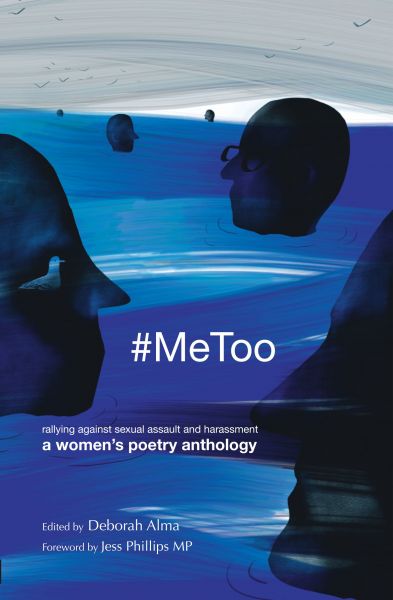
The #MeToo (Fair Acre Press, March 8, 2018) anthology camestraight out of a long thread on my Facebook page in October 2017, just as we were talking about the Harvey Weinstein allegations on the news and before I had even heard of the #MeToo campaign. I asked women friends of mine to add their name on the thread if they hadn’t experienced any form of sexual harassment in their lives and I was surprised to find that of the 200 women that started to share some of their stories , 2 or 3 told us that it had never happened to them. My surprise was not that there were so few, but that there were any women at all.
Of course over the years we have shared these stories with our friends, sisters, mothers, partners and sometimes with the police, or in court. It has been the water we swim in as women. But saying something publicly has always been difficult and brave. The words would stick in our throats, for so many reasons.
But something was released and given a space within social media. It was easy to add our voice to the rising shout of #MeToo. We felt the sisterhood. Many women were emboldened by this to share more difficult stories, more details.
I’m a poet, and an editor and someone suggested we collect these stories somehow and it was obvious to collect them as poems. It was what I could do.
I am very proud of this book, proud of the poets for sharing and for the courage in putting their names to their words. I have been amazed by the wonderful collaboration in its making; all of us women. Jessamy Hawke is the daughter of an online friend and she came forward and offered to make new line drawings for the book, the striking cover was made for the book by my friend Sandra Salter and all the work of editing and publishing was donated. Jess Phillips MP gave us her introduction and it’s been endorsed by Amanda Palmer and Rachel Kelly amongst others.
I do recognise that it is a painful and difficult to read a great deal of the time. But when taken slowly, and with reading only what you can bear, I trust the reader will hear its rallying cry of anger and impatience. We have had enough.
We share an attic room. In the corner is an old double bed that smells and sags on one side. My side. Late at night I hear my heart beat. Loud. So loud he will hear it. He will think my heart is calling him up the attic stairs. His footsteps are heavy. He smells of old spice and cherry tobacco. My eyes shut tight. I know he is there. I feel his weight. Never on my side. Always on the side she sleeps. When the bed-springs sing their sad song I fly away. Up to the ceiling. My sister is already there. Together we hold hands. Looking down we see our bodies. We are not moving. We are as still as the dead.
The Return of Persephone, c.1891 (oil on canvas) by Leighton, Frederic (1830-96); 203×152 cm; Leeds Museums and Galleries (City Art Gallery) U.K.; English, public domain
PERSEPHONE’S DAUGHTERS is published online, in print and in film. This magazine’s content is based on a mission to empower women / femme individuals who have experienced various forms of gendered abuse (sexual, emotional, physical, racial, verbal, etc), or other forms of degradation (harassment, catcalling, threats, etc). Persephone’s Daughterswelcomes all identities.
Online Sunday Stories feature personal accounts of those surviving abuse. There is also a film submission category that aligns with the mission. Accepted works are featured online on Film Fridays. Of note is a post-election mini-issue, a writing and art collection by people who are negatively effected by the outcome of the 2016 U.S. election. Proceeds from the sales of that collection go to the Young Center for Immigrant Children’s Rights, which provides services, legal help, and advocacy to unaccompanied immigrant children fleeing trafficking, conflict, poverty and more.
I bring you time
wide, unbridled,
seamless as seas;
the fragile vee
of fledgling’s beak;
the solidness of shapes:
oak, tower block, petrol pump;
a coupling, tripling,
quadrupling of souls;-,
the still small pureness
of alone;
of colours, every one;
an ample mixing palette,
deftness of touch to conjure
your own shades.
An ear tuned
to the furthest whisper
of the furthest corner
of all your life might hold,
and every decibel step
and variation from this
to the loudest brain roar;
a hundred eyes to sperm
innumerable words;
the knowledge-gift
and mystery of saying
all you need to say
in one, or two
ladybirds, beetles and bugs
worms and platoons
of white maggots
with bluebottle generals in charge
turned the corpse
inside out
upside down
and bit by bit
spirit eased itself free
of tissue remnants and bones
squeezed between stones
until it stood proud of the earth
an aura of wishes still clinging
wondering why it felt
so lost, so alone
wondering


 © Gretchen Del Rio
 Here in North America we tend to forget how pervasive sexual violence is, and how retraumatizing public conversations about sexual abuse and harassment can be for victims of sexual crimes.