Never starving artist, for we feast on what our father has made
Infinite of beauty.
This poem is about my reaction to the protest and gufaws at the die hard simplicity my husband and I attempt to maintain. Green is in but sadly simple joy and the appreciation of nature, human experiences and connection is not. So, if you see a petite, brown skinned cellist busking on a street corner near you, give her a hug. If it is not me, I am sure she won’t mind. If she does…it will give you something to write about.
There used to be craters on the moon, now the moon is a crater. Carved out, mined of all its juices, it remains derelict. Too light to continue to orbit: it just hangs, skeletal and listless. Unable to wax or wane, its cycle broken.
Tidal-confusion grips the ocean below. Trapped, neither flowing in nor out, unable to turn yet trying to. Turning itself one way, then the next, like an uncomfortable sleeper, too hot inside its own shape.
I sit, bare-footed, on night-dewed grass, sniffing out the hot-salt of the ocean that cannot rest, the orange-rind moon above. I too am neither one thing, nor another. I whisper to the blades of grass, tap on the earth, and wait for the flowers that will never come.
Carbon Footprint
In my lifespan,
so far reaching 22 years,
I have owned 3 computers,
3 games consoles (despite the fact I don’t really use them)
and 3 mobile phones,
the first of which would have lasted forever, but,
in a freak accident my dad ran his car over it.
I can’t drive, but I did have a moped –
but I crashed twice and got rid.
I have voted in 1 election – (you made me)
but I won’t say who for. (Yellow)
I can ride a bike, swim (just about), speak French
and have that crazy allele that lets me roll up my tongue.
I have drank 0 cups of tea, smoked 0 cigarettes –
the only nail polish I own is black.
I have eaten:
1516 Apples
1232 Loaves of Bread
243 tins of Baked Beans
3125 Carrots
669 kilos of Spuds
181 kilograms of Chocolate (mostly without you)
and 345 Chickens.
I have bought over 2000 books,
borrowed over 3000
and never returned at least 5 (one’s yours, I’m sorry).
I have spoken 32,301,600 words
written nearly as many,
but lost most of them in workshop.
I have had 30,025 dreams,
most of which were nightmares,
some in black and white,
some sound-only, (but always your voice)
and some so real – they remain
like false memories –
when I wake up the next morning.
I have blinked 119,376,303 times,
walked over 4450 miles,
cried 34 pints of tears (25 pints were for you),
shed 588 skins (but for you I haven’t changed once),
experienced over 834,200,000 heartbeats,
I have lost my virginity once,
had sex with one person,
and (I think you should know this)
have only ever fallen in love once.
To name a purple flower—hubris;
To call red a rose. A rose is a rose is a rose,
She said.
The fruit of purple.
So like an apple—
so unlike an apple—
poison to eat. —Sodom’s apple milkweed—
A rash thought that
blisters my skin. A rose is a rose is a rose,
She said.
[1] “Calotropis procera, a milkweed native to the Dead Sea and Sodom, Israel and other desert regions” (Wikipedia). Known also as Apple of Sodom.
Which is also the title of a Marilyn Manson song written for a David Lynch film, Lost Highway(warning: strong images in this YouTube music video of the Marilyn Manson song):
This poem originally appeared on Instagram, in an earlier version.
Shaken earth weeps
floods of ice in all lands,
attempts to cleanse itself.
We diseased cells have
metastasized, eaten
its forbidden flesh,
perforated its bones.
What it cannot shake
off it sweeps away
in wind or burns
off in fires. Glaciers
wear down what remains.
Everything known is now
extinct. Only new forms
emerge, scathed and
transformed from death
by cancerous greed—
into a fallen grace.
Some years ago, I spent extended time in the National Forests of Colorado and Utah. Between archaeological projects, I would have several weeks at a time for leisure, exploration, solitude. Sometimes I travelled and searched out places that I hadn’t been to before. Other times I practiced “staying”, or “being in place.”
The area I was in was at some elevation, and there were noble stands of Ponderosa pine, enormous trees that smelled of vanilla and created a very open and inviting park-like setting. One particular day I was out on a hike, wandering outwards from my base camp on various forest roads that criss-crossed and meandered. I remember feeling very alive, aware of my own aliveness, and aware of my curiosity about the trees, the geography, the clouds, etc….one of those days when every individual thing seems like a book, completely open for me to read from, if only I am willing to spend the time.
I had brought with me, almost as an afterthought, a Peterson’s bird guide. Somewhere in my mind I had thought that, as long as I had free time on my hands, perhaps I should learn to make some identifications, improve my standing as a “naturalist.” There always seemed something heroic about those intrepid 19th century gents (and a few ladies) who had adventured to parts unknown and had come back with a clear and precise list (if not a whole menagerie of samples) of what “things” are in the big wide world. Well, me with a Peterson guide felt like being Darwin without the hard work, Audubon without needing a paintbrush. Natural historian, lite.
On this day, I hadn’t gone out doggedly determined to “identify.” But as I hiked, the guidebook rubbed against my butt in my back pocket and gave me a little physical reminder that I could add a pinch of productivity to my high-spirited stroll in the woods. So, when I saw in the distance a little grove of aspen trees squeezed into a little spot between two Ponderosa stands, and I furthermore saw and heard some tiny birds flitting about, I pulled the guide book out. Even at this distance, I “recognized” the birds as chickadees though I wasn’t close enough really to see their markings well. It was just that the chickadee was a fairly common bird, one I that knew, and that these little birds were the right size and were behaving in ways that didn’t surprise me. So, my starting ID was “chickadee.”
I approached further, starting to leaf through the book to find the right section, and even as I got to the correct page, I remembered that there is one species commonly named “Black-capped Chickadee” (Poecile atricapillus) and another one, only slightly different in markings, named “Mountain Chickadee” (Poecile gambeli) which was to be found in the Rockies. Now, I’m from Wisconsin, so the black-capped is the one I’ve been familiar with through most of my life. But now, with page held open, reading the information, examining R.T. Peterson’s carefully drawn marking differences in the book, I felt like my original chickadee ID was not good enough! These birds must be identified correctly!
Luckily, chickadees are gregarious birds and generally happy to hang around when human company comes. I approached closer, looking to see if I could spot the color of the feathers around the eye. Mountain chickadees have “a black postocular stripe behind distinctive white eyebrows.” Sitting in the grass, looking up, watcing them, my bad eyesight and eye took enough time to confirm that these were mountain chickadees. A triumph of investigative naturalism, right?
Well, no, not exactly. My eyesight isn’t great, to say the least, so it took me some time and patience to really make sure what I was seeing. I sat there nearly an hour, watching the birds (3 of them) flit, perch, sing, fluff, swoop, hop, etc. And so, even as I was feeling more confident in my eye stripe observation, I was noticing that this one (Chickadee #1) had one of his tail feathers skewed a little to the side and that other one (Chickadee #2) was the one that kept going back to that same perch on that aspen tree, etc. It started to dawn on me that if I sat here long enough, if I had the patience of Darwin and the artistic eye of Audubon, eventually I would see each of these chickadees as a totally unique and individual creature. And then, I pondered philosophically, is Chickadee #3 (let’s call him Ralph) best known as (1) a mountain chickadee, (2) a chickadee, (3) a bird, (4) an animal? (And don’t think the list ends there. If we can stretch ourselves to think ecologically, there are much larger categories as well). Or is “Ralph”, the affectionate label I gave him/her and which encompasses what I experienced about him/her while I spent an hour in his/her company, equally as accurate a description of that wonderful animated life? In other words, was Ralph, the animal-bird-chickadee-mountain chickadee more accurately described as a thing that I can place in a category, or as that with which I had a relationship?
_____________
Wherefore this anecdote? What does this have to do with sustainability? Well, the time spent with Ralph had a profound effect on me. It critically changed how I think about the natural world, what it is and what my relationship is to it.
There is an innate human desire to understand. Understand what?….pretty much anything humans come into contact with. We are the animals that delve, that look into, that want to know what it’s all about. This desire to understand has been turned full force on the natural world since the dawn of the human species. But is the desire to understand the same as understanding? Are there good ways to understand and bad ways? Are knowledge and wisdom the same thing? And once understanding is attained does it require some sort of responsibility on our part?
One side of this picture is the human capacity to understand by rationally knowing, i.e. by identifying, labelling, organizing, measuring, connecting the dots. Data and the computing power of our brains lead us to a world of timing, efficiency, and predicting the future – all very useful things when you want to make a good decision. This talent, developed more highly in humans than in other living things, is undoubtedly one of the factors that has allowed us to survive and prosper on this planet. By knowing things, as “things”, they are easier to manipulate, overcome, defend against, manage, control, etc. It is a remarkable skill which, in conjunction with our ability to share information with other humans, not only contemporarily, but also into suceeding generations, has made us the all-time champion of “clever” animals. It has been critical to our power in the world….originally, the power to survive and then later, and only quite recently in our species’ history, the power to dominate natural environments.
On the other side of the picture is understanding by “having a relationship with.” This is understanding that develops through spending time with, observing (without categorizing), accepting, appreciating beings, things and systems for what they are, having affection, and loving. Think about all of the closest relationships you have with people in your life. Whether you are thinking about your spouse, your parents, your child, your best friend or your long time colleague at work, it is highly likely that you would say that you “know” them. But you didn’t get to know them simply by labelling them or by compiling statistics and facts about them. You didn’t do experiments on them (hopefully!) and, while you might think you can predict some of their behavior, you don’t enjoy their company because of their predictability. You know and understand them because you have spent much time with them. You’ve seen them in different moods and different situations. You’ve seen them change. You’ve had fun with them, been angry at them, laughed with them, forgiven them, apologized to them, touched them, given them space….and much, much more. Your knowing them is not so sharply specific as the genome data gleaned from a blood sample or a soil pH reading. Yet, I doubt anyone who has come to know another within the context of working at and living through relationship would ever trade that fuzzy, flexible, unreliable but ultimately personal understanding for a rationally, scientifically precise list of proven facts about their friend.
I do not want to denigrate the first way of knowing that I outlined above. I am deeply impressed and appreciative of the human mind. My own life and all of our lives have been enriched by the many minds that came before us to a degree that is hard to fathom. We stand on the shoulders of our ancestors and I thank them. Yet our over-reliance on this side of the picture of understanding has led us to a crisis, one which I believe we will not be able to overcome unless we invigorate the other side of our understanding. It is in relationship that our rational knowledge finds its proper place. Knowing in relationship requires that we begin to know ourselves better as well and this is the starting point of taking true responsibility for how we live.
As I see it used, the concept of sustainability sets up its own conversation in a way such that measurement, categorization, quantification, efficiency and acceptable loss are of prominent importance. The playing field of the debate is already chosen. There are quantifiable “bottom lines,” be they measured in dollars, board feet, number of mouths fed, acreage, species mix ratio, etc. It is my assertion that any question posed this way can only, at best, lead us to be better “managers,” when, in fact, it is not poor or inefficient management that is the problem. While collections of data and analysis can certainly be useful, they are completely silent on a far more crucial question. That question is this: Where do we get the wisdom to decide if, when and how to use the power that our “clever” knowledge has made available to us?
The ultimate decisions that will matter will not come from managers that “manage the world,” whatever that phrase could possibly mean. What is needed is the wisdom to manage ourselves, first as individuals, and subsequently in the context of community and culture. What needs to be “sustainable” is not something outside ourselves but a way of life that starts inside ourselves, that includes gratitude, acceptance, contentment, humility and responsibility.
My encounter with Ralph, the mountain chickadee, now as I think about it these so many years later, was importantly an encounter with myself, with my own biases, a desire for control, a mindset…and then, luckily, a moment when I found the world to be bigger and more unique than my mind could contain. I loved the world then, not because I was able to pin it down, separate from myself, but because I understood that I was part of it.
How often do you think about the future? Now, how often do you think about the future, without you in it? Do you ever wonder about the fates of the humans who will be here after you’re gone? How about the plants and animals that share this planet with us? We humans can be insatiable creatures. Unfortunately, insatiable is not sustainable. When is enough enough? When we have completely exhausted the planet’s natural resources? When there are unending wars over clean, drinkable water and viable food sources?
The bad news is that scientists are saying that we are already in the midst of the Earth’s sixth extinction event, also called the Holocene extinction and guess what? WE humans are the primary cause (due to overpopulation, over-consumption, humans’ overall impact on the environment and human-accelerated climate change) and we’re probably not going to be able to fix it anytime soon.
What’s worse, is that there are many world powers interested in keeping the status-quo of insatiability going; corporations and politicians who are making billions of dollars off of every day consumers who have been convinced/duped that they need the newest i-Phone, or who won’t go without their bottled water or snacks made with palm-oil. Are you contributing to the problem? Be honest.
The good news is that people are becoming aware of their impact on the planet and coming up with clever ways for all of us to be more sustainable. From 100% biodegradable disposable plates made of leaves and edible cutlery to shopping bags and packaging made of plants instead of plastic, we’re gradually making progress towards a zero-waste world. There are lots of Eco-Friendly inventions being created! For those of us working towards zero-waste, there are what are called the “5 R’s“: Refuse, Reduce, Reuse, Recycle and Rot. If you’re interested or thinking about ways in which to do this, here is a great video to help you get started.
It’s not about judgement, but rather, discernment and responsibility for your own actions. It’s about being the change you wish to see in the world. Let’s lead by example. 🙂
In closing, I’d like to share a video by one of my favorite activist-poets, Prince EA.
And these words, which I command thee with this day, shall be upon thy heart…
And thou shalt bind them for a sign upon thy hand, and they shall be for frontlets before thine eyes.
—Deut. VI:6, 8
I.
My beloved whispers in my ear; she reveals herself to me—
her Words, jewels upon my breast, upon my hand, upon my forehead. When my beloved walks in the field, the heron flies up with cackling praise; she inspires the crane to laugh as it rises into the sky; the swallows dance for her.
I have come and gone with uncertainty and doubt; but my beloved inspires constancy:
Though in times of drought the hill dries out, the hollows hide some mud, remembering. My beloved brings rain into the high, parched fields that have forgotten her; she walks among the swaths and sheds her tears for each cut stalk.
The hollows swell with water to quench the beasts and grow the iris;
my beloved reflects their grace as they mirror the sky among the grasses.
II.
The storm was terrible: the thunder rumbled long in the night; the lightning terrified;
a wind blew through the window of the house and tapped upon the walls. Yet, my beloved whispered in my ear and I wore her words like jewels. In her arms I rested as the fields drank deeply, the dry holes filled with sweet water.
In the dark I am drawn to my beloved; she is even more glorious in the light:
She is a stand of gentian unexpectedly found near the edge of the willow. An eagle flies above the goldenrod and pines; I know my beloved thinks of me. The thought of my beloved eases my burden as I toil on the road to her house:
Her kisses, sweeter than blueberries freshly picked, inspire acorns to rise toward the sky;
her caresses provide strength to the birch, the aspen, the maple, the oak, but also to grasses.
III.
I hold my love; she holds me. I have studied her in the willow, the iris, the thistle:
finches, warblers, and wrens feed and live in her shelter, so my love feeds and shelters me. The oats have been cut, the hay rolled and stored for the winter. My love comes to me and whispers in my ear; she reveals herself to me.
The geese gather and call, flying over the trees, landing in the pond:
my love sighs and the grasses bend; the aspens sigh and my love bends to me. Her kisses build the temple; her love holds me and I heal: My beloved is mine, I am hers. She points to the flowers off the path:
small white bells, tiny blue trumpets, vetches, paintbrush; I don’t know all the names.
My beloved knows the Names of the Flowers; she whispers them to me: I embrace her.
והיו הדברים האלה, אשר אנוכי מצווך היום– על לבבך… וקשרת לאות, על ידיך; והיו לטופפות בין עיניך
-ספר דברים, פרק;, פסוקים ו’-ח;
I.
אהובתי לוחשת לי באוזן; היא נגלת אלי-
מילותיה, תכשיטים על חזי, על ידי ועל מצחי. כשאהובתי פוסעת בשדה, הענפה אצה מקרקרת תשבוחות: לעגור היא נותנת השראה לצחוק במעופו אל השמיים; הסנוניות רוקדות עבורה.
באתי והלכתי עם ספק וחוסר ודאות: אולם אהובתי משרה השראה בלי הפסקה:
גם אם בשעת בצורת הגבעה מתייבשת; הנקיקים מחביאים קצת בוץ, זוכרים. אהובתי מביאה גשמים אל הגבהים, אל שדות קמלים אשר אותה שוכחים; היא מהלכת בין האלומות ומזילה דמעות על כל גבעול שנגדע.
הנקיקים מתרחבים ממים שמרווים את החיות ואת משקים ומצמיחים את האירוס;
אהובתי בבואה לחֵינם באותה מידה שהם משקפים את השמיים בין הדשאים.
II.
הסערה היתה נוראית: הרעם הרעים לאורך הלילה; הברקים הבהילו;
הרוח נשב מבעד לחלון ונקש על הקירות. אבל עדיין, אהובתי לחשה לי באוזן ואני לבשתי את המילים שלה כמו תכשיטים. נח בזרועותיה בעוד השדות בשקיקה שותים, הנקיקים היבשים במים מתוקים מתמלאים.
בחסות החושך אני נמשך אל אהובתי ובאור היא אפילו עוד יותר מופלאה:
היא גבעול גנציאן סגול הנמצא במפתיע בפאתי הערבה. נשר חג מעל האורנים ושיחי שרביט הזהב הצהובים; אני יודע שאהובתי עלי חושבת. המחשבה על אהובתי מקלה על המשא שלי בעוד אני עומל לעשות אל ביתה את דרכי:
נשיקותיה, מתוקות מאוכמניות טריות, מעוררות השראה באיצטרובלים להתעלות מעלה אל רקיע;
ליטופיה כוח נונתים לליבנה, לצפצפה, למייפל, לאלון אבל גם לעשב.
III.
אני מחזיק את אהובתי; היא מחזיקה אותי. למדתי אותה בערבה, באיריס, בחוח:
פרושים, גדרונים וסכבים ניזונים ובמקלטה חיים, ככה אהובתי מאכילה ועלי מגנה. שיבולת השועל נחרשה, עובדה ואוחסנה לימות החורף. אהובתי אלי ניגשה ולי באוזן לוחשת; היא מגלה עצמה בעבורי.
האווזים מתאספים וקוראים, עפים מעל העצים, באגם נוחתים:
אהובתי נאנחת והאווזים רוכנים; הצפצפה נאנחת ואהובתי רוכנת לעברי. נשיקותיה בונות את המקדש; אהבתה אוחזת בי ואני מחלים: אהובתי שייכת לי ואני לה. היא מצביעה לעבר הפרחים לצד הדרך:
פעמונים קטנים לבנים, חצוצרות זעירות כחולות; מברשות, מטפסים; אני לא מכיר את כל השמות.
אהובתי יודעת את שמות הפרחים; היא לוחשת לי אותם; אני אותה מחבק.
In reading that word – sustainability – cradling the head of our current Guide Dog puppy in my hands, her deeply pleading eyes looking up at me, I am reminded that this word not only describes what we at The BeZine – and indeed many, many more people around the world – more commonly come to understand of its meaning.
I have hitherto thought of sustainability as the fundamental process, nay philosophy, that needs to be adopted in order for the Earth to continue providing for all the life that inhabits it. But it also reflects human behaviour; it expects a certain attitude; it assumes that an essential ingredient to the achievement of a sustainable World is that the human beings, who inhabit the Earth become determined to adopt a way of life that is … well, sustainable!
It is an unfortunate character of the human condition that it is not until we lose someone that we become much more conscious of their value to our own life. It seems, whilst they are still around, that we prefer to focus more on their faults and shortcomings than on their virtues and strengths. We are even more prepared to abuse or betray their trust, than to respect them. So too, our Mother Earth.
As I regularly drive the roads around us, particularly the lanes of the beautiful countryside that surrounds us here in Yorkshire, I am reminded also of one of those human faults, anxiety, and of all the consequences of that condition: stress, impatience, fear, anger, aggression, depression. All too often, when I glance in my rear view mirror, I see another car race up behind me and sit so close to my rear bumper that I can’t see their number plate; at speeds and in situations in which it would be lunacy to contemplate overtaking. It is as if they are tempting me to yield, give in, pull over into a ditch and let them pass … and claim me as another victim! It isn’t necessarily that, I know, but it feels like that and, even in my advancing years, with the wisdom and insight of the road that I’ve gained in fifty years of driving, along with lowered testosterone levels, I sometimes feel like retaliating … and we all know how that could turn out.
The Dalai Lama it was, who attributed anxiety or agitation as the root of all conflict in the World. There is no doubt that he is right. Yes, I hear the academics, anthropologists, psychologists and any number of other -ologists, state the obvious, that Darwinian principles of evolution and survival in the animal kingdoms, of which human is one, dictate this behaviour. Our base instincts are therefore not to respect any forms of life outside our own sphere, outside our immediate survival zone; to consider them a threat to our survival.
… Really?
We are beyond this, surely, aren’t we? Can’t we exert more control over our behaviours, or are we simply hopeless victims of our own psyche; our individual intractable personality. For many in the Western World, the need to survive, to subsist on what our local environment can provide us, has long since turned into higher and higher material expectations. Each generation starts with more, but wants still more than the previous generation. Our survival instincts have turned into greed; at the expence of those on the margins, particularly in the overexploited so-called Third World. Are these expectations a consequence of some out of control unconscious driving forces within us, or could we re-educate ourselves. I believe the answer for some, sadly, is ‘no’. For others it would be ‘yes’.
I contend that the World could continue to support all life, even with its currently burgeoning (human) population. If only we were able to overcome our unreasonable expectations, there is one overriding benefit that could accrue from vanquishing our own greed … we could begin to feel what it is like to live with less poverty in the world, and less debt; less personal debt; less corporate debt; less national debt. Currently the only way Western governments can see to pay off the latter, is growth, economic growth, which has become the unquestioned Demi-God of economic and political policy objectives; growth is, I believe, a largely misunderstood, overused and abused tool of political rhetoric. This is, unfortunately, a vicious circle. I’ve heard growth described as a means of servicing our national debt. Long term, this does not make economic sense and surely cannot be sustainable!
So, what are we to do? Save more? Conserve our resources, however modest they may be? Adjust our expectations and those of our children? Their generation and the ones that follow, will otherwise only continue this roller coaster of a suicidal ride into debt and debt slavery; a World in which the super wealthy few have more and more control over the increasingly debt-ridden many. Freedom from debt, however you achieve it, whatever the cost to your expectations, your dreams, has to provide the way to a more sustainable World, and …
It. Is. Liberating.
Otherwise, our greatest and only means of survival, our patient and beautiful Mother Earth, will expel us, rich and poor, forever, and no-one will inherit anything! Space exploration to find a new life sustaining planet somewhere out there in the vastness, is pure fantasy … and vanity!
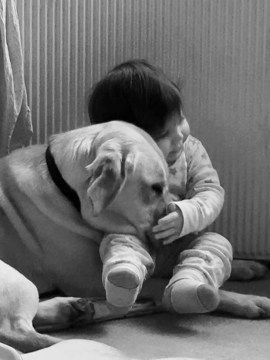
What can be done to reduce your anxiety? A starting point for me is to have a hug with your best friend, be they human … or puppy dog.
Photo: Barbara Anstie. Creative edit: Dave Anstie
“The Great Divide“
Crossing the great divide
between the dark age
and a brave new world,
sailing from the safety
of knowing your place
into uncharted waters.
In a deep and sickly swell,
an ocean of uncertainty,
struggling to recall
the purpose of the mission
for control of life, of lives,
and death by ownership.
From a certain time when
the have-nots had not
to one in which they have
a chance to trade their life
for aspiration, for riches,
for stuff and things,
for dukes and knights,
for castles and kings,
in suits that shine
with lights and bling,
but didn’t see the price
they’d have to pay.
Rivers flow with mighty force,
and carry away the memory
in a flood of whys, for what
and where will this all end?
Where are we now,
where will we be …
may be Utopia, the place of dreams
that while away our wild ambitious schemes?
We fail, as long as we can feel the pain
of having less than someone else’s gain.
Or we, by virtue of the coin’s toss,
have more by far than someone else’s loss.
What Fossil Fuels and Factory Farms Have in Common
Hint: They’re both issues of environmental injustice.
In 2008, Cabot Oil and Gas started fracking operations in Dimock, Pennsylvania. It was around that time the community started noticing their water was turning brown and making people and animals sick. One woman’s water well exploded. Fracking had come to town.
It’s a familiar story in other rural communities—from Pennsylvania to Montana and Texas—where fracking has contaminated drinking water resources and emitted toxic air pollution associated with higher rates of asthma, birth defects, and cancer.
But the story is similar in other communities where fracking or other extreme fossil fuel extraction isn’t happening. Air and drinking water that’s been dangerously polluted from industrial operations affect communities across Iowa, including the state’s largest city, Des Moines. Polluting facilities are operating in Central Oregon, North Carolina, Wisconsin, and Maryland. None of those places are fracking, but they are host to another environmental hazard facing rural communities: factory farms.
Like the fossil fuel cartel, this highly consolidated industry prioritizes profits at the cost of our environment. Factory farms are an industrial model for producing animals for food where thousands of cows, pigs, or birds are raised in confinement in a small area. While farms can and do apply manure as a fertilizer to cropland, factory farms produce more manure than nearby fields can absorb, leading to runoff into surface waters and contaminants leaching into groundwater. And storing concentrated quantities of manure releases toxins like ammonia and hydrogen sulfide into the air, threatening nearby communities—and even leading to worker deaths. The nearly half a million dairy cows on factory farms in Tulare County, California, produce five times as much waste as the New York City metropolitan area and carries chemical additives and pathogens like E. coli, many of which are antibiotic resistant.
Factory farms are also an issue of environmental injustice. In North Carolina counties that contain hog factory farms, schools with larger percentages of students of color, and those with greater shares of students receiving free lunches are located closer to hog farms than whiter and more affluent schools. Just like with fossil fuel infrastructure, these toxic facilities are more likely to be in places that are least able to resist their development.
Another thing factory farms have in common with fossil fuels: They are a danger to the climate. Livestock production contributes 14.5 percent of all human-caused greenhouse gas emissions. Methane emissions from the digestive processes of cattle contribute 39 percent of the greenhouse gas emissions from livestock production, and manure storage and processing contribute 10 percent. Additionally, monoculture crops like corn and soy are a hallmark of our highly consolidated food system and are one of the reasons we can raise mass quantities of livestock. These crops contribute nearly half of the emissions from the sector. Meanwhile, more sustainable meat production methods like smaller farms and grass-fed operations may have lower greenhouse gas emissions than factory farms. Without a rapid transition away from factory farming, we will not avoid catastrophic climate change.
We can’t shop our way out of the damage that is being done to our environment.
Yet attempts to regulate factory farms have been weak-kneed and ineffective. For example, federal law requires they report significant releases of toxic pollutants like ammonia. But the Environmental Protection Agency actually does little to monitor, much less prevent, these emissions. In 2009, for example, the agency rolled back regulations so that only the largest facilities had to report these emissions—and only to local, not national, emergency response officials. In 2018 Congress went even further, granting an exemption from reporting requirements for air emissions created by manure on farms. Similarly, the EPA does not collect comprehensive data on factory farm size or location, making oversight impossible. And while the Clean Water Act regulates water pollution from industrial facilities, the EPA has looked the other way; the agency estimated in 2011 that less than half of the facilities required to get discharge permits had actually obtained them.
Calls to ban fracking have been proliferating since we have found that it is too dangerous to simply regulate. The inherent risks to our environment, our climate, and our communities are simply too much.
Now, we need to say the same thing about factory farms. Both industries are putting rural communities at risk so that large polluting companies can become larger and more profitable. Climate advocates who are already facing down the fossil fuel industry should find common cause with those who are fighting to stop industrial agriculture in their community.
Systemic change is needed. We can’t shop our way out of the damage that is being done to our environment by simply choosing to reduce meat consumption or ride bikes to work. While these are meaningful steps, we must also demand policy action. It’s time to reverse the decades of pro-industry policy that have made Big Ag and Big Energy bigger and badder, and create policies that start phasing out pollution from agriculture and energy.
We know how to do it: We need to demand meaningful laws and regulations—including bans on new polluting factory farms and fossil fuel infrastructure—that prioritize people over profit. This is already happening at the state level in places like Iowa, but we need to work at all levels, starting now, to enact the changes we need to protect our environment, our water, and our communities.
The Wolf River, Kansas by Albert Bierstadt, c. 1859
I sometimes dream of eastern Kansas,
in those days before the wars,
when the white men fought each other
to be the right men behind the doors,
deciding the lives of men red and black,
to remain the preeminent beast,
over this land he said God was his alone,
from the left coast to the east.
I think of the man in the village,
sitting on the bluff above Wolf Creek,
and how once he ruled wherever he stood,
a wandering Pawnee being anything but meek.
And I know his time is passing,
his wandering no more his choice.
Soon the white man will fight everyone
over the black man who still had no voice.
In my dream the lodges moved westward,
if they ever moved at all.
Because illness, greed and the great lord God
seemingly turned on the Pawnee, Otoe and Kaw.
And that’s why I dream of eastern Kansas
in those days before the wars,
because a native man might still call his own
his land, his freedom and his lores.
Free-write rhyming thing, an exercise I tried to get the juices flowing. For whatever reason, the name William Stafford and the words “Lawrence, Kansas” kept clanging in my head. I searched for some art that might help stimulate some creative spark and found that picture by Albert Bierstadt of Wolf River in Kansas, circa 1859. Then I let loose the reins and my claybank muse cantered me here.
Vandana Shiva in Cologne, Germany in 2007 courtesy of Elke Wetzig (Elya) under CC BY-SA 3.0
“….this much I know. I do not allow myself to be overcome by hopelessness, no matter how tough the situation. I believe that if you just do your little bit without thinking of the bigness of what you stand against, if you turn to the enlargement of your own capacities, just that itself creates new potential. And I’ve learned from the Bhagavad-Gita and other teachings of our culture to detach myself from the results of what I do, because those are not in my hands. The context is not in your control, but your commitment is yours to make, and you can make the deepest commitment with a total detachment about where it will take you. You want it to lead to a better world, and you shape your actions and take full responsibility for them, but then you have detachment. And that combination of deep passion and deep detachment allows me to take on the next challenge, because I don’t cripple myself, I don’t tie myself in knots. I function like a free being. I think getting that freedom is a social duty because I think we owe it to each not to burden each other with prescription and demands. I think what we owe each other is a celebration of life and to replace fear and hopelessness with fearlessness and joy.” Vandana Shiva (born 5 November 1952) is an Indian scholar, environmental activist, food sovereignty advocate, ecofeminism, and alter-globalization author. Shiva, currently based in Delhi, has authored more than twenty books.
Thích Nhất Hạnh during a ceremony in Da Nang on his 2007 trip to Vietnam courtesy of mettabebe under CC BY-SA 2.0 license
“We often think of peace as the absence of war, that if powerful countries would reduce their weapon arsenals, we could have peace. But if we look deeply into the weapons, we see our own minds- our own prejudices, fears and ignorance. Even if we transport all the bombs to the moon, the roots of war and the roots of bombs are still there, in our hearts and minds, and sooner or later we will make new bombs. To work for peace is to uproot war from ourselves and from the hearts of men and women. To prepare for war, to give millions of men and women the opportunity to practice killing day and night in their hearts, is to plant millions of seeds of violence, anger, frustration, and fear that will be passed on for generations to come.” Thich Nhát Hanh, Living Buddha, Living Christ
A portrait of Rilke painted two years after his death by Leonid Pasternak
“How should we be able to forget those ancient myths that are at the beginning of all peoples, the myths about dragons that at the last moment turn into princesses; perhaps all the dragons of our lives are princesses who are only waiting to see us once beautiful and brave. Perhaps everything terrible is in its deepest being something helpless that wants help from us ….
“…..So you must not be frightened if a sadness rises up before you larger than any you have ever seen; if a restiveness, like light and cloudshadows, passes over your hands and over all you do. You must think that something is happening with you, that life has not forgotten you, that it holds you in its hand; it will not let you fall. Why do you want to shut out of your life any uneasiness, any miseries, or any depressions? For after all, you do not know what work these conditions are doing inside you.” Rainer Maria Rilke, Letters to a Young Poet
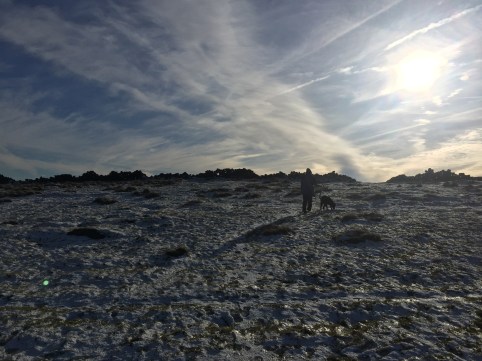
A sunny, frigid, late winter day. Later this week the temperatures will moderate and there will likely be a sap run.
I’ve taken to avoiding news feeds in the evening, and try to limit my intake of news during the day; I also spend too much time fact checking. Anyway, the sheer volume of hatred towards those who are vulnerable, and the environment, is simply overwhelming, a tsunami that threatens to devastate all I love in the world.
Of course, none of this craziness is new. I imagine Jung dropping by for a spot of tea. I can imagine him sitting there in the sun, drawing on his experiences leading up to World War Two, and expressing empathy for our situation. He would point out that we may easily become what we fear, and draw parallels between Islamic extremism and the behavior of extremists on the Christian right. Then he would wish us well, grab a cider doughnut for the road, and retreat to his hermitage.
I’m finding it difficult to take much solace in the knowledge that we humans fall off the cliff every now and then. These historical moments simply create way too much suffering, and I just can’t settle into any kind of detachment. If we learned anything from the events of the past hundred years, it is that any profound change requires acts of both personal and societal repentance and reparation.I understand there is only so much any one person or group can do to turn the tide, even as we must try. In the meanwhile, history moves forward under the watchful eyes of angels, even as many of us dig our heels in and resist.