It’s a monkey trap from West Africa, made of clay. When I acquired the clay pot, a rope was attached to its neck. Hunters used to stake the other end of the rope to the ground, and bait it with fruit or nuts. A monkey would smell the food, reach inside, and grab a handful.
The hole was large enough for a monkey’s open hand to pass through, but too small for a balled fist to come out. As hard as the monkey pulled, it couldn’t escape, because it never occurred to the greedy monkey to let go of the food.
This is often told as a parable denouncing greed, or as a cautionary tale about becoming trapped by a fixed mindset. But the antique dealer who sold me my monkey trap told me the rest of the story…
In the late 1940s, a monkey was caught in a clay monkey trap, like so many before it. It struggled to free itself, never thinking to open its fist. On purpose or by accident, it smashed the pot against the ground, the pot broke, and the monkey escaped. But here’s the best part…That monkey taught the other monkeys in its troop how to break and escape from a monkey trap. Neighboring troops caught on until, at least in that part of the monkey world, the traps became obsolete.
Imagine a world where we teach our young, our neighbors, and the greater community what they need to survive and thrive. Imagine a world where we open our tight fists and our closed minds and stop doing things just because that’s the way it has always been done. Imagine smashing the status quo to leave the world a better place for our children, a place where the powerful and oppressive are outwitted, outnumbered, and they and all their ugly trappings become obsolete.
If one little monkey can change the world, maybe there’s hope for us humans too.
no mendacity in the natural world ~ just an
untamed grace in the meditative industry of ants,
in the peaceable company of small creatures
going about the business of food finding
and mating and homemaking in the loam of
this province, the republic of innocence
here is the soul-filling beauty of sun rising over
jacaranda as she paints her joy on a blue dawn;
robin with her russet-hued breast hunts for worms,
her instinctive motherhood proud of babies in
the spar and scrap of nest life . . . it is in this –
the uncivil cosmos – that the gentle breezes
dance with us on our mud-caked travels along
ripening pathways through meadow and brush;
as the flaxen sun shifts from rise to fall,
our hearts beat with their ribbons of ruby life,
pulsing with ebbs and flows of love and fear ~
soon – we know – clouds will gray and the
inevitable dark and shivered moon will show
her craggy depths, sooty with doubt and danger,
our earthiness projecting its own shadows;
still we trust nature’s homilies, content in this
province where we’re left to be ourselves, left to
write our own wildness on the mirror of time
“How near to good is what is wild.” Henry David Thoreau
My days are ordinary now,
but they weren’t anything close
to that ideal at the time you
extended your hand.
We laughed at family
gatherings, just you and I–
knowing we were being bad,
which made it even funnier,
you being holy and all,
and me, a lowly sinner.
But you never saw me that way.
You were more Glastonbury
than Dublin,
More Yeats than Pope.
There are many aspects of life
that are still ordinary –
The sparrow’s call in
spring time,
the ball of fire
we call the sun
almost bouncing.
The days come and go–
Just like that.
I’m used to that idea.
It’s just you,
being gone
that will never feel ordinary.
Note: My friend, Father Patrick Rice earned his doctoral degrees in theology and poetry from Fordham University in New York City. He was a priest at St. Thomas Moore in Convent Station, NJ, from 1974-1979; Holy Spirit Church from 1979-1994; St. Francis de Sales Church in Vernon, NJ, from 1994-1997; St. Catherine of Siena, Mountain Lakes, NJ, from 1997-2009 and St. Kateri Tekakwitha in Sparta, NJ, from 2009 until his death. He was buried in Ireland. His spirit, however, remains alive and above ground in the hearts of all who knew and loved him. VG
Far within a forest thick, unperturbed by Time’s swift tick, stands a testament to Fae, roots deep as night, top tall as day.
Climbing vines hide tiny doors. Its feet are wreathed with mushroom spores. Leaves of Celadon and Jade mingle with the mossy shade and dappled greens of shimmered hues, creating screens for a secret muse.
Ancient seneschal of Pan, rarely revealed to the likes of man; misted tendrils obscure the way, they will not find it, try though they may. Only the pure of heart and need may find the chosen of Cernunnos’ seed.
If you should find a Fairie Tree, carry peace, tread lightly and leave it be. Respect the centuries that it’s stood, and be blessed by the Sidhe of the Woods.
Many people associate Israel with desert and war. Both desert and war do color the land. Some people express surprise when they also learn about the nature here—flora and fauna. I spoke with a travel editor once who said he had no idea there would be nature trails, flowers, or Ibex wandering the hills in Israel.
Ibex visit the field school
In the desert, the ibex (a species of goat and symbol of Israel’s nature preserves) often cross a hiker’s path. Especially in the nature preserves, they tend to be reasonably brave. One time, while staying in a field school in the Negev, a herd came to visit in the morning. Some of the small kids climbed acacia trees to get at the leaves. I encountered the kid standing on the rocks on a nature trail above the Dead Sea.
And there are trees, too
And we do have trees in Israel, too. As these pictures show, I am fascinated by the textures and colors of bark on the trees. Some of these trees grow near the Mediterranean. The red-barked katlav I usually see growing along valleys and gulches in the Jerusalem hills. We don’t actually have squirrels. I haven’t seen any, at least. The gray squirrel in the tree lives in Minneapolis. Or, at least, that’s where I took that picture.
Water reflections
Israel does have water. The t-shirt tells you so: Med Sea, Red Sea, Dead Sea. And there is the “sea” of Galilee (really a large lake). The pictures here come from a fish farm, freshwater springs that flow over the salty Dead Sea aquifers, a river, and the Mediterranean. There aren’t many lakes—there are some rivers. The Jordan River, most famous and religious of them, unfortunately has greatly diminished due to human use and misuse of water. It is no longer “mighty and cold,” although sometimes parts of it are cold.
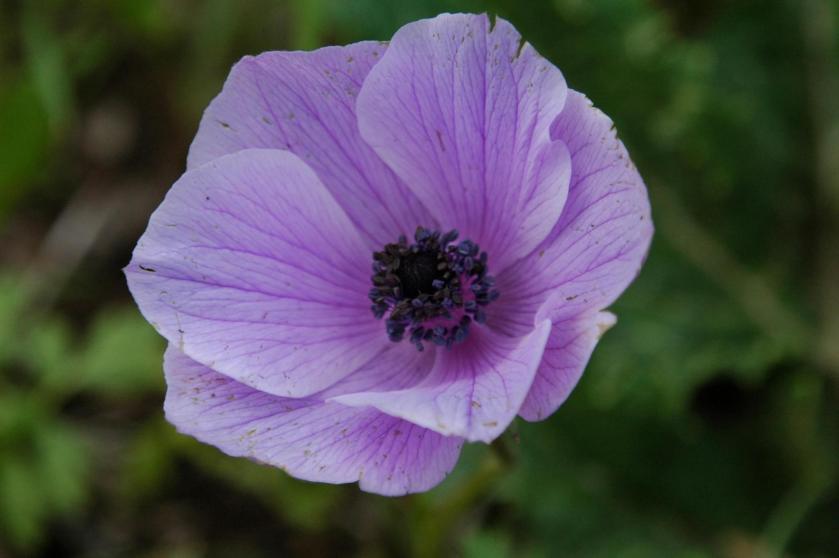
Of course, we have desert and beautifully barren-looking landscapes. We have rocky ruins (some of them along the nature trails). And not all of the anemones are red, although the other colored ones seem to grow mostly in the north (where there are incredible wild irises, rare wild peonies, and amazing narcissus that blooms with other wildflowers on some of the beaches. There are tiny narcissus flowers that bloom in the forests of the Jerusalem hills, too.
Purple anemone
The best time to see the flowers is late-winter to mid-spring. After that, it does turn hot, and most of the flowers die down. The trees remain. And the ibex roam the rocks, still. The nature trails are open all year. Although in winter, which is the rainy season, be sure to check for flash flood warnings—rain far enough away that the clouds are out of site could fill that dry gulch you’re hiking through with raging waters.
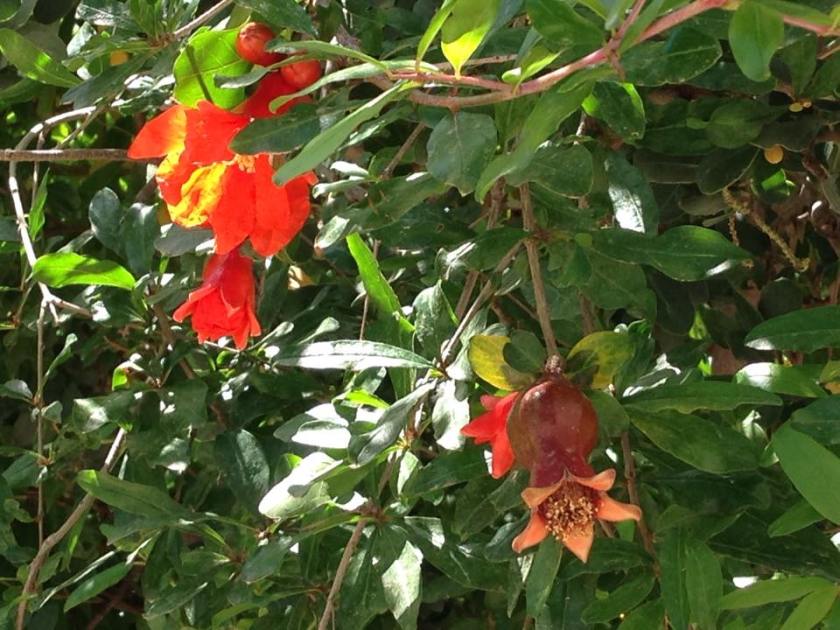
Pomegranate bush, growing wild.
All photographs were taken by Michael Dickel, who retains the copyright for them. Used with permission. The photos were taken with a Nikon D-70 digital SLR camera, which Michael unfortunately lost in recent travels. All light effects in the photos were done “in camera,” using manual settings, except the black and white tree, which was changed from color in Apple’s iPhoto app.
This feature article was originally published in Yes! Magazine. Annick Smith is the author of this and of a number of books, including Homestead (Milkweed Editions) and In This We Are Native (Lyons Press). She also produced the film Heartland and co-produced A River Runs Through It. It is licensed under Creative Commons and is published here with the permission of the Yes! Magazine.
When I was a child, I experienced my first taste of the wild from our summer house in the dunes bordering Lake Michigan. Running on beaches, gathering wildflowers, nestled within the maternal curves of the dunes, or swimming in waters that flowed to the horizon, I discovered freedom and solitude.
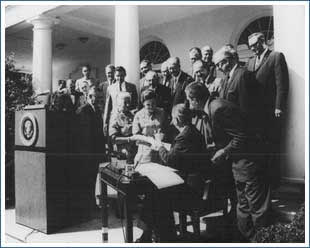
President Lyndon Johnson signs the Wilderness Act of 1964 in the White House Rose Garden. Also pictured are Interior Secretary Stewart Udall, Senator Frank Church, Mardy Murie, Alice Zahniser, and Representative Wayne Aspinall, among others.Public domain photograph of the U.S.Government
The Wilderness Act designated more than 9 million acres to be protected in its first year.
Seeking wild places would become a lifelong quest. I went from Chicago to Seattle as a 20-year-old wife and mother and discovered backpacking in the wilderness of the Olympic Peninsula. A few years later, my husband, Dave, and I acquired our patch of back-country in Montana’s Blackfoot River valley. We recycled an old hewn-log house and, with our four boys, moved into its rough shelter on Christmas Day in 1973. A year and a half later, while the six-year-old twins watched, I witnessed my husband die of heart failure on the maple floor of our kitchen. I stayed on our land, raised the boys, completed the unfinished house, found the true companion of my later years, and reinvented myself.
On balance, I think I am leading a good life, and it is tied to wilderness. My freezer is filled with salmon, steelhead, grouse, and elk fished and hunted by my son Steve; we grow organic vegetables in our raised-bed gardens; there is homemade wine in the cellar, and huckleberry jam for pancakes. My sons, though scattered, remain close to home in their hearts and minds. I share my household with two dogs and two cats, and the ghosts of my horses keep company with black bears, elk, whitetail deer, coyotes, bobcats—even porcupines. Our skies are vivid with American eagles, red-tailed hawks, and blue herons. Flitting among pines are migrating bluebirds, tanagers, chickadees, and hummingbirds. Down in Bear Creek, a few hundred yards from our cattle guard, we have seen endangered bull trout, and fished for native cutts, rainbows and brown trout. Tonight, singing winter’s end, spring peepers are courting in the cattail pond.
But a life in nature is not all wild roses. I used to have lush forests around me. Those forests had been logged, and in many places burned. Still, when my family settled here some 35 years ago, the foothills and mountains that circle our meadow were black-green with ponderosa pines, Douglas fir, and larch, and their density was broken only by chartreuse patches of seedlings growing back from clearcuts. For years, we have enjoyed the forest’s gifts, but now I watch logging trucks roll by carrying its trees away. Recently, I walked with my dogs in the woods above Bear Creek and found great swaths cut down, treetops and limbs scattered on the torn soil, bleeding sap. Health and beauty had fled to become toilet paper, plywood, and essays I publish in books and magazines—products I use and enjoy. I am complicit in my forest’s destruction.
Forrester Island Wilderness in the U.S. state of Alaska. Public domain photograph of the U.S. Fish and Wildlife Service
The idea of wilderness is embodied in our nation’s identity.
Yet not all logging is equal or necessary. I believe forests that harbor rare and bounteous wild life should enjoy protection, even if privately owned. I will do what I can to stop saws from cutting down every mature tree in my vicinity. But I doubt if I will succeed, because the forest is not mine. It is owned by Plum Creek, a corporation that calls its huge woodlands “industrial.” Plum Creek cares nothing for my environmentalist notions. If the forest is industrial, they reason, then it has one purpose, and that is to produce a cash product as efficiently as possible. But wasn’t it corporations themselves that thought to call forests industrial? As if calling something by a false name excuses the damage you do to it.
These days, looking west and south, I face logged off hills and peaks. And where the sun rises above my meadow’s fringed horizon, are the doublewides, SUVs, and barking dogs of creeping suburbia. Even the Blackfoot River, a mile and a half down Bear Creek, is being threatened by investors wanting to mine gold with cyanide at its headwaters.
A few years ago, we, the local landholders, ranchers, fishermen, environmentalists, concerned mothers, and plain citizens, won a ban on all mining with cyanide in Montana through an initiative process. It was a victory. But the price of gold is up, and mining interests with deep pockets are trying to overturn the initiative.
What we call wilderness was every place before humans destroyed so much of the natural world it seemed almost gone. Then wilderness became an idea. The idea of wilderness is embodied in our nation’s identity. Indian myths and cowboy myths and the myth of the frontier are all part of the wilderness idea. Europe and Asia might claim advanced civilization, but the United States boasts the Grand Canyon, giant sequoias, Yellowstone’s geysers, the grizzlies and glaciers of Montana.
Congress enacted the Wilderness Act 40 years ago this fall. Its purpose was to recognize certain wild and undeveloped regions as vital resources for our society, and to define such areas in ways that could make their preservation actual and consistent. Section 2(a) explains the rationale:
In order to assure that an increasing population, accompanied by expanding settlement and growing mechanization, does not occupy and modify all areas within the United States and its possessions, leaving no lands designated for preservation and protection in their natural condition, it is hereby declared to be the policy of the Congress to secure for the American people of present and future generations the benefits of an enduring resource of wilderness.
The Wilderness Act designated more than 9 million acres to be protected in its first year. Since then, citizens concerned with saving their special wild places have helped to increase the Wilderness System to a total of 105 million acres. This is less than 5 percent of the nation’s land, but it includes such beautiful and remote areas as mountains in the Northern Rockies, swamplands of Florida’s Everglades, deserts in the southwest, redrock canyons of the Colorado Plateau, as well as Idaho’s Salmon River country, and Alaska’s Denali Wilderness.
As for me, I have put a conservation easement on my 163 acres that will protect it from subdivision and development. Whether it stays in my family or passes to someone else, the meadow and its old-growth forest will stay wild. In the larger neighborhood, I will work to keep the watershed of the Big Blackfoot River free of cyanide, and beyond that I will join with those who are trying to protect the Rocky Mountain Front from energy exploitation. All this is preventive.
On the active side, over in eastern Montana, a group of us prairie lovers are collaborating on a project to preserve grasslands and reintroduce bison. In such collaborations, notions of how to lead a good life get married to the idea and practice of wilderness—a coupling that should last as long as wildness exists in the natural world.
– Annick Smith
YES! Magazine “reframes the biggest problems of our time in terms of their solutions. Online and in print, we outline a path forward with in-depth analysis, tools for citizen engagement, and stories about real people working for a better world.”
Yesterday was lovely, bright and warm. Right now, we have heavy snow, and the trees in the forest outside our door are coated. In a day or two, temps will be 60F and the maple sap will be aboilin’. Must be we are in the month of March.
Folks who know me will likely tell you that I am quite fond of the Natural World, and learn what I can about how it works. As a young person, this fascination with Pachamama and the ways we humans interact with her many facets resulted in me doing doctoral work in environmental studies and anthropology. Along the way, I visited many green places and accrued a good many field guides and related books.
One of the joys of being in wild places is the opportunity to meet non-human beings. Of course, this is not without risk. A couple of years ago we were walking in a jungle park in Kerala, India, when we came upon a branch lying atop the sidewalk. I was about to step over it when our guide told me to stop. The branch was a marker: on the other side of that branch were tigers and bandits! How marvelously liminal: in one step we could go from civilized wilderness to real wilderness with all of its unknows and dangers!
There are, I think, many forms of wilderness, most of which lie outside our cultural definitions of such. One in particular has my attention as I write: if I were to really get to know you, I would no doubt find that you possess an unfathomable depth, a wildness that is both raw Nature and your nature. In order to know you at that depth, I must be willing to be in relationship with you as you are.
Somewhere in our library there is a book that portends to explain the meaning of a great many animals that may appear to us in dreams or visions. The visage and meaning of each animal, including amphibians and birds, is given to us by author in a direct, succinct manner. Each species is presented as an archetypal image, and given a tidy definition.
The book was recommended by a traditional teacher many years ago. Being a dutiful student, I went right out and bought it. I was already well into middle age and remember making that purchase with considerable trepidation. I brought the volume home, opened it, and, apparently visibly cringing, began to read.
Sure enough, my worst expectations were confirmed. While the descriptions of the animals were fair, the author’s project, to carefully define the meaning of each, seemed painfully reductionist. I’ve often wondered why my teacher recommended the book. I remind myself that he was a trickster and probably just wanted to make a point. Point made!
I have met a fair number of animals in my life: cats and dogs, crows and ravens, mud puppies and frogs, deer, turkeys, and coyotes. I’ve also met quite a few very helpful plants. Not one of those living, breathing beings was like the others in its species!
One of my dear friends, an aging Medicine woman who sprints circles around me, has several friends who happen to be crows. Each responds to the name she has given it, and each has a totally unique relationship with her. As I don’t spend time with them, I have trouble telling them apart. Not her! (Truth be told, they are not all that interested in me anyway.)
In my twenties, a vision came to me while I was visiting friends on on a reservation in California. In the vision, I watched the Amazon basin turn brown and be covered in ice. I was terrified and heartbroken; only later, after spending time in the Amazon, would I realize that I had been visited by the being of an entire ecosystem.
When a being comes in a vision, dream, or everyday encounter, they come primarily as a self, and only then, sometimes, as what one might call an archetype. (The magpie, river, or forest that appears in one’s dream is first, and foremost, an individual magpie, river, or forest.) The being, whether Ancestor, plant, animal, weather, or spirit, appears, offering relationship. Along with that offer might come information, guidance, or healing, but the first focus is on relationship.
Oh, sure, that magpie might well also be Magpie, a representation of the species, and therefore totemic or archetypal, but she is primarily a person. I can tell you that it is an odd, unsettling, even enraging, experience to be asked, as a Native American raised in the pan-Eastern Woodlands tradition, to speak for all Natives. I personally do not like being reduced to a stereotype, even an archetype one. Truth is, I can only speak for myself, although, I may still be helpful.
I believe we are best served by allowing individual animals and plants to teach us what they will, and that we humans make an enormous mistake when we reduce individuals to species, and species to archetypes. Such reductionist thinking erases the possibility of real relationship, and diminishes our grasp of Life’s complexity, as well as our opportunities for healing. Next time a creature approaches you, consider pausing, noticing its individuality, and asking how you might be of service. The answer might surprise you, and you just might make a new friend.
I don’t want the mudless path
no dirt on my shiny shoe
Give me fossilized rocks
epoch charms and tiny clumps
jammed and stuck on my
lackadaisical sole
Give me bumpy ruts
and jaggedy juts
Jar my sensibly hued horizon
Paint heaven cornsilk blue
with feathers of rye grass
Punctuate lanes with baby turtles
and dressed up daisies
Let goldenrods gather at my feet
And dot my path with puddle-mirrored clouds
One-god-white tufts
sweeping sparrow butting in
Blow puffs of thistledown my way
feathered seeds prancing
on golden-fizzed rays
As the days dwindle
I’ll feel their tickle…and smile
how red can a cherry get
when drunk with sunlight?
just enough to kiss the tree goodbye
and roll down to feel
earth’s asperities.
there
the cherry spills its blood
all over the (maybe) ignorant rocks,
(i wonder) –
teaching them the poetry of redness,
and the rocks
in exchange
peel the cherry’s sacrificial skin
and dig within its flesh
for the pip.
would you recognize the ghost of the flower
when watching altogether
the bones of the cherry
among those of the rocks?
What exactly is our relationship with Earth, its wilderness, its gardens and its green spaces?
Of course we all value this place in some way. I won’t call it our home, although we all live here; we can live nowhere else. To me, the idea of ownership seems inappropriate at least and inaccurate at best. This place may be closer to owning me, in fact. And ‘home’ makes it seem so domesticated. Is that what it is? Or is it unapologetically wild and autonomous? I have decided to approach this place as I would an equal: with humility and respect for both of us. That seems to be the best moral decision I can make at this time.
Others don’t agree. They consider this place a servant in need of stewardship. They talk of ‘eco-system services’ and measure the value of this place by the benefits it provides to one species, a single leaf on the great Tree of Life – Humans. They extract the elements that serve them, but they are not producers, like plants; they are consumers. They talk in economic terms, like ‘board feet’, but the only thing they truly produce is waste, of which only a minimal amount can be absorbed and re-used. They concern themselves with ‘management’, imagining a parental responsibility for the growth and training of this place. It’s ironic to me that the child they attend is billions of years their senior.
This place is often valued for its beauty, prized for delicate and powerful sensual elements that fill the soul and spark the imagination. Many who praise it lift it far up on a pedestal of mysticism but decline to offer it their understanding or their presence. To them, it can become remote, surreal and alien, a romantic fantasy on an epic canvas.
Some view this place with disinterest, perturbation, or downright disgust. Standing on it just means that it’s beneath them; they will not allow themselves to be grounded. It takes a great expenditure of energy to maintain this separation, but they achieve this distance by employing every distraction and applying every veneer currently available.
This has been called the “Athropocene Era”, the geological epoch of Humans. We are the dominant species at the moment and the major force impacting the Earth. We’re no longer a hunter-gatherer society, and our advancing technology is always at the expense of natural resources, even if our intention is to use it for conservation efforts. For example, the ‘progress’ we have made in recycling plastic still uses tremendous energy to break down the material and still results in the production of waste and toxins. The unchecked growth of our species has effected the climate of the entire planet and threatens a mass extinction.
It stands to reason that the only way to lessen our impact is to become less numerous, consume less, and produce less waste. We must slow down and live simpler, more sustainable lifestyles in order to stop this growth mentality that has become a global menace. Then we can begin to nurture an equal relationship to this place and its inhabitants.
Let us spend time with this place, pay a lover’s attention to its moods, its responses. Let’s be careful what we take and what we leave behind. Let’s respect this place in every detail and not dismiss the nuances of its character. Let us champion its autonomy and dignity, seeking to understand but not using that understanding for our own advancement and growth. Let’s explore to gain wisdom, not to invade. And let us celebrate our love for this place! Teach it! Demonstrate it in song, story, art and work!
I hope we will not grow weary or discouraged in this love. There will certainly come a new age of geography yet, whether our species is included or not. In our own lifetimes, though, living a loving relationship to this place is its own reward. It is a love to fill the heart, soul, mind and body and to bless the entire world.
There have been worrying reports this week that wild bumble bees are now catching deadly diseases from domesticated honey bees. Numbers are declining across Europe, North America, South America and also in Asia. You can read the Guardian article about the situation HERE. Then there are problems with pesticides that halve bees’ capacity to gather pollen. Last month the Guardian reported that:
“A two-year EU ban of three neonicotinoids, the most widely used insecticides in the world, began in December, following research that showed harm to honey and bumblebees. The neonicotinoids are “systemic” pesticides, being applied to seeds so that the chemical spreads within the plants. Over three-quarters of the world’s food crops require insect pollination, but bees have declined in recent decades due to loss of flower-rich habitat, disease and pesticide use.”
One thing is certain, without bees we will start going hungry. But if this is all too depressing, here’s a view of our Much Wenlock garden taken last summer where there were in fact very many bees. So for all of us who think that winter will never end, take heart. Summer will come again.
In England once there lived a big
And wonderfully clever pig.
To everybody it was plain
That Piggy had a massive brain.
He worked out sums inside his head,
There was no book he hadn’t read.
He knew what made an airplane fly,
He knew how engines worked and why.
He knew all this, but in the end
One question drove him round the bend:
He simply couldn’t puzzle out
What LIFE was really all about.
What was the reason for his birth?
Why was he placed upon this earth?
His giant brain went round and round.
Alas, no answer could be found.
Till suddenly one wondrous night.
All in a flash he saw the light.
He jumped up like a ballet dancer
And yelled, ‘By gum, I’ve got the answer! ‘
‘They want my bacon slice by slice
‘To sell at a tremendous price!
‘They want my tender juicy chops
‘To put in all the butcher’s shops!
‘They want my pork to make a roast
‘And that’s the part’ll cost the most!
‘They want my sausages in strings!
‘They even want my chitterlings!
‘The butcher’s shop! The carving knife!
‘That is the reason for my life! ‘
Such thoughts as these are not designed
To give a pig great peace of mind.
Next morning, in comes Farmer Bland,
A pail of pigswill in his hand,
And piggy with a mighty roar,
Bashes the farmer to the floor…
Now comes the rather grisly bit
So let’s not make too much of it,
Except that you must understand
That Piggy did eat Farmer Bland,
He ate him up from head to toe,
Chewing the pieces nice and slow.
It took an hour to reach the feet,
Because there was so much to eat,
And when he finished, Pig, of course,
Felt absolutely no remorse.
Slowly he scratched his brainy head
And with a little smile he said,
‘I had a fairly powerful hunch
‘That he might have me for his lunch.
‘And so, because I feared the worst,
‘I thought I’d better eat him first.’
I levitate above my bed
with all those dogs clinging to my feet
eyeless, toothless, headless
the blue flowers on my white
bed sheets burst red
the fishermen around
read the future in dingy scales
I walk in these bare streets
dragging words behind me
heavy like carcasses
crying: listen!, listen!
but I hear no echo
just a flattering of wings
behind barred windows
I climb the walls of my bunker
pull at roots, filaments and fur
choke with the smell of burning flesh
cover my eyes with barbed wire
aghast at seeing the signs
branded on the festering cortex
of an army of mutants
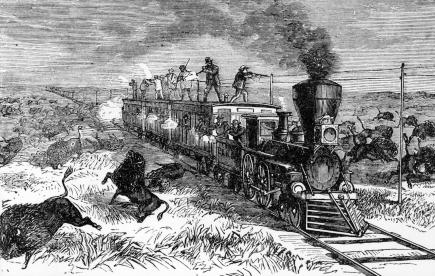
Killing buffalo – circa 1875. A group of men hunting buffalo from the top of a railroad train. (photo by MPI/Getty images)
The great bull the Cheyenne called Pó’otoéné, Gray Face, heard the hiss, the clang and roar, smelled the wood fire on the wind. He jerked his head up from the tough grass that grew at the entrance to the once-quiet cut where his herd had sheltered last year.
He was used to the incursion of young bulls, full of themselves and greedy for his ésevone. For ten years had sent each one off to try some other bull, some other herd, some other piece of his plains.
It was when he noticed the approaching beast, biggest and fastest hotóá’e he’d ever seen, that he himself roared and pushed his herd out of the cut into the open range. Behind him, the shrill steam whistle screamed as it would for any track-blocking herd of Herefords back in Illinois. But to Pó’otoéné, it meant as little as a man in a wool suit braving his way close to whisper, “Get off the tracks, please.” No, this roar sounded more war cry than warning.
His herd clear of the cut, Pó’otoéné turned toward the approaching Kansas Pacific locomotive. He pawed at the prairie grass and stood in defiant defense of his own.That is until the .50 caliber bullet entered his great heart and the legend that had endured a dozen winters, three arrows, one musket ball and countless challengers to his primacy, fell amid a yellow cloud of dust and a great gasp of blood.
From his position atop one of the first rail cars, Clyde Beene lowered his Sharps rifle and hooted in harmony with the still-screaming steam whistle.
“Hoo-wee, boys, you see that old sumbitch go down? Now this is what I call huntin’.”
After the War Between the States, a great migration of Euro-Americans crossed the Mississippi and spread west, pushing so much of what was native to the land aside, human and otherwise, often with little regard to any consequences. One example of this was the annihilation of the great bison herds of the northern and southern Great Plains. At some point, it became not only a profitable business to kill the buffs, but also sport for eastern hunters. This story is a meeting of all those dynamics.
Across the dead gray landscape of January
and February’s somber slate skies,
the grating complaint the blackest birds
lodge with steel-wrapped winter is the only
natural sound breaking the creak
and snap of wind bending these boughs
turned old by too many seasons’ snows.
Just when the cruelest month
nearly claims my spirit, the trees
begin to bleed drops of cardinal
from limb to limb and back again.
Urgent six-note melodies perch
on maple and pine staffs, breaking
the monotonous drear and crows’ atonal rasps,
as redbirds flit and spatter a transfusion
of warm hope into this frozen heart. Here,
place your hand on it and feel ice crack
and new life fight to trickle within.

 The top of the world: a rocky cliff,


 no mendacity in the natural world ~ just an
 My days are ordinary now,