There are children fleeing foreign lands
Parents are desperate for child’s survival
Tragedy far away is hard to understand
How do we react upon their arrival?
Children tired, beaten down and hungry
They’re only looking for salvation
Some people shout expressions, angry!
Say they’re not welcome in our nation
Lady Liberty says;
“Give me your tired, your poor, your huddled masses yearning to breathe free,
The wretched refuse of your teeming shore. Send these, the homeless, tempest-tost to me, I lift my lamp beside the golden door!”
What Would Jesus Do
If he were here with me and you?
Would he send these kids away?
What if this is a test to prove your morals true?
Will you show compassion today?
Would you take a child in to nurture
Or send him back to a land of war
Would you take away a child’s future
Is that what the Founding Fathers were fighting for?
Lady Liberty says;
“Give me your tired, your poor, your huddled masses yearning to breathe free,
The wretched refuse of your teeming shore. Send these, the homeless, tempest-tost to me,
I lift my lamp beside the golden door!”
Suffer the little children to come to me, James Wills, 1746 (public domain)
Luke 18:15-17 ~
“Now they were bringing even infants to him that he might touch them; and when the disciples saw it, they rebuked them. But Jesus called them to him, saying, “Let the children come to me, and do not hinder them; for to such belongs the kingdom of God. Truly, I say to you, whoever does not receive the kingdom of God like a child shall not enter it.”
This morning dawned warm and bright, with autumn’s colors seemingly more prevalent across the landscape than they were last evening. While today is forecast to be in the mid-seventies, there is talk of snow in the mountains by the weekend.
Today is Columbus Day, a good day to consider the history of European influence in the Americas. Like most things, this history is very complex. After all, I hold genes, ideas, and traditions from both Indigenous and European populations. That said, the larger context is one of ongoing genocide. It seems an everyday occurrence that some politician suggests we should be assimilated, steals more of our land, breaks a treaty out of greed and convenience, or ignores the rape or murder of thousands of Indigenous women. Too many of our people feel hopeless, resulting in unimaginably high suicide and substance abuse rates among our young people. Our young men are imprisoned at a rate far beyond our proportional share.
There is a strange dichotomy afoot: one hand the movement to change Columbus Day to Indigenous People’s Day is growing; on the other hand, the theft of Native lands and culture appears to be accelerating, as are calls for our assimilation. Noticeably absent is real movement towards honoring existing treaties and making reparation for centuries of broken promises and focused harm.
Rather than acknowledging the intergenerational effects of trauma, and of institutionalized racism and poverty, the dominant culture continues to place the blame for the suffering of Indigenous people on Indigenous people. Too many political leaders use the suffering of Native America as a rationale to do ever more harm. I find myself confused and dismayed that so few people challenge the politicians, like Donald Trump and countless others, who publicly espouse the destruction of Native people through assimilation and erasure. It is painful and frightening to listen to oneself, and one’s people, spoken of as worthy of extinction. I guess I am getting a hint of what my grandparents and still earlier generations faced.
While all of this is true, today we acknowledge something else. Today we proudly focus on our collective resilience and creativity, and the miracle of cultural continuity in the face of genocide. We are STILL HERE.
I snapped this photo in my Cousin Nancy’s backyard. We couldn’t have arranged a nicer outing. Her husband Ian played folk music on his guitar.
Tallie, her little Papillon, and our favorite little fur person, played fetch with the kids.
Then we all roasted marshmallows for s’mores in their fire pit.
Creating a lovely backdrop for us was this fascinating arrangement for firewood that I found so pleasing to the eye.
I did pause to wonder how the tree might have felt about the arrangement. Did it feel supported and held up by the spirits of its ancestors, or was it made nervous at the thought of suffering a similar fate? Am I the only one who thinks about these things?
Last summer the Seattle Theater Group treated its season ticket holders to a champagne lunch aboard a Holland America cruise ship.
The closest we’d come to a cruise was a day trip from Helsinki to Talin. Thom dusted off his sports jacket…
…and we went to lunch with our friend Monica.
Looking up…
…down…
…or sideways…
…there was unabashed glitz and glamor.
After dessert…
…they turned us loose.
We acquainted ourselves with the pool.
The art.
And the dance floor.
The lines…
…lights…
…curves…
…and colors were striking.
It was ‘The Titanic…
…meets Blade Runner.’
A place out of time. A floating island. Everyone the star of his or her own movie.
Across the harbor it was business as usual.
Gritty stories were played out in choppy waters, a world apart from our pampered microcosm.
As we left the parking lot, we drove through a sobering intersection of poverty and privilege.
Having just left a luxurious cruise boat, I thought of the Titanic. Many historians believe steerage passengers were treated with indifference at best, and that racism and classism was a factor in the dismal survival rates of the poor. Only 25% of the Third Class passengers survived, while 62% of the First Class passengers did.
One would hope for improvement in the last hundred years, and things did get better–for awhile.
From the 1950s through the 70s, middle class prosperity grew: more people could afford higher education, resulting in better jobs and owning homes. Then Ronald Reagan introduced Trickle Down Economics, claiming that by making the rich richer prosperity would trickle down to the poor, but that just kicked economic inequality into hyperdrive. Bush’s tax cuts for the rich also made the rich richer, while depriving the nation of income that would prevent the lower and middle classes from slipping further behind.
From 1979-2007, income of the top 1 percent grew by 275%, while the bottom 80 percent averaged 29%. From 2009-2012, the top one percent raked in 95% of all income growth in the nation.
Economist Paul Krugman says soaring profits of the one percent are achieved by squeezing those below: cutting wages, slashing benefits, crushing unions. Elite priorities exert a wildly disproportionate effect on policy, such as slashing social programs for the needy while lowering taxes for corporations and the wealthy.
When Abraham Lincoln said America’s representative democracy was of the people, by the people, and for the people, I’m sure he didNOT mean corporations.
We are all in the same boat. I’m thinking it’s time to bust out the life preservers, and this time, let’s make sure there is one for everyone.
each thursday they roll an array of musical gear past the nurses’ station down hallways full of the scent of aging and death postponed ending their journey in the senior activities center it’s a gig they look forward to when they can bring some joy into the routine days of so many there’s mary a mother of three grandmother of more than she can count now she raised not only her own children but her children’s children she always sits near frank whose broad smile appears when they play tunes from the 60s tunes he first heard in vietnam where he lost his legs oh and there’s jordan saved his wife from a fire they say he never speaks but always hums the old standards when played so many smiles to take in and relish however all too soon it’s the last song and then the heroes applaud
When I had wandered far in life, and felt I had filled this skin from within, When I had learned to breathe in every moment, and brought myself back to remembering again, When I had wakened from a dreaming existence and the sense which had found me Manifested around me, I discovered that all that time I had walked, all the time spent wishing for feather-light wings, had only been preparing me For all of these things which this fledgling being at the edge of the nest, Trying to find courage to take the rest of the test and plunge Into the unknown sky of the future, Had to fall for awhile before the wind made me sure.
With each heart-beat and down-stroke of strength, these wings grow stronger And fuller in length, with banded fingers splayed ‘gainst a rising sun, I’ve lived a full life, but it’s only begun.
With the actualization of realization Comes freedom to glide on the thermals of dreams, When mind and heart are in tune with that inner blue moon, And eclipses exist to sharpen the lines, If you look for the light, you’ll find your own gift for flight, And the lift will be right, And you’ll know what it means.
Fly toward the future with a focused intent, Let fall from your talons all wasted years spent, Drop the ballast that you claimed for so long would sustain you, Remember paths walked, Long before you ever flew. And when you finally reach the zenith…
Continuing the story from “Real Heroes – Part 1″ and so, the action started …
“Hello Blue 2, break away and engage”. I shouted and pulled away sharply to avoid a second attack. A crippled aircraft was always a tempting target. Almost immediately the radio was busy: I was not concerned with receiving orders but simply keeping in the air for long enough to reach land. But at least we were no longer alone.
The engine was now throwing back a thick pall of smoke, and I knew that it would be a matter of minutes or less before it seized, leaving me without power and an easy target for another attack. I looked back quickly in time to see a 190 curving in for an attack and I instantly pulled up in a sharp turn to frustrate him. He missed and carried on past me. Almost immediately there was a shout on the radio. No time for formality, simply I got him fair and square. He’s going down in flames”.
The Kent Coast had come partially into view through the smoke and after two or three minutes at full speed I knew that the Rolls had done all that could be expected and must soon die. Friends were covering me but by now I was too low to go over the side and drop to the sea with my parachute. The brief prospect of struggling in the icy water, scrambling into a small rubber dingy and sitting in a wet flying suit for an hour or more and perhaps never being found, did not appeal.
The engine laboured slightly as we reached the coast as though to warn me that it could do no more. A few seconds went by, then it stopped.
There was no alternative now, and in a peculiar way the tension eased with the sudden silence: a touch on the rudder to give her a slight sidelong movement to take the smoke away from the windscreen and I quickly saw that there was only one green field within reach; elsewhere was heavily wooded country. Although movement in the aircraft would be limited, I knew that I had to tighten the safety harness until it was like a straight jacket” almost certainly there would be a heavy crash and there were large wooden posts which had been fixed into the ground and scattered about the field. It was important that they were there to destroy any invading aircraft but now they could destroy me.
I knew that the approach had been judged well enough to land without hitting the bank at this end or decimating myself in the trees ahead. Smoke was still pouring from the engine and the field was even smaller than I had thought. Th fighter would drop to the ground at about 90mph ; we were flying at just above that speed. Landing on a soft field would almost certainly end in a high speed somersault; a belly landing without wheels gave one the best hope.
A quick glance to one side showed a hedge slopping quickly by; no more than twenty feet up now; a farmhand gazed up, so close that one could almost read his mind. “Bless the lad. Hope to God he makes it”. The smoke was still blinding. “For Christ’s sake keep her straight man, it’s not over yet. Count five and brace yourself”.
It was longer than five as it happened. Nearer ten, then a shattering jar and the tearing and ripping of metal. The wing caught on a post and there was a violent cartwheeling to the left.
Then an almost deafening silence.
Though only slightly dazed, the thought of fire cleared my mind sufficiently to make me release the harness: almost at once I heard “Don’t worry lad, we’ll have you out in a trice”. A pair of strong arms lifted me away and we staggered across the field, for all the world like a couple of drunks. He sat me down by the hedge and I looked back at the carcass of my Spitfire through one eye; a trickle of warm blood had already filled the other. The massive engine and both wings were scattered about the field.
Later, settled into the ambulance and with time to think back, I was able to appreciate the value of a good training. The safety harness had been one of the many important items. Even when pulled tight it was fitted with a small catch which allowed one to lean forward to reach some dial or switch. Btu this catch was never allowed to remain released for more than a few seconds. During the last half minute before the crash I had in fact briefly released it then locked it back. Had I neglected the advice, I would certainly have been scalped. But now I am sitting comfortably in an easy chair some forty years later.”
Unquote
His number two, with whom he’d shared a beer the night before, was shot down and killed. Apart from the trauma of facing his own death, it must also have been very difficult for my father to come to terms with the loss of a colleague in this way, knowing what had been going through his mind whilst he had to listen to his singing. Only when you find yourself in a field of anti-invasion barriers, sitting in a shattered aircraft, facing a shattered life, can you ever truly know the meaning of fear. The act of remembering fear, in my view, is evidence that you have, somehow, overcome it. This is true courage. Those that don’t remember the fear may too easily brag about their exploits or maybe have been permanently traumatised by their experience. My father didn’t want to talk about it overly much, let alone brag. So, whatever else he did in his life before or after this time, I would forgive my father almost anything.
It is very difficult to make a judgement about bravery, courage and heroism. In the ultimate analysis, I suppose, it all depends on what conscious thoughts prevail in the mind of the would be hero at the time of their heroism. Military records undoubtedly chronicle the thorough assessment of individuals’ entitlement to recognition of courage by the award of various grades of medal, but, for me, the one thing that truly counts is knowing what a hero really is. I wrote the following brief poetic tribute, remembering not only my father but also his brother, my uncle, who, as a qualified medical doctor, also served in the RAF, but lost his life earlier in the war, as a result of his injuries after the plane he was travelling in was shot down, but spent the last hours of his life attempting to save the life of the pilot. It summarises my views on courage and real heroes.
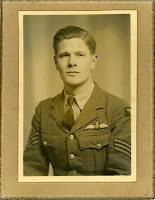
My father was not the obvious hero; he didn’t cut the image of a swashbuckling, devil-may-care pioneering patriot, which you might expect from a former fighter pilot in the RAF. He qualified as a pilot before the war started, so he was able to fly many different aircraft including sea planes before the outbreak of the war. However, it was the iconic Supermarine Spitfire that he flew with RAF 91 Squadron, that brought him to a life changing event.
The dashing young flyer
He was sometimes so laid back that a light breeze would have blown him over. His sense of humour would always prevent this happening. His grandchildren will testify to this. It is perhaps ironic, but not a coincidence that he was also a walking encyclopaedia of limericks (and fairly naughty jokes), most of which are not for public hearing, but a lot of which I have of him recorded on tape.
His was a humour that was tempered and hardened during the Second World War, as it was for so many. This humour was as dismissive of the realities of war, in a typically British way, as it was of his courage. As is so common amongst war veterans, he never voluntarily talked about his experiences as a fighter pilot, in fact it was like pulling teeth trying to get anything out of him at all, but my understanding of this is clear.
For the moment I speak only of fighter pilots, like my Dad, but this applies equally to all those who served their respective countries, in some capacity or other. It has its roots in a sense of guilt; that they survived and their friends and comrades-at-arms did not.
When you pull yourself into the cockpit for the umpteenth time and feel that stomach churning fear, the cold sweat dripping down your chest inside your flying jacket, knowing that, after you’ve propelled yourself skywards once again, the chances of landing in one piece were frighteningly low and that you may only ever have a few short seconds to avoid enemy fire coming from any one of six directions: then all you might ever remember is that fear.
There follows a transcript of his own account of one particular event on 24th March 1943, which started on a routine coastal patrol with his number two singing over the radio; a slightly bizarre start that had a tragic ending: –
Quote
“The action had been over in less than fifteen minutes. It had been raw and grey over the Straits of Dover on this day towards the end of winter when my No. 2 and I had taken off from our small grass airfield near the coast. We had expected a routine patrol. Nothing of importance had happened in our area for two or three weeks. The hummed strains of “Moonlight becomes you, I want you to know”, came over the radio. It came as a mild shock as in the two years or so of wartime flying I had never heard music.
Flight Sergeant Jim Anstie
Sometimes during a night’s sleep, a fictitious action would come through from the subconscious; something quite ridiculous; perhaps one would be sitting on a high cloud in supreme comfort and totally relaxed. Just below would be a sharp action yet in a detached way one could watch the combatants manoeuvring at high speed, intermittently closing on each other, a stream of tracer shells perhaps followed by a ball of fire as an aircraft plummeted down to earth. But there would be no sudden coming awake in a sweat of fear. The dreamer would be quite unconcerned. A mental jerk told me that this was no dream.
On a peaceful flight, singing on the radio would be amusing but now it only served to irritate. Even on a routine patrol one had to be ready for a snap decision; there could be no time to plan ahead. A decision had to be immediate and instinctive. It was still necessary to think logically: a Controller singing at Command HQ would have been quietly removed and perhaps ordered for a psychological test by the Medical Officer. It could only be my No 2 and I knew the cause. The radio manufacturers, doubtless with the best of intentions, had added to our sets what should have been an excellent gadget. The oxygen mask strapped over our mouth in flight also included the microphone; it only needed a spoken work and the set immediately transmitted to everyone in the area. But there was on disadvantage. A pilot might be flying to another friendly airfield with the mask loose on his face and the shattering noise of the engine would get through to the gadget and broadcast for all to hear. At the same time a squadron might be on its way to deal with enemy bombers and would be needing directions. But their radios had to be clear to receive orders, not the noise of an engine, nor for that matter the idle crooning of some witless lone pilot. It was impossible to bark at him “Shut up”! While his song drooled on I could only hope that his mind would snap out of its dream before there was an emergency.
And of course there was at this moment an emergency. The song finished at last and we were able to receive orders. Immediately I caught the end of a message. The words “Ashford” and “190s” were mentioned. There was no time to vent my feelings for the stupidity of No 2 as we were at the furthest point away from the trouble. “Hello Blue 2. Break away and follow me. Some 190s have bombed Ashford”.
I knew that we had several minutes of hard flying to be in a position to intercept and was tempted to hold the engine at full speed: but I slackened a little so that we could remain together.
The radio clicked and this time it was Control speaking. “Hullo Blue I, Blue I, set course 125 degrees. The enemy are crossing the coast”. Our home airfield was close to where the bombers should be heading back towards the French Coast and two flights from our Squadron had been alerted several minutes before.
It was routine at that time to have a flight at each end of the airfield. Four pilots would be in each flight hut during daylight hours. “A” Flight would have two pilots sitting in their aircraft for half and hour, strapped in and ready; then “B” Flight and so on. If the siren sounded they had only to reach for the starter button. In less than half a minute, twelve hundred horsepower from the Rolls engine would have them lifting away from the airfield. Today, when this particular emergency came, it was on the half hour; both pairs decided to take off. In seconds they were heading straight for each other. In such a situation the leader of a pair could do little to change direction and if he tried to steer sharply away he would collide with his No 2 or just as likely, somersault himself. They kept going and miraculously there was no collision.
A familiar voice came over the radio. It was the CO and the accent was unmistakable. He had been in the French Air Force, had escaped after the surrender and since acquired a formidable reputation as a fighter pilot. We had no difficulty in understanding him. One gets used to the strange pronunciations of otherwise familiar phrases.
By now my No 2 and I were well out over the Channel and straining for a sight of the enemy. “Hullo Blue I, Blue I, this is Red Leader. We are at 4000 feet and chasing the enemy to Boulogne. Join up with us”.
We were above this height and it was difficult to see small camouflaged aircraft which were still some way off. The German FW190s we knew were faster than our older Mark 5s so I decided to keep flying fast on the same course.
Quite suddenly four aircraft appeared ahead and flew straight for us; for a brief moment I assumed that they were ours. In less than ten seconds they had flashed past us, my aircraft shook briefly and I knew that I had been hit.
There is no glory in death.
This is no feature film.
Dying is death … is dying
in muddied boots and pain.
Where is the justice then,
to help us reckon with those
who would put out the light
that always shines bright.
It is here …
And the years shall not dim
a vision of him in gold and red,
on the battlefields of Europe,
the pride of the Fighting Fortieth,
the honour of his men,
the depth of his loyalty,
the colour of his blood …
unswerving from the truth,
the kind of truth revealed
in poverty and poetry … and death,
whose messenger, a musket ball,
cut short his breath, but not his words;
words that give context to his life:
On the night before the battle,
a letter to his wife still wets the eyes
and we shed tears two hundred years on.
Brightest of all, his words set fair
to illuminate his love and care
for ‘my Mary’ and ‘my children’,
whose future changed forever, when
the bugler’s victory fanfare blew,
and tyranny met its Waterloo.
~~~~~~~~~~~~~~~~~~~~~~~
*At the time of his death, Major Heyland was Commander of the 40th Regiment of Foot at The Battle of Waterloo, on the 18th June 1815. The author is the Major’s Great-Great-Great-Grandson.
When some old combat soldiers
tell me over beers how they got to be
what people called heroes,
they seem embarrassed,
saying they only did what their buddies
would do-–even the dead ones.
Then they put on sad faces,
like pinning on their medals.
One whispered his sorrow that
the real heroes died and he didn’t.
Moving closer, he rasped that courage
might really be what the guys had who,
when the shit went down,
turned in the wrong or right direction
(it didn’t matter, he said)
and were lucky enough to make it out.
For whatever reason, I thought of
the old soldier the other day–his claim
that what people who weren’t there
think is courage might just be so much wind.
Right there in front of me,
a swirling, breeze-blown potato chip bag
chased two squirrels
up a tree.
– Joseph Hesch
This poem may be read as resisting the hero or heroic, but should only be read as resisting a certain vision-version—specifically, the socially constructed masculine myth, the phallocentric conquering hero. The Quest is a different version, where She and He meet to become They / We. This poem relates directly to my essay, “(Not a) Poetics of the Hero’s Journey.”
Hero worship
I am hero. I win all battles. I am beer can, whiskey bottle, fishhook imbedded into side of heart’s mouth, penis failed and plunging. I am hero. Hero, bottle, whiskey, beer, phallus, fishhook heart, dear. Dream cream to butter; churn; I win! I win, I earn. I am deleted; dense discussion dismays to reveal.
Leaves, grass, river, flow, erode, change; do not win. Run! Flow! River, grove, leaves, grass, beer, whiskey, decompose dust. I, not alone, am built of bric-à-brac on trick of lack, disease, destroyer, cancer grower, sifted city dust; gifted growth. Foolish flight without breaking out, shout to shaking hordes below: I am, you need not grow city-scape, desert. Blow dust aside. Leaves, river, grass touch.
Break out through, below, above, side to side, into; river ride, dance slide, shove, flow glow. Do you flout doubt? Ride tide, hide guide, un-teach unleashed: fled bed, tread tomorrow without sorrow; glide, glide, glide. Can I unwrap trap crap, unhook lure manure, free bee sting sling? This is the real feel; feel the reel?
Slay it, it does us apart; join joint joist jostled gently, ride to side. Break it, suture it, moochers aside; pull it and tease it, re-seize it, thread it, don’t bed it; red it up. Shock the flock, mock the smock, muck the river bottom through. Rid it, kid it, deride it, re-construct it, fluctuate without it; much too much without touch. Touch it.
Break make; unmake; take. Know flow, no flow; un-scheme dream, ream upon ream; and ream the dream-scheme, seam upon seem. Flee me light and dark, flight stark raving; shaving quite lightly, flew it. Fluid opposition proposition: no go. Lay it aside and take up its other, don’t smother your brother, druther live, give. Sieve leaks, seeks solid landing: impossible.
I am hero. I am idea unsung, wrung, sung; I am empty sound round which thatch grows, course gorse flowers, continuous semantic somethings un-reveal; concealed, congealed darkly, harbor-sharkly devouring dense discussion; dis-made to re-seal: I am hero. I am in language. I am death. End me.
The hero’s journey is a deeply challenging topic for an amateur writer and philosopher. What a great invitation to read and research, to tie strands together and squint to see a pattern! Typically, I submit essays to this forum, as I am much more comfortable in prose. This time, however, I decided that an essay on this topic would be way too ambitious. What I have is Swiss cheese and spiderwebs, full of holes and only loosely connected, so I thought a poem would be more appropriate. However, I will preface this one with a bibliography. I began with the final chapter of Joseph Campbell’s The Hero With A Thousand Faces, where I read this:
“Today all of these mysteries [“the great pantomime of the sacred moon-king, the sacred sun-king, the hieratic, planetary state, and the symbolic festivals of the world-regulating spheres”] have lost their force; their symbols no longer interest our psyche. The notion of a cosmic law, which all existence serves and to which man himself must bend, has long since passed through the preliminary mystical stages represented in the old astrology, and is now simply accepted in mechanical terms as a matter of course. The descent of the Occidental science from the the heavens to the earth (from 17th century astronomy to 19th century biology), and their concentration today, at last, on man himself (in 20th century anthropology and psychology), mark the path of a prodigious transfer of the focal point of human wonder. Not the animal world, not the plant world, not the miracle of the spheres, but man himself is now the crucial mystery. Man is that alien presence with whom the force of egoism must come to terms, through whom the ego is to be reformed. Man, understood however not as “I” but as “Thou”: for the ideals and temporal institutions of no tribe, race, continent, social class, or century, can be the measure of the inexhaustible and multifariously wonderful divine existence that is the life in all of us.” (emphasis mine)
That reading led me to recall lectures I heard from Dave Foreman at the Wilderness 50 conference. His essay on “The Anthropocene and Ozymandius” can be found in several online posts. From there, I considered Nietzsche’s Übermensch from Also Sprach Zarathustra. And always underlying my thoughts is my admiration for Buddhist practice and The Middle Way. So, with all that as the primordial soup, this emerged:
Homo sapiens sapiens Oh most separate, separating Anthropocene anthropocentric The Egoid egotist Ozymandius, great Wizard of Man Eyes on screen Fingertips fiddling
Journey who will
That Über undertaking Condescend to transcend Dare to die in darkness, Awake in wilderness At one, atoned In mystic Middle
Every kind of priority gets noiselessly suppressed. Overnight, everything that is primordial gets glossed over as something that has long been well known. Everything gained by a struggle becomes just something to be manipulated. Every secret loses force.
—Martin Heidegger, Being and Time1
Confronting my narcissism, working on images of emptiness at the center of myself, I imagine mylar—not the overhead transparency type, but shiny mirror-finish mylar, a huge role of reflecting plastic. The hole at my center renders me invisible to introspection and investigation, unknowable to the world; it decomposes everything; constant annihilation lives there, fear.
I wrap that void with this mylar—that shiny plastic material that appears translucent, almost transparent, until layers of it turn into a poor-quality mirror—wrapping a shapeless mass, giving form to the monstrosity of dissolution and chaos at the center of being: in the beginning, chaos.2
Reflective mylar
These mirror-configured carbon chains reflect to the world around me my imagining of the world around me, as self. What I show of self is a reflection of what I think you want to see.
Know my poetry, then, through the distortions in the mirror, full of conflict twisting into a battle I wage against myself, my fear, my loneliness…seeking an Other and reflecting myself to the Other while seeking to destroy what I abhor in myself in that Other. This battle of monsters within trying to destroy themselves outside (without) me roars in my sleep but does not yet waken me.
This is the essence of our narcissistic society: projecting as Other the images we reflect of self in a spiraling failure to cast out the monsters within—a feedback loop of projected anxiety reflecting back fear and terror, thus fueling rage.
Our society swirls around a vortex of fear: fear of annihilation the decaying center of the vortex, the center of the vortex a void called “alone,” the void a presence replayed in empty media image after empty cultural icon after empty political act to convince us to buy, fear, follow—multiple reflections of this void spread out into the swinging arms of Chaos, the milky-way galaxy spiral we call the twenty-first century.
The annihilation, the physicists might call it entropy, which we feed in this way and which feeds us and on us, reflects itself in violence, destruction, greed, consumption—feeds on us and corrupts any chance for equilibrium and harmony not based on power differential and surrender—feeding us with war, terrorism, fear and offering its false sense of security as the ultimate venus flytrap honey bait.
Annihilation. Entropy. We fall into the dark pit.
At the center of our culture, the core of society—that other void, the real possibility of total annihilation suppressed yet remaining at the nucleus, nuclear destruction—drives our decomposition, whirls the void round and round.
So, society wraps protective mirrors around this center, fearing that the act of confrontation with the void leads to destruction. Society’s mirror reflects back to us what we think we want to see, reflects back our own anxiety and fear of the void in order to keep us away from its emptiness—consumption and greed for material wealth and power.
We must conquer this mirror. We no longer connect to earth or heaven when swept into the vortex, because the earth—and heaven itself—may instantly burn in nuclear fission. What other force could shred the soul?
We suffered this narcissistic injury together as a culture: a childhood trauma for some of us, a pre-nascent trauma for most, that keeps us locked into our own self-destruction. The mirror we wrap around this injury provides a surface for, but also covers the form of, the void by coating its nothingness with reflected images of something—but something superficial and unreal—seductions pulling us toward annihilation even as it seeks to hide and deny that destruction.
Know the void, then, by the distortions in these reflections.
Let our poetry confront the reflections, distortions, projections and thus, face the void. Let our words unwrap the fiber that simulates cultural and personal self. Let us destroy image and language and self, as necessary, in this poetry. This is not nihilism, but faith—faith in a renewal to follow.
I can only fail in this undertaking as I, one. We must move beyond e. e. cummings’ lonely leaf3:
l(a
le
af
fa
ll
s)
one
l
iness
I hope that we succeed. We must choose life, not death. We must choose to do what is right, not what quiets our fears. For what there is to know, it is in your mouth, in your heart.4
1 Martin Heidegger, Being and Time, trans. John MacQuarrie and Edward Robinson (New York: Harper and Row, 1962), p.165.
2the earth being unformed and void, with darkness over the surface of the deep… Gen. 1:2 (Biblical quotes from JPS Hebrew-English Tanakh, The Jewish Publication Society, 2005)
4It is not in the heavens, that you should say, “Who among us can go up to the heavens and get it for us and impart it to us, that we may observe it?” Neither is it beyond the sea, that you should say, “Who among us can cross to the other side of the sea and get it for us and impart it to us, that we may observe it?” No, the thing is very close to you, in your mouth and in your heart, to observe it. Deut. 30:12–14
One need not leave one’s armchair to undertake the Journey of the Hero. Such can happen entirely inside one’s skull. Though it is gradually coming to seem downright quaint these days, this concept of education was the rule rather than the exception until quite late in the 20th century. This is my personal account of how I embarked upon that journey, and why it is not over.
Life-changing moments are usually recognized as life-changing only in retrospect. But occasionally, such a moment is recognized, however dimly, as life-changing at the time it occurs. One of the latter, for me, occurred when my advanced-placement (AP) eighth-grade English teacher, Mr. Gordon Morse, handed out copies of Alfred, Lord Tennyson’s great poem “Ulysses” for us to read and to discuss in class the next day. I tucked the poem away in the “English” filing folder of my briefcase – yeah-yeah! … I carried a briefcase to and from school when I was in the eighth grade … I was a hyper-nerd … pity me! – and read it when I got home that afternoon. I was stunned: here was someone from the 19th century, writing in Victorian England, expressing in words the feelings and aspirations and restlessness that I thought were unique to me, that I would have sworn no one had ever felt except me. And this grey spirit yearning in desire to follow knowledge like a sinking star beyond the utmost bound of human thought. Yes, indeed. My blood still sings when I read those words! Later on, in college, as both an undergraduate and as a graduate, I had other life-changing moments, some even more transformative. But the first such, the Tennyson / “Ulysses” moment, though it took me years to articulate it, taught me what education should be about, what I had always wanted it to be: a voyage into Mystery in which the winds of curiosity and wonder fill one’s sails and take one to places beyond imagination. That such a description of education in terms of Mystery, curiosity, wonder, and imagination seems hopelessly, perhaps embarrassingly, naive these days only demonstrates how impoverished our concept of education has become. We have fallen prey to the belief that education is only about making a living, and has next to nothing to do with making a life.
The result – or perhaps the cause … a chicken-and-egg question — is what has been called the “monetization” of education: the belief that any field of study has to justify itself in terms of a quantifiable dollars-and-cents return-on-investment that will qualify a student who majors in that field to be gainfully employed upon graduation. Hence the contemporary emphasis on the STEM disciplines: Science, Technology, Engineering, and Math. And, for equally obvious reasons, such a criterion means the death, or at least the morbidity, of the humanities / liberal arts: art, literature, philosophy, history, etc. Stanley Fish writes about this with characteristic mordancy in several New York Times op-ed pieces over the last several years. As Fish notes elsewhere in his essays, this change has come about because, at least since the middle of this decade, private funding of universities has increasingly supplanted public / state funding, with the result that corporations tend to fund those fields and disciplines that show a quantifiable return on investment in the sense of providing professionally skilled bodies to populate corporate cubicle-farms – which certainly ain’t the humanities. Hence the rise of “University, Inc.” and books with that very title.
Nor is it a matter of the specific, discrete, particular disciplines one studies. Any field of study, when pursued far enough and as an end in itself, leads into Mystery,into wonder. As the old Scholastics expressed it Omnia exeunt in Mysterium: “Everything culminates in Mystery”. The primary reason I majored in math and physics was because I was, and still am, mesmerized by the subtlety and elegance of physical law and what Eugene Wigner called “the unreasonable effectiveness of mathematics” therefor. STEM disciplines can be gateways to wonder no less than philosophy and art. But for them to be conduits of wonder, the STEM disciplines, like all others, have to be, as it were, “bracketed off” from their purely pragmatic, dollars-and-cents uses, rather as one concentrates on beauty, and not on the chemical composition of the canvas and oils, when admiring Renoir’s Luncheon of the Boating Party.
Causes being as they may, what concerns me deeply is how this “monetization” phenomenon, whatever its origins, will affect the humanities / liberal arts themselves, and, most particularly, how this trend will affect the availability to succeeding generations of students of my inside-out transformative experience of education-as-heroic-Ulyssean-journey-into-wonder-and-Mystery. My English composition teacher during my freshman year at Wichita State University told me that what she admired most about me and about my writing in particular was the very thing she admired most about higher education in general, and the capacity she believed it was the purpose of a university-level education to instill in students. Mrs. Briggs gestured with her hands as if she were tossing a captive bird into the air and allowing it to fly freely, saying, as she did so, “It’s your ability to do this with your mind, the ability I wish more students had, the ability that universities exist to teach them”. As you can probably tell, her gesture and her words,which I paraphrased, have stuck in my memory over the intervening almost-50 years.
In an educational environment increasingly preoccupied with vocational / professional training, with giving students marketable skills, with being an assembly line for turning out students prepared for the job market in the oligarchy of the Corporate State … in that kind of environment, how much opportunity will there be for the inculcation of wonder, of curiosity sheerly for its own sake? How much of an opportunity will there be to toss the bird into the air and set it free? Will the system encourage and cultivate a Ulysses-like intellectual wanderlust that sees … all experience [as] an arch wherethro’ / Gleams that untravell’d world whose margin fades / For ever and forever when [one moves]. / How dull it is to pause, to make an end, / To rust unburnish’d, not to shine in use! Or will the system, in the interest of naked economic advantage, induce students to be content to remain … By this still hearth, among these barren crags, / … [To] mete and dole / Unequal laws unto a savage race, / That hoard, and sleep, and feed?
Either outcome is possible. Certainly there is no shame or dishonor in making a living. Everyone has bills to pay, obligations to meet. (I probably didn’t pay enough attention in college to the “making a living” part. I majored in math and physics, not in order to get a job, which seldom ever entered my mind, but because I was interested in math and physics. I also added a third major in philosophy — and wanted to add a fourth in English literature, until the university administration put its foot down — which more or less tells you where money-making ranked in my scale of priorities.) But succeeding generations of students will be the losers if my experience of education-as-wonder is no longer available, no longer useful in making a life. These are the kinds of questions with which Fish concludes one of his more pointed essays on “monetization”: Do you know what a university is, and if you don’t, don’t you think you should, since you’re making its funding decisions? Do you want a university — an institution that takes its place in a tradition dating back centuries — or do you want something else, a trade school perhaps? (Nothing wrong with that.) And if you do want a university, are you willing to pay for it, which means not confusing it with a profit center? And if you don’t want a university, will you fess up and tell the citizens of the state that you’re abandoning the academic enterprise, or will you keep on mouthing the pieties while withholding the funds?
In 1969, Dr. Robert A. Wilson, then director of the National Accelerator Laboratory (“FermiLab”) in Batavia, IL, during a funding hearing before the Joint Committee on Atomic Energy, was asked by Rhode Island Sen. John Pastore what FermiLab did to enhance the defense of the country. Replied Dr. Wilson: “ … [FermiLab] has nothing to do directly with defending our country except to help make it worth defending”. Similarly, the liberal arts, the humanities, curiosity for its own sake, education-as-heroic-journey, etc. … these make education and human culture worth having.
For what shall it profit a man, if he shall gain the whole world, and lose his own soul? Or what shall a man give in exchange for his soul? — Mark 8:36,37 (KJV)
Skepticism is the chastity of the intellect, and it is shameful to surrender it too soon or to the first comer: there is nobility in preserving it coolly and proudly through long youth, until at last, in the ripeness of instinct and discretion, it can be safely exchanged for fidelity and happiness. — George Santayana
i
That some of those labeled as enemies
have crossed the lines to offer condolences
at the mouring tents; that some of the mourning
families spoke to each other as parents
and cried on each other’s shoulders;
that we cried for the children that died
on both sides of the divide; that the
that the war began anyway; that hope must
still remain with those who cross
boarders, ignore false lines and divisions;
that children should be allowed to live;
that we must cry for all the children who die;
for all of this, dear owl mothers
whose children have been murdered,
do not call the sun to the dawn.
Let us suffer the night of losses.
ii
As the darkness settles the dust,
come, hear the witnesses
tell the lion what they know –
from the end to the beginning.
Let us find the mosquito who started
it all with his lies and rumors
in the African tale.
iii
First we learn that the monkey
killed your child.The monkey
ran, alarmed by the crow’s call.
The crow called out warning
when the rabbit ran, afraid.
The rabbit was scared by
the python, who crept into
its hole. The python feared
that the lizard had plotted
against it. The lizard simply
hadn’t heard a word.
iv ……………………………………… It
had blocked its ears,
in denial of the mosquito
propaganda, the lies
and rumors of death,
the drawing of lines
that divide us with
verbs we cannot
put objects to, do
not know the subjects
for. Do not call
the sun to the
dawn. Leave
us suffering
in the night
of losses.
The expanded text of a talk given at the New Year’s Interfaith Prayer Service, Chuang Yen Monastery, January 1, 2015.
At the beginning of a new year it is customary for us to express our hopes for peace in the year ahead and to wish each other peace. But to actually achieve peace is by no means an easy task. Real peace is not simply the absence of violent conflict but a state of harmony: harmony between people; harmony between humanity and nature; and harmony within ourselves. Without harmony, the seeds of conflict and violence will always be ready to sprout.
When I reflect on the challenge of achieving peace in today’s world, I have found it useful to treat the subject under three main headings:
The Obstacles to Achieving Peace—the barriers that maintain tension and foment conflict;
The Prerequisites of Peace—the goals we should pursue to achieve peace; and
The Means to Realizing these Goals. Each can in turn be analyzed into three secondary aspects.
The Obstacles to Achieving Peace
. (1) Profit-seeking: Driven by the urge to expand profits, global corporations and other mammoth enterprises flood the market with harmful or frivolous commodities. They spend billions on advertising, despoil the natural environment with toxic waste, and scuttle laws that protect workers and consumers. They take wild risks which, when successful, benefit management and shareholders, and when failures, push the costs on to the public.
The neoliberal economy has led to wider inequality of incomes and wealth.Recent figures reveal that the richest 70 people now own more wealth than the poorest half of the world, while in the US a mere 40 individuals own as much wealth as the bottom half. High levels of income inequality are associated with economic instability and crisis, whereas more equal societies tend to be more stable and to enjoy longer periods of sustained growth. More unequal societies show higher rates of violent crime and lower levels of social trust; more equal societies have lower crime rates and greater social trust. Greater economic equality thus contributes to peace.
(2) Plunder: Since the dawn of the industrial era we have been plundering nature’s treasures with reckless abandon. Today, this extractionist frame of mind drives us ever closer to the edge of calamity as rapacious economic activity disrupts the natural climate cycles on which human life depends. The big fossil fuel corporations plunder the earth for oil, coal, and gas, clearing ancient forests, blasting mountains to bits, and drilling down into the ocean depths. They transport the substances they extract over vast distances from source to refinery to market. Factories fill the skies with carbon dioxide, particulate matter, and harmful toxins. Extraction operations discharge toxic waste into rivers and lakes, poisoning the water resources on which whole communities depend.
Cumulative carbon emissions are cooking the planet and warming the seas. We’ve already had a taste of the future in the strange weather events that occur with greater frequency: droughts, floods, heat waves, and crop failures. As large regions of the earth turn barren, we will face mass migrations that can raise tensions and ignite violent confrontations. States may fail, unleashing chaos and giving the chance for tyrants to seize power and launch campaigns of conquest.
(3) Power projection: Driven by narrow economic interests, the powerful nations seek to enhance their might by projecting strategies of full-spectrum dominance across the globe. They finance ever more sophisticated weapons systems, spend billions on armaments, and spy on their citizens. They manipulate international protocols to their advantage, heightening tensions among old rivals. Weapons corporations thrive on the tensions, which they regard as new opportunities for profit. Global hostilities boil, and in certain hot spots periodically explode in outbursts of lethal violence.
The Prerequisites to Achieving Peace
. (1) Protection: To achieve real peace, we need a global commitment to protecting people everywhere from harm and misery. This commitment must be rooted in a universal perspective that enables us to see all people as brothers and sisters, worthy of care and respect regardless of their ethnic, national, and religious identity.
As Americans we can’t go on thinking that American lives are more important than the lives of people elsewhere—in Iraq and Afghanistan, in South America, Africa, and Southeast Asia. We can’t think that only the lives of middle-class people count, but not the lives of black youths in Chicago, herdsmen in Ethiopia, rice farmers in the Philippines, or factory workers in Bangladesh. Rather, we must regard all people as endowed with intrinsic value, which we must affirm by establishing greater economic, social, and political justice.
(2) Preservation. The greatest challenge of our time is to avoid climate chaos. The earth is our irreplaceable home, and if we destroy it, we will have no other place to go. At the rate we’re spitting out greenhouse gases, within a few decades we may raise the earth’s temperature to the point where the planet becomes inhospitable to human life. All the money in the world will be worthless on a planet where the grain belts have withered and oceans have turned deadly acidic.
We need to start making a rapid and full-scale transition to a new economy powered by clean and renewable sources of energy. The sun, wind, and heat of the earth are capable of providing us with all the energy we need. The main obstacle to date has been the lack of political will, whereby a band of powerful corporations, lobbyists, and compliant politicians reject the hard truths of science and even the clear decrees of rational self-interest.
We must stand up against moneyed interests and press our governments and civil groups to expedite the transition to a clean-energy future. Our window of opportunity is closing, and we must act fast before it slams shut. We need a sense of urgency, as if our clothes were on fire, an urge to act to preserve this precious planet—a miracle in a sea of cosmic dust, a blue-green pearl teeming with living forms.
(3) Prosperity. While extreme wealth for a few means misery for many others, prosperity is a good in which we all should be able to share. There is certainly enough wealth in the world to ensure that everyone can obtain sufficient food, clothing, housing, and medical care. The problem is not lack of wealth but its uneven distribution.
To lay the foundations for real peace, both national policies and international institutions must give precedence to uplifting people from the worst extremes of poverty. In today’s world, 900 million people live in perpetual food insecurity, while at least two billion suffer from malnutrition. Six million people a year, over half of them children, die from chronic hunger and related illnesses. The UN estimates that it would take just $30 billion a year to solve world hunger, a small fraction of the $737 billion that the US spent on defense in 2012. Tackling global hunger is not only a moral and ethical obligation but a policy that would have positive economic impacts and promote global solidarity. It could be a giant step in the direction of world peace.
Here in the US, some 50 million people—one out of seven—live in poverty. A half-century ago, the US had a social system that, while far from perfect, excelled in its public services. Over the past 30 years, many of these services have been downgraded or slashed. As the wealthiest country in the world, we can easily provide for the basic needs of all our citizens. But this will require new values. Instead of exalting individualism and ambition, we should prize cooperation and compassion. Instead of inciting competition, we should nurture harmonious communities and social solidarity.
. The Means to Realizing these Goals
(1) Prayer, meditation, and contemplation. People of faith should root transformative action in the spiritual disciplines of prayer, meditation, and contemplation. While traditionally such practices served as stepping stones to the realization of a transcendent goal, today we need a wider spiritual vision that can encompass the divine and the mundane, the transcendent and the immanent, in an integral whole. By bringing us into intimate contact with the transcendent ground of justice and love, practices like meditation and contemplative prayer empower us to bring greater justice and love into the world. By purging the toxins of greed, hatred, and selfishness from our hearts, these practices open us to the universality of suffering, awakening our compassion and inspiring us to become a source of good for others.
(2) Peace. Peace is not only the goal of our efforts but also a means for reaching that goal. Peace belongs to the means because in order to establish peace, we must be peaceful ourselves. If our minds are agitated by anger and resentment, our efforts to promote peace are more likely to create more conflict and perhaps ignite more violence. An angry mind is not a reliable instrument for promoting peace. But when our minds are peaceful, our bodily actions will be peaceful, and we will convey an ambiance of love, care, and mercy, which will help to establish peaceful relations.
(3) Participation. While the pursuit of meditation and other spiritual practices as a private quest for inner awakening and liberation may have fit the worldview of past historical eras, in today’s world our emphasis must shift toward a more participatory kind of spirituality, one that unites the quest for inner peace with the commitment to world peace, human unity, and planetary preservation. Our devotion to contemplative practice can inspire in us a stronger aspiration to promote social and economic justice, to preserve the planet’s vital ecosystems, and to heal long-standing enmities. At the same time, our active commitment to the well-being of others can nurture our own spiritual growth, deepening our compassion and strengthening our moral integrity.
There are many venues through which we can embody participatory spirituality in action. We can support organizations that advocate for poverty alleviation, address climate change, and promote the ethical treatment of animals, immigration rights, and better pay for fast-food workers. We can write to our congressional representatives, expressing our views on the issues that most deeply concern us. Our votes, too, express our values and conscience. Although the electoral process in this country has been badly skewed in favor of Big Money, our votes still count and can make a difference.
To express conscience in action, we can sign petitions, join marches, and participate in demonstrations. In New York this past September, 400,000 people walked peacefully through the streets on the People’s Climate March, demanding that world leaders tackle the climate crisis. In cities across the country, low-wage workers have been demanding better wages and other conditions that will enable them to live with dignity. In many cities as well, people of all ethnic backgrounds have joined hands to protest police brutality against communities of color.
While the endeavor to achieve peace may often be frustrating, we should remember that nothing truly worthy can be achieved without effort. Peace and justice may be slow to arrive, but we will never obtain them without a struggle.
Let us make [2016] a year in which we firmly commit ourselves to the pursuit of real peace. Then, a year from now, we can look back at [2016] and consider our time to have been truly well spent.


 This morning dawned warm and bright, with autumn’s colors seemingly more prevalent across the landscape than they were last evening. While today is forecast to be in the mid-seventies, there is talk of snow in the mountains by the weekend.