Archives: Projects
Letter to Non-Muslim Allies
 Dear Non-Muslim Allies,
I am writing to you because it has gotten just that bad. I have found myself telling too many people about the advice given to me years ago by the late composer Herbert Brun, a German Jew who fled Germany at the age of 15: “be sure that your passport is in order.” It’s not enough to laugh at Donald Trump anymore. The rhetoric about Muslims has gotten so nasty, and is everywhere, on every channel, every newsfeed. It is clearly fueling daily events of targeted violence, vandalism, vigilante harassment, discrimination.
I want you to know that it has gotten bad enough that my family and I talk about what to keep on hand if we need to leave quickly, and where we should go, maybe if the election goes the wrong way, or if folks get stirred up enough to be dangerous before the election. When things seem less scary, we talk about a five or a ten year plan to go somewhere where cops don’t carry guns and hate speech isn’t allowed on network television. And if you don’t already know this about me, I want you to know that I was born in this country. I have lived my whole life in this country. I have spent my entire adult life working to help the poor, the disabled and the dispossessed access the legal system in this country. And I want you to know that I am devoutly and proudly Muslim.
I am writing this in response to a non Muslim friend’s question about what she can do. Because there is much that can be done in solidarity:
- If you see a Muslim or someone who might be identified as Muslim being harassed, stop, say something, intervene, call for help.
- If you ride public transportation, sit next to the hijabi woman and say asalam ‘alaykum (That means ‘peace to you.’). Don’t worry about mispronouncing it; she won’t care. Just say “peace” if you like. She’ll smile; smile back. If you feel like it, start a conversation. If you don’t, sit there and make sure no one harasses her.
- If you have a Muslim work colleague, check in. Tell them that the news is horrifying and you want them to know you’re there for them.
- If you have neighbors who are Muslim, keep an eye out for them. If you’re walking your kids home from the bus stop, invite their kids to walk with you.
- Talk to your kids. They’re picking up on the anti-Muslim message. Make sure they know how you feel and talk to them about what they can do when they see bullying or hear hate speech at school.
- Call out hate speech when you hear it—if it incites hatred or violence against a specified group, call it out: in your living room, at work, with friends, in public. It is most important that you do this among folks who may not know a Muslim.
- Set up a “learn about Islam” forum at your book club, school, congregation, dinner club. Call your state Counsel on American-Islamic Relations (CAIR), interfaith group or local mosque and see if there is someone who has speaking experience and could come and answer questions about Islam and American Muslims for your group. They won’t be offended. They will want the opportunity to do something to dispel the nastiness.
- Write Op Eds and articles saying how deplorable the anti-Muslim rhetoric has gotten and voice your support for Muslim Americans in whatever way you can.
- Call your state and local representatives, let them know that you are concerned about hate speech against your Muslim friends and neighbors in politics and the media, that it is unacceptable and you want them to call it out whenever they hear it, on your behalf.
- Out yourself as someone who won’t stand for Islamophobia, or will stand with Muslims—there is an awful lot of hate filling the airways, and there are an awful lot of people with access to the media and/or authority stirring the pot about Muslims. Please help fill that space with support instead. Post, write, use your profile picture or blog to voice your support.
- Ask me anything. Really. Engage the Muslims in your life. Make sure you really feel comfortable standing for and with your Muslim friends, neighbors, coworkers.
- I can tell you that in addition to the very real threat to their civil and human rights that Muslims are facing, we are dealing with a tremendous amount of anxiety. While we, many of us, rely on our faith to stay strong, we are human. This is not an easy time. What you do will mean everything to the Muslim Americans around you. Thank you for reading and bless you in your efforts.
Please share this freely.
– Sofia Ali-Khan/Muslim Allies
What have we done that people can pick up guns and kill?

It was one of those things you think but don’t want to say. In the horror of the carnage in Paris and the world’s reaction, it struck me how very little had been said about the terrorist attack in Beirut the day before…or the attack on a funeral in Baghdad…or so much of the other violence that shakes the world. And I felt like I couldn’t say it for fear of looking like I was somehow diminishing the horror or pain of Paris, afraid it could been seen as a lack of respect and understanding. But I wondered. And now so many people are indeed raising such questions, and others are also reacting to such questions, calling them an appalling lack of sympathy…and things have at times spiraled down to a repulsive debate of numbers and geography, rather than of lives and humanity.
When I was young, it was the last hurrah of Lebanon’s golden era when people still referred to it as the “Switzerland of the East” and the wealthy went there to bask on the beach in the morning and ski on its snow-capped mountains in the afternoon. It was the land of poets and artists, and welcomed refugees and visitors equally.
I remember all the Lebanese women with my mother at fundraisers for the Palestinian refugees. We were all kinds of Christians, Muslims, Druze and even a lone family of Lebanese-Jews who ran a shop in our neighborhood. We were just “us”, the Lebanese diaspora, the children of the Phoenicians. And if you were Syrian or Egyptian, that didn’t matter, then we simply enlarged our self-definition to being Middle Easterners. And if you were anything else, then we were “the melting pot” and loved to learn from you.
But so much interference in the internal workings of the country, so much pushing and shoving, dangling of carrots by different powers and religious groups, and finally civil war exploded in Lebanon. What we had known suddenly disappeared. There were a myriad of political parties I couldn’t keep up with, weekly fundraisers for dozens of necessary causes, a flood of refugees, some legal, some not. It should have brought us together, made us one in the struggle for peace and justice. But it didn’t.
I remember vividly the look of joy on the face of complete strangers if they heard my family speak a bit of Arabic. There would be warm introductions and everyone wanted to know everyone. Suddenly it was different. I would say something in Arabic, and the other person would immediately ask “Muslim?” I remember once in my old neighborhood I went into an Arabic music store and was taken by the album playing. Great music, but the dialect threw me a bit. I cheerfully greeted the young man behind the counter with a wish for a morning filled with goodness. He gave me an annoyed look and pointed to the veiled young woman. When he walked away the woman leaned over and whispered in Arabic, “Don’t mind my brother. It’s clear from the way you greeted him that you’re not Muslim.”
I remember in Algeria when I used the traditional Muslim greeting of peace in the market place and the stall-keeper rudely told me I had no right to say such a thing because he knew I wasn’t Muslim. To my delight, an elderly gentleman in traditional dress got angry and shouted at him, “And what should he do, wish you war and trouble instead?” He went on to greet me with great poetry and many warm blessings. Touched, I kissed him the way one kisses his favorite uncle and a few of the women, all wrapped in the white haiks of western Algeria, applauded and blessed God. This, I thought, is what family is, this is how we will conquer the darkness.
We have become our own worst enemy. Whenever we separate the world into “them” and “us”, whenever we accept blind generalizations and cease to see a unique individual before us, whenever we forget we are all victims of carefully orchestrated deceit and deception for wealth and power, the force of darkness wins. Bullets will never win this struggle, only the heart and mind will. I know political scientists and analysts can tear my thoughts to shreds. I do not claim an intellectual understanding…I am only sharing a broken heart that grieves.
A young Melchite priest once told me a story from his village in Lebanon during the war. There was intense shelling and sniper fire for almost three days. After it stopped, people went out to gather up the dead. An old man went to the church and asked the priest to offer two masses. The priest took his pen and book and asked the man to continue. The first mass, he said, was for his son whom they found shot to death in the orchard by their house. And the second mass was for the person who shot him. Startled, the young priest looked at the old man with amazement. The old man explained the obvious saying “What have we done that people can pick up weapons and kill strangers without? What have we done that some poor fellow can kill my son without feeling it? We must pray for him, and ask God’s forgiveness.” When I remember that story, after all these years, I still cry.
– Daniel S. Sormani, C.S.Sp.
© 2015, essay and family photograph, Daniel S. Sormani C.S. Sp., All rights reserved
You are the promise … the hope … the one
If there is to be peace in the world,
There must be peace in the nations.
If there is to be peace in the nations,
There must be peace in the cities.
If there is to be peace in the cities,
There must be peace between neighbors.
If there is to be peace between neighbors,
There must be peace in the home.
If there is to be peace in the home,
There must be peace in the heart.
From “The Book of Tao (The Way), Lao-Tse (c 5th Century BCE, China, Zhou Dynasty)
And, as the song goes: “Let there be peace on Earth, and let it begin with me …” Jill Jackson Miller and Sy Miller (1955)
Peace, Let It Begin With Me
by
Rev. Ben Meyer
Unitarian Universalist Minister, San Mateo, California
 As we contemplate the theme of Peace during the month of December, we may wonder if the wars will ever end or if violence will ever cease. I know there may be some stern souls out there who question whether our reflections on the need for inner peace will undermine the urgent need to summon all our strength to confront and overcome the machinery of war, the waves of fear, or the agencies of violence. While we think about the need for inner peace, innocents are dying in Syria and Palestine and down the road, around the corner, and God only knows where else.
Why aren’t we out in the streets by the millions? What are we waiting for?
Listen to these words the Angel Gabriel is said to have whispered into Mary’s ear:
There is strength here like the sinew of a mother’s arm.
It shatters the brittle pride of wealth;
It levels the clayfoot thrones of tyrants.
It upholds the forgotten, the scarred.
Hunger both of body and soul will be filled.
Riches will no more be rewarded.
The holy one cleaves to those who keep faith;
It will endure in those who serve mercy.
And then the Promise made to legend ancestors will be kept;
And Peace shall prevail.
I understand and often share the “urge of urgency” over the peacefulness of peace. But this I also know: We live at the intersection of action and reflection.
Self-reflection is no luxury which has to wait until more urgent matters are attended to. It is as essential to our lives as food and drink.
When we don’t take time to know and befriend the darkness within us and in the world we all too soon are overcome by our own inner demons.
Then all our efforts in the name of peace, encumbered by our rage and fear, will only serve to magnify the violence we so wish to quell. What was “the Promise made to legend ancestors”? Surely not peace everlasting—even though we should yearn for and work for and practice peace with every fiber of our being.
The Promise and The Way both lie in the possibility that you and I might come to know the holiness of peace concealed in the darkness of our hearts, our homes, our neighborhoods and THEN beyond—not in some distant land but here at home, not in some long ago time but here, today, right now.
You are the promise. You are the one. You are the way.
Be the peace you seek by seeking the peace in you.
Blessings,
Ben
© 2015, words and photograph, Rev. Ben Meyer, All rights reserved; shared here with the permission of the author.
If you subscribe by email, it is likely that you will have to click through to the site to view this video:
With Faith in Love Beyond All Beliefs
Keeping it Kind. I am so very proud of the Unitarian Universalistist Clergy of the San Francisco Bay Area for their open hearts and their OPEN LETTER in support of the MUSLIM COMMUNITY. It was read at the MultiFaith Prayer service at the Yasmeen (Islamic) Cultural Center in Burlingame, California on Sunday, December 13, 2015.
December 13, 2015
An Open Letter
Dear People,
We are writing to call attention to a great injustice and to ask your help in addressing it.
Not that many years ago Catholics were seen as some “other” who could not be good Americans. More recently Jews suffered many insults and abuses because they did not belong to the dominant faith – again, seen as “other”. Good people rallied to stand with them and, over time, they have become so integrated into the fabric of our country that it is now unimaginable without them.
 Today we are seeing the same sort of prejudice and, on occasion, dreadful acts of violence directed at Muslims. They are our contemporary “other”. These are our neighbors, co-workers, and our friends. They serve in every branch of our American military. They are our doctors, lawyers, police officers, nurses, teachers and social workers. They are us.
Because of the actions of a very few, some current American politicians and others are sparking fear and hatred against the entire Muslim faith community.
In response, people of good-will and conscience must stand up and speak out. Many already have. Some, clinging to the haunting words of Pastor Martin Niemoeller, are asking “who will stand with them?” It is time to answer that question. We will. We, the Unitarian Universalist clergy of the San Francisco Bay/Peninsula, stand with the Muslim community.
We urge you to do so as well. Please take a stand and say your peace.
With faith in love beyond all beliefs,
The Reverend JD Benson, San Francisco
The Reverend John Buehrens, San Francisco
The Reverend Stefanie Etzbach-Dale, Redwood City
The Reverend Pamela Gehrke, San Mateo
The Reverend Elaine Gehrmann, Monterrey
The Reverend Axel Gehrmann, Monterrey
The Reverend Alyson Jacks, San Francisco
The Reverend Nancy Palmer Jones, San Jose
The Reverend Nina Kalmoutis, Sunnyvale
The Reverend Russ Menk, Aptos
The Reverend Ben Meyers, San Mateo
The Reverend Vail Weller, San Mateo
The Reverend Amy Zucker-Morgenstern, Palo Alto
Note: Again, please feel free to share this letter through WordPress’ “reblog” feature or by cutting and pasting. If you’d like me to it in HTML to make it easier, please let me know. J.D.
Untitled
Society at risk
committing crimes of indifference and apathy
clutching purses on subways
while sitting next to a cycle of poverty
sipping on $5 lattes at hipster coffee shops
shopping at upscale grocery stores with decadent chocolates and wine
living in the comfort of a high rise and a secured parking garage
turning away from the suffering that lives four blocks down the street
Society at risk, risking our youth
to dilapidated schools
broken systems
and violence
Locking kids up for
addictions
truancy
rebellion
and emotional distress
At risk societies, putting profit before people
dealing Gucci watches and Louis Vuittons
prostituting consumerism as worth
little girl locked up
seven months
she knew it was wrong
thought a purse could validate her worth
And while the judge and jury deliberated over her crime
nobody asked what was stolen from her
Society
I sentence you.
© Natasha Burrows
At-risk Youth
You are 13, 15, 16 and at risk,
of failing, of flunking,
of dropping out forever.
You are at risk
each time you do meth,
of losing your free will,
of losing your mind.
You are at risk,
of living in the streets,
under a bridge,
of freezing to death.
You are at risk,
of getting sick,
of being raped,
of losing yourself.
You are at risk
of going hungry,
of getting arrested,
of disappearing into the system.
You are at risk
of being bullied, of being sold,
of being killed by gangsta gun violence
in the hood.
I am at risk,
of caring too much,
of getting involved,
of giving advice when it isn’t wanted.
I am at risk,
of offering hope, when it isn’t mine to give,
of seeing the person you are, of connecting,
of closing the gap between us.
I am at risk,
of forgetting myself as I laugh with you
because you are smart and funny,
of cracking open my heart.
I am at risk
of forever changing
because I know you, because I sat with you,
because I heard you.
I can never go back.
I am at risk
of understanding the injustice,
of seeing the parallel universe where you live,
right next to me,
of having to do something about it.
I felt something touch me inside here, you said,
putting a finger on your chest.
I believe in you, I said. I’ll see you next week.
© Lisa Ashley, MDiv
Legacy
Not all legacies are good.
When I was a kid,
One day,
(I was 14).
Well, that day my dad
Well he got real mad,
In fact he got enraged.
And somehow or another,
Mistook my face for a punching bag.
Sullen teenage girl, I slammed my bedroom door shut.
I had no idea what was coming.
I heard footsteps pounding.
“Boom! Boom! Boom! Boom!”
My heart raced like the terrified little rabbit that I was.
My father flung open my bedroom door and slammed his fist into the right side of my face, right on the jaw.
So hard he literally knocked me off my feet.
24 years later the physical pain of that incident is starting to rear its ugly head.
My jaw is so sad, broken, in pain all the time.
The chiropractor tells me my father displaced the first cervical vertebrae in my neck.
“Oh.” I say.
“Is that why…
“The weekly debilitating migraines for the past 17 years?”
“Yes.”
“The ear aches?”
“Yes.”
“Wait, then, the hearing loss too?”
“Yes.”
“The stabbing nerve pain?”
“Yes.”
“The inability to bite properly?”
“Yes.”
I sit, numb in shock with the news,
feeling like that lost little 14 year old girl again.
Wow. Thanks dad.
What a wonderful legacy.
You son of a bitch.
– Christina Conroy
© 2015, poem, Christina Conroy, All rights reserved
Finding Life in Detention
I’ve only been working as a chaplain with youth in detention for a month. I could have chosen a number of different seminarian internships; campus ministry, church administration, advocacy. But I chose chaplaincy on purpose because I felt a “call.” It is why I’m studying an MDiv; it’s why I stopped running away from ministry.
.
In this month I’ve heard stories of rape, assault, grand theft, vandalism and trafficking in narcotics. There is something fundamentally disturbing to hear the voice of a child talk about getting so drunk and high that carjacking an elderly woman sounded like a way to “have fun.” All this from the mouths of youths who should be worried about their SATs rather than their next court date. So I’ve been asked the question, “How do you do this?” My answer is, “Because my faith demands it of me.”
.
As a Unitarian Universalist, I believe that salvation is IN my life. My faith as I choose it requires me to work towards the inherent worth and dignity of all people and all creation, not for heavenly reward but for humanity. Which means pushing myself to be in places and meet with people which make me uncomfortable. To speak truth to power. To give witness. To expand beloved community. To be where the Spirit of life needs me to be.
.
Yes, it is hard to sit in active listening, asking questions, attempting to sift through the psychic refuse to find the innocent child underneath. But let me be clear; there is an innocent child underneath! Because I have also heard these same children’s voices ask for mercy, beg for forgiveness and plead for a fifth, sixth or seventh chance to turn away from the paths well worn by their incarcerated fathers and addicted mothers and economically and educationally depressed neighborhoods. These children’s eyes reflect back at me; “Help me! Heal me! Love me! Save me!” And my faith and my humanity will not let me say “no!”
Even though a minister’s trade is in miracles, I expect none here. My ministry is to listen. To be present. To plant seeds of hope. To challenge my world to change for the sake of it’s children. And to push and pull with all my might to bend that arc of history just a little bit further toward justice. It is in this hard work that I find the Spirit of life seeking reconciliation and my own salvation.
.
In this way, working with youth who are incarcerated is life giving! It reminds me of who I should be. It wakes me up from the soma of my off-white middle class American social location. The work allows me to be so filled with gratitude for my family and baby boy that I have to respond in thanksgiving. And because I did very little to deserve my blessings and privilege, I must pay it forward. Which is where I am confronted by mystery and miracle! The more I give, the more I find that I am being transformed by these youth into a better human being.
– Justin Almeida
© 2015, essay, Justin Almeida, All rights reserved; public domain illustration, an early version of the “flaming chalice,” the symbol of Unitarian Universalism
Validating Myself
 once my dreams
were my possibilities
there was no dividing line
life was, what it was
blind happiness
in a state of sleep
as I crawled, walked
and ran through life
the strides I made
some say I was a success
I succeeded
to have three baby daddies
and three children
whom I may have failed
though I was respected
among co-workers
and peers
I enabled his addiction
while I searched for my happiness
mommy overprotective me
daddy left and never looked back
he took my hand and stole my virginity
a nymphomaniac I became
addicted to touch
I wrote the words
I felt the pain and
cried the tears
never knowing who I was
stumbling through darkness
while the sun shone on me
placing blame everywhere
except for where blame belonged
I was too light
my hair too soft
my face too pretty
hated by women
lusted by boys
the pedophiles I knew
kept secrets in the open
no one told me
I didn’t hear
when I should have listened
lungs full of holes
a heart lacking oxygen
joints swollen
aches fueling my fatigue
living the short life
missing teeth
overweight
graceful and elegant I’m not
I was what I’ll never be again
regrets gather like ocean tears
a wall I build
where I hide
forgotten
– Kimberly Wilhelmina Floria
© 2015, poem, Kimberly Wilhelmina Floria, All rights reserved; photograph courtesy of George Hoden, Public Domain Pictures.net
Deportment of the Soul
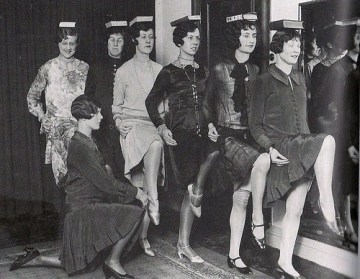
He passed me the disc, about the size of a small dinner plate and quite heavy. My hands were full of things needing to go through to the kitchen. There was only one thing for it, I placed the disc on my head and walked through that way, thinking how the lessons learned when we are younger than we are today still have value and inordinately pleased with myself that I could still do it without effort..
My mother used to tell me about good posture when I was small and it was fun trying to walk around with piles of books balanced on my head. We had to do the same at dance class. We had it in school and in the gym too back then. For my mother, it was about deportment; the way a lady carries the body. For my teachers, the idea was that by developing balance we would be able better able to perform the movements that were required of us with grace and poise. Nowadays, it is simply about good posture and, hunched over a keyboard far too much of the time, I am grateful for those early lessons and still prefer a straight back.
Good posture stays with you. It is not something that you lose like the beauty of dewy skin or the lustre of youthful hair. Something of it remains. Even my great grandmother, her spine bent under the weight of almost ten decades, still held herself well. Those we deem elegant seem to have something in their carriage that stays noticeable for the rest of their lives too, even when the years have erased all outward sign of youth.
When I was fifteen, my grandfather gave me a copy of Dion Fortune’s Moon Magic. There is much to be learned from the psychological journey of the two protagonists and it is still one of my favourite and best-thumbed books. Being young and on the verge of womanhood, however, one small phrase took my eye that had nothing to do with the story itself. “… the body should swing and balance from the waist and that is worth more in beauty than a slender line.” I think this is true and it gives an impression of balance and grace.
We learn very early in our lives the mechanics of sitting, standing and walking and, once learned, we seldom give them another thought until we begin to suffer the consequences of what we failed to learn to do well. Then we get back-ache and have to learn anew, starting with the core muscles, as often as not. Yet the body is designed to both respond to and create those minute shifts and adjustments that are required in order to maintain perfect equilibrium. Until it knows a poised centre of balance, it cannot create it.
Our inner balance is very similar… we learn as children our techniques of how to deal with the world and though they may be perfectly serviceable for years to come, evolving as we grow, they may also come back to haunt us as emotional aches and pains. The accumulated effects of the years gradually throw the balance even further out and it may take going back to the beginning to put things right, through therapy or through the self examination we do when we seek to understand why. It is only in doing so that we begin to see the repetitive scenarios and reactions that have been there all along, but which themselves are no more than a symptom of something we learned awry early in life. Once we find the starting point, we can begin too to straighten things out.
The spiritual life is little different. Spirituality does not necessarily mean religion, although religious faith should mean spirituality. The spiritual life is that very personal relationship we may each seek with whatever greater reality we some to know. We have all met those people who seem to radiate joy, no matter how hard their lives may be, no matter their age… they have a glowing beauty for which there seems no reason and they find a beauty in life that may seem to pass us by. We may ask ourselves why here too. We absorb what we are taught as children and it serves us as children. As we grow, so do our thoughts and beliefs change and grow with us. There usually comes a point where we may feel spiritually off balance and start to examine those deep-seated beliefs, tracing them to back to their beginnings. We may find that the spiritual ‘muscles’ were never fully flexed, that we simply accepted what we were given because it worked for us then, but now the core needs some work and the source does not seem to show us the Source we feel may be there.
Where can we look to find the answers to those questions we begin to ask, to find that poise and grace that comes from spiritual equilibrium? We need only look within. The questions we ask are unique to every one of us, the answers we seek are part of us all. It matters little if we give what we find there a Name and a Story… it is the essence of what lies at the heart of us that straightens the spiritual spine and brings back the balance.
– Sue Vincent
© 2015, essay, Sue Vincent, All rights reserved; illustration, Image by ADiamondFellFromTheSky
The Secret Object I Keep Hidden in My Underwear Drawer

Yes, I really do have a secret object hidden in the back of my underwear drawer.
It was in a bag earmarked for the Salvation Army, a tiny doll-sized white cotton undershirt, but I snatched it back from among the outgrown feet pajamas, baby booties, and Alice-in-Wonderland dresses. Then I tucked it into the back of my underwear drawer.
It isn’t an heirloom or valuable in any way, except to me, because both my kids wore it as fuzzy-headed milk-scented most-beautiful-in-the-world newborns. Once in awhile it still sees the light of day. Not on those “hurry-up-or-we’re-going-to-be-late! mornings,” but on quiet afternoons when I’m putting away freshly folded laundry. I can still smell the baby shampoo and feel the round little tummies that filled that shirt.

Recently I realized that no one in the world would know or care what happened to that little shirt unless…I showed it to my daughter Bea and told her about her first night home from the hospital. She was wearing the little shirt, or one just like it, while lying beside me on the bed to nurse. By the soft moonlight shining in on us I watched her, filled with awe at the sight of this new person looking up at me like a little old wisewoman. I marveled at her perfect little toes and her tiny feet and those exquisite fingers. Just as I was moved to tears at the miracle of life and birth, she reached up with her tiny finger and DOINK! poked me right in the eye. Ever since then, I told Bea, she has kept me from taking myself too seriously.

I told her how four year old Eli rubbed her tummy and told his baby sister all she would need to know to get by in the world. “You only get to drink milk now, but when you’re big you get macaroni and cheese from a fork. You’ll learn to walk and then run, but be careful or you might fall and scrape your knee and bleed, but blood has platelets that make a scab, but don’t pick it or it’ll bleed again…” What a warm, wise welcome into our family!

On my kitchen wall is a picture Bea drew of a paintbrush and an artist’s pallet. Underneath she wrote,”Only the artist knows the story of her painting.” Too true. So tell your stories to your kids, your friends or your enemies, lest they disappear when you do.

Whether you write them into your memoirs, or tell them from your mouth, let them see the light of day, feel the moisture of your breath, live in stark black beauty on a crisp white page.

One day Bea might show that tiny shirt to her children and say, “When I was a baby…” Even if it finds its way to the Salvation Army, she might say, “My mom once saved a tiny white undershirt from the rag pile and kept it in her underwear drawer. Sometimes she took it out, and told me stories about when I was a baby…”

All words and images copyright 2014 Naomi Baltuck
(Except “Mrs. Bradley Ripley Alden and Her Children” painted by Robert Walter Weir, 1852)
Some Thoughts on Adoption
Editorial Note: In April 2013, John Nooney wrote a series on his adoption. We think his message is an important one and he agreed to cut the 12,000 word feature down to 1,000 words to accommodate the needs of this site, a frankly heroic effort and something for which we are most appreciative. After reading this post, you may wish to read the longer piece on John’s blog HERE and we encourage you to do so. The details are interesting and thought-provoking. Jamie Dedes
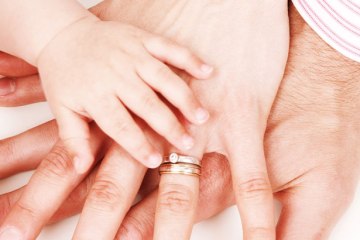 “Have you found your birth-mother?” is, more often than not, the first thing people ask me when I mention I am an adopted child.
Think about that.
When you share information about yourself, it is the first response that matters most; the first reply has the biggest emotional impact.
So, if the first response to news of adoption is wanting to know if you’ve found your birth-mother (often stated as Real Mother), one begins to feel they need to seek her out.
People ask this particular question, breathless with excited anticipation of an affirmative answer — they’re wanting a feel good story, with a big, bold headline: “Adopted Child Reunited With Real Mother!”
The question ends up making me feel as if the asker somehow views my adoptive parents (the people I think of as my only parents) as being inferior to Real Parents. It’s like they imagine I was kidnapped from my Real Mother, raised by people pretending to be my parents, and that I need to be rescued and returned to The Real Parents.
It’s insane.
And, it’s hurtful.
I’ve not spent much time thinking about my birth-parents. Sure, I’m curious what they look like, what their story is, and, more importantly, what their medical history is, so I know what to watch for. Other than that, I have little interest in them. Not for bad reasons — I don’t hate them for giving me up for adoption. I think my birth-mother made the best choice she knew how to make at the time. When people want to know if I’ve sought her out, I begin to wonder if there’s something wrong with me. Am I supposed to find her? Is there supposed to be a yearning for my Real Mother’s loving arms?
They say mothers have an unbreakable bond with the child they carried in their womb, that they’d do anything to protect that child. Am I, as the child in the womb, supposed to have that same unbreakable bond?
I don’t feel that bond.
I thought of searching, but when I began to think about the consequences of finding my birth-mother, I lost interest. What if she was married to a billionaire? Would I then hate my middle-class roots? What if she turned out to be a meth-addicted prostitute? How would I feel then? Knowledge can be dangerous. I was scared of what I might find — and what I might or might not feel.
I’ve spent many helpful hours in therapy over the years, though I’ve left several therapists because they’ve tried to convince me that my issues started by being abandoned by my birth-mother; that even though I was newborn, I was able to sense her abandoning of me, and its impact is at the root of many of my issues.
One thing I have absolutely no doubt about: I do not feel that my birth mother abandoned me.
We don’t know what communication passes between mother and fetus — though we often surmise. Perhaps because giving up a child is such a gut-wrenching decision for a mother, the trauma she feels imprints itself on her unborn child, and, perhaps, leaves some children with a sense of an emotional abandonment
Maybe there is a reverse that is also true: maybe a mother can tell her unborn child that it is being given up for the best reasons, that the decision she is making is one made out of an unimaginable love — a love that wants her child to have a home better than the one she can provide. And, maybe, communicating that love can leave an adopted child feeling that it hasn’t been abandoned, but that it is a child, being given as a gift — a great gift.
Sentimental claptrap? Maybe.
Our society runs on the belief of individuality. We take pride that we’re all different, that everyone’s story is not the same. Yet, we’ll try to claim that every adopted child should feel abandoned? It makes no sense. We are either all different, with different stories, or we’re not.
Growing up, my mother told me a story:
“There was a man and a woman who loved each other very much. They wanted to have a family, but, unfortunately they couldn’t have kids. One day, they got a phone call — there was a young woman who was having a baby, but, she was young, and was struggling to make ends meet. She wanted her baby to have a better home than she was able to give him. She knew that the man and woman would give her baby a loving home. So, the man and woman got on a plane, and, when they came home, they had the young girl’s baby with them. They were very happy to have him, and they loved him very much. There are many kids in this world who live in homes where they aren’t loved or wanted,” my mom would say, “and adopted children are special: they’re wanted very much.”
Mom would ask if I knew who the man and woman were, and I’d say “you and dad”. It was a story I liked to told, and would often ask to hear it. I especially liked the ending: they were happy to have him; they loved him.
Adoption gives birth to thoughts and feelings across the emotional spectrum: from feelings of profound love, to feelings of despair and abandonment. Mixed in with those feelings, at least for me, is a sense of loyalty to the people who adopted me, who opened their hearts and home to me. Along with that sense of loyalty goes a sense of obligation: to believe that adoption is ok, that it’s a wonderful, loving thing. I grew up in an environment that felt loving, so it was something I never questioned.
I’m adopted, but it doesn’t change the fact that my family is as much a family as anyone else’s family. We’ve managed to look past the wounds and the scars that all families accumulate over the years. I like to think that in spite of all the pain and hurt, that when we look at each other, we see the love, see the strength of a love that’s been tested and that still holds us together.
This is my telling of one person’s adoption: mine. I am in no way trying to say that my words apply to all adopted children. My opinions on adoption may be different than yours — and, that’s ok. Adoption, just like any other family issue, is unique to each individual and each family. Please do not interpret my words as a generalization of the experiences of all adopted children. This is my tale, my story, my thoughts.
– John Nooney
(c) 2013, feature article, John Nooney, All rights reserved
Photo credit ~ Vera Kratochvil, Public Domain Pictures.net
Some Early Seasonal Cheer
December is usually that time of year that we reflect on the year which is almost done and start thinking about Christmas and the coming new year. For me, this means a “clearing out” of things I’ve accumulated or held onto throughout the year (mentally, emotionally, spiritually and especially physically). In the tradition of “clearing out”, I’ve been slowly but surely deleting old e-mails.
One of them I came across was from several years ago and I thought I would share the joy of it with all of you, in case you hadn’t seen it. It was about Christmas Trees from all over the world. It seems that the Christmas Tree is a global symbol of celebration and delight at this time of year. The lights twinkle, the ornaments sparkle, and the decorating brings together friends and family to provide the warmth of camaraderie during the cold, dark, winter month of December. So sit back, grab a hot toddy or cup of hot cocoa and enjoy seeing how others celebrate their Christmas Trees. 🙂 (Note: The photos and text by each picture are what was included in the e-mail).

Before the ball drops in Times Square, the Big Apple turns on its
holiday charm with the Christmas tree in Rockefeller Center.

The Capitol Christmas tree in Washington, D.C., is decorated with 3,000 ornaments that are the handiwork of U.S. schoolchildren. Encircling evergreens in the ‘Pathway of Peace’ represent the 50 U.S. states.
 The world’s largest Christmas tree display rises up the slopes of Monte Ingino outside of Gubbio, in Italy’s Umbria region.
Composed of about 500 lights connected by 40,000 feet of wire, the ‘tree’ is a modern marvel for an ancient city.

A Christmas tree 100 Meters tall, befitting Tokyo’s nighttime neon display is
projected onto the exterior of the Grand Prince Hotel Akasaka.

Illuminating the Gothic facades of Prague’s Old Town Square, and casting its glow over the manger display of the famous Christmas market, is a grand tree cut in the Sumava mountains
in the southern Czech Republic.

Venice ‘s Murano Island renowned throughout the world for its quality glasswork is home to the tallest glass tree in the world. Sculpted by master glass blower Simone Cenedese, the artistic Christmas tree is a modern
reflection of the holiday season.
 Moscow celebrates Christmas according to the Russian Orthodox calendar on Jan. 7. For weeks beforehand, the city is alive with festivities in anticipation of Father Frost’s arrival on his magical troika with the Snow Maiden. He and his helper deliver gifts under the New Year Tree, or Yolka, which is traditionally a fir.
 The largest Christmas tree in Europe (more than 230 feet tall) can be found in the Praça do Comércio in Lisbon, Portugal. Thousands of lights adorn the tree, adding to the special enchantment of the city during the holiday season.
 ‘Oh Christmas tree, oh Christmas tree’: Even in its humblest attire,
aglow beside a tiny chapel in Germany’s Karwendel mountains,
a Christmas tree is a wondrous sight.
 Ooh la la, Galeries Lafayette! In Paris, even the Christmas trees are chic. With its monumental, baroque dome, plus 10 stories of lights and high fashion, it’s no surprise this show-stopping department store draws more visitors than the Louvre and the Eiffel Tower!
 In addition to the Vatican’s heavenly evergreen, St. Peter’s Square in Rome hosts a larger-than-life nativity scene in front of the obelisk.
 The Christmas tree that greets revelers at the Puerta del Sol is dressed for a party. Madrid’s two-week celebration makes
millionaires along with merrymakers. On Dec. 22, a lucky citizen
will win El Gordo (the fat one), the world’s biggest lottery.
 A token of gratitude for Britain’s aid during World War II,
the Christmas tree in London’s Trafalgar Square has been
the annual gift of the people of Norway since 1947.

Drink a glass of gluhwein from the holiday market at the Romer Frankfurt‘s city hall since 1405 and enjoy a taste of Christmas past.
 Against a backdrop of tall, shadowy firs, a rainbow trio of
Christmas trees lights up the night (location unknown).
– Corina Ravenscraft
© 2015, essay, Corina Ravenscraft, All rights reserved; illustration courtesy of Wikipedia
These Hallowed Halls of Hope
“Google can bring you back 100,000 answers, a librarian can bring you back the right one.”
–Neil Gaiman
When I saw the theme of “At-Risk Youth” listed for November at The BeZine, my first thought was how important libraries are to helping kids like these. For those who don’t know what the phrase “At-Risk Youth” means, it’s basically a label for any young person who is “at risk” of not making a successful transition into adulthood. They are typically minorities, live below the poverty level, have a higher rate of school drop-outs and illiteracy and tend to fall into gangs, drug use and/or turn to violence and criminal behavior.
Nowhere is this more apparent than in urban cities, where the library can often be an oasis of peace in the concrete jungle. They are usually quiet buildings with ambient lighting, lots of space and most have special areas just for children, with bright colors, lots of things to look at, activities to do and of course, lots and lots of books. We all know the power of books to transport and lift us from even the most depressing of realities, but today’s library goes far beyond that simple escapism.

I have worked in libraries most of my adult life and have witnessed first-hand how they can help at-risk young people. Many of the kids who come to the library after school are latch-key kids. They sometimes have to baby-sit younger siblings while their parent or parents go to work. A lot of them don’t do well in school, or don’t see education as a priority, so they struggle with basic reading, writing and arithmetic. They may live LGBT or other alternative lifestyles and face rejection and bullying every day. It occurred to me that the librarian may be the only smiling, accepting face these kids see all day. Most libraries offer literacy and/or homework assistance programs that can help on an educational level, but the librarians…they are the “people factor” that can bridge the gap and make the difference between engaging or alienating them further.
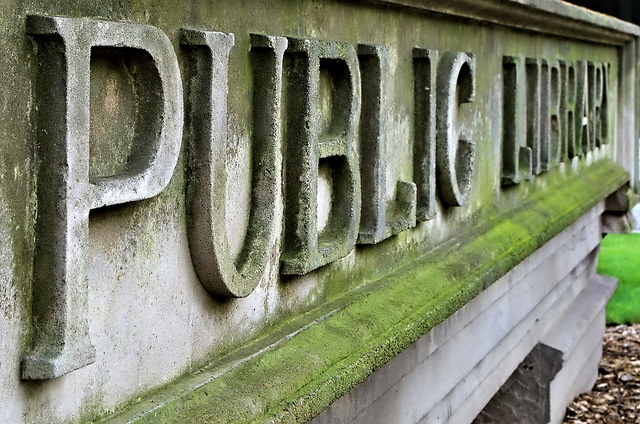
Today’s libraries often have after-school activities to help keep teens off the streets and out of trouble, or mentors to offer advice and assistance. Some participate in the YouthArts Program, which works to implement effective strategies to pair up at-risk youth with more art-focused programs. Others, like Memphis Public Library, have programs that teach teens how to do Music and Audio production, or Art Studio and Video and Photography classes. They also have resources like JOBLINC and employment workshops, giving youth the knowledge they need to find a job, create a résumé or ace an interview.
You may not know it, but the NEH (National Endowment for the Humanities) has awarded $350,000.00 to the ALA (American Library Association) this year for the Great Stories Club, a reading and discussion program specifically aimed toward at-risk youth:
“The Great Stories Club funding will introduce more than 8,000 young adults to accessible and thought-provoking literature selected by humanities scholars to resonate with reluctant readers struggling with complex issues like incarceration, violence and poverty. Librarian advisors will consult on material selection, assist with development of programming guides and best practices for libraries and provide training for grantees.” ~ http://www.ala.org/news/press-releases/2015/03/neh-grants-ala-350000-book-clubs-risk-youth

If you know of any at-risk youth who are lost and struggling, try guiding them (or accompanying them!) to their local library. The library has been and will continue to be more than simply a building which houses books and information. It is an ever-changing and evolving source of inspiration, hope and problem-solving; it’s an integral part of society’s infrastructure. As one librarian noted in a Metafilter discussion about funding cuts:
“Every day at my job I helped people just barely survive. … Forget trying to be the “people’s university” and create a body of well informed citizens. Instead I helped people navigate through the degrading hoops of modern online society, fighting for scraps from the plate, and then kicking back afterwards by pretending to have a farm on Facebook.”
~ https://placesjournal.org/article/library-as-infrastructure/
The entire response is here, and if you have a spare couple of minutes, I think you will find it quite eye-opening; perhaps it will give you another perspective and appreciation for how very, very necessary libraries have become for people who have no other options. When the rest of society is ignoring at-risk youth or struggling to find solutions, libraries have become spotlighted as hallowed halls of hope.
– Corina Ravenscraft
© 2015, essay, Corina Ravenscraft, All rights reserved; illustrations as indicated above
At-risk

as i dropped off
a few items
aunt bea
had requested
i found her staring
at the children
on the playground
across the street
she asked
can you
pick out
who among
that group
is at risk
they all
have the same
foundation from society
in
this neighborhood
the structure
of their future
has been created
using nothing more
than balance
and
friction
to stay upright
against the winds
of poverty
and
crime
oh i know
like the faces
on cards
a variety
of different problems
confront each child
abuse
disability
and such
and
each one
must face
unique family problems
but
who’s at risk
is it
the child
is it
the family
or
is it
the community
she said
i know
i’m not for sure
but
i do know
that each
at risk child
is stacked onto
the nation’s future
forming
a house of cards
Eli Eli lama sabachthani?
where were you
when the embryo
hatched and was formed
by blood-spattered hyenas
tearing hope from
limb to limb and
laughing gleefully
at the mockery
where were you
when the embryo
fell and love
offered a hit
of a crack pipe
covered in symbols
flashing through
the ghetto offering
escape from the
desolate heat
the hands that
should be reaching
out are cut off at
the wrists bleeding
sanctimonious tripe
in defiance of the call
to love the
least , lost, and lonely
while sentencing each
embryo to death
guilty rings through
the room as we
continue to bleed the
embryo out with
ignorance born of
fear and shame and
the lie of the only way
being my way standing
on the corner shouting
belligerently to
repent or die
revelation rings through
the cosmos as the
embryo marches the
guilty to sheol while
silent tears are birthed
wresting the stumbling
breath of hope into a
silent scream reaching
to the ramparts and
calling forth the final
battle fought with
easter lilies

©vPoem and Photo by Terri Stewart
Think Continually of Those at Risk
Under the light of the half moon, David Attenborough speaks to the camera on Christmas Island, surrounded by a moving mass of red crabs. Tens of thousands of crawling females, heavy-laden with hundreds of fertilized eggs, are approaching the high tide in order to release their burdens into the surf. The water turns reddish brown as a surge of life heads out to sea. Millions, no, billions of little babies are set adrift. Enormous whale sharks cruise the waters nearby, ready to feed. Sir David explains that the hatchlings will spend one month in the water before returning to land to move into the forests and begin their lives as adults.
That’s probably not the first picture you conjure when you hear the phrase “at-risk youth”, but it’s the one that came to my mind. It may not be popular to approach this topic from a biological standpoint, but there is a meaningful truth in this perspective. If the “risk” you are referring to is death, that is something that youths face as much as anyone. Death is certain for all of us, and no one is guaranteed adulthood. The human species, however, is far from the threat of extinction. Our population is dominating the globe, in fact. So, “at-risk youth” is not about the peril of the demise of our race. I believe it is much more about social and behavioral dangers than biological ones. This is where we can be optimistic. We can create and control our societies and our behaviors much more readily than we can our biological tendencies.
What does it mean to “survive” to adulthood in our society? How do we measure the success of childhood? Certainly benchmarks in health, education, safety, justice, self-reliance and freedom come to mind. We set standards and often cast about for whom to blame if they are not met. Aren’t our children entitled to these milestones? Are they goals to strive toward if not guaranteed rights? And what about the risk of “merely” surviving?


My youngest child is now an adult. She has survived the death of her father. She has survived self-destructive behavior due to depression. She has survived being institutionalized in the mental health care system. She has survived living in the third largest city in this nation, finding a job and supporting herself. She has survived coming out as queer and has proudly announced her engagement to another wonderful young woman. Her survival of everyday panic, anxiety and body-image crises is chronicled in her Facebook updates. While all of this is great success that I do not mean to diminish, I keep wondering, “Is the mere survival of the hazards of our society the best our young people can hope for?” My daughter is highly intelligent. She is a naturally talented singer and dancer. She is passionate about history and poetry and science. I fear there is a great risk that these traits may remain embryonic throughout her lifetime because she is so focused on navigating social pressures – in a culture that is probably the most economically and socially privileged one on the planet!
That our systems erect road-blocks to social survival and detour our young people from paths of true greatness is a profound risk, I believe. Read the poem “The Truly Great” by Stephen Spender. I get to this stanza, and I am openly weeping.
“What is precious is…
…Never to allow gradually the traffic to smother
With noise and fog, the flowering of the spirit.”
We can so easily provide food, shelter, and opportunity to our youth with the systems we have devised, but those systems have become mine fields where kids are sabotaged on the journey. We have become so enamored of control that we have hobbled love and freedom and self-worth, and our young people will always be the most vulnerable to that constriction. Their symptoms are obvious. They are fighting to survive amid an abundance that mocks spiritual destitution. The Dalai Lama commented on his first visit to America that the thing that surprised him the most about Westerners was that so many suffered from a sense of low self-esteem. He’d never heard the term up until then, but everyone he asked agreed that it effected them.
Our young people have the best advantage for living long biological lives. If they are to live good, happy lives as well, we all must take responsibility for creating caring social space within our psyches and our communities. We need to nurture and model the spirit of social justice from the ground up AND from the top down. We need to encourage and not criticize; we need to live as models, not as victims. One of my favorite examples of a person who dispels social danger with kind communication is Fred Rogers. He takes time; he is present; he sees truth and speaks love. Here is an excellent illustration of that. And a great example of modeling fairness and social progress from the top down can be found in this video about the new Prime Minister of Canada.
We will never be finished addressing the social risks facing our youth. They will be new every moment. If we take up the challenge to face each of those moments with awareness and a commitment to justice and kindness, though, we can be confident that we are living out the remedies even as problems continue to arise.
– Priscilla Galasso
© 2015, essay and photographs, Priscilla Galasso, All rights reserved

