At the beginning of before.
Here it is: are we in the right
spindle bobbing away?
Are you a fable resting in the sun and wanting?
Tell me how your dreams are.
Tell me what you might mean to yourself in their fury,
Now, skirts forever in a night wind
Yesterday spins yellows around tomorrow
Whatever did your mother tell you about
late at night when you put your book down
on the bed and she came in soundless
with a tight face to sit in the dark with you
while you wheezed and you waited.
Violence in the coal mines.
They always told me
La Pasionaría was brave no pasarán, she said. With her vision
she was defending Madrid’s mountains
they told me and I heard her when
she spoke with that spike of passion
indomitable: she said no pasarán
and in the foothills there were cheers all dressed in black.
Your father I learned took a gun with him
there at the beginning of before
to protect himself at midnight
on the picket lines in the dark
to protect himself from hit men
who hated his vision out west
in the fog in those long flat parking lots .
Low in his left cheek a muscle quivered
within, at the end of a smile that wasn’t.
He took a gun and she went kitten silent on your bed.
The quiet of her heavy sitting
at the beginning of before
reminds me of an old dream,
her telling you of crossing the street
because of the scar on her skin
because she wanted to hide it from all eyes
Was this a mingled message
to fight with all the passion the rains pour
or to scurry away from feeling?
To hold the front line or to flee into a hole?
Camus who believed in solitude as his struggle
And Aragon whose masses were transcendental
Tell, tell me more please before the end is over.
No matter how much we enlarge it,
that photograph snapped by a German soldier
of my grandmother in Lida, 1916,
remains perfectly clear. Her eyes
register her cold measure
of the soldier who could decide
Lida, 1916 photo
to shoot her instead of her
picture if that
was his hobby
instead of photography.
This is what war
is like – I taste her fear
even though I’m seeing her
now from the eyes
of the oppressor.
And I know the shame of both.
What brought the Israeli poet, Karen Alkalay-Gut, to post this on FaceBook, about the poem above?
Sepia: The poem is about 1916—there were no Nazis back then. By writing the poem about this scene I am doing what the German soldier is doing—taking advantage of the person in a helpless situation without their permission. That’s what the poem is about. Anyone who sees politics in this poem is paranoid. But if some people were hurt by this poem, especially because it was in a place so honorably perpetuating the memories of such persecuted people, I do apologize. —Karen Alkalay-Gut
A controversy led to this statement, of course, based on misreading the poem. The misreading, though, mattered because of the context of where the people that Alkalay-Gut mentions “were hurt by this poem” encountered the poem. The poem appeared in the exhibit “Flashes of Memory – Photography during the Holocaust,” at Yad Vashem, The World Holocaust Remembrance Center (Jerusalem, Israel). Although the photograph from the poem came from 1916, and the year appears in the poem, the context suggested to others that it was about a NAZI soldier. And rather than understand that Alkalay-Gut recognized that her own gaze at the helpless Lida, her grandmother, in the 1916 photo formed a kind of oppression (related to something called scopophilia in critical theory), viewers/readers saw in it a criticism of Israel that likened Israelis to NAZIs.
One might agree that a reasonable reading of the poem could be that those who benefit from military oppression are like the soldier who oppresses with his camera in the poem. The soldier had the choice to use a camera or a gun, and that those privileged to be in the class benefitting from soldiers’ guns also have a choice to use cameras or (let others) use a gun. The poet could be seeing her gaze as privileged and potentially oppressive (of her grandmother / grandmother’s memory, of others held at camera-gun point). But the soldier in the poem came from WWI, not from the Holocaust, and that is not a minor distinction.
Another distinction that matters is that Karen Alkalay-Gut lost her family during the Holocaust. She recognized that the hurt that could occur from encountering this poem in this context could be genuine and deep. She responded, as quoted in Israel HaYom newspaper:
“It’s a personal poem, I write from the heart, and it’s not a political poem, despite the fact that there are many ways to read a poem—and it could be read in such a way,” she explained.
“If this poem is hurtful to someone, then it should be removed from the exhibit. I did not mean to offend anyone, heaven forbid. I lost all my family in the Holocaust, and if it offends someone then I have no right to say something else,” she said.
“I think Yad Vashem needs to handle the matter, and if it appears to someone as political and insensitive – the poem must be removed from the exhibit,” she reiterated. —Israel HaYom
The poem cannot reasonably be read, on its own merits, as comparing Israel to NAZIs. It could be seen as being critical of oppression and military violence. It could be seen as drawing a parallel between the WWI soldier and the poet. On its own merits, yes. The context, however, created a different reading than the poem by itself would. And Israel does not appear in the poem, except if you know Alkalay-Gut is an Israeli living in Tel Aviv.
This is a strong poem, by a strong poet. She does write from the heart, as she says, but she also writes with a sense of justice. This poem is about justice in a very personal way—her grandmother is a victim of the soldier, as the speaker in the poem implies (the presumption is that he is exercising his power over her), and a victim of the poet looking at the photo, many decades later, when the grandmother can no longer say, “No. That is not for you to see. It is private.”
‘The spirit of the wolf resides in my heart Mostly peacefully, but ever wild Running in time to the blowing wind, Dancing in the clouds that drift in the heavens The spirit of the wolf resides in my soul.” – Gretchen Del Rio
The Howl or How Wild Women Press Came to Be
by Victoria Bennett
Snow Owl by Gretchen Del Rio
At twenty-six, I met an owl. It turned out to be one of the axis moments on which my life pivoted. It was a cold January day where frost lingered in the shade but the sun was shining, the kind of day where things seems possible because you have survived the darkness of winter. The trees stood bare of leaves, branch-fingers stretched out expectantly, waiting for Spring. I was waiting too, holding a sense of change quietly behind my eyes. I watched the crows fly, black wings against blue sky, looking for carrion, listened only to the sound of water and wind and some crow caw above. This was what I was trying to remember – the feel of my touch, the scent of the sky, the hopeful warmth of sun just after the midwinter. My life had become so much darkness, so much noise and pollution and not seeing. This was the counterbalance and so far, it was working. Slow, slow days, allowing the words to surface and sound and where words could not come, allowing the brush to paint or the body to move. All was changing. I was changing. The woman I was underneath was beginning to take shape, and to my surprise, I liked her.
But first, the owl. I was stood beside the ash, eyes closed, when I heard a scratch from above. I opened my eyes and saw the owl, white feathers thick for winter, watching me. Awake. Not daring to move, I simply looked and allowed it to look at me, until after a few moments, it flew away. The owl came, and I was listening because I was ready to hear, and I was ready, it seemed, to shift shape again.
One week after the owl and I met, I had a dream. In this dream, I was with a woman walking along the river. She told me I was to call the Wild Women together. This did not seem strange or unusually prophetic. I had found a deep resonance with the stories I had found in the Clarissa Pinkola Estes’ book Women Who Run with the Wolves and so the archetype of the Wild Woman was something I was familiar with, but the sense of purpose was surprising, and so, the next morning I got up and started to write the posters for what was to be the very first of the Wild Women workshops.
“The reason that people awaken is because they finally stop agreeing to things that insult their soul.” Gretchen Del Rio
Six weeks later, I stood in my living room, the fire in the stove burning and the tea hot in the pot. Before me sat twelve women, very different in ages and styles, but all sharing something special: they had all responded to the call. And so it came to be, the Wild Women group was born and I was to be their mother-wolf for this journey. As I stood there, faced with women whose individual and collective ages outstripped my own, I felt petrified. Who was I to stand here and say “this is the way of being woman”? Yet, that is exactly what I was to do. I did not know where it would take us, take me. I was just willing to begin, brave enough to speak out and hopeful enough to believe.
‘”Welcome…”
… and in that one word, I started something that would sustain me through my twenties, thirties and into my forties. I had met my clan. Together, we found the courage to stand up and say, “This is who I am…”.
That was nearly twenty years ago. Since then, working with the Wild Women, I have gone on to set up Wild Women Press, published several books of poetry from the group, worked with over 2000 women (and some brave men) on a number of amazing projects, hosted the (in)famous Wild Women Salons, made creative connections around the globe, and performed live at events around the UK and USA. It is a space of celebration and activism. There is no business plan or professional career path. It can lie dormant, hibernating as we nuzzle down and grow our ideas in the dark, or it can awake with passion and create for change on a global scale. We have used our creativity to create positive change, to be part of the world we want to live in andleave for those who follow. Sometimes we act on a very local level, sometimes on a global one.
Recently, I have been collaborating with the creators of the #MeToo poetry anthology. This is a very important movement for me personally, and for us as a group. As soon as I heard Deborah Alma was wanting to put together an anthology of poems from this movement, I offered my support, and the platform of Wild Women Press. It was obvious from the very beginning that there would be many more poems than there were pages in the book, and so #UsTogether was created, to give a platform for some of these other voices. Alongside the launch of the book, Wild Women Press are hosting a selection of these poems, in honour and celebration of the courage and sisterhood of all those who have spoken out as part of the #MeToo movement.
One of the core aspects of the group is the respect and celebration of each individual woman. Although in the beginning it was me who stood at the front of the room, every woman in the group was to go on to inspire and lead, using their own experiences, passions, talents, and knowledge to guide them in how they would to do that. In a similar vein, we will be launching an online Wild Women Press blog later in 2018, sharing our ideas and perspectives. Over the next year, we will be gathering Wild Women from around the globe to contribute, extending our circle of clan further. We would love to hear from other women, who would like to be part of a clan of contributors.If you are passionate about something, and would like to be part of a global group of Wild Women writing, creating, and being part of a positive change, please do get in touch.
In 2019, it will be our 20th Anniversary, and 20 years since we published our first book, Howl at the Moon: Writings By Wild Women. To celebrate this, we will be publishing a new book of poems by Wild Women – and this time, we are extending the howl out to others. We will be putting out the call for submissions soon, on our website, Twitter, and Facebook page.
For now, we continue to meet as a group every couple of months, and once a year, we spend four days at our Wild Women Gathering, celebrating, creating, and sharing our stories (and eating way too much food). We have witnessed births, marriages, divorces, unemployment, career changes, graduations, new beginnings, and painful goodbyes. What began as a workshop group, has become a place we now call home, and a wild family. You can sometimes find us on the fells or beside fires. We howl often, laugh lots, and when prompted, bare our teeth. Our coats are all a little more silver, and our eyes a little more wise, but we are still discovering. We are the Wild Women, and we welcome you.
Poet, publisher, activist and wild woman, Victoria Bennet
VICTORIA BENNET (Wild Woman Press) is an award-winning poet, creative activist and full-time home-educating Wild Mama to her son, Django. Originating from the borderlands below Scotland, she is the Founder of Wild Women Press and has spent the last quarter of a century instigating creative experiences in her community. Her poetry has appeared in print, online and even in the popular video game, Minecraft. She has published four collections and performed live across the UK, from Glastonbury Festival to a Franciscan Convent.
Poetry publications include:
Anchoring the Light
Fragile Bodies
Fragments
Byron Makes His Bed My Mother’s House – a Poetry & Minecraft Collaboration with Adam Clarke, that explores grief and letting go
What We Now Know – digital VR music collaboration with Adam Clarke and The Bookshop Band, inspired by the #MeToo anthology
returned to bite through the umbilical of tradition,
to flick her tongue
and cut loose the animus-god of our parents,
like a panther she roams the earth, she is eve wild in the night,
freeing minds from hard shells
and hearts from the confines of their cages,
she’s entwined in the woodlands of our psyches
and offers her silken locks to the sacred forests of our souls ~
naked but for her righteousness,
she stands in primal light,
in the untrammeled river of dreams
the yin to balance yang
the cup of peace to uncross the swords of war ~
through the eons she’s been waiting for her time
her quiet numinosity hiding in the phenomenal world,
in the cyclical renewal of mother earth,
whispering to us in the silver intuition of grandmother moon
watching us as the loving vigilance of a warming sun ~
she, omen of peace birthed out of the dark,
even as tradition tries to block her return,
her power leaps from the cleavage of time
Illustration ~ the lovely watercolor painting by Gretchen Del Rio with its girl-tree, panther and other spirit animals was the inspiration for my poem, Her Power Leaps, on the return of the divine feminine. The back-story on the painting is interesting. Gretchen says, “I painted this for a fourteen year old Navaho girl. It is for her protection and her power. She sees auras and is very disturbed by this. She is just amazing. Beauty beyond any words. You can see into the soul of the universe when you look at her eyes. She has no idea. I loved her the moment I saw her. My blessings for her well being are woven into the art.” Such a delightful piece. I purposely posted it full-size so that everyone can enjoy the detail. Bravo, Gretchen, and thank you. / Jamie Dedes
I store sorrow seeds and bitter roots
in gold jars where memory breaks
their pain into parables I’ve risen from.
Hell prefers the unaware, the wound
and not the scar, but the candle of my spirit
has been formed from match strikes at midnight.
My childhood stolen by hands of harm
caused me to swim silently in a river of threats
until trust carried my voice to freedom.
I reject brutality’s attempts to pour me into a victim’s mold
or chain me to the barbed wire of ghosts.
I am a survivor resurrected whole from affliction.
I’m on my way home from the Lucidity poetry conference. I learned a lot from fellow poets and from Nathan Brown. I highly recommend if you have a chance to go to one of Nathan Brown’s workshops, do it! He teaches through music, storytelling, and poetry reading.
As per one of the requirements I wrote a poem for Lucidity‘s Annual poetry contest. At the time I didn’t know why I was being led to write such a personal poem about abuse. When the awards were given out it earned an honorable mention. As with anyone who enters a contest the hope is to win. I was disappointed but stood up to read the poem not expecting to be emotional. I felt a bit overwhelmed but managed to read it and then sat down. After the ceremony a man came up to me in tears. He thanked me for being brave enough to write it and to read it. He said he was going home to tell his daughter about it. He said she had suffered abuse and he thought it would speak to her, help her. I leaned over to the table picked up the poem handed it to him,and told him to give it to her. He wrapped his arms around me and we cried together. I then knew my reason for writing it and my reason for reading it. Susie
I bring you time
wide, unbridled,
seamless as seas;
the fragile vee
of fledgling’s beak;
the solidness of shapes:
oak, tower block, petrol pump;
a coupling, tripling,
quadrupling of souls;-,
the still small pureness
of alone;
of colours, every one;
an ample mixing palette,
deftness of touch to conjure
your own shades.
An ear tuned
to the furthest whisper
of the furthest corner
of all your life might hold,
and every decibel step
and variation from this
to the loudest brain roar;
a hundred eyes to sperm
innumerable words;
the knowledge-gift
and mystery of saying
all you need to say
in one, or two
ladybirds, beetles and bugs
worms and platoons
of white maggots
with bluebottle generals in charge
turned the corpse
inside out
upside down
and bit by bit
spirit eased itself free
of tissue remnants and bones
squeezed between stones
until it stood proud of the earth
an aura of wishes still clinging
wondering why it felt
so lost, so alone
wondering
Never starving artist, for we feast on what our father has made
Infinite of beauty.
This poem is about my reaction to the protest and gufaws at the die hard simplicity my husband and I attempt to maintain. Green is in but sadly simple joy and the appreciation of nature, human experiences and connection is not. So, if you see a petite, brown skinned cellist busking on a street corner near you, give her a hug. If it is not me, I am sure she won’t mind. If she does…it will give you something to write about.
There used to be craters on the moon, now the moon is a crater. Carved out, mined of all its juices, it remains derelict. Too light to continue to orbit: it just hangs, skeletal and listless. Unable to wax or wane, its cycle broken.
Tidal-confusion grips the ocean below. Trapped, neither flowing in nor out, unable to turn yet trying to. Turning itself one way, then the next, like an uncomfortable sleeper, too hot inside its own shape.
I sit, bare-footed, on night-dewed grass, sniffing out the hot-salt of the ocean that cannot rest, the orange-rind moon above. I too am neither one thing, nor another. I whisper to the blades of grass, tap on the earth, and wait for the flowers that will never come.
Carbon Footprint
In my lifespan,
so far reaching 22 years,
I have owned 3 computers,
3 games consoles (despite the fact I don’t really use them)
and 3 mobile phones,
the first of which would have lasted forever, but,
in a freak accident my dad ran his car over it.
I can’t drive, but I did have a moped –
but I crashed twice and got rid.
I have voted in 1 election – (you made me)
but I won’t say who for. (Yellow)
I can ride a bike, swim (just about), speak French
and have that crazy allele that lets me roll up my tongue.
I have drank 0 cups of tea, smoked 0 cigarettes –
the only nail polish I own is black.
I have eaten:
1516 Apples
1232 Loaves of Bread
243 tins of Baked Beans
3125 Carrots
669 kilos of Spuds
181 kilograms of Chocolate (mostly without you)
and 345 Chickens.
I have bought over 2000 books,
borrowed over 3000
and never returned at least 5 (one’s yours, I’m sorry).
I have spoken 32,301,600 words
written nearly as many,
but lost most of them in workshop.
I have had 30,025 dreams,
most of which were nightmares,
some in black and white,
some sound-only, (but always your voice)
and some so real – they remain
like false memories –
when I wake up the next morning.
I have blinked 119,376,303 times,
walked over 4450 miles,
cried 34 pints of tears (25 pints were for you),
shed 588 skins (but for you I haven’t changed once),
experienced over 834,200,000 heartbeats,
I have lost my virginity once,
had sex with one person,
and (I think you should know this)
have only ever fallen in love once.
To name a purple flower—hubris;
To call red a rose. A rose is a rose is a rose,
She said.
The fruit of purple.
So like an apple—
so unlike an apple—
poison to eat. —Sodom’s apple milkweed—
A rash thought that
blisters my skin. A rose is a rose is a rose,
She said.
[1] “Calotropis procera, a milkweed native to the Dead Sea and Sodom, Israel and other desert regions” (Wikipedia). Known also as Apple of Sodom.
Which is also the title of a Marilyn Manson song written for a David Lynch film, Lost Highway(warning: strong images in this YouTube music video of the Marilyn Manson song):
This poem originally appeared on Instagram, in an earlier version.
Shaken earth weeps
floods of ice in all lands,
attempts to cleanse itself.
We diseased cells have
metastasized, eaten
its forbidden flesh,
perforated its bones.
What it cannot shake
off it sweeps away
in wind or burns
off in fires. Glaciers
wear down what remains.
Everything known is now
extinct. Only new forms
emerge, scathed and
transformed from death
by cancerous greed—
into a fallen grace.
And these words, which I command thee with this day, shall be upon thy heart…
And thou shalt bind them for a sign upon thy hand, and they shall be for frontlets before thine eyes.
—Deut. VI:6, 8
I.
My beloved whispers in my ear; she reveals herself to me—
her Words, jewels upon my breast, upon my hand, upon my forehead. When my beloved walks in the field, the heron flies up with cackling praise; she inspires the crane to laugh as it rises into the sky; the swallows dance for her.
I have come and gone with uncertainty and doubt; but my beloved inspires constancy:
Though in times of drought the hill dries out, the hollows hide some mud, remembering. My beloved brings rain into the high, parched fields that have forgotten her; she walks among the swaths and sheds her tears for each cut stalk.
The hollows swell with water to quench the beasts and grow the iris;
my beloved reflects their grace as they mirror the sky among the grasses.
II.
The storm was terrible: the thunder rumbled long in the night; the lightning terrified;
a wind blew through the window of the house and tapped upon the walls. Yet, my beloved whispered in my ear and I wore her words like jewels. In her arms I rested as the fields drank deeply, the dry holes filled with sweet water.
In the dark I am drawn to my beloved; she is even more glorious in the light:
She is a stand of gentian unexpectedly found near the edge of the willow. An eagle flies above the goldenrod and pines; I know my beloved thinks of me. The thought of my beloved eases my burden as I toil on the road to her house:
Her kisses, sweeter than blueberries freshly picked, inspire acorns to rise toward the sky;
her caresses provide strength to the birch, the aspen, the maple, the oak, but also to grasses.
III.
I hold my love; she holds me. I have studied her in the willow, the iris, the thistle:
finches, warblers, and wrens feed and live in her shelter, so my love feeds and shelters me. The oats have been cut, the hay rolled and stored for the winter. My love comes to me and whispers in my ear; she reveals herself to me.
The geese gather and call, flying over the trees, landing in the pond:
my love sighs and the grasses bend; the aspens sigh and my love bends to me. Her kisses build the temple; her love holds me and I heal: My beloved is mine, I am hers. She points to the flowers off the path:
small white bells, tiny blue trumpets, vetches, paintbrush; I don’t know all the names.
My beloved knows the Names of the Flowers; she whispers them to me: I embrace her.
והיו הדברים האלה, אשר אנוכי מצווך היום– על לבבך… וקשרת לאות, על ידיך; והיו לטופפות בין עיניך
-ספר דברים, פרק;, פסוקים ו’-ח;
I.
אהובתי לוחשת לי באוזן; היא נגלת אלי-
מילותיה, תכשיטים על חזי, על ידי ועל מצחי. כשאהובתי פוסעת בשדה, הענפה אצה מקרקרת תשבוחות: לעגור היא נותנת השראה לצחוק במעופו אל השמיים; הסנוניות רוקדות עבורה.
באתי והלכתי עם ספק וחוסר ודאות: אולם אהובתי משרה השראה בלי הפסקה:
גם אם בשעת בצורת הגבעה מתייבשת; הנקיקים מחביאים קצת בוץ, זוכרים. אהובתי מביאה גשמים אל הגבהים, אל שדות קמלים אשר אותה שוכחים; היא מהלכת בין האלומות ומזילה דמעות על כל גבעול שנגדע.
הנקיקים מתרחבים ממים שמרווים את החיות ואת משקים ומצמיחים את האירוס;
אהובתי בבואה לחֵינם באותה מידה שהם משקפים את השמיים בין הדשאים.
II.
הסערה היתה נוראית: הרעם הרעים לאורך הלילה; הברקים הבהילו;
הרוח נשב מבעד לחלון ונקש על הקירות. אבל עדיין, אהובתי לחשה לי באוזן ואני לבשתי את המילים שלה כמו תכשיטים. נח בזרועותיה בעוד השדות בשקיקה שותים, הנקיקים היבשים במים מתוקים מתמלאים.
בחסות החושך אני נמשך אל אהובתי ובאור היא אפילו עוד יותר מופלאה:
היא גבעול גנציאן סגול הנמצא במפתיע בפאתי הערבה. נשר חג מעל האורנים ושיחי שרביט הזהב הצהובים; אני יודע שאהובתי עלי חושבת. המחשבה על אהובתי מקלה על המשא שלי בעוד אני עומל לעשות אל ביתה את דרכי:
נשיקותיה, מתוקות מאוכמניות טריות, מעוררות השראה באיצטרובלים להתעלות מעלה אל רקיע;
ליטופיה כוח נונתים לליבנה, לצפצפה, למייפל, לאלון אבל גם לעשב.
III.
אני מחזיק את אהובתי; היא מחזיקה אותי. למדתי אותה בערבה, באיריס, בחוח:
פרושים, גדרונים וסכבים ניזונים ובמקלטה חיים, ככה אהובתי מאכילה ועלי מגנה. שיבולת השועל נחרשה, עובדה ואוחסנה לימות החורף. אהובתי אלי ניגשה ולי באוזן לוחשת; היא מגלה עצמה בעבורי.
האווזים מתאספים וקוראים, עפים מעל העצים, באגם נוחתים:
אהובתי נאנחת והאווזים רוכנים; הצפצפה נאנחת ואהובתי רוכנת לעברי. נשיקותיה בונות את המקדש; אהבתה אוחזת בי ואני מחלים: אהובתי שייכת לי ואני לה. היא מצביעה לעבר הפרחים לצד הדרך:
פעמונים קטנים לבנים, חצוצרות זעירות כחולות; מברשות, מטפסים; אני לא מכיר את כל השמות.
אהובתי יודעת את שמות הפרחים; היא לוחשת לי אותם; אני אותה מחבק.
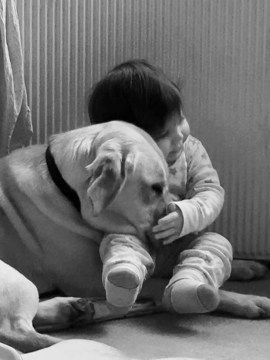
In reading that word – sustainability – cradling the head of our current Guide Dog puppy in my hands, her deeply pleading eyes looking up at me, I am reminded that this word not only describes what we at The BeZine – and indeed many, many more people around the world – more commonly come to understand of its meaning.
I have hitherto thought of sustainability as the fundamental process, nay philosophy, that needs to be adopted in order for the Earth to continue providing for all the life that inhabits it. But it also reflects human behaviour; it expects a certain attitude; it assumes that an essential ingredient to the achievement of a sustainable World is that the human beings, who inhabit the Earth become determined to adopt a way of life that is … well, sustainable!
It is an unfortunate character of the human condition that it is not until we lose someone that we become much more conscious of their value to our own life. It seems, whilst they are still around, that we prefer to focus more on their faults and shortcomings than on their virtues and strengths. We are even more prepared to abuse or betray their trust, than to respect them. So too, our Mother Earth.
As I regularly drive the roads around us, particularly the lanes of the beautiful countryside that surrounds us here in Yorkshire, I am reminded also of one of those human faults, anxiety, and of all the consequences of that condition: stress, impatience, fear, anger, aggression, depression. All too often, when I glance in my rear view mirror, I see another car race up behind me and sit so close to my rear bumper that I can’t see their number plate; at speeds and in situations in which it would be lunacy to contemplate overtaking. It is as if they are tempting me to yield, give in, pull over into a ditch and let them pass … and claim me as another victim! It isn’t necessarily that, I know, but it feels like that and, even in my advancing years, with the wisdom and insight of the road that I’ve gained in fifty years of driving, along with lowered testosterone levels, I sometimes feel like retaliating … and we all know how that could turn out.
The Dalai Lama it was, who attributed anxiety or agitation as the root of all conflict in the World. There is no doubt that he is right. Yes, I hear the academics, anthropologists, psychologists and any number of other -ologists, state the obvious, that Darwinian principles of evolution and survival in the animal kingdoms, of which human is one, dictate this behaviour. Our base instincts are therefore not to respect any forms of life outside our own sphere, outside our immediate survival zone; to consider them a threat to our survival.
… Really?
We are beyond this, surely, aren’t we? Can’t we exert more control over our behaviours, or are we simply hopeless victims of our own psyche; our individual intractable personality. For many in the Western World, the need to survive, to subsist on what our local environment can provide us, has long since turned into higher and higher material expectations. Each generation starts with more, but wants still more than the previous generation. Our survival instincts have turned into greed; at the expence of those on the margins, particularly in the overexploited so-called Third World. Are these expectations a consequence of some out of control unconscious driving forces within us, or could we re-educate ourselves. I believe the answer for some, sadly, is ‘no’. For others it would be ‘yes’.
I contend that the World could continue to support all life, even with its currently burgeoning (human) population. If only we were able to overcome our unreasonable expectations, there is one overriding benefit that could accrue from vanquishing our own greed … we could begin to feel what it is like to live with less poverty in the world, and less debt; less personal debt; less corporate debt; less national debt. Currently the only way Western governments can see to pay off the latter, is growth, economic growth, which has become the unquestioned Demi-God of economic and political policy objectives; growth is, I believe, a largely misunderstood, overused and abused tool of political rhetoric. This is, unfortunately, a vicious circle. I’ve heard growth described as a means of servicing our national debt. Long term, this does not make economic sense and surely cannot be sustainable!
So, what are we to do? Save more? Conserve our resources, however modest they may be? Adjust our expectations and those of our children? Their generation and the ones that follow, will otherwise only continue this roller coaster of a suicidal ride into debt and debt slavery; a World in which the super wealthy few have more and more control over the increasingly debt-ridden many. Freedom from debt, however you achieve it, whatever the cost to your expectations, your dreams, has to provide the way to a more sustainable World, and …
It. Is. Liberating.
Otherwise, our greatest and only means of survival, our patient and beautiful Mother Earth, will expel us, rich and poor, forever, and no-one will inherit anything! Space exploration to find a new life sustaining planet somewhere out there in the vastness, is pure fantasy … and vanity!
What can be done to reduce your anxiety? A starting point for me is to have a hug with your best friend, be they human … or puppy dog.
Photo: Barbara Anstie. Creative edit: Dave Anstie
“The Great Divide“
Crossing the great divide
between the dark age
and a brave new world,
sailing from the safety
of knowing your place
into uncharted waters.
In a deep and sickly swell,
an ocean of uncertainty,
struggling to recall
the purpose of the mission
for control of life, of lives,
and death by ownership.
From a certain time when
the have-nots had not
to one in which they have
a chance to trade their life
for aspiration, for riches,
for stuff and things,
for dukes and knights,
for castles and kings,
in suits that shine
with lights and bling,
but didn’t see the price
they’d have to pay.
Rivers flow with mighty force,
and carry away the memory
in a flood of whys, for what
and where will this all end?
Where are we now,
where will we be …
may be Utopia, the place of dreams
that while away our wild ambitious schemes?
We fail, as long as we can feel the pain
of having less than someone else’s gain.
Or we, by virtue of the coin’s toss,
have more by far than someone else’s loss.
The Wolf River, Kansas by Albert Bierstadt, c. 1859
I sometimes dream of eastern Kansas,
in those days before the wars,
when the white men fought each other
to be the right men behind the doors,
deciding the lives of men red and black,
to remain the preeminent beast,
over this land he said God was his alone,
from the left coast to the east.
I think of the man in the village,
sitting on the bluff above Wolf Creek,
and how once he ruled wherever he stood,
a wandering Pawnee being anything but meek.
And I know his time is passing,
his wandering no more his choice.
Soon the white man will fight everyone
over the black man who still had no voice.
In my dream the lodges moved westward,
if they ever moved at all.
Because illness, greed and the great lord God
seemingly turned on the Pawnee, Otoe and Kaw.
And that’s why I dream of eastern Kansas
in those days before the wars,
because a native man might still call his own
his land, his freedom and his lores.
Free-write rhyming thing, an exercise I tried to get the juices flowing. For whatever reason, the name William Stafford and the words “Lawrence, Kansas” kept clanging in my head. I searched for some art that might help stimulate some creative spark and found that picture by Albert Bierstadt of Wolf River in Kansas, circa 1859. Then I let loose the reins and my claybank muse cantered me here.


 © Gretchen Del Rio



 The BeZine