In the Jewish tradition, our first words on hearing of the death of someone are usually Baruch Dayan Ha’Emet, Blessed is the True Judge. It reminds us that we may not know why, but our friend has been taken. We give up our questions to a higher power.
Today, I learned that a friend here in Jerusalem from the creative-activist communities, Ester Karen Aida, passed away. Her funeral will be this evening, as I write this. In 2018, I published some of her poems on my blog, Meta/ Phor(e) /Play. Karen, as I knew her, contributed to The BeZine starting in 2021, when I invited her to send her words and art to us. Her most recent contributions were in this summer’s Waging Peace issue—an important theme in her activist and creative work. Her writing and artwork added strength, beauty, and compassion to each issue in which it appeared.
I first met Karen some years ago at a reading in an art gallery in Jerusalem, which had been organized by our mutual friend, Lonnie Monka. She was in a wheelchair, but active, engaged, and cheerful. We spoke, finding common ground in our creative work and activism. We both had trained in Marshall Rosenberg’s Nonviolent Communication (NVC) techniques. And we became friends from that conversation.
We would see each other mostly at poetry events. We kept up in email and on Facebook. She was making progress with her ongoing health issues, from wheelchair to walker to cane. I gave her rides home from some of these events, after she moved to a neighborhood near mine. She supported peace in the region here with words and deeds, helped individuals in need, and encouraged NVC training. She also supported accompanying and traditional health practices (aka alternative) to work alongside of Western medicine.
She was a dynamic, compassionate, and strong woman. She leaves grieving family, friends, colleagues. I am still in a bit of shock at the news. Not long from now, I will get ready to attend her funeral, drive across Jerusalem, and join the mourners.
In our Jewish tradition, the family will sit Shiva for 7 days. It is customary to sit with these mourners and listen to their sorrow and their memories as they process the loss. The stories they tell preserve their memory in our hearts. May it be so for all who knew and loved Karen, that her memory be for a blessing.
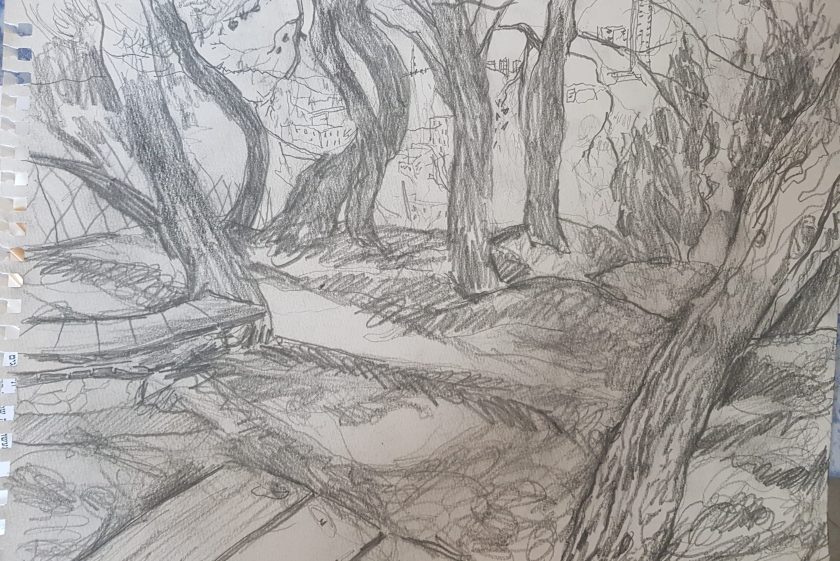
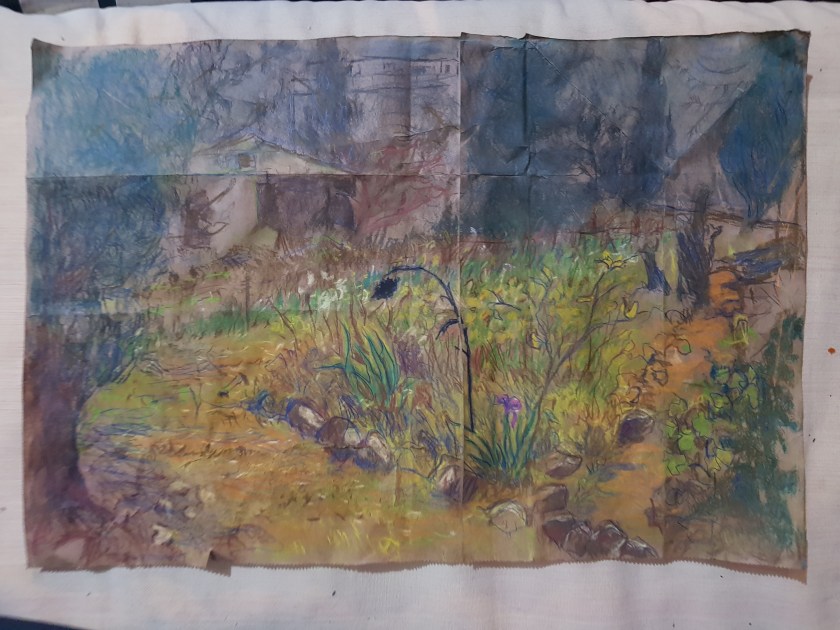
Children’s Community Garden, Arnona, Jerusalem (Pastel on brown paper grocery bag) Ester Karen Aida @2022
Those who visit to comfort the mourners say, when we leave: Ha’makom yenahem etkhem betokh she’ar avelei Tziyonvi’Yerushalayim, In this place may G-d console you among the other mourners of Zion and Jerusalem.
“There may be times when we are powerless to prevent injustice, but there must never be a time when we fail to protest.” Elie Wiesel
Toward the end of June this year I was introduced to Kella Hanna-Wayne’s (Yopp) work via a Facebook link shared by my colleague here at The BeZine, Contributing Editor Michael Dickel, which he in turn received from his daughter. I subsequently included info on Kella and her post HERE. That’s the way the world moves these days. Though technology and social networking are mixed blessings in some respects, they’re effective tools for people like Kella and I who have work to which we are committed but deal everyday with serious physical disabilities that constrain (in my case prohibit) activity outside the home.
The link of which I speak was to a post in which Kella provided some well-considered guidelines and resources for protesting the migrant travesties on the U.S. Southern Border. As I investigated Kella’s site, I was impressed with her thoroughness and clarity. I wrote to her about doing an interview on for our activist poets, writers, and friends. She agreed. Here it is. Read on. / Managing Editor, Jamie Dedes
JAMIE: Kella, you have taken on such a range of causes, all of them important, critical. Not everyone can do that. I hear people talk about “compassion burnout,” which is understandable but irritating. It’s a luxury oppressed people don’t have. I usually respond with “pick a cause. Pick one cause and focus on that.” What’s your advice?
KELLA: I think all of us, including activists, can agree that social justice is simply overwhelming. There are so many causes, there’s so much to learn about every cause, and to make things even more complicated, the needs of each cause are constantly progressing and changing. It’s a lot to keep up with.
But one of the fundamental ideas behind my blog is that there are a basic set of guidelines that you can follow that will help you understand any source of oppression. Instead of learning about male privilege, and then white privilege, and then financial privilege, why not learn how the concept of privilege works so that you can apply it to any new cause you learn about? There are so many challenges marginalized groups face that they have in common with one another: microaggressions, oppressive language, policing of their emotions/bodies, even difficulty accessing medical care. I think that if you learn the functionality of the oppressive systems that are at work and all the basic components of social justice, it enables you to support these groups of people much more effectively and thoroughly than if you were trying to learn one cause at a time from scratch.
I also think that even if you do choose to focus primarily on one cause, it’s important to be aware of the basics of the other ones because social justice issues are all inextricably connected to each other and ignoring the way intersectionality impacts the problems that we’re tackling tends to leave holes in our solutions.
JAMIE:What then are the steps activists can take to minimize burnout?
KELLA: No matter how narrow your focus, social justice issues are far bigger than any one person can solve. Because activism has to be a collective effort, I think it’s really important to recognize that completely fixing the problem is an impossible standard to hold yourself to. You are one piece in a much larger effort to create change. Even when you are focusing on what is within your personal power, you have to be realistic about what you can actually accomplish. If there are 20 different tasks that you could do as an activist and each one is individually within your ability to do, it’s likely doing all 20 of them is not. You have to choose what it is that you are going to do.
To make that choice, I recommend focusing on forms of activism that…
Are sustainable so that you can continue to do them over time
Are empowering to you so that you feel motivated to continue
Aren’t deeply upsetting or draining in such a way that the cost of the task is greater than the positive impact the action has
Feel right to you.
Which forms of activism meet those criteria is going to be different for everyone. For example, I believe that calling your representatives is an effective way to impact the future of our country but I find making phone calls incredibly anxiety-inducing and I have to spend a lot of energy to get myself to make one. That’s not a good use of my resources. On the other hand, writing comes easily to me, I find it rewarding, and it’s something that a lot of other people can’t contribute. I can accomplish way more by writing on behalf of activism than I could if I were using the same amount of resources to make phone calls. Whenever I feel the push to do more for a cause, I re-center on the importance of my writing and how much I’m offering in the work I already do.
A philosophy I carry around with me wherever I go is that everyone has something of value to offer. You have to find what your offering is.
JAMIE: Tell us about Yopp Academy.
KELLA: Yopp Academy is a section of my blog that focuses on educational material. It’s where I’m outlining that basic set of social justice guidelines I mentioned earlier.
To distinguish the amount of prior knowledge that’s needed to understand a given article, I used a college-style course numbering system, so articles are sorted into 100 level, 200 level, 300 level, etc. If you’re brand new to social justice, you start with the 100 level articles and work your way up. It really does function like a set of college courses in that articles of higher levels directly reference ideas from the level 100 articles, so the more of them you read together, the better your understanding will be of the subject as a whole.
The articles I have published currently only go up to level 300 because I’ve been putting my focus on establishing all the basic concepts before adding more advanced stuff. I’m currently working on a lesson plan of over 40 educational articles to serve as a foundation of knowledge which you can use regardless of your level of involvement with activism, which will include higher-level articles in the future.
JAMIE:Tell us about your Facebook debates.
KELLA: I’ve always had a lot of friends on facebook who are into social justice and some of them have such large friends list that anytime they posted something controversial, it would spark a discussion/debate. I started jumping into these discussions and offering my opinion and I got a reputation for being good at explaining basic social justice concepts to people who weren’t familiar with them and for clearly outlining the problems in someone else’s argument.
I used Facebook debates to practice my writing, increase my own understanding of social justice, it introduced me to a bunch of other amazing people that cared about the same things, and because managing my disability/mental illnesses made traditional activism prohibitive, it gave me a way to be involved in causes I cared about. Spending so much time arguing with people who I disagreed with also gave me a lot of insight into the places people were most likely to have holes in their understanding of our social systems which in turn has really informed the content and the structure of my blog. I often say the reason I started a blog in the first place was that I got tired of writing out the same explanations/arguments over and over again, and just wanted to write out the article once to link to every time I came across the same issue again.
I know I differ from a lot of people in that I believe debates on social media, even the “unproductive” ones, are an important branch of activism. Not only do they spread information to larger audiences of people (while only 10 people might be commenting, 1,000 could be reading the comments) but they serve as a means of socializing bigots to understand that their bigotry will be met with hassle and frustration rather than easy acceptance like they’re used to. I think that practice has a lot more power than people think it does.
JAMIE: So many people – like you and me – live with chronic, even catastrophic, illness. What can these illnesses teach us about social justice and advocacy?
KELLA: If you hold a conference for activism regarding chronic illness but you organize it in a similar way that you would any other business conference, your collection of speakers, organizers, and attendants are likely to be mostly healthy people rather than chronically ill people. If it’s energy-intensive to leave your house/travel, if you need frequent breaks or a special housing set up, if you have extensive food restrictions or you need to hire a carer to accompany you, it’s going to be very difficult, resource costly, and risky to go to a conference that healthy people can attend with ease. Even in attempting to center the chronically ill, if you organize from the perspective of a healthy person, you will leave chronically ill out of their own activism. That’s because the default systems that we have in place for most aspects of society make it very difficult for chronically ill people to participate let alone succeed.
Anytime you design a solution for the social issues chronically ill people face, you have to start by adapting your mindset and prioritizing accommodation of an experience that you’re not familiar with, or you’ll fail at your advocacy from the beginning.
And this idea is not at all exclusive to chronic illness. You see the same problem with white people organizing on behalf of people of color, cis people organizing for trans people, abled people organizing for disabled people, etc. You have to go in understanding that in order for your advocacy to be successful, you have to dismantle the relevant oppressive systems that are within your scope of power and create new systems, a new foundation before you attempt to build any kind of structure on top.
JAMIE: Your site is about eighteen months old as we work on this post. What are the goals for the next couple of years?
KELLA: I’m still very much working out what my ideal version of Yopp would be or what I want it to accomplish but so far, my concrete plans are:
Switch over to a new, more modern and accessible website
Finish writing the basic building blocks for Yopp Academy (all 40 of them!!)
Build up my Patreon supporter base– my first goal is $800 a month
Acquire enough sponsorships that I can publish up to 4 times a month
KELLA HANNA-WAYNE (Yopp) is a disabled, chronically/mentally ill freelance writer who is the editor, publisher, and main writer for Yopp, a social justice blog dedicated to civil rights education, elevating voices of marginalized people, and reducing oppression; and for GlutenFreeNom.Com, a resource for learning the basics of gluten-free cooking and baking. Her work has been published in Ms. Magazine blog, Multiamory, Architrave Press and is forthcoming in a chapter of the book Twice Exceptional (2e) Beyond Learning Disabilities: Gifted Persons with Physical Disabilities. For fun, Kella organizes and DJ’s an argentine tango dancing event, bakes gluten-free masterpieces, sings loudly along with pop music, and makes cat noises. You can find her on Facebook, Twitter, Patreon, Medium, and Instagram.
With all the strife in the world now, it seems a good thing to post something healing and peaceful.
Thich Nhat Hanh (b. 1926) Zen Monk, Dharma Teacher, Social Activist, Writer, Poet, Peacemaker
Thich Nhat Hanh is now recognized as a Dharmacharya and as the spiritual head of the Từ Hiếu Temple and associated monasteries. On May 1, 1966 at Từ Hiếu Temple, Thich Nhat Hanh received the “lamp transmission”, making him a Dharmacharya or Dharma Teacher, from Master Chân Thật.MORE [Wikipedia]
Though a Zen Buddhist monk, Thich Nhat Hanh combines traditional Zen with techniques from Theravada Buddhism, the wisdom of the Mahayana tradition, and ideas of modern Western psychology to teach meditation and spiritual values and practices in a way that resonates for people from diverse religious, political, and cultural backgrounds. He is a writer, poet, and peacemaker with over one-hundred books published, many in English. He was suggested for the Nobel Prize for Peace by Dr. Martin Luther King, Jr. in 1967. He was nominated again 2013.
Since 1966, Thich Nhat Hanh has lived in exile. Based at Plum Village, a meditation community in the south of France, he is a leading Buddhist teacher, encouraging engaged Buddhism, a movement for social activism that he founded. He organizes and supports many worthwhile humanitarian efforts.
Thich Nhat Hahn coined the term “interbeing,” a pointer to the Buddhist principles of impermanence and non-self, which bring light to the idea and ideal of the inter-connectedness of all things. He founded The Order of Interbeing, the members of which include lay people. Link HERE to brief summaries of each of the fourteen mindfulness trainings of the Order of Interbeing.
“If in our daily lives we can smile, if we can be peaceful and happy, not only we, but everyone will profit from it. If we really know how to live, what better way to start the day than with a smile? Our smile affirms our awareness and determination to live in peace and joy. The source of a true smile is an awakened mind.” ~ from Peace is Every Step by Thich Nhat Hanh
Here is a meditative interlude. The title of this post is a quote from the meditation, which is an excerpt from an album called Graceful Passages: A Companion for Living and Dying. It features spiritual teachers from many traditions offering advice to the dying … in other words, advice to all of us.
JAMIE DEDES (The Poet by Day)~I am a medically retired (disabled) elder and the mother of married son who is very dear. I started blogging shortly after I retired as a way to maintain my sanity, to stay connected to the arts and the artful despite being mostly homebound. My Facebook pages are:Jamie Dedes (Arts and Humanities) and Simply Living, Living Simply.
With the help and support of talented bloggers and readers, I founded and host The Bardo Group because I feel that blogging offers a means to see one another – no matter our tribe – in our simple humanity, as brothers and sisters and not as “other.”
“Good work, like good talk or any other form of worthwhile human relationship, depends upon being able to assume an extended shared world.” Stefan Collini (b. 1947), English Literary Critic and Professor of English Literature at Cambridge



 The BeZine