
Posted in Essay, General Interest, Spiritual Practice, Terri Stewart

Creating Sacred Space Wherever You Live

When I first started seminary, I was totally taken aback by two things. First, they start class in prayer. (Shocker! From a secular world to this!) Second, all the professors and administrative personnel seem to have an altar of some sort in their workspace. I never thought of having an altar before that–unless it was books. Creating a place in the home or work where your sacred articles live was a new idea to me. Especially since I came from that strain of protestantism that has all “things” as mundane, therefore personal altars were simply not a thing to be done.

Thank goodness for ecumenical seminary! This exposed me to new thoughts, broader ideas about who and what other people were, and broader ideas, and yet more specific, about who I am. I went about creating an altar at home. It is a little side table with a crystal bowl of rocks with an angel in it. And on the shelf of the table, there are books I love and find inspiration in…a book on hymnody, devotional books, prayer books, and about 10 children’s books ranging from “Where the Wild Things Are” by Maurice Sendak to “You Are Special” by Max Lucado. Over time and in a busy household with youngsters, the altar and items dispersed around the home. Occasionally, I rope them back together. But there is also a gift in seeing them spread all over the place. “Oh, look! A piece of the sacred right there!” or “Oh, that is a beautiful rock, the world is an amazing and holy place!” I suppose, I am not very good at being in one place, so scattering it willy nilly ends up working and becomes an odd kind of altar. I often wish I could build beautiful altars like my friends and colleagues do, but I know! The pieces will be everywhere. Maybe someday. (Said in a wistful voice!)

Today, for our sacred space exploration, I thought we could do an exercise about altars, creating personal altars, and whatnot. However, I had a better idea just typing that paragraph above! Let’s create a virtual altar together! Everybody offer a word, picture, poem, link to something or other, that you find to be inspiring, sacred, holy, or completely whole, and next week, I will bring back a virtual collage. At the same time the offerings are made, please visit the places that other people find sacred space in. I am confident that people will leave a word or two (or more!). You wouldn’t leave me hanging, would you?

Are you ready to do this together? After all, above and beyond having a personal altar, the altar of a community – whether it is in the Christian Church, a Jewish Synagogue, or a Pagan Altar – conveys that which the community finds sacred or holy. Or maybe just important. Maybe a quick examination of the words sacred and holy is in order (from the online etymology dictionary).

Holy:

Primary (pre-Christian) meaning is not possible to determine, but probably it was “that must be preserved whole or intact, that cannot be transgressed or violated,” and connected with Old English hal and Old High German heil “health, happiness, good luck” (source of the German salutation Heil). Holy water was in Old English. 

 Sacred:

late 14c., past participle adjective from obsolete verb sacren “to make holy” (c.1200), from Old French sacrer “consecrate, anoint, dedicate” (12c.) or directly from Latin sacrare “to make sacred, consecrate; hold sacred; immortalize; set apart, dedicate,” from sacer (genitive sacri) “sacred, dedicated, holy, accursed,”

What do you find holy or sacred? What word, image, poem, thought would you offer to a community altar? 

I offer one of my favorite photos of sunset from the top of the mountain, Haleakala on Maui. Why sunset? It is a liminal time when possibilities expand as we hold together both the end of a work day and the gestation of something new. In the Book of Genesis 1:5, it says, “And there was evening and there was morning, the first day.” Evening first. Gestation first. Darkness first. Sunset, first.

Haleakala Sunset by Terri Stewart
Haleakala Sunset
by Terri Stewart

Shalom,

Terri Stewart

(c) 2013, post & photo, Terri Stewart

REV. TERRI STEWART is Into the Bardo’s  Sunday chaplain, senior content editor, and site co-administrator. She comes from an eclectic background and considers herself to be grounded in contemplation and justice. She is the Director and Founder of the Youth Chaplaincy Coalition that serves youth affected by the justice system. As a graduate of Seattle University’s School of Theology and Ministry, she earned her Master’s of Divinity and a Post-Master’s Certificate in Spiritual Direction. She is a contributing author to the Abingdon Worship Annual. (The 2014 issue just released!)

Her online presence is “Cloaked Monk.” This speaks to her grounding in contemplative arts and the need to live it out in the world. The cloak is the disguise of normalcy as she advocates for justice and peace. You can find her at www.beguineagain.com ,www.twitter.com/cloakedmonk, and www.facebook.com/cloakedmonk.  To reach her for conversation, send a note to cloakedmonk@outlook.com

Posted in Essay, Spiritual Practice, Terri Stewart

Walking the Sacred Path with President Nelson Mandela

Nelson Mandela

This post is complementary to a post created at http://beguineagain.com/. I encourage you to read this and then read that post.

Today is the wrap-up in our recent series about President Nelson Mandela. As I was pondering how to close out the thoughts and hearts of our community, I remember that President Mandela was a deeply spiritual man who relied on the African theology of Ubuntu to carry the day. Ubuntu, which I have written about before, is the idea that “I am because we are.” It is deeply rooted in Africa with not only Mandela but Desmond Tutu subscribing to Ubuntu as core beliefs. Ubuntu is described below by Mandela himself.

“A traveler through our country would stop at a village, and he didn’t have to ask for food or for water. Once he stops, the people give him food, entertain him. That is one aspect of Ubuntu but Ubuntu has various aspects. Ubuntu does not mean that people should not enrich themselves. The question therefore is: Are you going to do so in order to enable the community around you to improve?” http://www.youtube.com/watch?v=Dx0qGJCm-qU#t=28

Knowing that this deeply spiritual man connected so strongly to a traditional spirituality, I have decided to combine the traditions of President Mandela and the gleanings of the Bardo Group with the ancient prayer practice of Midday Prayer. I am relying on the ancient rhythm but substituting readings from our authors and from President Mandela.

The general pattern of Midday Prayer is opening, hymn, psalm, Gloria, reading, prayers of the people, Lord’s prayer, collect, conclusion. This will be an adaptation of this ancient pattern. Someday we can discuss the prayer pattern and its ancient roots that extend beyond Christianity into Judaism and earlier.

Take a moment, light a candle, slow down and begin again with President Nelson Mandela leading the way.

A Midday Meditation in the Tradition of Ancient Mystics

Honoring Nelson Mandela

Help us as we pause at this point in the day to find safety and refuge, peace and mercy.

Glory to all that ties us together and brings our hearts into the center so we may listen. As it was in the beginning, it will be now, and will be forever more. Amen.

Hymn, excerpted from John Antsie

As the West winds blew their fury
the earth let out a cry;
as if to deny the awful truth,
it was more than just a sigh.
As if one life had greater value
than all of this; all of the love
that a world full of great lives
could bear; bear to contemplate
the loss of a legend, but
whose wisdom will be immortal …

Psalm, excerpted from Charles W. Martin

once
or twice
in a lifetime
an ancient returns
showing
the way
not
as a prophet
or
god-like figure
but as
a man
or
a woman
willing to expend
all their life forces
to open
the minds
of all those
willing
to listen

Glory to all that ties us together and brings our hearts into the center so we may listen. As it was in the beginning, it will be now, and will be forever more. Amen.

Reading: Inspired by Jamie Dedes, by President Nelson Mandela, Speech on World Civilisation, November 2000

The world had become much smaller, as I realised when racing on jumbo jets that I had never seen before, and talked every day on amazing new international telephones. I had to acquaint myself with this new phenomenon of globalisation, that enabled money and capital to flow instantly across the globe, and made the economies of the world startlingly more interdependent.

The effects and consequences of globalisation had to be internalised by many other South Africans, as well. South Africa became isolated from the international community during the apartheid years, and now saw how closely interconnected countries and economies had become. We welcome the process of globalisation. It is inescapable and irreversible. We can no more ignore it, as I said before, that we can reject the idea of winter by refusing to wear warm clothes. It can carry with it not only investment and transfer of expertise, but also knowledge and understanding of other people and cultures.

But if globalisation is to create real peace and stability across the world, it must be a process benefiting all. It must not allow the most economically and politically powerful countries to dominate and submerge the countries of the weaker and peripheral regions. It should not be allowed to drain the wealth of smaller countries towards the smaller ones, or to increase the inequality between richer and poorer regions.

Please take a moment for silent reflection.

Meditation: Inspired by Jamie Dedes, by President Nelson Mandela, Africa Standing Tall Against Poverty, 2 July 2005 [edited]

Massive poverty and obscene inequality are such terrible scourges of our times – times in which the world boasts breathtaking advances in science, technology, industry and wealth accumulation.

We live in a world where knowledge and information have made enormous strides, yet millions of children are not in school.

We live in a world where the Aids pandemic threatens the very fabric of our lives. Yet we spend more money on weapons than on ensuring treatment and support for the millions infected by HIV.

It is a world of great promise and hope. It is also a world of despair, disease and hunger.

Overcoming poverty is not a gesture of charity. It is an act of justice. It is the protection of a fundamental human right, the right to dignity and a decent life.

While poverty persists, there is no true freedom.

Please take a moment for silent reflection.

Have mercy on our souls.

Group prayer

Holiness, wholeness, perfectedness
The Name of the path of healing is sacred
Let the cosmos be filled with mercy and kindness!
Let the cosmos be filled with acts of justice and love!
Let it be so, here, on earth, and everywhere in the cosmos.
Let our needs be fulfilled with love so that it
Staves off temptation allowing an end to injustice and poverty.
The cosmos of love and mercy has power to move hearts and make it so.
Forever. And ever.
So it shall be.
Amen and amen.

Intercessory prayer for the poor and concluding collect

We lift up all who live below the poverty line – knowing that we do not succeed if they do not succeed. Each one is a unique and precious beloved person in the human family.

We know that good things can go to them if we work towards justice, love, and mercy to provide for the needs of one another in loving kindness and in political will. Let us seek help so that we may help the less fortunate who experience the apartheid of poverty.

This is an abundant world if we would act with mercy and justice for all. Sharing our resources in an equitable manner worthy of the label, loving kindness. While we ask for strength for the impoverished, we ask for the hearts of the comfortable to be shattered with love for neighbors both known and unknown so that we may truly live in an Ubuntu world, erasing the line between the haves and have-nots and transforming the cosmos into Sacred Wholeness.

Peace I give to you, peace I leave with you.

Shalom and Amen.

~Terri

(c) 2013, post, Terri Stewart

(c) 2013, photo, Ted Eytan, CC AT-SA 2.0, http://www.flickr.com/photos/22526649@N03/11235545336/

terriREV. TERRI STEWART is Into the Bardo’s  Sunday chaplain, senior content editor, and site co-administrator. She comes from an eclectic background and considers herself to be grounded in contemplation and justice. She is the Director and Founder of the Youth Chaplaincy Coalition that serves youth affected by the justice system. As a graduate of Seattle University’s School of Theology and Ministry, she earned her Master’s of Divinity and a Post-Master’s Certificate in Spiritual Direction. She is a contributing author to the Abingdon Worship Annual. (The 2014 issue just released!)

Her online presence is “Cloaked Monk.” This speaks to her grounding in contemplative arts and the need to live it out in the world. The cloak is the disguise of normalcy as she advocates for justice and peace. You can find her at www.beguineagain.com ,www.twitter.com/cloakedmonk, and www.facebook.com/cloakedmonk.  To reach her for conversation, send a note to cloakedmonk@outlook.com
Posted in Essay, Spiritual Practice, Terri Stewart

What’s in a Name? Finding Sacred Space in Identity

Christening  (c) 2009, Paula Bailey CC 2.0
Christening

A little secret: I am preaching on Sunday. So today’s inspiration is gleaned from random thoughts about what I have been studying. And I have been studying names. In the Gospel of Matthew, the story of Jesus’ beginning has an angel telling Joseph the name for this baby:  Jesus. Jesus is the English form of Yeshua which is a form of Joshua. Yep. Joshua. Where have we heard that before? Joshua is the name of the guy in Hebrew scripture who takes the people into the promised land. How is that for being saddled with a name? Joshua also means, arguably, “God saves.” Additionally, Matthew references the Book of Isaiah and the name Immanuel, “God with us.”

And I think being saddled with a name like Terri is a problem! Well, I don’t really think it is a problem, but in second grade, I had problems. My reading teacher put masking tape on each reading book so she could write our names onto our book. I don’t know why, perhaps because I was as boisterous then as I am now, but she put “Terrible Terri” onto my second grade reader. I was distraught. But, being ever so bashful, I said, “no, you need to change this.” And then it became Terrific Terri. Just goes to show that advocacy has always been in my personality. But I was hurt that a teacher would label me as Terrible.

Naming, labeling, creates expectations that can hinder us or help us in our journey. I think the name “Terrible Terri” is a hindrance! But the name “God Saves”… well, it could go either way. You either live up to that name or you become completely overwhelmed. Or maybe even both! It can be both an inspiration and an absolutely terrifying expectation. I wonder if Jesus ever worried about getting it wrong? For example, he was out in the country, and this woman runs up to him asking for him to heal her daughter and he says, “I did not come for your kind…you’re like the dogs underfoot at the dinner table!” Ouch. I hope he at least winced at that one. He did not live up to the expectation, at that moment, of being the perfect picture of saving grace. But he grew into it as he changed his mind. (Matt 15:21-28) and included the very ordinary mother and her daughter in his ministry. That’s kind of inspiring, isn’t it? A picture of someone willing to listen, hear, and change. We don’t get much of that in our daily life. Witness: CNN, MSNBC, FOX. Maybe that is one place where “God saves.” When we engage in a relationship, listen to each other, hear what is said, and change for the better. That might be new growth. That might be creating sacred space. Can I get an Amen?

My son, Colin, is transgender. His original name was Caitlyn. Caitlyn means “pure.” Pure is quite a lot to live up to. When Colin came out, he chose his name. He chose Colin for two primary reasons-he likes the name and it was close enough to Caitlyn that it would be easier for people to make the transition. Colin has several options in its meaning, but since Caitlyn is of Irish origin, we decided to continue with the Irish origin (much to the Scottish family’s dismay!). Irish-ly speaking, Colin means “peaceful dove.” Hmm. I don’t think Colin is quite the peaceful dove, but maybe he will live into it. In fact, upon reflection, I think he has lived into it in many ways. He may not be a quiet, peaceful dove. But he does advocate for right relationship between people and has zero tolerance for bullying. Can you exuberantly advocate for peacefulness? I think so.

We finally took Colin in to get his name changed legally. The judge looked at the paperwork “Caitlyn” to “Colin,” looked at me, asked me if all the signatures were valid and if this was something “she” wanted. I answered, “My son desires to change his name to Colin.” The judge blinked. Looked back down at his paperwork and then decreed it so. Then Colin got 100 pats on the back as he left court. And not one negative word was said. He was beaming from ear to ear. This was his naming ceremony. The moment in time where he stepped into who he really was. It was important. There is something sacred in claiming yourself and knowing your own identity, your own story. There is also something very difficult in the process. And, it is ultimately a very loving act. Can you love yourself enough to know your name? Not the name slapped onto your second grade reader, but the name you choose? Is your name Inspiration? Compassion? Love? Challenge? Maybe your name is a complex amalgam of inspirational-compassion-that-challenges-while-whispering. (Well, I would not whisper, but you take my meaning?!)

What name do you claim? What name do you want to jettison? What name has claimed you?

Shalom and Amen!

~Terri

(c) 2013, post, Terri Stewart

(c) 2009, photo, Paula Bailey, cc licensed 2.0, http://www.flickr.com/photos/32625013@N00/4195762309/

terriREV. TERRI STEWART is Into the Bardo’s  Sunday chaplain, senior content editor, and site co-administrator. She comes from an eclectic background and considers herself to be grounded in contemplation and justice. She is the Director and Founder of the Youth Chaplaincy Coalition that serves youth affected by the justice system. As a graduate of Seattle University’s School of Theology and Ministry, she earned her Master’s of Divinity and a Post-Master’s Certificate in Spiritual Direction. She is a contributing author to the Abingdon Worship Annual. (The 2014 issue just released!)

Her online presence is “Cloaked Monk.” This speaks to her grounding in contemplative arts and the need to live it out in the world. The cloak is the disguise of normalcy as she advocates for justice and peace. You can find her at www.beguineagain.com ,www.twitter.com/cloakedmonk, and www.facebook.com/cloakedmonk.  To reach her for conversation, send a note to cloakedmonk@outlook.com

Posted in Essay, Spiritual Practice, Terri Stewart

Sacred Space in Music

Probably most of us connect to music of some sort. And we all have our favorites. My favorites are a moving target…sometimes Katy Perry and sometimes Arvo Part. I’d like to consider that all music is sacred in some way. The creative spirit arriving and making something new. But, I admit, I can be an old fuddy duddy when I hear some of the music the youth I work with listen to. On the other hand, it is definitely a creative expression of their understanding of life; it is a way that they share their story.

What I’d like to consider for an exercise in capturing sacred space today, is not just any old music or reflection on your favorite song, but an exercise of audio divina. Listening with a contemplative spirit. I have chosen the Amen chorus from Handel’s Messiah. I chose this because Amen, strictly translated, means “So be it!” and it is a soaring and beautiful ending to this grand piece of music. So get comfortable! Here we go!

The earth has music for those who listen.”  ― George Santayana

I invite you to use this extraordinary listening and enter into the contemplative prayer practice of Audio Divina using the video and the steps outlined below.

  1. Explore the music. Listen once. Journal any notes you wish to make about the piece.
  2. Go deeper, listen a second time. Where were your ears drawn? What feelings rose up? Engaging your imagination, enter the music. Where are you? What are you doing? Do you see something differently from this vantage point? What relationships do you notice? Journal your reflections.
  3. Allow the music to lead you into a time of meditation Silently, offer prayers of gratitude, intercession, lament, confession, or praise – whatever wells up in you. If you wish, journal these prayers.
  4. Adjust your sitting position so that you are comfortable. You can continue listening to the music with your eyes closed.  Release tension in your neck, shoulders, arms, hands, legs and feet. Breathe deeply and slowly. Find your quiet center.  Rest in this quiet for 10-15 minutes, being open to all that is within you. Allow thoughts to drift past you as if they were clouds. If your mind wanders, that is okay, call it back to attention when you are able. At the end of this time, slowly open your eyes. Breathe deeply. Journal any insights you want to remember, actions you are invited to take, and any thoughts or feelings that are present. You may have only had random thoughts flying though your mind the entire time. Journal about that. Be gentle with yourself and have no expectations of grand revelations. The point is to practice and to offer quiet time to be attentive .
  5. Close by lifting up your gratitudes and thanksgivings.

If this music does not appeal, use this same process with music of your choice.

It is not often that we get the chance to listen to something-not for the pleasure it gives us, but for what it can teach us. I hope you can find a little sacred space in the music you choose to learn from.

Shalom and Amen,

Terri!

For a longer experience that delves into the beautiful music of Handel’s Messiah. You could listen to Part 3 (below).

© 2013, post, Terri Stewart, All rights reserved

terriREV. TERRI STEWART is Into the Bardo’s  Sunday chaplain, senior content editor, and site co-administrator. She comes from an eclectic background and considers herself to be grounded in contemplation and justice. She is the Director and Founder of the Youth Chaplaincy Coalition that serves youth affected by the justice system. As a graduate of Seattle University’s School of Theology and Ministry, she earned her Master’s of Divinity and a Post-Master’s Certificate in Spiritual Direction. She is a contributing author to the Abingdon Worship Annual. (The 2014 issue just released!)

Her online presence is “Cloaked Monk.” This speaks to her grounding in contemplative arts and the need to live it out in the world. The cloak is the disguise of normalcy as she advocates for justice and peace. You can find her at www.beguineagain.com ,www.twitter.com/cloakedmonk, and www.facebook.com/cloakedmonk.  To reach her for conversation, send a note to cloakedmonk@outlook.com

Posted in Essay, poem, Poems/Poetry, poetry, Spiritual Practice, Terri Stewart

Naming Your Sacred Truth

Gloriously Pink by Terri Stewart
Dazzling Pink

Recently, I took a personality test that was required for a program I am participating in. Sometimes, I feel like the most tested person in the world! Meyers Brigg, Gary Smalley, MMPI, an actual interview with a therapist—and I think there were other tests. My organization really, really wants their people to be healthy!

The unique thing about the most recent test – called the DISC – is that it created a public and private personality profile. My “two” personalities were not far off of each other, but they were different. Most significantly, my “D” or dominance trait is very high publicly and only moderately high privately. Meaning, I am bossy.

What a surprise!

Privately, though, my bossiness is exactly balanced with my expressive part of my personality. Meaning, I can be obnoxiously loud! Loud and bossy!

An even bigger surprise!

Not.

Those are just the harsh ways of looking at my personality. Really, I am the head of an organization – if I can’t provide direction, the organization will not succeed. And the expressive + directing can equal playful and silly. Or dramatic. That is the private me.

Question: What does this have to do with spiritual practices or sacred space?

Everything! There is the old adage, “Know thyself.” But it is also, “Know Your Story!” And “Tell Your Story!” (The whole expressive personality thing = exclamation points.)

I am reading a book called Your Mythic Journey by Sam Keen and Anne Valley-Fox. They go into a discussion of public and private personas. Sometimes we think about our authentic selves like it is only possible to be fulfilled if we are 100% “authentic.” Maybe. The questions that spring to my mind are: “Who is your authentic self?” “Is your public self any less important than your private self?” “Are we allowed to protect our fragile bits and keep them private?” “Can we hold personas these in dialogue?” “Is the private self always the healthy self?”

And on, and on.

Today, I’d like to encourage you to glimpse your public and private self through creating a fill-in-the-blank scenarios and then looking at all the words you accumulate to create a revelatory product that illumines the sacred being that we all are.

Pen and paper in hand, sit back and follow the prompts.

Your Public Self

  • Make a list of 10 words or phrases that best describe you using the prompt, “I am ______________ .”
  • Now rank the words/phrases in order of importance
  • Now cross them out one at a time until you are left with your most important trait.
  1. I am playful.
  2. I am smart.
  3. I am disorganized.
  4. I am also organized.
  5. I am faith-filled.
  6. I am compassionate.
  7. I am loud.
  8. I am wise.
  9. I am filled with ideas.
  10. I am creative.

  1. I am compassionate.
  2. I am playful.
  3. I am creative.
  4. I am filled with ideas.
  5. I am faith-filled.
  6. I am smart.
  7. I am loud.
  8. I am wise.
  9. I am also organized.
  10. I am disorganized.

What is your revelatory word? Please leave your word in the comments section to share.

If you would like to take this one step further, I encourage to take your 10 words/phrases and use them as word prompts to create a micro-poem (using as many or as few of the words as you like).

playful love

spatters life dripping

with painted ideas

of

dazzling pinks, blues, and yellows.

swarming compassionately

and loudly causing

chaos

while held together

in

sophic faith.

i. am.

Of course, my private self is not quite so lovey-dovey, dazzling pink, or wise. Often the chaos is on the rise internally or the struggles I have with health are masked out. But that will be a post for another day. Today, embrace the sacred space that you present to the world. I believe that when we don’t have enough faith in our own abilities to be compassionate or loving or wise, we can live into that reality until our inner space matches our outer space.

Shalom and Amen.

~Terri

P.S. I’d love to invite you over for a quick look at the Advent reflections that have been offered at BeguineAgain.com

Thursday, 11/28, The Tipping Point, Essay by Jamie Dedes (The Bardo Group)
Friday, 11/29, Simple Truths, Poem by Kathleen Tenpas
Saturday, 11/30, I Didn’t Want to Move, Essay by David Orendorff
Sunday, 12/1, World AIDS Day, Essay by Tracy Daugherty
Monday, 12/2, Fowler’s Snare, Collage by Judy Alkema
Tuesday, 12/3, An Advent Prayer, Prayer by Mark Sandlin
Wednesday, 12/4, An Angel Came Near, Essay by Tracy Daugherty
Thursday, 12/5, Washed, Poem by Terri Stewart
Friday, 12/6, Zoom In, Zoom Out, Essay by Catherine MacDonald
Saturday, 12/7, The Word Stands, Collage by Laura Esculcas
Sunday, 12/8, The Wolf, Storytelling by Jim Cyr

© 2013, post and photo , Terri Stewart, All rights reserved

terriREV. TERRI STEWART is Into the Bardo’s  Sunday chaplain, senior content editor, and site co-administrator. She comes from an eclectic background and considers herself to be grounded in contemplation and justice. She is the Director and Founder of the Youth Chaplaincy Coalition that serves youth affected by the justice system. As a graduate of Seattle University’s School of Theology and Ministry, she earned her Master’s of Divinity and a Post-Master’s Certificate in Spiritual Direction. She is a contributing author to the Abingdon Worship Annual. (The 2014 issue just released!)

Her online presence is “Cloaked Monk.” This speaks to her grounding in contemplative arts and the need to live it out in the world. The cloak is the disguise of normalcy as she advocates for justice and peace. You can find her at www.beguineagain.com , www.twitter.com/cloakedmonk, and www.facebook.com/cloakedmonk.  To reach her for conversation, send a note to cloakedmonk@outlook.com

Posted in Essay, Spiritual Practice, Terri Stewart

Sacred Space in Particles

I am fascinated with astrophysics. And I am probably just skilled enough to be dangerously inept! One thing that just makes my heart flutter is the idea that all matter is already created! We can neither destroy or create matter. (Except that we can, according to the Higgs Boson discovery – but that will be for another discussion!)

In general terms, matter is neither destroyed or created so that essentially the particles we immerse ourselves in are the same particles that have been around forever and ever. The Oxygen molecule I breathe in was perhaps breathed in by some semi-ancient ancestor. Who would I choose to share breath with? Maybe I would connect to some fabulously wonderful pioneering women such as Christine de Pizan or Joan of Arc. Or maybe with some substantial spiritual leaders like Jesus of Nazareth, Gautama Siddartha, or Mary of Magdala. I could be breathing their particles!

I am also breathing the particles that were created at the moment of birth of the cosmos. That rapid expansion of the universe when it really did somehow go from nothing to something. Pushed outward in a violent burst of matter, light, and waves. Culminating in this moment. This time. At least for us. This moment is the culmination. Until the next moment, that is!

So, I was thinking cosmologically in this way and I stumbled across a book called, The Tree. It is a children’s book written by a Pacific Northwest author. I imagined the particularity of matter as residing in the tree. And then I read the story of how this book came about. The author received this story while sitting underneath a Douglas Fir in the Pacific Northwest. He received it as a song, not as a story. He sang it often for various events. Half-heartedly claiming that the tree wrote it.

Later, he was invited to a celebration to celebrate the return of the Madrona Point burial ground to the Lummi people. The tribal chief wanted to hear his song. He sang it. And then offered the story of the song’s origins with the additional wondering, “Did it really come from that ancient Douglas Fir?”

The tribal chief said, “It did. I recognize the tune.” He went on. “It is known in our tradition that each tree has its own song. Our music comes from them. We show our respect for the great trees by singing their songs and playing them on the flute. We must all work to save the ancient groves in our territory.”

Hmm. That is really quite beautiful.

And so, for this offering in the quest towards finding sacred space, I invite you to connect with the particles of the cosmos, the particles of the tree, and to sit back and enter into the story of The Tree.

Shalom and Amen,

Terri

© 2013, post and video, Terri Stewart, All rights reserved

terriREV. TERRI STEWART is Into the Bardo’s  Sunday chaplain, senior content editor, and site co-administrator. She comes from an eclectic background and considers herself to be grounded in contemplation and justice. She is the Director and Founder of the Youth Chaplaincy Coalition that serves youth affected by the justice system. As a graduate of Seattle University’s School of Theology and Ministry, she earned her Master’s of Divinity and a Post-Master’s Certificate in Spiritual Direction. She is a contributing author to the Abingdon Worship Annual. (The 2014 issue just released!)

Her online presence is “Cloaked Monk.” This speaks to her grounding in contemplative arts and the need to live it out in the world. The cloak is the disguise of normalcy as she advocates for justice and peace. You can find her at www.cloakedmonk.com, www.twitter.com/cloakedmonk, and www.facebook.com/cloakedmonk.  To reach her for conversation, send a note to terri@cloakedmonk.com

Posted in Essay, Spiritual Practice, Terri Stewart

Finding Sacred Space In the Other

This week in my church, it has been filled with conflict and dissension. That makes for a tough week! Let me clarify – structurally, from the upper echelon of the decision-making bodies, there has been a reinforcement of codified discrimination and what I think is just pig-headed wrongness. Ha! I am not feeling very charitable at all. I always have the choice of staying within the system or leaving. But leaving does not really move the ball forward for me. Why? Because my basic anthropology is that we are all connected. Even if I left this system and surrounded myself with folks that were just like me (how irritating that would be!), I am still connected to the people that I find the most frustrating.

Harrumph.

Then, I discovered this exercise written by Troy Bronson in his book Drawn In. It is an exercise for integration and forgiveness. Or perhaps forgiveness and integration. I am fairly certain that full integration is not possible without forgiveness! At any rate, I have adapted his exercise and now I offer it to you as a spiritual practice to aid in integrating those people that drive us bananas.

Take a piece of paper and fold it in half twice so that you have four quadrants. In the bottom right list your enemies: those who mean harm to you and your family; those who are politically opposed to what you are for; those who persecute you and others associated with your causes and passions.

In the bottom left list your friends: advocates for those associated with your religious, political, or social causes. Write all of this so that both groups are at the bottom of the page, with only a crease separating them.

On the Horizon (c) 2013, Terri Stewart
On the Horizon
(c) 2013, Terri Stewart

Now, draw a horizontal line to separate both groups from the empty top half of the page. Read this adapted version of Psalm 121.

I look to the hills!
Where will I find help?
It will come from the immense force
that created the stars, sun, sky,
And earth.

You are protected by Love,
And Love will not sleep
Or stumble
Or snooze.
Love always is.
Protecting you,
Standing at your right side,

The Tree shades us from the sun
The sun will not harm you
Nor will the
Moon.
Protecting you,
Keeping you safe from
All
Dangers.

The incredible creative force
That was, that is, that shall be
Is with you.
Now and always.
Wherever you go.

Reflect on the line, “I look to the hills!” and imagine that the line you’ve drawn is a horizon line made by hills way off at the distance. Imagine your friends and your enemies looking into a future where all things are met with love, justice, and mercy. Where the separating walls between these two groups are healed and taken down. Where the grievances are forgiven. Where they gaze lightly upon one another and see beloved rather than the other.

Now, offer your thoughts to love and reconciliation choosing to step forward into the hills that were once a divider, but now, as we all step into them, cocoon us in beauty.

Adapted from Ephesians 2:11-22

Don’t forget that you used to be the other! The enemy! They used to call you crude and rude. You were a foreigner in this land with no understanding of tradition. You had no hope and were held far away from life giving love.

Creative, responsive love unites all in peace! Breaking down the laws that separate us – that separated us. Following religious rules that are not grounded in loving kindness is not helpful! We all suffer, feel pain. But we are all one, one body united together. We are in this one life together.

You are no longer a stranger or an enemy! You are beloved. Just as those you persecute are beloved. All who went before you are the foundation for who you are today. And it is held together by Love and grown into holy ground where Loving Kindness dwells.

You are part of that holy ground.
You are holy ground.
They are holy ground.
We are
Holy
Ground.

There is no near and no far.
There is only here.
Be one.

Shalom and Amen,

Terri

© 2013, post , Terri Stewart, All rights reserved

terriREV. TERRI STEWART is Into the Bardo’s  Sunday chaplain, senior content editor, and site co-administrator. She comes from an eclectic background and considers herself to be grounded in contemplation and justice. She is the Director and Founder of the Youth Chaplaincy Coalition that serves youth affected by the justice system. As a graduate of Seattle University’s School of Theology and Ministry, she earned her Master’s of Divinity and a Post-Master’s Certificate in Spiritual Direction. She is a contributing author to the Abingdon Worship Annual. (The 2014 issue just released!)

Her online presence is “Cloaked Monk.” This speaks to her grounding in contemplative arts and the need to live it out in the world. The cloak is the disguise of normalcy as she advocates for justice and peace. You can find her at www.cloakedmonk.com, www.twitter.com/cloakedmonk, and www.facebook.com/cloakedmonk.  To reach her for conversation, send a note to cloakedmonk@outlook.com
Posted in Essay, Spiritual Practice, Terri Stewart

Finding the Sacred in Impermanence

Today I have been thinking about the beauty of impermanence. These thoughts were inspired by an artwork installation I saw recently called Shimmering Tree. Shimmering Tree is a projection of a digital tree onto a huge wall in a gallery. The tree is shimmery, animated, and changes seasons. But it is digital! I wondered about this digital artwork media installment sitting next to traditional portraiture or other more concrete forms of art. Shimmering Tree is art from digital artist Jennifer Steinkamp. An earlier piece of hers is Dervish:

It is a fascinating thing. Steinkamp’s work may be a valuable lesson to not become too attached to a physical manifestation and to embrace the beauty of what is.The inherent contradiction is that this temporary art is captured forever kn a digital form!

I think there may be a deeper spiritual practice lurking in the embrace of impermanence. This is more than recognizing that things change-it is a deep-seated gratitude for impermanence. A recognition of the beauty inherent in change, impermanence, evolution.

I wonder, what have I been holding onto that I need to let go of? Usually those things are behavioral for me. But it could be something else. Shoes. Books. Things. Sometimes I get this fleeting impression of impermanence when I wish I had my camera with me to capture a particularly beautiful vision. But I am forced, in that moment, to receive the image and to release it-with gratitude.

Thinking of impermanence and developing a greater appreciation for it led me to remember a video I saw from Ukraine’s Got Talent. This art is the epitome of grace, beauty, and impermanence.

Of course, life has always been impermanent. Art decays. But usually it is with us more than 5 minutes! Much art outlasts people! What are we going to do when everything has a lifespan tied to the technology cycle?

We better learn to master this! I wonder if there is one word you would like to offer as a movement towards seeing the beauty of impermanence? My word is: ego.

How about you?

Shalom and Amen,

Terri

© 2013, post , Terri Stewart, All rights reserved

terriREV. TERRI STEWART is Into the Bardo’s  Sunday chaplain, senior content editor, and site co-administrator. She comes from an eclectic background and considers herself to be grounded in contemplation and justice. She is the Director and Founder of the Youth Chaplaincy Coalition that serves youth affected by the justice system. As a graduate of Seattle University’s School of Theology and Ministry, she earned her Master’s of Divinity and a Post-Master’s Certificate in Spiritual Direction. She is a contributing author to the Abingdon Worship Annual. (The 2014 issue just released!)

Her online presence is “Cloaked Monk.” This speaks to her grounding in contemplative arts and the need to live it out in the world. The cloak is the disguise of normalcy as she advocates for justice and peace. You can find her at www.cloakedmonk.com, www.twitter.com/cloakedmonk, and www.facebook.com/cloakedmonk.  To reach her for conversation, send a note to cloakedmonk@outlook.com

Posted in Essay, Spiritual Practice, Terri Stewart

Finding Sacred Space Within Our Own Skin

I am attending a retreat this weekend. I have done two exercises today that stretched my own perception of myself. I’d like to offer one to you as a Spiritual Practice geared towards finding sacred space within your own skin and being willing to see yourself.

I don’t know about you, but that can be the most difficult spot for me to discover. Somehow, I can look at others and see their beauty, but acknowledging my own beauty seems at once terrifying, bold, and that I may fall short of being that … what? That person. That human. That woman. That mother. That chaplain. That presence of comfort. Oh, I think it is true that I fall short – we all do – but failing myself at simply just seeing myself is not okay!

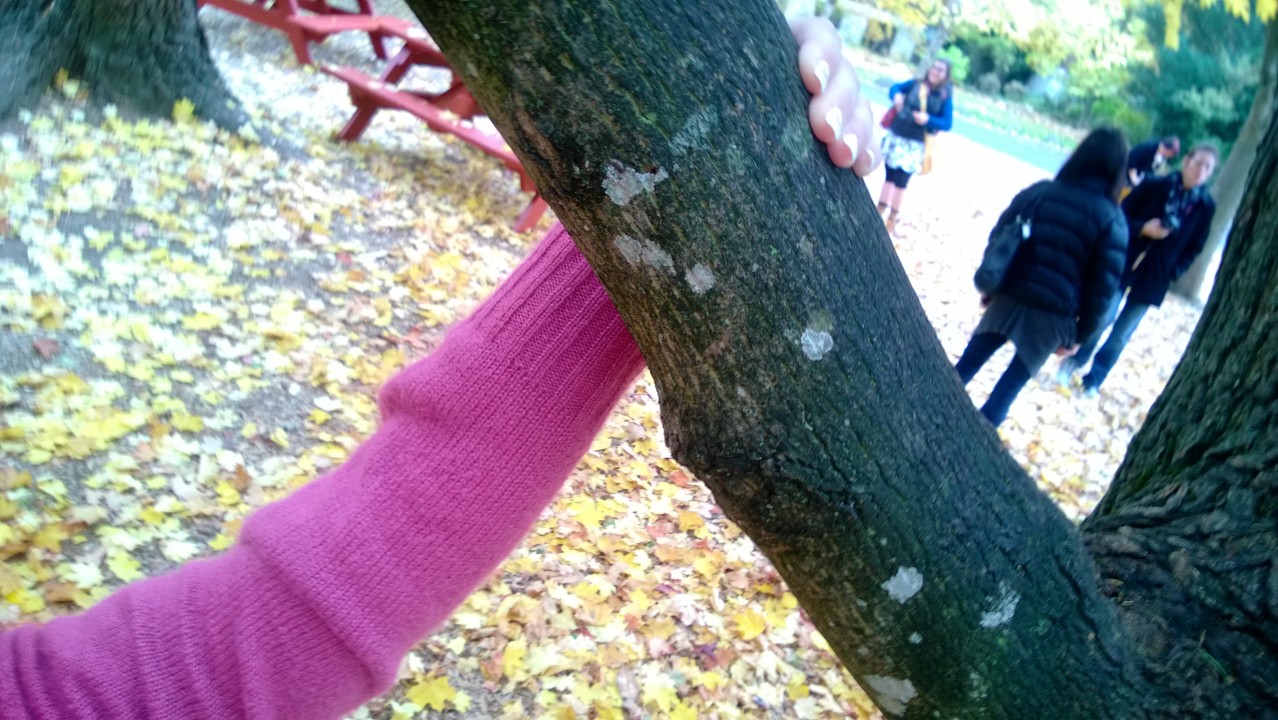
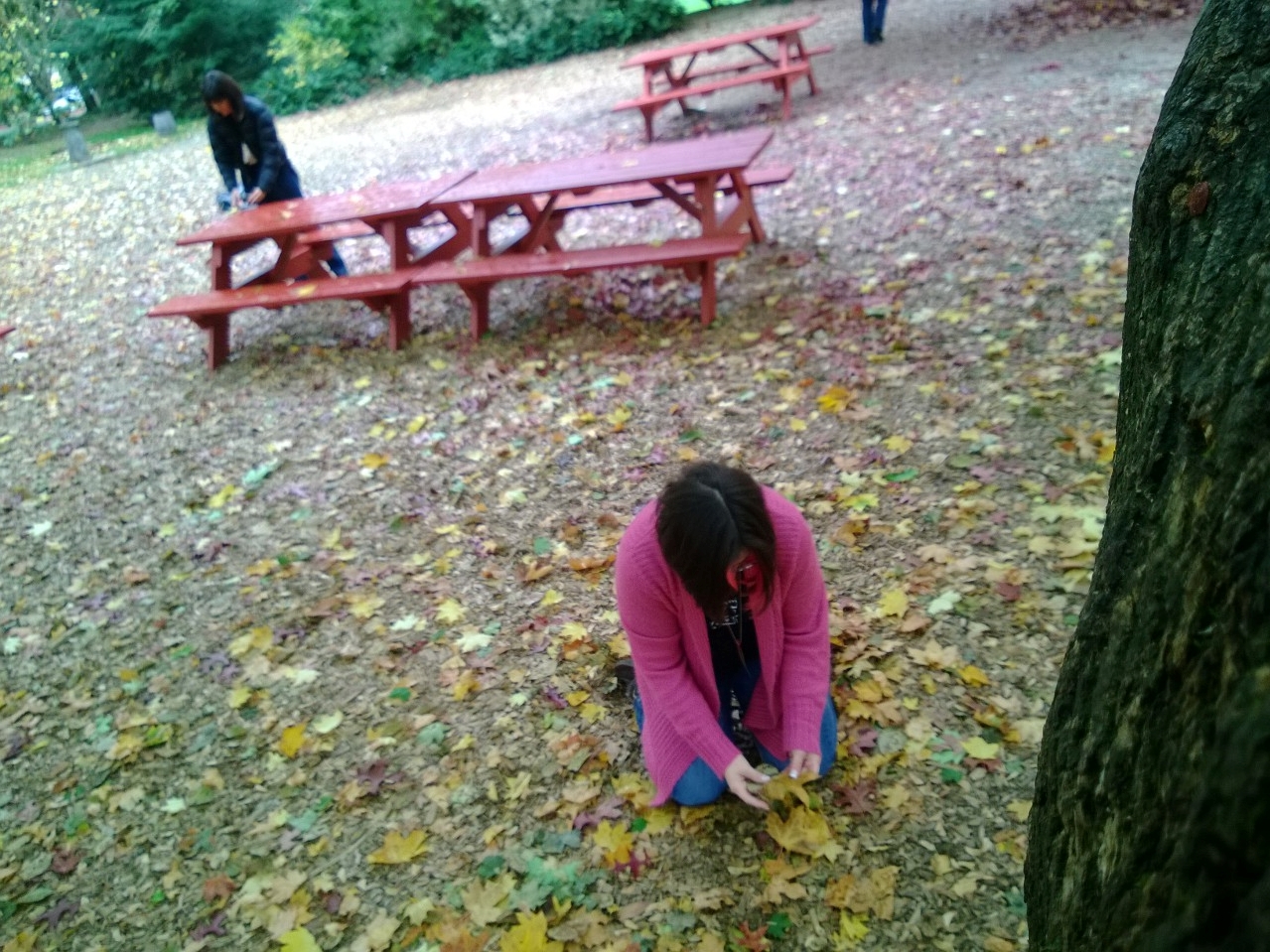
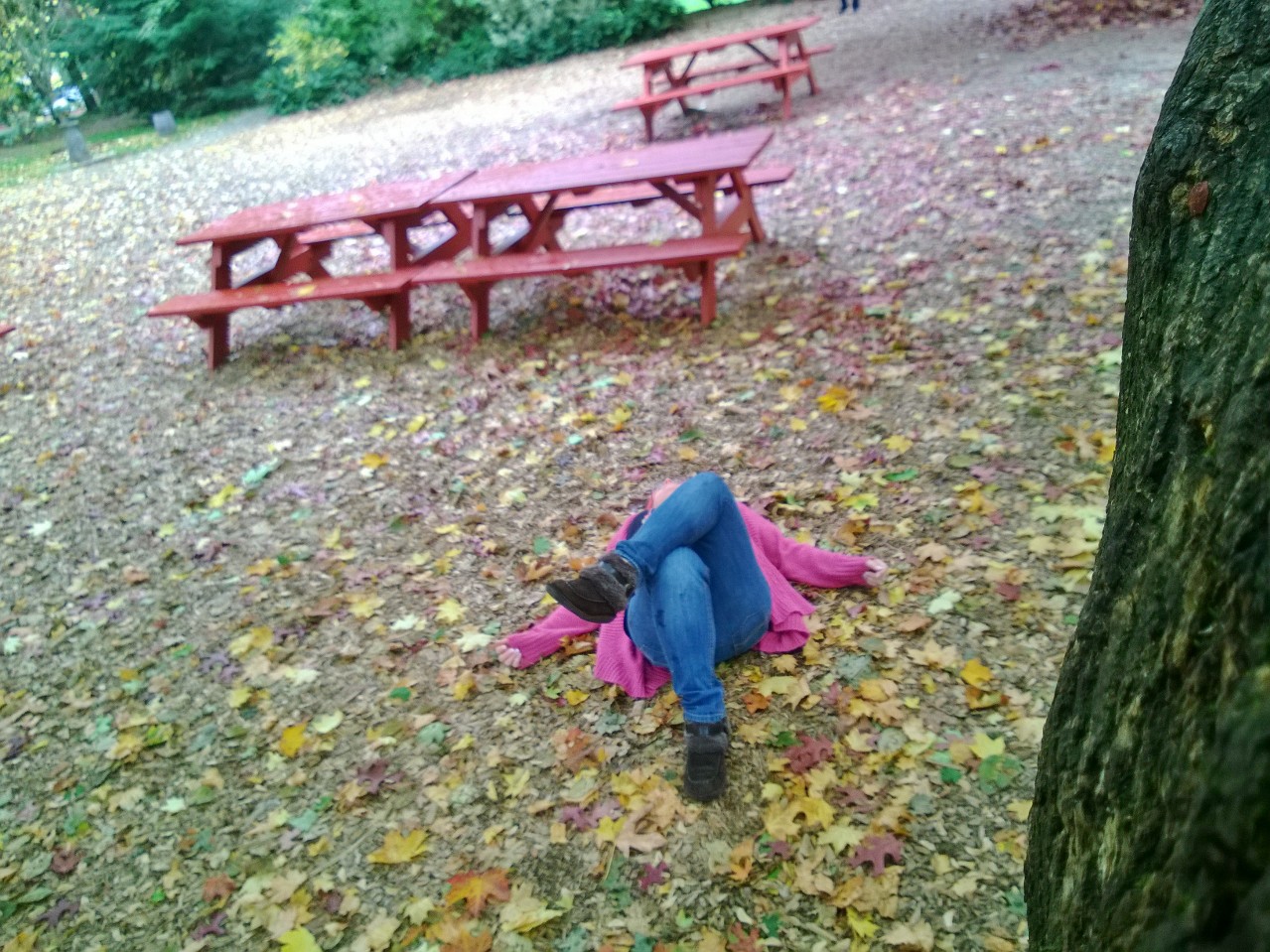
Nowhere is that more present than in the myriad of photos I have of family and family vacations. Where am I? Behind the camera. I may be in 1 in a thousand photos. Seriously. It’s not okay! This Spiritual Practice is geared at self portraiture. It is a series of photos. (None of these photos are touched up. I am intentionally resisting the temptation!)

First exercise … find a place where you can intentionally photo bomb yourself with a weird background. I thought this was fun with a mural in the background. I think I can use this one when I am mad! This will let you have a humorous, gentle start!

WP_20131026_019

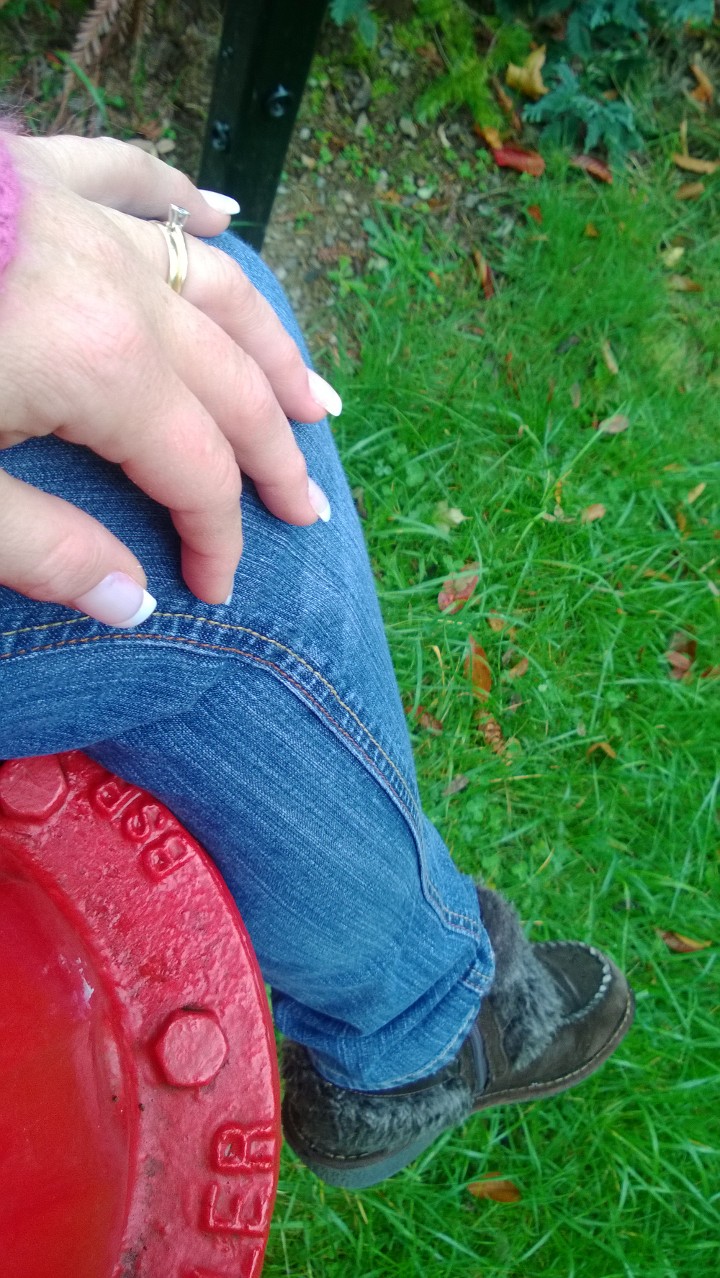
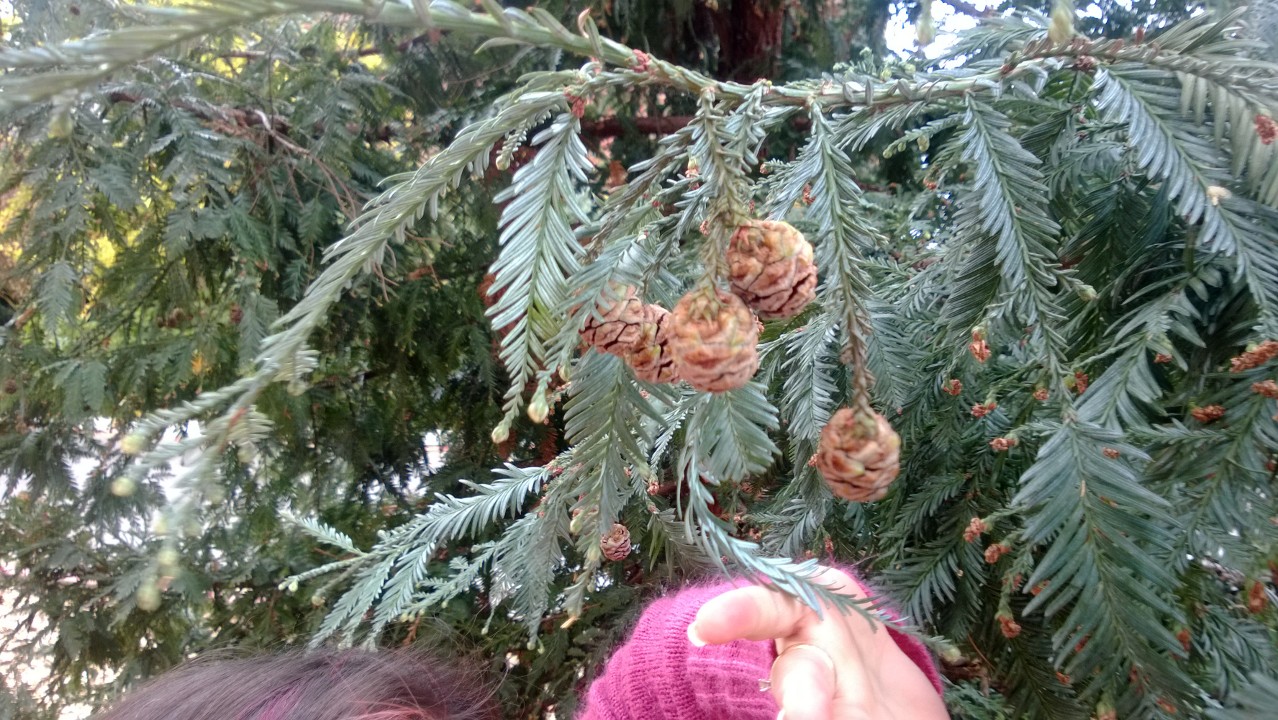
Next, consider what a self-portrait consists of … it is any part of you that is in a picture. Gather photos of you reaching for something, holding something, stepping onto a path, you name it! Hands, feet, hair!

WP_20131026_031

WP_20131026_028

WP_20131026_025

Next, learn to use that timer on your camera! I understand that iPhones have Gorilla and Windows phones have Auto Timer Camera. Now take full shots of yourself doing different things.

3_jpg

5_jpg (1)

12_jpg (1)

Last, look into the camera and be love. You may think of someone you love and gaze into the camera or think of loving yourself or think of loving the world. Start here. Be an image of love.

WP_20131026_034

I spend a lot of time “being love” in the world. Working with incarcerated and homeless youth. But without a loving foundation that includes spiritual practices that let me see and be myself, I won’t be able to sustain compassionate action. Even the healthiest egos need times of sustenance.

Shalom and Amen,

Terri

© 2013, post , Terri Stewart, All rights reserved

terriREV. TERRI STEWART is Into the Bardo’s  Sunday chaplain, senior content editor, and site co-administrator. She comes from an eclectic background and considers herself to be grounded in contemplation and justice. She is the Director and Founder of the Youth Chaplaincy Coalition that serves youth affected by the justice system. As a graduate of Seattle University’s School of Theology and Ministry, she earned her Master’s of Divinity and a Post-Master’s Certificate in Spiritual Direction. She is a contributing author to the Abingdon Worship Annual. (The 2014 issue just released!)

Her online presence is “Cloaked Monk.” This speaks to her grounding in contemplative arts and the need to live it out in the world. The cloak is the disguise of normalcy as she advocates for justice and peace. You can find her at www.cloakedmonk.com, www.twitter.com/cloakedmonk, and www.facebook.com/cloakedmonk.  To reach her for conversation, send a note to cloakedmonk@outlook.com

“A person with ubuntu is open and available to others, affirming of others, does not feel threatened that others are able and good, for he or she has a proper self-assurance that comes from knowing that he or she belongs in a greater whole and is diminished when others are humiliated or diminished, when others are tortured or oppressed.”
― Desmond Tutu

Posted in Essay, Spiritual Practice, Terri Stewart

It’s All Sacred Space II

"I AM" Sacred Space
“I AM”
Sacred Space

Following up on last week’s “It’s All Sacred Space.”

Two pastors that I know are extraordinary. They both pastor homeless people. One lived as a homeless person for two weeks so he could understand what was going on. The other is homeless. She refuses to live in a home and sleeps on the streets every night of her life. She takes this so seriously that given the opportunity to sleep inside at a convocation, she made special arrangements to sleep in the doorstep-declining housing thousands of miles away from her people. She is the only one who would have known! And nobody would have judged her in error for sleeping inside at a conference she was attending.

I am amazed at the depth of commitment they both have.

In my context, that would be sleeping in a detention center. I am not sure I am prepared to be locked up in order to be one with the people that I am committed to walking with.

But maybe that is because I am not viewing all space as sacred. If I imagine that a jail cell is the Cathedral of Notre Dame with an air of mystery, sacrament, and holiness…does that change the context? Maybe. But could I put on the blue scrubs, white t-shirt, white socks, and orange plastic flip-flops? Using harsh soaps, eating questionable food, everything? Hmmm. I am not sure I could ever do that. I am also not sure that it is a requirement to do so. But, perhaps what is a requirement is the holy imagination it takes to think of what this walk would be.

That is the spiritual practice I’d like to invite you into today, holy imagination. I believe that we are all called to support the least among us. In other words, those who cannot take care of themselves. Those our societies often label “other.” People who are “other” than us—outside the norm—impoverished, imprisoned, hungry, sick, non-gender conforming—whoever is being “othered.”

Who is your other?

Could it be someone from a different faith tradition? A different political point-of-view? Or any of those I listed above? Generally, there is always someone we “other-ize.” Even though I am working with people every day that are affected by incarceration, I found myself in a spot today where I felt the person I was sitting with was totally “other” from me. She is telling me flat-out that when she returns to her community, she will return to drug use and gang involvement. Period. She sees no other way. No other hope. That is hard for me to fathom. She says, “I will probably be dead by 21” without blinking. Wow. And sheesh. I need to find a way to sit with her in a way that is hopeful and not descend into other-izing her even though her current ideas are so foreign to my mind and heart.

If I use holy imagination, maybe I can put myself into her life and feel where her self-imposed traps come from. And seeing where the traps are, maybe I can point out a way she can negotiate the traps and bring herself greater freedom. I don’t know. I will continue to work on it.

Today, using your own holy imagination, can you take five minutes (really, 20 minutes is more like it!) to do some visualization work?

First, relax as much as you can. Keep working at it until you have quieted the monkey mind (or brain chatter—but my inner chatter is more like a monkey!).

When you have fully relaxed, set your intention. Here, I am suggesting your intention should be a conversation with whoever you “other-ize.” (Could it be yourself?)

Next, focus on what you want. Today, our desire is closer understanding. How can you begin to understand the figurative foreigner across from you? What questions can you ask in order to bring you deeper understanding? I am always amazed at my own capacity to carry assumptions. How can we leave assumptions and expectations behind so that there is room for increased understanding?

As realizations and understandings grow, there may be a struggle. Give your struggle up. It is like the monkey-brain. Keep offering both of these things away. I usually visualize putting these on a cloud and whooshing them out of my space. Don’t struggle too hard. If it isn’t happening, it isn’t happening. Then, don’t be too hard on yourself. There will be another day, another try.

Finally, don’t get tangled in negative thoughts—whoosh them away on that cloud! Experience your highest self—the one that sits in loving kindness, compassion, and hope.

When your conversation is complete (and you may get horrible answers, let’s be honest), hold onto the highest self for a moment and see yourself. See the person who took a risk today of entering scary, sacred space. A person who was willing to love. Look at yourself and see the sacred space within.

Shalom and Amen,

Terri

© 2013, post , Terri Stewart, All rights reserved

terriREV. TERRI STEWART is Into the Bardo’s  Sunday chaplain, senior content editor, and site co-administrator. She comes from an eclectic background and considers herself to be grounded in contemplation and justice. She is the Director and Founder of the Youth Chaplaincy Coalition that serves youth affected by the justice system. As a graduate of Seattle University’s School of Theology and Ministry, she earned her Master’s of Divinity and a Post-Master’s Certificate in Spiritual Direction. She is a contributing author to the Abingdon Worship Annual. (The 2014 issue just released!)

Her online presence is “Cloaked Monk.” This speaks to her grounding in contemplative arts and the need to live it out in the world. The cloak is the disguise of normalcy as she advocates for justice and peace. You can find her at www.cloakedmonk.com, www.twitter.com/cloakedmonk, and www.facebook.com/cloakedmonk.  To reach her for conversation, send a note to cloakedmonk@outlook.com
Posted in Essay, Spiritual Practice, Terri Stewart

It’s All Sacred Space

Star Trek, Captain Kirk and “Bones” (Dr. McCoy) using Universal Translators

Sometimes I think that we all need universal translators when we are trying to understand each other across cultures, belief systems, and personal social locations.

Often, though, it takes someone yelling at us to knock us out of our system of thinking and gives us the ability to see things in a new and visionary way that connects rather than divides. All too often we cannot get to this point because we walk away when we things are uncomfortable, challenging, or abrasive.

And no doubt, abrasive is yucky. Witness: the US government interactions right now.

What to do?

Enter deeply into the story of the other person. This is a spiritual practice. I call it Extreme Accompaniment (should I trademark that?). I was contemplating this further today as I was researching another article. My reading revealed to me that we get to radical acceptance of the other when:

  1. Everyone goes to uncomfortable places
  2. Step outside of social norms, forget what you think you know about the other
  3. Everyone involved becomes open to conversion
  4. Keep dialoguing past the rhetoric and abrasiveness
  5. Then, transformation and acceptance may occur (Congress, are you listening??)

Of course, there are limitations. You should not be in situations that may cause harm.  But I am more and more convinced that this deep listening is a spiritual practice. And it is a practice that our world does not do well right now. It is up to the artists and the contemplatives to lead a new revolution! A revolution of extreme accompaniment or of walking with other people. A practice of deeply listening and working with the other’s deepest desires. A practice of loving each other. Love is the universal translator.

If we listen and love, maybe we will all be able to see past the space debris and see the cosmos in each other’s souls.

Shalom and Amen,

Terri

© 2013, post , Terri Stewart, All rights reserved

terriREV. TERRI STEWART is Into the Bardo’s  Sunday chaplain, senior content editor, and site co-administrator. She comes from an eclectic background and considers herself to be grounded in contemplation and justice. She is the Director and Founder of the Youth Chaplaincy Coalition that serves youth affected by the justice system. As a graduate of Seattle University’s School of Theology and Ministry, she earned her Master’s of Divinity and a Post-Master’s Certificate in Spiritual Direction. She is a contributing author to the Abingdon Worship Annual. (The 2014 issue just released!)

Her online presence is “Cloaked Monk.” This speaks to her grounding in contemplative arts and the need to live it out in the world. The cloak is the disguise of normalcy as she advocates for justice and peace. You can find her at www.cloakedmonk.com, www.twitter.com/cloakedmonk, and www.facebook.com/cloakedmonk.  To reach her for conversation, send a note to cloakedmonk@outlook.com
Posted in Contributing Writer, Creative Nonfiction, Essay, General Interest, Karen Fayeth, memoir, Poets/Writers, Writing

Inspiration Takes Flight

Editorial note and reminder: In two weeks, Wednesday, October 23, at 7 p.m. we will host a second writing challenge (Writer’s Fourth Wednesday) featuring Victoria C. Slotto, novelist and poet. The subject of this next challenge-yourself exercise is stream-of-consciousness. So writers read on, enjoy, write and mark your calendars for next week’s event. Mr Linky, which enables you to share your work with everyone, will remain open for seventy-two hours. Victoria and Jamie will visit all participants to read and comment.

Here an accomplished story-teller, Karen Fayeth (pronounced “faith” by the way), shares her experience of inspiration, story, and the NYC Midnight Flash Fiction competition.  

Each year I enjoy participating in the NYC Midnight Flash Fiction contest. The challenge is to write a 1,000 word story over the course of one weekend.

But there’s more! The approximately 700 participants are divided up into groups and each group is given a genre, location and an object. All three must be incorporated in the resulting story. The tale must truly be in the genre, the majority of the story must take place in the location and the object must show up at some point.

It’s always amazing to see the wide array of stories that come from the same genesis. This assignment of genre, location and object can either be entirely freeing, allowing the writer a head start to leap from, or it can be incredibly constraining. It all depends on what genre, location and object gets assigned.

For the first round of the 2013 contest, I was assigned the romance genre. Bleah. Not my favorite but not awful. The location was a haunted house. Hmm. Possibilities abound, but not really for a romance? Hmm. Ok. And my object was marshmallows.

That was my place to start. Over the course of many of these contests I find the judges tend to like if you use the location and object in unique ways, so I always try to think of a twist or a different facet to use in my story.

I was quite busy over this first weekend of competition, doing some work for my employer and taking care of personal business, so there I found myself Sunday morning with nary a word written and a deadline of 9pm that night.

I opened the windows to my studio and let the light pour in. I felt the breeze through the screens and sat down at my computer to make magic.

Magic. Ha! There I sat looking at the curser on my computer screen, willing the magic to begin. It blinked. I blinked.

No magic was happening.

So I subscribed to the “just write something” theory and got started. I began typing words and thoughts and a character sketch. It was going. The magic was not quite lifting off, but it was certainly gaining speed.

That is when something caught my eye outside of the window. A little splash of orange on that first day of Autumn.

I was surprised to see a Monarch butterfly resting on the bush just to the side of the building where I live.

I rushed to get my camera, attached the longest lens I have, popped the screen out of my window, and began taking photographs.

I’m sure glad I did.

Photo Copyright 2013, Karen Fayeth

This gorgeous lone Monarch Butterfly was hanging out in the warm sun, using the ol’ proboscis to drink some nectar and gathering pollen on spindly legs. You know, general butterfly business.

As I watched, a couple of bees were highly displeased at the presence of the butterfly and kept strafing him (I say him but I looked up Monarch butterflies online and I think this might actually be a female, but I’m not sure).

These bees were executing deep aggressive fly-bys that only caused the butterfly to flap his wings a bit but stay put. The bees were quite persistent. They dive-bombed and I kept snapping away. I have some crazy action shots that I’m still editing.

After a while, the butterfly flew off and I downloaded and looked through my photos, very pleased with the results.

Then I sat back in my chair and smiled. After the visit from Mr. (Ms?) Butterfly, I felt totally motivated and completely creative. I turned back to my story and banged out about 1,300 words in one sitting.

Then I set the story aside and let it percolate while my husband and I went to explore a local street fair.

When we came back I had fresh eyes and gave the story a hard edit. I managed to pare it down to 999 words and submitted it about 45 minutes before the deadline.

Man-oh-man, hitting send on that story sure felt good.

I owe an awesome creative surge to a visit from a pretty orange butterfly on the first day of Autumn.

© 2013, essay and photo, Karen Fayeth, All rights reserved

webheadshotKaren Fayeth ~ is one of our regular writers. She is our tech manager, site co-administrator along with Jamie and Terri, and fiction and creative nonfiction editor. She blogs at Oh Fair New Mexico. Born with the writer’s eye and the heart of a story-teller, Karen Fayeth’s work is colored by the Mexican, Native American, and Western influences of her roots in rural New Mexico complemented by a growing urban aesthetic. Karen now lives in the San Francisco Bay area. When she’s not spinning a tale, she works as a senior executive for a science and technology research organization.

Karen has won awards for her writing, photography, and art. Recent publication credits include a series of three features in New Mexico magazine, an essay in the online magazine Wild Violet, and a short story in Foliate Oak. Her story “What Leibniz Never Learned” will appear in the Fall edition of The Storyteller.

Posted in Essay, Spiritual Practice, Terri Stewart

Sacred Space – Invitation to Practice

Today, I’m giving you a two-fer. A post based in my spiritual practice of photography that led creating something new (an animation) and a tanka! And then an invitation.

Invitation to Contemplation

Where is your light today? What is inspiring you? Transforming you? What is allowing you to be love to the world?

“Your purpose in life is to find your purpose and give your whole heart and soul to it”
― Gautama Buddha

rolling downhill

exuberant joy bubbling

authenticity

laid in unity with joy

foundation – loving kindness

downhill_animation

Invitation to Participation

During Advent, the time for Christians where they are preparing for Christmas and the celebration of the birth of Jesus, we will be running a creative invitation based on scripture that are in the common daily reading plan for many Christian traditions.

I would like to invite people to pick a day and sponsor it.

What that means is, if you are a photographer, maybe you would like to choose a day such as December 10 where the focus in on the poor and needy being refreshed with water. That leaves a lot of room open for various images. On December 10, then we would post your photo here with the scripture and have an invitation to those around the world to offer their response via posting a link to their own blog! You would be leading the community on that particular day!

Is it necessary to be of the Christian faith?

No. It is sacred scripture for Christians, so please respect it. But you can approach it from your tradition (or from no tradition). The emphasis is on creative response and crystallizing meaning as it pertains to your path. Advent is also the beginning of the Christian calendar year, so a theme of beginning again is also in play.

Is it possible to peak at the scripture?

Yes! The scripture choices are posted here.

What is a creative response?

Photography, artwork, mandala, essay, poems (and the many types there are), music, drama. Something that re-imagines what the words are saying and crystallizes meaning. The meaning may be a traditional point-of-view or it may be something that turns us upside down!

RSVP and Technicalities

Please contact me at cloakedmonk@outlook.com to negotiate the day or days you would like to sponsor. Deadline for submissions: November 10, 2013. I will ask you for your choice of scripture(s), a brief bio (2-3 sentences), any links you want to make to blogs or other things, and, of course, your submission(s).

sunset

Shalom and Amen,

Terri

© 2013, post and photos, Terri Stewart, All rights reserved

terriREV. TERRI STEWART is Into the Bardo’s  Sunday chaplain, senior content editor, and site co-administrator. She comes from an eclectic background and considers herself to be grounded in contemplation and justice. She is the Director and Founder of the Youth Chaplaincy Coalition that serves youth affected by the justice system. As a graduate of Seattle University’s School of Theology and Ministry, she earned her Master’s of Divinity and a Post-Master’s Certificate in Spiritual Direction. She is a contributing author to the Abingdon Worship Annual. (The 2014 issue just released!)

Her online presence is “Cloaked Monk.” This speaks to her grounding in contemplative arts and the need to live it out in the world. The cloak is the disguise of normalcy as she advocates for justice and peace. You can find her at www.cloakedmonk.com, www.twitter.com/cloakedmonk, and www.facebook.com/cloakedmonk.  To reach her for conversation, send a note to cloakedmonk@outlook.com
Posted in Essay, Music, mystic, Peace & Justice, Photo Essay, Photography/Photographer, Poems/Poetry, Poets Against War Week, Spiritual Practice, Terri Stewart

Peace Give I to Thee

Wow, the first in the series of Poets Against War or Poets for Peace. Hopefully I can do it justice! In riffing on peace and war, several things came together in my mind – or rather, many things came hopping through it! I hope the resulting series of images, words, and music will act as a meditation for you on this first day of Poets Against War. This will be synchro-posted at my blog, http://www.cloakedmonk.com. Feel free to reblog or synchropost elsewhere just link back to here.

First, a meme (my new favorite weird thing to do – make memes)…

wonka

Second, I have been noodling this around and the predominant thought I had was to sing a duet with my son, Colin Stewart. Colin is 17 and much more talented than I! But we held it together in order to sing an old church song, Peace Give I to Thee. Colin is playing the ukelele and singing. I confess that our sound system is not wonderful, so we both tempered ourselves to not blow out the microphones. It is accompanied by photos I took in the Bellevue Botanical Garden which bring me incredible peace.

Finally, the nature of the quest: Poets Against War or Poets for Peace. So black and white, it begs a reflection.

dichotomy

war destroys peace

hate destroys love

butterfly destroys chrysalis

child destroys dandelion

lion destroys lamb

lamb redeems lion

dandelion redeems child

chrysalis redeems butterfly

love redeems hate

peace redeems war

unity

 butterfly

And another old favorite, “Breathe Deep” by the Lost Dogs which speaks to the unity of all-even when we are uncomfortable with that unity.

Peace Out!

Terri

© 2013, post and photos, Terri Stewart, All rights reserved

terriREV. TERRI STEWART is Into the Bardo’s  Sunday chaplain, senior content editor, and site co-administrator. She comes from an eclectic background and considers herself to be grounded in contemplation and justice. She is the Director and Founder of the Youth Chaplaincy Coalition that serves youth affected by the justice system. As a graduate of Seattle University’s School of Theology and Ministry, she earned her Master’s of Divinity and a Post-Master’s Certificate in Spiritual Direction. She is a contributing author to the Abingdon Worship Annual. (The 2014 issue just released!)

Her online presence is “Cloaked Monk.” This speaks to her grounding in contemplative arts and the need to live it out in the world. The cloak is the disguise of normalcy as she advocates for justice and peace. You can find her at www.cloakedmonk.com, www.twitter.com/cloakedmonk, and www.facebook.com/cloakedmonk.

Posted in Essay, Photography/Photographer, Spiritual Practice, Terri Stewart

Prayer as Action for Peace

Saturday, September 7, 2013, was a call for worldwide prayer and fasting to focus on peace in Syria. I have seen many things happening–prayer vigils, personal meditation practices, marches, and communications with elected officials. We decided to offer a Labyrinth Walk for Peace at Bothell UMC in Bothell, WA in the morning. I gathered inter-faith prayers, we walked, prayed, and focused on bringing peace to the world. What follows is prayers and photos from that journey that became deeply personal for each attendant. There was a certain transition that occurred for me as I took in my surroundings and noticed Farmer Brown’s Garden. I began to see, literally, a connection between peacefulness and being fed. You will see.

Entering Sacred Space

prayers-for-peace-3

Sufi Prayer for Peace

Send Thy peace, O Lord, which is perfect and everlasting, that our souls may radiate peace.
Send Thy peace, O Lord, that we may think, act,
and speak harmoniously.
Send Thy peace, O Lord, that we may be contented
and thankful for Thy bountiful gifts.
Send Thy peace, O Lord, that amidst our worldly strife we may enjoy thy bliss.
Send Thy peace, O Lord, that we may endure all,
tolerate all in the thought of thy grace and mercy.
Send Thy peace, O Lord, that our lives may become a
divine vision, and in Thy light all darkness may vanish.
Send Thy peace, O Lord, our Father and Mother,
that we Thy children on earth may all unite in one family.
– Sufi Prayer

The Journey Begins

prayers-for-peace-6

An Islamic Prayer for Peace

In the Name of Allah, the beneficent, the merciful: Praise be to the Lord of the Universe
who has created us and made us into tribes and nations that we may know each other,
not that we may despise each other.

If the enemy incline towards peace, do thou also incline towards peace, and trust in God,
for the Lord is one that hears and knows all things.
And the servants of God Most Gracious are those who walk on the Earth in humility,
and when we address them, we say, “Peace.”
– U.N. Day of Prayer for World Peace 2

Walking Together in Ubuntu

prayers-for-peace-5

A Hindu Prayer for Peace

Supreme Lord, let there be peace in the sky and in the atmosphere.
Let there be peace in the plant world and in the forests.
Let the cosmic powers be peaceful.
Let the Brahman, the true essence and source of life, be peaceful.
Let there be undiluted and fulfilling peace everywhere.
– The Atharva Veda

All Are Invited to Be Fed

prayers-for-peace-1

Cheyenne Prayer for Peace

Let us know peace.
For as long as the moon shall rise,
For as long as the rivers shall flow,
For as long as the sun shall shine,
For as long as the grass shall grow,
Let us know peace.
– Cheyenne Prayer

Feeding the World in Spirit and Deed
Farmer Brown’s Garden at Bothell UMC

prayers-for-peace-7

A Jewish Prayer for Peace

Grant us peace. Your most precious gift,
O Eternal Source of Peace, and give us the will to proclaim its message to all the peoples of the earth.
Bless our country, that it may always be a stronghold of peace, and its advocate among the nations.
May contentment reign within its borders, health and happiness within its homes.
Strengthen the bonds of friendship among the inhabitants of all lands.
And may the love of Your name hallow every home and every heart.
Blessed is the Eternal God, the source of Peace.
– From The Gates of Prayer: The New Union Prayer Book, by the Central Conferences of American Rabbis

Growing Spiritually and Growing Food

prayers-for-peace-9

Buddhist Prayer for Loving Kindness

May all beings be peaceful.
May all beings be happy.
May all beings be safe.
May all beings awaken to
the light of their true nature.
May all beings be free.
– Metta Prayer

Loving Kindness through Loving Care

prayers-for-peace-8

A Christian Prayer for Peace

Blessed are the peacemakers, for they shall be called the children of God.
But I say to you that hear, love your enemies; do good to those who hate you;
bless those who curse you; pray for those who abuse you.
To those who strike you on the cheek, offer the other also;
and from those who take away your cloak, do not withhold your coat as well.
Give to everyone who begs from you, and of those who take away your goods,
do not ask them again. And as you wish that others would do to you, do so to them.
– U.N. Day of Prayer for World Peace 2

Becoming the Light Unto the World

prayers-for-peace-10

A Non Traditional Prayer for World Peace

Spirit of Life and Love, be present with all who are suffering terribly from violence.
Lift up the hearts of those who fear. And inspire courage among the peacemakers.
Be present with political leaders, ensuring a retreat from violence
and a procession towards the peace table.
Guide the hands of all those who are caring for the injured, the hungry and the grieving.
And, open our own hearts to compassion.
Remind us of our complicity and responsibility.
And lead us towards generous engagement—always towards a vision of peace.
–Adapted from the Unitarian Universalist Tradition

Shalom and Amen,

Terri

© 2013, post and photos, Terri Stewart, All rights reserved

terriREV. TERRI STEWART is Into the Bardo’s  Sunday chaplain, senior content editor, and site co-administrator. She comes from an eclectic background and considers herself to be grounded in contemplation and justice. She is the Director and Founder of the Youth Chaplaincy Coalition that serves youth affected by the justice system. As a graduate of Seattle University’s School of Theology and Ministry, she earned her Master’s of Divinity and a Post-Master’s Certificate in Spiritual Direction. She is a contributing author to the Abingdon Worship Annual. (The 2014 issue just released!)

Her online presence is “Cloaked Monk.” This speaks to her grounding in contemplative arts and the need to live it out in the world. The cloak is the disguise of normalcy as she advocates for justice and peace. You can find her at www.cloakedmonk.com, www.twitter.com/cloakedmonk, and www.facebook.com/cloakedmonk.  To reach her for conversation, send a note to cloakedmonk@outlook.com
Posted in Essay, Photography/Photographer, Spiritual Practice, Terri Stewart

A Prayer to Consider


I originally published this on my blog at cloakedmonk.com. I am reposting it here for a couple reasons – prayer is a great spiritual practice, whatever your understanding of prayer is. And I am at a conference called “Church Quake” in the DC area. It is a conference to aid United Methodist folks in helping to bring full inclusion to the church. Our theme has been “intersectionality.” What intersection of our understanding can come to the aid of an oppressed groups? We are related and interdependent as the prayer below says-we can see that when we consider our own woundedness and how we bring it to the altar of healing. Then what do we do? Consider the woundedness of others and help them find their way to healing. And so the pattern continues. Wounded becoming healing.

Henry Nouwen articulated the concept of the wounded healer quite well. Let me just share a quote from this Roman Catholic, PhD Psychologist, Theology teaching at Yale Divinity, depression suffering, book-writing, L’arche community loving, priest.

“When we honestly ask ourselves which person in our lives mean the most to us, we often find that it is those who, instead of giving advice, solutions, or cures, have chosen rather to share our pain and touch our wounds with a warm and tender hand. The friend who can be silent with us in a moment of despair or confusion, who can stay with us in an hour of grief and bereavement, who can tolerate not knowing, not curing, not healing and face with us the reality of our powerlessness, that is a friend who cares.”
― Henri J.M. Nouwen, The Road to Daybreak: A Spiritual Journey

Here, in this prayer, I find the intersectionality of flowers, interdependence, loving one another, an altar for all, and the healing of woundedness for the inclusion of all who are diverse and unique – precious and beautiful flowers.

A prayer in the Unitarian Universalist tradition by William G. Sinkford

In the presence of these flowers,
These representatives of Creation’s profound beauty:
Diverse and Unique, but Related and Interdependent,
These flowers which come to us as gifts from we know not where
And which we, in turn, choose to bring to our shared and common altar
As gifts to one another

In their presence we turn our thoughts to the mystery beyond mysteries
to the most sacred—which we never understand fully
but which we are granted revelatory glimpses of
in each of these flowers,
in each of your faces,
and through relationships with neighbors near and far

May they remind us of grace we have known in days past:
Forgiveness we have been granted, and provided.
Love, unearned and shared.
Recovery, begun and established.
Generosity, unforeseen and most sacred.

And may they inspire us now, and in days to come:
To seek,
To notice,
To embrace and,
To re-create beauty.
To give unto the world as exuberantly as these flowers.

yellow.center.flower

Go, be exuberant.

Shalom & Amen,

Terri

© 2013, post and photos, Terri Stewart, All rights reserved

© 2013, prayer, William Sinkford

terriREV. TERRI STEWART is Into the Bardo’s  Sunday chaplain, senior content editor, and site co-administrator. She comes from an eclectic background and considers herself to be grounded in contemplation and justice. She is the Director and Founder of the Youth Chaplaincy Coalition that serves youth affected by the justice system. As a graduate of Seattle University’s School of Theology and Ministry, she earned her Master’s of Divinity and a Post-Master’s Certificate in Spiritual Direction. She is a contributing author to the Abingdon Worship Annual. (The 2014 issue just released!)

Her online presence is “Cloaked Monk.” This speaks to her grounding in contemplative arts and the need to live it out in the world. The cloak is the disguise of normalcy as she advocates for justice and peace. You can find her at www.cloakedmonk.com, www.twitter.com/cloakedmonk, and www.facebook.com/cloakedmonk.  To reach her for conversation, send a note to cloakedmonk@outlook.com
Posted in Essay, Spiritual Practice, Terri Stewart

Sacred Space III

Continuing along the theme of sacred space, I would like to offer a method of creating sacred group space-especially in places of conflict or tension. Previous posts on sacred space are on the personal labyrinth and personal prayer patterns styled upon praying with beads.

Creating Sacred Group Space

Have you ever been in a situation where you needed to facilitate group sharing (or participate in) around a sticky topic or situation? It is really difficult to get people to move beyond finger pointing, conflict, and blaming. Eric Law developed a method that facilitates sharing in a sticky environment that offers mutual respect and honor to the participants. It is commonly called Eric Law’s Method of Mutual Invitation. I love using it!

Rev. Eric H. F. Law
(c) California-Pacific Conference of the UMC

One of the problems with most decision making settings is that a decision must be made! That necessitates a winner and a loser. It is rarely a win/win situation. Most often if one person wins, there is another person who loses or gives in. Eric Law’s Method of Mutual Invitation is not a decision making process, it is a listening process that can lead to deeper points and through long and hard work, lead to a consensus building model where every voice is heard and honored. It is at once simple and profound.

The Method

Mutual Invitation is a small group process designed to allow for inclusion and disciplined sharing in diverse settings, especially where there might be a variety of ages, ethnic backgrounds, different beliefs, or personality types present. The process allows for each person in the group to have an opportunity to share, as well as to participate in group dynamics. The process of Mutual Invitation can be adapted for different settings and purposes, e.g. family meal time, small group sharing, and office meetings.

Someone begins the sharing, related to the chosen topic.

  • The facilitator will set a time limit for each person.
  • No questions, responses, or interruptions are allowed during the process.

After the sharing there is a brief pause to allow the others to reflect upon what has been shared.

  • Responding begins after the pause. The pause should be stretched to a couple of minutes or longer if possible.
  • Responding is done by asking open ended questions designed to allow the person sharing to examine further her experience.

In a group sharing session, the person who is sharing invites the next person after others have responded to him/her.

  • Avoid inviting the person sitting next to you. This avoids the tendency to “go around in a circle.”
  • The goal of mutual invitation is to randomly invite the next person. This random invitation prevents distractions such as anticipating or worrying about what to share. Random invitation also helps keeps the focus on the person sharing.

The invited person may choose to share, to pass for now, or to pass.

  • Pass for now means she/he can share later when re-invited.
  • Pass indicates that she/he does not choose to share during this session.
  • Regardless of what the person chooses, she/he always invites the next person.

The process is repeated until everyone in the group has been invited. And every person has either responded or finished with a final pass.

Pattern sample:

  • Facilitator states the question being pondered and offers their own response.
  • Then silence is held for a couple minutes.
  • The group then asks questions-they must be either clarifying questions or open-ended questions. One person at a time.
  • The facilitator responds to questions as they come.
  • At the end of the questions, silence is held for a couple of minutes.
  • The facilitator invites the next person to share.
  • The next person responds with either their own sharing, a pass, or a pass for now.
  • Then silence is held for a couple of minutes.
  • The group then asks questions-they must be either clarifying questions or open-ended questions. One person at a time.
  • That person responds to questions as they come.
  • At the end of the questions, silence is held for a couple of minutes.
  • That person invites the next person to share.
  • And so on, until all have shared or responded with a final pass.

This sharing methodology, as simple as it is, has opened up sacred space. I love using it! Especially when confronted with sticky situations and group conflict. It keeps things calm, peaceful, and invites a sacred and healing quality to the space. You could even use it in a study environment! Imagine opening up a text and sharing responses in a group in this sacred, invitational manner! Beautiful.

The most profound time I have ever used this method involved a group in conflict. It was a group coming together after a major loss all with different ideas of how to move forward and very few ideas of how to sit in the loss. We used this method and brought out people’s fears, hopes, sorrows, and even some joys. It became a place of healing rather than a cantankerous committee meeting. It forced us to be still and to hold each other loosely and gently. Creating sacred space.

A bit about Rev. Eric Law:  He is an Episcopalian priest, is the founder and executive director of the Kaleidoscope Institute, the mission of which is to create inclusive and sustainable churches and communities. He has been writing and practicing for more than 20 years. He can be found online at The Sustainist.

Shalom and Amen,

Terri

© 2013, essay, Terri Stewart, All rights reserved

terriREV. TERRI STEWART is Into the Bardo’s  Sunday chaplain, senior content editor, and site co-administrator. She comes from an eclectic background and considers herself to be grounded in contemplation and justice. She is the Director and Founder of the Youth Chaplaincy Coalition that serves youth affected by the justice system. As a graduate of Seattle University’s School of Theology and Ministry, she earned her Master’s of Divinity and a Post-Master’s Certificate in Spiritual Direction. She is a contributing author to the Abingdon Worship Annual. (The 2014 issue just released!)

Her online presence is “Cloaked Monk.” This speaks to her grounding in contemplative arts and the need to live it out in the world. The cloak is the disguise of normalcy as she advocates for justice and peace. You can find her at www.cloakedmonk.com, www.twitter.com/cloakedmonk, and www.facebook.com/cloakedmonk.  To reach her for conversation, send a note to cloakedmonk@outlook.com
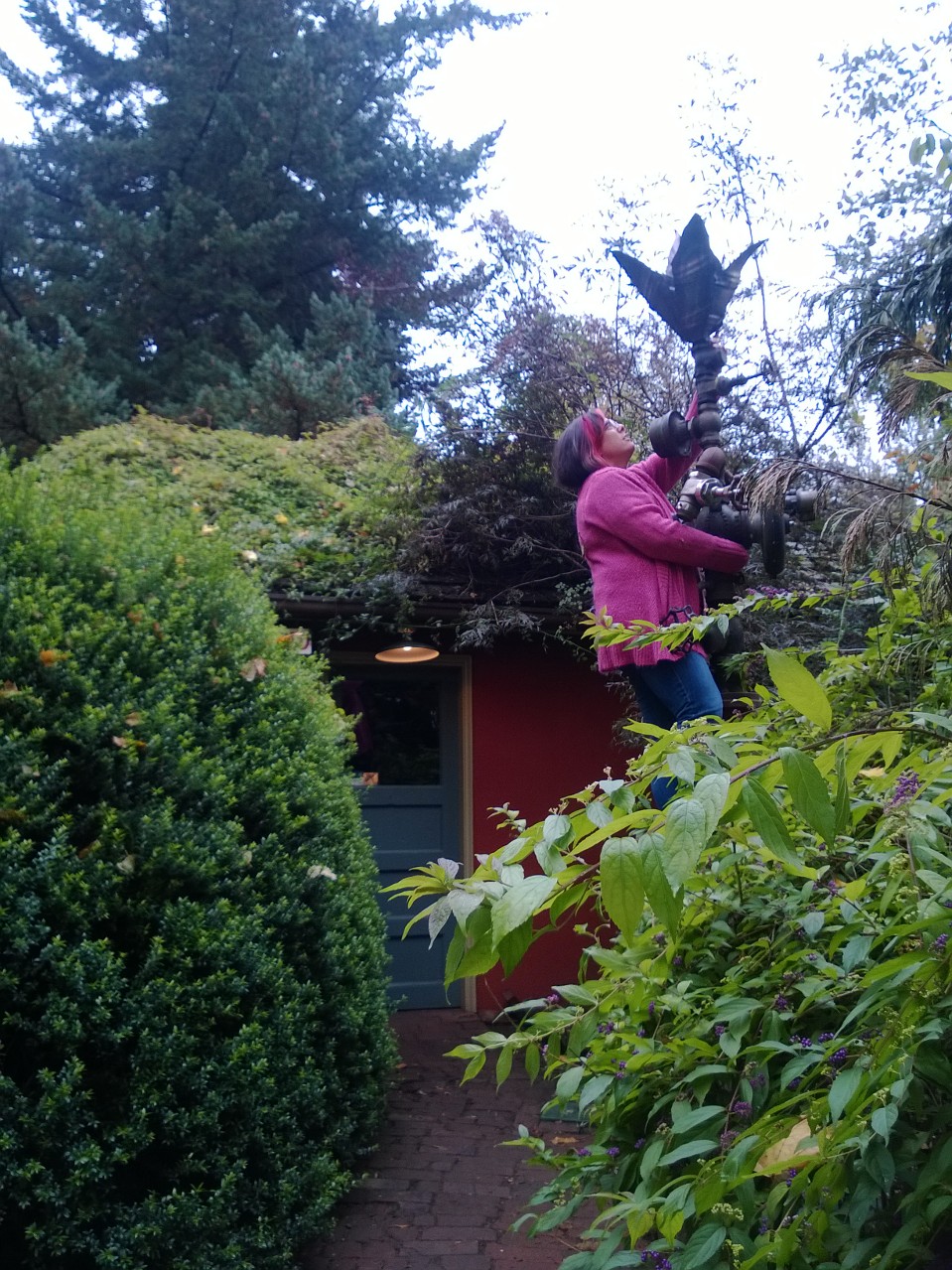
Posted in Essay, Spiritual Practice, Terri Stewart

Sacred Space Part II

Recently, I published a post on creating your own labyrinth as a way of making sacred space in a place where you may not be able to find a way to retreat to your preferred sacred space. This is a continuation upon that theme-creating sacred space in the midst of everyday living.

One thing my Spiritual Director and I agree upon is that I MIGHT have spiritual ADHD. Meaning, I need a variety of spiritual practices to keep me grounded. This totally makes sense since on the unofficial adult ADHD test I recently took, on a scale of 1-6 (6 being the most ADHD), I scored a six. Oh, yes. This penchant to need change and to be easily distracted often must be hemmed in by being very grounded in my own spiritual path while allowing myself the freedom to choose exercises, patterns, or methods from beyond my immediate experience.

This led me to take a workshop on praying with beads! Now, when I signed up for the workshop I knew that it was sponsored by an ecumenical organization so I assumed that it would be somewhat wide-open in its approach. I was wrong. It was a class on praying the Rosary. I am not Roman Catholic, and this was an ecumenical retreat, so I was a bit taken aback by the specific nature of the workshop. However, I decided to simply enter into the spirit of the situation and puzzle out my response later.

I am very glad that I did!

One of My Bracelets
One of My Bracelets

When I was able to reflect on the experience, I thought, “There must be a protestant version of this practice that would fulfill the tactile & prayerful longing that I have!” And I was right! Thank you search engine! I found a Unitarian Universalist Prayer Bead Practice. I cogitated on what I read there and then created my own practice. Now, I make prayer bead bracelets and use them to remind me to stay in touch with the sacred in my everyday living. It is one of the tools in my ADHD spiritual toolkit.

I adapted the main principle of the UUA prayer bead practice and utilized them for myself. I also make these for other folks selecting colors and images that I think will suit their spiritual journey. However, if you don’t have a bunch of beads lying around along with a crimper and all the stuff you need to make a bracelet, you can still do the prayer practice that I am about to outline by using your five fingers, starting at your thumb!

So here it is:

  1. My Hand-Each Finger a Bead
    My Hand-Each Finger a Bead

    See the “tail” on the bracelet? That is where you start or you can start with your thumb (lightly grasp the very end bead or the tip of your thumb) if you don’t have a bracelet or cannot make one. Sit still. Ground yourself. Rest gently with your eyes relaxed and gazing lightly or close your eyes, whatever is most comfortable to you. Here, focus on your image of the divine. Greet the divine and enter into the presence of holiness and join into a sacred moment. Hold this beloved image closely to your heart. Greetings of love, peace, serenity wash over you, through you, and into you. When you are ready, move up the tail of the bracelet or up your thumb to your hand. Feel each bead or feel each bend in your thumb.

  2. As you go up the beads, breath in and breath out at each small bead. Soon you will land on the large bead (not the clasp) or your fore finger. Here take time to envision those things you want to celebrate! This is a time for adoration, celebration, joy, happiness! Give all of this to your image of the divine and receive the gift that comes back to you whatever that may be. When you are ready, move to the next large bead (or your next finger tip) traveling slowly, thoughtfully, and with divine joy.
  3. At the next large bead, is the time to turn inward and look back at your day (or days before) and to offer a confession of where you have fallen short. For me, this is a time to admit where I have not been loving, peaceful, or justice seeking. Or a time to confess my lack of patience! This can be a time of sorrow, but it should not be a time of shame. We all fall short. Knowing we have, learning from it, and moving to the next bead is what this moment is for. When you are ready, move to the next large bead traveling slowly, thoughtfully, and with the knowledge that you can make mistakes and still return to a place of holiness and sacred healing.
  4. At the next large bead, it is time to name the things, people, and beings in the world that you are thankful for. Let love for the other wash over you and let gratitude sink deeply into you. It may be as simple as a favorite stuffed bear that has traveled with you since childhood. Gratitude in itself is a spiritual practice. Let it flow here. When you are ready, move slowly to the next large bead, touching each smaller bead and breathing in – breathing out at each touch. Do this with the understanding that as you find gratefulness in those around you, others are grateful for you and for who you are.
  5. At the final large bead, it is time to bring your concerns into sacred space. It could be concern for someone’s safety, for healing, for friends or family. Anything that is laying on your heart. Bring them into sacred, healing space. Here, depending on your space and time, you could do many things. You can talk with what is laying on your heart; hold it in love; offer it out to the world or the divine; or even do something creative with it.
  6. Finally, as close this part of the prayer, you will travel back to your initial image. Return to your thumb or return down the tail of the bracelet or beads. Breathing in and out at each small bead or bump along the way. As you return to your image, hold it, sit with it and when you are ready, leave it in whatever manner you are comfortable with. That could be namaste, amen, or a simple good-bye. Whichever way speaks to your path. Return to your every day living, bringing the sacred space you have made with you. Let it travel with you as you go about your day. Remembering that each time you touch your thumb or grasp a bead, that sacredness walks with and in you.

Shalom and Amen,

Terri

© 2013, post and photos, Terri Stewart, All rights reserved

terriREV. TERRI STEWART is Into the Bardo’s  Sunday chaplain, senior content editor, and site co-administrator. She comes from an eclectic background and considers herself to be grounded in contemplation and justice. She is the Director and Founder of the Youth Chaplaincy Coalition that serves youth affected by the justice system. As a graduate of Seattle University’s School of Theology and Ministry, she earned her Master’s of Divinity and a Post-Master’s Certificate in Spiritual Direction. She is a contributing author to the Abingdon Worship Annual. (The 2014 issue just released!)

Her online presence is “Cloaked Monk.” This speaks to her grounding in contemplative arts and the need to live it out in the world. The cloak is the disguise of normalcy as she advocates for justice and peace. You can find her at www.cloakedmonk.com, www.twitter.com/cloakedmonk, and www.facebook.com/cloakedmonk.  To reach her for conversation, send a note to cloakedmonk@outlook.com