

I’ve read an intriguing quote in Japanese Women Don’t Get Old or Fat by Naomi Moriyama;
‘The importance of ‘empty’ space in the presentation of Japanese cuisine can scarcely be exaggerated. Receptacles are never filled to the brim, but are left with a certain margin of emptiness- emptiness of an aesthetic significance comparable to that in a Zen ink painting‘.
(Chef Masaru Yammamoto).
Considering the importance of empty space is what I do when I draw or paint. Often an empty space is needed to guide the viewer to the place that needs his attention. Other times, empty space is filled with suspense. Because empty space can create guidance, tension and calm contemplation, it is full of possibility.
Isn’t possibility what emptiness is? The emptiness or absence of sound means a bird can fill it with its song. Emptiness as possibility works in compositions exactly the same. An empty place can be filled in or left open.
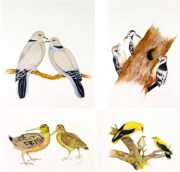
It is important to notice what exists in an empty space. If I paint a bird on the left side of my drawing looking at the right, what is the bird looking at? The empty space isn’t empty at all. It is full of possibilities. Is the bird looking at a mate? Or a prowling cat? Not filling up an empty space often works well; it adds more possibility, tension or imagination to a painting. Other times a large empty space is too dominating or too much a void, in that case, doing something with it is better. It is a place that offers calm contemplation, leave it open.
If you are a home educator, don’t teach you child that the whole page or canvas needs to be filled in. (The only reason why you should offer an art assignment in which nobody is allowed to leave the class room before his paper is completely covered, is when your students need to overcome shyness, self restrained, or inhibition).
If you are a creative therapist or an understanding friend, sit down with your client or friend, and analyse his doodle or drawing by asking what is going on in its empty space. Talk, investigate, and dream together. You will be surprised how many possibilities or interpretations will emerge.
If you are a parent and your young child is proudly showing you a painting, play with your child. Ask what is going on with the objects that are drawn, and what is happening within the empty space. Then built a story on what the child tells you. Your child will charm and entertain you with pure child fantasies. Empty spaces are full possibilities.
You thought empty space is boring or shows a lack of imagination? Or a bad composition? Certainly not always, often quite the opposite.
Returning to the book on Japanese food; I always dread the moment when I have to stop drawing in order to prepare a dinner. From now on, I will plan to continue my mindful meditation by bringing aesthetic principles into my kitchen.
– Paula Kuitenbrouwer
© 2013, essay and photographs and artwork (above and below), Paula Kuitenbrouwer, All rights reserved
 PAULA KUITENBROUWER ~ is a regular contributor to Into the Bardo and a Dutch nature artist living in The Netherlands and sharing her work with us on her blog, Mindful Drawing and on her website. In addition to art, Paula’s main interest is philosophy. She studied at the University of Utrecht and Amsterdam. She has lived in Eastern Europe and in Asia. Paula says that in Korea, “my family lived next to a Buddhist temple. In the early morning we would hear the monks chanting. During my hours of sauntering with my daughter through the beautiful temple gardens, I felt a blissful happiness that I try to capture in my drawings.” Paula sometimes teaches children’s art classes. She lives with her husband and daughter and close to her father. You can view her portfolio of mindful drawings HERE.


 The BeZine