Posted in Jamie Dedes, Peace & Justice, Poems/Poetry

Bodies of Their Bodies

hands-together-871294932977UgOgrateful for the backward glance of memory
to those days when life was about bottles
and diapers, walks in the park and baking
cookies for little hands and greedy mouth,
when the mornings were written in wonder,
months honey-combed with baby kisses
and the fascination of intrepid first steps …

in solidarity with other parents i will them
memories laced with gratitude, not the pain
of lost dreams, of lost bodies of their bodies,
the fragile students silenced in the corridors
of relative privilege after an insane rampage
or the everyday streets streaming blood in
Harlem and Bayview/Hunter’s Point where
uncelebrated kids live foreshortened lives

 and those are the children of democracy
there are these too, children of oppression
what of them? – tiny starved brown humans
that line the arenas of hunger and war, where
soundless tears of voiceless parents drown
the vestiges of hope while we  share our pain,
so sure the world will grieve along with us

© 2013, poem, Jamie Dedes, All rights reserved
Photo credit ~ Vera Kratochvil, Public Domain Pictures.net

Photo on 2012-09-19 at 20.00JAMIE DEDES ~ My worldly tags are poet and writer.  I’m in my fifth year of blogging at The Poet by Day, the journey in poem, formerly titled Musing by Moonlight.  Through the gift of poetry (mine and that of others), I enter sacred space.
Posted in Jamie Dedes, Poems/Poetry

Deconstructing Peace

moon-sea-cliff-137421298933417ekbDECONSTRUCTING PEACE

by

Jamie Dedes (The Poet by Day, the journey in poem)

the tawny moon is good fortune’s evening grace
it draps itself on the dwindling day’s calm
while mystic mountains rise pristine and high
above an earthy base, the wizard Merlin’s realm,
with memories of a green and primal past …
…….of rootedness
…………..essential things

the air is a sweet-and-salty caramel

and Peace!
a lively Peace …

visits on the briny spray and
delights at the meeting of land and sea
at rhythms of the ocean against the shore
the waves drift in and out, fling and toss
stop, start, begin again and then again
lilting, the dew drop of a mother’s kiss
it’s the mother’s kiss …

but moonlight wanes at the liminal hour

and Peace!
capricious Peace …

sees the moon incised with holographs
from the wind-whipped edges of the Earth
read the tales of valour and cowardice
…….the blight of war
…………..the naked lives
sundering tragedies under the heel of armies
citizen’s fleeing the lacerations of their plight
frozen in the crashing horror of their fright
in this amethyst veiled night . . .
the sense of peace deconstructed
on the rise of dawn, its shredding light

© 2013, poem, All rights reserved
Photo credit ~  Phil Downs, Public Domain Pictures.net

Photo on 2012-09-19 at 20.00JAMIE DEDES ~ My worldly tags are poet and writer. For the past five years on medical retirement due to a chronic, potentially life-threatening illness, I’ve blogged at The Poet by Day, formerly titled Musing by Moonlight. The gift of illness is more time for poetry. Through the gift of poetry (mine and that of others), I enter sacred space.

Posted in Fiction, Jamie Dedes

SEÑORA ORTEGA’S FRIJOLES or LESSONS LEARNED IN THE KITCHEN

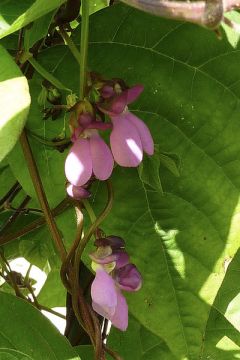
las flores de frijoles

SEÑORA ORTEGA’S FRIJOLES

by

Jamie Dedes

Her fate was set when she fell under the spell of the American’s kind eyes and bigger than life personality. For his part, he loved her gentle ways, the fluid dance of her hands at work, the sensual swing of her hips as she walked to the market with basket in hand. And so it happened that in 1948, with her father’s permission and her mother’s tears, they were wed in the old adobe iglesias where uncounted generations of her family had been married before her. Not many months after the wedding, she kissed her parents and siblings goodbye, took a long loving look at her village, and followed her new husband north to los Estados Unidos de América. She was already pregnant with Clarita.

****

As the days and years passed, they settled into their routines. Sunday mornings were her husband’s quiet time. He stayed at home while Señora Ortega and Clarita were at Mass. In their absence he would occasionally put down his newspaper and stir his wife’s frijoles simmering fragrant with pork, a few bay leaves, onions and garlic. Last night: their Saturday ritual, she and Clarita had sorted and then washed the dried beans in cold water and left them to soak until morning. The child – fast becoming a young woman – took the time and care to do a good job of this. El trabajo es vertud. Work is virtue, Señora Ortega encouraged.

In the tradition of Señora Ortega’s own madrela cocina was a place of teaching – about food, about life, about being a woman, about being human. “!Ten cuidado, hija!”  Be careful, she would say as she demonstrated her almost sacramental sorting of the dry beans. It was an opportunity to teach Clarita the dichos, the proverbs, of her mother and grandmother and all the grandmothers before.

“Los frijoles son nuestra fuerza.” We get our strength from los frijoles, she taught Clarita just as her own mother taught her. Certainly the beans give the strength to our bodies, but also the strength to our character.  There are lessons. “¡Aqui!”  Remove these. Remove the wrinkled, the broken, the discolored or malformed. Remove them as you should remove flaws from your character. One bad frijole will ruin the whole pot.  Taparse con la misma cobija.* … You will be judged by the company you keep. Be cautious in your choice of friends.  Even the Norte Americanos have such a saying: one bad apple spoils the bunch.

“Mama,” said Clarita, rolling her eyes after her mother’s latest speech. We are North Americans.” Señora Ortega’s brow furrowed when she heard this. She was given to worry about such reactions from her daughter. What of the child’s values?  It is true after all. My daughter is American. What does this mean for her future, for our relations, and for us as la familia?

****

Soon Señora Ortega had to put her concerns aside. It was springtime. Easter was upon them and with it a visit from her husband’s sister with her two small children. Señora Ortega and Clarita were busy with preparations. The air in her house smelled of poblanos roasting and cookies baking. They put fresh linens on the beds in the guest rooms. They picked flowers from her garden and set them in vases around the house. She gave in and bought chocolate Easter bunnies too, the silly convention of this country, but the children loved them and looked forward to them each year.

Finally the honored guests arrived and the house was filled with the cheerful noises oflos niños. The boy and girl were now old enough to learn to prepare beans and, on the eve of Easter Sunday, Señora Ortega gave Clarita the task of showing the children how to sort los frijoles for cooking.  She looked on as Clarita explained the process. “!Ten cuidado, mis primos. Aqui! Remove these. Remove the wrinkled, the broken, the discolored or malformed.  Remove them as you should remove flaws from your character. Remember one bad frijole will ruin the whole pot. Be cautious in your choice of friends. Taparse con la misma cobija. You will be judged by the company you keep. “Los frijoles son nuestra fuerza.” Los frijoles are our strength.

****

At some point, Señora Ortega’s husband had come to stand by her side. She realized he was watching her as intently as she watched their daughter. He put his arm around her and held her close. “You see, mi querida, she is a good girl and you are a good mother. It’s gonna be okay …”

“Am I that transparent,” thought Señora Ortega, but she sighed gratefully. All will be well. My mother was right. “Los frijoles son nuestra fuerza.” 

.

Taparse con la misma cobija – literally: to cover yourself with the same blanket, i.e. likely the same meaning as our expression “birds of a feather.”

© 2012, short story, Jamie Dedes, All rights reserved. This story is a fabrication and not meant to depict any specific person or persons living or dead.

Photo credit ~ Schnobby via Wikipedia under Creative Commons Share-Alike 3.0 unported license

Posted in Essay, Jamie Dedes

GREAT ACTS OF LOVE

PEARL BUCK (1892 – 1973)

American Novelist and Humanitarian

Pulitzer Prize, 1932

Nobel Prize for Literature, 1938

I give you the books I’ve made,

Body and soul, bled and flayed.

Yet the essence they contain

In one poem is made plain,

In one poem is made clear:

On this earth, through far or near,

Without love there’s only fear.

Essence by Pearl Buck

GREAT ACTS OF LOVE

by

Jamie Dedes

I view Pearl Buck, whom I started reading when I was twelve, as a sort of spiritual mother. You can imagine my joy then to find a copy of her one book of poetry in a used bookstore. It is the only book she wrote that I had not read. It sat dusty and torn and – while clearly once well-loved by someone – it was now hidden in an out-of-the-way place, untouched and unrecognized for its simple beauty.

In brief, eloquent, deft strokes, Ms. Buck’s poems do indeed express the great message of both her work as a novelist and writer and as a humanitarian  …

“WITHOUT LOVE THERE IS ONLY FEAR”


Born on June 28, 1892 in Virginia, Pearl Buck was the daughter of missionaries. She grew up in China and spoke Chinese before she ever spoke English. She was a prolific writer with most of her books inspired by her experiences in Asia. In the 1920s, before the publication of her books, her stories and essays began appearing in influential American and Chinese publications.

Of Ms. Buck’s novels, The Good Earth is the most well-known. It was her second novel and became a best seller. She also wrote a number of nonfiction books including memoir and a cookbook. Her poetry collection, Words of Love, was published in 1974, a year after her death. It is now out of print.  It is gracefully illustrated by Jeanyee Wong and was published by The John Day Company, the publishing firm founded by Ms. Buck’s second husband, Richard Walsh.

Throughout her career, Ms. Buck wrote heroically, acutely, and compassionately of women’s rights, immigration issues, mixed-race children, adoption… and, of course, China. She was blacklisted in the 50s for her political and social views. But Ms. Buck’s life was not just about words of love. It was about great acts of love.

Most of Pearl Buck’s humanitarian work was toward mitigating the poverty and discrimination suffered by children.Ms. Buck founded Welcome House, Inc, which was the first international interracial adoption agency. She adopted – if I remember correctly  – ten children herself. Her initial efforts to help mixed-race children were inspired by their rejection in Asia, especially in Korea. There mixed-race children fathered and left behind by American soldiers were barred from any social, educational, and civic privileges, as were the mothers of mixed-race children. Today Ms. Buck’s books still stand as ambassadors of her love and humanity and as introductions to China before Mao.

Here Anchee Min, Chinese-American author, discusses her reasons for writing Pearl of China, a fictionalized account of Pearl Buck’s life.

© 2012, essay, Jamie Dedes, All rights reserved

Ms. Buck’s photograph is in the public domain.

Video posted to YouTube by  .

Posted in Jamie Dedes, Poems/Poetry

BLACK DAYS IN THE SUDAN


We can run away from bombs, but not from hunger.” Sudan‘s refugees in South Sudan, report of Amnestyus.org 2012

·

I wrote this back in the 80s in response to an essay on the “black days” by someone from the Sudan.  

·

Have you read about them –

“Black Days” in the Sudan?

They are hunger-and-thirst days

When the supply of water –

One liter per person for two weeks

. . . is gone

When their food, one meal a day

For fourteen days

. . . is gone,

and the waiting and wasting begins –

four, five, fifteen days

Until more food and water

then Black Days again –

They are days of laying-in.

Conserving energy.

Some survive.

·

If you want and are able, you can make a donation to the Fill the Cup of the World Food Programme. They say $1 fills four cups.

© 2012, poem, Jamie Dedes, All rights reserved

Photo credit ~ mother and malnurished child, Darfur, taken by USAID and in the public domain

Posted in Jamie Dedes, Poems/Poetry

NO-BALONEY SANDWICHES

“ONE’S-SELF I sing—a simple, separate Person.” Walt Whitman, Leaves of Grass

·

For Zabaida on her 98th birthday.

Maybe next time around …

 NO-BALONEY SANDWICHES

by

Jamie Dedes

·

This is dedicated to all those fine beings . . .

Those who are blatantly themselves

You know the ones I mean –

Some, when seedlings, had folks

who jabbed a finger yelling: You! You! You!

accusing them of being quintessentially themselves

. . . as though that was wrong.

They are the YOUs who come from multi-colored places

and varied dreams

with hearts woven of wonderlush.

They are womanish or manish.

They are childlike and adultish.

They run from the gray streets to the green forest.

They take to long-lost roads and never-found pathways

with their song in a backpack and

a brown-bag lunch of no-baloney sandwiches.

When they elder they arrive back at the beginning

knowing who are they are

. . . and why.

·

© 2012, poem, Jamie Dedes, All rights reserved

Photo credit ~ Jon Sullivan’s “Woman on the Beach”

Posted in Jamie Dedes, Poems/Poetry

SILENCE AT NOON

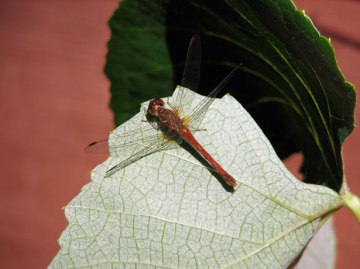
Deep in the sun-searched growth the dragon-fly

Hangs like a blue thread loosened from the sky ~

So this wing’d hour is dropt to us from above.

Dante Gabriel Rossetti, Silent Noon

SILENCE AT NOON

by

Jamie Dedes

The days are filled with noise and moods

but silence lies here at noon

like stillness between heartbeats

and the Ever speaks

through dragonflies breathing vineyards

and a million bees humming the same tune

Caravans of monks and nuns

leave messages in dead languages

and encrypted ritual

as they walk their pathways across bridges

known for their span and silver beauty

Like a revered teacher’s stupa

or a gothic Cathedral

those bridges spin toward heaven

stop short

and trip to the other side

Nothing changes

The same whispered stories

fill your rattling lungs with grief

The only truth is in the silence at noon

doing duty as shawl, shield, and salvation

·

© 2012, poem, Jamie Dedes, All rights reserved

Photograph ~ Arcana Dea, Public Domain Pictures.net

Posted in Jamie Dedes, Teachers

HONORING THE ULTIMATE MOTHER: Falling back in love with Mother …

THICH NHAT HANH (IN BROWN) AT HUE CITY AIRPORT, VIETNAM (2007)

“The situation the Earth is in today has been created by unmindful production and unmindful consumption. We consme to forget our worries and our anxieties. Tranquilizing ourselves with over-consumption is not the way.”  Thich Nhat Hanh, 2010, Tricycle Magazine

The Guardian UK posted an article in February that was written by Jo Confino and in which the dear Zen teacher, Thich Nhat Hahn, discusses his views on current environmental challenges and the need for a spiritual revolution to address them. I hope you will link through and read the article today or watch the interview video below in honor of our ultimate Mother, Earth. In Metta on Mothers Day, J.D.

“Zen master Thich Nhat Hanh has been practising meditation and mindfulness for 70 years and radiates an extraordinary sense of calm and peace. This is a man who on a fundamental level walks his talk, and whom Buddhists revere as a Bodhisattva; seeking the highest level of being in order to help others.

Ever since being caught up in the horrors of the Vietnam war, the 86-year-old monk has committed his life to reconciling conflict and in 1967 Martin Luther King nominated him for the Nobel Peace Prize, saying “his ideas for peace, if applied, would build a monument to ecumenism, to world brotherhood, to humanity.”

So it seems only natural that in recent years he has turned his attention towards not only addressing peoples’ disharmonious relationships with each other, but also with the planet on which all our lives depend.” MORE

And here is the video of the interview:

Photo credit ~ courtesy of Lu’u Ly via Wikipedia and generously released into the public domain.

Video ~ uploaded to YouTube by  .

Posted in General Interest, Jamie Dedes

WHILE I WAS GONE …

“And it occurred to me that there is no such thing as blogging. There is no such thing as a blogger. Blogging is just writing — writing using a particularly efficient type of publishing technology.” Simon Dumenco, writer/blogger with Advertising Age

BACK TO THE BLOG

by

Jamie Dedes

Well, I’m back and with me my partners, Ann and Rob, and all of the wonderful writers and poets who have contributed and will continue to contribute to the richness of this blog. (Thank you!) Short story: I’ve been “occupying” or at least boycotting my former Internet Service Provider for poor customer service and for billing for services not rendered. This isn’t done in the spirit of meanness or revenge, but in the search for honesty and ethic and justice, though I will go to war if need be to get the billing corrected.  Meanwhile, after much research, I found new provider that has – according to online reviews and polling of friends – a better ethic and more reliability. One can only hope …

Most immediately, I plan to catch-up with our readers. I look forward to finding out what I missed in your blogs – your lives, your wisdom and joy, your art – over the past month. There is always the richness of spiritual practice, family, friends, books, music, and shows. Still, a vacuum was created during the month I was off-line. For your concerned email notes and for your comments here: thank you!

I have many fine submissions to organize for publication. Some require work before they can be published. I’m not sure how fast they’ll go up, but you won’t be disappointed when they do. Stay tuned …

 See you in the Blogosphere!

and, from all of us to each of you, thank you for reading and commenting here.

Jamie

Posted in Jamie Dedes, Poems/Poetry

TRAFFICKING IN DREAMS.

Oh love and summer,  you are in the dreams and in me…Leaves of Grass by Walt Whitman

·

TRAFFICKING IN DREAMS

by

Jamie Dedes

·

Sitting on the worn stone steps of summer

on salty Brooklyn nights in Dyker Heights

with our senior year pending like a threat.

Jamming sessions.

Sharing hugs.

Sipping cokes.

I sang you, my first song. You played me,

honeyed melodies in B on a new guitar.

·

Stan on his Irish frame*. Jim on horn.

Your sassy sister chorine** sprinkling

silver star-dust. We trafficked in dreams.

But faith betrayed, a rusted rudder;

your future a rose-bright moon

falling sadly into a turquoise sea.

·

You’d drive me home at dawn

in your dad’s blue Nova, into a

violet sunrise, deep purple maples

standing guard by mom’s place.

Now gone, you and the old roost.

·

No more of your music. No old friends.

Just meandering the strangest streets

mumbling something off-key, strumming

the memory of you, a new guitar, and

the summer we trafficked in dreams.

·

© 2010-2012 poem, Jamie Dedes, all rights reserved

Photo credit ~ Petr Kratochvil, Public Domain Pictures.net

* a bodhrán drum.

** 1920s American term for a chorus girl.

Posted in Jamie Dedes, Poems/Poetry

BECAUSE

BECAUSE


by


Jamie Dedes

·

wind came through like an old bruja* one night

taking her broom to my cloud, scattering the seeds

of my hording to all the four corners and the center

below where I do my shopping for earthly things

down I went to try to gather them up only to

·

meet a philosopher peach who set me on my ear

with his questions on mind, matter, and meaning

wanting to know why he couldn’t taste himself

and how was it that I had a mouth that wouldn’t

·

in any trance, no matter the depth of it, be a

peach, pointing out to me how we needed one

another to get the job done and – Why?, he asked

and what could I say, having lived my life in the

·

clouds, drinking the vapors of trust and basic

instinct, and knowing tomorrow is today and

this day is perfect, and no matter the whys and

the wherefores, there’s a rightness to it all, so

·

on frail rimy breath, like the child I once was,

I… answered him simply: because

·

* bruja, Sp. – witch

© 2012, poem, Jamie Dedes, All rights reserved

Photo credit ~ mohan p, Public Domain Pictures.net

Posted in Jamie Dedes, Poems/Poetry

INTERNATIONAL WOMEN’S DAY: Connecting Girls, Inspiring Futures

In Pakistan the theme for International Women’s Day is “Connecting Girls, Inspiring Futures.”  In solidarity (I just picked a country at random), I am reblogging this poem, which I wrote last year.” I hope the day will come when all people  – regardless of country or gender – are able to express themselves creatively in whatever way and whatever field resonates for them.

·

I know that I haven’t powers enough to divide myself into one who earns and one who creates. Tillie Ollsen (1912-2007), American writer and feminist

·
I READ A POEM
by
Jamie Dedes

I read a poem today and decided

I must deed it to some lost, lonely

fatherless child to embrace her

·

along her stone path, invoke sanity

I want to tell her: don’t sell your

dreams for cash or buy the social OS*

·

Instead, let the poem play you like a

musician her viola, rewriting lonely

into sapphire solitude, silken sanctity

·

Let it wash you like the spray of whales

Let it drench your body in the music

of your soul, singing pure prana into

·

the marrow and margins of your life

Let the poet-shaman name your muse

and find you posing poetry as art and

·

discover the amethyst bliss of words

woven from strands of your own DNA.

Yes. I read a poem today and decided

I must deed it to a lost fatherless child

·

© poem, 2011, 2012, Jamie Dedes All rights reserved

* OS – Operating System

Photo credit – Jaime Junior, Public Domain Photographs.net

♥ ♥ ♥ ♥

Women’s Day Live 2012

Video uploaded to YouTube by .

Posted in Jamie Dedes, Meditation

THE DEPTHS OF YOUR HEART

Jalāl ad-Dīn Muḥammad Rūmī

Sufi Mystic and Poet (1207 A.D. – 1273 A.D.

Born in what is now Afghanistan, Died in Turkey

Your heart is the size of an ocean.

Go find yourself in its hidden depths.

Rumi

Wishing you peace of heart. Always. 

Jamie

·

Credit ~ The illustration of Rumi is in the U. S public domain.

Video ~ upload to YouTube by Mevlanaism.

Posted in Film/Documentaries/Reviews, Jamie Dedes

THE ULTIMATE GRACE OF GRATITUDE

GRATITUDE

Introduction to a Short Film

by

Jamie Dedes

I am so charmed by this six-minute moving-image film – you will be too – that I had to post it on Into the Bardo. I first shared it some time ago on at my primary playground, (Musing by Moonlight), where it was well received. If you can’t access YouTube or this specific video from your country, this film and The Hidden Beauty of Pollination are both on the TED talks site.

THE WISE AND GRACE-FILLED NARRATIVE

THE HEART OF THE FILM

The heart of this little gem is the gift of the very dear Br. David Steindl-Rast. If you are familiar with Br. David’s philosophy, writing, and voice, you will have immediately recognized who wrote and delivered the narrative.

BROTHER DAVID STEINDL-RAST (b. 1926)

Viennese, Catholic Benedictine Monk

Br. David is notable for his work fostering dialogue among the faiths and for exploring the congruence between science and spirituality. Early in his career he was officially designated by his abbot to pursue Catholic-Buddhist dialogue. He studied with several well-known Zen masters. He is the author of feature articles, chapter contributions to collections, and books. Among the most notable are Belonging to the Universe (with Frijof Capra) and The Music of Silence: A Sacred Journey Through the Hours of the Day (with Sharon Lebell). Br. David is the co-founder of A Network for Grateful Living, dedicated to the life-transforming character of gratitude.

THE FILMMAKER

Louie Schwartzberg, the film-maker, is an American and well-known for his time-lapse photography. The short-film here is one of several – each with a different theme – which you can find on YouTube.

THE MUSIC

The mood music background is by composer Gary Malkin. “He is founder of Musaic and Wisdom of the World™, a media production company and web site. He is also the co-founder of Care for the Journey, a care-for-the-caregiver initiative for healthcare professionals.” MORE

© 2011, Jamie Dedes All rights reserved

Video uploaded to YouTube by 

Photo credit ~ Br. David Steindl-Rast, courtesy of Verena Kessler. She has released the photograph into the public domain.

Posted in Buddhism, Jamie Dedes, Poems/Poetry

THE TRANSFORMATION OF THINGS

Zhuangzi Dreaming of a Butterfly by Lu Zhi (1496–1576), Ming dynasty, mid-16th century Ink on silk, 29.4 x 51.4 cm

THE TRANSFORMATION OF THINGS

by

Jamie Dedes

A Man sleeping … yes!

A Butterfly flitting… yes!

Zhuangzi, dreamer of Butterfly,

ponders what joy there might be

in that tiny Butterfly brain, so small

too small to be perceived by I or eye

Is it dreaming me? he asks

Or, am I dreaming it?

Imagine the Universe engaged,

he thinks to himself, inside that flutter

– thunder, a Cosmic Belly Laugh –  Ho! Ho! –

Then Zhuangzi knows: He is silent

flitting from flower to flower in eternal spring

coming and going, going and coming

This is called the Transformation of Things

·

© poem, 2012 Jamie Dedes, All rights reserved

Photograph courtesy of Gemeinfrei, in the U.S. public domain.

Posted in Essay, Jamie Dedes

ELDER POWER: Growing Strong in Broken Places

ELDER POWER:

Growing Strong in Broken Places

by

Jamie Dedes

Authors, like coins, grow dear as they grow old; It is the rust we value, not the gold. – Alexander Pope

Originally published in the now defunct California Woman.

I come to this place of Elder Power through the experience of a chronic, potentially life-threatening illness. Illness is many things. It is a mentor, not chosen, not welcome, but a mentor nonetheless. It is a challenge that often breaks the bonds of affection, the temper of the spine, and the sharpness of the mind. It is a reminder to everyone involved of his or her fragility and mortality. Everyone is touched: family, friends, and colleagues. Everyone is changed and the good or ill of it is largely choice

My family and friends want me to help others by writing from a more clinical perspective, but it seems to me that the clinical lessons are less important than the life lessons. It is the life lessons that give us the strength to keep going, that are the true value to be shared, and that make us elders. To me “elder” implies more than “senior” or “senior citizen,” which I see as demographic terms for people who have reached retirement age. A senior is someone who has merely put in time, while elder is about attitude and state of mind. Elder implies one who has learned a few things along the way.

As a writer, it is the life lessons, not the clinical ones, which inspire and inform my work. I have learned, for example, that all humans are in process and therefore imperfect; and that, no matter what our differences are, the most important things are to remain open to communication and to accept and release our own follies and those of others. I have learned that neither illness nor threat of death preclude joy. I have learned that people who are joyful rarely do harm to themselves or others. I have learned that fear of death has to be directly addressed and then firmly put aside in favor of the business of living. As the saying goes: “It’s not over until it’s over.” Until then, we have responsibilities to others and ourselves. The only real difference between someone who has a life- threatening illness and someone who doesn’t is that the former is no longer in denial.

“If people bring so much courage to this world, “ wrote Hemingway in A Farewell to Arms, “the world has to kill them to break them. The world beaks everyone, and afterward, many are strong at the broken places. But those that will not break, it kills. It kills the very good and the very brave and the very gentle impartially. If you are none of these it will kill you too but there will be no special hurry.”

I am not good, or brave, or particularly gentle. Sometimes I let it all get me down. I descend into fear. I am impatient with process, with taking meds and going for seemingly endless tests and doctors’ appointments. Maybe that’s why I’ve outlived my original expiration date by ten years. My mother used to say, “Only the good die young.” My best quality may be that under my protective shell of intractability, I actually am willing to be broken and reformed. I suppose only time will tell if I have grown “strong at the broken places.”

So, here I stand, after twelve years of battle, at the dawn of a bright new day in a body that is now significantly disabled and quite a bit older. It’s still a good morning and a good body. I recognize I once dealt with a worse handicap than my current disabilities. That handicap is commonly referred to as “youth.” I survived. Maturity on the other hand is a true boon, a gift to savor and enjoy with layers of luxurious nuance I had not anticipated. I do not long for my youth. I love my graying hair. I love my wrinkles and the loose skin on my neck. I love the mild deformity of my feet. These things remind me that I am still here after all. I will not dye my hair, though I have. I will not get chemical injections or cosmetic surgery. I will not use rejuvenating grooming products that have been tested on defenseless animals. I am inspired by civil-rights-era African-Americans who sported Afros, said essentially “this is who we are and what we look like,” and chanted “black is beautiful.” I am graying. I am wrinkled. It’s all lovely and lyrical and makes me smile. It’s about ripeness, not rottenness. It’s honesty: what you see is what you get. Aging is beautiful. With maturity, one finds character refined and perspective broadened, energy expands and compassion flowers. The experience of joy comes more easily.

As survivors, we owe it to those who have gone on, to live in gratitude for this gift of a long life. How ungrateful and what an insult it is to them for us to bemoan our maturity and yearn for our youth as we so often do. What an incredible waste of time and energy such yearning is. Many don’t survive childhood in their impoverished and war-torn areas. Some others don’t survive childhood due to congenital or other diseases. My sister died by her own hand when she was twenty-seven. I have a wonderful, talented, smart friend in her mid-thirties who will pass within three months from this writing. Like you, I have relatives and friends who didn’t make it to fifty, much less sixty or seventy. All things considered, aging is a gift not a curse.

Some of our power comes from our sheer numbers. I read somewhere that we are some six hundred million strong worldwide. In each of our countries, we represent a huge political constituency, a lucrative market, and an enormous fount of energy, experience, and expertise. If that isn’t power in this modern world, what is? What a force for peace we could be. Some of our power comes from consciousness. We are awake now. We have learned how to live in the moment and how to live joyfully, hugely. That alone is a lesson to share. Some of our power comes from more time and focus. Many of us are retired or semi- retired or on disability, or soon will be. Implicit in that is the time to keep abreast of issues in our communities, countries, and our world. We can take the time and make the effort to get accurate information, to analyze carefully, and to share appropriately; that is, in a well considered, non-inflammatory, non-sensational manner. We can act with grit and grace.

Let us show that we are strong in the broken places. Let those of us who have this gift of long life seize on it and ply our elder power. Let’s live with joy, do good, and have fun. Most of all let us be generous with our love. Soon enough, when the time is ripe, our bodies will return to the earth. Our spirits will go wherever spirits go. The river of earthly life will continue to flow. Our children will see us reflected in the eyes of their children. Our grandchildren will strain to hear our voices in rustling leaves and breezes that whisper to them in the night. They will seek us out in moonlight and the warmth of the sun, in the roar of the oceans and the gentle meandering of a lazy brook. They will find us in the good earth and in the good hearts of the lives we’ve touched with concern and compassion.

© 2009  photo and essay, Jamie Dedes All rights reserved

Posted in Essay, Jamie Dedes

POET ACTIVISTS IN SOLIDARITY


“From time immemorial, poetry has built better bridges between people than those with bricks and stones. And these bridges do not get old or obsolete … ” [Change Is Born in the Womb of Poetry]  MujeebJaihoon


POET ACTIVISTS IN SOLIDARITY

by

Jamie Dedes

After much resistance, I finally joined Facebook under my name HERE and created a page for Into the Bardo HERE. Facebook is yet another something that can consume too much time, but it’s also a gold mine of information and introductions to talented, responsible folks from around the world. Through poet-Friend connections I recently received an invitation to participate in:

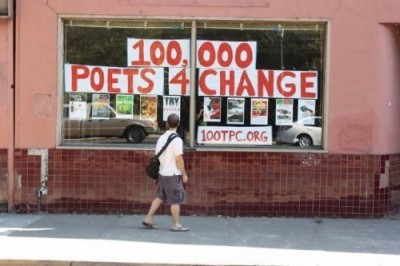
100 THOUSAND POETS OF THE WORLD (100 Thousand Poets for Change) – This puts me in mind of Sam Hamill‘s Poets Against the War, when hundreds of poets marched and read outside the White House in protest against the war in Iraq. That was a well-defined effort. In this case the first question that comes to mind is “What kind of change?” 

The first order of change is for poets, writers, artists, anybody, to actually get together to create and perform, educate and demonstrate, simultaneously, with other communities around the world. This will change how we see our local community and the global community. We have all become incredibly alienated in recent years. We hardly know our neighbors down the street let alone our creative allies who live and share our concerns in other countries. We need to feel this kind of global solidarity. I think it will be empowering.  Excerpt from the press release of March 2011 announcing the the first 100 Poets for Change global event that was held on September 24, 2011. The next global event is scheduled for September 29, 2012.

100 Thousand Poets for Change is a unified effort among activist poets, artists, photographers, and musicians working toward a sustainable world through simultaneous events held across the globe, basically consciousness raising and peaceful protest. This September under the umbrella of  100 Thousand Poets for Change, 700 events were held in 550 cities representing 95 participating countries united to promote environmental, social, and political change. That’s pretty amazing and down-right gratifying. 100 Thousand Poets for Change is not getting the press that the Occupy movement is getting, but it is striking by virtue of its size, support, and sustainability.

Bob Holman and Margery Snyder, in an article on About.com said, “the beauty of the concept of 100 Thousand Poets for Change is that it is completely decentralized and completely inclusive.”  All those involved are hoping, through their actions and events, to seize and redirect the political and social dialogue of the day and turn the narrative of civilization towards peace and sustainability.

Throughout the year, there are also small local events. Even as you read here today, the Sharjah International Book Fair is in progress will run  through November 27. 100 Thousand Poets for Change was invited to participate and is actively doing so.

If this effort sounds like something that interests you as a poet and/or citizen of the world, check out the website HERE.

POETS AGAINST THE WAR started in 2003 by Sam Hamill is now defunct, but all the poems have been placed in a university archive. I was honored to find that two of mine are included. Sadly the web domain has been assumed by others for advertising. However, there is a bound collection of some of the original poems, Sam Hamill, Poets Against the War.

Δ

AUDRE LORDE (1934 – 1992)

Caribbean-American poet, writer, activist

trying to make power out of hatred and destruction

trying to heal my dying son with kisses

Power by Audre Lorde, The Collected Poems of Audre Lorde

NOTABLE AND QUOTABLE

“[Poetry begins] that process by which we insure the future because we know so much more than we understand. We must first examine our feelings for questions, because all the rest has been programmed. We have been taught how to understand, and in terms that will insure not creativity, but the status quo. If we are looking for something which is new and something which is vital, we must look first into the chaos within ourselves. That will help us in the directions that we need to go–that’s why our poetry is so essential, is so vital. Now whether poetry has the responsibility to effect social change . . . it doesn’t really matter. As we get in touch with the things that we feel are intolerable, in our lives, they become more and more intolerable. If we just once dealt with how much we hate most of what we do, there would be no holding us back from changing it. This is true with any kind of movement. This is the way in which the philosopher/Queen, the poet-warrior leads.” Audra Lorde in an interview Karla Hammond, American Poetry Review, March-April 1980

©  Jamie Dedes, 2011 All rights reserved

photo credit ~ Audra Lorde (1980) by K. Kendall via Wikipedia and licensed under Creative Commons Attribution 2.0 Generic.

Posted in Jamie Dedes, Poems/Poetry

SOUL’S WINTER

In my coat I sit

At the window sill

Wintering with the snow …

The Dead of Winter by Samuel Menashe in Samuel Menashe: New and Selected Poems

·

MY SOUL’S WINTER

by

Jamie Dedes

soul’s winter with days like secret lights

like eels slithering in the depths of the sea

with vague interests and a fathomless eye

stilled by a gray groping arctic freeze into

thinking of what-fors, whys, then howling

and waking up in spring with the hope of

answers in the hint of fresh green summer

·

© poem, Jamie Dedes, 2011 All rights reserved

Photo credit ~ morgueFile