To help us continue our close of interNational Photography Month, what could be better than this lovely iris and poetic musing from Marilynn Mair, mandlinist, bandolimist, writer, photographer and wannabe Brasileira? Marilynn is Professor of Music at Roger Williams University in Bristol, Rhode Island. In some circles she is known as the First Lady of Mandolin.
Tag: Marilynn Mair
The First Lady of Mandolin, her poem and her music
 let’s make peace and give it a chance
make dinner and serve it up hot
let’s make love and marry or not
make some babies teach them to dance
make good music a grand entrance
make time without asking what for
make art make dreams come true and more
make mistakes make amends make tea
make someone laugh make them happy
let’s make a better world not war
– Marylinn Mair
I have been trying to write a poem about peace for my friend Jamie’s Poets Against War. Everything came out so stilted– no point trying to force the muse– until I was in the airport in Rio thinking about my family and events of the past few weeks, and this decima just popped out. A bit late but heartfelt. M. M.
© 2013, poem and photographs, Marilynn Mair, All rights reserved
 MARILYNN MAIR (Celebrating a Year, blog and marilynn mair mandolin, website) ~ is a contributor to Into the Bardo. She is a Professor of Music at Roger Williams University and internationally recognized as the “First Lady of the Mandolin”. Marilynn spends part of the year in Rio de Janeiro, where she researches and performs Choro music, a post-colonial Brazilian instrumental style dating back to the mid-19th century. She’s written two books on mandolin and has several albums out. Here she is – for those new to the Bardo – with Água no Feijão in Brazil.
Marilynn’s Amazon page is HERE. I have written more extensively about Marilynn and choro HERE. J. D.
I’m beginning to live with future tense …
 I’m beginning to live with future tense
once more expanding my conjugations
to will and shall and verbs like hope the ones
I’ve been afraid to say out loud no sense
tempting the subjunctive when a sequence
of events in future perfect beckons
besieged still by emotional demons
I wobble precariously the pretense
of the conditional implying that
the ground could give way any minute and
I’d be plummeting through the past again
insecure disillusioned railing at
imperfect while trying to stop and stand
on the crust of could-be despite was-then
– Marilynn Mair
© 2013, poem and portrait, Marilynn Mair, All rights reserved
MARILYNN MAIR ~ of Celebrating a Year is known as the “angel of the tremolo” and “the first lady of mandolin”. Marilynn is Professor of Music at Roger Williams University, Bristol, Rhode Island. Her most recent CDs are Meu Bandolim and Enigmatica. Her most recent book is Brazilian Choro – A Method for Mandolin. For more of Marilynn’s story, link HERE. Marilynn Mair is a contributing writer to Into the Bardo.
LIFE INTO ART
 LIFE INTO ART
by
Marilynn Mair (Celebrating a Year)
I think, looking back at my wayward path through the years, that the most valuable life skill one needs to develop in order to succeed, is to learn how to improvise. Life will never be smooth or rosy, except in very small stretches. Opportunities for your skill set may never materialize, love may not be as generous to you as you are to it, life as you planned it will definitely at some point go astray. Set-backs and tragedies await, and if you are to cope, to carry on, you need to be able to take a hard look at the pieces on the board and figure your best way forward. Right where you stand, right where you never expected to be. Imagination helps, optimism is a crucial ingredient even if it seems to have temporarily disappeared. No one teaches us how to do this, we learn from necessity. But it certainly puts jazz in a whole different perspective. And poetry, abstract painting, things most people think they don’t understand. Because, really, we are all just learning how to make life imitate art.
I think that if all we had in life to guide us was this paragraph by Marilynn Mair, we’d be okay. Life is the art of taking the jarring notes, the unlikely word, the unexpected juxtapositions, the odd shadings and turning them into something lovely. Life is the teacher. Art is the text. Creating art is survival, the way we work out understanding and meaning. Jamie Dedes
© 2013,essay and photographs, Marilynn Mair, All rights reserved
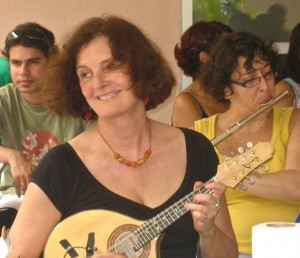 MARILYNN MAIR ~ of Celebrating a Year is known as the “angel of the tremolo” and “the first lady of mandolin”. Marilynn is Professor of Music at Roger Williams University, Bristol, Rhode Island. Her most recent CDs are Meu Bandolim and Enigmatica. Her most recent book is Brazilian Choro – A Method for Mandolin. For more of Marilynn’s story, link HERE. Marilynn Mair is a contributing writer to Into the Bardo.
Mandolinist, composer, educator and writer Marilynn Mair, posts a poem on her blog once a week. It’s always a treat: sonnet, villanelle, decima, rondeau, or pantoum … It’s an event I look forward to. This one is from her 208th week of blogging. Jamie Dedes
THE LIFE AND MUSIC OF MARILYNN MAIR
MARILYNN MAIR
American composer, mandolinist, professor, writer, and poet
Concert performer, recording artist, professor of music, mother of two musically talented kids, director of America’s pre-eminent summer school for mandolin and guitar — any one or two of these can be a full-time job, but Marilynn manages to do them all. MORE [MANDOZINE]
However untrained my ear may be, I immediately appreciated that there was something exciting and fresh in the audios Marilynn Mair uploaded to her blog Celebrating a Year. The reason for the freshness was that it was Brazilian jazz, called choro, something with which I was not familiar. I think the first audio might have been Isso, which was written by Marilynn and performed by her and Luiz Simas on Meu Bandolim, their CD released 2010. [Sample] I was hooked. I sent the link around to all my music-loving family and friends.
Choro (pronounced SHOH-roh) is best described in American terms as “the New Orleans jazz of Brazil.” It is a complex popular musical form based on improvisation, and like New Orleans jazz, blues, or ragtime, grew from a formalized musical structure and many worldly influences. But to the people of South America, choro is Brazil. It is life. MORE [Saint Paul Sunday]
As lutes go, I was most familiar with the oud of my Lebanese/Turkish background; but I also grew up among Brooklyn Italians and enjoyed their mandolino [The Serenade of Italy]. The European instruments have the oud as a common ancestor. Curious, I quieried Marilynn about choro and in response she gifted me with two of her seven CDs. That was my virgin venture into the delightful sounds of this distinctly Brazilian music. Now it’s an addiction.
Marilynn is professor of music at Roger Williams University at Bristol, Rhode Island. Each year, she travels to Brazil to continue research, study, and teaching. In fact, as I write this, she’s on her way to Rio to teach a class of mandolinists at the Universidade Federale and to write music. She always shares her adventures with us on Celebrating a Year, her blog.
The set of compositions that Marilyn is currently writing is a series of hybrid choro in which Marilynn uses themes from classical music and jazz to creat Brazilian music. She finished three: Um Quinto do Ludwig, a bossa nova based on the first movement of Beethoven’s 5th symphony; Farrapo (Rag) based on Scott Joplin’s The Entertainer, and Sonatinha based on Beethoven’s Sonatina in C for Mandoline. These trips may be a change of scenery for Marilynn, but they’re not a break from the work she loves. She’ll be hard at it on the next three compositions, one of which is to be based on Piazzola’s Milonga do Angel.
Next on her agenda is SummerKeys, a music camp providing students of mandolin and guitar with a week private lessons, plucked-string ensambles, concerts, new friends and mentors. SummerKeys is at Lubec, Maine. (Info and registration for that is HERE should you be interested.)
Marilynn’s newest book, available on Amazon, is Brazilian Choro – A Method for Mandolin. Her website [Maryilynn Mair Madolin] is a generous source of information on mandolin, choro, and Brazil including feature articles and her Brazil Log.
With all of her professional activities, it’s hard to believe that Marilynn also participated in the 2010 National Novel Writing Month (NaNo). She did this in solidarity with her equally talented brother – engineer and author – Ian Mair (Death in Mexico). Marilynn completed her 50,000 word commitment entirely in poem, writing to Edward Hopper paintings in décima joining the décima with free-verse as a narrative with the décima as soliloquies. This is much like Cuban musical décima, which were often interspersed with instrumental improvisation. I asked her why décima:
It was originally a Spanish poetry form first published in 1591. I was drawn to it because in the migration to the Americas the form survived and flourished as an improvisational song form. It has such a strict form and that’s surprising. No one improvises sonnets. As a song form, particularly in Cuba, it added four-line intros or outros, and improvised instrumental interludes between décimas. That worked for my manuscript because I could use the four-line piece to introduce or explain a décima’s connection to the plot line. And the interludes became free verse connectors dealing more specifically with the protagonist’s changing state of mind and emotions. But this all really developed in the process of writing all month.
I started writing décima earlier this year because I was intrigued by the form, and since no one seems to be writing them in English, or ever has, it seemed more “my” form to explore. I liked what I was coming up with so decided to go with that for NaNo rather than the more obvious villanelle or an iambic pentameter ballad.
Marilynn’s poetry is featured on her blog [Celebrating a Year] each Wednesday, where you can also catch up with her daily musings and photography. Marilynn is a contributing writer here at Into the Bardo. Her most recent contribution is Shred the Social Safety Nets.
By way of close, here’s Marilyn playing mandolin at a recording studio in Brazil with Grupo Água no Feijão Tocando Assanhado. They are recording the CD Meu Bandolim. Enjoy!
Marilynn Mair, mandolin, bandolim
Solo & Duo, Enigmatica, Água No Feijão
Author, The Complete Mandolinist- A Comprehensive Method
Co-author, Brazilian Choro – A Method for Mandolin
Director, The American Mandolin & Guitar Suitcase Seminars
http://www.marilynnmair.com/
“I sing of brooks, of blossoms, birds, and bowers
Of April, May, of June, and July flowers.” – Robert Herrick
– Jamie Dedes·
© 2012, essay, Jamie Dedes, All rights reserved
Photo credit ~ portrait by Romulo Aguiar (musician) and © 2012 Marilynn Mair
Video #1 uploaded to YouTube by thefeedRWU.
Video #2 uploaded to YouTube by EastBayNews. Link to HERE for a recent article about Marilynn by Jim McGraw.
SHRED THE SOCIAL SAFETY NETS

shred the social safety nets
by
Marilynn Mair (Celebrating a Year)
Into the Bardo Contributing Writer
shred the social safety nets
we cannot afford fairness
this is as good as it gets
for the future don’t make bets
poverty powerlessness
shred the social safety nets
any lingering regrets
are pointless though it’s a mess
this is as good as it gets
what ill mechanism lets
governments pleading blameless
shred the social safety nets
as the rich hide their assets
pretending with false distress
this is as good as it gets
and our silence aids abets
while willful lies egregious
shred the social safety nets
is this as good as it gets
© 2012 photograph and poem, Maryilynn Mair All rights reserved
Marilynn Mair – author, world renown mandolinist, and blogger – wrote this beautiful sympathetic villanelle in response to Charles W. Elliot’s piece HERE, “Mindful Steps to the End of Hunger.”
DO WE STAND TO BE COUNTED?

DO WE STAND TO BE COUNTED?
by
Marilynn Mair (Celebrating a Year)
Do we stand to bear witness, or stand to be counted? Is it just because we’re tired of sitting down, or do we feel a real need to step into history? When do we say– no, that’s enough? When does it get to the point where nothing is more important than being there, even our regular lives. I have been there in the past and sometimes I bear witness now, but never to the point of letting everything else go. I watch others stand up today, and wonder if this fight is mine, is ours, or if it’s just the grumbling of a few moderns who suddenly lost their easy-button. In my class the students worry out loud that future generations will forget how to remember since their smartphones always remind them. Or that their younger cousins know about things, but not how to actually do them. Will the Occupy movement have any large-scale effects? No answers here. But I’m thinking a few days in a park actually talking, a few nights in a tent lacking the isolating comforts of home, just might be a good thing for those who perhaps have never before been there.
© 2011 Marilynn Mair, All rights reserved
♥ ♥ ♥
 I am pleased to introduce for the first time here: Marilynn Mair (Celebrating a Year), also known as the “angel of the tremolo” and “the first lady of mandolin”. Marilynn is Professor of Music at Roger Williams University, Bristol, Rhode Island, U.S.A. Her most recent CDs are Meu Bandolim and Enigmatica. Her most recent book is Brazilian Choro – A Method for Mandolin. This post and photograph entered here today are from Celebrating a Year. They were posted by Marilynn on October 18 and are re-blogged with her permission. For more of Marilynn’s story, link HERE. Jamie Dedes
_____
“Best known for her performances and recordings of chamber music, Ms. Mair has also, in recent years, become increasingly involved in the field of Brazilian music, performing and recording “choro,” an early-20th-century style of Brazilian jazz that features mandolin. She has researched choro extensively, and her articles on its history and music, published in Mandolin Quarterly and elsewhere, are some of the most complete available in English.” Max McCullough (Mandozine)
Video uploaded to YouTube by thefeedRWU.
 The BeZine