Posted in Book/Magazine Reviews, Jamie Dedes, Poems/Poetry

The Lives of Women


… For when I shut myself off the outer tick
I find myself listening to the quickening beat
of this dear planet as if it were my own heart’s clock.”
The Composition Hut, Myra Schneider in What Women Want

www-cover
In this short collection of nineteen poems  – including the ten-page narratively-driven long-poem, Caroline Norton – Myra Schneider manages to cut through our many-layered lives. Her poems often move from the intimacy of  personal experience to a broader frame of reference. The opening poems are nature-and-spirit driven and bespeak a love of and concern for environment. The second part of the collection fulfills the polemic promise of the title to present hard lives and harder times in a clear and righteous outcry.

Among the opening poems is Losing, written for her publisher. Myra starts with the unimportant lose of socks and moves on to finding what is valuable:

“a sparrowhawk perched on your gate, eyes alert
for prey, words that toadleap from imagination,
from heart – to make sure every day is a finding.”

In two poems she hints at the symmetrical beauty of mathematics, “… the square root of minus one you once grasped, dumbfounded.” A visit to the Garden is bursting with color and movement and triggers speculations …

“but what does it matter? You know too well
how the years have shrunk your future,
that the past is an ever expanding suitcase.”

… and further along in the poem she closes with …

“to your feet, to the bees still milking
flowering raspberries. You free a frog
watch it hop back to its life.”

I was riveted by the story of Paula Schneider in Crossing Point, as Paula (probably Myra’s mother-in-law) crosses with her children from Germany into Holland during World War II. This is included in the second half of Myra’s book, which comes to the business at hand: injustice as it affects women and children.

Interesting that this book came my way when I am standing by two friends whose physical and emotional frailty are much entwined with their relations with fathers and husbands or boyfriends. It’s not that things haven’t been improved since our parents’ days…at least for many of us it has. It’s not that there are no kind and enlightened men. Certainly there are. It’s not because women and society are without culpability, because they are not.

The complexity of the gender and social issues examined are clear in Myra’s long poem, Caroline Norton, about the nineteenth century writer and poet,  social reformer and unwitting feminist. Caroline came to the latter two occupations, not so much by choice as necessity. As the poem folds out, we see that the brutal husband who separated Caroline from her children (with tragic results for them), was abetted and aided by the women in his life, influenced as they were by a social context in which women and children are property with no legal rights of their own. No doubt those women were numb to the implications, threatened by the hint of change, and anxious to bolster the sense of surperiority they got out of putting this woman down.

Myra stands firm in her poetic commitment to continue the fight started with Caroline Norton, since half the world is still under siege and the other half still begs improvements. We read about the child-bride (Woman) and the woman who is stoned (Her Story). One wonders what happens to the children – boys and girls – of such women. The short story here is that: What women want is justice.

For two years, I have enjoyed Myra Schneider’s work and appreciated her commitment to encouraging others to honor their inner artist, through her books on writing, her classes, and her support of Second Light Network (England), an association of women poets over forty. I suspect that her work doesn’t have the audience it deserves. I hope the day comes when that is remedied.

The closing poem in What Women Want:

WOMEN RUNNING
by Myra Schneider, 2013, All rights reserved
posted here with Myra’s permission

after Picasso: Deux femmes courant sur la plage
Look how their large bodies leaping
from dresses fill the beach, how their breasts
swing happiness, how the mediterraneans
of sea and sky fondle their flesh. Nothing

could rein them in. The blown wildnesses
of their dark animal hair, their hands joined
and raised, shout triumph. All their senses
are roused as they hurtle towards tomorrow.

That arm laid across the horizon,
the racing legs, an unstoppable quartet, pull
me from my skin and I become one of them,
believe I’m agile enough to run a mile,

believe I’m young again, believe age
has been stamped out. No wonder, I worship
at the altar of energy, not the energy huge
with hate which revels in tearing apart,

in crushing to dust but the momentum
which carries blood to the brain, these women
across the plage, lovers as they couple,
and tugs at the future till it breaks into bloom.

What Women Want, publisher (Second Light Publications)

© 2013, essay, Jamie Dedes, All rights reserved
Cover art and poetry, Myra Schneider, All rights reserved

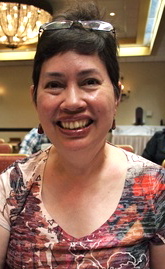
Photo on 2012-09-19 at 20.00JAMIE DEDES ~ My worldly tags are poet and writer.  I’m in my fifth year of blogging at The Poet by Day, the journey in poem, formerly titled Musing by Moonlight.  Through the gift of poetry (mine and that of others), I enter sacred space.

Posted in Marlene McNew, Poems/Poetry

MARATHON

Our treasured Marlene is not to be undone by Parkinson’s Disease. A former professional accountant, she is a master-level skier, participates in marathons, is an award-winning dancer, paints, writes poetry, and  . . . that’s just the short-story.  J.D.

MARATHON 

by

Marlene G. McNew (Strange Gift)

·

Decay’s process cannot be stopped.
In dark shadows of age, watch illness burn
all signs of pink that we treasure.
We become a residue of memory.

·

Ravaged, by the weight of the thought
we seek a path of the heart
lit by fire that burns within,
the will to endure anything,
a power to persist.

·

A marathon holds a promise of pain,
a challenge built upon reason, a test
for mind and body; a sacrifice
a vow of suffering in the name of hope.

·

A marriage of preparation and outcome,
of cooperation of heart with mind,
it is emergence from a cave,
the acceptance of help.
Is is a war against defeat

·

the making of a miracle.

·

© 2012, poem and video, Marlene’s and Carmen’s photographs, Marlene G. McNew, All rights reserved

Photo credit ~ Athletic Shoes, Vincent van der Heijden via Wikipedia and licensed under Creative Commons Attribution Generic 2.0


CARMEN McNEW

MARLENE G. McNEW ~ began exhibiting symptoms of Parkinson’s Disease (P.D.) eight years ago. Her blog (Strange Gift) is a vehicle for sharing her experiences with P.D. and her many, many interests. She maintains a lovely home in Northern California where she lives with her husband and a much-loved rescued golden retriever, Carmen.

Marlene is a master skier, but for the past several years she’s been able to incorporate into her life increasing involvement in the arts. She expresses her beautiful spirit through poems and paintings.  She also has a strong interest in dance, having been a competition level ballroom dancer.  Other interests include cooking.  

She is currently preparing for a marathon and is registered for the Mighty Mermaid sprint triathlon (1/4 mile open water swim, 12 mile bike, 2 mile run/walk) through Team in Training with the Leukemia Lymphoma Society. Marlene originally started her blog when she was getting ready for the Nike Women’s Marathon (half marathon walk) and raising funds for the Leukemia Lymphoma Society. Her YouTube channel is SkiDisiple. J.D.

Posted in Jamie Dedes, Poems/Poetry

THE LIFE AND POEMS OF MARY MacRAE

Mary MacRae (1942 – 2009), English poet

[Mary MacRae] wrote and published poetry the last ten years of her life, after ill-health forced her to take early retirement from teaching. She taught for fifteen years at the James Allen Girls School (JAGS), DulwichLondon. Her commitment to writing led to her deep involvement with the first years of the Poetry School under Mimi Khalvati, studying with Mimi and Myra Schneider, whose advanced poetry workshop she attended for eight years. In these groups her exceptional talent was quickly recognised, leading to publication in many magazines and anthologies. MORE [Second Light Live]

Elder

by

Mary MacRae

This poem is  excerpted from Mary MacRae’s book, Inside the Brightness of Red.

Reprinted here with permission. All rights are reserved by the publisher, Second Light Network.

·

A breathing space:

the house expands around me,

·

unfolds elastic lungs

drowsing me back

·

to other times and rooms

where I’ve sat alone

writing, as I do now,

when syncope –

·

one two three one two –

breaks in;

·

birdcall’s stained

the half-glazed door with colour,

·

enamelled the elder tree

whose ebony drops

·

hang in rich clusters

on shining scarlet stalks

·

while with one swift stab

the fresh-as-paint

·

starlings get to the heart

of the matter

of matter

·

in a gulp of flesh

and clotted juice that leaves me

·

gasping for words transparent

as glass, as air.

♥ ♥ ♥ ♥

My profound gratitude to poet Myra Schneider for the introduction to a new-to-me poet, Mary MacRae, and to poet Dilys Wood of The Second Light Network (England) and editor of ARTEMIS Poetry for granting this interview. J. D.

JAMIE: Clearly, and as has been stated by others, Mary was profoundly inspired by art, nature (particularly flowers and gardens), and love. What can you tell us about her life and interests that would account for that?

DILYS: Mary writes tender and accurate poems about wild nature, creatures and landscape, drawing on her stays in a cottage on an untamed part of the coast in Kent, England and visits to her daughter living in remote West Wales. In her London home, it’s easy to guess from her poems about garden birds and flowers how much time she spent at the window. She almost always sees nature in flux, changing moment by moment, unpredictable, mysterious, a spiritual inspiration. One of her great strengths as a poet is catching movement.

Many of Mary’s poems focus on love between close family members. This may relate to a difficult relationship with her own father, which she sought to understand, and the relationships which compensated (with mother, sister, husband Lachlan, daughter and grandchild). A back problem prevented her from holding her baby daughter and she often refers in her poems to young children. She clearly has a yearning towards them.

JAMIE: She wrote poetry apparently only at the end of her life and for ten years. What were her creative outlets before that? How did she come to poetry?

DILYS: Mary was a dedicated teacher of English Literature and language in a leading girls’ secondary school. She was also deeply interested in music and painting (these are strongly reflected in her poetry). Though she had written as a young woman she followed the pattern of many women creative artists in becoming absorbed into her home life and her paid work, only turning to writing when her illness released her from the daily grind of intensive teaching. The remarkable, rapid development of her poetry shows how strong her latent powers really were.

JAMIE: Was writing poetry a part of her healing process when she was diagnosed with cancer? If so, how did it help her?

DILYS: I’m confident that Mary’s diagnosis with cancer enabled her to change her life-style and from then on concentrate on her poetry, urged by the sense that she might be short of time. There is no evidence that Mary wrote therapeutically to come to terms with her cancer. In fact she only ever addressed her illness in relation to the possible unkindness of fate in cutting her off from beloved people and life itself. The poems written in the last 2-3 years of her life give the impression that her dedication to writing, with the spiritual experiences which accompanied it, enabled her to bear terrible distress. She records this distress, using imaginative and metaphorical approaches to focus it, and these poems make heart-wrenching reading.

JAMIE: Can you tell us about her process? When did she write? Where? For how long?

DILYS: I have the impression that Mary’s life revolved around three things, people she loved, gathering experiences that would feed her poetry (travel, listening to music, visiting galleries) and very hard work in direct furtherance of her writing (extensive reading, attending workshops with other inspirational poets, writing, revising and submitting her poems to criticism from critics she respected). She used notebooks to make a full, accurate record of those experiences – landscapes, human encounters, thoughts – that would feed her work. There is an extract from one such entry in the section about keeping a journal in the resource bookWriting Your Self, Transforming Personal Material by Myra Schneider and John Killick. This book also includes a contribution in the chapter on spirituality which reveals much about Mary’s attitudes to life, nature and also her writing process.

JAMIE: Do you have any advice from her for other poets and aspiring poets?

DILYS: Mary was a dedicated writer, entirely sincere in her commitment to poetry as opposed to ‘career’ as a poet. She was always ready to enjoy and praise the widest range of subject-matter, approaches and styles from other poets, providing she thought they were ‘busting a gut’ to get their poems right, and not indulging in the trendy or superficial, which she despised (whether from well-knowns or unknowns). She put much emphasis on wide-reading of both past and contemporary poets and she herself had absorbed a huge amount of other poets’ work, always quoting fully and accurately. She liked using another’s work as a starting pont for her own (the Glose) and particularly admired the work in strict form (includingSonnetVillanelle and Ghazal), which began to be more acceptable from the mid-1990s (eg from such poets as Marilyn Hacker and Mimi Khalvati).

JAMIE: Are any other collections of her poetry planned? If so, when might we look forward to them?

DILYS: When putting together ‘Inside the Brightness of Red’, Myra Schneider and I went through the whole of Mary’s unpublished work and selected all those poems we felt were both complete and would have satisfied her high standards. What remains unpublished would be mainly fragments and early versions of poems she did more work on. There will not, as far as we know, be a further book, but Mary did achieve her aim of being a significant lyric poet, whose work is very attractive, polished and, above all (as she would have wished) deeply moving and consolatory.

The Second Light Network aims to promote women’s poetry and to help women poets, especially but not only older women, poets develop their work. It runs weekends of workshops and readings in London usually twice a year, a residential extended workshop with readings and discussions at least once every eighteen months and occasionally other events. It is nationwide (England). Dilys is the main editor of ARTEMIS Poetry, a major poetry magazine for women produced by Second Light twice a year.  It includes a lot of reviews and some articles as well as poetry by Second Light members who receive it free as part of their subscription. An e-newsletter is sent out every few weeks. A few anthologies of poetry have been published by the network but now this magazine developes books under special circumstances only – such as Mary’s collections.

Thanks to Second Light Web Administrator, poet Ann Stewart, for the following: The books (Inside the Brightness of Red and As Birds Do) can be bought: via order form and cheque in post: http://www.secondlightlive.co.uk/books.shtml or here online: http://www.poetrypf.co.uk/shop.php (typing  ‘ Mary MacRae collection ’ in the filter box will reduce the list to just those two books).

Posted in Guest Writer, Poems/Poetry

THREE YEARS TODAY

THREE YEARS TODAY

by

Renee Espriu (Renee Just Turtle Flight)

three years today not
tomorrow giving rise to
yesterdays filled with
sorrow and trepidation

angst beating against
us like rain drops to
pelt out songs of dismay
pain like no other

causing us to walk in
our own shadows trying
to keep the pain at
bay until another
day and still the rain

came down to wrap us
secure in the fashion
meant for bringing forth
life and love with
emotional passion

we wept in silence an
effort to be brave
standing fierce against
the onslaught of a
disease rending

you mute most days
covered in blankets
against the inner chill
freezing your blood
a prisoner your will

three years today not
tomorrow giving rise to
yesterdays filled with
sorrow and trepidation

we are unbelieving now
the sun doth shine an
unbridled warmth we
walk among the living
cautious to walk forth

secure in our hesitation
did it really ever
happen that cancer
took our lives now we
took them back again

© May 05, 2012 Renee Espriu

This is dedicated to a woman who, when diagnosed with Stage III Breast Cancer, took her faith and belief that all would be well and fought to overcome and now three years later is cancer free. Her faith and fierce determination carried her through.

Copyright 2012, Renee Espru, All rights reserved

RENEE ESPRU ~ is a creative prose writer and poet. She began delighting us with her work at Renee Just Turtle Flight in March 2011. The work she shares with us there includes short stories. Renee is a daughter, mother, grandmother, and seeker of spiritual peace and soul-filled freedom. She’s studied at the graduate level and has attended seminary. She describes her belief system as eclectic, encompassing many faiths. She believes “Nature is the basis of everything that is and everything that is is also a part of Nature.” 

Posted in Poems/Poetry

WHEN YOU SEE MILLIONS OF THE MOUTHLESS DEAD

CHARLES HAMILTON SORLEY (1895 – 1915)

British Poet

Charles Hamilton Sorley was born in Aberdeen in 1894. The son of the profressor of moral philosphy at Aberdeen University, Sorley was extremely intelligent and won a scholarship to Marlborough College.

In 1913 Sorely decided to spend a year in Germany before taking up the offer of a place at University college, Cambridge. When war was declared in August 1914, sorley immediately went back to England and enlisted in the British Army. Sorely joined the Suffolk Regiment and after several months training, Lieutenant Sorly was sent to the Western Front.

Sorley arrived in France in May 1915 and after three months was promoted to captain. Charles Hamilton Sorley was killed by a sniper at the Battle of Loos on October 13, 1915. He left only 37 complete poems, including the one he wrote just before he was killed, When you see Millions of the Mouthless Dead. Sorley’s posthumous book, Marlborough and Other Poems was popular and achieved critical success when it was published in 1916. [adapted from Spartacus Educational, a site developed by John Simpkin (MPhil.), British educator, historian, and member of the European History E-Learning Project] J.D.

·

WHEN YOU SEE MILLIONS OF THE MOUTHLESS DEAD

by

Charles Hamilton Sorley

When you see millions of the mouthless dead
Across your dreams in pale battalions go,
Say not soft things as other men have said,
That you’ll remember. For you need not so.
Give them not praise. For, deaf, how should they know
It is not curses heaped on each gashed head?
Nor tears. Their blind eyes see not your tears flow.
Nor honour. It is easy to be dead.
Say only this, “They are dead.” Then add thereto,
“yet many a better one has died before.”
Then, scanning all the overcrowded mass, should you
Perceive one face that you loved heretofore,
It is a spook. None wears the face you knew.
Great death has made all this for evermore.

·

Photo credit ~ a cropped and retouched version of a portrait of British soldier poet, Charles Hamitlton Sorely dated c. 1914/1915, since Mr. Sorely is in uniform here and was enlisted in 1914 and killed in 1915. The photo was first published in 1918. The collection of his poems came out in 1919. The photo is from For Remembrance: Soldier Poets Who Have Fallen in the War. The photograph is in the public domain.

*Poems ~ excepts from Marlborough and Other Poems by Charles Hamilton SorelyIt would appear that this book is currently in the public domain. You can read the entire book on or download it from Internet Archives HERE.

Posted in Poems/Poetry

A FINAL POEM

CECIL DAY-LEWIS (1904-1972)

BRITISH POET LAUREATE (1968-1972)

·

This well-received post is re-blogged today:

C. DAY LEWIS AT LEMMONS

by

Jamie Dedes

I discovered the Anglo-Irish poet Cecil Day-Lewis (C Day-Lewis) quite by accident the one day some time ago when I was preparing my Sunday news feature for the main site of an online poetry community with which I am involved. On the basis that we all benefit from knowing our roots and connections – no matter our occupation – I always start off with a snippet about a poet who either was born or died on the day of the posting. Cecil  Day-Lewis died on May 22 in 1972 of pancreatic cancer. He was the British Poet Laureate from 1968 until his death. There’s lots about him and his work that nags for my attention, but one poem really struck home.

At Lemmons (1972), according to the C Day Lewis website (HERE), was written by Day-Lewis on his deathbed at the home of Sir Kingsley William Amis (1922-1995), the English poet, novelist, critic, and educator. Amis is quoted as saying that, “At no time did Cecil mention death. My own strong feeling is that he came to draw his own conclusions from his physical decline and increasingly severe – though happily intermittent – bouts of pain, but, out of kindness and abnegation of self, chose not to discuss the matter.” This last poem, which demonstrates a wonderful grace and acceptance, was published posthumously.

AT LEMMONS

by

C Day Lewis

Above my table three magnolia flowers

Utter their silent requiems.

Through the window I see your elms

In labour with the racking storm

Giving it shape in April’s shifty airs.

·

Up there sky boils from a brew of cloud

To blue gleam, sunblast, then darkens again.

No respite is allowed

The watching eye, the natural agony.

·

Below is the calm a loved house breeds

Where four have come together to dwell

–            Two write, one paints, the fourth invents –

Each pursuing a natural bent

But less through nature’s formative travail

Than each in his own humour finding the self he needs.

·

Round me all is amenity, a bloom of

Magnolia uttering its requiems,

A climate of acceptance.  Very well

I accept my weakness with my friends’

Good natures sweetening each day my sick room.

·

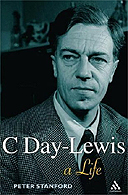
Photo credit ~ Copyrighted cover art (fair use) for Peter Stanford’s biography of Day-Lewis,C Day-Lewis, a Life. Definitely on my reading list.

Posted in Poems/Poetry

SUCH, SUCH IS DEATH

CHARLES HAMILTON SORLEY (1895 – 1915)

British Poet

Charles Hamilton Sorley was born in Aberdeen in 1894. The son of the profressor of moral philosphy at Aberdeen University, Sorley was extremely intelligent and won a scholarship to Marlborough College.

In 1913 Sorely spent a year in Germany before taking up the offer of a place at University college, Cambridge. When war (World War I) was declared in August 1914, Sorley returned to England and enlisted in the British Army. He joined the Suffolk Regiment and after several months training, Lieutenant Sorly was sent to the Western Front.

Sorley arrived in France in May 1915 and after three months was promoted to captain. Charles Hamilton Sorley was killed by a sniper at the Battle of Loos on October 13, 1915. He left only 37 complete poems, including the one he wrote just before he was killed, When You See Millions of the Mouthless Dead. Sorley’s posthumous book, Marlborough and Other Poems* was popular and achieved critical success when it was published in 1916.  [adapted from Spartacus Educational, a site developed by John Simpkin (MPhil.), British educator, historian, and member of the European History E-Learning Project] J.D.

·

SUCH, SUCH IS DEATH (1915)

by

Charles Hamilton Sorley 

·

Such, such is Death: no triumph: no defeat:

Only an empty pail, a slate rubbed clean,

A merciful putting away of what has been.

And this we know: Death is not Life, effete,

Life crushed, the broken pail. We who have seen

So marvellous things know well the end not yet.

Victor and vanquished are a-one in death:

Coward and brave: friend, foe. Ghosts do not say,

“Come, what was your record when you drew breath?”

But a big blot has hid each yesterday

So poor, so manifestly incomplete.

And your bright Promise, withered long and sped,

Is touched, stirs, rises, opens and grows sweet

And blossoms and is you, when you are dead.

·

TO GERMANY (1914)

by

Charles Hamilton Sorely 

You are blind like us. Your hurt no man designed,
And no man claimed the conquest of your land.
But gropers both through fields of thought confined
We stumble and we do not understand.
You only saw your future bigly planned,
And we, the tapering paths of our own mind,
And in each other’s dearest ways we stand,
And hiss and hate. And the blind fight the blind.

When it is peace, then we may view again
With new-won eyes each other’s truer form
And wonder. Grown more loving-kind and warm
We’ll grasp firm hands and laugh at the old pain,
When it is peace. But until peace, the storm
The darkness and the thunder and the rain.

Photo credit ~ a cropped and retouched version of a portrait of British soldier poet, Charles Hamitlton Sorely dated c. 1914/1915, since Mr. Sorely is in uniform here and was enlisted in 1914 and killed in 1915. The photo was first published in 1918. The collection of his poems came out in 1919. The photo is from For Remembrance: Soldier Poets Who Have Fallen in the War. The photograph is in the public domain.

*Poems ~ excepts from Marlborough and Other Poems by Charles Hamilton Sorely. It would appear that this book is currently in the public domain. You can read the entire book on or download it from Internet Archives HERE.

Posted in Poems/Poetry, Spiritual Practice

MEDITATION 101: Courtesy of Alan Ginsberg

DO THE MEDITATION ROCK

by

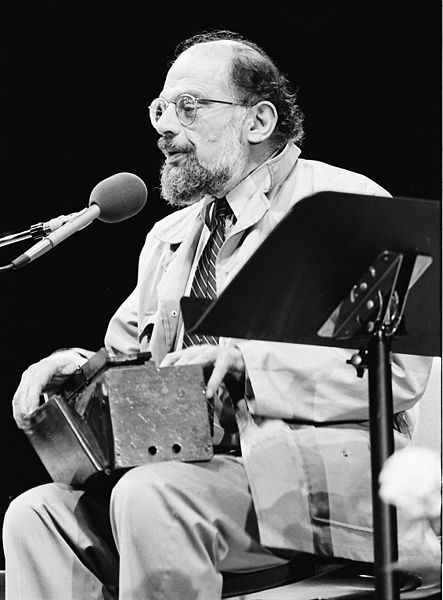
Allen Ginsberg 

is in this collection ~

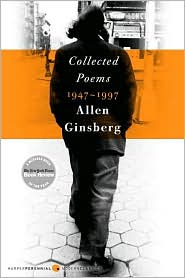
Collected Works 1947 – 1997, Alan Ginsberg

recommended reading, three thumbs up!

Posted in Guest Writer, Perspectives on Cancer, Uncategorized

PERSPECTIVES ON CANCER #15: Rise and Fall

RISE AND FALL

by

Umamaheswari Anandane

·
A reptile delaminates
as I watch my rusted skin
sketched with patterns of time
under the leaves
that subsides in the woods
·
Rise and fall of all seasons
Into the Bardo I swim
·
I fathom that every soul has a day
to dismantle from
its temporary shield
which acknowledged them of its short stay
·
I learned that the time come
to bestow my last kiss
in this embodiment where I learned
the true meaning of Love
Having called upon
is a gift bestowed on
I accepted it with love
·
Now I surrender myself
to those open arms
I got more learning to do
away from this body
to experience the memoir of the unknown
·
© 2011 Umamahswari Anandane, all rights reserved
Photo credit ~ courtesy of cohdra, morgueFile

♥ ♥ ♥ ♥

Umamahswari Anandane lives in India and is a poet, writer, blogger, and a self-described “simple woman.”  She is an accomplished engineer with multi-lingual skills who discovered in herself a passion for writing poems and fiction.  Ennai kandu peedi paarkalaam, her first novel, is in Tamil (a Dravidian language spoken predominantly by the Tamil peoples of the Indian subcontinent and the official language of Sri Lanka and Sinagpore) is due out in a few months. Find more of her poetry at Inside My Poem Book, a blog. Uma also blogs at Perpetual Mind where, among other things, she explors Tamil arts and Vedic math. Hers is a mind that never stops.
Posted in Guest Writer, Poems/Poetry

RIVER URKE, Poet and Writer

RIVER URKE, American Poet and Writer

River Urke lives in Minnesota with her daughter, Willow, and their cat Brownie, dog Odie, and two rats. She lives and loves hugely despite the challenges of MS. 

River is a consultant on Native American culture. Her poems have been published widely. She blogs her poetry at Waabin Ozhibiiwin~ Dawn Writer. You’ll find her articles at Rivers Ruminations and her YouTube Channel at RiverMariaHer work can also be found on MS MuSings, A Monthly Online Magazine by and for those with Multiple Sclerosis. 

River edits The River Paper to which I am a contributing writer effective September 9, 2011. The River Paper is published each Friday.

We’re pleased to introduce River Urke and her work to our readers here … Her photograph and poems are copyrighted and posted on Into the Bardo with permission. J.D.

If you are viewing this on the homepage, you may have to click on the post title to get the poem to layout properly. Thank you!

♥ ♥ ♥ ♥

Envy

by

River Urke

·

I sit outside the day hospital after my infusion

Feeling shitty

Waiting for my taxi to come

·

I am watching all the people walk by

Focusing on their lower half

Not noticing their faces

·

I begin to feel jealous

Their legs keep pace with each other

Their stride is straight and true

·

I look down at my legs

Imagining them amongst the crowd

In the stream headed west

·

No drunken gait

No dropping foot

·

I mingle in their movement

With a sway to my step

My pace is one with theirs

·

A noise wakes me

The taxi approaches to take me home

I pick up my cane

·

I start to head towards the van

I begin to feel eyes upon me

Looking me up and down

·

I freeze at their thoughts of me

Faces revealing their pity

‘A young woman with a cane’

·

My pride pushes forward

Determined not to give in

·

I raise my head high

Stand myself tall

Again I start towards the van

·

Moving forward in my reality.

©River Urke 3/09

The Crippling Effect by River Urke: