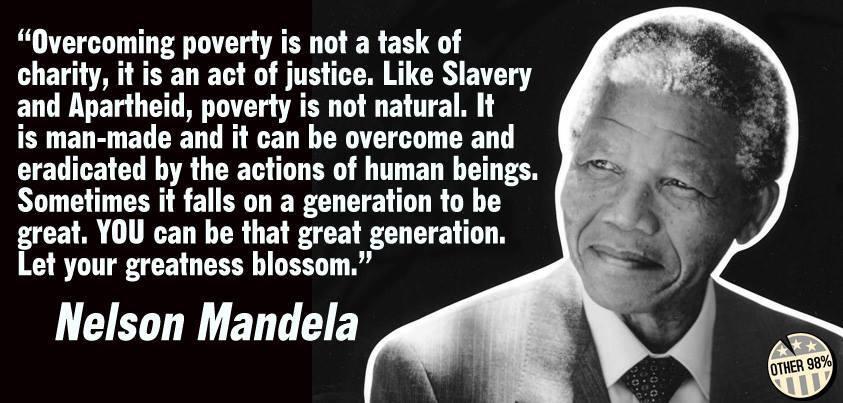
Last year saw the loss of a great man and a widening of the world-wide gap between the few haves and the many have-nots, an injustice and a certain recipe for unrest. As we celebrate the birth of a fresh new year today, we also celebrate the man, Nelson Mandela, and his ideas. Poverty creates its own apartheid.
Over the course of the few next days, The Bardo Group will deliver posts that honor the man and second his ideals as a reminder of the need to be resolute, to continue Nelson Mandela’s fight for balance, justice and equality of opportunity.
Nelson Mandela’s Speech on Poverty (2005) 9 min.
May all mothers and their children have food, housing, healthcare, education, freedom of spiritual practice, peace and safety.
aunt bea and i were sitting on the front porch when a political campaigner stopped to solicit our vote to which aunt bea replied lawd lawd lawd you folks done lost your mind promising prosperity when there ain’t even enough money to pay the rent and children are wearing grandparent hand-me-downs to school while carrying church sponsored lunches just so they’ll have something to eat and you fools are telling me that a vote for your candidate will bring back the good-old-days when the hell was that
. CHARLES W. MARTIN (Reading Between the Minds) — earned his Ph.D. in Speech and Language Pathology with an emphasis in statistics. Throughout Charlie’s career, he maintained a devotion to the arts (literature/poetry, the theater, music and photography). Since his retirement in 2010, he has turned his full attention to poetry and photography. He publishes a poem and a photographic art piece each day at Read Between the Minds, Poetry, Photograph and Random Thoughts of Life. He is noted as a poet of social conscience. Charlie has been blogging since January 31, 2010. He has self-published a book of poetry entitled The Hawk Chronicles and will soon publish another book called A Bea in Your Bonnet: First Sting, featuring the renown Aunt Bea. In The Hawk Chronicles, Charlie provides a personification of his resident hawk with poems and photos taken over a two-year period.
This is a re-blog of my very first blog post ever from 2008! I have edited it a tiny bit.
Moral courage is a rarer commodity than bravery in battle or great intelligence. Yet it is the one essential, vital quality of those who seek to change a world which yields most painfully to change. – Robert F. Kennedy, in a speech in Capetown, South Africa, June 6, 1966. (Source: Wikiquote )
What are our sources of moral courage? I can tell you that I find moral outrage easy, but where does moral courage come from? Relying on my Methodist heritage, The Wesleyan Quadrilateral would have us examine scripture, tradition, reason, and experience in making deliberations. What does this tell me?
What does scripture say?
In Hebrew Scriptures and in Christian Scriptures, we are taught to care for the alien, orphan, widow, and poor among us. In the story of the adulterous woman (John 8:1-11), we see a Jesus that stands between the accusers and the marginalized. This is what Christians are called to do. Take action in the face of injustice and stop pain from happening. Jesus teaches us repeatedly that we are to extend our hands to the hungry, the poor, the marginalized, and those outside of authority. This continues from the Jewish traditions. In Hebrew Scripture, we are told in Micah 6:8 that we are to “do justice, love kindness, and to walk humbly” with God (NRSV). These teachings can be encapsulated in the single commandment “love your neighbor as yourself” (Gal 5:14). Leviticus 19:34 tells us that our neighbor is the alien among us. Christ tells us that our neighbor is people outside of the power structure that he ministers too—the bleeding woman, the blind, the demon-possessed, or the widow. Those are the neighbors Jesus stands with.
What does tradition say?
In the Methodist tradition, John Wesley spoke out against many issues facing his generation. This included human rights, slavery, prison reform, labor rights, and education reform. Methodists also have the Social Principles and the Book of Resolutions to guide thoughts and deliberations in our present day. Wesley emphasized shaping public policies that would ensure equal and fair education for all children.
What does experience say?
It is very difficult to quantify experience across the board, but if I just examine one system, the education system, we know, through social sciences and the statistics they bring us, that poverty is the single most important factor in education. Poverty riddled areas simply do not have access to a great education system. And unfortunately, for many minority ethnicities in the U.S., poverty riddled areas are disproportionately filled with them. Why would that be? A good source for thought is this YouTube video from Tim Wise–
And we know that poverty is a world wide problem as the recent collapse of the factory in Bangladesh illustrates. The women who were lost there are typically impoverished, but they were considered the lucky ones. They were one step above abject poverty and simply impoverished. The literacy rate is 59%. Poverty and lack of education go hand-in-hand.
Bereaved mothers hold up pictures of their daughters who died in the factory collapse, but whose remains have yet to be identified. Photograph: Jason Burke for the Guardian
There is much to be outraged about. Let us find moral courage.
What does reason say?
Is it reasonable to expect there to be poverty in the world? Is it reasonable to expect there to be violence in the world? Is it reasonable that we hurt each other by action and inaction? I would say no. Jesus does say that the poor will always be with us (Matt 26:11), but that is after he has said that the world will be judged by its treatment of the poor, the hurting, and the hopeless (Matt 25:31-46). Why would Jesus say this bit about the poor being with us always? Perhaps he knew that the entirety of believers would not follow his command to visit the imprisoned, feed the hungry, and to clothe the naked. What would it look like if all of our faith communities fought against poverty by directly participating in feeding, clothing, and visiting? That is why it is unreasonable–we hurt each other by our actions and inactions because we are not doing the simple things that Jesus told us. It is unreasonable. Reasonably, we know that if we had a global will, hunger would be eradicated. God would be so pleased, I believe, to see all children fed.
And last, with these sources of moral courage available to us, what do we do with it? Issues in the world today are so complex and systems are so vast that it seems a hopeless exercise. We must remember that we are not called to fix the whole world, but we are called to be faithful. Be faithful and to keep moving forward one step at a time. Maybe even one meal at a time.
(c) 2013 post, Terri Stewart, all rights reserved
…
TERRI STEWART is Into the Bardo’s Sunday chaplain, senior content editor, and site co-administrator. She comes from an eclectic background and considers herself to be grounded in contemplation and justice. She is the Director and Founder of the Youth Chaplaincy Coalition that serves youth affected by the justice system. As a graduate of Seattle University’s School of Theology and Ministry, she earned her Master’s of Divinity and a Post-Master’s Certificate in Spiritual Direction with honors and is a rare United Methodist student in the Jesuit Honor Society, Alpha Sigma Nu. She is a contributing author to the Abingdon Worship Annual.
This was written to honor the courage and strength of a young woman who is being jumped-out of a gang. She is doing it for her child and for God. Perpetua was an early Christian martyr who, while imprisoned, kept her child with her for a time. She was imprisoned for the sake of her belief in the Christ-child. This young woman is being jumped-out for the sake of her child. We know of Perpetua because she was educated enough to keep a diary. There are fragments of this diary in existence today. She stayed with her child in prison until she was done nursing him. At that time, he was taken away from her and given to her family to raise.
Gangs and the fear they create are a scourge and it breaks my heart. If we could lift people out of poverty and the resultant system failures (failure of healthcare, failure of education) these kids, who join gangs by the age of 7 or 8, might have a shot at turning life around. In the long run, it is much cheaper to educate someone than it is to imprison them. In the US, there are approximately 800,000 gang members. El Salvador has at least 50,000 while Mexico is at 100,000 at least. There are about 90,000 in Japan and over 160,000 in China. Italy has at least 25,000. (Source: Wikipedia). This is a world-wide problem with real, heart-breaking consequences.
TERRI STEWART is Into the Bardo’s Sunday chaplain, senior content editor, and site co-administrator. She comes from an eclectic background and considers herself to be grounded in contemplation and justice. She is the Director and Founder of the Youth Chaplaincy Coalition that serves youth affected by the justice system. As a graduate of Seattle University’s School of Theology and Ministry, she earned her Master’s of Divinity and a Post-Master’s Certificate in Spiritual Direction with honors and is a rare United Methodist student in the Jesuit Honor Society, Alpha Sigma Nu. She is a contributing author to the Abingdon Worship Annual.
If Steve McCurry’s name doesn’t ring a bell, think of the iconic photograph “Afghan Girl” that appeared in National Geographic. He is a world-renowned photographer with a compassionate lense. In this series from his blog (be sure to link through to see it all and to follow him, worthwhile), he shares photographs of working children from around the world. Perhaps when we are tempted to complain about our lives and our fate, we just shouldn’t. This will move all of us. The question is, what will it move us to do? What are prayers and metta practice if they don’t have feet? Jamie
Remembering the Buddha and his teachings
with joy, gratitude, and generosity
•
[I’m sorry that I could not share this letter with you in a more timely fashion. The Buddha’s birthday was on May 6 this year. Nonetheless, the message is an important one. We are committed to supporting this effort and hope to engage your support as well. Thank you for reading …. J.D.]
•
Dear Friend,
The most important holiday in the Buddhist calendar, Vesak, is just around the corner. Starting on the full moon day of May, the month of Vesak celebrates the birth, enlightenment, and passing away of the Buddha. It is a day – and a month – not only for joy and gratitude but also for recollection: for remembering the Buddha’s teachings and making a more earnest effort to practice them.
The first step of Buddhist practice is giving, and the most basic gift is the gift of food. The importance of food can be gauged from the Buddha’s own life story. In the Middle Length Discourses, he tells us that before his enlightenment, he undertook long fasts that reduced his body to a tent of bones. When he saw that the true path to awakening requires deep meditation, he also realized: “It isn’t easy to meditate with an emaciated body.
Let me eat sustaining food such as rice and porridge.” It was only after he regained his strength that he could reach his goal.
Not only is it hard to meditate with an emaciated body, but when one is malnourished it’s hard to do anything – except wait intently for the next meal. Yet close to a billion people around the world endure this fate. It’s to give such people a fresh chance at life that BGR came into being, and this purpose has inspired our work through the years.
We don’t just give handouts. Rather, we seek to make people productive and self-sufficient. We do so in diverse ways: by supporting the education of poor children, especially girls; by creating right livelihood opportunities for women; and by supporting ecologically sustainable small-scale agriculture. In just four years, we’ve already sponsored fifty projects around the world, in Asia, Africa, Haiti, and the U.S. Some of our recent projects include:
introducing sustainable agriculture techniques to farmers in Cambodia and Vietnam, thus increasing the productivity and profitability of their rice yield
providing seeds and agricultural tools to 150 impoverished families in Cambodia so they can grow cash crops and establish home vegetable gardens
supplying hot, nutritious meals to hungry children in Port-au-Prince, Haiti, through a community-based food program called Lamanjay
supporting the education of 200 children in India, mostly girls of the Dalit community, formerly known as “untouchables”
training farmers in Kenya and Malawi in ecologically sustainable agriculture
teaching breastfeeding practices in the Diffa region of Niger, which profoundly improve survival rates of infants
funding the construction of a community garden and orchard in South Africa, in a region stricken by HIV and AIDS
providing funds for a greenhouse to grow produce for the poor in the Maryland-Pennsylvania region of the U.S.
Today BGR plays a major role in representing Buddhism on the stage of global giving. In fact, in late April we participated in a historical conference at the White House that brought representatives of the “Dharmic religions” into contact with government agencies in a common commitment to humanitarian service.
We hope to continue our mission long into the future, both in the U.S. and abroad. However, we can’t fulfill our goals without help from friends like you who share our ideals and resonate with our values. Your donations are the key to everything we do: to combating malnutrition, educating poor children, and helping those who cannot help themselves. And because we’re an all-volunteer organization, we use the funds we receive prudently, with care and discretion, to ensure that 85-90% of every dollar goes directly to finance projects.
So, remembering the great compassion the Buddha extended to us, let us extend compassion to others. This Vesak season please bring forth a heart of generosity and support the work of BGR. When you give, you become part of our mission, our partner in giving a helping hand to those who need help. And you experience the joy of knowing that you are truly making a positive difference in this world, a difference that’s transforming lives.
May all blessings be with you and your family, on Vesak and beyond.
Ven. Bhikkhu Bodhi
Founder and Chairperson
Buddhist Global Relief is a 501(c)(3) organization. Gifts are deductible to the full extent allowable under IRS regulations. You can either donate online via PayPal on the BGR web site or send a check to:
Buddhist Global Relief
PO Box 1611
Sparta, New Jersey 07871 USA
If your company has a Matching Gift Program, please enclose the necessary forms as well.
Marilynn Mair – author, world renown mandolinist, and blogger – wrote this beautiful sympathetic villanelle in response to Charles W. Elliot’s piece HERE, “Mindful Steps to the End of Hunger.”
Buddhist Global Relief came into being in June 2008, born of the conviction that Buddhists should play a more active role in helping our unseen brothers and sisters around the world emerge from the crushing weight of poverty and social neglect. Inspired by the Buddha’s great compassion, we chose chronic hunger and malnutrition as our special focus. Our programs are intended to help people escape this brutal trap by promoting more sustainable methods of food production and more equitable systems of food distribution. We also sponsor the education of poor children, especially girls, and right livelihood opportunities for poor women, enabling them to earn more to feed their families.
In only three years, we’ve already launched over twenty-five projects in Asia, Africa, Haiti, and the U.S. The most recent include:
regular nutritious meals for hungry children in Port-au-Prince, Haiti
wells to provide water for poor families in Cambodia
training in employable skills for indigent girls in Sri Lanka
educational assistance for slum children in Nagpur, India
training farmers from Malawi in ecologically sustainable agriculture
a community garden and orchard to produce nutritious organic vegetables and herbs in Mqatsheni, South Africa
a greenhouse to grow produce for the poor in the Maryland-Pennsylvania region of the U.S.
Today BGR is playing a major role in representing Buddhism on the stage of global giving. Last year, we were even invited to participate in conferences on collaboration in poverty alleviation at the White House and the National Cathedral. These led to several partnerships with Oxfam America on projects in Cambodia and Vietnam. Recently Tricyleand Buddhadharma, two major American Buddhist journals, featured articles about BGR (please see Tricycle’sFeeding the world’s hungry and Buddhadharma’sBuddhist Global Relief articles). We want this Buddhist presence to flourish, visibly representing the compassionate spirit of the Dharma in ways made urgent by the terrible persistence of poverty and malnutrition.
We’re doing our utmost to turn back this tide, but we can’t achieve our goals without help from friends who share our ideals and resonate with our values, good-hearted people like you. Your donations are the key to everything we do: to combating hunger and malnutrition, to educating poor children, to helping those who cannot help themselves. And because we’re an all-volunteer organization, we use the funds we receive prudently, with care and discretion, to ensure that over 90% of every dollar goes directly to finance projects.
As we come to the end of 2011 — the time for selfless giving — please bring forth a heart of generosity for the world’s poor and hungry people, who need a helping hand in order to rise up and stand on their feet. Please give generously. When you give, you become a part of our mission, a partner in our endeavor to express compassion in action. Bear in mind that to give is to receive, to experience the joy of offering others the chance to live with dignity and hope.
May all blessings be with you and your family,
Ven. Bhikkhu Bodhi
Founder and Chairperson
Buddhist Global Relief is a 501(c) (3) organization. Gifts are deductible to the full extent allowable under IRS regulations. You can either donate online at the BGR website or send a check to:
Buddhist Global Relief
PO Box 1611
Sparta, New Jersey 07871 USA
If your company has a Matching Gift Program, please enclose the necessary forms as well.
The Prospective on Cancer series will resume tomorrow. Today we break for the October 4 kick-off of The Girl Effect Blogging Campaign.
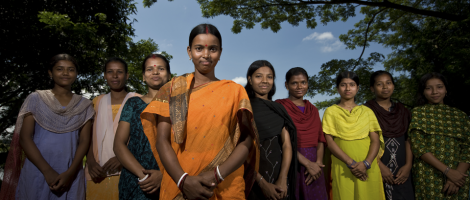
Last year when I participated in this blogging event, I focused on the plight of the girls. This year my focus is on the The Girl Effectproject. It is a stunning multifaceted effort that seeks to end poverty through understanding, documenting, and promoting the value, needs, and priorities of girls in developing countries. It forms a untied global collaboration of development partners for research and program design and delivery. It needs our support, not just as bloggers and writers, but also as workers, volunteers, and donors.
This project might sound to some like an effort with a bias, but it is really an effort to improve the social and economic fabric of families and communities by opening educational and economic opportunities to girls aged ten to twenty-four. Efforts are made toward removing barriers to family and economic stability, barriers like early pregnancy, school dropout, and HIV/AIDS. Girls are ultimately the backbone of their families and communities reinvesting ninety percent of what they earn in their families as opposed to boys’ reinvestment of sixty percent.
The studies that the development community have implemented and are sharing among partner agencies provide information we haven’t ever had before on girls in this age group in the developing nations. Their studies conclude with action items for governments and policy makers. Under the banner of The Girl Effect, the global community is united in assessing the cost to individuals, families, communities, and countries when girls live in poverty, are bared from education and proper health care, and suffer abuse.
The Girl Effect seeks support for efforts that address some things those of us in the developed nations take for granted: like being counted. When a child has no birth certificate and is not counted in any census, she has no identity and there is no way of knowing if programs that are in place are reaching her and helping her.
The Girl Effect partners seek to:
acquire funding for programs and to track program outcomes;
support, encourage, and provide opportunities for complete primary education and for secondary education;
provide health care, wellness programs, and HIV/AIDS prevention programs;
organize health-care delivery systems that are effective in reaching this demographic;
mobilize nations, communities, and families, men and boys, to support the efforts of girls to protect and educate themselves and improve their lives and those of their families.
The programs that are offered by partners include education, legal help, micro-loans, and health care. Donations may be made through Global Giving.





 The BeZine