Posted in Essay, Spiritual Practice, Terri Stewart

It’s All Sacred Space II

"I AM" Sacred Space
“I AM”
Sacred Space

Following up on last week’s “It’s All Sacred Space.”

Two pastors that I know are extraordinary. They both pastor homeless people. One lived as a homeless person for two weeks so he could understand what was going on. The other is homeless. She refuses to live in a home and sleeps on the streets every night of her life. She takes this so seriously that given the opportunity to sleep inside at a convocation, she made special arrangements to sleep in the doorstep-declining housing thousands of miles away from her people. She is the only one who would have known! And nobody would have judged her in error for sleeping inside at a conference she was attending.

I am amazed at the depth of commitment they both have.

In my context, that would be sleeping in a detention center. I am not sure I am prepared to be locked up in order to be one with the people that I am committed to walking with.

But maybe that is because I am not viewing all space as sacred. If I imagine that a jail cell is the Cathedral of Notre Dame with an air of mystery, sacrament, and holiness…does that change the context? Maybe. But could I put on the blue scrubs, white t-shirt, white socks, and orange plastic flip-flops? Using harsh soaps, eating questionable food, everything? Hmmm. I am not sure I could ever do that. I am also not sure that it is a requirement to do so. But, perhaps what is a requirement is the holy imagination it takes to think of what this walk would be.

That is the spiritual practice I’d like to invite you into today, holy imagination. I believe that we are all called to support the least among us. In other words, those who cannot take care of themselves. Those our societies often label “other.” People who are “other” than us—outside the norm—impoverished, imprisoned, hungry, sick, non-gender conforming—whoever is being “othered.”

Who is your other?

Could it be someone from a different faith tradition? A different political point-of-view? Or any of those I listed above? Generally, there is always someone we “other-ize.” Even though I am working with people every day that are affected by incarceration, I found myself in a spot today where I felt the person I was sitting with was totally “other” from me. She is telling me flat-out that when she returns to her community, she will return to drug use and gang involvement. Period. She sees no other way. No other hope. That is hard for me to fathom. She says, “I will probably be dead by 21” without blinking. Wow. And sheesh. I need to find a way to sit with her in a way that is hopeful and not descend into other-izing her even though her current ideas are so foreign to my mind and heart.

If I use holy imagination, maybe I can put myself into her life and feel where her self-imposed traps come from. And seeing where the traps are, maybe I can point out a way she can negotiate the traps and bring herself greater freedom. I don’t know. I will continue to work on it.

Today, using your own holy imagination, can you take five minutes (really, 20 minutes is more like it!) to do some visualization work?

First, relax as much as you can. Keep working at it until you have quieted the monkey mind (or brain chatter—but my inner chatter is more like a monkey!).

When you have fully relaxed, set your intention. Here, I am suggesting your intention should be a conversation with whoever you “other-ize.” (Could it be yourself?)

Next, focus on what you want. Today, our desire is closer understanding. How can you begin to understand the figurative foreigner across from you? What questions can you ask in order to bring you deeper understanding? I am always amazed at my own capacity to carry assumptions. How can we leave assumptions and expectations behind so that there is room for increased understanding?

As realizations and understandings grow, there may be a struggle. Give your struggle up. It is like the monkey-brain. Keep offering both of these things away. I usually visualize putting these on a cloud and whooshing them out of my space. Don’t struggle too hard. If it isn’t happening, it isn’t happening. Then, don’t be too hard on yourself. There will be another day, another try.

Finally, don’t get tangled in negative thoughts—whoosh them away on that cloud! Experience your highest self—the one that sits in loving kindness, compassion, and hope.

When your conversation is complete (and you may get horrible answers, let’s be honest), hold onto the highest self for a moment and see yourself. See the person who took a risk today of entering scary, sacred space. A person who was willing to love. Look at yourself and see the sacred space within.

Shalom and Amen,

Terri

© 2013, post , Terri Stewart, All rights reserved

terriREV. TERRI STEWART is Into the Bardo’s  Sunday chaplain, senior content editor, and site co-administrator. She comes from an eclectic background and considers herself to be grounded in contemplation and justice. She is the Director and Founder of the Youth Chaplaincy Coalition that serves youth affected by the justice system. As a graduate of Seattle University’s School of Theology and Ministry, she earned her Master’s of Divinity and a Post-Master’s Certificate in Spiritual Direction. She is a contributing author to the Abingdon Worship Annual. (The 2014 issue just released!)

Her online presence is “Cloaked Monk.” This speaks to her grounding in contemplative arts and the need to live it out in the world. The cloak is the disguise of normalcy as she advocates for justice and peace. You can find her at www.cloakedmonk.com, www.twitter.com/cloakedmonk, and www.facebook.com/cloakedmonk.  To reach her for conversation, send a note to cloakedmonk@outlook.com

Posted in Essay, Spiritual Practice, Terri Stewart

It’s All Sacred Space

Star Trek, Captain Kirk and “Bones” (Dr. McCoy) using Universal Translators

Sometimes I think that we all need universal translators when we are trying to understand each other across cultures, belief systems, and personal social locations.

Often, though, it takes someone yelling at us to knock us out of our system of thinking and gives us the ability to see things in a new and visionary way that connects rather than divides. All too often we cannot get to this point because we walk away when we things are uncomfortable, challenging, or abrasive.

And no doubt, abrasive is yucky. Witness: the US government interactions right now.

What to do?

Enter deeply into the story of the other person. This is a spiritual practice. I call it Extreme Accompaniment (should I trademark that?). I was contemplating this further today as I was researching another article. My reading revealed to me that we get to radical acceptance of the other when:

  1. Everyone goes to uncomfortable places
  2. Step outside of social norms, forget what you think you know about the other
  3. Everyone involved becomes open to conversion
  4. Keep dialoguing past the rhetoric and abrasiveness
  5. Then, transformation and acceptance may occur (Congress, are you listening??)

Of course, there are limitations. You should not be in situations that may cause harm.  But I am more and more convinced that this deep listening is a spiritual practice. And it is a practice that our world does not do well right now. It is up to the artists and the contemplatives to lead a new revolution! A revolution of extreme accompaniment or of walking with other people. A practice of deeply listening and working with the other’s deepest desires. A practice of loving each other. Love is the universal translator.

If we listen and love, maybe we will all be able to see past the space debris and see the cosmos in each other’s souls.

Shalom and Amen,

Terri

© 2013, post , Terri Stewart, All rights reserved

terriREV. TERRI STEWART is Into the Bardo’s  Sunday chaplain, senior content editor, and site co-administrator. She comes from an eclectic background and considers herself to be grounded in contemplation and justice. She is the Director and Founder of the Youth Chaplaincy Coalition that serves youth affected by the justice system. As a graduate of Seattle University’s School of Theology and Ministry, she earned her Master’s of Divinity and a Post-Master’s Certificate in Spiritual Direction. She is a contributing author to the Abingdon Worship Annual. (The 2014 issue just released!)

Her online presence is “Cloaked Monk.” This speaks to her grounding in contemplative arts and the need to live it out in the world. The cloak is the disguise of normalcy as she advocates for justice and peace. You can find her at www.cloakedmonk.com, www.twitter.com/cloakedmonk, and www.facebook.com/cloakedmonk.  To reach her for conversation, send a note to cloakedmonk@outlook.com

Posted in Essay, Spiritual Practice, Terri Stewart

Sacred Space – Invitation to Practice

Today, I’m giving you a two-fer. A post based in my spiritual practice of photography that led creating something new (an animation) and a tanka! And then an invitation.

Invitation to Contemplation

Where is your light today? What is inspiring you? Transforming you? What is allowing you to be love to the world?

“Your purpose in life is to find your purpose and give your whole heart and soul to it”
― Gautama Buddha

rolling downhill

exuberant joy bubbling

authenticity

laid in unity with joy

foundation – loving kindness

downhill_animation

Invitation to Participation

During Advent, the time for Christians where they are preparing for Christmas and the celebration of the birth of Jesus, we will be running a creative invitation based on scripture that are in the common daily reading plan for many Christian traditions.

I would like to invite people to pick a day and sponsor it.

What that means is, if you are a photographer, maybe you would like to choose a day such as December 10 where the focus in on the poor and needy being refreshed with water. That leaves a lot of room open for various images. On December 10, then we would post your photo here with the scripture and have an invitation to those around the world to offer their response via posting a link to their own blog! You would be leading the community on that particular day!

Is it necessary to be of the Christian faith?

No. It is sacred scripture for Christians, so please respect it. But you can approach it from your tradition (or from no tradition). The emphasis is on creative response and crystallizing meaning as it pertains to your path. Advent is also the beginning of the Christian calendar year, so a theme of beginning again is also in play.

Is it possible to peak at the scripture?

Yes! The scripture choices are posted here.

What is a creative response?

Photography, artwork, mandala, essay, poems (and the many types there are), music, drama. Something that re-imagines what the words are saying and crystallizes meaning. The meaning may be a traditional point-of-view or it may be something that turns us upside down!

RSVP and Technicalities

Please contact me at cloakedmonk@outlook.com to negotiate the day or days you would like to sponsor. Deadline for submissions: November 10, 2013. I will ask you for your choice of scripture(s), a brief bio (2-3 sentences), any links you want to make to blogs or other things, and, of course, your submission(s).

sunset

Shalom and Amen,

Terri

© 2013, post and photos, Terri Stewart, All rights reserved

terriREV. TERRI STEWART is Into the Bardo’s  Sunday chaplain, senior content editor, and site co-administrator. She comes from an eclectic background and considers herself to be grounded in contemplation and justice. She is the Director and Founder of the Youth Chaplaincy Coalition that serves youth affected by the justice system. As a graduate of Seattle University’s School of Theology and Ministry, she earned her Master’s of Divinity and a Post-Master’s Certificate in Spiritual Direction. She is a contributing author to the Abingdon Worship Annual. (The 2014 issue just released!)

Her online presence is “Cloaked Monk.” This speaks to her grounding in contemplative arts and the need to live it out in the world. The cloak is the disguise of normalcy as she advocates for justice and peace. You can find her at www.cloakedmonk.com, www.twitter.com/cloakedmonk, and www.facebook.com/cloakedmonk.  To reach her for conversation, send a note to cloakedmonk@outlook.com

Posted in Essay, Music, mystic, Peace & Justice, Photo Essay, Photography/Photographer, Poems/Poetry, Poets Against War Week, Spiritual Practice, Terri Stewart

Peace Give I to Thee

Wow, the first in the series of Poets Against War or Poets for Peace. Hopefully I can do it justice! In riffing on peace and war, several things came together in my mind – or rather, many things came hopping through it! I hope the resulting series of images, words, and music will act as a meditation for you on this first day of Poets Against War. This will be synchro-posted at my blog, http://www.cloakedmonk.com. Feel free to reblog or synchropost elsewhere just link back to here.

First, a meme (my new favorite weird thing to do – make memes)…

wonka

Second, I have been noodling this around and the predominant thought I had was to sing a duet with my son, Colin Stewart. Colin is 17 and much more talented than I! But we held it together in order to sing an old church song, Peace Give I to Thee. Colin is playing the ukelele and singing. I confess that our sound system is not wonderful, so we both tempered ourselves to not blow out the microphones. It is accompanied by photos I took in the Bellevue Botanical Garden which bring me incredible peace.

Finally, the nature of the quest: Poets Against War or Poets for Peace. So black and white, it begs a reflection.

dichotomy

war destroys peace

hate destroys love

butterfly destroys chrysalis

child destroys dandelion

lion destroys lamb

lamb redeems lion

dandelion redeems child

chrysalis redeems butterfly

love redeems hate

peace redeems war

unity

 butterfly

And another old favorite, “Breathe Deep” by the Lost Dogs which speaks to the unity of all-even when we are uncomfortable with that unity.

Peace Out!

Terri

© 2013, post and photos, Terri Stewart, All rights reserved

terriREV. TERRI STEWART is Into the Bardo’s  Sunday chaplain, senior content editor, and site co-administrator. She comes from an eclectic background and considers herself to be grounded in contemplation and justice. She is the Director and Founder of the Youth Chaplaincy Coalition that serves youth affected by the justice system. As a graduate of Seattle University’s School of Theology and Ministry, she earned her Master’s of Divinity and a Post-Master’s Certificate in Spiritual Direction. She is a contributing author to the Abingdon Worship Annual. (The 2014 issue just released!)

Her online presence is “Cloaked Monk.” This speaks to her grounding in contemplative arts and the need to live it out in the world. The cloak is the disguise of normalcy as she advocates for justice and peace. You can find her at www.cloakedmonk.com, www.twitter.com/cloakedmonk, and www.facebook.com/cloakedmonk.

Posted in Essay, Photography/Photographer, Spiritual Practice, Terri Stewart

Prayer as Action for Peace

Saturday, September 7, 2013, was a call for worldwide prayer and fasting to focus on peace in Syria. I have seen many things happening–prayer vigils, personal meditation practices, marches, and communications with elected officials. We decided to offer a Labyrinth Walk for Peace at Bothell UMC in Bothell, WA in the morning. I gathered inter-faith prayers, we walked, prayed, and focused on bringing peace to the world. What follows is prayers and photos from that journey that became deeply personal for each attendant. There was a certain transition that occurred for me as I took in my surroundings and noticed Farmer Brown’s Garden. I began to see, literally, a connection between peacefulness and being fed. You will see.

Entering Sacred Space

prayers-for-peace-3

Sufi Prayer for Peace

Send Thy peace, O Lord, which is perfect and everlasting, that our souls may radiate peace.
Send Thy peace, O Lord, that we may think, act,
and speak harmoniously.
Send Thy peace, O Lord, that we may be contented
and thankful for Thy bountiful gifts.
Send Thy peace, O Lord, that amidst our worldly strife we may enjoy thy bliss.
Send Thy peace, O Lord, that we may endure all,
tolerate all in the thought of thy grace and mercy.
Send Thy peace, O Lord, that our lives may become a
divine vision, and in Thy light all darkness may vanish.
Send Thy peace, O Lord, our Father and Mother,
that we Thy children on earth may all unite in one family.
– Sufi Prayer

The Journey Begins

prayers-for-peace-6

An Islamic Prayer for Peace

In the Name of Allah, the beneficent, the merciful: Praise be to the Lord of the Universe
who has created us and made us into tribes and nations that we may know each other,
not that we may despise each other.

If the enemy incline towards peace, do thou also incline towards peace, and trust in God,
for the Lord is one that hears and knows all things.
And the servants of God Most Gracious are those who walk on the Earth in humility,
and when we address them, we say, “Peace.”
– U.N. Day of Prayer for World Peace 2

Walking Together in Ubuntu

prayers-for-peace-5

A Hindu Prayer for Peace

Supreme Lord, let there be peace in the sky and in the atmosphere.
Let there be peace in the plant world and in the forests.
Let the cosmic powers be peaceful.
Let the Brahman, the true essence and source of life, be peaceful.
Let there be undiluted and fulfilling peace everywhere.
– The Atharva Veda

All Are Invited to Be Fed

prayers-for-peace-1

Cheyenne Prayer for Peace

Let us know peace.
For as long as the moon shall rise,
For as long as the rivers shall flow,
For as long as the sun shall shine,
For as long as the grass shall grow,
Let us know peace.
– Cheyenne Prayer

Feeding the World in Spirit and Deed
Farmer Brown’s Garden at Bothell UMC

prayers-for-peace-7

A Jewish Prayer for Peace

Grant us peace. Your most precious gift,
O Eternal Source of Peace, and give us the will to proclaim its message to all the peoples of the earth.
Bless our country, that it may always be a stronghold of peace, and its advocate among the nations.
May contentment reign within its borders, health and happiness within its homes.
Strengthen the bonds of friendship among the inhabitants of all lands.
And may the love of Your name hallow every home and every heart.
Blessed is the Eternal God, the source of Peace.
– From The Gates of Prayer: The New Union Prayer Book, by the Central Conferences of American Rabbis

Growing Spiritually and Growing Food

prayers-for-peace-9

Buddhist Prayer for Loving Kindness

May all beings be peaceful.
May all beings be happy.
May all beings be safe.
May all beings awaken to
the light of their true nature.
May all beings be free.
– Metta Prayer

Loving Kindness through Loving Care

prayers-for-peace-8

A Christian Prayer for Peace

Blessed are the peacemakers, for they shall be called the children of God.
But I say to you that hear, love your enemies; do good to those who hate you;
bless those who curse you; pray for those who abuse you.
To those who strike you on the cheek, offer the other also;
and from those who take away your cloak, do not withhold your coat as well.
Give to everyone who begs from you, and of those who take away your goods,
do not ask them again. And as you wish that others would do to you, do so to them.
– U.N. Day of Prayer for World Peace 2

Becoming the Light Unto the World

prayers-for-peace-10

A Non Traditional Prayer for World Peace

Spirit of Life and Love, be present with all who are suffering terribly from violence.
Lift up the hearts of those who fear. And inspire courage among the peacemakers.
Be present with political leaders, ensuring a retreat from violence
and a procession towards the peace table.
Guide the hands of all those who are caring for the injured, the hungry and the grieving.
And, open our own hearts to compassion.
Remind us of our complicity and responsibility.
And lead us towards generous engagement—always towards a vision of peace.
–Adapted from the Unitarian Universalist Tradition

Shalom and Amen,

Terri

© 2013, post and photos, Terri Stewart, All rights reserved

terriREV. TERRI STEWART is Into the Bardo’s  Sunday chaplain, senior content editor, and site co-administrator. She comes from an eclectic background and considers herself to be grounded in contemplation and justice. She is the Director and Founder of the Youth Chaplaincy Coalition that serves youth affected by the justice system. As a graduate of Seattle University’s School of Theology and Ministry, she earned her Master’s of Divinity and a Post-Master’s Certificate in Spiritual Direction. She is a contributing author to the Abingdon Worship Annual. (The 2014 issue just released!)

Her online presence is “Cloaked Monk.” This speaks to her grounding in contemplative arts and the need to live it out in the world. The cloak is the disguise of normalcy as she advocates for justice and peace. You can find her at www.cloakedmonk.com, www.twitter.com/cloakedmonk, and www.facebook.com/cloakedmonk.  To reach her for conversation, send a note to cloakedmonk@outlook.com

Posted in Essay, Photography/Photographer, Spiritual Practice, Terri Stewart

A Prayer to Consider


I originally published this on my blog at cloakedmonk.com. I am reposting it here for a couple reasons – prayer is a great spiritual practice, whatever your understanding of prayer is. And I am at a conference called “Church Quake” in the DC area. It is a conference to aid United Methodist folks in helping to bring full inclusion to the church. Our theme has been “intersectionality.” What intersection of our understanding can come to the aid of an oppressed groups? We are related and interdependent as the prayer below says-we can see that when we consider our own woundedness and how we bring it to the altar of healing. Then what do we do? Consider the woundedness of others and help them find their way to healing. And so the pattern continues. Wounded becoming healing.

Henry Nouwen articulated the concept of the wounded healer quite well. Let me just share a quote from this Roman Catholic, PhD Psychologist, Theology teaching at Yale Divinity, depression suffering, book-writing, L’arche community loving, priest.

“When we honestly ask ourselves which person in our lives mean the most to us, we often find that it is those who, instead of giving advice, solutions, or cures, have chosen rather to share our pain and touch our wounds with a warm and tender hand. The friend who can be silent with us in a moment of despair or confusion, who can stay with us in an hour of grief and bereavement, who can tolerate not knowing, not curing, not healing and face with us the reality of our powerlessness, that is a friend who cares.”
― Henri J.M. Nouwen, The Road to Daybreak: A Spiritual Journey

Here, in this prayer, I find the intersectionality of flowers, interdependence, loving one another, an altar for all, and the healing of woundedness for the inclusion of all who are diverse and unique – precious and beautiful flowers.

A prayer in the Unitarian Universalist tradition by William G. Sinkford

In the presence of these flowers,
These representatives of Creation’s profound beauty:
Diverse and Unique, but Related and Interdependent,
These flowers which come to us as gifts from we know not where
And which we, in turn, choose to bring to our shared and common altar
As gifts to one another

In their presence we turn our thoughts to the mystery beyond mysteries
to the most sacred—which we never understand fully
but which we are granted revelatory glimpses of
in each of these flowers,
in each of your faces,
and through relationships with neighbors near and far

May they remind us of grace we have known in days past:
Forgiveness we have been granted, and provided.
Love, unearned and shared.
Recovery, begun and established.
Generosity, unforeseen and most sacred.

And may they inspire us now, and in days to come:
To seek,
To notice,
To embrace and,
To re-create beauty.
To give unto the world as exuberantly as these flowers.

yellow.center.flower

Go, be exuberant.

Shalom & Amen,

Terri

© 2013, post and photos, Terri Stewart, All rights reserved

© 2013, prayer, William Sinkford

terriREV. TERRI STEWART is Into the Bardo’s  Sunday chaplain, senior content editor, and site co-administrator. She comes from an eclectic background and considers herself to be grounded in contemplation and justice. She is the Director and Founder of the Youth Chaplaincy Coalition that serves youth affected by the justice system. As a graduate of Seattle University’s School of Theology and Ministry, she earned her Master’s of Divinity and a Post-Master’s Certificate in Spiritual Direction. She is a contributing author to the Abingdon Worship Annual. (The 2014 issue just released!)

Her online presence is “Cloaked Monk.” This speaks to her grounding in contemplative arts and the need to live it out in the world. The cloak is the disguise of normalcy as she advocates for justice and peace. You can find her at www.cloakedmonk.com, www.twitter.com/cloakedmonk, and www.facebook.com/cloakedmonk.  To reach her for conversation, send a note to cloakedmonk@outlook.com

Posted in Essay, Spiritual Practice, Terri Stewart

Sacred Space III

Continuing along the theme of sacred space, I would like to offer a method of creating sacred group space-especially in places of conflict or tension. Previous posts on sacred space are on the personal labyrinth and personal prayer patterns styled upon praying with beads.

Creating Sacred Group Space

Have you ever been in a situation where you needed to facilitate group sharing (or participate in) around a sticky topic or situation? It is really difficult to get people to move beyond finger pointing, conflict, and blaming. Eric Law developed a method that facilitates sharing in a sticky environment that offers mutual respect and honor to the participants. It is commonly called Eric Law’s Method of Mutual Invitation. I love using it!

Rev. Eric H. F. Law
(c) California-Pacific Conference of the UMC

One of the problems with most decision making settings is that a decision must be made! That necessitates a winner and a loser. It is rarely a win/win situation. Most often if one person wins, there is another person who loses or gives in. Eric Law’s Method of Mutual Invitation is not a decision making process, it is a listening process that can lead to deeper points and through long and hard work, lead to a consensus building model where every voice is heard and honored. It is at once simple and profound.

The Method

Mutual Invitation is a small group process designed to allow for inclusion and disciplined sharing in diverse settings, especially where there might be a variety of ages, ethnic backgrounds, different beliefs, or personality types present. The process allows for each person in the group to have an opportunity to share, as well as to participate in group dynamics. The process of Mutual Invitation can be adapted for different settings and purposes, e.g. family meal time, small group sharing, and office meetings.

Someone begins the sharing, related to the chosen topic.

  • The facilitator will set a time limit for each person.
  • No questions, responses, or interruptions are allowed during the process.

After the sharing there is a brief pause to allow the others to reflect upon what has been shared.

  • Responding begins after the pause. The pause should be stretched to a couple of minutes or longer if possible.
  • Responding is done by asking open ended questions designed to allow the person sharing to examine further her experience.

In a group sharing session, the person who is sharing invites the next person after others have responded to him/her.

  • Avoid inviting the person sitting next to you. This avoids the tendency to “go around in a circle.”
  • The goal of mutual invitation is to randomly invite the next person. This random invitation prevents distractions such as anticipating or worrying about what to share. Random invitation also helps keeps the focus on the person sharing.

The invited person may choose to share, to pass for now, or to pass.

  • Pass for now means she/he can share later when re-invited.
  • Pass indicates that she/he does not choose to share during this session.
  • Regardless of what the person chooses, she/he always invites the next person.

The process is repeated until everyone in the group has been invited. And every person has either responded or finished with a final pass.

Pattern sample:

  • Facilitator states the question being pondered and offers their own response.
  • Then silence is held for a couple minutes.
  • The group then asks questions-they must be either clarifying questions or open-ended questions. One person at a time.
  • The facilitator responds to questions as they come.
  • At the end of the questions, silence is held for a couple of minutes.
  • The facilitator invites the next person to share.
  • The next person responds with either their own sharing, a pass, or a pass for now.
  • Then silence is held for a couple of minutes.
  • The group then asks questions-they must be either clarifying questions or open-ended questions. One person at a time.
  • That person responds to questions as they come.
  • At the end of the questions, silence is held for a couple of minutes.
  • That person invites the next person to share.
  • And so on, until all have shared or responded with a final pass.

This sharing methodology, as simple as it is, has opened up sacred space. I love using it! Especially when confronted with sticky situations and group conflict. It keeps things calm, peaceful, and invites a sacred and healing quality to the space. You could even use it in a study environment! Imagine opening up a text and sharing responses in a group in this sacred, invitational manner! Beautiful.

The most profound time I have ever used this method involved a group in conflict. It was a group coming together after a major loss all with different ideas of how to move forward and very few ideas of how to sit in the loss. We used this method and brought out people’s fears, hopes, sorrows, and even some joys. It became a place of healing rather than a cantankerous committee meeting. It forced us to be still and to hold each other loosely and gently. Creating sacred space.

A bit about Rev. Eric Law:  He is an Episcopalian priest, is the founder and executive director of the Kaleidoscope Institute, the mission of which is to create inclusive and sustainable churches and communities. He has been writing and practicing for more than 20 years. He can be found online at The Sustainist.

Shalom and Amen,

Terri

© 2013, essay, Terri Stewart, All rights reserved

terriREV. TERRI STEWART is Into the Bardo’s  Sunday chaplain, senior content editor, and site co-administrator. She comes from an eclectic background and considers herself to be grounded in contemplation and justice. She is the Director and Founder of the Youth Chaplaincy Coalition that serves youth affected by the justice system. As a graduate of Seattle University’s School of Theology and Ministry, she earned her Master’s of Divinity and a Post-Master’s Certificate in Spiritual Direction. She is a contributing author to the Abingdon Worship Annual. (The 2014 issue just released!)

Her online presence is “Cloaked Monk.” This speaks to her grounding in contemplative arts and the need to live it out in the world. The cloak is the disguise of normalcy as she advocates for justice and peace. You can find her at www.cloakedmonk.com, www.twitter.com/cloakedmonk, and www.facebook.com/cloakedmonk.  To reach her for conversation, send a note to cloakedmonk@outlook.com
Posted in Essay, Spiritual Practice, Terri Stewart

Sacred Space Part II

Recently, I published a post on creating your own labyrinth as a way of making sacred space in a place where you may not be able to find a way to retreat to your preferred sacred space. This is a continuation upon that theme-creating sacred space in the midst of everyday living.

One thing my Spiritual Director and I agree upon is that I MIGHT have spiritual ADHD. Meaning, I need a variety of spiritual practices to keep me grounded. This totally makes sense since on the unofficial adult ADHD test I recently took, on a scale of 1-6 (6 being the most ADHD), I scored a six. Oh, yes. This penchant to need change and to be easily distracted often must be hemmed in by being very grounded in my own spiritual path while allowing myself the freedom to choose exercises, patterns, or methods from beyond my immediate experience.

This led me to take a workshop on praying with beads! Now, when I signed up for the workshop I knew that it was sponsored by an ecumenical organization so I assumed that it would be somewhat wide-open in its approach. I was wrong. It was a class on praying the Rosary. I am not Roman Catholic, and this was an ecumenical retreat, so I was a bit taken aback by the specific nature of the workshop. However, I decided to simply enter into the spirit of the situation and puzzle out my response later.

I am very glad that I did!

One of My Bracelets
One of My Bracelets

When I was able to reflect on the experience, I thought, “There must be a protestant version of this practice that would fulfill the tactile & prayerful longing that I have!” And I was right! Thank you search engine! I found a Unitarian Universalist Prayer Bead Practice. I cogitated on what I read there and then created my own practice. Now, I make prayer bead bracelets and use them to remind me to stay in touch with the sacred in my everyday living. It is one of the tools in my ADHD spiritual toolkit.

I adapted the main principle of the UUA prayer bead practice and utilized them for myself. I also make these for other folks selecting colors and images that I think will suit their spiritual journey. However, if you don’t have a bunch of beads lying around along with a crimper and all the stuff you need to make a bracelet, you can still do the prayer practice that I am about to outline by using your five fingers, starting at your thumb!

So here it is:

  1. My Hand-Each Finger a Bead
    My Hand-Each Finger a Bead

    See the “tail” on the bracelet? That is where you start or you can start with your thumb (lightly grasp the very end bead or the tip of your thumb) if you don’t have a bracelet or cannot make one. Sit still. Ground yourself. Rest gently with your eyes relaxed and gazing lightly or close your eyes, whatever is most comfortable to you. Here, focus on your image of the divine. Greet the divine and enter into the presence of holiness and join into a sacred moment. Hold this beloved image closely to your heart. Greetings of love, peace, serenity wash over you, through you, and into you. When you are ready, move up the tail of the bracelet or up your thumb to your hand. Feel each bead or feel each bend in your thumb.

  2. As you go up the beads, breath in and breath out at each small bead. Soon you will land on the large bead (not the clasp) or your fore finger. Here take time to envision those things you want to celebrate! This is a time for adoration, celebration, joy, happiness! Give all of this to your image of the divine and receive the gift that comes back to you whatever that may be. When you are ready, move to the next large bead (or your next finger tip) traveling slowly, thoughtfully, and with divine joy.
  3. At the next large bead, is the time to turn inward and look back at your day (or days before) and to offer a confession of where you have fallen short. For me, this is a time to admit where I have not been loving, peaceful, or justice seeking. Or a time to confess my lack of patience! This can be a time of sorrow, but it should not be a time of shame. We all fall short. Knowing we have, learning from it, and moving to the next bead is what this moment is for. When you are ready, move to the next large bead traveling slowly, thoughtfully, and with the knowledge that you can make mistakes and still return to a place of holiness and sacred healing.
  4. At the next large bead, it is time to name the things, people, and beings in the world that you are thankful for. Let love for the other wash over you and let gratitude sink deeply into you. It may be as simple as a favorite stuffed bear that has traveled with you since childhood. Gratitude in itself is a spiritual practice. Let it flow here. When you are ready, move slowly to the next large bead, touching each smaller bead and breathing in – breathing out at each touch. Do this with the understanding that as you find gratefulness in those around you, others are grateful for you and for who you are.
  5. At the final large bead, it is time to bring your concerns into sacred space. It could be concern for someone’s safety, for healing, for friends or family. Anything that is laying on your heart. Bring them into sacred, healing space. Here, depending on your space and time, you could do many things. You can talk with what is laying on your heart; hold it in love; offer it out to the world or the divine; or even do something creative with it.
  6. Finally, as close this part of the prayer, you will travel back to your initial image. Return to your thumb or return down the tail of the bracelet or beads. Breathing in and out at each small bead or bump along the way. As you return to your image, hold it, sit with it and when you are ready, leave it in whatever manner you are comfortable with. That could be namaste, amen, or a simple good-bye. Whichever way speaks to your path. Return to your every day living, bringing the sacred space you have made with you. Let it travel with you as you go about your day. Remembering that each time you touch your thumb or grasp a bead, that sacredness walks with and in you.

Shalom and Amen,

Terri

© 2013, post and photos, Terri Stewart, All rights reserved

terriREV. TERRI STEWART is Into the Bardo’s  Sunday chaplain, senior content editor, and site co-administrator. She comes from an eclectic background and considers herself to be grounded in contemplation and justice. She is the Director and Founder of the Youth Chaplaincy Coalition that serves youth affected by the justice system. As a graduate of Seattle University’s School of Theology and Ministry, she earned her Master’s of Divinity and a Post-Master’s Certificate in Spiritual Direction. She is a contributing author to the Abingdon Worship Annual. (The 2014 issue just released!)

Her online presence is “Cloaked Monk.” This speaks to her grounding in contemplative arts and the need to live it out in the world. The cloak is the disguise of normalcy as she advocates for justice and peace. You can find her at www.cloakedmonk.com, www.twitter.com/cloakedmonk, and www.facebook.com/cloakedmonk.  To reach her for conversation, send a note to cloakedmonk@outlook.com


Posted in Essay, Meditation, meditative, Spiritual Practice, Terri Stewart, Uncategorized

Sacred Space

Sacred Space
Sacred Space

Have you had that day? Ever? When your last nerve has been strung and compassion, justice and mercy have fled your body? I have that day sometimes. Usually, on those kind of days I like to retreat to sacred space. Space that can be my family, my friends, my books, my camera…some place where I can be filled up with the qualities that have leeched out.

But sometimes that is not possible!

I could be at the detention center where I work. Conflict and craziness do sometimes abound among the incarcerated and sometimes among the staff and volunteers. One night I was working and a fight broke out right in front of me. Other nights, down the hall. As staff rush towards the chaos, I sit frozen (as I am instructed to do) and then proceed in the opposite direction. I often retreat to the library where the clanging is at least muted.

Or I could be at my home and expectations meet reality and voices rise in anger or disappointment threads the air. Then my retreat is not a retreat. Mostly, we are loving. But there are times when love seems miles away.

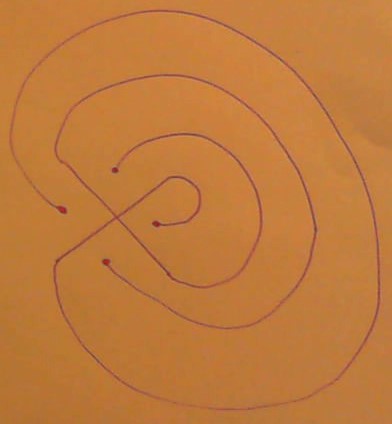
During those times, I need to create sacred space where it seems that there is no room for it. Hopefully, I am not alone in feeling this way! I would like to offer you one simple practice that can be done anywhere at any time. You can create your own sacred space with a piece of paper and a pen. No! This is not a writing assignment. It is a wholeness assignment.

Temenos (Greek) is sacred space. Or land that is set aside for royalty or the priesthood. In Ancient Greece, it would be the place reserved for worshiping the gods. Jung further expands on the concept of temenos as a place where you can encounter your unconsciousness, bringing the shadow into the light. A place of healing, acceptance, worship, encounter, and sacredness.

I am connecting these ideas to the ancient labyrinth where, at the very center, is the temenos.

I have a portable labyrinth that is used in my work with incarcerated youth. Teens can be so funny when they first encounter the labyrinth! They look at it as a maze, at first. But then as they slowly progress through the turns of the labyrinth, focusing on their chosen word or phrase, something happens. Softness overtakes them. They slow down. The rhythm of the room deepens. Their shields begin to drop. Sometimes, they arrive at the center and just sit for a long time. It is also a place of safety, even in the midst of incarceration, a place of danger.

However, we are not all blessed to have a labyrinth stored in our garage! Luckily, we do not need the full meal deal to create a labyrinth. Just pen and paper (or crayon and paper!).

As you set about creating your own labyrinth, set your intentions. When I am in the detention center and do this, I am often focused on peacefulness. Then, when you are done, walk the labyrinth with your finger. Focus on your intention. It is said that there are three stages to walking a labyrinth.

  1. Purgation:  purging yourself of your thoughts that are attached to the world.
  2. Illumination:  opening yourself to enlightenment, inspiration, reception of the other
  3. Union:  becoming one with ______________ . I will let you fill in the blank with your understanding of what we are in union with.  This could be anything from unity with self, others, the cosmos, the divine. This is where we sit and hold the space.

It only takes a minute to draw a labyrinth and to create an opportunity for your own sacred space no matter where you are or what your are doing. It could be as simple as a doodle on a napkin at lunch!

Shalom & Amen,

Terri

© 2013, post and photos, Terri Stewart, All rights reserved

terriREV. TERRI STEWART is Into the Bardo’s  Sunday chaplain, senior content editor, and site co-administrator. She comes from an eclectic background and considers herself to be grounded in contemplation and justice. She is the Director and Founder of the Youth Chaplaincy Coalition that serves youth affected by the justice system. As a graduate of Seattle University’s School of Theology and Ministry, she earned her Master’s of Divinity and a Post-Master’s Certificate in Spiritual Direction. She is a contributing author to the Abingdon Worship Annual. (The 2014 issue just released!)

Her online presence is “Cloaked Monk.” This speaks to her grounding in contemplative arts and the need to live it out in the world. The cloak is the disguise of normalcy as she advocates for justice and peace. You can find her at www.cloakedmonk.com, www.twitter.com/cloakedmonk, and www.facebook.com/cloakedmonk.  To reach her for conversation, send a note to cloakedmonk@outlook.com

Posted in Art, Jamie Dedes, Poems/Poetry

Jan Phillips’ The Artist’s Creed

Calliope

Artist” ~ generally refers to people who express visually. Sometimes it refers to folks in the entertainment industry. In criticism it may also refer to other forms of expression…music, poetry, writing and so on. As used here and generally on this site, it refers to one who creates out of their inner vision, no matter what form of expression the creation takes. It implies a unity of inspiration, practice, and craft. This is for you … ♥

– Jamie Dedes

Illustration ~ The Goddess Kalliopē (Calliope), Homer’s muse for the Odyssey and the Illiad, in a painting by Simon Vouet

The Artist’s Creed by Jan Philips:


The video is by Jan Phillips

Photo on 2012-09-19 at 20.00JAMIE DEDES ~ My worldly tags are poet and writer.  I’m in my fifth year of blogging at The Poet by Day, the journey in poem, formerly titled Musing by Moonlight.  Through the gift of poetry (mine and that of others), I enter sacred space.

Posted in Spiritual Practice

ARTIST’S CREED


Video posted to YouTube by Jan Phillips.

Eckhart Tolle.

This resonates for me as I know it must for other creative beings. (Aren’t we all?) I do believe that art comes from sacred space, that doing art is a meditation, and that our art comes through us not from us.

The poem was written by Jan Phillips. Link HERE to her website.


Posted in Jamie Dedes, Poems/Poetry

SUNDAY MORNING MIND

MY MIND ON SUNDAY MORNING

by

Jamie Dedes

So Sunday morning I’m in bed with Cleo

She wants to sleep & I get up naked at the table

Writing

And it all snaps into focus

The World inside my head & the cat outside the window

A one-to-one relationship

While I image whatever I imagine …

The Same Old Jazz by Philip Whalen from The Collected Poems of Philip Whalen.


the poet wrote and

in writing awoke

He fell one day into an

iris and drowned in the

color purple. Freedom

rose like a geyser

raining down poems,

engraving each on the

leaf of an old oak.

Photograph of Gypsy (The Cat’s Meow) courtesy of the Cityson Philosopher.