The focus of "The BeZine," a publication of The Bardo Group Beguines, is on sacred space (common ground) as it is expressed through the arts. Our work covers a range of topics: spirituality, life, death, personal experience, culture, current events, history, art, and photography and film. We share work here that is representative of universal human values however differently they might be expressed in our varied religions and cultures. We feel that our art and our Internet-facilitated social connection offer a means to see one another in our simple humanity, as brothers and sisters, and not as “other.” This is a space where we hope you’ll delight in learning how much you have in common with “other” peoples. We hope that your visits here will help you to love (respect) not fear. For more see our Info/Mission Statement Page.
September 21, 2013 is the United Nation’s International Peace Day. The theme this year is Education for Peace, including fostering respect, inclusiveness, and peaceful societies.
Many organizations across this beautiful blue orb of ours are marking the day with events of one sort or another. One of special interest is Unify’s Global Synchronized Meditation …
BE THE PEACE
“The purpose of meditation is to awaken in us the skylight nature of mind, and to introduce us to that which we really are, our unchanging pure awareness that underlies the whole of life and death.
Thanks to Mick B. for the Sogyal Rinpoche quote. Photo credit ~ Patty Mooney via Wikipedia under Creative Commons Attribution-ShareAlike 3.0 unported license Video uploaded to YouTube by UNIFYMEDIA2012
Editorial note and reminder: Next Wednesday, September 25, at 7 p.m. we will host a second writing challenge (Writer’s Fourth Wednesday) featuring Victoria C. Slotto, novelist and poet. The subject of next week’s challange is Literary Allusion. So writers read on, enjoy, write and mark your calendars for next week’s event. Mr Linky, which enables you to share your work with everyone, will remain open for seventy-two hours. Victoria will visit all participants to read and comment.
Here British poet, author and poetry teacher, Myra Schneider offers some thoughts on the possibilities and pitfalls of narrative poetry …
Myra Schneider
Narrative poetry is so different from lyrical that in many respects it is like another medium. A narrative poem needs to be structured as carefully as a novel and is likely to be less dense than a short poem yet it must still carry a sense of poetry, be more than condensed prose. What excites me most about this form is the chance to use voices very different from my own, to explore character, viewpoints and situations over a period of time. A narrative can express an idea in graphic action rather than in presenting it as an argument. Importantly, this medium can offer a route to writing about material which couldn’t be tackled in any other way.
Narrative poems are often rooted in difficult childhood and family experience. The great pitfall here is the danger of simply relating events as they happened intermixed with an outpouring of feelings. Releasing every detail of a painful memory on paper may be essential as a starting point but of course raw writing needs to be transformed to communicate to others. Selection, structuring and sometimes a measure of fictionalizing are necessary to convey the underlying truth to the reader. Widening the context beyond the narrator’s own reactions is likely to be a valuable contribution to the poem.
Donald Atkinson in his semi-autobiographical book-length A Sleep of Drowned Fathers and Kate Foley in her much shorter poem The Don’t Touch Garden have both written brilliant narratives with lively dialogue and sharp imagery showing different viewpoints in telescoped scenes which feature key moments or situations. Atkinson presents family life and traces his relationship with a violent and abusive father to a climactic incident when he is in his teens. His mother, who is trying to stand up for the children, calls him to help when her husband attacks her. The boy punches his father who collapses and it comes home to the reader that in reality the brutal man is very weak. The last sections show him as rich, isolated, sad and dying by accident in an appalling sex parlour. Yet what emerges is the narrator’s compassion and love for his father.
In The Don’t Touch Garden the narrator is an adopted child trying to make sense of the feeling that she didn’t fit with her mother. The climax of her story is the discovery of a bundle papers which reveal her identity. The adoptive mother is as much a focus as the child and there are graphic scenes which depict sympathetically the story of her background, marriage, and longing to have a child. Foley’s father, with whom she had a much easier relationship, is characterized in telling scenes. Important too is the wartime period in which the child grew up. There are very poignant moments in this many-stranded narrative which is told with wit, humour and economy.
The memory of childhood and relationships with parents can bring up such a welter of material it is difficult to find a route to a poetic narrative even though there is a strong urge to do so. This was my experience. I wanted to write about the way I was dominated by my father during my childhood and adult life and decided to create a fictional parallel with a main character whose life was very different life from mine. However, I couldn’t keep the fictional equivalent of my father under control. He ‘demanded’ sections in his voice which showed him behaving exactly as my father did. The result was he blotted out the daughter character and the poem didn’t develop properly. Discouraged after six months, I almost abandoned the poem but Mimi Khalvati gave me some encouraging feedback and I saw how to proceed. Looking back I realize I needed to write these ‘father scenes’ to clear an overwhelming anger out of my head. When I began again I confined the father to a few short scenes and fleshed out the narrative, widening the canvas with characters all of whom had difficulties to face in their lives. After about eighteen months the compressed novel Becoming found its shape.
Of course childhood and difficult personal relationships connected with it is only one source of personal subject matter for poems with a narrative element. Many poets (and non-poets) feel the need to write about the death of someone close and such poems often have a narrative drive. Understandably there is a desire to record every detail of a last illness but, as magazine editors and poetry judges are all too aware, writers often fall into the trap of offering a sad but drawn out story in which the material hasn’t been transformed.
Douglas Dunn’s moving book-length sequence, Elegies, about his wife Lesley’s illness and his own life after she died has a narrative thread but it is worth noting it barely touches on medical details and it doesn’t hammer out the harrowing day to day decline of his wife’s strength. What Dunn does is to make skilful shifts in chronology so that poems which recall incidents when Lesley was well are juxtaposed with graphic moments during the illness such as the couple looking at a hanging mobile of three seagulls made by a friend, the night before she died. These poems are sad yet celebratory and reveal the kind of person she was. The later part of the book traces the stages of grief and mourning which Dunn goes through as he re-lives events and finds ways of continuing to connect with his lost wife. Very controlled language and different kinds of strict form counterpoint the overwhelm of grief in this very moving sequence.
Many different kinds of personal material can trigger narrative poems. Gwyneth Lewis’s book-length Hospital Odysseywas inspired by her husband’s serious cancer illness and the frustration and fear she endured while he was undergoing treatment in an NHS hospital with all its inadequacies. Lewis turned the experience not into a painful account but a hugely inventive epic in nine books. She drew on the quest tradition, in particular Dante, but also created an extraordinary world in which matrons and consultants turn into creatures, diseases are personified, and microbes hold a manic ball. Maris, the heroine, is accompanied by two helpers rather as Dorothy was in the Wizard of Oz. Her search for her husband, Hardy, and for a way to find a cure that would save his life, takes her deeper and deeper into the underworld of hospital which perhaps is also a metaphor for the space in the human body. Lewis, following the literary tradition, sometimes addresses the reader and she is speaking for herself when she says the odyssey is one of healing that takes place in the head:
…….I won’t feel well
till this poem’s finished and I find what I mean
about health and loving. It’s a hospital,
this place I am constructing line by line.
There is satire and burlesque, as well as extremes of feeling in this complex and ambitious story. The whole, written in five line rhyming stanzas, is an extraordinary achievement and a wonderful illustration of how trauma can be transformed into a work of art which universalizes it.
Life experiences which have no direct connection with personal difficulties can also be the basis of narrative. I found it exciting to draw on my years of teaching disabled adults in writing Voicebox. The poem is entirely fiction but the trigger for the pivotal character, William, was a composite of clients I worked with, each of whom was wheelchair-bound and had speech problems. William, frustrated by his disabilities and his over-protective mother, is intelligent but antagonistic towards his mother, generally obstreperous and he lives mostly in fantasy. His outlet for self-expression is via his computer. Inventing him was liberating, great fun and extended my writing. Here is a brief excerpt from a poem he wrote after he’s seen a heron in a local park he went to with Katie, a neighbour and teacher, who’s taken an interest in him.
At middnight when the moon
berns whitely in the sky
William kreeps out to kiss his grilfrend
and heron snaps his beek at Mum
awders her to come to the park…
The thirty page poem is written in the voices of the four main characters, one of whom is Millie, William’s mother. All of them are in one sense or another finding their voices. I had already delved into this subject which has been an issue in my life. In Voicebox I found a new way to explore it.
Drawing on myth or fable also offers possibilities for narrative poems. In her book-length sequence, Meadowland, Louise Gluck harnessed the Odysseus story in a remarkable way. She interweaves poems in which Penelope, Telemachus (the son of Odysseus and Penelope) and Circe, in particular, put forward their own views. These offer a modern interpretation of the legend which connects with the story, also told in voice, of two contemporary un-named characters, whose marriage is falling apart. There is cutting humour as well as tenderness and pain in these poems which clearly reflect on personal experience. Gluck often draws on myth. In her book-length sequence Vita Nova, which has a strong sense of mourning, she turns to the Orpheus and Eurydice story. Classical stories, when used effectively as a base, heighten and universalize subject matter. Anne Cluysenaar makes the narrative of The Epic of Gilgamesh a frame for Clay, a long poem with different strands of reference including a strong meditative element.
I found re-telling the Orpheus story in contemporary terms and placing it in the London Underground offered surprising opportunities. With its many escalators, corridors and dark tunnels the Underground always fills me with a sense of drama and often seems to equate with Hades and other metaphorical underworlds. Details about the buskers, the dreadful suicides on the line, individuals I’d observed such as a thin pale girl with syringe marks all the way up her arm, gathered in my head. I pictured Eurydice following Orpheus up a long escalator before collapsing and envisaged him as a flute-playing busker who falls for a drug addict. Then I saw the drug pusher on whom Eurydice had been dependent, as the underworld king who would separate the couple. Other parallels suggested themselves. The myth seemed to strengthen my story and it allowed me to treat contemporary material I would not otherwise have dared to touch.
Historical characters and events can also be potent subject matter for narrative poems. It is crucial, however, in using this kind of material or classical stories that the poet brings something new to it. If there isn’t a re-interpretation or if the poet hasn’t found in the original material a driving point which gives the poem an illuminating focus the result is likely to be little more than a re-telling and will fail because it has no life of its own.
Elaine Feinstein was drawn to Lorenzo da Ponte, Mozart’s librettist, because she identified strongly with his sense of always being an outsider. His story was a strange one. The son of a poor Jewish tanner he was assimilated into European culture by the accident of family baptism and education, managed to move from a profligate life in Venice to the Emperor’s Court in Vienna and then, when out of favour, he made his way to New York. Amazed by his nerve and his ability to live on his wits as much as his talent, she conceived the narrative as a dramatic monologue, making da Ponte look back over his past with all its ironies at the point when he is living a humdrum life in America. The skilfully written poem, a salute to the librettist’s survival, points up the ironies of his ever-changing fortunes. It moves swiftly through his story but with graphic detail and the teller sometimes steps out of chronological order to make comments. The five line rhyming verses in iambics are a marvellous counterpoint to the subject matter. Form, of course, whether strict or free is as crucial in a narrative poem as any other.
Dilys Wood
Dilys Wood’s poem, The South Pole Inn, was triggered by a desire to write about early Antarctic exploration but she knew she must find an indirect approach to this well-documented subject. She hit on the idea of a dramatic narrative set in Ireland long after the main expeditions, intending to show the heroism of the men through the eyes of a woman. She chose Nell, wife of Tom Crean one of the participants, set the action in the Creans’ inn in Ireland and interwove the expedition material with references to the Irish troubles. She also invented a love-affair between Nell and Frank Worsley, another member of the expeditions, presenting him as a man who was more understanding of women than Tom. Combining fact and fiction was a challenge. There were others, in particular researching into the Irish Troubles and life in Western Ireland in the 1920s and later. She went to Ireland to see the South Pole Inn and the area round it. She also had to make sure the voices of its characters, were authentic. Nell was perceived as a capable woman frustrated by the way her husband sidelines her from ‘male’ action and as her story developed the theme of woman’s role became a major one. It was a tussle to control the plot and integrate the themes but after several drafts a remarkable poem emerged.
Carolyn Norton, a long narrative poem is included in this collection
Research, which is often essential when using known sources for a narrative poem, can also be a pitfall. It is all too easy to be carried away by fascinating information and include it without considering whether it is really relevant. Driven by anger that 150 years ago women were so powerless and that many women in the world still are, I wanted to write a poem about Caroline Norton. She was the first person in Victorian times to gain some rights for married woman and my intention was to highlight this as I felt she should be much better known. The problem was how to select details from her complicated life which would show how much she had to fight against and endure so that the reader would recognize the significance of her achievements. To do this, however carefully I selected, many facts needed to be included but the danger was the poem would read simply as an account. It was only when I hit upon the idea of a repeat with variations such as “What she did”, “What she didn’t do” to give a rhythm and act as a hook for selecting material, that I could begin.
In the last twenty years or so narrative poetry has reassumed its place as an important genre for some leading poets writing in English, including Derek Walcott and Les Murray. There isn’t space here to examine the wide canvasses of their epics, Omeros and Fredy Neptune. Omeros is set mainly in St. Lucia and Walcott weaves together fictional narratives based on the island’s present, past and his own experiences, creating some parallels with the Iliad. The island has played a crucial part in Walcott’s life and in this poem, among others, it features as a dominant character. I should mention that place often plays key role in narrative and this applies to several of the poems I’ve written about in this essay – Hospital Odyssey, for example. In Fredy Neptune Murray writes in an alter ego as a rough and ready Australian of German origin to produce a verse novel written as Fredy’s fantasy adventures. These take him to many parts of the world and incorporate the history of the period from the end of World War 1 to soon after the end of World War 2. Early in the story the shock of seeing Armenian women burnt to death by a mob makes him his lose his sense of touch, a condition which has metaphorical implications. In the later part of book he rescues a mentally disabled German boy. This strand of the story, which is haunting, was a way for Murray to write about his autistic son.
Omeros and Fredy Neptune are among the highest poetic achievements of our age. There are many pitfalls to be faced in writing poetic narrative but I hope I’ve shown the possibilities of the mode are unending.
Publications:
A Sleep of Drowned Fathers, Donald Atkinson, Peterloo 1989
Migrations, Anne Cluysenaar, Cinnamon Press 2011
Elegies, Douglas Dunn, Faber 1985
Gold, Elaine Feinstein, Carcanet 2000
Night & Other Animals, Kate Foley, The Green Lantern Press 2002
Meadowlands, Louise Gluck, Carcanet 1998; Vita Nova, Carcanet 2009
A Hospital Odyssey, Gwyneth Lewis, Bloodaxe 2010
Fredy Neptune, Les Murray, Carcanet 1998
Becoming, Myra Schneider 2007; Multiplying The Moon (Voicebox, Orpheus in the Underground), Enitharmon 2004, What Women Want, Second Light Publications 2012
Omeros, Derek Walcott, Faber 1990
Antarctica, Dilys Wood, Greendale Press 2008
The illustrations were not included in the original article and were added here by me. The portraits are the property of Myra Schneider and Dilys Wood and copyrighted. Book cover art is copyrighted and used here under fair use. J.D.
the work of Paula Kuitenbrouwer, a reblog of one of Paula’s Sonnetagsfreude – or Sunday Happiness – posts, which are an initiative of Maria at Kreativeberg. …Enjoy!
A Kid’s Herb Book by Lesley Tierra for my daughter, and for me The Practice of The Presence of God by Brother Lawrence.
Sunday Happiness* is about finding time to read. Our society slows down; we all get some time for reflection.
My daughter explores the mysterious world of herbs with this magical, herbal workbook. It is about making your own healing potions, secret remedies, and magical salves.
My book is about mindful meditation.
Brother Lawrence, a monk in the 1600s, promised himself he would live day and night, in good and bad times, in God. He spent many years practising the presence of God in his life. His key to this practice was that he strove to be consciously aware of God’s presence at all times, which seems a perfect synonymy of (Christian) mindfulness.
.
To me it means that with everything I do, I ask myself if I’m acting in the best consciousness and ethical conscientiousness. With means, I need to be aware and practice self-discipline, carefulness, and thoroughness. It is very easy to wander away from awareness and thoroughness, like with any meditation. If this happens, I bring myself back into the presence of God. It is a wonderful meditation, but not an easy one. Having said that, the more you do this, the longer the stretches of time of being in God, or being mindful, do occur.
.
I started to read this tiny book months ago, and I do return to it often, because Brother Lawrence’s promise still inspires. To purposefully enjoy God’s presence, or mindfulness, in your life, is like opening up to small miracles. Pouring tea becomes a meditation and so does watering the flowers on the balcony. It is still a bit hard to feel the presence of God while paying bills (and all others worldly and bureaucratic chores ), but to stay mindful, to stay open for the presence of God non stop is what it is about. And when I succeed, I feel a happy appreciation for the smallest things in life.
Rembrandt’s master work of his son, Titus van Rijn, in a monk’s habit
Is this book only for Christians? Not at all. I recommend it to all people who are interested in the spiritual life. It is about mindfulness in the 1600s.
Thich Nhat Hanh says, in one of his many books that I’ve read, that if you need the address of God, he will give it to you; it is Here and Now. Brother Lawrence would probably have said: God’s address is being in the presence of God.
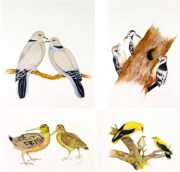
PAULA KUITENBROUWER ~ is a regular contributor to Into the Bardo and a Dutch nature artist living in The Netherlands and sharing her work with us on her blog, Mindful Drawing and on her website. In addition to art, Paula’s main interest is philosophy. She studied at the University of Utrecht and Amsterdam. She has lived in Eastern Europe and in Asia. Paula says that in Korea, “my family lived next to a Buddhist temple. In the early morning we would hear the monks chanting. During my hours of sauntering with my daughter through the beautiful temple gardens, I felt a blissful happiness that I try to capture in my drawings.” Paula sometimes teaches children’s art classes. She lives with her husband and daughter and close to her father. You can view her portfolio of mindful drawings HERE.
“The Bardo” is a place of transition, perhaps akin to Purgatory. It is common ground and a sacred space of sorts. It’s intriguing to think of the Laundromat as a place like that . . .
David Attenborough makes a point in The Life of Mammals video about “Social Climbers” – monkeys. He says that you can tell how large a monkey’s social group is by the size of his brain. Baboons live in large, complex social structures and have the largest brains of all the monkeys. Surviving and thriving in a social environment means that you have to be able to assess situations and make an array of decisions – how to make allies and with whom, how and when and whom to fight, how to secure a mate and improve your chances of passing on your genes. Navigating social life is even more brain-bending if you’re human, I think. More subtleties are involved. Here’s a case in point: the laundromat.
When Jim and I were first married, I did laundry at the laundromat. I hated going there, for several reasons. First of all, I was pregnant. The smells nauseated me; the physical demands of standing to fold and hoisting large loads of clothes around exhausted me. It was a depressing place to be physically, but perhaps even more uncomfortable was the social aspect. You never know what strangers you might encounter. I have had some rather pleasant days at the laundromat. I met a psychic, once, who was very interesting. She could tell I was skeptical and not receptive, but she kept on talking to me nevertheless. Gradually, I relaxed and figured out how to respect her and appreciate her and communicate that to her. We parted with a hug and wished each other well. Mostly, I get a pleasant experience if I can do my laundry in silence and read a few short stories at the same time. What I often find is that the laundromat is a place to observe human suffering, my own and others’.
I happened to have selected a book of short stories by William Faulkner as my laundry companion. I grabbed it off of Steve’s stack figuring that short stories would fit nicely into those periods of time between cycles, and I wouldn’t mind being interrupted or distracted as much as I would if I were trying to tackle “heavier” reading. What I didn’t think about was that these stories of post-Civil War race relations would be cast for me on a backdrop of the urban reality of this century…and that the same awkward tensions would result. I felt like some of his characters, eavesdropping in the kitchen, when people in the laundromat would chatter on their cell phones to friends and social agents. Outwardly, I guess I was trying to be invisible. I couldn’t help picking up snatches of their lives and wondering about their stories. For example, Jerry and his family…
I’ve seen Jerry twice now. Yesterday, I recognized him as I approached the laundromat. He was wearing a diaper under sweatpants, shoes, and no shirt. He was hitting his head repeatedly and grunting. Or maybe it was more like moaning. The woman he was with may have been his mother. She was in a wheelchair with an artificial leg that looked like a sandbag. He was with another woman as well, perhaps his sister. She was the one doing the laundry. I remembered them from a month ago. They came with about seven large, black garbage bags full of clothes. They took a social services shuttle bus to get there; I knew this from hearing the mother make cell phone calls about being picked up. This woman had the sweetest, kindest voice you would ever hope to hear. Her voice was full of compassion and pain; it was lilting and rich and Southern. I would cast her as a black Mammy in one of Faulkner’s stories. Her manners were impeccable. If she had to pass around me, she excused herself, and I felt like apologizing profusely for being in the way. Her daughter (?), the other woman, spoke almost unintelligibly as she did the laundry and corralled Jerry. Even the woman in the wheelchair told her, “I can’t understand what you’re saying.” Jerry likes to wander. They don’t want him to wander out to the street and get hit by a car. They don’t want him to bother the other people in the building. Their voices called out periodically, “Jerry. Jerry, come over here.” “Jerry, honey. Stop! Jerry, come here.”
When Jerry wanders near me, I don’t know what to do. I keep my head down and my eyes in my book. Would I frighten him if I made eye contact? Would he frighten me? Another gentleman was there. He helped bring Jerry back inside when he wandered out. The mother thanked him, “You’re so sweet. Thank you, sir.” They exchanged names. He told her that he has a grandson who was hit by a car at age seven; the grandson is now twenty-five and has brain damage. “Oh, so you know. You understand,” she sighed. I learned that Jerry is thirty-two years old.
In the other corner of the room, there was a mother with a five-year old daughter, London. She looked about five, anyway. London had a pacifier. I heard her mother yelling at her. “London! Get up offa that floor! Sit your butt down here!” Her voice was sharp and angry. London began to cry. There is not much to interest a five-year-old in the laundromat. She hadn’t brought any toys or books to occupy her.
The mother talked on her cell phone while London played with the lid of the laundry hamper. I made eye contact with the child as we went about our business. She silently bent her wrist toward me, while sucking her pacifier. “Oh, did you hurt yourself?” I asked. “London! Get out of the way!” her mother said.
In the Faulkner story, Master Saucier Weddell is trying to get back to Mississippi from Virginia. He is the defeated. He and his traveling companion, his former slave who is very attached to him and his family, find themselves in Tennessee at a farmhouse. These victors are extremely suspicious. They think Mr. Weddell is a Negro. Actually, he’s Cherokee and French. The story is short, but intense. The traveler and the farmer’s younger son end up being killed in an ambush by the farmer and his Union soldier son, Vatch. The last two sentences read, “He watched the rifle elongate and then rise and diminish slowly and become a round spot against the white shape of Vatch’s face like a period on a page. Crouching, the Negro’s eyes rushed wild and steady and red, like those of a cornered animal.”
I finished my laundry in silence. I waved my fingers and mouthed “goodbye” to London who had been banished to the corner. Her mother didn’t see me.
At home, the late afternoon sun shines down on the quilt on my bed. Steve isn’t home, and it’s very quiet. I feel like crying. My brain is not big enough to figure out why.
PRISCILLA GALASSO ~ is a contributor to Into the Bardo. She started her blog at scillagrace.com to mark the beginning of her fiftieth year. Born to summer and given a name that means ‘ancient’, her travel through seasons of time and landscape has inspired her to create visual and verbal souvenirs of her journey.
“My courage is in the affirmation of my part in co-creation”, she wrote in her first published poem, composed on her thirtieth birthday and submitted alongside her seven-year-old daughter’s poem to Cricket magazine. Her spiritual evolution began in an Episcopal environment and changed in pivotal moments: as a teenager, her twenty-year-old sister died next to her in a car crash and, decades later, Priscilla’s husband and the father of her four children died of coronary artery disease and diabetes in his sleep at the age of forty-seven Awakening to mindfulness and reconsidering established thought patterns continues to be an important part of her life work.
Currently living in Wisconsin, she considers herself a lifelong learner and educator. She gives private voice lessons, is employed by two different museums and runs a business (Scholar & Poet Books, via eBay and ABE Books) with her partner, Steve.
Excerpts from His Holiness the Dalai Lama’s address to the inter-faith seminar organised by the International Association for Religious Freedom, Ladakh Group, in Leh on 25 August.
We are now in the twenty first century. The quality of research on both the inner and physical world has reached quite high levels, thanks to the tremendous stride in technological advancement and human intelligence. However, as some of the speakers said before, the world is also facing a lot of new problems, most of which are man-made. The root cause of these man-made problems is the inability of human beings to control their agitated minds. How to control such a state of mind is taught by the various religions of this world.” MORE
Photograph taken by an employee of the Executive Office of the President of the United States and as a work of the U.S. federal government it is in the public domain.
I was reading about John Cage today and his famous piece, 4’33”. As you may know, that is a composition conceived in 1952, meant for any instrument (or combination of instruments), and the score instructs the performer(s) to not play the instrument(s) during the entire duration of the piece, which is meant to consist of the sounds of the environment that the listeners hear while it is performed, although it is commonly perceived as “four minutes thirty-three seconds of silence”.
The reason why I was reading that is less important, the irony was that there was an awful amount of noise around me while I was plunging into Cage’s reasons to write a piece about silence. Now, precisely at the time when I was sort of praying for a miracle that would stop all that noise, my eyes fell on the fragment quoted below:
“In 1951, Cage visited the anechoic chamber at Harvard University. An anechoic chamber is a room designed in such a way that the walls, ceiling and floor absorb all sounds made in the room, rather than reflecting them as echoes. Such a chamber is also externally sound-proofed. Cage entered the chamber expecting to hear silence, but he wrote later, ‘I heard two sounds, one high and one low. When I described them to the engineer in charge, he informed me that the high one was my nervous system in operation, the low one my blood in circulation.’ Cage had gone to a place where he expected total silence, and yet heard sound. ‘Until I die there will be sounds. And they will continue following my death. One need not fear about the future of music.’ The realisation as he saw it of the impossibility of silence led to the composition of 4′33″.”
And lo! While I was reading that, the huge noise around me stopped, and I was able to hear the music of my neurons, chewing on the relative silence suddenly fallen upon my surroundings . Quite a poetic coincidence, if I may add.
But coming back to the point, what people grew to call as “silence” is merely the absence of sounds. An absence otherwise relative, as demonstrated by the quote above – for our own body always plays its own music, above the absolute state of silence. Sometimes we like it, sometimes we don’t, simply because silence, like all things, is sometimes necessary, and other times it should be replaced by something else. There can be silence in the middle of the storm, as well as it can lack in the middle of some anechoic chamber. What matters most is not the physical silence that we experience, but the mental one, when the mind comes to that state of silence called peace – because that is when we actually “hear” our soul.
LILIANA NEGOI (Endless Journey and in Romaniancurcubee în alb şi negru) began to write poetry at eighteen – by accident – as she herself likes to remember, and has been exploring the depths of language ever since. Currently she is the author of three published volumes of poetry in English – which is not her mother tongue but one that she came to love especially because of writing: Sands and Shadows,Footstep on the San – tanka collection and The Hidden Well. The last one can also be heard in audio version, read by the author herself on her SoundCloud site HERE. Many of her creations, both poetry and prose, have been published in various literary magazines.
“The apricot throws itself on the ground. It is crushed and trampled for its next life.” Yang Mija “sees” while walking through an orchard and takes notes in her poetry notebook
This movie speaks quietly about life and art, devastation and redemption. Like the most refined poetry, it is nuanced, honest and dramatic without being melodramatic or manipulative. It is a spare work, whittled down to essentials. It whispers. It never shouts. Its pacing is leisurely and thoughtful. There is no suggestive music here to help you grasp the story’s progression. There are no stars who have been nipped, tucked, brushed, trussed and boosted. These people are real. They could be me or you or our next-door neighbor. The story could be anyone’s story anywhere in the world. Indeed, Director Lee Chang-dong got the basic idea for the screenplay from a news report..
“ … this story was finally born from a combination of different elements: the sexual assault case, the suicide of a girl, and the lady in her 60s writing a poem.” Lee Chang-dong in an interview HERE
Yoon Jeong-hee stars in the leading role (Yang Mija) and it is the lean script (though the movie is over two hours long) and Jeon-hee’s exquisitely understated acting that transfix us. Watch her face. Watch her body movements. These also are a kind of poetry.
“I’m quite a poet. I do like flowers and say odd things.” Yang Mija
Yang Mija is a sixty-six year-old grandmother charged with the care of a teenaged grandson, Jongwook – or Wook – whose mother is divorced and living in Busan. Wook is lazy and ungrateful and shows no respect for his grandmother or sensitivity to her age and her loneliness.
“You’re sprouting a mustache but acting like a child.” Yang Mija to Wook
Wook is part of a “gang” of male friends, fellow students, who over the course of six months repeatedly rape a young woman who subsequently drowns herself. News of this comes coincident with Yang Mija’s diagnosis of Alzheimer’s disease and her first poetry class. It is her poetry classes and effort to write a poem that provide the through-line for this story.
“The most important thing is seeing.” the poetry instructor to the class on the first day
We walk alongside Yang Mija as she struggles with these multiple challenges – not without some humor – and sorts through her emotions regarding her grandson’s actions, her sympathy for the drowned girl, and the desire of other parents to hide the boys’ culpability by buying off the drowned girl’s mother. While Yang Mija may be suffering the early stages of memory loss, she hasn’t lost her moral compass.
As she moves from one experience to the next, Yang Mija questions: How do you write a poem? Where does the poetry come from? When she decides how she is going to handle her grandson, she is finally able to write her poem.
Agnes’s Song
How is it over there?
How lonely is it?
Is it still glowing red at sunset?
Are the birds still singing on
the way to the forest?
Can you receive the letter
I dared not send?
Can I convey the confession
I dared not make?
Will time pass and roses fade?
Now it is time to say goodbye,
Like the wind that lingers
And then goes, just like shadows.
To promises that never came,
To the love sealed till the end,
To the grass kissing my weary ankles,
and to the tiny footsteps following me,
It is time to say goodbye.
Now as darkness falls
will a candle be lit again?
Here I pray nobody shall cry
and for you to know
how deeply I loved you.
The long wait in the middle
of a hot summer day.
An old path resembling my father’s face.
Even the lonesome wild flower
shyly turning away.
How deeply I loved.
How my heart fluttered at
hearing your faint song.
I bless you
before crossing the black river
with my soul’s last breath.
I am beginning to dream…
A bright sunny morning again I awake,
blinded by the light and meet you
standing by me.
– Yang Mija
“It is not difficult to write a poem. It is difficult to have the heart to write a poem.” the poetry instructor on the last day of class. Yang Meja is not in attendance but has left a bouquet of flowers and her poem
Both thumbs up on this one.
There are probably a lot of places you can go to rent or buy this, but I streamed it from Amazon.
JAMIE DEDES ~ My worldly tags are poet and writer. For the past five years I’ve blogged at The Poet by Day,the journey in poem, formerly titled Musing by Moonlight. Through the gift of poetry (mine and that of others), I enter sacred space.
the work of Shakti Ghosal, posted again due to its popularity
Fluidity and discontinuity are central to the reality in which we live. (1990), Mary Catherine Bateson(b. 1939), American writer and cultural anthropologist
The other day, I sat leafing through the yellowing pages of that half a century old Peter Drucker classic, ‘The Age of Discontinuity’. This book never ceases to amaze me at the prescient feeling it can generate even after so many decades. Drucker of course could not have envisioned the internet and today’s information flows but his book does ask the question, “As technology becomes ubiquitous, how would we need to cope?” He also challenged us “to be prepared for the complexities”. Big discontinuities that he saw so many years back……. as yet unresolved.
Since the dawn of history, Mankind has experienced discontinuities brought in by adoption of learnt skills and technology. As the first human learnt how to seed and grow plants, Mankind did a makeover from a wandering lifestyle to that of settlers on land. Then with the successive arrivals of the steam engine and electricity, the agrarian lifestyle started morphing into industrial clusters and an associated urban way of life.
And so has been the cycle. A periodic massive disruption of the way we live, the way we work, the way we trade, all leading to a discontinuity. But always, Mankind returned back to stability. Adjusting back into the equilibrium of a new socio-economic format, till the next bout of discontinuity.
But methinks we now have reached a different arena. A space and time where technologies are no longer stabilizing. If at all, they seem to be changing at a faster and faster pace. One needs to just see what is happening to computing, information and communication to appreciate this.
As I reflect, I am left wondering if we are facing the mother of all discontinuities, a shift to a world without stability. A world in which extreme social and economic disruptions become the norm. Be it the ongoing financial turmoil in the global markets. Be it increasing volatility in commodity prices. Be it companies losing out their leadership positions at an increasing rate. Be it product life cycles becoming shorter and shorter. I wonder if these indeed be the symptoms of a world becoming increasingly unstable.
So how do we, the individuals, cope with such constant discontinuities and loss of stability? Wired as we are to cherish stability and continuity in life, how do we retain our balance and sanity?
I think of the Chinese concept of Shi. Simply put it signifies a propensity based on situation. So whenever there is the propensity to play out to an extreme, there also occurs the tendency to self correct and reverse course. And herein lies the magic of Shi- embodying the spirit of dancing in the moment.
Shi is a belief. It promotes lightness and a dynamic view of our world. In Shi, everything is in a state of becoming. So as we focus on the flows and the lightness of the moment, we lose our obsession with discrete people, objects or situations. Shi allows a holistic appreciation of the complex webs of relationships among people, objects and the broader environment.
In a world fast losing traditional reference points, the future may well belong to those who adopt a Shi mindset. Those who embrace the lightness of relationships and flows rather than the heaviness of resource ownership. I believe it would be these ‘dancers of the moment’ who would lead the world in this era of uncertainty and discontinuity.
Acknowledgements:
1 The Age of Discontinuity: Guidelines to our changing society
by Peter F Drucker,1969.
2. The Propensity of Things: Toward a History of Efficacy in China
Shakti Ghosal ~ has been blogging (ESGEE musgings) since September 30, 2011 and he is a Contributing Writer to Into the Bardo. He was born at New Delhi, India. Shakti is an Engineer and Management Post Graduate from IIM, Bangalore. Apart from Management theory, Shakti remains fascinated with diverse areas ranging from World History and Economic trends to Human Psychology and Development.
A senior management professional, Shakti has been professionally involved for over twenty-five years at both international and India centric levels spanning diverse business areas and verticals. With a strong bias towards action and results, Shakti remains passionate about team empowerment and process improvement.
Shakti currently resides in the beautiful city of Muscat in Oman with wife Sanchita, a doctorate and an educationist. They are blessed with two lovely daughters, Riya and Piya.
“All you need is a sense that there is no such thing as ‘no’ and everything is possible.” Moira Kelly
This shining face, this sweet spirit with reason to be bitter and yet he is not. He is a hero and pure inspiration. When our own Naomi Baltuck posted this video on Facebook, I was as touched as anyone would be. I had to wonder though about his mom. What kind of hero is she, I thought, remembering the heroes of my childhood: Josephine Baker and my spiritual mother, Pearl Buck. Each of these women grew their families in unique – and extraordinarily unselfish – ways.
“All my life, I have maintained that the people of the world can learn to live together in peace if they are not brought up in prejudice.” Josephine Baker (1906-1975)
Josephine Baker was born in America but became a French citizen. She was a dancer, singer, actress and civil-rights activist. As a child living in St. Louis, Missouri, she suffered from discrimination, abandonment, and poverty. As an adult she had one miscarriage. She adopted twelve children, two girls and ten boys. They were from diverse races and cultures because, in addition to caring for them, she wanted to show that people can get along despite their different backgrounds. In the early ’80s two of her sons went into business together. They started Chez Josephine, which is on Theatre Row (42nd Street) in Manhattan. They dedicated the restaurant to their adoptive mom’s memory and decorated it with her memorabilia.
“. . . the test of a civilization is the way that it cares for its helpless members.”Pearl Buck (1892-1973)
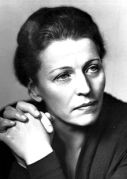
Pearl Buck was an American novelist, writer, humanitarian and the first woman to be awarded the Noble Prize in Literature (1938). She grew up in China and spent most of her life there until 1934. She had a deep affection for and knowledge of the countries of the East, not just China. She suffered through the Nanking Incident when the National Revolutionary Army captured Nanking (now Nanjing) in 1927. Many Westerners were killed, their homes destroyed, and their property stolen. Her only biological child, Carol, had phenylketonuria (PKU), which causes mental retardation and seizures. She adopted seven children. At a time when mixed-race children were considered unadoptable, Pearl Buck founded Welcome House, Inc., the first international, interracial adoption agency. Welcome House has placed some five thousand children since it was established 1949.
“The greatest act of kindness changes generations. Wherever there is the greatest evil, the greatest good can be achieved.” Moira Kelly (b. 1964)
This brings us to a contemporary hero: the mother of Emanuel Kelly, the young man in the video. Moira Kelly is an Australian humanitarian whose work has garnered her many awards and acknowledgements. When she was eight years old, after seeing a movie about Blessed Teresa of Calcutta (now Kolkata), Moira committed herself to working with disadvantaged children. She is the legal guardian of twins from Bangladesh, Trisha and Krishna. They are surgically separated but originally cranially conjoined twins. Moira Kelly also adopted the Iraqi-born Emmanuel and his brother Ahmet, both born with underdeveloped limbs. Among her efforts is Children First Foundation, formed to provide transportation and healthcare for children with urgent needs in developing countries.
These women are mothers in the best senses of that word. Their ideals are real and they stand by them. They have saved children from abandonment and loneliness, from poverty and hopelessness and, in some cases, from early death. They are goddess mothers and true heroes.
JAMIE DEDES ~ My worldly tags are poet and writer. For the past five years I’ve blogged at The Poet by Day,the journey in poem, formerly titled Musing by Moonlight. Through the gift of poetry (mine and that of others), I enter sacred space.
we live on Turtle Island and turtle is my totem ~
she speaks in the easy way only turtle can,
as one who is at home in herself, at home between
her plastron and carapace, wisdom in her measured
gait, her introversion a model for freedom, for cutting
the nets spun of wars and deceptions . . .
she is the everyday re-enchantment of my solitary
cosmos, my solidarity with life, i read her pastoral
letters in green on green, the sweet grasses and seas,
she speaks of connectedness, the basic constituents
of enigma, wizardry; and in the insanity of the times,
how best to journey and retrieve this world’s soul . . .
she is the unrushed cure for nature-deficit,
that consuming affliction, the spawn of culture’s
back-lighted screens and advertising of every bilk
turtle healing is simple peace and master lessons in
self-containment, she draws me into my meditations
and back along the first path of Maka Ina, the forgotten
primal path of earth ways and feminine energies and
the rhythms of grandmother moon whirling me heavenward.
– Jamie Dedes
Turtle ~ totem or power animal representing earth in Native American tradition
Turtle Island ~ in Iroquois tradition, when the earth was covered over with water, sundry animals attempted to create land by swimming to the bottom of the ocean and hauling up dirt. Muskrat succeeded. He placed the dirt on the back of Turtle, which grew into the landmass known today as North America.
Maka Ina ~ Lakota (Sioux) ~ “maka” is earth and “ina” is mother, so Mother Earth. Earth teachings were/are considered a path to wholeness (heaven).
JAMIE DEDES ~ My worldly tags are poet and writer. For the past five years I’ve blogged at The Poet by Day,the journey in poem, formerly titled Musing by Moonlight. Through the gift of poetry (mine and that of others), I enter sacred space.
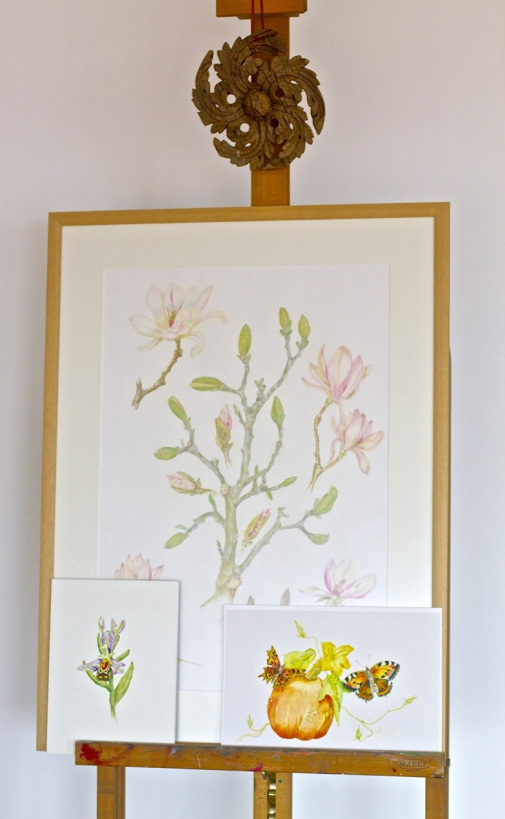
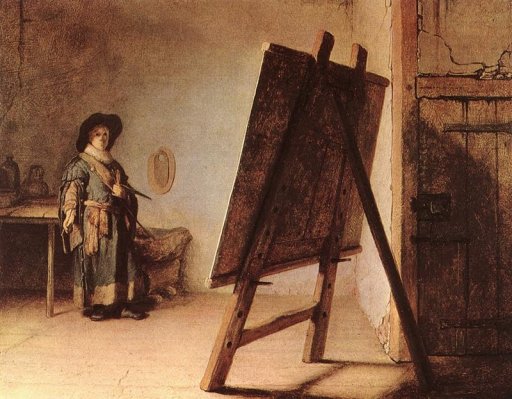
Rembrandt seems peaceful watching the canvas on his easel…
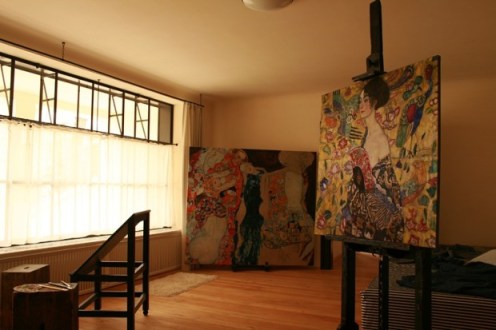
On the easel of Gustav Klimt are the paintings he dreamt…
The word ‘easel’ is an old Germanic synonym for donkey. In the Latin ‘Asinus’, we hear ‘ass’ (donkey).
An easel supports a canvas or painting. It is a humble piece of furniture; a few horizontal and vertical pieces of wood nailed together. Its plainness and instrumentality earned it its name ‘easel’ (i.e. donkey). An easel isn’t pretty nor noble, it carries our stuff like a donkey carries our stuff too.
.
It is said the easel was used by Egyptians. It took a long time before frescos and murals lost their glamour and artists started to work with painting boards and canvasses. Fast forward to the Renaissance, we see mobile easels changing dramatically the way painters work. Artists abandon their studios to work in the open air, catching the light, movement of the water, the clouds and waving grasses like no one has done before. The easel helps to create individual artists and new painting styles. Despite its achievements, its name has never been upgraded. Easels never look proud. To me they look often a tiny bit tragic and tired, like overloaded donkeys.
PAULA KUITENBROUWER ~ is a Dutch nature artist living in The Netherlands and sharing her work with us on her blog, Mindful Drawing and on her website. In addition to art, Paula’s main interest is philosophy. She studied at the University of Utrecht and Amsterdam. She has lived in Eastern Europe and in Asia. Paula says that in Korea, “my family lived next to a Buddhist temple. In the early morning we would hear the monks chanting. During my hours of sauntering with my daughter through the beautiful temple gardens, I felt a blissful happiness that I try to capture in my drawings.” Paula sometimes teaches children’s art classes. She lives with her husband and daughter and close to her father. You can view her portfolio of mindful drawings HERE.
JAMIE DEDES ~ My worldly tags are poet and writer. For the past five years I’ve blogged at The Poet by Day,the journey in poem, formerly titled Musing by Moonlight. Through the gift of poetry (mine and that of others), I enter sacred space.
What can I tell you?
She loved the guy …
She even loved the
scent of whiskey and cigarettes
She took due note of the clues
warning of devises and vices
that she’d never acquired
She didn’t care He was charming
Coupled in delicate balance
a yin and yang of extremes
a second marriage of differences
Fog being the common denominator ~
though his drink didn’t mix well
with her off-in-the-clouds-somewhere being
The accountant of just-the-facts ma’am
and the dreamer of unlikely dreams She was a trial
The bear who liked to escape to the woods
nonetheless some comfort, a decent person,
a hero of the practicalities,
a maker of omelets and fixer of things,
a reader, a gardener, an angry man
Anger . . .
. . . read pain but you probably knew that
a pain that waltzed with Jack Daniels
lent itself to long diatribes
and Pilsner-invented pontifications
it skied through the veins
built road-blocks to his heart
and in the end,
in the end, in the end
the pain did him in that lost man
that well-meaning, decent
distant, funny, lost man
JAMIE DEDES ~ My worldly tags are poet and writer. For the past five years I’ve blogged at The Poet by Day,the journey in poem, formerly titled Musing by Moonlight. Through the gift of poetry (mine and that of others), I enter sacred space.
We’re bringing this to you several days late and apologies for that … but thanks to Michael Watson for sharing this generous celebration of connection and people by the folks at Lateral Love Australia. J.D.
My Love for Mountian is a video poem by Marlene McNew.
Marlene McNew “Veni, Vidi, Vici”
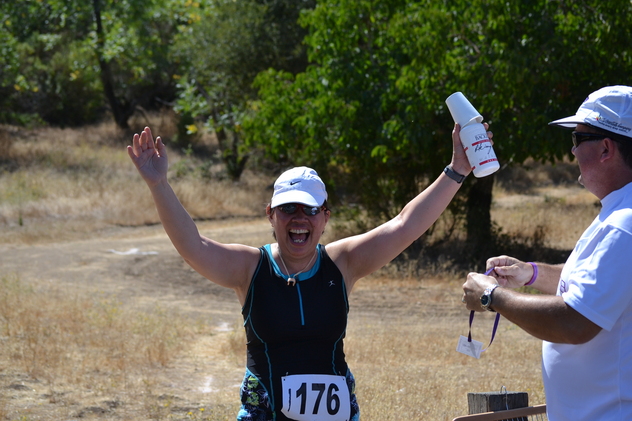
Marlene McNew ~ is a contributing writer to Into the Bardo. Shebegan exhibiting symptoms of Parkinson’s Disease (P.D.) nine years ago. Her blog (Strange Gift) is a vehicle for sharing her interests and her experiences with P.D. Marlene is a master skier and triathlon competitor. She expresses her beautiful spirit through poems and paintings. Her YouTube channel is SkiDisiple.

 September 21, 2013 is the United Nation’s International Peace Day. The theme this year is Education for Peace, including fostering respect, inclusiveness, and peaceful societies.













 The BeZine