The focus of "The BeZine," a publication of The Bardo Group Beguines, is on sacred space (common ground) as it is expressed through the arts. Our work covers a range of topics: spirituality, life, death, personal experience, culture, current events, history, art, and photography and film. We share work here that is representative of universal human values however differently they might be expressed in our varied religions and cultures. We feel that our art and our Internet-facilitated social connection offer a means to see one another in our simple humanity, as brothers and sisters, and not as “other.” This is a space where we hope you’ll delight in learning how much you have in common with “other” peoples. We hope that your visits here will help you to love (respect) not fear. For more see our Info/Mission Statement Page.
it must be painful for them to write, those poets in tough-times and hard places
where blood and tears and poverty contaminate the air, stain the sidewalks, and consume the people
the blood must be soul-sick and rusted and tasting of acid, not salt, and the poems meant to heal the writer and stroke the cheeks of the wounded, to dry their eyes and gently kiss their gray heads
to poem under such conditions must be like walking shoeless on glass shards
perhaps the most sacred thing in the dream-time meadow of poets’ desire is light
can you awaken to meet the Divine on the battlefield, in the camps, in government housing or in the ghettos?
if so, you are a saint, not simply a lyrist
2.
in my small world, my civilized world, people fall asleep reading or after making love or playing in the yard with their children
if they wander it is through books and planned travel
there are luxuries
there is food
there is cleanliness and paper on which to write
no bombs are dropping
there is almost certain dignity
3.
in San Francisco we walk along the beach at night, near the Cliff House
we walk to the sound of the waves, the sound of the Universe chanting its praise
our feet are bare and relish the comfort of cool sand
the air is clear and cold and easy to breathe, tasting of salt and smelling of sea life
here is a pristine moment of peace
i want to bequeath this peace to you, to everyone, as though it were a cherished heirloom
it is really a birthright
i want to plunge into the waters and gather the oceans to offer as sacramental wine in my cupped hands
i want to braid the seaweed into garlands for everyone to wear, hanging over their hearts, a symbol of affection
i want to collect pine cones from the trees that congregate along the coast and feed them to the children to remind them to love the earth and all its creatures, themselves included, and to say …
do not make war in your heart or upon your mother’s body
JAMIE DEDES ~ My worldly tags are poet and writer. For the past five years I’ve blogged at The Poet by Day,the journey in poem, formerly titled Musing by Moonlight. Through the gift of poetry (mine and that of others), I enter sacred space.
“You are what exists before all stories. You are what remains when the story is understood.”
Byron Katie, American speaker & author of The Work
I muse about this Coaching question asked me.
So what is my story? As I think of this, I see its tentacles going into the past.
The year is 1911. A lowly placed accounts clerk of the British Accounts Service in India boards the Kalka Mail train from Calcutta with his family. He is shifting home to Delhi in accordance with the British colonial Government’s decision to shift the administrative capital of the Indian subcontinent there. He is following his work, the only thing he knows that sustains him and his family. He is my grandfather.
ast forward fifty years and it is my father in the midst of a career in the Indian Audit and Accounts service. Now settled in Delhi, the capital of independent India. Content with a middle class lifestyle. So grooved in his office work that he feels insecure to take up an exciting consular opportunity in the US. He regrets it citing family constraints.
Fast forward another fifty years and it is I sitting at the desk in my office wondering what next. Having been on a sometimes exciting, sometimes lacklustre roller coaster ride through diverse business areas for three decades, I can claim fair knowledge of the nuts and bolts of corporate working. But like my grandfather and father, I see my work primarily as the means to provide a comfortable life to me and my family.
My story. The story in which working at an office desk equates to life comfort and sustenance. The story which I accept as me. And as I accept, I see it gaining power and dictating what I do. I see it protecting me in a ‘safe box’. As it allows me to peep through my perception coloured lenses and read meaning about the world at large. But as it protects, do I also see it confining and preventing me from setting forth, taking risks and achieving my true potential?
What is it that has embedded this ‘office work’ DNA in me thus? What is it that has made it such an integral part of my story? As I muse, I sense that in my office work DNA resides a gene harking back to the industrial revolution. A gene that through generations has altered my value system. And made me shift towards valuing business growth, productivity and profits over beauty, compassion, love and community ties. Over generations, the gene has also lured me away from simplicity and frugality and towards materialism. An attachment to materialistic possessions which has fuelled insecurity. And has manifested in my life through frantic work schedules, technology tying me down 24X7, scarcely any time to “stop by the woods” or “wander lonely as a cloud”.
So, who would I be without my story? Who would I be if I could shed the above DNA and gene? Would I have that glorious opportunity to start from a place where I am no longer confined and am free to define and implement what I think is important? What do I see?
I see myself slowing down, without the pressures of societal expectations of wealth and ownership. As I take personal responsibility to do that which is meaningful, creative and liberating to me.
I see myself effortlessly crossing those artificial barriers created by economic, social and racial compulsions.
I see in me the birth of a great willingness to learn. From all corners of the world. Unfettered and unhampered by beliefs of my education and experience.
Like the return of the Jedi, I see in me the comeback of the human heart. As I acknowledge intrinsic qualities like Empathy, Faith, Creativity and Interconnectedness and bring them centre stage.
I see how work would look like for me. Passion…. Art…… the pulse of the environment.
Who would I be without my stories?
Like a tree
Without the rustle of the leaves
Winter mind
Kind
Aligned
To the Inside
Inside the inside
A space so wide
It has no centre
Because it is centre
SHAKTI GHOSAL ~ has been blogging (ESGEE musgings)since September 30, 2011. He was born at New Delhi, India. Shakti is an Engineer and Management Post Graduate from IIM, Bangalore. Apart from Management theory, Shakti remains fascinated with diverse areas ranging from World History, Economic trends to Human Psychology & Development.
A senior Management professional, Shakti has been professionally involved over twenty-five years at both International and India centric levels spanning diverse business areas and verticals. With a strong bias towards action and results, Shakti remains passionate about team empowerment and process improvement.
Shakti currently resides in the beautiful city of Muscat in Oman with wife Sanchita, a doctorate and an Educationist. They are blessed with two lovely daughters, Riya and Piya.
Van Gogh paintings come to life through advanced digital editing techniques by Luca Agnani. The music is by Ludovico Einaudi. Thanks to Naomi Baltuck (Writing Between the Linesand Into the Bardo) for bringing the gift of this video to us.
The Wisdom of Vincent:
“The more I think about it, the more I realize there is nothing more artistic than to love others.”
“When I have a terrible need of – shall I say the word – religion. Then I go out and paint the stars.”
“But I always think that the best way to know God is to love many things.”
“The fishermen know that the sea is dangerous and the storm terrible, but they have never found these dangers sufficient reason for remaining ashore.”
*********
Vincent Van Gogh certainly painted and wrote (we have his letters to his brother) from sacred space and perhaps no one has acknowledged that more gracefully or gratefully than Don Mclean in his song ~
Starry Starry Night
Starry, starry night.
Paint your palette blue and grey,
Look out on a summer’s day,
With eyes that know the darkness in my soul.
Shadows on the hills,
Sketch the trees and the daffodils,
Catch the breeze and the winter chills,
In colors on the snowy linen land.
Now I understand what you tried to say to me,
How you suffered for your sanity,
How you tried to set them free.
They would not listen, they did not know how.
Perhaps they’ll listen now.
Starry, starry night.
Flaming flowers that brightly blaze,
Swirling clouds in violet haze,
Reflect in Vincent’s eyes of china blue.
Colors changing hue, morning field of amber grain,
Weathered faces lined in pain,
Are soothed beneath the artist’s loving hand.
Now I understand what you tried to say to me,
How you suffered for your sanity,
How you tried to set them free.
They would not listen, they did not know how.
Perhaps they’ll listen now.
For they could not love you,
But still your love was true.
And when no hope was left in sight
On that starry, starry night,
You took your life, as lovers often do.
But I could have told you, Vincent,
This world was never meant for one
As beautiful as you.
Starry, starry night.
Portraits hung in empty halls,
Frameless head on nameless walls,
With eyes that watch the world and can’t forget.
Like the strangers that you’ve met,
The ragged men in the ragged clothes,
The silver thorn of bloody rose,
Lie crushed and broken on the virgin snow.
Now I think I know what you tried to say to me,
How you suffered for your sanity,
How you tried to set them free.
They would not listen, they’re not listening still.
Perhaps they never will…
Starry Starry Night, Don Mclean, All rights reserved
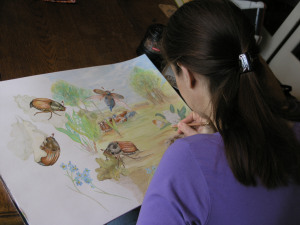
Many of us know what mindfulness is, but what is mindfully drawing? How can a beginner start with mindfully drawing?
In ‘The Zen of Seeing, seeing/drawing as meditation’, Frederick Franck describes drawing as ‘The Way of Seeing’, as a way of meditation, a way of getting into intimate touch with the visible world around us, and through it…with ourselves’.
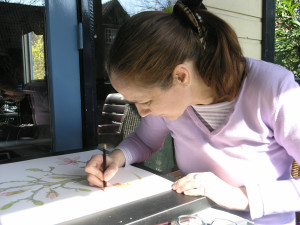
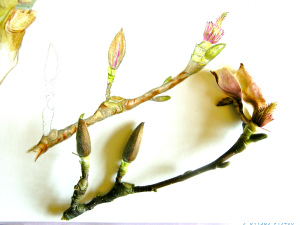
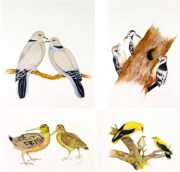
That is how I view mindfully drawing too. But there is more. In ‘The Zen of Seeing’, Franck is not concerned about the end product. I am, but I don’t feel this concern is impeding my drawing meditation. I carefully prepare my drawing session by laying out all the tools. I think long about what I want, and I pay attention to the composition. I also do research, because I like to know what I am drawing. When I draw a bird, I study that bird in real as well as with the helps of books. When I draw a flower, I have it seen in nature or it is right before me on my table. I read about the flower, and I like to study and know its Latin name. The same counts for bugs: I do not draw any bug I haven’t seen or studied. I need a connection of seeing and knowing my object. Only then I can picture my object in a habitat, a scene, and give it a proper background and let my drawing tell a (short) story that is accurate.
Mindfully drawing is an active meditation. It keeps my hands busy but it brings a calm mind. That is because when I draw, I open my eye and my inward eye. My eyes study the objects and my emerging drawing. I am never hurried. Ask me anything during my blissful moments of mindfully drawing and you will get a peaceful and kind answer.
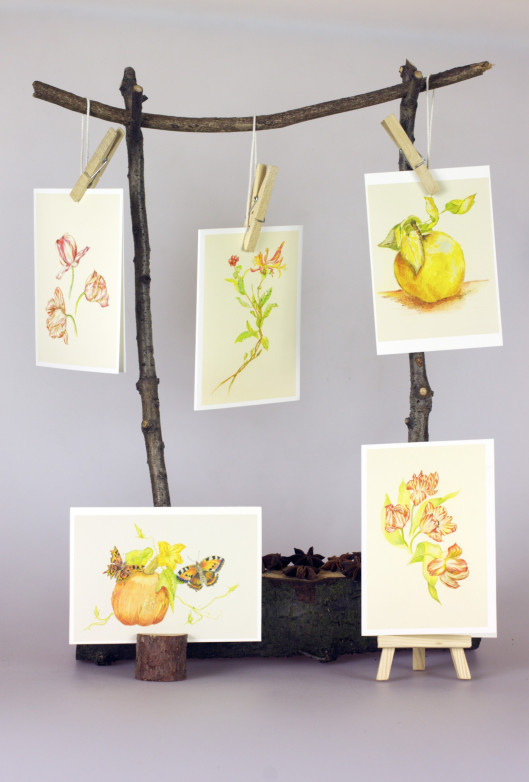
PAULA KUITENBROUWER ~ is a Dutch nature artist living The Netherlands and sharing her work with us on her blog, Mindful Drawing and on her website. In addition to art, Paula’s main interest is philosophy. She studied at the University of Utrecht and Amsterdam. She has lived in Eastern Europe and in Asia. Paula says that in Korea, “my family lived next to a Buddhist temple. In the early morning we would hear the monks chanting. During my hours of sauntering with my daughter through the beautiful temple gardens, I felt a blissful happiness that I try to capture in my drawings.” Paula sometimes teaches children’s art classes. She lives with her husband and daughter and close to her father. She has designed some special cards and gifts for Father’s Day HERE.
When I was young and naive, and a novice journalist, I wrote an article in a woman’s magazine which began:’ I got most of my education under the bed-clothes’, and went on to discuss children’s reading. Some wag must have been reading his wife’s copy, and the clipping appeared on the office notice-board amid crude male guffaws. Thank you chaps, I got the message. Not a quick learner, but I got there in the end.
Reading under the bed – clothes was the refuge of a child who was sent to bed at seven o clock every night, and allowed to read for fifteen minutes. Fifteen minutes! When I got older, and had more homework bed was set back to seven thirty, but the fifteen minute reading restriction still applied. Only a non-reader could have stipulated this ridiculous time limit, so under the bed-clothes it was. When I had no torch I knelt for hours, freezing in my night-clothes squinting to read by the crack of light under the door from the hall light.
Occasionally I tried the loo or the bathroom, but this was risky, as books aren’t easily hidden by a skinny child under a thin nightie. When I was fourteen I picked up Jane Eyre in the library. It exploded into my consciousness. I felt dazed and obsessed by the strange, compelling self-centred story. I could think of nothing else. I read it over and over again. I read it under the desk at school, in the bus and on the train, and of course, in bed.
Once the parents had gone to bed, I switched my light on with impunity, and read until I had finished Jane Eyre, and then started ‘Villette’, by which time it was heading for five o clock in the morning. Since I had to get up at six to cook my breakfast and catch the school bus at seven am, it seemed safer to stay awake, and soldier on. And having done it once, and finding it was possible to keep going without sleep, I quite often sacrificed my sleep for a good book after that.
Boarding school was tricky, but once again, there was always the bathroom. When I left home and became my own master, reading in bed became one of my favourite pastimes. Mostly literature and poetry in those palmy days. And usually then I had a bowl of apples to munch meditatively as the hours went by, or better still, a bar of chocolate. Sometimes decadence overcame me and I had a glass of lemonade. Marriage and motherhood dished all that of course, and reading in bed became a distant remembered pleasure.
But in the last few years since my husband’s snores have become so loud they wake me even when I’m sleeping in another room, we’ve taken a page out of the Royal Family’s domestic habits, and now sleep in separate rooms. This means I can read without disturbing him, and I’ve raised this noble pastime to a fine art.
Usually three books go to bed with me… something that I call mental knitting, a relaxing series like Georgette Heyer, (a much under-rated, very funny, witty and clever writer) or other light-hearted books like the hilarious Adrian Mole Diaries, or ‘The Jane Austen Book Club’. Georgette Heyer is sort of Jane Austen lite – but the blessed Jane is also a regular companion, along with the Thomas Hardy’s, George Eliot’s, Anthony Trollope’s, to re-read for the sheer pleasure of enjoying their writing again. In theory too, because I know the story, I kid myself I won’t be tempted to read too late. But that is a false premise. And as CS Lewis said, ‘I can’t imagine a man really enjoying a book and reading it only once.’
And then there’s the third category – those which are on the go, sometimes a new novel – Barbara Kingsolver at the moment, but not many of those – a biography, a history, a diary. And for real relaxation I sink into nature journals, often a classic like Flora Thompson’s: ‘Lark Rise at Candleford’ … Annie Dillard, Henry Beston or Ronald Lockley… mostly accounts of gentle, unpolluted country life.
But reading in bed isn’t just books. The bed matters too… preferably by the window… in summer with cool white linen-cotton blend sheets that have a silky feel, in winter comforting coloured flannelette to match the duvet. Pillows – plenty of them, to lean back on and others to support the elbows. Electric blanket a must in cold weather… I use it a bit like the hot tap in the bath… whenever it seems a bit chill, I switch it on until the bed is like toast again, and then prudently switch off again until the next time.
In summer, there’s the bliss of going to bed in day-light, knowing you have hours in front of you before dusk creeps up, before finally switching on the light. In winter, lamps on, curtains pulled, wood fire still burning in the sitting room to keep the house warm for when I emerge to make a cup of tea. And the bed, pyjamas warmed under the bed clothes on the electric blanket, cosy sheets and pillow slips, red mohair rug edged with wine-red satin, and a stash of peppermints to slowly chew as I turn the pages. No sounds, just the murmur of the soft sea, a distant owl, and occasionally a scuffle on the roof as a possum scrambles across. The sound of rain on the roof is good too.
The art of reading in bed is a silent, sybaritic, solitary joy and has nothing to do with going to sleep. It has everything to do with the pleasure of reading, frequently to the detriment of sleep. So I have to confess, in the words of L.M.Montgomery that : ‘I am simply a ‘book drunkard.’ Books have the same irresistible temptation for me that liquor has for its devotee. I cannot withstand them.’
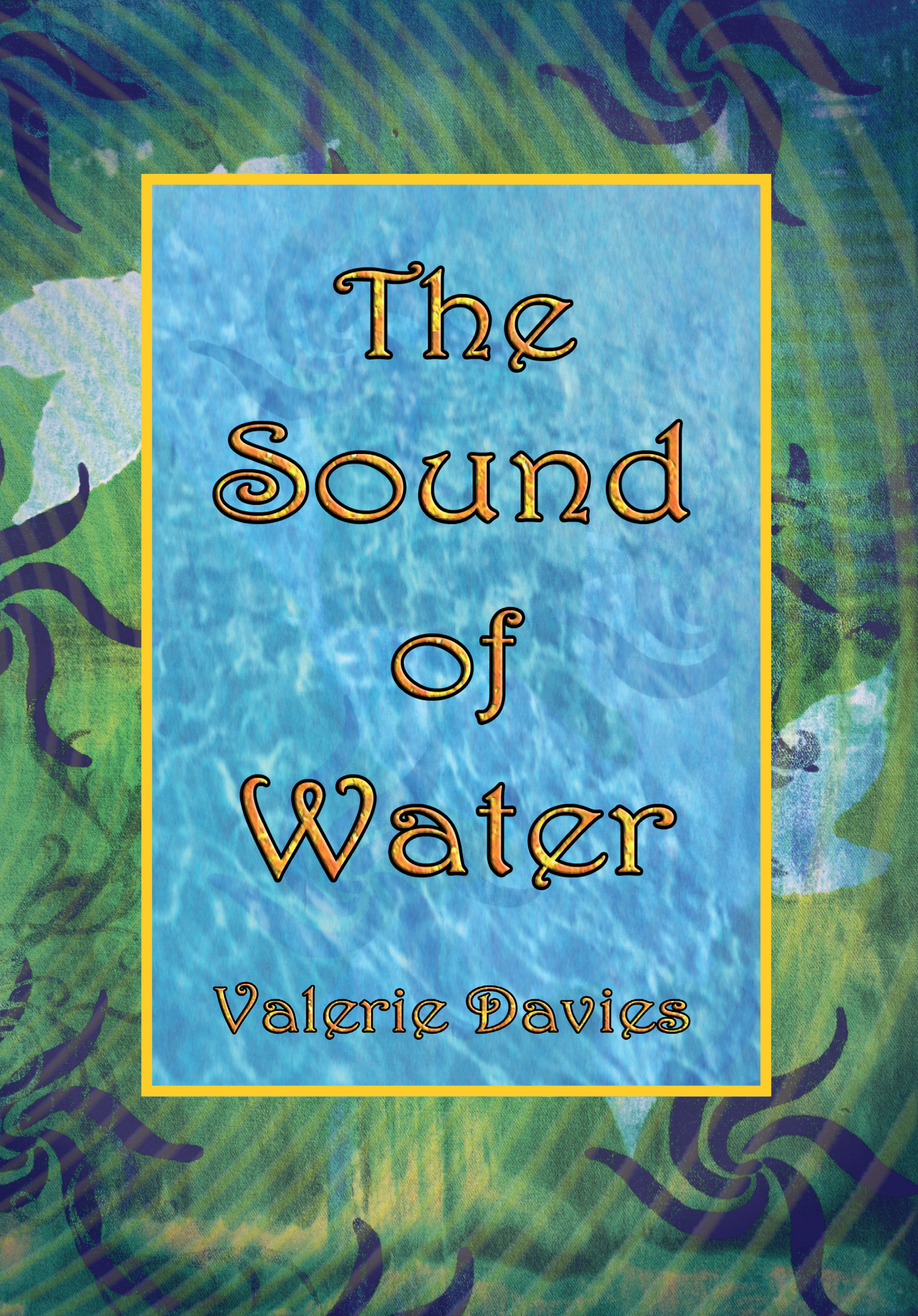
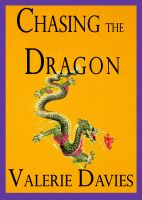
VALERIE DAVIES (Valerie Davies.com) ~ our guest writer today, says she’s had an adventurous life, living through the Blitz in England, growing up in a military family, becoming a captain herself, and marrying into the military. Between one thing and another, she’s been around the world and back and had some truly hair-raising adventures. She’s worked as an editor and columnist. Valarie has been blogging for some time now. Her posts are chatty and full of wisdom and humor. They touch the heart. Valerie books are The Sound of Water and Chasing the Dragon. Find them HERE.
No hesitation to break the silences,
to unite others with his verses, to
pierce sleep with the sharpened lance
of his reason, weaving his stanzas
and schemes into the warp and weft
of a marriage, with a single purpose ~ Peace. He tore at the knotted rhizome
and adventitious roots of hate and
despair, pressing on for the renewed
rootedness of hope and its fresh bright
blooms of honesty and courage, it was
his job to husband the survival of the
most refined proclivities of the heart
He planted his poems as seed in the
fertile ground of our best sensibilities
JAMIE DEDES ~ My worldly tags are poet and writer. For the past five years I’ve blogged at The Poet by Day,the journey in poem, formerly titled Musing by Moonlight. Through the gift of poetry (mine and that of others), I enter sacred space.
The video was uploaded to YouTube by tomasisms and is the work of Andrea Dorfman. The poem was written by Tanya Davis, poet, writer, musician. Thank you to Michael Yost (Michael’s Lair) for sharing this one with us.
I’m beginning to live with future tense
once more expanding my conjugations
to will and shall and verbs like hope the ones
I’ve been afraid to say out loud no sense
tempting the subjunctive when a sequence
of events in future perfect beckons
besieged still by emotional demons
I wobble precariously the pretense
of the conditional implying that
the ground could give way any minute and
I’d be plummeting through the past again
insecure disillusioned railing at
imperfect while trying to stop and stand
on the crust of could-be despite was-then
MARILYNN MAIR~ of Celebrating a Year is known as the “angel of the tremolo” and “the first lady of mandolin”. Marilynn is Professor of Music at Roger Williams University, Bristol, Rhode Island. Her most recent CDs are Meu Bandolim and Enigmatica. Her most recent book is Brazilian Choro – A Method for Mandolin. For more of Marilynn’s story, link HERE. Marilynn Mair is a contributing writer to Into the Bardo.
پاس په كمر ولاړه ګله! نصيب دچايي اوبه زه درخيژومه
O Flower that you grow on the mountain side;
The duty to water you belongs to me, but to whom would you belong?
ستا به د ګلو دوران تير شۍ زما به پاته شۍ دزړه سوۍ داغونه
The blooming season of your beauty will pass;
But the scorched patches on my heart will always remain fresh.
Zarmina’s parents at her grave. She was a poet who died after setting herself on fire. Photo by Seasmus Murphy, 2012, Courtesy of the Pulitzer Center on Crisis Reporting
This month The Poetry Foundation, publisher of Poetry magazine, published its June 2013 issue, Landays. The issue is dedicated entirely to poetry composed by and circulated among Afghan women.
After learning the story of a teenage girl, Zarmina, who was forbidden to write poems and burned herself in protest, poet and journalist Eliza Griswold and photographer and filmmaker Seamus Murphy journeyed to Afghanistan to investigate the impact of the girl’s death, as well as the role that poetry plays in the lives of contemporary Pashtuns. A year later, Griswold and Murphy returned to Afghanistan to study the effects of more than a decade of U.S. military involvement on the culture and lives of Afghan women. In the course of this work, Griswold collected a selection of landays, or two-line poems. These poems are accompanied by Murphy’s photographs from the same period and are presented in the June 2013 issue of Poetry.
My pains grow as my life dwindles,
I will die with a heart full of hope.
A report on death and love by Eliza Grizwold and Seamus Murphy, a project of the Pulitzer Center on Crisis Reporting
Griswold describes the characteristics of a landay in her introduction:
“Twenty-two syllables: nine in the first line, thirteen in the second. The poem ends with the sound “ma” or “na.” Sometimes they rhyme, but more often not. In Pashto, they lilt internally from word to word in a kind of two-line lullaby that belies the sharpness of their content, which is distinctive not only for its beauty, bawdiness, and wit, but also for the piercing ability to articulate a common truth about war, separation, homeland, grief, or love.
Landays are centuries-old custom among Afghans, traditionally passed along in the oral tradition, and passed down through generations. The topics of the landays included in the June 2013 issue run the gamut—love, marriage, war, the status of women, drones, politics, courage, nature, and the Internet. Sometimes humorous, sometimes heartbreaking, these captivating two-line poems offer unique insight into the contemporary life of the more than twenty million Pashtun women who span the border between Afghanistan and Pakistan.”
*****
About Poetry
Founded in Chicago by Harriet Monroe in 1912, Poetry is the oldest monthly devoted to verse in the English-speaking world. Monroe’s “Open Door” policy, set forth in Volume 1 of the magazine, remains the most succinct statement of Poetry’s mission: to print the best poetry written today, in whatever style, genre, or approach. The magazine established its reputation early by publishing the first important poems of T.S. Eliot, Ezra Pound, Marianne Moore, Wallace Stevens, H.D., William Carlos Williams, Carl Sandburg, and other now-classic authors. In succeeding decades it has presented—often for the first time—works by virtually every major contemporary poet.
The entire June 2013 issue is available online as of June 3 HERE. Digital copies of the June issue of Poetry magazine, as well as a digital subscription, are also available.
The June 2013 issue of Poetry is accompanied by an exhibition at the Poetry Foundation gallery in Chicago, Shame Every Rose: Images of Afghanistan, which will feature a selection of Seamus Murphy’s photographs. The exhibition will run from June through August 2013 and is free and open to the public.
About the Poetry Foundation
The Poetry Foundation, publisher of Poetry magazine, is an independent literary organization committed to a vigorous presence for poetry in our culture. It exists to discover and celebrate the best poetry and to place it before the largest possible audience. The Poetry Foundation seeks to be a leader in shaping a receptive climate for poetry by developing new audiences, creating new avenues for delivery, and encouraging new kinds of poetry through innovative literary prizes and programs. For more information, please visit http://www.poetryfoundation.org.
About Everything Afghanistan
“Afghanistan’s recent history is a story of war and civil unrest. A country once prosperous now suffers from enormous poverty, a lack of skilled and educated workers, a crumbling infrastructure, and widespread land mines. It’s being heard about in the news every day but the media approaches this country from its dark side only. Here at Everything Afghanistan we try to show the world the other side of this war torn country. Despite years of bloodshed and destruction, there is still so much beauty that remains unseen.
Here we post about Afghan related things, from politics and events to its culture and traditions. This blog is against the US invasion of Afghanistan.” Amina jalalzei, a.k.a. Vicoden
About Mirman Baheer, the Ladies Literary Society
“Over 300 members of Mirman Baheer, the Ladies Literary Society, stretch across the provinces of Afghanistan. Women write and recite landai, two-line folk poems that can be funny, sexy, raging or tragic and have traditionally dealt with love and grief. For many women, these poems allow them to express themselves free of social constraints and obligations. 5 out of 100 women in Afghanistan graduate from high school, and most are married by the age of 16. This kind of expression is looked down upon in society, forcing the women writing to keep their craft a secret.” The Pulitzer Center on Crisis Reporting
Meetings of the poetry society are held in Kabul, but with 8 out of 10 Afghanistan women residing in rural areas, many women call in to the meetings. Zarmina Shehadi was one of those callers. She lit herself on fire two years ago. Her family denies her suicide, claiming that she lit herself on fire to get warm after a bath. “She was a good girl, an uneducated girl. Our girls don’t want to go to school,” her mother said. Zarmina is the most recent of Afghanistan’s poet-martyrs.
About the Pultizer Center on Crisis Reporting
The Pulitzer Center on Crisis Reporting is an innovative award-winning non-profit journalism organization dedicated to supporting the independent international journalism that U.S. media organizations are increasingly less able to undertake. The Center focuses on under-reported topics, promoting high-quality international reporting and creating platforms that reach broad and diverse audiences. MORE
The Pulitzer Center will present I Am the Begger of the World, a reading and film screening event, on July 30, 2013, at Culture Project in New York City and on Wednesday, July 31, 2013, at the Corcoran Gallery of Art in Washington, DC. Farrar, Straus and Giroux will release I Am the Beggar of the World: Landays from Contemporary Afghanistanin spring 2014.
The primary narrative content for this post is courtesy of The Poetry Foundation.
Examples of Pashto Landay, A form of Afghan poetry courtesy of Everything Afghanistan
“I will die …” Landry courtesy of the Pulitzer Center on Crisis Reporting
Photo credit ~ Seamus Murphy for The Pulitzer Center on Crisis Reporting Video by Seamus Murphy for the Pulitzer Center on Crisis Reporting
If Steve McCurry’s name doesn’t ring a bell, think of the iconic photograph “Afghan Girl” that appeared in National Geographic. He is a world-renowned photographer with a compassionate lense. In this series from his blog (be sure to link through to see it all and to follow him, worthwhile), he shares photographs of working children from around the world. Perhaps when we are tempted to complain about our lives and our fate, we just shouldn’t. This will move all of us. The question is, what will it move us to do? What are prayers and metta practice if they don’t have feet? Jamie
CHARLES W. MARTIN (slpmartin) — earned his Ph.D. in Speech and Language Pathology with an emphasis in statistics. His credentials allowed him to pursue a career that included teaching, research and administration in university settings, treating patients and providing administrative leadership in clinical settings. Charlie worked as a speech pathologist professional in the public schools where he diagnosed and treated communication disorders caused by a wide range of health conditions and contextual factors. Charlie brought passion to each of his professional positions but he was always focused on mentoring his students and improving the quality of life for his clients and patients.
Throughout Charlie’s educational training and career he maintained a devotion to the arts (literature/poetry, the theater, music and photography). He was a published poet before he completed his graduate work. Since his retirement in 2010, he has turned his full attention to his poetry and photography. He publishes a poem and a photographic art piece each day at Read Between the Minds, Poetry, Photograph and Random Thoughts of Life. Charlie has been blogging since January 31, 2010. He is hugely popular for his poetry, his ethic, and his support of other poets and bloggers. His was the first blog I followed when I started blogging and for a long time his was the only blog I followed.
Charlie has self-published a book of poetry entitled The Hawk Chroniclesand will soon publish another book called A Bea in Your Bonnet: First Sting. The Hawk Chronicles is available through both Lulu and Amazon. In The Hawk Chronicles, Charlieprovides a personification of his resident hawk with poems and photos taken over a two year period.
By invitation Charlie has shown his photos in local businesses that display the works of outstanding artists.
In a statement on his blog, Charlie discusses the role of poetry and poems in man’s history:
“Poetry has the power to make us aware of what is hidden in the shadows…those places that we seldom see or want to see…the poet’s voice scrapes away the facade of an issue and lays bare for all to see what has been denied. By providing a voice to these mute realities, poets have throughout history altered the course of events by enlightening readers and encouraging them to take action to stop wars, halt injustice, and to reach out to their fellow man. Like those poets who have proceeded me, I am motivated by the same desire to bring about the social changes necessary to enhance the quality of life for those around me and around the world and to give voice to those who cannot speak for themselves.”
Charlie has contributed to Bardo in the past and joins us now as a part of our core team. On Friday, Charles will introduce Aunt Bea to Bardo readers for the first time. I know you will love Aunt Bea and Charlie.
A warm welcome to the blogosphere’s premier poet of conscience, Charles W. Martin.
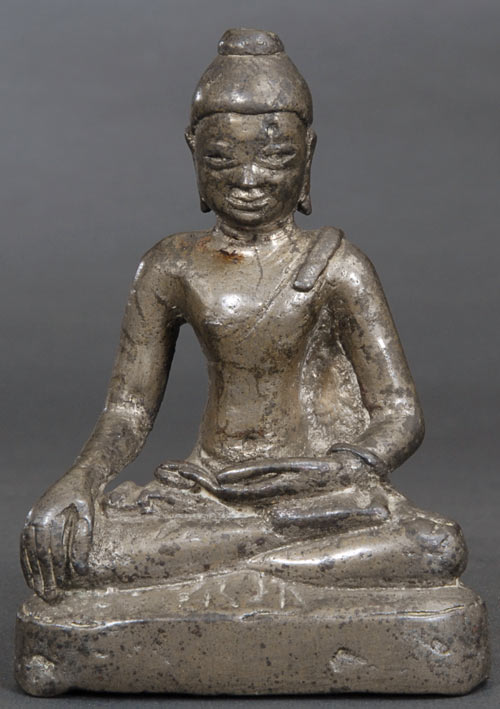
The Buddha’s Birthday, Vesākha, is a moveable feast.
This year it is celebrated on May 25, 2013 in Western Countries.
In Eastern Countries it is celebrated on the eighth day of the fourth lunar month, April 8.
The Buddha’s Birthday is celebrated in different ways:
On Vesākha day, devout Buddhists and followers alike are expected and requested to assemble in their various temples before dawn for the ceremonial, and honorable, hoisting of the Buddhist flag and the singing of hymns in praise of the holy triple gem: The Buddha, The Dharma (his teachings), and The Sangha(his disciples). Devotees may bring simple offerings of flowers, candles and joss-sticks to lay at the feet of their teacher. These symbolic offerings are to remind followers that just as the beautiful flowers would wither away after a short while and the candles and joss-sticks would soon burn out, so too is life subject to decay and destruction. Devotees are enjoined to make a special effort to refrain from killing of any kind. They are encouraged to partake of vegetarian food for the day. In some countries, notably Sri Lanka, two days are set aside for the celebration of Vesākha and all liquor shops and slaughter houses are closed by government decree during the two days. Also birds, insects and animals are released by the thousands in what is known as a ‘symbolic act of liberation’; of giving freedom to those who are in captivity, imprisoned, or tortured against their will. Some devout Buddhists will wear a simple white dress and spend the whole day in temples with renewed determination to observe the eight Precepts.
Devout Buddhists undertake to lead a noble life according to the teaching by making daily affirmations to observe the Five Precepts. However, on special days, notably new moon and full moon days, they observe the eight Precepts to train themselves to practice morality, simplicity and humility.
Some temples also display a small image of the baby Buddha in front of the altar in a small basin filled with water and decorated with flowers, allowing devotees to pour water over the statue; it is symbolic of the cleansing of a practitioner’s bad karma, and to reenact the events following the Buddha’s birth, when devas and spirits made heavenly offerings to him.
Devotees are expected to listen to talks given by monks. On this day monks will recite verses uttered by the Buddha twenty-five centuries ago, to invoke peace and happiness for the government and the people. Buddhists are reminded to live in harmony with people of other faiths and to respect the beliefs of other people as the Buddha taught.
Bringing happiness to others
Celebrating Vesākha also means making special efforts to bring happiness to the unfortunate like the aged, the handicapped and the sick. To this day, Buddhists will distribute gifts in cash and kind to various charitable homes throughout the country. Vesākha is also a time for great joy and happiness, expressed not by pandering to one’s appetites but by concentrating on useful activities such as decorating and illuminating temples, painting and creating exquisite scenes from the life of the Buddha for public dissemination. Devout Buddhists also vie with one another to provide refreshments and vegetarian food to followers who visit the temple to pay homage to the Enlightened One.
Paying homage to the Buddha
Tradition ascribes to the Buddha himself instruction on how to pay him homage. Just before he died, he saw his faithful attendant Ananda, weeping. The Buddha advised him not to weep, but to understand the universal law that all compounded things (including even his own body) must disintegrate. He advised everyone not to cry over the disintegration of the physical body but to regard his teachings (The Dhamma) as their teacher from then on, because only the Dhamma truth is eternal and not subject to the law of change. He also stressed that the way to pay homage to him was not merely by offering flowers, incense, and lights, but by truly and sincerely striving to follow his teachings. This is how Buddhists are expected to celebrate Vesak: to use the opportunity to reiterate their determination to lead noble lives, to develop their minds, to practise loving-kindness and to bring peace and harmony to humanity.
A Dharma Talk, the Practice Is Where You Are At:
Text courtesy of Wikipedia. Photo credits ~ the Buddha by Barbara Stone (The List of Buddha Lists) for The Buddha Gallery and courtesy of the curator of the gallery. Video courtesty of Insight Meditation Center, Redwood City, California, featuring Gil Frondal, teacher.
Don’t ask me how, don’t ask me why
But energy will never die
It merely changes shape and form
Regardless of faith and decorum
All things are bound by this dharma
This my friend is part of Karma
We will die and in death disperse
Seeds upon wind of universe
On what ground those seeds settle and grow
Is something no one can really know
Some say angels with halos and wings
But we know nothing of these things
There is more to elephant than just tusk
And our bodies no more than mortal husk
It is the fruit that it contains
That baffles our little birdbrains
It confounds the fool as it does the wise
Because energy never dies
TIMOTHY JAMES “TJ” THERIEN (Liars, Hypocrites & The Development of Human Emotions) ~ is a guest writer today on Into the Bardo. He has been blogging since November 2012 and has already garnered a significant and loyal following. He says in another poem “I am not a writer … I am possessed by unseen spirit/And my hand is so moved/Words dictated to me by inner voice/Muse speaks when she wants to speak…” That sounds an awful lot like work coming from sacred space. TJ tells us that he was born 1968 in Toronto, Ontario, Canada and current resides in The Eastern Townships, Quebec, Canada. He’s lived briefly in Calgary, Alberta, Canada, and Parry Sound, Ontario Canada. He participates in Poet’s Corner. His “About” is posted HERE.
The leaves of an elm splash
dappled sunlight on the forest
floor. A chill lingers in the
air so we share hot chocolate
from a thermos, pour the creamy
liquid into insulated mugs.
Age does not prevent her
from sprawling on the earth
she loves so passionately.
She leans against the tree’s
stout trunk, says, “I’m yours.”
My mouth is dry like when
the dentist stuffs it full of
cotton rolls. Disbelief numbs
me till she laughs—a sound
as real as songs of her beloved
birds that sing their prayers
in unison from the surrounding
branches and marshy meadows.
“I’m yours,” she says again,
reminding me I’m here to do
the interview I’ve wished for,
nurtured in my imagination
since I discovered her.
“Your life,” I coax, knowing
that but a single word suffices.
As for myself I swung the door open and there was The wordless singing world. And I ran for my life.
“You ran to it?”
“Yes, immersed myself in beauty.” While on and on the sparrow sings.
“And aging? If you don’t mind, that is.”
In the deep fall, don’t you imagine the leaves think how comfortable it will be to touch the earth…?”
…and what shall I wish for myself but, being so struck by the lightning of years to live with what is left, loving.
“Any regrets?”
There wasn’t time enough for all the wonderful things I could think of to do
In a single day…
“If you could choreograph your death?”
…Maybe on a midsummer night’s eve, And without fanfare.
“About death?”
So it is if the heart has devoted itself to love, there is not a single inch of emptiness. Gladness gleams all the way to the grave.
“And after?”
If there’s a temple, I haven’t found it yet, I simply go on drifting, in the heaven of grass and the weeds.
She takes her leave.
I watch her walk across the fields,
stopping to listen
or to follow the flight of a heron.
She’s alone now
with Percy her dog
and memories of having lived well.
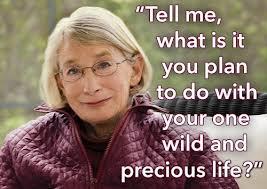
I would do just about anything to spend an hour with Mary Oliver, a poet who has touched my life and my writing so deeply. This is an imagined interview. The responses in italics are all snippets of her poetry chosen from New and Selected Poems, Volume Two.
– Victoria C. Slotto
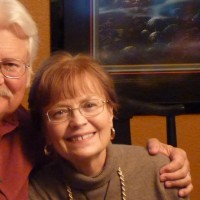
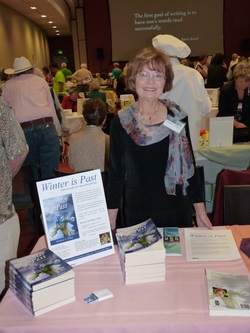
Victoria and Dave SlottoVictoria at the Palm Springs Writer’s Expo March 2012
VICTORIA C. SLOTTO (Victoria C. Slotto, Author: Fiction, Poetry and Writing Prompts) ~ a Contributing Writer to Into the Bardo ,attributes her writing influences to her spirituality, her dealings with grief and loss, and nature. Having spent twenty-eight years as a nun, Victoria left the convent but continued to work as a nurse in the fields of death and dying, Victoria has seen and experienced much. A result of Victoria’s life experience is the ability to connect with readers on an intimate level. She resides in Reno, Nevada, with her husband and two dogs and spends several months of the year in Palm Desert, California.
Winter is Past is her first novel. It was published in 2012 by Lucky Bat Books. She has a second novel in process and also a poetry chapbook. Victoria is also an accomplished blogger and poet who has assumed a leadership role in d’Verse Poet’s Pub. You can read more ofher fine poetry HERE.
The fence we walked between the years
Did balance us serene;
It was a place half in the sky where
In the green of leaf and promising of peach
We’d reach our hands to touch and almost touch the sky,
If we could reach and touch, we said,
‘Twould teach us not to, never to, be dead.
We ached and almost touched that stuff;
Our reach was never quite enough.
If only we had taller been,
And touched God’s cuff, His hem,
We would not have to sleep away and go with them
Who’ve gone before,
Who, short as we, stood tall as they could stand
And hoped by stretching thus to keep their land,
Their home, their hearth, their flesh and soul.
But they, like us, were standing in a hole.
O, Thomas, will a Race one day stand really tall
Across the Void, across the Universe and all?
And measured out with rocket fire,
At last put Adam’s finger forth
As on the Sistine Ceiling,
And God’s hand come down the other way
To measure Man and find him Good,
And Gift him with Forever’s Day?
I work for that.
Short man. Large dream. I send my rockets forth between my ears,
Hoping an inch of Good is worth a pound of years.
Aching to hear a voice cry back along the universal Mall:
We’ve reached Alpha Centauri!
We’re tall, O God, we’re tall!
– Ray Bradbury
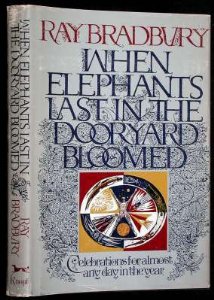
Ray Bradbury’s When Elephants Last in the Doorway Bloomed is a collection of poems in which he writes wistfully about childhood and about inventors, scientist, and explorers, often using religious imagery.
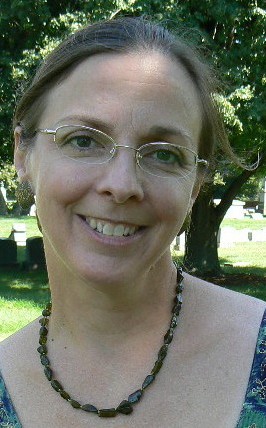
PRISCILLA GALASSO ~ is a new contributor to Into the Bardo. She started her blog at scillagrace.com to mark the beginning of her fiftieth year. Born to summer and given a name that means ‘ancient’, her travel through seasons of time and landscape has inspired her to create visual and verbal souvenirs of her journey.
“My courage is in the affirmation of my part in co-creation”, she wrote in her first published poem, composed on her thirtieth birthday and submitted alongside her seven-year-old daughter’s poem to Cricket magazine. Her spiritual evolution began in an Episcopal environment and changed in pivotal moments: as a teenager, her 20-year old sister died next to her in a car crash and, decades later, Priscilla’s husband and the father of her four children died of coronary artery disease and diabetes in his sleep at the age of 47. Awakening to mindfulness and reconsidering established thought patterns continues to be an important part of her life work.
Currently living in Wisconsin, she considers herself a lifelong learner and educator. She gives private voice lessons, is employed by two different museums and runs a business (Scholar & Poet Books, via eBay and ABE Books) with her partner, Steve.
It is my pleasure to provide a formal introduction to two of the newer members of Bardo’s core creative team:
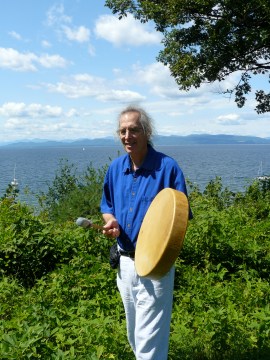
MICHAEL WATSON, M.A., Ph.D., LCMHC (Dreaming the World) ~is a practitioner of the Shamanic arts, a psychotherapist, educator and artist of Native American and European descent. Michael tells us that in childhood he had polio, an event that taught him much about challenge, struggle, isolation, and healing. He shares his personal, professional, and shamanic experiences and insights at Dreaming the World, as well as here at Into the Bardo.
Michael lives and works in Burlington, Vermont, which is nestled snugly between Lake Champlain and the Green Mountains. (He says that most days he can see the Adirondack Mountains across the lake.) He teaches in undergraduate and graduate programs at Burlington College, where he was once Dean of Students. Recently he returned home from teaching in India and Hong Kong.
Michael is mixed blood*, which makes his genealogy “confounding at best.” His father’s father was Native American from the Black Hills (most probably Lakota). His mother was Native American from Indiana, possibly Shawnee. Periodically someone on the distaff side of the family “discovers” their grandmother’s actual tribal affiliation, but “those discoveries tend to morph.”
In attempting to discover family roots, Michael says there are many genealogical stone walls, as befits a family in hiding. His mother’s family identified as hailing from the British Isles, although there were rumors of more recent Cherokee ancestry. “My father said our family is Native on both sides. Mom was from Texas, and both families very aware of the racism Natives face in their respective states. Anyway, my family did not speak much about being Indian and we don’t have tribal affiliation. Identity politics are strong in the United States and being mixed blood teaches one much about living in between easily defined categories.”
In 2002, Michael’s teachers told him he must become more visible and teach. That was not a simple directive to fulfill. He had always been taught that one never calls oneself a shaman or medicine person: only the elders and teachers, and the people one aids, can speak to who is, or is not, a shaman. Traditionally, when asked about being a shaman the appropriate response is, ” My teachers, and my teachers’ teachers, were shamans”. In many native communities, persons who claim to be shamans are highly suspect. “I was taught to always run the other direction when confronted with someone claiming to be a shaman. Yet, the world has changed and I do not live in traditional culture. The time is near when the ancient teachings and healing practices of First Nations people will find their rightful place in the world. My teachers believe it is now important for visionary healers to stand true and straight, to acknowledge our training, and to share the teachings and practices we know.”
* in the United States “mixed blood” usually indicates a mix of European and Native American, not Hispanic or Black.
KAREN FAYETH (Oh Fair New Mexico)~ Writer, blogger, photographer, visual artist: these are all words that can be used to describe Karen Fayeth and her work. A native of New Mexico, Karen moved to the San Francisco Bay Area in 1997 and was immediately inspired and engaged by the vibrant arts community, which is so woven into the local way of life. Karen blends the influences of the cultures where she grew up, including Hispanic, Native American, and the deep rural soul of the American West along with a newer city-sense acquired in places like San Francisco, Brooklyn, Boston, London, Singapore, and San Jose, Costa Rica.
A storyteller at heart, Karen’s main medium is words and writing, but she recognizes that words don’t always tell the tale. Karen expanded her studies to the visual arts including paint, clay, papier-mache and photography. She’s learned to craft stories using a combination of both words and images.
Karen’s been blogging at Oh Fair New Mexico since March of 2007. Her writing is featured in publications including New Mexico Magazine,Wild Violet Literary Magazine, and Foliate Oak. Her photography is regularly displayed as a part of an annual Localvision photography show and she’s received special note for her photographs of well-known baseball players. (She’s an avid baseball fan.) Karen’s won awards for her writing, photography, and crafts. When she is not spinning a tale or clicking her Canon, she works as a senior level executive for a science and research organization. She lives in the San Francisco Bay Area with her husband and her cat, and she can sometimes be found entertaining friends, family, and colleagues with her endearing sense of humor and her San Mateo County Fair blue-ribbon green chile chicken enchiladas. Yes! She even won an award for her cooking.
A crucial ingredient is the right frame of mind
so abandon all ideas of getting on. Stop pedalling,
dismount, go indoors and give yourself masses of time.
Then begin by heating a pool of oil in a frying pan
and, Mrs. Beeton style, take a dozen onions
even though the space you’re working in is smaller
than the scullery in a Victorian mansion. Pull off
the papery wrappings and feel the shiny globes’ solidity
before you chop. Fry the segments in three batches.
Don’t fuss about weeping eyes, with a wooden spoon
ease the pieces as they turn translucent and gold.
When you’ve browned but not burnt the cubes of beef
marry meat and onions in a deep pan, bless the mixture
with stock, spoonfuls of paprika, tomato purée
and crushed garlic. Enjoy the Pompeian-red warmth.
Outside, the sun is reddening the pale afternoon
and you’ll watch as it sinks behind blurring roofs,
the raised arms of trees, the intrepid viaduct.
In the kitchen’s triumph of colour and light the meat
is softening and everything in the pot is seeping
into everything else. By now you’re thinking of love:
the merging which bodies long for, the merging
that’s more than body. While you’re stirring the stew
it dawns on you how much you need darkness.
It lives in the underskirts of thickets where sealed buds
coddle green, where butterflies folded in hibernation,
could be crumpled leaves. It lives in the sky that carries
a deep sense of blue and a thin boat of moon angled
as if it’s rocking. It lives in the silent larder and upstairs
in the airing cupboard where a padded heart pumps
heat, in the well of bed where humans lace together.
Time to savour all this as the simmering continues,
as you lay the table and place at its centre a small jug
in which you’ve put three tentative roses and sprigs
of rosemary. At last you will sit down with friends
and ladle the dark red goulash onto plates bearing
beds of snowhite rice. As you eat the talk will be bright
as the garnets round your neck, as those buried
with an Anglo-Saxon king in a ship at Sutton Hoo,
and the ring of words will carry far into the night.
MYRA SCHNEIDER ~ is a poet, a poetry and writing tutor, and the author of Writing My Way Through Cancer and, with John Killick, Writing Your Self. Her poetry collections, Circling the Coreand Multiply the Moon, were published by Enitharmon Press. She has eight published collections. Her most recent work What Women Want was published earlier this year by Second Light Publications.
Myra’s long poems have been featured in Long Poem Magazine and Domestic Cherry. She co-edited with Dilys Wood, Parents, an anthology of poems by 114 women about their own parents. She started out writing fiction for children and teens. We first discovered Myra through her much-loved poem about an experience with cancer, The Red Dress, which she generously shared with readers here in our Perspectives on Cancer series in 2011.
Currently Myra lives in North London, but she grew up in Scotland and in other parts of England. She lives with her husband and they have one son. Myra tutors through Poetry School, London. Her schedule of poetry readings is HERE.

 JAMIE DEDES ~ My worldly tags are poet and writer. For the past five years I’ve blogged at The Poet by Day,the journey in poem, formerly titled Musing by Moonlight. Through the gift of poetry (mine and that of others), I enter sacred space.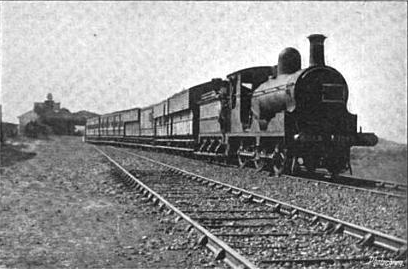













 The BeZine