The BeZine Blog

Posted in Contributing Writer, General Interest, Karen Fayeth

From Father to Son to Daughter

After my dad passed away several years ago, my mom gave me possession of the family collection of photo albums and scrap books, and I made the solemn promise I’d keep them safe.

It was an easy promise because I adore all the family artifacts. As a kid, I used to dive into the scrapbook pages and smile at photos of my hot young mom (she was stunning!) and my smart young dad (he was geeky!).

My mom was a great scrapbooker and I have mountains of artifacts to explore including photos, family letters and souvenirs.

The hand written letters are what I cherish the most. Reading words inked out in the strong hand of my great grandfather on his official stationary gives me a sense of connection to a man I never knew, yet his very DNA is alive within me. I can learn who he was by the choice of language and the surety of his pen stroke.

My grandfather on my father’s side was also a good letter writer. He had a keen sense for telling the mundane facts while inserting a good dose of wry humor. He was close to all eight of his children and since my father had moved a good distance from home, the two stayed close by writing letters.

Among the piles of correspondence I found a gem in an envelope from my grandfather to my father. It was typewritten using carbon paper, so perhaps my grandfather was making copies for all of his kids.

Because the photo (below) of an old letter may be difficult to read, here is what it says:

12 Things To Remember

* *

1. The value of time

2. The success of perseverance.

3. The pleasure of working.

4. The dignity of simplicity.

5. The worth of character.

6. The power of kindness.

7. The influence of example.

8. The obligation of duty.

9. The wisdom of economy.

10. The virtue of patience.

11. The improvement of talent.

12. The joy of originating.

The handwritten bit up in the corner says, “Read weekly, a good guide – Dad”

Such simple words that encapsulate such very strong values. This is endearing fatherly advice to a son and it is timeless. This was written in 1949, but is just as applicable 64 years later.

This advice was passed from father to son, and holding it in my hands it passes again, now from from father to daughter.

This guide has meaning to me and gives me much to ponder as I wade through another busy work week and think about who I am and who I came from.

And who I want to be.

To all fathers and grandfathers, I wish you a very joyful Father’s Day. May your own good words find their way through the generations.

***

© Karen Fayeth, copyright 2013, all rights reserved. The family photo of the author and her father and the image of the letter are covered under copyright. Please be respectful.

webheadshotKAREN FAYETH ~ is one of our regular contributing writers. She is our new tech manager, site co-administrator along with Jamie and Terri, and fiction and creative nonfiction editor. She blogs at Oh Fair New Mexico. Born with the writer’s eye and the heart of a story-teller, Karen Fayeth’s work is colored by the Mexican, Native American, and Western influences of her roots in rural New Mexico complemented by a growing urban aesthetic. Karen now lives in the San Francisco Bay area. When she’s not spinning a tale, she works as a senior executive for science and technology research organization.

Karen has won awards for her writing, photography, and art. Recent publication credits include a series of three features in New Mexico magazine and an essay with the online magazine Wild Violet. Her latest short story will be published in the May edition of Foliate Oak. Karen’s photography is garnering considerable attention, her photo titled “Bromance” (featuring Aubry Huff and Pat Burrell) was featured on MLB Network’s Intentional Talk hosted by Chris Rose and Kevin Millar.

Posted in Essay, memoir, Naomi Baltuck

Mom Always Said…

Hope for the best, expect the worst, and try not to be disappointed.   My mother’s life philosophy was actually pretty upbeat for a kid whose family lost everything during The Great Depression, including her father, who died of Brain Fever when she was only eight.  Grandma Rhea supported her children by sewing and taking in wash.  My mom shared a bed with Grandma, so they could rent out her room to make ends meet.  But they didn’t always quite make it.  In the freezing Detroit winters, they nailed blankets over the windows because they couldn’t afford coal to heat the house.

Their only book was the family bible.  But Mom found a copy of Alice in Wonderland in a box of textbooks left by a renter.  She read it cover to cover.  As soon as she finished, she turned back to the first page and started over.  She had discovered her passion and her escape–in books.

Mom was the first in her family to attend college, working her way through by reading to blind students.  A person of quiet, if impractical passions, Mom passed on normal school and secretarial school to study Classical Greek and Latin, French, German, and Russian.  Italian, too, but she said that hardly counted.  “After Latin,” Mom said, “Italian is a snap.”

I remember going home from college to visit one weekend.  There were index cards by Mom’s reading chair, on the kitchen windowsill, on the nightstand by her bed.  They had strange writing on them.

“It’s Greek,” she explained.  “Passages from The Iliad, by Homer.”

“Why?” I asked.

“I’m memorizing it,” she said.

“But why?”

“For fun, dear.  After I’ve memorized The Iliad, I’m going to memorize The Odyssey.”

As a young college grad, she had never shown any interest in men, and was still living at home while working for the War Department.  Grandma planned on having a spinster daughter to keep her company in her old age, unaware that Mom had already promised herself she would move out and find a place of her own by her 25th birthday, if she hadn’t gotten married by then.   Mom just hadn’t met her intellectual equal.  Then Harry Baltuck came along.

He was handsome, funny, brilliant; every woman in the office had her eye on him.  But he had eyes only for Mom.  She was so nervous on their first date that she threw up in his car.  Actually, she threw up every time they went out.  “But he kept coming back,” she said, laughing.

He was intrigued, and not just because she was determined to remain a virgin until her wedding night.  It was a very quick courtship.

His proposal wasn’t exactly story book.  “Well, what if we made it legal?” he asked.

“Would you wear a ring?” she countered.  And the rest is family history.

They traveled many peaks and valleys in their time.  They had seven children and eighteen years together.  She was still young when widowed, and Mom received several proposals from Daddy’s friends and army buddies; some decent and well-intended, others not so much.  But Mom didn’t take anyone up on his offer.  She never remarried, or even dated.  Books, once again, became her passion and her escape.

In 1989, I sat at her bedside as she lay dying of cancer.  It had been a long hard battle.  Mom looked up and caught her breath.  “Harry,” she whispered.

“What did you say, Mom?” I asked.

“Harry!”  She pointed toward the door, but I saw nothing there.

“Mom, do you see someone?”

“It’s Harry,” she said, nodding.  “He’s standing right there.”

Was it the delusion of a dying woman?  Or the love of her life, who had been patiently waiting for twenty-five years to take her home?

Let’s hope for the best.  Just like Mom always said, you have to hope for the best.

All images and words c2012 Naomi Baltuck

NaomiPHOTO1-300ppi51MC3SKEF0L._SY300_NAOMI BALTUCK ~ is a Contributing Editor and Resident Storyteller here at Bardo. She is a world-traveler and an award-winning writer, photographer, and story-teller whose works of fiction and nonfiction are available through Amazon HERE. Naomi presents her wonderful photo-stories – always interesting and rich with meaning and humor – at Writing Between the Lines, Life from the Writer’s POV.

Naomi also conducts workshops such as Peace Porridge (multicultural stories to promote cooperation, goodwill, and peaceful coexistence), Whispers in the Graveyard (a spellbinding array of haunting and mysterious stories), Tandem Tales, Traveling Light Around the World, and others. For more on her programs visit Naomi Baltuck.com

Posted in Essay, Michael Watson

To Err is Human

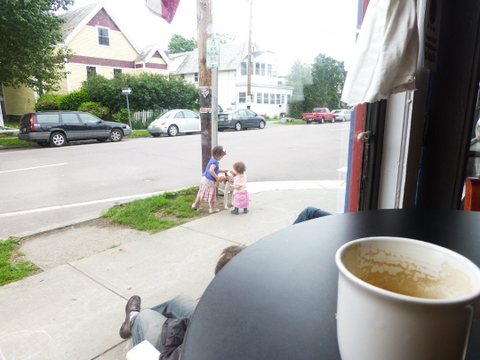
Window ViewThis morning I was driving home from one of our favorite bakeries via a well trodden, quietly residential route, one I have walked and driven for more than thirty years. I was lost in thought and focused on the many speed bumps that inhabit that street. I was thinking that the latte had been suburb, and the new pastry way too sweet and most likely going to suppress my immune system for hours. Suddenly I was aware I had run a stop light; seemingly the light had sprung up overnight in the middle of a block.

The light is long overdue and should aid elementary school students cross the sometimes busy street in route to their school. Yet, motorists are not warned of a new light, and the light itself is partially obscured by overhanging branches. (Often the city puts up warning signs for motorists approaching new stop signs and lights.) The light seems an excellent example of a well conceived project inadequately implemented.

I missed the light, in part, because, as I drove down the empty street  I was thinking about writing a post for this blog. Familiarity with the way, and a downward sighted focus on the speed bumps added to the problem. Yet, ultimately, I was a distracted driver and I drove through a red light. Clearly, my responsibility.

I imagine that most of us are doing our best to be kind and attentive to the needs and demands of life. We imagine we have things under control, forgetting our attention is divided, and the ease with which mistakes occur. How often our attention fails and we miss whatever might be important in the moment. How frequently do we become angry with others for doing the same?

Here is a paradox: maybe we take ourselves too seriously. Perhaps we would be happier were we to substitute humor for anger, playful reconsideration for aggression. Humor and playfulness support our presence in the moment and encourage us to forgive one another and ourselves for our misses.  Yes, driving is crucial business, requiring all our facilities and best judgement. Many other tasks are also decidedly important, demanding seriousness of purpose and focus. Yet, we are going to err. Most of the time a bit of laughter is more supportive of learning than is self criticism. A light heart seems to aid the brain in becoming more skillful.

The fretful side of me wonders what other hazards lurk in the midst of well trodden, usually safe paths. Those voices urge focus and attention, reminding me of the real consequences of grave mistakes. Other voices remind me few mistakes are truly harmful. They encourage breath and play, humor as well as focus. Both points of view are important in a world of hazards. I’m wondering where the balance between them lies. What do you think?

– Michael Watson

© 2013, essay and photographs (includes portrait below), Michael Watson, All rights reserved

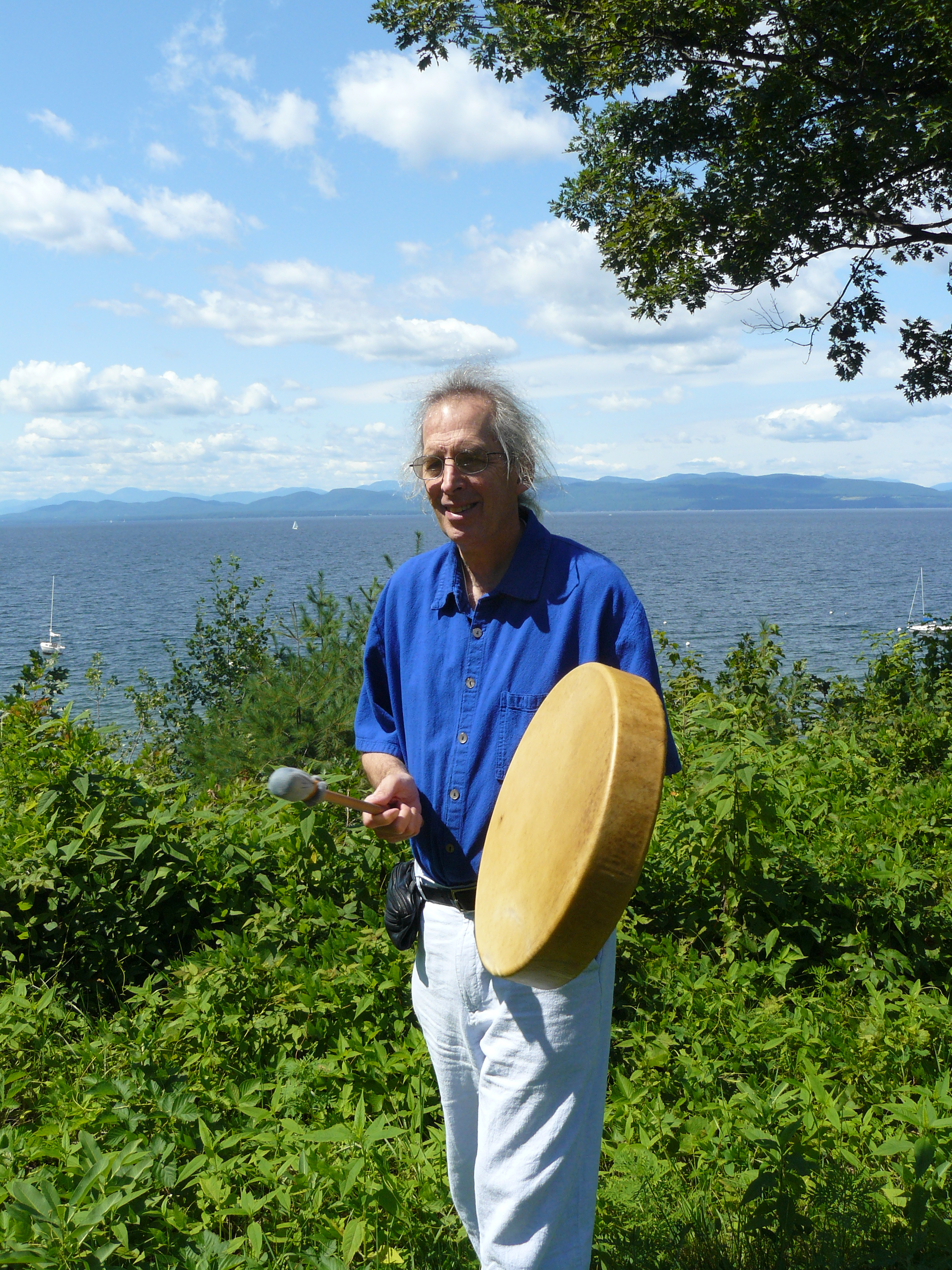
michael drumMICHAEL WATSON, M.A., Ph.D., LCMHC (Dreaming the World) ~ is a contributing editor to Into the Bardo, an essayist and a practitioner of the Shamanic arts, psychotherapist, educator and artist of Native American and European descent. He lives and works in Burlington, Vermont, where he teaches in undergraduate and graduate programs at Burlington College,. He was once Dean of Students there. Recently Michael has been teaching in India and Hong Kong. His experiences are documented on his blog. In childhood he had polio, an event that taught him much about challenge, struggle, isolation, and healing.

Posted in Art, Music, Video

An Homage to Van Gogh

Van Gogh paintings come to life through advanced digital editing techniques by Luca Agnani. The music is by Ludovico Einaudi. Thanks to Naomi Baltuck (Writing Between the Lines and Into the Bardo) for bringing the gift of this video to us.

The Wisdom of Vincent:

“The more I think about it, the more I realize there is nothing more artistic than to love others.”

“When I have a terrible need of – shall I say the word – religion. Then I go out and paint the stars.”

“But I always think that the best way to know God is to love many things.”

“The fishermen know that the sea is dangerous and the storm terrible, but they have never found these dangers sufficient reason for remaining ashore.”

*********

Vincent Van Gogh certainly painted and wrote (we have his letters to his brother) from sacred space and perhaps no one has acknowledged that more gracefully or gratefully than Don Mclean in his song ~

Starry Starry Night

Starry, starry night.
Paint your palette blue and grey,
Look out on a summer’s day,
With eyes that know the darkness in my soul.
Shadows on the hills,
Sketch the trees and the daffodils,
Catch the breeze and the winter chills,
In colors on the snowy linen land.

Now I understand what you tried to say to me,
How you suffered for your sanity,
How you tried to set them free.
They would not listen, they did not know how.
Perhaps they’ll listen now.

Starry, starry night.
Flaming flowers that brightly blaze,
Swirling clouds in violet haze,
Reflect in Vincent’s eyes of china blue.
Colors changing hue, morning field of amber grain,
Weathered faces lined in pain,
Are soothed beneath the artist’s loving hand.

Now I understand what you tried to say to me,
How you suffered for your sanity,
How you tried to set them free.
They would not listen, they did not know how.
Perhaps they’ll listen now.

For they could not love you,
But still your love was true.
And when no hope was left in sight
On that starry, starry night,
You took your life, as lovers often do.
But I could have told you, Vincent,
This world was never meant for one
As beautiful as you.

Starry, starry night.
Portraits hung in empty halls,
Frameless head on nameless walls,
With eyes that watch the world and can’t forget.
Like the strangers that you’ve met,
The ragged men in the ragged clothes,
The silver thorn of bloody rose,
Lie crushed and broken on the virgin snow.

Now I think I know what you tried to say to me,
How you suffered for your sanity,
How you tried to set them free.
They would not listen, they’re not listening still.
Perhaps they never will…

Starry Starry Night, Don Mclean, All rights reserved

Posted in Contributing Writer, Paula Kuitenbrouwer

Mindful Drawing to Me

p3237471

the work of Paula Kuitenbrouwer

Many of us know what mindfulness is, but what is mindfully drawing? How can a beginner start with mindfully drawing?

In ‘The Zen of Seeing, seeing/drawing as meditation’, Frederick Franck describes drawing as ‘The Way of Seeing’, as a way of meditation, a way of getting into intimate touch with the visible world around us, and through it…with ourselves’.

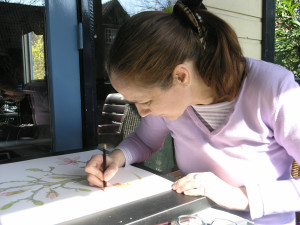
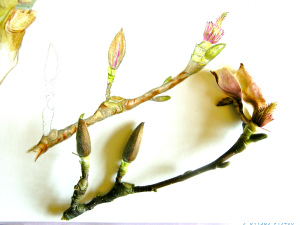
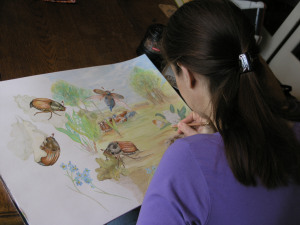
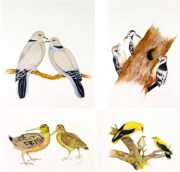
That is how I view mindfully drawing too. But there is more. In ‘The Zen of Seeing’, Franck is not concerned about the end product. I am, but I don’t feel this concern is impeding my drawing meditation. I carefully prepare my drawing session by laying out all the tools. I think long about what I want, and I pay attention to the composition. I also do research, because I like to know what I am drawing. When I draw a bird, I study that bird in real as well as with the helps of books. When I draw a flower, I have it seen in nature or it is right before me on my table. I read about the flower, and I like to study and know its Latin name. The same counts for bugs: I do not draw any bug I haven’t seen or studied. I need a connection of seeing and knowing my object. Only then I can picture my object in a habitat, a scene, and give it a proper background and let my drawing tell a (short) story that is accurate.

Click on the drawing to see it enlarged.

Mindfully drawing is an active meditation. It keeps my hands busy but it brings a calm mind. That is because when I draw, I open my eye and my inward eye. My eyes study the objects and my emerging drawing. I am never hurried. Ask me anything during my blissful moments of mindfully drawing and you will get a peaceful and kind answer.

Click on this photograph to see the drawing in progress.

My portfolio of mindful drawings is HERE.

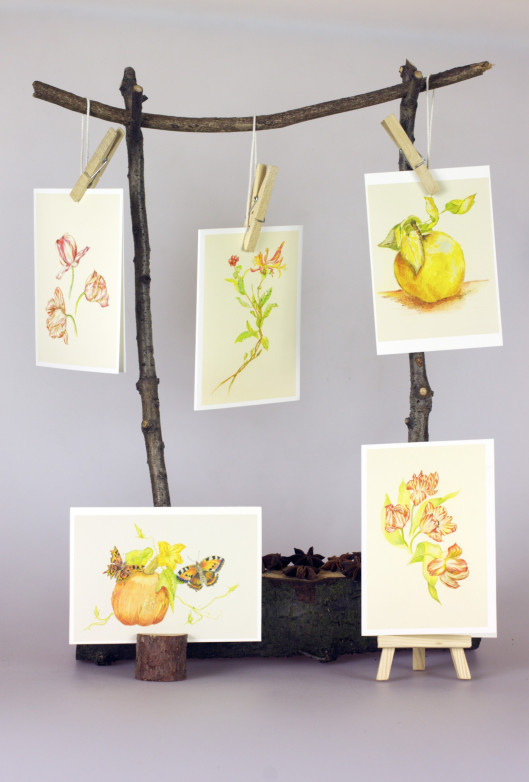
Here are some of my fine arts drawings made into cards.

mg_44141

– Paula Kuitenbrouwer

© 2013, essay, artwork and photographs, Paula Kuitenbrouwer, All rights reserved

birdcardsPAULA KUITENBROUWER ~ is a Dutch nature artist living The Netherlands and sharing her work with us on her blog, Mindful Drawing and on her website.   In addition to art, Paula’s main interest is philosophy. She studied at the University of Utrecht and Amsterdam. She has lived in Eastern Europe and in Asia. Paula says that in Korea, “my family lived next to a Buddhist temple. In the early morning we would hear the monks chanting. During my hours of sauntering with my daughter through the beautiful temple gardens, I felt a blissful happiness that I try to capture in my drawings.” Paula sometimes teaches children’s art classes. She lives with her husband and daughter and close to her father. She has designed some special cards and gifts for Father’s Day HERE.

Posted in Essay, Nature, Photography/Photographer, Spiritual Practice, story, Story Telling, Photo Story, Terri Stewart

One Foot in Front of the Other

Walking is a spiritual practice that I am predisposed to. After all, photography would not happen unless I walked around! Simply putting one foot in front of the other, time after time, without expectation of arrival at an end point is a contemplative practice. Recently, though, I discovered a new way of viewing walking as a contemplative practice. This practice had an end point and I was completely aware of all the w’s – who, what, when, where, why. I was not letting go and receiving images (well a little). I was literally focused on my feet and putting my feet, one step at a time, on stable ground.

And this is a metaphor. Sometimes, sitting at our desk or listening to our loved ones, can be a practice of just being aware of what is now and putting your best effort towards arriving at the next now. One step at a time.

As you continue reading, consider the questions, “In what area of my life can I start (or continue) putting one foot in front of the other? What new story will be created?

Here is my story.

Monday, I went hiking to Bridal Veil Falls / Lake Serene in the Central Cascade mountains of Washington. It was a spectacular day. (The weather is forecast to be fabulous all week-long in Seattle leading me to believe somebody is playing with our emotions.) I felt confident I could do the +7 mile hike. BUT I forgot to look at the way the path is (smooth vs. rocky) and the grade or “up-ness.”

I started out on the popular path and asked a co-hiker what to expect and she told me it was steep but that it was worth it. And that there were a lot of switchbacks. OK. I can do this! I will just take my time and be careful.

In February of this year, I was going through a diagnosis of Celiac disease. Now most folks just think that this is digestive only. Well, it is not. It causes inflammation in every part of my body. It grew tumors in my ovaries. I had a period for 3 weeks. I was severely anemic. The test didn’t say, “Low,” it said “Alert!” I could not walk up a short hill without being severely out of breath because I had very few mature red blood cells to carry oxygen around. In short, it stank.

And, over the last few years I have had surgery on my left ankle (torn tendon) and my right foot (two! neuromas crowding out my middle toes). I couldn’t walk without pain until, oh, last year after the neuroma surgery. Generally, I count every pain-free step a success. Would my feet hold out? Always a question. And with the ankle surgery, I generally look for nice, solid, flat ground so my ankle will not roll.

Rats! This path is not smooth. Very rocky. Wet sometimes. Muddy sometimes. But mostly rock, rock, rock. Keep my eyes down and make sure my feet land on flat spots! That’s the plan.

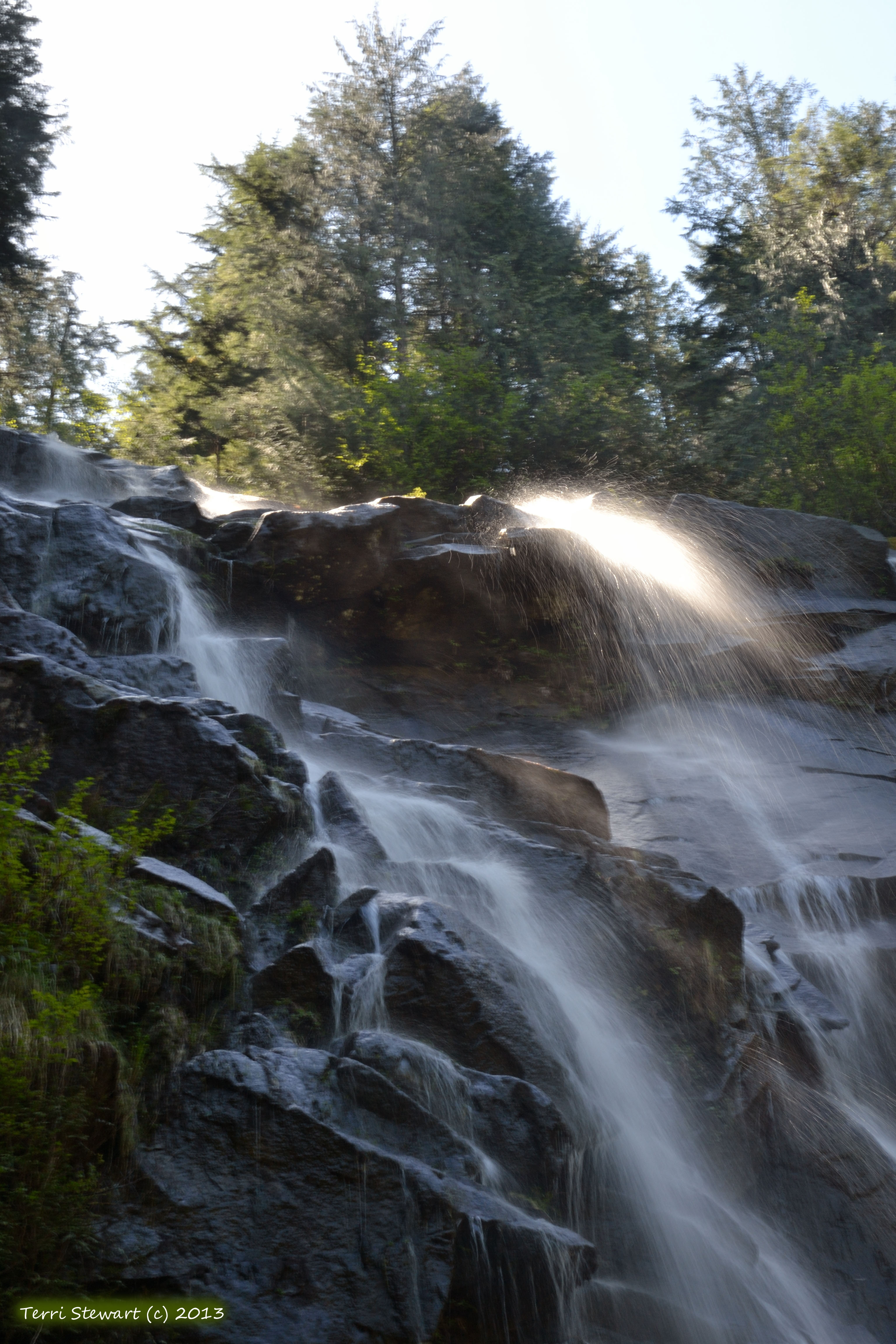
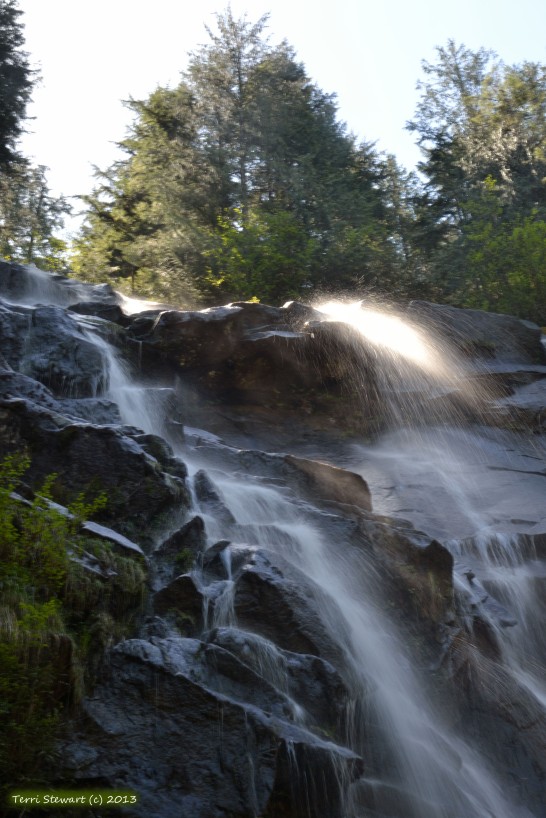
Anyway, I started up the path at my own pace. I got a little less than two miles in and found the below sight. I tried really hard to capture this thing that was happening with the sun and the water! It looked like liquid sunshine was pouring off the top of the waterfall. My eyes received the beautiful image of sunshine being poured down the mountain, could my camera receive it? A little.
Walkabouts__2013-06-03_12-05-17

At any rate, it was astounding. And it was the second set of falls I had seen. This mountain is one big slab of granite! (Hence the rocky path) And there is water everywhere. Well, okay, not everywhere, but in a lot of places. It was hard to get a good picture, but earlier, there was a set of falls that were very tall and jagged. But the trees were very overgrown so you could only get glimpses of the splash of light and water. This is the very bottom of that series. I received beautiful images of flowing water.

Walkabouts__2013-06-03_16-17-40

I got past the falls and it was two miles to Lake Serene. I was feeling good so decided my body could do this! I kept on going. And going. Up and up. Picking my way carefully through rocks. Resting when I felt overwhelmed. Then there came a moment when I thought that I was not going to be able to do it. I grounded my feet to the earth and drew on the strength of my God and the strength of the earth. I breathed deeply. This had become a spiritual quest.

I kept on going. But at that moment, I felt like giving up. I soon encountered a woman and her dog. They were resting. (Yay for rest!). I asked her how much further. She said, “When you feel like you have been through the worst possible climb, then it is just a bit more up and a little down and you’re there.”

OK. The worst possible climb. I can surely get to this.

I went up and encountered massive rocky path, with only about a 9″ clearance to skinny through. Surely, this is the worst possible spot.

I kept going and encountered another massive rocky path, with water and slipperiness. Surely, this is the worst possible spot.

Add water and repeat.

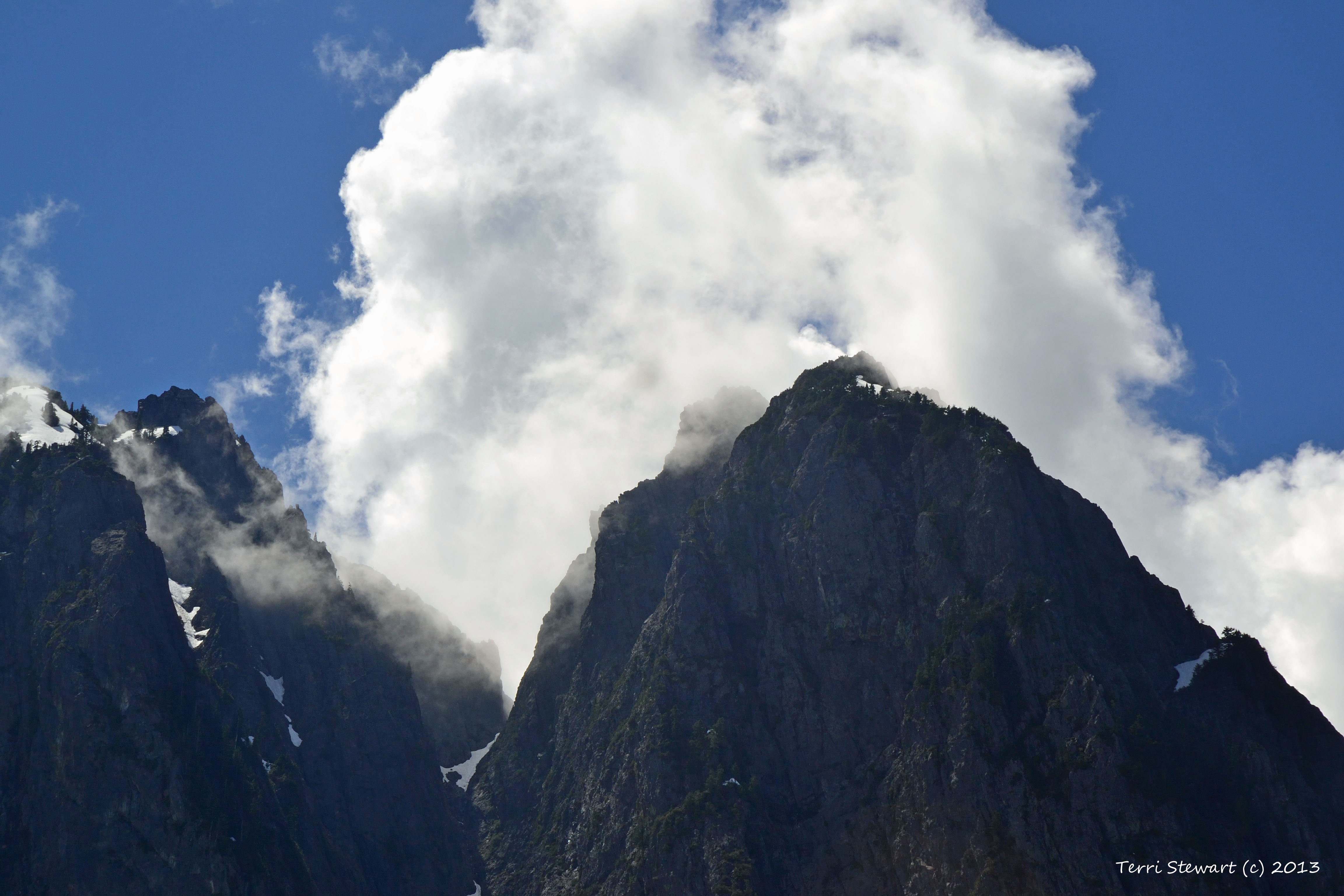
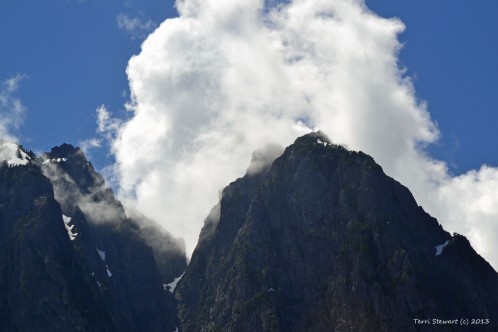
Finally, I broke through the shadows of the forest into a sunny meadowy type area (is it a meadow if it is on the side of a mountain?). I looked up and my breath left my body. It. Was. Amazing. I received the most beautiful blues intermingled with a dark granite mountain and white fluffy clouds rising like steam. I remember the story of Moses going up the mountain to be with his God and going into the cloud. This is a place to connect with spiritual strength. I felt strengthened, encouraged, excited, and alive. A complete contrast to how I felt when I was in the shadows.
Walkabouts__2013-06-03_13-56-59

I was now in the sun, with this incredible sight, having passed through at least 5 stretches of the worst climb ever. And I saw another worst climb ever in front of me. But my spirits were jubilant. I was in the light and had left the darkness. Amen!

I kept on going. There was one more seriously worst climb ahead and then I was there. Lake Serene.
Walkabouts__2013-06-03_14-25-52

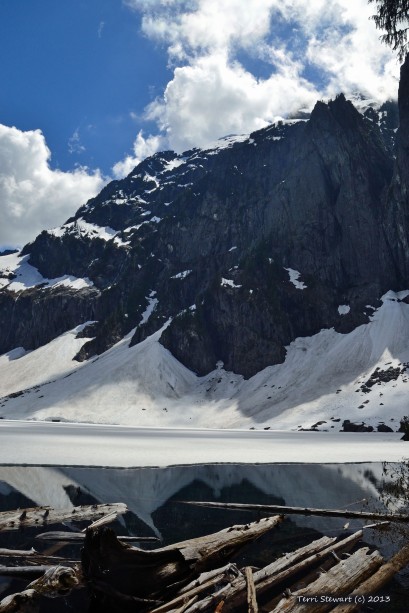
In fact, this lake feeds into the waterfalls pictured earlier. I had climbed all the way around to the other side. Here is what the top of the waterfall looks like from this same point, just facing the other way.

Walkabouts__2013-06-03_14-25-23

I clambered through the snow a bit and sat at the closest point I could get to the top of the waterfall. Ate lunch. Relaxed a moment.

Time to head back down. Surely, down would be easier! It always is. Mostly.

On the way down, I kept my head down looking to keep my feet planted so my ankle will not turn. I almost made it. Darn it. One misstep and a turned ankle. Choice – fall in a way to minimize injury or try to get that wobbly ankle to hold me up. Quick decision – my ankle will not withstand the effort to stay firmly up. Fall it is! Sheesh. I hate rocky, downhill, paths. Now, cuts and bruises, scratches and blood. I would hate to see what I looked like.

I crossed back in front of the amazing waterfall that poured sunshine and the woman I had met earlier was there with her dog! She was resting. Her dog decided to try to clean up the scratches on my legs a bit (ha ha!). We chatted a bit and she moved on. I stayed and tried to get some more photos of the falls and take a rest. Oh, and to use the water to wash my arm which has a pretty serious scratch(es).

But, gosh darn it, I did it! I am still on the path. I can still walk. My body is sustaining me. This is such a big deal, you have no idea. I was misdiagnosed for at least 20 years. To be able to do this is the most awesomely amazing thing ever. My muscles don’t even hurt as much today as they did on days the inflammation from being celiac made them hurt. (That was a bad sentence, sorry.)

I kept going. And I made it back to my car by about 5:00 p.m.

The quest was complete.

I am proud that I had the perseverance to keep on pushing through. My blood tests still say “alert” on the iron portion, but it is improving. My ankles and feet are okay today. My right arm and right shin are pretty banged up, but as long as nobody touches them (!) I will be fine.

The return hike took 2 hours. It took me 4 hours to go up.

Walking or hiking as a spiritual practice, for me, is typically about opening myself up to the images around me. Receiving images that I sometimes share here or on my blog. This time, though, it transformed into something else. Instead of receiving the beauty around me, I had to dig deep to connect to the strength of the earth, strength of my faith, and to the strength in my own body in order to find sustenance for the journey. This is a new kind of spiritual practice for me.  I had thought, Monday night, that I would not be eager to repeat this experience. But I am. Focusing on putting one foot in front of the other in this way gave me a faith in myself that I sometimes lack. Especially in my own body’s ability to sustain me. That is my new story. I trust my body.

Blessed be.

Shalom and Amen.

~Chaplain Terri

Adapted from a post at my blog. Trials on the Trail.

© 2013, post & photos, Terri Stewart, All rights reserved

terriTERRI STEWART is Into the Bardo’s  Sunday chaplain, senior content editor, and site co-administrator. She comes from an eclectic background and considers herself to be grounded in contemplation and justice. She is the Director and Founder of the Youth Chaplaincy Coalition that serves youth affected by the justice system. As a graduate of Seattle University’s School of Theology and Ministry, she earned her Master’s of Divinity and a Post-Master’s Certificate in Spiritual Direction with honors and is a rare United Methodist student in the Jesuit Honor Society, Alpha Sigma Nu. She is a contributing author to the Abingdon Worship Annual.

Her online presence is “Cloaked Monk.” This speaks to her grounding in contemplative arts and the need to live it out in the world. The cloak is the disguise of normalcy as she advocates for justice and peace. You can find her at www.cloakedmonk.com, www.twitter.com/cloakedmonk, and www.facebook.com/cloakedmonk.  To reach her for conversation, send a note to cloakedmonk@outlook.com

Posted in Essay, Guest Writer

The Noble Art of Reading in Bed

100_0088cropped-bedroom

the work of Valerie Davies

When I was young and naive, and a novice journalist, I wrote an article in a woman’s magazine which began:’ I got most of my education under the bed-clothes’, and went on to discuss children’s reading. Some wag must have been reading his wife’s copy, and the clipping appeared on the office notice-board amid crude male guffaws. Thank you chaps, I got the message. Not a quick learner, but I got there in the end.

Reading under the bed – clothes was the refuge of a child who was sent to bed at seven o clock every night, and allowed to read for fifteen minutes. Fifteen minutes! When I got older, and had more homework bed was set back to seven thirty, but the fifteen minute reading restriction still applied. Only a non-reader could have stipulated this ridiculous time limit, so under the bed-clothes it was. When I had no torch I knelt for hours, freezing in my night-clothes squinting to read by the crack of light under the door from the hall light.

Occasionally I tried the loo or the bathroom, but this was risky, as books aren’t easily hidden by a skinny child under a thin nightie. When I was fourteen I picked up Jane Eyre in the library. It exploded into my consciousness. I felt dazed and obsessed by the strange, compelling self-centred story. I could think of nothing else. I read it over and over again. I read it under the desk at school, in the bus and on the train, and of course, in bed.

Once the parents had gone to bed, I switched my light on with impunity, and read until I had finished Jane Eyre, and then started ‘Villette’, by which time it was heading for five o clock in the morning. Since I had to get up at six to cook my breakfast and catch the school bus at seven am, it seemed safer to stay awake, and soldier on. And having done it once, and finding it was possible to keep going without sleep, I quite often sacrificed my sleep for a good book after that.

Boarding school was tricky, but once again, there was always the bathroom. When I left home and became my own master, reading in bed became one of my favourite pastimes. Mostly literature and poetry in those palmy days. And usually then I had a bowl of apples to munch meditatively as the hours went by, or better still, a bar of chocolate. Sometimes decadence overcame me and I had a glass of lemonade. Marriage and motherhood dished all that of course, and reading in bed became a distant remembered pleasure.

But in the last few years since my husband’s snores have become so loud they wake me even when I’m sleeping in another room, we’ve taken a page out of the Royal Family’s domestic habits, and now sleep in separate rooms. This means I can read without disturbing him, and I’ve raised this noble pastime to a fine art.

Usually three books go to bed with me… something that I call mental knitting, a relaxing series like Georgette Heyer, (a much under-rated, very funny, witty and clever writer) or other light-hearted books like the hilarious Adrian Mole Diaries, or ‘The Jane Austen Book Club’. Georgette Heyer is sort of Jane Austen lite – but the blessed Jane is also a regular companion, along with the Thomas Hardy’s, George Eliot’s, Anthony Trollope’s, to re-read for the sheer pleasure of enjoying their writing again. In theory too, because I know the story, I kid myself I won’t be tempted to read too late. But that is a false premise. And as CS Lewis said, ‘I can’t imagine a man really enjoying a book and reading it only once.’

And then there’s the third category – those which are on the go, sometimes a new novel – Barbara Kingsolver at the moment, but not many of those – a biography, a history, a diary. And for real relaxation I sink into nature journals, often a classic like Flora Thompson’s: ‘Lark Rise at Candleford’ … Annie Dillard, Henry Beston or Ronald Lockley… mostly accounts of gentle, unpolluted country life.

But reading in bed isn’t just books. The bed matters too… preferably by the window… in summer with cool white linen-cotton blend sheets that have a silky feel, in winter comforting coloured flannelette to match the duvet. Pillows – plenty of them, to lean back on and others to support the elbows. Electric blanket a must in cold weather… I use it a bit like the hot tap in the bath… whenever it seems a bit chill, I switch it on until the bed is like toast again, and then prudently switch off again until the next time.

In summer, there’s the bliss of going to bed in day-light, knowing you have hours in front of you before dusk creeps up, before finally switching on the light. In winter, lamps on, curtains pulled, wood fire still burning in the sitting room to keep the house warm for when I emerge to make a cup of tea. And the bed, pyjamas warmed under the bed clothes on the electric blanket, cosy sheets and pillow slips, red mohair rug edged with wine-red satin, and a stash of peppermints to slowly chew as I turn the pages. No sounds, just the murmur of the soft sea, a distant owl, and occasionally a scuffle on the roof as a possum scrambles across. The sound of rain on the roof is good too.

The art of reading in bed is a silent, sybaritic, solitary joy and has nothing to do with going to sleep. It has everything to do with the pleasure of reading, frequently to the detriment of sleep. So I have to confess, in the words of L.M.Montgomery that : ‘I am simply a ‘book drunkard.’ Books have the same irresistible temptation for me that liquor has for its devotee. I cannot withstand them.’

– Valerie Davies

© 2013, essay, photograph, and portrait (below), Valerie Davies, All rights reserved

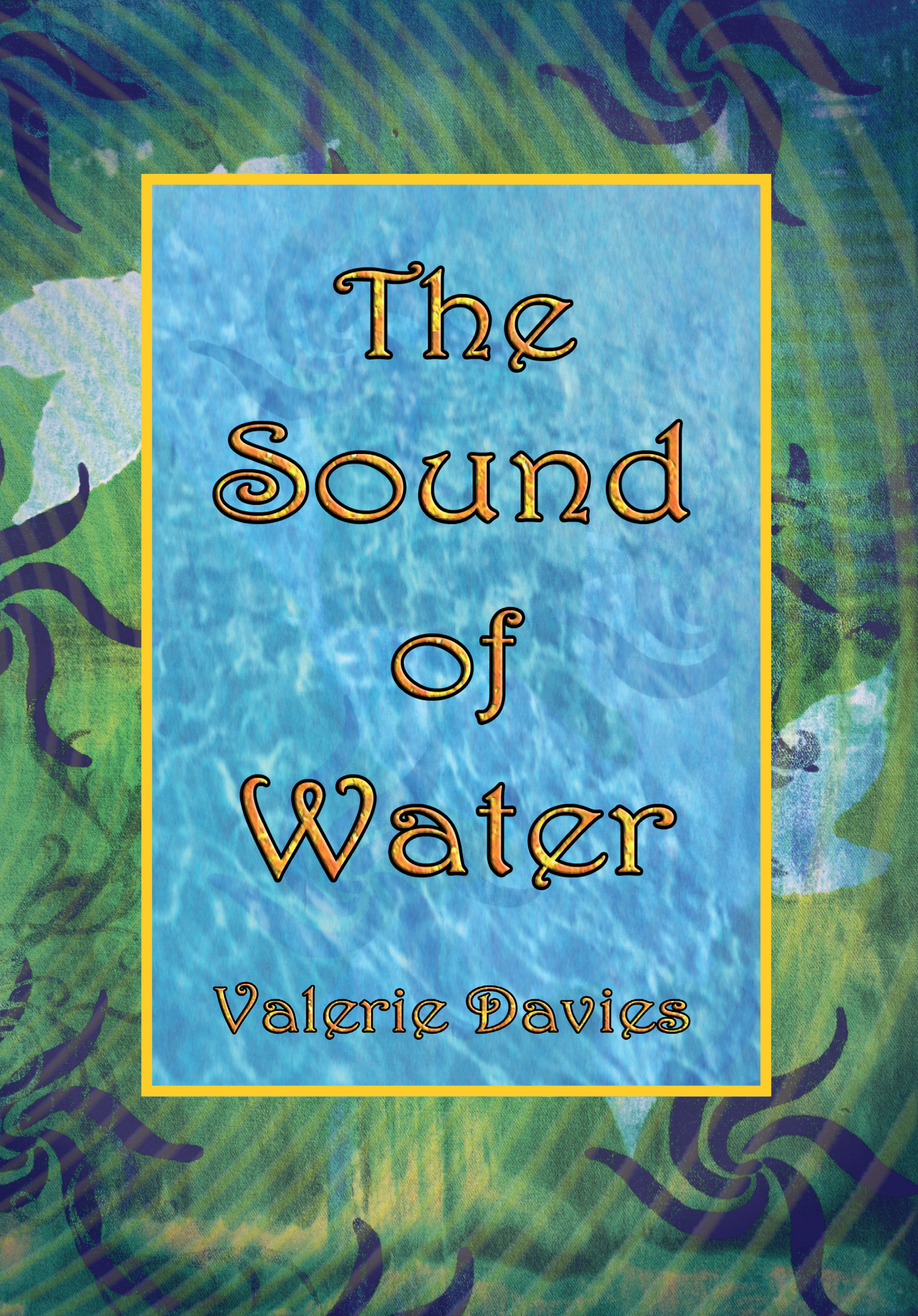
100_036634d750b1228d96f442911457fa49f7d5d3e2d8ea925f4a2067aec04be59b0e280856da42aad7d73b-thumbVALERIE DAVIES  (Valerie Davies.com) ~ our guest writer today, says she’s had an adventurous life, living through the Blitz in England, growing up in a military family, becoming a captain herself, and marrying into the military. Between one thing and another, she’s been around the world and back and had some truly hair-raising adventures. She’s worked as an editor and columnist. Valarie has been blogging for some time now. Her posts are chatty and full of wisdom and humor. They touch the heart. Valerie books are The Sound of Water and Chasing the Dragon. Find them HERE.

Posted in Jamie Dedes, Poems/Poetry

The Poet

478px-The_BardNo hesitation to break the silences,
to unite others with his verses, to
pierce sleep with the sharpened lance
of his reason, weaving his stanzas
and schemes into the warp and weft
of a marriage, with a single purpose ~
Peace. He tore at the knotted rhizome
and adventitious roots of hate and
despair, pressing on for the renewed
rootedness of hope and its fresh bright
blooms of honesty and courage, it was
his job to husband the survival of the
most refined proclivities of the heart
He planted his poems as seed in the
fertile ground of our best sensibilities

– Jamie Dedes

© 2013, poem, Jamie Dedes, All rights reserved
Illustration ~
The Bard by John Martin (1789-1854), English romantic painter and engraver, via Wikipedia and in the U.S. Public Domain.

Photo on 2012-09-19 at 20.00JAMIE DEDES ~ My worldly tags are poet and writer. For the past five years I’ve blogged at The Poet by Day,the journey in poem, formerly titled Musing by Moonlight.  Through the gift of poetry (mine and that of others), I enter sacred space.

Posted in Essay, Naomi Baltuck

Today (we are all survivors)

We are all survivors, of our personal histories, our family lines, and of the human race.  Since the dawn of time, think of the families ended abruptly by a bullet, a spear, a club, a predator, illness, by accident and even by someone’s own hand.

Today is the anniversary of D-Day, the Normandy invasion in 1944.  It was the day my Uncle Lewis was launched onto the Normandy beaches into a cruel war.  I think it no coincidence that today is also the anniversary of my father’s death in 1965.

The day before he died, while his kids ran and laughed and played in the yard, my father planted a walnut tree—just a stick of a sapling–by the side of the house.  Did he know what he was going to do?  Did he plant that tree as his own memorial?

I hope not, because someone else is living in that little house in Detroit, and my Dad’s walnut tree is long gone, cut down in its prime.  This I know, because I drive past each time I go back to visit my Aunt Loena.   So these words must serve as a memorial to a World War II vet who came home without his little brother and best friend.  That was the sin his mother never forgave him for, the sin he could he never quite forgive himself for either.

My army buddy, Jack Oliver, attended boot camp with Uncle Lewis.  He helped me understand that my father was as much a victim of the war as my uncle.  When the War Department tallies the casualties, it counts the dead, the wounded, the missing in action.  But no one ever takes into account the broken hearts and broken families left by the wayside in the wake of war.  If they did, perhaps they would stop sending our children off to fight and die.

But today is a day a of forgiveness, a day of understanding, a day to be thankful that life goes on.  It is a day of sorrow, but most of all, today is a day to love.

– Naomi Baltuck

© 2012, essay and photographs, Naomi Baltuck, All rights reserved

NaomiPHOTO1-300ppi410xuqmD74L._SY300_NAOMI BALTUCK ~ is a Contributing Editor and Resident Storyteller here at Bardo. She is a world-traveler and an award-winning writer, photographer, and story-teller whose works of fiction and nonfiction are available through Amazon HERE. Naomi presents her wonderful photo-stories – always interesting and rich with meaning and humor – at Writing Between the Lines, Life from the Writer’s POV. She also conducts workshops such as Peace Porridge (multicultural stories to promote cooperation, goodwill, and peaceful coexistence), Whispers in the Graveyard (a spellbinding array of haunting and mysterious stories), Tandem Tales, Traveling Light Around the World, and others. For more on her programs visit Naomi Baltuck.com

Posted in Poems/Poetry, Video

How To Be Alone!

The video was uploaded to YouTube by tomasisms and is the work of Andrea Dorfman. The poem was written by Tanya Davis, poet, writer, musician. Thank you to Michael Yost (Michael’s Lair) for sharing this one with us.

Posted in Guest Writer, Poems/Poetry

I’m beginning to live with future tense …

me-241I’m beginning to live with future tense
once more expanding my conjugations
to will and shall and verbs like hope the ones
I’ve been afraid to say out loud no sense
tempting the subjunctive when a sequence
of events in future perfect beckons
besieged still by emotional demons
I wobble precariously the pretense
of the conditional implying that
the ground could give way any minute and
I’d be plummeting through the past again
insecure disillusioned railing at
imperfect while trying to stop and stand
on the crust of could-be despite was-then

– Marilynn Mair

© 2013, poem and portrait, Marilynn Mair, All rights reserved

MARILYNN MAIR ~ of Celebrating a Year is known as the “angel of the tremolo” and “the first lady of mandolin”. Marilynn is Professor of Music at Roger Williams University, Bristol, Rhode Island. Her most recent CDs are Meu Bandolim and Enigmatica. Her most recent book is Brazilian Choro – A Method for Mandolin.  For more of Marilynn’s story, link HERE. Marilynn Mair is a contributing writer to Into the Bardo.

Posted in Book/Magazine Reviews, Peace & Justice, Poems/Poetry

“I Will Die With a Heart Full of Hope,” the Rebel Poetry of the Women of Afghanistan

پاس په كمر ولاړه ګله!
 نصيب دچايي اوبه زه درخيژومه 
O Flower that you grow on the mountain side;
The duty to water you belongs to me, but to whom would you belong?

ستا به د ګلو دوران تير شۍ
زما به پاته شۍ دزړه سوۍ داغونه
The blooming season of your beauty will pass;
But the scorched patches on my heart will always remain fresh.

Zarmina's parents at her grave. She was an poet who died after setting herself on fire. Photo by Seasmus Murphy, 2012, Courtesy  of the Pulitzer Center on Crisis Reporting
Zarmina’s parents at her grave. She was a poet who died after setting herself on fire. Photo by Seasmus Murphy, 2012, Courtesy of the Pulitzer Center on Crisis Reporting

This month The Poetry Foundation, publisher of Poetry magazine, published its June 2013 issue, Landays. The issue is dedicated entirely to poetry composed by and circulated among Afghan women.

After learning the story of a teenage girl, Zarmina, who was forbidden to write poems and burned herself in protest, poet and journalist Eliza Griswold and photographer and filmmaker Seamus Murphy journeyed to Afghanistan to investigate the impact of the girl’s death, as well as the role that poetry plays in the lives of contemporary Pashtuns. A year later, Griswold and Murphy returned to Afghanistan to study the effects of more than a decade of U.S. military involvement on the culture and lives of Afghan women. In the course of this work, Griswold collected a selection of landays, or two-line poems. These poems are accompanied by Murphy’s photographs from the same period and are presented in the June 2013 issue of Poetry.

My pains grow as my life dwindles,
I will die with a heart full of hope.

A report on death and love by Eliza Grizwold and Seamus Murphy, a project of the Pulitzer Center on Crisis Reporting

Griswold describes the characteristics of a landay in her introduction:

“Twenty-two syllables: nine in the first line, thirteen in the second. The poem ends with the sound “ma” or “na.” Sometimes they rhyme, but more often not. In Pashto, they lilt internally from word to word in a kind of two-line lullaby that belies the sharpness of their content, which is distinctive not only for its beauty, bawdiness, and wit, but also for the piercing ability to articulate a common truth about war, separation, homeland, grief, or love.

Landays are centuries-old custom among Afghans, traditionally passed along in the oral tradition, and passed down through generations. The topics of the landays included in the June 2013 issue run the gamut—love, marriage, war, the status of women, drones, politics, courage, nature, and the Internet. Sometimes humorous, sometimes heartbreaking, these captivating two-line poems offer unique insight into the contemporary life of the more than twenty million Pashtun women who span the border between Afghanistan and Pakistan.”

*****

About Poetry
Founded in Chicago by Harriet Monroe in 1912, Poetry is the oldest monthly devoted to verse in the English-speaking world. Monroe’s “Open Door” policy, set forth in Volume 1 of the magazine, remains the most succinct statement of Poetry’s mission: to print the best poetry written today, in whatever style, genre, or approach. The magazine established its reputation early by publishing the first important poems of T.S. Eliot, Ezra Pound, Marianne Moore, Wallace Stevens, H.D., William Carlos Williams, Carl Sandburg, and other now-classic authors. In succeeding decades it has presented—often for the first time—works by virtually every major contemporary poet.

The entire June 2013 issue is available online as of June 3 HERE. Digital copies of the June issue of Poetry magazine, as well as a digital subscription, are also available.

The June 2013 issue of Poetry is accompanied by an exhibition at the Poetry Foundation gallery in Chicago, Shame Every Rose: Images of Afghanistan, which will feature a selection of Seamus Murphy’s photographs. The exhibition will run from June through August 2013 and is free and open to the public.

About the Poetry Foundation
The Poetry Foundation, publisher of Poetry magazine, is an independent literary organization committed to a vigorous presence for poetry in our culture. It exists to discover and celebrate the best poetry and to place it before the largest possible audience. The Poetry Foundation seeks to be a leader in shaping a receptive climate for poetry by developing new audiences, creating new avenues for delivery, and encouraging new kinds of poetry through innovative literary prizes and programs. For more information, please visit http://www.poetryfoundation.org.

About Everything Afghanistan
“Afghanistan’s recent history is a story of war and civil unrest. A country once prosperous now suffers from enormous poverty, a lack of skilled and educated workers, a crumbling infrastructure, and widespread land mines. It’s being heard about in the news every day but the media approaches this country from its dark side only. Here at Everything Afghanistan we try to show the world the other side of this war torn country. Despite years of bloodshed and destruction, there is still so much beauty that remains unseen.

Here we post about Afghan related things, from politics and events to its culture and traditions. This blog is against the US invasion of Afghanistan.” Amina jalalzei, a.k.a. Vicoden

About Mirman Baheer, the Ladies Literary Society
“Over 300 members of Mirman Baheer, the Ladies Literary Society, stretch across the provinces of Afghanistan. Women write and recite landai, two-line folk poems that can be funny, sexy, raging or tragic and have traditionally dealt with love and grief. For many women, these poems allow them to express themselves free of social constraints and obligations. 5 out of 100 women in Afghanistan graduate from high school, and most are married by the age of 16. This kind of expression is looked down upon in society, forcing the women writing to keep their craft a secret.” The Pulitzer Center on Crisis Reporting

Meetings of the poetry society are held in Kabul, but with 8 out of 10 Afghanistan women residing in rural areas, many women call in to the meetings. Zarmina Shehadi was one of those callers. She lit herself on fire two years ago. Her family denies her suicide, claiming that she lit herself on fire to get warm after a bath. “She was a good girl, an uneducated girl. Our girls don’t want to go to school,” her mother said. Zarmina is the most recent of Afghanistan’s poet-martyrs.

About the Pultizer Center on Crisis Reporting
The Pulitzer Center on Crisis Reporting is an innovative award-winning non-profit journalism organization dedicated to supporting the independent international journalism that U.S. media organizations are increasingly less able to undertake. The Center focuses on under-reported topics, promoting high-quality international reporting and creating platforms that reach broad and diverse audiences. MORE

The Pulitzer Center will present I Am the Begger of the World, a reading and film screening event, on July 30, 2013, at Culture Project in New York City and on Wednesday, July 31, 2013, at the Corcoran Gallery of Art in Washington, DC. Farrar, Straus and Giroux will release I Am the Beggar of the World: Landays from Contemporary Afghanistan in spring 2014.

The primary narrative content for this post is courtesy of The Poetry Foundation.
Examples of Pashto Landay, A form of Afghan poetry courtesy of Everything Afghanistan
“I will die …” Landry courtesy of the Pulitzer Center on Crisis Reporting
Photo credit ~ Seamus Murphy for The Pulitzer Center on Crisis Reporting

Video by Seamus Murphy for the Pulitzer Center on Crisis Reporting

– compiled by Jamie Dedes

Posted in Meditation, Spiritual Practice, Terri Stewart

Meditation on the Shadow

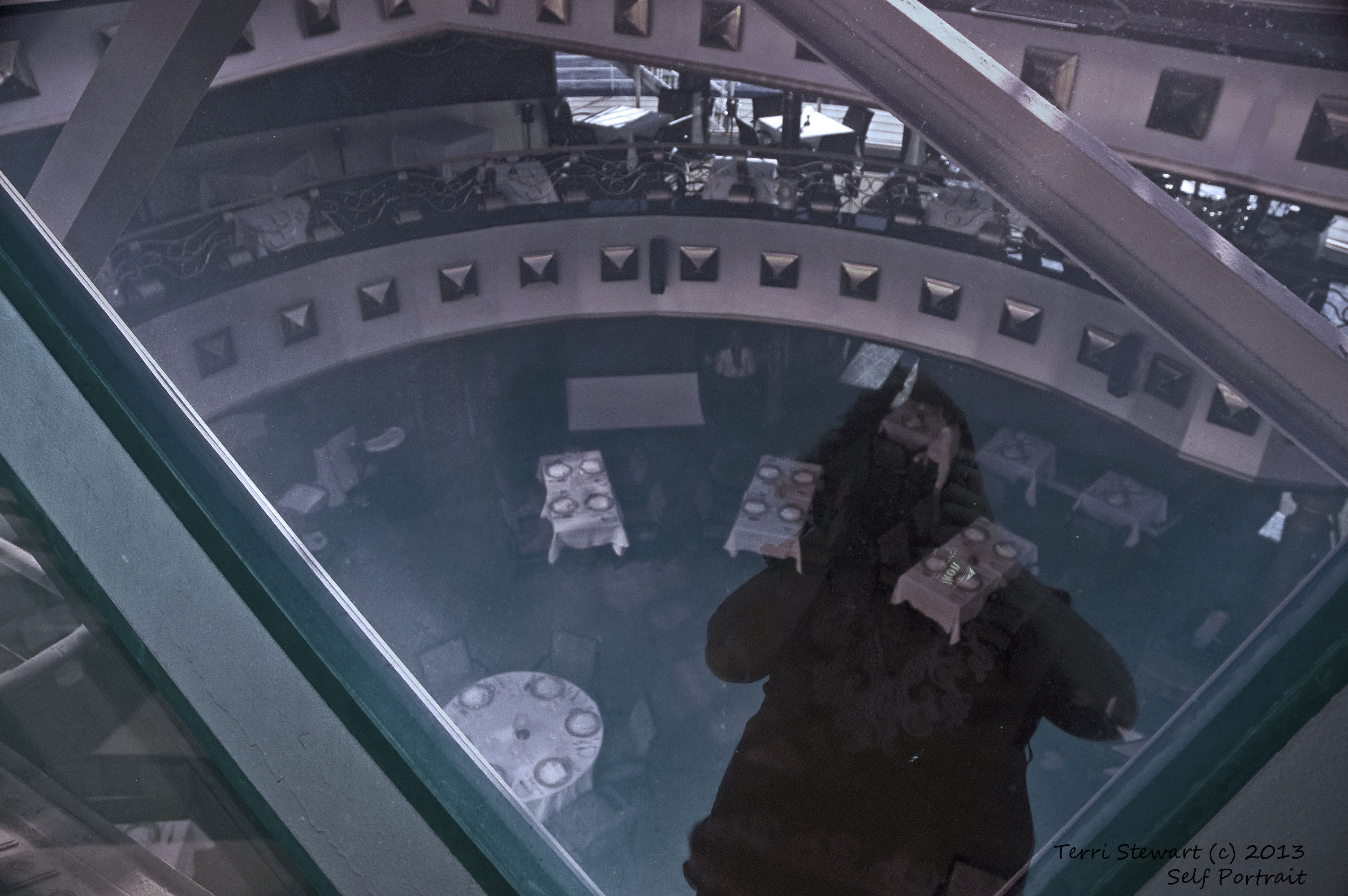
shadow reflection self portraitI have been reflecting on shadow work a lot lately.  The shadow is that part of ourselves that we often keep hidden. It was especially prompted by Naomi’s images and thoughts in her post “Black and White (or not).” The world is shades of gray as our shadows often seem to be.

Physically, our shadows take on the colors of what they are cast on. We stand ‘here,’ the shadow projects ‘there,’ and our shadow is integrated with rock or grass or concrete or sofa–with the barest connection with our embodied self. Sometimes our shadows hang on to us by the barest toe. Sometimes we are connected fully.

The shadow is something darker, hidden, taking on different tones and different shapes than our embodied selves. But ultimately, it is a projection of our own self. What we don’t want to see in ourselves, we push into our shadow.

One of the most valuable lessons I had in seminary was a discussion of the Johari Window. It is really pretty simple! There are four ways to be known in the world (each one pane of a four paned window):

  1. Things we know about ourselves that nobody else knows
  2. Things others know about us that we don’t know
  3. Things we know and others know
  4. Things nobody knows

Our job is to shrink the part of our window that is “things nobody knows.”

γνῶθι σεαυτόν – Know Thyself, on the Temple of Apollo at Delphi

I’d like to offer a meditation on accepting the shadow self. Please only do this if you feel safe.

Find a comfortable place.  If you are sitting, ground your feet restfully, but firmly. If you are laying, sink down towards the earth. Let the earth buoy you and hold you through this exercise.

You may close your eyes if that is comfortable for you or you may keep them open. If your eyes are open, let your gaze fall gently onto a nearby spot—not particularly noticing anything about the spot, but just accepting the spot as your companion.

Let your gaze turn inward. Take an inventory. Do you feel anxious? Excited? Relaxed? Where is the energy stirring? Is your mind whirring? Or is it in your solar plexus? Or lower? What energy are you bringing to your meditation in your body? Greet the energy and invite it into your journey.

Pause and acknowledge the sacredness of joining with your energy. Breathe in. Breathe out.

Continue your inventory. Moving beyond the physical. What are all the great things you see about yourself? Your creativity? Your love? Your compassion? Mercy? Analysis? Quietness? Strength? Acceptance? Meticulousness? Acknowledge these beautiful and wonderful things and give thanks to them. Breathe in. Breathe out. Now, let them go. They will still be with you. Consider them your backbone. Holding you firmly in place, but behind you.

Reconsider your connectedness to the earth. Let her energy support you while sinking in. Reconsider your gifts—the great things about you. Let them provide structure to your body. Breathe in. Breathe out.

Before you, now, is an empty room. Just you and the energy you have brought with you. The energy from your body. The energy from the earth. The support from your gifts. A formidable group.

See the shadow.

How are you connected to the shadow? Fingertip? Toes? Fully? Check in with yourself and stop here if that feels right to you.

What contrasting energy is pulsing in the shadow? Is it a mirror of your own body’s energy? Or is it different? What is the shadow projecting onto you? Does it make you seem tall? Or small? What color does the shadow take on? What is it drawing from its surroundings? Check in with yourself and stop here if that feels right to you.

Open a dialogue with your shadow. Something like, “I see you. I know you are part of me. What do you have to teach me today?”

Listen to your shadow. Breathe in, breathe out. Check in with yourself and stop here if that feels right to you. This will be different for everybody.

If you feel brave, offer your shadow love. Compassion. Acceptance. Acknowledgement. What does that feel like? Check in with your body and see where your energy is stirring. Is your heart chakra pulsing? Or maybe your shadow has some energy swirling? Check in with yourself and stop here if that feels right to you.

Seeing your shadow, connecting, dialoguing, loving—continue to offer love and imagine love emanating towards your shadow from your energy, from the energy of the earth, and from the gifts that you bring that stabilize you. Imagine the love pouring out everywhere as light. Light as soft as a glowing sunset or as strong as a summer’s day. Whatever light is needed. As the light increases, the shadow steps closer and makes one more connection with you. Maybe just a pinky. Check in with yourself and stop here if that feels right to you.

Now, it is time to close the dialogue with the shadow.

Offer your loving kindness to the shadow. Bring your hands together over your heart chakra in a prayer position. Let your inner gaze fall gently on your shadow. Breathe in, breathe out. As you gaze at your shadow, offer Namaste.

Bring the inner light down to an inner, restful darkness. Let your shadow leave your full awareness, knowing you are that much more connected and that you will be back.

Breathe in, breathe out.

Feel your gifts that strengthened you. Thank them for being with you. Bid your gifts Namaste.

Feel the earth that supported you. Thank the earth for providing support. Bid the earth Namaste.

Feel the energy in your body that journeyed with you. Thank yourself for being present. Bring to yourself, Namaste.

Breathe in, breathe out.

Namaste.

Shalom and Amen,

~Terri

© 2013, post & photo, Terri Stewart, All rights reserved

Terri StewartTERRI STEWART is Into the Bardo’s  Sunday chaplain, senior content editor, and site co-administrator. She comes from an eclectic background and considers herself to be grounded in contemplation and justice. She is the Director and Founder of the Youth Chaplaincy Coalition that serves youth affected by the justice system. As a recent graduate of Seattle University’s School of Theology and Ministry, she earned her Master’s of Divinity and a Post-Master’s Certificate in Spiritual Direction with honors and is a rare United Methodist student in the Jesuit Honor Society, Alpha Sigma Nu. She is a contributing author to the Abingdon Worship Annual.

Her online presence is “Cloaked Monk.” This speaks to her grounding in contemplative arts (photography, mandala, poetry) and the need to live it out in the world. The cloak is the disguise of normalcy as she advocates for justice and peace. You can find her at www.cloakedmonk.com, www.twitter.com/cloakedmonk, and www.facebook.com/cloakedmonk.  To reach her for conversation, send a note to cloakedmonk@outlook.com
Posted in Naomi Baltuck, Photography/Photographer, Story Telling, Photo Story, Writing

Editing Monet’s Garden

Last May, while traveling in France, my sister and I went to Giverny to visit Monet’s Garden.  The line to enter was horrendous, and once we got past the ticket booth, we became part of the swarm of tourists overrunning his house and garden.  We must have heard a dozen different languages spoken, people from all over the globe had come to see for themselves the inspiration for Monet’s most famous paintings.

It was eye candy, a stunning profusion of color!   But instead of the rare and exotic flora I expected, all the flowers were, well, your regular garden variety.  Irises, roses, tulips, pansies, alyssum, forget-me-nots…nothing I don’t grow in my own garden.  Yet they were artfully arranged by height, texture, and color to maximize the effect.  And after all, they were in Monet’s Garden.

I wanted to capture at least the illusion of solitude and serenity, and to photograph the garden as I thought it must have been back in Monet’s day.  I waited for lulls in tourist traffic to get my shots.  But while waiting, I watched hoards of humanity shuffling by, and I caught glimpses of peoples’ lives that I found as moving as anything I saw in those historic gardens. Mothers and children, old couples holding hands, a little boy with eyes only for the baby chicks, an awkward teenaged boy who had eyes only for the teenaged chicks, and a family with four generations of women all sharing a park bench.

While we writers strive to capture a mood or feeling or effect, we should also observe the stories happening all around us.

The first  is like a very pretty still life, or a posed portrait of Mother Nature.  The other is a very real, sometimes messy picture of the world, brimming with humanity, and all the joy and heartbreak that life and love have to offer.

There is beauty in it all.

null

All images and words c2012 Naomi Baltuck

NaomiPHOTO1-300ppi51MC3SKEF0L._SY300_NAOMI BALTUCK ~ is a Contributing Editor and Resident Storyteller here at Bardo. She is a world-traveler and an award-winning writer, photographer, and story-teller whose works of fiction and nonfiction are available through Amazon HERE. Naomi presents her wonderful photo-stories – always interesting and rich with meaning and humor – at Writing Between the Lines, Life from the Writer’s POV.

Naomi also conducts workshops such as Peace Porridge (multicultural stories to promote cooperation, goodwill, and peaceful coexistence), Whispers in the Graveyard (a spellbinding array of haunting and mysterious stories), Tandem Tales, Traveling Light Around the World, and others. For more on her programs visit Naomi Baltuck.com

Posted in Charles W Martin, Photography/Photographer, Poems/Poetry

nomenclature…

nomenclature

aunt bea
said
i’ve figured out
why people
don’t believe in
global warming
it’s got
the wrong
name
people see
and
hear about
ice floes into homes
superstorms
around the world
these hot
and cold
flashes of weather
make people say
you call that
global warming
we need a name
that matches the symptoms
the earth is experiencing
a term that conveys
the extremes
of the earth’s moods
and
the difficult times
ahead for
mankind
i’m recommending
global menopause
there’s a term
even a politician
will be able
to comprehend

– Charles W. Martin

© 2013, poem and illustration, Charles W. Martin, All rights reserved

This is Charlie’s first post with us as a part of our core creative team. If you missed his complete profile the other day, it is posted HERE. Jamie

678ad505453d5a3ff2fcb744f13dedc7-1CHARLES W. MARTIN, Ph.D. (Reading Between the Minds) ~ Throughout Charlie’s educationalhawk chronicles training and career in speech and language therapy, he maintained a devotion to the arts (literature/poetry, the theater, music and photography). He was a published poet before he completed his graduate work. Since his retirement in 2010, he has turned his full attention to his poetry and photography. He publishes a poem and a photographic art piece each day on his blog.  Charlie has been blogging since January 31, 2010. He is hugely popular for his poetry, his ethic, and his support of other poets and bloggers.

Recently Charlie self-published a book of poetry entitled The Hawk Chronicles and will soon publish another book called A Bea in Your Bonnet: First StingThe Hawk Chronicles is available through both Lulu and Amazon. In The Hawk ChroniclesCharlie provides a personification of his resident hawk with poems and photos taken over a two year period. By invitation Charlie has shown his photographs in local businesses that display the works of outstanding artists.

Posted in General Interest, Peace & Justice, Photography/Photographer

Stolen Childhoods

If Steve McCurry’s name doesn’t ring a bell, think of the iconic photograph “Afghan Girl” that appeared in National Geographic. He is a world-renowned photographer with a compassionate lense. In this series from his blog (be sure to link through to see it all and to follow him, worthwhile), he shares photographs of working children from around the world. Perhaps when we are tempted to complain about our lives and our fate, we just shouldn’t. This will move all of us. The question is, what will it move us to do? What are prayers and metta practice if they don’t have feet? Jamie

Posted in Essay, Michael Watson

Troubling the Post-Tribal

On hte BridgeRecently, I found myself in conversation with a diverse group of alternatively oriented, North American,  health care providers, some of whom integrate shamanic practices into their work. As often happens, talk turned to our various efforts to situate ourselves in the broader cultural framework. Inevitably, this proves a thorny conversation.

Identity issues cut deep, exposing the painful questions underlying the increasingly tenuous fabric of Self. When engaged in conversations about our fundamental beliefs about Self we may find ourselves asking: “Who am I? What claims may I make about my experience of Me-ness? In a world that appropriates and commodities everything, how do I understand and situate Self?”

Speaking with my colleagues I was reminded that conversations about traditional modes of living and healing generate additional anxiety. Ethical questions abound: “What constitutes appropriation? Given we learn to be adults through acts of appropriation, what may we respectfully borrow from others? Does our use of another’s knowledge diminish the other? “

My colleagues attempted to circumvent these raw issues by positioning themselves squarely in the “Post Tribal”. At that point I stopped talking and simply listened. While I see myself as situated in the uncomfortable potential space between tribal and urban, I identify strongly with my tribal heritage. From that point of reference it seems to me the idea of Post Tribal is fraught  with problems.  The greatest of these is that it effectively erases the sovereignty and authorship of the world’s thousands of active tribal cultures. In so doing it effectively dismisses any claim to ownership of knowledge, traditions, and practices these cultures may make. The idea of the Post Tribal threatens, once again, to leave tribal people behind and alone. It borrows freely and selectively from Indigenous understanding, and uses these decontextualized bits of knowledge to strengthen the very citadel  of individuality that tribal ways of knowing challenge.  This seems, at best, disrespectful, and at worst genocidal. Either way, such attitudes inflict great harm on the souls of tribal and non-tribal people alike. There must be more heart centered ways for us to negotiate these issues.

Most of my teachers walked the “Soft Path,” the way of the Heart. On this path we are encouraged to balance mind and heart, and to be courageous warriors of the Spirit. We are advised to wrestle lovingly with difficult questions and the challenges of our time. Yet we are also to stand up to tyranny in all its forms. From the place of the Tribal Heart, we can understand that in a world of eight billion people most of us will not live on the land, in tribal communities. That must not stop us from acknowledging and honoring diverse knowledges and ways of living, no matter how easy it would be to do otherwise. Rather, I believe we must, if we are to survive as persons and as a species, tend the garden of diversity, protecting and nurturing the myriad forms of culture and biological life that make Earth home.

As we consider the way onward we may well ask ourselves:”How are we to hold on to the best of the traditions from which we spring? What might we ethically incorporate into our lives from the beliefs and practices of other cultures? What shared knowledge might be of real use in our turbulent times, might aid all of us in moving towards sustainable lifeways?”

The path ahead is challenging and the view is at times bleak. Yet, we do not know how that view, or the terrain, may change around the bend, or on the other side of the mountain. I imagine we are called simply do our best as we walk on. Approaching questions of Self and appropriation with deep thought and great kindness is good to practice  as we journey along together.

– Michael Watson, M.A., Ph.D., LCMHC

© 2013, essay and photographs (includes portrait below), Michael Watson, All rights reserved

michael drumMICHAEL WATSON, M.A., Ph.D., LCMHC (Dreaming the World) ~ is a contributing editor to Into the Bardo, an essayist and a practitioner of the Shamanic arts, psychotherapist, educator and artist of Native American and European descent. He lives and works in Burlington, Vermont, where he teaches in undergraduate and graduate programs at Burlington College,. He was once Dean of Students there. Recently Michael has been teaching in India and Hong Kong. His experiences are documented on his blog. In childhood he had polio, an event that taught him much about challenge, struggle, isolation, and healing.

Posted in Charles W Martin, Poems/Poetry

Welcome Poet Charles W. Martin, Ph.D. to Bardo’s Core Creative Team

678ad505453d5a3ff2fcb744f13dedc7-1CHARLES W. MARTIN (slpmartin) — earned his Ph.D. in Speech and Language Pathology with an emphasis in statistics. His credentials allowed him to pursue a career that included teaching, research and administration in university settings, treating patients and providing administrative leadership in clinical settings. Charlie worked as a speech pathologist professional in the public schools where he diagnosed and treated communication disorders caused by a wide range of health conditions and contextual factors. Charlie brought passion to each of his professional positions but he was always focused on mentoring his students and improving the quality of life for his clients and patients.

Throughout Charlie’s educational training and career he maintained a devotion to the arts (literature/poetry, the theater, music and photography). He was a published poet before he completed his graduate work. Since his retirement in 2010, he has turned his full attention to his poetry and photography. He publishes a poem and a photographic art piece each day at Read Between the Minds, Poetry, Photograph and Random Thoughts of Life. Charlie has been blogging since January 31, 2010. He is hugely popular for his poetry, his ethic, and his support of other poets and bloggers. His was the first blog I followed when I started blogging and for a long time his was the only blog I followed.

hawk chroniclesCharlie has self-published a book of poetry entitled The Hawk Chronicles and will soon publish another book called A Bea in Your Bonnet: First StingThe Hawk Chronicles is available through both Lulu and Amazon. In The Hawk Chronicles, Charlie provides a personification of his resident hawk with poems and photos taken over a two year period.

By invitation Charlie has shown his photos in local businesses that display the works of outstanding artists.

In a statement on his blog, Charlie discusses the role of poetry and poems in man’s history:

Poetry has the power to make us aware of what is hidden in the shadows…those places that we seldom see or want to see…the poet’s voice scrapes away the facade of an issue and lays bare for all to see what has been denied. By providing a voice to these mute realities, poets have throughout history altered the course of events by enlightening readers and encouraging them to take action to stop wars, halt injustice, and to reach out to their fellow man. Like those poets who have proceeded me, I am motivated by the same desire to bring about the social changes necessary to enhance the quality of life for those around me and around the world and to give voice to those who cannot speak for themselves.” 

Charlie has contributed to Bardo in the past and joins us now as a part of our core team. On Friday, Charles will introduce Aunt Bea to Bardo readers for the first time. I know you will love Aunt Bea and Charlie.

A warm welcome to the blogosphere’s premier poet of conscience, Charles W. Martin.

– Jamie Dedes

© 2013, content, portrait, and cover art, Charles W. Martin, All rights reserved