This evening we get to share some wonderful news with you.
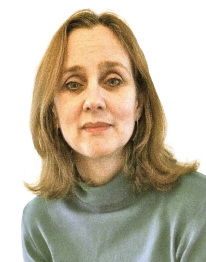
We have a new and exciting collaborator, our Resident Story Teller, Naomi Baltuck, and
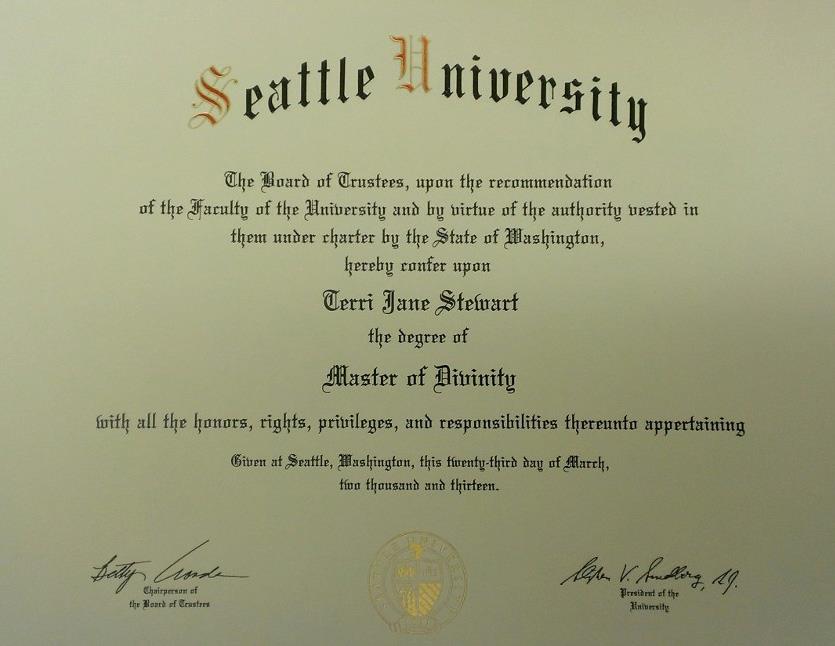
We are pleased to announce that our Chaplain and Site Co-Administrator, Terri Stewart, was just awarded a Master’s in Divinity from Seattle University.
Naomi tells us …
“I was raised in a family blessed with good stories to tell. Mom told hers over the kitchen table, while Grandma Rose spun her yarns with a kid on each knee. After college I packed my diploma into the saddlebag of my bike and headed west to see what adventures my own story held in store. I taught canoeing in King’s Canyon, worked at the Bar 717 Ranch in the Trinity Alps, and waited tables in the Tetons.
In Seattle, I became a teacher, a professional puppeteer, and a Wet Apple Clogger. It was there that I discovered storytelling, first as a teaching tool, then as a profession. That was almost thirty years ago. I met my husband and raised my family in this silver city by the sea, writing books and telling stories all the while.”
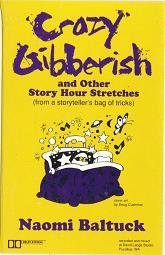
Since storytelling is one of Naomi’s major interests and special gifts in life, it’s not surprising to know that she charms us each week with a story in photographs on her blog, Writing Between the Lines, Life from the Writer’s POV. There she shares life and travel adventures. Among her published books are: six books including several on the art and practice of storytelling. Her Amazon page is HERE.
Naomi, an award-winning writer and story-teller, has been a contributing writer here in the past. We love her posts: they are perfectly executed works of art: careful and caring, symmetrical and clear. Lest you think we are her only admirers, here is what others are saying:
Baltuck is a master storyteller. Story time is a very special time when Baltuck does the telling. As she talks she is part mime, part actor, part singer… –The Seattle Times
Perhaps the quality that makes Naomi Baltuck such a fine storyteller is her affinity for and ability to communicate the beauty in life. — The Palo Alto Tribune
Storyteller Naomi Baltuck weaves magic with words…Yakima schoolchildren were treated to a taste of virtuoso storytelling as the West Coast’s best tale-spinner visited Yakima. — The Yakima Herald Tribune
Storyteller Naomi Baltuck makes sense of the world. — Pacific Northwest Magazine
With song and pantomime and the lilting cadence of her speech, Baltuck seemed to have no trouble sweeping her audience away to a world where the myths of the Pacific Northwest came alive. — The Bellingham Herald
Please join us in a warm and grateful welcome to Naomi …
…. and a proud “Congratulations” to Terri who says,
Terri Stewart
“An MDIV is a four-year general theology degree. I was terrified when I went back to school. I came from a scientific writing background and landed in territory where you are supposed to use personal pronouns in your papers and in your expression! Whoa!
After the first set of classes, I figured it out and also re-discovered my inner poet and artist. I began writing poetry again, doing art, and stepping into contemplative photography. I took to the more spiritual classes with such a passion that I decided to add on a certificate in Spiritual Direction.
I finished the two courses in 5 years except for one silly class that I had dropped earlier and had to take this last January-Medieval Church History. Now there’s a fun topic! In fact, it was a blast. My major papers were on the Court Beguines of the Flemish territory and on Christine de Pizan. I learned so much about women, spirituality, and what real community is by spending time with the Beguines and with Christine. It was amazing. I was also struck by the similarities in our current times and the time directly prior to the Renaissance. Polarization. Duality. The big lie. Denigration of education and intellect. Whisper campaigns. I spent half this particular class going, “Holy moley, batman!”
Anyway, my diploma says that I have rights and privileges earned with this degree. I’m not quite sure what those things are other than I have a student loan to pay back! But I am taking the education that I received and using it in two ways. One, working with incarcerated youth. Two, encouraging people to develop diverse spiritual practices.
I am blessed and privileged to have been able to travel this path. I look forward to the next rabbit trail! (Is that a PhD calling?)”
Terri has been fabulous, actively involved in Bardo from day one. She has a fine sense of timing and is a collaborator in every sense. We are more grateful for her presence here than we can say and know everyone is enjoying her wise, wonderful, and often witty posts.
grateful for the backward glance of memory
to those days when life was about bottles
and diapers, walks in the park and baking
cookies for little hands and greedy mouth,
when the mornings were written in wonder,
months honey-combed with baby kisses
and the fascination of intrepid first steps …
in solidarity with other parents i will them
memories laced with gratitude, not the pain
of lost dreams, of lost bodies of their bodies,
the fragile students silenced in the corridors
of relative privilege after an insane rampage
or the everyday streets streaming blood in
Harlem and Bayview/Hunter’s Point where
uncelebrated kids live foreshortened lives
… and those are the children of democracy
there are these too, children of oppression what of them? – tiny starved brown humans
that line the arenas of hunger and war, where
soundless tears of voiceless parents drown
the vestiges of hope while we share our pain,
so sure the world will grieve along with us
JAMIE DEDES ~ My worldly tags are poet and writer. I’m in my fifth year of blogging at The Poet by Day, the journey in poem, formerly titled Musing by Moonlight. Through the gift of poetry (mine and that of others), I enter sacred space.
Mother’s Day is a celebration honouring mothers and motherhood, maternal bonds, and the influence of mothers in society. Nowhere it says it is only for human mothers, so let’s have a look at two bird-mothers.
The first second I saw this photo, I thought it was gross because the bird looked distorted. However, a serious deformation as having 4 pair of extra feet is a bit too much to take. Close inspection learns that this Common Ringed Plover is sheltering her chicks from the cold wind that can make their habitat, the beach, rather unpleasant. Mummy Ringed Plover will regularly do this till the chicks have replaced their fluffy down with insulating feathers.
Imagine being a chick Ringed Plover and just walking into the warm, insulating plumage of your big mum and having a chat with your siblings. I bet mummy-bird is enjoying this peaceful moment of having all her chicks near her too.
This peaceful moment is a pause in the paradoxical task that characterizes motherhood; mothers have to keep their offspring close to gear them safely in to adulthood, adulthood that is all about growing away from the parents. Keeping them close in order to let them go.
Here is another mummy-bird, shielding her chicks to keep them safe and warm.
I like to point out that I can’t state for sure that above photos are depicting mums with chicks. The Dove and Common Ringed Plover can be fathers. They can be those excellent fathers that care about their youngsters. Mothering isn’t exclusively done by mothers. Therefore, if Mother’s Day is about mothering, caring and loving, we should celebrate Mother’s Day with all who care, love, and share. And this includes childless couples, cooks, nurses, doctors, and all those who take others under their wings for a cuddle, a dinner, a supporting hug, or a bit of warmth.
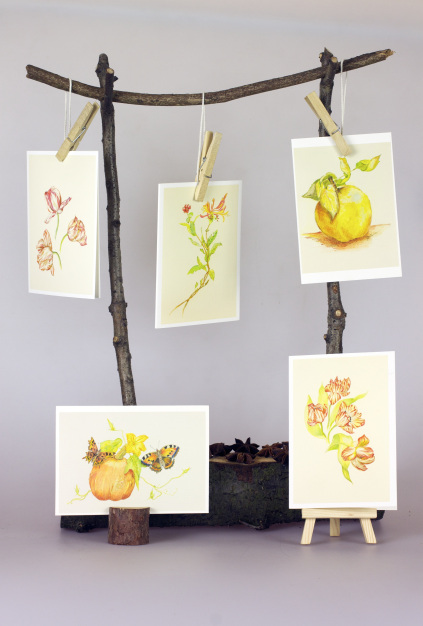
PAULA KUITENBROUWER is a Dutch nature artist living The Netherlands and sharing her work with us on her blog, Mindful Drawing and on her website. Paula says, “Mother’s Day is about a hug or a poem. Nothing more is needed. But if gifts are given; flowers express gratitude and love.” She’s designed a Mother’s Day Gift-set for the 12th of May.You can purchase her art HERE.
In addition to art, Paula’s main interest is philosophy. She studied at the University of Utrecht and Amsterdam. She has lived in Eastern Europe and in Asia. Paula says that in Korea, “my family lived next to a Buddhist temple. In the early morning we would hear the monks chanting. During my hours of sauntering with my daughter through the beautiful temple gardens, I felt a blissful happiness that I try to capture in my drawings.” Paula sometimes teaches children’s art classes. She lives with her husband and daughter and close to her father. We are often honored with and most grateful for the wise and gentle posts from our much-valued Paula.
Contemplative photography is a practice I try to observe. So often, I end up reserving it for vacation times. However, with the advent of phone cameras and the increased capabilities they have, contemplative photography is at my fingertips every day! I am reading a book on contemplative photography and would like to share some of the thoughts it is stirring in me and the information it has. The book is Eyes of the Heart: Photography as a Christian Contemplative Practice by Christine Valters Paintner. You can find her at Abbey of the Arts.
Contemplative seeing is described by Carmelite William McNamara as a “long loving look at the real.” Let’s think about what each one of these words means.
Long – to see, we need to slow down and notice our surroundings, immerse ourselves into the moment
Loving – to see clearly, we need to have a compassion filter that sees beauty in all things, the horrible and the joyful
Look at the real – to see things as they are, not how we want them to be
Contemplative seeing also requires a journey from the head down into the heart.
In Buddhism, there is a practice of contemplative photography called Miksang. This is Tibetan for “good eye.” Miksang has the goal of looking at the real without judgement or distinctions like “beautiful” or “ugly.” The goal is to see things as they are without attaching value judgments and to appreciate it. This opens up a third space, seeing things in a creative new way. I am reminded of a visit I made to the women’s prison. It was a spectacular Pacific Northwest day. Brilliant blue skies. Inside the prison, walking across the grounds, I looked up and saw the razor wire. At the same time it was incredibly beautiful and incredibly repulsive. That is the tension that the “good eye” brings.
robin sitting still
between barbs of sharpened steel
her spirit will soar
In Christianity, this “good eye” is termed the “third eye” by Richard Rohr. He describes it as the moment when “our heart space, our mind space, and our body awareness are all simultaneously open and non-resistant. I like to call it presence. It is experienced as a moment of deep inner connection, and it always pulls you, intensely satisfied, into the naked and undefended now, which can involve both profound joy and profound sadness. At that point, you either want to write poetry, pray, or be utterly silent.”
The monk, Thomas Merton, started practicing contemplative photography and he said, “How the blank side of a frame house can be so completely beautiful I cannot imagine. A completely miraculous achievement of forms.” Perhaps the good eye or the third eye is simply seeing the miracle.
All this is quite a lead up to the offering I have today of a contemplative photograph. I am going to offer an image and then I encourage you to visit one from Thomas Merton he titled “Sky Hook” and described as the “Only known photograph of God.”
After entering the photograph(s), please consider sitting with the feeling that is created when you shift from head seeing to heart seeing. Gaze lightly into the distance without focusing on any one thing. Be present to the real. After you have considered these photographic offerings, perhaps you would consider gazing around you, holding compassion in your heart and seeing something beautiful. If you have your camera, great! If not, consider the magical moment of holding the image in your heart and then releasing it.
Community
Reflection: What, if anything, has changed? How was the journey from head to heart?
TERRI STEWART is Into the Bardo’s Sunday evening chaplain. You can expect a special post from her each week. She comes from an eclectic background and considers herself to be grounded in contemplation and justice. She is the Director and Founder of the Youth Chaplaincy Coalition that serves youth affected by the justice system. As a recent graduate of Seattle University’s School of Theology and Ministry, she earned her Master’s of Divinity and a Post-Master’s Certificate in Spiritual Direction with honors and is a rare United Methodist student in the Jesuit Honor Society, Alpha Sigma Nu. She is a contributing author to the Abingdon Worship Annual.
Her online presence is “Cloaked Monk.” This speaks to her grounding in contemplative arts (photography, mandala, poetry) and the need to live it out in the world. The cloak is the disguise of normalcy as she advocates for justice and peace. You can find her at www.cloakedmonk.com,www.twitter.com/cloakedmonk, and www.facebook.com/cloakedmonk. To reach her for conversation, send a note to cloakedmonk@outlook.com.
He is the guiding teacher of the Insight Meditation Center (IMC) of Redwood City, California. He has a PhD inBuddhist Studies from Stanford University. His many dharma talks available online contain basic information on meditation and Buddhism, as well as subtle concepts of Buddhism explained at the level of the lay person.” Wikipedia
Video uploaded to YouTube by insightmed. Photo credit ~ Insight Meditation Center, Creative Commons Attribution-NonCommercial-No Deriv 3.0 Unported
… For when I shut myself off the outer tick
I find myself listening to the quickening beat
of this dear planet as if it were my own heart’s clock.” The Composition Hut, Myra Schneider in What Women Want
In this short collection of nineteen poems – including the ten-page narratively-driven long-poem, Caroline Norton – Myra Schneider manages to cut through our many-layered lives. Her poems often move from the intimacy of personal experience to a broader frame of reference. The opening poems are nature-and-spirit driven and bespeak a love of and concern for environment. The second part of the collection fulfills the polemic promise of the title to present hard lives and harder times in a clear and righteous outcry.
Among the opening poems is Losing, written for her publisher. Myra starts with the unimportant lose of socks and moves on to finding what is valuable:
“a sparrowhawk perched on your gate, eyes alert for prey, words that toadleap from imagination, from heart – to make sure every day is a finding.”
In two poems she hints at the symmetrical beauty of mathematics, “… the square root of minus one you once grasped, dumbfounded.” A visit to the Garden is bursting with color and movement and triggers speculations …
“but what does it matter? You know too well how the years have shrunk your future, that the past is an ever expanding suitcase.”
… and further along in the poem she closes with …
“to your feet, to the bees still milking flowering raspberries. You free a frog watch it hop back to its life.”
I was riveted by the story of Paula Schneider in Crossing Point, as Paula (probably Myra’s mother-in-law) crosses with her children from Germany into Holland during World War II. This is included in the second half of Myra’s book, which comes to the business at hand: injustice as it affects women and children.
Interesting that this book came my way when I am standing by two friends whose physical and emotional frailty are much entwined with their relations with fathers and husbands or boyfriends. It’s not that things haven’t been improved since our parents’ days…at least for many of us it has. It’s not that there are no kind and enlightened men. Certainly there are. It’s not because women and society are without culpability, because they are not.
The complexity of the gender and social issues examined are clear in Myra’s long poem, Caroline Norton, about the nineteenth century writer and poet, social reformer and unwitting feminist. Caroline came to the latter two occupations, not so much by choice as necessity. As the poem folds out, we see that the brutal husband who separated Caroline from her children (with tragic results for them), was abetted and aided by the women in his life, influenced as they were by a social context in which women and children are property with no legal rights of their own. No doubt those women were numb to the implications, threatened by the hint of change, and anxious to bolster the sense of surperiority they got out of putting this woman down.
Myra stands firm in her poetic commitment to continue the fight started with Caroline Norton, since half the world is still under siege and the other half still begs improvements. We read about the child-bride (Woman) and the woman who is stoned (Her Story). One wonders what happens to the children – boys and girls – of such women. The short story here is that: What women want is justice.
For two years, I have enjoyed Myra Schneider’s work and appreciated her commitment to encouraging others to honor their inner artist, through her books on writing, her classes, and her support of Second Light Network (England), an association of women poets over forty. I suspect that her work doesn’t have the audience it deserves. I hope the day comes when that is remedied.
The closing poem in What Women Want:
WOMEN RUNNING
by Myra Schneider, 2013, All rights reserved
posted here with Myra’s permission
after Picasso: Deux femmes courant sur la plage
Look how their large bodies leaping
from dresses fill the beach, how their breasts
swing happiness, how the mediterraneans
of sea and sky fondle their flesh. Nothing
could rein them in. The blown wildnesses
of their dark animal hair, their hands joined
and raised, shout triumph. All their senses
are roused as they hurtle towards tomorrow.
That arm laid across the horizon,
the racing legs, an unstoppable quartet, pull
me from my skin and I become one of them,
believe I’m agile enough to run a mile,
believe I’m young again, believe age
has been stamped out. No wonder, I worship
at the altar of energy, not the energy huge
with hate which revels in tearing apart,
in crushing to dust but the momentum
which carries blood to the brain, these women
across the plage, lovers as they couple,
and tugs at the future till it breaks into bloom.
Video, Myra Schneider at Poetry East, [interview] audio is poor. I was motivated . I actually listened to it on my iPad so that I could put it up to my ear.
JAMIE DEDES ~ My worldly tags are poet and writer. I’m in my fifth year of blogging at The Poet by Day, the journey in poem, formerly titled Musing by Moonlight. Through the gift of poetry (mine and that of others), I enter sacred space.
Our friends at HeartMath have described a wonderful technique to rapidly get into your heart. The Quick Coherence® Technique ( a heart math trademark) helps you create a coherent state, offering access to your heart’s intelligence. It uses the power of your heart to balance thoughts and emotions, helping you to achieve a neutral, poised state for clear thinking. It is a powerful technique that connects you with your energetic heart zone to help you release stress, balance your emotions and feel better fast.
Quick Coherence® will help you find a feeling of ease and inner harmony that will be reflected in your heart rhythms. The heart is a primary generator of rhythm in your body, influencing brain processes that control your nervous system, cognitive function and emotion. More coherent heart rhythms facilitate brain function, allowing you more access to your higher intelligence so you can improve your focus, creativity, intuition and higher-level decision-making. When you’re in heart-rhythm coherence, you perform at your best – what athletes call being in the zone. You feel confident, positive, focused and calm yet energized.
Step 1: Heart Focus.
Focus your attention on the area around your heart, the area in the center of your chest. If you prefer, the first couple of times you try it, place your hand over the center of your chest to help keep your attention in the heart area.
Step 2: Heart Breathing.
Breathe deeply but normally and feel as if your breath is coming in and going out through your heart area. Continue breathing with ease until you find a natural inner rhythm that feels good to you.
Step 3: Heart Feeling.
As you maintain your heart focus and heart breathing, activate a positive feeling. Recall a positive feeling, a time when you felt good inside, and try to re-experience the feeling. One of the easiest ways to generate a positive, heart-based feeling is to remember a special place you’ve been to or the love you feel for a close friend or family member or treasured pet. This is the most important step.
Quick Coherence® is especially useful when you start to feel a draining emotion such as frustration, irritation, anxiety or stress. Using Quick Coherence at the onset of less intense negative emotions can keep them from escalating into something worse. This technique is especially useful after you’ve had an emotional blowup to bring yourself back into balance quickly.
You can do the Quick Coherence® Technique anytime, anywhere and no one will know you’re doing it. In less than a minute, it creates positive changes in your heart rhythms, sending powerful signals to the brain that can improve how you’re feeling. Apply this one-minute technique first thing in the morning, before or during phone calls or meetings, in the middle of a difficult conversation, when you feel overwhelmed or pressed for time, or anytime you simply want to practice increasing your coherence. You can also use Quick Coherence whenever you need more coordination, speed and fluidity in your reactions.
Another technique that we, The Shift Doctors, regularly teach in seminars, to patients and in our books comes from the Buddhist tradition and is called The Loving Benefactor Meditation. The meditation goes as as follows:
(This meditation can also be downloaded at iTunes and is from our 2nd companion CD for our book Shift: 12 Keys to Shift Your Life – for details see meditation page at shiftyourlife.com ). This meditation is great for getting into your heart in about 30 seconds or less.
Find a comfortable, seated position on a chair or cushion and allow your body to settle into position. Close your eyes and begin to focus your attention on your breath, following your cycles of inhalation and exhalation. Notice the rising and falling sensations in your belly as you breathe in and out and follow this for a few cycles.
Now try to bring to mind a heartfelt sense or visual image of someone whom you believe embodies the qualities of unconditional love and compassion. This person can be a friend or relative, a religious or historical figure, a spiritual being or just someone who embodies these qualities. Picture this person as if they were sitting or standing right in front of you.
Look into their eyes and feel the absolute unconditional love and compassion flowing from them towards you. Now, radiate feelings of love and gratitude back towards this person. Whenever you feel your mind wandering, gently bring your attention back to the image of the loving friend, historical or spiritual image and once again practice radiating love, empathy and compassion towards them. Feel their love, empathy and compassion radiating back towards you.
You can choose to stay with your Loving Benefactor and feel their love flowing to you and your love flowing to them for up to 20 minutes. You can also have your Loving Benefactor move slowly around your left side and stand behind your left shoulder to be with you as you go about your day. You can still feel them present when you open your eyes! Know that this Loving Benefactor is sending you love every minute of every day.
In addition, The Mountain Meditation can be quite helpful to melt away stress or anxiety. When you are feeling helpless, powerless, inadequate or have angst about meeting a challenge that is facing you in your life, the ‘Mountain Meditation’ can prove to be a transformative experience. If you are ready to feel your inner strength, click on the meditation above, sit back, close your eyes and prepare for a journey (led by ‘The Shift Doctors’) back to vitality and your powerful inner nature. Listen to The Mountain Meditation by clicking here!
Hope these tips and tools are helpful –
Loads of Light to all!
Tracy Latz, M.D.and Marion Ross PhD. (a.k.a. “The Shift Doctors”)
**The Shift Doctors (Tracy Latz, M.D. & Marion Ross, Ph.D.) are available for keynote talks, classes, events or for seminars (1/2 day or up to 2 day) on Energy Medicine personal transformation, team-building, motivation, anger management, intuitive development, or collaboration for private groups, conferences, corporations or corporate events. Contact them at info@shiftyourlife.com or find out more about their books, DVD’s, CD’s and tools for personal transformation at www.shiftyourlife.com.
Pavel Friedmann was born in Prague on January 7, 1921. He was deported to Terezin on April 26, 1942 and later to Auschwitz, where he died on September 29, 1944. At least 960,000 Jews were killed in Auschwitz. Other victims included approximately 74,000 Poles, 21,000 Roma (Gypsies), and 15,000 Soviet prisoners of war; and 10,000-15,000 members of other nationalities (Soviet civilians, Czechs, Yugoslavs, French, Germans, and Austrians). Women, men, children.
While it is common to say “never again” … meaning that event we refer to as THE Holocaust … it’s important to remember that there are Holocausts (genocides) in process now and there have been many in our history … think of Armenia, Rawanda, the Congo, Cambodia, Vietnam, Sudan, Iraq, Somalia, North Korea, the Kurdish peoples, Syria, Palestine … Time and past time to put an end to it …
I like to remember the lesson taught by Pastor Martin Niemoller (1892-1984) – a victim of the Nazis – and passed on to us. There is some controversy over the many versions of his “First they came …” It is often presented as a poem. The great jazz musician, Charles Mingus, recites a version before his musical composition, Don’t Let It Happen Here. In any event, the point is made: political apathy is dangerous.
First they came for the Jews
and I did not speak out-
because I was not a Jew.
Then they came for the Communists
and I did not speak out-
because I was not a Communist.
Then they came for the trade unionists
and I did not speak out-
because I was not a trade unionist.
Then they came for me-
and there was no one left
to speak out for me.
– Pastor Martin Niemoller
– Jamie Dedes
Photo credits: Sidney Fagin – New College of Florida; German postage stamp with sketch of Pastor Martin Niemoeller (licensing status unclear ) via Wikipedia
PEOPLE EVERYWHERE WHO ARE SUFFERING THE EFFECTS OF VIOLENCE
There is a saying in Tibetan, ‘Tragedy should be used as source of strength.” No matter what sort of difficulties, how painful experience is, if we lose our hope, that is our real disaster.’ ” Dalai Lama XIV
April 7th marked Yom Hashoah, the Holocaust Remembrance of Judaism (and thank you to Dr. Erica Martin for bringing this to my attention). I have participated in several Yom Hashoah services over the years during my time as Ecumenical Liturgy Graduate Assistant at Seattle University. You will be brought to your knees acknowledging the atrocities that can be (and continue to be) committed in the name of humanity. And then further humbled by the acknowledgment of hope and transcendence that exists in the human spirit. A particular phrase that marks the worship service is, “We will never forget.” Let it be so.
Let us never forget that all it takes for evil to prosper is for good people to be silent.
Let us never forget that we are capable of unspeakable atrocities in the name of nationalism and in patriotism.
Let us never forget that by having a desire to punish at all costs, we create the monsters that haunt us.
Let us never forget that innocents pay the price of our decisions to turn away from caring for one another.
Let us never forget that holocausts continue and that genocide is still experienced.
Let us never forget the evil that haunts humanity.
But,
Let us never forget that a caterpillar is transformed into a butterfly.
Let us never forget that caring for the widow, the orphan, and the stranger among us is a call to compassion at all costs.
Let us never forget that when we offer our neighbor care, we offer our care to the entire world.
Let us never forget that the peacemakers are blessed.
Let us never forget that those who are last among us, will be first.
Let us never forget that love overcomes evil.
And,
Let us never forget that no matter how small the light, it cannot and will not be overcome.
There is a spiritual practice called SoulCollage®. The main focus of this practice is to put together a collage that represents various things to you… your inner committee, your community, world archetypes, or totems and chakras. Below is an example of a card I created that represents various voices on my inner committee.
One of My Committee Cards
It isn’t simply the making of the card that is the point, but it is exploring the card. If I look at the card and the various images, I can settle into one (or more) of the images and complete the following sentence. I am the one who….
I am the one who dreams
I am the one who prophesies
I am the one who walks towards a voice that calls
I am the one who is grounded
I am the one who flies
I could continue on. What became clear to me after I put these images together is that the holy and the worldly are held together in one place for me. That I need the child-like dreamer to be the one who confronts injustice and demands change. That the holy ferris wheel in my head holds together joy and the sacred. That being grounded allows me to fly. And I could still continue on!
Now it is your turn! I have taken a few photos of various situations, people, animals, things. I am presenting them here. I ask you to locate one photo (maybe more), and enter it and complete the statement: “I am the one who ___________________ .”
What did you discover?
How was the process for you?
“The greatest hazard of all, losing one’s self, can occur very quietly in the world, as if it were nothing at all. No other loss can occur so quietly; any other loss – an arm, a leg, five dollars, a wife, etc. – is sure to be noticed.”
― Søren Kierkegaard, The Sickness Unto Death
“You are — your life, and nothing else.”
― Jean-Paul Sartre, No Exit
What experience of the presence of the divine can you speak to?
Where has grace moved in your life?
Every time I meet with youth in detention, I am interested in hearing their story. Monday, I heard the story of a young man who is extremely disappointed in himself. So we read the Tales of the Pointless People by Dan Ehrlander. Here we explored that the keeping score, comparing, ourselves to other, leads to spiritual death. Holding yourself responsible and bearing guilt beyond your capacity are two separate things.
“Write your story as it needs to be written. Write it honestly and tell it as best you can. I’m not sure that there are any other rules. Not ones that matter.” ― Neil Gaiman
What story do you have to tell?
“It doesn’t interest me what you do for a living. I want to know what you ache for, and if you dare to dream of meeting your heart’s longing.
It doesn’t interest me how old you are. I want to know if you will risk looking like a fool for love, for your dream, for the adventure of being alive.
It doesn’t interest me what planets are squaring your moon. I want to know if you have touched the center of your own sorrow, if you have been opened by life’s betrayals or have become shriveled and closed from fear of further pain! I want to know if you can sit with pain, mine or your own, without moving to hide it or fade it, or fix it.
I want to know if you can be with joy, mine or your own, if you can dance with wildness and let the ecstasy fill you to the tips of your fingers and toes without cautioning us to be careful, to be realistic, to remember the limitations of being human.
It doesn’t interest me if the story you are telling me is true. I want to know if you can disappoint another to be true to yourself; if you can bear the accusation of betrayal and not betray your own soul; if you can be faithless and therefore trustworthy.
I want to know if you can see beauty even when it’s not pretty, every day, and if you can source your own life from its presence. .
I want to know if you can live with failure, yours and mine, and still stand on the edge of the lake and shout to the silver of the full moon, “Yes!”
It doesn’t interest me to know where you live or how much money you have. I want to know if you can get up, after the night of grief and despair, weary and bruised to the bone, and do what needs to be done to feed the children.
It doesn’t interest me who you know or how you came to be here. I want to know if you will stand in the center of the fire with me and not shrink back.
It doesn’t interest me where or what or with whom you have studied. I want to know what sustains you, from the inside, when all else falls away.
I want to know if you can be alone with yourself and if you truly like the company you keep in the empty moments.”
TERRI STEWART is Into the Bardo’s Sunday Chaplain. You can expect a special post from her each week. She comes from an eclectic background and considers herself to be grounded in contemplation and justice. She is the Director and Founder of the Youth Chaplaincy Coalition that serves youth affected by the justice system. As a recent graduate of Seattle University’s School of Theology and Ministry, she earned her Master’s of Divinity and a Post-Master’s Certificate in Spiritual Direction with honors and is a rare United Methodist student in the Jesuit Honor Society, Alpha Sigma Nu. She is a contributing author to the Abingdon Worship Annual.
Today begins the first of three features on finding yourself. “Be True to Yourself” would be another good name for this series with the perspectives of three writers:
.
Part 1: The Freedom of “I Don’t Know” ~ Natasha Head Part 2: What story do you have to tell? ~ Terri Stewart Part 3: On the Razor’s Edge ~ Jamie Dedes
The Freedom of “I Don’t Know” …
There is a peace to be found in releasing labels, brands and notions we are conditioned with before we even have a chance to determine if this is who we want to be. Every day, I feel as though I am failing in the expectations others have for me, yet…I know I cannot let their preconditioned labels define me.
The little bit of myself I have been able to hang on to, throughout all the many roles we get sucked into, shows in my writing. If I had to name the biggest reason why I do write, it’s to hang on to me. The one thing I can be sure of in this world is the girl sitting in the dark corner alone, tattered notebook and cheap pen, ink spots on her fingers and a desire to be left alone with her thoughts.
This is my church. I can enter anywhere, on any day, at any time. I am always accepted, I am always welcomed, and I always feel…right.
I think that sense of “right” is one of the hardest things to find in this world. For so long, I tried to shape myself to fit in so many ways others told me I had to in order to be part of the crowd. They would fight me tooth and nail when I asked a question they couldn’t answer. They would belittle and scorn me for not taking as faith what they never had the courage to question. Where is the poetry if we are not allowed to question? Where do great ideas and new discoveries come from if we are not pushed and encouraged to seek further.
When they come at me now…wanting to know my beliefs, where I pray, where I’m going to go when I die…I’ve learned they already know the answer they want to hear…and I’ve learned the only compassionate one I can give, so as not to offend and engage is “I don’t know.” Really…what other honest answer is there? It turns a soldier into teacher, a teacher to a guide, and suddenly a new path unfolds with an invitation to explore. I have learned so very much…simply by admitting, I don’t know.
And at the end of the day…how much does it matter if it steals from the gift this lifetime is? Our true blessings are found in the now. In the time we have right now to help, to lift up, to learn, to love. Imagine, if the world could stop debating what is personal and individual to everyone, and simply come together to make the most of where we’re at with what we have? If there’s one thing I do know…it would have to make it a much better place…a much better now.
Hunger remains a problem and we think it is not inappropriate to post this again, an essay by Charles W. Elliot that we featured a couple of years ago. On the blog roll to the right, there is a link to BGW ‘s donation page in the event that you are inspired to make a donation. We don’t take donations or any remuneration for the work on this site; but, if you get something out of what is presented on Bardo, we encourage you to support one of the organizations we support or another worthy charity of your choosing. Let’s collaborate to keep the good works going. In gratitude, Jamie Dedes
The simplest act of eating a piece of fruit is inevitably embedded in a complex web of systems: economic, agricultural, financial, and environmental. In attending mindfully to this act, we can discern myriad interdependent phenomena: the beginningless origins of its seeds, the earth from which the fruit grew, the laboring hands that brought the food to our table. The same mindfulness will show how our own lives depend upon the efforts of others, the essential kindness of countless strangers. And in recalling this kindness, we should be ready to take steps to repay it. One such way is to carefully consider the needs of others, and where we find that basic human needs remain unmet because of injustice, we should be motivated to act.
The Universal Declaration on the Eradication of Hunger and Malnutrition states that “society today already possesses sufficient resources, organisational ability and technology and hence the competence to [eradicate hunger].” While food supplies are abundant, access to that food is not. In 2010, 925 million people suffered from chronic hunger, representing one in seven of a global population approaching 7 billion.
Access to adequate food, as indispensable to basic human survival, is a matter of social justice. One of the earliest pronouncements of global governance on fundamental human rights was the U.N. General Assembly’s simple declaration: “Everyone has the right to a standard of living adequate for the health and well-being of himself and of his family, including food[.]” (Universal Declaration of Human Rights, Article 25, paragraph 1, 1948.) If food has been recognized as a human right since the end of World War II, and if society has the resources and competence to end hunger, we should ask ourselves: why are so many millions still hungry?
Of course, there is no single answer to that question. Like all other phenomena, the persistence and spread of human hunger is a complex dependent-arising involving many interwoven causes. Two disturbing factors are financial speculation, which drove commodity prices sky-high in 2007-2008, and the increasing diversion of crops from food production to biofuel production. Thus, the portion of U.S. corn grown to produce corn-based ethanol rose from 15% in 2006 to an estimated 40% in 2011. Other factors include catastrophic weather conditions such as droughts and floods, and global climate change, which has an adverse impact on water supplies and land, especially in the developing world. At the same time, urban sprawl reduces available farmland, while the urban middle class consumes more meat and processed food, which in turn demands more land, water, and energy.
While resources for food dwindle, governmental policies, particularly in the West, have become increasingly hostile to the poor. The shredding of social safety nets puts at risk an ever-larger number of people who need help in the face of poor economic conditions. Last year, about 25% of the House of Representatives voted to eliminate foreign food aid. Such policies appeal to the notion that the world is a zero-sum game, that any help we offer another family will mean that we get less and that we cannot afford fairness. Here in the U.S. help for the poor is in jeopardy. In my home state of Pennsylvania, food stamp use has risen 50% from 1.2 million people in 2008 to 1.8 million today. Despite the increasing need driven by the Great Recession, the current governor proposes to disqualify anyone with assets of more than $5,500—for example, a bank account or a second car—from food stamp eligibility. As a result, it is estimated that 4,023 Pennsylvania households will lose their food stamp benefits on May 1 of this year.
Battling institutional and entrenched social injustice helps alleviate hunger because poverty is at the root of hunger, and the root cause of poverty is powerlessness: the “powerlessness of those who lack resources such as land and water to grow food, jobs to earn money to buy food, an adequate food safety net and food reserves, and adequate nutrition.” (The Downward Spiral of Hunger: Causes & Solutions)
There are many small steps we can take to end hunger, but we must be prepared to respond to the call of conscience to help others and to restore social justice. A key step is to rebuild and enhance small-scale local food systems and turn away from globally concentrated control of food production and distribution. Ultimately, we should reject the domination of agriculture by large corporate agribusiness, and confront corporate attempts to control the very seeds of life with their patented genetically-modified “single generation” seeds.
At the neighborhood scale here in the U.S., community food gardens are springing up even in major cities like New York City and Detroit. Food waste and post-harvest losses could be remedied to make more food available to those in need. Greater investment in small-scale agriculture in rural areas and urban agriculture in the cities would empower the poor and hungry.
At Buddhist Global Relief, we are taking our own small steps. For example, we provide village-scale training in intensified rice cultivation to rural farmers in Cambodia and Vietnam, helping to build their capacity and confidence in applying sustainable agriculture techniques. These techniques dramatically boost yields without expensive external inputs. BGR funds tools and seeds to impoverished families in Cambodia to grow cash crops and home vegetable gardens. Following each harvest, each family then gives the same amount of seed they received to another local family, thus establishing a community of mutual support. BGR helps train villagers in Kenya and Malawi in small-scale agricultural techniques that nurture healthy soil fertility, produce high yields, conserve resources, and meet the basic need of people to independently feed themselves.
Such small steps, taken collectively by Buddhist Global Relief and countless others, are helping to empower the poor, reduce poverty, and alleviate the suffering of hunger. Neither the complexity of the manifold causes of hunger nor the daunting statistics of global poverty should deter us from acting out of compassion and generosity. In the Buddhist tradition, the embodiment of compassion, Avalokiteshvara – Guanyin – Kwannon, is often depicted not just with a thousand eyes to gaze upon the suffering in the world, but with a thousand hands to aid those who suffer. Of course, not even a thousand arms are enough to help the billion people who suffer from hunger. But if we recognize each motivated human heart as the eyes and hands of Avalokiteshvara, each of us acting in our own way, in our own communities, might yet help to end hunger in our generation.
Charles W. Ellliott, a member of the Board of Directors of Buddhist Global Relief, is a lawyer practicing environmental, land use, and human rights law.
The phrase “listen with the ear of your heart” comes to us from St. Benedict and the Rule that he developed for his monks. He begins the prologue this way,
“Listen carefully, my son, to the master’s instructions, and attend to them with the ear of your heart.”
Summarizing Jane Tomaine, author of St. Benedict’s Toolbox: The Nuts and Bolts of Everyday Benedictine Living, the divine is before us and within us waiting to be seen. Our challenge is that our busy lives leave us hurrying from task to task. Is it possible to do our work and connect to our heart, mind, and awareness of eternal transcendence? Is it possible to allow ordinary, every-day tasks to reveal to us the divine?
Yes! It is possible
Today, I am offering to you a journey with the idea of listening with the ear of the heart and apply it to an adaptation of lectio divina. Lectio divina is a way of reading that is sacred. It involves four movements. (1) lectio (read), (2) meditation (meditate), (3) oratio (pray), and (4) contemplation (contemplate). However, I am offering a practice with music. Audio divina, if you will.
This is a piece of music called “Shadows” from the “Diaspora” album by Ibrahim Maalouf. Ibrahim Maalouf is a trumpet player and teacher, composer and arranger. He was born in Beirut, Lebanon, and now lives in Paris, France. His style is uniquely his own. A blend of Arabic tonality and jazz.
The complete movement of audio divina should take approximately 30 minutes to an hour. Feel free to adapt the practice to suit your busy lifestyle (allow the ordinary to be infused with the extraordinary!)
Audio
Please listen.
Now, take a moment to pause. Breathe. In. Out. In. Out. (allow time for the music to echo within you)
What is echoing?
Meditatio
Please play the video again.
Again, take a moment to pause. Breathe. In. Out. In. Out. (allow time for the music to begin resonating within you)
What part is pulling you? What part is pushing you? Is there a particular movement or instrument that is creating energy within?
Oratio
Please play the video again.
Again, take a moment to pause. Breathe. In. Out. In. Out. (allow time for the music to begin pulling you)
Often, prayer is about opening up to possibilities. Do you hear new possibilities? Is there an invitation? Is the energy beginning to coalesce?
Contemplatio
Please play the video again.
Again, take a moment to pause. Breathe. In. Out. In. Out. (allow time for the music to energize you)
Contemplation should lead to action. You have heard the music, entered it’s space, begun to feel it’s pull, now, where is that pull leading you? What is your response?
TERRI STEWART is Into the Bardo’s ne Sunday evening chaplain. You can expect a special post from her each week. She comes from an eclectic background and considers herself to be grounded in contemplation and justice. She is the Director and Founder of the Youth Chaplaincy Coalition that serves youth affected by the justice system. As a recent graduate of Seattle University’s School of Theology and Ministry, she earned her Master’s of Divinity and a Post-Master’s Certificate in Spiritual Direction with honors and is a rare United Methodist student in the Jesuit Honor Society, Alpha Sigma Nu. She is a contributing author to the Abingdon Worship Annual.
Her online presence is “Cloaked Monk.” This speaks to her grounding in contemplative arts (photography, mandala, poetry) and the need to live it out in the world. The cloak is the disguise of normalcy as she advocates for justice and peace. You can find her at www.cloakedmonk.com,www.twitter.com/cloakedmonk, and www.facebook.com/cloakedmonk. To reach her for conversation, send a note to cloakedmonk@outlook.com.
This following piece on Roger Ebert was originally written for our Perspectives on Cancer series in 2011. I don’t know how well known Roger Ebert is outside of the United States; and while he is best know and appreciated as a journalist and film critic, I feel his inspiring response to catastrophic illness makes him a true hero and role model for anyone anywhere. Earlier this week the Chicago Sun Times announced Roger Ebert’s death from cancer.
Roger Eberts cancer and treatments took away his jawbone, his ability to speak, and even his ability to eat and drink. He continued writing right to the end, said that when he wrote he was just like his old self, and he wrote his last tweet two days before his death. Of his life online, he said:
Now we live in the age of the Internet, which seems to be creating a form of global consciousness. And because of it, I can communicate as well as I ever could. We are born into a box of time and space. We use words and communication to break out of it and to reach out to others.
For me, the Internet began as a useful tool and now has become something I rely on for my actual daily existence. I cannot speak; I can only type so fast. Computer voices are sometimes not very sophisticated, but with my computer, I can communicate more widely than ever before. I feel as if my blog, my email, Twitter and Facebook have given me a substitute for everyday conversation. They aren’t an improvement, but they’re the best I can do. They give me a way to speak. Not everybody has the patience of my wife, Chaz… But online, everybody speaks at the same speed.” Roger Ebert
Born in Urbana, Illinois to parents of modest means who wanted a better life for him then they had, Ebert’s affinity for writing and film were encouraged. He went to Urbana High School, University of Chicago, and University of Illinois at Urbana-Champaign. He is known for his film column in the Chicago Sun-Times (1967 – April 4, 2013), his film guide books, and for the television programs he did in collaboration with Gene Siskel and later Richard Roeper. Ebert struggled with alcoholism. He is married to a trial attorney, Charlie “Chaz” Hammel Smith, now Chaz Ebert and VP of Ebert Company.
In 2002, Ebert was diagnosed with salivary cancer. He received radiation treatments and multiple surgeries that effected his speech. In 2006, more cancer was found in his jaw bone. He was rushed to the hospital when his carotid artery burst and he “came within a breath of death.” The jaw bone was removed. Between one thing and another, he suffered through excessive bleeding, loss of muscle mass, deformity, a jaw prosthetic, and the loss of his voice. In the TED Award video below, he informs us of his – among other things – experiments with different voices.
I have always admired Roger Ebert as a writer, film critic, and the first film critic to win the Pulitzer Prize for Criticism. Since he has been living with cancer and then the fallout from cancer, I have come to admire Roger Ebert, the man. He has shown himself to be a world-class role model and a first class human being. As you will see, through it all, he has retained his sense of humor. Write on Roger …
ROGER EBERT: Remaking My Voice
Photo credits ~ Ebert at the 2004 Savaanah Film Festival by Rebert under GNU Free Documentation License and Lillian Boutte and Roger Ebert by Jon Hurd under Creative Commons Attribution 2.0 Generic license. Both photos via Wikipedia.
Belated addition to this post 12:22 a.m.: I just found this lovely essay by Roger Ebert entitled, “I do not fear death …” on Salon’s site. Link to it HERE.
Jamie Dedes ~ My mother lived with cancer of one sort or another for forty years. She was diagnosed with cancer the first time at thirty-six. She was pregnant with me, her second and last child. She had a radical mastectomy and radiation treatments while pregnant. Ultimately, she went three rounds with breast cancer, one with thyroid cancer, and died at seventy-six of breast and colon cancer. I pray everyday for cures. Advancements in medicine and technology give us hope. I’m also encouraged to see that we are doing more with lifestyle and nutrition (antiangiogenic foods), both prophylactically and for healing and remission, and with the soft technologies of prayer, guided visualization, energy medicine, meditation, music and art.

 Naomi tells us …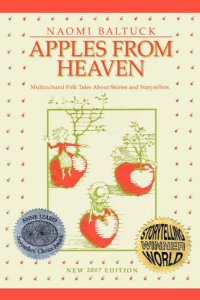
 Since storytelling is one of Naomi’s major interests and special gifts in life, it’s not surprising to know that she charms us each week with a story in photographs on her blog, Writing Between the Lines, Life from the Writer’s POV. There she shares life and travel adventures. Among her published books are: six books including several on the art and practice of storytelling. Her Amazon page is HERE.
I finished the two courses in 5 years except for one silly class that I had dropped earlier and had to take this last January-Medieval Church History. Now there’s a fun topic! In fact, it was a blast. My major papers were on the Court Beguines of the Flemish territory and on Christine de Pizan. I learned so much about women, spirituality, and what real community is by spending time with the Beguines and with Christine. It was amazing. I was also struck by the similarities in our current times and the time directly prior to the Renaissance. Polarization. Duality. The big lie. Denigration of education and intellect. Whisper campaigns. I spent half this particular class going, “Holy moley, batman!”















 The BeZine
