The BeZine Blog

Posted in Essay, Teachers

THERAVADA SPIRITUALITY IN THE WEST

THERAVADA SPIRITUALITY IN THE WEST

by

Gil Fronsdal

While the Western contact and study of the Theravāda tradition goes back to the earliest Christian missionaries in Sri Lanka in the sixteenth century and to European scholars in the early nineteenth century, the beginning of popular Western interest in and inspiration from Southeast Asian Buddhism began around 1870. Since that time there has been two peaks in this interest: the first, from 1870 to 1912 and the second, a century later from 1970 to the present. The former was characterized primarily by an intellectual orientation as Europeans and Americans found in the early Buddhist texts preserved by the contemporary Theravāda tradition an attractive alternative to Western religious beliefs. In contrast, the current upsurge in interest centers predominantly around religious praxis, with specific practices attaining great popularity sometimes completely divorced from the doctrinal and religious context of the Southeast Asian Theravāda tradition(s). At the same time however, an influx of immigrants from Theravāda countries, especially to the United States, has resulted in the presence of numerous Thai, Burmese and Sri Lankan temples that replicate the cultural forms of Theravāda Buddhism of their respective home countries. Most of these ethnic temples created since 1970 have had little impact outside of their respective ethnic constituencies.

With the exception of the partially westernized Sri Lankan missionary Anagārika Dharmapāla (1864 – 1933; discussed below), Theravāda Buddhism has mostly been introduced to the West by westerners. As can be expected, the importation of Theravāda Buddhism to the West has involved a selection, translation and adaptation process as westerners defined the tradition for themselves. What has been most fascinating about this process is that the twentieth century Theravāda Buddhism that many westerners are encountering in Southeast Asia has been profoundly changed by the nineteenth century Asian contact with the West and with Western interpretations of Buddhism. MORE [Insight Meditation Center, Redwood City, California, USA]

♥ ♥ ♥ ♥

Teacher

Gil Fronsdal is the primary teacher for the Insight Meditation Center in Redwood City, California; he has been teaching since 1990. He has practiced Zen and Vipassana in the U.S. and Asia since 1975. He was a Theravada monk in Burma in 1985, and in 1989 began training with Jack Kornfield to be a Vipassana teacher. Gil teaches at Spirit Rock Meditation Center where he is part of its Teachers Council.

Gil was ordained as a Soto Zen priest at the San Francisco Zen Center in 1982, and in 1995 received Dharma Transmission from Mel Weitsman, the abbot of the Berkeley Zen Center. He is currently serving on the SF Zen Center Elders’ Council.

Gil has an undergraduate degree in agriculture from U.C. Davis where he was active in promoting the field of sustainable farming. In 1998 he received a PhD in Religious Studies from Stanford University studying the earliest developments of the bodhisattva ideal. He is the author of The Issue at Hand, essays on mindfulness practice, and the translator of The Dhammapada, published by Shambhala Publications.

You may listen to Gil’s talks on Audio Dharma.

The Buddha illustration is courtesy of The Buddha Gallery. If you click on the photograph, you will link to a detailed description.

Bells - Click image to download.

Posted in Essay, General Interest, Guest Writer, Uncategorized

I hope you enjoy this interesting piece by Manu Kurup, which he has done with a delightfully light touch. Jamie Dedes

Posted in Essay, Guest Writer, Shakti Ghosal

Connecticut, Delhi and HO’OPONONO

Connecticut, Delhi and HO’OPONONO

by

Shakti Ghosal (ESGEE musings)

What we feel and think and are is to a great extent determined by the state of our ductless glands and viscera.” ~Aldous Huxley, English author, 20th century

Over the last month the media streams have remained clogged with two events. First,the horrific massacre of school children and teachers in Connecticut, USA. Second, the barbaric rape and “murder” of an Indian medical student in Delhi.

connecticutschoolshooting110059-525x270

delhi_gangrape_protest_new_pti

As part of an increasingly aware and connected society, we remain quick to rationalise into the underlying reasons and ascribe blame. The flickering screens become full with debates and sermons as questions and suggestions fly thick and fast.

• Why does the U.S. Government not take up with the National Rifle Association and amend the gun ownership laws?
• What makes the Indian police so insensitive and ill equipped to take care of women safety on the roads?
• If, as it now emerges, gunman Adam Lanza displayed worrisome and awkward behaviour, why did his mother not do something about it?
• What was the trigger for the gang of rapists to have conducted themselves in such a brutal and violent manner?

…and so on, the list goes on and on.

delhi-rape

We may sit in judgement and hold holier than thou perceptions. As we take time out to show our solidarity with the cause and impatience and distrust with the ‘powers that be’. Or we may choose to get involved with our hearts, indulge in emotional outpourings and feel we are doing our bit. Either way we do not take responsibility for what happened.

But could it be that as we come across such evil and darkness in the world, there lies a seed of responsibility within us? When we accept the status quo of injustice on the plea that this is how it has been? When we prefer to remain an onlooker to a crime perpetrated on someone else? When we spend our energy to protect our own cocoon only? When we expect the Government and the police to follow standards of morality and behaviour higher than our own?

My thoughts flit to Joe Vitale and his book “Zero Limits”. About therapist Dr.Hew Len and his handling of a ward of criminally insane patients. Dr. Len never saw patients but only reviewed their files. As he looked at the files, he would work on himself by repeating the following universal mantras.
• I am sorry.
• Please forgive me.
• I thank you
• I love you.

And as he worked and improved himself, the patients started to improve and heal!

Dr. Hew Len was following the concept of HO’OPONONO, a Hawaiian word dealing with “extreme responsibility” which requires the person to take total responsibility of his life including all people and situations coming into it. A ‘tough to swallow’ and bizarre concept on first sight!

hooponopono-hula-rye-optimiced

But as I muse on the need to take responsibility of anything that shows up in our life, absolutely everything, I start seeing a continuum. Between extreme responsibility and that of reconciliation and forgiveness. I also come face to face with my Karma in that I must be willing to experience myself what I have allowed to happen to others, either by my inaction or inability.

And today in this new millennium, as we sit on the explosive powder keg of increasing disparity, isolation of the ‘left behinds’ in fast changing societies and values and technology driven, rapid creation of awareness and beliefs, could HO’OPONONO show us the way forward?

In learning……… Shakti Ghosal

Acknowledgement: Zero Limits: The Secret Hawaiian System for Wealth, Health, Peace, and More by Joe Vitale & Ihaleakala Hew Len, Dec. 2008.

© 2013, Shakti Ghosal, All rights reserved

Shakti Ghosal
Shakti Ghosal

Shakti Ghosal ~ has been blogging (ESGEE musgings)since September 30, 2011. He was born at New Delhi, India. Shakti is an Engineer and  Management Post Graduate from IIM, Bangalore. Apart from Management theory, Shakti remains fascinated with diverse areas ranging from World History, Economic trends to Human Psychology & Development.

A senior Management professional, Shakti has been professionally involved over twenty-five years at both International and India centric levels spanning diverse business areas and verticals. With a strong bias towards action and results, Shakti remains passionate about team empowerment and process improvement.

Shakti currently resides in the beautiful city of Muscat in Oman with wife Sanchita, a doctorate and an Educationist. They are blessed with two lovely daughters, Riya and Piya.

Posted in Art

Almost daily, Gretchen Del Rio takes our breath away with her mystical watercolors. Here: a lovely painting of Quan Yin, Goddess of Compassion, which Gretchen just recently added to her “Angels and Goddesses” collection. Jamie
Gretchen Del Rio's avatarGretchen Del Rio's Art Blog

Goddess of compassion.

purchase this painting

View original post

Posted in Essay, Guest Writer

Giulas is a thoughtful, talented South American film-maker and photographer. I have followed his blog and YouTube channel for a few years now. This post is one I particularly appreciate. Guilas gives us something to think about, which he has drawn from his refined spiritual and artistic sensibility. Thanks, Giulas. Jamie

giulas41's avatarThe eternal solitude of the restless Mind

We live in a world with lots of differences. People are dying of poverty by the millions while other people are feasting in fancy hotels in Europe and Asia. People are suffering for not been able to afford dental treatment while people are spending hundreds of thousands in a new shining smile. That’s the world. I know it can get a lot better but i also know it was a lot worst. At times slavery was common. At times killing with no reason was acceptable. It sounds like the world we live in now, right? Look up in history and you will see it was a lot worst. Our life expectancy is proof of that. This is already subject for a lot of arguments but this is not the main subject here. The main subject maybe has to do with the fact things doesn’t get even better. Much better. And…
View original post 531 more words

Posted in Guest Writer, Teachers

VISIONING A PEACEABLE KINGDOM

Video posted on YouTube by daryndamae

Well the bear will be gentle,
And the wolves will be tame.
And the lion shall lay down by the lamb, oh yes.
And the beasts from the wild,
Shall be lead by a child.
And I’ll be changed, changed from this creature that I am, oh yes.

From the song Peace In The Valley by Thomas A. Dorsey

a004
web-1
“Teachers, angels and bodhisattvas come in many guises.”

Reblogged from Gypsy’s place: The Cat’s Meow.

© Gypsy photo, 2013, KarenFayeth, All rights reserved
Kitty gif courtesy of Cat Stuff: Thousands of Animations
Video uploaded to YouTube by bisonfilms

Posted in Guest Writer, Photography/Photographer

AT THE BUDDHIST TEMPLE ON PAYA LEBAR ROAD IN SINGAPORE

Sydney lives in Singapore from which my son and daughter-in-law recently returned. They were enchanted and vow to go back. If Singapore is anything like Sydney and his blog, everyone would be completely charmed.

The Buddha said, “Fashion your life as a garland of beautiful deeds.”  Sydney has fashioned his blog as a garland of beautiful posts. You will see from this one that he is so genuine and enthusiastic about life that he’s irresistible. This particular post warmed my heart. It is  loving, respectful, tender.

Today, it is an honor to share Sydney’s visit with his parents here. Thank you, Sydney! Jamie Dedes

I SAW MY PARENTS THIS MORNING

by

Sydney Fong (Add Grain on Earth)

temple-01

To day, my family and me spent half a day doing prayer to my ancestors and deceased parents. The littleBuddhist temple located at Paya Lebar road, where tranquil and serenity lived.

temple-02

This is the place for holding the prayer for the deceased and the tablets.

My parents are somewhere at the left near the front.

But strangely, I couldn’t see them!

temple-03-e1358699926868

I walked to the back yard, saw a young papaya tree waved and said hello to me.

temple-06

And walked further, asked Phalaenopsis,” where are my parents?”

She just smiled at me in return.
temple-07

I asked the pearl drop, do you know where are my dearest parents?

temple-05-1

I approached the aging bench.
temple-08-1

I feel a balmy and gentle hand pat on my shoulder, and I looked up.
I saw daylight resting on the leaves. I saw them!

temple-04-1

Dad and Mom said:” son, not to worry about us! We have friends, many friends here!

You should take good care of yourself and live meaningfully each day!”

I kept nodding in sob.

temple-12

Raindrops witnessed and shared with me this moment.
My dearest Dad and Mom, I missed you!

© 2013, photographs/photo portrait/narrative, Sydney Fong, All rights reserved

myself-01SYDNEY FONG (Add Grain on Earth) started blogging in July of 2012 and focuses on photo essays with accompanying music and short narrative interludes. He is the sweet voice of Buddha-like gentleness and a self-described “visionary.” He earns his living as an architectural illustrator. Of his blog he says, “My blog entails categories of my interest, joy, upheaval of life and its destiny. Every post has its own characteristic. It conveys a story of its own, and the life of its owner.” I am pleased to welcome Sydney as a contributing writer to Into the Bardo.

Posted in meditative, Teachers, Video

YOUR HEART IS THE SIZE OF AN OCEAN

Jalāl ad-Dīn Muḥammad Rūmī

Sufi Mystic and Poet (1207 A.D. – 1273 A.D.

Born in what is now Afghanistan, Died in Turkey

Your heart is the size of an ocean.

Go find yourself in its hidden depths.

Rumi


Credit ~ The illustration of Rumi is in the U. S public domain.
Video ~ upload to YouTube by Mevlanaism.

Posted in Book/Magazine Reviews, General Interest, Jamie Dedes

WINTER IS PAST

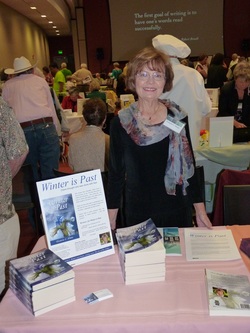
Victoria at the Palm Springs Writer's Expo March 2012
Victoria at the Palm Springs Writer’s Expo March 2012

Victoria Slotto, an Into the Bardo contributing writer, had her first novel – Winter is Past – published last year. Her second novel is in progress as well as a poetry chapbook. Victoria is a gifted writer and poet. I am proud and delighted to feature her here and honored that she has shared work on this site. She and I have much in common in terms of values and life experience. It was gratifying to see how well she incorporated important insights and ideals into the narrative flow of her novel. You will fall in love with and not soon forget her dear character, Claire. Jamie Dedes

See! The winter is past; the rains re over and gone. Flowers appear on the earth.” Song of Songs: 2:12

2940013445222_p0_v1_s260x420Enter a world where achieving inner strength and surviving the odds are possible

With a talent and voice unlike any other, Victoria C. Slotto captures the reader’s heart and mind with a tale of overcoming personal hardships and struggling with one of life’s most difficult questions, “What if…?”

What does a woman—a fearful woman—do when all she holds dear is in danger of being lost? Victoria C. Slotto’s romantic drama, Winter is Past, explores the depths of joy and sorrow women face and the paths that women find through fear.

Winter is Past explores Claire’s story, a woman with a perfect life—a husband she loves, friends, and meaningful work. As life changes around her, she shows us the strength of her spirit, as well as her belief.

Victoria C. Slotto, a former hospice nurse and a kidney transplant survivor, speaks from experience as she writes Claire’s story. But Winter is Past is not a memoir by any stretch; it is a story written by an accomplished poet and essayist.Victoria’s poems and short stories have been published in several magazines and journals since 2005.

The Plot of Winter is Past

After receiving a kidney from her best friend, Claire has a renewed delight in life. This newfound happiness is put on hold when she discovers Kathryn has cancer in her remaining kidney. To cope with a possible loss, Claire is forced to face a source of fear that has haunted her from early in life. Throughout her journey she will uncover an inner strength and survive the unthinkable. Claire’s fear is every woman’s fear. Her question is every woman’s—can she survive?

Critics Weigh In

Critics have already weighed in with reviews. Jean Davenport describes the novel as “A beautifully written and purposeful exploration of the meaning of life through love, loss and rebirth. The journey of Claire makes us all appreciate the fragile string our lives are attached to and how each event makes all worth living. A great read!”

Winter is Past was released December 2011 and is available in both print and e-book formats via most online retailers, which are listed HERE.

© 2012, 2013, photographs, Victoria C. Slotto, all rights reserved

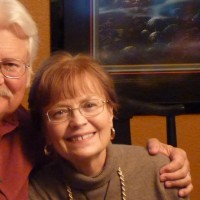
Victoria and Dave Slotto

Victoria C. Slotto attributes her writing influences to her spirituality, her dealings with grief and loss, and nature. Having spent twenty-eight years as a nun, Victoria left the convent but continued to work as a nurse in the fields of death and dying, Victoria has seen and experienced much. Because of her experience, Victoria is able to connect with her audience on an intimate level. She resides in Reno, Nevada, with her husband and two dogs and spends several months of the year in Palm Desert, California. Winter is Past is her first book published by Lucky Bat Books. Victoria is also an accomplished blogger, sharing her fine poetry with us HERE.

Posted in Essay, Guest Writer

LAUNCHED AT LAST! … Rhineo & Juliet, Love & Tragedy in Africa

DAV8700wtmk-e1353004364882

LAUNCHED AT LAST!

by

Naomi Estment (Naomi’s Notes)

It’s been a wild and woolly year, since my husband, Dave, and I embarked on an unforgettable journey in the creation of two short rhino films and an accompanying photographic book. They have been launched at last by Africa Cries. This Mauritian-based film production company was founded by Roland Vincent, whose vision inspired this phenomenal project.

Shot in South Africa and created in response to the escalating threat of extinction facing Earth’s remaining rhinos, the first film, Rhineo & Juliet – Love and Tragedy in Africa, addresses this crisis, while the second, The Ark – Rhino Survival Sanctuary, shares a far-reaching, sustainable solution, integral to saving this irreplaceable member of Africa’s Big Five.

Our heart-felt thanks goes out to all the amazing people who have given generously of their time, energy and expertise in contributing to the making of the films, as listed in the credits, as well as to the translation of both scripts into multiple languages. Special mention also to Wayne Nicholson and his team for their valued contribution and for sharing this in his post,Love & Tragedy in Africa.

Here are the films, with a word of warning to sensitive viewers: the first one contains a few brief but extremely hard-hitting scenes, which we have been repeatedly advised are critical to convey the extent of the rhino poaching horror. These were contributed by witnesses, who care deeply about the importance and urgency of the message. While the first is a sweeping story that tugs at the heart by humanizing rhino, the second film is documentary in nature, sharing a beautiful, tranquil overview of a solution.

Rhineo & Juliet – Love and Tragedy in Africa

The Ark – Rhino Survival Sanctuary

PLEASE VISIT THE AFRICA CRIES WEBSITE IF YOU’RE MOVED TO MAKE A CONTRIBUTION. WE WOULD ALSO REALLY APPRECIATE YOUR SHARING THESE VIDEOS FOR THE SAKE OF THE RHINO. SINCERE THANKS FROM US ALL!

I leave you with the words of Tony Frost, CEO of Sirocco Strategy Management, former CEO of WWF and board member of the South African National Biodiversity Institute: “I must say you are embarking on a terrifically exciting journey.  . . . the rhino is a massive and incredibly important symbol of a much bigger malaise attacking this planet and therefore it is a magnificent opportunity to do something much bigger than only saving the rhino. You have the vehicle, we have to help you to drive it hard!”

© 2013, essay and photographs, Naomi Estment, All rights reserved
This feature is presented here with the permission of the author
The videos were uploaded to YouTube by AfricaCries

537866_2655020590484_1671114272_aNAOMI ESTMONT is a South African writer, photographer, blogger (Naomi’s Notes), and contributing writer to Into the Bardo. She reports, “Dave and I have been extremely dedicated to conservation this past year, including creating these and other videos, establishing the Wild Imaging Trust and launching an epic project called Rock ‘n Ride 4 Rhino, which entails a five-month motorcycle tour of Southern Africa next year, in partnership with Jason Hartman (2009 SA Idol and passionate conservationist) and Damien Mander (founding director of the International Anti-Poaching Foundation).”

Posted in Essay, Guest Writer

THE RATE RACE

kgrhqvk0e1np4un-bqbsbibsc60_35

THE RAT RACE

by

J.D. Gallagar

In 2011, researchers at the University of Chicago conducted a simple experiment to ascertain whether a rat would release another rat from a cage without being given a reward. The answer was yes. After several sessions, the rats learned intentionally and quickly to open the restrainer and release the caged rats. The rats also repeated the behaviour even when they were denied the reward of reunion. Even more astonishing, when the rats were presented with two cages, one containing a rat, the other chocolate, they chose to open both cages and “typically shared the chocolate”.

For the researchers, the conclusion was inescapable: the rats were displaying empathy. Announcing the results in Science the lead researcher, Peggy Mason, explained: “There is nothing in it except whatever feeling they get from helping another individual.”

This is the opening of an article I was reading recently,(read it HERE if you like) it was about Barack Obama, Republicans, gun control, rich people and poor people. I don’t really want to go into the whole political aspect of it. Everyone to their own. Personally I believe all sides of politics, Left or Right, Independent or Green will screw us all over without the slightest hesitation. But I am a cynic.

But what I found interesting about this is not the experiment but the subjects. Rats. How many times have we heard the term Rat Race or the expression: even if you win the race you are still a rat? Quite a lot I bet. Buy why rats? Is it this perception that they are lowly and dirty, poisonous, dangerous. Even in school (I don’t know about other places but here in Ireland) if someone called you a rat it was the worst insult you could receive, it meant you told on someone to a teacher, you ratted on them.

You squealed was another popular expression in the schoolyard, again it implied the same thing and again conjured up the image of the  rat.  A coward. The lowest of the low.

So the experiment was interesting in that it showed rats in a better light, and yet how strange it is that when rats help each other for little or no reward we call it empathy and when humans do it we call it socialism or communism and it is frowned upon, socialism is one of the worst insults you can throw at a politician in the Western world, it implies weakness.

Funny old world.

© 2013, illustrations and essay, J.D. Gallager, All rights reserved
Published here with the author’s permission

010_the_embrace_hr-copy-2J.D. Gallager is a: “Writer. Avid reader. Type 1 diabetic. Irish” and “A struggling author … struggling to convince people he is an author.” His blog is HERE  and his Amazon author’s page is HERE. Mr. Gallager writes fiction for adults and young adults. (Book cover art is property of the author.)

Posted in Uncategorized

A simple and simply wonderful post from writer and positive thinker, Eva Tenter (Power of Postive Thoughts: Positive Thoughts, Inspirational Stories & Mental Health Advocacy). Nicely done, Eva~ Jamie

Posted in Uncategorized

INTO THE BARDO in 2012

The WordPress.com stats helper monkeys prepared a 2012 annual report for this blog. Thanks to all for your support, contributions, comments, and reading.

Here’s an excerpt:

4,329 films were submitted to the 2012 Cannes Film Festival. This blog had 28,000 views in 2012. If each view were a film, this blog would power 6 Film Festivals

Click here to see the complete report.

Posted in Uncategorized

WHEN THE POWER OF LOVE …

“When the power of love overcomes the love of power the world will know peace.
Jimi Hendrix (1942-1970), American musician/singer-songwriter

11143

Whether you celebrate the holiday season
religiously
spiritually
in a secular fashion
or not at all
Best Wishes
as we close one year and open another
Thank you for reading, sharing your work
and being the best possible you that you can be

INTO THE BARDO
is on hiatus until mid-January

Illustration courtesy of the Physicians Committee for Responsible Medicine (PCRM). 
Posted in Guest Writer, Poems/Poetry

A TRAMP SPEAKS

POEM: A TRAMP SPEAKS

by

David Francis Barker (DF Barket – Restless Art)

Reblogged with permission.

Soon after he arrived I gave him
some food. Half way through
his ham and eggs he raised a fork,
pointing it at me as if he had
a thought:

“The universe is where you are, not
somewhere else. Belief is the key,
not truth. Truth is relative,
subjective,
so don’t look for it.

Believe
in what’s important
to you
and go all out. Then keep it
to yourself.”

© 2012, poem and portrait, David F. Barker, All rights reserved

qjdn9ga4qsc23seqwxsmDavid F. Barker (DF Barker – Restless Art) is an independent poet, writer and artist. He paints mainly in oil, but also occasionally uses acrylics and watercolour. He often experiments with digital art. You can see some of his art work HERE. David writes articles, usually about artistic, local, political or timely themes, as well as short stories and longer fiction. He is a professional poet and his collection Anonymous Lines is available at amazon.co.uk and amazon.com  David has had a life-long love of history. He has a large collection of books spanning various epochs, but his consuming passion is English history. He makes music, too. Guitars and sounds of all sorts have been his friends, his solace for years. Very much in line with the Into the Bardo philosophy, he feels that all creativity is the same, it springs from the same source of mystery. He has no idea where it is, he only knows he must answer the call. J.D.

Posted in Guest Writer, Poems/Poetry

(pre) occupied

Banks-to-Jail

(pre) occupied
by
Luke Prater (WordSalad)
Reblogged with permission
.
(out)classist Zen, dour Marxist yen
  unwelcome resting here
night:stick the pigs back in the pen
  torn figments of a year
.
no turning back, no pushing on
  unwelcome resting here
the sink-sunk rides old suns outshone
  torn figments of a year
.
to watch and flinch while women, men
  unwelcome resting here
stand weak in words beyond their ken
  torn figments of a year
.
the lighting flickers, then it’s gone
  unwelcome resting here
the power’s out for Jane and John
  torn figments of a year
.
preoccupied with Occupy
  unwelcome resting here
as Occident’s wrung wraithly dry
  torn figments of a year
.
police-guard-bull-statue-occupy-wall-street-1

©2012, Luke Prater, All rights reserved

9cdbb60f2264b266b199b0c889fba15a-1-1Luke Prater’s (Word Salad) poetry is ever fascinating. Luke will often tackle the same subject in more than one poetic form. Dedication, patience, and a singular irreverence are the hallmarks of this thirty-five year old English poet who took a degree in English lit with creative writing and performance and subsequently went to SOAS, London to study ethnomusicology at the master’s level. At twenty-seven he took up poetry, which he says saved his life – a thing it has done for many of us.  J.D.

Posted in Essay

THE LOVE FOR (OLD) BOOKS

obblog

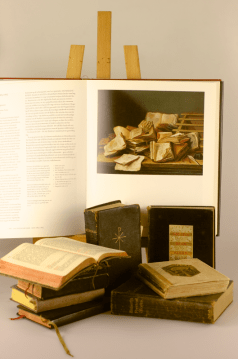
Some of my old books. Photo by Paula Kuitenbrouwer

THE LOVE OF (OLD) BOOKS

by

Paula Kuitenbrouwer (Mindful Drawing)

Reblogged here with Paula’s permission. 

A few days ago, I read in a newspaper about a Dutch politician questioning the future existence of libraries. Kindle was mentioned as well as the Internet, so why have libraries? I stopped reading the article because there is only so much flap-doodle one can stomach. One might hope that our politician will start reading T.S. Eliot and stumbles upon Eliot’s quote: ‘The very existence of libraries afford the best evidence that we may yet have hope for the future of man’.

220px-the_burning_of_the_library_at_alexandria_in_391_ad

Imagine a few philistines standing in front of the burning library of Alexandria, in estimate 48 BC, indifferently saying to each other; ‘A well…who cares?’ I care, and that is what I commented at Jamie Dedes’ discussion Times Change on The Writer by Day.

You could object and point out that we can store all books digitally, something that wasn’t possible in ancient times. That isn’t a very convincing argument to me, because at ancient and medieval times copies were produced too, in order to preserve knowledge and to make knowledge widely available. The problem, to me, is that digital copies are clean and sterile presentations. They do not enchant, hold no smell, sensation nor touchable illustrations. Many of us need to experience these qualities hands-on.

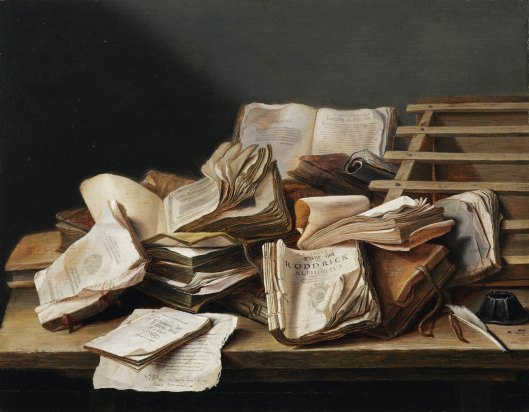
I also love painting old books. Books offer a wonderful theme, showing off a collection that represents a specific time, a layer of the society, telling a story about the writer, reader, and publisher.

28_de_heem_183

Jan Davidz de Heem (1606-1683/84), Still-life with Books

A painting like this communicates ‘Look that my books’, and ‘Look what I read and store in my head’. See the ink-pot and feather-pen, stating; ‘I write too’ or ‘I’m a scholar’.

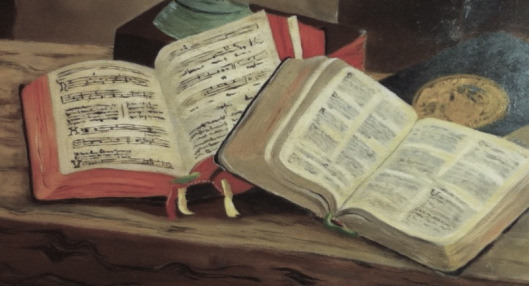
obb

Detail oil painting Paula Kuitenbrouwer

Do you also like the little extra treasures old books sometimes offer? They can be underlined sentences that ones held significant meaning to the former owner of the book. Or they can be a handwritten old name on a pretty Ex Libris.

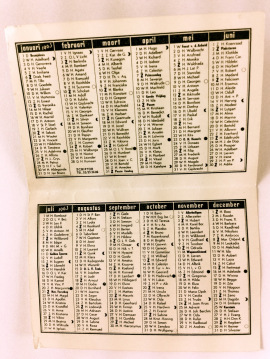
A few year ago I bought an old book. At home a small calendar of my year of birth dropped out (now how amazing is that?), showing a year long list of -to my generation- forgotten saints as well as a moon calendar.

tx1
The Saint and Moon Calendar of my birth-year.

Last, have a look at this beauty: an old Dutch book on Percival, with the name of the former owner in the right upper corner in ink. The Art-Nouveau illustration, in relief gold, offers enough reason to buy the book. There is even a treat inside: a small, printed prayer card, showing St. Martin by Michelina da Besozzo, 1410.

parceval
Will we ever enjoy a relief print, golden illustration on a Kindle? If we ‘open’ our E-reader, will we ever experience a pleasurable surprise of a little wink or glimpse back in time, falling out? I’m afraid not. Books provide us with all sort of inspiration; we therefore need old books, stored in libraries (and available in second hand bookshops).

© 2012, essay/photos/artwork, Paula Kuitenbrouwer, All rights reserved

Posted in Buddhism, Teachers

INTENTIONS

Reblogged from July 2012. J.D.

OUR INTENTIONS — noticed or unnoticed, gross or subtle – contribute either to our suffering or to our happiness. Intentions are sometimes called seeds. The garden you grow depends on the seeds you plant and water. Long after a deed is done, the trace or momentum of the intention behind it remains as a seed, condition our future happiness or unhappiness.” Gil Frondsdal, Teacher, Insight Meditation Center, Redwood City, CA

.

Photo credit ~ Hana Muchová, Public Domain Pictures.net