
Posted in Essay, Karen Fayeth

On Tenacity

mymettles

ON TENACITY

by

Karen Fayeth (Oh Fair New Mexico)

Earlier this week I received the results of a competition I had entered, and for which I held out great hope. It was related to my writing and even an honorable mention would have been a huge step forward for me.

While entering I knew it was a long shot, but I really believed I had a chance.

Predictably, when the results were announced I was nowhere in the list, and yes, this got me a little down.

That’s the trouble, sometimes, with having hope. A burgeoning flower bud of belief can so easily get ravaged by insatiable locusts (over dramatic metaphor alert!!!).

When one is a rather sensitive artist type, it’s hard not to feel steamrolled at such times. Then again, what separates the doers from the dilettantes is tenacity.

So after feeling mopey for several days I am starting to rally. In defeat my resolve becomes just that much stronger.
For almost two years I have been using a really wonderful service that forces me to submit writing to literary journals every quarter. They are strict taskmasters and they keep me focused.

Once every three months I send out about thirty submissions, of which most of them are rejected. This means piles and piles of both email and snail mail arrive at my door just to say “you are not a good fit.”

Amazing how something like two hundred rejections can really make a girl immune to the woes. It’s like a pair of ill-fitting shoes. At first it hurts, then it makes a really painful blister, then finally a callus forms. The thin skin has toughened to endure the scraping.

Like that.

This morning I was thinking back to about seven years ago, back before The Good Man and I had married, and he was living in San Francisco’s North Beach. A really cool new art store had opened on Columbus Ave. near his place and I was just beginning my foray into the visual arts. Visual arts were a big departure from writing, which had dominated my creative juices for so long.
I loved everything about the art store and bought quite a few supplies there. One day they had posters up announcing an auction. Customers were invited to submit art works and the store would display them and then at the end of the month, the store auctioned them off for charity.

Great! I was on board. I created an item to give to the auction and when The Good Man turned in my piece for me, he was asked to put a starting bid. Because he loves me and encourages my work, he put the amount of $50 as a starting price instead of starting at zero as most other artists were doing.

Later, when we walked into the store to see my stuff on display, my piece was at the very, very back of the store among the tools and shelves where they stretch canvas. My work was clearly more amateur than the rest of the offerings and it stood out as the only one using the photographic medium, but ok. It was on display which was a huge rush.

When the auction was finished, they called to ask me to come pick up my work. The rather arrogant and sniffly clerk informed me bluntly that my piece was the ONLY one that hadn’t sold (meanwhile, he gave us a flyer so we could attend his exhibit of butt ugly paintings at a local small gallery).

I was, of course, embarrassed beyond belief, humiliated and totally crushed. Being judged by a more experienced (and in my mind, more talented) artist just about did me in.

Just thinking about it still gives me shudders of embarrassment. This morning in the wake of my recent defeat I thought again about this experience. I recalled today that among all the donated pieces, my work was the only one that listed a starting bid.

All others put in a starting bid of $0, and they all sold. Snotty clerk said they didn’t have a lot of bids and bidders. All of this means that at the end of the auction, someone could have thrown $5 at a piece of artwork and would have won.

Today I understand that instead of being sheepish about that whole thing, I should be proud. I may not have sold my work but I valued my art enough to put a price on it.

Which is stronger? Valuing my own work and not selling it at that auction, or giving it away for free, thus saying the value of my work is nothing?

I know which one I choose. Today I have straightened my spine and I feel a little better.

In defeat, my mettle is being tempered, and that only makes me stronger.

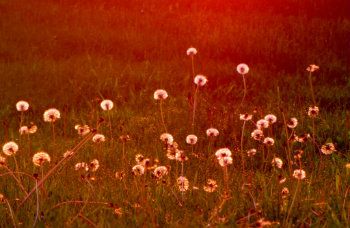
© 2013, essay, Karen Fayeth, All rights reserved. Photo by Claudia Akers.
Photo credit ~ Forge, ScienceGuide

webheadshotKAREN FAYETH ~ is one of our regular contributing writers. She is our new tech manager, site co-administrator along with Jamie and Terri, and fiction and creative nonfiction editor. She blogs at Oh Fair New Mexico. Born with the writer’s eye and the heart of a story-teller, Karen Fayeth’s work is colored by the Mexican, Native American, and Western influences of her roots in rural New Mexico complemented by a growing urban aesthetic. Karen now lives in the San Francisco Bay area. When she’s not spinning a tale, she works as a senior executive for science and technology research organization.

Karen has won awards for her writing, photography, and art. Recent publication credits include a series of three features in New Mexico magazine and an essay with the online magazine Wild Violet.  Her latest short story will be published in the May edition of Foliate Oak. Karen’s photography is garnering considerable attention, but her proudest moment was having her “Bromance” (Aubry Huff and Pat Burrell) photo featured on Intentional Talk hosted by Chris Rose and Kevin Millar on MLB TV. She’s a Giant’s fan.

Posted in Essay, Jamie Dedes, Music, Poems/Poetry

I Never Saw Another Butterfly

Butterfly Boy Bronze Statue unveiled at Jane Bancroft Cook Library (Florida), January 28, 2010

Sculptor, Sidney Fagin.

.

I NEVER SAW ANOTHER BUTTERLY

The last, the very last,

So richly, brightly, dazzlingly yellow.

Perhaps if the sun’s tears would sing

against a white stone. . . .

Such, such a yellow

Is carried lightly ‘way up high.

It went away I’m sure because it wished to

kiss the world good-bye.

For seven weeks I’ve lived in here,

Penned up inside this ghetto.

But I have found what I love here.

The dandelions call to me

And the white chestnut branches in the court.

Only I never saw another butterfly.

That butterfly was the last one.

Butterflies don’t live in here,

in the ghetto.

– Pavel Friedmann

Pavel Friedmann was born in Prague on January 7, 1921. He was deported to Terezin on April 26, 1942 and later to Auschwitz, where he died on September 29, 1944. At least 960,000 Jews were killed in Auschwitz. Other victims included approximately 74,000 Poles, 21,000 Roma (Gypsies), and 15,000 Soviet prisoners of war; and 10,000-15,000 members of other nationalities (Soviet civilians, Czechs, Yugoslavs, French, Germans, and Austrians). Women, men, children.

722px-Timbre_Allemagne_1992_Martin_Niemoller_oblWhile it is common to say “never again” … meaning that event we refer to as THE Holocaust … it’s important to remember that there are Holocausts (genocides) in process now and  there have been many in our history  … think of Armenia, Rawanda, the Congo, Cambodia, Vietnam, Sudan, Iraq, Somalia, North Korea,  the Kurdish peoples, Syria, Palestine … Time and past time to put an end to it …

I like to remember the lesson taught by Pastor Martin Niemoller (1892-1984) – a victim of the Nazis – and passed on to us. There is some controversy over the many versions of his “First they came …” It is often presented as a poem.  The great jazz musician, Charles Mingus, recites a version before his musical composition, Don’t Let It Happen Here. In any event, the point is made: political apathy is dangerous.

First they came for the Jews
and I did not speak out-
because I was not a Jew.
Then they came for the Communists
and I did not speak out-
because I was not a Communist.
Then they came for the trade unionists
and I did not speak out-
because I was not a trade unionist.
Then they came for me-
and there was no one left
to speak out for me.

– Pastor Martin Niemoller

– Jamie Dedes

Photo credits: Sidney Fagin – New College of Florida; German postage stamp with sketch of Pastor Martin Niemoeller (licensing status unclear ) via Wikipedia

Posted in Contributing Writer, Essay, find yourself

FINDING YOURSELF Part 1: The Freedom of “I Don’t Know”

1-1213801011KG6LToday begins the first of three features on finding yourself.  “Be True to Yourself” would be another good name for this series with the perspectives of three writers:

.

Part 1: The Freedom of “I Don’t Know” ~ Natasha Head
Part 2:
What story do you have to tell? ~ Terri Stewart
Part 3:
On the Razor’s Edge ~ Jamie Dedes

The Freedom of “I Don’t Know”

There is a peace to be found in releasing labels, brands and notions we are conditioned with before we even have a chance to determine if this is who we want to be. Every day, I feel as though I am failing in the expectations others have for me, yet…I know I cannot let their preconditioned labels define me.

The little bit of myself I have been able to hang on to, throughout all the many roles we get sucked into, shows in my writing. If I had to name the biggest reason why I do write, it’s to hang on to me. The one thing I can be sure of in this world is the girl sitting in the dark corner alone, tattered notebook and cheap pen, ink spots on her fingers and a desire to be left alone with her thoughts.

This is my church. I can enter anywhere, on any day, at any time. I am always accepted, I am always welcomed, and I always feel…right.

I think that sense of “right” is one of the hardest things to find in this world. For so long, I tried to shape myself to fit in so many ways others told me I had to in order to be part of the crowd. They would fight me tooth and nail when I asked a question they couldn’t answer. They would belittle and scorn me for not taking as faith what they never had the courage to question. Where is the poetry if we are not allowed to question? Where do great ideas and new discoveries come from if we are not pushed and encouraged to seek further.

When they come at me now…wanting to know my beliefs, where I pray, where I’m going to go when I die…I’ve learned they already know the answer they want to hear…and I’ve learned the only compassionate one I can give, so as not to offend and engage is “I don’t know.” Really…what other honest answer is there? It turns a soldier into teacher, a teacher to a guide, and suddenly a new path unfolds with an invitation to explore. I have learned so very much…simply by admitting, I don’t know.

And at the end of the day…how much does it matter if it steals from the gift this lifetime is? Our true blessings are found in the now. In the time we have right now to help, to lift up, to learn, to love. Imagine, if the world could stop debating what is personal and individual to everyone, and simply come together to make the most of where we’re at with what we have? If there’s one thing I do know…it would have to make it a much better place…a much better now.

– Natasha Head

© 2013, essay and portrait, Natasha Head, All rights reserved
Photo credit ~ Petr Kratochvil, Public Domain Pictures.ent

9-1NATASHA HEAD debut poetry collection (from Winter Goose Publishing) was Nothing Left to LosePushcart Prize nominee for 2012. A year later – almost to the day – her newest offering, Pulse. was releasedNatasha blogs at The Tashtoo Parlour and participates in a leadership role on d’Verse ~ Poets Pub. She is the founder and coordinator of New World Creative Union

Posted in Essay, Guest Writer, Peace & Justice

Mindful Steps to End Hunger

Charles W. Elliot

By Charles W. Elliot

Posted here with the permission of Buddhist Global Relief (BGW)

Hunger remains a problem and we think it is not inappropriate to post this again, an essay by Charles W. Elliot that we featured a couple of years ago. On the blog roll to the right, there is a link to BGW ‘s donation page in the event that you are inspired to make a donation. We don’t take donations or any remuneration for the work on this site; but, if you get something out of what is presented on Bardo, we encourage you to support one of the organizations we support or another worthy charity of your choosing. Let’s collaborate to keep the good works going. In gratitude, Jamie Dedes

The simplest act of eating a piece of fruit is inevitably embedded in a complex web of systems: economic, agricultural, financial, and environmental. In attending mindfully to this act, we can discern myriad interdependent phenomena: the beginningless origins of its seeds, the earth from which the fruit grew, the laboring hands that brought the food to our table. The same mindfulness will show how our own lives depend upon the efforts of others, the essential kindness of countless strangers. And in recalling this kindness, we should be ready to take steps to repay it. One such way is to carefully consider the needs of others, and where we find that basic human needs remain unmet because of injustice, we should be motivated to act.

The Universal Declaration on the Eradication of Hunger and Malnutrition states that “society today already possesses sufficient resources, organisational ability and technology and hence the competence to [eradicate hunger].” While food supplies are abundant, access to that food is not. In 2010, 925 million people suffered from chronic hunger, representing one in seven of a global population approaching 7 billion.

Access to adequate food, as indispensable to basic human survival, is a matter of social justice. One of the earliest pronouncements of global governance on fundamental human rights was the U.N. General Assembly’s simple declaration: “Everyone has the right to a standard of living adequate for the health and well-being of himself and of his family, including food[.]” (Universal Declaration of Human Rights, Article 25, paragraph 1, 1948.) If food has been recognized as a human right since the end of World War II, and if society has the resources and competence to end hunger, we should ask ourselves: why are so many millions still hungry?

Of course, there is no single answer to that question. Like all other phenomena, the persistence and spread of human hunger is a complex dependent-arising involving many interwoven causes. Two disturbing factors are financial speculation, which drove commodity prices sky-high in 2007-2008, and the increasing diversion of crops from food production to biofuel production. Thus, the portion of U.S. corn grown to produce corn-based ethanol rose from 15% in 2006 to an estimated 40% in 2011. Other factors include catastrophic weather conditions such as droughts and floods, and global climate change, which has an adverse impact on water supplies and land, especially in the developing world. At the same time, urban sprawl reduces available farmland, while the urban middle class consumes more meat and processed food, which in turn demands more land, water, and energy.

While resources for food dwindle, governmental policies, particularly in the West, have become increasingly hostile to the poor. The shredding of social safety nets puts at risk an ever-larger number of people who need help in the face of poor economic conditions. Last year, about 25% of the House of Representatives voted to eliminate foreign food aid. Such policies appeal to the notion that the world is a zero-sum game, that any help we offer another family will mean that we get less and that we cannot afford fairness. Here in the U.S. help for the poor is in jeopardy. In my home state of Pennsylvania, food stamp use has risen 50% from 1.2 million people in 2008 to 1.8 million today. Despite the increasing need driven by the Great Recession, the current governor proposes to disqualify anyone with assets of more than $5,500—for example, a bank account or a second car—from food stamp eligibility. As a result, it is estimated that 4,023 Pennsylvania households will lose their food stamp benefits on May 1 of this year.

Battling institutional and entrenched social injustice helps alleviate hunger because poverty is at the root of hunger, and the root cause of poverty is powerlessness: the “powerlessness of those who lack resources such as land and water to grow food, jobs to earn money to buy food, an adequate food safety net and food reserves, and adequate nutrition.” (The Downward Spiral of Hunger: Causes & Solutions)

There are many small steps we can take to end hunger, but we must be prepared to respond to the call of conscience to help others and to restore social justice. A key step is to rebuild and enhance small-scale local food systems and turn away from globally concentrated control of food production and distribution. Ultimately, we should reject the domination of agriculture by large corporate agribusiness, and confront corporate attempts to control the very seeds of life with their patented genetically-modified “single generation” seeds.

At the neighborhood scale here in the U.S., community food gardens are springing up even in major cities like New York City and Detroit. Food waste and post-harvest losses could be remedied to make more food available to those in need. Greater investment in small-scale agriculture in rural areas and urban agriculture in the cities would empower the poor and hungry.

At Buddhist Global Relief, we are taking our own small steps. For example, we provide village-scale training in intensified rice cultivation to rural farmers in Cambodia and Vietnam, helping to build their capacity and confidence in applying sustainable agriculture techniques. These techniques dramatically boost yields without expensive external inputs. BGR funds tools and seeds to impoverished families in Cambodia to grow cash crops and home vegetable gardens. Following each harvest, each family then gives the same amount of seed they received to another local family, thus establishing a community of mutual support. BGR helps train villagers in Kenya and Malawi in small-scale agricultural techniques that nurture healthy soil fertility, produce high yields, conserve resources, and meet the basic need of people to independently feed themselves.

Such small steps, taken collectively by Buddhist Global Relief and countless others, are helping to empower the poor, reduce poverty, and alleviate the suffering of hunger. Neither the complexity of the manifold causes of hunger nor the daunting statistics of global poverty should deter us from acting out of compassion and generosity. In the Buddhist tradition, the embodiment of compassion, AvalokiteshvaraGuanyin Kwannon, is often depicted not just with a thousand eyes to gaze upon the suffering in the world, but with a thousand hands to aid those who suffer. Of course, not even a thousand arms are enough to help the billion people who suffer from hunger. But if we recognize each motivated human heart as the eyes and hands of Avalokiteshvara, each of us acting in our own way, in our own communities, might yet help to end hunger in our generation.

Charles W. Ellliott, a member of the Board of Directors of Buddhist Global Relief, is a lawyer practicing environmental, land use, and human rights law.

© 2012, photo and essay, Buddhist Global Relief, All rights reserved

Posted in Essay, Jamie Dedes

Roger Ebert “…online, everybody speaks at the same speed.”

ROGER EBERT (1942-2013)

film critic, screenwriter, Pulitzer Prize for Criticism

Ebert at the Conference on World Affairs in September 2002,

shortly after his cancer diagnosis

THE WISDOM AND COURAGE OF ROGER EBERT

This following piece on Roger Ebert was originally written for our Perspectives on Cancer series in 2011. I don’t know how well known Roger Ebert is outside of the United States; and while he is best know and appreciated as a journalist and film critic, I feel his inspiring response to catastrophic illness makes him a true hero and role model for anyone anywhere. Earlier this week the Chicago Sun Times announced Roger Ebert’s death from cancer.

Roger Eberts cancer and treatments took away his jawbone, his ability to speak, and even his ability to eat and drink. He continued writing right to the end, said that when he wrote he was just like his old self, and he wrote his last tweet two days before his death. Of his life online, he said:

 Now we live in the age of the Internet, which seems to be creating a form of global consciousness. And because of it, I can communicate as well as I ever could. We are born into a box of time and space. We use words and communication to break out of it and to reach out to others.

For me, the Internet began as a useful tool and now has become something I rely on for my actual daily existence. I cannot speak; I can only type so fast. Computer voices are sometimes not very sophisticated, but with my computer, I can communicate more widely than ever before. I feel as if my blog, my email, Twitter and Facebook have given me a substitute for everyday conversation. They aren’t an improvement, but they’re the best I can do. They give me a way to speak. Not everybody has the patience of my wife, Chaz… But online, everybody speaks at the same speed.” Roger Ebert

Born in Urbana, Illinois to parents of modest means who wanted a better life for him then they had, Ebert’s affinity for writing and film were encouraged. He went to Urbana High School, University of Chicago, and University of Illinois at Urbana-Champaign. He is known for his film column in the Chicago Sun-Times (1967 – April 4, 2013), his film guide books, and for the television programs he did in collaboration with Gene Siskel and later Richard Roeper. Ebert struggled with alcoholism. He is married to a trial attorney, Charlie “Chaz” Hammel Smith, now Chaz Ebert and VP of Ebert Company. 

In 2002, Ebert was diagnosed with salivary cancer. He received radiation treatments and multiple surgeries that effected his speech. In 2006, more cancer was found in his jaw bone. He was rushed to the hospital when his carotid artery burst and he “came within a breath of death.”  The jaw bone was removed. Between one thing and another, he suffered through excessive bleeding, loss of muscle mass, deformity, a jaw prosthetic, and the loss of his voice. In the TED Award video below, he informs us of his – among other things – experiments with different voices.

I have always admired Roger Ebert as a writer, film critic, and the first film critic to win the Pulitzer Prize for Criticism. Since he has been living with cancer and then the fallout from cancer, I have come to admire Roger Ebert, the man. He has shown himself to be a world-class role model and a first class human being. As you will see, through it all, he has retained his sense of humor. Write on Roger
ROGER EBERT: Remaking My Voice

Photo credits ~ Ebert at the 2004 Savaanah Film Festival by Rebert under GNU Free Documentation License and Lillian Boutte and Roger Ebert by Jon Hurd under Creative Commons Attribution 2.0 Generic license. Both photos via Wikipedia.

Video upload to YouTube by 

Belated addition to this post 12:22 a.m.: I just found this lovely essay by Roger Ebert entitled, “I do not fear death …” on Salon’s site. Link to it HERE.

ge-officeJamie Dedes ~  My mother lived with cancer of one sort or another for forty years. She was diagnosed with cancer the first time at thirty-six.  She was pregnant with me, her second and last child. She had a radical mastectomy and radiation treatments while pregnant. Ultimately, she went three rounds with breast cancer, one with thyroid cancer, and died at seventy-six of breast and colon cancer. I pray everyday for cures. Advancements in medicine and technology give us hope. I’m also encouraged to see that we are doing more with lifestyle and nutrition (antiangiogenic foods), both prophylactically and for healing and remission, and with the soft technologies of prayer, guided visualization, energy medicine, meditation, music and art.

Posted in Essay, General Interest, Guest Writer

LIFE INTO ART

2-1-13-2LIFE INTO ART

by

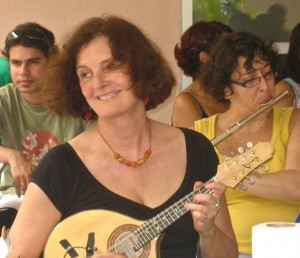
Marilynn Mair (Celebrating a Year)

I think, looking back at my wayward path through the years, that the most valuable life skill one needs to develop in order to succeed, is to learn how to improvise. Life will never be smooth or rosy, except in very small stretches. Opportunities for your skill set may never materialize, love may not be as generous to you as you are to it, life as you planned it will definitely at some point go astray. Set-backs and tragedies await, and if you are to cope, to carry on, you need to be able to take a hard look at the pieces on the board and figure your best way forward. Right where you stand, right where you never expected to be. Imagination helps, optimism is a crucial ingredient even if it seems to have temporarily disappeared. No one teaches us how to do this, we learn from necessity. But it certainly puts jazz in a whole different perspective. And poetry, abstract painting, things most people think they don’t understand. Because, really, we are all just learning how to make life imitate art.

I think that if all we had in life to guide us was this paragraph by Marilynn Mair, we’d be okay. Life is the art of taking the jarring notes, the unlikely word, the unexpected juxtapositions, the odd shadings and turning them into something lovely. Life is the teacher. Art is the text. Creating art is survival, the way we work out understanding and meaning. Jamie Dedes

© 2013,essay and photographs, Marilynn Mair, All rights reserved

Rs-roda-016-e1335986264463-300x258MARILYNN MAIR ~ of Celebrating a Year is known as the “angel of the tremolo” and “the first lady of mandolin”. Marilynn is Professor of Music at Roger Williams University, Bristol, Rhode Island. Her most recent CDs are Meu Bandolim and Enigmatica. Her most recent book is Brazilian Choro – A Method for Mandolin.  For more of Marilynn’s story, link HERE. Marilynn Mair is a contributing writer to Into the Bardo.

Posted in Essay, Teachers

THERAVADA SPIRITUALITY IN THE WEST

THERAVADA SPIRITUALITY IN THE WEST

by

Gil Fronsdal

While the Western contact and study of the Theravāda tradition goes back to the earliest Christian missionaries in Sri Lanka in the sixteenth century and to European scholars in the early nineteenth century, the beginning of popular Western interest in and inspiration from Southeast Asian Buddhism began around 1870. Since that time there has been two peaks in this interest: the first, from 1870 to 1912 and the second, a century later from 1970 to the present. The former was characterized primarily by an intellectual orientation as Europeans and Americans found in the early Buddhist texts preserved by the contemporary Theravāda tradition an attractive alternative to Western religious beliefs. In contrast, the current upsurge in interest centers predominantly around religious praxis, with specific practices attaining great popularity sometimes completely divorced from the doctrinal and religious context of the Southeast Asian Theravāda tradition(s). At the same time however, an influx of immigrants from Theravāda countries, especially to the United States, has resulted in the presence of numerous Thai, Burmese and Sri Lankan temples that replicate the cultural forms of Theravāda Buddhism of their respective home countries. Most of these ethnic temples created since 1970 have had little impact outside of their respective ethnic constituencies.

With the exception of the partially westernized Sri Lankan missionary Anagārika Dharmapāla (1864 – 1933; discussed below), Theravāda Buddhism has mostly been introduced to the West by westerners. As can be expected, the importation of Theravāda Buddhism to the West has involved a selection, translation and adaptation process as westerners defined the tradition for themselves. What has been most fascinating about this process is that the twentieth century Theravāda Buddhism that many westerners are encountering in Southeast Asia has been profoundly changed by the nineteenth century Asian contact with the West and with Western interpretations of Buddhism. MORE [Insight Meditation Center, Redwood City, California, USA]

♥ ♥ ♥ ♥

Teacher

Gil Fronsdal is the primary teacher for the Insight Meditation Center in Redwood City, California; he has been teaching since 1990. He has practiced Zen and Vipassana in the U.S. and Asia since 1975. He was a Theravada monk in Burma in 1985, and in 1989 began training with Jack Kornfield to be a Vipassana teacher. Gil teaches at Spirit Rock Meditation Center where he is part of its Teachers Council.

Gil was ordained as a Soto Zen priest at the San Francisco Zen Center in 1982, and in 1995 received Dharma Transmission from Mel Weitsman, the abbot of the Berkeley Zen Center. He is currently serving on the SF Zen Center Elders’ Council.

Gil has an undergraduate degree in agriculture from U.C. Davis where he was active in promoting the field of sustainable farming. In 1998 he received a PhD in Religious Studies from Stanford University studying the earliest developments of the bodhisattva ideal. He is the author of The Issue at Hand, essays on mindfulness practice, and the translator of The Dhammapada, published by Shambhala Publications.

You may listen to Gil’s talks on Audio Dharma.

The Buddha illustration is courtesy of The Buddha Gallery. If you click on the photograph, you will link to a detailed description.

Bells - Click image to download.

Posted in Essay, General Interest, Guest Writer, Uncategorized

I hope you enjoy this interesting piece by Manu Kurup, which he has done with a delightfully light touch. Jamie Dedes

Posted in Essay, Guest Writer, Shakti Ghosal

Connecticut, Delhi and HO’OPONONO

Connecticut, Delhi and HO’OPONONO

by

Shakti Ghosal (ESGEE musings)

What we feel and think and are is to a great extent determined by the state of our ductless glands and viscera.” ~Aldous Huxley, English author, 20th century

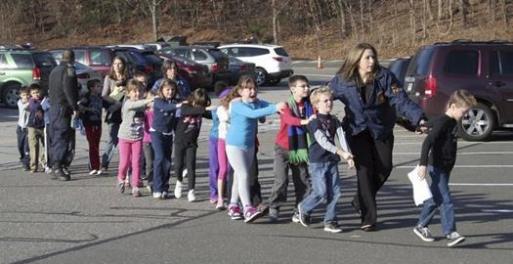
Over the last month the media streams have remained clogged with two events. First,the horrific massacre of school children and teachers in Connecticut, USA. Second, the barbaric rape and “murder” of an Indian medical student in Delhi.

connecticutschoolshooting110059-525x270

delhi_gangrape_protest_new_pti

As part of an increasingly aware and connected society, we remain quick to rationalise into the underlying reasons and ascribe blame. The flickering screens become full with debates and sermons as questions and suggestions fly thick and fast.

• Why does the U.S. Government not take up with the National Rifle Association and amend the gun ownership laws?
• What makes the Indian police so insensitive and ill equipped to take care of women safety on the roads?
• If, as it now emerges, gunman Adam Lanza displayed worrisome and awkward behaviour, why did his mother not do something about it?
• What was the trigger for the gang of rapists to have conducted themselves in such a brutal and violent manner?

…and so on, the list goes on and on.

delhi-rape

We may sit in judgement and hold holier than thou perceptions. As we take time out to show our solidarity with the cause and impatience and distrust with the ‘powers that be’. Or we may choose to get involved with our hearts, indulge in emotional outpourings and feel we are doing our bit. Either way we do not take responsibility for what happened.

But could it be that as we come across such evil and darkness in the world, there lies a seed of responsibility within us? When we accept the status quo of injustice on the plea that this is how it has been? When we prefer to remain an onlooker to a crime perpetrated on someone else? When we spend our energy to protect our own cocoon only? When we expect the Government and the police to follow standards of morality and behaviour higher than our own?

My thoughts flit to Joe Vitale and his book “Zero Limits”. About therapist Dr.Hew Len and his handling of a ward of criminally insane patients. Dr. Len never saw patients but only reviewed their files. As he looked at the files, he would work on himself by repeating the following universal mantras.
• I am sorry.
• Please forgive me.
• I thank you
• I love you.

And as he worked and improved himself, the patients started to improve and heal!

Dr. Hew Len was following the concept of HO’OPONONO, a Hawaiian word dealing with “extreme responsibility” which requires the person to take total responsibility of his life including all people and situations coming into it. A ‘tough to swallow’ and bizarre concept on first sight!

hooponopono-hula-rye-optimiced

But as I muse on the need to take responsibility of anything that shows up in our life, absolutely everything, I start seeing a continuum. Between extreme responsibility and that of reconciliation and forgiveness. I also come face to face with my Karma in that I must be willing to experience myself what I have allowed to happen to others, either by my inaction or inability.

And today in this new millennium, as we sit on the explosive powder keg of increasing disparity, isolation of the ‘left behinds’ in fast changing societies and values and technology driven, rapid creation of awareness and beliefs, could HO’OPONONO show us the way forward?

In learning……… Shakti Ghosal

Acknowledgement: Zero Limits: The Secret Hawaiian System for Wealth, Health, Peace, and More by Joe Vitale & Ihaleakala Hew Len, Dec. 2008.

© 2013, Shakti Ghosal, All rights reserved

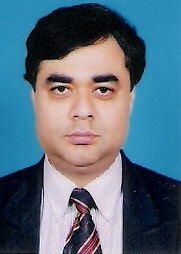
Shakti Ghosal
Shakti Ghosal

Shakti Ghosal ~ has been blogging (ESGEE musgings)since September 30, 2011. He was born at New Delhi, India. Shakti is an Engineer and  Management Post Graduate from IIM, Bangalore. Apart from Management theory, Shakti remains fascinated with diverse areas ranging from World History, Economic trends to Human Psychology & Development.

A senior Management professional, Shakti has been professionally involved over twenty-five years at both International and India centric levels spanning diverse business areas and verticals. With a strong bias towards action and results, Shakti remains passionate about team empowerment and process improvement.

Shakti currently resides in the beautiful city of Muscat in Oman with wife Sanchita, a doctorate and an Educationist. They are blessed with two lovely daughters, Riya and Piya.

Posted in Essay, Guest Writer

Giulas is a thoughtful, talented South American film-maker and photographer. I have followed his blog and YouTube channel for a few years now. This post is one I particularly appreciate. Guilas gives us something to think about, which he has drawn from his refined spiritual and artistic sensibility. Thanks, Giulas. Jamie

giulas41's avatarThe eternal solitude of the restless Mind

We live in a world with lots of differences. People are dying of poverty by the millions while other people are feasting in fancy hotels in Europe and Asia. People are suffering for not been able to afford dental treatment while people are spending hundreds of thousands in a new shining smile. That’s the world. I know it can get a lot better but i also know it was a lot worst. At times slavery was common. At times killing with no reason was acceptable. It sounds like the world we live in now, right? Look up in history and you will see it was a lot worst. Our life expectancy is proof of that. This is already subject for a lot of arguments but this is not the main subject here. The main subject maybe has to do with the fact things doesn’t get even better. Much better. And…

View original post 531 more words

Posted in Essay, Guest Writer

LAUNCHED AT LAST! … Rhineo & Juliet, Love & Tragedy in Africa

DAV8700wtmk-e1353004364882

LAUNCHED AT LAST!

by

Naomi Estment (Naomi’s Notes)

It’s been a wild and woolly year, since my husband, Dave, and I embarked on an unforgettable journey in the creation of two short rhino films and an accompanying photographic book. They have been launched at last by Africa Cries. This Mauritian-based film production company was founded by Roland Vincent, whose vision inspired this phenomenal project.

Shot in South Africa and created in response to the escalating threat of extinction facing Earth’s remaining rhinos, the first film, Rhineo & Juliet – Love and Tragedy in Africa, addresses this crisis, while the second, The Ark – Rhino Survival Sanctuary, shares a far-reaching, sustainable solution, integral to saving this irreplaceable member of Africa’s Big Five.

Our heart-felt thanks goes out to all the amazing people who have given generously of their time, energy and expertise in contributing to the making of the films, as listed in the credits, as well as to the translation of both scripts into multiple languages. Special mention also to Wayne Nicholson and his team for their valued contribution and for sharing this in his post,Love & Tragedy in Africa.

Here are the films, with a word of warning to sensitive viewers: the first one contains a few brief but extremely hard-hitting scenes, which we have been repeatedly advised are critical to convey the extent of the rhino poaching horror. These were contributed by witnesses, who care deeply about the importance and urgency of the message. While the first is a sweeping story that tugs at the heart by humanizing rhino, the second film is documentary in nature, sharing a beautiful, tranquil overview of a solution.

Rhineo & Juliet – Love and Tragedy in Africa

The Ark – Rhino Survival Sanctuary

PLEASE VISIT THE AFRICA CRIES WEBSITE IF YOU’RE MOVED TO MAKE A CONTRIBUTION. WE WOULD ALSO REALLY APPRECIATE YOUR SHARING THESE VIDEOS FOR THE SAKE OF THE RHINO. SINCERE THANKS FROM US ALL!

I leave you with the words of Tony Frost, CEO of Sirocco Strategy Management, former CEO of WWF and board member of the South African National Biodiversity Institute: “I must say you are embarking on a terrifically exciting journey.  . . . the rhino is a massive and incredibly important symbol of a much bigger malaise attacking this planet and therefore it is a magnificent opportunity to do something much bigger than only saving the rhino. You have the vehicle, we have to help you to drive it hard!”

© 2013, essay and photographs, Naomi Estment, All rights reserved
This feature is presented here with the permission of the author
The videos were uploaded to YouTube by AfricaCries

537866_2655020590484_1671114272_aNAOMI ESTMONT is a South African writer, photographer, blogger (Naomi’s Notes), and contributing writer to Into the Bardo. She reports, “Dave and I have been extremely dedicated to conservation this past year, including creating these and other videos, establishing the Wild Imaging Trust and launching an epic project called Rock ‘n Ride 4 Rhino, which entails a five-month motorcycle tour of Southern Africa next year, in partnership with Jason Hartman (2009 SA Idol and passionate conservationist) and Damien Mander (founding director of the International Anti-Poaching Foundation).”

Posted in Essay, Guest Writer

THE RATE RACE

kgrhqvk0e1np4un-bqbsbibsc60_35

THE RAT RACE

by

J.D. Gallagar

In 2011, researchers at the University of Chicago conducted a simple experiment to ascertain whether a rat would release another rat from a cage without being given a reward. The answer was yes. After several sessions, the rats learned intentionally and quickly to open the restrainer and release the caged rats. The rats also repeated the behaviour even when they were denied the reward of reunion. Even more astonishing, when the rats were presented with two cages, one containing a rat, the other chocolate, they chose to open both cages and “typically shared the chocolate”.

For the researchers, the conclusion was inescapable: the rats were displaying empathy. Announcing the results in Science the lead researcher, Peggy Mason, explained: “There is nothing in it except whatever feeling they get from helping another individual.”

This is the opening of an article I was reading recently,(read it HERE if you like) it was about Barack Obama, Republicans, gun control, rich people and poor people. I don’t really want to go into the whole political aspect of it. Everyone to their own. Personally I believe all sides of politics, Left or Right, Independent or Green will screw us all over without the slightest hesitation. But I am a cynic.

But what I found interesting about this is not the experiment but the subjects. Rats. How many times have we heard the term Rat Race or the expression: even if you win the race you are still a rat? Quite a lot I bet. Buy why rats? Is it this perception that they are lowly and dirty, poisonous, dangerous. Even in school (I don’t know about other places but here in Ireland) if someone called you a rat it was the worst insult you could receive, it meant you told on someone to a teacher, you ratted on them.

You squealed was another popular expression in the schoolyard, again it implied the same thing and again conjured up the image of the  rat.  A coward. The lowest of the low.

So the experiment was interesting in that it showed rats in a better light, and yet how strange it is that when rats help each other for little or no reward we call it empathy and when humans do it we call it socialism or communism and it is frowned upon, socialism is one of the worst insults you can throw at a politician in the Western world, it implies weakness.

Funny old world.

© 2013, illustrations and essay, J.D. Gallager, All rights reserved
Published here with the author’s permission

010_the_embrace_hr-copy-2J.D. Gallager is a: “Writer. Avid reader. Type 1 diabetic. Irish” and “A struggling author … struggling to convince people he is an author.” His blog is HERE  and his Amazon author’s page is HERE. Mr. Gallager writes fiction for adults and young adults. (Book cover art is property of the author.)

Posted in Essay

THE LOVE FOR (OLD) BOOKS

obblog

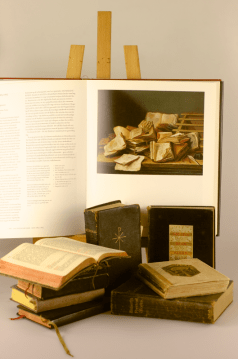
Some of my old books. Photo by Paula Kuitenbrouwer

THE LOVE OF (OLD) BOOKS

by

Paula Kuitenbrouwer (Mindful Drawing)

Reblogged here with Paula’s permission. 

A few days ago, I read in a newspaper about a Dutch politician questioning the future existence of libraries. Kindle was mentioned as well as the Internet, so why have libraries? I stopped reading the article because there is only so much flap-doodle one can stomach. One might hope that our politician will start reading T.S. Eliot and stumbles upon Eliot’s quote: ‘The very existence of libraries afford the best evidence that we may yet have hope for the future of man’.

220px-the_burning_of_the_library_at_alexandria_in_391_ad

Imagine a few philistines standing in front of the burning library of Alexandria, in estimate 48 BC, indifferently saying to each other; ‘A well…who cares?’ I care, and that is what I commented at Jamie Dedes’ discussion Times Change on The Writer by Day.

You could object and point out that we can store all books digitally, something that wasn’t possible in ancient times. That isn’t a very convincing argument to me, because at ancient and medieval times copies were produced too, in order to preserve knowledge and to make knowledge widely available. The problem, to me, is that digital copies are clean and sterile presentations. They do not enchant, hold no smell, sensation nor touchable illustrations. Many of us need to experience these qualities hands-on.

I also love painting old books. Books offer a wonderful theme, showing off a collection that represents a specific time, a layer of the society, telling a story about the writer, reader, and publisher.

28_de_heem_183

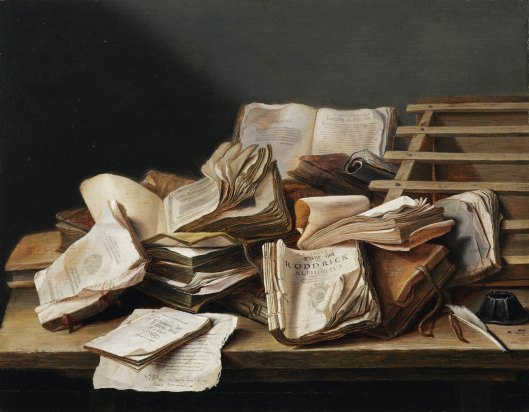
Jan Davidz de Heem (1606-1683/84), Still-life with Books

A painting like this communicates ‘Look that my books’, and ‘Look what I read and store in my head’. See the ink-pot and feather-pen, stating; ‘I write too’ or ‘I’m a scholar’.

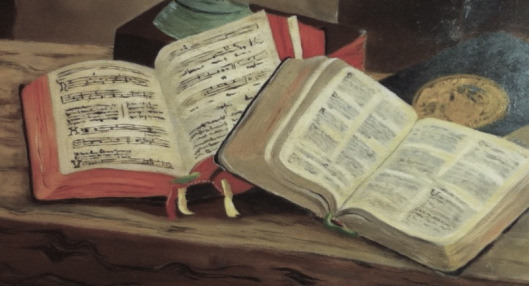
obb

Detail oil painting Paula Kuitenbrouwer

Do you also like the little extra treasures old books sometimes offer? They can be underlined sentences that ones held significant meaning to the former owner of the book. Or they can be a handwritten old name on a pretty Ex Libris.

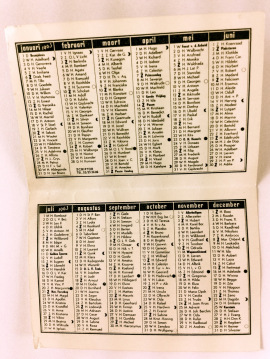
A few year ago I bought an old book. At home a small calendar of my year of birth dropped out (now how amazing is that?), showing a year long list of -to my generation- forgotten saints as well as a moon calendar.

tx1
The Saint and Moon Calendar of my birth-year.

Last, have a look at this beauty: an old Dutch book on Percival, with the name of the former owner in the right upper corner in ink. The Art-Nouveau illustration, in relief gold, offers enough reason to buy the book. There is even a treat inside: a small, printed prayer card, showing St. Martin by Michelina da Besozzo, 1410.

parceval
Will we ever enjoy a relief print, golden illustration on a Kindle? If we ‘open’ our E-reader, will we ever experience a pleasurable surprise of a little wink or glimpse back in time, falling out? I’m afraid not. Books provide us with all sort of inspiration; we therefore need old books, stored in libraries (and available in second hand bookshops).

© 2012, essay/photos/artwork, Paula Kuitenbrouwer, All rights reserved

Posted in Essay, Guest Writer

THE READING CURSE

I wish I’d written this. Though, being the product of a convent education, I would not have expressed myself in the colorful way that Señor Steve has. In my case, my parents did not encourage me to read nor did they ignore my reading. They thought my love affair with books written by crazy Americans, dark Russian nobleman, and childless English women was unhinged … and it is. Now it’s  late in the game of life and I have no more hope of getting out from under “the reading curse” than Steve does. Enjoy his sideways rant. I did.  Jamie Dedes

THE READING CURSE

by

Steve Brassawe (The Solipsist)  

Reblogged with permission.

I  am a reader, not a writer. Nonetheless, I did write the following profane rumination on the deleterious effects of reading, 7360286644_f88be67d81_mspecifically reading the wrong things, in late January 2010. The particular novel at hand then was 2666 by Roberto Bolaño.

* * * * * * * * * * * *

At page 803 of this novel, something occurred to me. It was an idea with the same beautiful simplicity and clarity of the little bell that I used to hear inside my head at cocktail hour. When I have finished this novel, there will be no point in reading any other novel for the rest of my life. I will finally be done with all of that. I have had this vague feeling for some time that there was something else that I needed to correct, some further, last little personal adjustment. Clearly, this is it.

The ways in which novels have tricked up my head throughout my life to this point make the ways that liquor and women tricked up my head look like paltry, harmless eccentricities. First of all, I had no business ever undertaking great novels in the first place. I do not have the intellectual wherewithal to properly metabolize the best of them. And of course, I always tried to read the best. Why fuck around smoking kid’s stuff when you can mainline a freight train?

Given that simple fact, to think that I chose English literature as my major at university! That is illustrative on several levels. It never crossed my mind to do my undergraduate work in a field in which one could earn money. Never crossed my mind.

Later, I practiced law–in the sense of the pure work, relatively successfully by the way. But there was never any time, energy, or inclination left over to think about money or care about money. No, all of my quality time, energy, and inclination was devoted to reading goddamned novels, when I was not talking about novels in a bar, that is. Pissing away my time on dreams that I was not mentally equipped to dream.

Second, I had no capability for keeping a proper emotional distance from these bastards. These novelists. Bellow, Dostoyevsky,

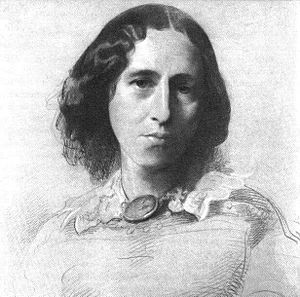
George Eliot by Samuel Laurence via Wikipedia

Tolstoy, Flaubert, Hemingway, Camus, and that too clever Updike, to name a few. The females are just as bad or worse. George Eliot. Austen. Those damned Brontë strumpets. I could not read novels for a little harmless escape and relaxation like a normal person not afflicted with this nameless disease. No, I made those novelists’ problems my own problems, and let me assure you that their problems are all of the first order of complexity no matter how much some of them may make you laugh.

Perhaps I should have tried to start a conversation with one of those women to whom I was married, but I was too busy with Faulkner or Melville. I was more enamored with Eula Varner of Yoknapatawpha County (downright hot for her in fact) than I was with any of that crowd of real women. God, I feel sorry for them in retrospect.

This has been a bane of my existence. A plague upon my house, when I had a house. A plague upon my apartment, when I had an apartment. Clichés those, but I am too upset thinking about this to come up with anything original. I am not upset about myself. I have survived it after all and in a manner of speaking. Those novelists’ problems are not going to be my problems any more.

I am upset thinking about those few young people out there starting to read novels. Not only do their parents do nothing to stop it, many times they encourage those young people in this incredibly dangerous endeavor. As for the proper authorities, they seem perfectly oblivious.

My own parents, God bless them, could have done something to save me. But not being readers themselves, they paid no attention whatsoever to what my young self was reading. Furthermore, they were utterly lax about enforcing lights out in my bedroom. They were too preoccupied with whatever was going on in their bedroom. So there I was at the age of thirteen, fourteen, or fifteen sitting up until 3:00 a.m. reading The Naked and the Dead by Norman Mailer or some other such mind rot. (I do remember that the word “naked” in that title caught my attention at the time.) I did not even have to hide under a blanket with the book and a flashlight.

The way that I see it, we could lose some of the best and brightest of another generation in just that way. Young people who might otherwise accumulate capital and invest it for the general benefit of mankind. Where would we be, for example, if Bill Gates had been screwing around reading novels and staring off into space instead of devoting every bit of his time, energy, and inclinations to devising MS-DOS and contractually fucking IBM? Now he is applying a chunk of the capital that he accumulated in an effort to help feed the world. (Is that the nature of his philanthropy, or is it some other wonderful thing that he and his bride are doing? I cannot remember.)

So this is Roberto Bolaño’s posthumous personal gift to me, this novel entitled 2666. It is as if he handed this to me and said, “Señor Steve, when you finish this novel, you need not read another. It will all be over, you can put it all behind you, and you can truly breathe easily at last.”

If I get the urge to read a novel in the future, if I flirt with a relapse, I will simply reread this one. The book actually consists of five different novels, each of which will be entirely new to me every time I read it. That will do no further harm. In other words, I will never be done with this one and on to another novel with a whole new set of problems. That is the thing to be avoided here.

So that’s it. No more. It’s all over. I mean it. Don’t laugh. I am serious.

* * * * * * * * * * * *

Malcolm LoweryPhoto credit: Wikipedia
Malcolm Lowery
via Wikipedia

So much for that resolution so quickly abandoned along with a myriad others. I am now well into my second reading of Under the Volcano by Malcolm Lowry hard upon my first reading of it.–13 June 2012.

Related articles
Posted in Essay, Guest Writer

GIVING THANKS: AN INVITATION TO AWARENESS

On Thanksgiving Day in 2010, Awyn (The Jottings of an AmeriQuebeckian and Salamander Cove) wrote this piece. It has remained with me since then and this year I asked Awyn for permission to reblog it here. Awyn and I met thanks to Poets Against War. She was kind enough to include two of my anti-war poems in her online poetry magazine, Salamander Cove. Awyn is an accomplished poet and writer of conscience.  JAMIE DEDES
.
This is also the perfect post to add to Amy Nora Doyle’s (SoulDipper) Occupy the Blogospher effort.

MAY WE HAVE MANY REASONS TO GIVE THANKS
AND HEARTS BIG ENOUGH TO INCLUDE STRANGERS IN OUR CIRCLE OF CONCERN

Here’s Awyn:

Happy Thanksgiving! — to all those who celebrate this special holiday.

Last year on Thanksgiving, I itemized all the things for which I was thankful. Here it is that time again, one year later and that still all holds true but no special dinner has been planned. Canada celebrated its Thanksgiving Day in October and it’s nowhere near as big a holiday here as it is in the U.S.

In the U.S., for many Thanksgiving means not only a big family dinner but watching the annual parade or football game on TV, big sales on Black Friday the day after, and the horrendous traffic back for those who came in from out of town. All part of the tradition.

We have plenty of big, sit-down dinners here with my mate’s family, but my fondly remembered American Thanksgivings are now a thing of the past. I don’t know any Americans here, my mate’s not that crazy about pumpkin pie, and I’m a vegetarian, so there’d be no turkey. Turkey is traditional but I’ve had many an untraditional version, with calamari or tofu or soup.  It was still a thanks-giving.  My kids are hundreds of miles away and none of us can afford to visit at this time. Hence no big family Thanksgiving get-together celebration this year. We will share our good wishes over the telephone. As for spectator parade-watching or sports broadcasts or Black Friday shopping, none of that interests me. In that, I guess you could say I’m untraditional. Pumpkin pie, however, is non-negotiable. You absolutely cannot have Thanksgiving without pumpkin pie. It just doesn’t compute.

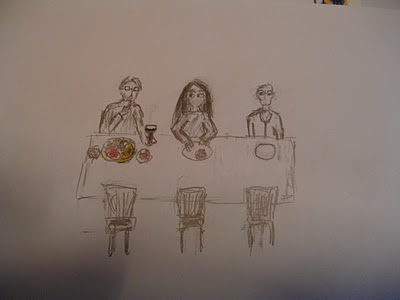
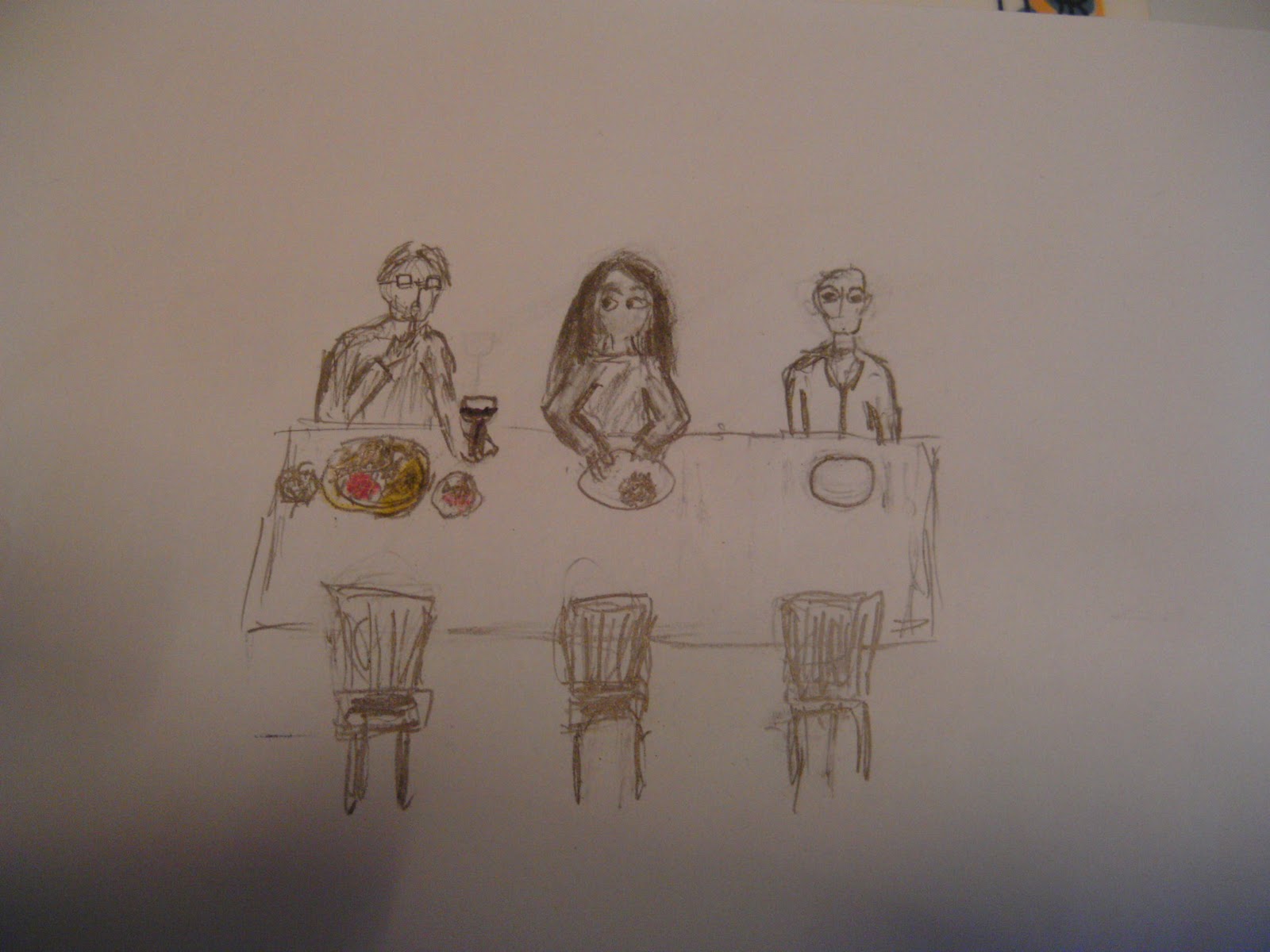
The most interesting Thanksgiving I ever heard about was from the wife of a former colleague who volunteered at a local soup kitchen. She told me that one Thanksgiving, to raise awareness of all the people who were starving in the world, some organization whose name I can no longer remember invited people to attend a big sit-down Thanksgiving dinner, for $15 per person, proceeds to go towards world hunger.

When you arrived, you were asked to pick your entry ticket out of a box. There were three kinds of tickets.

If you got a green ticket, you would be served the full dinner, with all the trimmings–and be allowed seconds on desert.

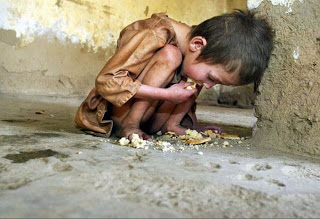
If you got a yellow ticket, you would be served what starving people in third-world countries sometimes get to eat–a child-sized helping of rice or thin, watery soup–and nothing else.

And if you got a white ticket–you’d get nothing at all.

So imagine you’re at this banquet and you get the full meal, with all the trimmings, and you’re sitting next to someone who got nothing. Would you turn and give half of what you have to that person? What if you’re one of the unlucky ones who got the thin, watery soup? Or worse, the empty plate. Would you quietly sip your water and listen to your stomach growl, hoping the people next to you might offer to give you some of theirs?

I’m sure a lot of sharing went around, probably immediately, after the initial surprise (and perhaps discomfort) wore off. Giving money to a charity, for which you get a sit-down dinner, is one thing; being invited to dinner and served an empty plate and having it suddenly sink in what real deprivation is like, is quite another. (Well, the invitation did say the theme was Awareness.)  But how uncomfortable to have to sit in front of an empty plate all evening long while others are eating. That glass of water can only go so far.

I went without  lunch yesterday–not by choice.  I simply forgot.  I was working on something and the hours flew and I suddenly realized it was getting dark outside and all I’d had to eat the whole day long was a cup of coffee at 6 a.m.  My stomach began reminding me it hadn’t been fed.  Loudly.  No problem.  I could open my refrigerator or reach for something in the cupboard and solve the problem, instantly.

But what if I couldn’t?  What if, for whatever reason,there was none to be had and no more food would be forthcoming for another day. Another two days. Maybe even a whole week. How would I deal with that?  Certainly, after a day or two, lack of food would make me woozy, lightheaded … lethargic, even.   I’d probably lose weight.  Temporarily fasting is one thing. Starvation, however, is quite another.

I think that’s what the organizers of that unusual Thanksgiving dinner wanted to convey–that life is not fair.  Some of us get to sit down every evening to a good meal, Every Single Night.  Some can only afford to buy food meant for animals.  Some get somebody else‘s leftovers, fished out of a trash can.  And some get nothing at all.

So many things to be thankful for this holiday.   Awareness–however received–is one of them.

© 2012, Awyn, All rights reserved

Posted in Essay, Guest Writer

Our dear artist-friend, Paula Kuitenbrouwer, shares her thoughts on homesickness and being at home wherever you are. Be sure to link through to her site and enjoy her “Mindful Drawing.” J.D.

Posted in Essay, Guest Writer

A dear lesson offered in story and photograph by the talented writer/blogger/world traveler, Naomi Baltuck, whose daughter is attending college just down the road from us. The link will take you to her blog to see the whole piece. Naomi is the author of a novel “The Keeper of the Crystal Spring,” which is available in English, German, Spanish and Italian. Her anthology of storytelling , “Apples From Heaven,” is an award winning collection. Jamie Dedes

Naomi Baltuck's avatarWriting Between the Lines

A friend said to Hodja Nasruddin, “Look at all these dandelions!  I’ve tried pulling them, poisoning them, starving them, digging them out by the root.  Nothing works.  I am at my wit’s end!”

“That’s a shame,” said the Hodja. “They are not a problem for me.”

“Really?  Please tell me your secret, my friend!”

“It is very simple,” said Nasruddin.  “I have learned to love them.”

Dandelions are native to Eurasia, but have traveled all over this world.   In France they were called “Dent de Lion,” or “Lion’s Tooth,” because of their toothed leaves. In England they were, “Piss-a-Beds,” for their diuretic properties.  In Germany, Russia, and Italy they are “blowing flowers.”  In Catalan, Poland, Denmark, and Lithuania they are  “milk flowers,”  “milkpots,” and “sow’s milk,” after the flower stem’s milky sap.  In Finland, Estonia, and Croatia, they are “butter flowers.”  In China, they are “flower that grows in…

View original post 161 more words

Posted in Essay, General Interest, Guest Writer

“Success” … where are we on that spectrum between vision and delusion … such is the exploration of Shakti Ghosal an Indian Engineer and Business Management professional currently living and working in Oman. Jamie Dedes

Shakti Ghosal's avatarA New Beginning

“When your life flashes before your eyes, make sure you’ve got plenty to watch, be it vision or delusion.”

Anonymous


 Success is such an empowering word. We think of it and we think of…. Happiness….Self esteem….Superiority…..  facets which enthuse, inspire, pump the adrenalin. Success seems to be   what we live for. What our parents and teachers always exhorted us to do. Scholastically, materialistically, competitively. Success brings forth visions of wealth, power, intelligence and with these the ability to control the outcome of events. All those external trappings. What the world judges us by.

But as I think of success, I also see within it the other paradigm. Of increased self awareness and self development. Of a positive intention and an alignment with a higher purpose. Of that mysterious inner process which ensures personal integrity and a commitment to values. The aspect of success as exemplified by Mahatma…

View original post 645 more words