[Current world events have conspired to remind me recently about a post that I wrote over three years ago. My experience to date, at that time, had demonstrated to me that I don’t have complete control over the processes that steer me through life. Nobody does, however much we would like to think we do. It is also apposite that the worrying and sinister developments in talks between the European Union and the USA about what is called the TTIP (Transatlantic Trade and Investment Partnership) have rather vindicated the concerns that I expressed three years ago. It may also be appropriate to mention that the theme of this essay just happens to align, I think quite well, with Corina’s last piece – “Wilful Ignorance and Some Food for Thought” as well as Jamie’s “Earthlings, Making The Compassionate Connection” ].
Since my retirement, I’ve had more time not only to reflect but also review, research and interrogate life’s processes and relate them to what’s going on ‘out there’. I’ve woken up and opened my eyes. I admit, from time to time, that I’ve allowed my mind to become infected by pessimistic thoughts, which have conspired to worsen my mood, with a concomitant fear for the futures of my children and grandchildren in a world with an increasing population, increasing greed for its limited resources, self-interest, political and corporate corruption, treachery and tyranny!
In my less cynical moments, I like to call this ‘life’s rich tapestry’ and all the more interesting for it. So not all is bad; there is still hope.
We are all self-interested, to a greater or lesser degree; we are all selfish and greedy from time to time; and, given the opportunity, I dare say there are many of us, who would be tempted to take advantage of privilege and power, if we had it in sufficient measure! I hope that I would not be one of these, but how can I say so with certainty? It is only the truly arrogant, who are unable to see how fragile and vulnerable we all are! But it takes a certain type of personality to be capable of merciless and ruthless exploitation and treachery; to be bereft of conscience – I am reminded of the ‘Morlocks’ in H G Wells’ chilling vision of the world in “The Time Machine“, published late in the 19th Century.
These personalities display all the characteristics of damaged minds that can exploit beyond a simple local selfish motive; even beyond a desire to build and run a large, successful organisation – be it commercial, charitable or social one. I’m talking here of international, corporate power mongering; a desire to exploit and control whole populations, with the end game being investment solely in the interests of a minority elite. It has happened throughout the history of the human race. It continues today, but that doesn’t make it right.
In the face of all this, it is sometimes encouraging to know that there are still some very courageous, inspiring as well as philosophically and intellectually ennobled people in the world, people with huge integrity as well as faith, who are capable of giving us great strength as well as hope for the future of humanity. They come in all shapes and sizes and you find them in the most unexpected places, not least amongst some of the free spirits that are to be found here in ‘Blogosphere’. They can be anybody, from wealthy philanthropists like the social thinker and reformer, John Ruskin, on the one hand, to the totally charitable, nay saintly, who dedicate their lives to the cause of the underprivileged, to help the truly needy of the world, whose selfish human motive seems to have been subordinated and whose spiritual conscience transcends all that is material; here I think of Mother Teresa of Calcutta.
The Captain’s Table nearby poetic inspiration…
Whilst we each fight our own battles to survive and thrive, to overcome whatever obstacles there may be in our competition for the world’s resources, as well as our own sanity, I am constantly reminded that there is also a vast array, a rich vein of powerful and beautiful natural phenomena that have the unquenchable capacity to ennoble our own minds, to elevate our spirits. I am speaking of the natural world; the flora, fauna and insectoids, some of which existed long before homo sapiens marched onto the scene with our unique set of biological characteristics that have enabled us to rule, dominate and change all that we see. But – and I say this with some trepidation, because I know it is controversial in some quarters – we are still animals; animals with an extraordinary ability for creative and innovative endeavour, but animals nonetheless. Look what happens, as we turn on our television screens almost every day, when law and order breaks down or when people get hungry or angry [evidence the London Riots in 2011], and tell me human beings are only capable of civilised behaviour… the fact that we are, well, hopefully a vast majority of us, capable of civilised behaviour, listening to your conscience and, above all, giving air to our compassion, is a cause for optimism; a cause for us never, and I mean never to give up the fight to maintain democracy and intelligently to vanquish those who represent the worst side of human nature (ibid) and the greatest threat to our freedoms.
Although the natural world cannot help us directly in this quest, it is in this vein that I come to the crux. Something occurred to me that I would not normally have expected, not even given my ability for creative thought. This … happening … somehow focussed my attention and led me, in that moment, to become intensely mindful.
This post is a part of our participation in 100,000 Poets – and Musicians, Artists and Activists – for Change. Details HERE. Our theme is Peace and Justice.We invite you to participate in this global event by linking in your work with ours. We’ll be collecting all the links in a commemorative page shortly after we close this project on October 3. You may use Mister Linky below or include your link in the comments section. Thank you!
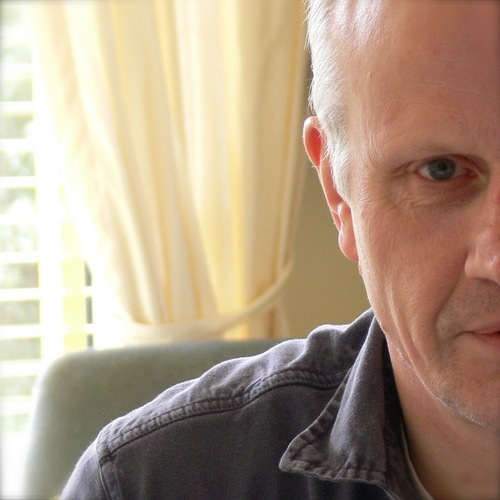
JOHN ANSTIE (My Poetry Library and 42) ~ is a British writer and poet, a contributing editor here at Bardo, and multi-talented gentleman self-described as a “Family man, Grandfather, Occasional Musician, Singer, Amateur photographer and Film-maker, Apple-MAC user, Implementation Manager, and Engineer”. He has participated in d’Verse Poet’s Pub and is a player in New World Creative Union as well as a being a ‘spoken-voice’ participant in Roger Allen Baut’s excellent ‘Blue Sky Highway‘ radio broadcasts. He’s been blogging since the beginning of 2011. He is also a member of The Poetry Society (UK).
*****
John has also been involved in the recent publication of two anthologies that are the result of online collaborations among two international groups of amateur and professional poets. One of these is The Grass Roots Poetry Group, for which he produced and edited their anthology, “Petrichor* Rising“. The other group is d’Verse Poet Pub, in which John’s poetry also appears The d’Verse Anthology: Voices of Contemporary World Poetry, produced and edited by Frank Watson.
* Petrichor – from the Greek pɛtrɨkər, the scent of rain on the dry earth.
Editorial note:This was originally written by Terri Stewart for Saturday, September 7, 2013, in response to a call for worldwide prayer and fasting to focus on peace in Syria. With all that is going on in the Middle East and given the Ukraine crises, the many conflicts in Africa and the deaths and dislocations resulting from drug wars in Central and South America, this seems a good time to post it again in the spirit of peace, love and community …
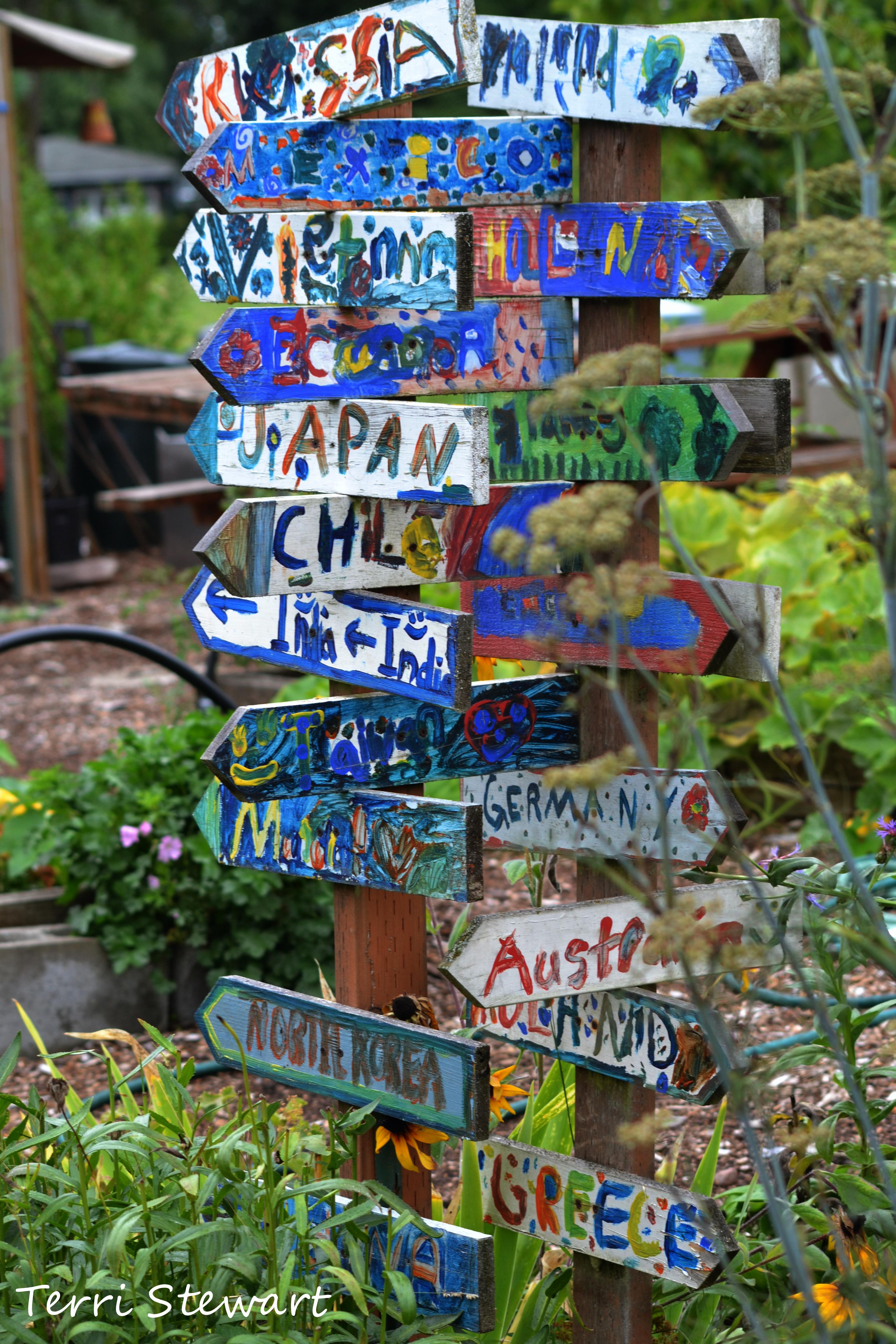
I have seen many things happening–prayer vigils, personal meditation practices, marches, and communications with elected officials. We decided to offer a Labyrinth Walk for Peace at Bothell UMC in Bothell, WA in the morning. I gathered inter-faith prayers, we walked, prayed, and focused on bringing peace to the world. What follows is prayers and photos from that journey that became deeply personal for each attendant. There was a certain transition that occurred for me as I took in my surroundings and noticed Farmer Brown’s Garden. I began to see, literally, a connection between peacefulness and being fed. You will see.
Entering Sacred Space
Sufi Prayer for Peace
Send Thy peace, O Lord, which is perfect and everlasting, that our souls may radiate peace.
Send Thy peace, O Lord, that we may think, act,
and speak harmoniously.
Send Thy peace, O Lord, that we may be contented
and thankful for Thy bountiful gifts.
Send Thy peace, O Lord, that amidst our worldly strife we may enjoy thy bliss.
Send Thy peace, O Lord, that we may endure all,
tolerate all in the thought of thy grace and mercy.
Send Thy peace, O Lord, that our lives may become a
divine vision, and in Thy light all darkness may vanish.
Send Thy peace, O Lord, our Father and Mother,
that we Thy children on earth may all unite in one family. – Sufi Prayer
The Journey Begins
An Islamic Prayer for Peace
In the Name of Allah, the beneficent, the merciful: Praise be to the Lord of the Universe
who has created us and made us into tribes and nations that we may know each other,
not that we may despise each other.
If the enemy incline towards peace, do thou also incline towards peace, and trust in God,
for the Lord is one that hears and knows all things.
And the servants of God Most Gracious are those who walk on the Earth in humility,
and when we address them, we say, “Peace.” – U.N. Day of Prayer for World Peace 2
Walking Together in Ubuntu
A Hindu Prayer for Peace
Supreme Lord, let there be peace in the sky and in the atmosphere.
Let there be peace in the plant world and in the forests.
Let the cosmic powers be peaceful.
Let the Brahman, the true essence and source of life, be peaceful.
Let there be undiluted and fulfilling peace everywhere. – The Atharva Veda
All Are Invited to Be Fed
Cheyenne Prayer for Peace
Let us know peace.
For as long as the moon shall rise,
For as long as the rivers shall flow,
For as long as the sun shall shine,
For as long as the grass shall grow,
Let us know peace. – Cheyenne Prayer
Feeding the World in Spirit and Deed
Farmer Brown’s Garden at Bothell UMC
A Jewish Prayer for Peace
Grant us peace. Your most precious gift,
O Eternal Source of Peace, and give us the will to proclaim its message to all the peoples of the earth.
Bless our country, that it may always be a stronghold of peace, and its advocate among the nations.
May contentment reign within its borders, health and happiness within its homes.
Strengthen the bonds of friendship among the inhabitants of all lands.
And may the love of Your name hallow every home and every heart.
Blessed is the Eternal God, the source of Peace. – From The Gates of Prayer: The New Union Prayer Book, by the Central Conferences of American Rabbis
Growing Spiritually and Growing Food
Buddhist Prayer for Loving Kindness
May all beings be peaceful.
May all beings be happy.
May all beings be safe.
May all beings awaken to
the light of their true nature.
May all beings be free. – Metta Prayer
Loving Kindness through Loving Care
A Christian Prayer for Peace
Blessed are the peacemakers, for they shall be called the children of God.
But I say to you that hear, love your enemies; do good to those who hate you;
bless those who curse you; pray for those who abuse you.
To those who strike you on the cheek, offer the other also;
and from those who take away your cloak, do not withhold your coat as well.
Give to everyone who begs from you, and of those who take away your goods,
do not ask them again. And as you wish that others would do to you, do so to them. – U.N. Day of Prayer for World Peace 2
Becoming the Light Unto the World
A Non Traditional Prayer for World Peace
Spirit of Life and Love, be present with all who are suffering terribly from violence.
Lift up the hearts of those who fear. And inspire courage among the peacemakers.
Be present with political leaders, ensuring a retreat from violence
and a procession towards the peace table.
Guide the hands of all those who are caring for the injured, the hungry and the grieving.
And, open our own hearts to compassion.
Remind us of our complicity and responsibility.
And lead us towards generous engagement—always towards a vision of peace. –Adapted from the Unitarian Universalist Tradition
REV. TERRI STEWART is Bardo’s Sunday chaplain, senior content editor, and site co-administrator. She comes from an eclectic background and considers herself to be grounded in contemplation and justice. She is the Director and Founder of the Youth Chaplaincy Coalition that serves youth affected by the justice system. As a graduate of Seattle University’s School of Theology and Ministry, she earned her Master’s of Divinity and a Post-Master’s Certificate in Spiritual Direction. She is a contributing author to the Abingdon Worship Annual. (The 2014 issue just released!)
If you’re reading this right now, chances are good that you have heard the phrase, “First-World Problem”. I find myself thinking this phrase more than I would like, but I count myself damned lucky that I’m even aware of what it means.
When you live in a country as rich as America, it’s easy to take things for granted and forget that so many other places in the world lack basic, human rights. When you read the words “human rights” what comes to mind? Food? Shelter? Clean water? Freedom? Living life without fear for one’s safety? It can be difficult to empathize with those who do not have these things, if you, yourself, have always had them.
May 28th is “Amnesty International Day” and it’s a chance for you to help those in other places throughout the world who are being starved, tortured, oppressed, or who may have no shelter, no access to clean water, no one to speak up for them, and worst of all, no hope.
Image borrowed from amnesty.org
“Amnesty International Day recognizes the need to protect human rights around the world. The Amnesty International organization strives to accomplish these goals by providing awareness and recognition of the issues. They work to publicize local and regional problems, and to arouse citizens, governments and politicians to action.
This post isn’t meant to guilt trip you into donating anything, be it time, money or effort. It’s not a late-night infomercial showing you pitiful images of children who are little more than walking skeletons due to malnourishment. (As a side note: isn’t it telling that such infomercials are not on prime time television where so many more people would/could see them, but instead they are in late night spots where they won’t get the attention they need? Why do you suppose that is?)
Amnesty International logo from Amnesty.org
I simply would like you to take a moment to think about what human rights you cherish the most and then find a way to help bring that right to a complete stranger. There are, unfortunately, countless human rights violations happening all over the globe. On the bright side, that means that there are countless opportunities to help. You can sign petitions, write letters, make phone calls, get involved in your local community. Or you can join movements like Amnesty International, and while the day is “Amnesty International Day”, nothing says you can’t join other worthwhile organizations who also strive to speak up for human rights. In fact, here is a quite comprehensive list of Human Rights Organizations, all in one place.
“Many organizations around the world dedicate their efforts to protecting human rights and ending human rights abuses. Major human rights organizations maintain extensive websites documenting violations and calling for remedial action, both at a governmental and grass-roots level. Public support and condemnation of abuses is important to their success, as human rights organizations are most effective when their calls for reform are backed by strong public advocacy.” ~ http://www.humanrights.com
Remember this:
“If you have food in the refrigerator, clothes on your back, a roof overhead and a place to sleep … you are richer than 75% of this world.
If you have money in the bank, in your wallet, and spare change in a dish someplace … you are among the top 8% of the world’s wealthy.
If you woke up this morning with more health than illness … you are more blessed than the million who will not survive this week.
If you have never experienced the danger of battle, the loneliness of imprisonment, the agony of torture, or the pangs of starvation… you are ahead of 500 million people in the world.
If you can attend a church or synagogue meeting without fear of harassment, arrest, torture, or death … you are more blessed than three billion people in the world.
If your parents are still alive and still married … you are very rare, even in the United States.
If you hold up your head with a smile on your face and are truly thankful … you are blessed because the majority can, but most do not.
If you can hold someone’s hand, hug them or even touch them on the shoulder … you are blessed because you can offer a healing touch.
If you can read this message, you just received a double blessing in that someone was thinking of you, and furthermore, you are more blessed than over two billion people in the world that cannot read at all.“
About dragonkatet Regarding the blog name, Dragon’s Dreams~ The name comes from my love-affairs with both Dragons and Dreams (capital Ds). It’s another extension of who I am, a facet for expression; a place and way to reach other like-minded, creative individuals. I post a lot of poetry and images that fascinate or move me, because that’s my favorite way to view the world. I post about things important to me and the world in which we live, try to champion extra important political, societal and environmental issues, etc. Sometimes I wax philosophical, because it’s also a place where I always seem to learn about myself, too, by interacting with some of the brightest minds, souls and hearts out there. It’s all about ‘connection(s)’ and I don’t mean “net-working” with people for personal gain, but rather, the expansion of the 4 L’s: Light, Love, Laughter, Learning.
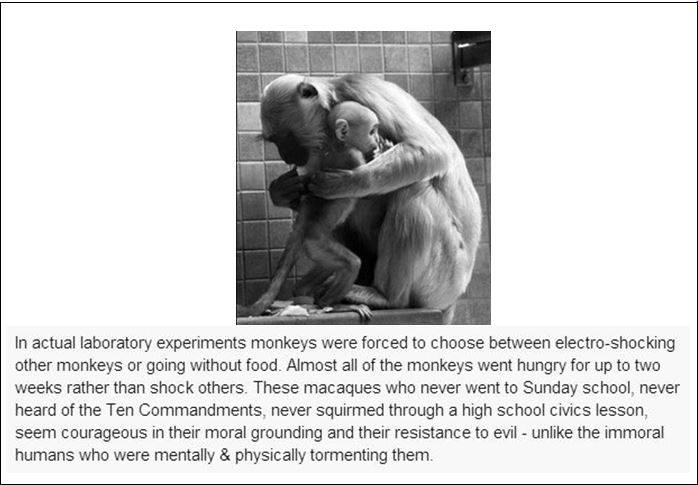
We humans labor under the conceit that we are the only animals that grieve and have an impluse to be protective. Similar outcomes as those described above resulted from experiments performed on rats. See our feature The Rate Race by J.D. Galleger.
Study published in the American Journal of Psychiatry Vol 121 Dec. 1964. 584-585 Titled “Altruistic” Behaviour in Rhesus Monkeys! Jules H Masserman, M.D.; Stanley Wechkin, PH.D., and William Terris, M.S
This piece is from Rev. Terri Stewart’s blog, “Clocked Monk.” It’s an acknowledgement of someone who is involved in doing some rather controversial work regarding civil rights and the justice system. J.D.
[This piece was started some months ago, before I wrote the poem Fortune, featured here on the Into The Bardo a few weeks ago. That poem and this piece focus on a common theme, which is, perhaps more than any other in my writing life, a constant thread of philosophical thought for me. This is that, however much we may be short on fortune, there is never cause to give up on our hopes and dreams, or more realistically, our ‘visualisation’ of what we want from this life.]
~~~~~~~~~~~~~~~~~~~~~~~~~~~~~~~~~~~~~~~~~~~~~
Picture, via Google Images and courtesy Canvas Art (www.the-canvas-art-shop.co.uk)
“Oh what a tangled web we weave, When first we practise to deceive!”
(Sir Walter Scott, Marmion, Canto vi. Stanza 17.
Scottish author and novelist: 1771 to 1832).
Some days are better than others . . .
The better ones allow me to indulge myself in my passions. I could have walked the dog and come back feeling refreshed, or have attended a rehearsal with the Waldershelf Singers and feel utterly uplifted, or complete a piece of prose or, better, a poem and feel a sense of release. On other days, I feel disillusioned, cynical, angry, like throttling public figures (politicians) to within an inch of telling them what a bunch of useless, self-interested, lying, cheating ne’er-do-wells they are! … which they are, almost to a man (and woman) …
Why is it that, once human beings attach themselves to an organisation, an establishment, a business, a company, a corporation, a religion, or they declare their political affiliations, somehow, they lose the ability to tell the truth, assuming their integrity would allow them to differentiate between the truth and a lie, in the first place. They become overly deferential, assume the organisation’s rules are right and, worst of all, become somewhat apathetic and are inclined to assume the ‘elders’, senior leaders of the organisation are right and therefore entitled to our undying respect.
This subjugation of self, a denial of the person that was borne into this world, through that infinitely variable process, driven at its lowest level by chemistry and physics, in turn determined by the relevant genetic ‘pool’ and nurtured by the geographic, economic, demographic, societal and political environments it is our fortune, or misfortune, to have grown up in, is undeniable. This denial of the uniquely wired ‘self’ and its particular talents and aptitudes, opinions and attitudes, and the ability to discern right from wrong, truth from the lie, and I mean the real truth, the kind that only you yourself will know deep inside, is almost guaranteed.
Does it have to be this way?
I think that I’ve come to hold this position rather late in life. Questioning authority is the stuff of rebellious youth, isn’t it? When we didn’t know any better, few had any time for the opinions of young people, anyway!
Is it so, because we are too shallow? … I don’t think so, not for everyone, anyway.
Is it because we are too lazy or unable to think for ourselves … almost certainly for some.
Is it because we have to earn a living? … inevitably a contributory factor.
Is it due to the fact that, as human beings, in spite of our incredible capacity for ingenuity, we are still very insecure; none of us are ever entirely in control of our lives and I mean NONE of us, given the uncertainties of our own health and particularly of the natural world and what Mother Earth herself can throw at us! We therefore have to enwrap ourselves with a protective external blanket, woven by someone else’s dreams or designs, at one extreme by the premeditated manipulation of tyrannical leadership or, at another, simply by the desire to ensure the annual bonus, a generous pension, public honours, a knighthood … or simply the reassurance of knowing from where our next meal will come?
Is it because we are all limited in our capacity to take on too much information, store all the factors affecting any number of problems that face us each day; wrapped up in life’s complexity that sometimes threatens to overwhelm us, wouldn’t we prefer to take an easier option and permit others to make decisions for us, which acts as a perverse kind of freedom? Herein lies a major truth. But it’s not easy for managers and leaders either.
Contrary to the impression we might receive from those in stations so elevated, it may act as some comfort to those who aren’t to know that the higher up the ladder of success we go, in whatever field of human endeavour, the more insecure we get. Why, you ask? It is because we have our limits, all of us, and some of us are more limited than others; that is our birthright, given the variable abilities, with which we are endowed, the tactics and strategies we have learned and been taught to cope; it is the way we are wired. The higher up the ladder of success all this leads us, the stronger becomes our inclination, consciously and unconsciously, to hang on to whatever we’ve got; the more inclined we become to develop further selfish strategies to aid this survival process. That’s what it is to be human, well, at least to be an animal. Being human does, nevertheless, endow us with an extra ability: high intellect and, with it, a great responsibility and, yet, this tendency, this seemingly irresistible force, does inevitably lead to greed.
So what happens!
We get our heads down and graft, manoeuvre, wheel and deal, whatever it takes to gain influence, fame, attention, success, with whatever vanity or hope or need that has the greatest hold on our hearts, minds … and stomachs.
At some future moment in time, we then find ourselves, well, what’s the best word to describe it … trapped, yes trapped by our ambitions, needs, material greed, more than by hopes and dreams.
I should say something about dreams. Before you think I’m about to crush them, I’m not. As one who writes poetry and pieces of prose like this, I find dreams are just as important as the ambitions of a professional footballer I know, who learned, early on in his journey through that precarious profession, that visualising your goals (figuratively as well as literally in his case), that is imagining yourself scoring the goal, over and over again, is a truly powerful and effective way of motivating yourself to feel better about your abilities and potential. This is, for me, an unexpected way in which to feed the creative imagination; such is the process that leads to the products of human ingenuity as well as understanding and success. But, a word of warning about dreams! They can also be manipulative! They can be induced and ‘used’ by others to manipulate control over lives – take advertising, particularly on the television, as one example! We need to learn how to distinguish good from bad dreams, your own from other people’s dreams, just as we should be able to tell the difference between good and evil.
Now, I’m not necessarily talking about conspiracy theories here, about demons and evil people, who sit in back rooms and scheme to overthrow regimes or gain control of whole populations. No, I’m talking, for the moment at least, about the demons inside our heads; the ones that lead us to the point of paranoia, the fear of not being ‘successful’, wearing the right ‘fashion’, living in the right district, driving the right car, appearing in all the right ‘places’, doing what’s apparently ‘right’ in society … tricky concept this, but I’ll try to explain my thinking.
If you were to ask a child of five or six to tell you their dreams of how to make the world a better place, wouldn’t they give you magical answers, which involve the charm of fairy tale characters and imaginative, not to say unusual (and, sadly, unlikely) conclusions to their stories?
If you were to pose that same question to a child in their mid ‘teens, wouldn’t their answer be tainted with a little more realism, perhaps even a touch of hopeless, hormonal cynicism, whilst still retaining some of that childhood naiveté, a lack of what we grown-ups would call wisdom?
If you were to ask a grown up poet or a philosopher, I think their answer would come out in one of several subtle ways, but one thing is for sure, any poet, with integrity, that I know, would try to address all of the issues that confront us head on, in an honest way. This is perhaps because they rarely make a living from their writings and, therefore have no vested (financial) interest in it, other than for the integrity of their material and perhaps for a bit of recognition!
Even Poets …
Yes, even poets and philosophers have to live and pay their ‘rent’. So, somewhere along the path of life, we have to align ourselves with an organisation or two, toe the line and obey the rules. We most certainly should obey the law and, if we don’t agree with it, don’t break it, lobby to change it! There is nothing wrong with toeing the line, provided there is a fair share of integrity within the organisation; provided that we don’t lose sight of our own personal integrity, justice, beliefs, values and, above all else, what we know, deep down inside, makes each of us unique individuals, our identity.
For those, who are born with a genetic code that, given the right environment, encouragement and education, predestines them to a life of leadership and possibly even greatness, let us not forget that for those of us, who remain, whilst we may not have had the good fortune of the same faculties and opportunities, we do nevertheless represent the vast majority of the population of the world. So, if we do still have a vote in what can reasonably be described as a democracy, then we must use it or lose it! If we have the ability to write, we should do it! We must make our mark upon the paper, make our feelings, our values and beliefs known. Whilst we still have the freedom to do so, we have the ability to depose those in power who do conspire to deceive us, who have been corrupted by their privilege and who would continue to weald the power they have from such privilege for self interest. Otherwise we get what we deserve. If that happens to be a comfortable life that we’ve achieved by subordinating our own integrity, it is our choice, but, from where I am now in my life, I know that I would sooner follow and trust someone who refused to allow themselves to be trapped by the material rewards of compromising complicity, than one who, in the fullness of time, would be racked with regret, that they didn’t follow their conscience and their dream of a better life … a better world.
It would be wrong of me, however, to leave you with my totally cynical outlook, without mentioning that, thank God, there are some remarkable people in this world, who, at and on all sorts of levels, do remarkable work on behalf of their fellow human beings. Whether they be local community charity workers and volunteers, international aid workers or the likes of the inspired Mother Teresa of Calcutta’s Missionaries of Charity foundation, they are all driven, by some degree of selflessness, to improve the lot of the less fortunate and I have nothing but admiration for them.
If there is a moral to my tale, this long and rambling piece of prose, it is that I believe life can become much less complex, when we stop trying to satisfy someone else, when we discover the very best in ourselves. However unfair, unjust or unreasonably difficult life seems to be sometimes, we should never allow ourselves to give in to the pessimism that results from a state of despair at the world, to roll over on our backs with our legs in the air! We must never believe that someone else, whether it be a single person or a large faceless organisation, either has control over us or is beyond control by the voting, lobbying, plural us. For writers and poets in particular, as long as we can breath and weald a pen, we can do something, however small, and collectively we are able to make a difference, even if we don’t feel we can hop on the next flight to Africa, we musn’t allow ourselves to believe that we can’t still bring something to the table from our own unique armoury of intellectual skills. We can, above all, in our own way, be winners. It takes courage to step out of the crowd, but courage comes in many colours, one of which is being true to your innermost convictions. Fortune really can favour the bold.
[If you don’t already read it, you could do worse than by starting to read poetry now. Good poetry should open the eyes that are shut, elevate the spirit that is depressed and enrich the soul that is impoverished. Good poetry is the highest form of literature, which should tell us the way it is and feed us with deep insights that we would otherwise not experience; and I mean insights and creative thought that will enable change, not only in your own life, but also others.]
JOHN ANSTIE (My Poetry Library and 42) ~ is a British poet and writer, a contributing editor here at Bardo, and multi-talented gentleman self-described as a “Family man, Grandfather, Occasional Musician, Amateur photographer and Film-maker, Apple-MAC user, Implementation Manager, Engineer and general all-round good egg.” This he tells us with tongue firmly planted in cheek. Add grace and humor to the list.
John participates in d’Verse Poet’s Pub and is a player in New World Creative Union. He’s been blogging since 2011. John is also an active member of The Poetry Society (UK). He says of his work, “Much of my writing and my poetry focuses on the future and the important part that our children, and the way we treat them, play in this. It also spans a diversity of life’s experiences, some moving war poetry and particularly observations of life for a modern generation.
Also a member of Grass Roots Poetry Group John steered their anthology, Petrichor* Rising, into publication. It is now in print and available for purchase. “Petrichor Rising takes you on a journey that exposes you to the full spectrum of emotions, from barely concealed despair to hope, from love to sorrow, with a clear appreciation of nature’s value and humanity’s shortcomings. It rides a roller-coaster that moves you to consider many of life’s challenges from a different perspective, as all good poetry should. It is at once haunting, yet shocking, with aching nostalgia alongside enchanting stories of dragons. It gives you optimism and hope tinged with shadows of doubt. It writes about places never seen and humanity’s uncaring nature, in prosodic social commentaries and observations of the minutest details of life, mood, atmosphere and romance. It contains clever writing that brings you close to the edge of society, still capable of moving you, but not pulling any punches. It has poetry with a universal appeal covering subjects as varied as the loss of a cat or a harrowing account of the 7/7 London bombings, poetry that focuses on the roots of all that makes us respond to life and long for something better.”
* Petrichor – from the Greek pɛtrɨkər, the scent of rain on the dry earth.
I was at the Redwood Shores library the other day. They had a small display on the Ohlone Tribe. It made me think again of the Wiyot. They live in my dreams. Their name is pronounced Wee-yhot and it means Eel River. That was their home.
In the mid-eighties, for about a year-and-half, we lived near the Eel River in Humboldt County, an area about 200 miles north of San Francisco. It’s stunning and peaceful with dense redwood forests, wild rivers, and creeks that run dry in the summer and overflow in the winter. If you live in a rural area or grew up in one, you might take such things for granted. Having lived in cities all my life, it was magical to me. In the midst of that feral earth, in the stillness of leafy green days and velvet blue nights, it was easy for me to imagine the first peoples as they might have lived there in other times.
I fancied I could see them tending fires, boiling and drying acorns and then grinding them for flour, bathing in the river, raising their children, and hunting, gathering, and enjoying sacred ceremonies and tribal celebrations. I knew the same ancient sky-scrapping sequoias that watched over us had watched over them.
Our place was just short of four acres and rich with sequoia, madrone, oak, and some forty fruit trees. Blue jays flew in to feed in the morning and the quail marched down to visit at nightfall. Hawks and hummingbirds put on air shows. Rosemary thrived unattended. There was a beautiful lush 100-year-old rosebush. There were wild roses too. They gave us rose hips for cough syrup. Witches Broom lined our creek side with bright yellow. There were cascades of Japanese quince, which provided ample housing for the hummingbirds. Queen Ann’s lace* danced in the wind like ladies dressed for a ball. When they went to seed I collected the seeds for use in cooking. They have a taste somewhere between a carrot and caraway seed. The great bursts of blackberry bushes were a visual and edible delight.
I gathered fresh fruit almost every morning and every morning I thought of the people who preceded me more than a century ago and who picked berries there just like me. I did some research and found out that our property was once inhabited by the Wiyot peoples whose numbers were almost decimated in a genocide.
“Eureka newspapers of the time exulted at the night massacres conducted by the “good citizens of the area”. Good haul of Diggers and Tribe Exterminated! were 2 headlines from the Humboldt Times. Those who thought differently about it were shut up by force. Newspaper publisher and short story writer Bret Harte called it “cowardly butchery of sleeping women and children” — then had to flee ahead of a lynch mob that smashed his printing presses.” MORE [Wiyot Tribal Council Page]
* WARNING:If you are tempted to gather the seeds from Queen Ann’s lace, think twice. I didn’t know it at the time but it is hard to distinguish them from hemlock, which is poisonous.
JAMIE DEDES ~ My worldly tags are poet and writer. For the past five years I’ve blogged at The Poet by Day,the journey in poem, formerly titled Musing by Moonlight. Through the gift of poetry (mine and that of others), I enter sacred space.
This is a re-blog of my very first blog post ever from 2008! I have edited it a tiny bit.
Moral courage is a rarer commodity than bravery in battle or great intelligence. Yet it is the one essential, vital quality of those who seek to change a world which yields most painfully to change. – Robert F. Kennedy, in a speech in Capetown, South Africa, June 6, 1966. (Source: Wikiquote )
What are our sources of moral courage? I can tell you that I find moral outrage easy, but where does moral courage come from? Relying on my Methodist heritage, The Wesleyan Quadrilateral would have us examine scripture, tradition, reason, and experience in making deliberations. What does this tell me?
What does scripture say?
In Hebrew Scriptures and in Christian Scriptures, we are taught to care for the alien, orphan, widow, and poor among us. In the story of the adulterous woman (John 8:1-11), we see a Jesus that stands between the accusers and the marginalized. This is what Christians are called to do. Take action in the face of injustice and stop pain from happening. Jesus teaches us repeatedly that we are to extend our hands to the hungry, the poor, the marginalized, and those outside of authority. This continues from the Jewish traditions. In Hebrew Scripture, we are told in Micah 6:8 that we are to “do justice, love kindness, and to walk humbly” with God (NRSV). These teachings can be encapsulated in the single commandment “love your neighbor as yourself” (Gal 5:14). Leviticus 19:34 tells us that our neighbor is the alien among us. Christ tells us that our neighbor is people outside of the power structure that he ministers too—the bleeding woman, the blind, the demon-possessed, or the widow. Those are the neighbors Jesus stands with.
What does tradition say?
In the Methodist tradition, John Wesley spoke out against many issues facing his generation. This included human rights, slavery, prison reform, labor rights, and education reform. Methodists also have the Social Principles and the Book of Resolutions to guide thoughts and deliberations in our present day. Wesley emphasized shaping public policies that would ensure equal and fair education for all children.
What does experience say?
It is very difficult to quantify experience across the board, but if I just examine one system, the education system, we know, through social sciences and the statistics they bring us, that poverty is the single most important factor in education. Poverty riddled areas simply do not have access to a great education system. And unfortunately, for many minority ethnicities in the U.S., poverty riddled areas are disproportionately filled with them. Why would that be? A good source for thought is this YouTube video from Tim Wise–
And we know that poverty is a world wide problem as the recent collapse of the factory in Bangladesh illustrates. The women who were lost there are typically impoverished, but they were considered the lucky ones. They were one step above abject poverty and simply impoverished. The literacy rate is 59%. Poverty and lack of education go hand-in-hand.
Bereaved mothers hold up pictures of their daughters who died in the factory collapse, but whose remains have yet to be identified. Photograph: Jason Burke for the Guardian
There is much to be outraged about. Let us find moral courage.
What does reason say?
Is it reasonable to expect there to be poverty in the world? Is it reasonable to expect there to be violence in the world? Is it reasonable that we hurt each other by action and inaction? I would say no. Jesus does say that the poor will always be with us (Matt 26:11), but that is after he has said that the world will be judged by its treatment of the poor, the hurting, and the hopeless (Matt 25:31-46). Why would Jesus say this bit about the poor being with us always? Perhaps he knew that the entirety of believers would not follow his command to visit the imprisoned, feed the hungry, and to clothe the naked. What would it look like if all of our faith communities fought against poverty by directly participating in feeding, clothing, and visiting? That is why it is unreasonable–we hurt each other by our actions and inactions because we are not doing the simple things that Jesus told us. It is unreasonable. Reasonably, we know that if we had a global will, hunger would be eradicated. God would be so pleased, I believe, to see all children fed.
And last, with these sources of moral courage available to us, what do we do with it? Issues in the world today are so complex and systems are so vast that it seems a hopeless exercise. We must remember that we are not called to fix the whole world, but we are called to be faithful. Be faithful and to keep moving forward one step at a time. Maybe even one meal at a time.
(c) 2013 post, Terri Stewart, all rights reserved
…
TERRI STEWART is Into the Bardo’s Sunday chaplain, senior content editor, and site co-administrator. She comes from an eclectic background and considers herself to be grounded in contemplation and justice. She is the Director and Founder of the Youth Chaplaincy Coalition that serves youth affected by the justice system. As a graduate of Seattle University’s School of Theology and Ministry, she earned her Master’s of Divinity and a Post-Master’s Certificate in Spiritual Direction with honors and is a rare United Methodist student in the Jesuit Honor Society, Alpha Sigma Nu. She is a contributing author to the Abingdon Worship Annual.
This was written to honor the courage and strength of a young woman who is being jumped-out of a gang. She is doing it for her child and for God. Perpetua was an early Christian martyr who, while imprisoned, kept her child with her for a time. She was imprisoned for the sake of her belief in the Christ-child. This young woman is being jumped-out for the sake of her child. We know of Perpetua because she was educated enough to keep a diary. There are fragments of this diary in existence today. She stayed with her child in prison until she was done nursing him. At that time, he was taken away from her and given to her family to raise.
Gangs and the fear they create are a scourge and it breaks my heart. If we could lift people out of poverty and the resultant system failures (failure of healthcare, failure of education) these kids, who join gangs by the age of 7 or 8, might have a shot at turning life around. In the long run, it is much cheaper to educate someone than it is to imprison them. In the US, there are approximately 800,000 gang members. El Salvador has at least 50,000 while Mexico is at 100,000 at least. There are about 90,000 in Japan and over 160,000 in China. Italy has at least 25,000. (Source: Wikipedia). This is a world-wide problem with real, heart-breaking consequences.
TERRI STEWART is Into the Bardo’s Sunday chaplain, senior content editor, and site co-administrator. She comes from an eclectic background and considers herself to be grounded in contemplation and justice. She is the Director and Founder of the Youth Chaplaincy Coalition that serves youth affected by the justice system. As a graduate of Seattle University’s School of Theology and Ministry, she earned her Master’s of Divinity and a Post-Master’s Certificate in Spiritual Direction with honors and is a rare United Methodist student in the Jesuit Honor Society, Alpha Sigma Nu. She is a contributing author to the Abingdon Worship Annual.



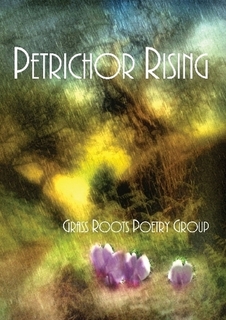
 John has also been involved in the recent publication of two anthologies that are the result of online collaborations among two international groups of amateur and professional poets. One of these is The Grass Roots Poetry Group, for which he produced and edited their anthology, “Petrichor* Rising“. The other group is d’Verse Poet Pub, in which John’s poetry also appears The d’Verse Anthology: Voices of Contemporary World Poetry, produced and edited by Frank Watson.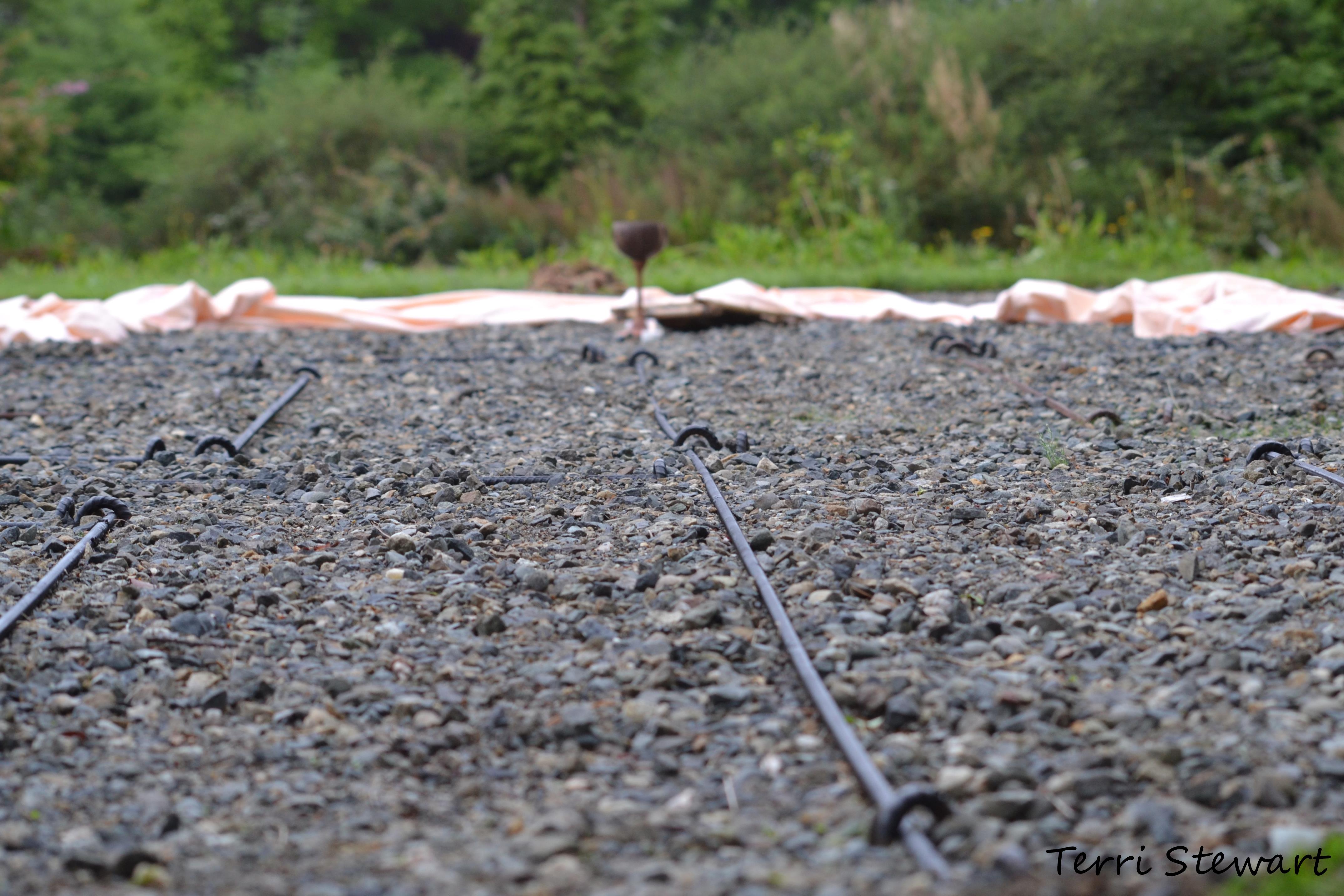








 The BeZine