Posted in Essay, Nature, Photography/Photographer, Spiritual Practice, story, Story Telling, Photo Story, Terri Stewart

One Foot in Front of the Other

Walking is a spiritual practice that I am predisposed to. After all, photography would not happen unless I walked around! Simply putting one foot in front of the other, time after time, without expectation of arrival at an end point is a contemplative practice. Recently, though, I discovered a new way of viewing walking as a contemplative practice. This practice had an end point and I was completely aware of all the w’s – who, what, when, where, why. I was not letting go and receiving images (well a little). I was literally focused on my feet and putting my feet, one step at a time, on stable ground.

And this is a metaphor. Sometimes, sitting at our desk or listening to our loved ones, can be a practice of just being aware of what is now and putting your best effort towards arriving at the next now. One step at a time.

As you continue reading, consider the questions, “In what area of my life can I start (or continue) putting one foot in front of the other? What new story will be created?

Here is my story.

Monday, I went hiking to Bridal Veil Falls / Lake Serene in the Central Cascade mountains of Washington. It was a spectacular day. (The weather is forecast to be fabulous all week-long in Seattle leading me to believe somebody is playing with our emotions.) I felt confident I could do the +7 mile hike. BUT I forgot to look at the way the path is (smooth vs. rocky) and the grade or “up-ness.”

I started out on the popular path and asked a co-hiker what to expect and she told me it was steep but that it was worth it. And that there were a lot of switchbacks. OK. I can do this! I will just take my time and be careful.

In February of this year, I was going through a diagnosis of Celiac disease. Now most folks just think that this is digestive only. Well, it is not. It causes inflammation in every part of my body. It grew tumors in my ovaries. I had a period for 3 weeks. I was severely anemic. The test didn’t say, “Low,” it said “Alert!” I could not walk up a short hill without being severely out of breath because I had very few mature red blood cells to carry oxygen around. In short, it stank.

And, over the last few years I have had surgery on my left ankle (torn tendon) and my right foot (two! neuromas crowding out my middle toes). I couldn’t walk without pain until, oh, last year after the neuroma surgery. Generally, I count every pain-free step a success. Would my feet hold out? Always a question. And with the ankle surgery, I generally look for nice, solid, flat ground so my ankle will not roll.

Rats! This path is not smooth. Very rocky. Wet sometimes. Muddy sometimes. But mostly rock, rock, rock. Keep my eyes down and make sure my feet land on flat spots! That’s the plan.

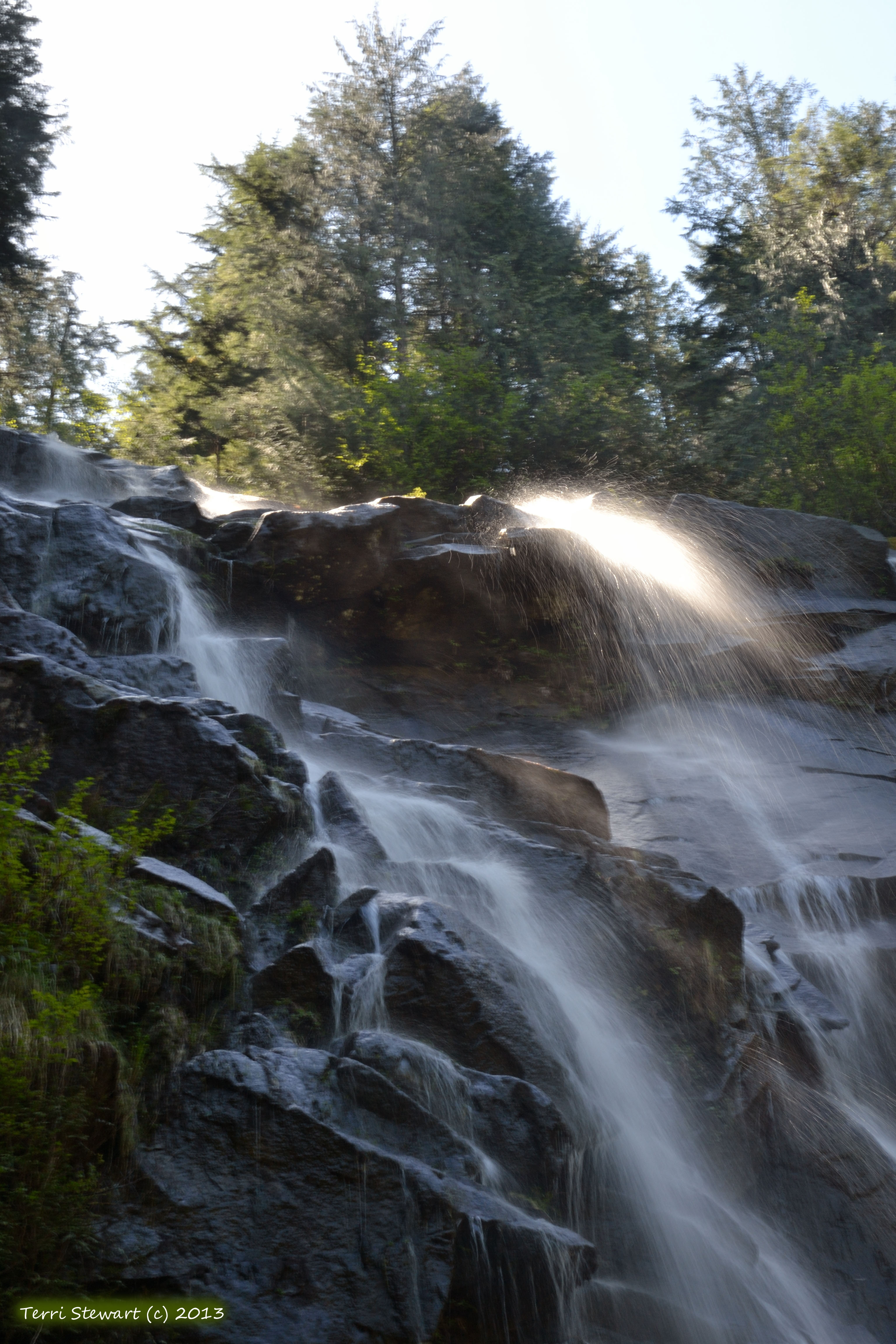
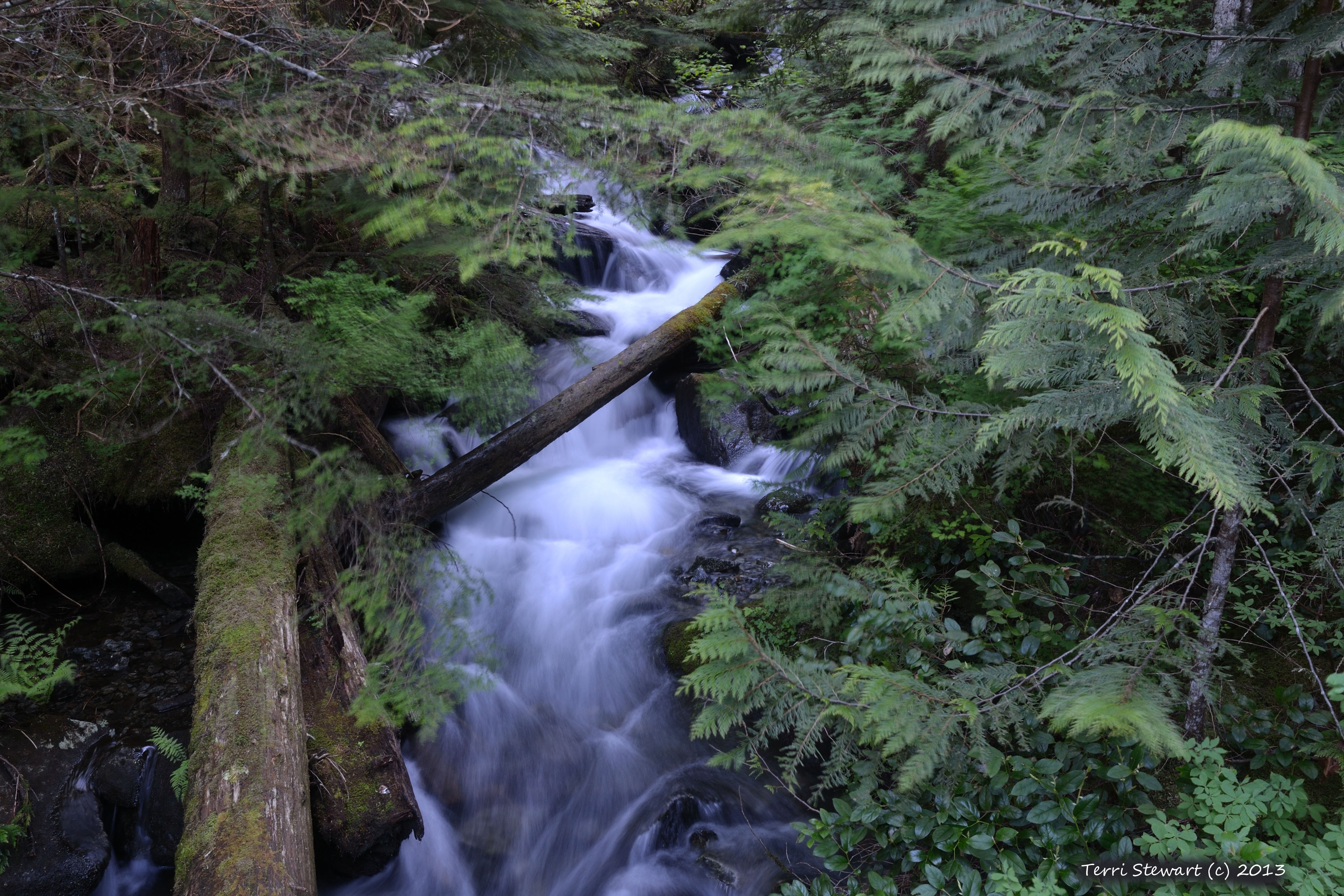
Anyway, I started up the path at my own pace. I got a little less than two miles in and found the below sight. I tried really hard to capture this thing that was happening with the sun and the water! It looked like liquid sunshine was pouring off the top of the waterfall. My eyes received the beautiful image of sunshine being poured down the mountain, could my camera receive it? A little.
Walkabouts__2013-06-03_12-05-17

At any rate, it was astounding. And it was the second set of falls I had seen. This mountain is one big slab of granite! (Hence the rocky path) And there is water everywhere. Well, okay, not everywhere, but in a lot of places. It was hard to get a good picture, but earlier, there was a set of falls that were very tall and jagged. But the trees were very overgrown so you could only get glimpses of the splash of light and water. This is the very bottom of that series. I received beautiful images of flowing water.
Walkabouts__2013-06-03_16-17-40

I got past the falls and it was two miles to Lake Serene. I was feeling good so decided my body could do this! I kept on going. And going. Up and up. Picking my way carefully through rocks. Resting when I felt overwhelmed. Then there came a moment when I thought that I was not going to be able to do it. I grounded my feet to the earth and drew on the strength of my God and the strength of the earth. I breathed deeply. This had become a spiritual quest.

I kept on going. But at that moment, I felt like giving up. I soon encountered a woman and her dog. They were resting. (Yay for rest!). I asked her how much further. She said, “When you feel like you have been through the worst possible climb, then it is just a bit more up and a little down and you’re there.”

OK. The worst possible climb. I can surely get to this.

I went up and encountered massive rocky path, with only about a 9″ clearance to skinny through. Surely, this is the worst possible spot.

I kept going and encountered another massive rocky path, with water and slipperiness. Surely, this is the worst possible spot.

Add water and repeat.

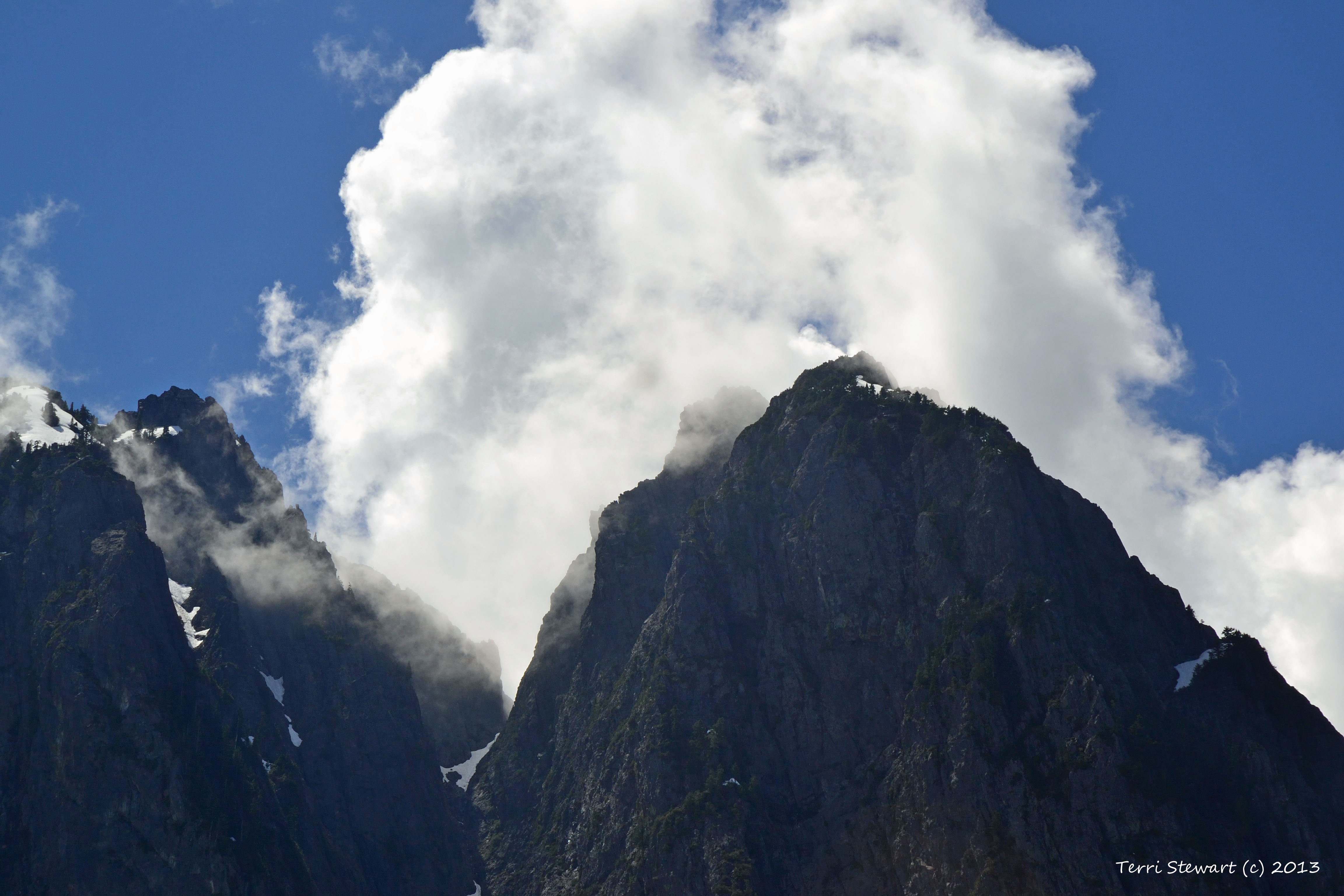
Finally, I broke through the shadows of the forest into a sunny meadowy type area (is it a meadow if it is on the side of a mountain?). I looked up and my breath left my body. It. Was. Amazing. I received the most beautiful blues intermingled with a dark granite mountain and white fluffy clouds rising like steam. I remember the story of Moses going up the mountain to be with his God and going into the cloud. This is a place to connect with spiritual strength. I felt strengthened, encouraged, excited, and alive. A complete contrast to how I felt when I was in the shadows.
Walkabouts__2013-06-03_13-56-59

I was now in the sun, with this incredible sight, having passed through at least 5 stretches of the worst climb ever. And I saw another worst climb ever in front of me. But my spirits were jubilant. I was in the light and had left the darkness. Amen!

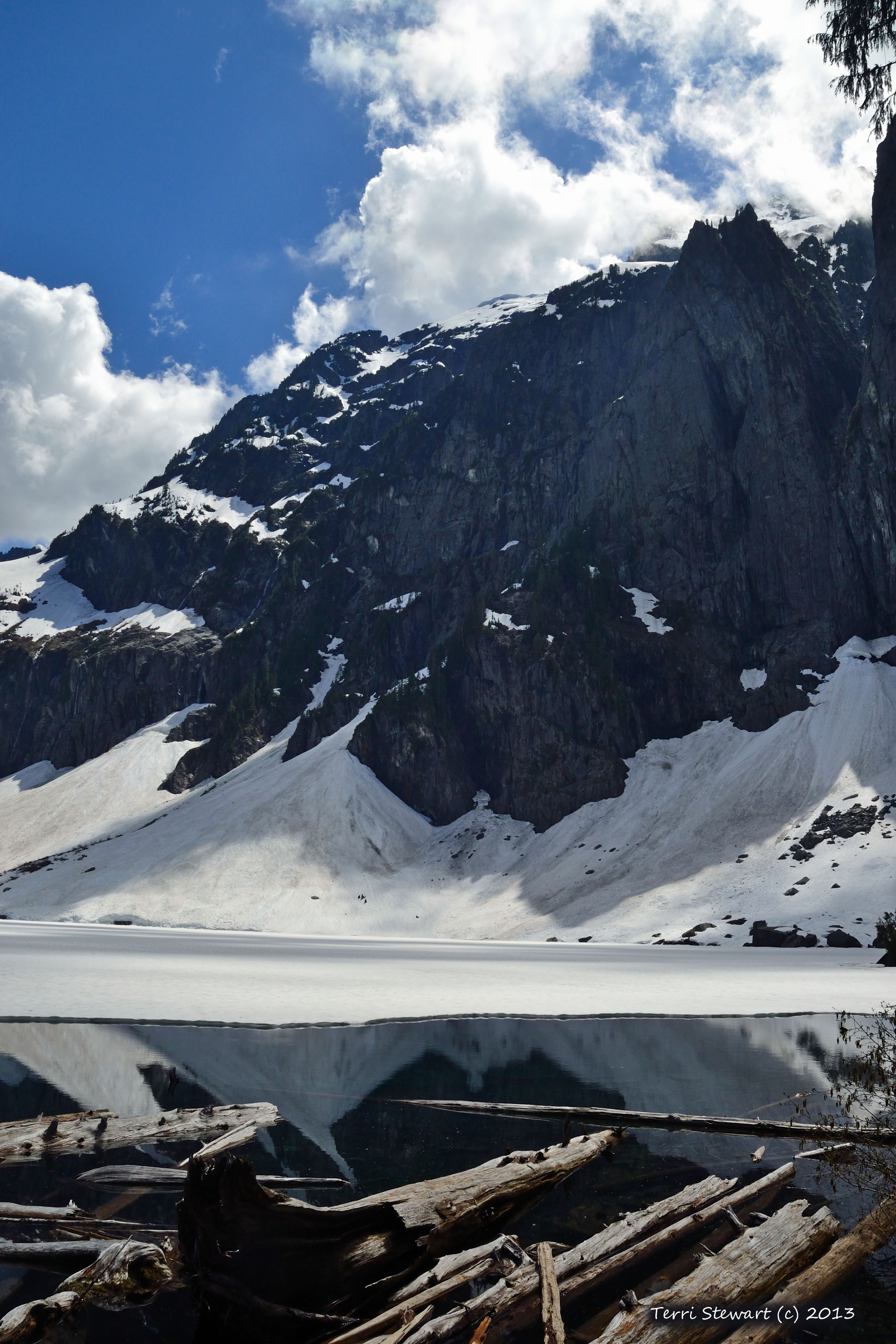
I kept on going. There was one more seriously worst climb ahead and then I was there. Lake Serene.
Walkabouts__2013-06-03_14-25-52

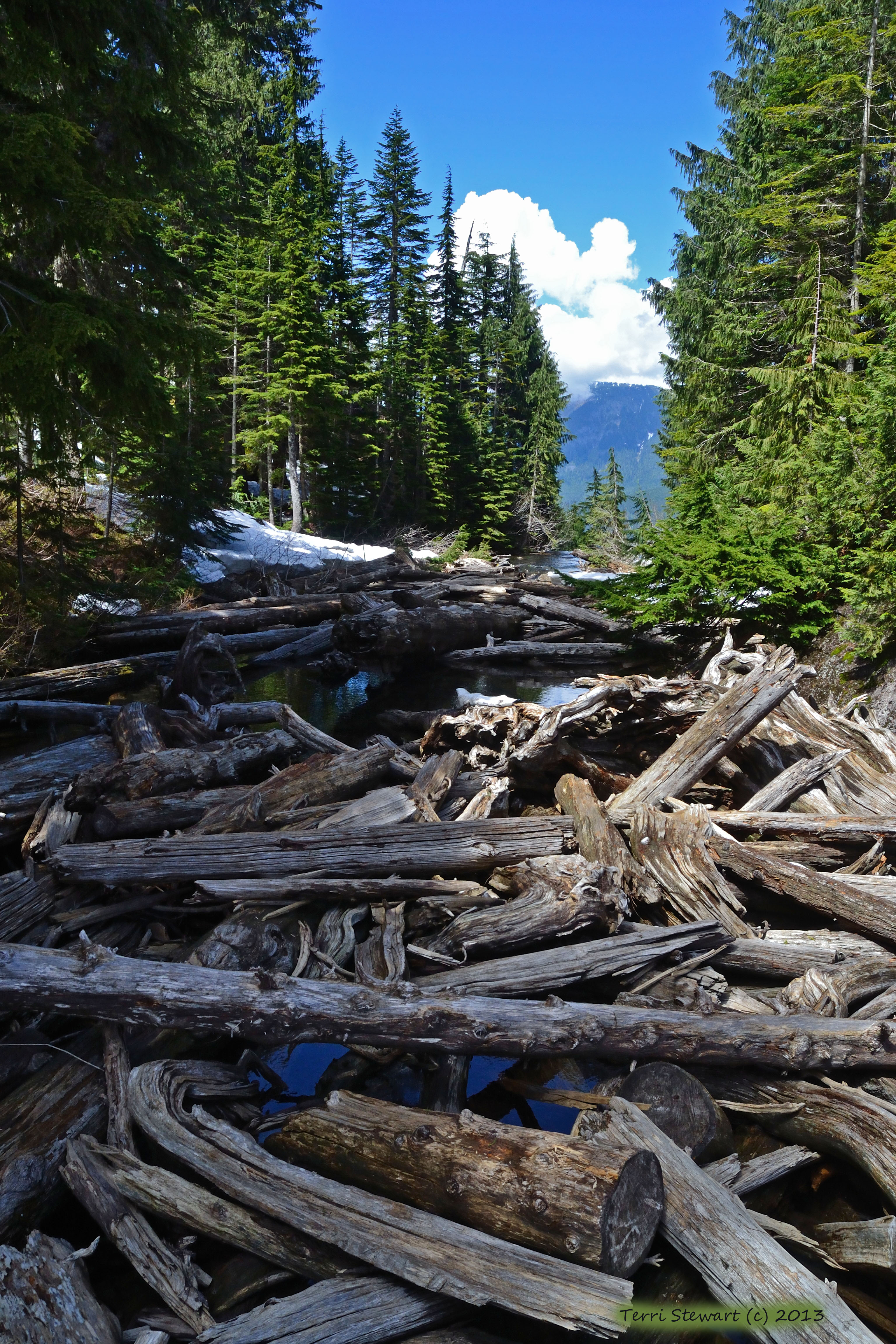
In fact, this lake feeds into the waterfalls pictured earlier. I had climbed all the way around to the other side. Here is what the top of the waterfall looks like from this same point, just facing the other way.
Walkabouts__2013-06-03_14-25-23

I clambered through the snow a bit and sat at the closest point I could get to the top of the waterfall. Ate lunch. Relaxed a moment.

Time to head back down. Surely, down would be easier! It always is. Mostly.

On the way down, I kept my head down looking to keep my feet planted so my ankle will not turn. I almost made it. Darn it. One misstep and a turned ankle. Choice – fall in a way to minimize injury or try to get that wobbly ankle to hold me up. Quick decision – my ankle will not withstand the effort to stay firmly up. Fall it is! Sheesh. I hate rocky, downhill, paths. Now, cuts and bruises, scratches and blood. I would hate to see what I looked like.

I crossed back in front of the amazing waterfall that poured sunshine and the woman I had met earlier was there with her dog! She was resting. Her dog decided to try to clean up the scratches on my legs a bit (ha ha!). We chatted a bit and she moved on. I stayed and tried to get some more photos of the falls and take a rest. Oh, and to use the water to wash my arm which has a pretty serious scratch(es).

But, gosh darn it, I did it! I am still on the path. I can still walk. My body is sustaining me. This is such a big deal, you have no idea. I was misdiagnosed for at least 20 years. To be able to do this is the most awesomely amazing thing ever. My muscles don’t even hurt as much today as they did on days the inflammation from being celiac made them hurt. (That was a bad sentence, sorry.)

I kept going. And I made it back to my car by about 5:00 p.m.

The quest was complete.

I am proud that I had the perseverance to keep on pushing through. My blood tests still say “alert” on the iron portion, but it is improving. My ankles and feet are okay today. My right arm and right shin are pretty banged up, but as long as nobody touches them (!) I will be fine.

The return hike took 2 hours. It took me 4 hours to go up.

Walking or hiking as a spiritual practice, for me, is typically about opening myself up to the images around me. Receiving images that I sometimes share here or on my blog. This time, though, it transformed into something else. Instead of receiving the beauty around me, I had to dig deep to connect to the strength of the earth, strength of my faith, and to the strength in my own body in order to find sustenance for the journey. This is a new kind of spiritual practice for me.  I had thought, Monday night, that I would not be eager to repeat this experience. But I am. Focusing on putting one foot in front of the other in this way gave me a faith in myself that I sometimes lack. Especially in my own body’s ability to sustain me. That is my new story. I trust my body.

Blessed be.

Shalom and Amen.

~Chaplain Terri

Adapted from a post at my blog. Trials on the Trail.

© 2013, post & photos, Terri Stewart, All rights reserved

terriTERRI STEWART is Into the Bardo’s  Sunday chaplain, senior content editor, and site co-administrator. She comes from an eclectic background and considers herself to be grounded in contemplation and justice. She is the Director and Founder of the Youth Chaplaincy Coalition that serves youth affected by the justice system. As a graduate of Seattle University’s School of Theology and Ministry, she earned her Master’s of Divinity and a Post-Master’s Certificate in Spiritual Direction with honors and is a rare United Methodist student in the Jesuit Honor Society, Alpha Sigma Nu. She is a contributing author to the Abingdon Worship Annual.

Her online presence is “Cloaked Monk.” This speaks to her grounding in contemplative arts and the need to live it out in the world. The cloak is the disguise of normalcy as she advocates for justice and peace. You can find her at www.cloakedmonk.com, www.twitter.com/cloakedmonk, and www.facebook.com/cloakedmonk.  To reach her for conversation, send a note to cloakedmonk@outlook.com

Posted in Naomi Baltuck, Photography/Photographer, Story Telling, Photo Story, Writing

Editing Monet’s Garden

Last May, while traveling in France, my sister and I went to Giverny to visit Monet’s Garden.  The line to enter was horrendous, and once we got past the ticket booth, we became part of the swarm of tourists overrunning his house and garden.  We must have heard a dozen different languages spoken, people from all over the globe had come to see for themselves the inspiration for Monet’s most famous paintings.

It was eye candy, a stunning profusion of color!   But instead of the rare and exotic flora I expected, all the flowers were, well, your regular garden variety.  Irises, roses, tulips, pansies, alyssum, forget-me-nots…nothing I don’t grow in my own garden.  Yet they were artfully arranged by height, texture, and color to maximize the effect.  And after all, they were in Monet’s Garden.

I wanted to capture at least the illusion of solitude and serenity, and to photograph the garden as I thought it must have been back in Monet’s day.  I waited for lulls in tourist traffic to get my shots.  But while waiting, I watched hoards of humanity shuffling by, and I caught glimpses of peoples’ lives that I found as moving as anything I saw in those historic gardens. Mothers and children, old couples holding hands, a little boy with eyes only for the baby chicks, an awkward teenaged boy who had eyes only for the teenaged chicks, and a family with four generations of women all sharing a park bench.

While we writers strive to capture a mood or feeling or effect, we should also observe the stories happening all around us.

The first  is like a very pretty still life, or a posed portrait of Mother Nature.  The other is a very real, sometimes messy picture of the world, brimming with humanity, and all the joy and heartbreak that life and love have to offer.

There is beauty in it all.

null

All images and words c2012 Naomi Baltuck

NaomiPHOTO1-300ppi51MC3SKEF0L._SY300_NAOMI BALTUCK ~ is a Contributing Editor and Resident Storyteller here at Bardo. She is a world-traveler and an award-winning writer, photographer, and story-teller whose works of fiction and nonfiction are available through Amazon HERE. Naomi presents her wonderful photo-stories – always interesting and rich with meaning and humor – at Writing Between the Lines, Life from the Writer’s POV.

Naomi also conducts workshops such as Peace Porridge (multicultural stories to promote cooperation, goodwill, and peaceful coexistence), Whispers in the Graveyard (a spellbinding array of haunting and mysterious stories), Tandem Tales, Traveling Light Around the World, and others. For more on her programs visit Naomi Baltuck.com

Posted in Charles W Martin, Photography/Photographer, Poems/Poetry

nomenclature…

nomenclature

aunt bea
said
i’ve figured out
why people
don’t believe in
global warming
it’s got
the wrong
name
people see
and
hear about
ice floes into homes
superstorms
around the world
these hot
and cold
flashes of weather
make people say
you call that
global warming
we need a name
that matches the symptoms
the earth is experiencing
a term that conveys
the extremes
of the earth’s moods
and
the difficult times
ahead for
mankind
i’m recommending
global menopause
there’s a term
even a politician
will be able
to comprehend

– Charles W. Martin

© 2013, poem and illustration, Charles W. Martin, All rights reserved

This is Charlie’s first post with us as a part of our core creative team. If you missed his complete profile the other day, it is posted HERE. Jamie

678ad505453d5a3ff2fcb744f13dedc7-1CHARLES W. MARTIN, Ph.D. (Reading Between the Minds) ~ Throughout Charlie’s educationalhawk chronicles training and career in speech and language therapy, he maintained a devotion to the arts (literature/poetry, the theater, music and photography). He was a published poet before he completed his graduate work. Since his retirement in 2010, he has turned his full attention to his poetry and photography. He publishes a poem and a photographic art piece each day on his blog.  Charlie has been blogging since January 31, 2010. He is hugely popular for his poetry, his ethic, and his support of other poets and bloggers.

Recently Charlie self-published a book of poetry entitled The Hawk Chronicles and will soon publish another book called A Bea in Your Bonnet: First StingThe Hawk Chronicles is available through both Lulu and Amazon. In The Hawk ChroniclesCharlie provides a personification of his resident hawk with poems and photos taken over a two year period. By invitation Charlie has shown his photographs in local businesses that display the works of outstanding artists.

Posted in General Interest, Peace & Justice, Photography/Photographer

Stolen Childhoods

If Steve McCurry’s name doesn’t ring a bell, think of the iconic photograph “Afghan Girl” that appeared in National Geographic. He is a world-renowned photographer with a compassionate lense. In this series from his blog (be sure to link through to see it all and to follow him, worthwhile), he shares photographs of working children from around the world. Perhaps when we are tempted to complain about our lives and our fate, we just shouldn’t. This will move all of us. The question is, what will it move us to do? What are prayers and metta practice if they don’t have feet? Jamie

Posted in Culture/History, Essay, Naomi Baltuck, Photography/Photographer

Remembering Uncle Lewis, A Memorial Day Story

One of my earliest memories is of dinner at Grandma Rose’s house.  Her towels, furniture, and closets smelled of mothballs; she even stored her silverware in mothballs.  Mostly, though, I recall standing on Grandma’s couch to study the framed collage of black and white photographs on her wall.  I recognized my father, but knew the other boy in the pictures only by name, and by heart.

Uncle Lewis was my father’s only sibling, younger than my dad by ten years.  We never met, and Daddy never spoke of him.  But they were best friends.  In one picture Lewis was laughing, having been surprised on the toilet by my father with his camera.  The brothers teased Grandma too.  Lewis would yell, “Harry, stop hitting me!”  Grandma would rush in, and scold my father for picking on his brother.  Undaunted, they’d laugh and repeat, until Grandma caught on.

Soon after the attack on Pearl Harbor, Lewis was drafted into the infantry, a shy studious eighteen year old who had never kissed a girl.  My father joined up as an officer.  He pulled a few strings to get Lewis transferred into the 30th ‘Old Hickory’ Division, so the brothers could cross the Atlantic on the same ship.  Lewis wrote letters and post cards home, often addressed to their dog ‘Peanuts.’

“Hey, Peanuts, tell Pa to eat his spinach!”   From the ship he wrote, “Harry and his buddies sneaked me into their cabin.  They gave me chocolate and let me play with their puppy.  Don’t tell anyone, or we’ll all catch it.  They smuggled the pup on board, and officers shouldn’t fraternize with enlisted men…”

While serving in Africa, Italy, England, France, and Germany, Harry was safely behind the front lines.  But Lewis was sent to Normandy two days after the D-Day invasion.  He fought in the hedgerows of France, and in Holland.  “The Dutch ran into the streets and passed out everything from soup to nuts.  As we marched out of there in the middle of the night, you could hear the clink of cognac, whiskey, and wine bottles in the guys’ jackets, amidst all the cursing and the roar of the Jerrys’ planes overhead.”  

To his parents Lewis wrote, “Dear Ma and Pa, today I saw General Eisenhower drive by.”  Or, “Kronk said the war can’t last.  It just can’t.  And he said it with such an angelic look on his face, I believe him!”

But to my father he wrote, “You should see the bruise from where a bullet passed through my shirt, Brub.  It was a close call.”  Or, “They took Julian away.  It’s so lonely here, Brub.  He’s the reason I wouldn’t take that promotion to sergeant.  We dug in together, took care of each other when things got rough.  I don’t know how bad he’s hurt; I just hope he makes it, and escapes this Hell.  Pray for me, Brub. Pray for me.”

On September 20, 1944, the day before his company attacked the Siegfried Line, Staff Sergeant Lewis Baltuck was killed by the blast of a shell.  Twenty years old, he had hardly begun to live.  He was survived by his parents, his dog Peanuts, and his brother Harry.  He never had the time or the opportunity to fall in love and marry.  He left no children to mourn for him—only the Bronze Star and the bronzed baby booties Grandma kept on her bookshelf until the day she died, more than forty years after her son’s death.

Harry married, had seven children, and built his own little house in Detroit.  But for the rest of his life he suffered acutely from the unspeakable burden of depression and Survivor’s Guilt.  When Grandpa Max died, my father became the sole caretaker of his widowed mother.  There was no one to share that burden with, to joke with or jolly her along.  Worst of all, crazed with grief, Grandma Rose blamed Harry for Lewis’s death.

I envied those kids who grew up with cousins to play with, and uncles who cared about them.  Uncle Lewis would’ve been that kind of uncle, and my father would have been a different man, without that black cloud to live under.  When Daddy died in 1965, we lost our connection to my father’s extended family, and our ties to our paternal cultural heritage were nearly lost as well.  But it does no good to dwell on the past or to speculate on what might have been.

Uncle Lewis was right about one thing.  War is Hell.  The price it exacts is impossible to tally, and can never be repaid.  When a soldier is killed, one heart stops beating, but many more are broken.  The wounds inflicted upon whole families are so deep that the scars can still be felt after generations.

I swear my uncle’s little bronze baby booties will never end up on the bargain shelf at the Salvation Army Thrift Store, like so many others I have seen there.  How sad to think that such precious keepsakes might be tossed into the giveaway because no one remembers or cares about the one whose little feet filled them.

I attended the 60th reunion of the Old Hickory Division in Nashville in search of someone who knew my uncle.  I met only one man who remembered him…“a quiet man who didn’t say much, but when he did speak, he was always worth listening to.”

I tell my children that story, and many other stories about their Great Uncle Lewis.  I am confident he will be cherished and remembered, not just for his tragic death, but for his joyful life.

copyright 2012 Naomi Baltuck

NaomiPHOTO1-300ppiNAOMI BALTUCK ~ is a Contributing Editor and Resident Storyteller here at Bardo. She is a world-traveler and an award-winning writer, photographer, and story-teller whose works of fiction and nonfiction are available through Amazon HERE. Naomi presents her wonderful photo-stories – always interesting and rich with meaning and humor – at Writing Between the Lines, Life from the Writer’s POV. She also conducts workshops such as Peace Porridge (multicultural stories to promote cooperation, goodwill, and peaceful coexistence), Whispers in the Graveyard (a spellbinding array of haunting and mysterious stories), Tandem Tales, Traveling Light Around the World, and others. For more on her programs visit Naomi Baltuck.com

Posted in Photography/Photographer

Ice Age Spring

This slideshow requires JavaScript.

This Ice Age Spring was photographed in Wisconsin.

– Priscilla Galasso

© 2013, photographs including the portrait below, Priscilla Galasso, All rights reserved

004PRISCILLA GALASSO ~ is a new contributor to Into the Bardo. She started her blog at scillagrace.com to mark the beginning of her fiftieth year. Born to summer and given a name that means ‘ancient’, her travel through seasons of time and landscape has inspired her to create visual and verbal souvenirs of her journey.

“My courage is in the affirmation of my part in co-creation”, she wrote in her first published poem, composed on her thirtieth birthday and submitted alongside her seven-year-old daughter’s poem to Cricket magazine. Her spiritual evolution began in an Episcopal environment and changed in pivotal moments: as a teenager, her 20-year old sister died next to her in a car crash and, decades later, Priscilla’s husband and the father of her four children died of coronary artery disease and diabetes in his sleep at the age of 47.  Awakening to mindfulness and reconsidering established thought patterns continues to be an important part of her life work.

Currently living in Wisconsin, she considers herself a lifelong learner and educator. She gives private voice lessons, is employed by two different museums and runs a business (Scholar & Poet Books, via eBay and ABE Books) with her partner, Steve.

Posted in Photography/Photographer, Poems/Poetry, Rumi, Spiritual Practice, Terri Stewart

Doors

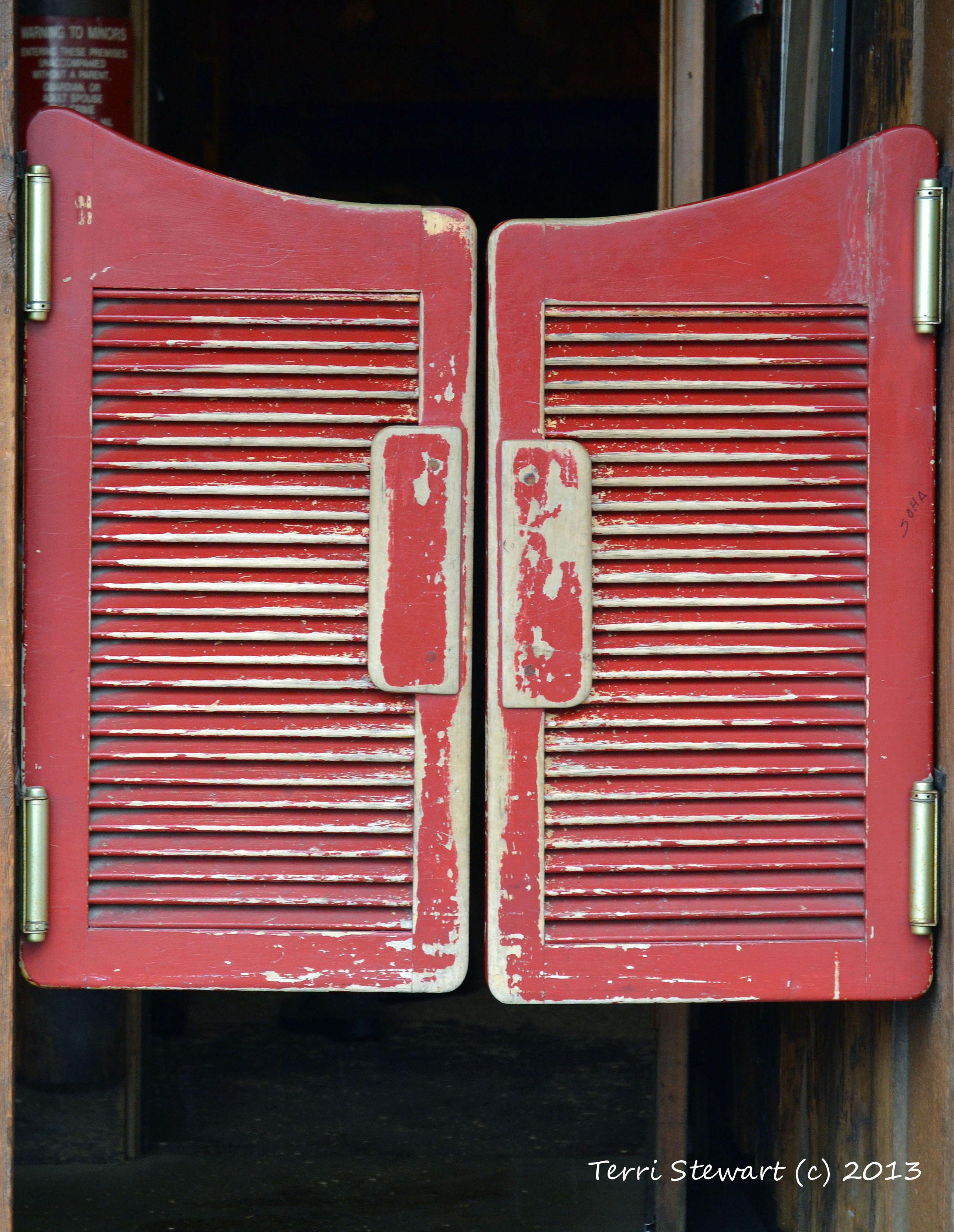
bar_doorsConsider doors. We enter or exit through doors. Sometimes we just look at doors. They lead towards something or away from something.

“As long as you are performing prayer, you are knocking on Allah’s door. And whoever knocks on Allah’s door [constantly], He will open it.” -Ibn Al-Qayyim Al-Jawzi

“The doors we open and close each day decide the lives we live.” -Flora Whittemore

“A man who does not plan long ahead will find trouble right at his door” -Confucius

“Ask, and it will be given to you; seek, and you will find; knock, and it will be opened to you.” Matthew 7:7, Christian Scripture

“In oneself lies the whole world and if you know how to look and learn, the door is there and the key is in your hand. Nobody on earth can give you either the key or the door to open, except yourself.” -Jiddu Krishnamurti

“Knowledge of what is does not open the door directly to what should be.” -Albert Einstein

Lots of thought has been given to doors! Now it is our turn to consider doors. I would like to offer up a lectio divina experience. Lectio divina is an ancient way of “being present
to a text in a heart-centered way.” (Christine Valters Paintner) It is a way of meditating or praying. When we use the lectio divina technique, we see the words we read as living, breathing essence. It becomes an encounter with the sacred. There are four primary movements of lectio (and sorry if this is repeat news!)…

Read (lectio): Read and listen for a word or phrase that creates energy within your body

Reflect (meditatio): Read again and savor the words, delve into them, use your senses to experience them

Respond (oratio): Read again and listen for the invitation coming from the text

Rest (contemplatio): Rest, be still.

Go slowly and be present. I offer you a poem from Rumi.

Lectio:

The bfirehouse_doorreeze at dawn has secrets to tell you.
Don’t go back to sleep.

You must ask for what you really want.
Don’t go back to sleep.

People are going back and forth across the doorsill
where the two worlds touch.

The door is round and open.
Don’t go back to sleep.

From Essential Rumi
by Coleman Barks

Meditatio:

weird_doorThe breeze at dawn has secrets to tell you.
Don’t go back to sleep.

You must ask for what you really want.
Don’t go back to sleep.

People are going back and forth across the doorsill
where the two worlds touch.

The door is round and open.
Don’t go back to sleep.


Oratio:

lots_of_doorsThe breeze at dawn has secrets to tell you.
Don’t go back to sleep.

You must ask for what you really want.
Don’t go back to sleep.

People are going back and forth across the doorsill
where the two worlds touch.

The door is round and open.
Don’t go back to sleep.

Rest:

forboding_door

Shalom and Amen.

~Chaplain Terri

© 2013, post and photos, Terri Stewart, all rights reserved

Terri StewartTERRI STEWART is Into the Bardo’s  Sunday Chaplain, Senior Content Editor, and Site Co-administrator. She comes from an eclectic background and considers herself to be grounded in contemplation and justice. She is the Director and Founder of the Youth Chaplaincy Coalition that serves youth affected by the justice system. As a recent graduate of Seattle University’s School of Theology and Ministry, she earned her Master’s of Divinity and a Post-Master’s Certificate in Spiritual Direction with honors and is a rare United Methodist student in the Jesuit Honor Society, Alpha Sigma Nu. She is a contributing author to the Abingdon Worship Annual.


Her online presence is “Cloaked Monk.” This speaks to her grounding in contemplative arts (photography, mandala, poetry) and the need to live it out in the world. The cloak is the disguise of normalcy as she advocates for justice and peace. You can find her at www.cloakedmonk.com, www.twitter.com/cloakedmonkwww.flickr.com/cloakedmonk and  www.facebook.com/cloakedmonk.  To reach her for conversation, send a note to cloakedmonk@outlook.com.
Posted in Music, Naomi Baltuck, Photography/Photographer

As I Was Going Up the Stair

Yesterday upon the stair, I met a man who wasn’t there.


He wasn’t there again today.  Oh, how I wish he’d stay away!

photograph c2013 Naomi Baltuck

This is the first stanza of Antigonishwritten in 1899 by Hughes Mearns.  It was inspired by rumors of a ghost roaming the stairs of a haunted house in Antigonish, Novia Scotia.  It inspired a popular Glenn Miller song in 1939, with vocals by Tex Beneke.

– Naomi Baltuck

Editor’s note: What a  fine example of how – with our art – we feed one anther. Here people pass around a folk tale. A poet picks it up and writes a poem. A composer finds the poem and sets it to music, which musicians then play accompanied by a singer singing the poem. Wonderful! J.D.

NaomiPHOTO1-300ppiNAOMI BALTUCK ~ is a Contributing Editor and Resident Storyteller here at Bardo. She is a world-traveler and an award-winning writer, photographer, and story-teller whose works of fiction and nonfiction are available through Amazon HERE. Naomi presents her wonderful photo-stories – always interesting and rich with meaning and humor – at Writing Between the Lines, Life from the Writer’s POV. She also conducts workshops such as Peace Porridge (multicultural stories to promote cooperation, goodwill, and peaceful coexistence), Whispers in the Graveyard (a spellbinding array of haunting and mysterious stories), Tandem Tales, Traveling Light Around the World, and others. For more on her programs visit Naomi Baltuck.com

Posted in Photography/Photographer

Divine Look

This lovely photo and message from Ajaytao says it all.

Posted in Photography/Photographer, Spiritual Practice, Terri Stewart

Contemplative Photography: Listen with the Eye of the Heart

Contemplative photography is a practice I try to observe. So often, I end up reserving it for vacation times. However, with the advent of phone cameras and the increased capabilities they have, contemplative photography is at my fingertips every day! I am reading a book on contemplative photography and would like to share some of the thoughts it is stirring in me and the information it has. The book is Eyes of the Heart: Photography as a Christian Contemplative Practice by Christine Valters Paintner. You can find her at Abbey of the Arts.

Contemplative seeing is described by Carmelite William McNamara as a “long loving look at the real.” Let’s think about what each one of these words means.

  • Long – to see, we need to slow down and notice our surroundings, immerse ourselves into the moment
  • Loving – to see clearly, we need to have a compassion filter that sees beauty in all things, the horrible and the joyful
  • Look at the real – to see things as they are, not how we want them to be

Contemplative seeing also requires a journey from the head down into the heart.

In Buddhism, there is a practice of contemplative photography called Miksang. This is Tibetan for “good eye.” Miksang has the goal of looking at the real without judgement or distinctions like “beautiful” or “ugly.” The goal is to see things as they are without attaching value judgments and to appreciate it. This opens up a third space, seeing things in a creative new way. I am reminded of a visit I made to the women’s prison. It was a spectacular Pacific Northwest day. Brilliant blue skies. Inside the prison, walking across the grounds, I looked up and saw the razor wire. At the same time it was incredibly beautiful and incredibly repulsive. That is the tension that the “good eye” brings.

freedom in the penitentiary

robin sitting still
between barbs of sharpened steel
her spirit will soar

In Christianity, this “good eye” is termed the “third eye” by Richard Rohr. He describes it as the moment when “our heart space, our mind space, and our body awareness are all simultaneously open and non-resistant. I like to call it presence. It is experienced as a moment of deep inner connection, and it always pulls you, intensely satisfied, into the naked and undefended now, which can involve both profound joy and profound sadness. At that point, you either want to write poetry, pray, or be utterly silent.”

The monk, Thomas Merton, started practicing contemplative photography and he said, “How the blank side of a frame house can be so completely beautiful I cannot imagine. A completely miraculous achievement of forms.” Perhaps the good eye or the third eye is simply seeing the miracle.

All this is quite a lead up to the offering I have today of a contemplative photograph. I am going to offer an image and then I encourage you to visit one from Thomas Merton he titled “Sky Hook” and described as the “Only known photograph of God.”

After entering the photograph(s), please consider sitting with the feeling that is created when you shift from head seeing to heart seeing. Gaze lightly into the distance without focusing on any one thing. Be present to the real. After you have considered these photographic offerings, perhaps you would consider gazing around you, holding compassion in your heart and seeing something beautiful. If you have your camera, great! If not, consider the magical moment of holding the image in your heart and then releasing it.

Community
Community

Reflection: What, if anything, has changed? How was the journey from head to heart?

Shalom and Amen.

Chaplain Terri

© 2013, post and photographs, Terri Stewart, All rights reserved

Terri Stewart
Terri Stewart

TERRI STEWART is Into the Bardo’s  Sunday evening chaplain. You can expect a special post from her each week. She comes from an eclectic background and considers herself to be grounded in contemplation and justice. She is the Director and Founder of the Youth Chaplaincy Coalition that serves youth affected by the justice system. As a recent graduate of Seattle University’s School of Theology and Ministry, she earned her Master’s of Divinity and a Post-Master’s Certificate in Spiritual Direction with honors and is a rare United Methodist student in the Jesuit Honor Society, Alpha Sigma Nu. She is a contributing author to the Abingdon Worship Annual.

Her online presence is “Cloaked Monk.” This speaks to her grounding in contemplative arts (photography, mandala, poetry) and the need to live it out in the world. The cloak is the disguise of normalcy as she advocates for justice and peace. You can find her at www.cloakedmonk.com,www.twitter.com/cloakedmonk, and www.facebook.com/cloakedmonk.  To reach her for conversation, send a note to cloakedmonk@outlook.com.
Posted in Guest Writer, Photography/Photographer

AT THE BUDDHIST TEMPLE ON PAYA LEBAR ROAD IN SINGAPORE

Sydney lives in Singapore from which my son and daughter-in-law recently returned. They were enchanted and vow to go back. If Singapore is anything like Sydney and his blog, everyone would be completely charmed.

The Buddha said, “Fashion your life as a garland of beautiful deeds.”  Sydney has fashioned his blog as a garland of beautiful posts. You will see from this one that he is so genuine and enthusiastic about life that he’s irresistible. This particular post warmed my heart. It is  loving, respectful, tender.

Today, it is an honor to share Sydney’s visit with his parents here. Thank you, Sydney! Jamie Dedes

I SAW MY PARENTS THIS MORNING

by

Sydney Fong (Add Grain on Earth)

temple-01

To day, my family and me spent half a day doing prayer to my ancestors and deceased parents. The littleBuddhist temple located at Paya Lebar road, where tranquil and serenity lived.

temple-02

This is the place for holding the prayer for the deceased and the tablets.

My parents are somewhere at the left near the front.

But strangely, I couldn’t see them!

temple-03-e1358699926868

I walked to the back yard, saw a young papaya tree waved and said hello to me.

temple-06

And walked further, asked Phalaenopsis,” where are my parents?”

She just smiled at me in return.

temple-07

I asked the pearl drop, do you know where are my dearest parents?

temple-05-1

I approached the aging bench.

temple-08-1

I feel a balmy and gentle hand pat on my shoulder, and I looked up.
I saw daylight resting on the leaves. I saw them!

temple-04-1

Dad and Mom said:” son, not to worry about us! We have friends, many friends here!

You should take good care of yourself and live meaningfully each day!”

I kept nodding in sob.

temple-12

Raindrops witnessed and shared with me this moment.
My dearest Dad and Mom, I missed you!

© 2013, photographs/photo portrait/narrative, Sydney Fong, All rights reserved

myself-01SYDNEY FONG (Add Grain on Earth) started blogging in July of 2012 and focuses on photo essays with accompanying music and short narrative interludes. He is the sweet voice of Buddha-like gentleness and a self-described “visionary.” He earns his living as an architectural illustrator. Of his blog he says, “My blog entails categories of my interest, joy, upheaval of life and its destiny. Every post has its own characteristic. It conveys a story of its own, and the life of its owner.” I am pleased to welcome Sydney as a contributing writer to Into the Bardo.

Posted in Art, Photography/Photographer, Wendy Alger

MEET WENDY ALGER, fine art photographer

WENDY ALGER (b. 1972), Chicago, IL, U.S.A.

Fine Art Photography

Photography. It’s like music … It’s like your favorite song, something you can listen to over and over and over again. You try to explain it to some and you can’t. That’s the feeling it gives me. It’s like traveling and you want to tell everyone how great it was … and I have that experience every time I pick up a camera. Wendy Alger.

·

MY FRIEND: WENDY ALGER

by

Jamie Dedes (The Poet by Day, a jouney in poem)

Initially, when Wendy started doing photography, it was a hobby. Then a friend suggested she become a photographer.  Wendy thought that sounded just right for her. Both her parents knew photography and her dad gave her one of his cameras and some lenses.

At the time, Wendy owned an old ’68 Mustang. She says she’d drive around and listen to music. When something called out to her, she’d stop and take photographs. That’s how she began to learn what subjects appealed to her. “I photographed everything that felt right and compelled me to keep taking photographs.” Slowly, she discovered the photographer within and her own distinctive style. “I enrolled at the Academy of Art University in San Francisco and trained there, where I learned manual SLR. I also learned how to use a dark room.”

Given Wendy’s vision challenges, I am always amazed at what she can do. She has visual impairment due to retinitis pigmentosa She tells me that new camera technologies make it easier. “I use a digital camera and I can review my pictures on the camera instead of in a dark room.I have a digital dark room, which consists of a laptop and Photoshop and Photoshop Lightroom. This allows me to transform and print my images at home. I also use visual memory … I remember feeling to get through a photo session.”

Wendy’s long-term goal: “To have my artwork  displayed in the same building as Walker Evans in my lifetime – not after – during! My vision problems are not stopping me. I never even think about that. After I was diagnosed and as soon as I got the money I bought my digital camera.”

Here is a small gallery of Wendy’s recent work with a digital camera. The photo at the head of the post and the first one below are self-portraits. Wendy’s photographs are copyright protected. You can see more of her work HERE.

© narrative, 2011 Jamie Dedes All rights reserved

© photographs, 2011 Wendy Rose Alger, All rights reserved