Yet undescribed member of the Order of Lepidoptera of the Paraphyletic group, one of the 160,000 alive on this planet.
Think not of me as a tender butterfly,
though I am a painted lady, breeding
in Royal State. Beware! I am deadly,
my habitat disturbed, not comforting.
I hide and rest by day, not for fear of the
butterfly. I believe in peaceful coexistence,
having a long witch’s nose, not casting spells,
keratin I love, in cashmere, wool, angora, fur.
Yes I often hit the wall. I am confused by light,
but when I fly by it, I frighten the flame. I love
to play the game. I bite, chew from side to side,
hiding in basements, cool fabric folds, inside.
Nature created me to warn mankind of the
temporal world. Whatever lies unused, I eat
and destroy, so the world ends. And I, too, die.
Or else, so delicate, how long can I fly?
Lay not up for yourselves treasures upon earth,
where moth and rust doth corrupt, and where thieves
break through and steal, but lay up for yourselves
treasures in heaven, away from moths and all decay.
I grew up in a struggle.
Like always.
Like there was no peace.
Ever. But for the Bay.
That blue quiet light.
What can i say?
Inside the edges of childhood
sick red baited & bothered,
It made you bonkers in a new way;
the house shook on its stilts. No silk.
Just struggle.
What more can i say?
Bias Burning Time
Bigots have no spigots of charity
They burn bias with threaded needles
As a way of catching and trapping us
God save all our souls from this evil contamination
Of such wickedness and sadness.

Let us stand on the streets together
Tall and proud
And read poetry with each other
Hug and love with all our muster
To share a shining nuance of the wonderful
While this untenable world circumnavigates around
in crippling blindness
Ubiquitous need
Feeling the hunger
in the streets
I don’t
matter anymore
my slow lapse
a particle
in the span
of ubiquitous wanting
everywhere barbarous
greed and rapacious
capitalist
tyranny
I deepen the tongue of my ink
in the rich pot of praise and protest
blisters of praise, scars of patriotism
the war I fought without guns
my laughter’s stitched with worry and fondness
smiles of east laden with grief
my country
my heartburn for freedom is burning me
roasted nuts of justice bleed no peanut
remind me of those wind choked tunes of mountains
remind me of happiness once perched on treetops
alongside the orange tinge of dawn
remind of laughter that echoed from mountain caves
remind of the love dressed in the hearts of fathers
remind of freedom songs that are buried together with ancestors
remind me and I will sing with you
I have a dream to ride those mountains of home
and drink from the calabashes of their mist
my country, you lost your salt
Matters of Conscience
Gulf of inspiration
oils the spin weave of my mind

Rhythm and imagery my constitution
Meditation my second bible after proverbs


I am apostoled by heart pounding drumbeat ritual of metaphors
pandamu! pangu ! panda ! pako ! panda ! pandamu! pa!
sanctified by breath choking incense of satire

[wordsmith chiseling thesaurus rocks for jargon,
poet planting saliva in wombs of readers digest to reap diction]

Political suspense
nutrition to my poetic conscience

Social drama
fodder to my mental digestion

War
rabies that poisoned the tongue of Pakistan.
Diseased the saliva of Afghanistan

Corruption.
Polio, paralyzing penury burnt fingers of matopos
and inflation butchered thighs of Zambezi


Poverty.
Scabies eating away bare brown. Winter ravaged buttocks of Darfur
shrinking hunger sucked mango like breasts of tutsiville

Religion
measles blighting arteries of Vatican. Bleeding yellow gums of Mecca.
Shriveling hoarse breath of Jerusalem
Viva Revolution
for Guyana and Tobago
Slavery blew off candles of generations
Children molded by the clay of revolutions after revolutions
Children of Guyana and Tobago
Voices of reason drowned in clay of chocolates and rivers of Pepsi Cola
Green back and condom generations with revolution sodden wounds
and deep scars embedded in their pigment
Children whose sweat washes the linen of oxford
and tears rinse dishes of Harvard
Generations of unending revolution,
polishing emerald for Gucci
And diamonds for Rivera
Generations breakfasting sausages made from their sweat
Children of revolution: I raise my pen, your sun will rise
Mbizo CHIRASHA, the Author of a Letter to the President. Co-Authored Whispering Woes of Ganges and Zambezi. Co-Edited Street Voices Poetry Collection (Germany Africa Poetry Anthology). Co-Editor of the Corpses of Unity Anthology. Associate Editor at Diasporia(n) online. Chief Editor at Time of the Poet Republic. Founding Editor at WomaWords Literary Press. Publisher at Brave Voices Poetry journal. Curator at Africa Writers Caravan.
UNESCO-RILA Affiliate Artist at University of Glasgow. 2020 Poet in Residence Fictional Café. 2019 African Fellow, IHRAF.ORG Project. Curator and Co-Editor of the Second Name of Earth is Peace (Poetry Voices Against WAR Anthology). Contributing Essayist to Monk Arts and Soul Magazine.
Poetry and writing appear in FemAsia Magazine, Wrath-Bearing Tree, Ink, Sweat, and Tears journal, One Ghana One Magazine, Ofi Press, World Poetry Almanac, Demer Press, Atunis Galaxy. Poetry online: IHRAF Publishes, The Poet a Day, Bezine.Com, Sentinel UK, Oxford School of Poetry Pamphlet, Africa Crayons, PulpitMagazine, Poetry Pacific, Zimbolicious, Best New Poets, Poetry Bulawayo, Gramnet webjournal, Diogen Plus, Poeisis.si, Festival de Poesia Medellin and elsewhere.
Walking down the aisles, aimlessly …
glancing at the jacks, plastic soldiers, cap guns …
Remembering when I was young,
boys had their toys and girls had theirs

I picked up a rubber ball, rainbow on white,
bounced it on the concrete floor,
caught it with senseless fingers …
      Bounce      Catch
            Bounce      Catch
Flex the wrist, sing a song
      When we grew up, we were at war
      When we grew up, we were at war

My hand went limp, dropped the rubber ball
into its bin … the rainbow dimmed …
my senseless fingers rubbing tired eyes.
      When we grew up, we were at war
      When we grew up, we were at war
That senseless war of our childhood ended as our youth ended.
The embers of senseless wars, smoldering as our youth smolders.
      … When we were grown up, we were at war
             When we were grown up, we were at war …
Spring Storm
In my deep sleep
      I hear another storm
Thunder rumbles my bed
      lightning shimmers through
            the window-blind slats ajar
Raining hail pings off the roof

In my deep sleep
      I hear another Stealth
The jet rumbles my bed
      its blackness blankets my mind
            suffocating deep dreams
Raining bombs ping off distant lands


Water rises in the streams
      in low lanes       in ceramic
            bowls left beneath
                  the leaking skylight
Above       its stained glass is dull
      in the blackness       it rattles
            with the rumbles


I awaken from another
      long rumble reaching
            deep within my being
To water rising across
      the wooden floor beneath
            that stained glass
Lanterns
Across this lightly
               wind-rippled pond
                               lanterns float
Their candles flicker
               struggling to keep alight
                               souls floating
                                              to the Spirit World
Struggling against a white-cap wake
               of another one
                               of our steps
                                              from the marshy shore

Lanterns for the souls
               let loose       to soar
                               on our nuclear winds
                                              above Hiroshima
                                                             & Nagasaki
Our steps
               into that New Age
                               of Kali
Our step
               letting loose
                               a hundred thousand souls
                                              of Japan
Our step
               like the multi-legged
                               Indian deity
In to the waters of this pond
               into the Sea of Japan

Hundreds of thousands
                               millions more
               into many other seas
A million more lanterns
               candles flickering       struggling
                               against this evening breeze
               of Vietnamese souls
& those of Laotians
                               more for the Kampucheans
& those of Filipinos       of Indonesians
               Timorese . . . .

How many lanterns shall we
               send adrift for
                               Native American souls?
Will we ever know?
Souls caked with
               coal dust & homeland dirt
                               glowing with uranium
Floating off across
               with our step
                               our push

Like a multi-handed
               Indian deity
We push these lanterns
               across this pond
One hundred twenty thousand
               Guatemalan souls
                               we push
Over a hundred thousand
               Salvadoran souls
Thirty thousand Argentinean
               perhaps an equal number
                               of Chilean
How many souls
               Panamanian       Colombian
                               Nicaraguan
How many souls
               of Latin Americans
                               have we sent afloat
                                              across these waters?

& how many African souls?
               Will we ever know?
Souls dipped in cobalt & platinum
               glittering with diamonds
A million more lanterns
               candles flickering     struggling
                               against the breeze
               of Chockwe       Bantu       Yoruba
& those of South Africa
               more for the Angolans
& more for . . .

Ay--& the nuclear rains of munitions
               & the twice, thrice weekly
                               rains of bombs
                                              over Iraq
Like the multi-handed deity
               they fall from the palms
                               sift through the fingers
                                              of our many hands
Our many hands strangling
               a million & a half
                               & more Iraqis
Squeezing every drop we can
               to fuel these candles lit
                               in these lanterns we
                                              push across this pond
Squeezing       pushing
               to give ourselves dignity

Our many hands strangling
               North Koreans       Cubans       Libyans
Our 285 million pairs of hands
               strangling so many millions
                               & pushing their souls across
               for all this around us
                               & perhaps
                                              a bit
                                                             of dignity


Like Kali
               we hand the world death
Gathering skull garlands
               around our fattened necks

But like Kali
               can we also
                               create life?
Lorraine Caputo is a documentary poet, translator and travel writer. Her works appear in over 180 journals on six continents; and 12 chapbooks of poetry – including Caribbean Nights (Red Bird Chapbooks, 2014), Notes from the Patagonia (dancing girl press, 2017) and On Galápagos Shores (dancing girl press, 2019). She authors travel narratives, articles and guidebooks. She travels through Latin America, listening to the voices of the pueblos and Earth.
bodies
Bodies
bodies

So many bodies
rotting bodies
Hundreds of bodies

dumped in drainage canals
in plastic bags

buried in fields
patios
yards of homes

dissolved in acid or lye

19 corpses hung from ropes
hacked to pieces

authorities ran out of space
neighbors complained about the smell
killings skyrocketed

cartel lost control
battling that splinter

group
violence
fractured

key
decision-making

Hope
draconian
assault[s]

1.

wildlife species such as bamboo rats
may have been    hosts
for the    coronavirus
__

a breeder of bamboo rats
a delicacy when grilled
has    not earned a penny
since January
__

In June
he dug a deep pit
and buried [hundreds] alive

“I invested all I had
into this business”

2.

The Chinese government
plunged
more than
330,000 IUDs    in
Uighur residents

all women of childbearing age
__

Side effects can include
headaches
dizziness
nonstop menstrual bleeding

irremovable without special instruments
__

still leaking breast milk
strap[ped] her to an iron chair

electric vacuum
sucked her fetus
__

The IUD
sunk into her flesh

a bitter reminder of
that fear
Kat Bodrie’s prose and poetry have appeared in Waymark: Voices of the Valley, West Texas Literary Review, Rat’s Ass Review, and other publications. She lives in North Carolina. Learn more.
Buried deep in the cemetery made of concrete and smog
Her dreams lay under a blood red tombstone that will soon be washed
                                                                                          away by public servants

And the casket of her physical form will be carted off in black body bag
to hide from polite society the grim evidence of this most recent victim
of our voluntary blindness

Immigrant. Brown. Female. Other.

She wanted safety. Wanted freedom. Wanted joy.
Wanted to be no one’s slave,
No one’s shackled bird in a cage
but she was trapped in a prison of disregard, limitations
                          and entrapped by a system that calls itself … humane.
Calls itself… just.
Calls itself… equal.

but last time I checked being male with pale skin prevents
                                                           you from feeling the pain she lived.
and the death that was her punishment
for being
… immigrant, brown, female, other.

No other reason for the path she was forced onto
Because her sisters, imprisoned on these streets, break sweats
                                                                             to fix your fitted sheets,
pour you another glass of tea, and pretend to not see or hear your
                                                  disdain for the place she is forced to fill

Her brothers refused a living wage, but got no right to voice their rage,
        because the public stage would send him to prison inside real bars …

Disenfranchised is too pretty of a sounding word for this

Abused doesn’t quite capture it

Oppressed sounds like gently holding back

This is violent aggressive bloody parasitic attacks on the daily

but this is supposed to be

Sisi’s Song
As an Historian, Mother, Language Instructor, Investor, Financial Activist and Creative Artist, Jessica Bordelon’s creative and literal work are always focused on empowerment. She embraces her roots in both the East and the West, Muslim and Christian backgrounds. She believes in building bridges. Her work is always available at this link.
One hundred thousand
Poets for change,
so many voices and
carefully chosen words, seem
to be decaying into the void
of the anechoic chamber.

Earthly Fathers praying
for the Establishment,
that sets the stage
and casts its values
in concrete, steel,
plastic…and carbon.

Leaders of the World,
whose balance sheets and
rational, numerate intellect
measure only a notion
of success. What is that?
What is success?

For aren't we just that,
a wealth of rich and
creative intelligence
that is the only hope
for our universe
to understand itself?

Heavenly Mothers ask us
why digitise and monetise
and worship at the alter
of the great god, Thworg,
when we are in the face of
richness beyond measure.

Escape to the stars, if you must,
but answers will be found, not
in the vanity of space-time travel,
but here, with unaided vision
they lie in the green and blue,
right before your disbelieving eyes.

Permit your heart to rule
even if only one day a week, when
the visceral, and the common sense
can overrule logic and intellect, and
that subliminal noise in our head
will slowly awaken the conscience.

Maybe, one day we'll be
Seven Thousand Million
Poets for Change!
Our time will come. Greatness beckons.
It's in the wind, this beating heart,
a movement beyond the gaze of mortals…
At the time I wrote this in August, Jamie Dedes, founder and editor in chief of The BeZine, formerly ‘Into The Bardo’, for over ten years, had already stepped down from the roll because of failing health and, in her words, feeling too exhausted from the effort required to maintain the project. Instead she characteristically showed her faith in the team she built up around her. She encouraged, nurtured and, above all, imbued us with her own enthusiasm for the BeZine‘s mission of promoting Peace, Sustainability and Social Justice, through the medium of the written word and all-coming art forms.
She invited me to get involved in 2013, it seems like an age ago! She said that she found the ‘About’ page in ‘My Poetry Library‘ was the most most impressive she’d ever seen!. Come what may, I have never regretted a moment and further often wonder where my motivation would have come from, to write and achieve more than I would have given myself credit to achieve. This is my humble attempt to show my appreciation for her influence on me, alongside other stalwarts like Michael Dickel, who, as an experienced editor and writer, agreed to take the tiller as Editor in Chief, and the other ten or so members of the core team, who have kept the faith. Not to mention countless guest contributors, all of whom have entered the spirit of a very, very worthy cause. This is as much a tribute to you as it is to Jamie. I salute you all.
I find it both encouraging and, in a strange way, heart warming to know that I actually ran this poem passed Jamie before publishing it in the September edition, because I didn’t want to embarrass her. She was never keen to promote herself in any way, but she did give it a nod of approval.
Announcing the Winner of The BeZine 100TPC 2021 Banner Contest
—Corina Ravenscraft
It’s our pleasure and privilege to announce the winners of the 2021 Banner Contest for The BeZine 100TPC! The competition was fierce and our outside judge had a difficult time deciding, as all of the entries we received showed talent and great merit.
The Grand Prize is awarded to Jane Grenier, of JaneSpokenWord.com. Her entry will be showcased as The BeZine 100TPC Banner Header for the next year.
The New BeZine Banner by Jane Grenier
The BeZine 100TPC Team came up with some extra prizes for the designs of four Honorable Mentions! They are, in alphabetical order:
Honorable Mention: Jazmine Cabaluna
Honorable Mention: Sasha Callaghan
Honorable Mention: Kella Hanna-Wayne
Honorable Mention: Peter Wilkin
All winning entrants will receive official certificates of merit that may be printed, as well as Amazon gift cards. Both certificates and gift cards will be e-mailed to the e-mail addresses associated with the submitted entries.
Thank you all for your wonderful submissions and special thanks to our judge, Mrs. Bettye Shely Holte, a University Professor Emeritus of Art and Gallery Director of two galleries for over twenty years!
Below is my humble offering to the movement. Please come share with us and check out some of the others as we dare to make a real difference for those in need.
—Corina Ravenscraft, core team member
“And the King shall answer and say unto them, Verily I say unto you, Inasmuch as ye have done it unto one of the least of these my brethren, ye have done it unto me.” ~ Matthew 25:40 KJV Bible
~ Under ~
Homeless Joe, has nowhere
to go. He lives under a bridge;
not a troll, just poor.
(Not in some third-world country, no).
Crazy Jane lives under
a delusion—from voices
of people not here anymore.
(In the land of the free and the home of the brave).
Carmen, a single mother of five,
lives under the stigma
of using food stamps to eat.
(In America, the poor are victimized, you know).
Speed-freak Charlie lives under
the influence of the drugs
which keep him wandering the streets.
(How many poor would that daily latte save?)
All of them, under poverty’s yoke.
Under society’s up-turned nose.
Homeless, hungry and in many ways “broke,”
Do you really think this is the life that they chose?
(How about walking a mile in their…feet?)
What they truly need is understanding,
To help them get back to dignity’s door.
Out from under all the senseless branding,
Back to being visible people once more.
In September 2011, Michael Rothenberg and Terri Carrion saw their idea and month of work come to fruition—the first 100 Thousand Poets for Change (100TPC) worldwide poetry events, held on the last Saturday in September. Little could they imagine back then that it would continue and grow for the next ten years!
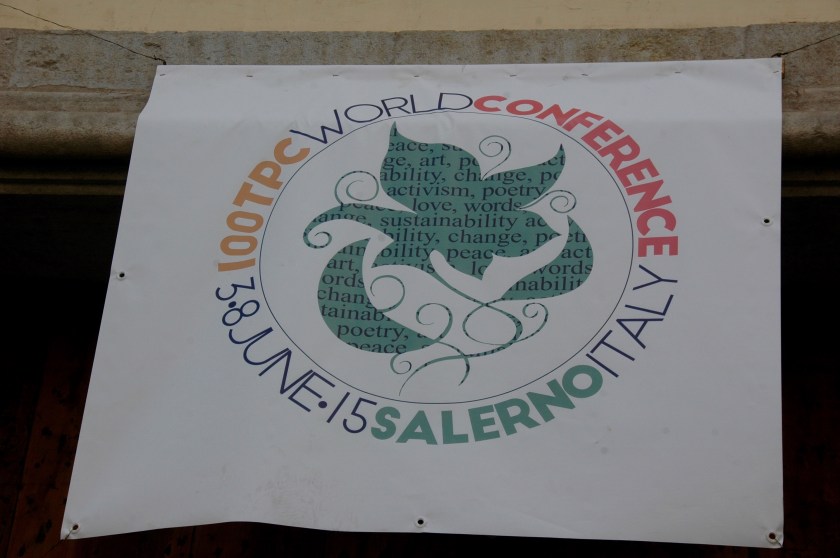
The organization has over the years focused on three general areas globally: Peace, Sustainability, and Social Justice. Around the world, organizers and groups focus on these issues as they fit in local contexts plus other local issues that require attention to bring about positive change. In 2015, Michael and Terri worked with 100TPC organizers in Italy to put together the first 100TPC World Conference in Salerno, Italy.
100TPC World Conference Banner
Save the Date for this Year!
We will hold our annual online 100TPC at The BeZine again this year, on the “official” date for 100TPC: 26 September, 2020. So, save that date! In addition, we will be co-sponsoring All Africa Poetry Symposium in Celebration of 100 Thousand Poets for Change 10-Year Anniversary at 8 AM US East Coast, early afternoon in the Africa time zones. Read more here (including times in Africa). With this new mix of live-stream poetry, we hope to provide an exciting 100TPC virtual BeZine event. We plan to live-stream in The BeZine Facebook groups and on YouTube…stay tuned for more information.
Ultimately, talking points preserve narratives seeking to keep the status quo or create a reality that aligns with the person’s ideology or personal needs.
We want to start this introduction to the SustainABILITY issue of The BeZine with a pause and breath.
Go ahead, breathe in deeply. This is both calming and symbolic of the interrelated crises of humanity at this time.
Three huge, potentially shattering issues loom large today, what commentator Elizabeth Sawin, Co-Director of the nonprofit Climate Interactive calls “three massive threats”:
Climate Change, COVID-19, Racism a sustainABILITY pastiche
Climate Change
Climate change concerns the atmosphere and excessive carbon.
Breathe in again, deeply. Breathe out.
That exhalation, as you probably know, is CO2, carbon dioxide. We breathe the atmosphere.
And, as we pollute it, we poison our own breaths through industry, fossil fuels, factory farming, and other human activity. We poison the globe. And as climate change continues its charge ahead in leaps and bounds, it will be increasingly difficult for us to breathe, literally.
Climate Change hits much more than White areas in what Hop Hopkins (“Racism is Killing the Planet,” Sierra Club) calls the “Sacrifice Zones,” where White Supremacy’s “Disposable People” live. The 1% remain more secure and protected.
Have you tried to breathe when the temperatures go above body temperature (37C / 98.6F)? Imagine what it must be like for those locations that have had recent record-breaking temperatures of around 50C / 122F?
Where do you think waste is dumped? Where are polluting industries and power plants built? Who lives in areas that risk their health the most? Certainly not those with money, status, and power in societies.
How long can we continue this way? Are we able to find a path to sustain life on earth (human and otherwise)? That is the goal—sustainABILITY.
According to a 2015 study published in PNAS, a 30,000 year old virus was found in the permafrost of the Arctic, raising concern that rising temperatures could lead to the rise of deadly, archaic illnesses. —cited in Science Alert (Melting Glaciers Are Revealing Dead Bodies And Ancient Diseases, 23 March 2019).
The economic problems will compel those in power to take actions that before this crisis appeared to be radically leftist measures. Even conservatives are having to do things that run against their principles. —Slavoj Zizek (Slavoj Zizek’s ‘Brutal, Dark’ Formula for Saving the World, Haaretz interview, 04 June 2020)
Higher temperatures and respiratory problems are also linked. One reason is because higher temperatures contribute to the build-up of harmful air pollutants. —U.S. CDC and American Public Health Association (Extreme Heat Can Affect our Health)
COVID-19
COVID-19 blocks our lungs. It literally stops us from breathing. Yes, also organ damage, including heart problems. But it stops our breath, in a world-wide pandemic. Like the global crisis of climate change will, eventually, stop our breath.
There will be more pandemics with continued Global Warming. There will be more disruption, economic loss, social unrest, and all of the things we have seen so far in this pandemic.
Will we avoid the next pandemic? Could a 30,000 year-old virus, or a 150 year-old virus revive to attack? If so, who will have our back? The government?
How will we be able to sustain human and other life on earth if we continue on this path? Will we build a sustainABLE future for our children, our grandchildren? Ourselves?
In the US, even the current CDC admits that COVID-19 has hit POC and Indigenous Peoples, especially African Americans, harder than White people. The 1% remain more secure and protected.
From Pandemic to Race
The effects of COVID-19 on the health of racial and ethnic minority groups is still emerging; however, current data suggest a disproportionate burden of illness and death among racial and ethnic minority groups. —US CDC (COVID-19 in Racial and Ethnic Minority Groups page last reviewed on by CDC June 4 2020)
Robert D. Bullard is a professor at Texas Southern University who has written for more than 30 years about the need to redress environmental racism. He welcomed the statements of support this week from the leaders of big environmental groups but he lamented that the vast amount of donor money still goes to white-led environmental groups.
“I’d like to see these groups start to embrace this whole concept of justice, fairness and equity,” he said. “Those statements need to be followed up with a concerted effort to address the underlying conditions that make for despair.” —(Black Environmentalists Talk About Climate and Anti-Racism, NYTimes, June 2, 2020)
It’s essential to have anti-racism baked into the goals that even white-led organizations are pursuing because both political racism and environmental racism are drivers of our excess pollution and climate denialism. —Heather McGhee, senior fellow at Demos, a nonpartisan research and advocacy group, and the author of a forthcoming book called The Sum of Us: What Racism Costs Everyone and How We Can Prosper Together (cited in Black Environmentalists Talk About Climate and Anti-Racism, NYTimes, June 2, 2020)
Police violence is an aspect of a broader pattern of structural violence, which the climate crisis is a manifestation of. Healing structural violence is actually in the best interest of all human beings. —Sam Grant, executive director of MN350.org, the Minnesota affiliate of the international climate activist group 350.org (cited in Black Environmentalists Talk About Climate and Anti-Racism, NYTimes, June 2, 2020)
Anti-Racism
Racism has come to the fore with the anti-racist, anti-police-brutality protests and riots since the murder of George Floyd in Minneapolis. His quoted last words, echoing those of Eric Garner (murdered by police in New York City six years ago): “I can’t breathe.” Protest signs and chants have repeated this phrase thousands of times since last month.
George Floyd, a Black man suspected of passing a counterfeit $20, was strangled by a police officer kneeling on his neck for nearly 9 minutes. Eric Garner, a Black man selling loose cigarettes, was strangled by police using a “choke hold.” The 1% remain totally secure and protected.
Structural, systemic racism is an integral part of our extraction economy, according to Hop Hopkins, writing for The Sierra Club. It keeps those in power in power by dividing us against each other—so that the 1% (or 3% or 5% or 10%) can keep in power and grow their wealth. It is built into not only the U.S, but Western Society.
Hopkins writes:
Devaluing Black and Indigenous people’s lives to build wealth for white communities isn’t new. White settlers began that project in the 15th century, when they arrived in North America. Most Native peoples of North America lived in regenerative relationships with the land; they were careful to take no more than the land could sustain. The settlers had another ethic: They sought to dominate and control. —Hop Hopkins (Sierra Club, Racism is Killing the Planet, June 8, 2020)
From “Three Massive Threats” to SustainABILITY
One of the most baffling things throughout the coronavirus pandemic is that even with a life-threatening global pandemic, sides emerged. At the beginning of the pandemic, I remember thinking that this threat to humanity would unify us and strengthen public trust in science. Boy was I wrong. The economic realities of the pandemic, cries of “just the flu”, and protests against social distancing policies tell a different and complex story.—Marshall Shepherd (3 Common Things In Race, Coronavirus And Climate Change Debates, Forbes, June 12 2020)
I wish I had all the answers, but I don’t. The answer is for all of us to figure out together.
All I know is that if climate change and environmental injustice are the result of a society that values some lives and not others, then none of us are safe from pollution until all of us are safe from pollution. Dirty air doesn’t stop at the county line, and carbon pollution doesn’t respect national borders. As long as we keep letting the polluters sacrifice Black and brown communities, we can’t protect our shared global climate. —Hop Hopkins (Sierra Club, Racism is Killing the Planet, June 8, 2020)
Today we face threemassive threats, and the only way to neutralize any one of them is to succeed at addressing all three at once.…
…we must as soon as possible – in our cities, states and nations – convene emergency task forces to tackle equity, the pandemic and climate change as an integrated whole.
These task forces will need expertise in climate, clean energy, equity, public health, epidemiology and people-centered economics. Each task force should include an additional kind of expertise: the life experience of those who are most impacted by inequity, climate change and COVID-19. Those who live with the impacts of multiple problems often have the most creative ideas about addressing them.
Time and money are in short supply. There isn’t enough of either to treat equity, climate change and the current pandemic as separate issues. A holistic, multisolving approach is an effective, cost-saving way to tackle the great challenges of our times. —Elizabeth Sawin (US News & World Report, Commentary, Why We Can’t Ignore the Link Between COVID-19, Climate Change and Inequity, April 1, 2020)
The June Theme of The BeZine: SustainABILITY
We can’t wait. The time to act is now.
We may want to say, “God save us.” But we have free will, so it is up to us to move forward and make the change, so that we are ABLE to sustain the earth.
Then, perhaps 100% of humans (and other life) would be more secure and protected.
—Michael Dickel, Co-Managing Editor
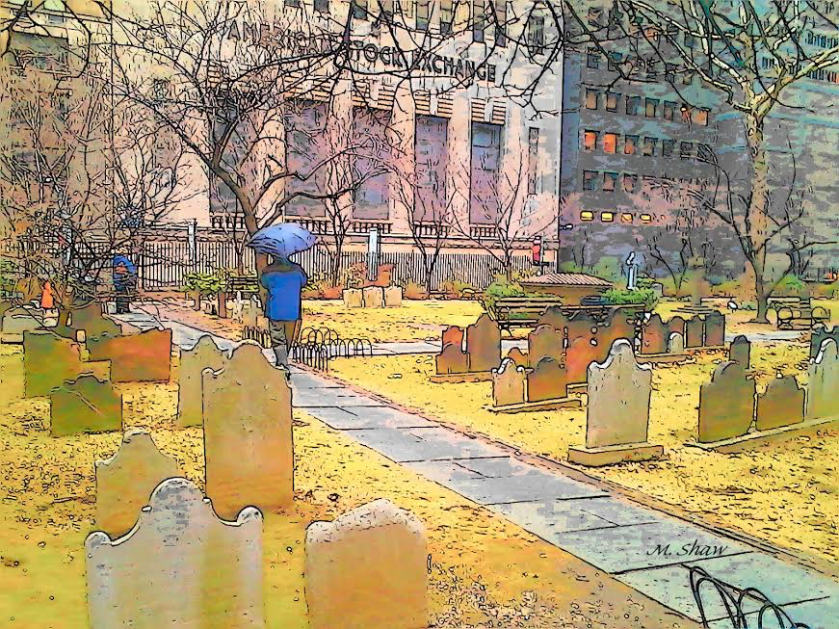
Much thanks to Michael Dickel for stunning and exhaustive editorial collaboration and technical innovations on this issue, to the whole of the Zine team for stalwart efforts and supports, to our readers and supporters who share our peaceable values, and to Margaret Shaw for the wonderful header-art gracing this edition of the Zine.
In the spirit of love (respect) and community and on behalf of The Bardo Group Beguines,
—Jamie Dedes, Founding Editor and Co-Managing Editor
Given the scope and magnitude of this sudden crisis [the COVID-19 pandemic], and the long shadow it will cast, can the world afford to pay attention to climate change and the broader sustainability agenda at this time? Our firm belief is that we simply cannot afford to do otherwise. —
“Earth care, as it turns out, is really about self-care and other-care. What we design today impacts how we live tomorrow. For better or for worse, it impacts far into upcoming generations.”
“All the human and animal manure which the world wastes, if returned to the land, instead of being thrown into the sea, would suffice to nourish the world.”
“The main thing, Ruby said, was not to get ahead of yourself. Go at a rhythm that could be sustained on and on. Do just as much as you could do and still be able to get up and do again tomorrow. No more, and no less.”
“In the end, the term ‘circularity’ may just be one way to make us aware that we need a more encompassing, integrated and restorative sustainability path that includes people as much as technology and nature.”
“..despite myriad differences in beliefs and value systems, people have the capacity to acknowledge that the one constant across the board is the Earth. Her health is our health. Her life is our life.”
We need to stop thinking through a capitalist prism. I don’t agree with those who claim that now is no time for politics, that we should just mobilize to survive these dangers. No! Now is a great time for politics, because the world in its current form is disappearing. Scientists will just tell us, ‘If you want to play it safe, keep this level of quarantine,’ or whatever. But we have a political decision to make, and we are offered different options.
There is a country that has a dream.
The dream has no walls and has no gates.
It has no roof and it has no floor.
The dream stretches wide
From sea to shining sea,
From craggy peaks to sculptured valleys,
From fecund farmland to bustling cities,
And from scorched salt flats
To moon, sun, and far beyond.
The dream is made of dreams
Of every woman, man, and child,
Not a single dream one tells around a star-strewn fire
But a glorious cacophony of every voice
Of every dreamer who ever dreamed a better life
Than the one he left behind, for we are all immigrants,
Even those who crossed the icy straits.
There will always be some who came before
And some who’ll came after
As long as the dream is big enough
For dreamers to dream.
We came from England, Scotland, Ireland
Starving, sick and dying,
Swimming or floating unconscious like flotsam
On the thunderous seas
Picked up, dried and warmed
By red-skinned heathens
Who welcomed us to their meager meals.
We would walk tall, heads held high,
Breathing the mountain-fresh air of freedom
And tilling the new promised land of equality
For anyone willing to work for it.

We came from Germany, France, and Italy
With our trunks and valises, sacks
And handkerchiefs tied on a stick.
Friends and relatives from the new world
Sent us letters about the mountain-fresh air of freedom,
Promises of new lands for tilling
Enough for anyone with a strong back
And a will to work.

We came from China and Japan,
Jews from Russia and Poland
With their ragged overcoats and sad eyes,
Many turned away at Ellis Island
Back to pogroms from which they thought to escape
To America the beautiful,
The land of the free and the brave
With a statue welcoming the tired and the poor
Yearning to be free.
Some were allowed to enter the promised land,
The not-so-tired and not-so-poor
With enough money to be free.

We came from Mexico, Honduras, the Dominican Republic,
We came from Lebanon, Algeria, Syria, Iran, Iraq,
From Sudan, from Ethiopia, and from New Guinea,
To escape the murders, the drugs, the poverty,
The criminals, the police, and dictators
To pick the grapes, to harvest the crops,
To send back home whatever dollars we could,
So maybe our children could have a small piece of the dream,
The dream of a better life than the one we left.

We came from England, Scotland, Ireland,
We came from Germany, France, and Italy,
We came from China and Japan,
Jews from Russia and Poland,
We came from Mexico, Honduras, the Dominican Republic,
We came from Lebanon, Algeria, Syria, Iran, Iraq,
From Sudan, from Ethiopia, and from New Guinea,
We would walk tall, heads held high,
Breathing the mountain-fresh air of freedom
And tilling the new promised land of equality
For anyone willing to work for it.
To America the beautiful,
The land of the free and the brave
With a statue welcoming the tired and the poor
Yearning to be free.
So maybe our children could have a small piece of the dream,
The dream of a better life than the one we left.
What have they done to you, my lovely, my brave?
What have they done?
What have they done?
They’ve shot you, they’ve hung you,
They’ve burned you, they’ve flung you
Back into the drowning seas
And heartless deserts.
They’ve poked out your eyes,
They’ve poured lead in your ears,
So you can’t see or hear
The difference ‘tween wrong and right.

What have they done to you, my lovely brave country?
What have they done?
What have they done?
They’ve turned their backs on hope
And outlawed extending a helping hand,
Dividing us against each other,
Turning neighbors against neighbors.
They’ve told us the opinions of fools
Are as good as those of wise men.
The criminals lord over us,
Passing unjust laws and voiding rightful ones.

What have they done to you, my lovely brave world?
What have they done?
What have they done?
They’ve told us the earth is so big
We can take what we want without giving any back.
They’ve poisoned our oceans, rivers, and lakes,
They’ve cut down the trees we need to breathe
To make superhighways to death,
They’ve killed all the flowers and bees,
The fish in the seas,
They’ve suffocated the skies with Satan’s breath.
What have they done to you,
What have they done?
February 8, 2020
Mike Stone was born in Columbus Ohio, USA, in 1947. He lived in San Diego and Chicago. Mike played clarinet and saxophone in his high school marching band, dance band, and concert band. He also composed music. He started out with a Fine Arts major but then graduated from Ohio State University with a BA in Psychology. He served in both the US Army (stationed in Germany) and the Israeli Defense Forces. Mike has traveled throughout Europe and to several Arab countries.
Mike has been writing poetry since he was a student at OSU. He has published four books of poetry (The Uncollected Works, Yet another Book of Poetry, Bemused, and Call of the Whippoorwill), a book of essays, and four science fiction novels (The Tin Man, The Rats and the Saps, Whirlpool, and Out of Time). Mike is currently working on his fifth book of poetry (The Hoopoe’s Call) and a fifth science fiction novel (H4N5-2080). He supported his writing habit by working as a computer programmer, specializing in information security.
Mike speaks English and Hebrew, as well as a smattering of Spanish, German, Russian, and a bit of Arabic. He also speaks several computer languages fluently. Now he is retired. Mike moved to Israel in 1978 and lives in Raanana. He is married and has three sons and seven precious grandchildren.
Check out his blog. You can read his latest poetry, short stories, and essays, while they are works in progress. Mike also has an Amazon author’s page.
IRMA DO (I Do Run, And I do a few other things too . . . ) is a writer, runner, and raiser (of children not plants or animals). She is an avid anti-racist, anti-pollutionist, and anti-antipathist. Her poetry and other writings, can be found on her blog.
I put on my body armour of black rubber
the absurd flippers, the grave and awkward mask.
The salt is on the briar rose. The sea howl and
the sea yelp are different voices. I go down
an innocent ladder. Where is there an end
to the drifting wreckage the silent withering
of autumn flowers dropping
their petals and remaining motionless?
First having read the book of myths
I come to see the damage we’ve done
trying to unweave, unwind, unravel.
Yes, we believed that the oceans were endless
surging with whales, serpents and mermaids
there is no end but addition the trailing
prayer of the bone on the beach where we heard
consequences of further days and hours
demon-haunted and full of sweet voices
while emotion took to itself the emotionless
years of living among the breakage
to lure us over the edge of the world. We were
conquerors, pirates, explorers, vagabonds;
years of living among the breakage, war-makers,
sea-rovers, we ploughed what was believed in
as the most reliable, made maps that led others
to the sea’s harvest and therefore were the fittest
for renunciation and sometimes we heard dolphins
whistling, older than the time of chronometers.
Where is the end of them, the fishermen sailing
into the wind’s tail, where the fog cowers?
We cannot think of a time that is ocean-less.
The catch was good and the oceans endless
for a haul that will not bear examination.
Where is there an end of it, the voiceless wailing
the backward look behind the assurance
towards the primitive terror?
1 Helen Dunmore, Dolphins Whistling: T. S. Eliot, Four Quartets: Adrienne Rich, Diving into the Wreck.
Like our manic thoughts, she opines while pointing
to the exquisite whiteness of a swan on the lake.
How its feet are scrabbling under the water as it glides
serenely. As we walk further round the lake
a submerged swan twenty times bigger
hoves into view, its wooden neck two feet above the water.
One black-headed gull perches on its hull swivelling
its winter-white head and stretching alternate wings.
Later in the park café she tells us she’s knitting mittens
for the koalas burnt in Australia’s fires but she thinks
we’ll all be incinerated eventually. She talks with a twinkle
in her eye about the death of flying foxes who can’t fly
fast enough. Maybe she’ll knit joey pouches or bat wraps
next if she has time. She sips her hot cappuccino and tells us
about the melting cameras set up to capture
the regent honeyeater’s nesting habits.
Her smile’s disarming as she hands round the biscuits.
LINDA E. CHOWN grew up in Berkeley, Ca. in the days of action. Civil Rights arrests at Sheraton Palace and Auto Row. BA UC Berkeley Intellectual History; MA Creative Writing SFSU; PHd Comparative Literature University of Washington. Four books of poetry. Many poems published on line at Numero Cinq, Empty Mirror, The Bezine, Dura, Poet Head and others. Many articles on Oliver Sachs, Doris Lessing, Virginia Woolf, and many others. Twenty years in Spain with friends who lived through the worst of Franco. I was in Spain (Granada, Conil and Cádiz) during Franco’s rule, there the day of his death when people took to the streets in celebration. Interviewed nine major Spanish Women Novelists, including Ana María Matute and Carmen Laforet and Carmen Martín Gaite. Linda’s Amazon Page is HERE.
Puzzles of fire solved by the ashes
while water wonders- how a piece of glass smashes
the rock beneath the starfishes: embraced
Upon the reddened shore lost-footsteps traced
Our memories do we need to remember,
if from the heart all ache we dismember?
“Before Hail Melts Away”
We need to use the rain water before hail melts away
Hours we have to count before the end of the day
But how can we save the light after the dark
When flickers of flame fade in a moment’s spark?
MUNIA KHAN was born on a spring night of 15th March in the year 1981. She enjoys her journey to the literary world. Most of her works are poems of different genres, short stories and articles. She is the author of four poetry collections and one non-fiction inspirational book : ‘Beyond The Vernal Mind’ (Published from USA, 2012), ‘To Evince The Blue’ (Published from USA, 2014), ‘Versified’ (Published from Tel Aviv, Israel, 2016) and ‘Fireclay’ ( Published from USA, 2020) and ‘Attainable’ ( USA, 2 June, 2020) Her poetry is the reflection of her own life experience. Her works have been translated into various languages: Japanese, Romanian, Urdu,Italian, Dutch, Croatian, Spanish, Portuguese,Russian, Albanian, Finnish, Greek, Indonesian, Hindi, Turkish, Arabic, Bengali and in Irish language. Her poetry has been published in several anthologies, literary journals, magazines and in newspapers.
The veggie lady
grows ingredients in a garden
in a part of the heartland where the peckish
primarily crave pork and poultry
over pea protein and spirulina.
The veggie lady
sells her “social distancing snacks” out of
a sliding window on a multicolored bus,
brightening an otherwise empty parking lot
on eerily dreary spring afternoons
while suggesting singing Partridges
during the days of the plague.
As the Pied Piper of
plant-based well-being,
the veggie lady
encourages concerned consumers to locate
her vehicle and discover the pleasurable
treasure of sustainable sustenance never
blood-splashed
inside an abattoir,
perpetually promoting
the peaceful,
the perennial and
the renewable
in a way that's
as whimsical as it is
realistic.



 The BeZine
 The BeZine