When I think back upon those days,
I remember only one textbook
the nuns parceled out to us, their
semi-sentient little lumps of clay.
The catechism’s soft covers of sky blue
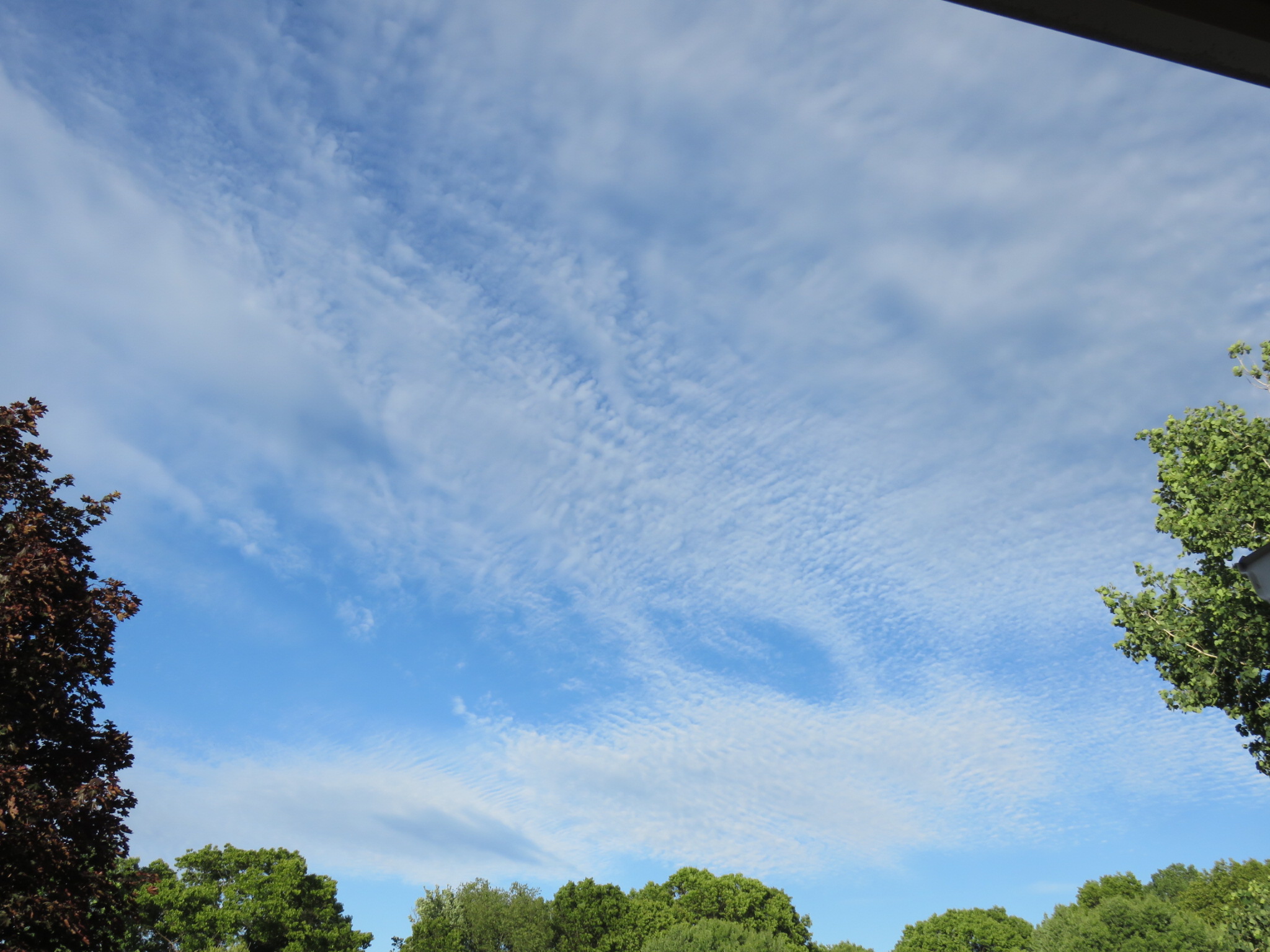
and white reminded me of a sky full
of wispy clouds half-hiding my view of heaven.
Mom already dug the foundation of her child’s
certainty that the Hereafter nestled
behind that star-strewn real estate
above that some called The Firmament.
But black-habited virgins swinging rulers,
sticky gold stars and glow-in-the-dark
rosaries required to teach me
the necessary tenets for gaining admittance
into that divine eternal housing project
only brought blink-inducing pain and
phosphorescent bling. The same as if
I devoured all the Sugar Smacks to get to
the prize at the bottom of the box.
So my faith stood built upon those
flurried clouds, apparitions of such
small substance that persistent breezes
whispering gossip about Fathers X and Y
and one of my fellow acolytes blew
enough doubt to topple it. They tore
from me my willing but rickety belief
in the unbelievable as easily as an
abused and angry boy could rip those soft
cerulean covers from their holy rule book.
When I was asked to write a poem on the subject of Faith, I don’t think this is what they had in mind. I’d like to believe in something bigger than I, in earning the fabulous prizes available for one who lives a good life, a life of treating others as he would want to be treated. But so many of the men who served as the arbiters of the rules of the road to that Better Place, men I knew personally, carried souls within as black as the outfits they wore without. I still lead that good life as best I can, because it’s the right thing and…well, just in case. But that’s Hope, the surviving little brother of a Faith I fear shaken to its foundations, apparently built upon sand.
In fifth grade
my father’s secrets
start to breed under my red
confirmation dress—
dig deep in the tunnel of my inner
ear, cling to sentry hairs
on the nape of my neck—
his secrets: black bodies,
glassy eyes, squeeze
beneath my fingernails—
quiet as eggs;
they spin a red thread
that cuts me inside
out.
Over Exposed, the memoir of Terri Muuss, is at once painful and triumphant. It is an examined life that exposes the family of her childhood, the obscenities imposed on her by her father, her numbing with alcohol and drugs and her journey in therapy. All of this and yet she arrives victorious and accomplished with a healthy marriage, healthy sons and a multifaceted career, elements of which reach a hand out to those in trauma.
This is the story of how a child survived and became a woman who found herself and a writer who found her voice. The experiences of a lifetime form a collection of poems and prose vignettes that bespeak the possibilities of redemption and hold out hope and affirmation to those others whose childhoods have left them wounded. I recommend this book to everyone but, most especially, to those who have a history like Terri’s.
Lately, I feel a bull’s eye on me: on the street, the A train, in the fruit market. Men infect me with words, with smiles. Eyes snatch at breasts, tongues pin me to subway walls, mouths like a cold speculum pry open my inner ear. Their words pound, pound me, a worn head of drum. Voices divide and conquer, dividing me from myself—
Emotionally it was not the easiest book to read. I often found myself in tears.It is rewarding though, not only because its subject remains unbeaten but because the writing, pacing and organization have you moving through the pages anxious to gobble up each poem, each story, every nuance. Terri’s switches from child-voice to adult are smooth, her imagery clear and moving, her poetry well-crafted.
INTERVIEW
JAMIE: Am I right that your first love was acting? If so, how did you transition – or what inspired – the addition of poetry to your artistic repertoire?
TERRI: Yes, acting, theatre and directing have always been my first loves. I came to acting quite young and naturally. It will always be a huge part of who I am and how I see art in a larger sense. Much of my poetry is born out of a theatricality I possess from being onstage these many years.
That being said, poetry was always sort of waiting in the wings for me. When I was in 10th grade, my best friend Leslie was a beautiful person and poet who I admired greatly. I spent long days at her house after school as I had no inclination to go home to my own dysfunctional house. There, she read and wrote poetry in front of me and it certainly inspired me to use it as an avenue for expression. Later, during senior year, I had a teacher hand me a packet of poems by e.e. cummings, T.S. Eliot, Emily Dickinson and Langston Hughes that she thought I would enjoy. That packet sent me on a journey of reading as many poets as I could. Still, poetry was off to the side while theater took center stage.
It really wasn’t until I was faced with the trauma of my past and of putting myself together that writing became both a therapeutic tool and an artistic passion. To better understand the trauma of being sexually abused as a child, I wrote and wrote and wrote. Mostly poetry but also monologues. At the end, what I’d constructed was a one-woman show skeleton that became Anatomy of a Doll. I performed the show throughout New York City and then the country at conferences and in theaters. Even then, I didn’t identify myself as a writer. I thought of myself as a performer who just happened to use my writing as a script. When Veronica Golos (my friend, mentor and a gorgeous poet who’s won numerous awards) began taking an interest in my work and started editing it in a poetry workshop she led out of her house on the Upper West Side, I started to see myself in the context of being a poet and poetry as a vocation. I think the form of poetry works well to showcase the dissociation that comes with abuse much more than prose does. Veronica is still my editor, having worked on both Anatomy of a Doll and my book, Over Exposed.
But the biggest transition from actor to writer happened during my marriage to poet Matt Pasca. He’s always seen me as a writer and, before I even claimed that identity for myself, always pushed me to go deeper, to write more, to get better, to submit my work. Through our marriage I have grown as a writer and came to see myself as a poet.
JAMIE:It is one thing to write about painful events in life and another to share them publicly. I think you are something of a hero for doing so. Where does this core of courage come from? What is the reaction from friends and relatives?
TERRI: This is a very interesting question that I get often–the question of the courage it takes to reveal my past. Many people have said they’ve seen me as courageous because I share the truth of my childhood sexual abuse, subsequent rapes, addiction and my recovery quite publicly. I have to acknowledge that this is the way it is perceived by other people. For me, however, it’s born out of necessity and so it’s never felt or seemed like courage. I have lived my life according to the 12-step saying, “You’re only as sick as your secrets.” I know that what I keep inside me, what I feel shame about, what I try to hide, will destroy me from the inside. Giving a voice to my pain and shame and grief and mistakes gives me back my power, my joy and my life.
I’ve also grown to see that if I’m hiding the fact that I was sexually abused, I am sending myself and others the message that it was somehow my fault or that there’s something for me to be ashamed of. I’ve come to understand that what happened to me was not anything that I should be ashamed of. I was the victim so why should I be ashamed. I’ve also come to understand that the sexual abuse and the rape and the violence are a part of me but they are not the entirety of me.
Lastly, if I can help someone (with my story) to recover, let go of their shame, and move into survivorhood, then it is all more than worth it. As social worker and researcher Brene Brown states, “If you put shame in a petri dish, it needs three ingredients to grow exponentially: secrecy, silence, and judgment. If you put the same amount of shame in the petri dish and douse it with empathy, it can’t survive.” I choose let go of secrecy and to douse my shame with empathy, and empathy for the world must begin with me.
Friends and relatives have been overwhelmingly supportive, although for some of them, it took a period of adjustment and listening that gave birth to deeper understanding. I surround myself with people who are willing to be empathetic, courageous, vulnerable, and honest with both me and themselves. I consider myself very lucky to have a wide circle of supportive people in my life.
JAMIE:With two parents who are poets, do your children like poetry? Have they started writing themselves? Have they read your poetry?
TERRI: Great question! Yes! We have two boys, Rainer, 10, and Atticus, 7, and they have both had poems published. Rainer is by far the more prolific writer who really loves writing and poetry. Atticus is a drummer who dabbles in writing. They both had poems published in Skipping Stones, a journal for children ages 7-14. Rainer has also been published in Stone Soup, The Louisville Review (when he was 4), and the anthology, Holiday Word Gifts (JB Stillwater, 2011). Some of the things that Rainer writes take my breath away. It’s proof positive that as artists we are always trying to get back to that place where we were as children– where we can take risks and be playful and not worry about being judged.
JAMIE:You seem to have a gift for building a poetry community. What advice do you have for readers who might be trying to do the same?
TERRI: I’m a licensed social worker and the macro version of social work is community organizing. The first rule of community organizing is to listen to the community. Too often, people come into a community with their own expectations and demands. They try to foist onto a community what they want to see the community have. If you’re really trying to build community, through the arts or otherwise, ask questions and be willing to hear the answers. The community might not want the same things you want for them but if community is your ultimate goal, you need to let its members be your guide. Too often in the poetry community, as in other communities, people set up an event that mirrors the kind of poetry THEY want but disregard what the community is really is looking for. Finding the right venue, format and publicity are integral to success.
I would also add that it’s so important to have collaborators in any community venture. Without them, burnout is a real factor. You need to be able to share the workload, bounce ideas off of each other, and laugh together to elevate stress and keep it going!
JAMIE:You put together a lovely trailer for “Over Exposed.” How long did it take to put it together and what kind of tools did you use. Have you found it helpful in getting the word out.
TERRI: Dana Maddox did my trailer. She’s a brilliant filmmaker studying in LA right now. I came in contact with her through the mother of someone I directed in a show. We did the voiceover elements in the studio first and then she came to shoot the video at my house. It took about 10 hours of shooting and about two weeks of intense editing for her to put together the trailer. It’s not something that I could have done alone. Many people have that skill set but that’s not my wheelhouse. I can direct videos but editing is a different thing. She did an amazing job and I’m very proud of it. It certainly helps get the word out about my book. I think social media and online platforms always help books.
JAMIE: So you have to my knowledge three books out: one on poetry as therapy, the recently published anthology, and “Over Exposed.” What’s next on the agenda?
TERRI: I have two books out currently. Over Exposed is my memoir, told in both poetry and prose. Grabbing the Apple is an anthology of New York women poets that I coedited with M.J. Tenerelli. The other group you mentioned here is the Poets of Well-being (Susan Dingle, Maggie Bloomfield, Nina Yavel and I). We are all social worker-writers who are in long term recovery (we have over 100 years of sobriety between us). I was the last member to join the group and so their chapbook does not include my work. It’s absolutely worth checking out. You can find the group on Facebook. As a group, we travel to conferences and venues to showcase how writing can be a therapeutic tool for helping others overcome addiction and abuse. We facilitated a workshop at AWP in Minnesota, at the Expressive Therapies Conference in NYC and were even invited to the 2016 NASW conference in DC. Susan runs a beautiful poetry event called “Poetry Street” out in Riverhead that is a fine example of great community organizing and art as a healing method.
*****
A tidbit on the light side and apropos upcoming elections in the U.S.: Atticus and Rainer Muuss on Ellen and at The White House with the First Lady.
Above taxi queues, red velvet
loops and black CB’s—The Metropolitan:
second floor, Manhattan, bamboo and pooled
trickling, tiered eaves of a Ming
pagoda, home to winged moonlight
and Suzhou scholars lifted by heaven’s
blue arms, as when breeze and constellation
rock us to summer sleep—calling us
to dream of gardens and streams,
pain and peace though we are
Western men: Compete!
Achieve! Consume! Turn away
from Shiva’s fiery dance,
His serpent hair, His palm
that says: Do not be afraid.
Turn away from Buddha folded
in our sun-warmed core,
whispering: Detach.
Facades of camphor
and gingko welcome
us from centuries spent
answering a shrill, misguided bell.
Listen: to the drip of melting ice,
the bullfrog at water’s edge,
crickets in the hot night,
the lowing of mottled cows,
the swish of maple leaves,
the silence of the stones.
Listen to your own ancient
drum, thumping its way
towards infinity.
When hearts swell or crack
there are no words—
words are not
life, but keep us alive
when we are not living.
Why is it
we speak so much?
I have never looked at a cricket
without knowing it was a cricket,
yet the experience is not cricket.
Without words we see
lichen, jetties, the cold glare
in city windows; we mend
rips and tears; we hear
the concert of sparrows; we
finger the rim of beauty.
You and I might meet and sway
like two branches in
a breeze, our skins
completing each other’s
landscape, only jagged
breath to puncture rhythm.
My eyes and fingers you may read,
and if you slow down and listen
you will hear yourself inside
of me, blowing like a hundred
leaves on a forest trail.
And if I move while you are not
looking do not ask why:
there are peat mounds and brambles
that will know where I have gone.
Smog accumulates loved ones
in our lungs, blackening air laced
with carcinogens yet—
when the sun from Montauk crests
the Whitestone Bridge—cirrus
catching plumes of sherbet gilt
lavender more dramatic
than museum paintings—
we see pain has made us
spectacular.
When joy breaks
like the purling rills of spring,
laughter spiraling through tiny windows,
a dolphin slapping its cold blue back
against the sea;
When joy breaks
and spins free the spigots of my mind,
I want to stay awake for the rest
of my life—
Seeking glad conspiracies
of atoms,
the wax seal
of God’s greatest love note:
each breath
a yearning,
each day
a crown of elms,
each story
a breeze soothing our lonesome crags,
each sorrow
a luminous jolt of flight.
And when it’s all over
I hope to say:
This life made of me a lantern,
a whitish beacon of matter
staining the sky
long after my cells
had scattered.
There is no fixed truth
in this moment—only the hollow
clank of knowing between
your ribs, the ticking
clock, the bomb in your
stomach. Grasp the cold
shovel. In absence, the heart
breathes; the lungs beat.
teach us to be kind
to the shadows
dragging behind us
the half-blind woman
stops the other half-blind woman
tells her
about those bad numbers
creeping under her door
about how they besiege
her place
and grin from the shelves
how they snigger
behind her back –
the other woman
nods sympathetically
takes bread crumbs
out of her pocket
feeds imaginary pigeons
oh God
be good
be good to recycled angels
and to homeless warriors
be good to what is left of the day
and to the darkness to come
I’m moonless as tonight’s sky, helpless
as a rabbit’s blind and furless kits
and in my body’s cave misgivings hang
from the walls like folded wings. To combat
thumping pain and racing fear, I picture
a Matisse-red room with French windows,
potted palms and a half-naked woman
lounging on a sofa, then the yellow surprise
of the first drifts of daffodils trumpeting
spring to morose February this morning.
It doesn’t work and the silence is implacable
as the dark – I wish it purred like the cat settling
her warm self into the curve of my spine
to sleep but the black cat has long gone.
A tremble in the air – and there are my friends,
shadowy at first beyond my bed. Their outlines
slowly fill out with muted colours and now
they’re facing each other in two rows
as if for a formal dance. They reach out,
join hands across the divide. I gaze
at their arms which seem to form the ribs
of a boat, the kind ancient kings were buried in
but this is no death ship – it’s a hammock
they’ve made for me. The moment I lie down
it takes my body’s burden. No one speaks
but touch has its own language. I let go
of distress and feel such lightness of being
I could lift off into the blue like a damselfly.
excerpt from Myra Schneider’s twelfth poetry collection, Persephone in Finsbury Park, which was published last month by Second Light Publications and launched for Myra’s 80th birthday. It is available through p f poetry site.
It is lonely on cool tiles of my corruption
eye on domes of Rome, midday stretches
lethargic silence on ashes I burn
in the high sun on red rooftops basking in refuge
feathers from ashes, feathers short of a wing
to glide down like a raven to your chiral streets
there’s a congregation praying for my salvation
a choir singing the gospel, mirage on church steeples
I wring last drop of resolve in your mouth
and keep a river in my womb to wash my disillusionment
squatting to gut irony collected on your stairways
raw against my breastbone fishing-line stringed
putrescent promises familiar in flared nostrils
same as ancient prayers filtering through parched tourist lips
I will tell you again of pagan sins kneeling in confession
when you stop searching for the righteous woman
buried under four layers of leathered skin
you ask me if I want to pray with you for redemption
I ask you where do we go from here
where do we go not to converge in a dream
excerpt from Rumor and published here with the poet’s permission. Procedes from the sale of Rumor – both poets and publishers – go to the Syrian-Armenian Relief Fund. Three poems from Rumor have been nominated for the Pushcart Prize.
From early days you were the entrepreneur
hawking produce from the family fields
bartering in the playground to add
pennies to the communal pot.
You grew feasting on almonds, pomegranates
tomatoes warm with the sun – and on words;
devoured every book the small school possessed
began to gnaw at the professor’s stock.
Tanks, stones, missiles, murders marked your youth
then forced exile, the village and fields left behind;
more scraping for an existence but always
more reading, learning – you began to write.
Later your family seeped back across
the border; your childhood sweetheart
stayed, married and one dream slowly died.
You took an arranged bride.
*
With Saffariyya flattened you live your life
in Nazareth nearby and the village becomes
your myth, its stones, courtyards, people
the lodestone of all that you are.
Days full of duty, compromise, juggling, but
nights bathed in books, penning words.
Stories come first, of people and places; a past
you can’t lose, a present gripped with both hands.
Then an Eden of poems blossoms, a smelting
of bitter nuggets tempered with fragrance
of herbs, the chance laughter of a small child.
Its seeds spread wide, travel West.
At readings, the eloquence of your Arabic
needs no translation, nor the passion and feeling.
You handle the praise, pocket your glasses,
spread your broad hands on old knees
and mutter into your stubble
My happiness bears
no relation to happiness.
– Patricia Leighton, Bromsgrove, UK
[ Saffariyya was the birthplace of the Palestinian poet, Taha Muhammed Ali.
It was obliterated during the 1948 Arab-Israeli war. ]
It’s not that there’s never any good news, uplifting news; but we can’t escape the every day facts of violence. With each news report we are pummeled with visions of terrorism and hate crimes. As a measure of degree, the University of Maryland Global Terrorism Database reports 180,000 terrorism attacks from 1970 – 2015 inclusive. In other acts of violence, hate crimes hit us with the sharp rapidity of the rapid fire weapons used to inflict them. All over the world people of good conscience gather when and where they can to mourn with victims and families at candlelight vigils. In places of war and conflict where people cannot gather, they are left to hold vigil in the silence of the heart.
A vigil, from the Latin vigilia meaning wakefulness is a period of purposeful sleeplessness, an occasion for devotional watching or an observance.
But what exactly do we mean by vigil? A vigil is a SACRED kind of watchfulness, a call to be attentive and aware with devotion for the emotions that are sure to surge up within us— emotions of anger, even rage; emotions surrounding loss and shock; emotions steeped in frustration and fear. These emotions can convince us, if we are not careful, that rage justifies the kind of outrage that lashes out, repaying violence with violence, seeking a life for a life, an eye for an eye, the kind of rage that would turn the whole world into an unending whirl of violence and vengeance.
Inevitably, we must come to the question: “What WILL we do?” Because, now awakened, now alert, now vigilant…We know we are called to respond, to act, to engage in change that makes a difference.
Call it terrorism. Call it hate crime. It’s all of a piece. We find ourselves asking “what do we need to make sure we do not do?” How do we help those victimized by hate and honor the memory of those who were murdered by hate? How do we stand with those who are in compromised situations? How do we keep from falling into the pattern of hate ourselves? Given the size and complexity of the problems, how do we remain vigilant and not acquiesce back into silence, numbness, complacency?
Compassion and prayers must have feet. In cultures that continue to marginalize and stigmatize, how do we do more than pray? We know that a culture of violence creates an environment of numbness and distance and silent complicity, which can be and has been part of what perpetuates the continuance of the dominant culture. We have now heard enough shots to know that silence is inadequate to the task of countering a culture of violence. We must employ the power of love and peaceful engagement for we know that moments of silence and prayer are no longer enough. That they have never been enough…
We acknowledge that there are enormous theological differences and historical resentments that carve wedges among and within the traditions and ethnic or national groups, but we believe that ultimately self-preservation, common sense, and human solidarity will empower connections and collaboration and overcome division and disorder.”
In a world where our histories are marred by division and where social and economic inequity is rampant, where access to the tools of hate and war are easy and where it is easy to blame the “other” for the travesties of life, we must start with our faith organizations. Our faith organizations must stand consciously and firmly together to break down the divisions, to heal the histories, to move out of isolation and to honor the connectedness of all life. Joint grassroots efforts in our communities help to power the global movement toward peace and understanding, they harness the respect necessary to stop oppression. This is a way we most strongly affirm our faith in that Spirit that enlivens us all regardless of religion or creed.
– Rev. Ben Meyers, Minister, Unitarian Universalists of San Mateo in California
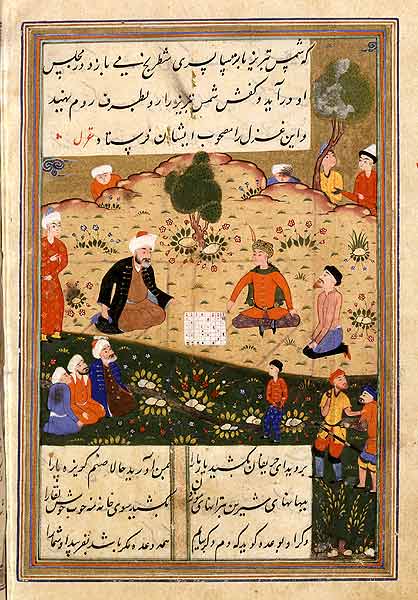
A page of a copy c. 1503 of the Diwan-e Shams-e Tabriz-i.
Bring all those who are led astray, out of the desert…
when Rumi was a refugee fleeing the Mongol armies
from Balkh to Istanbul and Konya
his Sufi dancing dervishes, music of the forbidden dohl drum
his poetry of kindness, was for every heart and every breath—
it worked for Islam like water, not a hammer
where the Sufi knows human weakness
and the unauthorised drum beats like a heart beats
his words offer an opening for kindness—
let us not worry so much about who we think we are—
if you are not the enemy, then we make the best of it.
in kindness Albert Einstein wrote to Marie Curie
with advice on how to handle haters,
Mark Twain wrote to Helen Keller, Frida Kahlo to Georgia O’Keeffe,
all allowing kindness, working like water—
when we hear the hate preachers where we should be hearing love,
we still have Rumi, the ultimate refugee
.
Rumi (1207-17 December 1273) 13th C Persian poet, Islamic scholar and theologian, Sufi mystic. Born in Balkh, Afghanistan, buried in Konya, Turkey. When the Mongols invaded Central Asia around 1215 the family set out in caravan migrating and moving all over the area now containing Baghdad, Damascus, Mecca and finally settled in Anatolia (now Turkey) in 1228.
.
Rumi, an ascetic, believed passionately in the use of music, poetry, and dance as a path for reaching God, the Divine, hence the whirling dervishes developed into a ritual form, to be of service to the whole of creation without discrimination in beliefs, races, classes and nations.
“The Conversion of St. Augustine” by Fra Angelico (born Guido di Pietro; c. 1395[2] – February 18, 1455)Faith. Why do we need faith in a period like this? We absolutely need certainties. Look around yourself and you will see a world devastated by war, with economies that shake our lives and value systems that are falling down because they are too old for this society. So what can I do, in front of this giant mess? Having faith in God (or in a god, or in something out from me) seems a sort of joke.
“I must rely only on myself” it’s what is saying the voice that comes into our ears every time we watch ourselves at the mirror. Ourselves and nothing else. And then we fall, obviously.
I would like to tell you a story about a man, that lived a long time ago and wrote a lot of books and essays about religion and faith, Christian faith and religion in particular but I don’t care about that point now.
He was born in a great city of the Northern Africa and he studied to become a lawyer. He got the job and, in a short period of time, he became the most important lawyer of the city. This means that he defended also people who were not so worthy of being acquitted, but he did not care about that because he was the most important lawyer of Hippo, he was well-paid. He was powerful.
Walking down the city he felt himself indestructible until he ran into a book, written by an author who died some time before him, who spoke about justice and life after death. After reading that book he understood that he needed something more than power: he needed faith.
So he started studying ancient texts from different religions, he left his work and he travelled a lot.
He became Manichaean for a period but he felt that it was not the right way, so he changed.He became Stoic but also that way did not fit with his need of truth, so he changed. When he became older, he finally found his way: Christianity.
This little fable is the real story of St. Augustine of Hippo, the first father of Christian Philosophy.
I wrote his story in a few lines because I think that he was exactly the kind of man able to understand what does it means a “living faith”.
In this periods of difficulties, in this periods of change, the only possibility we have to maintain ourselves spiritually alive is to living our faith, is searching the way to the truth without hurting the other people who are trying to follow our path.
So we need to put a rucksack on our backs to start a voyage that could also bring us in places that we dislike but we must face all the “demons” with courage and force.
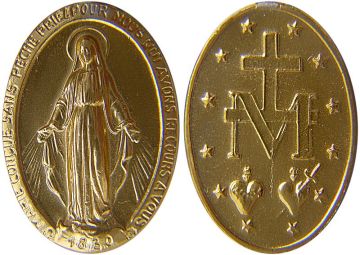
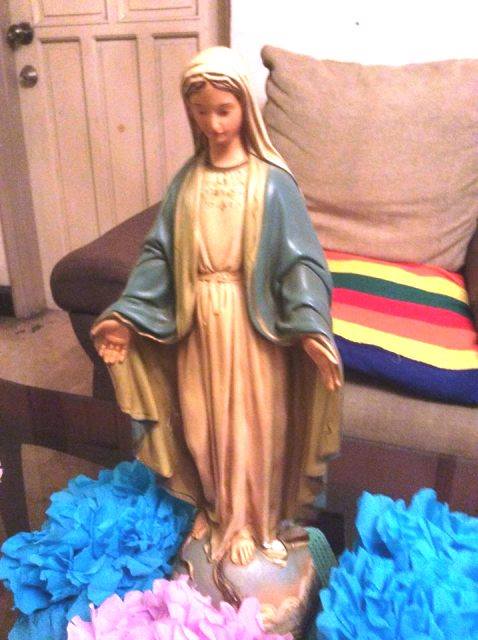
I was surprised when I opened the box of philosophy and theology books sent from a sweet woman who has made it her mission to fill our library. Inside was tucked away a good-sized statue of the Blessed Virgin Mary, that simple blue and white statue that stood in the corner of every American Catholic elementary and high school through the 40s, 50s, and 60s: Our Lady of the Miraculous Medal. While being the most common in the U.S, it’s not often seen elsewhere. I was suddenly sent reeling back in time to May Crownings and devotions of my youth. The statue was well-worn, old, and even a bit chipped; but I was touched by the kindness and generosity of the woman who wanted to share it with us. I put it on the shelf in the dining room.
Medal of the Immaculate Conception (aka Miraculous Medal), a medal created by Saint Catherine Labouré in response to a request from the Blessed Virgin Mary who allegedly appeared rue du Bac, Paris, in 1830. The message on the recto reads: “O Mary, conceived without sin, pray for us who have recourse to thee — 1830”.Our Lady of the Miraculous Medal
One evening while a visitor was with us, it was time for common prayer. We are a bit cramped in our rented house and don’t have a chapel. So a crucifix was set on the coffee table in the living room along with the image of Mary. We certainly don’t need either to pray but reminders are nice and can help keep you focused. Some of my Theology 131 students had made big colorful flowers as part of the decorations for our class “wedding celebration” and gave them to me at the end of class. I really wasn’t sure what to do with them, but when I took them out at home, the guys liked them and suggested they decorate the shelf in the living room. So the colorful tissue paper flowers also came out to bring joyful color to the room for prayer.
After evening prayer, the visitor said to me rather dryly, “You need a new statue of the Virgin Mary, that one is dirty. And it’s chipped.” I thought about that and realized it was precisely because it was a bit stained and chipped that I liked the image. I’ve never liked all those fancy statues and paintings of the Blessed Mother where she is dressed in great finery with jewels and a crown, not to mention all those angels and archangels playing harps and violins for her. I know they are to symbolize the result of her great faith, hope and love, but I’d always rather remember how she lived out those amazing gifts and graces here on earth. She reminds me who I am and who I should be.
Imagine a messenger of God dropping by and telling you you’ll have a child while remaining a virgin! Then add to it the fact you’re engaged and when your fiancé finds out, you risk being stoned to death by a self-righteous and indignant mob. Then you’ve got no time to be proud of yourself or even worry about yourself because you’ve got to make a long, difficult and dangerous journey into the mountain country to visit your old cousin who is also now pregnant. What ever happened to the normal days in Palestine? So you get married and have to go off to Bethlehem where you give birth, all sorts of weird things happen, then just when you’re trying to settle into some sense of normalcy, your husband suddenly tells you to pack up the house, you’re off to Egypt. Imagine what you feel when you hear that the babies of your friends, relatives, neighbors have been murdered by the army. The solidarity among mothers is a fierce force of the heart to be reckoned with. Then just when you finally begin to settle in, set up house, make new friends, your husband has another one of those bizarre dreams and says it’s time to pack everything up again. Nazareth, here you come. What humility, that after having Gabriel drop in on her, she had no problem trusting that when her husband shared his understanding of what God was telling them, she knew God was in touch with all of us and we can be the voice of God for each other. For her, the world was aglow with the presence of God.
I can see Mary kneading bread, the sweat dripping from her brow. Like women have done for time immemorial, she cleaned and washed and fixed, looked after her husband and her son. I imagine she good-naturedly shooed Joseph out of the house when he traipsed in covered in sawdust and filth from a hard day’s work, dirtying the room she had cleaned all morning. Even with her menstrual cramps and splitting headache, she went for water from the well as all women did. I doubt she was able to keep her robes well-ironed and beautifully clean. She didn’t have a nice French manicure highlighting soft lovely hands. Her nails were probably chipped, more than our poor statue; her hands rough, but her touch soft and loving.
It would have made all the papers today that a young couple lost their kid in Jerusalem and judgments would run wild. Luke uses wonderful expressions like “she wondered what this could mean” and “she pondered all this in her heart” to show she didn’t really know what was happening, what was next, or how it would play out. What she did know was something about a savior, and God’s love and faithfulness, and that was enough for her. Like all mothers who know their sons so well, she enjoyed going to a wedding celebration with him and nudged him into his first miracle. While most of the macho apostles and disciples of patriarchal society kept a low profile during her son’s crucifixion for fear of all sorts of things, she was there. And she must have looked quite a mess, hardly an artist’s portrait, but her faith, her hope, and her love never wavered.
She was, as we used to say in the politically incorrect and sexist quarters of the Brooklyn of my youth, one hell of a gutsy dame!! That came from her relationship with God, from love. Paul wrote, “Love bears all things, believes all things, hopes all things, endures all things. Love never fails.” (1Cor.13:7-8). And that’s exactly why she inspires me. Heck, if I had jewels and crowns and angels and archangels playing violins for me while I float in the sky and had more titles of awe than I can keep track of, I suppose it would be a lot easier to do the right thing than it is for those of us who sweat and toil and live day-to-day, sometimes without a clue about what we’re doing, but trusting that it will become clear one of these days, that God never abandons us…that grace comes often in the most unexpected ways.
I looked again at the chipped and worn and stained image of Mary, Mother of Jesus, and I realized again that I like it because it reminded me of who she is and who I can be. And it doesn’t happen by floating in air. Oh, I have a feeling that when we move into our new home it won’t be taken with us. That’s okay, too, because we don’t need any image to pray. Probably some artistically beautiful representation of the Blessed Virgin symbolizing the heavenly reward that is hers will be seen there instead. And that’s fine, too. It’s all one story after all. It’s just important to remember that the glory of the saints comes from the faith, hope and love they lived out every moment of their lives. And like I heard in Brooklyn, she was one hell of a gutsy dame. Love will do that to you! John reminds us, “God is love, and whoever remains in love remains in God and God in them.” (1 Jn.4:16). Mary, Mother of Jesus, what a great woman, such a blessing to know!
– Fr. Daniel Sormani, C.S.Sp.
Fr. Dan is a Spritan priest who teaches philosophy at Ateneo de Manila University, Philippines
I had a scary grandmother. She was my father’s mother,Ellen Mulvihill Spearing, an old woman, bent from arthritis and tucked into an easy chair in the living room. Worst of all, I couldn’t understand a thing she said in her thick Irish brogue, so she would yell at me. That sent me scurrying out of the room.
No wonder I was afraid of her, but now I wonder if I had truly seen her or could have seen her differently. I had never known her as a young woman, as a teenage immigrant, as a homemaker trying to feed a growing family or as the mother who lost a son in World War I. To be fair, I was a small child; I couldn’t have the vision or even the language, to understand her world. But last week that changed. The fog of time lifted and I began to see Ellen Spearing.
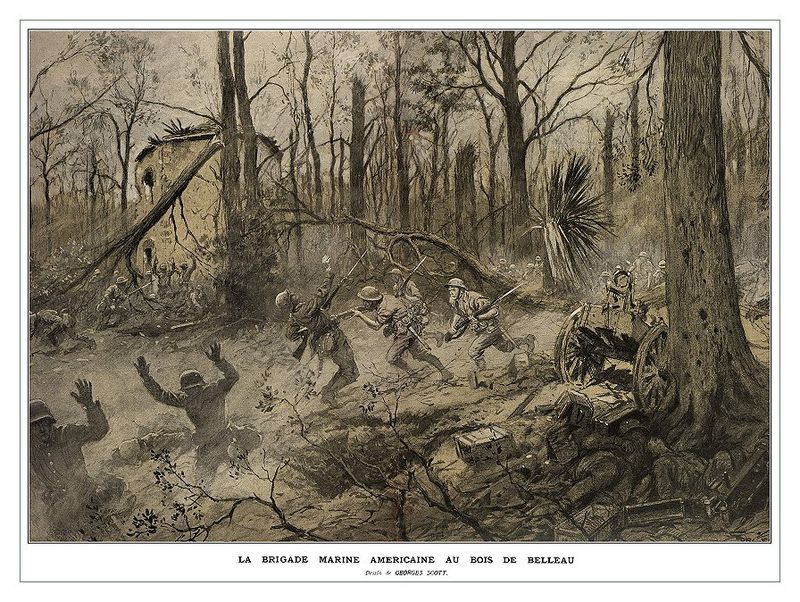
Georges Scott (1873-1943) illustration “American Marines in Belleau Wood (1918)” – originally published in the French Magazine “Illustrations”
Ellen’s second son, Pvt. Walter Joseph Spearing, 23rd Co. 5th Reg. U.S. Marine Corp, was killed in action at the Battle of Belleau Wood in France, June 1918. By all reports, Walt, was a fun-loving but serious young man, a ginger-haired boy who excelled at Roman Catholic High School in Philadelphia and had gone on to the University of Pennsylvania. I didn’t see Ellen when she opened a letter of condolence from her son’s friend. In fact, I knew nothing about the letter until last week, when thanks to newspaper archivists, and modern technology, I received a copy of Ellen’s letter.
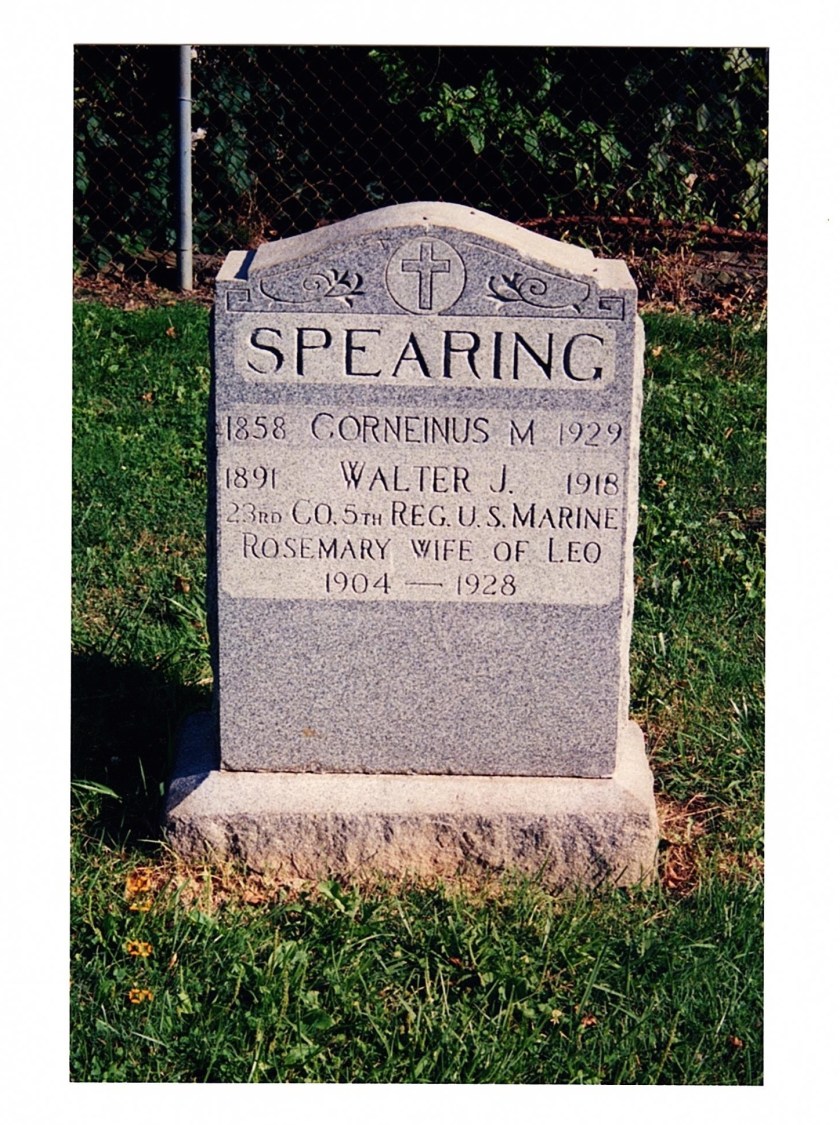
Spearing Head Stone
Walter Spearing and his best buddy, Pvt. Sol Segel had promised each other that if one of them died the survivor would try to “console the sorrowing mother” of the other.
So shortly after the battle, when the guns were quiet, Sol Segel sat down next to his friend’s grave, and wrote words that “fullfill a duty I am bound by oath and will to perform.” From the distance, almost 100 years later, we may not view the First World War through Segel’s lens as “martyrdom in the Holy Cause of Freedom and Liberty.” But I was touched by his nobility, sick his own losses, he wrote to comfort his buddy’s family.
“There is grief in my heart,” he wrote, “and in the hearts of all my comrades for the great sorrow that this war has brought to you and to us. We all unite to express our heartfelt sympathy and condolences….
“Beneath the green in Belleau Woods, forever connected with the ‘Honor of the Marines,’ lies Walt with two comrades, dead on the ‘Field of honor.’ Above their graves the stately pines sway in their grandeur, an imperishable monument….
Dear lady, the very thought of you in grief tears my heart…. In the name of the Twenty-third Company, in the name of the Marines, I salute you and all my comrades salute you.”
Unknown to me, a writer in Philadelphia, Pennsylvania, Chris Gibbons, was researching alumni of the Catholic High School who had died in the war and came across Ellen’s letter. He found my name in Ancestry.com and contacted me hoping I might know some of Walter’s classmates.
Oddly enough, Gibbons recently used Ellen’s historic letter in a Mothers’ Day article for the Philadelphia Inquirer. He wrote, “The pledge between Segal and Spearing, as well as the letter sent to Spearing’s mother, Ellen, is certainly not unique in the long, tragic annals of warfare….
“What was unique about this war was how mothers organized….
“In September 1917…the ‘American War Mothers’ organization formed…and quickly spread across the country. These mothers, who had children serving in the military, displayed a flag in their home windows with a blue star denoting the service of a child. Many displayed more than one star. If a son [or daughter] was killed in action, a gold star was sewn over the blue. These women subsequently became known as the ‘Gold Star Mothers,’ a phrase coined by President Woodrow Wilson….
“After the war, the American War Mothers … assisted families who wished to have their sons’ bodies brought back for burial in the United States. …[they also helped organize]…the ‘Gold Star Mothers Pilgrimages,’ in which the government paid the travel expenses of families who wished to visit the European grave sites of their … [loved ones].
As for Ellen Spearing, she did not sit privately with her grief. Shortly after receiving the letter from Segal…she sent a copy to her congressman, J. Hampton Moore with a message “…to demonstrate the spirit of the boys in the district you represent”. She also requested he share it with his colleagues in Congress. The letter was subsequently published on the front page of the Philadelphia Evening Public Ledger.
In 1921, my grandparents had the body of their son exhumed from its battlefield grave, shipped to the United States, and reburied in St. Denis cemetery [Philadelphia].”
Chris Gibbons wrote that he visited Walter Spearing’s grave earlier this year and was surprised to see that Ellen’s name is not on the grave stone although that of Walter’s father Cornelius is.
Chris concludes, “As I stared at the grave, I could only shake my head in sadness. It’s almost as if Ellen Spearing, the mother who wanted to ensure that her son and the boys in her district would not be forgotten, had never existed.”
I want to reassure Chris Gibbons on this Memorial Day that Ellen Spearing is remembered. And, if I could speak to her across the intervening century, I’d say, “I see you now as a person who lived her values. As a woman in 1918, you couldn’t vote, but you found your voice, and you used it to speak your truth on behalf of the voiceless soldiers and their families. I might not agree with you about the First World War; I might think it was a disaster; but I salute you, Ellen, I salute your steadfastness in the face of loss. You clearly valued loyalty – loyalty to your family, your neighbors, your country and your God.
– Connie Spearing
Editor’s note: Connie Spearing may not have “seen” her grandmother, but she certainly walks in Ellen Spearing’s footsteps. Connie is a prominent activist in her San Francisco Bay Area community.
this is no city of ultimate bliss*,
though the traffic is backed up to kingdom come
and the streets are a scrimmage, full and rough,
teeming with feral bits of hope and hunger
the people here are virtuous though,
ripe with love for one another, for Christ and music
hear the music winding, insinuating
and tumbling from la iglesiay las casas
the rents are morbidly obese, don’t you know?
though the wages and hours are skeletal
too often along B Street and downtown,
a man begs a cigarette, a woman begs for lunch
Are you in the huts of the poor, consoling the
Broken-hearted with the sweetness of your soul, and
Filling their hands with your bounty? A Lover’s Call, Khalil Gibran
*****
esto no es una parte de la ciudad que está feliz
el tráfico es interminable y ruidoso y crudo
y las calles son una áspera, llena ~
lleno de esperanza salvaje y hambres profundas
la gente aquí es virtuoso, con buenos corazónes
madura con amor por el otro, para Cristo y la música
escuchar la música, que insinutes, una cascada ~
fluye de la iglesia y las casas
los alquileres son obesos mórbidos, ¿no lo sabes?
aunque los salarios y las horas son esquelético
a menudo a lo largo de la calle “B” y el centro de la ciudad
un hombre pide un cigarrillo, una mujer pide luncha
If I really screwed up on the translation and you’re burning to let me know, you can leave comment in Letters to the Editor. Thank you!



!["The Conversion of St. Augustine" by Fra Angelico (born Guido di Pietro; c. 1395[2] – February 18, 1455)](https://thebezine.com/wp-content/uploads/2016/07/1024px-fra_angelico_-_conversion_de_saint_augustin.jpg?w=840&h=525)