NOTIONS OF THE SACRED: Poetry as Spiritual Practice


poet

“Without art, we should have no notion of the sacred; without science, we should always worship false gods.” W.H. Auden
When we move on in the arc of our lives – to center – we cross the threshold into that place from which all things emanate – the sacred space of poetry and indeed all art and creativity, we leave behind the cacophony of assumptions and received wisdom to rest in Rumi’s field – a place he says is “beyond ideas of wrong doing and right doing.” We cross the threshold into a w-h-o-l-l-y, place – a place Rumi tells us the “world is too full to talk about.” The ideal of this field reminds me very much of Leonard Cohen’s Hallelujah, where all the hallelujah’s – broken or whole – are equal. And so it is with us and with our poetry, which as a spiritual practice brings balance and sacredness into our lives.

This business of taking up our pens involves more than learning the technical rudiments, the history of our craft and its key players. It requires of us a trust in ourselves and learning to let go of the expectation of understanding everything. We learn to embrace mystery and ambiguity. We learn to sit with process and to sit with the poems we are drawn to or the poetry we write. We allow the visions, the word-play, the cadence to work on us. Whether we share our poems with others or not, whether we are amateur or professional, is irrelevant. What matters is that we go on the hero’s journey and we come back with a gift.

When we write, we are like Rilke’s “Swan” …

“when he nervously lets himself down
into the water, which receives him gaily
and which flows joyfully under
and after him, wave after wave,
while the swan, unmoving and marvelously calm,
is pleased to be carried, each moment more fully grown,
more like a king, further and further on.”

Sacred space always reveals the unexpected. We are always changed, though the change may be subtle. What might come up are the daily concerns – how to make it through the day – or the current pain: the loss of a loved one, abandonment, ills of body and mind, concerns for children … Joy! and Gratitude! As we grow “more like a king, further and further on,”  our sacred space may reveal something about the greater mysteries…

does it matter after all, the curiosities

when fish and water are one
when light and dark are indistinguishable
when we are neither content nor discontent
when questions cease and ideologies melt
when there is no helping and no taking

. . . there is this” [Jamie Dedes]

enso

And “this” is well represented by the Buddhist ensō illustrated above. It is meant to express that moment when the mind is still, allowing for creation. It symbolizes enlightenment. I’m sure all faiths have similar concepts. From a Christian perspective – perhaps the discussion would be about the “gaze of faith” and claritas (Thomas Aquinas) –  “intellectual light,” illumination. In Buddhism, traditionally this ensō is done as a part of spiritual practice and it is a kind of meditation in the way that all creative efforts are meditation.

“Writing is a process in which we discover what lives in us. The writing itself reveals to us what is alive in us. The deepest satisfaction of writing is precisely that it opens up new spaces within us of which we were not aware before we started to write. To write is to embark on a journey whose final destination we do not know. Thus, writing requires a real act of trust. We have to say to ourselves: ‘I do not yet know what I carry in my heart, but I trust that it will emerge as I write.’ Writing is like giving away the few loaves and fishes one has, trusting that they will multiply in the giving. Once we dare to ‘give away’ on paper the few thoughts that come to us, we start discovering how much is hidden underneath these thoughts and gradually come in touch with our own riches.” ‪‎Henri Nouwen‬ REFLECTIONS ON THEOLOGICAL EDUCATION (unpublished) http://www.henrinouwen.org

So trust that through your poetry you will enter that field where there is no right doing or wrong doing and …

“The time will come
when, with elation
you will greet yourself arriving
at your own door, in your own mirror
and each will smile at the other’s welcome,

and say, sit here. Eat.
You will love again the stranger who was your self.
Give wine. Give bread. Give back your heart
to itself, to the stranger who has loved you

all your life, whom you ignored
for another, who knows you by heart.
Take down the love letters from the bookshelf,

the photographs, the desperate notes,
peel your own image from the mirror.
Sit. Feast on your life. “ [Love After Love, © Derrick Walcott, Collected Poems, 1948–1984 (Farrar, Straus and Giroux, 1987)

© 2016, essay and photograph, Jamie Dedes, All rights reserved; Ensō (c. 2000) by Kanjuro Shibata XX under CC BY-SA 3.0
Hindsight

I found a clandestine translation
between our hearts…
with coagulated rhythms
of thick lines of Reality…

You and Me…
no more conjugated by a verb,
no more nouns
pleaded to be sung,
no more chorus
to fill the empty line…

My wings cannot fit,
into your story,
and my eyes stopped
describing the sound
of your body…

All you needed
was to conjugate
my 17 syllables…
so, your shadow
will not grow
under my shadow…

© Anca Mihaela Bruma

The Autumn of Our Spring

The Autumn of Our Spring

My autumnal words fell on the sidewalk of Love!
You looked like Autumn… I behaved like Spring…
I found you when I had lost you
In this autumn… of our spring.

I re-arranged my rustic colors
so Love might gain a new anthem
with fluid steps and no numb regrets,
forgotten overdue epiphanies,
lost stolen rainbows
and red echoes with tangerine taste.

In this autumn of our spring
with its golden trail and acoustic wings
the season paints its words as a grand finale
while your leaves whisper secrets to the World
and a puff of wind lingers our photographic memories
as journals left and long forgotten on the path’s end.

A stolen cry, a remembered loss of innocence,
as my desires hung on Sun’s shoulder,
I see a repainted canvas of us
with cycled memories on the hills’ canopy.

How sensual this autumn is!
Spiraling its space… tumbling its distance,
prolonged myself by flaming orange leaves.

During this autumn of our spring
my World turned into a September embrace,
October tinted your presence
With blossoming hues of green-orange undertones.

A dreamy dream… an autumnal fugue,
during lost Summer epopee,
and I breathed… with November pulse.

My soul’s crimson is ambered and rubied
And I feel… autumned…
I left my cinnamon spice to learn more about your beauty
the citrine embers of your eyes under the raindrops,
watched the cosmic dance on your skin, a whisper in time,
my temple of words still carry a forgotten white procession.

And love again… and again… dawns upon my future self
with rain scented winds, thrumming my life in your heart…

Words still scream the nuances of your disappearances
sailing across my punctuated flight…
Of so much yearning… I have sharpened more wings…

In this autumn of our spring, I will stumble no more
behind your voice… as Life cannot be half sung!…

A stolen cry… a remembered loss of innocence,
and I have learnt how to die… by living!…

© Anca Mihaela Bruma

Rhetoric Introspection

I do not know what to regret anymore…
that I cannot reach you through our memories,
that an insane song cannot touch your soul,
or that you reversed yourself on the other side of Life?!…

I watched how spring drained from us
and not even a curved second could see anymore
the Miracle from us!…

Not even my own flying is vertical anymore
and I remained with my wings sealed
running barefoot on the shells of Time
on the look for that plenary Love
which you had promised along a sunset…

You stole the jewels of Time from beneath my eyelids…
just one white night struggled to reach the cloud’s temple
and I do not have shores to reach…. anymore…
I just got lost in the morning known by nobody!…

© Anca Mihaela Bruma

Bonds

FullSizeRender-9[…] I took a deep breath, and closed my eyes, waiting for the burst – which came almost instantaneously:

– Our talks should be different! You know? Different. Like, when you come to me with that long face and I just know that something’s wrong, you should just talk to me and tell me about it. I mean, for heaven’s sake, I know you since you were a child, since you took your first steps towards me and hugged me. I felt you there, at my feet, a little being with so much potential, looking at me with those big round eyes and laughing with all your heart…you were such a marvel…and you still are, but somewhere on the way you lost your confidence in me. I used to be the keeper of all your secrets – and now you’re ashamed to talk to me, as if talking to me would make you some sort of a freak…Talking to me doesn’t make you a freak. Sharing your inner world with me doesn’t make you a freak. Feeling together with me doesn’t make you a freak. But your fear and shame do.

I opened my eyes, trying to ignore the tears streaming along my cheeks – how I had missed that voice…and how much truth it carried…I wanted to mumble a feeble “I’m sorry”, but then it spoke again:

– I don’t want you to be sorry. I just want you to open your eyes and see me for what I truly am – for what I’ve always been: your friend. And if you don’t believe me, look at me and remember the countless times when you ran to me and gifted me with your tears, your laughter and your thoughts. I still remember each and every moment we shared.

And while I touched the tree’s bark, letting my heartbeats resonate between my palm and the old trunk, its leaves caressed my cheek and it concluded gently:

– Your most loyal friend I am, not just the old oak in your father’s garden.[…]

© Liliana Negoi

DREAMING THE WORLD: An Interview with Michael Watson

Michael Watson
Michael Watson

JAMIE:I often tell people that if have time for only one blog, it should be yours, DREAMING THE WORLD. You bring such a wealth of understanding, experience and education to your posts, so gently delivered and so healing. Thank you! You write a lot about nature. Did you grow up in the country?

MICHAEL: Thank you, Jamie. I am deeply moved and honored.
My dad was in the Air Force so we moved periodically. He hailed from Southwest Indiana, from a hillside farm overlooking the Ohio river. My mom grew up on a farm in Texas, a couple of hours west of Dallas. The upshot was we tended to be stationed near one family or the other. When I was six or so, we lived in rural Lincolnshire, England, on an estate, complete with a game warden, where I spent untold hours in the woods with friends. Then we moved to rural Illinois, where we lived on the edge of a small town, and I was free to roam the countryside. From there we spent a year in suburban Ft. Worth, Texas, then we lived in urban Ohio while I finished high school and college. No matter where we were my parents had a garden, and made sure we kids had access to Nature. Given the option, I would head for the forest or prairie. I spent quite a few fabulous summers on my uncle’s farm in the fertile Ohio river valley near Madison. My dad’s family encouraged me to understand myself as part of the Natural world.

JAMIE: How did you get interested in therapy as a profession?

MICHAEL: I had a good therapist in college, then was clinical coordinator for a large “Free Clinic”. After working for the Soil Conservation Service for a while (I had a splendid job where I was outside most of the time, often in wilderness), I realized my legs were not going to tolerate the demands on them, and I had best find a more sedentary job. I already had an MA in Studio Art, and was offered a position as a community based artist, so I grabbed the opportunity to explore engaging people in arts for healing. I also went back to school to get a degree in counseling. During that time I provided some services to patients in the local university medical center, and when I finished my degree they offered me a part-time position, as did an outpatient clinic in town. One of my teachers worked in the clinic, and when he decided to leave his private practice, he essentially gave it to me.

JAMIE: What spurred your interest in shamanism?

MICHAEL: My dad’s side of the family has always identified as Native, although they steadfastly refused to tell us our tribal identity. One of my cousins, who is a genealogist, has tried several times to trace our family, without success. There are birth certificates for family members that go back three or four generations, then there is simply no record. All the birth certificates list us as being Caucasian. Indiana was a very nasty place for Native people during much of the last two centuries and it was very common for light skinned Natives to pass. My grandmother used to say, “We must protect the children.”

Anyway, I mostly didn’t think much about Natives, except to identify with the cowboys when we kids played cowboys and Indians. I could never figure out why my dad got upset with me for being a cowboy! Then in college there were all these books about Native American healers and shamans. A lot of those books turned out to be fraudulent but they got my attention. When I went to New Mexico for grad school I had many Native friends. I ran a small ranch in the mountains so I could afford school, and got a real hit of the sacredness of that country. Eventually I moved to California, then back East. I kept meeting Native elders who offered to teach me something. I’d protest that I wasn’t Native and they would look at me as though I was completely out to lunch. Often they would say, “We know more about you than you do.” I guess they were right.

When I was living in northern California I had a vision that turned my life upside down, and set me to trying to understand what I was being asked to do. That was forty years ago. I still ask the Powers what they want, and I’m still not the best at engaging with them.

JAMIE: You have lived virtually all your life with polio: traumatic, painful and disabling. I know you’ve thought a lot about disability, about cultural misconceptions and about meaning. What is the most important thing you think we need to know as a culture about the nature of disability and the impact – not so much of the disability itself – but of the assumptions that are made about people with disability?

MICHAEL: I was seven when we came back from England. I started school, second grade, and after a week we had the Labor Day weekend holiday. I developed Polio during that weekend and spent the next year trying to recover. I was in the iron lung and had significant paralysis; I made a rapid recovery (one of those “miraculous” recoveries that happened fairly often) and left the hospital after only a bit more than three months. We Polios were encouraged to believe we were not disabled, but many of us were. Much later, we discovered there is a correlation between the severity of the illness, the degree of one’s recovery, and the disabling that comes with Post-Polio Syndrome. PPS had been studied for about a hundred years, but everyone conveniently forgot about it once the vaccines arrived and the epidemics ended. (The same thing happened with us Polios, we were forgotten, even by the March of Dimes, an organization that had promised to support us, and our families, for as long as we needed them.)

Being an enlisted person in the military means one is not well paid; a lot of military families are on food stamps! As it turned out, I most likely survived Polio only because I was in a military hospital, and the Air Force literally did whatever was necessary to support me during the acute phase of the illness; they even flew in two top Polio docs to help me.

Being a closet Native and a Polio who tried, rather unsuccessfully, to pass as able, I learned a lot about the way our culture attends to people with disabilities. There is a strong Calvinistic streak in the culture, one that subtly, or not so subtly, places the blame for disabling events on the disabled person and their family. There is a strange cultural belief that disability is a moral failure, rather than an act of Fate; there is also a belief that physical disability implies cognitive impairment. (There are more reportedly Ph.D.s among Polio survivors than any other segment of the population.) There is also a willful refusal to notice and address all sorts of physical and cultural barriers that greatly affect disabled people.

I have worked on issues of disability throughout my adult life. When I am teaching about the experience of disability I remind students/participants that disability is largely a social construct; even the medical definition of disability is socially constructed, a fact many doctors forget. (Actually, younger physicians tend to be much more aware of this.) I often ask those present to speak about the experiences that disable them; I find it immensely useful to aid individuals to understand the experience of being disabled by locating parallel experiences in their own lives. The truth is, most of us have had moments when someone else’s attitudes, behaviors, or beliefs are/were disabling to us. Disability is created!

Oh, one more thing. There is, in North America, a cultural expectation that persons with disability will be either unceasingly cheerful or despondent. We should never be angry. Well, what is one to say to that? I have a wide array of responses to my experience, certainly including anger.

[Michael, I appreciated this by you: We find it useful to define disability as a lack of access to the social and/or physical environment, a lack created by the beliefs and behaviors of self, or, especially, others. While many disability activists and theorists find this definition overly broad, we believe it aids people to understand the experience of disability, building empathy and community.]

JAMIE: You also have been involved in education at the university level for good part of your life. How do you feel about the current emphasis on vocational vs. liberal arts/humanities? What price do we pay or will we pay for this?

MICHAEL: I have long encouraged students to explore widely, to engage the fine and liberal arts, and to create internships and other avenues for applying their learning in the everyday world. Being educated in the fine/performing arts, and the liberal arts, gives one models for being creative, and understanding historical and cultural context, as well as opportunities to learn about human nature. Hopefully, one also gets enough science to be able to understand the broader ecosystem implications of one’s behavior. Unfortunately, those who have overly specialized training tend to be lacking in tools.

JAMIE: What is the major work or interest of the next year for you?

MICHAEL: I’m dealing with progressive Post-Polio Syndrome, and approaching seventy, so I am practicing becoming more choosy about the projects I take on. I will continue to see clients in my counseling and healing practices. I have a list of photographic and writing projects, and Jennie, my wife, and I are working on new toy theater shows. Now that I am no longer classroom teaching, I’m also working to create time to read for fun!

Father’s Day with Juan Felipe Herrera, Performance Artist and former California Poet Laureate

Juan Felipe Herrara (b. 1948), American poet and writer, photo by SlowKing
Juan Felipe Herrera (b. 1948), Mexican-American poet and writer, photo by SlowKing under GNUFDL

Juan Felipe Herrera is a Mexican-American poet and performance artist, a writer and cartoonist, a teacher and an activist.

“Many poets since the 1960s have dreamed of a new hybrid art, part oral, part written, part English, part something else: an art grounded in ethnic identity, fueled by collective pride, yet irreducibly individual too. Many poets have tried to create such an art: Herrera is one of the first to succeed.”  Punk Half Panther by Stephen Burt in the New York Times

Herrara incorporates into his writing his experience of family and the life of the compesinos, migrant farm-workers.

“Into the tilted factories, the smeared taxis,
the stunted universities, into the parlor of bank notes,
in the cramped cookhouse where the dark-skinned
humans still stoop and pitch the daily lettuce bags …”

He sometimes tells stories that arise from what is for him a pivotal moment: the early school experience of trying to fit in though he had no English-language skills. He also writes stories that illustrate the problems of immigration, which often separates families.

In 2012, California Governor, Jerry Brown, named Herrera California Poet Laureate, the first Chicano poet to be so honored.

Many of us – like Juan Felipe Herrara – had fathers or grandfathers who came to the United States to make a better life for themselves and eventually for their children and future generations. Sometimes we like to remember and acknowledge them for their vision, courage and hard work. Today seems like a good day to do so. The video below is charming children’s story, A Tale for Father’s Day, about Herrera’s immigrant father. Enjoy!

Happy Fathers’ to all the dads and to all the moms who, for one reason or other, are both dad and mom.

stars and scars

FullSizeRender-10Seven stars on your face
Seven brown butterflies
I count them
And read in your eyes
The hieroglyphs of sorrow

This is who I am, you say
I carry my country
A wound and a rose
My memory is on my body
In these scars you love
In these hands, in this heart
Still lush with childhood

Behind curls of smoke
I watch you from a distance
And you contemplate the orange sky
Your soul brims over
With a glowing melancholy
I know it well
It is what transforms you
Into an citadel of silence
Only then I realise
The depth of your wound

This is how poetry is born
Green between your fingers
When you take refuge
In the shade of words
And solitude

I count them
Seven stars the night collects
For its celestial gallery
Only the scars remain
To remind me
Of who you are

© Imen Benyoub

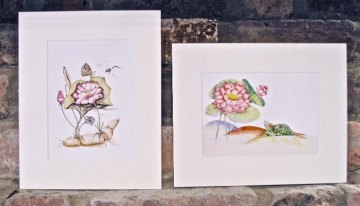
“Lotus Plant” & “Lotus Pond with Tortoise”

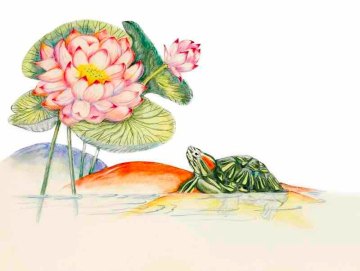
In preparation for the the Buddha’s Birthday in April, I drew two different views of a lotus plant. Much venerated in Buddhism, the lotus is one of the ‘Eight Auspicious Symbols’. It is also a delight to draw, as the textured leaves and petals of the plant encourage the kind of finely-detailed observation and drawing work that give richness and texture to an image.
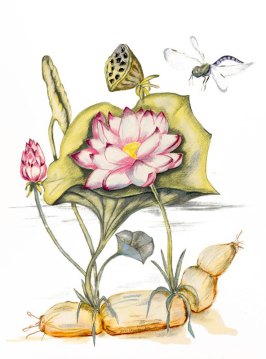
 

For my first drawing, ‘Lotus Plant’, I researched and focussed on all the interconnecting parts of the plant. Most drawings and paintings of the lotus concentrate on the flower itself; the next part, the stem, is submerged and thus often merely hinted at. And the roots, although many of us will be familiar with them as edible parts of the plant, are rarely depicted in art, since they grow deep in the muddy bed of the pond.
For a Buddhist, this concept of living in three mediums – mud, water, air – signifies a progression. The soul journeys from the muddiness of materialism, through the water-world in which we live and experience our daily, day-to-day lives, and thence beyond, to enlightenment in the ethereal world of light and air. That these parts are all connected, roots to stem, stem to flower, is reflected in my drawing.


My ‘Lotus Pond with Tortoise’ shows the flowering plant, partly in water, and blooming just at the surface. A tortoise, resting on a rock, looks up at the lotus. Such a bright and beautiful flower is an inspiration to all who see it, tortoise as much as human.

In Asian culture, tortoises are sacred. The longevity and tenacity that they symbolize seemed to me to be a wonderful way to celebrate what the birthday of the Buddha means. We need to live long and work hard to reach enlightenment. And if the ageing process is enlightenment in slow motion, as John C. Robinson describes in his book ‘The Three Secrets of Ageing’, then my combining of the symbols of enlightenment with those of longevity expresses this process.

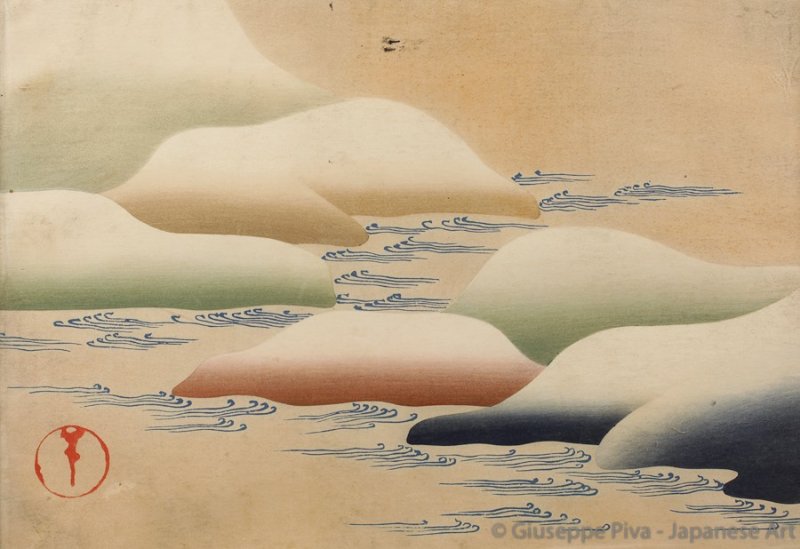
Those who have studied Kamisaka Sekka (1866-1942) may notice that the stones in my pond resemble, in reverse colour, his ‘Snowcaps’, a woodblock print.

AAEAAQAAAAAAAAXSAAAAJGI2MWU3M2NiLWM1NDItNDAxYS04MDgzLTMxNWRjNGQwZGMwYg

When we fall in love with a work of art, as I did with ‘Snowcaps’, with its depth and colour, and its suggestion of water rippling in two different directions, then that inspiration feeds into our own work and, like my lotus drawings, establishes and confirms our interconnectedness.

© Paula Kuitenbrouwer
Text edited and enriched by Janet Gough
Lotus (Botanical) at Etsy and at Amazon Handmade
Lotus with Tortoise at Etsy and at Amazon Handmade


re: your account

unnamedour accounting department
has contacted you numerous times
regarding your account
for example
on all your birthdays
right after your graduation
from college
your first christmas alone
we even sent you postcards
during staff vacations
a policy not normal
but in your case
we made an exception
this is your final notice
but you need not respond
we have determined that you
were a bad investment
so we’re writing your debt off
this is just our way of saying
this
friendship
is over
don’t bother to call
the account
is closed

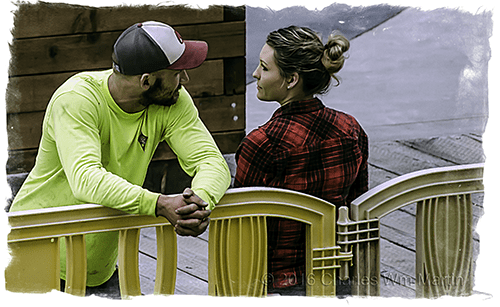
© Charles W. Martin, poem and illustration

you really didn’t say that

your-really-didnt-say-thati had just
stopped by
aunt bea’s
and
was relating
a problem
i was having
with a friend
of mine
i said
she always wants
to pay
for things
i
just want
to have things
balanced
you know
what I mean
i could see
aunt bea’s eyebrows
rise
just above the borders
of her
reading glasses
oh
she said
that
accountant syndrome
where
relational spreadsheet columns
must always
zero out
my dear
friendship
is not about
balancing
the books
at the end
of the day
it’s about
love

© Charles W. Martin, poem and illustration

of lovers and friends

unnamedlovers aren’t always friends
but friends are always the ones
that offer you love

© Charles W. Martin, poem and illustration

Silva Merjanian, From War-torn Lebanon to Peace in California

Armenian/Lebanese American poet, Silva Zanoyan Merjanian
Silva Zanoyan Merjanian

Silva Zanoyan Merjanian is an Armenian ethnic who was born in Lebanon. She escaped the civil war there and lived for a time in Geneva, ultimately settling to build a family life in California. Silva has two published collections. Most recently Rumor (Cold Water Press, 2015), which received the Best Book Award from NABE in the 2015. Three poems from Rumor were nominated for a Pushcart Prize. Silva’s first collection is Uncoil a Night (CreateSpace, 2013).

73f533_9cc020b992f94d93a6acdd49383341f5

Falling

In rind of wishes sticky on lips
and sermons’ echo on facepsalms slipping
in envies squirted on spruce and cedar
whims twirling, spiraled, speckled
gossamer visions of friendships withered
in crevices of an upbeat mien
Your name hidden in prayer embers
I mend among buds of poems
flying on a trapeze
with no one at the other end

Rumor is a stunning tour de force of passionate, life-affirming poetry. Silva Merjanian evokes time and place with both grace and authority. Poetry is obviously a tool for her own healing and in that she brings us face to face with the human condition in all its complexity, beautiful and loving and devastating cruel, and she does so totally without pretension.

Mornings arriving
Me alone
Poems half written and done
Poems between toes and toast
‘Round Midnight and Monk
Nostalgia
Right reasons
Brave decisions
Thoughts that glow in the light
Just love
Always, in absence of rats and such
fresh sheets and I
between over and under

from Between the Sheets

She writes with immediacy of war:

bounce of gold crosses between breasts
colorful hijabs ’round others’ bare face
friendships seeded in borrowed sugar, borrowed time
she, unaware of borrowed wailers on their way
makes plans on a sunny balcony as she hangs
her blue jeans on a clothesline
moments before war drums ripple through crisp calm

from Borrowed Sugar Borrowed Time

INTERVIEW

JAMIE:  Silva, Rumor is a remarkable collection with many poems that stay with one. It’s also quite generous of you to donate proceeds to the Syrian-Amenian Relief Fund (SARF). How are sales going and how is the fundraising?

SILVA: Thank you Jamie. I did not have an event or a formal fundraising with Rumor. The sales were a result of readings, speeches, word of mouth and some ads in newspapers and on Facebook. In July there will be an ad for it in Poets & Writers and it will also be included in five book fairs this summer.

My publisher, Dave Boles of Cold River Press, will release the e-book version soon. He is kind enough to donate all proceeds from the e-book also to the SARF. So with all these developments I expect a boost in sales.

JAMIE: When did you fall in love with poetry? When did you realize you are a poet?

SILVA: I am a late bloomer. I started writing in 2011 and my first book was released in 2013. Even though we grew up with the poetry of Shakespeare, Keats, etc.. and many Armenian poets, the thought of writing poetry hadn’t occurred to me. My education is in Business Administration not Fine Art. It was almost like catching the bug of poetry, very unexpected, once I started writing I couldn’t stop. I didn’t write to be published at first, it was just for the pleasure of it, later when I saw friends publishing books, the idea came to me to publish and make it count for something by donating the proceeds.

JAMIE: What are the reactions to your work that surprise you most?

SILVA: I didn’t expect the level of appreciation for my poetry that I received. Especially from those who themselves write and/or are well read in poetry. I have to thank the Irish first for this recognition. They have such talented poets and they recognized my potential first.

I also didn’t expect the difficulty to be accepted as a writer in the Armenian community. It was almost like they waited for me to be respected in the foreign circles before they’d acknowledge me, instead of reading my work and appreciating it themselves. I am disappointed in that respect.

JAMIE: Tell us something about your travels: How did your family arrive in Lebanon and why did they move from there. How did you end up in the U.S.?

SILVA:  My grandparents had to flee their homes twice, trying to survive the Armenian Genocide. If you are familiar with the book The Forty Days of Musa Dagh by Austrian -Bohemian writer Franz Werfel, first published in German in 1933, it is the story of my grandparents. The French helped the population of seven villages escape and relocate as refugees in the Bekaa Valley in Lebanon. So my grandparents did live under refugee tents for a whole year. Now the area is a buzzing town with three churches and schools and commerce.

I left Lebanon after experiencing eight years of the civil war*. Geneva was the city I healed from the war scars. Later I settled in California to raise my sons with my husband.

JAMIE: What do you think most Westerners don’t understand about the Middle East? What do you know and understand that you would like everyone to know?

SILVA: What most don’t understand about Lebanon, and to a degree parts of the Middle East, is that the vast majority of the people are just the nicest fun loving, peace loving, hard working families. They want for their children everything an American family wants. The number of innocent people who are collateral damage to the events in that part of the world is just heartbreaking.

JAMIE: I understand that your brother is a novelist. Does your family have a history of poets and writers?

SILVA: My brother has two volumes of poetry in Armenian. He is writing his third novel. I am not aware of anyone else in my family who has published books, except a volume of translations by my father.

JAMIE:  You have two well-received collections completed. Where to now?

SILVA:  That’s a question I’ve been asking myself. I think I will keep writing and hope a third book will be in the future for me.

* Lebanese Civil War – 1975-1990

© 2016, portrait, poems, bookcover art and responses to questions, Silva Merjanian, All rights reserved

“GRABBING THE APPLE” … or, How a Regional (New York) Anthology of Women Poets Was Create

51UKv1yazEL._SX322_BO1,204,203,200_

Thanks to poet, writer and anthologist, M. J. Tenerelli, for sharing this story with us today.

Several years ago I did a show for the Northport Arts Coalition highlighting the work of well established women poets. I thought at that time that pulling together a collection of passionate, local women’s voices in a book of poetry would be a wonderful thing to do. There were so many talented women I knew on the New York circuit, giving profoundly moving performances, sharing really fine work. Two years ago my friend and co-editor, Terri Muuss, suggested that we get together and produce what became Grabbing the Apple, and anthology of New York women poets. And so a two-year project began.

The idea behind the book was to share what we believed was the unique voice of the New York woman, informed by place as well as a particular confidence, savvy, and passion. Terri and I wanted the book to serve as a conduit for these women, allowing them to define themselves as opposed to the traditional definitions existing in male-created literature, including the bible. Eve from Eve’s perspective.

First we needed a title. We wanted something that reflected the concept of women defining themselves. We turned to the original story of creation in the bible, where the mother of us all begins the downfall of man by plucking an apple from a tree. With Grabbing the Apple, we believed we had a title that turned that creation story upside down. Yes, the first woman, embraced wisdom, and that did not make her a monster but rather a heroine and a role model. The poets in the book define themselves and the lives and concerns of women, forcefully and without shame. We felt the anthology’s title embodied that. And of course “Apple” brings to mind New York.

Call for Submissions: We used social media, college websites and word of mouth to solicit submissions. We emailed the women poets we personally knew. The amount of work that poured in amazed us. I think the concept of the book really spoke to these writers, and they wanted to be heard. We culled 47 pieces from hundreds of submissions. It wasn’t easy. With the help of poet Matt Pasca, Terri’s husband, we instituted a blind process. Matt oversaw the email submission box, and printed out the poems for us, minus the writers’ names. Terri and I both had complete copies of the submissions to read through and consider. I don’t think we understood at the time just how long it would take to come up with a book we were satisfied with–to do right by the poets and the idea behind the book.

Reading and Selecting: I spent a lot of time with the work. As a mother with a full-time job, I spent many lunch hours in my car, and on the couch after work, reading poetry. It was far from a chore. The work energized me, moved me, and surprised me again and again. I started to feel honored to be stewarding these pieces into publication. It was often hard to choose what to accept and what to leave behind. Terri was also reading and considering. We each had a form to work with, where we gave each poem, identified only by number, a yes, no, or maybe. Then we would meet to compare our opinions.

In pizza restaurants, cafes, and often in Terri’s spacious living room, we would have “Apple” meetings. Often we agreed on what needed to go into the book. But not always. Sometimes one or the other of us would make a strong case for a poem we were passionate about. There were negotiations. It was never contentious. We respect each other as writers and editors, and are good friends. So we really listened to what the other had to say. It worked. We came up with a manuscript we could both stand behind. When it came to our own work, I picked a poem of Terri’s that I thought was perfect for the book, and Terri chose a piece that I had done. The next step was to create an order for the poems.

Terri suggested dividing the book into three parts, “Eden,” “The Fall,” and “After the Garden.” I loved the idea, but worried the poems we had wouldn’t lend themselves to the categories. It turned out to be needless worry. Whether loosely or specifically, each poem fits under one of the headings. I remember one night crawling around on Terri’s living room floor with the work spread out in front of us, moving poems around like puzzle pieces into each of the three sections. Again, there was a lot of consideration and some negotiating, but in the end we had groupings that made us both happy. We high fived each other and then celebrated with brownies! We had our poems and we had an order. We weren’t quite done though.

Finalizing and Publishing: We were our own proofreaders. There were a hundred plus pages to pour over. We wanted to get everything right. This took time, and in the end there were a few mistakes but we did our best. We proofed alone and together. We sent the manuscript to the publisher, corrected galleys, and up to the day before publication were still proofing! While we had input into the layout and design, it was the artist Janine DiNatale who created and did the layout for the front and back covers, and the publisher, J.B. Stillwater, who provided the beautiful finished book. I remember cradling the first copy sent to us and feeling like a proud mother. The final step was to get the collection out into the world.

Our initial book launch was at Cyrus Chai, in Bay Shore, New York. So many of the poets in the book came to read. For me, this was the defining moment. The poems I’d been living with for so long came to life. The electricity, love, and sisterhood in the room were palpable. The words sang. We’d accomplished what we set out to do, with more launches planned throughout the Summer.

© 2015, article and portrait (below), Mary Jane Tenerell;  bookcover art © Muuss and Tenerelli, All rights reserved

Grabbing the Apple is on Amazon where you can have a peek inside and sample a poem or two.

© M.J. Tenerelli 

It’s spring, folk!

It’s spring folk!

it’s spring folk!
what do you expect to rejoice?

along ditches violets bloom
and the bees begin to prepare
their juicy nectar

it’s spring again
and the wine tastes better
when you drink it on the veranda
with friends and lovers

forget about the winter
that will come
after the summer and autumn

let the dead branches are
a near remembrance
a far promise

it’s spring folk!
and you can hear again
the birds singing
together with the cravings of the body

that is the last
or that many will have to come

it’s spring folk!

© Mendes Biondo

Musing on a Sixty-Year Friendship

For J

It is you who clicks kitten heels on Fired Earth tiles,
thuds a spade into clay soil, clips fast a patio door,
who watches solitary over a willow tree, shadow casting?
When you catch your image in the sash glass, who do you see?
the girl who taught me to shell peas,
study dog-leafed pages of the Kama Sutra, why?
Is it you who shuddered at the thought,
caught smoking in your froth-white wedding dress?
What’s the measure of your mother-love,
of two sons on the sibling seesaw, how?
From what do you run, and how resist, and how forgive,
dream of on light summer nights, of what?
Of your bully bankrupt brother, your silly, skittish mother?
How deep the sighs, how slow to unwrap your son’s ivy-tight hold?
To relax, how, to be loose from head to toe, how,
from sorrow, which, what about the penny pinching days?
Why the elongated midnights of your middle years,
with which you shared tawny owl moons?
How does my twelve o’clock slip into your late afternoon?

If we were never friends, who might have taken my place?

© Maggie Mackay

Eyeing the Landscape

You are strong firm granite.
Rough quarried, you still
hold your own edges.
Your fire goes deep, only
splinters of surface crystals
catching the fickle sun.

Weatherproof, all but invincible,
it would take carborundum
to smooth you out.
I know how; I lie over you,
a coverlet of soft moss,
wind-patterned grass.

We grow children:
delicate harebell,
tough scented heather,
bluest of blue speedwell.
They lift their heads, take in
storm, rain, sun, clear air.

Even knowing their parentage
their beauty, their differences,
strike me with awe.

© Patricia Leighton, Bromsgrove, UK

photographs

and if you look closer
at these photographs
you will see that,
though taken all at a time,
we were wearing
different clothes in each
which we kept changing
in a bliss of disguise
taking off blouses
laying breasts bare
touching en passant
without any sense of guilt
or sin
since we were sisters
and loved men
and in this privacy
there was no censorship
as there was nothing to censor
lying naked
under wet sheets
skin burnt
with too much sun
it was a nurse’s touch
the spreading of ointment
with soothing fingers
on the depth of the belly
nothing like
the claw grips
of the men to come

© Aprilia Zank