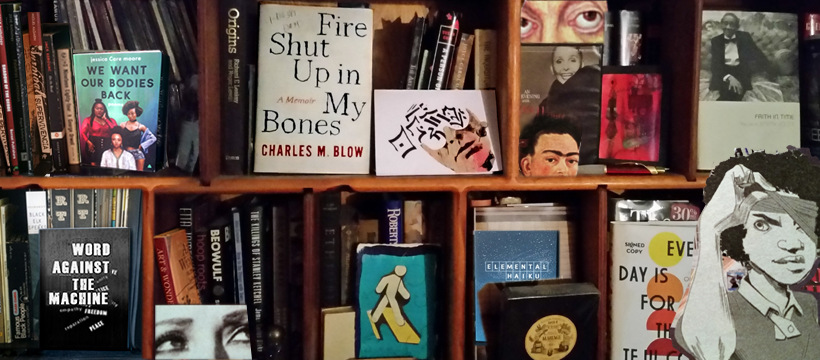
Charles W. Martin and the Ever-loveable Aunt Bea

Charles W. Martin, American poet

Charles W. Martin (Read Between the Minds) …. Charlie …. “slpmartin” … was the first blogger-poet that I started to follow with some regularity.  That was back in February 2010. Charlie had – if memory serves (which it doesn’t always these days) – recently retired and just returned from a trip to Africa – Tunisia, I think – and had shared a few poems about dusty streets and ancient wisdom and social inequities.  At the time he was also sharing poems that had been published in his first book, Read Between the Minds. 

I was struck by two things in Charlie’s poetry: his unremitting concern for social and political issues and his unique style. Charlie wrote about having lost patience with the poetic forms he was taught in school. He developed a spare and direct style that worked for him. As it happens it works well for readers and is perfectly suited to blogging, where brevity is the popular preference.

As time went on, Charlie created and introduced us to the kick-in-the-pants wisdom of Aunt Bea, whom we all came to love.  It wasn’t long before Charlie created two other personalities, each with a distinct voice.

Recently, I read Charlie’s self-published collection: Bea in Your Bonnet, Volume 1, First Sting. As expected, it was pure fun laced with homey wisdom.

Here’s a sample:

word usage…

aunt bea
was reading
the paper
when i stopped by
for a visit
she noted that
there had been
a number of
indictments
of
political leaders
for fraud
and
failure
to serve
the public need
most
of these indictments
she said
were unfounded
in her opinion
since
the word
indictment
suggests
the person
may
be
innocent

– Charles W. Martin

Charlie’s backstory:

Charles W. Martin earned his Ph.D. in Speech and Language Pathology (hence the “slp” in his url) with an emphasis in statistics. His credentials allowed him to pursue a career that included teaching, research and administration in university settings, treating patients and providing administrative leadership in clinical settings.

Charlie worked as a speech pathologist professional in the public schools where he diagnosed and treated communication disorders caused by a wide range of health conditions and contextual factors. Charlie brought passion to each of his professional positions but he was always focused on mentoring his students and improving the quality of life for his clients and patients.

Throughout Charlie’s educational training and career he maintained a devotion to the arts (literature/poetry, the theater, music and photography). He was a published poet before he completed his graduate work. Since his retirement in 2010, he has turned his full attention to his poetry and photography. He publishes a poem and a photographic art piece each day at Read Between the Minds, Poetry, Photograph and Random Thoughts of Life.

Charlie's second self-publsihed work
Charlie’s second self-published work

Aunt Bea’s backstory:

Charlie wrote me saying that “Aunt Bea, my mother’s twin sister, represents all six of the aunts, my mother, and grandmother.  Aunt Bea’s voice is one I’ve heard almost every day of my life.  The poems are family observations, lessons, and advice given to me and every other family member who had the good sense to listen.  Her homespun philosophy most likely will not be found in any collegiate textbooks or for that matter in any local town crier newspaper catering to city dwellers.  Indeed, she has a different way of viewing the world – a bit old-fashioned, sassy, and steely at times but a viewpoint which has engaged my imagination and heart.”

Heads-up Australia: Aunt Bea is heading your way. I predict she’ll turn down-under right-side up.

Charlie has three books out now including Bea in Your Bonnet: First Sting.  Charlie posts daily to his blog and is also a member of The Bardo Group/Beguine Again core team.

“Poetry has the power to make us aware of what is hidden in the shadows…those places that we seldom see or want to see…the poet’s voice scrapes away the facade of an issue and lays bare for all to see what has been denied. By providing a voice to these mute realities, poets have throughout history altered the course of events by enlightening readers and encouraging them to take action to stop wars, halt injustice, and to reach out to their fellow man. Like those poets who have proceeded me, I am motivated by the same desire to bring about the social changes necessary to enhance the quality of life for those around me and around the world and to give voice to those who cannot speak for themselves.” Charles W. Martin

– Jamie Dedes

© 2016 (upated), Jamie Dedes; poem and illustrations Charles W. Martin, All rights reserved, used here with permission

EDUCATING THE TEACHER: Poet to Poet, Ann Bracken & Michael Dickel

NOTE: This was originally published at Ann Bracken: Poet, Author, Creator of Possibilities. It is shared here with permission.

Ann Bracken
Ann Bracken

I had the pleasure of meeting Michael in Salerno, Italy, last summer when we both participated in the 100Thousand Poets for Change Conference. Michael joined me, along with Laura Shovan and Debby Rippey, my travel companions, in sharing a gourmet Salerno lunch in a wonderful ristorante. Michael also served as the emcee for one of our poetry nights. His work speaks of struggle and peace, and he is committed to using the arts for social change.

Ann: Welcome, Michael.

Does teaching have to contribute to the status quo? Must it be dominated by business models that value efficiency over humanity and greed over compassion?

MICHAEL: Yes and no. But, it doesn’t have to be this way.

This is my story. It just happened. And it’s been happening for years.

Michael Dickel
Michael Dickel

I’m letting go of teaching. I’m kicking and screaming, hanging on with my fingernails, letting go.

I’m sixty. I’m “outside faculty” (literally translated from the Hebrew, adjunct in plain English). One of my bread-and-butter teaching gigs will evaporate with a just-launched Ministry of Education, free, online, self-study English reading course.

And things are not working so well at a new gig this semester, where an administrator seems to have taken a dislike for me. I don’t want this constant battle in my life anymore, the struggle to make a living doing something I believe should have value.

After three months teaching, a group of us who are “hourly” teachers this semester saw a contract for the first time. It was dated Monday, the 18th of January. It begins three months before, 18th October. And, the contract expires this Friday, the 22nd. Four-days after they presented it to us. That’s, not coincidentally, the last day of classes for the semester.

One of the many problems with this end date is that we had been told to be present at the final exams on Monday, the 25th. Please note, that is after the contract ends. And, in addition to the paragraph that say, “you are hired from this date to that date,” paragraph seven also says something that loosely translates as: to be very clear, after the end date above, you are no longer an employee of the university, unless you are explicitly given an extension in writing. There is no extension of the dates.

This attitude toward those of us who teach is as destructive to education (and, by extension, society) as almost any other force other than war.

I hate having to fight for employment rights, like getting paid. The constant battling leaves me feeling like a failure. I am letting go of this work, which is no longer teaching, but a form of war.

I am hanging on to a lot of anger. I felt it as I left campus today. Boiling under the virus, feeding its fever. I am seething. And I need to find something else to hold on to.

I teach English as a Foreign Language reading comprehension to international students, Israelis, and Palestinians, in a post-high school prep program, called in Hebrew a mechina. (Yes, these students study together in the same classroom.) I love my students. I want to hold on to those marvelous relationships with students we teachers have the honor of sharing with them, where we learn together.

Today was our last regular meeting as a class. As I often do, I invited them to keep in touch—they have my email. Use it, I said. I’m on Facebook, I added. Three have already sent friend requests. Two of them are Palestinian students.

And just before supper, a student sent me an email (uncorrected and shared with permission of the student):

Hi Michael, this is __________, from English.

I want to tell you that you are a awesome teacher. Since the first lesson, I want to stay in your class. When I heard that we have to redo the [placement] exam. It’s my first time that I started to worry about if I can still be in a specific class.

I love the way you teaching, although sometime it is a little bit boring. I still remember that you played guitar and singing with us. And you told us that the purpose of teaching us is teach us how to think, about critical thinking. Since that, I knew that I was in the right class.

This particular student comes from China. He wants to study in Israel. He knows English already, and has been learning Hebrew. He also takes math, history, physics…a full load of prep-courses that has most of the students studying from 8:30 to 5 or later.

What he wrote at the end of his email, I will hold onto forever:

And I mentioned that I have something to share with you, the topic is that the relationship between war and education.

I found that, if a country want to get strong, it must have to good education in the nation. And the way to show others that you are strong, is to show them you have high tech and strong military. I would like to say high tech in some way is for high tech weapons. So who will provide the nation researchers and scientists to make weapons? Education do.

So in this way. I can say education make this world worse not better. And it get worse after every year. I believe that one day this world will get destroyed by those weapons and war. So who cause this? Education.

What do you think about this?

We had a unit on comparative education. The students spent a couple of classes online, looking at websites for places like Summerhill School (Democratic education), reading articles about Tiger Mom’s and Finland’s education system, and listening to TED Talks on the need for more creativity in education.

We did not discuss war, or its connection to education. That came from an amazing student. It didn’t come from me. Yet, providing students a chance to think such thoughts and to ask such questions—that is why I teach. And a successful teacher is someone to whom a student could write: I have something to share with you…What do you think?

I will hang on to the memory of this email. And hanging on to it will allow me to let go of frustrations with the difficulties and unfairness of a system that is stacked against him more than it is me. Hanging on to what matters will help me let go of what doesn’t matter.

It will also help me let go of this form of the work.

I wrote this student a long reply, which allowed me to hang on to what I really value. And, paradoxically perhaps, to let go of the job. The end of what I wrote went something like this:

If education doesn’t ask the questions that need to be asked, or, more importantly, teach how to ask important and critical questions, then you are right, education is part of the problem. It becomes an accomplice, helping to build the structures of dominance and power. Then, it feeds the cycles of greed. All of these things threaten our world today. If education is about training workers and obedience to authority, if it teaches accepted facts and does not challenge students to think for themselves, we are in trouble.

I think that this is one of the reasons why the Humanities are under attack, politically and economically, in much of the world today. It is why many politicians attack education—not because it is “failing,” but because it challenges. And why “reforms” are regularly introduced that use over-simplified models of “manufacturing knowledge,” teaching doctrinal facts (in whatever discipline or doctrine)—serving a purpose of producing workers and even leaders who “fit,” but not inspiring thinkers who question.

We need to find ways to inspire students to think—as I see you have been doing—about our world, about how to make it better, about how to find reasonable and well-reasoned approaches to fixing the problems we see and providing a sustainable, healthy, and worthwhile future for our species.

I don’t have the answers. I hope that we will find the right approaches, or at least, good enough approaches. And I hope that education does not end up only serving the powerful, the military, and the greedy.

However, it is always about possibilities. We must look for and welcome new possibilities into our lives.

From the Jewish tradition, we have this teaching, too: “You are not obligated to complete the task, but neither are you free to desist from it” (Pirke Avot 2:21).

I believe that we can stop the destruction you fear. I hope that we can. May we not desist (stop) from trying. May we continue to seek forms of truth, practice heartfelt communication, and learn compassion for each other. May we cooperate and share with each other solutions as we find them. And may we always look to improving the world, not simply existing, or, worse,“using up” the world.

I believe that you could be someone who makes a difference. Start with your questions. And then, look for those possible solutions. That is all I know to say to you as an answer to your question about whether education is causing the destruction of the world. Yes and no. And, it doesn’t have to be this way.

With respect and hope for your generation,
Michael Dickel

© 2016 Ann Bracken and Michael Dickel, text and photographs, All rights reserved


Musicman (Villanelle)

his linen song in half-light cast her
swallowed by the burn and sway
in cashmere waves on alabaster

unbound in time that’s turning faster
midnight climbs upon the day
his linen song in half-light cast her

their shadows dance on lath and plaster
straddled bare and mirrored grey
two cashmere waves on alabaster

a blinding flight that pulling past her
strumming fingers circle play
his linen song in half-light cast her

collapsing images may capture
scale the walls in rhythm they
turn cashmere waves on alabaster

as beauty’s spun in Black and rapture
silhouettes beneath the fray
his linen song in half-light cast her
in cashmere waves on alabaster

– Christi Moon

© Christi Moon, All rights reserved

Nyctalopia

I couldn’t
see
the clouds

or the way
time was
climbing

one hungry
rung
after another

the way
light strung
on attic beams

clings to
an unhinged
moon

and her
night-blinded
visions

of you

– Christi Moon

© Christi Moon, All rights reserved

dandelions

there’s something
gruesome
about tulips

the way they lie
beneath
the fallen leaves

neat tufted rows
planted in a cold
earthen casket

where colour
slips off everything
old and new

closed blooms
crawl through
a muddy tomb

I much prefer
a random gathering
of dandelions

the haphazard way
they scatter
laughing at the light

tiny torches
bright yellow pinwheels
spin on windy hillsides

spent in the burn
and sway of a
scorching summer’s day

– Christi Moon

© Christi Moon, All rights reserved

Stray Dogs and Shtreimels: What Does Istanbul and Mea Shearim Have in Common?

ShtreimelsThe hat you are looking at is called a shtreimel. It is worn by married Haredim (ultra orthodox Jews). Adorning oneself in luxurious fur might not feel like an act of Halacha (religious laws). It Shtreimelsisn’t exactly ‘modest.’ However, when the Jews of very cold climes in Eastern Europe saw the aristocracy in these hats, they considered, especially on Sabbath, how lovely it would be to both honor the lord and keep themselves warm by wearing such a thing. In order to make it ‘kosher’ though it must have Halachic meaning, and so they constructed them from multiple pieces of fur, each being made from a number of pieces having a special meaning. Common numbers are 13, 18, and 26, corresponding respectively to the Thirteen Attributes of Mercy, the numerical value (gematria) of the word for life (Hebrew: חי), and the numerical value of the Tetragrammaton. Thus, these deeply observant men can wear this hat of fur remaining true to the law and staying warm in style!
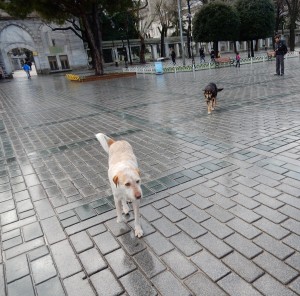
Below, you can see the street dogs of Istanbul. They are running, Street-dogs-T-300x296like old friends going out for tea, throughout the city. You see them waiting outside ‘their’ restaurant or Street dogs-Tattending careful watch at a back door with empty bowls beside it. Sure enough, patrons will emerge and offer their leftovers, and home owners will fill the little bowls much to the joy of the pooches. The dogs have little tags on their ears to connote that they have been given all shots necessary to insure health. They are friendly, clean, abundant, and often come nuzzling up under your hand for a friendly scratch.
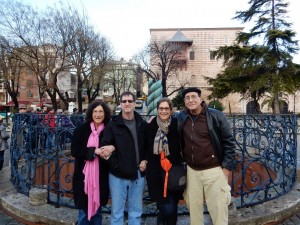
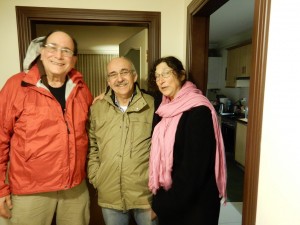
“Where do they live?” I asked a Turkish guide. “Oh they live on the streets, but everyone feeds and cares for them.” ‘OK,’ I thought, ‘that’s different.’ My brother in law who must walk their dog in Houston three times a day was passionately interested in spreading this pet care innovation.

My brother-in-law is much better looking.

It wasn’t until later that week.while reading more about Islam (Turkey is 98% Muslim) I ran across a law that prohibits Muslims from keeping dogs as pets. A law is a law, but there is no law that condemns caring for them communally, outside the home, and that is exactly what the people of Istanbul do.

OK, so what do these two religious traditions have in common? When they have secular desires, whether it is to wear a warm stylish fur hat, or have the companionship of a canine, they do not violate the law, but cleverly circumvent it. The Haredim turn the desired object into a sacred one. The Muslims of Istanbul maintain what is required within their homes, but expand their community to create a welcoming one for man’s best friend.

Do you know other examples of this wonderfully real ability to accommodate new needs within ancient belief systems?

– Judith Black

© 2016, Judith Black, story and illustrations, All rights reserved

Welcome to Istanbul, Not Constantinople

The Family: Intrepid Travelers

I just returned from a journey to Turkey and Israel. My husband is the kind of Jew who eats ham and cheese sandwiches on the synagogue steps on Yom Kippur. So, when he muttered, “I think Ineed to go to Israel,” I said “hold that thought” and got planning. Always wanted to go to Turkey, and once you are half way around the world, how far of a detour is it?

Michael, Ahmet (one of ‘his boys’), and Me

Ironically, it was himself who was able to provide us windows into both cultures. During the Vietnam War, Michael (the hubby) avoided the draft by working as a missionary in Turkey. (Don’t ask! OK, he primarily coached basketball, taught English and shot billiards.) His ‘boys’ now had bald pates and were at the far end of their careers, but many of them made us welcome in their homes and hearts. They were all Muslims.

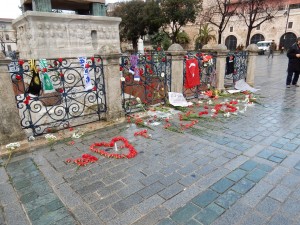
Site of terrorist attack in Istanbul one day before we arrived!

Though Ataturk dragged Turks into a modern, secular state, the nation remains about 98% Muslim. In the U.S. our exposure to Muslims is limited. They make up a mere 1% of the population. Since the Paris attacks, this small population has been exposed to heightened threats and violence. There has also been a rise in anti-Muslim rhetoric within the Republican party. The top Republican presidential candidates have compared Syrian refugees — most of whom are Muslim — to “rabid dogs,” toyed with the idea of a Muslim national database, and seriously In memory of attackdebated temporarily barring Muslims from entering the United States.

Site of terrorist attack in Istanbul one day before we arrived!

Here we were in Turkey, a place where we could actually experience a broad expression of Islam.

My sister and I took a long walk one day, getting quite lost from Fener, the small middle and working class neighborhood we were renting a home in. We turned a corner and every female around us was draped from head to toe in dark clothing and every man’s head was adorned with a kufi. I whispered to Rebecca, “I don’t think we are in Kansas anymore.” We continued to walk for another hour in this very orthodox neighborhood, and despite the fact that we wore western jeans and bore uncovered heads, not a single person, orally or physically, sneered at our very unorthodox ways.

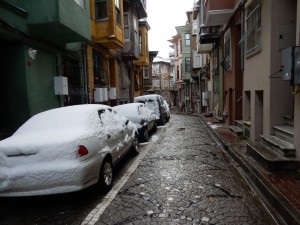
Snowy day in Fener
Snowy day in Fener

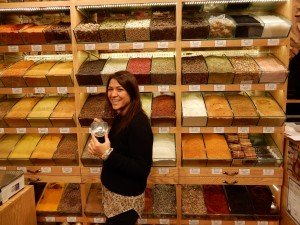
The next day we took a culinary tour with a lovely, bright, and very communicative young woman in a stylish skirt, long dark hair, and delicately applied make-up. I asked her what the most peevish thing was that happened on her tours.She replied immediately “Not just once or twice, but many times I have been told by westerners that I ‘don’t look Muslim.’ While in Turkey I learned what Muslim looks like.

Tour of a Turkish Spice Shop

Muslims are women in full Chadors, and Niqāb or burqa.Muslims are slim men in sharp European suits with dark, brooding eyes.

Muslims are teen aged girls with a shock of green running through their hair, hip huggers and shirts with
names of bands on them.

Muslims are men dressed in salwar kameez, with loose Turkish pants, flowing tops, and prayer caps, kufis, upon their heads.

Muslims are women in modest dress with head scarfs that cover their hair and neck.

Muslims are little boys in jeans and tea shirts, racing down the street.

Muslims are women in french high fashion, their heels clicking on the ancient stones.

Muslims are… as varied in dress as the broad range of humans representing any world religion.

This might well suggest, that were Americans to engage them, we’d also find them richly varied in thought, action, and the practice of religious traditions.

Ancient Cistern
Ancient Cistern

In this city of Istanbul, a Byzantine cistern, constructed in the 6th century, uses 336 columns, to hold up hundreds of curved ceiling pieces, resulting in both stability and breathtaking grandeur. Islam, whose origins reach back to same era, is practiced here in every shape and form. Like those columns they have learned to collaborate and tolerate one another so that they might hold up a united secular state. Why is this so difficult for the rest of us?

– Judith Black

© 2016, story and photographs, Judith Black, All rights reserved

Interview with Matt Pasca

MattThis is Matt’s second appearance in our pages and I hope we see more of him here. He’s a poet, teacher and speaker and I believe he’s someone to watch. On February 27, his second poetry collection, Raven Wire (Shanti Arts Publishing) will launch at Bay Shore, Long Island, New York.  For those living in that area, the details are HERE.

12718356_10153377544577895_4241506836986252048_n

Two of Matt’s poems are featured in the last issue of the zine. His work is refined, ambitious and precise. It exposes an intimacy with mythology, history, music and literature as well as a keen eye and ear for the complexities and pains of our post-modern times.

Matt demonstrates a sensitivity to the moral responsibilities of the artist and all human beings and an appreciation of social insults and human frailty that is intelligent and compassionate and able to be transformed by beauty. His work is not trite or cheapened by sensationalism or voyeurism. It invites one to read and reread to fully appreciate it.

The name of the book is a reference to the Norse god Odin’s ravens, Huginn and Muninn, thought and memory. The collection is divided into two sections, one for each category.

So … artists, I humbly submit, in addition to craft and toil, [we must] maintain a vigorous and sacred practice of Listening, becoming a receptacle that extends into the universe, hoping to return with something true. It is not Odin‘s ring, spear, or death-defying feats I wish to spotlight here, but his practice, our tether as humans seeking compassion and connection, wonder and wisdom…” Matt Pasca, Raven Wire


JAMIE: What first drew you to poetry at age eleven?

MATT: I was never much of a talker. I spent lots of time alone as a kid—just my hyper-awareness and a constant hailstorm of words banging off the windshield of my consciousness. Before writing, my only relief from the intensity of life’s stimuli was music. Then, yes, at 11, I discovered a word processing program on the Commodore 64 called Easy Script and fell immediately and unimpeachably in love with the process of making external what had been entirely internal. Not to be dramatic but it felt, as I typed, as if I were writing myself into existence—calmly, honestly and courageously, without shame or judgment or raised voices. Absolute freedom. I was hooked. As years passed and my process evolved, I learned how to hover while the external and internal intertwined and became not only transfixed by these conversations but spurred on to render them with potency.

As for the genre itself, I was around poetry often as a boy, but didn’t take much of a liking to it. I avoided it out of a sense of distaste and saturation, seeking out short stories and non-fiction instead. I remember thinking, “If there is James Baldwin in the world, why bother with poetry?” Even in Kenneth McClane’s wonderful verse-writing course at Cornell, I found poetry composition an arduous and frustrating endeavor. At some point in my late 20s, poetry suddenly “clicked” with me. It became all I wanted to write or read.

JAMIE: As you matured, what surprised you about poetry as both writer and reader?

MATT: In some ways, I think poetry finally “clicked” for me as an outgrowth of my passion for cinema. I had always loved the experience of being in a theatre, dreaming while awake—it felt familiar. When I became a trained projectionist at Cornell Cinema, the flames of my passion for film were mightily fanned. I spent countless nights up in that booth, mesmerized. I decided to sign up for a film class and was lucky enough to have the late Don Fredericksen as my professor. One day he taught a lesson on cinema’s early experimental filmmakers who said to hell with filming stage plays, let’s use this new technology to create something ONLY the film camera can do! During this lesson, we watched Leger’s Ballet Mecanique, a brief 15 minute film that capitalized on the basic principle that a huge screen and a zoom lens could create instant and utter defamiliarization. This made so much sense to me, and reminded me of how I had perceived the world even as a child: intensely, fragmentedly, impressionistically, with a different aperture and at a different speed. Poetry, in turn, more than any other genre, seemed perfectly equipped to provide me with Leger-like shortcuts to the creation of/expression of defamiliarized perception. I began to chase this as both as a writer and reader – the isolation of the familiar in a way that reframes and challenges, both artistically and emotionally. And me, with my long, detail-oriented attention span (perfect for both cinema and poetry), I do enjoy the infamously laborious process of sculpting a single page of defamiliarizing verse.

JAMIE: Your interests are quite diverse. They appear to me to influence your language and bring a multi-layered perspective to your poetry. Russian. Africana studies. Gospel music. Sports and travel. How do they move into your poetry?

MATT: I credit my family for fostering in me not only an aversion to rigid thinking but a relentless pursuit of others’ points of view. I was exposed, as a kid, to people from countries all over the world—ate their food, heard their accents, wanted to memorize the contours and colors of their flags. The more foreign a thing was to me, the more interesting it became; the more misunderstood a thing was by my more homogenous Long Island surroundings, the more sense it made to me; the more marginalized, the more attractive. Diversity is the hallmark of my cellular structure and every pursuit I undertake consists of new and dissimilar information. I don’t remember a time when I didn’t want to grab on to what I do not know and absorb it, walk around inside of it and get to know how it feels. A poet-friend of mine, Steven T. Licardi, writes in a poem about life on the autism spectrum, “Even numbers have feelings,” and I so get that. Everything seems to be alive and vibrating. As a word-lover/wordsmith, I find I want to upload every activity or subculture’s “lexical field”, to the point where a single new word or detail can trigger an entire poem. The interests I have stuck with the longest—baseball, social justice, music, travel—are also a kind of spiritual chiropractic; they align my rhythms and spaces and prepare me for poetry’s entry and excavation.

JAMIE: I think a lot of my readers will be interested to know how you carve out time for creativity with job, marriage, children, social commitments and so forth. What can you share with them that will assist them in their own work?

MATT: My wife (author Terri Muuss) and I get this question a lot and I have a few answers that may be of some use. First and foremost, my marriage is the engine that drives everything else, just as in a plane, car, ship or train. If you take care of your engine, make sure it fires on all cylinders, there is no telling what you can accomplish. (Astrologically inclined friends would say it’s because she is a Capricorn and I am a Taurus and, despite being wildly creative, neither one of us likes to be un-grounded or unorganized. Guilty as charged.) ☺ So back to the question—since, for both of us, parenting and job and marriage are non-negotiables, where do we find the time to run workshops, perform, curate, edit and write?

The simple answer, and my second point, is that we use what time we have rather than ruing its deficient quantity. We write in stolen moments at work, taking off in a plane, speaking into our phones while stopped at red lights, during faculty meetings. Once you start waiting for “enough time”, or the “right kind of time” to create, you are dead in the water. It simply won’t happen, unless you are willing to sacrifice your relationships or professional standing. Naturally, these stolen moments must be attended by some ongoing and suspended organizational system (i.e., somewhere to store the scraps and composted bits until there is time to assemble them)—that is what Dropbox, IClouds or folders are for. ☺

Thirdly, I feel I would be remiss if I didn’t offer a word about process. If one has only stolen moments here and there that require immediate generation and organization, one must be coherent and focused, with a writing process that precludes writers’ block or any notions of perfectionism. This tends to also preclude drinking and/or drugging, neither of which my wife and I do. There is no judgment in this, just a fact that does influence our ability to get so much done in so little available time. Rather than subscribe to the archetypal “artist mystique” involving inebriation and inordinate drama, we believe more can be accomplished creatively and perceptively when one stands in the honest space of clarity and fullness or brokenness, whichever is ascendant in the moment. It is hard not to get in one’s own way, but it’s awfully important to try. ☺

JAMIE: Our mutual friend, Michael Dickel, said in his interview that the job of a poet is to bear witness. You write in a different frame, so what to you is the poet’s job? What is the poet’s social and artistic responsibility?

MATT: Well I would agree whole-heartedly with Michael and posit, further, that there is no “other frame” than bearing witness in poetry. To the casual observer, there is ostensibly socio-political poetry and its more internal-leaning counterpart, but I don’t find this dichotomy convincing. No. A good poet friend of mine, Veronica Golos, once said in a Q&A, when asked, “Do you set out to write political poetry?” that she believed all poetry is political. I agree with her. The very paradigm of our individual perception at any given time is what creates our sense of reality as well as our response to it. Even bearing witness to how we witness is political.

At the micro level, how we learn to honor complexity and timelessness in an age bent on thumbs up/thumbs down exigencies and disposabilities is, ultimately, political. My hero in so many ways, James Baldwin, said, “One must know what is happening around them in order to know what is happening to them.” No, not everyone finds their way from the specific to the general, from the micro to the macro, but I believe deeply that peace begins with a more robust, nuanced and empathic perception that begins at the molecular level. This is the job of the poet: to listen, notice, pan for truth, scrape for justice and undertake the alchemic sculpting of language and space to illuminate and, hopefully, heal. In my ongoing effort to cure myself of ignorance, I want each of my poems to act as a dissertation highlighting and easing humanity’s tragic miscalculations.

review portion, Jamie Dedes; © interview responses, photograph and cover art, Matt Pasca, All rights reserved

Interview of Priscilla Galasso

unnamed-5JAMIE: I think you started with us in 2012, not long after initiating your blog, scillagrace. Your life at that time was very much in transition and you had quite specific goals for yourself and your blog. Where do you find yourself after the passage of almost four years?

PRISCILLA: My blog began as a sort of online journal of self-discovery. I had been widowed in 2008 and began a new relationship within the year. By 2011, my four children had moved out of the suburban home I’d kept for 19 years, and I moved in with Steve. I took more than a year off from any kind of employment as I worked through my grief in writing, reading, walking and talking with Steve. My goal in this transition was to learn to live gracefully, to face and accept life as it is. Now, four years later, I find myself still practicing that way of life, but with far fewer tears and fears. I feel more compassion, understanding and respect for myself and more eagerness to engage with the broader world.

JAMIE:You write the most remarkable essays, always well-considered. Logical! Always perfectly edited. What in life – education, teachers, friends, inclination – prepared you for this? I know you don’t do it for a living at this time, but writing certainly appears to be a natural endeavor for you, a kind of home-place.

PRISCILLA: I have to say that my writing style was probably most influenced by my parents. My father was a Harvard man of science, math, and letters and became an educational project director for SRA (a subsidiary of IBM before McGraw/Hill bought it out) and a technical writer for IBM. He helped develop national standardized tests for high school students and volunteered as a computer tutor later on. He was on a minor mission to teach young people how to think and write clearly. My mother was a Radcliffe English major and the volunteer editor of church newsletters and such. They probably had a critical hand in everything I wrote for school. When I was 15, I fell in love with the man who became my husband, and suddenly, I wrote poems and love letters in alarming abundance…and didn’t show them to my parents. I am still far more confident in prose and essay than in poetry and fiction, but learning to value my emotions and communicate them with greater facility and expression has become increasingly important to me. I am a sort of “recovering perfectionist” who is learning to love her feelings.

JAMIE: Since we are concerned in this issue with parents and parenting: I know that your parents – especially your mom – were quite accomplished. How did they encourage your moral and intellectual grown? How did you in turn foster good qualities in your children?

PRISCILLA: Moral and intellectual growth can be encouraged from the top down and from the bottom up. I have learned, however, that the “top down” style can lead to resentment and rebellion in spirited children! I was a compliant kind of kid, eager to please my parents because I was afraid of them to some degree. They espoused some rigorous moral and intellectual standards, and I did my best to meet them. As this was my model, I attempted to repeat it in the next generation. I discovered that neither my 3 daughters nor my son was interested in being that compliant, especially as teenagers! So, I have modified my approach. My mother is my enduring inspiration for “bottom up” encouragement and growth. She lives her values – positively, joyously, and with diminishing criticism and anxiety as she ages. This is much easier once your children aren’t living with you, though. I find that celebrating how we are maturing as equals is a lot more rewarding than policing behavior! Their good qualities continue to emerge and develop, as do most people’s, and my estimation of a “good quality” also is evolving. I had pride in the fact that they were quite accomplished as children, but now I know that they were not at ease with themselves and they developed some serious anxieties. My hope now is not that they will be “successful” in conventional ways. I hope that they will be happy, at peace, and continually growing in awareness and responsibility.

JAMIE: Over the past few years, you’ve been to several wilderness events and you are a great supporter of wilderness protections. What is/are you major concern/s and what are you doing to address your concern/s?

PRISCILLA: My major concerns for the health of the planet and its inhabitants revolve around the attitudes of human beings. We are way too arrogant and detached from the rest of the tree of Life, in my opinion. We have a penchant for “doing things” in the world instead of granting autonomy to other creatures and natural systems. We impose our will without compassion or understanding far too often. And this is especially dangerous because there are more of us than ever, demanding more resources for our growing technology. Our domination is reaching critical proportions; I don’t believe it can be absorbed much longer. This is why I think it’s of paramount importance that we preserve and protect wild land, places where we are not dominant, where we are merely visitors, places that can teach us humility.
What am I doing to address this? Trying to live an ethic of humility and harmony with the rest of the world and communicate that at every opportunity. So far this includes visiting wilderness areas, working for a conservation foundation, making political choices that support the environmental movement and becoming more mindful of habit and practice – like what I eat, what I buy and what I throw away. Steve and I are also operating a used book store online that is his only source of income, so we are in the salvage and recycling business. Steve is also researching a book on wilderness management philosophy and operation and developing his own blog, http://www.forthelastwolverine.com. This is sort of the way we are “parenting” together: modeling our values and putting our energy and resources into projects that can effect the future. But we may be poised at the brink of some radical changes in how the planet responds to our footprints, and we need to be ready to act differently!

JAMIE: You’ve had to deal with a lot of grief: the premature death of your relatively young husband and the tragically early death of your sister in a car accident. What have you learned about dealing with grief?

PRISCILLA: I am learning about suffering from the Buddhist perspective now. It’s a vastly different vantage point than the Western one. When my sister and I were in that car accident, I was not yet 17. Grief was something I wanted to “fix”. I wanted a remedy as quickly as possible. I was raised in a devoutly Christian family, and I plunged myself deeper into that doctrine. It was about having an answer, undoing the spell, reversing the consequences. My sister was in heaven; her death was somehow made “okay” at the end of the story. By the time I was 45, I’d been studying and teaching that story at higher and higher levels, but I was still afraid of death. My husband died at the age of 47. My life changed overnight, and I was terrified. The Christian story was played out in epic pageantry at his funeral, but I still had fears, anxiety, and suffering that I needed to deal with in real life. When I met Steve, he began to tell me about Buddhist philosophy and consciousness. It looks at grief and suffering head on. There’s no “fix”, no story. It’s part of the fabric of life: painful things happen. There’s no aberration; nothing’s gone horribly wrong. You have experiences, and you think about them, but you can decide how to think about them. It was like a veil lifted then. I had been told all my life what was the “right” thing to think, and it all had to do with that story. And now I realize it is just that, a story I decided to believe. So, I made a new decision to try to think in a different way. I think about suffering and grief as part of being alive. I’m not singled out in it or exempt from it. It just is what it is. A lot of added anxiety has unraveled since I started making conscious decisions about how to think. I have befriended grief and life, in a way. Grief has taught me that I practice attachment and aversion: I loved my husband fiercely and hated the idea of living without him. That kind of thinking caused me a lot of suffering. So now I try to practice appreciation and awareness. I still love my husband and appreciate the time I spent with him, and I know that life is lived in the moment and death is inevitable.

This slideshow requires JavaScript.

Interview of Corina Ravenscraft

c Corina Ravenscraft

JAMIE: Corina, you have been sharing the journey here almost from the beginning. I believe you may be our most long-standing contributor. Your work is always intelligent, well-considered and fresh. You are always supportive of this effort and of other contributors.

I’ve noticed over the years that your interests are broad. In fact what first attracted my attention was your artistic sensibility and your charming love of dragons. These combine well in your hands. Your dragons are beautiful  lovable creatures. How and when did your affinity for dragons start?

CORINA: Thanks, Jamie, for inviting me to be a part of such a worthwhile collective. It has been a real pleasure and honor to be among all of The BeZine’s talented, genuine and enlightened writers. As far as when my love for dragons began: growing up, my brother and I spent a lot of time with my maternal grandmother and sometimes stayed the night with her. I was always up a lot later than my brother, so my Gran used to tell me stories to get me to go to sleep.

Most of the time, they were Aesop’s Fables or Grimm’s fairy tales that she could recite from memory. My favorite of story was one that she completely made up one night when she couldn’t think of a story that I hadn’t heard. It was called A Dragon in the King’s Court and it was about a nice dragon who would rather make children laugh instead of being fierce and fighting knights for the King’s entertainment. She was a marvelous story-teller and the next time I stayed over, that was the story I wanted to hear (much to her chagrin! Haha! She had forgotten a lot of the story!)…but I was able to fill in all the details when she forgot. Later, came Puff, the Magic Dragon, Pete’s Dragon – Elliott, and of course, Tolkien’s Smaug. I was nine years old when I first read The Hobbit …and after Smaug, well…my heart was truly lost to dragons.

JAMIE: Art is apparently a tradition in your family. Your mom is an artist and I think she encouraged you in your art and in writing. I was touched that you shared poetry over lunch for “a poem in my pocket” during poetry month in April. Since our theme this month is parents and parenting: how did your mother nurture the artist and writer in you?

CORINA: My mom has always been my biggest fan and encouraged me in both visual arts and writing. I still have a hard time choosing “one master” to serve creatively, although writing has usually won most of my time. Aside from having just about any kind of art supply available to experiment with and a vast array of books to read, I also had an instant source of honest feedback on works that I attempted. Any artist will tell you that sincere feedback is crucial to exploring and growing in the craft. Mom was there cheering for me any time I succeeded (whether it was ribbons in school art shows or a Young Author’s award) and she was there to dry my tears and give me pep talks when I didn’t win and/or got frustrated. She has provided me with a safe, encouraging space to test my creative wings and learn to soar.

JAMIE: You have expressed a devoted interest in peace, social justice and environmental sustainability, but we all have to pick one or two things on which to focus. You seem to have chosen to focus on homelessness and animal welfare. No doubt the latter is the reason your place is home to several kitties. How did you arrive at your focus?

CORINA: I’ll be the first to admit that I spread myself far too thinly among my chosen causes, but those are certainly two of the most important to me. When you work in libraries, contact with the local homeless population is a given. The library provides a quiet building with running water, restrooms, lots of material to read and comfy places to relax. They are warm in the winter and cool in the summer. Over the years, I made friends with homeless people in several cities and learned their stories. Once you talk to them, they become real people that you can’t ignore or pretend don’t exist (not that I ever did that, but it’s easy to do because it’s something that makes most people uncomfortable). I discovered where the local shelters were located and what they were most in need of, and where people went when the shelters were full. I learned the depressing amount of women and children who become homeless in this country every day, and vowed to help as much as I could, whether it was volunteering time, or donating money, items, food or even supplying information to those who need it most.

Animal welfare is another cause that is near and dear to me. We always had various cats and dogs growing up, but I also found a deep respect for wild animals, probably because my step-father was a licensed falconer. He had many hawks, kestrels and owls over the years and taught me the beauty of wild things. My mother had a part to play in my love for wildlife, too, because she had a large “natural objects” collection full of shells, fossils, stones and bones, and she used to take us on hikes through the woods or fields. As I grew older, and read more about the plights of different animals around the world, I couldn’t escape the grim reality that all of them were suffering because of mankind. I decided that I wouldn’t contribute to hurting any of them if I was able, and that I would be a voice for those who couldn’t speak.

JAMIE: By day (now that you are not on the night shift), you work as a college librarian. Tell us about your job. What are the rewards?

CORINA: It’s hard work, but it’s satisfying. I love being able to help people, and my job allows ample opportunity for that. Like most library staff, I wear many hats – I have to know how to find the right information, but I also have to know how to fix computer problems or answer questions about various software programs, give directions (both within the library and on general campus), operate and fix most types of office machinery (printers, copiers, scanners, microfilm machines, etc.) and most importantly, provide informed, smiling customer service the whole time (Mid-terms and Finals weeks can make this last part a little…challenging). One of the biggest perks is that I am surrounded by knowledge, and by people who are learning and want to learn. It helps keep me young. 🙂

JAMIE:What are some of the things you still want to do in life?

CORINA: I’d love to travel and see some of the places on my “Bucket List” (Scotland, Ireland and the Grand Canyon, to name a few). I want to continue to write and perhaps someday publish an anthology of poetry, or maybe write and illustrate my grandmother’s story into a children’s book. Mostly, though, I tend to take life one day at time and make the best of each day. If I can leave this world a little better than I found it, then I will settle for that and be happy

This slideshow requires JavaScript.

Three by Ampat Varghese Koshy

I am autistic.
What about you?
Are you autistic too?

If you are
don’t tell.
They will look down on you.

How boring to be “normal” –
able to be and do –
How sad not to perceive with our eyes
our beauty and our truth.

*Based on her poem “I am nobody/ Who are you?”
This poem is a conversation between a father and son who is non-verbal, thus one-sided but one in which the father comforts the son who understands though he cannot speak.

Dad

Joe
whom you nursed back to health
when she had typhoid
when her back was broken –
so twice –
had a dream about you
that she was in your home
and you were laughing
said you were fine
and we were silly to mourn
cheered her up
even after you’ve left

A good dream

You were my father and hers
to make up for my
absence
to her, my daughter

I owe you
a double debt
one I can never repay
only
pay it
forward

Mother (Sara)

I still search
for your core
in me
knowing
it will
make me
win.

Though you left
your will remains
strong as warp and weft
of steel.

I still search
for that in me
to become steady
to make me
win.

– Ampat Varghese Koshy

© 2016, poem, Ampat Koshy, All rights reserved

Bullied to Insanity

Bullying_on_Instituto_Regional_Federico_Errázuriz_(IRFE)_in_March_5,_2007A Social misfit. He never fit in
Awkward movements and pasty white skin
They bullied him to a Life of Sin
Now he won’t take it

Never again

They had friends while he had none
They’d swing their fists and he would run
He cried in the dark, cried under the sun

And then he went and got a gun

Society says lets ‘Arm the Teachers’
Against these ‘Devils’ without a Preacher
When he walks in – we Shoot to Kill
Everybody up, lets Fire at Will!

Kill the kid who was Beaten down
Instead of teaching children all around
In his own blood, now he must drowned
Lessons learned?

Not a sound

We can beat this problem before it starts
If we pause and Think. Have a Heart
Move the killings down the chart
With knowledge that we can impart

Kill the Bully – mentality
Make social strides we all can see
It starts at home with You and Me
Teach kids to live in Unity

– Brian Crandall

© 2016, poem, Brian Crandall, All rights reserved; photograph courtesy of Diego Grez-Cañete under CC BY-SA 3.0 license

Into the darkness – a mugging

Myself whole in an alleyway,
breath and whispers
of darkness slowly entering,
entrapping. …
a pale loitering light off in the
distance, lurking like
an unwanted stranger. …
embolden souls approaching,
bidding- their hands as shadows
clinging; my heart like clay, crumbling. …

A gun waving one minute past darkness
enwrapped my soul in gloom-
no fair dreams to follow, now woven in
musings fright. …
their hands deep within
stealing a part of my existence. …
the Air in the alleyway unweaved
the night- miscreants of social injustice fled. …
me, slowly aging, scarred- now
searching for the feel of not to feel it.

– Lance Sheridan


image


© 2016, poem and phtograph, Lance Sheridan, All rights reserved

Walkin’ Home


WALKIN’ HOME

I’m walkin’ home tonight
The streets are glowing ‘neath the pale moonlight
I look around, there’s not a soul in sight
and I’m walkin’ home
Once again I hear my mother’s voice
and all us kids making a bunch of noise
If I’m not careful I might start to cry
Just walkin’ home tonight

I turn my head and hear the screen door slam
and there he is, that tall and dark-haired man
He looks my way but all alone he stands
and I am walkin’ home
He’s my Dad, you know I was his girl
He taught me all he knew about this world
and then he traveled right on out of sight
and I’m just walkin’ home tonight

I’m walkin’ home tonight
The streets are glowing ‘neath the pale moonlight
I look around, there’s not a soul in sight
and I am walkin’ home

Old worn-out couches and a bunch of kids
Four to a bedroom and all Mom’s plates were chipped
but I never knew about the things I missed
and I’m walkin’ home
You see, it’s just the place where I come from
and, good or bad, it’s where the deal was done
Mom and Dad, their daughters and their sons
and I’m just walkin’ home tonight

I’m walkin’ home tonight
The streets are glowing ‘neath the pale moonlight
I look around, there’s not a soul in sight
and I’m walkin’ home
Once again I hear my mother’s voice
and all us kids making a bunch of noise
If I’m not careful I might start to cry
Just walkin’ home tonight

Iris Dement

© words and music, Iris Dement

Christmas Fare

The caviar of death between bread,
that’s what we ate this Christmas –
black salt:
that’s what you spit,
what you pass,
what you eat raw,
what you become,
when we lay between bread and eat
it is our fare, our diet
how we must be between slices of life,
between ramming breadcrumbs in birds,
heating the oven for Christmas Dinner.

‘Not by bread alone’ –
black salt in your look
when I wake you with fatuous words,
‘It’s Christmas, Mother’.

Your concentration
your tar
between sheets,
hidden

Linen folds its think wink
over the slow black underground stream
that flows through,
marks your breath purple where it touches,
like salt thawing ice.

We say that you upstairs
are with us downstairs in spirit
as we eat meat and gravy,
duchess potatoes, broccoli,
baby sprouts, carrots,
Christmas Pudding,
mince pie,
double cream.

– Dilys Wood

©2016, poem, Dilys Wood, All rights reserved; excerpt from “Parents, an anthology of perms by women writers (Entharmon/Second Light), published here with the permission of writer and publisher

Soup and Slavery

Yes, I can hear you, father,
at the other end of the line you invented
for us to phone on after you died.
I can hear your prolonged throat-clearing
like fork tines dragged over grit,
know you’re preparing to speak.
I can even see the anger boiling up in your face
as I pull specked leaves from sprouts tighter
than fists, chop shining leeks into rings
for a soup I’m making to succour
the aged pair next door. Now you scald me:
Why are you making soup
for strangers when you wouldn’t cook,
wouldn’t take care of me?

I’m making soup
because it’s not a duty that traps me
rabbit-helpless between metal teeth,
because it comforts me in winter
to smell the sizzle of softened onions,
because it doesn’t occur to my old neighbour
to give in to shaky legs, shrinking body,
because he planed at his bench for years, grew
potatoes, gooseberries, sweet peas in his garden,
because he waits on his wife who’s enjoyed
almost a century of delicate health,
because I’ve seen four pans steaming on his stove,
because love fuels his willing slavery,
because he’ll call this soup a godsend.

All right, I knew you’d bark me down –
it wouldn’t be you if you weren’t top dog.
I can see you issuing instructions
up there as if you were still
in the Home, demanding special rights,
losing your temper with the cackhanded,
hounding the timid, passing judgement,
making up jokes for your favourites, offering
advice on finances, giving the thoughtful one
a cheque to buy panchromatic glasses –
oh I know your deep seam of kindness.

But I can’t forget the jug.
Jug? you boom. Yes, the white-lipped jug
painted with roses, not even half full,
the jug you complained was a burden
to carry upstairs so that your dying wife
could totter to the kettle in her room, pour
your afternoon tea – she whose picture
you idolized after her death.
That jug is lodged inside me.

Jug! you bellow but I cut you off.
When I choose I can reconnect
to you at ninety-three, alert, probing
theories of the universe, explaining
the more we know the less we know;
or I can listen again to the story
of that sleepless night in 1943
when you struggled to solve in your head
the mystery of the gas the Germans
had packed into powerful missiles,
the eureka moment flooding
like the moon on a frosty lawn,
feel proud you helped shorten The War…

Yes, I can hear you father,
am sad I didn’t cook you meals,
glad I’d slipped enough chains
to stay with myself. No need
to shout. Go back to bossing
the angels while I add a pinch of sage
and thyme to the barley-pearled soup.

©2016, Myra Schneider, All rights reserved; excerpted from
Parents, an anthology of peoms by women writers” (Entharmon/Second Light, 2000), published here with the permission of writer and publisher