This quarter’s theme at The BeZine is sustainABILITY: shaping uncertain future(s). How do we choose the best paths to sustain (broadly defined) the Earth (focused on the climate crisis) our lives, our children’s, and our grandchildren’s?
If you care about the future beyond your own mortality, it can feel overwhelming to think of all of the problems facing the next generations. I’m only one person, you might think. What can I possibly do that will make a difference? The thing is, we each can only control ourselves and our own actions. We cannot control what other people do or don’t do. It’s about personal responsibility and accountability. It’s possible to inspire others by our own actions. And when enough people take personal actions, it adds up. The oceans are formed one drop of water at a time. Change happens one action at a time. What’s that old saying, “Be the Change you wish to see in the world.”? One step, one action at a time, we CAN reach a sustainable future. Are you with us? 🙂
I bring the world with me,
In the choices I make.
I recycle because I care,
About the rivers, oceans, lakes,
See there, the giant gyres
Of our garbage and goop;
The world has quite enough plastic soup!
I bring the world with me,
When I
Refuse plastic straws,
So that turtles don’t die.
When I choose “Dolphin Safe”
For the tuna I buy,
To the snacks with Palm Oil on the label,
Goodbye.

I bring the world with me,
By becoming aware,
Of how my personal actions,
Affect the land, water and air.
Like how many bags
Of trash,
We each create?
Have you counted your number?
Care to speculate?

I bring the world with me,
Because we’re all connected.
Each action (or not),
A drop,
In a Change-fueled wave,
Any bad practice can be
Redirected,
For this world,
We bring with us,
It’s ours to save.
nobody could have predicted this
one existential challenge drops on top of another

much like the weather, seeing farther
than three days ahead seems unlikely

each time we think we have it sussed
events transpire to prove us wrong

even the birds couldn’t sing
drowned out by blaring horns

what winter's chill couldn't still
harsh diesel fumes conquered

cardinals, woodpeckers, sparrows
crows—all fled upwind to peace

wings gave them ability to flee
what human residents endured
Mob Rule, Ottawa 2022
the urge to do something positive overwhelms me
cabin fever drives me outside to winter's chill
I am greeted by diesel fumes and honking horns
an air-raid siren blares above them—deafening

holders of extreme, selfish views, from far and wide
descended on our city—we were warned
but prior groups had all been civilized
demonstrated, made their point and gone away

a vociferous minority, much less than one percent
holds hostage our daily lives, those in need
unable to obtain necessities or support
invaders speak of freedom while ensuring our captivity

our common enemies cannot be seen
neither the virus that has upended all our lives
nor the shambles we have created of the planet
so some lash out at targets they can comprehend

mythology they follow designed to bolster
sorry egos that desire power but warrant it not
the freedom they request applies only to them
they would deny it to the rest of us

how do a few coerce the many?
a question well-known in history
—expedient collaborators in the halls of power
emerge to take photo-ops—follow the money

augmenting the insult, local officialdom seems paralysed
police infiltrated by those of similar ideology
fearing to lose their privilege, feeling threatened
from all sides—women, minorities, the other

around the clock abuse accumulates with impunity
pets terrorized by fireworks augment the noise
local citizens the only ones fined or arrested
the insurrectionists enabled at every turn

driven by blind hatred or driven to take a stand?
when people blockade our streets, hold knives, clubs, guns
fully prepared to wield them against the innocent
do fine distinctions matter?

if we must descend into anarchy, for all our sins
against each other and the world, it would be easier
to bear if it was a natural disaster that sent us there
and not our fellow, imperfect human beings

lungs suffocated by fumes, ears deadened by cacophony
eyes weeping over obstruction and assault
I withdraw into my warm haven, to grieve democracy
not knowing when or if my positive outlook will return
Trust Fund for Tomorrow
a change of world is coming
we cannot stop it or even interfere
without precipitating its arrival
—it has been on its way a long time

symptoms of the upheaval
pile up daily—society's fringes
restless, rumbling, ranting
chanting conspiracy theories

will we avoid the lawlessness
that so often accompanies change?
our eroded infrastructure
might not cope with turmoil

I take heart in my fellows
whose forebears endured war
disease, oppression, hate
survived, remained strong

we are the world's trust fund
we are the reservoir of courage
we will resist anarchy, those who would
tear us down, and we will rise
…is a Canadian living in Ottawa, Ontario. A retired forensic scientist, when not writing, she tends a large garden. Her poetry has appeared in more than thirty print and online publications in Canada, the USA, the UK, and Australia, most recently in Bywords, The Elpis Pages, Silver Apples, WordCityLit and The BeZine.
In South-Central Pennsylvania,
the dogwoods are in full bloom.
Grass greens and wrens breed,
as bees zizz and aggregate pollen,
disturbing the allergies of women
and men. Un-garaged automobiles drive
into clouds of pollen flung like confetti.

But that was yesterday.
Today, the grass, birds,
bees, and people are bewildered
as the encrusted automobiles
emerge as fluffy featherbeds.
Mother nature halts her pursuits
to lament—to moan and weep.
…is a poet living in Pennsylvania, USA. His work has been featured at The BeZine Quarterly, Fevers of the Mind, Ink, Sweat, and Tears, Red Eft Review, Trouvaille Review, among others. He also is the editor ofEast Ridge Review, a new platform for poetry book and writer reviews.
Pete and Richard’s orange safety vests glowed a blinding light under the scorching sun, and their sweat dripped onto the pavement as they stood in the middle of the right lane on Highway 61, staring at an opossum lying stiffly on its side.
Richard handed Pete a dirty shovel. “Scoop it up,” he said.
Everything made Pete queasy. He once fainted at the sight of a moldy loaf of bread. Even so, he decided to take on a thankless summer job as a roadkill cleaner. At least he didn’t have to deal with many people.
Richard nudged Pete. “What are you waiting for?” he asked.
Pete squinted at the creature. “It’s not dead,” he said. “It’s just sleeping.”
“Are you sure?” Richard asked as he scratched his beard. He had one of those beards that looked like it would give a chainsaw a difficult time.
“Yes,” Pete said. “I just saw it twitch.”
Richard walked back toward the shoulder of the road and popped open the driver’s side door of a rusty pickup truck. “Alright, let’s go.”
Pete shook his head. “We can’t just leave it here.”
“It’s not our problem,” Richard said. “They tell us to do with the dead ones, but not the ones that are still alive.”
Pete crouched down and took a closer look. “We need to get it to safety,” he said.
Richard sighed and walked back toward the possum. “What if it wakes up and attacks us?” he asked. “That thing could have rabies.”
“I don’t think anything could wake it up right now,” Pete said.
Richard belched, “It’s an ugly son of a gun, isn’t it?”
“I think it’s so ugly that it’s cute,” Pete said.
“No one ever says that about me,” Richard said with a chuckle. “I guess I just haven’t crossed into that territory.”
Just then, a car sped by and swerved over into the next lane. Pete and Richard dashed out of the way.
“People drive like animals!” Richard said. “We’d better get going.”
Pete took a deep breath, slipped his gloves on, gently picked up the opossum, and carried it into the woods.
“What are you doing?” Richard asked. “Are you crazy?”
After nestling the possum into a bush, Pete smelled the scent of burning wood. He gazed out into the clearing and noticed a plume of black smoke billowing into the sky. The sparrows scattered away, and the trees stood with their limbs spread, as if they were about to be crucified.
“Jesus Christ,” Pete whispered under his breath.
Pete picked up the opossum and turned back around.
…is a Hawaii-born writer with a background in cinema. His stories appear in Reed Magazine, The Coachella Review, Maudlin House, Still Point Arts Quarterly, B O D Y, Ruminate, Wilderness House Literary Review, Flash: The International Short-Short Story Magazine, and more. His debut chapbook Tiny Universes (Selcouth Station Press, 2021) is available in paperback and e-book. He lives with his wonderful wife Kelly in St. Paul, Minnesota.
The day when God made Oceans,
The moment when Goddess touched the Sea,
Extraordinary motions set planet Earth free
By the love of God and her majesty, Goddess-Queen.
The light inside of me
is probably the colour of my soul.
The hands who help sometimes,
perhaps are sent from God.
Each time I fall,
some angels come to support me.
The light inside is probably my divine part.
I hope some day I will be sent like an angel to someone.
That should be our reason to live...
…is Bulgarian and writes poems in Bulgarian and English. She lived in Luxembourg and currently lives and works in Belgium. Dessy has publications in many Bulgarian magazines and newspapers, also in Romania, Belgium, USA, India, Peru, Philippines. She has 4 books in Bulgarian, 1 in English, and she has also compiled a book as translator from Bulgarian into English, an anthology of Bulgarian top authors. She writes about nature, love and God, and her accent is the positive message at the final. Member of Flemish Party for Poetry. Editor in Homagi International Web literature magazine.
I’ve had to cut down trees before. Trees that grew sick. Or a tree mauled by wet snow laid down so heavily and unseasonably, that branches enough to make a forest sheered away, stripping cambium and core alike. I fussed over a tree once so marked with the hammering of a hungry woodpecker that I wasn’t at all sure how the sap could flow. And then there were the two Canadian hemlocks that a new homeowner, eager for quick landscaping, had planted right on the foundation at the back. They bolted in their tenth year, doubling their height and girth. They would have buckled the house. They had to go.
I mourned them all. Yet, I am mourning this one more. For a lot of reasons. But because it was healthy, because it was senseless. Because it was a blue spruce. We had two blue spruce trees at the home where we raised our kids. When we moved, this spruce reminded me of home. But like the hemlocks, a previous owner had hurried the landscaping, planting it small right under the deck. They didn’t do the math as to how wide those branches would grow.
I let it climb, honestly who would not? I was going to let it grow.
I live in Southern Oregon, land of wildfires and droughts, wagon trains and the volcanic Mount Mazama from which formed Giiwas, Crater Lake. Last September, our town sparked the Almeda Fire, a fire that ripped through green spaces, forests, and neighborhoods alike. It marched at the direction of the wind, fueled by worsening summers of heat. It burned most fiercely all along the greenway of Bear Creek, as if to show us in no uncertain terms that climate change didn’t care about our embattled, remnant park. The mossy banks, the moist woods, the stream with water depth enough to shelter folks who jumped in to flee the fire—none of that was water enough. Not after 20 years of drought.
I live in Southern Oregon. I am used to smoke. The wildfire season stretches well into November, months longer than before the wagon trains, or when the Shasta and Takelma raised their children here. And this is nothing! Each year is warmer than the last, but all told this is the result of only just over 1°C warming. We are on track for 3-6° or more. We are on track to crush this life with heat.
So this summer, we took down trees. The city instituted new rules to keep neighborhoods fire-safe. The trees along the wooden fence line, trees and bushes near the house, they all had to go. The junipers. The spruce. The mock cherry cut way back. The manzanita. For two days the men with the chainsaws cleared, chipped and cut.
Those of us whose work intersects with climate change (which is all of us, now) may not all have listened, as I did, to the screams of the chainsaw. Yet nonetheless, all of us now are all too familiar with this sense of loss. Many refer to it is ‘eco-grief,’ a particular sadness arising from the loss and destruction of the natural world and ecological balance that supports our lives and next breath.
It was hard to see that spruce come down. Its trunk and limbs gone. There is nothing left to see. Not even a stump, as it was cut close to the ground. Yet it remains, in a way, for its roots are still underground, stretching out, alive with microbes, seeking water.
I have sat with it, making remembered space. From my spot with the roots I have a pretty good view of the whole front yard. From this seat I am surrounded by plants that, like the hemlocks, don’t belong here: beautiful lavender, gorgeous butterfly bush, a happy, orchard apple tree left from a homestead a hundred years ago. There is boxwood, bamboo, ryegrass, and clusters of daffodils. None of that belongs here.
I am grieving.
Yet. Where there is grief, can there be hope? I think there probably isn’t ever any hope unless there can be grief. First we have realize our loss. And, in seeing the truth, new choices can be made. The hard truth is, we cannot reverse the damage we have done. But the hope that rises from that truth is that the invitation for restoration is everywhere.
The invitation for restoration is in every perennial you plant, every habitat you enrich, every bird that can be protected, and every acre of land conserved. We have taken too much. We can turn, repent, restore. From now on, right now, we can pledge to heal ourselves, our landscapes and our earth. Mourn. Say a prayer. Make room for hope. And act on climate change.
…stepped into the world of climate organizing in 2015, when she joined the grassroots efforts of organizations such as Columbia Riverkeeper, Sierra Club, and Earth Ministries in the effort to keep massive fossil fuel infrastructure out of Washington State. She supported local efforts, and then attended, organized, and/or served as a mentor for multiple trainings through The Center for Earth Ethics at Union Seminary, the Climate Speakers Network, and The Climate Reality Project. Ordained in the United Methodist tradition, Rev. Fairhurst pastored churches in Washington and Oregon, served as a protest chaplain at the Occupy Wall Street encampment in NYC, went to Standing Rock, gratefully received training as Keeper in the Tagish T’lingit Peacemaking Circle tradition, and currently serves on the Creation Justice Committee for Ecumenical Ministries of Oregon and is a Co-Founder and served as Chair of the Southwestern Oregon Chapter of The Climate Reality Project. Climate is about much more than greenhouse gasses, it is about how we choose to treat our neighbors and God’s creation. At Circle Faith Future, Rev. Fairhurst acts in the role of Organizing Director and Steward of Creation.
This great tide of solar beginnings
Growth indivisible—beyond words
Such reawakenings
When we green ourselves
Sun spices everything stronger
A triumphant glare shows you
and her and the world wallows with us
all in now when life wells to a head.
Plant blooms bloom more
In a plethora of themselves
A grand annual rejoicing
When our faith strengthens
In silent joy that all is what it is
That we can be blooming now together.
…is a writer born in Berkeley who has been socially aware all her life. Years in Franco’s Spain only taught her more about group action and collaboration. Professor of American and teaching World literatures teach her how to live and love. Intensity is her middle name.
One of the greatest necessities…is to discover creative solitude.
Carl Sandberg
Sometimes one needs the silence, the solitude – if for nothing else than to meditate on where one has been, where one is now … and ponder where the road may lead to wander in the future.
Sometimes that silence, that solitude is chosen. A few weeks in a beach hut in Zorritos is always a wonderful tonic for me. To spend long hours soaking in the hot springs up in the desert hills. Hours wandering the beach. Hours swimming in the Pacific Ocean, feeling my muscles stretch with each stroke. Hours sitting on the bamboo porch, writing poetry – or swaying in the hammock reading.
Or anyplace along the Caribbean. That warm sea serenades my spirit. A home for meditating, creating poetry, exploring nature.
Sometimes, though, we are called from without to be in silence and solitude … called to re-learn the old ways, before internet and cell phones (which I don’t have anyways).
And such is my place in this present. A thousand kilometers at sea, surrounded by the Pacific Ocean. At night I hear its thunderous voice with the incoming tide. The wind rises, banging my door ajar wide open or closing it with a bang – a ghostly message to open my self to what is happening at that moment. Or a ghostly message to release my self of it.
Although the village is just a few kilometers away and its multi-colored lights serpentine across the night bay, here it is another world.
My few neighbors are scientists or students working to preserve these islands’ unique environment, and their flora and fauna. (Me – I’m here to preserve their work for future generations of investigators.)
Like the tourists, though, that flock here to gawk at nature’s bounty, we are here only for a while. We see specimens of that species Homo sapiens turiensis every day. Many colleagues walk or bike those several kilometers to interact with that world, only to return late at night on a dark road.
I prefer to be here at night. I prefer to sit out on the porch, watching the violently colored sunset over in that direction where the town lay. Venus is bright against that pallet. Then I watch the full moon rise above the long-extinct volcano’s slopes, now covered with wild vegetation. To wonder at the multitudes of stars dusted by the Milky Way, Mars bright red near Scorpio’s curling tail.
I listen to the sea, to the call of some night bird, the rustle of something unseen in the heavy growth of saltbush and espino.
Until the clouds begin to drift in off the bay. It is now time to repose, to drift away on that spirit serenade ….
Only to awaken with the dawning of a new day misted by the seasonal garúa and mockingbird melodies.
After a day of measurements and studies, of translations and writing reports, I often head to the beach near my temporary home.
At the gate, village youth park their bikes and head off, surfboards under arms. In these garúa months, the wind comes from the south, causing the bay’s waters to swell into curving waves.
I sit on the time-worn lava rock, watching those young folk bobbing in the platinum-blue waters. When a wave begins to rise, one paddles and catches it, riding the curl until it breaks into white froth.
Overhead fly blue-footed boobies. A yellow warbler hops amidst the purslane, pecking at the coarse soil. Behind me, an iguana sprawls, resting after his algae feast.
Or perhaps when I arrive, it is low tide (like it was today). Now it is a solitary beach, with only a few errant Homo sapiens turiensis taking photos of a pelican atop a mound of rocks, hunched against the chill breeze.
There is a silence broken by the shriek of an ashen-colored gull. A ruddy turnstone steps across these black fields, as does a whimbrel and over yonder, a dusky heron. Overhead, a boobie passes. A frigatebird circles over the shallows.
Carefully I step across the tumbled, fractured lava and peer into the tidal pools, at the life that is within. How many will find safe haven until the waters once more rise? A yellow warbler bathes in a small pool captured between algae-greened stones.
I take off my shoes. Feeling the rough sands of broken coral, shells and sea urchin spines beneath my bare feet, I begin to meld with the energy of this enchanted place. I merge my energy with its during qi chi chuan.
Doing Standing Five Elements, I feel the isles’ volcanic fire and the cool waters that wash this shore. Earth that slowly breaks down into soil, to accept the mangrove woods that take root. And finally the metal of minerals belched from the planet’s soul. Bringing all these energies into me, to balance me.
Then I Yang-dance more than a hundred postures across this coarse strand, shutting doors, grasping a grass sparrow’s tail, my hands waving like the clouds passing through this heaven, waving to Buddha …
Meditatively I close the session. The western sky over the village is awash with golden fuchsia. I gather my shoes in hand and walk barefoot to my temporary home to eat dinner under starlight, to the tidal music.
Silence and solitude is what this place gifts to me every moment.
Yet sometimes the silence deepens … the electricity may go out, plunging all in lava-black darkness. Not even those multi-color tourist hotel lights paint the bay.
Sometimes the internet fades away, cutting all ties with the outside world that lies beyond those clouds that bear garúa.
This is when I am reminded to return, to re-learn the old ways. To sit at the table on my porch, listening to the mockingbird song and the high tide, writing these words to share with you, to let you know that indeed I am still here.
Hope, I do, to be able to send this meditation to you from this island a thousand miles out at sea.
The earth has its music for those who will listen …
…is a documentary poet, translator and travel writer. Her works appear in over 300 journals on six continents; and 20 collections of poetry – including On Galápagos Shores (dancing girl press, 2019), Caribbean Interludes (Origami Poems Project, 2022) and Fire and Rain (Red Mare #18, 2019), a collection of eco-feminist poetry. She also authors travel narratives, articles and guidebooks. Her writing has been honored by the Parliamentary Poet Laureate of Canada (2011) and nominated for the Best of the Net. Caputo has done literary readings from Alaska to the Patagonia. She journeys through Latin America, listening to the voices of the pueblos and Earth.
We live within a society transformed by the consumer revolution. In the mid- and late 20th century, consumer products became widely available in the United States and Europe. When something breaks, the question may arise, repair it, or get rid of it and buy a new one? If it is cheaper to buy a new one, many people are reluctant to go through the hassle of trying to repair it. With material goods so abundant and cheap today, it is easy to throw things away. We discard clothing and appliances and buy new ones instead of repairing them, or throw away useable items because they are a few years old and maybe outdated by new products.[1]
People living in consumer society relate to material objects in a vastly different way than people did in previous times.[2] The decision whether to reuse or discard an object in part emerges from how a person relates to material possessions: as essential or expendable, indispensable or disposable. This is where Jewish tradition is so relevant today. Age-old Jewish teachings reveal a Jewish vision for ‘holy use’ of the material world which can reorient a person toward environmentally sustainable resource use. These teachings can deepen our understanding and inform our actions about a subject in which the Western world has recently taken an interest. We will explore how reuse of material objects contains physical benefits for people and the planet and spiritual fruits as well.
Jacob and Small Vessels
A teaching from the Midrash (rabbinic commentary on the Torah) sheds light on a Jewish ethic of sustainable resource use. Before the epic encounter between Jacob and Esau, Jacob brought his family and possessions across a stream. He returned at night to the other side of the stream, and the Torah narrates that: “Jacob remained alone.” The rabbis see the word “alone” (levado) as superfluous, and understand it as related to the similar looking word lecado, “for his vessel,” yielding, “Jacob remained for his vessel.” That is, say the rabbis, he re-crossed the stream at night to recover a few small vessels he forgot to bring across.[3] Why did Jacob, facing an imminent confrontation with Esau and his 400-man militia, leave his family alone and vulnerable at night to recover a few forgotten flasks? Why were they so important to him?
The seeming absurdity of Jacob’s action becomes understandable when one examines Jacob’s worldview: he believed that everything in his possession comes from G-d, has a specific purpose and must be used to its full potential. As one medieval commentary explains, each material item that a righteous person uses is a means toward a spiritual repair in the world.[4] Jacob went back for the vessels to ensure they were used in the optimal way. Had he not, their full potential would not have been realized. The truly righteous recognize the value of their G-d-given possessions, and are very careful with them, no matter how small or seemingly insignificant they are. While not overly attached to material things, they do not dispose of objects prematurely or use them inappropriately. Reuse is their message, not recycle.
Reuse as an Elevation of ‘Sparks’
Rebbe Nachman of Breslov offers a teaching, based on Kabbalistic sources, that can also help us understand the likely reason for Jacob’s actions. He writes:
…Everything in the world has in it sparks of holiness that fell at the time of the Shattering of the Vessels. “Shattering” is the aspect of letters that shattered and fell into each and every thing of this world.[5]
For every thing has its time: it must come at that time, to that person who shares the same root with those sparks in that thing. Thus, when that thing comes to this person, and he receives vitality from it–i.e., from the shattered letters that are there–through this the shattered letters are encompassed in this person, in his vitality. They become a complete entity, and infuse the vitality of the entire body. Through this the letters are restored and become complete. Then that thing must stay with this person, for him to use, until the letters and sparks that are associated with his root terminate. After this it leaves his possession for someone else; the time has come for the remaining letters to have an ascent. They share the same root with that other person and so depart for his possession.[6]
According to this understanding, an object comes to a person for the purpose of spiritual elevation. Reuse of a physical object enables a further spiritual elevation of the sparks of holiness within the object. The Talmudic sage Rabbi Yochanan ben Zakkai, on his deathbed, told his students to remove the vessels from his room lest they become contaminated by his corpse, and thereby unusable.[7] He acted so that others would be able to reuse the vessels after he died. In the 20th century, Rabbi Yaakov Kanievsky, the Steipler Gaon, instructed his children to straighten a bent nail and use it in building their sukkah so that it would not go to waste. By raising the sparks to Heaven, we also refrain from littering the earth. These examples show the relationship our Sages had with material objects, and the effort they invested in elevating the holy sparks in the objects.
Elevating Waste
The commandment of building a Sukkah (covered dwelling) is also relevant regarding reuse. The Torah instructs, “You shall make yourself the Festival of Sukkoth for seven days, when you gather in [the produce] from your threshing floor and your vat.”[8] Note that the verse links the festival of Sukkoth, whose primary mitzva involves living in the Sukkah, with the gathering in of produce from each Jewish farmer’s wheat threshing floor and wine vat. The Rabbis of the Talmud pick up on this linkage to make a further connection—that the agricultural refuse from the threshing floor and wine vat should be used as the covering (schach), the most essential part of the Sukkah.[9]
Rabbi Natan of Breslov explains a deeper meaning of the Talmud’s teaching.[10] The Sages teach that before the sin of eating from the Tree of Knowledge of Good and Evil, Adam did not produce waste because he fully assimilated everything he consumed. Rabbi Natan of Breslov notes that in the Garden of Eden, Adam and Eve were to eat fruit, but after their sin, people moved toward the level of animals by eating foods that grow from the ground, and having to work very hard to process grains into bread. The sin also led to a more animalistic way of life in which more waste is produced, unlike before the sin. We can repair the sin by showing we recognize that the agricultural waste from processing the wheat and grape harvest is not garbage. Rather, it can be used to create the Sukkah and enable celebrating within a holy space on the festival of Sukkot.
Material Goods in Modern Society
Reduce, reuse, recycle. What does this saying signify, and how does the Jewish tradition relate to it? The phrase contains within it a descending order of preference: first reduce, then reuse, and then recycle only as a last resort.[11] While recycling is often synonymous with ‘green,’ acts with far greater environmental impact are reducing what one uses in the first place, and reusing that which one does use.
In 1955, the retailing analyst Victor Lebow highlighted a trend in consumer society, away from greater mindfulness regarding possessions and toward a more short-term view. He wrote:
Our enormously productive economy…demands that we make consumption our way of life, that we convert the buying and use of goods into rituals, that we seek our spiritual satisfaction, our ego satisfaction, in consumption…We need things consumed, burned up, worn out, replaced, and discarded at an ever increasing rate.[12]
Western society ritualizes consumption, whereas Jewish practice ritualizes reuse. Jewish sources abound with examples of reusing ritual objects. The Torah notes that the copper firepans of Korach and his assembly were melted and reused to form the outer layer of the altar.[13] The Talmud records how two Sages, Rav Ami and Rav Asi, would reuse bread used in the ritual of making a courtyard eruv (ritual enclosure) for Shabbat by blessing over it and eating it. Concerning this reuse of ritual bread, Rav Ami and Rav Asi said, “Since one mitzvah was done with it, we should use it for another mitzvah.”[14] The principle these Talmudic sages state–of using a ritual object for multiple rituals–manifests in a number of other Jewish practices.
One example is a custom to use the myrtle from the lulav bundle (four species) of Sukkot as the pleasing fragrance for Havdala, based on the mystical tradition of the Zohar.[15] Many other examples exist.[16] What might be the reason for reusing ritual objects? Since one mitzva has been done with it, the object has been infused with holiness. In doing a separate mitzva, it is preferable to use such an object, because its elevated holiness will enable the second mitzva to be done at a higher level of sanctity.[17] The Jewish tradition therefore clearly contains instructions for reuse of certain objects, in this case for spiritual reasons.
The reuse of ritual objects contrasts with the trend Victor Lebow described above. Disposing of consumer items has only become more pronounced in the last half century, as material goods have become cheaper and more available. The cheapness of new products serves as a disincentive for incurring the cost of repairing an item that breaks. In America, one can purchase disposable barbeques.[18] In Jerusalem, entire stores are devoted to selling disposable products.
These are the consequences of a human society that does not fully assimilate that which it consumes – a disposable society. When one is accustomed to throwing out disposable dishes and to disposing of cheap electronic goods whenever they break, the value of material goods becomes diminished in one’s perception. Cell-phones, refrigerators, and cars can become disposable when the cost of buying a new one is less than the cost of repairing it. Such a lifestyle habituates a person to devalue things that do have value. Even relationships—of friends, parents, spouses—can be viewed as disposable within such a mindset.
Waste and the Planet
This perspective and way of living also has tangible, environmental consequences. While we usually think of mountains of rock and oceans of water, today we can speak of mountains of trash and oceans of plastic. The US Environmental Protection Agency reports that “In 2009, Americans generated about 243 million tons of trash and recycled and composted 82 million tons of this material, equivalent to a 33.8 percent recycling rate. On average, we recycled and composted 1.46 pounds of our individual waste generation of 4.34 pounds per person per day.”[19]
Let us examine what happens to some plastic waste– from bags, forks, plates, and bottles—which is not reused or recycled. After we throw it “away”, some of the plastic we use likely makes its way to the oceans. The United Nations Environment Program (UNEP) cites a 1997 estimate from the US Academy of Sciences that each year, humans put 6.4 million tons of marine litter into the oceans. The UNEP continues that “according to other calculations, some eight million items of marine litter have been estimated to enter oceans and seas every day, about five million of which are thrown overboard or lost from ships. Furthermore, it has been estimated that over 13,000 pieces of plastic litter are floating on every square kilometer of ocean surface.”[20] Huge patches of garbage and plastic have been reported in the Pacific and Atlantic Oceans.[21]
What impact does this marine debris have on ocean ecosystems? According to the U.S. National Oceanic and Atmospheric Administration Marine Debris Program, this debris entangles sea life, and harms marine animals such as sea turtles, seabirds, and marine mammals who come to eat the debris. Furthermore, marine debris can “damage important marine habitats, such as coral reefs. Many of these habitats serve as the basis of marine ecosystems and thus they are critical to the survival of many other species.”[22] Plastic waste in the oceans is thus not merely an eyesore for people, but a threat to a wide array of marine life. Humans depend on healthy marine life for food consumption. Indeed, some countries harvest from the oceans a significant percentage of their dietary intake.
Another example of waste from modern society is spent fuel rods from nuclear reactors that generate electricity. The nuclear crisis in Japan in 2011, following the Chernobyl nuclear accident of 1986, highlighted the risks involved in nuclear energy which produces nuclear waste. The New York Times reported that according to figures provided by the Tokyo Electric Power Company, which operates the six reactors at the Fukushimi nuclear plant, “11,125 spent fuel rod assemblies were stored at the site. That is about four times as much radioactive material as in the reactor cores combined.”[23] Since nuclear waste lasts for so long, it can never really be ‘disposed’ of, and must be stored. In Japan’s case, the waste was stored in a place vulnerable to earthquakes and tsunamis. In the United States, storage of nuclear waste also presents a challenge, and no long-term solution has been found.
In conclusion, how could it be that we generate so much waste? That brings us back to the small vessels– one plastic bag at the checkout stand, one plastic yogurt container– multiplied by decades of such consumption and now billions of people. Things add up. Jacob’s going back for two or three vessels teaches us that little things matter. In our consumer age the message has only become more relevant. Today’s abundance and affluence presents both an environmental and a religious challenge—of using the physical world in a mindful, holy way. May we live up to the task and leave our children a planet that testifies to the glory of its Creator.
1. The author would like to acknowledge Evonne Marzouk for her helpful editorial comments in developing this article. [back]
2. For more on this, see Waste and Want: A Social History of Trash, by Susan Strasser, Henry Holt and Co., 2000. [back]
3. Rashi to Genesis 32:25 based on Babylonian Talmud, Chulin, 91a. The Gur Aryeh (Maharal of Prague) on 32:24 says these were two or three very small vessels. Baalei Tosafot on 32:25 understand levado as hinting at lecado, “for his vessels.” The words are identical except for the letters bet and caf, which look very similar. [back]
5. According to Kabbala, when G-d created the world, the vessel was not able to contain the Light, and shattered into ‘sparks’ which are dispersed throughout the world. [back]
6. Likutei Moharan, section 54c, translation reprinted with permission from The Breslov Research Institute, Jerusalem. [back]
10. The following is based on Rebbe Natan of Breslov, Likutei Halachot, Choshen Mishpat, Hilchot Mekach u’Memkar, halakha 4, section 8, as taught by Rabbi Natan Greenberg and Rabbi Daniel Kohn of Yeshivat Bat Ayin. [back]
12. “The Journal of Retailing,” Spring 1955, p. 7, quoted in Durning, How Much is Enough? (1992) [back]
13. Numbers 17:3. The Talmud in Tractate Menachot 99a records how Rabbi Acha bar Yaakov cites this verse as the example of the principle of only using holy objects again for a more holy use. [back]
14. Babylonian Talmud, Tractate Berachot 39b and Tractate Sahbbat 117b, and Jerusalem Talmud, Tractate Eruvin 86:7. Such a practice of eating this bread after it has been used for the eruv chatzeirot (courtyard ritual enclosure) is codified in the Rama to Shulchan Aruch, Orech Chaim 394:2. See also Taz there. This practice is codified in Jewish law as a practice for Jews of European-descent. [back]
15. Shulchan Aruch, Orech Chaim, 297:4, based on Zohar, Parshat Vayhakhel, p. 94, as cited by Darchei Moshe to the Tur. [back]
16. Rabbi Shmuel Simenowitz provides other examples, based on the Zohar: “After Sukkos, an esrog is typically encrusted with cloves and used as ‘B’samin”—fragrant spices for Havdala. Similarly, the lulav is customarily used to fuel the fires in which the leavened bread is burnt before Pesach.” (“Water Conservation and Halakha—an Unorthodox Approach,” Compendium of Sources in Halacha and the Environment, Canfei Nesharim, NY, 2005, p. 52.) Rabbi Binyomin Adilman notes the following additional cases: “The old worn tzitzit fringes, when replaced, are used as bookmarks in Bibles. Olive oil from the Land of Israel is hung in the Sukkah as a representative of one of the seven species of the land. It is then saved to use for lighting the Chanukah lights. In addition, a small amount is squeezed out of the wicks, and is eaten six weeks later on Tu B’Shevat.” In the Mishnah there is a description of the Simchas Beis Hashoeva (Rejoicing of the Water Drawing), a celebration in which tall menorot (candelabras) were lit that illuminated every courtyard in Jerusalem (Tractate Sukkah 5:3). The wicks for these flames were made from the worn out garments of the cohanim, the priests who served in the Temple in Jerusalem.” See Rabbi Binyomin Adilman’s “Recycling in Jewish Tradition” about these examples and others. Available online at http://www.jewishvirtuallibrary.org/jsource/Judaism/recycling.html [back]
17. This explanation of the Talmudic teaching of Rav Ami and Rav Asi is based on the explanation given by Rabbi Adilman in his article cited above. [back]
21. Charles Moore, founder and research coordinator of the Algalita Marine Research Foundation, first reported on the Pacific Ocean patch in 1997. [back]
Spiritual ecology arises out of the need for a spiritual response to our present ecological crisis.
—Llewellyn Vaughan-Lee
These are the introductory words of Llewellyn Vaughan-Lee, a world renowned Sufi teacher, in his recently published book Spiritual Ecology. 10 Practices to Reawaken the Sacred in Everyday Life. He is one of the many examples of a spiritual mentor within the modern Sufi communities, who actively addresses the ecological problem, suggesting actionable ways to deal with and eventually solve the current environmental crisis.
This awareness of the importance of nature goes way back into the past of Sufi tradition.
The 9th century Sufi mystic Ali Al-Khawas, who was even quoted by Pope Francis in his environmental-encyclical Laudato Si, wrote that:
The initiate will capture what is being said when the wind blows, the trees sway, water flows, flies buzz, doors creek, bird sings, or in the sound of stirring flutes, the sighs of the sick, the groans of the afflicted.
—Ali Al-Khawas
The universe unfolds in God, who permeates it in all its manifestation, including every aspect of nature. “Hence,” said Pope Francis, “there is a mystical meaning to be found in the leaf, in a mountain trail, in a dewdrop, in a poor person’s face.”
A key figure for the development of some Sufi lineages was the Muslim philosopher Shihab al-Din Yahya Suhrawardi.
Born in Iran in 1154, Suhrawardi founded his own school of philosophy and was probably executed in 1191 because of his unorthodox teachings. “Suhrawardi´s unification of Neoplatonism and Mazdeism finds expression in the conception of an animate universe” where everything is conceived as being the manifestation of the light of God.
The concept of an animate universe in his illuminationist philosophy plays an important role in the new age world as well as in modern spiritual ecology movements. Through the integration of the neoplatonic concept of the “chain of beings”, in which all creation is a successive effluence from the original Supreme being, or in Suhrawardi´s words the Supreme Light of lights (Nur al-Anwar), Suhrawardi builds a bridge between the transcendental God and Nature by showing that all manifestations on earth have an underpinning, an archetype in the world of pure light. Suhrawardi´s universe is inherently alive and sacred.
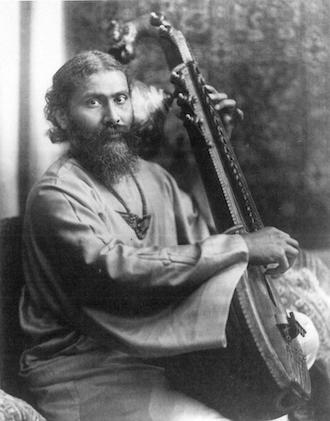
Hazrat Inayat Kahn, founder of the Inayati Order
Contemporary to Suhrawardi, another important Sufi Teacher appeared in 12th century India: Mu´in al-Din Muhammad Chishti. Born in 1142 in Sistan, Chishti founded one of the most influential tariqas (Sufi school) of India, the Chishtiyya. Although his theology differed widely from Hindu teachings, he shared the common view amongst yogis, that of the “vital livingness of the elements and the status of the human form as a microcosm encapsulating…the whole universe.” The Chishti-Sufis understoode teachings of the Qur’an about elements as alive and worthy of deep respect. At the same time, the human body was considered as the microcosm reflecting and encapsulating the macrocosms.
A modern Sufi teacher and actual spiritual leader of the Inayati Order is Pir Zia Inayat Khan. He regards the current ecological crisis as “a unique and compelling factor in contemporary mysticism.” Modern spiritual schools cannot avoid dealing with environmental problems as they are a reflection of a “spiritual crisis”. According to Pir Zia Inayat Khan, the spiritual answer to the ecological crisis lies in the acknowledgment of the sacredness of nature and of the environment. Spiritual practices are essential in this. Rites and prayers can potentially lead the practitioner to a state of communion with nature and help to attune them with the environment in a contemplative way.
Together with other religious leaders, Pir Zia Inayat Khan and Peter Lamborn coined the term “Green Hermeticism”. Green Hermeticism aims to reintegrate alchemical and Hermetic knowledge into modern ecology. According to Wilson, it can be understood as a “specifically green form of spirituality, that provides a much -needed sacred theory of Earth, the body, and Nature.” Its intention is to be a holistic approach to the environmental crisis, where “science transcends and erases all separations such as inner and outer, spirit and matter, divine and human, earthly and heavenly.”
But the ecological legacy of the Inayati Order is older than the Green Hermeticism and goes back to its founder, Hazrat Inayat Khan. According to his teachings, “there is one Holy Book, the sacred manuscript of nature, the only scripture which can enlighten the reader.”
Nature takes a central position, in Khan´s worldview, as the source of true knowledge: “to the eye of the seer every leaf of the tree is a page of the holy book that contains Divine Revelation.” According to Khan, we can gain direct knowledge of life by ‘reading’ nature. Nature for him is the ‘place’ where we can find ‘truth’. This is why Hazrat Inayat Khan – and Sufism today – regards the conservation and protection of the natural environment as a spiritual priority.
Tanja Mancinelli, Interfaith Minister from the Inayati Order, has a background in Biology and Religious Studies. Presently she is doing an internship at the Interfaith Center for Sustainable Development (ICSD).
For other faith’s statements on the environment on the ICSD Website, please click here.
ICSD works on a global basis, with current engagement in Africa, the Middle East, North America, and Europe.


















 The BeZine
