Posted in Buddhism, Guest Writer

Ashok Zamon is a spiritual explorer and freelance writer living in Shanghai who, in this detailed post, brings us a view of the ancient practice of Buddhism as it is rekindled in modern China. For those readers who are not entirely familiar with Buddhist concepts, this well-written feature incidentally provides excellent definition of mindfulness. The post includes stunning and evocative photographs by Mr. Zamon’s partner, Anya.

The blog is just three months old and already contains a wealth of information and insight. I’m grateful to have “Into the Bardo” as a means to provide an introduction to “The Beyond Within” and it’s very excellent writer. J.D.

ashok z's avatarThe Beyond Within

I was going to blog from the temple, but of course it ended up panning out differently. It was a wonderful weekend and it’s great to see how things are progressing there. The last couple of days I’ve been putting together the piece for Vantage Magazine, and here is the draft that I’m turning in. It’s a bit of a rewrite of the Emergent Buddhism piece for a more public audience. We’ll see what the editing process will do to it. I had to take a knife to it myself and cut about 500 words, always a hard thing to do. Hopefully Vantage will just tidy it up a bit and help it flow. It’s obviously for a more mainstream audience, so there were many aspects that I could only really allude to rather than express directly, and plenty of details that I had to leave out all together, but hopefully…

View original post 1,673 more words

Posted in Ann Emerson, Buddhism, General Interest

A LITTLE GIFT FROM ANN …

SMILE!

It’s good for your spirit.

Ann found this photograph on CatalystYogi.

Posted in Buddhism, Jamie Dedes, Poems/Poetry

THE TRANSFORMATION OF THINGS

Zhuangzi Dreaming of a Butterfly by Lu Zhi (1496–1576), Ming dynasty, mid-16th century Ink on silk, 29.4 x 51.4 cm

THE TRANSFORMATION OF THINGS

by

Jamie Dedes

A Man sleeping … yes!

A Butterfly flitting… yes!

Zhuangzi, dreamer of Butterfly,

ponders what joy there might be

in that tiny Butterfly brain, so small

too small to be perceived by I or eye

Is it dreaming me? he asks

Or, am I dreaming it?

Imagine the Universe engaged,

he thinks to himself, inside that flutter

– thunder, a Cosmic Belly Laugh –  Ho! Ho! –

Then Zhuangzi knows: He is silent

flitting from flower to flower in eternal spring

coming and going, going and coming

This is called the Transformation of Things

·

© poem, 2012 Jamie Dedes, All rights reserved

Photograph courtesy of Gemeinfrei, in the U.S. public domain.

Posted in Art, Buddhism

BUDDHIST ART: Animals

Video uploaded to YouTube by  

Extremely high quality Thai Buddha Head  from the Ayuthaya period. More finely cast and more artistically sculpted than most of the pieces created during that time. Loss of the earlobes, but otherwise a truly striking piece. The curator of The Buddha Gallery

One of his students asked Buddha, “Are you the messiah?”

“No,” answered Buddha.

“Then are you a healer?”

“No,” Buddha replied.

“Then are you a teacher?” the student asked.

“No,” Buddha replied.

“Then what are you?” The student was frustrated.

“I am awake,” replied the Buddha

Posted in Book/Magazine Reviews, Jamie Dedes

NINE GATES: ENTERING THE MIND OF POETRY

NINE GATES: ENTERING THE MIND OF POETRY

by Jane Hirshfield (b. 1953, American) author and poet

Review by: Jamie Dedes (Musing by Moonlight)


An award-winning author and poet, Jane Hirshfield has published seven collections of poetry in addition to  Nine Gates: Entering the Mind of Poetry, a collection of essays. Her most recent book of poetry is Come, Thief (August 2011). In collaboration with Mariko Aratoni, Hirshfield edited and translated four volumes of poetry by women of ancient Japan.

Ms. Hirshfield is a Zen Buddhist and her practice informs her work with spiritual insight and delicate nuance.  She has said, “It is my hope that the experience of that practice underlies and informs [my poetry] as a whole. My feeling is that the paths of poetry and of meditation are closely linked – one is an attentiveness and awareness that exists in language, the other an attentiveness and awareness that exists in silence, but each is a way to attempt to penetrate experience thoroughly, to its core.” [The Poetry Foundation]

Nine Gates: Entering the Mind of Poetry (September 1998) is a series of nine essays that were written by Jane Hirshfield over a ten-year period and published or presented at poetry events.

*****

Gates are a means of exit and entrance, providing connection between the inner and the outer.  The premise of Hirshfield’s book is that the art of poetry is the gate by which we are offered  “mysterious informing.” Nine Gates is at once a primer for the reader and a manual for the writer. This is a book that is reverent of art, artist, and life. All is sacred ground.

The book begins at the beginning – the root of poetry – concentration.  “By concentration, I mean a particular state of awareness: penetrating, unified, and focused, yet also permeable and open.” As she says, this is Huxley’s “doors to perception” and James Joyce’s “epiphany.”  It is what I would call sacred space, and this focus, this concentration, “however laborious, becomes a labor of love.” In this chapter, I particularly appreciated the short discussion of voice: writers whose ear is turned to both the inner and outer have found their voice and thus are able to put their  ”unique and recognizable stamp” upon their work.

The book closes with “Writing and the Threshold Life” and a discussion of the space into which a writer withdraws, liminal space.  The writer, she tells us, becomes like the monk giving-up identity and assumptions. . “The person [in liminal state] leaves behind his or her identity and dwells in the threshold state of ambiguity, openness, and indeterminacy.” This is all rather like the person going through a ritual transitions. Only after transition to this liminal space, neither here nor there, is community wholeheartedly embraced. To see clearly and to embrace the whole without judgment, one has to be free of the standard cannon and the received wisdom.  The idea being that the creative life is one that gives up the ordinary conventions, which is the price of freedom.

Encased between the two portals of concentration and the threshold life are discussions of originality, translation (what we learn from the poetry and linguistic traditions of others), “word leaves” (images), indirection (the mind of the poet circles the poem), inward and outward looking, the shadow side of poetry (between the realms of heaven and hell), and poetry as a “vessel of remembrance.”

The book’s range is broad, using poets and their wisdom from ancient times to modern and from East to West. The essays are at once a delicate lace and a sturdy practical homespun. All is approached with respect, clarity, and intelligence. Each chapter is a gentle nudge toward more authenticity, greater truth, deeper spirituality. In her introduction, Jane Hirshfield says that because the essays were written at different times some themes and quotes are repeated and removing the repetitions proved impossible. I felt the repetitions served to reinforce. I was grateful for them. If I have any difficulty with this book, it was the conflict between not wanting to put it down and wanting to put it down to start writing in the spirit of entering the mind of poetry. A definite thumbs-up on this one.

·

Essay ~ © 2011, Jamie Dedes, all rights reserved

Cover art ~  © publisher, posted under fair use

·

Posted in Guest Writer, Perspectives on Cancer

PERSPECTIVES ON CANCER #31: Isolation

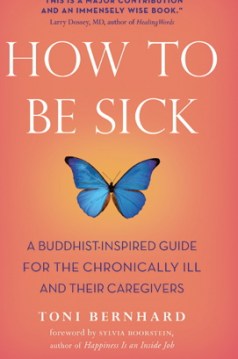
Although this book concerns living with chronic illness … which may not be life-threatening but is certainly quality of life-threatening … many of the issues Toni Bernhard discusses are relevent issues for cancer patients. Not the least of these issues is isolation. The book is available online through Barnes and Noble and Amazon or through the publisher HERE. Three thumbs up on this one. A recommended read. Jamie Dedes

HOW TO BE SICK:

A Buddhist-Inspired Guide for the Chronically Ill and Their Caregivers

by 

Toni Bernhard

“All human beings need the company and support of others. We create our world together. But community can be a tremendous challenge for someone who must spend a lot of time in bed or must suddenly take to bed in spite of plans to be with others. The Dharma places a very high value on community, which is called sangha. The word originally referred to the disciples of the Buddha. It then evolved to include Buddhist monks and nuns. Today sangha refers to the entire spiritual community that supports a practitioner . . . .

“Before I got sick, I was active in several Buddhist sanghas. I co-hosted a weekly meditation group with Tony [Toni’s husband]. We used a local meeting hall every Monday night. At least once a month, I would lead the sitting and then give a talk. We also hosted a monthly group at our house in which we discussed Dharma readings that Tony and I chose and distributed each month. The readings were the starting point for a spirited and often humorous two hours of reviewing our lives since we last met. This was sangha at its richest for me. Tony still hosts this group at our house.

“When I got sick, I could no longer participate in these activities, even though the meeting hall is three blocks away and the monthly group is a room away . . . . In addition to losing this precious source of spiritual support, I had to adjust to the social isolation that accompanied the illness like night follows day.

“‘It’s hard to distinguish between the effects of my illness and the effects of isolation,’ wrote a member of an online support group for people with an illness similar to mine. I, too, have days when the isolation feels like the illness itself. People who are house-bound are not just isolated from one-on-one personal contacts. We are often isolated from nature and even from the warm feel or a friendly crowd. Our best bet to see the changing seasons is on the drive to and from a doctor’s appointment, but this is often a stress-filled outing. Similarly, our best bet to be in a crowd is in the waiting room at the doctor’s office—not the most comfortable or uplifting of settings. I recently read a blog entry from a woman with chronic fatigue syndrome in which she said she went to get a blood test a week early just to be around people.”

© text and cover art, Toni Bernhard, 2011 all rights reserved. Blogged here with the permission of the author. No reblogging without Toni Bernhard’s permission.

Video uploaded to YouTube by . I’m the author of “How to Be Sick: A Buddhist-Inspired Guide for the Chronically Ill and Their Caregivers” (Wisdom Publications 2010). The theme of the book is that illness and wellness are not mutually exclusive. Our bodies may be sick or otherwise disabled, but our minds can be at peace. For reviews and other information, including where you can order the book, please go to How To Be Sick.

♥ ♥ ♥ ♥

Toni Bernhard fell ill on a trip to Paris in 2001 with what doctors initially diagnosed as an acute viral infection. She has not recovered. In 1982, she’d received a J.D. from the School of Law at the University of California, Davis, and immediately joined the faculty where she stayed until chronic illness forced her to retire. During her twenty-two years on the faculty, she served for six years as Dean of Students.

In 1992, she began to study and practice Buddhism. Before becoming ill, she attended many meditation retreats and led a meditation group in Davis with her husband.

She lives in Davis with her husband, Tony, and their hound dog, Rusty. Toni can be found online at How To Be Sick. [Bio courtesy of Wisdom Publications.]

Posted in Jamie Dedes, Perspectives on Cancer, Poems/Poetry

PERSPECTIVES ON CANCER #29: Nothing

NOTHING

by

Jamie Dedes

·

no buddha, no bodhi tree

no earth upon which to sit

in silent meditation

no suffering, no not suffering

nothing

rest assured

·

© poem, Jamie Dedes, 2011 all right reserved

Photo credit ~ Photo credit ~ A small temple beneath the Bodhi treeBodh Gaya, built in 7th century, after the original built by King Ashoka in 3rd century BCE, ca. 1810, British Library, public domain photograph via Wikipedia

♥ ♥ ♥ ♥

Jamie Dedes ~ is a former freelance feature writer and columnist whose topic specialties were employment, vocational training, and business. She finds the blessing of medical retirement to be more time to indulge in her poetry, creative nonfiction, and fiction. She has two novels in progress, one in final edits, and is pulling together a poetry collection. Her primary playground is Musing by Moonlight. She is the founder and editor/administrator of Into the Bardo. Jamie’s mother was diagnosed with cancer the first time at thirty-six. She went three rounds with breast cancer, one with thyroid cancer, and died at seventy-six of breast and colon cancer.

Posted in Buddhism

BUDDHIST GLOBAL RELIEF: Walk of Compassion

Ven. Bhikkhu Bodhi

Found of Buddhist Global Relief

The gift of food is the gift of life. ~ The Buddha

Buddhist Global Relief 2nd Annual Walk to Feed the Hungry

3.5 mile walk • Saturday, September 10, 2011
9:30 a.m. Check-in • 10:00 a.m. Walk • Rain or Shine!
Riverside Park, W. 83rd St. & Riverside Dr., New York, NY
(Please register by September 1st)

-BHANTE BUDDHARAKKHITA: WALK LEADER
-GUEST SPEAKER: MICHAEL ROEHM, BGR Adviser
-FREE VEGETARIAN PICNIC LUNCH AFTER THE EVENT!

Today we can send men into space, but here on earth chronic hunger and malnutrition still cast their shadows over the heads of far too many people, claiming ten million lives a year, more than half of them children. Though we may never know or see these folks, we should recognize that they are human beings just like ourselves, worthy of our deepest concern. Together we can make a difference, and it doesn’t take much to help them live in dignity and hope! All proceeds from the walk will go to support BGR’s global hunger relief programs. MORE

Photo credit ~ Bhikku Bodhi, American Buddhist monk, taken in 2003 by Ken and Visakha Kawasaki licensed under the Creative Commons Attritution-Share Alike 3.0 via Wikipedia.

Posted in Teachers, Tibetan Buddhism

OUR HYPERLINKED WORLD

Commercial interests with their advertising industry do not want people to develop contentment and less greed.  Military interests in economic, political, ethnic or nationalist guises, do not want people to develop more tolerance, nonviolence and compassion. And ruling groups in general, in whatever sort of hierarchy, do not want the ruled to become too insightful, too independent, too creative on their own, as the danger is a threat that they will be insubordinate, rebellious, and unproductive in their alloted tasks. Robert Thurman

Robert Thurman holds the first endowed chair in Buddhist Studies in the West, the Jey Tsong Khapa Chair in Indo-Tibetan Buddhist Studies. After education at Philips Exeter and Harvard, he studied Tibet and Tibetan Buddhism for almost thirty years as a personal student of His Holiness the Dalai Lama. He has written both scholarly and popular books, and has lectured widely all over the world. His special interest is the exploration of the Indo-Tibetan philosophical and psychological traditions with a view to their relevance to parallel currents of contemporary thought and science. Columbia University, Department of Religion

Robert Thurman won the TED (Technology, Entertainment, Design) Prize in June of 2007. In addition to that and the accomplishments listed in his Columbia University bio above, he writes for BeliefNet and cofounded Tibet House in New York, which is dedicated to preserving Tibetan culture. One of his more recent books is Why the Dalai Lama Matters, subtitled “His Act of Truth as the Solution for China, Tibet, and the World.”

In the video below, the acceptance presentation for the TED Prize, Dr. Thurman talks about our hyperlinked world. He describes a world in which we can know anything at any time. This means that we are always aware of the suffering of others and cannot ignore our inter-relatedness. We cannot ignore the misery of others. He suggests that this is in effect a mass enlightenment and a step toward Buddhahood. J.D.

Video posted to YouTube by .

Photo credit ~ Robert Thurman courtesy of Tenzin Nyima licensed under the Creative Commons Attribution-Share Alike 2.0 Generic via Wikipedia. The lotus illustration below is from PD Clipart.org.

Posted in Meditation, Teachers

THE GARDEN OF MY HEART

Thich Nhat Hanh (b. 1926) Zen Monk, Dharma Teacher, Social Activist, Writer, Poet, Peacemaker

Nhat Hanh is now recognized as a Dharmacharya and as the spiritual head of the Từ Hiếu Temple and associated monasteries. On May 1, 1966 at Từ Hiếu Temple, Thich Nhat Hanh received the “lamp transmission”, making him a Dharmacharya or Dharma Teacher, from Master Chân Thật. MORE [Wikipedia]

Though a Zen Buddhist monk, Thich Nhat Hanh combines traditional Zen with techniques from Theravada Buddhism, the wisdom of the Mahayana tradition, and ideas of modern Western psychology to teach meditation and spiritual values and practices in a way that resonates for people from diverse religious, political, and cultural backgrounds. He is a writer, poet, and peacemaker with over 100 books published (many in English). He was suggested for but never received the Nobel Prize for Peace by Dr. Martin Luther King, Jr. Since 1966, Thich Nhat Hanh has lived in exhile in France. Based at Plum Village, a meditation community in the south of France, he is a leading Buddhist teacher, encourages engaged Buddhism (a movement for social activism that he founded), and conducts humanitarian efforts.

Thich Nhat Hahn coined the term “interbeing,” a pointer to the Buddhist principles of impermanence and nonself, which bring light to the idea and ideal of the inter-connectedness of all things. He founded The Order of Interbeing, the members of which include lay people. Link HERE to brief summaries of each of the fourtheen mindfulness trainings of the Order of Interbeing. J.D.

“If in our daily lives we can smile, if we can be peaceful and happy, not only we, but everyone will profit from it. If we really know how to live, what better way to start the day than with a smile? Our smile affirms our awareness and determination to live in peace and joy. The source of a true smile is an awakened mind.”

~ from Peace is Every Step by Thich Nhat Hanh

Here is  a meditative interlude. The title of this post is a quote from the meditation, which is an excerpt from an album called Graceful Passages: A Companion for Living and Dying. It features spiritual teachers from many traditions offering advice to the dying  –  in other words, advice to all of us.  Today and everyday : in metta, A.E., R.R., J.D.

Video posted to YouTube by .

Posted in Book/Magazine Reviews, Jamie Dedes

BROAD MARGIN

MAXINE HONG KINGSTON (b. 1940)

Chinese-American Author, Poet, Peacemaker, and Professor Emeritus of University of California at Berkeley, California, U.S.A.

Photograph courtesy of the CitySon Philosopher. Taken at Kepler’s Books, Menlo Park, California, U.S.A.

Keep this day. Save this moment;

Save each scrap of moment; write it down.

Save this moment. And this one. And this.

I Love a Broad Margin to My LifeMaxine Hong Kingston

AN EVENING WITH MAXINE HONG KINGSTON

by

Jamie Dedes

I suspect that when many of us think of Buddhist influences on American literature, the first writers we think of are the Beats, but there are also very fine contemporary writers: Maxine Hong Kingston, Lan Cao, Anne Waldman, and Charles Johnson among others. Hence, I was delighted when, as part of the two-week-long celebrations of my sixty-first birthday, the CitySon Philosopher took me to dinner at Cafe Barrone and afterward next door to Kepler’s Books – a favorite among family and friends, the local independent – to hear Maxine Hong Kingston talk about her new book, I Love a Broad Margin to My Life.

Story gives form and pleasure to the chaos that’s life. By the end of the story, we have found understanding, meaning, revelation, resolution, reconciliations. Maxine Hong Kingston

This newest book is a memoir in long poem, in effect like the old-country tradition of writing a poem on a scroll. Flowing. Organic. Seemingly endless. It was occasioned about six years ago by Ms. Kingston’s sixty-fifth birthday. When I dipped a ready toe into its rippling waters of free-verse, my own preference, I was not disappointed.

Going to author presentations is one of our nicer family traditions. Having both already read The Woman Warrior: Memoirs of a Girlhood Among Ghosts, my son and I looked forward to hearing what Ms. Kingston had to say. There’s also a certain amount of local pride. Ms. Kingston was born and raised in Stanford, a university town and the next one over.  She derives from a family of Chinese immigrants with strong culturally inspired story-telling and poetry traditions. This family experience combined with some years in Hawaii and traveling to China and elsewhere enriches Ms. Kingston’s writing and lends vitality, color, and perspective to both her prose and poetry.

Am I pretty at 65?

What does old look like?

Ms. Kingston immediately addresses the  issues of aging and fears of dying, both in her book-presentation and in the book itself. She talks about being superstitious and thinking that as long as she has things to write “I keep living…” She tells the origins of the title: Thoreau. It’s a line from Walden that, she says, also hangs framed over her desk. She explains the Chinese custom of “writing poems back” and tells of her dad who would write poems to her in the margins of her books. Charming! She is now translating these for publication, though that was never her dad’s intention. Or so I would infer. She encourages us to write our own poems in the margins of her book, which certainly are wide.

Ms. Kingston stands in front of us, like a fragile little bird, reading excerpts from the book, which I delight to hear. She is ten years older than me and remembers the same key events: civil rights, women’s rights, Vietnam, Iraq … and so on. She’s lived the immigrant experience. She does indeed sound like a Buddhist. Has the Buddhist sensibility: respect for life, for silence, for present moment.

When Ms. Kingston has finished her presentation and Q & A, my son excuses himself and kindly goes to buy two copies of the book. We stand in line with others, waiting for her to sign our books. Every moment spent attending to writers, talking about books and writing, is precious…even more this one, because I am with my son and the writer happens to be one with whom I share values, gender, and the context of time. She also is a mother with one son.

Finally it is our turn: Ms. Kingston sits tiny and cheerful with pen in hand. She greets us, as cordial as she has been with each reader. She writes my name in big, bold sprawling black letters and “Joy and beauty and delight” and signs her full name,  with “Hong” in Chinese characters. In the privacy of my mind, I think: teachers do indeed come in many guises and Ms. Kingston provides an engaging example of Buddhist values in action and at work.

Finally, my son and I head for his car, for home, and for good reading, just as we so often have over the past forty years. I feel sated. As long as we have dear children, fine friends, authentic authors, and good books to read and our own stories to write, we have everything. Life is indeed full of joy, beauty, and delight. Thank you, Son! Thank you, Ms. Kingston!