

WENDY ALGER (b. 1972), Chicago, IL, U.S.A.
“Photography. It’s like music … It’s like your favorite song, something you can listen to over and over and over again. You try to explain it to some and you can’t. That’s the feeling it gives me. It’s like traveling and you want to tell everyone how great it was … and I have that experience every time I pick up a camera.” Wendy Alger
My friend, Wendy Alger, is a talented photographer, now still active though legally blind. Wendy pursued the craft of photography as a hobby until another friend of hers suggested that she become a photographer. Wendy thought that sounded just right and a natural thing to do since both her parents were photography enthusiasts. Wendy’s dad supported her new goal and gave her one of his cameras and some lenses. And so the story begins …
At the time when this adventure started, Wendy owned an old ’68 Mustang. She’d drive around, listening to music. When something called out to her, she’d stop and take photographs. Thus Wendy began to learn what subjects appealed. “I photographed everything that felt right and compelled me to keep taking photographs.” Slowly, she discovered the artful photographer within and her own distinctive style. “I enrolled at the Academy of Art University in San Francisco and trained there, where I learned manual SLR. I also learned how to use a dark room.”
I am always surprised and delighted with the remarkable results Wendy manages despite the limitations of her sight due to retinitis pigmentosa. Quite a bit older than Wendy, I cut my own photo visionings using a Brownie and have not graduated much beyond that. My camera is digital, but it’s just a simple budget-wise P.H.D. (Push Here Dummy) camera. Wendy, however, uses newer, better quality and more complex equipment than mine and tells me that these newer technologies facilitate the practice of her craft. “I use a digital camera and I can check my pictures on the camera instead of in a dark room. Nowadays, my darkroom is a laptop, Photoshop and Photoshop Lightroom. This allows me to transform and print my images at home. I also use visual memory … I remember feeling to get through a photo session.”
Wendy’s long-term goal:
“To have my artwork displayed in the same building as Walker Evans in my lifetime – not after – during! My vision problems are not stopping me. I never even think about that. After I was diagnosed and as soon as I got the money I bought my digital camera.”
Here is a small gallery of Wendy’s recent work with a digital camera. The photo at the head of the post and the first one below are self-portraits. Wendy’s photographs are copyright protected. You can see more of her work HERE. She’s now in the process of updating her site.


 – Jamie Dedes
© photographs, 2011 Wendy Rose Alger, All rights reserved

 JAMIE DEDES (The Poet by Day)~ I am a medically retired (disabled) elder and the mother of a married son. The graces of poetry, art, music, writing and reading continue to evolve as a sources of wonder and solace, as creative outlets, and as a part of my spiritual practice. My Facebook pages are: Jamie Dedes (Arts and Humanities) and Simply Living, Living Simply.
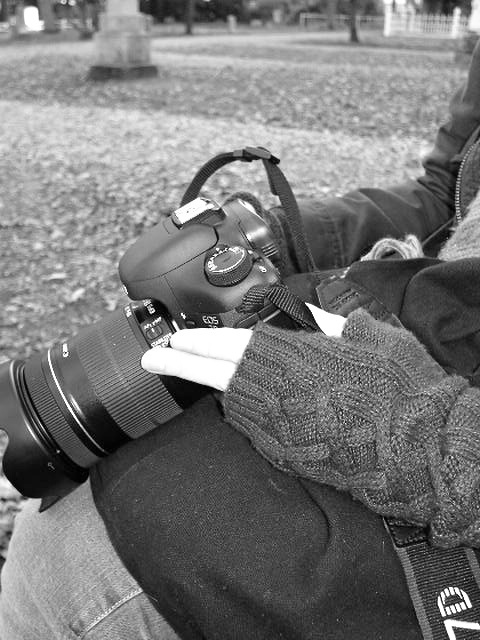
The photograph to your right, Portrait of a Photographer, which some will recognize as the photo I used for Wordless Wednesday, is a portrait of Wendy. I guess it might be more correct to say it’s a portrait of the camera not the photographer, though it was meant to capture the spirit in which Wendy works. I took the photograph some years ago when we spent an afternoon at Union Cemetery in Redwood City, Wendy pursuing art and me as chauffeur and tag-along doing the best I could. My own portrait here is a selfie captured using the photo feature on my MacBook. Happy interNational Photography Month.




 The BeZine