Posted in Essay, Photography/Photographer, Spiritual Practice, Terri Stewart

Prayer as Action for Peace

Saturday, September 7, 2013, was a call for worldwide prayer and fasting to focus on peace in Syria. I have seen many things happening–prayer vigils, personal meditation practices, marches, and communications with elected officials. We decided to offer a Labyrinth Walk for Peace at Bothell UMC in Bothell, WA in the morning. I gathered inter-faith prayers, we walked, prayed, and focused on bringing peace to the world. What follows is prayers and photos from that journey that became deeply personal for each attendant. There was a certain transition that occurred for me as I took in my surroundings and noticed Farmer Brown’s Garden. I began to see, literally, a connection between peacefulness and being fed. You will see.

Entering Sacred Space
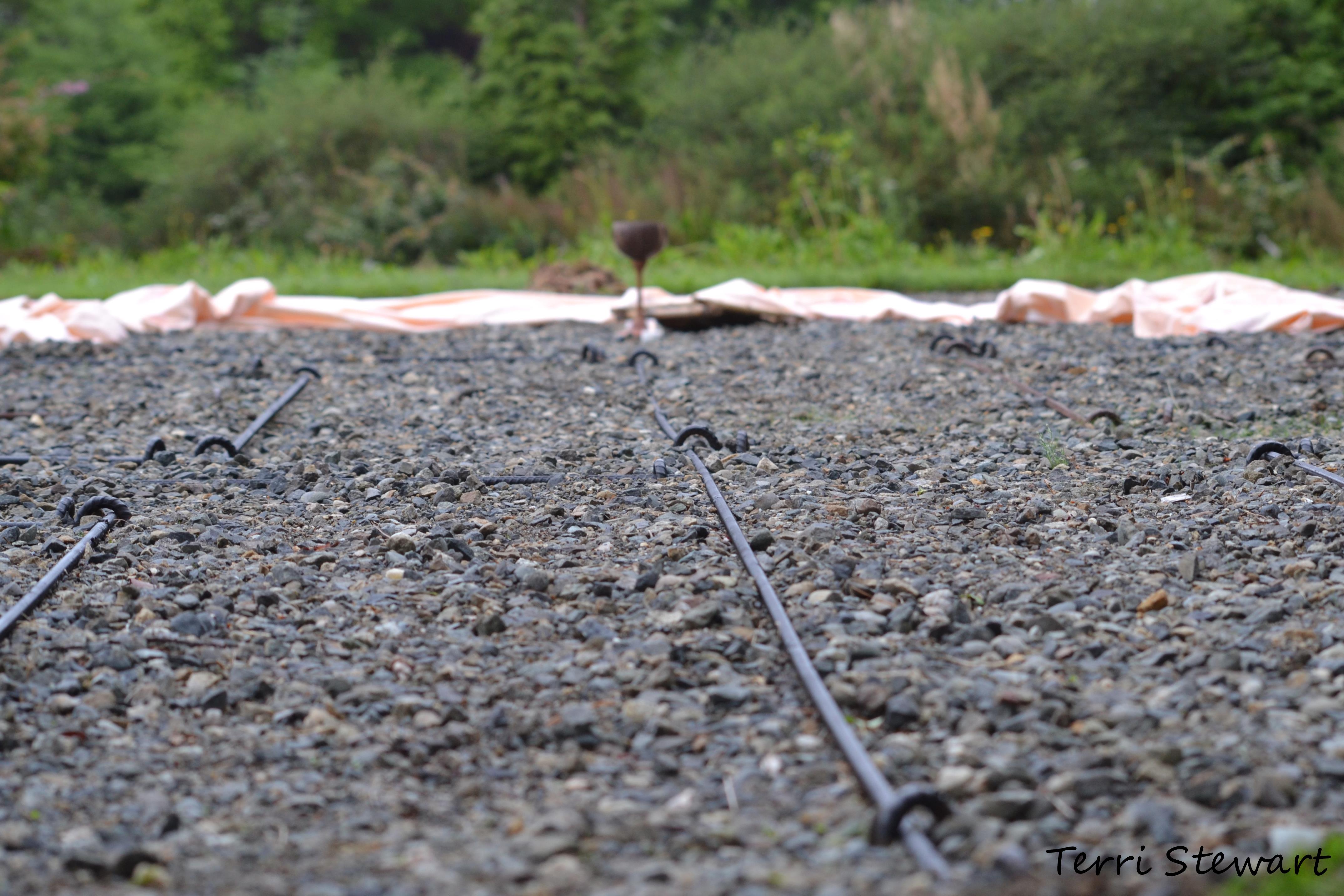
prayers-for-peace-3

Sufi Prayer for Peace

Send Thy peace, O Lord, which is perfect and everlasting, that our souls may radiate peace.
Send Thy peace, O Lord, that we may think, act,
and speak harmoniously.
Send Thy peace, O Lord, that we may be contented
and thankful for Thy bountiful gifts.
Send Thy peace, O Lord, that amidst our worldly strife we may enjoy thy bliss.
Send Thy peace, O Lord, that we may endure all,
tolerate all in the thought of thy grace and mercy.
Send Thy peace, O Lord, that our lives may become a
divine vision, and in Thy light all darkness may vanish.
Send Thy peace, O Lord, our Father and Mother,
that we Thy children on earth may all unite in one family.
– Sufi Prayer

The Journey Begins

prayers-for-peace-6

An Islamic Prayer for Peace

In the Name of Allah, the beneficent, the merciful: Praise be to the Lord of the Universe
who has created us and made us into tribes and nations that we may know each other,
not that we may despise each other.

If the enemy incline towards peace, do thou also incline towards peace, and trust in God,
for the Lord is one that hears and knows all things.
And the servants of God Most Gracious are those who walk on the Earth in humility,
and when we address them, we say, “Peace.”
– U.N. Day of Prayer for World Peace 2

Walking Together in Ubuntu

prayers-for-peace-5

A Hindu Prayer for Peace

Supreme Lord, let there be peace in the sky and in the atmosphere.
Let there be peace in the plant world and in the forests.
Let the cosmic powers be peaceful.
Let the Brahman, the true essence and source of life, be peaceful.
Let there be undiluted and fulfilling peace everywhere.
– The Atharva Veda

All Are Invited to Be Fed

prayers-for-peace-1

Cheyenne Prayer for Peace

Let us know peace.
For as long as the moon shall rise,
For as long as the rivers shall flow,
For as long as the sun shall shine,
For as long as the grass shall grow,
Let us know peace.
– Cheyenne Prayer

Feeding the World in Spirit and Deed
Farmer Brown’s Garden at Bothell UMC
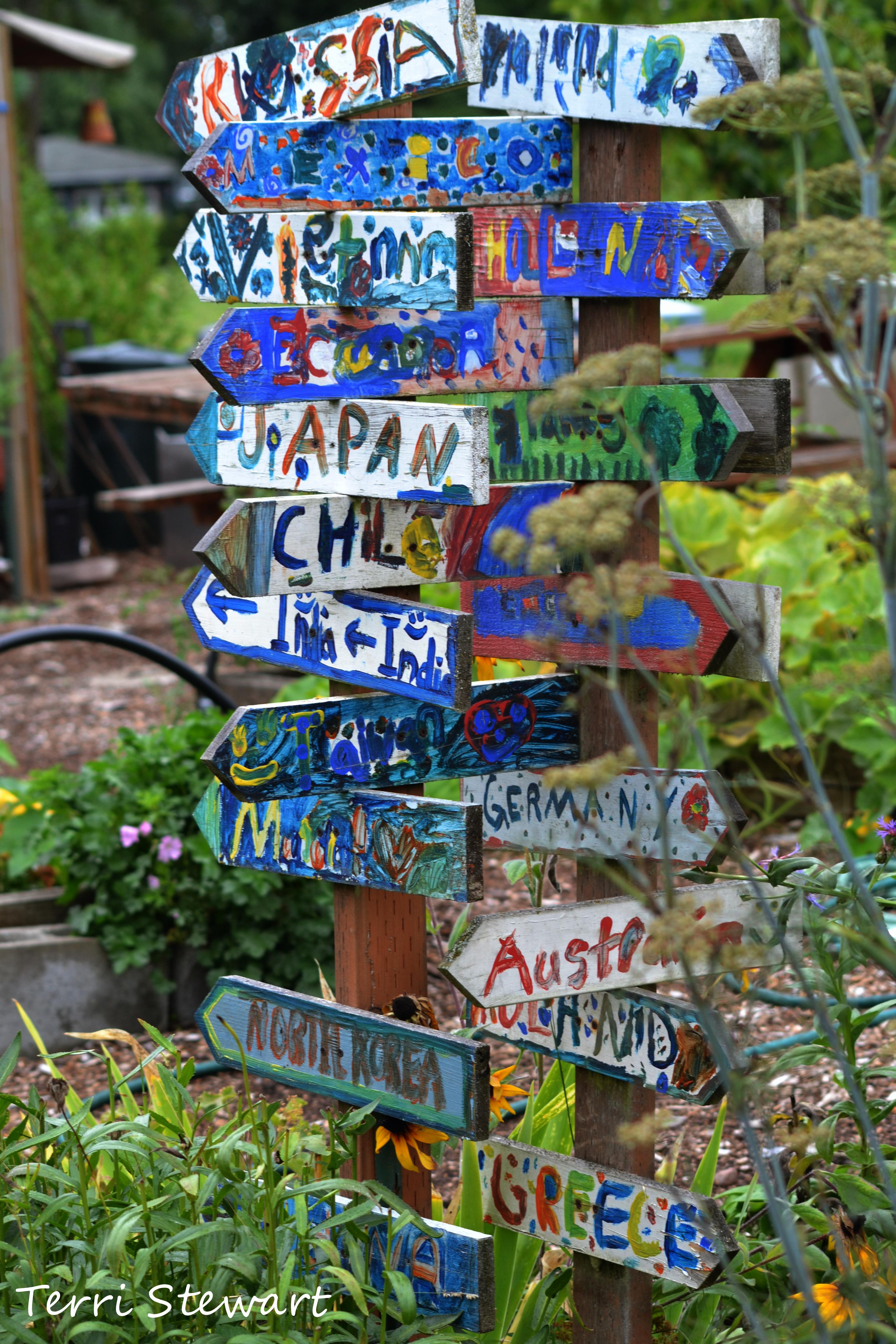
prayers-for-peace-7

A Jewish Prayer for Peace

Grant us peace. Your most precious gift,
O Eternal Source of Peace, and give us the will to proclaim its message to all the peoples of the earth.
Bless our country, that it may always be a stronghold of peace, and its advocate among the nations.
May contentment reign within its borders, health and happiness within its homes.
Strengthen the bonds of friendship among the inhabitants of all lands.
And may the love of Your name hallow every home and every heart.
Blessed is the Eternal God, the source of Peace.
– From The Gates of Prayer: The New Union Prayer Book, by the Central Conferences of American Rabbis

Growing Spiritually and Growing Food

prayers-for-peace-9

Buddhist Prayer for Loving Kindness

May all beings be peaceful.
May all beings be happy.
May all beings be safe.
May all beings awaken to
the light of their true nature.
May all beings be free.
– Metta Prayer

Loving Kindness through Loving Care

prayers-for-peace-8

A Christian Prayer for Peace

Blessed are the peacemakers, for they shall be called the children of God.
But I say to you that hear, love your enemies; do good to those who hate you;
bless those who curse you; pray for those who abuse you.
To those who strike you on the cheek, offer the other also;
and from those who take away your cloak, do not withhold your coat as well.
Give to everyone who begs from you, and of those who take away your goods,
do not ask them again. And as you wish that others would do to you, do so to them.
– U.N. Day of Prayer for World Peace 2

Becoming the Light Unto the World

prayers-for-peace-10

A Non Traditional Prayer for World Peace

Spirit of Life and Love, be present with all who are suffering terribly from violence.
Lift up the hearts of those who fear. And inspire courage among the peacemakers.
Be present with political leaders, ensuring a retreat from violence
and a procession towards the peace table.
Guide the hands of all those who are caring for the injured, the hungry and the grieving.
And, open our own hearts to compassion.
Remind us of our complicity and responsibility.
And lead us towards generous engagement—always towards a vision of peace.
–Adapted from the Unitarian Universalist Tradition

Shalom and Amen,

Terri

© 2013, post and photos, Terri Stewart, All rights reserved

terriREV. TERRI STEWART is Into the Bardo’s  Sunday chaplain, senior content editor, and site co-administrator. She comes from an eclectic background and considers herself to be grounded in contemplation and justice. She is the Director and Founder of the Youth Chaplaincy Coalition that serves youth affected by the justice system. As a graduate of Seattle University’s School of Theology and Ministry, she earned her Master’s of Divinity and a Post-Master’s Certificate in Spiritual Direction. She is a contributing author to the Abingdon Worship Annual. (The 2014 issue just released!)

Her online presence is “Cloaked Monk.” This speaks to her grounding in contemplative arts and the need to live it out in the world. The cloak is the disguise of normalcy as she advocates for justice and peace. You can find her at www.cloakedmonk.com, www.twitter.com/cloakedmonk, and www.facebook.com/cloakedmonk.  To reach her for conversation, send a note to cloakedmonk@outlook.com
Posted in Essay, Judaism, Michael Watson, Spiritual Practice

Lessons From The Seer of Lublin

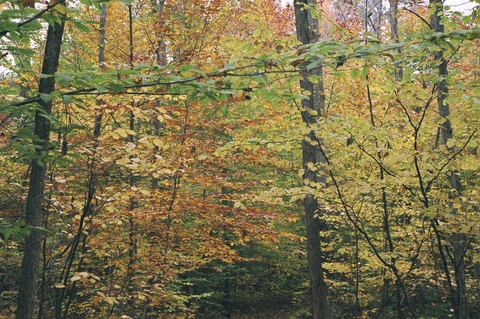
Autumn Colors, Nova ScotiaLast night we went to the synagogue for a healing service and to recite selichot in preparation for Rosh Hashanah. During the service one of the Rabbis told a story about the Seer of Lublin, a Hasidic Master who lived from 1745 to 1815.

Briefly the tale is this. A Hasid travels some distance to see The Seer who looks at him and tells him that since he (the visitor) is to die that night, he should go to a hotel in a nearby village to do so. The Seer explains that as it is the Sabbath a dead body in his house would create enormous problems. The man dutifully sets off for the village, only to meet a cart filled with Hasidim on their way into Lublin to spend the Sabbath with The Seer. They ask him why he is going in the WRONG DIRECTION, and he explains that the Rabbi has sent him away to die. The Hasidim respond that if he is to die he should certainly come with them so as not to die alone. He climbs into the cart and they set off for the city. Soon the men ask our tired journeyer, seeing as he obviously has money, to buy spirits to keep them happy and warm on the trip. He complies and soon all are happily singing and swapping tales. As they travel towards the city our Hasid is heaped with praise, blessings, and hopes for a long a prosperous life. When finally the crew arrives back at the Rabbi’s house, the Rabbi looks at our traveler and says, “Oh, you are indeed lucky. The blessings of your fellows have warded off Death.” It is said the man lived well for several more years.

Having told the tale, the Rabbi spoke to the power of blessing. She assured us she was not convinced blessing another has power in itself, and express concern about magical thinking. She was more certain that gathering in community opens the door to healing. She also spoke about what she saw as shamanic elements in the story. I have long considered the best Hasidic Rebbes to be shamans. Indeed, in many texts The Seer is portrayed as a great shaman, as are many of the best Hasidic Rebbes. After all, he can see the future, determine whether something is fated, and utilize whatever wiggle room is available to aid the members of his extended community to a different fate.

Today I’ve been thinking about the story, as well as the service. It seems to me The Seer saw a way to awaken the Wise Healer within the traveler. Perhaps he knew the man would meet fellow Hasids on their way into town, as The Seer’s congregation was far-flung, yet united in the task of reaching the Rabbi’s home before darkness and the beginning of the Sabbath. Maybe he felt secure in the likelihood his congregants would never let a fellow Hasid die alone.  Maybe he, like the founder of Hasidism, The Baal Shen Tov, could, through the good graces of All That Is, intervene directly in the man’s fate. We do not know, and that, too, is part of the mystery and the story.

So this evening we begin the Jewish High Holy Days, the time of remembrance, atonement, and forgiveness, a time we are invited to thoughtfully consider our individual and communal lives. Although I am not Jewish, the rest of our household is, and over the years this time of year has become dear to me. Like the Rabbi I, too, have doubts about magical thinking. Yet, I also believe in the power of compassion, prayer, and joy to awaken the Healer Within persons and communities. Luckily, we have these stories, arising from many traditions, to remind us of our connection to the Creator, one another, and the larger world.

Michael Watson, Ph.D.

© 2013, essay and photographs (includes the one below), Michael Watson, All rights reserved

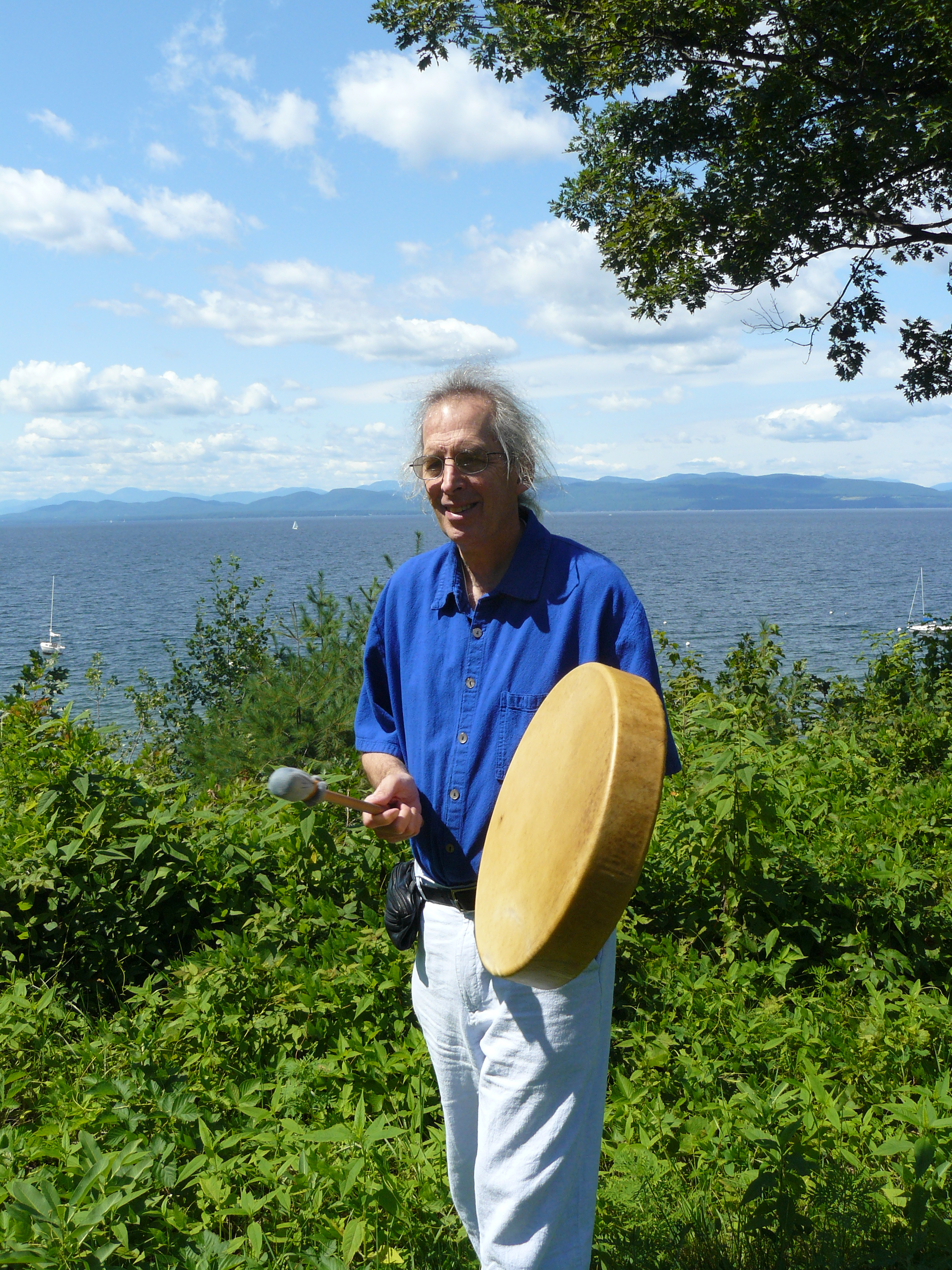
michael drumMICHAEL WATSON, M.A., Ph.D., LCMHC (Dreaming the World) ~ is a contributing editor to Into the Bardo, an essayist and a practitioner of the Shamanic arts, psychotherapist, educator and artist of Native American and European descent. He lives and works in Burlington, Vermont, where he teaches in undergraduate and graduate programs at Burlington College,. He was once Dean of Students there. Recently Michael has been teaching in India and Hong Kong. His experiences are documented on his blog. In childhood he had polio, an event that taught him much about challenge, struggle, isolation, and healing.

Posted in Essay, Photography/Photographer, Spiritual Practice, Terri Stewart

A Prayer to Consider


I originally published this on my blog at cloakedmonk.com. I am reposting it here for a couple reasons – prayer is a great spiritual practice, whatever your understanding of prayer is. And I am at a conference called “Church Quake” in the DC area. It is a conference to aid United Methodist folks in helping to bring full inclusion to the church. Our theme has been “intersectionality.” What intersection of our understanding can come to the aid of an oppressed groups? We are related and interdependent as the prayer below says-we can see that when we consider our own woundedness and how we bring it to the altar of healing. Then what do we do? Consider the woundedness of others and help them find their way to healing. And so the pattern continues. Wounded becoming healing.

Henry Nouwen articulated the concept of the wounded healer quite well. Let me just share a quote from this Roman Catholic, PhD Psychologist, Theology teaching at Yale Divinity, depression suffering, book-writing, L’arche community loving, priest.

“When we honestly ask ourselves which person in our lives mean the most to us, we often find that it is those who, instead of giving advice, solutions, or cures, have chosen rather to share our pain and touch our wounds with a warm and tender hand. The friend who can be silent with us in a moment of despair or confusion, who can stay with us in an hour of grief and bereavement, who can tolerate not knowing, not curing, not healing and face with us the reality of our powerlessness, that is a friend who cares.”
― Henri J.M. Nouwen, The Road to Daybreak: A Spiritual Journey

Here, in this prayer, I find the intersectionality of flowers, interdependence, loving one another, an altar for all, and the healing of woundedness for the inclusion of all who are diverse and unique – precious and beautiful flowers.

A prayer in the Unitarian Universalist tradition by William G. Sinkford

In the presence of these flowers,
These representatives of Creation’s profound beauty:
Diverse and Unique, but Related and Interdependent,
These flowers which come to us as gifts from we know not where
And which we, in turn, choose to bring to our shared and common altar
As gifts to one another

In their presence we turn our thoughts to the mystery beyond mysteries
to the most sacred—which we never understand fully
but which we are granted revelatory glimpses of
in each of these flowers,
in each of your faces,
and through relationships with neighbors near and far

May they remind us of grace we have known in days past:
Forgiveness we have been granted, and provided.
Love, unearned and shared.
Recovery, begun and established.
Generosity, unforeseen and most sacred.

And may they inspire us now, and in days to come:
To seek,
To notice,
To embrace and,
To re-create beauty.
To give unto the world as exuberantly as these flowers.

yellow.center.flower

Go, be exuberant.

Shalom & Amen,

Terri

© 2013, post and photos, Terri Stewart, All rights reserved

© 2013, prayer, William Sinkford

terriREV. TERRI STEWART is Into the Bardo’s  Sunday chaplain, senior content editor, and site co-administrator. She comes from an eclectic background and considers herself to be grounded in contemplation and justice. She is the Director and Founder of the Youth Chaplaincy Coalition that serves youth affected by the justice system. As a graduate of Seattle University’s School of Theology and Ministry, she earned her Master’s of Divinity and a Post-Master’s Certificate in Spiritual Direction. She is a contributing author to the Abingdon Worship Annual. (The 2014 issue just released!)

Her online presence is “Cloaked Monk.” This speaks to her grounding in contemplative arts and the need to live it out in the world. The cloak is the disguise of normalcy as she advocates for justice and peace. You can find her at www.cloakedmonk.com, www.twitter.com/cloakedmonk, and www.facebook.com/cloakedmonk.  To reach her for conversation, send a note to cloakedmonk@outlook.com
Posted in Essay, General Interest, teacher

A Biased Mind Cannot Grasp Reality: A Message from the Dalai Lama

Dalai_Lama_at_WhiteHouse_(cropped)Excerpts from His Holiness the Dalai Lama’s address to the inter-faith seminar organised by the International Association for Religious Freedom, Ladakh Group, in Leh on 25 August.

We are now in the twenty ­first century. The quality of research on both the inner and physical world has reached quite high levels, thanks to the tremendous stride in technological advancement and human intelligence. However, as some of the speakers said before, the world is also facing a lot of new problems, most of which are man­-made. The root cause of these man­-made problems is the inability of human beings to control their agitated minds. How to control such a state of mind is taught by the various religions of this world.” MORE 

Photograph taken by an employee of the Executive Office of the President of the United States and as a work of the U.S. federal government it is in the public domain.

Posted in Essay, Spiritual Practice, Terri Stewart

Sacred Space III

Continuing along the theme of sacred space, I would like to offer a method of creating sacred group space-especially in places of conflict or tension. Previous posts on sacred space are on the personal labyrinth and personal prayer patterns styled upon praying with beads.

Creating Sacred Group Space

Have you ever been in a situation where you needed to facilitate group sharing (or participate in) around a sticky topic or situation? It is really difficult to get people to move beyond finger pointing, conflict, and blaming. Eric Law developed a method that facilitates sharing in a sticky environment that offers mutual respect and honor to the participants. It is commonly called Eric Law’s Method of Mutual Invitation. I love using it!

Rev. Eric H. F. Law
(c) California-Pacific Conference of the UMC

One of the problems with most decision making settings is that a decision must be made! That necessitates a winner and a loser. It is rarely a win/win situation. Most often if one person wins, there is another person who loses or gives in. Eric Law’s Method of Mutual Invitation is not a decision making process, it is a listening process that can lead to deeper points and through long and hard work, lead to a consensus building model where every voice is heard and honored. It is at once simple and profound.

The Method

Mutual Invitation is a small group process designed to allow for inclusion and disciplined sharing in diverse settings, especially where there might be a variety of ages, ethnic backgrounds, different beliefs, or personality types present. The process allows for each person in the group to have an opportunity to share, as well as to participate in group dynamics. The process of Mutual Invitation can be adapted for different settings and purposes, e.g. family meal time, small group sharing, and office meetings.

Someone begins the sharing, related to the chosen topic.

  • The facilitator will set a time limit for each person.
  • No questions, responses, or interruptions are allowed during the process.

After the sharing there is a brief pause to allow the others to reflect upon what has been shared.

  • Responding begins after the pause. The pause should be stretched to a couple of minutes or longer if possible.
  • Responding is done by asking open ended questions designed to allow the person sharing to examine further her experience.

In a group sharing session, the person who is sharing invites the next person after others have responded to him/her.

  • Avoid inviting the person sitting next to you. This avoids the tendency to “go around in a circle.”
  • The goal of mutual invitation is to randomly invite the next person. This random invitation prevents distractions such as anticipating or worrying about what to share. Random invitation also helps keeps the focus on the person sharing.

The invited person may choose to share, to pass for now, or to pass.

  • Pass for now means she/he can share later when re-invited.
  • Pass indicates that she/he does not choose to share during this session.
  • Regardless of what the person chooses, she/he always invites the next person.

The process is repeated until everyone in the group has been invited. And every person has either responded or finished with a final pass.

Pattern sample:

  • Facilitator states the question being pondered and offers their own response.
  • Then silence is held for a couple minutes.
  • The group then asks questions-they must be either clarifying questions or open-ended questions. One person at a time.
  • The facilitator responds to questions as they come.
  • At the end of the questions, silence is held for a couple of minutes.
  • The facilitator invites the next person to share.
  • The next person responds with either their own sharing, a pass, or a pass for now.
  • Then silence is held for a couple of minutes.
  • The group then asks questions-they must be either clarifying questions or open-ended questions. One person at a time.
  • That person responds to questions as they come.
  • At the end of the questions, silence is held for a couple of minutes.
  • That person invites the next person to share.
  • And so on, until all have shared or responded with a final pass.

This sharing methodology, as simple as it is, has opened up sacred space. I love using it! Especially when confronted with sticky situations and group conflict. It keeps things calm, peaceful, and invites a sacred and healing quality to the space. You could even use it in a study environment! Imagine opening up a text and sharing responses in a group in this sacred, invitational manner! Beautiful.

The most profound time I have ever used this method involved a group in conflict. It was a group coming together after a major loss all with different ideas of how to move forward and very few ideas of how to sit in the loss. We used this method and brought out people’s fears, hopes, sorrows, and even some joys. It became a place of healing rather than a cantankerous committee meeting. It forced us to be still and to hold each other loosely and gently. Creating sacred space.

A bit about Rev. Eric Law:  He is an Episcopalian priest, is the founder and executive director of the Kaleidoscope Institute, the mission of which is to create inclusive and sustainable churches and communities. He has been writing and practicing for more than 20 years. He can be found online at The Sustainist.

Shalom and Amen,

Terri

© 2013, essay, Terri Stewart, All rights reserved

terriREV. TERRI STEWART is Into the Bardo’s  Sunday chaplain, senior content editor, and site co-administrator. She comes from an eclectic background and considers herself to be grounded in contemplation and justice. She is the Director and Founder of the Youth Chaplaincy Coalition that serves youth affected by the justice system. As a graduate of Seattle University’s School of Theology and Ministry, she earned her Master’s of Divinity and a Post-Master’s Certificate in Spiritual Direction. She is a contributing author to the Abingdon Worship Annual. (The 2014 issue just released!)

Her online presence is “Cloaked Monk.” This speaks to her grounding in contemplative arts and the need to live it out in the world. The cloak is the disguise of normalcy as she advocates for justice and peace. You can find her at www.cloakedmonk.com, www.twitter.com/cloakedmonk, and www.facebook.com/cloakedmonk.  To reach her for conversation, send a note to cloakedmonk@outlook.com

Posted in Essay, Spiritual Practice, Terri Stewart

Sacred Space Part II

Recently, I published a post on creating your own labyrinth as a way of making sacred space in a place where you may not be able to find a way to retreat to your preferred sacred space. This is a continuation upon that theme-creating sacred space in the midst of everyday living.

One thing my Spiritual Director and I agree upon is that I MIGHT have spiritual ADHD. Meaning, I need a variety of spiritual practices to keep me grounded. This totally makes sense since on the unofficial adult ADHD test I recently took, on a scale of 1-6 (6 being the most ADHD), I scored a six. Oh, yes. This penchant to need change and to be easily distracted often must be hemmed in by being very grounded in my own spiritual path while allowing myself the freedom to choose exercises, patterns, or methods from beyond my immediate experience.

This led me to take a workshop on praying with beads! Now, when I signed up for the workshop I knew that it was sponsored by an ecumenical organization so I assumed that it would be somewhat wide-open in its approach. I was wrong. It was a class on praying the Rosary. I am not Roman Catholic, and this was an ecumenical retreat, so I was a bit taken aback by the specific nature of the workshop. However, I decided to simply enter into the spirit of the situation and puzzle out my response later.

I am very glad that I did!

One of My Bracelets
One of My Bracelets

When I was able to reflect on the experience, I thought, “There must be a protestant version of this practice that would fulfill the tactile & prayerful longing that I have!” And I was right! Thank you search engine! I found a Unitarian Universalist Prayer Bead Practice. I cogitated on what I read there and then created my own practice. Now, I make prayer bead bracelets and use them to remind me to stay in touch with the sacred in my everyday living. It is one of the tools in my ADHD spiritual toolkit.

I adapted the main principle of the UUA prayer bead practice and utilized them for myself. I also make these for other folks selecting colors and images that I think will suit their spiritual journey. However, if you don’t have a bunch of beads lying around along with a crimper and all the stuff you need to make a bracelet, you can still do the prayer practice that I am about to outline by using your five fingers, starting at your thumb!

So here it is:

  1. My Hand-Each Finger a Bead
    My Hand-Each Finger a Bead

    See the “tail” on the bracelet? That is where you start or you can start with your thumb (lightly grasp the very end bead or the tip of your thumb) if you don’t have a bracelet or cannot make one. Sit still. Ground yourself. Rest gently with your eyes relaxed and gazing lightly or close your eyes, whatever is most comfortable to you. Here, focus on your image of the divine. Greet the divine and enter into the presence of holiness and join into a sacred moment. Hold this beloved image closely to your heart. Greetings of love, peace, serenity wash over you, through you, and into you. When you are ready, move up the tail of the bracelet or up your thumb to your hand. Feel each bead or feel each bend in your thumb.

  2. As you go up the beads, breath in and breath out at each small bead. Soon you will land on the large bead (not the clasp) or your fore finger. Here take time to envision those things you want to celebrate! This is a time for adoration, celebration, joy, happiness! Give all of this to your image of the divine and receive the gift that comes back to you whatever that may be. When you are ready, move to the next large bead (or your next finger tip) traveling slowly, thoughtfully, and with divine joy.
  3. At the next large bead, is the time to turn inward and look back at your day (or days before) and to offer a confession of where you have fallen short. For me, this is a time to admit where I have not been loving, peaceful, or justice seeking. Or a time to confess my lack of patience! This can be a time of sorrow, but it should not be a time of shame. We all fall short. Knowing we have, learning from it, and moving to the next bead is what this moment is for. When you are ready, move to the next large bead traveling slowly, thoughtfully, and with the knowledge that you can make mistakes and still return to a place of holiness and sacred healing.
  4. At the next large bead, it is time to name the things, people, and beings in the world that you are thankful for. Let love for the other wash over you and let gratitude sink deeply into you. It may be as simple as a favorite stuffed bear that has traveled with you since childhood. Gratitude in itself is a spiritual practice. Let it flow here. When you are ready, move slowly to the next large bead, touching each smaller bead and breathing in – breathing out at each touch. Do this with the understanding that as you find gratefulness in those around you, others are grateful for you and for who you are.
  5. At the final large bead, it is time to bring your concerns into sacred space. It could be concern for someone’s safety, for healing, for friends or family. Anything that is laying on your heart. Bring them into sacred, healing space. Here, depending on your space and time, you could do many things. You can talk with what is laying on your heart; hold it in love; offer it out to the world or the divine; or even do something creative with it.
  6. Finally, as close this part of the prayer, you will travel back to your initial image. Return to your thumb or return down the tail of the bracelet or beads. Breathing in and out at each small bead or bump along the way. As you return to your image, hold it, sit with it and when you are ready, leave it in whatever manner you are comfortable with. That could be namaste, amen, or a simple good-bye. Whichever way speaks to your path. Return to your every day living, bringing the sacred space you have made with you. Let it travel with you as you go about your day. Remembering that each time you touch your thumb or grasp a bead, that sacredness walks with and in you.

Shalom and Amen,

Terri

© 2013, post and photos, Terri Stewart, All rights reserved

terriREV. TERRI STEWART is Into the Bardo’s  Sunday chaplain, senior content editor, and site co-administrator. She comes from an eclectic background and considers herself to be grounded in contemplation and justice. She is the Director and Founder of the Youth Chaplaincy Coalition that serves youth affected by the justice system. As a graduate of Seattle University’s School of Theology and Ministry, she earned her Master’s of Divinity and a Post-Master’s Certificate in Spiritual Direction. She is a contributing author to the Abingdon Worship Annual. (The 2014 issue just released!)

Her online presence is “Cloaked Monk.” This speaks to her grounding in contemplative arts and the need to live it out in the world. The cloak is the disguise of normalcy as she advocates for justice and peace. You can find her at www.cloakedmonk.com, www.twitter.com/cloakedmonk, and www.facebook.com/cloakedmonk.  To reach her for conversation, send a note to cloakedmonk@outlook.com


Posted in Essay, Meditation, meditative, Music, Spiritual Practice, Terri Stewart, Uncategorized

Let Your Light Shine On

Finding Light
The Light Shines On

Where is your light today? What is leading you? What is giving you hope? Joy?

“When I find myself in times of trouble, mother Mary comes to me,
speaking words of wisdom, let it be.
And in my hour of darkness she is standing right in front of me,
speaking words of wisdom, let it be.

Let it be, let it be, let it be, let it be.
Whisper words of wisdom, let it be.

And when the broken hearted people living in the world agree,
there will be an answer, let it be.
For though they may be parted there is still a chance that they will see,
there will be an answer. let it be.

Let it be, let it be, …..

And when the night is cloudy, there is still a light, that shines on me,
shine until tomorrow, let it be.
I wake up to the sound of music, mother Mary comes to me,
speaking words of wisdom, let it be.

Let it be, let it be, …..”
― Paul McCartney

A note about the light fixture:

I photographed this light at the Merchant’s Cafe in Seattle, Washington. It is the first cafe in Seattle and has seen several iterations of its business as it was built, burned down, and built again. The interesting thing is that it is in the oldest part of Seattle (of course!). It was built in a building near first avenue. The tidal flats used to flood in every day, twice a day, up to third avenue. This makes doing business quite difficult! Seattle then had businesses build their buildings at least two stories tall. Then they raised all the roads, surrounding the existing buildings with raised roads. For a while, they put ladders at the streets so people would go off of the road, down the ladder, into the businesses.

Finally, they built sidewalks that connected the streets to the second story level of the buildings. So today, in Pioneer Square, when you enter the buildings, you are, in fact, entering the second story of the buildings that were placed there. If you look down, you will notice odd glass squares in the sidewalk. Those were originally skylights so that the first story of the buildings were kind of like an inside shopping mall with a view to the sidewalk above. So even there, in the midst of a buried first floor of these buildings, the light was still able to shine!

Such a fun history!

Shalom and Amen.

Terri

© 2013, post and photos, Terri Stewart, All rights reserved, originally posted at http://www.cloakedmonk.com

terriREV. TERRI STEWART is Into the Bardo’s  Sunday chaplain, senior content editor, and site co-administrator. She comes from an eclectic background and considers herself to be grounded in contemplation and justice. She is the Director and Founder of the Youth Chaplaincy Coalition that serves youth affected by the justice system. As a graduate of Seattle University’s School of Theology and Ministry, she earned her Master’s of Divinity and a Post-Master’s Certificate in Spiritual Direction. She is a contributing author to the Abingdon Worship Annual. (The 2014 issue just released!)

Her online presence is “Cloaked Monk.” This speaks to her grounding in contemplative arts and the need to live it out in the world. The cloak is the disguise of normalcy as she advocates for justice and peace. You can find her at www.cloakedmonk.com, www.twitter.com/cloakedmonk, and www.facebook.com/cloakedmonk.  To reach her for conversation, send a note to cloakedmonk@outlook.com

Posted in Essay, Michael Watson, Spiritual Practice, teacher

Ceremony and the Raven

Evening, Lake ChamplainThis morning we put aside our frustration and despair and spoke with the land and spirits. The mosquitoes, which had been fierce, quieted their attack, and even the birds calling stopped to listen. We like to open the altar outside whenever the weather allows, but of late have not had the heart to do so. The last time we opened the altar was the only time all summer we have heard the calls of the Hermit Thrush.

We awoke feeling sad and angry. The news on the racial, social, and climate fronts has been heartbreaking. We’ve been feeling overwhelmed, unable to see how we might contribute significantly to much-needed change. We’ve also been asked to aid others who are thinking they should do more than they possibly can. We remind others to do only what they are able. As we do so we remind our many selves to do the same, even as some selves feel frightened and desperate for change.

In the brief ceremony we spoke to the Creator, Pachamama, and the spirits about our gratitude for our lives and our concerns for the present and future. We acknowledged we humans are not caring for the futures of our grandchildren, let alone those of all species who will follow us in seven generations. This is a great sadness.

After the ceremony we came in to respond to e-mail and do other tasks. Online, we discovered a brief video posted to Facebook. In the video, a wild raven, perched on a fence, allows a woman to remove porcupine quills from its face. After each quill is removed, the raven squawks and complains, then allows the woman to soothe it and remove the next quill. How familiar!   (Watch video.)

Watching the video, we were once again reminded that ravens are immensely intelligent creatures, that humans are not the only ones who seek aid from others, and that all life forms are profoundly interconnected, in life as in story. We were also reminded that small things, even removing quills from an injured animal, can be powerful ceremony, and profoundly healing to those in an ever-widening circle.

– Michael Watson, Ph.D.

© 2013, essay and photographs (includes portrait below), Michael Watson, All rights reserved

michael drumMICHAEL WATSON, M.A., Ph.D., LCMHC (Dreaming the World) ~ is a contributing editor to Into the Bardo, an essayist and a practitioner of the Shamanic arts, psychotherapist, educator and artist of Native American and European descent. He lives and works in Burlington, Vermont, where he teaches in undergraduate and graduate programs at Burlington College,. He was once Dean of Students there. Recently Michael has been teaching in India and Hong Kong. His experiences are documented on his blog. In childhood he had polio, an event that taught him much about challenge, struggle, isolation, and healing.

Posted in Essay, Meditation, meditative, Spiritual Practice, Terri Stewart, Uncategorized

Sacred Space

Sacred Space
Sacred Space

Have you had that day? Ever? When your last nerve has been strung and compassion, justice and mercy have fled your body? I have that day sometimes. Usually, on those kind of days I like to retreat to sacred space. Space that can be my family, my friends, my books, my camera…some place where I can be filled up with the qualities that have leeched out.

But sometimes that is not possible!

I could be at the detention center where I work. Conflict and craziness do sometimes abound among the incarcerated and sometimes among the staff and volunteers. One night I was working and a fight broke out right in front of me. Other nights, down the hall. As staff rush towards the chaos, I sit frozen (as I am instructed to do) and then proceed in the opposite direction. I often retreat to the library where the clanging is at least muted.

Or I could be at my home and expectations meet reality and voices rise in anger or disappointment threads the air. Then my retreat is not a retreat. Mostly, we are loving. But there are times when love seems miles away.

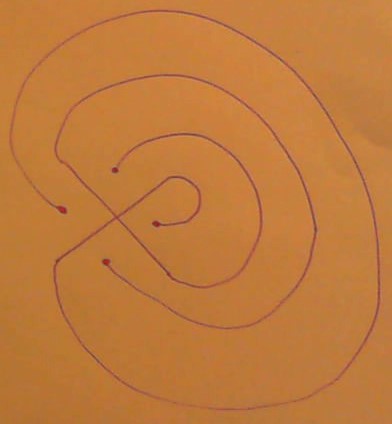
During those times, I need to create sacred space where it seems that there is no room for it. Hopefully, I am not alone in feeling this way! I would like to offer you one simple practice that can be done anywhere at any time. You can create your own sacred space with a piece of paper and a pen. No! This is not a writing assignment. It is a wholeness assignment.

Temenos (Greek) is sacred space. Or land that is set aside for royalty or the priesthood. In Ancient Greece, it would be the place reserved for worshiping the gods. Jung further expands on the concept of temenos as a place where you can encounter your unconsciousness, bringing the shadow into the light. A place of healing, acceptance, worship, encounter, and sacredness.

I am connecting these ideas to the ancient labyrinth where, at the very center, is the temenos.

I have a portable labyrinth that is used in my work with incarcerated youth. Teens can be so funny when they first encounter the labyrinth! They look at it as a maze, at first. But then as they slowly progress through the turns of the labyrinth, focusing on their chosen word or phrase, something happens. Softness overtakes them. They slow down. The rhythm of the room deepens. Their shields begin to drop. Sometimes, they arrive at the center and just sit for a long time. It is also a place of safety, even in the midst of incarceration, a place of danger.

However, we are not all blessed to have a labyrinth stored in our garage! Luckily, we do not need the full meal deal to create a labyrinth. Just pen and paper (or crayon and paper!).

As you set about creating your own labyrinth, set your intentions. When I am in the detention center and do this, I am often focused on peacefulness. Then, when you are done, walk the labyrinth with your finger. Focus on your intention. It is said that there are three stages to walking a labyrinth.

  1. Purgation:  purging yourself of your thoughts that are attached to the world.
  2. Illumination:  opening yourself to enlightenment, inspiration, reception of the other
  3. Union:  becoming one with ______________ . I will let you fill in the blank with your understanding of what we are in union with.  This could be anything from unity with self, others, the cosmos, the divine. This is where we sit and hold the space.

It only takes a minute to draw a labyrinth and to create an opportunity for your own sacred space no matter where you are or what your are doing. It could be as simple as a doodle on a napkin at lunch!

Shalom & Amen,

Terri

© 2013, post and photos, Terri Stewart, All rights reserved

terriREV. TERRI STEWART is Into the Bardo’s  Sunday chaplain, senior content editor, and site co-administrator. She comes from an eclectic background and considers herself to be grounded in contemplation and justice. She is the Director and Founder of the Youth Chaplaincy Coalition that serves youth affected by the justice system. As a graduate of Seattle University’s School of Theology and Ministry, she earned her Master’s of Divinity and a Post-Master’s Certificate in Spiritual Direction. She is a contributing author to the Abingdon Worship Annual. (The 2014 issue just released!)

Her online presence is “Cloaked Monk.” This speaks to her grounding in contemplative arts and the need to live it out in the world. The cloak is the disguise of normalcy as she advocates for justice and peace. You can find her at www.cloakedmonk.com, www.twitter.com/cloakedmonk, and www.facebook.com/cloakedmonk.  To reach her for conversation, send a note to cloakedmonk@outlook.com

Posted in Culture/History, Essay, Mental Health, Michael Watson, Nature, Shamanism, Spiritual Practice

Working With the Spirits

Shrine, Chennai, India

Eight years ago we purchased a dilapidated cottage, took it down to studs, and with the aid of a brilliant contractor, built a wonderful home. Since then we have developed much-loved gardens on our small plot of urban land.

As the late effects of Polio have become more challenging for me to manage, Jennie has become the tender of those beds. We both care deeply about the garden’s well-being, but much of my limited energy is needed for our healing and teaching work. I am grateful to Jennie for reminding me that healing and teaching are also forms of gardening, other ways of working with spirit.

In the seven years we have lived in our home we’ve been quietly working with the spirits of the land. This is a tad challenging as we live in a residential neighborhood and all ceremony is public. My teachers always said one should be polite, humble, and do ceremony anyway. This simple advice turns out to be remarkably complex in practice.

The spirits of the land are often profoundly responsive to gratitude and ceremony. One evening during our most recent Asia trip we were asked to do a simple traditional shamanic ceremony for a group of college students. This was to be a simple show-and-tell, yet, as sometimes happens, the ceremony took on a momentum of its own, becoming profoundly moving and healing for all present.

When we returned home to Vermont we told our friend and colleague, Julie Soquet, about the experience. Julie listened to our story, considered it for a moment, then said, “The spirits of the land must be really alive and receptive there.”  I was stunned by her naming of the missed obvious. Local gods and spirits are routinely honored in both India and Hong Kong, and Jennie and I had spoken after the ceremony about how we felt the presence, support, and appreciation of the spirits. (There was an active shrine directly across the street from where we were conducting the ceremony.)

The other night, in dream, I was reminded we are loaned our bodies for our stay here on Pachamama. Our bodies are sacred; they are Medicine bundles. At the end of our lives we give our bodies back to the Earth. Pachamama asks that we grow the spirit and power of these bundles, so that when we return them they benefit Her and all beings. In the dream I was asked simply to keep this in mind as I made my way through what remains of my walk here. There were no other instructions, no “shoulds”, no “musts”. Expressing gratitude to the myriad beings who make our lives possible is part of that way of walking and gardening. I wonder how these simple, profound truths will enter into our work.

Michael Watson, Ph.D.

© 2013, essay and photographs (includes portrait below), Michael Watson, All rights reserved

michael drumMICHAEL WATSON, M.A., Ph.D., LCMHC (Dreaming the World) ~ is a contributing editor to Into the Bardo, an essayist and a practitioner of the Shamanic arts, psychotherapist, educator and artist of Native American and European descent. He lives and works in Burlington, Vermont, where he teaches in undergraduate and graduate programs at Burlington College,. He was once Dean of Students there. Recently Michael has been teaching in India and Hong Kong. His experiences are documented on his blog. In childhood he had polio, an event that taught him much about challenge, struggle, isolation, and healing.

Posted in Art, Buddhism, Jamie Dedes, Poems/Poetry, Spiritual Practice

Wabi Sabi

Japanese tea house: reflects the wabi sabi aesthetic, Kenroku-n Garden
Japanese tea house: reflects the wabi sabi aesthetic, Kenroku-en Garden

if only i knew
what the artist knows

about the great
perfection in imperfection

i would sip grace slowly
at the ragged edges of the creek

kiss the pitted
face of the moon

befriend the sea
though it can be a danger

embrace the thunder of a waterfall
as if its strains were a symphony

prostrate myself atop the rank dregs on the forest floor,
worshiping them as a breeding ground for fertile seeds
and the home of a million small lives

if i knew what the artist knows,
then i wouldn’t be afraid to die,
to leave everyone

i would be sure that some part of me
would remain present
and that one day you would join me
as the dusky branch of a river or the
bright moment of the flowering desert

if i knew what the artist knows,
i would surely respond body and soul
to the echo of eternity in rough earthy things

i would not fear decay or work undone
i would travel like the river through its rugged, irregular channels
comfortable in this life; imperfect, impermanent, and incomplete

© 2013, poem, Jamie Dedes, All rights reserved,
Photo credit ~ from Pictures section of OpenHistory via Wikipedia under Creative Commons Attribution-Share Alike 3.o Unported license

Photo on 2012-09-19 at 20.00JAMIE DEDES ~ My worldly tags are poet and writer. For the past five years I’ve blogged at The Poet by Day,the journey in poem, formerly titled Musing by Moonlight.  Through the gift of poetry (mine and that of others), I enter sacred space.

Posted in Essay, Meditation, meditative, Spiritual Practice, Terri Stewart, Uncategorized

Enter the Story – An Ignatian Style Meditation

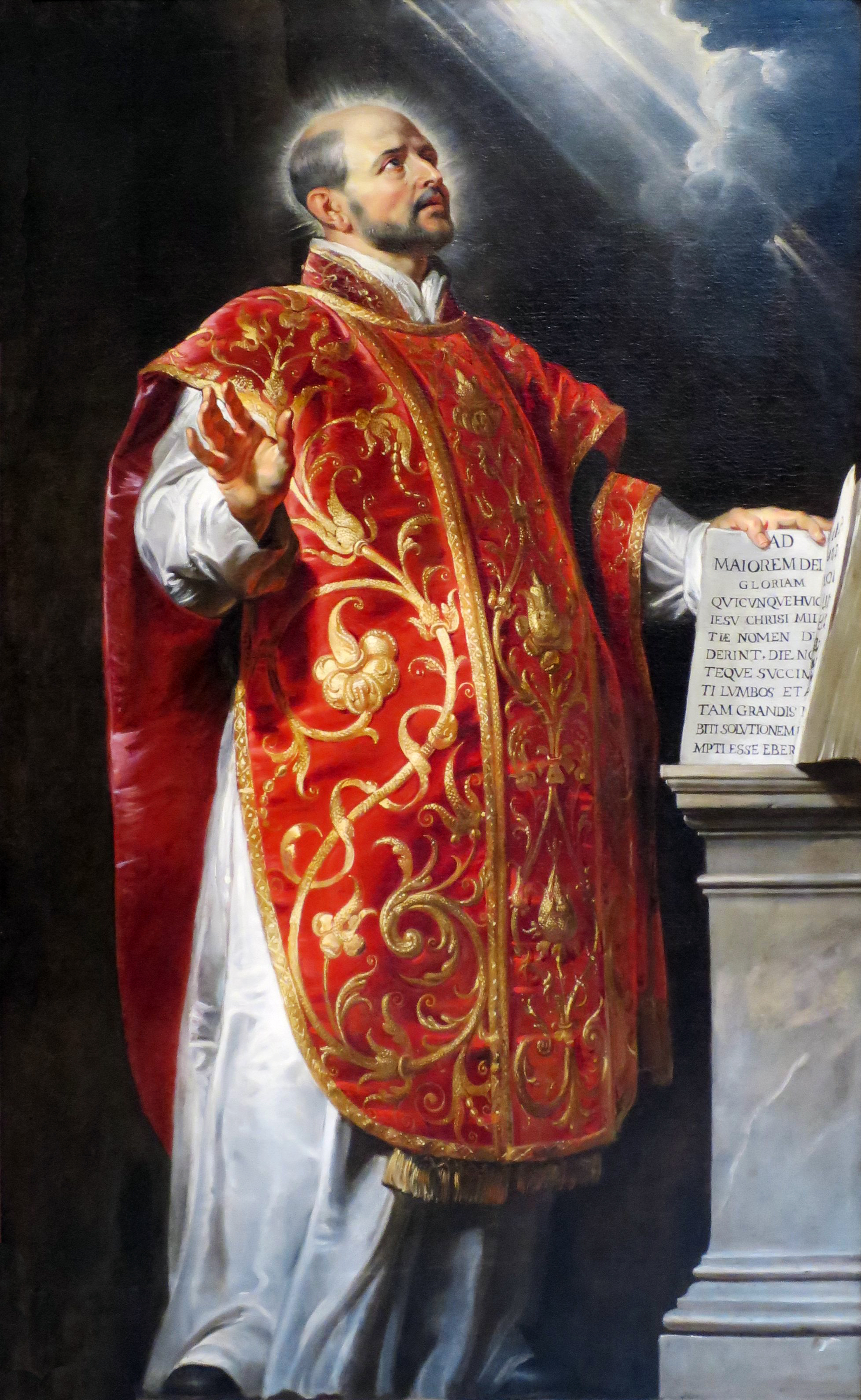
St. Ignatius of Loyola
From Wikipedia

St. Ignatius of Loyola, over time, became very concerned with spiritual practices. He developed one particular method that uses the imagination. It is sometimes called “Ignatian Contemplation.” Ignatian Contemplation uses the imagination as its center piece. In particular, using scripture and entering it using all the senses–feel the heat of the day, the dust in the road, or the smell of livestock. Enter the story in a complete way.

Today, I offer to you the story of the first king of Israel, Saul, and how he became the king. I ask you to use all your senses to enter the story. You may enter it as one of the characters or you may be a bystander. You may even be livestock! Whatever you choose, extend your reading of the story into your senses–taste, touch, smell, sight, sounds.

Take a moment and ground yourself. Sit comfortably, whatever that means for you. Take a breath in and release it.

Saul was at home, hanging out with his family and some of the donkeys escaped. Now Saul was a young, teenage boy–not viewed as a testosterone filled leader (although he is reported to be quite handsome!). Saul’s task, assigned by his family, was to go get the donkeys and return them  home!

So Saul goes on the road. He looked here and there, and the donkeys were not there. He looked over there and over here, and the donkeys were not there. Finally, the servant travelling with Saul says, “Let’s go ask the seer in town!” The seer was the prophet Samuel.

Saul travels to the seer, Samuel. Samuel tells Saul that he is destined to control the future of the Israelites. Saul says, “I’m a Benjamite, from the smallest clan! Surely not me!”

Samuel and Saul eat and then Samuel anoints Saul to become the king. Samuel then sends Saul on his way home.

Saul travels home with Samuel’s instructions. He travels home and even encounters other prophets on the road, goes into a prophetic frenzy with them, and continues towards home.

Upon his arrival home, his uncle asks, “Where have you been?!”

Saul said, “Well, we couldn’t find the donkeys, so we visited Samuel.” Saul says nothing of the anointing by Samuel, the prophetic frenzy on the side of the road, or of being made king! Nothing!

Then, Samuel comes to seek Saul out. Samuel gathers all the tribes together to “determine who will be king.” Samuel “casts lots.” (Throws dice!) Among the gathered tribes, he throws his dice, and Lo! The Tribe of Benjamin is chosen. Among the families in the tribe of Benjamin, he throws his dice, and Lo! The family of Matri was chosen. Among the people in the family of Matri, Samuel throws his dice, and Lo! Saul is chosen king.

But Saul is not there! They go to find him and he is hiding in the supply closet. Then Saul becomes the king.

What questions did that raise for you? Where were you in the story? Who were you? What will you become?

Shalom & Amen,

Terri

© 2013, post, Terri Stewart, All rights reserved

terriREV. TERRI STEWART is Into the Bardo’s  Sunday chaplain, senior content editor, and site co-administrator. She comes from an eclectic background and considers herself to be grounded in contemplation and justice. She is the Director and Founder of the Youth Chaplaincy Coalition that serves youth affected by the justice system. As a graduate of Seattle University’s School of Theology and Ministry, she earned her Master’s of Divinity and a Post-Master’s Certificate in Spiritual Direction. She is a contributing author to the Abingdon Worship Annual. (The 2014 issue just released!)

Her online presence is “Cloaked Monk.” This speaks to her grounding in contemplative arts and the need to live it out in the world. The cloak is the disguise of normalcy as she advocates for justice and peace. You can find her at www.cloakedmonk.com, www.twitter.com/cloakedmonk, and www.facebook.com/cloakedmonk.  To reach her for conversation, send a note to cloakedmonk@outlook.com

Posted in Essay, Meditation, meditative, Music, Spiritual Practice, Terri Stewart, Uncategorized

Desire and Intention

Today, I want to try a very simple meditation / body prayer. It involves movement of the arms, breathing, intention, and if you choose, your particular word for the divine or that which transcends.

Take a moment for contemplation. Turn your eyes inward and find two desires.

“You are what your deepest desire is.
As your desire is, so is your intention.
As your intention is, so is your will.
As your will is, so is your deed.
As your deed is, so is your destiny.”
~ Upanishads

First-your desire for yourself. This wish could be for love, for kindness, for healing. What you feel you need at this moment.

Second-your wish for the world.  This wish could be peace, love, kindness. What you feel is your unique gift of intention for the world. All that is present in the cosmos.

“He has told you, O mortal, what is good;
and what does the Lord require of you
but to do justice, and to love kindness,
and to walk humbly with your God?”
~ Micah

These desires will be your intentions.

As always, do this as you are able.

Sit comfortably however you like. Be aware of the earth supporting you. Take a moment to feel the groundedness and the ground of all being.

The breathing / motion pattern is this:

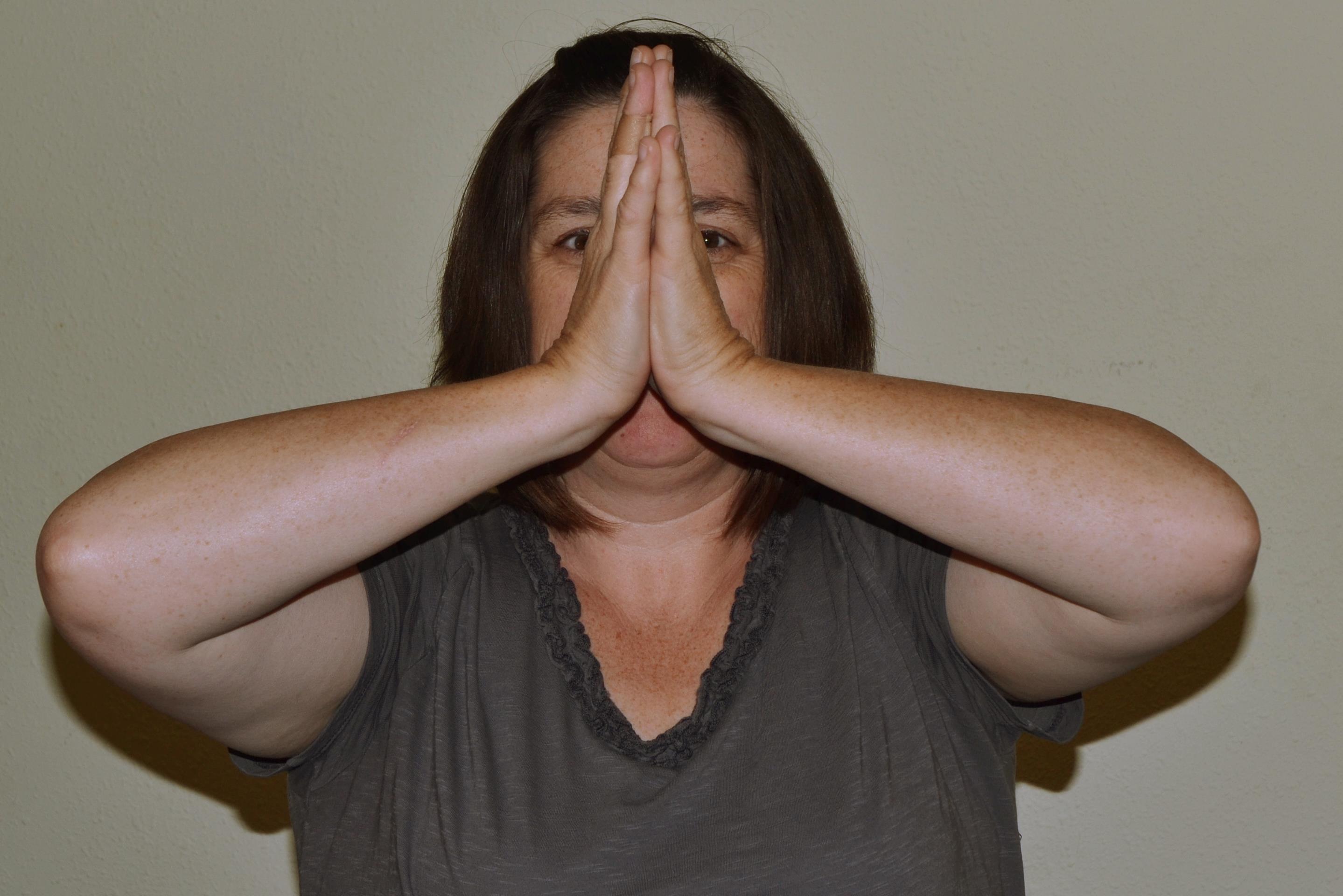
Arms loosely at sides … Inhale … and move arms to overhead in a prayer position, (hands flattened together)

Hands Overhead, Prayer Position

On exhale … Hands descend to chest / heart level while holding intention for self. Intentionally cross your eyes, your lips as you end at your heart.

Descending Towards the Heart
"om"
“om”

Express, outloud or however you feel comfortable, the particular word that encompasses the divine for you. Divine being interconnectedness to all, that which transcends all, that which is lived within, or the languaging that you choose. This could be the Sanskrit “om” (pictured), the Aramaic “abwoon” which is father, or any of the myriad words that are symbols that stand in for the divine.

Hands at heart level … Inhale

On exhale … Hands push outward, forward and go slowly to the sides (right arm going right / left arm going left). Do this while holding your intention for the world.

Pushing Intention To the World

Express, outloud or however you feel comfortable, the particular word that encompasses the divine for you.

Bring your arms gently down to your sides.

Repeat this simple meditation for as long as it feels comfortable to do so. If you desire, close the meditation with an Amen (“so be it.”)

Shalom & Amen,

Terri

© 2013, post and photos, Terri Stewart, All rights reserved

terriREV. TERRI STEWART is Into the Bardo’s  Sunday chaplain, senior content editor, and site co-administrator. She comes from an eclectic background and considers herself to be grounded in contemplation and justice. She is the Director and Founder of the Youth Chaplaincy Coalition that serves youth affected by the justice system. As a graduate of Seattle University’s School of Theology and Ministry, she earned her Master’s of Divinity and a Post-Master’s Certificate in Spiritual Direction. She is a contributing author to the Abingdon Worship Annual. (The 2014 issue just released!)

Her online presence is “Cloaked Monk.” This speaks to her grounding in contemplative arts and the need to live it out in the world. The cloak is the disguise of normalcy as she advocates for justice and peace. You can find her at www.cloakedmonk.com, www.twitter.com/cloakedmonk, and www.facebook.com/cloakedmonk.  To reach her for conversation, send a note to cloakedmonk@outlook.com

Posted in Essay, Meditation, meditative, Spiritual Practice, Terri Stewart, Uncategorized

Meditations of Our Hearts

I am saddened and deeply troubled by the Trayvon Martin case verdict. Mark Sandlin, a new Facebook friend of mine, offered the below. I have decided to add it to what I previously planned to publish. What I originally offered is a meditation based on a Psalm using very simple body prayer-a video that I put together. I thought about simply letting the video go for another day, but I think I, at least, need the reminder that there is something greater than the imperfection that we find in our daily living.

Questions?

Will anyone’s soul rest well tonight?
Will justice feel it was served?
Will a weary nation rest easy?
Can it believe its truths still hold true?
That all are created equal?
That truth is our nation’s highest good?
How can we sleep?
How can we slumber
when justice seems to be a game
and innocence has become relative?
Will we not grow restless?
Will our tears not matter?
Shall we continue our malaise?
Is our discontent so flaccid
that is ends in a Facebook post?
Is our will so weak that it is eased
with nothing more than words on a page?
Is the cost of our inconvenience
truly more valuable than a life…
our rights…
our jobs…
the hungry…
the sick…
the poor…
minorities…
?
Will our souls rest well tonight?
Should they?
Will our discontent respond?
Or will it slumber?
Will we drown out our malcontent
with the drone of a television…
the buzz of a beer…
the mindless escape of Candy Crush…
the busyness of our lives…
?
Will we simply get over it…
When there are parents who cannot,
When children are starving,
When there are families being buried,
While men make laws about women’s bodies,
As rights which were received
at the cost of lives
are made a mockery
for the sake of the few…
will we rest well tonight?
Will we rest?

Mark writes for Huffington Post, Sojourners, and his own blog at The God Article. This is reprinted with permission.

My fair warning before the video–this is in my living room, not professionally done! Bear with me as I learn these new skills.  Shalom.

© 2013, post and video, Terri Stewart, All rights reserved

MARK SANDLIN is an ordained PC(USA) minister currently serving at Vandalia Presbyterian Church in Greensboro, NC. Mark is a co-founder of The Christian Leftand blogs at The God Article. He has been featured on NPR’s The Story with Dick Gordon, PBS’s Religion & Ethics NewsWeekly, and the upcoming documentary filmAmendment One.

terriTERRI STEWART is Into the Bardo’s  Sunday chaplain, senior content editor, and site co-administrator. She comes from an eclectic background and considers herself to be grounded in contemplation and justice. She is the Director and Founder of the Youth Chaplaincy Coalition that serves youth affected by the justice system. As a graduate of Seattle University’s School of Theology and Ministry, she earned her Master’s of Divinity and a Post-Master’s Certificate in Spiritual Direction. She is a contributing author to the Abingdon Worship Annual. (The 2014 issue just released!)

Posted in Spiritual Practice, Terri Stewart

Connecting with the Mountain

Here, in the Pacific Northwest, there is a unique descriptor that books have been written about. It is the “none zone.” As in, “What is your religious preference?”

Answer: “None.”

I live here, in the none zone. However, there is a curious thing that happens as soon as the sun comes out. People start going up into the mountains climbing as high and as far as their bodies will let them. Going on a trail, you will never be alone. There are always people traveling with you. I thought, today as I hiked, “This is Pacific Northwest church!” Meaning people are seeking a mystical experience by going up as high as they can and as deep into nature, away from the cities, as they can.

short_semitic_viewLong ago, I mean a really long time ago, about 3,000 BCE or so, the ancient semitic worldview was quite different from our worldview. The world was flat, the mountains held up the dome of heaven, the concept was that the higher you went up the mountain, the closer you got to the divine. A concrete example of this is the many times that Moses went up the mountain in Hebrew scripture. He goes up to speak to God and comes back down to lead the people. I have included a picture depicting the ancient semitic worldview.

The picture doesn’t quite get across the idea that the highest mountain top was considered to be directly underneath the throne of heaven. So if you could get to the tippy top, you could be the closest to the divine.

In many ways, the folks here, although not religious, are seeking an experience of transformation that happens at the top of the mountain.

Seeing the beauty in sparkling water or the dappled shadows of leaves on the trail. Hearing delighted laughter as a child discovers the lake around the corner or standing still while a bird communes with you. Each act of curiosity, amazement, and even perseverance is an act of transformation. And transformation expands your heart, maybe even up to three times (odd reference to the Grinch here-“and his heart grew three times that day”)!

Baring MountainHiking, for me, feeds into my spiritual practice of contemplative walks. Coincidentally, it feeds into the ancient pattern of going to the top of the mountain to experience the divine. It is not only the ancient semitic people that did this! I am reminded particularly of the Blackfeet from Heart Butte, Montana. Their most sacred spot (no photos) is at the top of a mountain. There is a tree and people carry their prayers and offerings to that tree and put them there. It feels sacred. It is the holder of dreams and hopes. Hopefully, that is what our spiritual practices lead us to! A place inside our bodies that can hold dreams and hopes–and great sorrow.

Mountains are both physical and metaphorical. Not all of us can climb up a mountain (I am not going to go all the way to the top of Mt. Rainier!). But we all face challenges. Our challenges can either be transformational or they can get us stuck in the mud. So all of this is really a wind-up to get to the questions!

  • What is your mountain?
  • Can you go up it?
  • Do you need to go around it?
  • Is there a creative, third way to approach the mountain?
  • What spiritual practices will strengthen you for the journey?

And now I’m suddenly remembering a children’s song / chant called, “Goin’ on a Bear Hunt.”

Can’t go over it!

Can’t go under it!

Oh no!

We’re gonna go through it!

What do you have to go through? And how will you go through it?

Shalom and Amen!

~Chaplain Terri

© 2013, post, Terri Stewart, All rights reserved

terriTERRI STEWART is Into the Bardo’s  Sunday chaplain, senior content editor, and site co-administrator. She comes from an eclectic background and considers herself to be grounded in contemplation and justice. She is the Director and Founder of the Youth Chaplaincy Coalition that serves youth affected by the justice system. As a graduate of Seattle University’s School of Theology and Ministry, she earned her Master’s of Divinity and a Post-Master’s Certificate in Spiritual Direction with honors and is a rare United Methodist student in the Jesuit Honor Society, Alpha Sigma Nu. She is a provisional elder in the United Methodist Church and a contributing author to the Abingdon Worship Annual.

Her online presence is “Cloaked Monk.” This speaks to her grounding in contemplative arts and the need to live it out in the world. The cloak is the disguise of normalcy as she advocates for justice and peace. You can find her at www.cloakedmonk.com, www.twitter.com/cloakedmonk, and www.facebook.com/cloakedmonk.  To reach her for conversation, send a note to cloakedmonk@outlook.com


Posted in Essay, Nature, Photography/Photographer, Spiritual Practice, story, Story Telling, Photo Story, Terri Stewart

One Foot in Front of the Other

Walking is a spiritual practice that I am predisposed to. After all, photography would not happen unless I walked around! Simply putting one foot in front of the other, time after time, without expectation of arrival at an end point is a contemplative practice. Recently, though, I discovered a new way of viewing walking as a contemplative practice. This practice had an end point and I was completely aware of all the w’s – who, what, when, where, why. I was not letting go and receiving images (well a little). I was literally focused on my feet and putting my feet, one step at a time, on stable ground.

And this is a metaphor. Sometimes, sitting at our desk or listening to our loved ones, can be a practice of just being aware of what is now and putting your best effort towards arriving at the next now. One step at a time.

As you continue reading, consider the questions, “In what area of my life can I start (or continue) putting one foot in front of the other? What new story will be created?

Here is my story.

Monday, I went hiking to Bridal Veil Falls / Lake Serene in the Central Cascade mountains of Washington. It was a spectacular day. (The weather is forecast to be fabulous all week-long in Seattle leading me to believe somebody is playing with our emotions.) I felt confident I could do the +7 mile hike. BUT I forgot to look at the way the path is (smooth vs. rocky) and the grade or “up-ness.”

I started out on the popular path and asked a co-hiker what to expect and she told me it was steep but that it was worth it. And that there were a lot of switchbacks. OK. I can do this! I will just take my time and be careful.

In February of this year, I was going through a diagnosis of Celiac disease. Now most folks just think that this is digestive only. Well, it is not. It causes inflammation in every part of my body. It grew tumors in my ovaries. I had a period for 3 weeks. I was severely anemic. The test didn’t say, “Low,” it said “Alert!” I could not walk up a short hill without being severely out of breath because I had very few mature red blood cells to carry oxygen around. In short, it stank.

And, over the last few years I have had surgery on my left ankle (torn tendon) and my right foot (two! neuromas crowding out my middle toes). I couldn’t walk without pain until, oh, last year after the neuroma surgery. Generally, I count every pain-free step a success. Would my feet hold out? Always a question. And with the ankle surgery, I generally look for nice, solid, flat ground so my ankle will not roll.

Rats! This path is not smooth. Very rocky. Wet sometimes. Muddy sometimes. But mostly rock, rock, rock. Keep my eyes down and make sure my feet land on flat spots! That’s the plan.

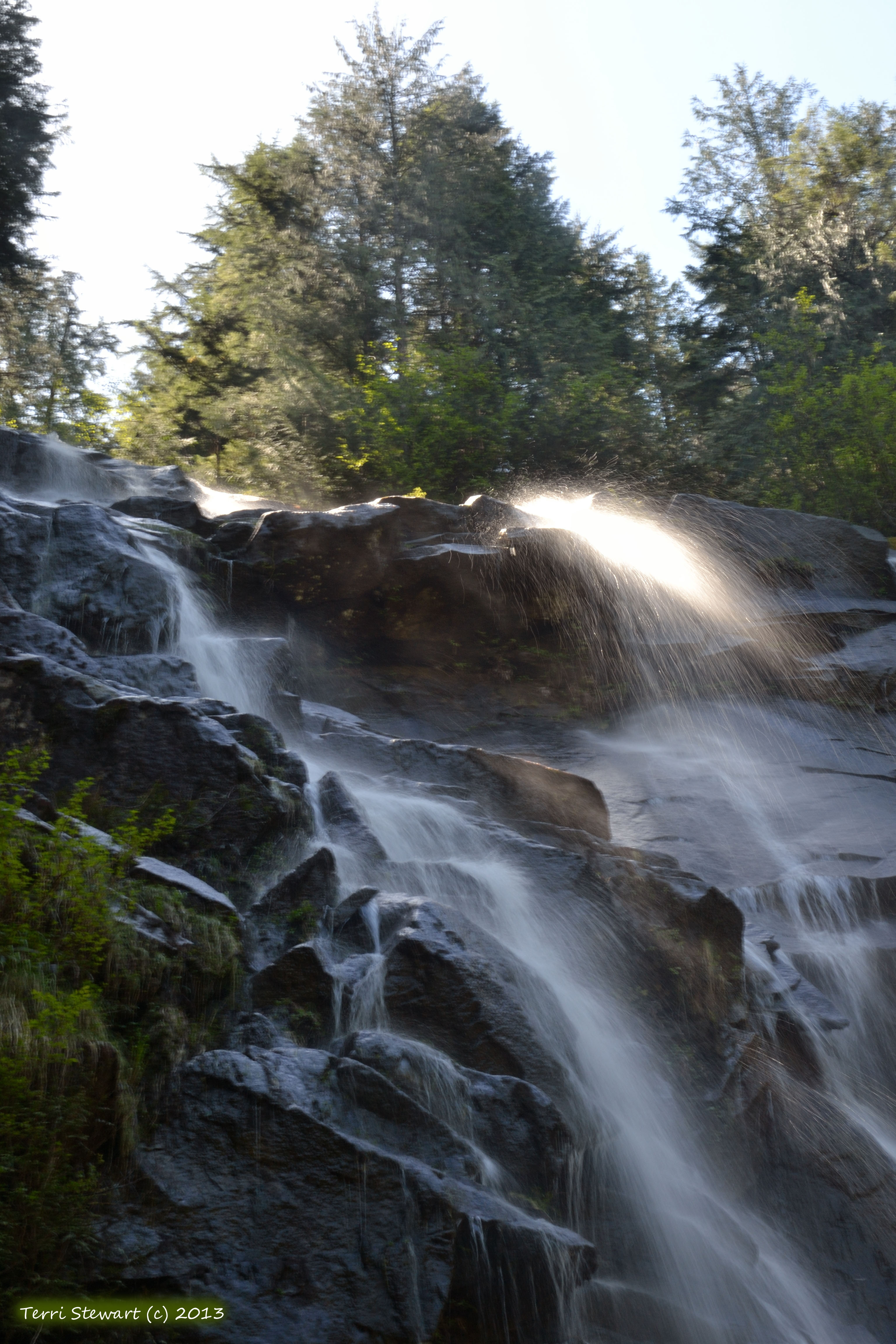
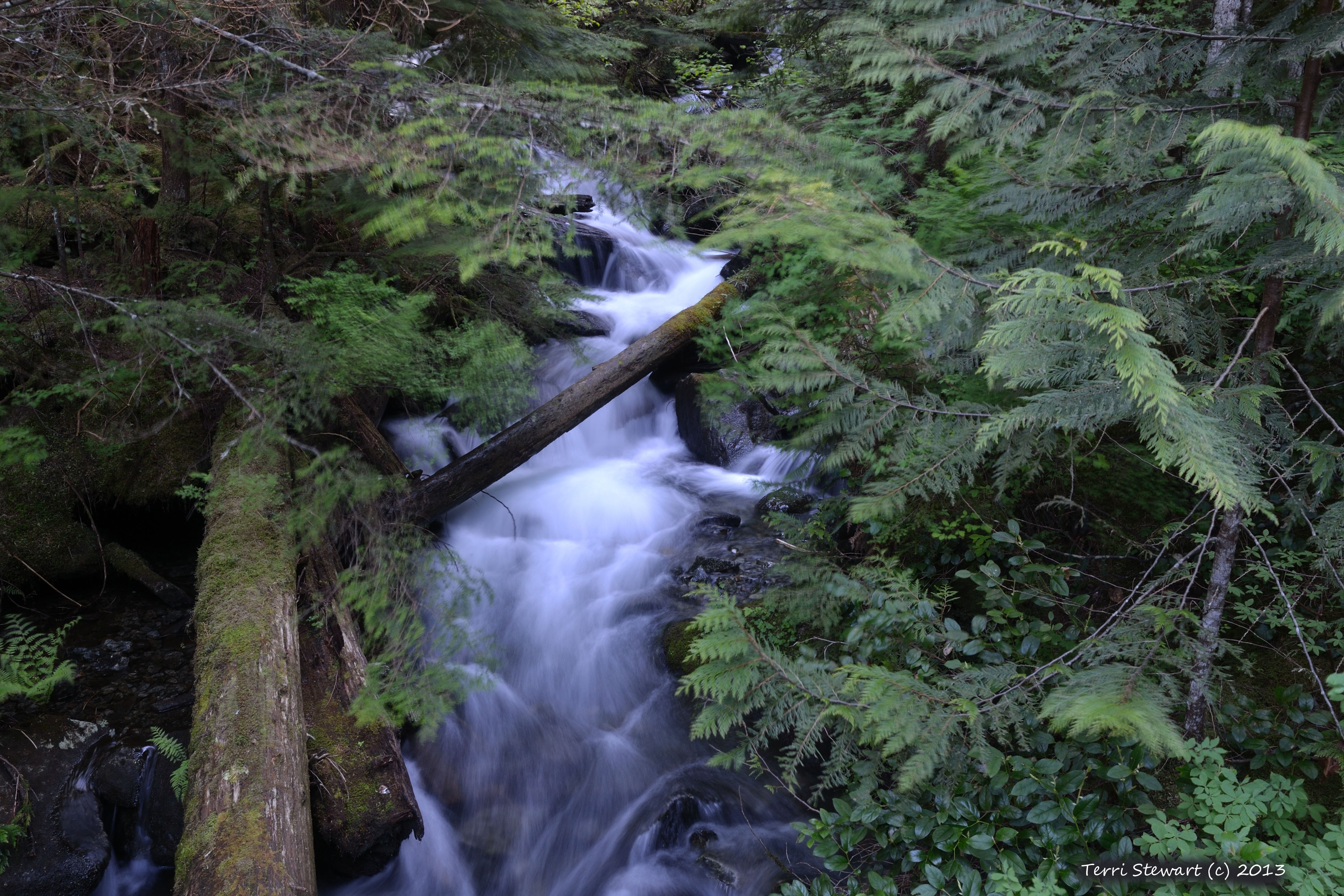
Anyway, I started up the path at my own pace. I got a little less than two miles in and found the below sight. I tried really hard to capture this thing that was happening with the sun and the water! It looked like liquid sunshine was pouring off the top of the waterfall. My eyes received the beautiful image of sunshine being poured down the mountain, could my camera receive it? A little.

Walkabouts__2013-06-03_12-05-17

At any rate, it was astounding. And it was the second set of falls I had seen. This mountain is one big slab of granite! (Hence the rocky path) And there is water everywhere. Well, okay, not everywhere, but in a lot of places. It was hard to get a good picture, but earlier, there was a set of falls that were very tall and jagged. But the trees were very overgrown so you could only get glimpses of the splash of light and water. This is the very bottom of that series. I received beautiful images of flowing water.

Walkabouts__2013-06-03_16-17-40

I got past the falls and it was two miles to Lake Serene. I was feeling good so decided my body could do this! I kept on going. And going. Up and up. Picking my way carefully through rocks. Resting when I felt overwhelmed. Then there came a moment when I thought that I was not going to be able to do it. I grounded my feet to the earth and drew on the strength of my God and the strength of the earth. I breathed deeply. This had become a spiritual quest.

I kept on going. But at that moment, I felt like giving up. I soon encountered a woman and her dog. They were resting. (Yay for rest!). I asked her how much further. She said, “When you feel like you have been through the worst possible climb, then it is just a bit more up and a little down and you’re there.”

OK. The worst possible climb. I can surely get to this.

I went up and encountered massive rocky path, with only about a 9″ clearance to skinny through. Surely, this is the worst possible spot.

I kept going and encountered another massive rocky path, with water and slipperiness. Surely, this is the worst possible spot.

Add water and repeat.

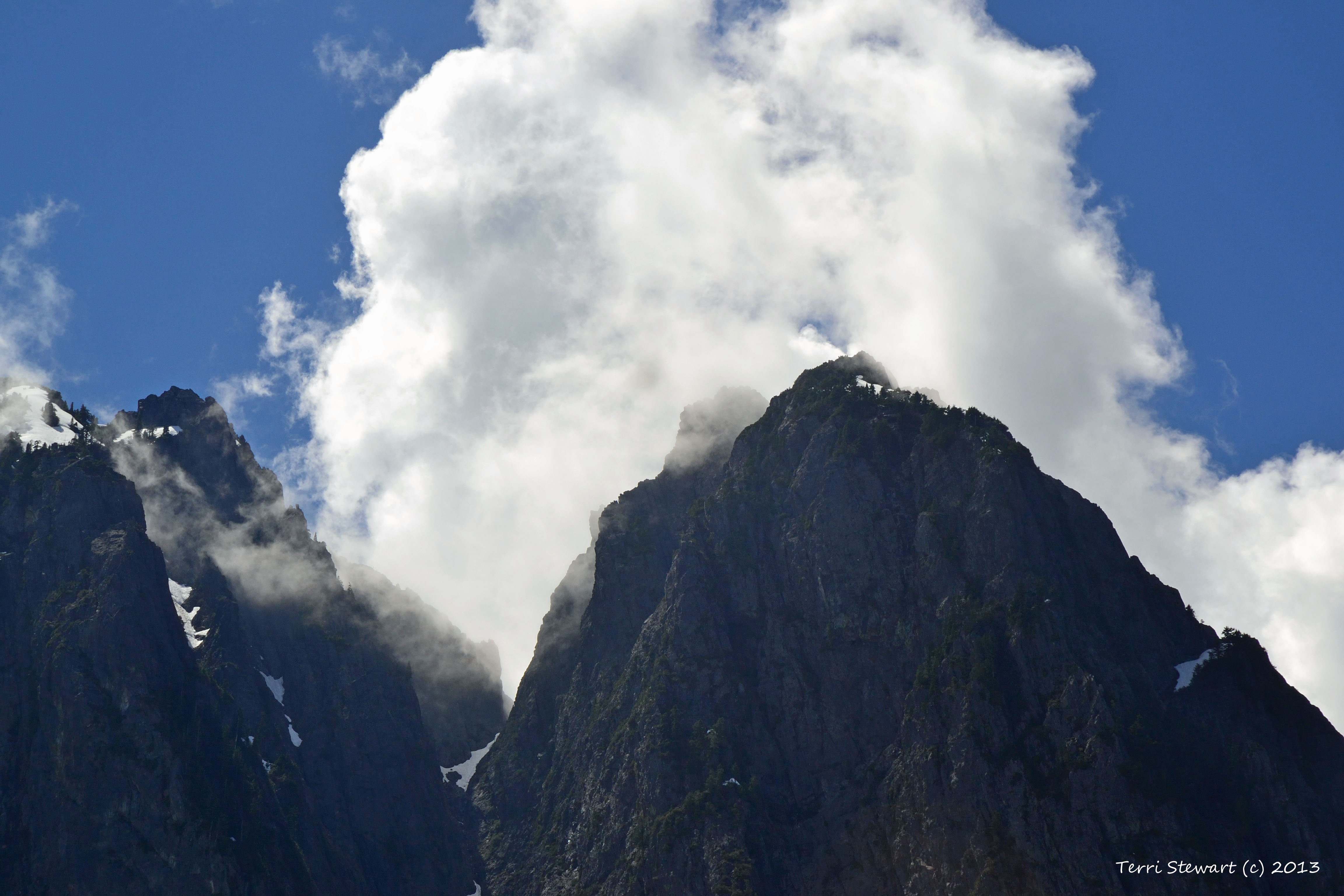
Finally, I broke through the shadows of the forest into a sunny meadowy type area (is it a meadow if it is on the side of a mountain?). I looked up and my breath left my body. It. Was. Amazing. I received the most beautiful blues intermingled with a dark granite mountain and white fluffy clouds rising like steam. I remember the story of Moses going up the mountain to be with his God and going into the cloud. This is a place to connect with spiritual strength. I felt strengthened, encouraged, excited, and alive. A complete contrast to how I felt when I was in the shadows.

Walkabouts__2013-06-03_13-56-59

I was now in the sun, with this incredible sight, having passed through at least 5 stretches of the worst climb ever. And I saw another worst climb ever in front of me. But my spirits were jubilant. I was in the light and had left the darkness. Amen!

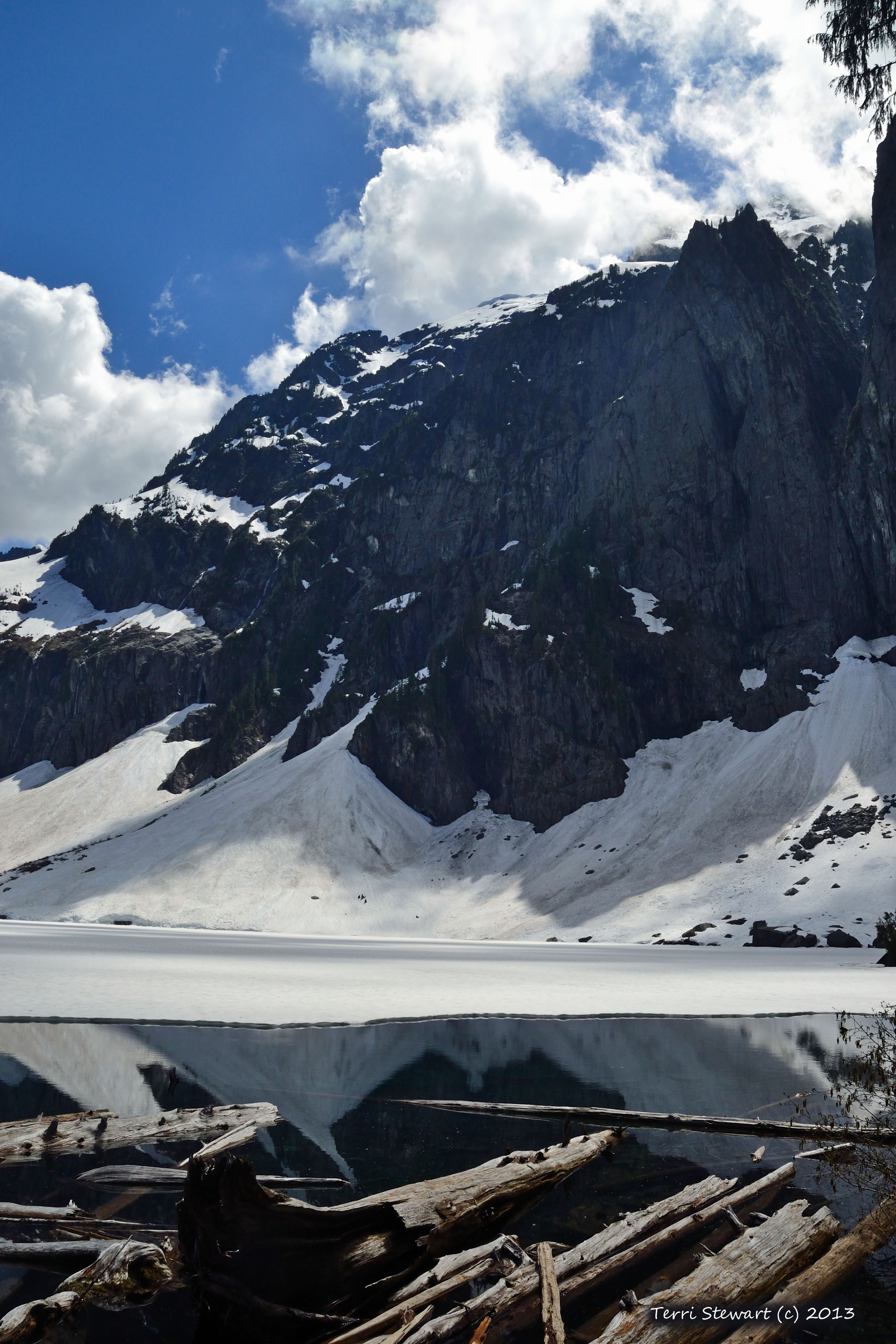
I kept on going. There was one more seriously worst climb ahead and then I was there. Lake Serene.

Walkabouts__2013-06-03_14-25-52

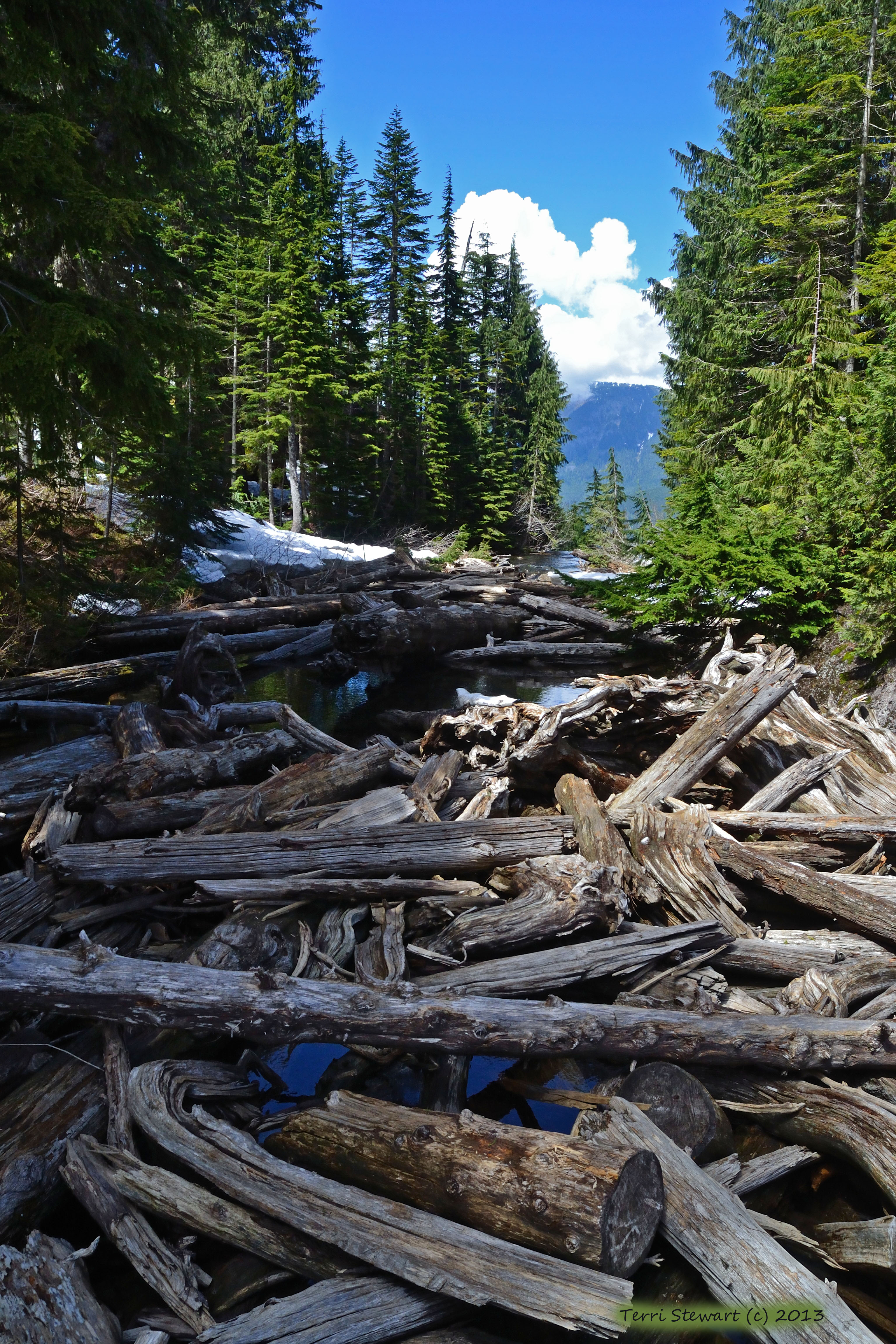
In fact, this lake feeds into the waterfalls pictured earlier. I had climbed all the way around to the other side. Here is what the top of the waterfall looks like from this same point, just facing the other way.

Walkabouts__2013-06-03_14-25-23

I clambered through the snow a bit and sat at the closest point I could get to the top of the waterfall. Ate lunch. Relaxed a moment.

Time to head back down. Surely, down would be easier! It always is. Mostly.

On the way down, I kept my head down looking to keep my feet planted so my ankle will not turn. I almost made it. Darn it. One misstep and a turned ankle. Choice – fall in a way to minimize injury or try to get that wobbly ankle to hold me up. Quick decision – my ankle will not withstand the effort to stay firmly up. Fall it is! Sheesh. I hate rocky, downhill, paths. Now, cuts and bruises, scratches and blood. I would hate to see what I looked like.

I crossed back in front of the amazing waterfall that poured sunshine and the woman I had met earlier was there with her dog! She was resting. Her dog decided to try to clean up the scratches on my legs a bit (ha ha!). We chatted a bit and she moved on. I stayed and tried to get some more photos of the falls and take a rest. Oh, and to use the water to wash my arm which has a pretty serious scratch(es).

But, gosh darn it, I did it! I am still on the path. I can still walk. My body is sustaining me. This is such a big deal, you have no idea. I was misdiagnosed for at least 20 years. To be able to do this is the most awesomely amazing thing ever. My muscles don’t even hurt as much today as they did on days the inflammation from being celiac made them hurt. (That was a bad sentence, sorry.)

I kept going. And I made it back to my car by about 5:00 p.m.

The quest was complete.

I am proud that I had the perseverance to keep on pushing through. My blood tests still say “alert” on the iron portion, but it is improving. My ankles and feet are okay today. My right arm and right shin are pretty banged up, but as long as nobody touches them (!) I will be fine.

The return hike took 2 hours. It took me 4 hours to go up.

Walking or hiking as a spiritual practice, for me, is typically about opening myself up to the images around me. Receiving images that I sometimes share here or on my blog. This time, though, it transformed into something else. Instead of receiving the beauty around me, I had to dig deep to connect to the strength of the earth, strength of my faith, and to the strength in my own body in order to find sustenance for the journey. This is a new kind of spiritual practice for me.  I had thought, Monday night, that I would not be eager to repeat this experience. But I am. Focusing on putting one foot in front of the other in this way gave me a faith in myself that I sometimes lack. Especially in my own body’s ability to sustain me. That is my new story. I trust my body.

Blessed be.

Shalom and Amen.

~Chaplain Terri

Adapted from a post at my blog. Trials on the Trail.

© 2013, post & photos, Terri Stewart, All rights reserved

terriTERRI STEWART is Into the Bardo’s  Sunday chaplain, senior content editor, and site co-administrator. She comes from an eclectic background and considers herself to be grounded in contemplation and justice. She is the Director and Founder of the Youth Chaplaincy Coalition that serves youth affected by the justice system. As a graduate of Seattle University’s School of Theology and Ministry, she earned her Master’s of Divinity and a Post-Master’s Certificate in Spiritual Direction with honors and is a rare United Methodist student in the Jesuit Honor Society, Alpha Sigma Nu. She is a contributing author to the Abingdon Worship Annual.

Her online presence is “Cloaked Monk.” This speaks to her grounding in contemplative arts and the need to live it out in the world. The cloak is the disguise of normalcy as she advocates for justice and peace. You can find her at www.cloakedmonk.com, www.twitter.com/cloakedmonk, and www.facebook.com/cloakedmonk.  To reach her for conversation, send a note to cloakedmonk@outlook.com
Posted in Meditation, Spiritual Practice, Terri Stewart

Meditation on the Shadow

shadow reflection self portraitI have been reflecting on shadow work a lot lately.  The shadow is that part of ourselves that we often keep hidden. It was especially prompted by Naomi’s images and thoughts in her post “Black and White (or not).” The world is shades of gray as our shadows often seem to be.

Physically, our shadows take on the colors of what they are cast on. We stand ‘here,’ the shadow projects ‘there,’ and our shadow is integrated with rock or grass or concrete or sofa–with the barest connection with our embodied self. Sometimes our shadows hang on to us by the barest toe. Sometimes we are connected fully.

The shadow is something darker, hidden, taking on different tones and different shapes than our embodied selves. But ultimately, it is a projection of our own self. What we don’t want to see in ourselves, we push into our shadow.

One of the most valuable lessons I had in seminary was a discussion of the Johari Window. It is really pretty simple! There are four ways to be known in the world (each one pane of a four paned window):

  1. Things we know about ourselves that nobody else knows
  2. Things others know about us that we don’t know
  3. Things we know and others know
  4. Things nobody knows

Our job is to shrink the part of our window that is “things nobody knows.”

γνῶθι σεαυτόν – Know Thyself, on the Temple of Apollo at Delphi

I’d like to offer a meditation on accepting the shadow self. Please only do this if you feel safe.

Find a comfortable place.  If you are sitting, ground your feet restfully, but firmly. If you are laying, sink down towards the earth. Let the earth buoy you and hold you through this exercise.

You may close your eyes if that is comfortable for you or you may keep them open. If your eyes are open, let your gaze fall gently onto a nearby spot—not particularly noticing anything about the spot, but just accepting the spot as your companion.

Let your gaze turn inward. Take an inventory. Do you feel anxious? Excited? Relaxed? Where is the energy stirring? Is your mind whirring? Or is it in your solar plexus? Or lower? What energy are you bringing to your meditation in your body? Greet the energy and invite it into your journey.

Pause and acknowledge the sacredness of joining with your energy. Breathe in. Breathe out.

Continue your inventory. Moving beyond the physical. What are all the great things you see about yourself? Your creativity? Your love? Your compassion? Mercy? Analysis? Quietness? Strength? Acceptance? Meticulousness? Acknowledge these beautiful and wonderful things and give thanks to them. Breathe in. Breathe out. Now, let them go. They will still be with you. Consider them your backbone. Holding you firmly in place, but behind you.

Reconsider your connectedness to the earth. Let her energy support you while sinking in. Reconsider your gifts—the great things about you. Let them provide structure to your body. Breathe in. Breathe out.

Before you, now, is an empty room. Just you and the energy you have brought with you. The energy from your body. The energy from the earth. The support from your gifts. A formidable group.

See the shadow.

How are you connected to the shadow? Fingertip? Toes? Fully? Check in with yourself and stop here if that feels right to you.

What contrasting energy is pulsing in the shadow? Is it a mirror of your own body’s energy? Or is it different? What is the shadow projecting onto you? Does it make you seem tall? Or small? What color does the shadow take on? What is it drawing from its surroundings? Check in with yourself and stop here if that feels right to you.

Open a dialogue with your shadow. Something like, “I see you. I know you are part of me. What do you have to teach me today?”

Listen to your shadow. Breathe in, breathe out. Check in with yourself and stop here if that feels right to you. This will be different for everybody.

If you feel brave, offer your shadow love. Compassion. Acceptance. Acknowledgement. What does that feel like? Check in with your body and see where your energy is stirring. Is your heart chakra pulsing? Or maybe your shadow has some energy swirling? Check in with yourself and stop here if that feels right to you.

Seeing your shadow, connecting, dialoguing, loving—continue to offer love and imagine love emanating towards your shadow from your energy, from the energy of the earth, and from the gifts that you bring that stabilize you. Imagine the love pouring out everywhere as light. Light as soft as a glowing sunset or as strong as a summer’s day. Whatever light is needed. As the light increases, the shadow steps closer and makes one more connection with you. Maybe just a pinky. Check in with yourself and stop here if that feels right to you.

Now, it is time to close the dialogue with the shadow.

Offer your loving kindness to the shadow. Bring your hands together over your heart chakra in a prayer position. Let your inner gaze fall gently on your shadow. Breathe in, breathe out. As you gaze at your shadow, offer Namaste.

Bring the inner light down to an inner, restful darkness. Let your shadow leave your full awareness, knowing you are that much more connected and that you will be back.

Breathe in, breathe out.

Feel your gifts that strengthened you. Thank them for being with you. Bid your gifts Namaste.

Feel the earth that supported you. Thank the earth for providing support. Bid the earth Namaste.

Feel the energy in your body that journeyed with you. Thank yourself for being present. Bring to yourself, Namaste.

Breathe in, breathe out.

Namaste.

Shalom and Amen,

~Terri

© 2013, post & photo, Terri Stewart, All rights reserved

Terri StewartTERRI STEWART is Into the Bardo’s  Sunday chaplain, senior content editor, and site co-administrator. She comes from an eclectic background and considers herself to be grounded in contemplation and justice. She is the Director and Founder of the Youth Chaplaincy Coalition that serves youth affected by the justice system. As a recent graduate of Seattle University’s School of Theology and Ministry, she earned her Master’s of Divinity and a Post-Master’s Certificate in Spiritual Direction with honors and is a rare United Methodist student in the Jesuit Honor Society, Alpha Sigma Nu. She is a contributing author to the Abingdon Worship Annual.

Her online presence is “Cloaked Monk.” This speaks to her grounding in contemplative arts (photography, mandala, poetry) and the need to live it out in the world. The cloak is the disguise of normalcy as she advocates for justice and peace. You can find her at www.cloakedmonk.com, www.twitter.com/cloakedmonk, and www.facebook.com/cloakedmonk.  To reach her for conversation, send a note to cloakedmonk@outlook.com
Posted in Spiritual Practice, story, Terri Stewart

Connecting to Our Story

New Life, New Story
New Life, New Story

Often times, we look back at our lives and we can see the story. But is that story really the heart of the matter? How do we connect to the heart of our story in the present moment? Taking meaning from what is now to illuminate what was then.

At the core of every moment lies the heart of the cosmos, and my heart, and yours.

~Margaret D. McGee, Haiku–the Sacred Art

Today, I’d like to try a technique that Margaret McGee teaches in her book referenced above. She uses it to teach haiku. If you feel comfortable with that, I would definitely encourage you! If you feel there is another creative form calling forth from you, then use that–music, dance, poetry.

You will need up to 20 minutes for this exercise. Review all the steps before you start, unless you’re like me, in which case you just jump in!

Make a chart something like this (you probably will need extra room under sight!):

table

Now, if it is possible, find a nice place outside to sit comfortably and to take in your surroundings.

Relax, breathe deeply, look around.

  • Now–What do you smell? It’s spring–are there flowers blooming? Can you smell them? Not all smells are serene! It could be something else altogether!
  • Then–Close your eyes. Let go and stroll through your memories. Is there a particular scent from your past (last week? childhood?) that is arising for you?
  • Now–Write down the first thing you see! And keep on filling it in. Our eyes can take in so many things! We can see, arguably, over 100,000 different colors! What words can you create that describes the individuality in what you see?
  • Then–Close your eyes. Let go and stroll through your memories. Is there a particular color or scene from your past that is arising for you?

Continue on in this pattern for each category.

Now, get a fresh sheet of paper or use the back of your grid. Choose a few images from your lists that are resonating with you and with each other. These images may all be from the present moment or they may be from past moments. In particular, if you want to use the present to cast meaning on your past story, search for threads that connect across time.

Go and do! Create your artwork (or soulwork) in haiku, other poetry forms, photography, collage, painting, mandala, essay, etc. Whatever way calls to you. Take time now to make meaning and to add to the depth and meaning of your own story.

table2

For me, what is resonating is the bitterness of coffee, addiction, wind that is too strong. Yikes–what can I do with that?

stormy winds of spring

whistle through my breaking heart–

promises unkept

Aaah, well, this exercise today seems to have brought up some memories. What is clear to me is that our stories are never finished. We can continue to add meaning and to find new meaning and to have alternate meanings! A surplus of meaning.

The full story behind this new story has been started before if you would like to read it.

Shalom,

Chaplain Terri

© 2013, essay, haiku, and photograph, Terri Stewart, all rights reserved

Terri StewartTERRI STEWART is Into the Bardo’s  Sunday Chaplain, Senior Content Editor, and Site Co-administrator. She comes from an eclectic background and considers herself to be grounded in contemplation and justice. She is the Director and Founder of the Youth Chaplaincy Coalition that serves youth affected by the justice system. As a recent graduate of Seattle University’s School of Theology and Ministry, she earned her Master’s of Divinity and a Post-Master’s Certificate in Spiritual Direction with honors and is a rare United Methodist student in the Jesuit Honor Society, Alpha Sigma Nu. She is a contributing author to the Abingdon Worship Annual.
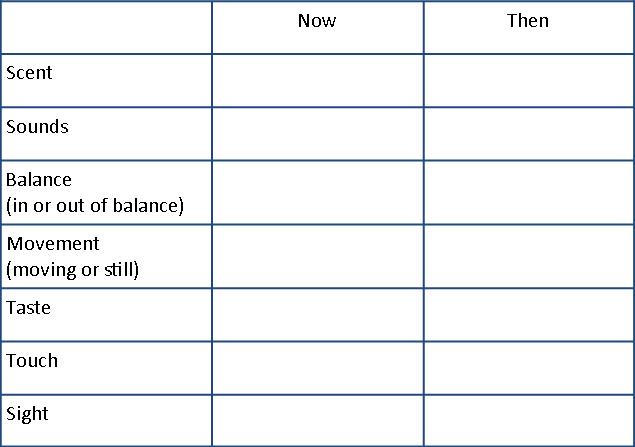
Her online presence is “Cloaked Monk.” This speaks to her grounding in contemplative arts (photography, mandala, poetry) and the need to live it out in the world. The cloak is the disguise of normalcy as she advocates for justice and peace. You can find her at www.cloakedmonk.com, www.twitter.com/cloakedmonk,  and  www.facebook.com/cloakedmonk.  To reach her for conversation, send a note to cloakedmonk@outlook.com.