Posted in Creative Nonfiction, Jamie Dedes

For the Record: Remembering Mom

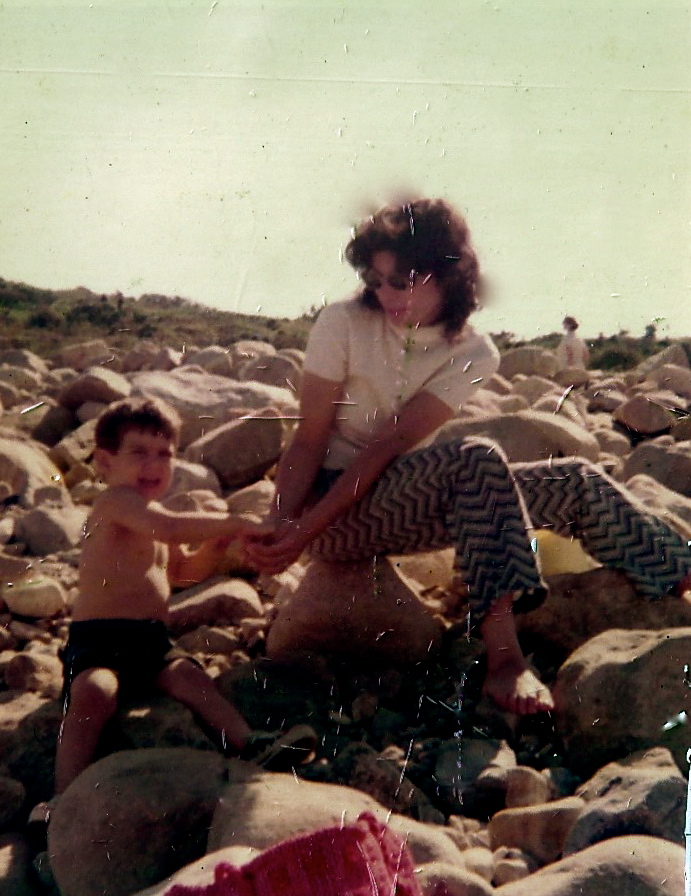
Mom and Me 1950, Brooklyn
Mom and Me
1950, Brooklyn

First publication: March 15, 2012, Connotation Press

I am the keeper of the dreams and the memories, the matrix where the generations converge, the record-book held between familial bookends. I am responsible for passing her life on to him that she may continue to live and that he may understand the consequences of history and culture as common people do.

He is the vindication of hope, his and ours. Her heart is the place were hope started. I can hardly think of my son without also thinking of my mother. They are the two people I love most in this world, though one of them – Mom – is no longer here. So for the record, I’m not sure why, but the occasional pancake breakfasts I had with her at Oscar’s of the Waldorf are on my mind. We had rituals we honored until life had its way with her.

______

We spent time savoring the hotel before going into Oscar’s for breakfast. The Waldorf was decorated with so much gold color that despite the muted lighting we felt we were having our moment in the sun. The jewel-colored furnishings and plush carpeting invited us to find a place to sit. We indulged in wide-eyed rounds of people watching. The businessmen seemed busy with self-importance. The women fussed with their manifest charm. We always stopped in the ladies’ room with its uniformed attendants continually present. They provided each guest with a freshly laundered terry-cloth towel and double-wrapped soaps, lavender-scented. Mom would tip the attendant a quarter and give me a quarter to tip her too.

Waldorf Lobby & Clock

An important ritual was a visit to the Waldorf Astoria Clock in the main lobby. I’ve read that it’s there still, all two tons of it. It’s a place where people find one another. I’ll meet you at the clock. Everyone knows that means the clock inside the Waldorf-Astoria at Park Avenue. It’s a towering thing, the actual clock sitting below a replica of the Lady Liberty, hope of immigrants, and above some bronze carvings and an octagonal base of marble and mahogany. Standing near the clock gave us the sense of a history of which we were not a part. It offered the illusion of privilege, the true secret spice that made the blueberry pancakes at Oscar’s so delicious. The famed maître d’hôtel, Oscar Tschirky, Oscar of the Waldorf, was no longer there. He died in 1950, the year I was born.

_______

My mom loved the Waldorf and Oscar’s blueberry pancakes as she did everything she felt characteristic of culture and good breeding. Being well bred meant you recognized quality in a person or product: women who wore pearls, men who always tipped their hats in greeting, and dresses with wide hems. Well-bred meant you didn’t swear or use colloquialisms.  It meant that if you were a boy you never cried. If you were a girl you didn’t display your intelligence. You didn’t run. You didn’t shout. You never went out without wearing hat, gloves, and girdle.  You sacrificed sports and ballet at nine. You didn’t risk turning any tidbit of excess fat into unseemly muscle.

Given my illegitimate birth – which occurred when my mother was thirty-six – combined with our roots, peasant not patrician, and our working-class status in this country, it seemed Mom was forever posturing. Nonetheless, over time I convinced myself that my mother was indeed a most cultivated person. Hence my birth had to be a virgin birth. That would explain my father’s absence, though there was no kindly Joseph to lend an aura of respectability. Mom advised me never to kiss a boy. Kissing could cause pregnancy. Well, yes, if one thing leads to another, but how would my mom know?

'50s Style Theater seating
’50s Style Theater seating

Mom’s interest in culture was insatiable. What she viewed as high culture most people would see as popular culture. We consumed it regularly and with religious fervor. We were fickle about our temples of worship. We opened our hearts at the Harbor Theater on Wednesday night, the RKO on Saturday afternoon, the Loew’s Alpine on Sunday, and for whatever reruns were on television at any given time. Because of movies we knew what to dream. They were our world; their luminaries our goddesses and gods. Audrey Hepburn, goddess of fashion. Cyd Charisse, goddess of posture. Katherine Hepburn, the great goddess of elocution. Grace Kelly inspired us to wear pearls, however faux our own five-and-dime pearls were. We did our best to meet the standard. Fred Astaire, Gene Kelly, and Jimmy Stewart were the gentlemen gods who shaped our expectations of men.

Our home back then was a one-bedroom Brooklyn apartment on the top floor of a six-story four-section complex that was built in the 1920s before the Wall Street Crash of 1929. Each of the four sections had an elevator, often in disrepair. Our apartment had French windows, which we found romantic and from which we could see the lights of the Verrazano-Narrows Bridge at night. The bridge didn’t open until 1964 and so it came to our landscape late. The requisite fire escape was outside the kitchen window, the only window without a radiator below its sill. It made a fine place to sit and read, write stories, and watch the cars below and the clouds above.

Our apartment, D61, was often blessed with rain in the form of leaks. Manna dropped from the ceiling in the guise of paint chips. If the people downstairs were too noisy, we tapped on the wood floor with the end of a broomstick. When there was no heat or hot water we consulted with the landlord’s wife, a common woman whose carelessly open closet displayed a frowzy collection of cotton house-dresses and limp lifeless sweaters. Mom always sniffed as we walked away, her sensibility offended. She said the woman’s hair was entirely too long and youthfully styled for someone of her station and maturity.

I remember my mother as so refined that when conflict arose between us she never fought or yelled or slammed a fist on the table. After a quiet well-barbed soliloquy, she went silent. If Mom’s anger was white-hot, she might not talk to me for years. The last episode of protracted silence extended from my fifteenth birthday until after my marriage. I no longer remember my original offense but a rebellious marriage to someone of a different ethnicity did nothing to serve the cause of reconciliation.

________

00000001There’s my mother, the little girl on your left. She’s about seven in that sepia photograph – circa 1921 – where she stands alongside her mother and three of her six siblings. My mother’s mother is pregnant and in her mid-twenties. There would be four more children that survived out of eighteen pregnancies. Mom told me my grandmother was married off at twelve to a seventeen-year-old boy-man with something of a temper. They immigrated to this United States of America after the first two children were born, one boy (thank God!) and one girl.

I often look at that photograph of my mother and wonder what she was thinking. What did she long for? As she made her way around the old neighborhood and tried to grow beets in a wooden box on the tenement fire escape, certainly she dreamed of dressing in the latest rage. When, through the aegis of the New York Times Fresh Air Fund, she spent a month each summer at the Muzzi’s farm upstate, no doubt she fantasized about living where the air is clear and the spaces packed tight with solitude and well-occupied with growing green things. She often talked with longing of the fresh vegetables at the Muzzi’s and of a large accommodating farm kitchen.

Mom once landed a part in an elementary-school version of Aïda and got to wear a costume and make-up. Her father had her remove the red lipstick that was provided by a teacher. As an adult, Mom collected lipsticks. You wouldn’t believe how many different shades of red there are and how poetic the names: autumn rose, wild ruby, crimson dew …

Over time, the hope of being valued by a good man, of living in a garden apartment with something more than an efficiency kitchen, moved slowly out of reach. As Mom grew older, less nubile, and more invisible, she became more artful with her war paint and her dress. She no longer wore what jewelry she had as decoration, but as amulets.

Her decline must have started when she was pregnant with me. Coincident with that, she was diagnosed with cancer for the first time. Through the years and bit by excruciating bit, she lost organs: a breast now, then her thyroid, then her womb, a kidney and finally the second breast and lymph glands. I’m just a shell, she’d tell me before warming her soul by the cold fire of a movie screen. She would fight cancer on-and-off all her life. When the end came, she died in my arms of breast and colon cancer. She was seventy-six.

Mom was a good numbers person, always able to find work as a full-charge bookkeeper. When I was twelve, a particularly exciting opportunity came her way. A prospective employer flew her – a Kelly Girl ®, forty-eight years old – to D.C. for a trial assignment and a job interview. When she arrived, she found the possibility of permanent employment required a full medical exam. The exam, along with work history and evaluation, would be submitted to the board for review. All those men would see it. They might even discuss her lack of womanly organs at the board meeting, complete with board notes for the record. Embarrassed, Mom declined the interview, packed her bag, and found her way to the airport. That afternoon, she arrived back in New York at Idlewild.

Subway Station
Our Subway Station

The next morning, without even a nod to the well-bred goddesses and gods of mortal fancy, Mom threw on some clothes and grabbed my hand. An hour or so later we were in Manhattan. We went straight into Oscar’s. We didn’t stop in the hotel lobby for people-watching or give quarters to the ladies’ room attendant. We didn’t pay our respects to the Waldorf Astoria Clock. We just ate. Rather, I should say I watched. Mom ate. She cut her pancakes at punitive angles and made doleful jabs at the pieces with her fork. When she finished her serving, she moved on to mine. By the time Mom gulped her third coffee, paid the bill, and left a grudging tip, even my child-mind understood that our visits to Oscar’s for blueberry pancakes would no longer be part of a wistful dream. Lacking sacred ritual, they would devolve into compulsion. This was the beginning of Mom eating much too much and of me not eating quite enough. While Mom endeavored to bury her dreams, I sought to scrap their bones bare and set them free.

© 2012, memoir/family photographs and portrait (below), Jamie Dedes, All rights reserved /the photographs which include my mother are a part of our family album but they’re also covered by copyright. Please be respectful. Waldorf Lobby & Clock courtesy of New York Architecture. Theater seating by Reddi  via Wikipedia under Creative Commons Attribution-Share Alike 3.0 unported license. Subway station by David Shakelton via Wikipedia under Creative Commons Attritution-Share Alike 3.0 unported license.

Photo on 2012-09-19 at 20.00JAMIE DEDES ~ My worldly tags are poet and writer.  I’m in my fifth year of blogging at The Poet by Day, the journey in poem, formerly titled Musing by Moonlight.  Through the gift of poetry (mine and that of others), I enter sacred space.
Posted in Fiction, Guest Writer

Shadows …

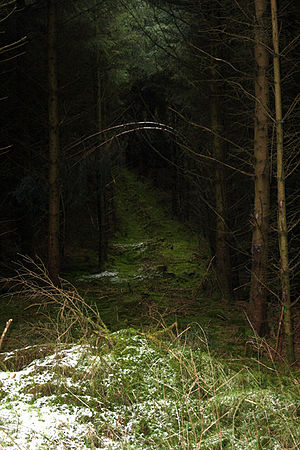
Auchenroddan Forest
Auchenroddan Forest

In the deep-rooted shadows upon which the forest stands, where nothing grows except moss and the debris piles of winter-felled branches and twigs, they heard the stuttering k-r-r-r-r-r-k like that of an opening door to a derelict shack.

But around Jerry Lilly and his brother Ben, padding through the shadows, there was no abandoned home except last year’s finch’s nest and the insect domicile within the pine upon which a woodpecker hammered another k-r-r-r-r-k.

“This noise where there’s nothing around creeps me out, man,” Ben said.

“Someday, little brother, you’ll find such ‘noise,’ as you call it, a blanket of quiet comfort, the caress of natural music far from the crash and soul-crunching violence in the city to which you’ll run as often as possible for its peace,” said Jerry.

“Okay, I get it, but it’s so darn dark in here, how the hell are we supposed to see anything well enough to shoot it?” Ben said, shifting the new rifle to his shoulder and swinging it around in carefree arcs.

– Joseph Hesch

© 2013, Joseph Hesch, story and the portrait below, All rights reserved

Hesch ProfileJOSEPH HESCH (A Thing for Words) is a writer and poet from Albany, New York. This delightfully ironic flash-fiction piece is what we hope will be the first of many contributions to Into the Bardo. Joe’s poems and stories are inspired by his almost 400-year-old hometown, but most spring from his many travels between his right ear and his left ear. A former journalist, Joe has written for a living for more than thirty years and only recently convinced himself to rediscover the writer he once thought he was. Five years ago he began to write short fiction. Two years later, in a serendipitous response to a blinding case of writer’s block, he wrote his first poem…ever. He hasn’t looked back.

Joe’s work is published in journals and anthologies coast-to-coast and worldwide. He posts poems and stories-in-progress on his blog, A Thing for Words.  An original staff member at dVerse Poets Pub website, Joe was named one of Writers Digest Editor Robert Lee Brewer’s “2011 Best Tweeps for Writers to Follow.”

Posted in Poems/Poetry, Video

On the Death of the Beloved

$T2eC16FHJG!E9nm3pwQLBRZIZHCJm!~~_35Though we need to weep your loss,
You dwell in that safe place in our hearts,
Where no storm or might or pain can reach you.

Your love was like the dawn
Brightening over our lives
Awakening beneath the dark
A further adventure of colour.

The sound of your voice
Found for us
A new music
That brightened everything.

Whatever you enfolded in your gaze
Quickened in the joy of its being;
You placed smiles like flowers
On the altar of the heart.
Your mind always sparkled
With wonder at things.

Though your days here were brief,
Your spirit was live, awake, complete.

We look towards each other no longer
From the old distance of our names;
Now you dwell inside the rhythm of breath,
As close to us as we are to ourselves.

Though we cannot see you with outward eyes,
We know our soul’s gaze is upon your face,
Smiling back at us from within everything
To which we bring our best refinement.

Let us not look for you only in memory,
Where we would grow lonely without you.
You would want us to find you in presence,
Beside us when beauty brightens,
When kindness glows
And music echoes eternal tones.

When orchids brighten the earth,
Darkest winter has turned to spring;
May this dark grief flower with hope
In every heart that loves you.

May you continue to inspire us:

To enter each day with a generous heart.
To serve the call of courage and love
Until we see your beautiful face again
In that land where there is no more separation,
Where all tears will be wiped from our mind,
And where we will never lose you again.

– John O’Donohue

Posted in Creative Nonfiction, Jamie Dedes, Uncategorized

Those Infamous New York Moms

Mom and Me 1950, Brooklyn
Mom and Me
1950, Brooklyn, NY

A woman in Brooklyn decided to prepare her will. She told her rabbi she had two final requests. First, she wanted to be cremated. Second, she wanted her ashes scattered over the local shopping mall.

‘Why the shopping mall?’ asked the rabbi.

‘Then I’ll be sure my daughters will visit me twice a week.’

I met my Jewish friend, Laurel, when she came to a meeting at our local meditation center in Northern California where we now live. Laurel and I  got on right away. We both like Broadway shows, music and opera, reading, writing, and good meals seasoned with great conversation. She’s from Great Neck, LI in Nassau County. I’m from

Me and Rich 1972, Montauk Point, LI, NY
Me and Rich
1972, Montauk Point, LI, NY

the Center of the Universe, Brooklyn. We’re about the same age. So we come from the same time and, essentially, the same place.

Now New York moms get a bad rap, especially Jewish moms – but none of us gets off free. Laurel reminded me of that yesterday with a stereotypical New York joke at the expense of mothers. These jokes usually illustrate moms making caustic remarks or their attempts to foster guilt in adult children. While we do use regional idioms and have a distinct style of delivery, I’m really not sure that mothers from our time and place have the corner on either caustic commentary or the laying on of guilt. New York moms can’t be the only ones who, when distressed by a child’s behavior, say or at least think – despite how treasured the child … and they are treasured – “For this I was in labor thirty-six hours.”

Like all of us, my mother was very much in process and very much a product of her place and time. Among other things, what that means is that modesty was a primary concern. For my Maronite (Eastern Catholic) mother this included modest dress, which in turn included girdles. Now I’ve got to tell you that until I hit forty I was mostly underweight. In fact at Christmas when I was nineteen, I stood 5′ 3 1/2″ and, though I was three months pregnant with my son, I weighed only ninety-three pounds. Nonetheless, from my thirteenth year until her death when I was forty, my mother was adamant that I should wear a girdle so that I wouldn’t “jiggle.” That would be immodest and unseemly. Only my mother, I would think, would put me through this torture for nothing. As my husband said, “What’s to jiggle? If she turned sideways and stuck out her tongue she’d look like a zipper.”

Those old, typically New York jokes at the expense of our mothers were funny because there’s an element of truth in them. Our mothers often did pave the pathways to their homes and hearts with guilt. They could be cruelly caustic. They were as tough as life. They tended to be rigid and narrow on some sensitive subjects. But they were also present. They were idealistic. They worked hard in their homes and at their jobs, where they were grossly underpaid. Many of them worked for hours each week to make the most unbelievably complex old world dinners for traditional Sundays that included religious services and large gatherings of extended family and orphaned friends and neighbors.

No matter how difficult things got, these sturdy immigrant and first-generation American women did not resort to drugs, alcohol, or beatings. They went to bat for us at school. They got us into the best schools they could afford and kept us in school for as long as they could afford to do so. They protected us from old lechers and young men who did not have “honorable” intentions. Kudos and compliments were about as common as Dodo birds in the twenty-first century; but secretly they were pleased and would proudly show photographs of us to their friends and boast of our accomplishments. It took me years to appreciate their insecurities and motivations.

Mom and me 1980, San Francisco, CA
Mom and me
1980, San Francisco, CA

You can tell by the posture in the photo to your right, that moving into my thirties, I was still struggling with mixed feelings. The reason in this particular case: Before I went to work one morning, I left money on the kitchen table for a pizza. I called home at 5:00 p.m. as I was leaving the office and asked my mother if she’d order the pizza right away because I was “starving.” I got home and “binged”: I ate one slice of pizza and left the crust. “I thought you were hungry,” Mom said. “I was.”  The fact that I was thirty and still “eating like a bird” and underweight disturbed her. In turn, I was disturbed because she was still trying to tell me how to eat. I do the same sort of thing to my son now, not about food, but about other things.

I miss my mother and am thinking of her even more than usual with Mother’s Day soon to arrive. I wish she was here nagging me to clean my plate. I finally understand. As the saying goes, “We grow too soon old and too late smart.”

– Jamie Dedes

© 2013, feature and all photographs (from our family album, please be respectful), Jamie Dedes, All rights reserved

Photo on 2012-09-19 at 20.00JAMIE DEDES ~ My worldly tags are poet and writer. For the past five years on medical retirement due to a chronic, potentially life-threatening illness, I’ve blogged at The Poet by Day, formerly titled Musing by Moonlight. The gift of illness is more time for poetry. Through the gift of poetry (mine and that of others), I enter sacred space, the common ground that is our true home.

Posted in Essay, Guest Writer

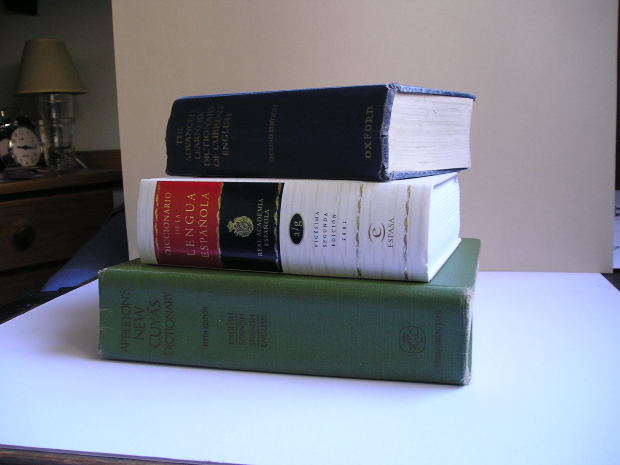
FROM HARPY’S REVIEW: The 10 Top Relationship Words That Aren’t Translatable Into English

OLYMPUS DIGITAL CAMERA

Published here with the permission of the author, Pamela Haag, who did the original research and writing. It was published on November 18, 2011 on The Big Think, which hosts Pamela’s blog, Harpy’s Review.  I thought it an interesting piece. Apparently, so did a lot of others.  It was blogged and reblogged often and generally without Pamela’s analysis and often without attribution to her. It took a bit of doing to find the source. All other postings I found of this piece were dated subsequent to Pamela’s. J.D.

Here are my top ten words, compiled from online collections, to describe love, desire and relationships that have no real English translation, but that capture subtle realities that even we English speakers have felt once or twice. As I came across these words I’d have the occasional epiphany: “Oh yeahThat’s what I was feeling…”

Mamihlapinatapei (Yagan, an indigenous language of Tierra del Fuego): The wordless yet meaningful look shared by two people who desire to initiate something, but are both reluctant to start. 

Oh yes, this is an exquisite word, compressing a thrilling and scary relationship moment. It’s that delicious, cusp-y moment of imminent seduction. Neither of you has mustered the courage to make a move, yet. Hands haven’t been placed on knees; you’ve not kissed. But you’ve both conveyed enough to know that it willhappen soon… very soon.

Yuanfen (Chinese): A relationship by fate or destiny. This is a complex concept. It draws on principles of predetermination in Chinese culture, which dictate relationships, encounters and affinities, mostly among lovers and friends.

From what I glean, in common usage yuanfen means the “binding force” that links two people together in any relationship.

But interestingly, “fate” isn’t the same thing as “destiny.” Even if lovers are fated to find each other they may not end up together. The proverb, “have fate without destiny,” describes couples who meet, but who don’t stay together, for whatever reason. It’s interesting, to distinguish in love between the fated and the destined. Romantic comedies, of course, confound the two.

Cafuné (Brazilian Portuguese): The act of tenderly running your fingers through someone’s hair.

Retrouvailles (French):  The happiness of meeting again after a long time.

This is such a basic concept, and so familiar to the growing ranks of commuter relationships, or to a relationship of lovers, who see each other only periodically for intense bursts of pleasure. I’m surprised we don’t have any equivalent word for this subset of relationship bliss. It’s a handy one for modern life.

Ilunga (Bantu): A person who is willing to forgive abuse the first time; tolerate it the second time, but never a third time.

Apparently, in 2004, this word won the award as the world’s most difficult to translate. Although at first, I thought it did have a clear phrase equivalent in English: It’s the “three strikes and you’re out” policy. But ilunga conveys a subtler concept, because the feelings are different with each “strike.” The word elegantly conveys the progression toward intolerance, and the different shades of emotion that we feel at each stop along the way.

Ilunga captures what I’ve described as the shade of gray complexity in marriages—Not abusive marriages, but marriages that involve infidelity, for example.  We’ve got tolerance, within reason, and we’ve got gradations of tolerance, and for different reasons. And then, we have our limit. The English language to describe this state of limits and tolerance flattens out the complexity into black and white, or binary code. You put up with it, or you don’t.  You “stick it out,” or not.

Ilunga restores the gray scale, where many of us at least occasionally find ourselves in relationships, trying to love imperfect people who’ve failed us and whom we ourselves have failed.

La Douleur Exquise (French): The heart-wrenching pain of wanting someone you can’t have.

When I came across this word I thought of “unrequited” love. It’s not quite the same, though. “Unrequited love” describes a relationship state, but not a state of mind. Unrequited love encompasses the lover who isn’t reciprocating, as well as the lover who desires. La douleur exquise gets at the emotional heartache, specifically, of being the one whose love is unreciprocated.

Koi No Yokan (Japanese): The sense upon first meeting a person that the two of you are going to fall into love.

This is different than “love at first sight,” since it implies that you might have a sense of imminent love, somewhere down the road, without yet feeling it. The term captures the intimation of inevitable love in the future, rather than the instant attraction implied by love at first sight.

Ya’aburnee (Arabic): “You bury me.” It’s a declaration of one’s hope that they’ll die before another person, because of how difficult it would be to live without them.

The online dictionary that lists this word calls it “morbid and beautiful.” It’s the “How Could I Live Without You?” slickly insincere cliché of dating, polished into a more earnest, poetic term.  

Forelsket: (Norwegian):  The euphoria you experience when you’re first falling in love.

This is a wonderful term for that blissful state, when all your senses are acute for the beloved, the pins and needles thrill of the novelty. There’s a phrase in English for this, but it’s clunky. It’s “New Relationship Energy,” or NRE.  

Saudade (Portuguese): The feeling of longing for someone that you love and is lost. Another linguist describes it as a “vague and constant desire for something that does not and probably cannot exist.”

It’s interesting that saudade accommodates in one word the haunting desire for a lost love, or for an imaginary, impossible, never-to-be-experienced love. Whether the object has been lost or will never exist, it feels the same to the seeker, and leaves her in the same place:  She has a desire with no future. Saudade doesn’t distinguish between a ghost, and a fantasy. Nor do our broken hearts, much of the time.

– Pamela Haag

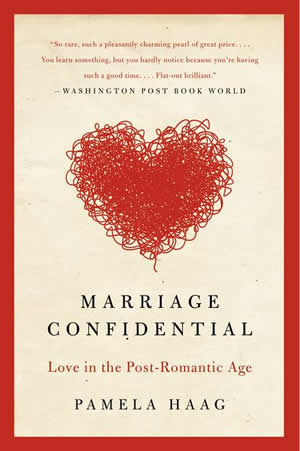
© 2011, Pamela Haag, All Rights Reserved, posted on Into the Bardo with permission, bookcover design (below) courtesy of HarperCollins, All rights reserved

paperback_300PAMELA HAAG’S work spans a wide, and unusual, spectrum, all the way from academic scholarship to memoir. Thematically, it has consistently focused on women’s issues, feminism, and American culture, but she’s also written on topics as eclectic as the effort to rebuild the lower Manhattan subway lines after 9/11, 24-hour sports radio talk shows, and the experience of class mobility.

Haag’s latest book, Marriage Confidential: The Post-Romantic Age of Workhorse Wives, Royal Children, Undersexed Spouses, and Rebel Couples Who Are Rewriting the Rules, released by HarperCollins in May of 2011, draws on all of these strands of Haag’s unique professional biography to create almost a new genre, a weave of academic expertise, cultural history, creative nonfiction, memoir, storytelling, interviews, and commentary. Pamela’s blog, Harpy’s Review is hosted by Big Think. She writes a regular column, Marriage 3.0, for Psychology Today.

Posted in Art, Jamie Dedes, Poems/Poetry

Jan Phillips’ The Artist’s Creed

Calliope

Artist” ~ generally refers to people who express visually. Sometimes it refers to folks in the entertainment industry. In criticism it may also refer to other forms of expression…music, poetry, writing and so on. As used here and generally on this site, it refers to one who creates out of their inner vision, no matter what form of expression the creation takes. It implies a unity of inspiration, practice, and craft. This is for you … ♥

– Jamie Dedes

Illustration ~ The Goddess Kalliopē (Calliope), Homer’s muse for the Odyssey and the Illiad, in a painting by Simon Vouet

The Artist’s Creed by Jan Philips:


The video is by Jan Phillips

Photo on 2012-09-19 at 20.00JAMIE DEDES ~ My worldly tags are poet and writer.  I’m in my fifth year of blogging at The Poet by Day, the journey in poem, formerly titled Musing by Moonlight.  Through the gift of poetry (mine and that of others), I enter sacred space.
Posted in Photography/Photographer

Divine Look

This lovely photo and message from Ajaytao says it all.

Posted in Contributing Writer, Essay, find yourself

FINDING YOURSELF Part 1: The Freedom of “I Don’t Know”

1-1213801011KG6LToday begins the first of three features on finding yourself.  “Be True to Yourself” would be another good name for this series with the perspectives of three writers:

.

Part 1: The Freedom of “I Don’t Know” ~ Natasha Head
Part 2:
What story do you have to tell? ~ Terri Stewart
Part 3:
On the Razor’s Edge ~ Jamie Dedes

The Freedom of “I Don’t Know”

There is a peace to be found in releasing labels, brands and notions we are conditioned with before we even have a chance to determine if this is who we want to be. Every day, I feel as though I am failing in the expectations others have for me, yet…I know I cannot let their preconditioned labels define me.

The little bit of myself I have been able to hang on to, throughout all the many roles we get sucked into, shows in my writing. If I had to name the biggest reason why I do write, it’s to hang on to me. The one thing I can be sure of in this world is the girl sitting in the dark corner alone, tattered notebook and cheap pen, ink spots on her fingers and a desire to be left alone with her thoughts.

This is my church. I can enter anywhere, on any day, at any time. I am always accepted, I am always welcomed, and I always feel…right.

I think that sense of “right” is one of the hardest things to find in this world. For so long, I tried to shape myself to fit in so many ways others told me I had to in order to be part of the crowd. They would fight me tooth and nail when I asked a question they couldn’t answer. They would belittle and scorn me for not taking as faith what they never had the courage to question. Where is the poetry if we are not allowed to question? Where do great ideas and new discoveries come from if we are not pushed and encouraged to seek further.

When they come at me now…wanting to know my beliefs, where I pray, where I’m going to go when I die…I’ve learned they already know the answer they want to hear…and I’ve learned the only compassionate one I can give, so as not to offend and engage is “I don’t know.” Really…what other honest answer is there? It turns a soldier into teacher, a teacher to a guide, and suddenly a new path unfolds with an invitation to explore. I have learned so very much…simply by admitting, I don’t know.

And at the end of the day…how much does it matter if it steals from the gift this lifetime is? Our true blessings are found in the now. In the time we have right now to help, to lift up, to learn, to love. Imagine, if the world could stop debating what is personal and individual to everyone, and simply come together to make the most of where we’re at with what we have? If there’s one thing I do know…it would have to make it a much better place…a much better now.

– Natasha Head

© 2013, essay and portrait, Natasha Head, All rights reserved
Photo credit ~ Petr Kratochvil, Public Domain Pictures.ent

9-1NATASHA HEAD debut poetry collection (from Winter Goose Publishing) was Nothing Left to LosePushcart Prize nominee for 2012. A year later – almost to the day – her newest offering, Pulse. was releasedNatasha blogs at The Tashtoo Parlour and participates in a leadership role on d’Verse ~ Poets Pub. She is the founder and coordinator of New World Creative Union

Posted in Essay, Guest Writer, Peace & Justice

Mindful Steps to End Hunger

Charles W. Elliot

By Charles W. Elliot

Posted here with the permission of Buddhist Global Relief (BGW)

Hunger remains a problem and we think it is not inappropriate to post this again, an essay by Charles W. Elliot that we featured a couple of years ago. On the blog roll to the right, there is a link to BGW ‘s donation page in the event that you are inspired to make a donation. We don’t take donations or any remuneration for the work on this site; but, if you get something out of what is presented on Bardo, we encourage you to support one of the organizations we support or another worthy charity of your choosing. Let’s collaborate to keep the good works going. In gratitude, Jamie Dedes

The simplest act of eating a piece of fruit is inevitably embedded in a complex web of systems: economic, agricultural, financial, and environmental. In attending mindfully to this act, we can discern myriad interdependent phenomena: the beginningless origins of its seeds, the earth from which the fruit grew, the laboring hands that brought the food to our table. The same mindfulness will show how our own lives depend upon the efforts of others, the essential kindness of countless strangers. And in recalling this kindness, we should be ready to take steps to repay it. One such way is to carefully consider the needs of others, and where we find that basic human needs remain unmet because of injustice, we should be motivated to act.

The Universal Declaration on the Eradication of Hunger and Malnutrition states that “society today already possesses sufficient resources, organisational ability and technology and hence the competence to [eradicate hunger].” While food supplies are abundant, access to that food is not. In 2010, 925 million people suffered from chronic hunger, representing one in seven of a global population approaching 7 billion.

Access to adequate food, as indispensable to basic human survival, is a matter of social justice. One of the earliest pronouncements of global governance on fundamental human rights was the U.N. General Assembly’s simple declaration: “Everyone has the right to a standard of living adequate for the health and well-being of himself and of his family, including food[.]” (Universal Declaration of Human Rights, Article 25, paragraph 1, 1948.) If food has been recognized as a human right since the end of World War II, and if society has the resources and competence to end hunger, we should ask ourselves: why are so many millions still hungry?

Of course, there is no single answer to that question. Like all other phenomena, the persistence and spread of human hunger is a complex dependent-arising involving many interwoven causes. Two disturbing factors are financial speculation, which drove commodity prices sky-high in 2007-2008, and the increasing diversion of crops from food production to biofuel production. Thus, the portion of U.S. corn grown to produce corn-based ethanol rose from 15% in 2006 to an estimated 40% in 2011. Other factors include catastrophic weather conditions such as droughts and floods, and global climate change, which has an adverse impact on water supplies and land, especially in the developing world. At the same time, urban sprawl reduces available farmland, while the urban middle class consumes more meat and processed food, which in turn demands more land, water, and energy.

While resources for food dwindle, governmental policies, particularly in the West, have become increasingly hostile to the poor. The shredding of social safety nets puts at risk an ever-larger number of people who need help in the face of poor economic conditions. Last year, about 25% of the House of Representatives voted to eliminate foreign food aid. Such policies appeal to the notion that the world is a zero-sum game, that any help we offer another family will mean that we get less and that we cannot afford fairness. Here in the U.S. help for the poor is in jeopardy. In my home state of Pennsylvania, food stamp use has risen 50% from 1.2 million people in 2008 to 1.8 million today. Despite the increasing need driven by the Great Recession, the current governor proposes to disqualify anyone with assets of more than $5,500—for example, a bank account or a second car—from food stamp eligibility. As a result, it is estimated that 4,023 Pennsylvania households will lose their food stamp benefits on May 1 of this year.

Battling institutional and entrenched social injustice helps alleviate hunger because poverty is at the root of hunger, and the root cause of poverty is powerlessness: the “powerlessness of those who lack resources such as land and water to grow food, jobs to earn money to buy food, an adequate food safety net and food reserves, and adequate nutrition.” (The Downward Spiral of Hunger: Causes & Solutions)

There are many small steps we can take to end hunger, but we must be prepared to respond to the call of conscience to help others and to restore social justice. A key step is to rebuild and enhance small-scale local food systems and turn away from globally concentrated control of food production and distribution. Ultimately, we should reject the domination of agriculture by large corporate agribusiness, and confront corporate attempts to control the very seeds of life with their patented genetically-modified “single generation” seeds.

At the neighborhood scale here in the U.S., community food gardens are springing up even in major cities like New York City and Detroit. Food waste and post-harvest losses could be remedied to make more food available to those in need. Greater investment in small-scale agriculture in rural areas and urban agriculture in the cities would empower the poor and hungry.

At Buddhist Global Relief, we are taking our own small steps. For example, we provide village-scale training in intensified rice cultivation to rural farmers in Cambodia and Vietnam, helping to build their capacity and confidence in applying sustainable agriculture techniques. These techniques dramatically boost yields without expensive external inputs. BGR funds tools and seeds to impoverished families in Cambodia to grow cash crops and home vegetable gardens. Following each harvest, each family then gives the same amount of seed they received to another local family, thus establishing a community of mutual support. BGR helps train villagers in Kenya and Malawi in small-scale agricultural techniques that nurture healthy soil fertility, produce high yields, conserve resources, and meet the basic need of people to independently feed themselves.

Such small steps, taken collectively by Buddhist Global Relief and countless others, are helping to empower the poor, reduce poverty, and alleviate the suffering of hunger. Neither the complexity of the manifold causes of hunger nor the daunting statistics of global poverty should deter us from acting out of compassion and generosity. In the Buddhist tradition, the embodiment of compassion, AvalokiteshvaraGuanyin Kwannon, is often depicted not just with a thousand eyes to gaze upon the suffering in the world, but with a thousand hands to aid those who suffer. Of course, not even a thousand arms are enough to help the billion people who suffer from hunger. But if we recognize each motivated human heart as the eyes and hands of Avalokiteshvara, each of us acting in our own way, in our own communities, might yet help to end hunger in our generation.

Charles W. Ellliott, a member of the Board of Directors of Buddhist Global Relief, is a lawyer practicing environmental, land use, and human rights law.

© 2012, photo and essay, Buddhist Global Relief, All rights reserved

Posted in Essay, Jamie Dedes

Roger Ebert “…online, everybody speaks at the same speed.”

ROGER EBERT (1942-2013)

film critic, screenwriter, Pulitzer Prize for Criticism

Ebert at the Conference on World Affairs in September 2002,

shortly after his cancer diagnosis

THE WISDOM AND COURAGE OF ROGER EBERT

This following piece on Roger Ebert was originally written for our Perspectives on Cancer series in 2011. I don’t know how well known Roger Ebert is outside of the United States; and while he is best know and appreciated as a journalist and film critic, I feel his inspiring response to catastrophic illness makes him a true hero and role model for anyone anywhere. Earlier this week the Chicago Sun Times announced Roger Ebert’s death from cancer.

Roger Eberts cancer and treatments took away his jawbone, his ability to speak, and even his ability to eat and drink. He continued writing right to the end, said that when he wrote he was just like his old self, and he wrote his last tweet two days before his death. Of his life online, he said:

 Now we live in the age of the Internet, which seems to be creating a form of global consciousness. And because of it, I can communicate as well as I ever could. We are born into a box of time and space. We use words and communication to break out of it and to reach out to others.

For me, the Internet began as a useful tool and now has become something I rely on for my actual daily existence. I cannot speak; I can only type so fast. Computer voices are sometimes not very sophisticated, but with my computer, I can communicate more widely than ever before. I feel as if my blog, my email, Twitter and Facebook have given me a substitute for everyday conversation. They aren’t an improvement, but they’re the best I can do. They give me a way to speak. Not everybody has the patience of my wife, Chaz… But online, everybody speaks at the same speed.” Roger Ebert

Born in Urbana, Illinois to parents of modest means who wanted a better life for him then they had, Ebert’s affinity for writing and film were encouraged. He went to Urbana High School, University of Chicago, and University of Illinois at Urbana-Champaign. He is known for his film column in the Chicago Sun-Times (1967 – April 4, 2013), his film guide books, and for the television programs he did in collaboration with Gene Siskel and later Richard Roeper. Ebert struggled with alcoholism. He is married to a trial attorney, Charlie “Chaz” Hammel Smith, now Chaz Ebert and VP of Ebert Company. 

In 2002, Ebert was diagnosed with salivary cancer. He received radiation treatments and multiple surgeries that effected his speech. In 2006, more cancer was found in his jaw bone. He was rushed to the hospital when his carotid artery burst and he “came within a breath of death.”  The jaw bone was removed. Between one thing and another, he suffered through excessive bleeding, loss of muscle mass, deformity, a jaw prosthetic, and the loss of his voice. In the TED Award video below, he informs us of his – among other things – experiments with different voices.

I have always admired Roger Ebert as a writer, film critic, and the first film critic to win the Pulitzer Prize for Criticism. Since he has been living with cancer and then the fallout from cancer, I have come to admire Roger Ebert, the man. He has shown himself to be a world-class role model and a first class human being. As you will see, through it all, he has retained his sense of humor. Write on Roger

ROGER EBERT: Remaking My Voice

Photo credits ~ Ebert at the 2004 Savaanah Film Festival by Rebert under GNU Free Documentation License and Lillian Boutte and Roger Ebert by Jon Hurd under Creative Commons Attribution 2.0 Generic license. Both photos via Wikipedia.

Video upload to YouTube by 

Belated addition to this post 12:22 a.m.: I just found this lovely essay by Roger Ebert entitled, “I do not fear death …” on Salon’s site. Link to it HERE.

ge-officeJamie Dedes ~  My mother lived with cancer of one sort or another for forty years. She was diagnosed with cancer the first time at thirty-six.  She was pregnant with me, her second and last child. She had a radical mastectomy and radiation treatments while pregnant. Ultimately, she went three rounds with breast cancer, one with thyroid cancer, and died at seventy-six of breast and colon cancer. I pray everyday for cures. Advancements in medicine and technology give us hope. I’m also encouraged to see that we are doing more with lifestyle and nutrition (antiangiogenic foods), both prophylactically and for healing and remission, and with the soft technologies of prayer, guided visualization, energy medicine, meditation, music and art.

Posted in Spiritual Practice, Teachers

Conditions for Inner Happiness

Commercial interests with their advertising industry do not want people to develop contentment and less greed.  Military interests in economic, political, ethnic or nationalist guises, do not want people to develop more tolerance, nonviolence and compassion.  And ruling groups in general, in whatever sort of hierarchy do not want the ruled to become too insightful, too independent, too creative on their own, as the danger is that they will become insubordinate, rebellious, and unproductive in their alloted tasks.” Robert Thurman, Ph.D., American Buddhist, writer, and Je Tsongkhapa Professor of Indo-Tibetan Buddhist Studies at Columbia University

We can never share the above comment by Bob Thurman enough as either a wake-up call or a reminder. We are indeed forever being worked by the media, business, and political interests. Here in Matthieu Ricard’s “The Habits of Happiness” is a discussion of the inner conditions for happiness, which help us maintain a frame of mind that is not susceptible to fool’s gold offered by the “ruling groups.” Jamie Dedes

Video posted to YouTube by TEDtalksDirector

ITEM-175---061229_6429T
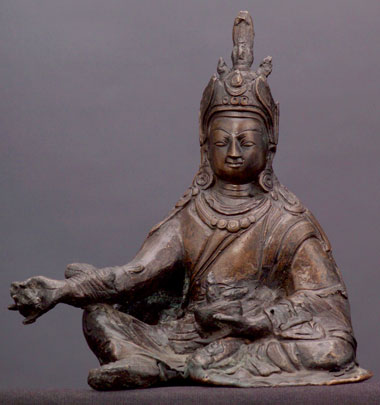
19th Century Padma Sambaba sculpture from Nepal is courtesy of the currator of The Buddha Gallery

Posted in Uncategorized

Introducing Terri Stewart and the Youth Chaplaincy Coalition

Terri Stewart
Terri Stewart

Recently I quietly announced the addition of Terri Stewart to our team as Sunday Chaplain. Terri generously agreed to enrich our site by sharing something meditative and uplifting each week. She is helping with Bardo’s effort toward expansion and inclusion.

Terri brings a lot to the table and you can read more about her on the Contributing Writers page. Included in her resume is the founding of the Youth Chaplaincy Coalition, A Task Force of the Church Council of Greater Seattle.

If those of us who read and write here have one thing in common in addition to a rich life of mind and spirit, it’s a sense of social conscience. Hence, I think you’ll enjoy learning more about Terri’s Coalition. Jamie Dedes

The Youth Chaplaincy Coalition
is a group of like-minded individuals and churches that seek to provide services, in a faith-based context, to Youth Detention Centers.

Mission: The mission of the Youth Chaplaincy Coalition is to provide quality, innovative, comprehensive services for the whole person, to youth and families affected by the justice system within a quality volunteer and work environment staffed by knowledgeable, ecumenical, and caring faith-based volunteers.

Vision:  While the justice system can treat the psychological and physical symptoms a youth in crisis has, chaplains have a unique opportunity to bring in the third leg of the stool, spirituality.  By bringing a holistic vision of the child, the possibility of healing the body, mind, and spirit  becomes a reality.  Our work creates possibilities for transformation and integration.

Values: The mission is attained by adherence to the values of listening and loving.

For more information, please go to The Youth Chaplaincy Coalition site HERE.

Posted in Guest Writer, Poems/Poetry

Children’s Hospital, a poem

CHILREN’S HOSPITAL, WAITING ROOM

by

Rev. Bill Cook Poetry Matters

From this side of this window-
through this glass looking
down seventeen stories –
the world is a odd place.
.
The smell of rain
has become a distant memory.
Taxi cabs – thick bugs.
People- so much seed
scattered on a hard path.
.
Who would have thought
a tiny swish rising
through a stethoscope
could so change everything.
.
Here we are a congregation
Of the suspended –
Inhabitants of a sanitized purgatory –
A communion of those who wait.
.
Here the priests and prophets
wear blue scrubs
and white paper masks.
.
Why, I ask, is it that your tiny heart,
no larger than your tiny hand,
should refuse to grow?
What providence has brought us here?
What karma? There is no answer
.
so we wait.
We wait for our names to be called.
We wait.

– Bill Cook, Poetry Matters

Re-blogged with the permission of Bill Cook, Poetry Matters. Bill is an Ordained Elder in the United Methodist Church, serving a wonderfully diverse congregation.

  • His church: St. Paul UMC, Willingboro NJ.
  • BA. English Lit., Rutger’s, the State University, New Brunswick NJ.
  • M Div. New Brunswick Theological Seminary New Brunswick NJ.
  • D Min. Wesley Theological Seminary, Washington DC.

Although Bill’s had a life long love of reading poetry, he’s relatively new to writing and publishing it. In addition to his poetry blog, Poetry Matters, he has three other blogs that address spiritual matters. Most recently his poem Lost was picked up for publication by a regional poetry magazine.

Posted in Uncategorized

The Herald’s Song

296px-Engel_Moroni_Bern_TempelTHE HERALD’S SONG

by

Monty Wheeler (Babbles)

Editor’s Note: Monty Wheeler is new to our blog. I appreciate his vivid images and adherence to his religious values and to traditional verse forms. I am quite taken with his skill and sincerity and look forward to reviewing his recently published collection. Jamie Dedes

She turned her trumpet to the moon;
T’was not to entertain.
The trumpet’s voice rang loud and clear
Across the night-swept plain.

Each note drew out till nigh breath’s end—
A woman’s wounded cry.
The herald’s trumpet sang the song
Of Death into black sky.

The runes were cast upon the ground
Long centuries before;
The weights of possibilities
Were scaled and one weighed more.

Yet, nobody heard the herald’s cry,
Her news of man’s demise.
On they slept oblivious to
A sun that would not rise.

A darkness hung about the earth–
Cold wasteland man slept in.
No more came dawn; great man was done—
Unheeded warning’s sin.

© 2012, poem, portrait, and cover art, Monty Wheeler, All rights reserved
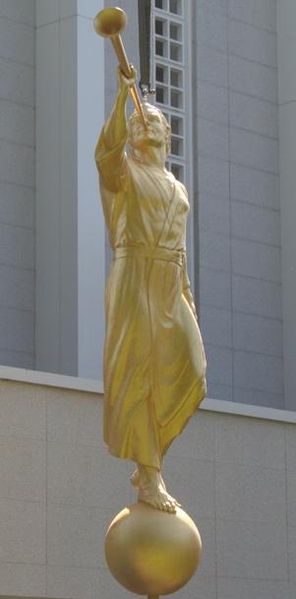
Photo (angel) credit ~ Phillipp Spinnler under CC Attribution-Share Alike 3.0 unported license via Wikipeida

coffeethumb.phpMONTY WHEELER is the author of The Many Shades of Dark, his debut collection on the shelves this month via Winter Goose Publishing. Monty considers himself naught but a little old feller living out his days in the foothills of the Ozark Mountains.  With his work in meter and rhyme, he strives to keep the art of formal verse alive.  His days, when not at the job that pays the bills, are spent in writing, fishing, hunting, and his newly-acquired want of gardening.   You can find him on Twitter as bumfuzzled2004 and on Facebook as Monty Wheeler.

Posted in Jamie Dedes, Poems/Poetry

Deconstructing Peace

moon-sea-cliff-137421298933417ekbDECONSTRUCTING PEACE

by

Jamie Dedes (The Poet by Day, the journey in poem)

the tawny moon is good fortune’s evening grace
it draps itself on the dwindling day’s calm
while mystic mountains rise pristine and high
above an earthy base, the wizard Merlin’s realm,
with memories of a green and primal past …
…….of rootedness
…………..essential things

the air is a sweet-and-salty caramel

and Peace!
a lively Peace …

visits on the briny spray and
delights at the meeting of land and sea
at rhythms of the ocean against the shore
the waves drift in and out, fling and toss
stop, start, begin again and then again
lilting, the dew drop of a mother’s kiss
it’s the mother’s kiss …

but moonlight wanes at the liminal hour

and Peace!
capricious Peace …

sees the moon incised with holographs
from the wind-whipped edges of the Earth
read the tales of valour and cowardice
…….the blight of war
…………..the naked lives
sundering tragedies under the heel of armies
citizen’s fleeing the lacerations of their plight
frozen in the crashing horror of their fright
in this amethyst veiled night . . .
the sense of peace deconstructed
on the rise of dawn, its shredding light

© 2013, poem, All rights reserved
Photo credit ~  Phil Downs, Public Domain Pictures.net

Photo on 2012-09-19 at 20.00JAMIE DEDES ~ My worldly tags are poet and writer. For the past five years on medical retirement due to a chronic, potentially life-threatening illness, I’ve blogged at The Poet by Day, formerly titled Musing by Moonlight. The gift of illness is more time for poetry. Through the gift of poetry (mine and that of others), I enter sacred space.
Posted in vegan/vegetarian

Veg Pledges and Vegan Days!

As a follow-up to Paula Kuitenbrouwer’s (Mindful Drawing) post yesterday, we are sharing announcements of  U.S. VegWeek and the wonderfully fun Worldwide Vegan Bake Sale. J.D.

549994_10151254157840895_1303682551_n
Details on US Vegetarian Week HERE.

animal-cupcakes

The Worldwide Vegan Bake Sale is which is April 20 – April 28 in 2013. Anyone can participate and participants decide where and how proceeds will be used. Participation is fun AND meaningful …

The stated missions are:

1 – Show people that vegan baked goods are delicious and that you can easily create vegan versions of your favorite cookies, cakes, pies, and even cheesecakes – and much more.

2 – Introduce people to veganism in a friendly and fun way.

3 – Raise money for worthy causes all over the world.

Sign-up for Worldwide Vegan Bake Sale HERE.

Photo credits ~ U.S. VegWeek poster by Compassion Over Killing, Cupcake Photo by Jenny Porter, Public Domain Pictures.net

Posted in Art, Guest Writer

Kindly Kitchens …

Female Bullfinchcolored pencils c Paul Kuitenbrouwer
Female Bullfinch
colored pencils
c Paula Kuitenbrouwer

International Women’s Day 2013

by

Paula Kuitenbrouwer (Mindful Drawing)

Editor’s Note: Life happens and I apologize for bringing this post of Paula’s to you so late after the day it honors. Nonetheless, the message of kindness must always be delivered; and, I think her message is valid and beautifully delivered. I thought it important that we share it with you here. Jamie Dedes

This year’s theme for International Women’s Day is ‘A promise is a promise: Time for action to end violence against women‘. I suggest we stretch that promise and for one day we end the violence against female animals too.

See, it is known that mostly female animals suffer because of our meat industry. Cows, hens, goats, and sheep have to produce a crazy amount of meat (off spring), milk, and eggs. Dairy cows have a natural lifespan of 20 years, however their factory farmed lifespan is only 5-6 years. Sheep have a natural lifespan of 12 years, but the factory farmed lifespan for lambs is only 3 months. Apart from that, we use drugs to squeeze in 3 lambkins every two years. Hens have a natural lifespan of 7 years, but live much, much shorter due to the poultry-industry.

So, if you want to participate low profile, in International Women’s day, this day could be your (first) vegan day. If we all do that, it will help to reduce suffering, even if it is only for one day.

As a vegan myself, I can assure you that eating vegan is wonderful. Just leave out all animal products and there you are. Your food is animal – especially female-animal – friendly and as a bonus it is good for your health, weight, and karma.

Here are my inspirational vegan connections and female friends, slowly changing the world in to a better place for female animals:
Lee Aiken’s great recipes are at Plenty Sweet Enough;
Susan Voisin’s wonderful recipes are at Fat Free Vegan Kitchen;
Janie shares great ideas at Gluten Free Vegan Me;
Angela show us her vegan wonders at The Great Vegan Caper
Veronica Grace’s delicious recipes are at Low Fat Vegan Chef.
Rhonda Dunlap inspires us with her Vegan Pinterest broads.
Do sink your teeth in Marilyn Peterson’s 
Vegan Bite by Bite book
… and if you are in need of a lovely teen book on a vegan dog, here is Marian Hailey-Moss’s A Dog named Randall

www.CompassionateCook.com
http://www.CompassionateCook.com

© 2013, art and essay, Paula Kuitenbrouwer, All rights reserved

PAULA KUITENBROUWER is a Dutch nature artist living The Netherlands and sharing her work with us on her blog, Mindful Drawing, and on her website. You can purchase her art HERE. In addition to art, Paula’s main interest is philosophy. She studied at the University of Utrecht and Amsterdam. She has lived in Eastern Europe and in Asia. Paula says that in Korea, “my family lived next to a Buddhist temple. In the early morning we would hear the monks chanting. During my hours of sauntering with my daughter through the beautiful temple gardens, I felt a blissful happiness that I try to capture in my drawings.” Paula sometimes teaches children’s art classes. She lives with her husband and daughter and close to her father. We are frequently honored with and most grateful for guest posts from Paula.

Posted in Contributing Writer, teacher

Radiance

RADIANCE

by

Terri Stewart (Cloaked Monk)

I have been contemplating what it means to carry radiance within. I remember one of my favorite childhood books, Charlotte’s Web, and Wilbur, the pig, was declared by Charlotte to be “radiant.” Such a different way of thinking about a pig! And maybe it is a different way to think about ourselves.

What does it mean to carry radiance within?
How are you changed if you consider yourself radiant?
What does it look like to bear radiance into the world?

Radiance by Terri Stewart

“In the beginning..
when ray and day hadn’t yet come into existence at all,
there was a kind of radiance that illuminates universe.
That radiance is the light of knowledge and goodness.
That radiance will persistently and consistently shine brightly
even after all the stars and moons in this vast universe died out.”
~Toba Beta, My Ancestor Was an Ancient Astronaut

© 2013, post and photographs, Terri Stewart, All rights reserved

mailTERRI STEWART is Into the Bardo’s new Sunday evening chaplain. You can expect a special post from her each week. She comes from an eclectic background and considers herself to be grounded in contemplation and justice. She is the Director and Founder of the Youth Chaplaincy Coalition that serves youth affected by the justice system. As a recent graduate of Seattle University’s School of Theology and Ministry, she earned her Master’s of Divinity and a Post-Master’s Certificate in Spiritual Direction with honors and is a rare United Methodist student in the Jesuit Honor Society, Alpha Sigma Nu. She is a contributing author to the Abingdon Worship Annual.
Her online presence is “Cloaked Monk.” This speaks to her grounding in contemplative arts (photography, mandala, poetry) and the need to live it out in the world. The cloak is the disguise of normalcy as she advocates for justice and peace. You can find her at www.cloakedmonk.com,www.twitter.com/cloakedmonk, and www.facebook.com/cloakedmonk.  To reach her for conversation, send a note to cloakedmonk@outlook.com.