The BeZine Blog

Posted in Essay, General Interest, Spiritual Practice, Terri Stewart

Creating Sacred Space Wherever You Live

When I first started seminary, I was totally taken aback by two things. First, they start class in prayer. (Shocker! From a secular world to this!) Second, all the professors and administrative personnel seem to have an altar of some sort in their workspace. I never thought of having an altar before that–unless it was books. Creating a place in the home or work where your sacred articles live was a new idea to me. Especially since I came from that strain of protestantism that has all “things” as mundane, therefore personal altars were simply not a thing to be done.

Thank goodness for ecumenical seminary! This exposed me to new thoughts, broader ideas about who and what other people were, and broader ideas, and yet more specific, about who I am. I went about creating an altar at home. It is a little side table with a crystal bowl of rocks with an angel in it. And on the shelf of the table, there are books I love and find inspiration in…a book on hymnody, devotional books, prayer books, and about 10 children’s books ranging from “Where the Wild Things Are” by Maurice Sendak to “You Are Special” by Max Lucado. Over time and in a busy household with youngsters, the altar and items dispersed around the home. Occasionally, I rope them back together. But there is also a gift in seeing them spread all over the place. “Oh, look! A piece of the sacred right there!” or “Oh, that is a beautiful rock, the world is an amazing and holy place!” I suppose, I am not very good at being in one place, so scattering it willy nilly ends up working and becomes an odd kind of altar. I often wish I could build beautiful altars like my friends and colleagues do, but I know! The pieces will be everywhere. Maybe someday. (Said in a wistful voice!)

Today, for our sacred space exploration, I thought we could do an exercise about altars, creating personal altars, and whatnot. However, I had a better idea just typing that paragraph above! Let’s create a virtual altar together! Everybody offer a word, picture, poem, link to something or other, that you find to be inspiring, sacred, holy, or completely whole, and next week, I will bring back a virtual collage. At the same time the offerings are made, please visit the places that other people find sacred space in. I am confident that people will leave a word or two (or more!). You wouldn’t leave me hanging, would you?

Are you ready to do this together? After all, above and beyond having a personal altar, the altar of a community – whether it is in the Christian Church, a Jewish Synagogue, or a Pagan Altar – conveys that which the community finds sacred or holy. Or maybe just important. Maybe a quick examination of the words sacred and holy is in order (from the online etymology dictionary).

Holy:

Primary (pre-Christian) meaning is not possible to determine, but probably it was “that must be preserved whole or intact, that cannot be transgressed or violated,” and connected with Old English hal and Old High German heil “health, happiness, good luck” (source of the German salutation Heil). Holy water was in Old English. 

 Sacred:

late 14c., past participle adjective from obsolete verb sacren “to make holy” (c.1200), from Old French sacrer “consecrate, anoint, dedicate” (12c.) or directly from Latin sacrare “to make sacred, consecrate; hold sacred; immortalize; set apart, dedicate,” from sacer (genitive sacri) “sacred, dedicated, holy, accursed,”

What do you find holy or sacred? What word, image, poem, thought would you offer to a community altar? 

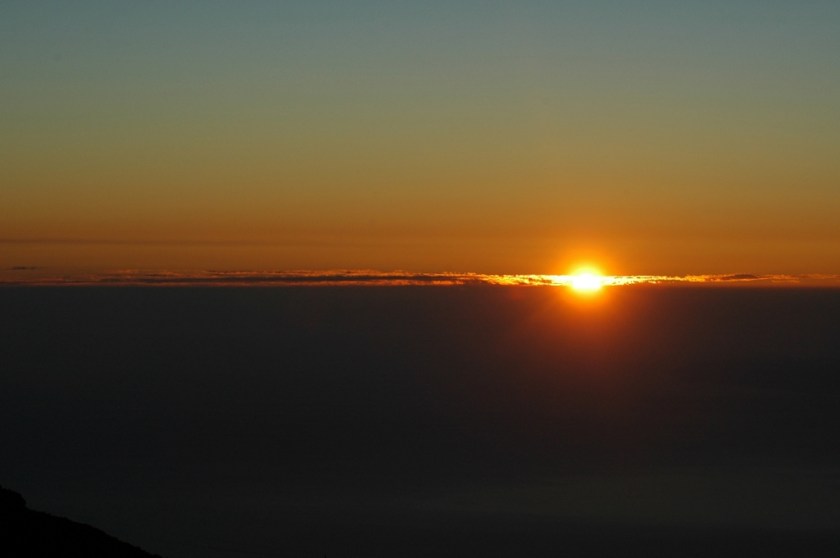
I offer one of my favorite photos of sunset from the top of the mountain, Haleakala on Maui. Why sunset? It is a liminal time when possibilities expand as we hold together both the end of a work day and the gestation of something new. In the Book of Genesis 1:5, it says, “And there was evening and there was morning, the first day.” Evening first. Gestation first. Darkness first. Sunset, first.

Haleakala Sunset by Terri Stewart
Haleakala Sunset
by Terri Stewart

Shalom,

Terri Stewart

(c) 2013, post & photo, Terri Stewart

REV. TERRI STEWART is Into the Bardo’s  Sunday chaplain, senior content editor, and site co-administrator. She comes from an eclectic background and considers herself to be grounded in contemplation and justice. She is the Director and Founder of the Youth Chaplaincy Coalition that serves youth affected by the justice system. As a graduate of Seattle University’s School of Theology and Ministry, she earned her Master’s of Divinity and a Post-Master’s Certificate in Spiritual Direction. She is a contributing author to the Abingdon Worship Annual. (The 2014 issue just released!)

Her online presence is “Cloaked Monk.” This speaks to her grounding in contemplative arts and the need to live it out in the world. The cloak is the disguise of normalcy as she advocates for justice and peace. You can find her at www.beguineagain.com ,www.twitter.com/cloakedmonk, and www.facebook.com/cloakedmonk.  To reach her for conversation, send a note to cloakedmonk@outlook.com
Posted in find yourself, Liliana Negoi, Meditation, meditative, Nature, Poems/Poetry

Monologue

file00034904762ahhhh, my dear reader…
today I shall talk to your soul about a lake…
they say that someone threw a stone in it,
breaking the mirror of the surface in circles…
and the parable follows
that even though the surface of the lake became still again after a while,
the lake itself has changed
and that it knows that deep down it is not the same lake as it was…
allow me to extrapolate from that, my dear reader:
the lake is not defined by a stone
thrown at anger by a silly child…
for first of all the lake is the valley in which that water holds place…
not perfect, with ups and downs,
paved maybe with sand or maybe with mud,
but eager to withhold in it the magic of life…
then, the lake is the water
cradled by the valley…
the clear, life-giving and life-hosting water…
and then the lake is also what lives inside the water…
life forms that sometimes we notice
when they catch our eye by beauty of by fierceness,
but other times we tend to ignore
because they are usually too small to catch our glance
or even our thought…
so there it is, after embracing that stone,
the same lake as before,
as the stone becomes now a part of it, a part of its own life…
just the same,
a human being is more than what you may see in front of you:
for we have the valley of our body,
sheer beauty in its entire imperfection,
then we have the water of our soul,
filling us with life and energy,
and then we have our life experiences,
sometimes big and sometimes small…
so you see, dear reader,
the real lesson here, in my opinion,
is not that of not throwing a stone,
for each stone rises a bit the level of the water…
but that of making sure of not throwing too many…
for sometimes lakes can also effuse…

From “Sands and shadows” © 2011 Liliana Negoi

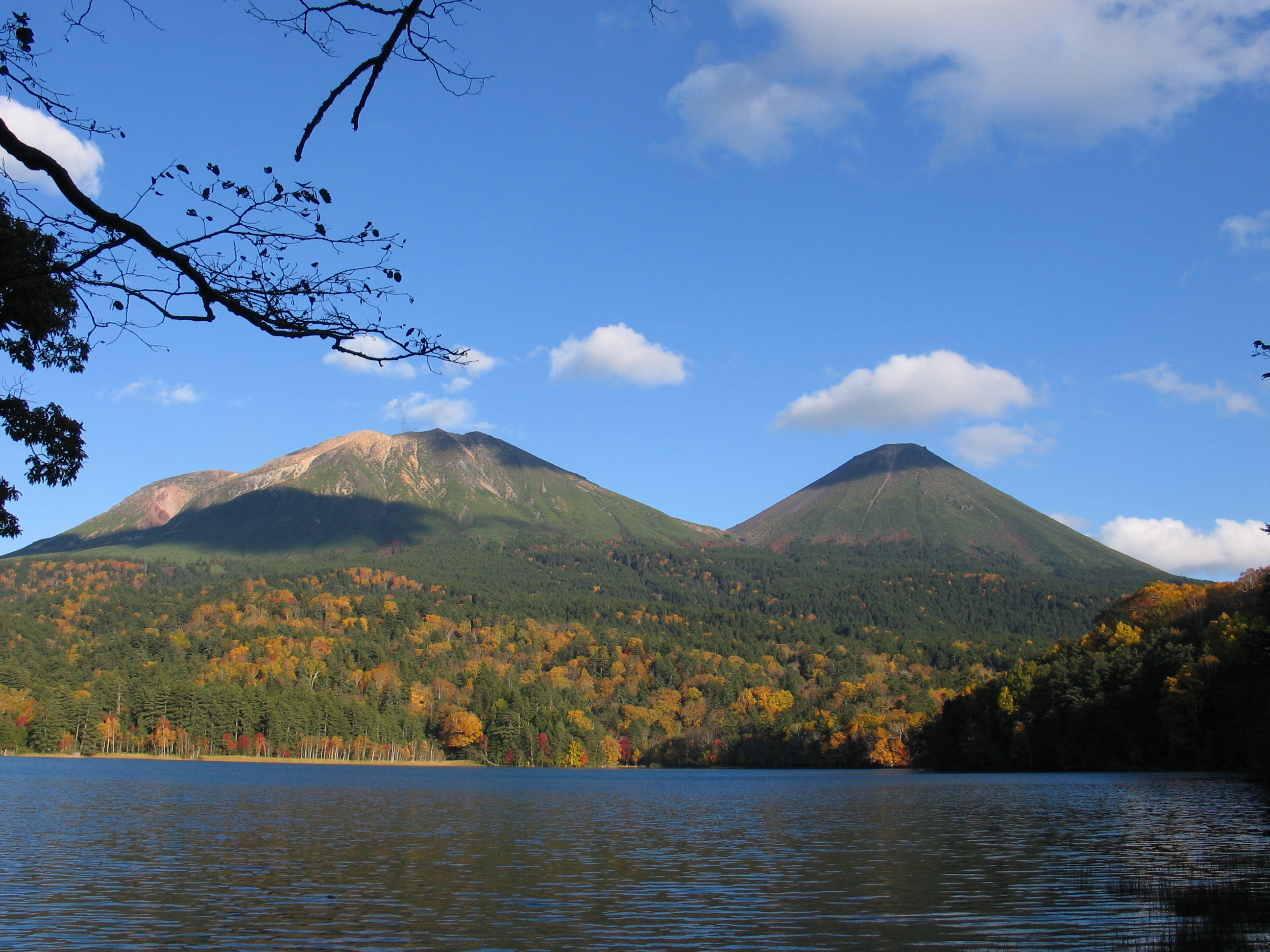
The image used was taken from http://morguefile.com.

IMG_7667LILIANA NEGOI  (Endless Journey and in Romanian curcubee în alb şi negru) ~ is a member of our core team on Into the Bardo. She is the author of three published volumes of poetry in English, which is not her mother tongue but one that she came to love especially because of writing: Sands and Shadows, Footsteps on the San – tanka collection and The Hidden Well.  The last one can also be heard in audio version, read by the author herself on her SoundCloud site HERE.  Many of her creations, both poetry and prose, have been published in various literary magazines.

Posted in Jamie Dedes, Peace & Justice, Poems/Poetry

I Want To Make It Sane Again

file0001824554659what must it be like for you in your part of the world?

there is only silence, I don’t know your name, i know only
that the fire of life makes us one in this, the human journey,
search and return, reaching for the sun, running through mud

walking the gauntlet without a prayer or a blessing

our eyes meet in secret, our hearts open on the fringe,
one breath and the wind blows, one tear and seas rise,
on the street where you live, your friends are all gone

the houses are crushed and the doves have flown

there is only silence, no children playing, no laughter
here and there a light remains to speak to you of loneliness,
my breath caught in my throat, i want to make it sane again

“Sometime they’ll give a war and nobody will come.”
Carl Sandburg (1878-1967), American poet, writer, and editor

– Jamie Dedes

©2013, poem, Jamie Dedes, All rights reserved, Photo courtesy of morgueFile

photo-on-2012-09-19-at-19-541JAMIE DEDES (The Poet by Day)~ I am a mom and a medically retired (disabled) elder. The graces of poetry, art, music, writing and reading continue to evolve as a sources of wonder and solace, as a creative outlet, and as a part of my spiritual practice.

Posted in Essay, General Interest, Priscilla Galasso

Wise or Otherwise

Editor’s note: This lovely piece was originally posted by Priscilla on her personal blog and is a part of her Advent series. Like a spiritual box of Advent chocolates, each day she unwrapped one of the free gifts life gives us.
.
The free gift for today is something that can be acquired, but cannot be bought.  I don’t think that it can be given, either.  The gift is Wisdom.  According to Wikipedia, “Wisdom is a deep understanding and realization of people, things, events or situations, resulting in the ability to apply perceptions, judgements and actions in keeping with this understanding.”  In other words, “To recognize the significant in the factual is wisdom.” (Dietrich Bonhoeffer)  However, “We are made wise not by the recollection of our past, but by the responsibility for our future.”  (George Bernard Shaw)  And finally, “It is unwise to be too sure of one’s own wisdom. It is healthy to be reminded that the strongest might weaken and the wisest might err.”  (Mohandas K. Gandhi)
.

It would seem, then, that wisdom is something that can be acquired in living with awareness and engaging humbly with experiences.  It seems to me, though, that you can’t give someone the benefit of this process.  You might point out the process and talk about its benefit, you might set up the beginning of the process, but you can’t impart the journey or the result.  It has to be lived.  I’m a mother; trust me on this.  I wanted to give my children wisdom more than anything, probably for selfish reasons.  I wanted to be spared the pain.  I wanted to spare them the pain.  I asked God to give them wisdom…like on a magic platter descending from heaven…but spare them the pain.  Can’t be done.  Wisdom is born of pain and suffering and effort and failure.  You have to be awake through it all as well.  You can’t gain wisdom while you’re anesthetized.  I’ve made a great discovery, though.  This process is a great equalizer.  Keeping Gandhi’s wisdom in mind, my children and I are fellow travelers on this path.  We share our stories as friends, we perhaps contribute insights to this process, but we cannot assume the roles of provider and receiver.  I try to remember that as I talk to them.  It is too easy for me to slip into the “teacher” role and begin to spew language about what they “should” do and what is the “right” way to do something.  I often issue too many reminders and begin to sound like I’m micro-managing them.   They notice.  They mention it.  I have to challenge myself to be wiser and trust them to be wise.

I remember the day my father told me that something I said was wise.  It felt like a great victory for me.  I was 19 or 20.  I had been talking to my oldest sister about some article I had read in an evangelical Christian newsletter taking issue with science and carbon dating.  My father was eavesdropping from the breakfast room and jumped on the subject by voicing some objection to the fact that the money he was paying for my college education hadn’t stopped me from discoursing like an ignoramus.  I was scared of his strong emotion, ashamed of myself, and angry at his insult.  Embarrassed and hurt, I fled.  We didn’t speak for 3 days.  I realized that he wasn’t going to apologize to me or mention the event on his own, so I decided I needed to take the initiative to talk to him about my emotions, clear the air, and try to restore our relationship.  I’d never talked to my father about our relationship very much before.  He was always right, often angry, and anything that was amiss was my fault.  I also knew that he would not show his emotions, that it would be a “formal discussion” on his part, but that I would probably not be able to contain my tears, making me feel foolish and not his equal.  I decided to brave the consequences and approach him with Kleenex in hand.  I began to talk, and cry, and tell him how I felt.  Then he asked me if I wanted an apology.  “What do you want me to say?”  I told him that part was up to him.  My dictating an apology to him would be meaningless.  That’s when he said, “That is very wise.”   Suddenly, I felt I had grown up and been respected as an equal to my father in some way.   What I understood or didn’t understand about evolution and carbon dating and creation didn’t matter to me any more.  That I had been able to navigate emotions with my father and repair a broken relationship was far more significant.

Dad & me in 1992. Photo by my 8 year old daughter.

Wisdom isn’t easy to get, but it is available.  If you pursue it, you’ll probably get it eventually.  It’s completely avoidable, though, if you so choose.   I know which way I want to go, so I’ll keep paddling my canoe and checking the horizon.   For those of you heading the same way, STEADY ON!  I salute you.

004PRISCILLA GALASSO ~ started her blog at scillagrace.com to mark the beginning of her fiftieth year. Born to summer and given a name that means ‘ancient’, her travel through seasons of time and landscape has inspired her to create visual and verbal souvenirs of her journey.

Currently living in Wisconsin, she considers herself a lifelong learner and educator. She gives private voice lessons, is employed by two different museums and runs a business (Scholar & Poet Books, via eBay and ABE Books) with her partner, Steve.

Posted in folk tale, General Interest, Naomi Baltuck, Photography/Photographer, story, Story Telling, Photo Story

The Most Noble Story

There was once a widow who had three sons, Alberto, Eduardo, an Ernesto. She had spent a lifetime trying to teach them the meaning of charity and compassion.

The day came when she knew she was dying, and would no longer be there to guide them.  She called her sons to her bedside.

“My sons, the only thing of value I have to leave you is my diamond ring. It was given to me by my mother, who had it from her mother, whose mother handed it down to her. It cannot be divided and it must not be sold, for one day, it shall go to one of your daughters.  Now I must decide which of you is most worthy of this treasure. Go, my sons, and do good in the world.  Come back in one week’s time and tell me your stories. The one who has performed the most noble deed shall inherit the diamond.”

By the time the three young men gathered again at her bedside, their poor mother was near death.

She said to her firstborn, “Alberto, tell me your story.”
“Well, Mother,” said the eldest, “after much thought, I gave half of everything I owned to the poor.”
“My son,” said the old woman, “no one can tell you that you haven’t performed a good deed. But it is not a noble deed, for have I not taught you that it is everyone’s responsibility to care for the needy?”


She said to her secondborn son, “Eduardo, tell me your story.”
He said, “Mama, I was passing the river when I saw a small child swept away in the current. I can hardly swim, but I jumped into the water and pulled the child out to safety.  It was only by the grace of God that I didn’t drown myself.”


“My son, you too have performed a good deed, but not a noble deed. Have I not taught you that everyone should be willing to lay down his life for that of a helpless child?”


The old woman said to her youngest son, “Eduardo, come tell me your story.”
Ernesto hesitated before taking her hand. “Mamacito,” he confessed, “I haven’t much to tell. As you know, I’ve no earthly goods, and I cannot swim a stroke. But I’ll tell you something that happened to me this week. Very early one morning I was walking in the mountains.

I came upon a man sleeping at the edge of a cliff. If he were to stir in his sleep, he would surely fall to his death on the rocks below. I determined to prevent this tragedy. I crept over, so as not to startle him awake. Then I saw that it was my bitter enemy, Juan Miguel. At first, I thought to leave him there, for the last time we met, Juan Miguel threatened to kill me if he ever got the chance. But deep down I knew what I had to do.
“As I put my arms around him, Juan awoke and I could see the fear in his eyes as he recognized me.
“’Don’t be afraid,’ I told him. I quickly rolled him away from the precipice to safety, and helped him to his feet. When Juan Miguel came toward me, I was sure he meant to kill me. But then he threw open his arms to embrace me.
“Juan said, ‘Last night darkness fell before I could get home. Rather than chance a misstep in the dark, I decided to spend the night where I was. I had no idea I was so close to the cliff edge. You saved my life, Ernesto, and after I treated you so poorly!’
“To make a long story short, Mamacita, Juan and I are no longer enemies, but have sworn to be friends forever.”

The old woman shed tears of joy. “My son, I have taught you well. That was truly a noble deed, and you are a noble man, for you risked your life to save a man sworn to kill you. With one act of kindness, you have transformed hatred into love and made the world a better place.” With her dying breath she told her sons, “The diamond shall go to Ernesto, but you must all remember that with each noble deed you perform, you shall add to the treasure that awaits you in Heaven.”


All three sons married and had children of their own. They, like their mother, taught their children the meaning of charity and compassion. When the time came, Ernesto left his mother’s diamond to one of his daughters.

But Alberto and Eduardo left their children a gem worth as much as any diamond, for their children held in their hearts their grandmother’s precious legacy, the story of the most noble story.

All photos copyright 2013 Naomi Baltuck

The Most Noble Story is from Apples From Heaven, copyright 1995 Naomi Baltuck, and retold from a folk tale of Mexico.

NaomiPHOTO1-300ppi51kAqFGEesL._SY300_NAOMI BALTUCK ~ is a Contributing Editor and Resident Storyteller here410xuqmD74L._SY300_ at Bardo. She is a world-traveler and an award-winning writer, photographer, and story-teller whose works of fiction and nonfiction are available through Amazon HERE. Naomi presents her wonderful photo-stories – always interesting and rich with meaning and humor – at Writing Between the Lines, Life from the Writer’s POV. She also conducts workshops such as Peace Porridge (multicultural stories to promote cooperation, goodwill, and peaceful coexistence), Whispers in the Graveyard (a spellbinding array of haunting and mysterious stories), Tandem Tales, Traveling Light Around the World, and others. For more on her programs visit Naomi Baltuck.com

Posted in Charles W Martin, Photography/Photographer, Poems/Poetry

holographic images

holographic images

these children you see
homeless hungry and alone
are to be ignored
their fate is not yours
nor that of your dear children
no need to look up
finish your coffee
catch the downtown train to work
you’ll feel better then
we have really tried
to make them invisible
but their holograms
for moral reasons
reappear from time to time
not to worry friend
winter vacation
is at hand so forget them
have another drink
give us a moment
to erase their visual file
from your memory
they’re a hologram
nothing more than an image
that somehow can bleed

.
678ad505453d5a3ff2fcb744f13dedc7-1product_thumbnail.php41V9d9sj5nL._SY344_PJlook-inside-v2,TopRight,1,0_SH20_BO1,204,203,200_CHARLES W. MARTIN (Reading Between the Minds) — earned his Ph.D. in Speech and Language Pathology with an emphasis in statistics.  Throughout Charlie’s career, he maintained a devotion to the arts (literature/poetry, the theater, music and photography).  Since his retirement in 2010, he has turned his full attention to poetry and photography. He publishes a poem and a photographic art piece each day at Read Between the Minds, Poetry, Photograph and Random Thoughts of Life. He is noted as a poet of social conscience. Charlie has been blogging since January 31, 2010. He has self-published a book of poetry entitled The Hawk Chronicles  and will soon publish another book called A Bea in Your Bonnet: First Sting, featuring the renown Aunt Bea. In The Hawk Chronicles, Charlie provides a personification of his resident hawk with poems and photos taken over a two-year period. Charlie’s lastest book, When Spirits Touch, Dual Poetry, a collaboration with River Urke, is available through Amazon now.

Posted in General Interest

Little Papal Bling, but enough dazzle to grab our attention …

“Such an economy kills. How can it be that it is not a news item when an elderly homeless person dies of exposure, but it is news when the stock market loses two points.?” Pope Francis, Jorge Mario Bergoglio (1936), Argentinian, 266th Pope of the Catholic Church

Posted in animals/animal welfare/interspecies connections, Disability, Fiction, Liliana Negoi, meditative, Nature, Writing

luminous – short prose

She sat there, with the precious stillness of a Tanagra, frozen beneath the cascade of magnolia petals – and all that sunrise was able to do was to jewel her aura with fiery reflexes, as if she was Amaterasu herself, borrowing for a while the limits of flesh with the sole purpose of proving the beauty of her infinity. I was unable to move, unable to make a sound, and for a moment I thought I would see her suddenly float and fly away, her body soaked with light and my eyes drained of all will to blink. Even her voice sounded as if woven from glints, when it stretched towards my senses like an invisible limb:

– The sun doesn’t always rise with the same brilliance. There are dawns when, for various reasons (all, or almost all of them of a scientific nature, of course) what you see growing above the line of the horizon is not that imposing disk of glowing majesty, but a shy red roundel, mat and exuding insecurity, as if it were born untimely from sky’s bleeding wombs. But if you stay there long enough and stare at it, you will witness the victory of plasma over atmosphere and soon the cells from your retina will be burned, as punishment for daring to assist at the visual metamorphosis of our closest star, as if your gaze would have somehow stained that moment of vulnerability…

She paused for a second – a long, ethereal, suspended on the tip of her gaze second – and then she continued:

Sparrow_on_snowy_branch– I’ve watched such sunrises more than just once from the window of my room. There were times when I saw the sky being flooded with raw sunlight and then suddenly a sparrow with eyes of onyx would come and sit on a branch of the elm tree growing right next to that window. It looked at me cautious, first with an eye, then with the other, and then it would suddenly release from that tiny throat a sample of happiness and freedom, as if to demonstrate me that joy can be found even in the simplest of things. It was that sparrow that taught me how to feel free, beyond the wheels of this chair, and not a sunrise goes by without me hoping you’d find your own sparrow, my son…

© 2013 Liliana Negoi

The photo attached was taken by Lewis Collard,

IMG_7667LILIANA NEGOI  (Endless Journey and in Romanian curcubee în alb şi negru) ~ is a member of our core team on Into the Bardo. She is the author of three published volumes of poetry in English, which is not her mother tongue but one that she came to love especially because of writing: Sands and Shadows, Footsteps on the San – tanka collection and The Hidden Well.  The last one can also be heard in audio version, read by the author herself on her SoundCloud site HERE.  Many of her creations, both poetry and prose, have been published in various literary magazines.

Posted in Essay, Spiritual Practice, Terri Stewart

Walking the Sacred Path with President Nelson Mandela

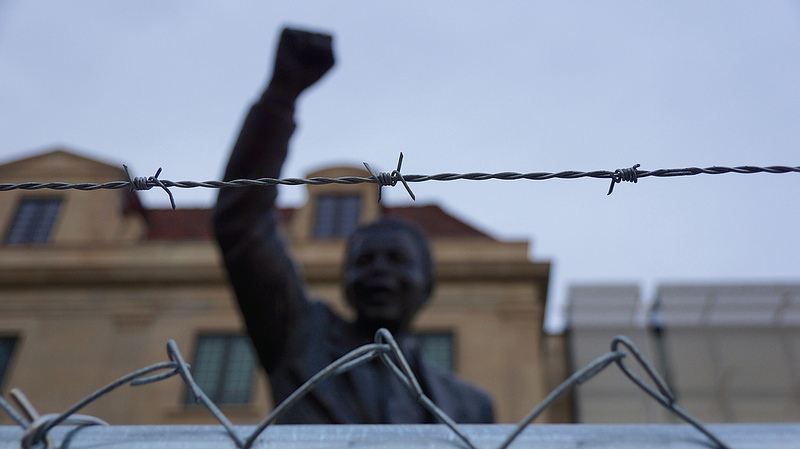
Nelson Mandela

This post is complementary to a post created at http://beguineagain.com/. I encourage you to read this and then read that post.

Today is the wrap-up in our recent series about President Nelson Mandela. As I was pondering how to close out the thoughts and hearts of our community, I remember that President Mandela was a deeply spiritual man who relied on the African theology of Ubuntu to carry the day. Ubuntu, which I have written about before, is the idea that “I am because we are.” It is deeply rooted in Africa with not only Mandela but Desmond Tutu subscribing to Ubuntu as core beliefs. Ubuntu is described below by Mandela himself.

“A traveler through our country would stop at a village, and he didn’t have to ask for food or for water. Once he stops, the people give him food, entertain him. That is one aspect of Ubuntu but Ubuntu has various aspects. Ubuntu does not mean that people should not enrich themselves. The question therefore is: Are you going to do so in order to enable the community around you to improve?” http://www.youtube.com/watch?v=Dx0qGJCm-qU#t=28

Knowing that this deeply spiritual man connected so strongly to a traditional spirituality, I have decided to combine the traditions of President Mandela and the gleanings of the Bardo Group with the ancient prayer practice of Midday Prayer. I am relying on the ancient rhythm but substituting readings from our authors and from President Mandela.

The general pattern of Midday Prayer is opening, hymn, psalm, Gloria, reading, prayers of the people, Lord’s prayer, collect, conclusion. This will be an adaptation of this ancient pattern. Someday we can discuss the prayer pattern and its ancient roots that extend beyond Christianity into Judaism and earlier.

Take a moment, light a candle, slow down and begin again with President Nelson Mandela leading the way.

A Midday Meditation in the Tradition of Ancient Mystics

Honoring Nelson Mandela

Help us as we pause at this point in the day to find safety and refuge, peace and mercy.

Glory to all that ties us together and brings our hearts into the center so we may listen. As it was in the beginning, it will be now, and will be forever more. Amen.

Hymn, excerpted from John Antsie

As the West winds blew their fury
the earth let out a cry;
as if to deny the awful truth,
it was more than just a sigh.
As if one life had greater value
than all of this; all of the love
that a world full of great lives
could bear; bear to contemplate
the loss of a legend, but
whose wisdom will be immortal …

Psalm, excerpted from Charles W. Martin

once
or twice
in a lifetime
an ancient returns
showing
the way
not
as a prophet
or
god-like figure
but as
a man
or
a woman
willing to expend
all their life forces
to open
the minds
of all those
willing
to listen

Glory to all that ties us together and brings our hearts into the center so we may listen. As it was in the beginning, it will be now, and will be forever more. Amen.

Reading: Inspired by Jamie Dedes, by President Nelson Mandela, Speech on World Civilisation, November 2000

The world had become much smaller, as I realised when racing on jumbo jets that I had never seen before, and talked every day on amazing new international telephones. I had to acquaint myself with this new phenomenon of globalisation, that enabled money and capital to flow instantly across the globe, and made the economies of the world startlingly more interdependent.

The effects and consequences of globalisation had to be internalised by many other South Africans, as well. South Africa became isolated from the international community during the apartheid years, and now saw how closely interconnected countries and economies had become. We welcome the process of globalisation. It is inescapable and irreversible. We can no more ignore it, as I said before, that we can reject the idea of winter by refusing to wear warm clothes. It can carry with it not only investment and transfer of expertise, but also knowledge and understanding of other people and cultures.

But if globalisation is to create real peace and stability across the world, it must be a process benefiting all. It must not allow the most economically and politically powerful countries to dominate and submerge the countries of the weaker and peripheral regions. It should not be allowed to drain the wealth of smaller countries towards the smaller ones, or to increase the inequality between richer and poorer regions.

Please take a moment for silent reflection.

Meditation: Inspired by Jamie Dedes, by President Nelson Mandela, Africa Standing Tall Against Poverty, 2 July 2005 [edited]

Massive poverty and obscene inequality are such terrible scourges of our times – times in which the world boasts breathtaking advances in science, technology, industry and wealth accumulation.

We live in a world where knowledge and information have made enormous strides, yet millions of children are not in school.

We live in a world where the Aids pandemic threatens the very fabric of our lives. Yet we spend more money on weapons than on ensuring treatment and support for the millions infected by HIV.

It is a world of great promise and hope. It is also a world of despair, disease and hunger.

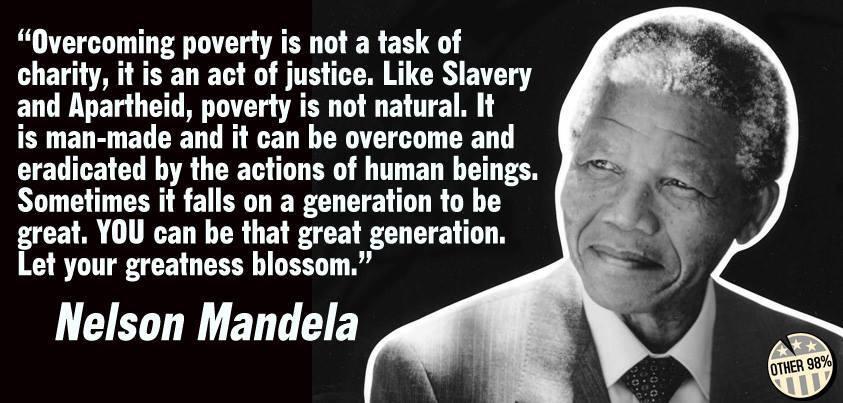
Overcoming poverty is not a gesture of charity. It is an act of justice. It is the protection of a fundamental human right, the right to dignity and a decent life.

While poverty persists, there is no true freedom.

Please take a moment for silent reflection.

Have mercy on our souls.

Group prayer

Holiness, wholeness, perfectedness
The Name of the path of healing is sacred
Let the cosmos be filled with mercy and kindness!
Let the cosmos be filled with acts of justice and love!
Let it be so, here, on earth, and everywhere in the cosmos.
Let our needs be fulfilled with love so that it
Staves off temptation allowing an end to injustice and poverty.
The cosmos of love and mercy has power to move hearts and make it so.
Forever. And ever.
So it shall be.
Amen and amen.

Intercessory prayer for the poor and concluding collect

We lift up all who live below the poverty line – knowing that we do not succeed if they do not succeed. Each one is a unique and precious beloved person in the human family.

We know that good things can go to them if we work towards justice, love, and mercy to provide for the needs of one another in loving kindness and in political will. Let us seek help so that we may help the less fortunate who experience the apartheid of poverty.

This is an abundant world if we would act with mercy and justice for all. Sharing our resources in an equitable manner worthy of the label, loving kindness. While we ask for strength for the impoverished, we ask for the hearts of the comfortable to be shattered with love for neighbors both known and unknown so that we may truly live in an Ubuntu world, erasing the line between the haves and have-nots and transforming the cosmos into Sacred Wholeness.

Peace I give to you, peace I leave with you.

Shalom and Amen.

~Terri

(c) 2013, post, Terri Stewart

(c) 2013, photo, Ted Eytan, CC AT-SA 2.0, http://www.flickr.com/photos/22526649@N03/11235545336/

terriREV. TERRI STEWART is Into the Bardo’s  Sunday chaplain, senior content editor, and site co-administrator. She comes from an eclectic background and considers herself to be grounded in contemplation and justice. She is the Director and Founder of the Youth Chaplaincy Coalition that serves youth affected by the justice system. As a graduate of Seattle University’s School of Theology and Ministry, she earned her Master’s of Divinity and a Post-Master’s Certificate in Spiritual Direction. She is a contributing author to the Abingdon Worship Annual. (The 2014 issue just released!)

Her online presence is “Cloaked Monk.” This speaks to her grounding in contemplative arts and the need to live it out in the world. The cloak is the disguise of normalcy as she advocates for justice and peace. You can find her at www.beguineagain.com ,www.twitter.com/cloakedmonk, and www.facebook.com/cloakedmonk.  To reach her for conversation, send a note to cloakedmonk@outlook.com
Posted in Jamie Dedes, Nelson Mandela, Video

“Let me tell you a story,” Nelson Mandela said

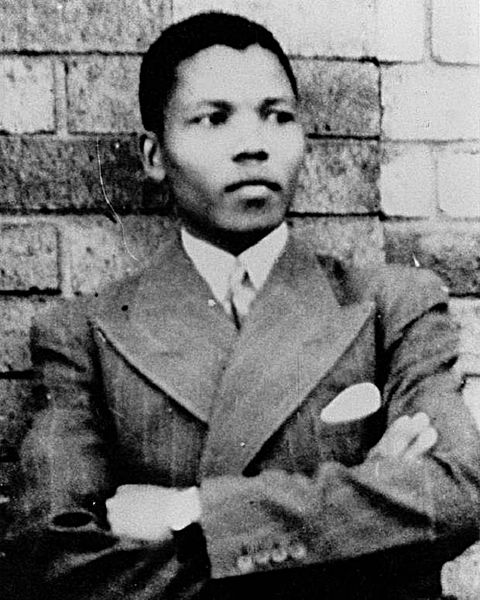
Nelson Mandela, 1937
Nselson Mandela, 1937

“If history were taught in the form of stories, it would never be forgotten.”

― Rudyard KiplingThe Collected Works

I appreciate this story of a story of Nelson Rolihlahla MandelaI appreciate it for many reasons, but most of all because storytelling is what we are about, whether our creativity expresses in music, theatre, or film, writing or poetry, or visual arts. We tell stories to – among other things – encourage positive change and healing, however modest. In this video we learn how Nelson Mandela used storytelling as leverage to make a big dream come true. It’s the ultimate use of storytelling.  It’s a bit of history and inspiration you won’t soon forget.

“We must use time wisely and forever realize that the time is always ripe to do right.” Nelson Mandela

Nelson Mandela (1918-2013)

South African anti-apartheid revolutionary, politician and philanthropist, former President of South Africa, first Black South African to be elected in a democratic election, a nationalist, a democratic socialist, a former President of the African Congress, husband, father, friend, inspiration, prophet

His work done. He is resting in peace … no doubt.

It is up to us to carry his vision forward.

Photograph in the U.S. public domain

photo-on-2012-09-19-at-19-541JAMIE DEDES (The Poet by Day)~ I am a mom and a medically-retired (disabled) elder. The graces of poetry, art, music, writing and reading continue to evolve as a sources of wonder and solace, as a creative outlet, and as a part of my spiritual practice. The gift of blog offers a platform for having my say and a means to maintain off-line and online friendships with others who value the arts and humanities and favor the causes of peace.

Posted in Essay, John Anstie, Nelson Mandela

It is Our Fortune …

Nelson Mandela (1918-1963), Anti-Apartheid Revolutionary, Politician and former President of South Africa (first Black president, and philanthropist
Nelson Mandela (1918-2013), Anti-Apartheid Revolutionary, Politician and former President of South Africa (first Black president, and philanthropist

I was saddened by the news of Nelson Mandela’s passing. Whilst it was not unexpected, his death has set in train much reflective thought, not only about the man he was, but also about his leadership, which was imbued with a kind of power to bring people together that is rarely seen amongst today’s political leaders.

In an essay and a poem, previously published in the summer, here on the Bardo, the word ‘fortune’ featured large in their purpose. The essay, “Fortes Fortuna Adiuvat”, was also recorded in two parts and broadcast on Roger Alan Baut’s rather unique ‘Blue Sky Highway’ Episode 3 (on BlogTalk Radio). I did eventually write an epilogue over on ‘Forty Two‘, in which I told the story of my chance encounter with a devout Christian, who harboured rather bitter feelings toward Islam. Whilst not the subject of this post, it does focus on the fortune I sometimes feel, particularly inspired by great lives, whose vision spans across the whole spectrum of human purpose, beliefs and faiths. Nelson Mandela inspired those feeling in me.

There is a need to ask the question: has this man set the standard for world leadership and will any politician be capable of taking up his mantle; will just one world leader step out of their political comfort zone and turn Mandela’s legacy into a blueprint for a new future order?

Madiba, his tribal name, the man from Qunu, had fortune for sure, in that he was clearly born with the genetic foundation of a strong constitution; he was also, somehow, able to show courage of an exceptional kind, in all sorts of ways.

As an angry young man, he fought against an oppressive regime, who felt that segregation was the only way they could manage to control a population – and preserve the security of their / the nation’s (delete whichever you think is least applicable) interests.  This was Apartheid, the slogan adopted in 1948 by the Afrikaner National Party, which the white regime maintained until February 1991, not long after Mandela’s release.

It took several years of concerted protest and sanctions from the international community eventually to bring about the release of Mandela and his fellow political conspirators. That might have been the end of it, but Mandela somehow mustered the magnanimity and strength to leave his anger and resentment inside the prison cell, which had confined him for twenty seven years. Not only this, but his new regime set up the Truth and Reconciliation Commission, which was an extraordinary attempt to bring about reconciliation between the oppressors and the oppressed and to learn how to forgive.

I feel very fortunate to have witnessed the effects of one man, who was supported by many of his own friends and fellow strugglers as well as by the many anti-apartheid movements and protests around the world, and sanctions, which the persistent pressure from those protest movements eventually brought to bear on political establishments.

Each of us is born with a unique footprint, a unique perspective, but each of us can also learn from our environment and from great lives. Nelson Mandela was a great man, a charismatic leader. His fortune was his birthright, his genes, which will have imbued him with some of the characteristics that enabled him to endure the privation of incarceration, absorb and process the positive and healing forces that worked on his mind during that time. The environment that surrounded him will have forged the spirit that underpinned the great leader and human being he came to be.

Human progress toward a better order in the world, toward peace, has as it’s building blocks, the example laid by such great lives.  Mandela’s legacy therefore leaves us with an opportunity.  Future leaders of the world don’t have to be imprisoned, to be freedom fighters or terrorists, to qualify as great leaders, but they, like each new generation, can learn the obvious lessons from the generation before them.  Here’s hoping there will be more Nelson Mandela’s, who have the courage to step out of their comfort zone, to step away from anger and resentment, to show that fortune does favour the bold.

There has been much poetry written about this man; such was his influence and inspiration. I wrote this at the time of his death, amidst the chaos of some severe storms over the UK (hence the opening reference):

Twenty Seven Years

As the West winds blew their fury
the earth let out a cry;
as if to deny the awful truth,
it was more than just a sigh.
As if one life had greater value
than all of this; all of the love
that a world full of great lives
could bear; bear to contemplate
the loss of a legend, but
whose wisdom will be immortal …

How many years in a small, small room
with the same view through the bars.
How many years of breaking stone
that broke his view of the stars.

How many years of prayer and pain,
to grow his wings and fly,
like soaring eagle, dancing crane,
over mountains in the sky.

How many years to find his truth,
and reconciliation
that helped empower his legacy
from the torment of a nation.

How long did it take to forge his spirit,
imbue his captors’ tears
with the power of his forgiveness
after twenty seven years.

– John Anstie

© 2014, John Anstie, All rights reserved
Photograph of Nelson Mandela taken in 1937 and in the United States public domain

John_in_Pose_Half_Face351w-rH34dTL._BO2,204,203,200_PIsitb-sticker-arrow-click,TopRight,35,-76_AA300_SH20_OU01_JOHN ANSTIE (My Poetry Library and 42) ~ is a British poet and writer, a contributing editor here at Bardo, and multi-talented gentleman self-described as a “Family man, Grandfather, Occasional Musician, Amateur photographer and Film-maker, Apple-MAC user, Implementation Manager, and Engineer. John participates in d’Verse Poet’s Pub and is a player in New World Creative Union. He’s been blogging since the beginning of 2011. John is also an active member of The Poetry Society (UK).

product_thumbnail-3.phpJohn has been involved in the recent publication of two anthologies that are the result of online collaborations among two international groups of amateur and professional poets. One of these is The Grass Roots Poetry Group, for which he produced and edited their anthology, “Petrichor* Rising. The other group is d’Verse Poet Pub, in which John’s poetry also appears The d’Verse Anthology: Voices of Contemporary World Poetry, produced and edited by Frank Watson.

* Petrichor – from the Greek pɛtrɨkər, the scent of rain on the dry earth.

Posted in Charles W Martin, Nelson Mandela, Peace & Justice, Photography/Photographer, poem, poetry

mandela…

mandela

once
or twice
in a lifetime
an ancient returns
showing
the way
not
as a prophet
or
god-like figure
but as
a man
or
a woman
willing to expend
all their life forces
to open
the minds
of all those
willing
to listen
and
do
as they
have done
the world
always
sees
them
and
offers up
great praise
so
when they die
mourners
shed tears
in the rain
but
the world
quickly
loses its way
in the fog
of greed
until
the next
ancient
is
reborn

.
678ad505453d5a3ff2fcb744f13dedc7-1product_thumbnail.php41V9d9sj5nL._SY344_PJlook-inside-v2,TopRight,1,0_SH20_BO1,204,203,200_CHARLES W. MARTIN (Reading Between the Minds) — earned his Ph.D. in Speech and Language Pathology with an emphasis in statistics. Throughout Charlie’s career, he maintained a devotion to the arts (literature/poetry, the theater, music and photography). Since his retirement in 2010, he has turned his full attention to poetry and photography. He publishes a poem and a photographic art piece each day at Read Between the Minds, Poetry, Photograph and Random Thoughts of Life. He is noted as a poet of social conscience. Charlie has been blogging since January 31, 2010. He has self-published a book of poetry entitled The Hawk Chronicles and will soon publish another book called A Bea in Your Bonnet: First Sting, featuring the renown Aunt Bea. In The Hawk Chronicles, Charlie provides a personification of his resident hawk with poems and photos taken over a two-year period. Charlie’s lastest book, When Spirits Touch, Dual Poetry, a collaboration with River Urke, is available through Amazon now.

Posted in Nelson Mandela, Video

celebrating the intention of Nelson Mandela as a new year’s resolution

1464669_606566802744421_242685911_n

Last year saw the loss of a great man and a widening of the world-wide gap between the few haves and the many have-nots, an injustice and a certain recipe for unrest. As we celebrate the birth of a fresh new year today, we also celebrate the man, Nelson Mandela, and his ideas. Poverty creates its own apartheid.

Over the course of the few next days, The Bardo Group will deliver posts that honor the man and second his ideals as a reminder of the need to be resolute, to continue Nelson Mandela’s fight for balance, justice and equality of opportunity.

Nelson Mandela’s Speech on Poverty (2005) 9 min.

May all mothers and their children have
 food, housing, healthcare, education, freedom of spiritual practice, peace and safety.

May open hands and open hearts reign. 

MAY GREATNESS BLOSSOM IN 2014

The Bardo Group Core Team

John Anstie

Naomi Baltuck

Terri Stewart

Corina Ravenscraft

Jamie Dedes

Josepth Hesch

Karen Fayeth

Victoria C. Slotto

Liz Rice-Sosne

Michael Watson

Niamh Clune

Priscilla Galasso

Lily Negoi

Charlie Martin

Posted in Essay, John Anstie

There but for Fortune … and a Rucksack

The Rucksack Project Banner

Fortune seems to be the word of the moment for me; it keeps recycling itself and coming back to haunt me! On the one hand I’m not surprised, because I feel I’ve had my fare share of it. I was born into a middle class family, privately educated, for the most part and afforded the grants to enable me to attain undergraduate as well as postgraduate degrees. As a result of this start in my life, my career path has enabled me to get jobs in disciplines that require scientific, engineering and management skills, which later led to positions outside my original education and training, including giving me sufficient wit to own and manage my own company for a while.

Recently, I become involved, through the initiative and actions of Peter Wilkin, a Poet friend and co-author of the anthology, “Petrichor Rising”, which we published in July this year, in a charitable project, which is an early rising star of the social networks, called the Rucksack Project.

The Rucksack Project is relatively little known charitable concern, set up within the last two years by one man, Matthew White. It is not a registered charity because it does not accept donations. Instead, it empowers people physically to contribute their time along with the resources of local charity shops to make up a rucksack containing several essential material items aimed at helping to sustain homeless people against the cold Winter weather.

Whilst in the process of preparation for this rucksack ‘drop’, which is planned to take place in Bradford, UK, on 21st December, I was recently told a story by a fellow chorister of his meeting with a homeless person. In brief he had passed the gentleman of the road on his way to a well-known fast food restaurant for a quick bite. Because my friend didn’t have any change, instead, whilst getting his own meal, he bought and extra meal and a cup of hot coffee. On his way back to where they were performing, he explained why he hadn’t stopped before and gave the homeless person the meal and coffee he’d just purchased and carried on his way.

Within a few paces, he felt the meal, still in its bag, fly past his left ear; clearly, it wasn’t wanted by its homeless recipient. My friend uttered his displeasure to us with the swift judgement of one who maybe hasn’t experienced at first hand, the kind of issues that drives people to become homeless, which include alcoholism and drug addiction; which in turn can be caused by pre-existing mental health issues, neglect or abuse, particularly as children. Or perhaps my friend had just not thought about it long enough to come to a more humane conclusion.

I would say to anyone who has not been touched in some way by a mental health issue, in a family member or a friend, or who has not come across a child or teenager, who has been abused – either physically or mentally – and consequently disenfranchised from family life; tossed into the precarious position of depending on the largesse of others or the state; they are not work shy wasters! Instead of throwing charity at them and running, try sitting down beside them, talk to them and find out what is their story … and listen. If they have become an agitated addict, this won’t be easy, but do try, because you may be surprised how much it means to them to be treated like a fellow human being, like equals. It behoves us to remember how lucky we are. There but for fortune go we.

– John Anstie

© 2013, essay,  John Anstie, All rights reserved
Photo credit ~ LHC -CHERN Cocument Server licensed under CC A-SA 3.0 Unported License

John_in_Pose_Half_Face351w-rH34dTL._BO2,204,203,200_PIsitb-sticker-arrow-click,TopRight,35,-76_AA300_SH20_OU01_JOHN ANSTIE (My Poetry Library and 42) ~ is a British poet and writer, a contributing editor here at Bardo, and multi-talented gentleman self-described as a “Family man, Grandfather, Occasional Musician, Amateur photographer and Film-maker, Apple-MAC user, Implementation Manager, and Engineer. John participates in d’Verse Poet’s Pub and is a player in New World Creative Union. He’s been blogging since the beginning of 2011. John is also an active member of The Poetry Society (UK).

product_thumbnail-3.phpJohn has been involved in the recent publication of two anthologies that are the result of online collaborations among two international groups of amateur and professional poets. One of these is The Grass Roots Poetry Group, for which he produced and edited their anthology, “Petrichor* Rising. The other group is d’Verse Poet Pub, in which John’s poetry also appears The d’Verse Anthology: Voices of Contemporary World Poetry, produced and edited by Frank Watson.

* Petrichor – from the Greek pɛtrɨkər, the scent of rain on the dry earth.

Posted in Essay, Spiritual Practice, Terri Stewart

What’s in a Name? Finding Sacred Space in Identity

Christening  (c) 2009, Paula Bailey CC 2.0
Christening

A little secret: I am preaching on Sunday. So today’s inspiration is gleaned from random thoughts about what I have been studying. And I have been studying names. In the Gospel of Matthew, the story of Jesus’ beginning has an angel telling Joseph the name for this baby:  Jesus. Jesus is the English form of Yeshua which is a form of Joshua. Yep. Joshua. Where have we heard that before? Joshua is the name of the guy in Hebrew scripture who takes the people into the promised land. How is that for being saddled with a name? Joshua also means, arguably, “God saves.” Additionally, Matthew references the Book of Isaiah and the name Immanuel, “God with us.”

And I think being saddled with a name like Terri is a problem! Well, I don’t really think it is a problem, but in second grade, I had problems. My reading teacher put masking tape on each reading book so she could write our names onto our book. I don’t know why, perhaps because I was as boisterous then as I am now, but she put “Terrible Terri” onto my second grade reader. I was distraught. But, being ever so bashful, I said, “no, you need to change this.” And then it became Terrific Terri. Just goes to show that advocacy has always been in my personality. But I was hurt that a teacher would label me as Terrible.

Naming, labeling, creates expectations that can hinder us or help us in our journey. I think the name “Terrible Terri” is a hindrance! But the name “God Saves”… well, it could go either way. You either live up to that name or you become completely overwhelmed. Or maybe even both! It can be both an inspiration and an absolutely terrifying expectation. I wonder if Jesus ever worried about getting it wrong? For example, he was out in the country, and this woman runs up to him asking for him to heal her daughter and he says, “I did not come for your kind…you’re like the dogs underfoot at the dinner table!” Ouch. I hope he at least winced at that one. He did not live up to the expectation, at that moment, of being the perfect picture of saving grace. But he grew into it as he changed his mind. (Matt 15:21-28) and included the very ordinary mother and her daughter in his ministry. That’s kind of inspiring, isn’t it? A picture of someone willing to listen, hear, and change. We don’t get much of that in our daily life. Witness: CNN, MSNBC, FOX. Maybe that is one place where “God saves.” When we engage in a relationship, listen to each other, hear what is said, and change for the better. That might be new growth. That might be creating sacred space. Can I get an Amen?

My son, Colin, is transgender. His original name was Caitlyn. Caitlyn means “pure.” Pure is quite a lot to live up to. When Colin came out, he chose his name. He chose Colin for two primary reasons-he likes the name and it was close enough to Caitlyn that it would be easier for people to make the transition. Colin has several options in its meaning, but since Caitlyn is of Irish origin, we decided to continue with the Irish origin (much to the Scottish family’s dismay!). Irish-ly speaking, Colin means “peaceful dove.” Hmm. I don’t think Colin is quite the peaceful dove, but maybe he will live into it. In fact, upon reflection, I think he has lived into it in many ways. He may not be a quiet, peaceful dove. But he does advocate for right relationship between people and has zero tolerance for bullying. Can you exuberantly advocate for peacefulness? I think so.

We finally took Colin in to get his name changed legally. The judge looked at the paperwork “Caitlyn” to “Colin,” looked at me, asked me if all the signatures were valid and if this was something “she” wanted. I answered, “My son desires to change his name to Colin.” The judge blinked. Looked back down at his paperwork and then decreed it so. Then Colin got 100 pats on the back as he left court. And not one negative word was said. He was beaming from ear to ear. This was his naming ceremony. The moment in time where he stepped into who he really was. It was important. There is something sacred in claiming yourself and knowing your own identity, your own story. There is also something very difficult in the process. And, it is ultimately a very loving act. Can you love yourself enough to know your name? Not the name slapped onto your second grade reader, but the name you choose? Is your name Inspiration? Compassion? Love? Challenge? Maybe your name is a complex amalgam of inspirational-compassion-that-challenges-while-whispering. (Well, I would not whisper, but you take my meaning?!)

What name do you claim? What name do you want to jettison? What name has claimed you?

Shalom and Amen!

~Terri

(c) 2013, post, Terri Stewart

(c) 2009, photo, Paula Bailey, cc licensed 2.0, http://www.flickr.com/photos/32625013@N00/4195762309/

terriREV. TERRI STEWART is Into the Bardo’s  Sunday chaplain, senior content editor, and site co-administrator. She comes from an eclectic background and considers herself to be grounded in contemplation and justice. She is the Director and Founder of the Youth Chaplaincy Coalition that serves youth affected by the justice system. As a graduate of Seattle University’s School of Theology and Ministry, she earned her Master’s of Divinity and a Post-Master’s Certificate in Spiritual Direction. She is a contributing author to the Abingdon Worship Annual. (The 2014 issue just released!)

Her online presence is “Cloaked Monk.” This speaks to her grounding in contemplative arts and the need to live it out in the world. The cloak is the disguise of normalcy as she advocates for justice and peace. You can find her at www.beguineagain.com ,www.twitter.com/cloakedmonk, and www.facebook.com/cloakedmonk.  To reach her for conversation, send a note to cloakedmonk@outlook.com

Posted in Naomi Baltuck, Photo Essay, Photography/Photographer

Whatever the Hell It Takes

Well?  What do you think?  Is it half full or half empty?

Do you see a gray cloudy day or blue skies?

Is the task before you huge and daunting?

Or are you ready to dig in?

Of course, your perspective will be affected by where you are…

…where you’re going…

…or your current situation in life.

Timing can certainly affect your perspective.

When you have no control over certain events, you can still choose the lens through which you look.

Will this injury leave a horrible scar or provide material for a good story to tell the relatives back home?

Is this an obstacle to folding clean laundry, or the cutest kid in the world?

Do you feel the damp and see the darkness, or admire the view?

It’s not always this easy to find a happy place….

…or even the light at the end of the tunnel.

Sometimes you have to write yourself a better ending.

It helps to have someone who understands.

Who can lend a hand.

Who can help you put things in perspective.

If you can’t change your path, then do whatever the hell it takes to change your perspective.

Sometimes the glass really is half empty, but who says you can’t fill up the darn thing?  In fact, fill up another one too, for a friend.

All images and words copyright 2013 Naomi Baltuck

NaomiPHOTO1-300ppi51kAqFGEesL._SY300_NAOMI BALTUCK ~ is a Contributing Editor and Resident Storyteller here410xuqmD74L._SY300_ at Bardo. She is a world-traveler and an award-winning writer, photographer, and story-teller whose works of fiction and nonfiction are available through Amazon HERE. Naomi presents her wonderful photo-stories – always interesting and rich with meaning and humor – at Writing Between the Lines, Life from the Writer’s POV. She also conducts workshops such as Peace Porridge (multicultural stories to promote cooperation, goodwill, and peaceful coexistence), Whispers in the Graveyard (a spellbinding array of haunting and mysterious stories), Tandem Tales, Traveling Light Around the World, and others. For more on her programs visit Naomi Baltuck.com

Posted in Michael Watson, Shamanism, Spiritual Practice

The Year Turns

Written by our own Michael Watson a few days before Christmas, here is the wisdom of the shaman writing in gratitude for the Life we share as we hold our fellow creatures and this earth as intrigral to ourselves and as we recognize the seasons of our souls. He hints at the hope and possibility in our continual rebirthing. Read and ponder. This is worth your time.

Michael Watson PhD's avatarDreaming the World

Ice-Storm The year has turned. This evening, weather permitting, we will gather with others to celebrate the changing seasons and honor Grandfather Fire without whom we could not live. We will mark the Sun’s return, remembering the change of seasons is also within us. Here in the Northern Hemisphere the days will now lengthen as the sun begins His slow drift northward. That is the future; this morning the dark lingers. Jennie has moved through the house; lit candles mark her passage.
View original post 515 more words

Posted in animals/animal welfare/interspecies connections, Corina L. Ravenscraft, Environment/Deep Ecology/Climate Change, Nature, Story Telling, Photo Story, Video

The Power of Collective Creativity

As creative individuals, it’s rewarding when we can use our skills to make something that “speaks” to others. Whether it’s the written word, the visual arts, music or performance arts, “The Arts” have always been a way to make powerful statements about politics, religion, war, the environment. It’s a way to make your own opinion known about these and other things that usually embody a very personal, individual set of beliefs or values. It has been said that any “successful” piece of art is one that evokes an emotional response (be it good or bad).

image borrowed from http://www.edutopia.org/arts-music-curriculum-child-development

image borrowed from http://www.edutopia.org/arts-music-curriculum-child-development

Throughout history, there are scads of examples of “The Arts” changing the world in some way. I’m not just talking about changing the “Art World”, though there are plenty of examples of that, too. But consider things like cave paintings. Once discovered, they completely changed the way that modern mankind viewed our cave-dwelling ancestors! Or how about Shakespeare and his influence of adding around 1700 words to the English language, or his play “Othello” which brought the idea of inter-racial love to the forefront of peoples’ minds?

image borrowed from http://www.durbeckarchive.com/plays.htm

image borrowed from http://www.durbeckarchive.com/plays.htm

The song “Imagine” by John Lennon became something of a “global” anthem for peace, because anyone, anywhere could relate to the desire of human beings for peace instead of war. The photograph of the young, naked Vietnamese girl running away from a napalm attack in the 1970′s shocked enough people to significantly swell the anti-Vietnam movement here in America.

image borrowed from http://www.telegraph.co.uk/news/worldnews/asia/vietnam/7735854/Vietnam-War-girl-in-the-picture-reunited-with-journalist-who-saved-her-life.html

image borrowed from http://www.telegraph.co.uk/news/worldnews/asia/vietnam/7735854/Vietnam-War-girl-in-the-picture-reunited-with-journalist-who-saved-her-life.html

I’m sure you can think of numerous examples, but the point is that Art has POWER.

Now take that creative energy and then multiply it, with many artists working for the same cause…and the possibilities are astounding! I’d like to share a video I recently watched from here regarding the POWER of a “Collective Creative Conscience”. It gave me hope and inspiration that we CAN (and DO) change the world in better ways than we ever thought possible! Enjoy! :)


Corina L. Ravenscraft

© 2013, essay and portrait (below), Corina Ravenscraft, All rights reserved

Corina-1CORINA L. RAVENSCRAFT (Dragon’s Dreams) ~ is an old friend of The Bardo Group and a new member of the Core Team. She is a poet and writer, artist and librarian who has been charming us through her blog since 2000, longer than any blogger in our little blogging community.  In the her engaging “about” on her blog HERE, Corina says, “I’m not a materialistic person, because I’ve learned that it’s not the “things” in life which really count, but the people you connect with, whose lives you touch or who touch yours. I don’t take anyone or anything for granted because I know from experience that it can all disappear in the blink of a cosmic eye.  People and animals are so much more important (and interesting!) to me than any kind of material possessions.”