The BeZine Blog

Posted in Essay

Reflections, In Honor of Mother’s Day


Once, when we were running late, I was waiting impatiently to lift my little boy Eli into his car seat, while he studied a bug on the driveway.  “Hurry up!” I said.  “We’re going to be late.”

Puzzled, my little boy looked up at me and said, “Mommy, why are you using that tone of voice?”

Such a grownup expression from the mouth of the babe!  And it took my breath away.

“You’re right, honey,” I told him. “It’s not the end of the world if we’re late to pre-school, and it wouldn’t be your fault, if we were.”

Eli and I had a good look at the bug, while I quietly reflected upon what kind of parent I wanted to be.  Which memory of me would I want my kids to look back on and remember me by?  My mother once told me, “The best friends you’ll ever have are the ones you raise yourself.”  Bless her!  Bless them!  Bless us all!

I love that tee shirt that says, “Please let me be the person my dog thinks I am.”   But I aspire always to be the person my kids think I am.

All words and images copyright Naomi Baltuck

NaomiPHOTO1-300ppiNAOMI BALTUCK ~ is a Contributing Editor and Resident Storyteller here at Bardo. She is a world-traveler and an award-winning writer, photographer, and story-teller whose works of fiction and nonfiction are available through Amazon HERE. Naomi presents her wonderful photo-stories – always interesting and rich with meaning and humor – at Writing Between the Lines, Life from the Writer’s POV. She also conducts workshops such as Peace Porridge (multicultural stories to promote cooperation, goodwill, and peaceful coexistence), Whispers in the Graveyard (a spellbinding array of haunting and mysterious stories), Tandem Tales, Traveling Light Around the World, and others. For more on her programs visit Naomi Baltuck.com

Posted in Fiction, Guest Writer

Shadows …

Auchenroddan Forest
Auchenroddan Forest

In the deep-rooted shadows upon which the forest stands, where nothing grows except moss and the debris piles of winter-felled branches and twigs, they heard the stuttering k-r-r-r-r-r-k like that of an opening door to a derelict shack.

But around Jerry Lilly and his brother Ben, padding through the shadows, there was no abandoned home except last year’s finch’s nest and the insect domicile within the pine upon which a woodpecker hammered another k-r-r-r-r-k.

“This noise where there’s nothing around creeps me out, man,” Ben said.

“Someday, little brother, you’ll find such ‘noise,’ as you call it, a blanket of quiet comfort, the caress of natural music far from the crash and soul-crunching violence in the city to which you’ll run as often as possible for its peace,” said Jerry.

“Okay, I get it, but it’s so darn dark in here, how the hell are we supposed to see anything well enough to shoot it?” Ben said, shifting the new rifle to his shoulder and swinging it around in carefree arcs.

– Joseph Hesch

© 2013, Joseph Hesch, story and the portrait below, All rights reserved

Hesch ProfileJOSEPH HESCH (A Thing for Words) is a writer and poet from Albany, New York. This delightfully ironic flash-fiction piece is what we hope will be the first of many contributions to Into the Bardo. Joe’s poems and stories are inspired by his almost 400-year-old hometown, but most spring from his many travels between his right ear and his left ear. A former journalist, Joe has written for a living for more than thirty years and only recently convinced himself to rediscover the writer he once thought he was. Five years ago he began to write short fiction. Two years later, in a serendipitous response to a blinding case of writer’s block, he wrote his first poem…ever. He hasn’t looked back.

Joe’s work is published in journals and anthologies coast-to-coast and worldwide. He posts poems and stories-in-progress on his blog, A Thing for Words.  An original staff member at dVerse Poets Pub website, Joe was named one of Writers Digest Editor Robert Lee Brewer’s “2011 Best Tweeps for Writers to Follow.”

Posted in Poems/Poetry, Video

On the Death of the Beloved

$T2eC16FHJG!E9nm3pwQLBRZIZHCJm!~~_35Though we need to weep your loss,
You dwell in that safe place in our hearts,
Where no storm or might or pain can reach you.

Your love was like the dawn
Brightening over our lives
Awakening beneath the dark
A further adventure of colour.

The sound of your voice
Found for us
A new music
That brightened everything.

Whatever you enfolded in your gaze
Quickened in the joy of its being;
You placed smiles like flowers
On the altar of the heart.
Your mind always sparkled
With wonder at things.

Though your days here were brief,
Your spirit was live, awake, complete.

We look towards each other no longer
From the old distance of our names;
Now you dwell inside the rhythm of breath,
As close to us as we are to ourselves.

Though we cannot see you with outward eyes,
We know our soul’s gaze is upon your face,
Smiling back at us from within everything
To which we bring our best refinement.

Let us not look for you only in memory,
Where we would grow lonely without you.
You would want us to find you in presence,
Beside us when beauty brightens,
When kindness glows
And music echoes eternal tones.

When orchids brighten the earth,
Darkest winter has turned to spring;
May this dark grief flower with hope
In every heart that loves you.

May you continue to inspire us:

To enter each day with a generous heart.
To serve the call of courage and love
Until we see your beautiful face again
In that land where there is no more separation,
Where all tears will be wiped from our mind,
And where we will never lose you again.

– John O’Donohue

Posted in Essay, Terri Stewart

Christine de Pizan, Part 3 of 3

This series is an academic article that I wrote on the life of Christine de Pizan, an extraordinary woman of the medieval era. This is part 3. Part 1 is here. Part 2 is here.

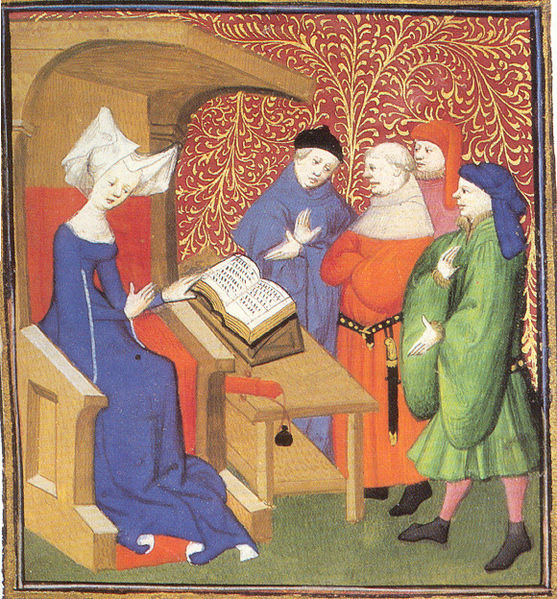
Christine de Pizan lecturing men Image from Wikimedia Commons
Christine de Pizan lecturing men
Image from Wikimedia Commons

In her poems on courtly love, she was able to express her deeply held conviction that “society obliged a woman to pay far too high a price for any momentary pleasure experienced from love outside marriage.”[1] So begins her championship of women aptly captured in “Cupid’s Letter.” During this time of growth for Christine, misogynistic attitudes abounded in the Universities, in court, and in the clergy. Aristotle’s influence held sway over the common understanding of what it was to be female. Every ill of the world was laid at the feet of women. As Christine aptly said in “Cupid’s Letter,”

There are women vilely named,

And often without cause are blamed,

And even those of noble race,

However fair and full of grace.

Lord, what company, what talk—

Women’s honor they freely mock.[2]

“Cupid’s Letter” enjoyed immediate success and was translated into English by Chaucer’s disciple, Thomas Hoccleve.[3] Her work of defending women and removing the tarnish that had been applied to their honor continued in other works including “The Debate of Two Lovers” which showed that true love is joyful, not deceitful or jealous, The Book of the City of Ladies that showed women’s contributions to history through time, The Book of the Three Virtues that sought to inculcate feminine virtues to counteract the misogyny of the time, and concluded with a eulogy poem in honor of Joan of Arc, “Ditie de Jehanne dArc.”

Throughout the time of her writing of poems and books, Christine became embroiled in a literary feud with Jean de Meun who wrote the second half of “The Romance of the Rose.” This became the “first recorded literary quarrel in France.”[4] Christine was inclined to blame the deceit and trickery of the men of her day at the feet of Jean de Meun.[5] “The Romance of the Rose” encouraged men to use whatever means necessary to acquire the woman they wanted in whatever way they wanted.  Jean de Meun belonged to another generation, another social world (not the courtly world of Christine de Pizan), and was primarily a philosopher.[6] He is crude and rude in his references to women and their body parts and advises “opportunism in relations with women, who are seldom virtuous, debauchery being the least of their crimes. The fine clothes of women do not really enhance them, for a dungheap covered with a silken cloth is still a dungheap.”[7] It is with this man and his very popular poem that Christine feels compelled to specifically defend womankind. Interestingly, she counters both in a poetic literary form, written letters, and politically through the official circle of Tignonville and the queen.[8] The chancellor of the University of Paris, Jean Gerson eventually entered the fray, siding with Christine de Pizan.[9]  Eventually, he wrote a treatise against “The Romance of the Rose.”[10] Chancellor Gerson and Christine de Pizan as literary allies were unbeatable and the argument ended (although it was not resolved.)[11] Christine was able to, for the first time, remove the discussion of women “from intellectual circles and [make] it possible for a lay-person, and a woman at that, to take part.”[12] From this point on, she leveraged her fantastic intellect, writing skill, and fame to continue writing about her major concern-“the defense of women against…unjust slander and…hypocrisies of contemporary society.”[13]

Christine de Pizan was a child and woman of privilege. She moved in circles that most people could not enter. She was affected by Petrarch, the University of Bologna, the University of Paris, and by the French Court of Charles V. Typically, a woman of her lifestyle would marry a man, have children, and live on. If her husband died, her task would be to re-marry. Christine did not do this. She educated herself, honed her literary skills and became an unlikely champion of women.

© 2013, post, Terri Stewart, All rights reserved

Terri StewartTERRI STEWART is Into the Bardo’s chaplain, senior content editor, and site co-administrator. You can expect a special post from her each week. She comes from an eclectic background and considers herself to be grounded in contemplation and justice. She is the Director and Founder of the Youth Chaplaincy Coalition that serves youth affected by the justice system. As a recent graduate of Seattle University’s School of Theology and Ministry, she earned her Master’s of Divinity and a Post-Master’s Certificate in Spiritual Direction with honors and is a rare United Methodist student in the Jesuit Honor Society, Alpha Sigma Nu. She is a contributing author to the Abingdon Worship Annual.

Her online presence is “Cloaked Monk.” This speaks to her grounding in contemplative arts (photography, mandala, poetry) and the need to live it out in the world. The cloak is the disguise of normalcy as she advocates for justice and peace. You can find her at www.cloakedmonk.com, www.twitter.com/cloakedmonk, and www.facebook.com/cloakedmonk.  To reach her for conversation, send a note to cloakedmonk@outlook.com.

[1] Willard, Christine de Pizan: Her Life and Works, 61.
[2] Ibid, 62.
[3] Ibid 63-64.
[4] Ibid, 73.
[5] Ibid, 63.
[6] Ibid, 75.
[7] Ibid, 75-76.
[8] Ibid, 77.
[9] Ibid, 80.
[10] Ibid, 84.
[11] Ibid, 86.
[12] Ibid.
[13] Ibid.

Posted in Essay, Terri Stewart

Christine de Pizan, Part 2 of 3

This series is an academic article that I wrote on the life of Christine de Pizan, an extraordinary woman of the medieval era. This is part 2. Part 1 is here.

Christine Presenting Her Book to Queen Isabeau, WikiCommons Images

Christine married Etienne de Castel, a son of a court official, in 1380.[1] It was a love match. Then things took a turn for Christine and her family. Charles V died and the crown’s close association with the academic world came to a close.[2] Tommaso became embroiled in a controversial cure that he had prescribed that “went awry.”[3] This caused the de Pizan family’s economic situation to deteriorate. Tommaso died in 1387.[4] Then in 1390, Christine’s husband died in an epidemic.[5] Christine became the head of a family with three children (one would die in childhood), a widowed mother, and a niece that was living with them. Furthermore, when she tried to settle the estate of her husband, she was met with deception, dishonesty, and lawsuits trying to strip her of her property.[6] Adding to her grief, money that had been reserved for her children’s future and invested was stolen.[7]To make matters worse, she became very ill, describing it as succumbing “like Job.”[8]

Given that Christine was now the head of her family, in France away from other relatives, without income, she had to create a way to support her household. Christine was still welcome at court and witnessed the frivolity of the court of Queen Isabeau and Louis of Orleans.[9] Here, poetry was one of the “principal social accomplishments”[10] and Christine turned her hand to poetry that reflected the Parisian social scene in its glory and ugliness. She proceeded to write poetry that reflected that scene, the grief she was still experiencing, and fond reminiscing of the reign of Charles V. Slowly, her poetry began to gather attention in the rarefied air of the court. Her fortunes began to turn when she was able to meet the earl of Salisbury in 1398.[11] They formed a bond based on love of poetry and he took her son into his own home to raise him with his own son. Then, in 1397, through Charles VI’s aunt, Marie de Bourbon, she was able to secure a place for her daughter at the Abbey of Poissy.[12]

Christine started writing poetry as early as 1394, but speaks of her literary career starting in 1399 after several years spent on self-education.[13] She studied ancient history, sciences, and the books of poets.[14] When she started studying the poets, she said to herself, “Child, be consoled, for you have found the thing that is your natural aspiration.”[15] She found her place. However, she did not take her early poetry very seriously. Her early poetry consisted of ballades, rondeaus, and the virelay.[16] These were well respected forms during her day. In addition, she started growing her own library of books by copying books in her own hand.[17] Christine also started writing letters purely for literary purposes.[18] She was becoming skilled at poetry, letter writing, and at common rhetorical devices used among the educated and courtly elite. Leaning on Plato’s view of women, Christine wrote in “The Mutation of Fortune,” that her change in status caused her to “become a man.”[19] It is this educated, courtly-adept woman that became a powerful voice for the fair and honorable treatment of women.

Christine’s poetry began to be known beyond the French court by approximately the year 1400.[20] She claims that it was because she was such a novelty—being a woman poet—that her work spread widely and rapidly.[21] However, it was probably because she wrote from her own point-of-view, a widowed woman. Her early poems used the court and its characters for the basis of her stories. She discovered that she had a particular talent for working with words and fitting them into poetic forms.[22] But her most striking skill was in expressing her own emotions and experience via literary devices.[23] The theme of grief and widowhood arises frequently in her writing.

© 2013, post, Terri Stewart, All rights reserved

Terri StewartTERRI STEWART is Into the Bardo’s  Sunday chaplain, senior content editor, and site co-administrator. She comes from an eclectic background and considers herself to be grounded in contemplation and justice. She is the Director and Founder of the Youth Chaplaincy Coalition that serves youth affected by the justice system. As a recent graduate of Seattle University’s School of Theology and Ministry, she earned her Master’s of Divinity and a Post-Master’s Certificate in Spiritual Direction with honors and is a rare United Methodist student in the Jesuit Honor Society, Alpha Sigma Nu. She is a contributing author to the Abingdon Worship Annual.

Her online presence is “Cloaked Monk.” This speaks to her grounding in contemplative arts (photography, mandala, poetry) and the need to live it out in the world. The cloak is the disguise of normalcy as she advocates for justice and peace. You can find her at www.cloakedmonk.com, www.twitter.com/cloakedmonk, and www.facebook.com/cloakedmonk.  To reach her for conversation, send a note to cloakedmonk@outlook.com.


[1] Willard, Christine de Pizan: Her Life and Works, 34-35.
[2] Ibid.
[3] Ibid, 38.
[4] Ibid, 39.
[5] Ibid.
[6] Ibid.
[7] Ibid, 40.
[8] Ibid.
[9] Ibid, 42.
[10] Ibid.
[11] Ibid.
[12] Ibid, 43.
[13] Ibid, 44.
[14] Ibid.
[15] Ibid.
[16] Ibid.
[17] Ibid, 45.
[18] Ibid.
[19] Ibid, 48.
[20] Ibid, 51.
[21] Ibid.
[22] Ibid, 53.
[23] Ibid.

Posted in Essay, Terri Stewart

Christine de Pizan, Part 1 of 3

This series is an academic article that I wrote on the life of Christine de Pizan, an extraordinary woman of the medieval era.

Christine de Pizan from Wikispaces.com
Christine de Pizan
from Wikispaces.com

During the lifetime of Christine de Pizan (1364-1430),[1] women were not well respected.[2] However, Christine managed to carve out a unique spot for herself among authors of poetry and rhetorical letters. Along her journey, she also became an unlikely champion of women, women’s roles, and the honorable treatment of women. Unlikely champion because Christine came from a privileged, comfortable background and was discouraged from stepping outside of traditional female roles by her mother.[3] I am going to show that Christine’s background peculiarly gave her the gifts to become not only a gifted author, but the unlikely champion of women. Then, a brief exploration of the misogynistic attitudes present during her lifetime that called forth a response and thrust her into the role of France’s first woman of letters.[4]

Christine de Pizan was born in Venice, Italy.[5] At the time she was born, the city was just recovering from two horrific events – an earthquake followed by the first outbreak of the bubonic plague in 1348.[6] It was thought that these events were punishments from God for Venice’s wickedness at warring with its neighbors and with Genoa.[7] Venice was a port city that was among the first cities hit by the plague due to its status as a maritime trader.[8] As the downfall of Venice was seen to be attributable to the movement of the planets and stars (earthquake), astronomy and astrology were respected and revered sciences.[9] The potential for ad4vanced study in these fields is what drew Tommaso da Pizzano to Venice.

Tommaso da Pizzano arrived in Venice in 1357 from Bologna. He had been studying there towards his degree of doctor in medical studies which would have included studying astrology.[10] Bologna had a reputation as an intellectual center of Europe, a book production center, and a center of secular thought.[11] That is the rarified air that Christine de Pizan’s father came from. Here, Tommaso met Christine’s mother, they married and soon had Christine. It is also in Venice that Tommaso became acquainted with Petrarch, one of the most influential poets[12] of his day.[13] Here the thoughts of Bologna-based on Aristotle’s writings-collided with Petrarch’s thoughts that were grounded in Plato.[14] Plato believed that women had a place in society—they had strengths that differed from men, but strengths none-the-less. Aristotle, however, had a much more subservient view of women.

In the Republic, Plato argues that women must be assigned social roles in the ideal state equal to those of men. Only one generation later, Aristotle, in his Politics, returns women to their traditional roles in the home, subserving men. Plato’s position in the Republic is based upon his view that “women and men have the same nature in respect to the guardianship of the state, save insofar as the one is weaker and the other is stronger.” Nature provides no such equality in Aristotle; in the Politics he flatly declares, “as regards the sexes, the male is by nature superior and the female inferior, the male ruler and the female subject.”[15]

I must say that Plato was not perfect on women, but he was more charitable in his views that Aristotle. Women, for Plato, degenerated from perfection while for Aristotle, they were inferior by nature.[16] Christine de Pizan was born into an environment more influenced by Petrarch and Platonic thought than by the University center’s reliance upon Aristotelian thoughts on women.

Tommaso soon re-established his family in Bologna because of the prestige that being at University brought him.[17] However, he was soon invited to join the courts of both Paris and Hungary. He chose Paris.[18] He left his family for two years in Bologna while he established himself at the French court of Charles V. This allowed him to have the prestige of being at court and being near the University of Paris. In December 1368, Charles V “received at the Louvre the newly arrived family of Tommaso, now transformed into Thomas de Pizan.”[19]

In the courts of Charles V, Christine was given quite a lot of freedom. Charles V has a propensity for intellectual interests.  He cultivated contacts with the University of Paris and built an impressive library. He contracted Nicole Oresme to translate the entire works of Aristotle into French.[20] Christine had access to the king’s library and to his personal study.[21] She later recalled the king with fondness saying, “In my youth and childhood, with my parents, I was nourished by his hand.”[22] Christine was enthralled with intellectual pursuits from a young age.[23] Her father encouraged her in her studies (he had very liberal views on the education of women) while her mother was more traditional.[24] Christine managed to walk a line between her two parents—tending to her traditional roles as a female and pursuing intellectual curiosities at every opportunity.

© 2013, post, Terri Stewart, All rights reserved

Terri StewartTERRI STEWART is Into the Bardo’s  Sunday chaplain, senior content editor, and site co-administrator. She comes from an eclectic background and considers herself to be grounded in contemplation and justice. She is the Director and Founder of the Youth Chaplaincy Coalition that serves youth affected by the justice system. As a recent graduate of Seattle University’s School of Theology and Ministry, she earned her Master’s of Divinity and a Post-Master’s Certificate in Spiritual Direction with honors and is a rare United Methodist student in the Jesuit Honor Society, Alpha Sigma Nu. She is a contributing author to the Abingdon Worship Annual.

Her online presence is “Cloaked Monk.” This speaks to her grounding in contemplative arts (photography, mandala, poetry) and the need to live it out in the world. The cloak is the disguise of normalcy as she advocates for justice and peace. You can find her at www.cloakedmonk.com, www.twitter.com/cloakedmonk, and www.facebook.com/cloakedmonk.  To reach her for conversation, send a note to cloakedmonk@outlook.com.

[1] Danuta Bois, “Christine de Pisan,” Distinguished Women of Past and Present, http://www.distinguishedwomen.com/biographies/pisan.html (accessed March 12, 2013).
[2] Charity Cannon Willard, Christine de Pizan: Her Life and Works (NY, Persea Books, 1984), 15.
[3] Willard, Christine de Pizan: Her Life and Works, 33.
[4] Ibid, 15.
[5] Ibid, 16.
[6] Ibid.
[7] Ibid.
[8] Cara Murphy, “The Bubonic Plague and the Impact on Venice,” FluTrackers, http://www.flutrackers.com/forum/showthread.php?t=23196 (accessed March 12, 2013).
[9] Willard, Christine de Pizan: Her Life and Works, 17-18.
[10] Ibid, 17.
[11] Ibid.
[12] Petrarch was an Italian humanist.
[13] Willard, Christine de Pizan: Her Life and Works, 19.
[14] Ibid.
[15] Nicholas D. Smith, “Plato and Aristotle on the Nature of Women,” Journal of the History of Philosophy 21.4 (1983): 467-478. Project MUSE. http://muse.jhu.edu/ (accessed March 13, 2013).
[16] John Wijngaards, “Greek Philosophy on the Inferiority of Women,WomenPriests.org, http://www.womenpriests.org/traditio/infe_gre.asp (accessed March 13, 2013).
[17] Willard, Christine de Pizan: Her Life and Works, 20.
[18] Ibid.
[19] Ibid.
[20] Ibid, 21.
[21] Ibid, 28-29.
[22] Ibid, 23.
[23] Ibid, 33.
[24] Ibid.

Posted in Creative Nonfiction, Jamie Dedes, Uncategorized

Those Infamous New York Moms

Mom and Me 1950, Brooklyn
Mom and Me
1950, Brooklyn, NY

A woman in Brooklyn decided to prepare her will. She told her rabbi she had two final requests. First, she wanted to be cremated. Second, she wanted her ashes scattered over the local shopping mall.

‘Why the shopping mall?’ asked the rabbi.

‘Then I’ll be sure my daughters will visit me twice a week.’

I met my Jewish friend, Laurel, when she came to a meeting at our local meditation center in Northern California where we now live. Laurel and I  got on right away. We both like Broadway shows, music and opera, reading, writing, and good meals seasoned with great conversation. She’s from Great Neck, LI in Nassau County. I’m from

Me and Rich 1972, Montauk Point, LI, NY
Me and Rich
1972, Montauk Point, LI, NY

the Center of the Universe, Brooklyn. We’re about the same age. So we come from the same time and, essentially, the same place.

Now New York moms get a bad rap, especially Jewish moms – but none of us gets off free. Laurel reminded me of that yesterday with a stereotypical New York joke at the expense of mothers. These jokes usually illustrate moms making caustic remarks or their attempts to foster guilt in adult children. While we do use regional idioms and have a distinct style of delivery, I’m really not sure that mothers from our time and place have the corner on either caustic commentary or the laying on of guilt. New York moms can’t be the only ones who, when distressed by a child’s behavior, say or at least think – despite how treasured the child … and they are treasured – “For this I was in labor thirty-six hours.”

Like all of us, my mother was very much in process and very much a product of her place and time. Among other things, what that means is that modesty was a primary concern. For my Maronite (Eastern Catholic) mother this included modest dress, which in turn included girdles. Now I’ve got to tell you that until I hit forty I was mostly underweight. In fact at Christmas when I was nineteen, I stood 5′ 3 1/2″ and, though I was three months pregnant with my son, I weighed only ninety-three pounds. Nonetheless, from my thirteenth year until her death when I was forty, my mother was adamant that I should wear a girdle so that I wouldn’t “jiggle.” That would be immodest and unseemly. Only my mother, I would think, would put me through this torture for nothing. As my husband said, “What’s to jiggle? If she turned sideways and stuck out her tongue she’d look like a zipper.”

Those old, typically New York jokes at the expense of our mothers were funny because there’s an element of truth in them. Our mothers often did pave the pathways to their homes and hearts with guilt. They could be cruelly caustic. They were as tough as life. They tended to be rigid and narrow on some sensitive subjects. But they were also present. They were idealistic. They worked hard in their homes and at their jobs, where they were grossly underpaid. Many of them worked for hours each week to make the most unbelievably complex old world dinners for traditional Sundays that included religious services and large gatherings of extended family and orphaned friends and neighbors.

No matter how difficult things got, these sturdy immigrant and first-generation American women did not resort to drugs, alcohol, or beatings. They went to bat for us at school. They got us into the best schools they could afford and kept us in school for as long as they could afford to do so. They protected us from old lechers and young men who did not have “honorable” intentions. Kudos and compliments were about as common as Dodo birds in the twenty-first century; but secretly they were pleased and would proudly show photographs of us to their friends and boast of our accomplishments. It took me years to appreciate their insecurities and motivations.

Mom and me 1980, San Francisco, CA
Mom and me
1980, San Francisco, CA

You can tell by the posture in the photo to your right, that moving into my thirties, I was still struggling with mixed feelings. The reason in this particular case: Before I went to work one morning, I left money on the kitchen table for a pizza. I called home at 5:00 p.m. as I was leaving the office and asked my mother if she’d order the pizza right away because I was “starving.” I got home and “binged”: I ate one slice of pizza and left the crust. “I thought you were hungry,” Mom said. “I was.”  The fact that I was thirty and still “eating like a bird” and underweight disturbed her. In turn, I was disturbed because she was still trying to tell me how to eat. I do the same sort of thing to my son now, not about food, but about other things.

I miss my mother and am thinking of her even more than usual with Mother’s Day soon to arrive. I wish she was here nagging me to clean my plate. I finally understand. As the saying goes, “We grow too soon old and too late smart.”

– Jamie Dedes

© 2013, feature and all photographs (from our family album, please be respectful), Jamie Dedes, All rights reserved

Photo on 2012-09-19 at 20.00JAMIE DEDES ~ My worldly tags are poet and writer. For the past five years on medical retirement due to a chronic, potentially life-threatening illness, I’ve blogged at The Poet by Day, formerly titled Musing by Moonlight. The gift of illness is more time for poetry. Through the gift of poetry (mine and that of others), I enter sacred space, the common ground that is our true home.

Posted in Music, Naomi Baltuck, Photography/Photographer

As I Was Going Up the Stair

Yesterday upon the stair, I met a man who wasn’t there.


He wasn’t there again today.  Oh, how I wish he’d stay away!

photograph c2013 Naomi Baltuck

This is the first stanza of Antigonishwritten in 1899 by Hughes Mearns.  It was inspired by rumors of a ghost roaming the stairs of a haunted house in Antigonish, Novia Scotia.  It inspired a popular Glenn Miller song in 1939, with vocals by Tex Beneke.

– Naomi Baltuck

Editor’s note: What a  fine example of how – with our art – we feed one anther. Here people pass around a folk tale. A poet picks it up and writes a poem. A composer finds the poem and sets it to music, which musicians then play accompanied by a singer singing the poem. Wonderful! J.D.

NaomiPHOTO1-300ppiNAOMI BALTUCK ~ is a Contributing Editor and Resident Storyteller here at Bardo. She is a world-traveler and an award-winning writer, photographer, and story-teller whose works of fiction and nonfiction are available through Amazon HERE. Naomi presents her wonderful photo-stories – always interesting and rich with meaning and humor – at Writing Between the Lines, Life from the Writer’s POV. She also conducts workshops such as Peace Porridge (multicultural stories to promote cooperation, goodwill, and peaceful coexistence), Whispers in the Graveyard (a spellbinding array of haunting and mysterious stories), Tandem Tales, Traveling Light Around the World, and others. For more on her programs visit Naomi Baltuck.com

Posted in Spiritual Practice, Terri Stewart, Uncategorized

Locked Away

locked-away
Locked Away

I read a brief article about potential, gifts, talents, and how we can use those things to actually make a living! Embedded in the exercise that they walked the reader through is a wonderful contemplative exercise. So here we go!

Need:  Paper and writing utensil, timer

Often, as an ice-breaker, when I first meet youth in detention, I ask them to tell me the three best things about themselves. They always come up with one thing. Then most come up with a second thing. The third one is always a struggle. It is often a struggle to recognize the greatness in ourselves…in our own story. We so often lock our gifts away and don’t let other people see the precious gift that we are. We hide our greatness under a bushel, so to speak!

Recently, NBA player, Jason Collins, came out and told the world he was gay. Some would say that is a great act of heroism. I think it is especially interesting that he came out so recently after the Jackie Robinson movie, 42, released. Both are great efforts put forth by African-American men to combat hatred. I also find greatness in the gay youth that shows up to school every day to face bullying or ridicule. One is greatness on a national scale. The other is greatness measured in every day strides.

Now, get comfortable, create a space where your feet are grounded. Put your paper before you and hold your preferred writing utensil(s) in your hand. Hold in your mind a comfortable sense of yourself. Where is your greatness today? Where has it been in the past? What is your yardstick that measures greatness? How will you claim your greatness and let it shine?

Take 5 minutes and write down things that you think are great about yourself! Talents, gifts, actions. Even going back to childhood. Yes, 5 minutes.

Now, take that paper and fold it up. Tuck it away in an accessible location–a purse or a wallet would be great. From now until next Sunday, keep a greatness log! I wonder if we can recognize the greatness in the everyday acts of living. Like yesterday, maybe it was “great” that I gave a homeless man all my change so he could get food. Some days greatness, for me, can be measured by the ability to get out of bed! Perhaps the trick is not to compare your greatness to other people.

Have a great week!

Shalom,

Chaplain Terri
CloakedMonk

© 2013, post and photos, Terri Stewart, All rights reserved

Terri StewartTERRI STEWART is Into the Bardo’s  Sunday chaplain, Senior Content Editor and Site Co-Administrator.  She comes from an eclectic background and considers herself to be grounded in contemplation and justice. She is the Director and Founder of the Youth Chaplaincy Coalition that serves youth affected by the justice system. As a recent graduate of Seattle University’s School of Theology and Ministry, she earned her Master’s of Divinity and a Post-Master’s Certificate in Spiritual Direction with honors and is a rare United Methodist student in the Jesuit Honor Society, Alpha Sigma Nu. She is a contributing author to the Abingdon Worship Annual.

Her online presence is “Cloaked Monk.” This speaks to her grounding in contemplative arts (photography, mandala, poetry) and the need to live it out in the world. The cloak is the disguise of normalcy as she advocates for justice and peace. You can find her at www.cloakedmonk.com, www.twitter.com/cloakedmonk, and www.facebook.com/cloakedmonk.  To reach her for conversation, send a note to cloakedmonk@outlook.com.
Posted in Essay, Guest Writer

FROM HARPY’S REVIEW: The 10 Top Relationship Words That Aren’t Translatable Into English

OLYMPUS DIGITAL CAMERA

Published here with the permission of the author, Pamela Haag, who did the original research and writing. It was published on November 18, 2011 on The Big Think, which hosts Pamela’s blog, Harpy’s Review.  I thought it an interesting piece. Apparently, so did a lot of others.  It was blogged and reblogged often and generally without Pamela’s analysis and often without attribution to her. It took a bit of doing to find the source. All other postings I found of this piece were dated subsequent to Pamela’s. J.D.

Here are my top ten words, compiled from online collections, to describe love, desire and relationships that have no real English translation, but that capture subtle realities that even we English speakers have felt once or twice. As I came across these words I’d have the occasional epiphany: “Oh yeahThat’s what I was feeling…”

Mamihlapinatapei (Yagan, an indigenous language of Tierra del Fuego): The wordless yet meaningful look shared by two people who desire to initiate something, but are both reluctant to start. 

Oh yes, this is an exquisite word, compressing a thrilling and scary relationship moment. It’s that delicious, cusp-y moment of imminent seduction. Neither of you has mustered the courage to make a move, yet. Hands haven’t been placed on knees; you’ve not kissed. But you’ve both conveyed enough to know that it willhappen soon… very soon.

Yuanfen (Chinese): A relationship by fate or destiny. This is a complex concept. It draws on principles of predetermination in Chinese culture, which dictate relationships, encounters and affinities, mostly among lovers and friends.

From what I glean, in common usage yuanfen means the “binding force” that links two people together in any relationship.

But interestingly, “fate” isn’t the same thing as “destiny.” Even if lovers are fated to find each other they may not end up together. The proverb, “have fate without destiny,” describes couples who meet, but who don’t stay together, for whatever reason. It’s interesting, to distinguish in love between the fated and the destined. Romantic comedies, of course, confound the two.

Cafuné (Brazilian Portuguese): The act of tenderly running your fingers through someone’s hair.

Retrouvailles (French):  The happiness of meeting again after a long time.

This is such a basic concept, and so familiar to the growing ranks of commuter relationships, or to a relationship of lovers, who see each other only periodically for intense bursts of pleasure. I’m surprised we don’t have any equivalent word for this subset of relationship bliss. It’s a handy one for modern life.

Ilunga (Bantu): A person who is willing to forgive abuse the first time; tolerate it the second time, but never a third time.

Apparently, in 2004, this word won the award as the world’s most difficult to translate. Although at first, I thought it did have a clear phrase equivalent in English: It’s the “three strikes and you’re out” policy. But ilunga conveys a subtler concept, because the feelings are different with each “strike.” The word elegantly conveys the progression toward intolerance, and the different shades of emotion that we feel at each stop along the way.

Ilunga captures what I’ve described as the shade of gray complexity in marriages—Not abusive marriages, but marriages that involve infidelity, for example.  We’ve got tolerance, within reason, and we’ve got gradations of tolerance, and for different reasons. And then, we have our limit. The English language to describe this state of limits and tolerance flattens out the complexity into black and white, or binary code. You put up with it, or you don’t.  You “stick it out,” or not.

Ilunga restores the gray scale, where many of us at least occasionally find ourselves in relationships, trying to love imperfect people who’ve failed us and whom we ourselves have failed.

La Douleur Exquise (French): The heart-wrenching pain of wanting someone you can’t have.

When I came across this word I thought of “unrequited” love. It’s not quite the same, though. “Unrequited love” describes a relationship state, but not a state of mind. Unrequited love encompasses the lover who isn’t reciprocating, as well as the lover who desires. La douleur exquise gets at the emotional heartache, specifically, of being the one whose love is unreciprocated.

Koi No Yokan (Japanese): The sense upon first meeting a person that the two of you are going to fall into love.

This is different than “love at first sight,” since it implies that you might have a sense of imminent love, somewhere down the road, without yet feeling it. The term captures the intimation of inevitable love in the future, rather than the instant attraction implied by love at first sight.

Ya’aburnee (Arabic): “You bury me.” It’s a declaration of one’s hope that they’ll die before another person, because of how difficult it would be to live without them.

The online dictionary that lists this word calls it “morbid and beautiful.” It’s the “How Could I Live Without You?” slickly insincere cliché of dating, polished into a more earnest, poetic term.  

Forelsket: (Norwegian):  The euphoria you experience when you’re first falling in love.

This is a wonderful term for that blissful state, when all your senses are acute for the beloved, the pins and needles thrill of the novelty. There’s a phrase in English for this, but it’s clunky. It’s “New Relationship Energy,” or NRE.  

Saudade (Portuguese): The feeling of longing for someone that you love and is lost. Another linguist describes it as a “vague and constant desire for something that does not and probably cannot exist.”

It’s interesting that saudade accommodates in one word the haunting desire for a lost love, or for an imaginary, impossible, never-to-be-experienced love. Whether the object has been lost or will never exist, it feels the same to the seeker, and leaves her in the same place:  She has a desire with no future. Saudade doesn’t distinguish between a ghost, and a fantasy. Nor do our broken hearts, much of the time.

– Pamela Haag

© 2011, Pamela Haag, All Rights Reserved, posted on Into the Bardo with permission, bookcover design (below) courtesy of HarperCollins, All rights reserved

paperback_300PAMELA HAAG’S work spans a wide, and unusual, spectrum, all the way from academic scholarship to memoir. Thematically, it has consistently focused on women’s issues, feminism, and American culture, but she’s also written on topics as eclectic as the effort to rebuild the lower Manhattan subway lines after 9/11, 24-hour sports radio talk shows, and the experience of class mobility.

Haag’s latest book, Marriage Confidential: The Post-Romantic Age of Workhorse Wives, Royal Children, Undersexed Spouses, and Rebel Couples Who Are Rewriting the Rules, released by HarperCollins in May of 2011, draws on all of these strands of Haag’s unique professional biography to create almost a new genre, a weave of academic expertise, cultural history, creative nonfiction, memoir, storytelling, interviews, and commentary. Pamela’s blog, Harpy’s Review is hosted by Big Think. She writes a regular column, Marriage 3.0, for Psychology Today.

Posted in Essay, Michael Watson

The Past Two Weeks: A View from New England

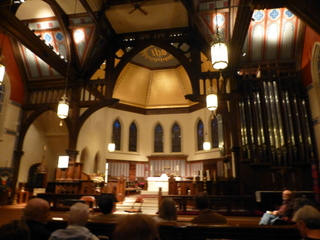
Grace Church, New Bedford, MAThis past weekend we were visiting family in southeastern Massachusetts, and decided to attend a concert by the virtuoso classical guitarist, Eliot Fisk and friends. The concert was staged in the magnificent Grace Episcopal Church in New Bedford. As we listened to music ranging over several centuries, I found my mind wandering far and wide.

Earlier in the day we had received a phone call from a woman who had run the Boston Marathon and now was preparing for another. She was feeling fearful and becoming increasingly hesitant to run. Could she come in and speak to one of us, maybe get some help sorting out her anxiety? We set a time to meet and went on with our day.

The prior couple of weeks had been quite difficult. We have family and adult children living, or going to school, in Boston. On the day of the Boston Marathon I went in to work as usual. Late in the day a client came in and told me his wife had called and said there had been a bombing at the Marathon. We turned on the office computer and looked at the news feed. At that point, there was a fire at the Kennedy Library as well as reports of possible new bomb blasts, and rumors that additional devices had been found. I explained to my client I have family in Boston, picked up the phone, and called home. Everyone was safe and accounted for. I then called my daughter who lives in the Midwest and reassured her we were all safe. Only then did we settle into the routine of our therapy session.

That session was unique in all my years of practice. I spoke about how surprised I was that I called home instead of forcing myself to wait til after the session. He spoke to feeling remorse at being the bearer of bad news. I expressed my gratitude to him for sharing the news and for being generous in allowing me to check on the safety of my family, and for simply being another human presence in a difficult moment. Together we shared our experience of living in a world where people harm one another in the service of ideology.

On Wednesday I got together with a group of old friends. Naturally, the conversation turned to the week’s events. I spoke about imagining I understood some small part of the anger and hopelessness of the two brothers accused of the bombings. I added I thought they were probably doing their best and we could detest their actions and still hold on to the brothers’ humanity. Perhaps we are all doing as we are able, and sharing, ultimately, a common bond and fate. None of this went over well.

Then came Friday, and New England was back in the middle of terror and chaos. We were hosting Bangladeshi friends who were visiting the U.S. for the first time. I was up early, turned on the radio, and was greeted by reports of shootouts and bombs, again in Boston. One of my stepsons posted to Facebook that his street was blocked off, police were everywhere, and the neighborhood was in lockdown. Once again we were on the phone to Boston and the Midwest; our family members were safe, at least for the moment.

When our Bangladeshi friends awoke and came downstairs (they had luxuriated in long, hot showers, so different from the cold showers available to them at home), we explained the situation to them. They spoke to their compassion for our plight, and told us about one day, a few years ago, when Bangladesh had suffered 400 separate blasts. By early afternoon it was apparent the situation in Boston was under relative control, so we drove up to the mountains where our friends met snow for the first time. They proceeded to frolic, build snow people, and have a snowball fight, all in near 80 degree weather. The next day was cold and windy and we built a fire in the wood stove…… Welcome to Vermont in April!

All this came back as I sat in the enormous vaulted church, surrounded by family and and friends, listening to a remarkable concert drawn from the Western canon. A reception P1050301followed the concert, but we went straight home. Although it was late (the concert lasted well over two hours), the Red Sox were still playing, and winning to boot! It was then, sitting in the family kitchen, surrounded by loved ones, drinking late night decaf cappuccinos, that I finally grasped the healing, normalizing power of baseball.

Sunday we drove home via Boston where we visited more family. The world was abloom, and the streets were filled with happy, playful people. Surprisingly we spoke very little about the events of the proceeding two weeks, other than brief recaps of how folks spent their time during the lockdowns, or decided not to attend the Marathon. Rather, we spoke about the tenacity and resilience of the people of Boston. I guess we should not have been surprised at their resiliency, given their decades of loving support of the Red Sox prior to 2004.

– Michael Watson

© 2013, essay and all photographs include the portrait below, Michael Watson, All rights reserved

michael drumMICHAEL WATSON M.A., Ph.D., LCMHC (Dreaming the World) ~ is a contributing editor to Into the Bardo, an essayist and a practitioner of the Shamanic arts, psychotherapist, educator and artist of Native American and European descent. He lives and works in Burlington, Vermont, where he teaches in undergraduate and graduate programs at Burlington College,. He was once Dean of Students there. Recently Michael has been teaching in India and Hong Kong. His experiences are documented on his blog. In childhood he had polio, an event that taught him much about challenge, struggle, isolation, and healing.

Posted in Art, Jamie Dedes, Poems/Poetry

Jan Phillips’ The Artist’s Creed

Calliope

Artist” ~ generally refers to people who express visually. Sometimes it refers to folks in the entertainment industry. In criticism it may also refer to other forms of expression…music, poetry, writing and so on. As used here and generally on this site, it refers to one who creates out of their inner vision, no matter what form of expression the creation takes. It implies a unity of inspiration, practice, and craft. This is for you … ♥

– Jamie Dedes

Illustration ~ The Goddess Kalliopē (Calliope), Homer’s muse for the Odyssey and the Illiad, in a painting by Simon Vouet

The Artist’s Creed by Jan Philips:


The video is by Jan Phillips

Photo on 2012-09-19 at 20.00JAMIE DEDES ~ My worldly tags are poet and writer.  I’m in my fifth year of blogging at The Poet by Day, the journey in poem, formerly titled Musing by Moonlight.  Through the gift of poetry (mine and that of others), I enter sacred space.

Posted in Culture/History, mystic, Naomi Baltuck, Spiritual Practice

The Stairway (to Skellig Michael)

When we traveled to Ireland we visited Skellig Michael, a monastery founded by Christian monks in the 7th century.  Life there was remote and harsh, the weather often severe.   The monks collected rainwater to drink, raised a few animals and imported soil from the mainland nine miles away so they could grow vegetables on that barren little island.

If a monk made a rare crossing to the mainland for supplies, rough weather might strand him there for a week or a month.  To return to his spartan life in a cold stone beehive hut, he would have to climb 700 feet up these winding stairs, bearing whatever supplies he had fetched home.

On our life’s journey most of us earn our bread, raise our families, and pursue our passions.  Sometimes, like water flowing down a hillside, we take the path of least resistance.  What in your life do you care enough about to be willing to make this climb?

– Naomi Baltuck

All words and images (including the portrait below) copyright 2013 Naomi Baltuck,All rights reserved

NaomiPHOTO1-300ppiNAOMI BALTUCK ~ is a Contributing Editor and Resident Storyteller here at Bardo. She is a world-traveler and an award-winning writer, photographer, and story-teller whose works of fiction and nonfiction are available through Amazon HERE. Naomi presents her wonderful photo-stories – always interesting and rich with meaning and humor – at Writing Between the Lines, Life from the Writer’s POV. She also conducts workshops such as Peace Porridge (multicultural stories to promote cooperation, goodwill, and peaceful coexistence), Whispers in the Graveyard (a spellbinding array of haunting and mysterious stories), Tandem Tales, Traveling Light Around the World, and others. For more on her programs visit Naomi Baltuck.com

Posted in Meditation, Spiritual Practice, story, Terri Stewart

Candle Gazing and a Contemplative Tale

Today’s practice is two tales set to a video recording of three candles. I will confess that this was done in my living room and, well, the candles are not as flickery on the video as they were in my living room. I would suggest getting a candle and looking at it instead of the video screen! Or simply closing your eyes and listening.

Candle gazing is a contemplative meditation technique. In this manner, instead of closing your eyes, you let your eyes rest on the flame of a candle. Let your gaze rest softly, neither focusing too hard or letting the candle leave your gaze. Stay with the candle as it dances and let your mind be free.

This video is about 4 1/2 minutes long. There are a couple of brief moments of silence. Stay with the silence and get through to the other side.

The stories are from one of my favorite books, “Peace Tales: World Folktales to Talk About” by Margaret Read MacDonald. This book found us when my kids were in elementary school. (My youngest is graduating this year! Yikes!!)

Sit back. Relax. Get comfortable. Become grounded. Now listen with your heart.


Namaste, salām, shalom.


© 2013, post and video, Terri Stewart, All rights reserved

Terri StewartTERRI STEWART is Into the Bardo’s  Sunday evening chaplain. You can expect a special post from her each week. She comes from an eclectic background and considers herself to be grounded in contemplation and justice. She is the Director and Founder of the Youth Chaplaincy Coalition that serves youth affected by the justice system. As a recent graduate of Seattle University’s School of Theology and Ministry, she earned her Master’s of Divinity and a Post-Master’s Certificate in Spiritual Direction with honors and is a rare United Methodist student in the Jesuit Honor Society, Alpha Sigma Nu. She is a contributing author to the Abingdon Worship Annual.

Her online presence is “Cloaked Monk.” This speaks to her grounding in contemplative arts (photography, mandala, poetry) and the need to live it out in the world. The cloak is the disguise of normalcy as she advocates for justice and peace. You can find her at www.cloakedmonk.com,www.twitter.com/cloakedmonk, and www.facebook.com/cloakedmonk.  To reach her for conversation, send a note to cloakedmonk@outlook.com.
Posted in Photography/Photographer

Divine Look

This lovely photo and message from Ajaytao says it all.

Posted in Essay, Karen Fayeth

On Tenacity

mymettles

ON TENACITY

by

Karen Fayeth (Oh Fair New Mexico)

Earlier this week I received the results of a competition I had entered, and for which I held out great hope. It was related to my writing and even an honorable mention would have been a huge step forward for me.

While entering I knew it was a long shot, but I really believed I had a chance.

Predictably, when the results were announced I was nowhere in the list, and yes, this got me a little down.

That’s the trouble, sometimes, with having hope. A burgeoning flower bud of belief can so easily get ravaged by insatiable locusts (over dramatic metaphor alert!!!).

When one is a rather sensitive artist type, it’s hard not to feel steamrolled at such times. Then again, what separates the doers from the dilettantes is tenacity.

So after feeling mopey for several days I am starting to rally. In defeat my resolve becomes just that much stronger.
For almost two years I have been using a really wonderful service that forces me to submit writing to literary journals every quarter. They are strict taskmasters and they keep me focused.

Once every three months I send out about thirty submissions, of which most of them are rejected. This means piles and piles of both email and snail mail arrive at my door just to say “you are not a good fit.”

Amazing how something like two hundred rejections can really make a girl immune to the woes. It’s like a pair of ill-fitting shoes. At first it hurts, then it makes a really painful blister, then finally a callus forms. The thin skin has toughened to endure the scraping.

Like that.

This morning I was thinking back to about seven years ago, back before The Good Man and I had married, and he was living in San Francisco’s North Beach. A really cool new art store had opened on Columbus Ave. near his place and I was just beginning my foray into the visual arts. Visual arts were a big departure from writing, which had dominated my creative juices for so long.
I loved everything about the art store and bought quite a few supplies there. One day they had posters up announcing an auction. Customers were invited to submit art works and the store would display them and then at the end of the month, the store auctioned them off for charity.

Great! I was on board. I created an item to give to the auction and when The Good Man turned in my piece for me, he was asked to put a starting bid. Because he loves me and encourages my work, he put the amount of $50 as a starting price instead of starting at zero as most other artists were doing.

Later, when we walked into the store to see my stuff on display, my piece was at the very, very back of the store among the tools and shelves where they stretch canvas. My work was clearly more amateur than the rest of the offerings and it stood out as the only one using the photographic medium, but ok. It was on display which was a huge rush.

When the auction was finished, they called to ask me to come pick up my work. The rather arrogant and sniffly clerk informed me bluntly that my piece was the ONLY one that hadn’t sold (meanwhile, he gave us a flyer so we could attend his exhibit of butt ugly paintings at a local small gallery).

I was, of course, embarrassed beyond belief, humiliated and totally crushed. Being judged by a more experienced (and in my mind, more talented) artist just about did me in.

Just thinking about it still gives me shudders of embarrassment. This morning in the wake of my recent defeat I thought again about this experience. I recalled today that among all the donated pieces, my work was the only one that listed a starting bid.

All others put in a starting bid of $0, and they all sold. Snotty clerk said they didn’t have a lot of bids and bidders. All of this means that at the end of the auction, someone could have thrown $5 at a piece of artwork and would have won.

Today I understand that instead of being sheepish about that whole thing, I should be proud. I may not have sold my work but I valued my art enough to put a price on it.

Which is stronger? Valuing my own work and not selling it at that auction, or giving it away for free, thus saying the value of my work is nothing?

I know which one I choose. Today I have straightened my spine and I feel a little better.

In defeat, my mettle is being tempered, and that only makes me stronger.

© 2013, essay, Karen Fayeth, All rights reserved. Photo by Claudia Akers.
Photo credit ~ Forge, ScienceGuide

webheadshotKAREN FAYETH ~ is one of our regular contributing writers. She is our new tech manager, site co-administrator along with Jamie and Terri, and fiction and creative nonfiction editor. She blogs at Oh Fair New Mexico. Born with the writer’s eye and the heart of a story-teller, Karen Fayeth’s work is colored by the Mexican, Native American, and Western influences of her roots in rural New Mexico complemented by a growing urban aesthetic. Karen now lives in the San Francisco Bay area. When she’s not spinning a tale, she works as a senior executive for science and technology research organization.

Karen has won awards for her writing, photography, and art. Recent publication credits include a series of three features in New Mexico magazine and an essay with the online magazine Wild Violet.  Her latest short story will be published in the May edition of Foliate Oak. Karen’s photography is garnering considerable attention, but her proudest moment was having her “Bromance” (Aubry Huff and Pat Burrell) photo featured on Intentional Talk hosted by Chris Rose and Kevin Millar on MLB TV. She’s a Giant’s fan.

Posted in Naomi Baltuck, Story Telling, Photo Story

Benchmarks

A bench is like an old shoe.  Whether in use at the moment…

…or long since abandoned…

…its former occupants leave their mark.

All over the world, these are the true thrones of the people.

They provide company…

…entertainment…

…a sense of belonging…

…a place to rest…

…to reflect…

…to escape the worries of the workaday world…

…or not.

Oh, the stories they have heard…

The sights they have seen…

Those benches have been warmed by the flesh and blood of people who have loved…

…and sometimes lost. Who’s to say?

But the next time you see one, sit and rest a spell.

As you take the bench, and watch the world go by, don’t judge too harshly.

Listen to the stories it has to tell.  They won’t be so very different from your own.

– Naomi Baltuck

All words and images (including the portrait below) copyright 2013 Naomi Baltuck,All rights reserved

NaomiPHOTO1-300ppiNAOMI BALTUCK ~ is a Contributing Editor and Resident Storyteller here at Bardo. She is a world-traveler and an award-winning writer, photographer, and story-teller whose works of fiction and nonfiction are available through Amazon HERE. Naomi presents her wonderful photo-stories – always interesting and rich with meaning and humor – at Writing Between the Lines, Life from the Writer’s POVShe also conducts workshops such as Peace Porridge (multicultural stories to promote cooperation, goodwill, and peaceful coexistence), Whispers in the Graveyard (a spellbinding array of haunting and mysterious stories), Tandem Tales, Traveling Light Around the World, and others. For more on her programs visit Naomi Baltuck.com
Posted in folk tale, story, Uncategorized

Why We Shout in Anger

377px-VishnuvishvarupaA Hindu saint who was visiting river Ganges to take bath found a group of family members on the banks, shouting in anger at each other. He turned to his disciples smiled and asked.

‘Why do people shout in anger shout at each other?’

Disciples thought for a while, one of them said, ‘Because we lose our calm, we shout.’

‘But, why should you shout when the other person is just next to you? You can as well tell him what you have to say in a soft manner, ‘asked the saint.

Disciples gave some other answers but none satisfied the other disciples. Finally the saint explained, .

‘When two people are angry at each other, their hearts distance a lot. To cover that distance they must shout to be able to hear each other. The angrier they are, the stronger they will have to shout to hear each other to cover that great distance.

What happens when two people fall in love? They don’t shout at each other but talk softly, Because their hearts are very close. The distance between them is either nonexistent or very small…’

The saint continued, ‘When they love each other even more, what happens? They do not speak, only whisper and they get even closer to each other in their love. Finally they even need not whisper, they only look at each other and that’s all. That is how close two people are when they love each other.’

He looked at his disciples and said.

‘So when you argue do not let your hearts get distant, Do not say words that distance each other more, or else there will come a day when the distance is so great that you will not find the path to return.’
-Author Unknown.

Thank you to Kris Lee for bringing this story to my attention.
Photo Illustration ~ Krishna (Hindu avatar)via Wikipedia and in the public domain.

– Terri Stewart

mailTERRI STEWART is Into the Bardo’s Chaplain, Sr. Consulting Editor, and Site Co-administrator. She comes from an eclectic background and considers herself to be grounded in contemplation and justice. She is the Director and Founder of the Youth Chaplaincy Coalition that serves youth affected by the justice system. As a recent graduate of Seattle University’s School of Theology and Ministry, she earned her Master’s of Divinity and a Post-Master’s Certificate in Spiritual Direction with honors and is a rare United Methodist student in the Jesuit Honor Society, Alpha Sigma Nu. She is a contributing author to the Abingdon Worship Annual.

.
Her online presence is Cloaked Monk.This speaks to her grounding in contemplative arts (photography, mandala, poetry) and the need to live it out in the world. The cloak is the disguise of normalcy as she advocates for justice and peace. You can find her at www.cloakedmonk.com,www.twitter.com/cloakedmonk, and www.facebook.com/cloakedmonk.  To reach her for conversation, send a note to cloakedmonk@outlook.com.