Our thanks to Laurel D. for sharing Vienna Teng’s video with us …
This crowd-funded (Kickstarter) video by the remarkable singer and song-writer Vienna Teng was released in December. The song Level Up is featured in her album Aims which was released last September. In this video, Ms. Teng moves through four scenes of devastation including one featuring b-boy Tommy Guns-Ly, dancer, bone cancer survivor and amputee. Tommy Guns-ly is part of the ILL-Abilities crew.
“Originally created in 2007 with the idea of being a “Super Crew” of disabled dancers, it is now becoming a global movement helping to spread the message: No Excuses, No Limits. ILL-Abilities’ mission is to redefine society’s view of disability, promote empowerment, and encourage limitless possibilities through motivational entertainment.”
Source: Breakin Convention.
The heart of this little gem is the gift of the very dear Br. David Steindl-Rast. If you are familiar with Br. David’s philosophy, writing, and voice, you will have immediately recognized who wrote and delivered the narrative though for some strange reason he is not credited.
Br. David is notable for his work fostering dialogue among the faiths and for exploring the congruence between science and spirituality. Early in his career he was officially designated by his abbot to pursue Catholic-Buddhist dialogue. He studied with several well-known Zen masters. He is the author of feature articles, chapter contributions to collections, and books. Among the most notable are Belonging to the Universe(with Frijof Capra) and The Music of Silence: A Sacred Journey Through the Hours of the Day (with Sharon Lebell). Br. David is the co-founder of A Network for Grateful Living, dedicated to the life-transforming character of gratitude.
THE FILMMAKER
Louie Schwartzberg, the film-maker, is an American and well-known for his time-lapse photography. The short-film here is one of several – each with a different theme – which you can find on YouTube.
THE MUSIC
The mood music background is by composer Gary Malkin. “He is founder of Musaic and Wisdom of the World™, a media production company and web site. He is also the co-founder of Care for the Journey, a care-for-the-caregiver initiative for healthcare professionals.” MORE
Our thanks to Laurel D. for contributing this film clip.
http://theladyinnumber6.com https://www.facebook.com/theladyinnum…
The Lady in Number 6 is one of the most inspirational stories ever told. 109 year old, Alice Herz Sommer, the world’s oldest pianist and oldest holocaust survivor, shares her views on how to live a long happy life. She discusses the vital importance of music, laughter and having an optimistic outlook on life. This powerfully inspirational video tells her remarkable story of survival and how she managed to use her time in a Nazi concentration camp to empower herself and others with music. See the entire documentary at: https://twitter.com/AliceTheFilm
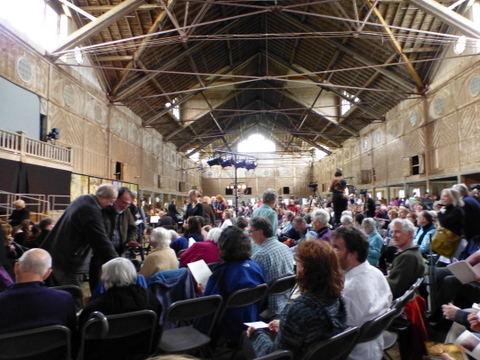
Recently we traveled down to Shelburne Farms for the world premiere of the Emergent Universe Oratorio, composed by Sam Guarnaccia. The Oratorio is a work that re-imagines the dominant culture’s physics-based creation narrative, and seeks to universalize the story. Before the Oratorio we were treated to the soulful playing of Eugene Friesen, of Paul Winter Consort fame. New Paintings, created for the event,by our friend, the marvelous artist, Cameron Davis, graced the walls in the remarkable, “cathedral-like” Breeding Barn.
Just prior to the performance, Mary Evelyn Tucker and John Grim, Co-Directors of the Forum on Religion and Ecology at Yale, and whose film of the same title was the inspiration for the oratorio, spoke. They acknowledged, and expressed appreciation for, Indigenous friends and adopted family. (No Indigenous people spoke.) They then spoke about a vision they hold, in which all of the Earth’s people have one creation story, a story that leads us to an Earthly paradise.
The Oratorio draws on texts from many Western traditions, but appears to include no Indigenous authors. This is problematic and, unfortunately, common in the Deep Ecology world. ( I have been reviewing Ecopsychology texts in preparation for teaching and have noticed a paucity of Indigenous voices, even in texts published this year.)
Of more concern is the notion that any narrative should be the ONLY narrative. This is an idea Indigenous people know well, whether presented in the guise of religious or economic dogma. The very idea of a universal point of view is imperial and colonizing, and alien to Native American cultures. We have many creation stories, each loved and valued.
I was feeling rather blue as I read the text and listened to the lovely melodies of the oratorio. I imagined myself to be the only one in the audience of hundreds who was discomforted. Then intermission came and others stopped by to share their concerns. As so often happens following such events, the concert has remained a topic of conversation at our house.
A few days ago I was having coffee with a Six Nations friend. Out of the blue he looked me in the eye and said, “I am so appreciative of time with you. It’s such a relief to not have to explain myself.” When I asked what he meant, he replied that I understood his struggles and, although we are from different tribal backgrounds, we share a similar ethos. Sometimes I forget how wide the divide between cultures can be in one geographically defined country. To be reminded, as I was at the concert, of the chasm we cross daily can be painful indeed.
MICHAEL WATSON, M.A., Ph.D., LCMHC (Dreaming the World) ~ is a contributing editor to Into the Bardo, an essayist and a practitioner of the Shamanic arts, psychotherapist, educator and artist of Native American and European descent. He lives and works in Burlington, Vermont, where he teaches in undergraduate and graduate programs at Burlington College,. He was once Dean of Students there. Recently Michael has been teaching in India and Hong Kong. His experiences are documented on his blog. In childhood he had polio, an event that taught him much about challenge, struggle, isolation, and healing.
Metastasize;
an awkward word,
vowels lurking with malice
between those rock hard t’s
and stumbling past that sinister s,
into that endless z…
Even educated women know;
the seeds of broken dreams will gather
nearest to the heart
and grow
until the Gardener’s sharpened shears
snip away the wretched, rotted root.
That puckered rose, that brutal scar,
my brave and beautiful friend;
wear it as a medal:
triumphant, survivor, heroine!
– Cindy Taylor
Minnie Julia Riperton (1947-1979), American singer-songwriter: In January 1976 Riperton was diagnosed with breast cancer and underwent a modified radical mastectomy. Though she was given just six months to live, she continued recording and touring, and in 1977 she became spokesperson for the American Cancer Society. Riperton was one of the first celebrities to go public with her breast cancer diagnosis, but did not disclose that she was terminally ill. In 1978, Riperton also received the prestigious Society’s Courage Award presented to her at the White House by then-President Jimmy Carter. She died at age 31 on July 12, 1979.
A VOICE SILENCED TOO SOON
Listen:
♥ ♥ ♥ ♥
CINDY TAYLOR ~ originally contributed this piece to us in 2011 for our Perspectives on Cancerseries. She is multitalented: a freelance writer, a poet, editor and proofreader. She also has an abiding passion for food and an endearing zeal for life, which she shares with us on her award-winning blog, The Only Cin. Cindy lives in Johannesburg, South Africa.
This irreverent music video for 70 Million, the hit song by the Franco-American band, Hold Your Horses!, offers a wink at art history. The inventive seven-member group playfully recreated twenty-five iconic paintings – can you name them all? – from Da Vinci to Andy Warhol. Enjoy!
What follows is a video using the original paintings with the artist’s name on each. If you care to, you can check it out to see if you got all the paintings and artists right when you viewed the first video.
let’s make peace and give it a chance
make dinner and serve it up hot
let’s make love and marry or not
make some babies teach them to dance
make good music a grand entrance
make time without asking what for
make art make dreams come true and more
make mistakes make amends make tea
make someone laugh make them happy
let’s make a better world not war
– Marylinn Mair
I have been trying to write a poem about peace for my friend Jamie’s Poets Against War. Everything came out so stilted– no point trying to force the muse– until I was in the airport in Rio thinking about my family and events of the past few weeks, and this decima just popped out. A bit late but heartfelt. M. M.
MARILYNN MAIR (Celebrating a Year, blog and marilynn mair mandolin, website) ~ is a contributor to Into the Bardo. She is a Professor of Music at Roger Williams University and internationally recognized as the “First Lady of the Mandolin”. Marilynn spends part of the year in Rio de Janeiro, where she researches and performs Choro music, a post-colonial Brazilian instrumental style dating back to the mid-19th century. She’s written two books on mandolin and has several albums out. Here she is – for those new to the Bardo – with Água no Feijão in Brazil.
Marilynn’s Amazon page is HERE. I have written more extensively about Marilynn and choro HERE. J. D.
Wow, the first in the series of Poets Against War or Poets for Peace. Hopefully I can do it justice! In riffing on peace and war, several things came together in my mind – or rather, many things came hopping through it! I hope the resulting series of images, words, and music will act as a meditation for you on this first day of Poets Against War. This will be synchro-posted at my blog, http://www.cloakedmonk.com. Feel free to reblog or synchropost elsewhere just link back to here.
First, a meme (my new favorite weird thing to do – make memes)…
Second, I have been noodling this around and the predominant thought I had was to sing a duet with my son, Colin Stewart. Colin is 17 and much more talented than I! But we held it together in order to sing an old church song, Peace Give I to Thee. Colin is playing the ukelele and singing. I confess that our sound system is not wonderful, so we both tempered ourselves to not blow out the microphones. It is accompanied by photos I took in the Bellevue Botanical Garden which bring me incredible peace.
Finally, the nature of the quest: Poets Against War or Poets for Peace. So black and white, it begs a reflection.
dichotomy
war destroys peace
hate destroys love
butterfly destroys chrysalis
child destroys dandelion
lion destroys lamb
lamb redeems lion
dandelion redeems child
chrysalis redeems butterfly
love redeems hate
peace redeems war
unity
And another old favorite, “Breathe Deep” by the Lost Dogs which speaks to the unity of all-even when we are uncomfortable with that unity.
REV. TERRI STEWART is Into the Bardo’s Sunday chaplain, senior content editor, and site co-administrator. She comes from an eclectic background and considers herself to be grounded in contemplation and justice. She is the Director and Founder of the Youth Chaplaincy Coalition that serves youth affected by the justice system. As a graduate of Seattle University’s School of Theology and Ministry, she earned her Master’s of Divinity and a Post-Master’s Certificate in Spiritual Direction. She is a contributing author to the Abingdon Worship Annual. (The 2014 issue just released!)
Her online presence is “Cloaked Monk.” This speaks to her grounding in contemplative arts and the need to live it out in the world. The cloak is the disguise of normalcy as she advocates for justice and peace. You can find her at www.cloakedmonk.com, www.twitter.com/cloakedmonk, and www.facebook.com/cloakedmonk.
The first and only time, in my life so far, that a piece of music has inspired me to write a poem directly about it, was when I heard a piece of music, composed by Sir John Tavener in 1982 and performed by Harry Christophers’ The Sixteen, whose eighteen members produce the most sublime choral sound I’ve ever heard. It was only by listening to the music, not particularly paying much attention to the words, that I was inspired to write this piece, which is a Haiku Triplet. It wasn’t until a little time after completing the poem, which was originally intended as a devotion to my wife, that I discovered an interesting connection between the music and a famous poet, who inspired Tavener to compose it in the first place. Only when I listened to the words, did I discover that Tavener had based his composition on William Blake‘s poem The Lamb, part of Blake’sSongs of Innocence and Experience, published in 1789. A full circle had thus turned, from poem to music and back again. I find it quite stirring that William Blake’s poem inspired John Tavener to write music to it and, in turn, Tavener’s music alone, my own poem, whose theme turns back to Blake’s original, perhaps because I think the wording of my poem can also be interpreted as devotional in a religious sense. My original title was in fact The Lamb, because that is the title of Tavener’s composition.
John Tavener
The most significant feature of this composition, which had the greatest impact on my poetic inspiration, is the way that the music cycles alternately between a seemingly discordant, if not quite atonal, series of musical passages and delicious, heart melting harmonies. It had the most striking effect on me. I should confess that I didn’t particularly like the piece at first, but now, every time I listen to it, I am transfixed and cannot help myself tearing up and choking at its beauty. It seems simply to mirror the cycles of life’s experience – from its hardest and most difficult periods to its happiest and most joyous moments and, with it, our responsibility to stay strong, particularly for those we love, through good times and bad, from the discordant times to the harmonious ones.
I cannot find a YouTube recording of The Sixteen singing this piece, but because of its brevity and simplicity, it is important to hear it with the purity and perfection of the best voices, in order to capture its depth and spirit, and the Tenebrae Choir, founded by Nigel Short of the famous King’s Singers, here provide the nearest thing I can find to this quality:
I think I’ve captured the essence of the Japanese poetic form of haiku, which is the seventeen-syllable 5-7-5 three-line verse structure with a requirement to contain “season words,” or Kigo. The choice of this poetic form was very deliberate, not least because it is, by its very nature, capable of distilling the essence of its subject and because Tavener’s composition is also brief, at only three and a half minutes.
Notwithstanding the background, the fascinating influences, coincidences and connections, this poem was and is dedicated to my wife, with whom I have shared a few highs and lows during our nearly forty years together.
This may seem an odd thing to suggest you do, but, in spite of the fact that the choir is singing Blake’s words, I do like to read my poem (contemplatively), whilst listening to the music at the same time …
I leave it to you.
Devotion
(aka “The Lamb”)
From the coldest snow
To the warmest sun you go
And I go with you
From blossom of spring
To golden leaves of autumn
I bathe in your light
From the beginning
To ending of the seasons
I am ever yours.
[The poem was also published on the Marriott Love Poems Competition website in March 2011; it didn’t win any prizes, but gave me a bit of a buzz for a short while].
Photo credits ~ Blake sketch by by John Flaxman circa 1804 and in the U.S. public domain; Tavener by Clestur via Wikipedia and under Creative Commons Attribution 3.0 Unported license
You Tube video uploaded by shawshank4u
JOHN ANSTIE (My Poetry Library and 42) ~ is a British poet and writer, a contributing editor here at Bardo, and multi-talented gentleman self-described as a “Family man, Grandfather, Oc casional Musician, Amateur photographer and Film-maker, Apple-MAC user, Implementation Manager, and Engineer. John participates in d’Verse Poet’s Pub and is a player in New World Creative Union. He’s been blogging since the beginning of 2011. John is also an active member of The Poetry Society (UK).
John has been involved in the recent publication of two anthologies that are the result of online collaborations among two international groups of amateur and professional poets. One of these is The Grass Roots Poetry Group, for which he produced and edited their anthology, “Petrichor* Rising“. The other group is d’Verse Poet Pub, in which John’s poetry also appears The d’Verse Anthology: Voices of Contemporary World Poetry, produced and edited by Frank Watson.
* Petrichor – from the Greek pɛtrɨkər, the scent of rain on the dry earth.
I was reading about John Cage today and his famous piece, 4’33”. As you may know, that is a composition conceived in 1952, meant for any instrument (or combination of instruments), and the score instructs the performer(s) to not play the instrument(s) during the entire duration of the piece, which is meant to consist of the sounds of the environment that the listeners hear while it is performed, although it is commonly perceived as “four minutes thirty-three seconds of silence”.
The reason why I was reading that is less important, the irony was that there was an awful amount of noise around me while I was plunging into Cage’s reasons to write a piece about silence. Now, precisely at the time when I was sort of praying for a miracle that would stop all that noise, my eyes fell on the fragment quoted below:
“In 1951, Cage visited the anechoic chamber at Harvard University. An anechoic chamber is a room designed in such a way that the walls, ceiling and floor absorb all sounds made in the room, rather than reflecting them as echoes. Such a chamber is also externally sound-proofed. Cage entered the chamber expecting to hear silence, but he wrote later, ‘I heard two sounds, one high and one low. When I described them to the engineer in charge, he informed me that the high one was my nervous system in operation, the low one my blood in circulation.’ Cage had gone to a place where he expected total silence, and yet heard sound. ‘Until I die there will be sounds. And they will continue following my death. One need not fear about the future of music.’ The realisation as he saw it of the impossibility of silence led to the composition of 4′33″.”
And lo! While I was reading that, the huge noise around me stopped, and I was able to hear the music of my neurons, chewing on the relative silence suddenly fallen upon my surroundings . Quite a poetic coincidence, if I may add.
But coming back to the point, what people grew to call as “silence” is merely the absence of sounds. An absence otherwise relative, as demonstrated by the quote above – for our own body always plays its own music, above the absolute state of silence. Sometimes we like it, sometimes we don’t, simply because silence, like all things, is sometimes necessary, and other times it should be replaced by something else. There can be silence in the middle of the storm, as well as it can lack in the middle of some anechoic chamber. What matters most is not the physical silence that we experience, but the mental one, when the mind comes to that state of silence called peace – because that is when we actually “hear” our soul.
LILIANA NEGOI (Endless Journey and in Romaniancurcubee în alb şi negru) began to write poetry at eighteen – by accident – as she herself likes to remember, and has been exploring the depths of language ever since. Currently she is the author of three published volumes of poetry in English – which is not her mother tongue but one that she came to love especially because of writing: Sands and Shadows,Footstep on the San – tanka collection and The Hidden Well. The last one can also be heard in audio version, read by the author herself on her SoundCloud site HERE. Many of her creations, both poetry and prose, have been published in various literary magazines.
Where is your light today? What is leading you? What is giving you hope? Joy?
“When I find myself in times of trouble, mother Mary comes to me,
speaking words of wisdom, let it be.
And in my hour of darkness she is standing right in front of me,
speaking words of wisdom, let it be.
Let it be, let it be, let it be, let it be.
Whisper words of wisdom, let it be.
And when the broken hearted people living in the world agree,
there will be an answer, let it be.
For though they may be parted there is still a chance that they will see,
there will be an answer. let it be.
Let it be, let it be, …..
And when the night is cloudy, there is still a light, that shines on me,
shine until tomorrow, let it be.
I wake up to the sound of music, mother Mary comes to me,
speaking words of wisdom, let it be.
Let it be, let it be, …..”
― Paul McCartney
…
…
A note about the light fixture:
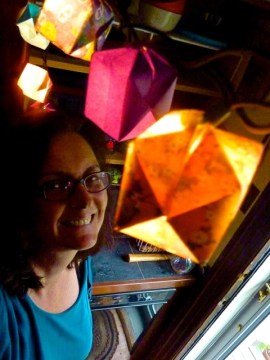
I photographed this light at the Merchant’s Cafe in Seattle, Washington. It is the first cafe in Seattle and has seen several iterations of its business as it was built, burned down, and built again. The interesting thing is that it is in the oldest part of Seattle (of course!). It was built in a building near first avenue. The tidal flats used to flood in every day, twice a day, up to third avenue. This makes doing business quite difficult! Seattle then had businesses build their buildings at least two stories tall. Then they raised all the roads, surrounding the existing buildings with raised roads. For a while, they put ladders at the streets so people would go off of the road, down the ladder, into the businesses.
Finally, they built sidewalks that connected the streets to the second story level of the buildings. So today, in Pioneer Square, when you enter the buildings, you are, in fact, entering the second story of the buildings that were placed there. If you look down, you will notice odd glass squares in the sidewalk. Those were originally skylights so that the first story of the buildings were kind of like an inside shopping mall with a view to the sidewalk above. So even there, in the midst of a buried first floor of these buildings, the light was still able to shine!
REV. TERRI STEWART is Into the Bardo’s Sunday chaplain, senior content editor, and site co-administrator. She comes from an eclectic background and considers herself to be grounded in contemplation and justice. She is the Director and Founder of the Youth Chaplaincy Coalition that serves youth affected by the justice system. As a graduate of Seattle University’s School of Theology and Ministry, she earned her Master’s of Divinity and a Post-Master’s Certificate in Spiritual Direction. She is a contributing author to the Abingdon Worship Annual. (The 2014 issue just released!)
Today, I want to try a very simple meditation / body prayer. It involves movement of the arms, breathing, intention, and if you choose, your particular word for the divine or that which transcends.
Take a moment for contemplation. Turn your eyes inward and find two desires.
“You are what your deepest desire is. As your desire is, so is your intention. As your intention is, so is your will. As your will is, so is your deed. As your deed is, so is your destiny.” ~ Upanishads
First-your desire for yourself. This wish could be for love, for kindness, for healing. What you feel you need at this moment.
Second-your wish for the world. This wish could be peace, love, kindness. What you feel is your unique gift of intention for the world. All that is present in the cosmos.
“He has told you, O mortal, what is good; and what does the Lord require of you but to do justice, and to love kindness, and to walk humbly with your God?” ~ Micah
These desires will be your intentions.
As always, do this as you are able.
…
Sit comfortably however you like. Be aware of the earth supporting you. Take a moment to feel the groundedness and the ground of all being.
The breathing / motion pattern is this:
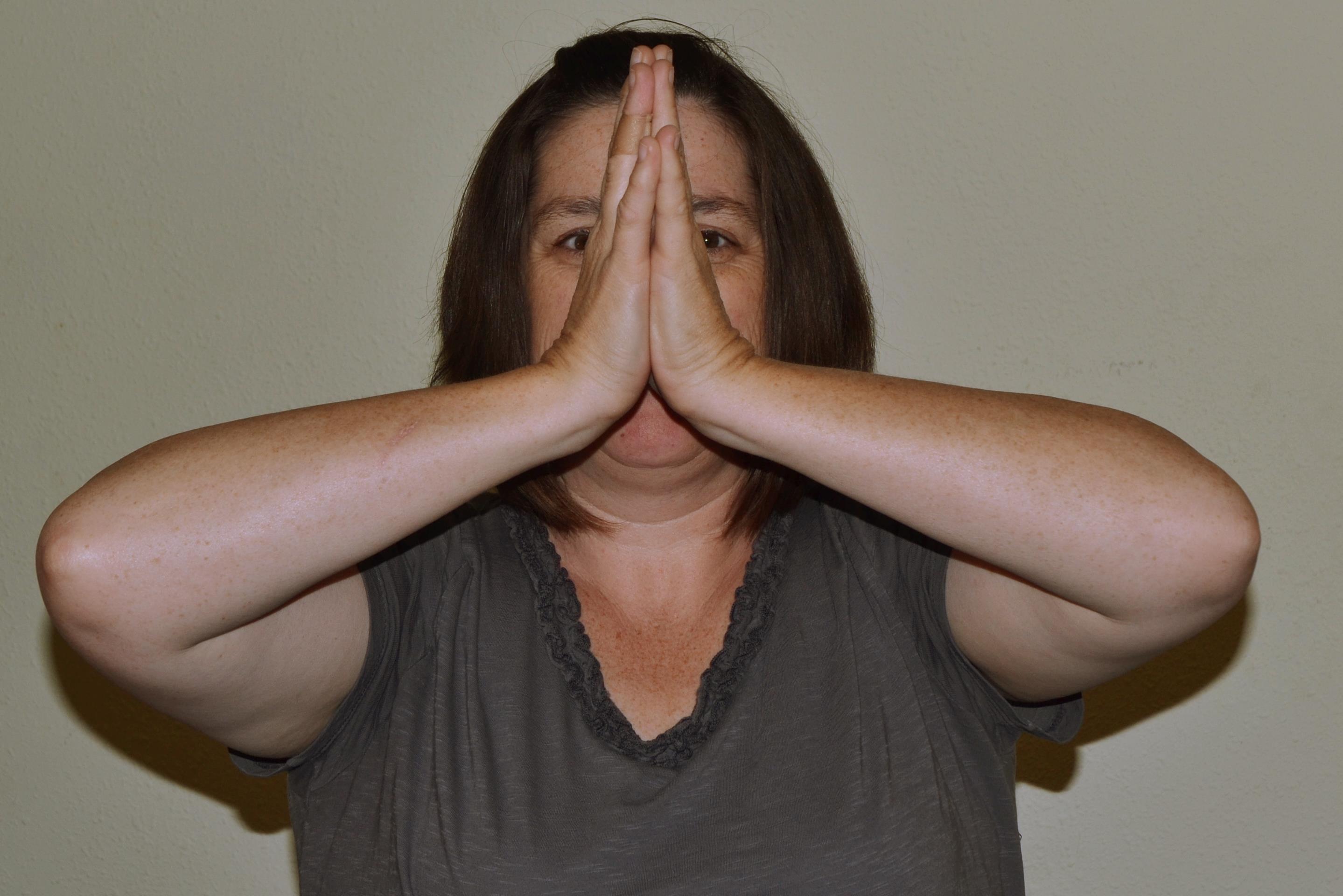
Arms loosely at sides … Inhale … and move arms to overhead in a prayer position, (hands flattened together)
Hands Overhead, Prayer Position
On exhale … Hands descend to chest / heart level while holding intention for self. Intentionally cross your eyes, your lips as you end at your heart.
Descending Towards the Heart“om”
Express, outloud or however you feel comfortable, the particular word that encompasses the divine for you. Divine being interconnectedness to all, that which transcends all, that which is lived within, or the languaging that you choose. This could be the Sanskrit “om” (pictured), the Aramaic “abwoon” which is father, or any of the myriad words that are symbols that stand in for the divine.
Hands at heart level … Inhale
On exhale … Hands push outward, forward and go slowly to the sides (right arm going right / left arm going left). Do this while holding your intention for the world.
Pushing Intention To the World
Express, outloud or however you feel comfortable, the particular word that encompasses the divine for you.
Bring your arms gently down to your sides.
Repeat this simple meditation for as long as it feels comfortable to do so. If you desire, close the meditation with an Amen (“so be it.”)
REV. TERRI STEWART is Into the Bardo’s Sunday chaplain, senior content editor, and site co-administrator. She comes from an eclectic background and considers herself to be grounded in contemplation and justice. She is the Director and Founder of the Youth Chaplaincy Coalition that serves youth affected by the justice system. As a graduate of Seattle University’s School of Theology and Ministry, she earned her Master’s of Divinity and a Post-Master’s Certificate in Spiritual Direction. She is a contributing author to the Abingdon Worship Annual. (The 2014 issue just released!)
I began thinking of Ubuntu today because I love the music of Eric Whitacre! Eric Whitacre is a contemporary choral composer who excels at using social media to bring people together. I first encountered his music with my children’s choir – Seattle Children’s Choir. The mature choir – Camerata – performed his piece Lux Arumque and I just cried. (I often cry during choir music-especially when my children are/were performing!)
As I mentioned, Eric Whitacre excels at using social media. He has used social media and the internet to create four virtual choirs. His first virtual choir was in 2010. It was his piece, Lux Arumque. He had 243 videos from 12 countries.
His second piece was Sleep. It had over 2,000 videos from 58 countries and was published in 2011. 2012 brought Water Night with 3,746 videos from 73 countries. He is currently assembling Virtual Choir IV – Fly to Paradise – with 8,400 submitted videos from 101 countries.
What does this have to do with Ubuntu?
I first heard of Ubuntu at seminary. I learned it from my friend, Sr. Jane Frances of Uganda. It is encapsulated in the phrase, “I am because we are.”
Bishop Desmond Tutu speaks of Ubuntu in his 1999 book, No Future Without Forgiveness-
A person with Ubuntu is open and available to others, affirming of others, does not feel threatened that others are able and good, based from a proper self-assurance that comes from knowing that he or she belongs in a greater whole and is diminished when others are humiliated or diminished, when others are tortured or oppressed.
He further expands on Ubuntu-
One of the sayings in our country is Ubuntu – the essence of being human. Ubuntu speaks particularly about the fact that you can’t exist as a human being in isolation. It speaks about our interconnectedness. You can’t be human all by yourself, and when you have this quality – Ubuntu – you are known for your generosity. We think of ourselves far too frequently as just individuals, separated from one another, whereas you are connected and what you do affects the whole World. When you do well, it spreads out; it is for the whole of humanity.
We are connected; Eric Whitacre does it well and it spreads out for the whole of humanity.
…night brings its wetness to beaches in your soul (from Water Night)
Let your soul’s beach be made wet again with this offering from Eric Whitacre and Virtual Choir III- Water Night. Connect to Mr. Whitacre, the music, the thousands of artists from around the world, and ultimately, to something that is bigger than we are. This one piece of music is because we are. Ubuntu.
P.S. Half of the recording length is not the music – it is the list of the names of all of the participants.
You can find Eric Whitacre on Facebook. He is wickedly funny!
TERRI STEWART is Into the Bardo’s Sunday chaplain, senior content editor, and site co-administrator. She comes from an eclectic background and considers herself to be grounded in contemplation and justice. She is the Director and Founder of the Youth Chaplaincy Coalition that serves youth affected by the justice system. As a graduate of Seattle University’s School of Theology and Ministry, she earned her Master’s of Divinity and a Post-Master’s Certificate in Spiritual Direction. She is a contributing author to the Abingdon Worship Annual. (The 2014 issue just released!)
the work of Kim Moore (Kim Moore, poetry), originally published in Artemis poetry and posted here with Ms. Moore’s permission and that of the publisher
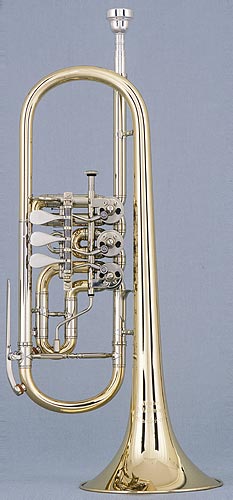
When I was first asked to write an article exploring the links between being a poet and a trumpet teacher, my first reaction was panic. How could I possibly link my poetry life and my teaching/music life together? In my head they occupy two very separate spaces. Whilst pondering this, I grumpily thought of how often they seem to leech time and energy from each other, and it was this thought that made me realise they must be linked in some way and gave me the confidence to start writing.
I’ve only just started telling pupils that I write poetry – they often just look at me strangely. Then they ask what I write about – I usually change the subject and make them play a scale or something – because what poet likes to be asked what they write about? Especially when you are asked by a ten year old who is not going to be impressed by an airy flourish of my hand and a vague reference to gender politics. .
At the beginning of 2012 I told one of my teenage pupils I’d got a job working as a poet in a men’s prison for ten weeks. He looked at me in disbelief, then did that clicking knuckles thing that’s all the rage with young people, before exclaiming with delight ‘You’re gonna get stabbed!’ followed by another click of his knuckles. When I appeared the next week with no puncture wounds, triumphant, he’d forgotten about the conversation already. .
I’ve been working as a full time brass teacher for seven years – but in September 2012 I decided to reduce my contract down to four days a week to give myself more time to write. I teach in about 16 primary schools a week delivering a programme called ‘Wider Opportunities’ where every child in the class gets a brass instrument as well as the teacher and teaching assistants. I also run two brass bands and teach small groups of children as well. .
I think the most important part of my job is to show both adults and children that music is for them. I can relate to thinking that it is not you see – being the only child in the school not allowed in the choir age eleven. The same thing happens in poetry – people think it is not for them – but it is surprising how many people in conversation will admit they have written a poem or ‘always wanted to learn to play a musical instrument’. .
As I’m writing this article, I can see more and more connections. The role of peripatetic teacher is always that of an outsider – I’m not attached to any school and this loneliness is reminiscent of the work of being a poet, or a writer. My two worlds creep closer when I think of the way I had to learn as a new teacher, that my hope of guiding young players who spent every spare minute practising (as I did) off to music college was unlikely. I had to learn to let go of what I wanted, to understand that if my enjoyment of my job, my success, was measured by how much my pupils practised and whether they went off to music college, I would be a Very Miserable Teacher. I had to learn to listen to what my pupils wanted – and this transaction is often non-verbal because sometimes they don’t know either. Doesn’t this sound like poetry? The act of letting go, of relinquishing control is precisely what writing is to me. I learnt as a poet as well, that if I measured success by publication or prizes I would be a Very Miserable Poet. .
Another part of my job is conducting a junior band. This is going to sound harsh, but conducting is all about imposing your will on the group. There is no room for anyone else to be creative. In fact, rehearsing is more like editing a poem – practising the same section over and over again, breaking the band down into parts so you can hear the weakest links – is exactly like reading your own poem over and over again, to find a line that will give way under scrutiny. .
Teaching music and writing poetry are ultimately an act of balance – they both have that feeling of walking a tightrope, of words being vastly important. I often find myself using the same catchphrases when I’m teaching – they almost become your own personal clichés. I made a list of mine and turned it into a poem – it made it into my first pamphlet at the last minute and on the advice of my editor, Ann Sansom rather than any passion for it on my part – maybe it reminded me too much of work – but it is often the poem that people comment on – the most surprising people will confess they used to play a brass instrument or will say ‘I remember my trumpet teacher saying that to me when I was small’. And of course, the lines in my poem are not mine at all, really. They were given to me by my trumpet teacher and I remembered them, and repeated them to my pupils, like a poem, learnt by heart. . Teaching the Trumpet
I say: imagine you are drinking a glass of air.
Let the coldness hit the back of your throat.
Raise your shoulders to your ears, now let
them be. Get your cheeks to grip your teeth.
Imagine you are spitting tea leaves
from your tongue to start each note
so each one becomes the beginning of a word.
Sing the note inside your head then match it.
At home lie on the floor and pile books
on your stomach to check your breathing.
Or try and pin paper to the wall just by blowing.
I say: remember the man who played so loud
he burst a blood vessel in his eye? This was
because he was drunk, although I don’t tell
them that, I say it was because he was young,
and full of himself, and far away from home.
KIM MOORE (Kim Moore, poetry) ~ works as a peripatetic brass teacher in Cumbria. In 2011 she won an Eric Gregory Award and the Geoffrey Dearmer Prize, and in 2012 her first pamphlet If We Could Speak Like Wolves was a winner in the Poetry Business Pamphlet competition, judged by Carol Ann Duffy. It was selected as one of the Independent’s ‘Books of the Year’. Kim has been published in various magazines including The Rialto, Poetry Review, The TLS, Magma, and ARTEMISpoetry. She is currently working on her first collection. You can sample more of her poetry on her blog HERE.
,
ARTEMIS poetry ~ the bi-annual journal (November and May) of the Second Light Network , a professional association of women poets. The journal is published under their Second Light Publications imprint. Members receive a copy as part of their membership benefits. Issues are available to non-members by subscription at £9 p.a. or as a one-off purchase at £5 a copy (plusp&p).
.
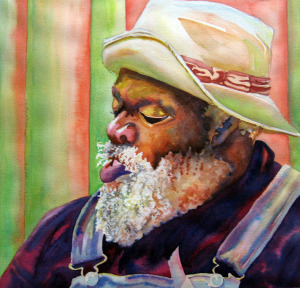
I could not believe my good fortune when I found a photo of Grandpa Elliot posted to the wet canvas photo reference library for artists. It was a must-do for me..Several bloggers have made mention of underpaintings; the most recent being Amy from Souldipper found here. She asked me about an artist’s use of an underpainting. I responded something like it is the foundation that we build our final work on. That made me think more on the subject as we were also talking about underpainting our lives with love and kindness. Then I came across the photo of Grandpa Elliot who has actually underpainted his life with sharing music to millions in New Orleans and becoming part of the project, “Playing for Change”, a CD whose proceeds go to helping others.The other connection I can make about an underpainting is that it always, for me, sets the tone for where the light will fall in it. BINGO! I see the same in life with passing on kindness. Light is passed on through our kindness to others. The above stage of my painting illustrates how I carved out areas where I wanted the light to fall.
The above image is the finished result.
I can not think of a better way to start the weekend than this:
LESLIE WHITE (lesliepaints) ~ is a guest writer here and an artist, teacher, book illustrator, and blogger. She’s been blogging since March 2009 and appreciated for the skill and beauty she shares. Her gifts to us are mini-lessons in a artistic technique. Often there is value added with life lessons, such as the one presented here. Leslie shares information on new art products and techniques and enriches our understanding of and appreciation for art. Her blog-posts go a long way toward encouraging others. She often enchantes us by sharing the work of her granddaughter and her students.
Van Gogh paintings come to life through advanced digital editing techniques by Luca Agnani. The music is by Ludovico Einaudi. Thanks to Naomi Baltuck (Writing Between the Linesand Into the Bardo) for bringing the gift of this video to us.
The Wisdom of Vincent:
“The more I think about it, the more I realize there is nothing more artistic than to love others.”
“When I have a terrible need of – shall I say the word – religion. Then I go out and paint the stars.”
“But I always think that the best way to know God is to love many things.”
“The fishermen know that the sea is dangerous and the storm terrible, but they have never found these dangers sufficient reason for remaining ashore.”
*********
Vincent Van Gogh certainly painted and wrote (we have his letters to his brother) from sacred space and perhaps no one has acknowledged that more gracefully or gratefully than Don Mclean in his song ~
Starry Starry Night
Starry, starry night.
Paint your palette blue and grey,
Look out on a summer’s day,
With eyes that know the darkness in my soul.
Shadows on the hills,
Sketch the trees and the daffodils,
Catch the breeze and the winter chills,
In colors on the snowy linen land.
Now I understand what you tried to say to me,
How you suffered for your sanity,
How you tried to set them free.
They would not listen, they did not know how.
Perhaps they’ll listen now.
Starry, starry night.
Flaming flowers that brightly blaze,
Swirling clouds in violet haze,
Reflect in Vincent’s eyes of china blue.
Colors changing hue, morning field of amber grain,
Weathered faces lined in pain,
Are soothed beneath the artist’s loving hand.
Now I understand what you tried to say to me,
How you suffered for your sanity,
How you tried to set them free.
They would not listen, they did not know how.
Perhaps they’ll listen now.
For they could not love you,
But still your love was true.
And when no hope was left in sight
On that starry, starry night,
You took your life, as lovers often do.
But I could have told you, Vincent,
This world was never meant for one
As beautiful as you.
Starry, starry night.
Portraits hung in empty halls,
Frameless head on nameless walls,
With eyes that watch the world and can’t forget.
Like the strangers that you’ve met,
The ragged men in the ragged clothes,
The silver thorn of bloody rose,
Lie crushed and broken on the virgin snow.
Now I think I know what you tried to say to me,
How you suffered for your sanity,
How you tried to set them free.
They would not listen, they’re not listening still.
Perhaps they never will…
Starry Starry Night, Don Mclean, All rights reserved
















 The BeZine