Here we see two countries locking horns
like schoolboys in the schoolyard,
as always a bully twice the size is
throwing sawdust in the eyes of the other,
and us observing bystanders stood around.

The smaller boy is on his blooded knees
holding all the high moral ground
takes his nosebleeds well and won’t concede
it’s the old story of David and Goliath I fear
the bigger shouting I will win, I will domineer.

But we witnessing, see it’s a battle of attrition
who’ll fight the longer like a body combating cancer?
And in this battle, we’re all rooting for contrition,
contrition from the bigger slain by the littler
to eventually become the rightful winner.
Consequences uttered to instil a sense of fear
Today we watch in horror
the deliberate act of a Russian tank
driving over a moving civilian car
and see the ruin remains of residential tower blocks
the homes of the innocent destroyed sent fleeing
midwinter into the perilous unknown,
we see people desperately clutching babies, children
and teddy bears to their breast.
While Russia, with all its military arsenal of chess pieces
encircles its prey, threatening the world with its
shelling, closing in on the Zaporizhzhia nuclear plant
like a cat, playing with a globe in its paw.

And to this added-horror unfolding
we are all told of crematorium death machines
how they roll on behind to dispose of their own dead
we are all told the War to "de-militarise and de-Nazify"
that it’s an effort to stop any more future violence
but what’s clearly on display is genocide
an invasion of aggressors hell-bent on destruction
on looting and murder, they claim hysteria
has taken hold of our senses and shortly
we in the West will all come to our senses—again.

We once a trusting partner, will settle down
and later calmly renegotiate a mutual endgame
that settles for King’s stalemate, an equal partnership
because if you don’t, there’ll be
consequences greater than any you’ve faced
in the history of the world.
Because why do we need a world if Russia is not in it?
So Putin once again has announced he wants
Russia’s nuclear deterrence forces placed on “high alert,”
and orders the West not to interfere,
again “Consequences” uttered to instil a sense of fear.
It’s a perilous junction even for us distant boy scouts
There are two dog owners on either side of the road
at a crossing, any minute, a landmine might explode
it is more than likely a standoff, a bad mixture
one is with a black and tan Miniature Pinscher
the other is with three snarling borzoi hounds
it’s a perilous junction even for us distant boy scouts
there look to be some cordial words spoken at first
but leashes are loosened, and threats are interspersed
there’s a greeting of canine teeth bared to kill
locked in a bloodlust that crushes all the daffodils
that spills innocent blood on the freshly falling snow
these wild dogs are now unchained and let go.
Their owners are at distant ends of the earth.
Their howling, their baying, their wailing never adjourns
there’s no end to war when war crimes are waged
and an entire world and people are enraged.
Putin has ‘gone full tonto’
Defence minister Ben Wallace says Putin has 'gone full tonto.'
So saddle up your 'wild horse's folks,'
and get out of your lunatic asylum beds
he’s mental folks now, that’s-what-I've read.

Putin has-gone-full tonto they say
there is no neutrality in this nuts psychiatric unit.

He's said to have lost it during his covid-19 isolation lockdown,
they say he’s been sharpening knives for a good while now

and even wants to microwave the world for his Sunday roast?

Putin has 'gone full tonto' they say,
saving comrades and neighbours from Neo-Nazism
all his clowns and jesters are clueless about what the hell to do
so they wave flags and fire bullets and generally join in his parade.
Announcing corridors are opening to the poor folk they're killing.

Putin has 'gone full tonto' they say,
and who can disagree when a baby boy dies of shrapnel wounds
died in his mother's arms on International Women's Day
and all he and they can say is war has its casualties
maybe they shouldn’t have got in our way.
…is an adult learning difficulties support worker with 200-plus poems published in journals, magazines, and anthologies both online and in print. He resides in the UK, from Manchester. Mark is the author of In Perpetuity and Back on Earth, two books of poems published by Creative Talents Unleashed.
The nightingale soared peacefully and free
While the mighty bear sauntered patiently.
Wisdom kept the bruin from aggression
The nightingale, high above oppression.

Then one day, abandoning its reason
The bear initiated songbird season.
How embarrassing it made the effort
To pluck the sky of the singing feathered.

The ursine losing all its common sense
Should apologize and return to whence.
Then if the natural order is reset
If love and beauties preconditions met
The bear and nightingale again may gather
And share a song of futures that are better.
…is a graduate of Central Connecticut State University where he majored in history and minored in social studies. He is very interested in events and people of the past and the present. His current vocation is at a non-profit for individuals with intellectual disabilities, which I have been doing for over a decade. I enjoy writing poetry as well as the visual arts.
I took the same path in the morning—
woke up to find my cat lying in sunbeams,
got dressed, had breakfast, prepped
before my nine o’clock class,

then I heard the chainsaw,
cutting through Thursday’s route
sending ice floating in lily pads
down Poestenkill Creek.

I could see it all from my window
driving to work,
listening to bombs on the radio,
 “listening to bombs on the radio,”

echoing old sounds of the twentieth century.
I put on Stand or Fall by The Fixx
and thought, “how the hell
can I continue my classes

on the Protestant Reformation?”
My plan was to have them assess Cranach,
 Law and Gospel and Martin Luther’s 95 Theses.
 How can I go through with this now?

Crying parents tell their children
 if you survive don't do as we did.
 I thought about my two students
from Lithuania and Ukraine,

Ugne and Yaryna,
roaming this quiet N.Y, boarding school
like Stoics, consumed by Putin
and the safety of their families back home.

I decided to keep Luther’s 95 Theses
nailed to the Wittenberg church door.
Impromptu teaching has always terrified me,
but what right do I have to feel this way now,

when red-lit metal boxes
are jamming Kyiv highways
in a desperate attempt to flee the city.
What do I know about fear?

Ugne and Yaryna forced a good morning smile.
I stared at the class for a painful moment,
then nailed Putin to the whiteboard.
Oh! Their faces! Their Munch faces!

I tried to answer all their questions,
giving Ugne and Yaryna a moment to speak,
to cry, to be consoled by their classmates,
many of whom had not heard what had happened

until now.
…is a widely published poet: Defenestration, Typehouse Literary Magazine, Glass: a Poetry Journal are some of the places you will find her. She is the author of two chapbooks, Temptation of Wood (Nixes Mate Review, 2018), and Goblin Fruit (Impspired, 2021); she is also a teacher, and woodland roamer.
blue on one end of the scale
yellow at the opposite end
a kind of magnetic needle in between

blue, a feeling of down or calm
yellow feels up, vibrant, bright
somewhere in the middle, green
in the middle, they meld and transform
yellow and blue become green
three for the price of two

this gauge is invisible, yet lives within
it is carried eternally
it is the human tachometer
a reminder that nothing stays the same
everything can change
it can go from blue to yellow to green
unaware of its change
remarkable in being seen
When the world is on fire
do you close your eyes?  Ignore it?
Do you?

Fuelled by racial discrimination
this conflagration
is a spirit abomination
this IS my nation
home of my education
playground of my indoctrination
to a world of justification
looking for integration
knowing that communication
is the way forward

I say I want a revolution, a human revolution
it’s gonna have to start with me
the only solution for this revolution
Has to start with me

We’re all in the same war
but not all in the same trenches
these flames are deep, embedded
we need more than hammers and wrenches

reformation, inner reformation
takes transformation
no longer subjugation
seeing ourselves as real
co-existing
human transformation
my own revolution
lighting my way and seeing you
Yasher Koiech Nefesh Yehudi
These words, “yasher koiech, mein nefesh Yehuda”
“Have strength, my Jewish soul” is like the mantra
used to encloak myself when leaving the comfort of home.

Even with broad-minded people, there is always the risk
of awakening the sleeping dragon of the Jew-baiting anti-semite
ready to pounce.  Will this feeling, ever so deeply engrained
leave the awareness I call myself?

I choose one Jewish metaphor to describe myself,
“charoseth”, the sweet, dark, spicy, nutty, tart mixture
made for the Passover Seder, one of the six Seder plates,
an homage to the slave labour in Egypt’s Pharoah time,
the reason for the Exodus.

Charoseth resembles mortar.
Mortar builds things—houses, outdoor ovens.
Because Jews number few in population,
we are noticed and well-known for high achievements.
I try to build friendships
while remembering the charoseth of
apples and dates and wine and nuts.
I think of people this way,
full of goodness, sweetness and with the
intoxicating alluring risks hidden in the dangers of nuts.
I want to be accepted—not tolerated,
therefore I must accept others
just as different to me as I am to them.
Not easy, but definitely doable.

I think of our foremother Esther whose intelligence
saved her people.
My own orphaned, biological mother Yocheved
was responsible, at age 7, for a younger brother and sister.
These women and Ruth, whose compassion became
synonymous with empathy used the mortar of their own wisdom
to build better societies.
They are the woof and weft of the weaving of these cultures.

When Vashti refused to parade naked
in front of her husband’s cadre of supporters
she was replaced by Esther and through
cunning and fortuitousness exposed calumniaty
for what it is.

At  7 years of age, at cheder (religious school),
there was an Esther contest.
I had no hope of winning.
My family was unable to purchase my costume.
Being self-conscious, yet enjoying the participation,
I took a brown paper bag, drew a crown of crayon coloured jewels,
borrowed my mother’s flowery cotton skirt and elastic-necked blouse,
marched down the aisle with a devil-may-care smile,
fully expecting nothing but a good time, and
for my ingenuity, I won and won more than flowers
I won a confidence that is sewn irrevocably
in the decision-making process of my every day

Never give up, give in, go forth, be creative,
with the directive Yasher Koiech, Nefesh Yehudi
the mortar is in you, build with sweetness, goodness,
tartness, nuttiness, chutzpah and always with the
knowledge that with a Nefesh Yehudi
we are together, we are strong,
I am with you, I am strong,
I and you are strong and we are all together
Yasher Koiech!
…was privileged to record with bill bissett for the Secret Handshake Reading Series in December 2021. The Secret Handshake also published her chapbook, Bob Dylan, My Rabbi. Two copies were purchased by the Robards Library, University of Toronto. “Kaleidoscopic Wonderful” was published in January 2022 by the Taj Mahal Review. She was commissioned by the Friendly Spike Theatre Band to write the history of mad people’s theatre in Toronto with “I’m Mad, I Matter, Making a Difference,” and also edited the anthology, POEMDEMIC.
From the ruins my offspring
forceps out the burnt remains
of my poem:

"The sunflowers burst in
my mind. They must have warned,
but I tend to ignore the signs.
The shrapnel in the spring zephyr
pierces one or two stray thoughts.

Somewhere, when the explosions hush,
some music bleeds. I can hear."

If there were other staves to this,
future cannot tell now. Blue, green,
yellow and rust choke all possibilities.
My offspring's footsteps clot
when the discoveries end.
Another spring, perhaps one during
a brief period of doves cooing Zen
or perhaps time rides a pale wild horse,
my progeny returns to the tent.
The campfire glows atomic
amidst the tar of the night.
…is an author and a father, editor of ‘Words Surfacing’, with eight books to his name, the latest being ‘Postmarked Quarantine’. His works have been translated in eleven languages.
In meditation, I find my mind more restless and wandering than usual. The minutes since sitting seem long and drawn out—time has stilled but not my attention. Heaviness is pervasive and a tightness around my heart.
I’m conscious of the fan blades moving lazily overhead and a slightly warmed breeze coming through the open window. The sound of tiny birds enters the room coming forth from the bird feeder hanging just outside. A light, fluttering splash lets me know that someone is bathing in the nearby birdbath. The chimes outside the kitchen door let out an almost imperceptible tinkling as the melody finds its way to my room.
silence breaks my heart
cold as a mountain peak
sunflowers weep
Rolling tanks,
the devil, Putin,
arrives without warning.
The invaded country, a zoo.
Cities bombarded.
Ukrainian citizens
not knowing where to go.
Muddy, soft ground,
dogs barking,
endless walking,
feet hurting.
Leave homes behind,
keep walking.
Refuges, with the clothes
on their backs catching trains,
that still run, to friendly,
neighboring countries.
Their country’s flag,
a banner of blue and yellow bands.
Wide blue skies denote calm
Yellow wheat fields, joy.
Blue skies grayed by aerial attacks
Russian tanks trample wheat fields.
Bands of blue and yellow.
Past symbol of calm and joy
where sunflowers no longer bloom.
Sunflowers Don’t Bloom
Sunflowers don’t bloom today.
Tanks ravage the fields of amber grains.
The blue skies dotted with Russian missiles.
Flower shaped bullets fly into ground and air.
Buildings in rubble.
Neighborhoods destroyed.
Refugees take trains to sympathetic neighbors.
Dead sunflower stalks fall and die.
Symbols of calm and joy in the
blue and yellow banded Ukrainian flag
are no more. Only sadness.
…is a freelance writer living in Massachusetts. Her poetry has appeared in Capsule Stories, Fumble Magazine, Peeking Cat Anthology, Poets are Heroes Magazine, Mused Literary Review, Helen Magazine, Blue Heron Review, The Show-Me Doctrine, Sol Magazine, Amaze Cinquain Journal and Bonsai Magazine. She has had travel articles accepted on We Said Go Travel as well as non-fiction pieces in the Online Biographical Dictionary of the Woman Suffrage Movement in the United States to commemorate the 100th anniversary of the passage of the nineteenth amendment.
Pill boxes rest on the counter,
an abacus of prescriptions.
I’ll remember this chapter passed down
from one ancestor to another,
weight of the family tree.
Hiatus comes from Latin to yawn.
I love to ignore the gaping one.
Think vespertine, flourishing in the evening:
crepuscular. I crave an innocent gloaming.
Instead, I see flame-shaped markings.
Flammulated. Tattoos. Not just on owls,
the symbol of Athena.
I’m seeing too many flames.
I want to put bombed cinderblocks on mute,
erase complicity off my skin.
I want numbing for spirit pain.
Will my heart become cold like a beetle
pinned in a science project?
Launched into another grief,
my teeth hide behind the mask, the dire veil.
Let’s not go back to old ways of drinking.
I mean thinking.
Give up our alibis. Give up our vodka.
We must not abet.
I will try dying. I fear I’m dyslexic?
Dependable
Beside the stealth piano
with its keys like black licorice
so beautiful and tragic
I hear another State of the Union from a great height.
I can’t even look or I might get dizzy.
I’d love to edit the world,
the geography of the mind
with its tar pit that preserves the burdens of my ancestors.
A brief history (of?):
<insert war/s here>
<insert denial>
<insert plague and pestilence>
<insert denial>
<insert a great leap>
<repeat>
On schedule like a bus,
here come the grenades with hand-dug graves
in grease and sorrow.
And into the firmament of its own surprise,
the latest terror
that doesn’t even need to be warfare to be
terrifying.
The piano is padlocked to a stupor.
A [New] Context
I feel like I’m reading
the same page over and over,
checking the time
and forgetting the hour,
waving at someone
who is waving at someone else.
The drift of neurotransmitters
float through straits, synaptic gauntlets,
this everywhere listing.
Another war blooming.
There’s a moth that feeds on tears
of horses—that could be my tears
for the thought everything is broken.
And that we spend
twenty-six years sleeping,
seven trying to sleep.
But that’s an average.
Meaningless for this day
since we (I) spend how much
doing anything meaningful
to save our planet. For peace.
All this primordial stuff being
ignored, natural and preternatural,
macro- and microscopic,
the will of the Great Architect,
in regalia with tattered flags
as the virtuous minutes go.
Don’t we want to fix our world.
That’s not a question.
Our sighing shrines splinter
in war and weather.
Move all the statues to a museum, they say.
Move endangered mammals to a sanctuary.
Move women and children to a strange country.
Let them breathe trapped air.
Give everything dead or alive a new old context.
… has a recent poetry collection, “Genealogy Lesson for the Laity” (Unsolicited Press, 2020); her chapbooks include “Backpack Full of Leaves” and “It’s Raining Lullabies.” A Best of the Net nominee, her poetry has appeared in anthologies and journals including Poet Lore, New Orleans Review, Tar River, Gargoyle, Tinderbox. Cathryn served as editor for Marin Poetry Center Anthology. She lives in Fairfax, CA.
Sting has brought back a song he wrote many years ago, but put away because he thought it was no longer relevant … how wrong we can be! The culture of protest is alive and well!
A young woman with blond hair
Tied in a ponytail
Wearing jeans and a sweater
Hums a song to herself
While she brushes off shards
Of shattered glass from what was
Once a window overlooking
The destruction across the street.
The shards fall inward onto the floor.
Tanks roll by in the street below
Clinking like a xylophone out of tune.
She notices a sniper take up position
Across the way. He checks his crosshairs.
As I sit at the kitchen table in front of a screen
On the other side of the world
Suddenly it’s very important to me
To hear the words she is humming
Even though I don’t understand them.
…was born in Columbus Ohio, USA, in 1947. He graduated from Ohio State University with a BA in Psychology. He served in both the US Army and the Israeli Defense Forces. Mike moved to Israel in 1978 and lives in Raanana. He has self-published eight books of poetry. Mike is married to Talma. They have 3 sons and 8 grandchildren.
Frozen red snowflake,
soaked in someone's blood…
Procession of people, cars and suitcases…
Chaos in the sky,
explosions on the balconies…
Which is more expensive,
a drop of blood
or a drop of gas?
War should stop
The world is mad today,
after all the suffering and pain,
we lost our peace again…
The innocent children had to pay
with their life, with abyss, so hollow
that war creates into human souls…
Poor child, may God save you
from that horror…
“No victory brings the dead back”
We sent carriers pigeons,
we built crystal bridges,
on rice paper we wrote prayers,
we entered in the temples…

Let's take another look at smidgens…

Any dispute can be resolved by force,
but better with a conversation…
Wisdom wins, wisdom may bring salvation…

May God send the Peace angels
to end this course…
The dove
Let the dove
free!
Let him take flight
round
above the frenzied brains,
above the tormented souls,
to give them peace…
It is time, please!
…is Bulgarian who writes poems in Bulgarian and in English. She lived in Luxembourg and currently she lives and works in Belgium. Dessy has publications in many Bulgarian magazines and newspapers, also in Romania, Belgium, USA, India, Peru, Philippines. She has 4 books in Bulgarian, 1 in English, and she has also compiled a book as translator from Bulgarian into English, an anthology of Bulgarian top authors. She writes about nature, love and God, and her accent is the positive message at the final. Member of Flemish Party for Poetry. Editor in Homagi international Web literature magazine.
Taking his shirt off
and riding a horse
no longer makes Putin
hide the small man he is,
staring at the mirror
that no longer tells him
grand enough lies.

So he attacks a smaller
country after rereading
Bullies For Dummies.
Quotes Bowie,
blames Nato, The West
with their eyes on gas
prices-still safe if turned off
turning off nightly television
horrors.

Crimea first, now Ukraine
with a blue print for a
reunited Russia on his desk.
His version of the globe
Chaplin twirled in The
Great Dictator, saying
Mine! Mine!

While the planet waits
holding its breath
as does Putin's mirror
at what it can't hide.
Yet the cracks tiny
and almost unseen
are beginning to show
meanwhile  an unhinged
sociopath dares us
to exhale.
Ukraine Burns
In the Smoke
trying to find
hope where
there's little
to none
as thousands
flee their old
lives
to new
uncertainty
Ukraine's on fire
as bombs and bullets
missiles and tanks
do what they do.
All our copious tears
lacking the water
so far
to put it out.
Nuclear Alert
Nucleart missles
on alert to turn
Ukraine to a cinder
turned to ash.

A Threat or...

The ash taste
in our mouths
now ever more
profound.
…lives in New York City. He has an MFA in creative writing from City College. He taught in New York Public schools for many years. His first volume of poetry- Damaged by Dames& Drinking was published in 2017 and another – Femme FatalesMovie Starlets & Rockers in 2018. A set of three e-bookstitled Lies From The Autobiography vol 1-3 were published from2018 to 2020. is newest book, ImaginedIndecencies, was published in February of 2022.
Like his grandson’s toy, the Russian army
swiftly re-assembles itself in Belarus, Donetsk, and Crimea
with blood banks, field hospitals, mess tents,
and mysterious HQs marked by geodesic domes,
dark inside where the orders arrive
and are mistaken for Tarot and silently obeyed--
this the way the tumor surrounds my friend’s esophagus
from many staging points in his throat and abdomen—
the thyroid, the intestines, the nether regions
no one would willingly travel  in conditions like these.

This is where the rages we never got to speak have gathered,
and who can blame us given the awfulness
we have banked inside?
It strangles so that we can’t eat
and no longer think of eating.
We wait out the wreckage the body can do to itself
in some subterranean station
decorated in hues of another century
our daughters and grandsons have never imagined.
And into this come the healers, charged with excising ills
as our insides get chewed once more this morning
through a port, this hole dug in our soul,
meant to make us a new life—
here, or in the long dreamed of other side.
A virtual reading series born out of pandemic, meant to outlast it. To maintain & build literary community across distance through our shared love of words. Words Together, Worlds Apart held a virtual poetry reading of US and Ukrainian poets, plus translators on 01 March at 12:30 pm NYC time, 7:30 pm Kyiv time.
Since the start of social distancing, poets Julia Kolchinsky Dasbach and Kelly Grace Thomas created a virtual platform for poetry that would get us through this time, but also outlast, endure, be somehow beneficial beyond it too. This reading demonstrates the benefit of virtual events.
In the midst of war, Ukrainian poets in Ukraine read their work to an international audience that peaked at over 800 participants. Others were out of Ukraine but joined in solidarity. They were joined by US poets who read poems in support of Ukraine and peace. I watched and listened to this moving performance.
In this YouTube, you can also watch the two-and-a-half hours of poetry in solidarity. As it’s video, you can stop and start, like a book. Savor it. Go back and listen again.
“As Ukraine faces a fight the likes of which it hasn’t seen since WWII, writers across the US joined by their Ukrainian colleagues will read in solidarity with all Ukrainian people,” Pen America‘s announcement began. Another lineup of Ukrainian and US poets held online, this one 04 March at 2:00 pm NYC / 9:00 pm Kyiv time. Unfortunately, I could not watch this one as it happened. Happily, like you, I can watch it on YouTube.
Details about the reading are in the Pen America announcement.
Hope beats at the heart of humanity
It beats within where none can bar its way
It beats aloud in the shouts of protests
It beats steadily in the hands of the medics
Hope beats

Swiss banks freeze after 500 years of hibernation in neutrality
And a farmer feeds his hungry homeless used-to-be neighbors
Hope beats

Worldwide people choose sanctions with their higher prices
To rally against the price of Ukranian blood
And a Polish driver takes a volunteer to the border
Hope beats

Russian independent broadcasters protest the lies Putin mandates
Risking their lives playing Swan Lake on repeat as long as they can
And a Russian boy’s last words inspire a viral TikTok song reaching more than 2 million people
Hope beats

Diapers, formula, hairbrushes, toothpaste; donation sites in Poland fill to capacity
And the Meme Mom I follow tells me the truth through her camera in Eastern Europe
Hope beats

Hope beats at the heart of humanity
It beats in every act of kindness and charity for love
It beats in every act of defiance and courage for justice
It beats in every act of sacrifice for the sake of others
Listen for the Hope Beats
Imagine, if you will, that I found a new passion after I left my mate of many years. I was not looking for a new love. Nay – you could say, it found me.
It was 1988 and I struck out to learn, face to face, mouth to ear — about Mexico and Central America. Twenty-nine years old and I reclaimed my self, my independence. And during that ten-week sojourn, I took the first honest-to-goodness train of my life. We ain’t talking ‘bout no rapid from the east side to the west. We’re talking ‘bout El Oaxaqueño, 12 hours from Mexico City to Oaxaca. Ay, how I relished the mystery of traveling through the night, awakening in the morning amidst hamlets nestled in the folds of rock, cliffs so close I could study their formations. The slow reach of the sun over one and another range of the Sierra Madre del Sur. Wood smoke scenting the crisp air. The food offered by the women who boarded, the conversations with other passengers and the workers. The squeal of wheel upon rail as we hairpinned through those mountains, finally descending to our destination.
I then knew that riding the rails is a perfect way to learn about a country. Many times the train goes where no road goes. You travel slow enough to be able to see wildlife from those smoke-hazed and cracked windows, critters scared by the traffic of highways. You can catch glimpses into homes set close to the tracks. And beyond passing through pueblocitos, within the train itself forms a community. You can talk, share lives and food, walk about. Face it, you can’t even begin to do that on a bus.
If I could, through my poetry and stories, share these experiences, put a human face on the names of pueblos from Alaska to Patagonia through these rides. I decided to devote every cent, every opportunity to travel by train.
But come 1997, the raison d’être of these journeys changed. No, it deepened.
With the signing of NAFTA, Mexico had to agree to privatize its national holdings, including the railroad. In five sectors it was sold off to consortia, made up by Mexican capitalists and — in larger part — by US cargo train companies: Union Pacific, Santa Fe-Burlington Northern and others. By early 1996 freight services were in their hands. Then 1 October 1997 — I came to discover — marked the official turnover of the passenger services.
I didn’t know this when I crossed the border on an October day, planning to again to ride the rails. I wanted to go to a friend’s family’s village in the Sierra of northern Durango State. I could make it totally by trains.
Or so I thought.
14 October 1997 / Matamoros, Mexico
Just after dawn I cross the bridge from Brownsville and arrive at Mexican immigration.
“How will you be traveling?” the official asks.
“By train.”
“Well, you’ve missed today’s train. It left at seven this morning.” He turns to a co-worker. “Isn’t that right?”
The other man raises his eyebrows and shrugs his shoulders.
My information says the Tamaulipeco leaves at 9:20 a.m. I head off for the station, through the streets of this awakening city, in hopes of catching it.
I stop at a stand where a brazier and pots of coffee steam in the cool of morning. “Which way is the train station?”
The man replies, “There are no trains, no hay.”
Further down the main road, I find a tourist information booth. Two men are inside, one behind a desk. “The train station? It’s up about four more blocks. Pero no hay.”
Next door is the government tourist office. The young woman shrugs. “I don’t know. It’s best to go to the station and ask.”
Once more I make my way up the now-busier street. At the next corner, near the tracks, a tourist officer and several taxi drivers sit on a bench. They all say, No, there is no service from here because of privatization by the government. Pero sí hay from Reynosa. It leaves at 4 p.m.
A loud train horn disturbs our conversation. We all cover our ears. A long chain of Northwestern and other cars come rumbling along. It stops. Security men begin searching between the cars for stowaways, pulling them off. A few jump and escape.
I turn back from my quest and catch a bus for Reynosa.
Reynosa
Out front of the bus terminal, I ask a man where the train station is. He responds, “No hay trenes.”
I walk up to a taxi driver (they always know). Yes, he agrees, at 4 p.m. there is a train. He gives me directions.
Later I stop by a man selling roasted corn at the curb. “No,” he answers, “there are no trains.”
“But in Matamoros they told me there is, and a taxi driver here said so, too.”
“Look,” he says adamantly, “you can believe me or you can waste your time. But there is no train.”
“Since when?”
“Oh, at least six months now.”
Another man comes. “For Monterrey? Yes, there is. My sister took it Sunday. It runs every other day. So, yes, today there will be.”
With this hope I follow the tracks to the blue and white station.
It is boarded up, the doors locked with heavy chains. Some of the windows are broken. Through their white paint peeling away, I see the schedule blackboard still hanging by the ticket window. The blue seats in the waiting room remain.
Between the old station and the abandoned restaurant next door, a man sells gum and candies. “Excuse me, sir. Why is there no passenger service?”
“It’s because of a company del otro lado, from the other side. It bought it and decided there will be no service.”
“Since when?”
“Oh, since three or four months ago.”
Right at that moment, a lengthy string of US freight cars halts, brakes clanking. Black-coated men begin searching among the cars for stowaways.
I return to the bus terminal and stay until night to go to Monterrey. In the women’s bathroom, I recount to Socorro, the attendant, my fruitless search for the train to Monterrey. She is surprised to hear the news.
15 October 1997 / Monterrey
I grew bored in Reynosa and finally took a bus here, arriving at 1 a.m.
At about three, I wander outside and ask two taxistas there. They conclude, “With the change of owners, no-one knows the present schedules. It’s best to go inquire there.”
“Who are the new owners?”
“Some are Mexicans, others are from the US.”
I wait until the light of day begins washing the city streets and I walk as fast as I can with this forty-pound knapsack to the train station. A man sits behind the ticket window.
“Is there still a train for Durango?” I shift the pack on my back.
“Yes. It leaves in fifteen minutes. For only one? Ninety pesos.”
Ay, I tell him of my misadventures with the Tamaulipeco. “Since when doesn’t it run?”
“Since January.”
We leave behind those saw-tooth mountains of Monterrey, swirled with white rock. The chilled dust of early morning blows through my shattered window. Our train of hard foam cushioned seats, of dirty floors and dirty floors rocks and sways past a hamlet of rubble of once-homes destroyed. From the ruins of one flies a zopilote. Forests of ages-old yucca trees. A hawk soars over the green desert thicket. Encrusted sand dunes sculpt the earth. I snuggle into the warmth of the sun as we pass by a village of old-fashioned adobes.
And I awaken at Paredón. In those hazes of sleep, I expect this car to be full of Mexican Revolutionaries.
The train winds through low mountains, then horseshoe-curves around a flatland. Once more it begins to corkscrew through mountains. A hawk sits up on the rise of ancient basalt boulders. The desert sand is laced with dry streambeds and footprints, horse trails, coyote tracks.
We zoom past cornfields and jolt past a sky-blue circus big top as we enter Concordia. There, a black-hatted, sun-glassed man boards. He strolls up the aisle and back down, playing a beat-up guitar and singing a corrida. He gathers his tips, then goes to the back of the car. He performs a few ballads, a fellow passenger joining in.
As we pull into the next town, a new voice and masterful strumming is heard. All women’s eyes turn to that man, black hair pulled back into a curly ponytail. They nod, smiling, whispering to one another.
Near the tracks, nine students stand. Their brass coronets gleam in the now-afternoon sun. A few practice notes, and as we pull away, they play a clarion call.
The strolling musician is gone.
We fast clip upon these old rails. The diesel engine hums deep. Vineyards and orchards neatly crisscross this wide valley.
Over a soccer field in Gómez Palacios bobs a blue and yellow kite. Children gather in the stands, watching its dance. A colorful clothesline flaps its laundry in the cool sun.
At Torreón, an elderly woman boards. Her silver hair is covered by a black lace scarf. She holds one corner of it in her mouth, hiding the right side of her face. It falls away for a second, revealing a misshapened nose, a cheek deeply incised with wrinkles, a sunken eye, a sneering mouth.
A little girl’s dark eyes peer over the seat in front of me, then dart away as I grin. Next they appear around the side of the seat and retreat with a shy smile.
As we ride into the sunset, we hug mountains of folded rock. Shadows fall deep and long. The red soil is shaped into irrigation ditches and plowed rows of golden maize. The bright-yellow sun nears a blanket of gilt-edged periwinkle clouds touched with peach. I listen to the music of this train and wish I could write its symphony.
Dá-da-da
Dah Dah
counterpointed by squeaking springs.
Just before the sun sinks beyond, the bottoms of the clouds are etched in magenta. Then the landscape falls into greys. The pastel sky drains. Out there, to the north, a long spume of white smoke blows from an orange bundle of flames.
I turn my eyes to where the moon has risen above the sierra. The rest of our way to Durango, I gaze upon her fullness.
17 October 1997 / Durango
Sunrise is beginning to wash the eastern sky. The once-full moon disappears in the western. The chill of this semi-desert morning hovers around and within this caboose. In the warmth of a diesel stove, the conductor, an old farmer and I huddle.
“Come Monday,” the conductor says, “there will be no more passenger service — only cargo. The day before yesterday there was a passenger car. Now they ride in the caboose.”
“Why will there be no more passenger service?” I lean towards the stove, holding my hands out.
“The new owners have decided the tracks are in too bad of shape.”
“Who are the new owners?”
“Union Pacific here, Santa Fe elsewhere. They own the tracks, stations, everything. And they’re ending a lot of services.”
“Así pues, I wanted to take the train from Matamoros to Monterrey, but there is none now. But there is from Reynosa, they told me. So I went there by bus. Pero no hay.”
The farmer shakes his head. The conductor nods his, “But we believe some will return once repairs are done — like that one.”
“Well, the story is much the same up north. Before, all the passenger trains were run by the freight companies — Union Pacific, Santa Fe and others. But during the 60s and 70s they decided to do away with them. Then in 1976 the government said we needed them again. But AMTRAK, as the passenger service is now called, doesn’t own many lines. It has to pay the freight companies to use theirs. So AMTRAK can’t make much money, and fares are high.”
The conductor checks the fire. “Sí, money is more important than the people.”
The old man nods.
The conductor falls silent as several other workers enter. He hands me a cigarette and lights it, hands cupping the flame.
Once they leave, he continues. “One has to be careful of what one says. There are many animalillos.” He draws a finger across his throat.
“Even on el otro lado,” I respond, “people are afraid to speak up. For fear of losing their jobs, their homes, their cars and all else.”
We talk about our pueblos, our people on either side of the Great River. Of how US corporations are robbing the people of the trains, the farmers of their lands.
Soon the day is lighter and more passengers board. Our conversation ends. I take a perch in the cupola. The old man stays at the table, near the stove. The conductor begins his work.
At about 8:30 a.m. we leave, with two locomotives, seven open hoppers, this caboose, a car with barred windows for security guards and a payroll car behind. Over two dozen passengers are crowded in here.
Past shantytowns of wood and cardboard homes and into the desert, its edges and mountains hazed. The rocky land rises, studded with fruiting nopales, and it falls away to dry stream beds. Through forests of mesquite, the ashy soil beneath carpeted with sage. Campos of maize sprinkled with sunflowers, fields of frijol. Cows graze near the tracks. One’s breath steams the morning. Another, chewing its cud, slowly moves off to a quieter place, away from our clicking train.
We stop at a village. The sun strokes my face through this open cupola window. The farmer looks up at me writing these words. With a slight laugh I wave my pen, writing in air. He nods and smiles. I lean out a bit and notice in the third hopper up front rides a white-jacketed, white cowboy-hatted man.
A herd of seven bulls begins stampeding, one by one, across a high field of grain. Above them flies a flock of low-swooping black birds. And just as suddenly the bulls stop.
In the yard of a blue and turquoise house, a young boy runs. He pauses to watch our train go by.
On the stove the workers heat some chiles rellenos and water for coffee. One of them warms his hands.
We arrive at another village. On the gravel road traversing the tracks a bicyclist stops to look. Before we depart with nine new passengers aboard, he pedals off.
A yellow-sweatered boy climbs up to sit on the cupola floor. He calls to his nervous brother to join him. I squeeze myself closer to the window to share my seat with him.
Lucia — a pueblo of raw adobe walls. A woman with her young daughter runs alongside us. The conductor leans out the vestibule. “Where are you going?”
“To Canatlán.”
“Get in the caboose.”
“En serio? They told us there was no passenger car!”
And more pots appear on the stove. Their smells waft up to my hungry nose. The conductor motions me down to share lunch with them.
As we slow for the next stop, Los Pinos, the old farmer waves good-bye before darting out the back door.
The conductor rummages through his black sports bag. His ball cap comes flying, landing at my feet, as he puts on a gnarl-faced mask and turns to us at the table. He tosses that aside and digs out a cassette player. Between stops he listens to music through the headphones.
A woman sits upon the bed platform in the rear section. Her young fingers skillfully crochet a doll’s dress. Her son Josué puts on the Halloween mask. Papa reads today’s paper. Over his shoulder, her green eyes study an article he shows her.
At this workers’ dining table sits Mary with her four-year-old niece. Next to me is Rosario. Rosario, now 18, yes, has finished her studies. “A ver – we’ll see,” she says with a shrug when asked about her future. Mary, 23, finished only secondary school. She has no job. “No, I’m too old to finish my studies,” she says with a tilt of the head, a lift of the shoulders.
We ignore, then parry, and ignore again the chiding of men.
Through the partly opened window, I catch glimpses of countryside and villages, of children waving, of workers in the fields. Lakes glitter in the noon-day sun.
Esfuerzos Unidos, Alisos, Nuevo Ideal. Family by family, person by person, the caboose begins to empty. Angelita, Las Flores, Chinacates. A wagon drawn by two horses trots across a field.
The wooden crucifix and rosary beads above this table sway with the train’s rocking. We begin winding our way down through the heights of the Sierra Madre. Rock walls hug this train.
The conductor goes atop. Another worker hops out a cupola window to join him. There I see them standing, coated against the wind, speaking into walkie-talkies. One leans through my window and begs some matches.
At Kilometer 157 we make a short stop. A sow leads three piglets across the dirt road. The conductor climbs down to talk with some fellow workers there about when their paychecks will come. “We have the payroll car here.”
“No,” one states, “I got my letter.”
“Well, after Monday, no hay tren.”
“No me digas — Don’t tell me,” another says surprised.
A lone zopilote soars over a land of bleached bones. Two yellow butterflies dance above a yucca. Beneath the shade of mesquite a burro lies. He lazily turns his head to these clapping cars. We still creep through this mountain chain, metal screeching against metal. Not far from a swift river sits a lone adobe house. In the front patio grazes a tethered horse. A small waterfall tumbles. A black bull wanders to the shallows to drink from the clear waters.
At Santiago Papasquiaro we wait. The locomotive pulls away. A dust devil picks up trash & egrets in its whirlwind. We finally depart here. Three young boys jump on a trampoline in a yard. The man with the white sombrero is gone. A dog on a rooftop barks as we gain speed.
Rosario, now in the cupola, squeals as one of the brakemen walks through with the mask on.
Within the cloudless sky a hawk dips and rises above the scrublands. A roadrunner darts among the brush. Above a pool of steaming sulfur springs hovers an orange and white dragonfly.
The conductor sits at the table reading the news. After a while he falls asleep. Rosario and Josué sit across from me up here, singing corridas. A six-pack of Modelo goes around the caboose. One by one, the cans of beer are popped open.
A pair of blue and black butterflies appears alongside us. But just as quickly, we leave them behind.
At Presidio Rosario gets off, a bit tipsy from one beer. A family of four women and a boy come on with hand-made ribbon wreaths protected by clear plastic bags.
We journey along a river that occasionally cuts cliffs and other times winds through the plain. At Corrales the new women and boy depart. They walk across the wood-plank bridge, across the river, into town.
We arrive at Tepehuanes, only seven passengers left, the end of this line. The adobe station is pink-painted bricks. The train goes a bit further to begin loading timber for the paper mills down south.
Next door to the station is a hotel. My room is large, with thick adobe walls. I open the shutters of the window and begin spreading my work on the table beneath it. Before sunset I head for dinner, crossing the bridge over a brook, climbing the hill into town. After I return, Magdalena invites me to join them in the kitchen. An adobe stove in the corner warms the interior dimly lit by one bulb. On tomorrow’s south-bound train, she will be leaving on a “trip.” Later, she confides she is going to el otro lado. Since the train will no longer be arriving, there will be no guests for their hotel — and so to make a living? She will leave her 113-year-old mother in the care of a young Lola. Lola’s mate, José still doesn’t believe the train will end come Monday, that this was indeed the last train to Tepehuanes.
I spend evenings in that kitchen, seeking the heat of that stove, chatting with Lola and José. Doña Julia dips gingerbread cookies into her glass of warm milk, gumming her words. One night of chilled stars and the sierra silhouetted against the waning moon, she tells me of when she met Pancho Villa. She was down by the river washing clothes with other women. No, she laughs, she rejected his invitation to join the revolutionary forces. I ask her if it were true he had many women. She only gives me a demure, silent look.
My plan is to spend a month here, then travel down to Durango. From there I will take the train to Felipe Pescador, to make the connection with the south-bound Ciudad Juárez-Mexico City train.
I spend the days writing, and talking with the local people about the end of this train, and of those to Aserraderos and Regocijo. One late afternoon several women and I drink coffee in an eatery. Candy, who works for the village, shakes her head. “I had heard such, but…” The waitress is shocked. “There is no train for Regocijo? But, but I was going to go visit my sister there in a few weeks! How will I be able to afford it now?
The Day of the Dead comes and goes. And every other day, when the cargo train is due in, I go down to greet the workers.
7 November 1997 / Tepehuanes
I go to dinner about 4:30 p.m. Afterwards I decide to walk down to the station to see if the cargo train had come in. Several workers and I sit on the platforms.
“Today is National Railroad Day,” says one.
“Ay, there used to be bands greeting us here and elsewhere,” another reminisces.
“But now there is just silence. All is mute.”
The conductor turns to me. “Since two or three days ago, there’s no train from Durango to Felipe Pescador.”
“What? How are people going to get there? There’s no road!” I interject.
The workers dejectedly nod.
“There’s talk, too,” he continues, “that there won’t be one for Torreón nor from Mexico City for Juárez come the 13th or 14th of this month.”
“When I was in Durango, I asked about those trains, and I was told that they would continue to exist!”
“Well, that of the Felipe Pescador line was a bit abrupt. The jefe de patio got a telegram saying, ‘As of tomorrow, service is cancelled.’ What could he do?”
I look at the shadowing ground. “How is it now without passengers?”
“Triste, sad.”
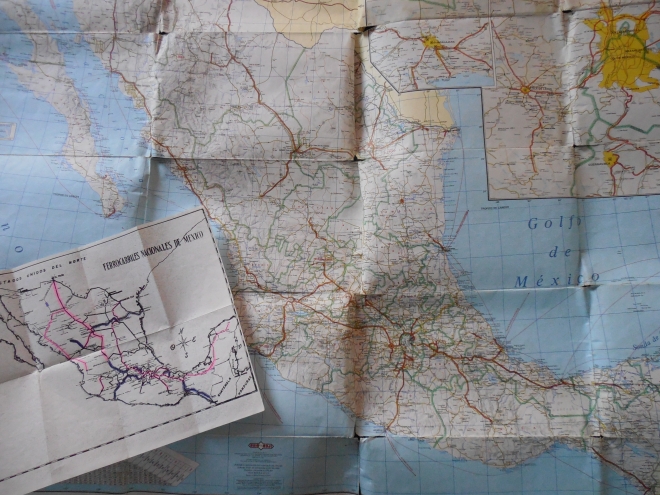
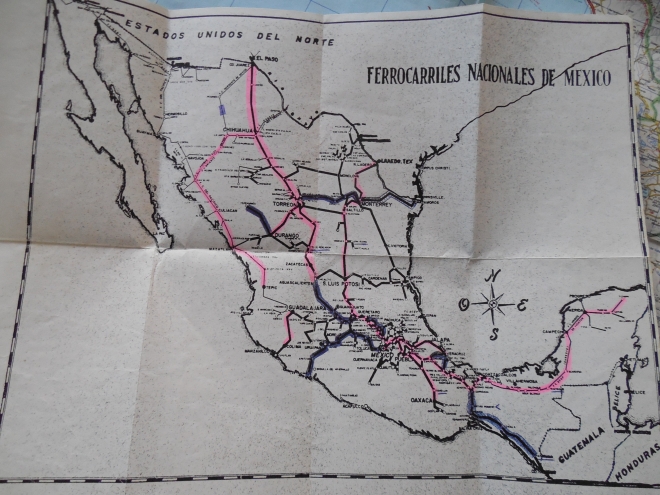
I arrive in Mexico City 15 November and go to the Ferrocarriles Nacionales de México. A woman in a 12th floor office shows me the official schedule as of 29 September 1997. She has received reports that between 40 and 50 routes have been cancelled since then. No, she didn’t know about Tepehuanes, nor Aserraderos, nor Regocijo.
In the next few months in Mexico, I madly dash after disappearing trains.
I look at my map of Mexico, noticing those black rail lines that go where no road passes, a web covering the nation from Baja to the Yucatán. I think of the routes I have taken over this decade of traveling. I think of the rides I will never get a chance to experience.
I shall miss the awakening from dreams, to see the full moon shining upon a sleeping home. Hushed voices in unlit cars of passengers coming, passengers going. The golden mesh of lights filling the valley as we’d come into Mexico City at night. I shall miss seeing the morning sun reach its fingers into the crevices, range by range, of the southern Sierra Madre mountains, morning mists over jungle cerros of Tabasco. I shall miss storm clouds mounding, then bursting upon the afternoon desert, sand imprinted by coyote, correcaminos running for shelter. Sunsets painting the western horizon.
I shall miss leaning upon the vestibule half-door, the wind blowing loose strands of my hair about, listening to the clickety-clack over wooden ties, the softer rhythm over concrete ones. I shall miss the smells of those women offering me gorditas de nopales con queso and atole in Chihuahua mornings, volovanes de cangrejo and coffee come Veracruz evenings. The bite of wood fires in crisp darkness. Of burning fields of sugar cane in the zafra.
I shall miss the stories of a doña Juana telling me of her childhood during the Mexican Revolution, before roads cut the Durango deserts. I miss sitting next to a doña Teresa embracing sweet azucenas to her Tehuantepec-huipil breast, like a Diego Rivera painting. I shall miss the conductor’s wife offering me a croissant, a banana and coffee, the workers offering me fish tacos or chiles rellenos.
I shall miss the sharing of lives and hopes, food and love with others, whiling away the time on those endless, timeless journeys.
Traveling by train no longer became a way to enjoy the country, to learn of its culture and life, to share community. No, riding became much more than that. I had to face deeper realities of the importance of these trains.
What will happen to those people who supported their families by selling to us passengers? On ebon nights, awaiting in the lights of the station, boarding with their baskets and kettles steaming in the chill air, stepping over bodies wrapped in thin blankets, sleeping in the aisles. The voices of mothers and their children quietly calling
                           Arroz con leche

                                    Café       Atole

                           Tamalitos       Enchiladas

                                    Gorditas…
How shall campesinos get their cheeses and fruits to market? How will they feed their families tonight, tomorrow and tomorrow’s tomorrow?
What will happen to those villages whose lifelines were the silver rails?
Will abandonment beat the dirt roads, melt adobe homes into the earth? Will wooden doors bang in winter winds sweeping down from the north? No longer will laundry sway in a blue-white sun. No longer will small circuses pitch their ragged big tops for a few day’s pesos before moving on to some other pueblo. How many of these families have had to pack their trunks and bundles, migrate to a city in hopes of survival? How many of these communities are now rent by these winds of thoughtless change?
How will folks visit one another? How many will be able to afford a bus ticket for everyone in the family, to see abuelito, to celebrate Tía Rosa’s birthday, to take a holiday? Before, the bus was up to three times more expensive than the train. Who will be able to afford those bus fares spiraling, spiraling upward, now that there is no competition?
How many lines might continue to because these new owners deem they can jack the prices up, rake in the big bucks from the foreign tourists? Or because of protest by the people?
For now the vestiges of the Mexican Revolution continue to fray in the northern winds. Perhaps those days of train travel are gone. Or perhaps not. Maybe someday a new government shall come to power that recognizes the importance of the trains to communities, to the families, to the economies of these pueblocitos — as is happening in other countries.
Or perhaps a new Revolution is brewing in the Sierra Madre. Maybe one day former workers and a village will take up “arms” of máquinas and carros, appropriate the tracks, and with no funds from anyone keep the lines alive and gleaming silver to the ejidos, giving campesinos a way to get their products to market, for the ill to receive medical attention, for kinfolk to visit.
It may seem this affair has ended, but I still study my map, tracing those black lines. This is a love that has deepened with the years. I still search, every time I am in Mexico, for whatever visage of those train adventures. And, ay, when we meet once more, what a ride we have!
Sí pues, as long as there is a train upon which to journey, this shall be an affair never-ending.
…is a documentary poet, translator and travel writer. Her works appear in over 300 journals on six continents; and 20 collections of poetry – including On Galápagos Shores (dancing girl press, 2019), Caribbean Interludes (Origami Poems Project, 2022) and Fire and Rain (Red Mare #18, 2019), a collection of eco-feminist poetry. She also authors travel narratives, articles and guidebooks. Her writing has been honored by the Parliamentary Poet Laureate of Canada (2011) and nominated for the Best of the Net. Caputo has done literary readings from Alaska to the Patagonia. She journeys through Latin America, listening to the voices of the pueblos and Earth.










 The BeZine