
Posted in Bardo News, General Interest, Islam, Paula Kuitenbrouwer, poem, Poems/Poetry, poetry, Poets/Writers, Spiritual Practice, Terri Stewart

BARDO NEWS: Blessings on Ramadan; “Begin Again” blog expands its writer base and gets funding; artfully eco-friendly . . ….

Islamic Center of the U.S. in Washington by agnosicpreachers kid under CC BY-SA 3.o license

BEST WISHES to our Moslem contributors, readers and friends all over the globe on this: the first day of Ramadan. ~ During this month, 1.6 million Muslims – or 23% of the world population according to Pew Research Religion and Public Life Project – observe a strict fast if they are of an age and healthy enough to do so. The fast extends each day from sunrise to sunset. The month-long fasting ends with a feasting celebration, Eid al-Fitr (the breaking of the fast), which falls on 28 July this year.

Britain’s David Cameron has this to say:

https://www.youtube.com/watch?v=WwiKLxPeti4

Kul ‘am wa enta bi-khair!

May everyday find you in good health!

Kazim Ali (b. 1971) American poet
Kazim Ali (b. 1971) American poet (c) Kazim Ali

CELEBRATING POET, NOVELIST, ESSAYIST and EDUCATOR, KAZIM ALI ~  who was born in the UK, is from an Indian Islamic household, and was educated at State University of New York (SUNY) and at New York University. Currently he lives in Oregon.

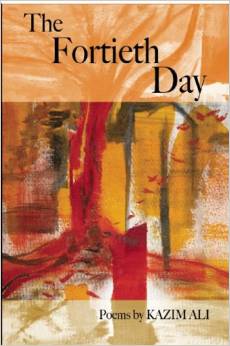
Of his most recent poetry collection, The Fortieth Day, the Library Journal review says that Ali …

“continues his task of creating a rejuvenated language that longs to be liberated from the weight of daily routine and the power of dogmatic usage . . . writing in the tradition of Wallace Stevens, Ali is clearly a poet of ideas and symbols, yet his words remain living entities within the texture of the poem.”


Of his essay collection, Fasting for Ramadan, Notes on Spiritual Practice, Tupelo Press states …

“Kazim Ali’s searching descriptions of the Ramadan sensibility and its arduous but liberating annual rite of communal fasting is sure to be a revelation to many readers — intellectually illuminating and aesthetically exhilarating.

“Fasting for Ramadan is structured as a chronicle of daily meditations, during two cycles of the 30-day rite of daytime abstinence required by Ramadan for purgation and prayer. Estranged in certain ways from his family’s cultural traditions when he was younger, Ali has in recent years re-embraced the Ramadan ritual, and brings to this rediscovery an extraordinary delicacy of reflection, a powerfully inquiring mind, and the linguistic precision and ardor of a superb poet.”
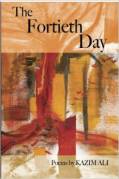
Unknown-8Ali’s poem Ramadan is from his collection, The Fortieth Day.
You wanted to be so hungry, you would break into branches,
and have to choose between the starving month’s

nineteenth, twenty-first, and twenty-third evenings.
The liturgy begins to echo itself and why does it matter?

If the ground-water is too scarce one can stretch nets
into the air and harvest the fog.

Hunger opens you to illiteracy,
thirst makes clear the starving pattern,

the thick night is so quiet, the spinning spider pauses,
the angel stops whispering for a moment—

The secret night could already be over,
you will have to listen very carefully—

You are never going to know which night’s mouth is sacredly reciting
and which night’s recitation is secretly mere wind—

– Kazim Ali
“Ramadan” except from The Fortieth Day. © 2008 by Kazim Ali, posted here under fair use

“Poetry is the smallest way – it is a small, small way, but it is a way indeed – that the individual body can express its own personhood and value in the face of faceless systems.” Kazim Ali

Terri Stewart
Terri Stewart (c) Terri

TERRI STEWART REPORTS on the expansion of Begin Again, the blog she started and hosts ~ “First news, welcome Bruce Chittick to the team of writers! Woot!! He will bring an awesome perspective to Sundays and inspiration. I can’t wait to get to know his writing. I experience him to be a thoughtful, gracious, inclusive kind of guy. His first post went live on the 22nd!

“And, in other exciting news, we got some funding. The United Methodist Church, in an expansive move towards trying new things (although we aren’t exactly NEW) has decided to fund my position at BeguineAgain.com AND all the technology for the next year and a half. This gives me & us time to build a class & subscription base to move towards an independent funding mechanism. This is awesome on so many counts. They know what we have been publishing and are willing to sit in that tension. Amazeballs! And it also lets the pressure off of me regarding all the work I am doing to create alternate funding mechanisms for my own family’s subsistence. Whew. Chaplaincy pays like zero. It is being billed as an online spiritual community. Very vague.

” … I can’t wait to try some of the new technology that will be available now that I can upgrade us to WordPress pro!”
Rose at Dusk (c) Jamie Dedes
Rose at Dusk (c)  Jamie Dedes

ARTFULLY ECO-FRIENDLY

Dutch Nature Artist, PAULA KUITENBROUWER (Mindful Drawing) ~ a long-standing member of The Bardo Group and a contributor to the blog has sent out a call to all of us  – team members, bloggers and friends – to initiate discussions of how and why we are living and working in an eco-conscious ways and how we can use our art and our blogs to encourage environmentally sound practices. Paula shares on her Guilt-Free Art Page …

“My original drawings are drawn on acid free paper. In the process of making acid free paper fewer corrosive chemicals are used, which makes acid free paper significantly environmentally friendlier than normal paper.

“For packing my fine art cards and reproductions, I use biodegradable plastic. I like my art work to be as environmentally friendly as possible and I select my products carefully. My paint-brushes are synthetic without animal hair.”

Other eco-friendly living practices that might be shared would include the ways in which we order our lives to enable no-or-minimal use of cars, mindful shopping (buying only what we need and buying from bulk containers rather than packaged items, buying locally produced food and other products), using biodegradable cleaning products and reusable shopping bags. Yes! All this and how about telling us about your advocacy efforts?

We invite you share your thoughts on this in the comments section here, on your own blogs (then leave us a link under any current post so that we can publicize it in the next Bardo News) or as submissions to The Bardo Group blog this month. (If you are not a core-team member, please email us at  bardogroup@gmail.com.)

Coming up:

… and many more goodies from our Core Team, readers and guests. This month’s guests will include:

Poet K.A. Brace (The Mirror Obscura) and Jewelry-Maker, Writer, Photographer Isadora (Inside the Mind of Isadora)

bardogroup@gmail.com

The Bardo Group Facebook Page

In the spirit of peace, love and community,

THE BARDO GROUP

Posted in Essay, Guest Writer

The Noble Art of Reading in Bed

100_0088cropped-bedroom

the work of Valerie Davies

When I was young and naive, and a novice journalist, I wrote an article in a woman’s magazine which began:’ I got most of my education under the bed-clothes’, and went on to discuss children’s reading. Some wag must have been reading his wife’s copy, and the clipping appeared on the office notice-board amid crude male guffaws. Thank you chaps, I got the message. Not a quick learner, but I got there in the end.

Reading under the bed – clothes was the refuge of a child who was sent to bed at seven o clock every night, and allowed to read for fifteen minutes. Fifteen minutes! When I got older, and had more homework bed was set back to seven thirty, but the fifteen minute reading restriction still applied. Only a non-reader could have stipulated this ridiculous time limit, so under the bed-clothes it was. When I had no torch I knelt for hours, freezing in my night-clothes squinting to read by the crack of light under the door from the hall light.

Occasionally I tried the loo or the bathroom, but this was risky, as books aren’t easily hidden by a skinny child under a thin nightie. When I was fourteen I picked up Jane Eyre in the library. It exploded into my consciousness. I felt dazed and obsessed by the strange, compelling self-centred story. I could think of nothing else. I read it over and over again. I read it under the desk at school, in the bus and on the train, and of course, in bed.

Once the parents had gone to bed, I switched my light on with impunity, and read until I had finished Jane Eyre, and then started ‘Villette’, by which time it was heading for five o clock in the morning. Since I had to get up at six to cook my breakfast and catch the school bus at seven am, it seemed safer to stay awake, and soldier on. And having done it once, and finding it was possible to keep going without sleep, I quite often sacrificed my sleep for a good book after that.

Boarding school was tricky, but once again, there was always the bathroom. When I left home and became my own master, reading in bed became one of my favourite pastimes. Mostly literature and poetry in those palmy days. And usually then I had a bowl of apples to munch meditatively as the hours went by, or better still, a bar of chocolate. Sometimes decadence overcame me and I had a glass of lemonade. Marriage and motherhood dished all that of course, and reading in bed became a distant remembered pleasure.

But in the last few years since my husband’s snores have become so loud they wake me even when I’m sleeping in another room, we’ve taken a page out of the Royal Family’s domestic habits, and now sleep in separate rooms. This means I can read without disturbing him, and I’ve raised this noble pastime to a fine art.

Usually three books go to bed with me… something that I call mental knitting, a relaxing series like Georgette Heyer, (a much under-rated, very funny, witty and clever writer) or other light-hearted books like the hilarious Adrian Mole Diaries, or ‘The Jane Austen Book Club’. Georgette Heyer is sort of Jane Austen lite – but the blessed Jane is also a regular companion, along with the Thomas Hardy’s, George Eliot’s, Anthony Trollope’s, to re-read for the sheer pleasure of enjoying their writing again. In theory too, because I know the story, I kid myself I won’t be tempted to read too late. But that is a false premise. And as CS Lewis said, ‘I can’t imagine a man really enjoying a book and reading it only once.’

And then there’s the third category – those which are on the go, sometimes a new novel – Barbara Kingsolver at the moment, but not many of those – a biography, a history, a diary. And for real relaxation I sink into nature journals, often a classic like Flora Thompson’s: ‘Lark Rise at Candleford’ … Annie Dillard, Henry Beston or Ronald Lockley… mostly accounts of gentle, unpolluted country life.

But reading in bed isn’t just books. The bed matters too… preferably by the window… in summer with cool white linen-cotton blend sheets that have a silky feel, in winter comforting coloured flannelette to match the duvet. Pillows – plenty of them, to lean back on and others to support the elbows. Electric blanket a must in cold weather… I use it a bit like the hot tap in the bath… whenever it seems a bit chill, I switch it on until the bed is like toast again, and then prudently switch off again until the next time.

In summer, there’s the bliss of going to bed in day-light, knowing you have hours in front of you before dusk creeps up, before finally switching on the light. In winter, lamps on, curtains pulled, wood fire still burning in the sitting room to keep the house warm for when I emerge to make a cup of tea. And the bed, pyjamas warmed under the bed clothes on the electric blanket, cosy sheets and pillow slips, red mohair rug edged with wine-red satin, and a stash of peppermints to slowly chew as I turn the pages. No sounds, just the murmur of the soft sea, a distant owl, and occasionally a scuffle on the roof as a possum scrambles across. The sound of rain on the roof is good too.

The art of reading in bed is a silent, sybaritic, solitary joy and has nothing to do with going to sleep. It has everything to do with the pleasure of reading, frequently to the detriment of sleep. So I have to confess, in the words of L.M.Montgomery that : ‘I am simply a ‘book drunkard.’ Books have the same irresistible temptation for me that liquor has for its devotee. I cannot withstand them.’

– Valerie Davies

© 2013, essay, photograph, and portrait (below), Valerie Davies, All rights reserved

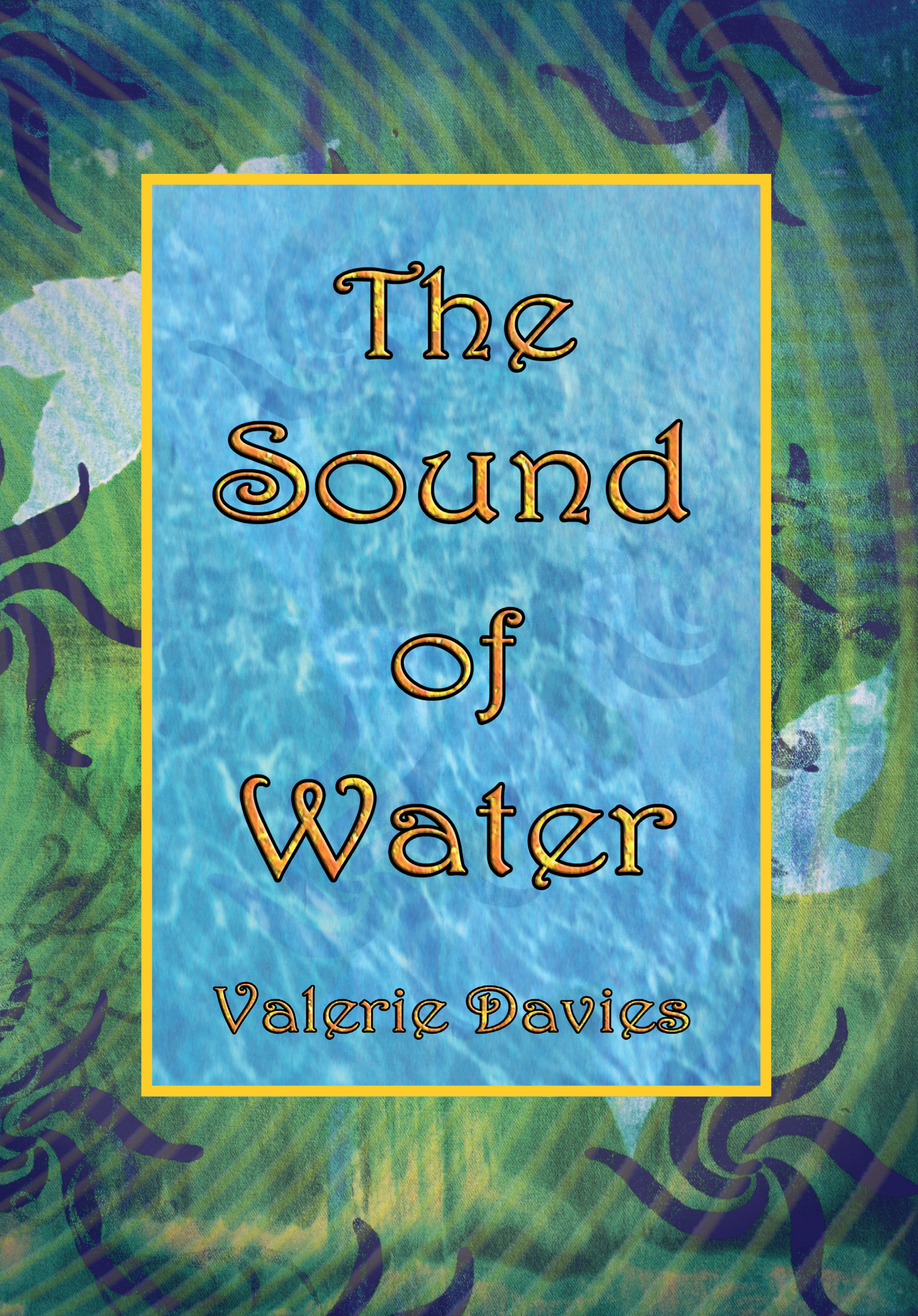
100_036634d750b1228d96f442911457fa49f7d5d3e2d8ea925f4a2067aec04be59b0e280856da42aad7d73b-thumbVALERIE DAVIES  (Valerie Davies.com) ~ our guest writer today, says she’s had an adventurous life, living through the Blitz in England, growing up in a military family, becoming a captain herself, and marrying into the military. Between one thing and another, she’s been around the world and back and had some truly hair-raising adventures. She’s worked as an editor and columnist. Valarie has been blogging for some time now. Her posts are chatty and full of wisdom and humor. They touch the heart. Valerie books are The Sound of Water and Chasing the Dragon. Find them HERE.

Posted in Essay

THE LOVE FOR (OLD) BOOKS

obblog

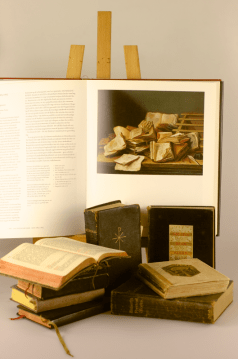
Some of my old books. Photo by Paula Kuitenbrouwer

THE LOVE OF (OLD) BOOKS

by

Paula Kuitenbrouwer (Mindful Drawing)

Reblogged here with Paula’s permission. 

A few days ago, I read in a newspaper about a Dutch politician questioning the future existence of libraries. Kindle was mentioned as well as the Internet, so why have libraries? I stopped reading the article because there is only so much flap-doodle one can stomach. One might hope that our politician will start reading T.S. Eliot and stumbles upon Eliot’s quote: ‘The very existence of libraries afford the best evidence that we may yet have hope for the future of man’.

220px-the_burning_of_the_library_at_alexandria_in_391_ad

Imagine a few philistines standing in front of the burning library of Alexandria, in estimate 48 BC, indifferently saying to each other; ‘A well…who cares?’ I care, and that is what I commented at Jamie Dedes’ discussion Times Change on The Writer by Day.

You could object and point out that we can store all books digitally, something that wasn’t possible in ancient times. That isn’t a very convincing argument to me, because at ancient and medieval times copies were produced too, in order to preserve knowledge and to make knowledge widely available. The problem, to me, is that digital copies are clean and sterile presentations. They do not enchant, hold no smell, sensation nor touchable illustrations. Many of us need to experience these qualities hands-on.

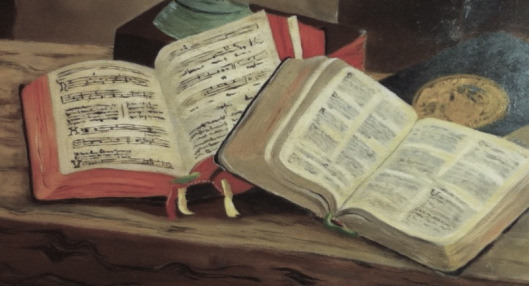
I also love painting old books. Books offer a wonderful theme, showing off a collection that represents a specific time, a layer of the society, telling a story about the writer, reader, and publisher.

28_de_heem_183

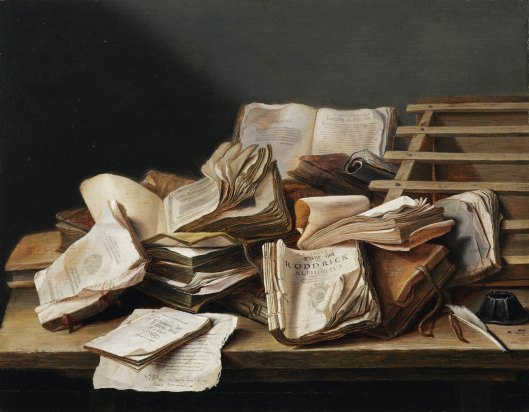
Jan Davidz de Heem (1606-1683/84), Still-life with Books

A painting like this communicates ‘Look that my books’, and ‘Look what I read and store in my head’. See the ink-pot and feather-pen, stating; ‘I write too’ or ‘I’m a scholar’.

obb

Detail oil painting Paula Kuitenbrouwer

Do you also like the little extra treasures old books sometimes offer? They can be underlined sentences that ones held significant meaning to the former owner of the book. Or they can be a handwritten old name on a pretty Ex Libris.

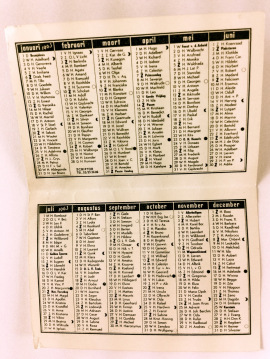
A few year ago I bought an old book. At home a small calendar of my year of birth dropped out (now how amazing is that?), showing a year long list of -to my generation- forgotten saints as well as a moon calendar.

tx1
The Saint and Moon Calendar of my birth-year.

Last, have a look at this beauty: an old Dutch book on Percival, with the name of the former owner in the right upper corner in ink. The Art-Nouveau illustration, in relief gold, offers enough reason to buy the book. There is even a treat inside: a small, printed prayer card, showing St. Martin by Michelina da Besozzo, 1410.

parceval
Will we ever enjoy a relief print, golden illustration on a Kindle? If we ‘open’ our E-reader, will we ever experience a pleasurable surprise of a little wink or glimpse back in time, falling out? I’m afraid not. Books provide us with all sort of inspiration; we therefore need old books, stored in libraries (and available in second hand bookshops).

© 2012, essay/photos/artwork, Paula Kuitenbrouwer, All rights reserved