The Wiyot lived in the Humboldt Bay area of Northern California and they live in my dreams. For about a year-and-half we made our home in Humboldt County, an area about 200 miles north of San Francisco on the far North Coast. It’s a place dense with redwood forests, wild rivers, and creeks that run dry in the summer and overflow in the winter. If you live in a rural area or grew up in one, you might take such things for granted. Having lived in paved-over cities all my life, they seemed magical to me.
Our four acres were rich with sequoia, madrone, oak, and twenty-eight fruit trees. Blue jays flew in to feed in the morning. Quail families visited at night. They marched down our drive in orderly formation. Hawks and hummingbirds put on air shows. Rosemary thrived unattended. There was a beautiful lush 100-year-old rosebush. There were wild roses too. They gifted us hips for homemade cough syrup.
Scotch Broom
The colors there were brilliant and varied: smog-free blue skies (you could see the stars at night!), rich brown earth, a population of purple iris in a grove of California bay laurel, orange cosmos and red dahlias, yellow scotch broom lining our creek-side in the company of cascading Japanese quince. The Japanese quince provided ample housing for Rufus hummingbirds. Nearby, Queen Ann’s lace stood unbent by the wind. When it went to seed we collected the seeds for cooking. They have a taste somewhere between carrot and caraway.
The spread of blackberry bushes was both wonder and wealth. They seemed never to run out of fruit. I gathered some almost every morning for breakfast and every morning I thought of the women in buckskins who preceded me more than a century ago. Perhaps there was a mother who stood on this spot, picking blackberries for her son too.
I think the peace, quiet and simplicity of that place made it easy to imagine the first peoples as they might have lived there in other times. I could see them tending fires, boiling and drying acorns and then grinding them for flour, bathing in the river, raising their children, gathering wood, hunting and enjoying sacred ceremony. I knew the very same ancient sequoia that watched over us had watched over them.
Qual-a-wa-loo (Humboldt Bay) near Eureka, traditional Wiyot lands, The 1860 Wiyot Massacre happened on Indian Island
Finally, I did some research. I was sad but not surprised to find that the area was once inhabited by an indigenous people – the Wiyot people – who were decimated in a genocide ~
Wiyot Mother and Child
“Eureka newspapers of the time exulted at the night massacres conducted by the “good citizens of the area”. Good haul of Diggers and Tribe Exterminated! were 2 headlines from the Humboldt Times. Those who thought differently about it were shut up by force. Newspaper publisher and short story writer Bret Harte called it “cowardly butchery of sleeping women and children” — then had to flee ahead of a lynch mob that smashed his printing presses.” MORE [Wiyot Tribal Council Page]
Note: Originally written in 2012, I’ve posted this today as a an acknowledgement of Indigenous Peoples’ Day, October 12. More than 40 US jurisdictions celebrate Indigenous Peoples’ Day; the majority of these have replaced Columbus Day with this holiday, but some jurisdictions celebrate both Columbus Day and Indigenous Peoples’ Day.
In addition to reading here, please also treat yourself to Michael Watson’s post Silence, Story, and Healing, a short and thoughtful piece.
Perhaps you too grew up in a time and place where the history books taught a one-sided view of the land you live on and the people who originated there. Perhaps, like me, you had to get out of school and meet new people, read books that weren’t sanctioned by academic authority and do your own research to learn about the devastation that was and is rained upon indigenous people all over the world … the violence, the slavery and the genocide. Perhaps you are a descendent of the original people who suffered so and know the truth from the stories of your elders. Perhaps your roots are in the nations of empire and you are saddened that they perpetrated or were complicit in such unimaginable injustice.
We can’t change what happened in the past but we can make sure that lies aren’t propagated and that the truth is told and shared. Whether or not you are a writer, try this exercise: write a poem, short story, essay or article that illustrates some aspect of colonialism, racial bias and stereotype, or the modern complications of colonial history. Doing research and writing about our feelings are good ways to clarify circumstance and clear out unconscious bias. That’s one of the possible benefits of journaling, for example. If you are a professional poet or writer, you have the tools to help set the record straight and win a small victory for the human race.
We are a Jewish-Native household and events in the Middle-East have deep resonance for us. For the past two weeks we have watched and thought about the fighting in Gaza, our sadness, and sense of helplessness, growing daily.
Of course, it is impossible to know, with any certainty, the truth of things. Propaganda is unleashed by both sides. Still, there is something terribly familiar about the one-sided nature of the conflict. The history of the U.S., like that of Palestine, is usually told from the view of the dominant power. From our Indian perspective, the story is vastly different from that told in most history books.
We watched as the colonial powers invited landless Europeans to emigrate, and forced criminals and others who were disenfranchised to do so. Thus, they created an ever-growing hunger for land, a tidal wave that would eventually sweep over us. We were under constant pressure to move West, and to relinquish our ancestral lands. The colonists made promises and gave us land that would be ours “forever”. Then they brought in settlers who lived in enclaves, always encroaching on our land. When our people attempted to defend the land the colonial powers had seeded to us, the colonial government made war against us. They killed our children and elders, and raped and murdered our women. They sought to destroy our cultures by stealing the land, our traditional knowledge and life-ways, and our children. Because we hold this knowledge, many of us remember, and observe remembrance of, the Shoah, the Holocaust, and acknowledge our kinship with those who were the victims of that genocide.
Let us remember that, like the Jews who made their way to the Holy Land, many of those early emigrants to our lands were the dispossessed. The British attempted to depopulate Ireland, Scotland, and Wales. They used war, famine, and desperation to drive people from their traditional lands. They employed “Acts of Enclosure” to force their own people to flee to the cities, hungry and destitute; many families eventually found their way to our lands. Because they understood colonialism and genocide, because they understood trauma, many of these early immigrants married Native people. But soon, propaganda, hunger, greed, and the rising tide of immigration overwhelmed us.
Although they had killed ninety-nine percent of our people, forcing us to live on tiny reserves, starving and desperate, they continued their attack. They banned hunting, and our drums and our ceremonies, the heart of our cultures. This is not ancient history, it continues, as governments grab what little land we retain and willy-nilly destroy our sacred sites. It continues as Non-Natives rape and murder our women, and jail our young people, in vastly disproportionate numbers. When I see destruction of olive groves in Palestine, and hear reports of the rape of women and the murder of children, I am reminded of this. When I see the Bedouins forced into reservations, their traditional nomadic life forbidden to them, my heart breaks in recognition.
This is an old story. Those with superior numbers and weapons take land from people who have lived in a place for untold centuries. They use resistance to their domination as an excuse to make war on the people. As they do so, they often target children, women, and elders. Too frequently, women are raped and/or killed, children are murdered or traumatized, the land that feeds the stomachs and culture of the people is stolen. Thus the future of the people is threatened. These are acts of genocide. We cannot remain silent when we witness them. Our ancestors lived through this. They remember and whisper their experience in our minds. They are always with us, and they do not forget.
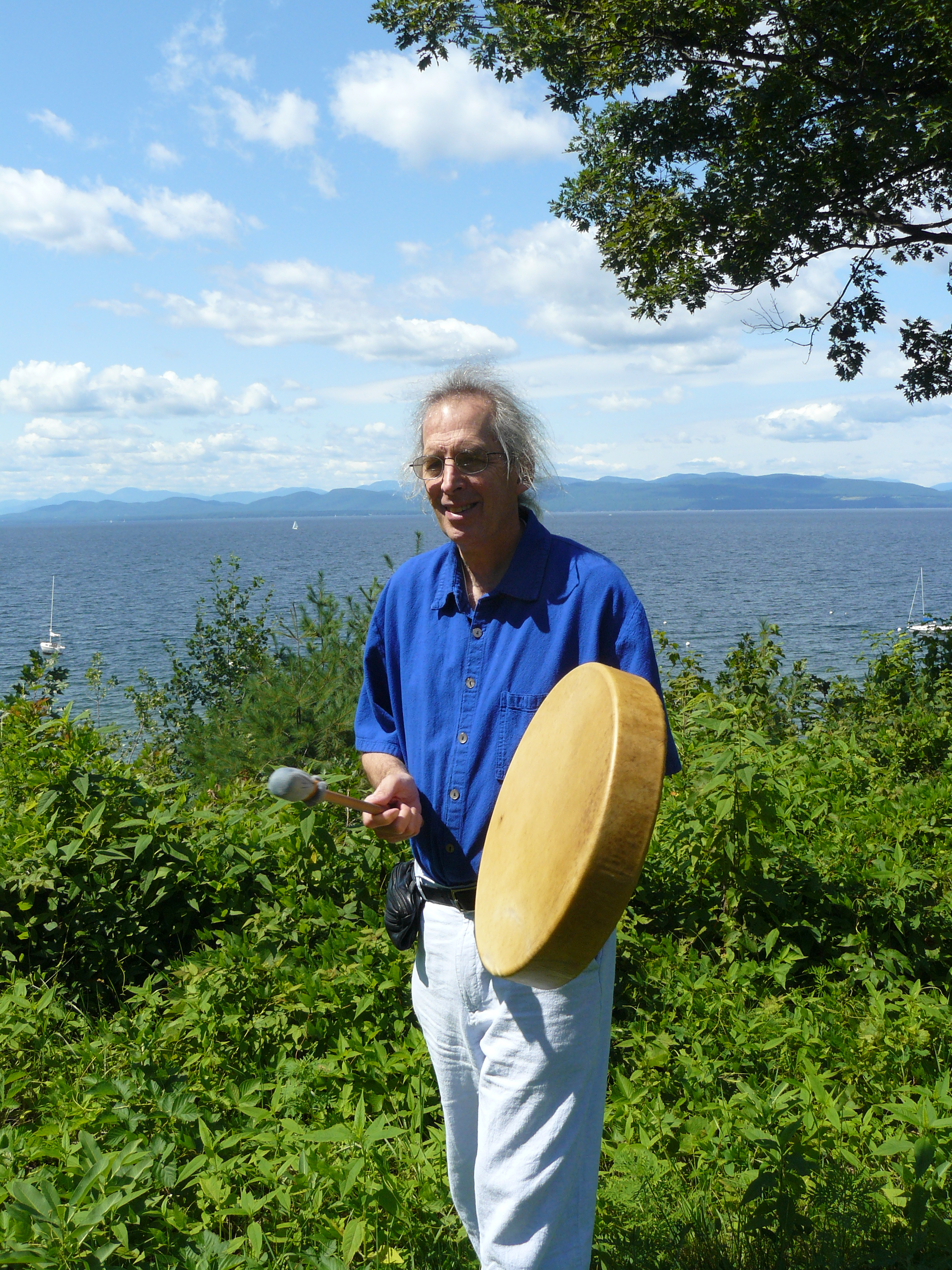
MICHAEL WATSON, M.A., Ph.D., LCMHC (Dreaming the World) ~ is a contributing editor to Into the Bardo, an essayist and a practitioner of the Shamanic arts, psychotherapist, educator and artist of Native American and European descent. He lives and works in Burlington, Vermont, where he teaches in undergraduate and graduate programs at Burlington College,. He was once Dean of Students there. Recently Michael has been teaching in India and Hong Kong. His experiences are documented on his blog. In childhood he had polio, an event that taught him much about challenge, struggle, isolation, and healing.
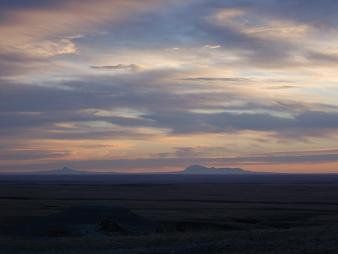
Sweetgrass Hills in Montana from Red Rock Coulee
Source: Wikipedia
“His father’s father was Métis, you know…rode with Riel in 1869 and his father fought with Dumont at Duck Lake and Batoche in ’85,” Sheriff Hank Reynolds said as he pulled the glasses off his nose after reading the arrest report on his desk.
“That may be so, Sheriff, but it doesn’t give Liberté Beaubois license to ride into Montana, hunt protected buffalo and take a couple of shots at my head, does it?” asked Reynolds’ new deputy, Linus Philkin.
Reynolds wiped a few drops of coffee off his graying mustache and walked back to the holding cell, where he stared at a buckskin-clad man sleeping on the floor, face to the wall, on a mattress he’d pulled off the cot.
The sheriff rubbed his hand across his bald spot and recalled wind blowing through his hair in the long-ago when he, Liberté and some Piegan boys from over Milk River way would ride hell-bent for election chasing buffalo that would wander onto his father’s place. It was in those days before the Somme, before Liberté came home with a Victoria Cross and Croix de guerre in exchange for his childhood, an eye and, some said, his mind.
“I’ll take care of this,” Reynolds said, and loaded Liberté into his Ford pickup truck and Liberté’s horse with his into the trailer behind it. They drove from Chester up to his old man’s place outside Whitlash, where they mounted and pointed their ponies north, all the while howling like twelve-year-olds, chasing memories through the Sweet Grass back into Alberta.
A true mash-up of prompts went into this little story. First was Lillie McFerrin’s word of the week, Freedom. Then I decided it worked with Canadian writer Sarah Salecky’s daily prompt, which was “His father’s father was Métis.” I can never let a chance to write a North American historical piece go by. Then, as luck would have it, the first Story-A-Day May prompt was Going Home. And there you have it.
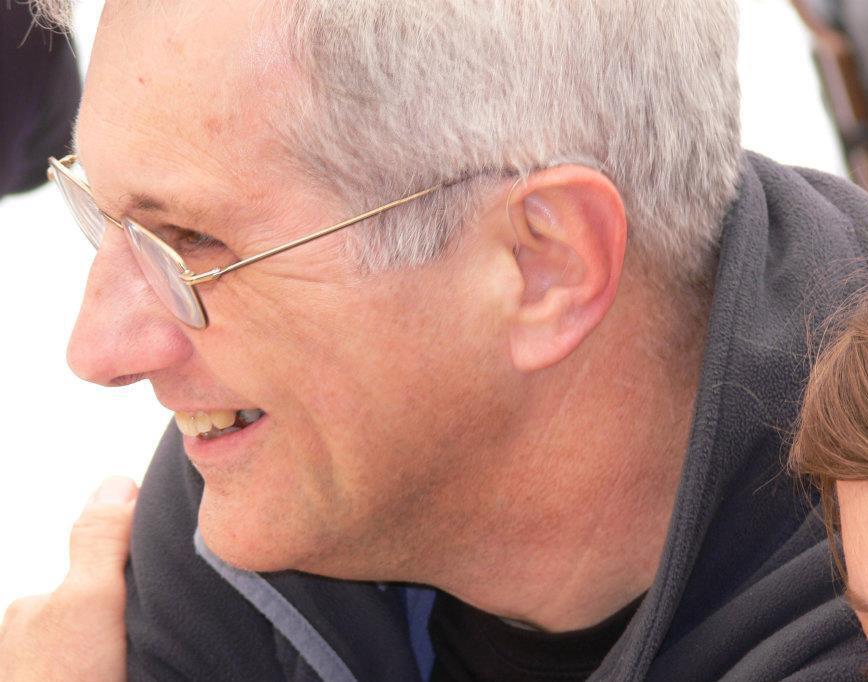
JOSEPH HESCH (A Thing for Words) is a writer and poet from Albany, New York , an old friend of Bardo and a new core team member. Joe’s work is published in journals and anthologies coast-to-coast and worldwide. He posts poems and stories-in-progress on his blog, A Thing for Words. An original staff member at dVerse Poets Pub website, Joe was named one of Writers Digest Editor Robert Lee Brewer’s “2011 Best Tweeps for Writers to Follow.” He is also a member of the Grass Roots Poetry Group and featured in their 2013 poetry anthology Petrichor Rising.
When my daughter Bea and I were in England, I took her to the picturesque little town of Rye.
Rye was a Cinque Port, charged in 1155 by Royal Charter to provide ships for the royal navy, and rewarded with tax-exempt status and other privileges.
Rye was situated on the coast until The Great Storm of 1287 silted the harbor, and transformed the coastal port into a river port, two miles inland.
The town’s history is colorful, with smuggling, and raids by and against the French, just across the Channel. It’s also said to be the most haunted town in England. There’s the ghost of the girl who fell in love with a smuggler and was murdered by him for her indiscretion. Turkey Cock Lane is haunted by the ghost of the monk bricked up alive behind a wall for trying to elope with a local lass. The mysterious boy wrapped in a shroud, and a pair of duelers reenacting their last fatal sword fight are just a few of the ghosts who frequent The Mermaid Inn. So many stories!
Every house has a story. In Rye, as with everywhere else in England, they like to give their houses a name. White Vine House was very pretty.
On a narrow cobbled lane called Mermaid Street stands The Mermaid Inn, which dates back to 1156.
It was remodeled in anticipation of a visit from Queen Elizabeth I. On a previous trip, I stayed at The Mermaid in a room with a plaque on the door boasting that the Queen Mum had once spent the night in that very room. I think I can truthfully say I have slept in the same bed, looked out the same window and, at least for a little while, sat on the same throne as Queen Elizabeth II’s mum!
The Mermaid Inn was so famous that the house across the street was known simply as “The House Opposite.”
We discovered an unusual house, with two front doors. The owners called it, “The House With Two Front Doors.” (Well, of course, they did!) They even had the name painted on it in shiny gold paint.
The neighbors who lived next to The House With Two Front Doors also had a house with one distinguishing feature, a bench built into one side of the porch. Maybe they thought the neighbors were getting too high and mighty, with their spiffy gold-painted signs and their highfalutin name. In what seems a clear case of one downmanship, they too gave their house a name, and put up their own sign to let passersby know they were looking at “The House With the Seat.”
I want to know all the stories–big ones like The Great Storm that changed the whole coast of England overnight, compelling but heartbreaking ones like the Mary Stanford Lifeboat Disaster, in which the entire heroic rescue crew was drowned in a storm, trying to save survivors of a shipwreck who had already been saved. Some of my favorite tales are the Tempests in the Teapots. Those you won’t find in tour guides or history books, but you might be fortunate enough to stumble upon one. A local told us stories about watching the filming of Cold Comfort Farm in Rye. Afterwards we took afternoon tea in the teahouse where one scene was filmed.
Stories live all around us. Some fall into our lap like ripened fruit from a tree. Others are hiding in nooks and crannies, waiting to be ferreted out. Often we are left to speculate over the missing details–not unlike trying to read tea leaves in the bottom of the tea cup. Who hid in the priest hole over the fireplace at The Mermaid Inn? Who was left to mourn the seventeen lads lost in the Mary Stanford disaster? Do the occupants of The House With Two Front Doors and those of The House With the Seat ever sit down together for a cup of tea?
All images and words c2013 by Naomi Baltuck
NAOMI BALTUCK ~ is a Contributing Editor and Resident Storyteller here at Bardo. She is a world-traveler and an award-winning writer, photographer, and story-teller whose works of fiction and nonfiction are available through Amazon HERE. Naomi presents her wonderful photo-stories – always interesting and rich with meaning and humor – at Writing Between the Lines, Life from the Writer’s POV. She also conducts workshops such as Peace Porridge (multicultural stories to promote cooperation, goodwill, and peaceful coexistence), Whispers in the Graveyard (a spellbinding array of haunting and mysterious stories), Tandem Tales, Traveling Light Around the World, and others. For more on her programs visit Naomi Baltuck.com
I am the keeper of the dreams and the memories, the matrix where the generations converge, the record-book held between familial bookends. I am responsible for passing her life on to him that she may continue to live and that he may understand the consequences of history and culture as common people do.
He is the vindication of hope, his and ours. Her heart is the place were hope started. I can hardly think of my son without also thinking of my mother. They are the two people I love most in this world, though one of them – Mom – is no longer here. So for the record, I’m not sure why, but the occasional pancake breakfasts I had with her at Oscar’s of the Waldorf are on my mind. We had rituals we honored until life had its way with her.
______
We spent time savoring the hotel before going into Oscar’s for breakfast. The Waldorf was decorated with so much gold color that despite the muted lighting we felt we were having our moment in the sun. The jewel-colored furnishings and plush carpeting invited us to find a place to sit. We indulged in wide-eyed rounds of people watching. The businessmen seemed busy with self-importance. The women fussed with their manifest charm. We always stopped in the ladies’ room with its uniformed attendants continually present. They provided each guest with a freshly laundered terry-cloth towel and double-wrapped soaps, lavender-scented. Mom would tip the attendant a quarter and give me a quarter to tip her too.
Waldorf Lobby & Clock
An important ritual was a visit to the Waldorf Astoria Clock in the main lobby. I’ve read that it’s there still, all two tons of it. It’s a place where people find one another. I’ll meet you at the clock. Everyone knows that means the clock inside the Waldorf-Astoria at Park Avenue. It’s a towering thing, the actual clock sitting below a replica of the Lady Liberty, hope of immigrants, and above some bronze carvings and an octagonal base of marble and mahogany. Standing near the clock gave us the sense of a history of which we were not a part. It offered the illusion of privilege, the true secret spice that made the blueberry pancakes at Oscar’s so delicious. The famed maître d’hôtel, Oscar Tschirky, Oscar of the Waldorf, was no longer there. He died in 1950, the year I was born.
_______
My mom loved the Waldorf and Oscar’s blueberry pancakes as she did everything she felt characteristic of culture and good breeding. Being well bred meant you recognized quality in a person or product: women who wore pearls, men who always tipped their hats in greeting, and dresses with wide hems. Well-bred meant you didn’t swear or use colloquialisms. It meant that if you were a boy you never cried. If you were a girl you didn’t display your intelligence. You didn’t run. You didn’t shout. You never went out without wearing hat, gloves, and girdle. You sacrificed sports and ballet at nine. You didn’t risk turning any tidbit of excess fat into unseemly muscle.
Given my illegitimate birth – which occurred when my mother was thirty-six – combined with our roots, peasant not patrician, and our working-class status in this country, it seemed Mom was forever posturing. Nonetheless, over time I convinced myself that my mother was indeed a most cultivated person. Hence my birth had to be a virgin birth. That would explain my father’s absence, though there was no kindly Joseph to lend an aura of respectability. Mom advised me never to kiss a boy. Kissing could cause pregnancy. Well, yes, if one thing leads to another, but how would my mom know?
’50s Style Theater seating
Mom’s interest in culture was insatiable. What she viewed as high culture most people would see as popular culture. We consumed it regularly and with religious fervor. We were fickle about our temples of worship. We opened our hearts at the Harbor Theater on Wednesday night, the RKO on Saturday afternoon, the Loew’s Alpine on Sunday, and for whatever reruns were on television at any given time. Because of movies we knew what to dream. They were our world; their luminaries our goddesses and gods. Audrey Hepburn, goddess of fashion. Cyd Charisse, goddess of posture. Katherine Hepburn, the great goddess of elocution. Grace Kelly inspired us to wear pearls, however faux our own five-and-dime pearls were. We did our best to meet the standard. Fred Astaire, Gene Kelly, and Jimmy Stewart were the gentlemen gods who shaped our expectations of men.
Our home back then was a one-bedroom Brooklyn apartment on the top floor of a six-story four-section complex that was built in the 1920s before the Wall Street Crash of 1929. Each of the four sections had an elevator, often in disrepair. Our apartment had French windows, which we found romantic and from which we could see the lights of the Verrazano-Narrows Bridge at night. The bridge didn’t open until 1964 and so it came to our landscape late. The requisite fire escape was outside the kitchen window, the only window without a radiator below its sill. It made a fine place to sit and read, write stories, and watch the cars below and the clouds above.
Our apartment, D61, was often blessed with rain in the form of leaks. Manna dropped from the ceiling in the guise of paint chips. If the people downstairs were too noisy, we tapped on the wood floor with the end of a broomstick. When there was no heat or hot water we consulted with the landlord’s wife, a common woman whose carelessly open closet displayed a frowzy collection of cotton house-dresses and limp lifeless sweaters. Mom always sniffed as we walked away, her sensibility offended. She said the woman’s hair was entirely too long and youthfully styled for someone of her station and maturity.
I remember my mother as so refined that when conflict arose between us she never fought or yelled or slammed a fist on the table. After a quiet well-barbed soliloquy, she went silent. If Mom’s anger was white-hot, she might not talk to me for years. The last episode of protracted silence extended from my fifteenth birthday until after my marriage. I no longer remember my original offense but a rebellious marriage to someone of a different ethnicity did nothing to serve the cause of reconciliation.
________
There’s my mother, the little girl on your left. She’s about seven in that sepia photograph – circa 1921 – where she stands alongside her mother and three of her six siblings. My mother’s mother is pregnant and in her mid-twenties. There would be four more children that survived out of eighteen pregnancies. Mom told me my grandmother was married off at twelve to a seventeen-year-old boy-man with something of a temper. They immigrated to this United States of America after the first two children were born, one boy (thank God!) and one girl.
I often look at that photograph of my mother and wonder what she was thinking. What did she long for? As she made her way around the old neighborhood and tried to grow beets in a wooden box on the tenement fire escape, certainly she dreamed of dressing in the latest rage. When, through the aegis of the New York Times Fresh Air Fund, she spent a month each summer at the Muzzi’s farm upstate, no doubt she fantasized about living where the air is clear and the spaces packed tight with solitude and well-occupied with growing green things. She often talked with longing of the fresh vegetables at the Muzzi’s and of a large accommodating farm kitchen.
Mom once landed a part in an elementary-school version of Aïda and got to wear a costume and make-up. Her father had her remove the red lipstick that was provided by a teacher. As an adult, Mom collected lipsticks. You wouldn’t believe how many different shades of red there are and how poetic the names: autumn rose, wild ruby, crimson dew …
Over time, the hope of being valued by a good man, of living in a garden apartment with something more than an efficiency kitchen, moved slowly out of reach. As Mom grew older, less nubile, and more invisible, she became more artful with her war paint and her dress. She no longer wore what jewelry she had as decoration, but as amulets.
Her decline must have started when she was pregnant with me. Coincident with that, she was diagnosed with cancer for the first time. Through the years and bit by excruciating bit, she lost organs: a breast now, then her thyroid, then her womb, a kidney and finally the second breast and lymph glands. I’m just a shell, she’d tell me before warming her soul by the cold fire of a movie screen. She would fight cancer on-and-off all her life. When the end came, she died in my arms of breast and colon cancer. She was seventy-six.
Mom was a good numbers person, always able to find work as a full-charge bookkeeper. When I was twelve, a particularly exciting opportunity came her way. A prospective employer flew her – a Kelly Girl ®, forty-eight years old – to D.C. for a trial assignment and a job interview. When she arrived, she found the possibility of permanent employment required a full medical exam. The exam, along with work history and evaluation, would be submitted to the board for review. All those men would see it. They might even discuss her lack of womanly organs at the board meeting, complete with board notes for the record. Embarrassed, Mom declined the interview, packed her bag, and found her way to the airport. That afternoon, she arrived back in New York at Idlewild.
Our Subway Station
The next morning, without even a nod to the well-bred goddesses and gods of mortal fancy, Mom threw on some clothes and grabbed my hand. An hour or so later we were in Manhattan. We went straight into Oscar’s. We didn’t stop in the hotel lobby for people-watching or give quarters to the ladies’ room attendant. We didn’t pay our respects to the Waldorf Astoria Clock. We just ate. Rather, I should say I watched. Mom ate. She cut her pancakes at punitive angles and made doleful jabs at the pieces with her fork. When she finished her serving, she moved on to mine. By the time Mom gulped her third coffee, paid the bill, and left a grudging tip, even my child-mind understood that our visits to Oscar’s for blueberry pancakes would no longer be part of a wistful dream. Lacking sacred ritual, they would devolve into compulsion. This was the beginning of Mom eating much too much and of me not eating quite enough. While Mom endeavored to bury her dreams, I sought to scrap their bones bare and set them free.
JAMIE DEDES ~ My worldly tags are poet and writer. I’m in my fifth year of blogging at The Poet by Day, the journey in poem, formerly titled Musing by Moonlight. Through the gift of poetry (mine and that of others), I enter sacred space.
When we traveled to Ireland we visited Skellig Michael, a monastery founded by Christian monks in the 7th century. Life there was remote and harsh, the weather often severe. The monks collected rainwater to drink, raised a few animals and imported soil from the mainland nine miles away so they could grow vegetables on that barren little island.
If a monk made a rare crossing to the mainland for supplies, rough weather might strand him there for a week or a month. To return to his spartan life in a cold stone beehive hut, he would have to climb 700 feet up these winding stairs, bearing whatever supplies he had fetched home.
On our life’s journey most of us earn our bread, raise our families, and pursue our passions. Sometimes, like water flowing down a hillside, we take the path of least resistance. What in your life do you care enough about to be willing to make this climb?
– Naomi Baltuck
All words and images (including the portrait below) copyright 2013 Naomi Baltuck,All rights reserved
NAOMI BALTUCK ~ is a Contributing Editor and Resident Storyteller here at Bardo. She is a world-traveler and an award-winning writer, photographer, and story-teller whose works of fiction and nonfiction are available through Amazon HERE. Naomi presents her wonderful photo-stories – always interesting and rich with meaning and humor – at Writing Between the Lines, Life from the Writer’s POV. She also conducts workshops such as Peace Porridge (multicultural stories to promote cooperation, goodwill, and peaceful coexistence), Whispers in the Graveyard (a spellbinding array of haunting and mysterious stories), Tandem Tales, Traveling Light Around the World, and others. For more on her programs visit Naomi Baltuck.com
Our dear artist-friend, Paula Kuitenbrouwer, shares her thoughts on homesickness and being at home wherever you are. Be sure to link through to her site and enjoy her “Mindful Drawing.” J.D.










 The BeZine
