I’ve been known to chat with birds in public places
To rescue lost worms sizzling on the pavement in summer
To photograph the irrepressable in every garden
To weave music, emotion and story into poetry
I’m known to be free, female, of motley race and sixty-five
* Second Light Nework of Women Poets is open world-wide to women poets over forty. Affiliate membership is available for those under 40. Details on SLN’s website.
I am going to resurrect and modify a presentation I did a few years ago with Terra Morgan, Bjorn Peterson, and Denise Ritthaler. In this presentation, we develop the case for a theology of Liberation of the Body. Although we use references, occasionally, from Christianity, the topics transcend that particularity. And unfortunately, this dialogue has framed much of western culture’s understanding of our bodies.
This will be a four part series looking at:
The case for a Liberation of the Body & Liberation of our sexual being
Liberation of women and particularly body image
Liberation of elder bodies
Liberation of men
(Note: This already is too gendered and separated! But it is the beginning of our thoughts on the topic).
And we just barely touch the iceberg!
Why do I consider this sacred space? I consider that we are in relationship with three things:
us and bodies
us and the world
us and the divine
If we are not at peace with our bodies, our own selves, our angst and anger will spill into our treatment of the world and into our understanding of the divine. If we believe the Divine is within, and within us we hurt ourselves, then the Divine is also hurt. If we believe the Divine is outside of us, and has caused this, the Divine becomes capable of vengeance and capricious pain. Either way, it seems a difficult place to hold. Throw in the world and how we use it, and we are done for. So in an effort to move into peacefulness within ourselves and then in relationship with the world, let us consider our bodies as sacred space worth liberating.
Additionally, since nobody has really written “Let’s liberate our bodies!” what you will experience may be music, images, factual stuff, poetry…it’s all fair game!
Do you want the geeky stuff? Here it is!
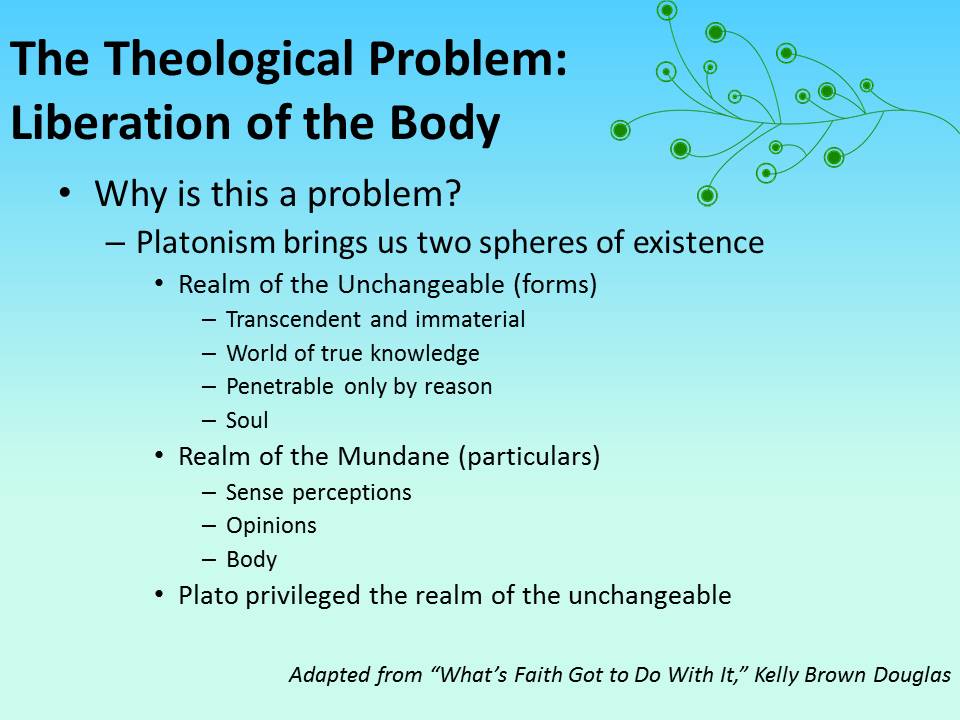
The Theological Problem: Liberation of the Body
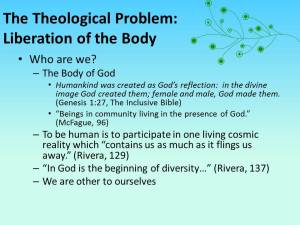
We are talking about liberating the body in a variety of forms. It is a theological problem that has developed from Platonism which brings us the realm of forms and particulars. In forms we have transcendence, the soul, and reason. This is the optimal way of being in the world. In the particulars, we have our senses, opinions, and our body. This is not the preferred way of being in the world. Separating ourselves into dualistic (tri-istic?) bits ignores that we are one integrated body and only one way to experience our senses.
Platonism impacts Christianity through an interpretation of Jesus’ ascetic personal practices. Then Paul, who was Greek and had a greater influence from Platonic sources, brought a more extreme sexual ethic into his writings.
Then, through the source of tradition, we then have Augustine who tells us that the body is sinful and that the soul and reason are to be preferred. This places God as “out there.” Away from the body because clearly, God is not sinful, therefore, even though the Divine is incarnational, the Divine has nothing to do with the body.
Maya Rivera, theologian, says, “This privileges “sameness over difference, of the One over the multiplicity, of the universal over the particular…in such systems there is no place for real otherness. Totalities reduce persons to categories.” (Rivera, 57)
However, Neale Donald Walsh reminds us of the inseparability.
“Your mind holds the past,
your body holds the present,
your soul holds the future.
Put another way,
the mind analyzes and remembers,
the body experiences and feels,
the soul observes and knows.”
So who are we really?
We are the body of the Divine participating in one diverse reality that would cast us all as other.
And who is the Divine?
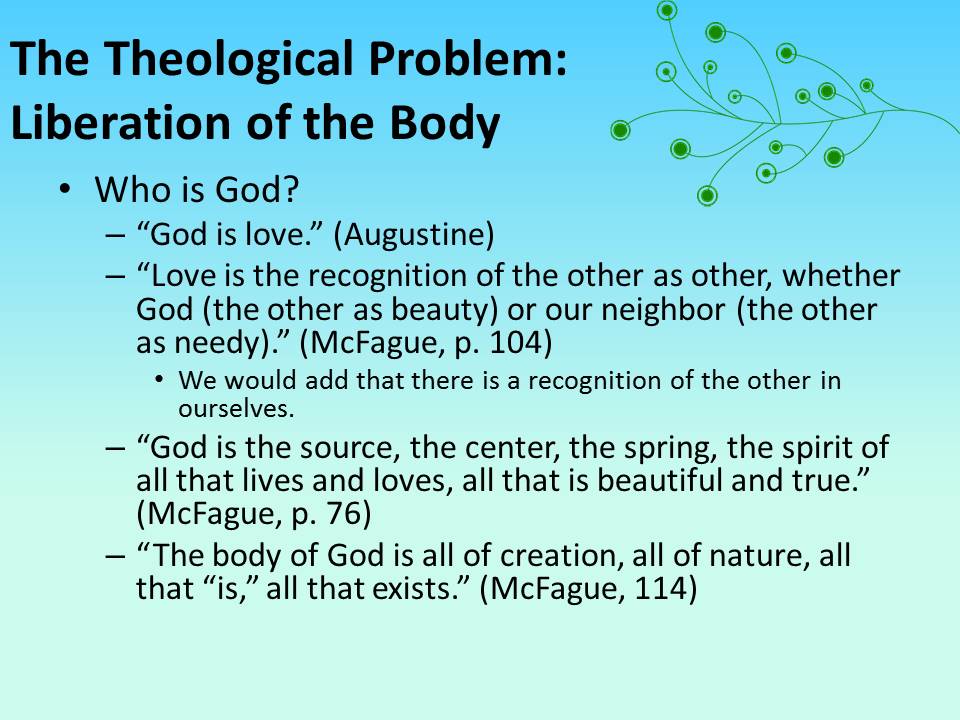
God is love in the recognition that we and all of creation exist together and yet the Divine is so much more. The source, the center, the spring of existence. The Divine is other, existence is other, and we are other to ourselves. And yet, we are all each an incarnational part of Love’s cosmic creation.
This approach to liberation of the body is through a demonstration of what it means for humans as sexual beings, humans as women and their body image, humans as the elder body, and humans as men. (Note: I would also consider that this is entirely too gendered, but it is a starting point.)
…
Liberation of the Sexual Body
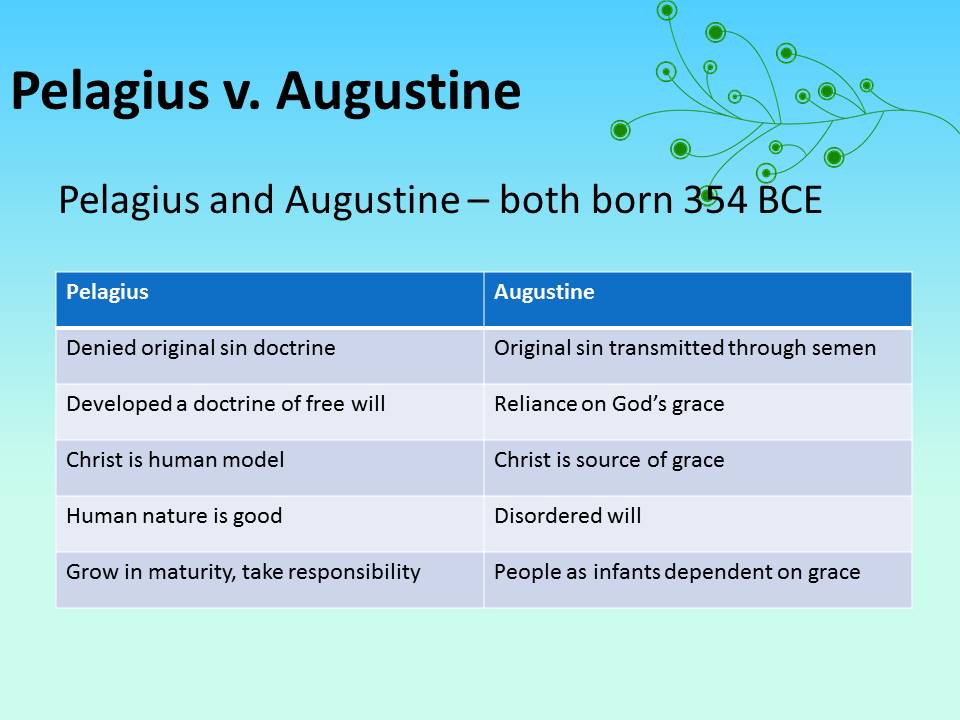
We are all sexual beings. Whether or not we have sex, we are sexual beings. In Western culture (and many others around the world), our sexuality is frowned upon. The appreciation for eros is limited. In ancient Greek, we have three words for love – agapos, philos, and eros. Each one describing a different aspect of love. Eros is believed to be that type of love that is the seat of creativity. In sexuality, we see this as the drive to have children – create! Some scholars believe that eros is the seat of all our creative desires. But our religious authorities rarely express this. This is because of a theological battle endured 1600+ years ago between Augustine and Pelagius.
If we had only chosen Pelagius! But the foundation is there to have a theology based in free-will and the idea that we are indeed born in a state of being good rather than in a state of being a worm. And it was good! Very, very good!
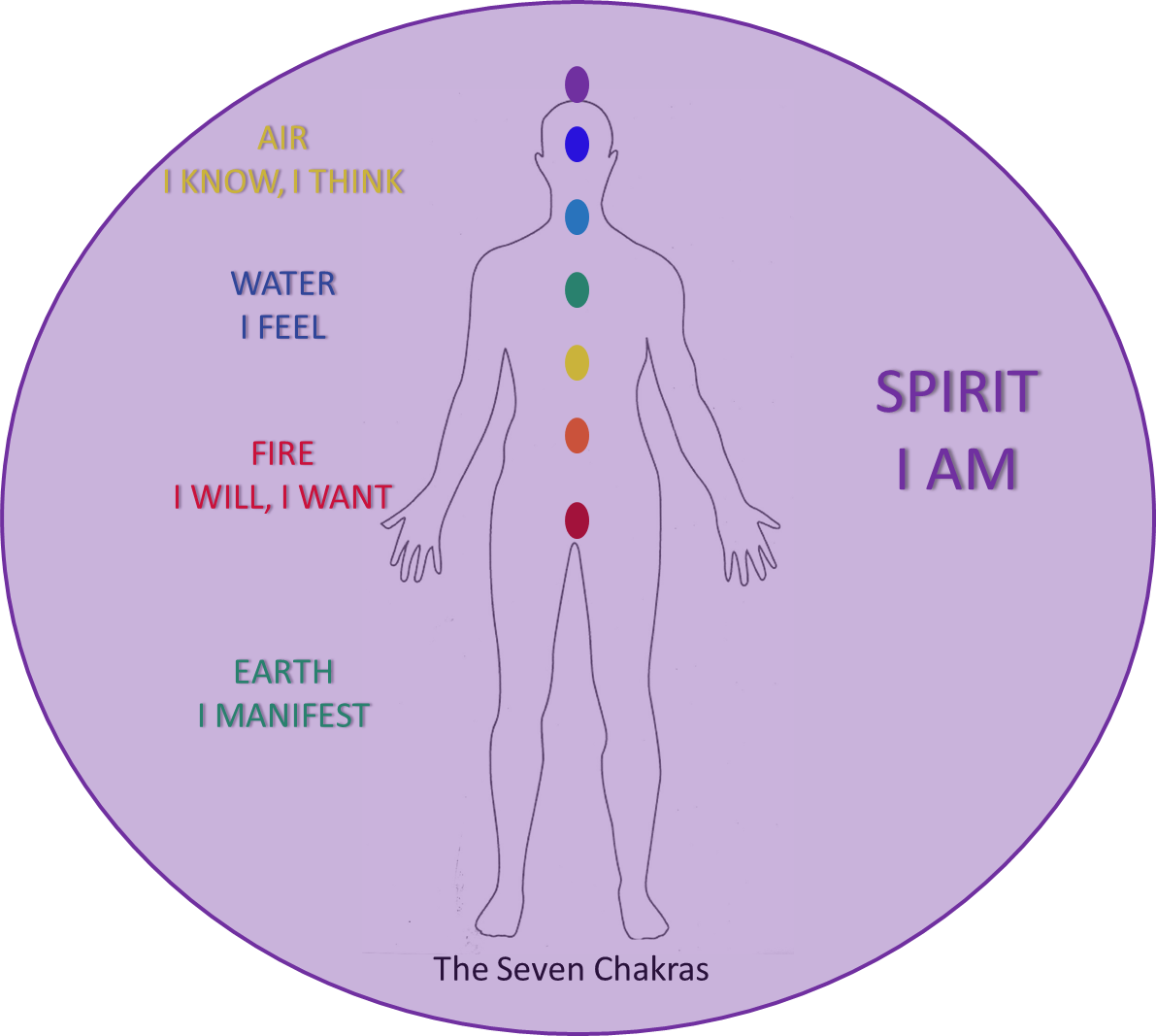
graphic created by Terri Stewart
The Unity Church developed a philosophy of “The 12 Powers.” Spiritual abilities that we are perfectly able to express and that are present in every person. These powers hold that the body is good, very very good! This connects very nicely to the Chakras as described in so many ways and visualized to the right.
But through it all, from the beginning to now, the body, mind, and spirit has been connected to our bodies. Pelagius knew that and we can see it. And our creative, generative bodies can also experience being liberated through the concept of liberating our own bodies to give and receive love. We are created, we create. That is the Divine circle of our eros bodies.
One way to experience a liberated body grounded in eros-creativity is through music and movement. I encourage you to listen to the below, simple music and to move your body however you will–without shame or reservation. Reach an arm to the sky! Roll your head from side-to-side! Sway! Thou shalt do what thou shalt do! And this is the end of part 1, laying the groundwork for a Liberation of the Body and using cultural items to show that we are already liberated! Let’s claim our sexual, eros selves as liberated beings.
Ara, Flora, and Taylor. Girls Making Media: Episode 4, “Body Image.” Written and presented by Ara, Flora, and Taylor. Produced by WomanKraft. Youtube.com. http://www.youtube.com/watch?v=u4GoHhnNhm4
Takayanagi, Paul, Journal of Religious Gerontology, Volume 10, The Institute of Spirituality and Aging: Identifying and Promoting Spiritual Values of Elders, The Hawthorne Press, Inc. 1996
Cole, Thomas, R., The Journey of Life: A Cultural History of Aging in America, The Body As an Instrument of Control, “Women, Aging and Ethics”, New York: Cambridge University Press, Inc. 1992.
The Robert Wood Johnson Foundation, Last Acts – Rallying Points To Improve Care and Caring Near End of Life, National Resource Center on Diversity, “Diversity Notes”, September 2002.
Book FHR.com, “Better Access For Disabled Passengers at Prestwick Airport”, posted by Graham Greenaway October 9, 2008, http://www.fhr_net.co.uk/travel- news/1467/better_access_for- disabled_passengers_at_prestwick_airport
see it moving – Life!
moving through the ache of time
seeking that place
where identity isn’t worn on a sleeve,
where individuals challenge the tribe,
where beauty frees itself from convention,
where the chain of fear dissolves
JAMIE DEDES (The Poet by Day)~ I am a mother and a medically retired (disabled) elder. The graces of poetry, art, music, writing and reading continue to evolve as a sources of wonder and solace, as a creative outlet, and as a part of my spiritual practice.
 I’ve been known to chat with birds in public places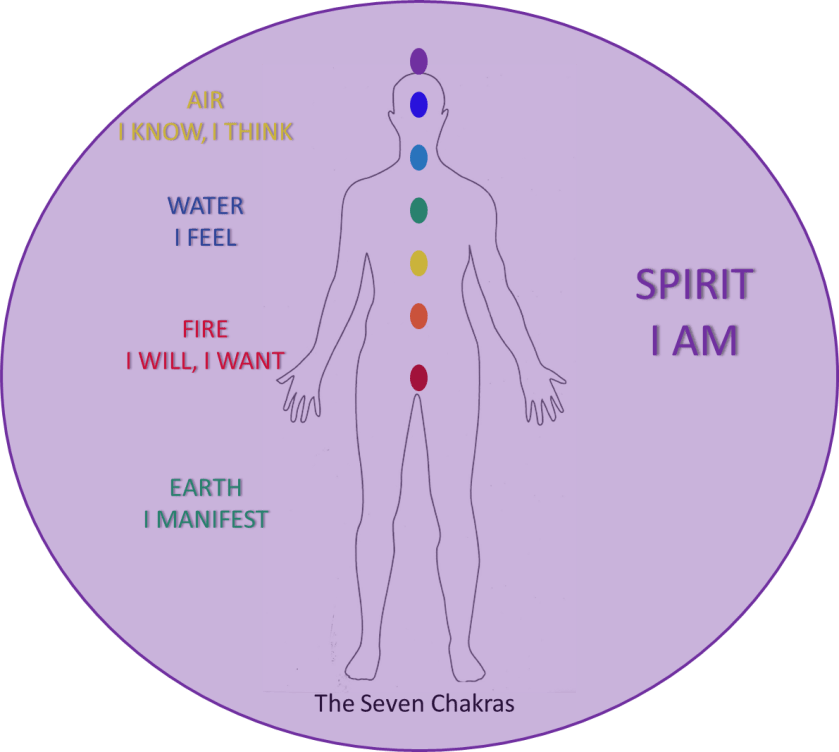





 The BeZine