
The first post in this series is HERE.
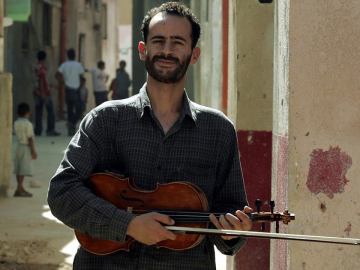 Music, the language of the soul
The cultural Intifada*…From stones to musical instruments.
The story of Ramzi Abu Radwan.

They impressed the world
And all they had in their hands were stones
They lit like lanterns, and came like messengers
From “children of the stones” Nizar Quabbani (1923-1998), Syrian poet and publisher
The first Intifada is the Palestinian uprising against the Israeli occupation that started on December 1987 in Jabalia** refugee camp and spread throughout the rest of Gaza, the West Bank and East Jerusalem. It lasted six years until the signing of Oslo Accords in 1993.
It was an unarmed, spontaneous yet exploding uprising, men with their faces covered with keffiyehs***, women and children with nothing but stones, slingshots and Molotov cocktails faced tanks and live ammunition of well-trained, heavily equipped Israeli soldiers.
 One of those children, a kid wearing blue jeans and a red jacket whose picture reached the world newspapers became a legendary symbol of the Intifada, a skinny kid throwing stones at an army jeep, his eyes welled with tears, on his face a mixture of anger, fear and defiance. This kid, whose picture was reproduced in posters all over the world as an icon of the uprising, never knew that his destiny will change forever and he will become a visionary artist.
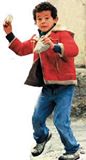
This was Ramzi Aburadwan, born in Bethlehem in 1979, he spent his childhood and first teenage days in a refugee camp in Ramallah where his family was forced to live after the Nakbah****, his best friend died on their way home from school during a military operation, he was eight when a journalist took a picture of him hurling stones and was later called “the iconic child of the Intifada”.
Ramzi was introduced to music at the age of 17, when a woman invited him to attend a course, he immediately loved it and this was the beginning of his journey with music.
After a year of study in the Edward Said National Conservatory of Music at Birzeit University, he received a scholarship to study in a Conservatoire in France; on 2005 he went back to Palestine after graduation with dreams and promises of a brighter life for children.
 The multi-talented Aburadwan founded Al Kammanjati*****, a nonprofit organization that offers children especially from refugee camps music lessons, its aim is to keep them in touch with their cultural heritage, develop and nurture their skills and create an intimately entertaining atmosphere away from the violence and frustrations of their daily life under occupation. It gave them a precious chance to travel, play with different orchestras and meet young musicians from all over the world. Classical music is also introduced as a valuable weapon in the so called “the cultural Intifada” a peaceful way of resistance to save Palestinian culture and identity through letters, art and musical notes, something Palestinians began to understand with time because of Israeli policy of extensive judaisation of the land and fierce attempts to bury and distort Palestinian history and heritage.
He takes part in the West Eastern Divan Orchestra directed by Israeli-Argentine born conductor and pianist Daniel Barenboim who said about him:
“Aburadwan has transformed not only his life, his destiny but that of many, many, many other people, this is an extraordinary collection of children all over Palestine that have all been inspired and opened to the beauty of life”
Al Kammanjati was honoured by “prince Klaus award” from the Netherlands in 2006.
* Intifada: Arabic word for “uprising”-Bethlehem, Ramallah: Palestinian cities in the West Bank.
**Jabalia: a refugee camp in the North of Gaza.
***Keffiyeh: a traditional black and white Middle Eastern cotton scarf, later considered a symbol of Palestinian nationalism and solidarity
***Bethlehem, Ramallah: Palestinian cities in the West Bank.
****Nakbah: Arabic word for “catastrophe” refers to the mass expulsion of more than 750.000 Palestinians from their lands in 1948 and creating a state of Israel on the occupied land.
****
*Al Kammanjati: Arabic word for “the violinist”

A concerto for stone and violin:
The story of this generous musician and fighter inspired me to write this poem
A Poem for Ramzi Abu Radwan
The meditation of stone
In my hand
Is my song of freedom
That even your bullets
Can never pierce
Look at me
I am the child of the Intifada
These Palestinian hands
That were uprooted from my village
Like olive trees
And grew up in a camp
Small and scratched
will braid another song
From strings of a violin
Years pass
And the weeping violin
In my exiled soul
Will always remain
My song of freedom
That even your oppression
Can never silence
– Imen Benyoub
A portrait of the man:
The man’s music:
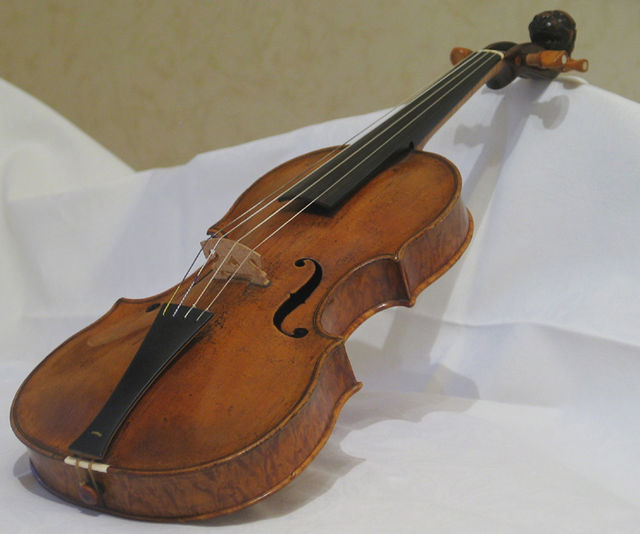
© 2014, essay and poem, Imen Benyoub, All rights reserved; Photograph (1) Ramzi Abu Radwan, adult and child, courtesy of Mr. Abu Radwan and ramallah cafe; photo of violin courtesy of Frink54 via Wikipedia under CC BY-SA 3.0; musical notations courtesy of Sprouls via Wikipedia under CC BY-SA 3.0.

 The BeZine