Posted in Blaga Todorova, poem, Poems/Poetry, poetry

I Can Write Another Poem Tonight

450px-Tango-Show-Buenos-Aires-01After Pablo Neruda …

I can write another poem about the distance tonight.
Something about chants over shivering seconds and stolen lights,
about his mahogany eyes and forgotten Milonga dance.

But the night burns with treacherous sparks,
with thousand butterflies over cliffs and tides.

I can write another poem about him, how I craved
his lips, his words, his hands and sometimes he did too.

In nights like this, within crested dreams, he desired me
and sometimes I did too. And how couldn’t I?
The world in his eyes, I was the only one allowed inside.

I can write another poem about love and passion under
the never-ending violin sounds and voluminous skies;

when I know that everything is bound to break,
even the perfect curves chasing the ocean.

To feel that with every crash of the waves I have lost him.
To hear the whispers of his soul, faraway whispers,
even more without him,

when the night ignites under the moonlight and
poetry drops heavily on my heart, just like
the rain that strikes everything dead or alive.

And that’s all there is. In the distance someone plays
Morricone on the piano. In the distance.

My mind does not know harmony. My heart searches for his.
My voice longs for the breeze that would carry my secrets to him;

how I no longer hate the darkness of the night without him,
it’s true, but maybe I still do. Longing comes so suddenly, settles
comfortably in the shape of a precious hug and never dies.

Because in nights like this he always held me in his arms,
through the imaginary miles apart,
while poetry drifted into the distance, silently, lilac like and sad …

– Blaga Todorova

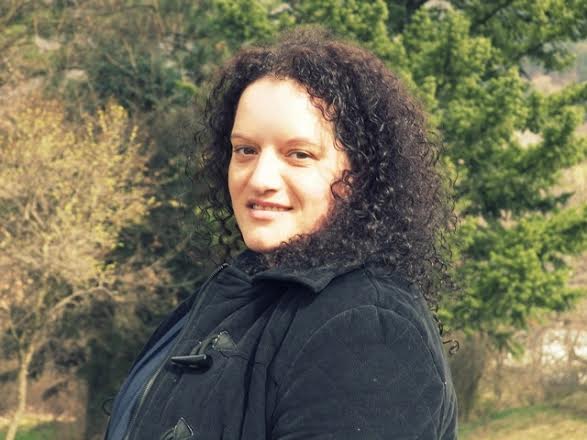
© 2014, poem and protrait (below), Blaga Todorova; photo credit ~ Dancing Tango in Buenos Aires by Jenny Mealing and licensed under the CC A 2.0 Generic license.

unnamed-6BLAGA TODOROVA (Between the Shadows and the Soul) ~ was born in Bulgaria, lives in Greece and doesn’t stop dreaming about finding new country for herself. She doesn’t consider herself a writer, but just someone who sometimes is lucky enough to be at the right place, with the right person, with the background of the right music that will bring the right words.

Blaga has been blogging for many years now and has won the friendship and following of other poets and writers for her insights, humor and sense of romance and of justice. English is not her first language, but she uses it well and it is her favorite language for her favorite artisitic persuit, writing. She has a novel in progress. She is also a rather accomplished photographer.

Although we believe Blaga was named for a relative, it is interesting to note that she shares her lovely first name with Blaga Dimitrova, the Bulgarian poet and former Vice President of Bulgaria (1992-1993) who was the inspiration for John Updike’s short story, The Poetess. We have invited Blaga Todorova to write about Blaga Dimitrova and hope to present that work on The Bardo Group blog one day.

Posted in Charles W Martin, Nature, poem, Poems/Poetry, poetry

first kiss…

first kiss

morning doves takes flight
kissing the sky with their wings
sky’s cloudy cheeks blush

678ad505453d5a3ff2fcb744f13dedc7-1product_thumbnail.php41V9d9sj5nL._SY344_PJlook-inside-v2,TopRight,1,0_SH20_BO1,204,203,200_CHARLES W. MARTIN (Reading Between the Minds) — earned his Ph.D. in Speech and Language Pathology with an emphasis in statistics. Throughout Charlie’s career, he maintained a devotion to the arts (literature/poetry, the theater, music and photography). Since his retirement in 2010, he has turned his full attention to poetry and photography. He publishes a poem and a photographic art piece each day at Read Between the Minds, Poetry, Photograph and Random Thoughts of Life. He is noted as a poet of social conscience. Charlie has been blogging since January 31, 2010. He has self-published a book of poetry entitled The Hawk Chronicles and will soon publish another book called A Bea in Your Bonnet: First Sting, featuring the renown Aunt Bea. In The Hawk Chronicles, Charlie provides a personification of his resident hawk with poems and photos taken over a two-year period. Charlie’s lastest book, When Spirits Touch, Dual Poetry, a collaboration with River Urke, is available through Amazon now.

Posted in poem, Poems/Poetry, poetry

night-blooming lovers

file0001371332238 maybe a thing about particles and waves
or wave-particles and the way light works
and moves, the way soulmates’ eyes ignite
into stardust, the way some ancient god

smiled and blinked, flicked an able wrist
to strew some billion stars across a darkly
barren sky, then asked his goddess to
suspend the yellow moon, a caress so

softly lighted, it stirred the hopeful hearts of
night-blooming lovers into endless devotion,
though for sure the years run like the cheetah
and soon-or-late all hearts quake asunder,
just as sure as moonlight and stardust and
the way a true love fills in the fault lines

– Jamie Dedes

© 2013, poem, Jamie Dedes, All rights reserved
Photo courtesy of morgueFile

A ROMANTIC VALENTINE’S DAY POST because Valentine’s Day itself will be devoted to our BLOGGERS IN PLANET LOVE event, which will start on Valentine’s Day at 7 p.m., that is Friday, February 14. We invite writers, poets, artists, musicians and other creatives to join in by linking your work that shares your appreciation for the beauty of nature or your concern for environmental issues. You can share the url to your post via Mr. Linky, which will stay up for seventy-two hours. Corina Ravenscraft (DragonDreams) hosts and Jamie Dedes (The Poet by Day) will visit sites and comment. We hope you will also visit others and comment on their work, lending support and encouragement.

photo-on-2012-09-19-at-19-541JAMIE DEDES (The Poet by Day)~ I am a mother and a medically retired (disabled) elder. The graces of poetry, art, music, writing and reading continue to evolve as a sources of wonder and solace, as a creative outlet, and as a part of my spiritual practice.

Posted in Jamie Dedes, Poems/Poetry

I Remember the Amber Moon

file3761333734081When I remember you
I remember the amber moon
the burnished brown of the old oaks
their leaves like hands waving goodbye
As dusk transitioned to dark, stars alight,
we sat on the beach by slow cooking-fires,
their coals gone from hard black to gray dust
I cherished your warm hug in the chill of the night
and falling asleep, safe

I stopped loving you,
but I never stopped loving the memory of you
I carry that with me on lunatic trips of the heart ~
though my preference is to rest solitary on forest logs
with their stunning imperfections and
the secret-lives swirling in the sunless damp on which they rest

I think of the path that led from then to now,
a mix of smooth and rough along a rocky coast
I live near the sea to breath
I imagine you living, wherever you are
by an ocean with your skin still smelling of Old Spice,
with your well-formed hands, the hands of a pianist and surgeon,
and the high-tensile strength of your mind

In the odd geography of life, no one knows where we came from
or how it was, how it felt to be us in the days of promise
when the spell of Hudson Bay felt like a prayer to St. Christopher
That bay is no longer our safe harbor,
but it gave us our sturdy roots and strong wings
and so the nights, the nights by this bay are good
When I smile at the amber moon, it smiles at you

– Jamie Dedes

© 2013, poem, Jamie Dedes, All rights reserved 
Photo credit ~ Anne Lowe, Public Domain Pictures.net

Photo on 2012-09-19 at 20.00JAMIE DEDES ~ My worldly tags are poet and writer. For the past five years I’ve blogged at The Poet by Day,the journey in poem, formerly titled Musing by Moonlight.  Through the gift of poetry (mine and that of others), I enter sacred space.

Posted in Essay, memoir, Naomi Baltuck

Mom Always Said…

Hope for the best, expect the worst, and try not to be disappointed.   My mother’s life philosophy was actually pretty upbeat for a kid whose family lost everything during The Great Depression, including her father, who died of Brain Fever when she was only eight.  Grandma Rhea supported her children by sewing and taking in wash.  My mom shared a bed with Grandma, so they could rent out her room to make ends meet.  But they didn’t always quite make it.  In the freezing Detroit winters, they nailed blankets over the windows because they couldn’t afford coal to heat the house.

Their only book was the family bible.  But Mom found a copy of Alice in Wonderland in a box of textbooks left by a renter.  She read it cover to cover.  As soon as she finished, she turned back to the first page and started over.  She had discovered her passion and her escape–in books.

Mom was the first in her family to attend college, working her way through by reading to blind students.  A person of quiet, if impractical passions, Mom passed on normal school and secretarial school to study Classical Greek and Latin, French, German, and Russian.  Italian, too, but she said that hardly counted.  “After Latin,” Mom said, “Italian is a snap.”

I remember going home from college to visit one weekend.  There were index cards by Mom’s reading chair, on the kitchen windowsill, on the nightstand by her bed.  They had strange writing on them.

“It’s Greek,” she explained.  “Passages from The Iliad, by Homer.”

“Why?” I asked.

“I’m memorizing it,” she said.

“But why?”

“For fun, dear.  After I’ve memorized The Iliad, I’m going to memorize The Odyssey.”

As a young college grad, she had never shown any interest in men, and was still living at home while working for the War Department.  Grandma planned on having a spinster daughter to keep her company in her old age, unaware that Mom had already promised herself she would move out and find a place of her own by her 25th birthday, if she hadn’t gotten married by then.   Mom just hadn’t met her intellectual equal.  Then Harry Baltuck came along.

He was handsome, funny, brilliant; every woman in the office had her eye on him.  But he had eyes only for Mom.  She was so nervous on their first date that she threw up in his car.  Actually, she threw up every time they went out.  “But he kept coming back,” she said, laughing.

He was intrigued, and not just because she was determined to remain a virgin until her wedding night.  It was a very quick courtship.

His proposal wasn’t exactly story book.  “Well, what if we made it legal?” he asked.

“Would you wear a ring?” she countered.  And the rest is family history.

They traveled many peaks and valleys in their time.  They had seven children and eighteen years together.  She was still young when widowed, and Mom received several proposals from Daddy’s friends and army buddies; some decent and well-intended, others not so much.  But Mom didn’t take anyone up on his offer.  She never remarried, or even dated.  Books, once again, became her passion and her escape.

In 1989, I sat at her bedside as she lay dying of cancer.  It had been a long hard battle.  Mom looked up and caught her breath.  “Harry,” she whispered.

“What did you say, Mom?” I asked.

“Harry!”  She pointed toward the door, but I saw nothing there.

“Mom, do you see someone?”

“It’s Harry,” she said, nodding.  “He’s standing right there.”

Was it the delusion of a dying woman?  Or the love of her life, who had been patiently waiting for twenty-five years to take her home?

Let’s hope for the best.  Just like Mom always said, you have to hope for the best.

All images and words c2012 Naomi Baltuck

NaomiPHOTO1-300ppi51MC3SKEF0L._SY300_NAOMI BALTUCK ~ is a Contributing Editor and Resident Storyteller here at Bardo. She is a world-traveler and an award-winning writer, photographer, and story-teller whose works of fiction and nonfiction are available through Amazon HERE. Naomi presents her wonderful photo-stories – always interesting and rich with meaning and humor – at Writing Between the Lines, Life from the Writer’s POV.

Naomi also conducts workshops such as Peace Porridge (multicultural stories to promote cooperation, goodwill, and peaceful coexistence), Whispers in the Graveyard (a spellbinding array of haunting and mysterious stories), Tandem Tales, Traveling Light Around the World, and others. For more on her programs visit Naomi Baltuck.com

Posted in Essay, Guest Writer

FROM HARPY’S REVIEW: The 10 Top Relationship Words That Aren’t Translatable Into English

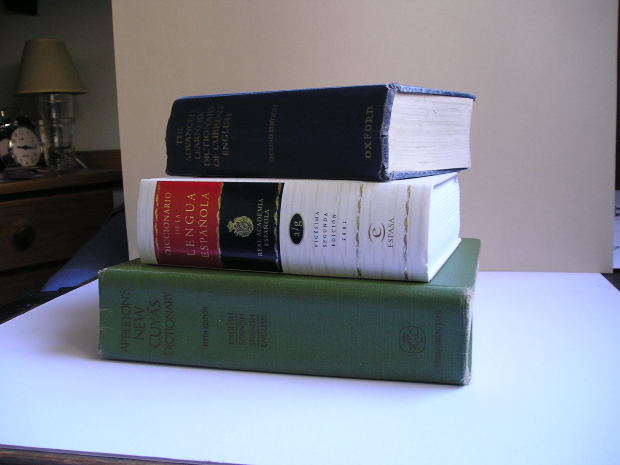
OLYMPUS DIGITAL CAMERA

Published here with the permission of the author, Pamela Haag, who did the original research and writing. It was published on November 18, 2011 on The Big Think, which hosts Pamela’s blog, Harpy’s Review.  I thought it an interesting piece. Apparently, so did a lot of others.  It was blogged and reblogged often and generally without Pamela’s analysis and often without attribution to her. It took a bit of doing to find the source. All other postings I found of this piece were dated subsequent to Pamela’s. J.D.

Here are my top ten words, compiled from online collections, to describe love, desire and relationships that have no real English translation, but that capture subtle realities that even we English speakers have felt once or twice. As I came across these words I’d have the occasional epiphany: “Oh yeahThat’s what I was feeling…”

Mamihlapinatapei (Yagan, an indigenous language of Tierra del Fuego): The wordless yet meaningful look shared by two people who desire to initiate something, but are both reluctant to start. 

Oh yes, this is an exquisite word, compressing a thrilling and scary relationship moment. It’s that delicious, cusp-y moment of imminent seduction. Neither of you has mustered the courage to make a move, yet. Hands haven’t been placed on knees; you’ve not kissed. But you’ve both conveyed enough to know that it willhappen soon… very soon.

Yuanfen (Chinese): A relationship by fate or destiny. This is a complex concept. It draws on principles of predetermination in Chinese culture, which dictate relationships, encounters and affinities, mostly among lovers and friends.

From what I glean, in common usage yuanfen means the “binding force” that links two people together in any relationship.

But interestingly, “fate” isn’t the same thing as “destiny.” Even if lovers are fated to find each other they may not end up together. The proverb, “have fate without destiny,” describes couples who meet, but who don’t stay together, for whatever reason. It’s interesting, to distinguish in love between the fated and the destined. Romantic comedies, of course, confound the two.

Cafuné (Brazilian Portuguese): The act of tenderly running your fingers through someone’s hair.

Retrouvailles (French):  The happiness of meeting again after a long time.

This is such a basic concept, and so familiar to the growing ranks of commuter relationships, or to a relationship of lovers, who see each other only periodically for intense bursts of pleasure. I’m surprised we don’t have any equivalent word for this subset of relationship bliss. It’s a handy one for modern life.

Ilunga (Bantu): A person who is willing to forgive abuse the first time; tolerate it the second time, but never a third time.

Apparently, in 2004, this word won the award as the world’s most difficult to translate. Although at first, I thought it did have a clear phrase equivalent in English: It’s the “three strikes and you’re out” policy. But ilunga conveys a subtler concept, because the feelings are different with each “strike.” The word elegantly conveys the progression toward intolerance, and the different shades of emotion that we feel at each stop along the way.

Ilunga captures what I’ve described as the shade of gray complexity in marriages—Not abusive marriages, but marriages that involve infidelity, for example.  We’ve got tolerance, within reason, and we’ve got gradations of tolerance, and for different reasons. And then, we have our limit. The English language to describe this state of limits and tolerance flattens out the complexity into black and white, or binary code. You put up with it, or you don’t.  You “stick it out,” or not.

Ilunga restores the gray scale, where many of us at least occasionally find ourselves in relationships, trying to love imperfect people who’ve failed us and whom we ourselves have failed.

La Douleur Exquise (French): The heart-wrenching pain of wanting someone you can’t have.

When I came across this word I thought of “unrequited” love. It’s not quite the same, though. “Unrequited love” describes a relationship state, but not a state of mind. Unrequited love encompasses the lover who isn’t reciprocating, as well as the lover who desires. La douleur exquise gets at the emotional heartache, specifically, of being the one whose love is unreciprocated.

Koi No Yokan (Japanese): The sense upon first meeting a person that the two of you are going to fall into love.

This is different than “love at first sight,” since it implies that you might have a sense of imminent love, somewhere down the road, without yet feeling it. The term captures the intimation of inevitable love in the future, rather than the instant attraction implied by love at first sight.

Ya’aburnee (Arabic): “You bury me.” It’s a declaration of one’s hope that they’ll die before another person, because of how difficult it would be to live without them.

The online dictionary that lists this word calls it “morbid and beautiful.” It’s the “How Could I Live Without You?” slickly insincere cliché of dating, polished into a more earnest, poetic term.  

Forelsket: (Norwegian):  The euphoria you experience when you’re first falling in love.

This is a wonderful term for that blissful state, when all your senses are acute for the beloved, the pins and needles thrill of the novelty. There’s a phrase in English for this, but it’s clunky. It’s “New Relationship Energy,” or NRE.  

Saudade (Portuguese): The feeling of longing for someone that you love and is lost. Another linguist describes it as a “vague and constant desire for something that does not and probably cannot exist.”

It’s interesting that saudade accommodates in one word the haunting desire for a lost love, or for an imaginary, impossible, never-to-be-experienced love. Whether the object has been lost or will never exist, it feels the same to the seeker, and leaves her in the same place:  She has a desire with no future. Saudade doesn’t distinguish between a ghost, and a fantasy. Nor do our broken hearts, much of the time.

– Pamela Haag

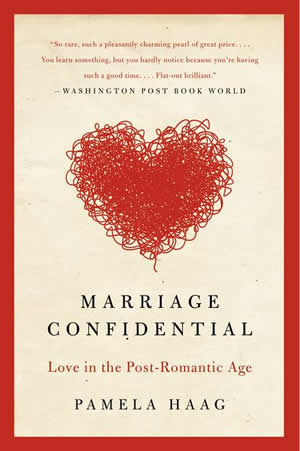
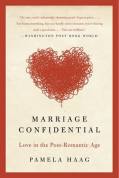
© 2011, Pamela Haag, All Rights Reserved, posted on Into the Bardo with permission, bookcover design (below) courtesy of HarperCollins, All rights reserved
paperback_300PAMELA HAAG’S work spans a wide, and unusual, spectrum, all the way from academic scholarship to memoir. Thematically, it has consistently focused on women’s issues, feminism, and American culture, but she’s also written on topics as eclectic as the effort to rebuild the lower Manhattan subway lines after 9/11, 24-hour sports radio talk shows, and the experience of class mobility.

Haag’s latest book, Marriage Confidential: The Post-Romantic Age of Workhorse Wives, Royal Children, Undersexed Spouses, and Rebel Couples Who Are Rewriting the Rules, released by HarperCollins in May of 2011, draws on all of these strands of Haag’s unique professional biography to create almost a new genre, a weave of academic expertise, cultural history, creative nonfiction, memoir, storytelling, interviews, and commentary. Pamela’s blog, Harpy’s Review is hosted by Big Think. She writes a regular column, Marriage 3.0, for Psychology Today.