Posted in General Interest, The BeZine Table of Contents, TheBeZine

July 2016, Vol.2/Issue 10; Faith in Things Seen and Unseen

If the doors of perception were cleansed every thing would appear to man as it is, infinite.
For man has closed himself up, till he sees all things thro’ narrow chinks of his cavern.
The Marriage of Heaven and Hell, William Blake

Faith! In the discussions here you won’t find consistent perspective or theology. You will find faith explored in its many manifestations, religious and otherwise. You’ll find it both shaken and unshakable and in things of the spirit, in nature and humanity, in intuition and in self and family. Unity here is not in things creedal but in the shared values of peace, sustainability and social justice and for many of us – implicitly – in ultimate salvation through artistic expression.

Unitarian Universalist Minister, Rev. Ben Meyers, starts us with an appeal to religions to give their prayers and vigils legs, to befriend one another into the groundswell of local social justice initiatives that ultimately help to inform and bolster global efforts toward equity, justice and peace.This couldn’t be more appropriate as The BeZine “went to press” amid news reports of yet more violence.

You will find our usual diversity represented: skepticism and atheism, the three Abrahamic traditions, shamanism, and the mystical perspectives of Buddhism, Hinduism and Sufism.

Our special selection of lead features and poems are by: shamanic practitioner and psychotherapist, Michael Watson; resident skeptic, James R. Cowles; the always engaging and level-headed analyst, Priscilla Galasso; the fallen altar boy, poet Joe Hesch; professional story-teller and photographer, Naomi Baltuck; our renaissance man in Sheffield, John Anstie; and university librarian, poet and artist, Corina Ravenscraft, on the ultimate triumph of the Universe.

Speaking from positions of their unshakable religious faith are: Algerian poet, Imen Benyoub, on the spiritual joys and family and community connection she finds in the holy tradition of Ramadan; Catholic Theologian, Fr. Daniel S Sormani, theology professor at Ateneo de Manila University, warmly writes about lessons learned from the homely life of the Blessed Virgin Mary; and our gentle Italian literary contributor, Mendes Biondo, tells of inspiration from the Bishop of Hippo Regius (current Annaba, Algeria), St. Augustine. Imen and Mendes are our two student contributors.

Two of our contributors allude to child sexual abuse but a third, Terri Muuss, addresses it head-on and in depth. These are experiences that may strengthen faith in self, though that doesn’t come without pain and work. Terri is featured this month in our popular “Getting to Know You” section.

Our July poetry collection covers matters spiritual, emotional and environmental with excerpts from published collections by Zine regulars: Matt Pasca, Terri Muuss, Myra Schneider, Silva Merjanian and Michael Dickel, contributing editor to The BeZine. With joy we welcome back two lights: German poet, photographer and educator, Dr. Aprilia Zank and English poet, Patricia Leighton.

New to our pages in this issue are:

  • Connie Spearing  who writes of finally “seeing” her Irish grandmother with the accidental discovery of her family’s history during and after World War 1.
  • Sandra Renew’s s poetry expresses her opinions on the state of the world. She wonders who sleeps at night? Who is lucky enough to live in safety and peace?
  • Anca Mihaela Bruma, citizen of world, educated in Rumania, is a poet who writes spiritual autobiography. Anca wanted to incorporate some lovely music and art into her posts. Due to copyrights in one case  (Dorina Costras’ art) and technical incompetence (mine) in the other, we are unable to share Dorina’s paintings or Anca’s soundcloud recordings. However you can view Dorina’s work HERE. You can listen to Anca on soundcloud HERE.

****

One last word: DON’T FORGET TO SAVE THE DATE Saturday, 24 September 2016 is The BeZine’s 100,000 Poets for Change, an event which we host virtually.  This event is part of an  important annual arts initiative for global solidarity and peace, social justice and sustainability. Reader participation is invited and encouraged. This is a good time to share your work in the service of a worthy cause.  As is our tradition, all submissions will be archived here and at Standford University. Instructions for participation will be provided on our blog that day with Michael Dickel serving as Master of Ceremonies.  Between Michael and me, the event will run from morning in Israel to midnight in California. The theme this year is Environment/Environmental Justice. More detail HERE.

****

Now, come friends.  Read.  Nourish yourselves at our table …

In the spirit of peace, love and community
and on behalf of The Bardo Group Beguines,
Jamie Dedes
Founding and Managing Editor
The BeZine

EDITORIAL

The World in Vigil, by Rev. Ben Meyers

THEME: FAITH IN ALL THINGS SEEN and UNSEEN

Lead Features

Knowing, Michael Watson
Varieties of Faith – Rational and Religous, James R. Cowles
Faith Means Making Choices, Priscilla Galasso
A Perfect World, Naomi Baltuck
Falling But Willing, Joseph Hesch
The Pine Cone Project, John Anstie
Regarding Faith, Corina Ravenscraft

Essays

A Month of Light, Imen Benyoub
The Blessed Mother: She Reminds Me of Who I Am and Who I Should Be, Fr. Daniel S. Sormani, C.S.Sp.
A Little Story of Faith, Mendes Biondo
NOTIONS OF THE SACRED: Poetry as Spritual Practice, Jamie Dedes
The Grandmother I Didn’t See, Connie Spearing

Speculative Flash Fiction

Moshe’s House in Space, Michael Dickle

Poetry

Rhetoric Introspection, Anca Mihaela Bruma
Our Autumn Spring, Anca Mihaela Bruma
Hindsight, Anca Mihaela Bruma

Unidos en Cristo, a poem in English y en español, Jamie Dedes

Three Poems, Michael Dickel
En Gedi, Michael Dickel
Hybrid: Warm Hunger, Michael Dickel

Lost Behind Clouds in Skies of Blue, Joseph Hesch
Hang in There, Joseph Hesch

And the Village Still Sings for Taha Muhammad Ali, Patricia Leighton

Coverage, Silva Merjanian

Passing, Terri Muuss
What Heals, Terri Muuss

Tanyou (In Search of Quietude), Matt Pasca
Silence, Matt Pasca
Toll, Matt Pasca
When Joy Breaks, Matt Pasca

Bring all those who are led astray out of the desert, Sandra Renew

3 a.m., Myra Schneider

prayer for shadows, Aprilia Zank

GETTING TO KNOW YOU

Terri Muuss, Over Exposed

CONNECT WITH US

IMG_0234Beguine Again, Spiritual Community and Practice

Facebook, The Bardo Group Beguines

Twitter, The Bardo Group Beguines

Access to the biographies of our core team, contributing writers and guest writers is in the blogroll where you can also find links to archived issues of The BeZine (currently in the process of updating), our Mission Statement and Submission Guidelines.

Posted in The BeZine, The BeZine Table of Contents

June 2016, Vol. 2/Issue 9; The Joys of Friendship

June 15, 2016

“Friendship improves happiness, and abates misery, by doubling our joys, and dividing our grief” Marcus Tullius Cicero

Friendship: Such a homely topic and yet where would we be without friends, whether from childhood or new to us in retirement, whether with family, schoolmates, coworkers, online or in the flesh, our friends do indeed double our joys and make our grieving more bearable. Friends may share specific times in our lives or specific values and interests. Each friend is without a doubt among the great treasures of life and living.

This month our contributing writers and our guests explore the wide range of friendships, their observations and notably, their gratitude. From newborn friendships to one that has stood the great test of time and is in its sixtieth year, from friends who share our family life to those who accompany us in retirement, all are savored this month.

Many of our reader-faves are back this month. Writing on theme Contributing Editor Priscilla Galasso, and Contributing Writers John Anstie, Corina Ravenscraft, Naomi Baltuck, Liliana Negoi and Charlie Martin. Frequent guest contributors Imen Benyoub and Aprilia Zank share their world-class poetry.

Poet Maggie MacKay debuted with us last month. We’re delighted to bring another of her poems to you today. We extend a warm welcome to poet Patricia Leighton, new to our pages.

Fathers can be our greatest champions and friends and we celebrate Father’s Day with Juan Felipe Herrera, former poet laureate of the United States. He’s a joy. Don’t miss that feature.

In our “More Light” section: We continue our well-received “Getting to Know You” series this month with interviews of Silva Merjanian, a frequent guest contributor, and Michael Watson, a member of the Bardo team from almost the beginning.

With Michael we also explore the consequences of disability in a special collection of features on illness and disability. You’ll find an inspiring piece there about a heroic friend of mine who, despite being legally blind, continues to ply her passion, fine art photography.

Contributing Writer, Joe Hesch, and Mendes Biondo – Mendes debuted with us last month – share their world class poety.

Among the features included in “More Light” is M.J. Tenerelli’s article about the process of publishing a poetry collection – Grabbing the Apple, An Anthology of New York Women Poets – which just launched a few weeks ago A long-time friend of The Bardo Group Beguines, Dutch nature artist, Paula Kuitenbrouwer, shares the tranquility in her art, “Lotus Plant” and “Lotus Pond and Tortoise.”

Enjoy all and thank you for being the peace.

On behalf of The Bardo Group, Beguines, and in the spirit of peace, love and community,
Jamie Dedes
Founding and Managing Editor

FRIENDSHIP

Features

Friendship and the Serious Introvert, Priscilla Galasso
You Rock, Naomi Baltuck
Musings on Friendship, Corina Ravenscraft
There Are Friends … and there are Friends, John Anstie
Bonds, Liliana Negoi

Poetry

scars and stars, Imen Benyoub
Eyeing the Landscape, Patricia Leighton
Musing on a Sixty-Year Friendship, Maggie MacKay
of lovers and friends, Charles W. Martin
you really didn’t say that, Charles W. Martin
re: your account, Charles W. Martin
photographs, Aprilia Zank

HAPPY FATHER’S DAY

Father’s Day with Juan Felipe Herrera, Performance Artists and former California Poet Laureate

MORE LIGHT

Special Section: Disability

Illness, Disability and Servitude, Michael Watson
Living …. the operative word …. With Disability, Jamie Dedes
Legally Blind Photographer, Wendy Alger, Jamie Dedes

Feature

“Grabbing the Apple” … or, How a Regional Anthology of Women Poets Was Created and Successfully Launced, M. J. Tenerelli

Poetry

In Chorus We Breath, Joseph Hesch
It’s spring, folk!, Mendes Biondo

Art

“Lotus Plant” & “Lotus Pond with Tortoise”, Paula Kuitenbrouwer

Getting to Know You

Silva Merjanian, From War-torn Lebanon to Peace in California
Dreaming the World, An Interview with Michael Watson

IMG_9671CONNECT WITH US

Beguine Again, Spirtual Community and Practice

Facebook, The Bardo Group Beguines

Twitter, The Bardo Group Beguines

Access to the biographies of our core team, contributing writers and guest writers is in the blogroll where you can also find links to archived issues of The BeZine, our Mission Statement and Submission Guidelines.

Posted in Beguine Again, General Interest, Peace & Justice, The BeZine, The BeZine Table of Contents

MAY 2016, Vol.2/Issue 8; Books That Changed Our Lives

May 15, 2016

Books are a uniquely portable magic.
Stephen King, “On Writing: A Memoir of the Craft”

Books are a primary way we get to travel, meet new people, and learn about the world and the human condition outside the narrow confines of our personal concerns, our families and communities. They are indeed magic: they inform, heal, spur us to action, offer new perspectives, new ways of being in the world and – perhaps most important – they open us to the joys and suffering of others.

In this month’s lead feature, Algerian poet, writer, university student and frequent contributor to The BeZine, Imen Benyoub, tells how three important books that focus on war and genocide teach us about “courage, tolerance, love and sacrifice” and bear witness to “how generous and resilient a human spirit can be, even in the darkest times.”

Imen’s feature is suggestive of The BeZine‘s raison d’etre: to come together from different parts of the world, different cultures, races and creeds, to show our soft underbelly, our most human side in the interest of peace. We are here to quietly be ourselves, to share and in so doing to recognize one another as sister and brother, not “other.” If one of us bleeds, we all bleed. Let us not be silent in the face of daily brutalities. Pens, not swords, open minds and hearts and heal our world. This month – as always – our writers represent a diversity of nations, religions (or lack of), ethnicities and cultures. While this is an English language publication, not all of our writers have English as a first language.

Lilianna Negoi and Contributing Editor, Priscilla Galasso, get us started at the beginning, our early childhood reading. Lana Phillips tells the touching story of comfort in reading Red Shoes for Nancy about a girl older than she who was also living with disability. Corina Ravenscraft tells us how two books made a substantive difference in her life and way of being in the world. Michael Watson says in his essay:

Being an avid reader, I have developed a suspicion that, like the Great Weathers, almost any book can change one’s life for good or ill, and that timing has a lot to do with the outcome.

James R. Cowles’ essay, Escaping Into Reality, offers a lot to think about (as his essays always do) and Mendes Biondo (new to our pages) tells us of personal growth and changes in perspective fostered by an encounter with The Cannon of 20th Century Greek poet, Costantino Cavafy.

We move on to poetry by several of our core team members: John Anstie’s profound Looking South (looking back) with Frodo Baggins; Joe Hesch’s well-crafted and honest poems Schwund und Reue (Loss and Regret) and Confessions of Light-reading Poet; Naomi Baltuck combines a poem by Alice Lowe with her signature photo-storytelling; Charlie Martin loves too many books; Liliana Negoi writes movingly and vividly of reading.

We have several newcomers to our pages this month. We are delighted to introduce poets Joshua Medsker, whose poem is included with the themed pieces and, under the More Light section, Miki Byrne, Sakshi Chanana and Maggie Mackay. Please be sure to welcome them with “likes” and comments. Read their bios HERE.

Also under More Light are Naomi Baltuck’s always engaging photo-stories. We close with a charming art piece from Marlyn Exconde and her children.

Enjoy! … and be the peace …

Jamie Dedes, Managing Editor

LEAD FEATURE

Three books. Three cities: Sarajevo, Warsaw, and Lod … stories about music, war, friendship and survival…, Imen Benyoub

THEME FEATURES

Essays and Photo Stories

The First Book That Shaped Me, Lilianna Negoi
Books That Change Lives, Priscilla Galasso
Red Shoes for Nancy, Lana Phillips
Books That Changed My Life, Corina Ravenscraft
Books and Great Weather, Michael Watson
Escaping Into Reality, James R. Cowles
May there be many a summer morning …, Mendes Biondo

Poems

Looking South with Frodo Baggins, John Anstie (essay & poem)
A Merry Literary Christmas, Naomi Baltuck and Alice Lowe
Schwund und Reue, Joseph Hesch
Confessions of a Light-reading Poet, Joseph Hesch
too many loves, Charles W. Martin
The Poetic Books, Joshua Medsker
Night Light, Liliana Negoi

MORE LIGHT

Poetry

Tying Coats on Elephants, Miki Byrne
Drugs on the Street, Miki Byrne
Blood and Money, Miki Byrne
Transience, Sakshi Chanana
Silver and Gold, Maggie Mackay
Anosmia, Maggie Mackay

Photo Stories

A Peace of My Mind, Naomi Baltuck
The Mistery of Life, Naomi Baltick
Lullaby of Life, Naomi Baltick

Art

Magic Is Your Name, Marlyn Exconde and Children

IMG_9671CONNECT WITH US

Beguine Again, Spirtual Community and Practice

Facebook, The Bardo Group Beguines

Twitter, The Bardo Group Beguines

Access to the biographies of our core team contributing writers and guest writers is in the blogroll to your left along with archived issues of The BeZine, our Mission Statement and Submission Guidelines.

Posted in General Interest, The BeZine, The BeZine Table of Contents

March 2016, Vol. 2/Issue 6 ~The Joys of Nature: Wilderness, Gardens and Green Spaces

March 15, 2016

With this issue, we bring to center stage a relationship in which we are all engaged in one way or another – our relationship to this Place. Call it Nature or Earth or Gaia or Creation, this is where all of us are born, where we will live our lives, and where we will die.

Does this place have a Spirit of its own? Does it have a will? How does it relate to us?

Those are some of the questions behind the pondering, the exploring, the dreaming and the planning that is communicated here in our writing, in our songs, in our art, and in our work.

Taking the lead in preparing this issue has been a great adventure for me. It has challenged me to hold the lens of Place in front of my eyes more intentionally and to listen more closely to the voices of those who look through different spectacles. It is my hope that the contents here will encourage sharper focus on this relationship for all of our readers.

I am delighted to have Michael Watson’s piece “The Gift of Relationship” to launch our journey. The essay “I Love This Place!” follows and establishes the Lead Features. John Anstie offers “An Alternative View of Nature” so that we might ponder not only joy, but also humility and personal cost in this relationship. This piece also ushers in our first Poetry section for this month. Nature provides so many metaphorical images that bloom into greater understanding as we ponder our interaction with the world. We have a marvelous cornucopia of poems from Zen-like to Romantic from our core members and newcomers to our group, a true garden of delights, broken into two sections: shade and full sun. (Can you tell I enjoy running with a theme?!)

So often the weight and depth of a crucial relationship is handled most gracefully in a good story. Naomi Baltuck is one of my favorite storytellers! She makes me feel the magic of my purest attempts to make meaning, the ones I began as a child. And she always includes great pictures! She offers a selection of her tales in our Story Corner.

Art and Photography are natural mediums for portraying this beloved Place. In this section, Michael Dickel will challenge your assumptions about the Holy Land and show you the true Nature of that country in personal photos…and then invite you to examine your perspective further in “Capturing and Interpreting Light”.

Two exceptional Essays put some real heartwood into this issue. “Staying Wild: How the Wilderness Act Changed My Life” by Annick Smith describes living the idea and practice of wilderness and illustrates a real alternative to human ‘trammeling’.  “Let’s Hear It For The Bees! (Parts 1-3)” by Tish Farrell provides some important information about a current environmental crisis – a wake-up call to the vulnerability of Nature.

Liliana Negoi next surrounds us with Green Light – two creative non-fiction essays to stimulate luminous musing.

After the Full Sun section of our Poetry garden, we offer some cool Music with tight harmony and a timeless message.

In More Green Light, we gaze on “Life in Ordinary Time”, “Unseen”.  Finally, “Who Is She?” introduces our Getting To Know You subject, the poet Joseph Hesch.

Variety, diversity, fecundity, liveliness – yep, this issue looks like Wilderness, Gardens and Green Spaces.  I hope you enjoy exploring and engaging in this small space and that it inspires you to deeper and broader and higher interaction with the larger Place where we all live. –

Priscilla Galasso
Contributing Writer/Associate Editor

c Michael Dickel
c Michael Dickel

THEME:
The Joys of Nature: Wilderness, Gardens and Green Spaces

Lead Features

The Gift of Relationship, Michael Watson
I Love This Place, Priscilla Galasso

Poetry (Shade)

An Alternative View of Nature, John Anstie
flies, Michael Dickel
Gardens, Ampat Koshy
Green Spaces, Ampat Koshy
Noctune, Sharon Frye
Rock Quarry, Corina Ravenscraft
Wilderness, Ampat Koshy

Story Corner

Monkey See, Monkey Do, Naomi Baltuck
Birds of a Feather, Naomi Baltuck

Art/Photography

Holy Nature Land, Michael Dickel
Capturing and Interpreting the Light, Michael Dickel

Essays

Staying Wild: How the Wilderness Act Changed My Life, Annick Smith
Three Bees, Two Bees, One Bee (Bees, Part 1), Tish Farrell
Let’s Hear It for the Bees – Hooray! (Bees, Part 2), Tish Farrell
Bee-ing Bee-Minded (Bees, Part 3), Tish Farrell
Nothing More, Liliana Negoi
Gardening Tools, Liliana Negoi

Poetry (Full Sun)

Haiku, Liliana Negoi
Lackadaisy, Sharon Frye
Nemeton Unfaded, Corina Ravenscraft
purple fates, Liliana Negoi
The Republic of Innocence, Jamie Dedes
Watching the World, Sharon Frye

Music

Let There Be Peace on Earth

More Green Light

Life in Ordinary Time, Virginia Galfo
Unseen, Tiramit
Who Is She, Joseph Hesch

Getting to Know You

Interview with Joseph Hesch

IMG_1750Connect with us …

Beguine Again, Spirtual Community and Practice

Facebook, The Bardo Group Beguines

Twitter, The Bardo Group Beguines

Access to the biographies of our core team contributing writers and guest writers is in the blogroll to your left along with archived issues of The BeZine, our Mission Statement and Submission Guidelines.

Posted in General Interest, The BeZine, The BeZine Table of Contents

February 2016, Vol.2/Issue 5 ~ Theme: All God’s Creatures

15 February 2016

“All God’s Creatures” … and what a menagerie we have, mostly dogs, cats and human beings … okay, a spider, a pig, a frog, a fly and a few birds.

This is a fun issue, though it has its inspirational moments too with the themed lead features by our premier essayists, Michael Watson and Priscilla Galasso; a lesson in detente from our resident Cannoness, Terri Stewart; and with characteristic grace, good criter-loving book recommendations and a call for compassion from Corina Ravenscraft. Judith Westerfield is back for a visit with An Amnesty for Daddy Longlegs, a short piece with a double-edge.

Under humor, Mafia Cats (Roger McGough) and The Pig (Roald Dahl) should put smiles on your faces.

For the poetry lovers, there is quite a collection of poems in both the themed section and under “More Light.” Michael Dickel and John Anstie share themed poems.

Core team member, Joseph Hesch, offers two signature pieces – one poem, one flash fiction – and resident skeptic, James R. Cowels, tickles our brains with Life, Death, and the “Establishment Clause.”

Under art, check out Gretchen Del Rio’s beautiful spirit-animal paintings of my grand-kitty, Gypsy Rose.

Aprilia Zand is back – Hooray! – this time with a poem.

New in this issue with impressive bios and even more impressive work: Roger Allen Baut, Ann Bracken, Christi Moon and Judith Black.

You’ll enjoy a couple of true adventures in the Storytelling section with Judith Black in Turkey. She’s a funny lady.

Under best practices learn how Zena Hagerty and fellow artists turned the James Street area of Hamilton, Ontario from a rough neighborhood into an arts enclave where art crawls are held regularly, pulling the community together.

The featured interviews this month are Sharon Frye, Matt Pasca, Michael Dickel and Charlie Martin. All the interviews offer value added by virtue of vision and wisdom.

Many thanks to Michael Dickel for introducing Ann Bracken and Matt Pasca, to Naomi Baltuck for introducing Judith Black, and to Native American Girl for the music selection.

Enjoy! Let us know what you think in the comments section and with your likes. Thanks for joining with us in the celebration of life, love and art.

In the spirit of peace and community,
Jamie Dedes
Managing Editor

THEME: ALL GOD’S CHILDREN

Lead Features

At the Bird Feeder, Michael Watson
All that Matters, Priscilla Galasso
Reflections on Snowy Owl and Raven, Terri Stewart
Animal Stories, Corina Ravenscraft
Campaigning for Compassion, Corina Ravenscraft
Giving Amnesty to Daddy Longlegs, Judith Westerfield

Humor

Mafia Cats, Roger McGough
The Pig, Roald Dahl
Cat v Comma, Grammerly

Poetry

A Dog’s Life, John Anstie
Snow Dog, John Anstie
Frog, Michael Dickel
Fancy Flight, Michael Dickel
Reading the Signs, Aprilia Zank

Art

The Several Faces of Gypsy Rose, art/Gretchen Del Rio, words/Jamie Dedes

MORE LIGHT

Special Feature/Best Practice

How One City’s Artists Transformed a “Rough’ Neighborhood into an Arts Enclave, Zena Hagerty

Storytelling

Welcome to Istanbul, Not Constantinople, Judith Black
Stray Dogs and Shtreimels: What Does Istanbul and Mea Shearim Have in Common?, Judith Black

Poetry

Ghost Dance, Roger Allen Baut
The Code, Ann Bracken
Transformation, Joseph Hesch
Musicman, Christi Moon
Dandelions, Christi Moon
Nyctalopia, Christi Moon

Flash Fiction

Kansas Pacific, Joseph Hesch

Essay

Life, Death, and the “Establishment Clause”, James R. Cowles

Music

Red Shift Blues, The Sweet Lowdown
Chickens Under the Washtub and Western Country, The Sweet Lowdown

Getting to Know You

Interview with Sharon Gariepy Frye, a.k.a. Sharon Frye
Interview with Matt Pasca
Educating the Teacher: Poet to Poet, Ann Bracken and Michael Dickel
Charles W. Martin and the Ever-loveable Aunt Bea

Connect with us …

Beguine Again, Spirtual Community and Practice

Facebook, The Bardo Group Beguines

Twitter, The Bardo Group Beguines


Posted in 100,000 Poets, Musicians, Artists and Activists for Change, General Interest, Peace & Justice, Poets/Writers

In Conversation: Poet/Musician Graffiti Bleu & Michael Rothenberg, co-founder of the global initiative, 100,000 Poets for Change

810919_RJ8dSr1y

You can listen to the two-hour podcast HERE. Recommended! This post is meant as an alert and also to share my two cents.

As I write, it’s just a few hours after listening to Just My Thoughts with Graffiti Bleu on BlogTalk Radio. The show started with an exploration of What does the revolution look like? with Graffiti Blue, Michael Rothenberg, and the show’s panel and callers comprised of poets involved in 100,000 Poets for Change (100TPC).

Harkening back to Gil Scott-Heron and his poem, The Revolution Will Not Be Televised,  part of the discussion was on technology and social networking and their roles in fostering peace, social justice and sustainability. When Heron wrote his poem in 1971, the means to formulate and distribute information and opinion were dominated by mainstream media and corporate interest, which were not in sympathy with the revolution Heron envisioned. Those interests are still dominant and still lack sympathy, but there’s something of a balance occurring – however imperfect – now that we plain folk have access to the tools of technology and social networking. Without social networking, we wouldn’t have 100TPC, which can happily be said to have gone viral since Michael Rothenberg put out a call on Facebook for poets to join in a global peace effort back in 2010. While each of us in the “100,000” has a relatively small “audience” together we touch many, many minds and hearts. We do have an agenda, but it doesn’t foment strife. We’re not in anyone’s pocket. That’s clean power. It’s power to …

On a personal level, one benefit of technology is that people who are homebound – as I sometimes am – can take part in change-making initiatives more actively than simply writing letters-to-the-editor or to our legislators, which is not to say we should give that up. I started a virtual 100TPC via The BeZine and with The Bardo Group Beguines so that disabled people and people who do not live near a 100TPC event would have the opportunity to have their say, to lend their support. Our 2015 commemorative page is HERE.

We need to do more than “talk.”  Agreed. And I think that one of things 100TPC gives us is hope … huge hope from seeing that there are people in every nook-and-cranny of the world who share our values and priorities. This helps us to keep on keeping on with our local grassroots initiatives as well as our broader advocacy. This serves to sustain our faith and commitment.

Ultimately for me, 100TPC is about breaking down barriers, crossing boarders. It leads the way in our evolutionary journey toward a sustainable peace. In the documentary film Ten Questions for the Dalai Lamathe Dalai Lama says “we need more festivals.”  In other words, if we get to know people, if we break bread with them or share a bowl of rice, we are less likely to think of them as “other.”  It will be more difficult to turn around the next day and do harm.  100TPC is our festival. Once we’ve shared hearts, souls and stories through poetry, how can we marginalize anyone? How can we abandon or abuse?

Can the revolution be bloodless? The question is really “will it be?” I don’t think so. I don’t think revolutions are by their very nature “bloodless.” The psychopaths will always be with us and until we stop marginalizing people and leaving them desperate and vulnerable to tyrants, we’ll never have bloodless reform. We’ll never achieve a sustainable peace. Peace is a state that takes awareness and awareness takes growth, which is an evolutionary process.  That doesn’t mean we should give up. It means that as poets we should continue to bear witness, to touch hearts, to raise consciousness and to nurture the process of growth. As poet Michael Dickel said in an interview on this site HERE: “. . . it may not be ours to see the work completed, but that does not free us from the responsibility to do the work.”

– Jamie Dedes

© 2016, words, Jamie Dedes (The Poet by Day), All rights reserved; photograph courtesy of Graffiti Bleu and Michael Rothenberg.

Posted in General Interest, The BeZine Table of Contents

The BeZine, 15 Jan. 2016, Vol.2, Issue 4 (Parents and Parenting), Table of Contents with Links

Published by Second Light Network of Women Poets, Parents, an anthology of poems by women writers (Enitharmon/Second Light, 2000) was the inspiration for this month’s theme. What a wonderful idea. Parents are after all universal, even when the one who parents is a surrogate. This month The Bardo Group Beguines and friends have taken on parenting as well as parents and  present an interesting blend of insights and experience.

BUDDHA AS PARENT

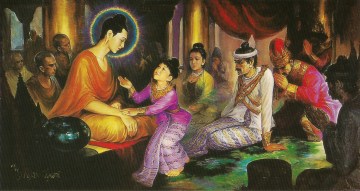
Young Prince Rāhula prompted by his mother to ask for his inheritance, left behind by the Buddha after His renunciation. Instead, the Buddha told Venerable Sariputta (Sariputra) to ordain Prince Rāhula, giving him a spiritual inheritance better than the one he asked for.

The lead feature, Buddha as Parent, is by Gil Fronsdal.  Gil was ordained as a Soto Zen priest at the San Francisco Zen Center in 1982. In 1995 he received Dharma Transmission from Mel Weitsman, the abbot of the Berkeley Zen Center. Gil currently serves on the SF Zen Center Elders’ Council. He is the primary teacher at the Redwood City Insight Meditation Center in California and he teaches at Spirit Rock Meditation Center in Woodacre, California where he is part of the Teacher’s Council. His books include the ever popular Issue at Hand: Essays on Buddhist Mindfulness and A Monastery Within: Tales from the Buddhist Path.

If you have read the life story of Buddha, you may have been disconcerted to find as I was that the Buddha was an absentee father. Gil says however:

“…that after his awakening, the Buddha became his son’s primary parent for most of the boy’s childhood. From the time Rāhula was seven, he was under the care of his father, who proved to be a remarkably effective parent: Rāhula had reached full awakening by the time he reached adulthood. So we can ask, what kind of parent was the Buddha?”

In exploring the Buddha as a parent, we get some insight into how we too might bequeath a spiritual inheritance.

c Corina Ravenscraft

We move on to read Corina Ravenscraft’s touching feature Art Lessons about the support and inspiration her artist mother provided and Priscilla Galasso’s The Nature of Nurture, about her experience of parenting.

“Parenting is a living thing, a responsive dance with biology, and although we humans are biologically social creatures, heavy-handed social structure can strangle our relationships and bind us into damaging patterns.”

Resident storyteller Naomi Baltuck – whose family wins the award for most original family photos and best costume parties – generously offers two of her wise photo stories on theme.

We have a rich collection of poems under both “Parents and Parenting” and the “More Light” section. These include works by three poets proudly added to our pages: award-winning New York poet, Matt Pasca along with Lance Sheridan and Ampat Varghese Koshy.  Incuded among the poets are Myra Schneider and Dilys Wood, who share their poems from the anthology, Parents.

Under music you’ll find Walkin’ Home, so beautifully written and sung by Iris DeMent.

James Cowels and John Anstie offer thought-provoking essays under “More Light” and Marlyn Suarez-Exconde – also new to our pages – combines words and art into a pleasant nugget of wisdom.

Getting to Know You, a new section, features charming interviews of team members, Cornia Ravenscraft and Priscilla Galasso.

Read. Learn. Laugh. Cry … share your thoughs in the comment sections and show your appreciation of contributors with “likes.”  Join us next month for “All God’s Creatures.”

Special thanks to Moshe Dickel for letting us use his painting for this month’s header, to team member, Michael Dickel, for introducing Matt Pesca, and to award-winning British poet Anne Stewart for her kind and constant assistance in getting permissions for me from writers and publishers in the UK.

Don’t forget to visit The BeZine sister site, the spiritual community, Beguine Again, where you can enjoy Terri Stewart’s inspirational posts for daily spiritual practice. These have been well-received and are beginning to go viral.  Bravo!

On behalf of The Bardo Group Beguines and in the spirit of peace and community,
Jamie Dedes
Managing Editor

PARENTS and PARENTING

Lead Feature:

Budda as Parent, Gil Fronsdale

Parent:

Art Lessons, Corina Ravenscraft

Parenting:

The Nature of Nurture, Priscilla Galasso

Memoir

Remembering Mom, Jamie Dedes

Photostories

Magnum Opus, Naomi Baltuck
Back Down to Earth, Naomi Baltic

Poetry:

Squeezing a Penny, Jamie Dedes
Nursery Rhymed, Michael Dickel
Hearts and Glowers, Joseph Hesch
Three Poems by Ampat Koshy, Ampat Varghese Koshy
Jigsaw Puzzle, Charles Martin
Walking Around Monaco, Matt Pasca
Soup and Slavery, Myra Schneider
Christmas Fare, Dilys Wood

Music:

Walkin’ Home, Iris DeMent

GETTING TO KNOW YOU

An Interview of Corina Ravenscraft
An Interview of Priscilla Galasso

MORE LIGHT

Art:

When the Heart Speaks, Marlyn Suarez-Exconde

Essay:

Individual Responsibility … Whose job is this?, John Anstie
Sailing with the Ancient Mariner, James R. Cowles

Poems:

Bullied Into Insanity, Brian Crandal
Compassion, Michael Dickel
Grace, Matt Pasca
Into the Darkness … A Mugging, Lance Sheridan

Further Connections

Beguine Again, Spiitual Community and Practice

Brief Biographies of Core Team and Contributors

For updates and inspiration “Like” us on Facebook, The Bardo Group Beguines

Track our Tweets at The Bardo Group Beguines

MISSION STATEMENT

Back Issues Archive
October/November 2014, First Issue
December 2014, Preparation
January 2015, The Divine Feminine
February 2015, Abundance/Lack of Abundance
March 2015, Renewal
April 2015, interNational Poetry Month
May 2015, Storytelling
June 2015, Diversity
July 2015, Imagination and the Critical Spirit
August 2015, Music
September 2015, Poverty (100TPC)
100,000 Poets for Change, 2015 Event
October 2015, Visual Arts (First Anniversary Issue)
The BeZine, Volume 2, Issue 1, Nov. 2015 (At-risk Youth)
The BeZine, Volume 2, Dec. 2015 (Waging Peace, An Interfaith Exploration & The Hero’s Journey)

Posted in Bardo News, Beguine Again, General Interest, justice, The BeZine, The BeZine Table of Contents

The BeZine, 15 Dec. 2015, Vol. 2, Issue 2-3 (Waging Peace and The Hero’s Journey)

15 December 2015

When we planned this issue we planned to focus on “The Hero’s Journey.” We have done that, but events this past month also led to a spontaneous eleventh-hour addition,  a special section, Waging Peace. Thank you to Rabbi Gershon Steinberg-Caudill, Rev. Ben Meyers, Father Daniel Sormani, C.S. Sp., Sophia Ali-Khan, the Unitarian Universalists of the San Francisco Bay/Peninsula, Michael Dickel, the Venerable Bhikkhu Bodhi and to Carla Prater, the assistant director of Buddhist Global Relief for her help.

Rabbi SteinBerg-Caudill is a Jewish teacher who espouses a Jewish Spirituality and Universalist teaching for the future brotherhood of all people. When I wrote to him about this effort he reminded me of what surely should be foremost in our minds and hearts:

“The Hebrew word for PEACE – שלום – does not imply a lack of strife. It implies instead WHOLENESS, COMPLETION. If one is in a state of peace, he can still be whole in a time of chaos.”

Rev. Meyers of the Unitarian Universalists of San Mateo also counsels inner peace with his You are the promise … the one … the hope. Rev. Meyers says:

“I understand and often share the ‘urge of urgency’ over the peacefulness of peace. But this I also know: We live at the intersection of action and reflection.”

Father Sormani, a Spiritan priest (a Catholic) who has lived and worked in Algeria and Dubai and is now teaching theology at Ateneo de Manila University in the Philipines, asks What Have We Done that People Can Pick-up Weapons and Kill. Father Dan says:

“We have become our own worst enemy. Whenever we separate the world into ‘them’ and ‘us’, whenever we accept blind generalizations and cease to see a unique individual before us, whenever we forget we are all victims of carefully orchestrated deceit and deception for wealth and power, the force of darkness wins. Bullets will never win this struggle, only the heart and mind will.”

The Unitarian Universalist clerics of the San Francisco Bay/Peninsula share their open letter  – With Faith in Love Beyond All Beliefs – encouraging the support of Muslims in our communities.

Lest you’ve missed Sofia Ali-Khan‘s letter, Dear Non-Muslim Allies, which has been making the rounds on Facebook and was also recently picked up by some mainstream media, we’ve included it here.

We’ve also included a video recitation of Tunisian poet Anis Chouchéne‘s profoundly moving poem against racism and fanaticism. Chouchène speaks directly to radical Islam  … but I think you’ll agree that ultimately he speaks to all of us in our fear and ignorance.

“Peace we keep an eye on/while it packs its bags/to abandon our lands, little by little …”

Chouchène concludes as Father Dan does, that we must be able to see the individual.

Michael Dickel‘s poem Mosquitoes (excerpt from his chapbook, War Surrounds Us) is included. The poem starts out with Israelis and Palestinians crossing the artificial lines that divide to offer one another condolences on the deaths of their children.  This is a favored poem of mine, especially so because The Bardo Group Bequines was formed to – in effect – cross boarders. Our mission statement is HERE. Michael spins the poem on to show how we are manipulated by the propaganda machine. Michael Dickel, Father Dan and Bkikkhu Bodhi are of a mind on this.

We’ve included a short video presentation on the seven steps to peace developed by peace activist, Rabbi Marc Gopin. Director of the Center for World Religions, Diplomacy and Conflict Resolution (CRDC) and co-owner of MEJDI, “a peace tourism business that embraces the multiple narratives of indigenous peoples.”

The Venerable Bhikkhu Bodhi is Buddhist monk in the Theravada tradition, an author and teacher. He is the founder of Buddhist Global Relief.  With permission, we offer his 2015 talk given at the New Year’s Interfaith Prayer Service, Chuang Yen Monastery. In the same spirit as Rabbi SteinBerg Cadhill and Rev. Ben Meyer, Bhikkhu Bodhi says:

“Real peace is not simply the absence of violent conflict but a state of harmony: harmony between people; harmony between humanity and nature; and harmony within ourselves. Without harmony, the seeds of conflict and violence will always be ready to sprout.

Bhikku Bodhi goes on to analyze the obstacles to achieving world peace, the prerequisites of peace, and the means to realizing these goals.

So here we are attempting to untie the ropes that bind us …  certainly a hero’s journey … unchosen as hero’s journeys often are. Under our themed section, we explore the journey in its many manifestations – in its parts and in it’s whole – with features, fiction, memoir, and poems by John Anstie, James Cawles, Michael Dickel, Priscilla Galasso, Joseph Hesch, Charlie Martin, Corina Ravenscraft and Terri Stewart. Under “more light” – we can always use that, eh? – we have photo-stories from Naomi Baltuck, a poem from Brain Crandall and an essay from Michael Watson.

Special Announcement

Last week we unveiled our new community website thanks to long and hard work by Terri Stewart and generous funding by the Pacific Northwest United Methodist Church.  You can read all about it HERE. You can visit it HERE.  Please enjoy but also be patient, the tech gremlins are still at work. This site is set-up (both design and intention) to facilitate more participation with and among readers.

On behalf of The Bardo Group Beguines and in the spirit of love and community, Jamie Dedes, Managing Editor

Thanks to poet and artist K.A. Brice (Mirror Obscura) for our fabulous December header.

Table of Contents with Links

Waging Peace
An Interfaith Exploration

You are the promise . . . the one . . . the hope, Rev. Ben Meyers, Unitarian Universalist cleric

What Have We Done That People Can Pick Up Weapons and Kill?, Fr. Daniel Sormani, C.S.Sp., Catholic Priest

With Faith In Love Beyond All Beliefs, an open letter, Unitarian Universalist clerics

Dear Non-Muslim Allies,  Sofia Ali-Khan, Muslim activist for understanding

Peace Be Upon You, شوشان – سلام عليكم, Tunisian poet, Anis Chouchène, Muslim

Mosquitoes, American-Israeli poet, Michael Dickel, Jewish

Peace Steps: One Man’s Journey Into the Heart of His Enemies, Rabbi Mark Gopin, Jewish

Waging Peace, Venerable Bhikkhu Bodhi, Buddhist

December’s Theme
The Hero’s Journey

When a Hero Needs a Hero

I think I need a hero, Colin Stewart

Lead Pieces

Mankind: The Modern Mystery and Myth, Priscilla Galasso
The Hero’s Journey and the Void Within: Poetics for Change, Michael Dickel
Hero Worship, a poem, Michael Dickel
Sailing with Ulysses, James R. Cowles

Fiction

Who Cries for Icarus?, Joseph Hesch

Poetry

Courage, Joseph Hesch
local heroes, Charles W. Martin
~ Lifted ~, Corina Ravenscraft
~ Epic Everyday ~, Corina Ravenscraft
Heroes Seldom Wear Capes, Terri Stewart

Memoir/Family History

The Major, a poem, John Anstie
Real Heroes, Part 1, John Anstie
Real Heroes, Part 2, John Anstie

More Light

Photostories

Pondering, Naomi Baltuck
The Same Boat, Naomi Baltuck

Poetry

Let the Children Come, Brian Crandall
A Dream Walker Hands You The Door, Michael Dickel

Essay

We’re Still Here, Michael Watson

Further Connections

Our Community Site: Beguine Again

Brief Biographies of Core Team and Contributors

For updates and inspiration “Like” us on Facebook, The Bardo Group Beguines

Track our Tweets at The Bardo Group Beguines

MISSION STATEMENT

Back Issues Archive
October/November 2014, First Issue
December 2014, Preparation
January 2015, The Divine Feminine
February 2015, Abundance/Lack of Abundance
March 2015, Renewal
April 2015, interNational Poetry Month
May 2015, Storytelling
June 2015, Diversity
July 2015, Imagination and the Critical Spirit
August 2015, Music
September 2015, Poverty (100TPC)
100,000 Poets for Change, 2015 Event
October 2015, Visual Arts (First Anniversary Issue)
The BeZine, Volume 2, Issue 1, Nov. 2015 (At-risk Youth)

Posted in Beguine Again, General Interest, TheBeZine

a story of faith, hope and love

IMG_1955I feel almost inclined to start this story with “once upon a time” since it feels that we began our adventure so long ago.  I started The Bardo Group (though it wasn’t titled that way to begin with) in 2011 as a way to encourage a sort of world without borders by having people from different cultures and religions come together to show what’s in their hearts and in doing so to demonstrate that with all our differences we have much in common: our dreams and hopes, our plans for children and grandchildren, our love of family, friends and the spiritual traditions we’ve chosen or into which we were born  . . . not to mention our love of sacred space as it is expressed in the arts and our concerns for peace, social justice and sustainability.

At one point I decided that it would be nice to have a sort of virtual Sunday service and invited Terri Stewart, a Methodist Minister, to be our “Sunday Chaplain.”  In 2008 she founded Beguine Again, an interfaith platform for clerics and spiritual teachers to offer daily solace and inspiration. I felt comfortable inviting Terri in because she didn’t want to convert anyone and seemed to appreciate the beauty and wisdom of traditions other than her own. She even incorporated the wisdom of other traditions in her rituals and writings. Terri supported our mission. She didn’t appear threatened by different opinions or beliefs.

A little over a year ago, I suggested we might throw our two efforts together, Beguine Again and The Bardo Group. I hoped that would ensure the continuation of the The Bardo Group and the wise, beautiful and valued work and ideals of our core team and guests, a group of earnest and talented poets, writers, story-tellers, essayists, artists, photographers and musicians.  Each is a strong advocate for a better – fair, peaceful and sustainable – world. Together they are a powerhouse.

Okay, yes!  I’m a bit biased.  I’ve only met one of our group in person and only talked by phone with Terri,  but I’ve read everyone’s work – their emails, messages, books, blogs and FB posts for years now.  We’ve been through deaths in families, births and birthdays, graduations, illness and recovery, major relocations, wars and gunfire, triumphs and failures. Two of our original contributors have died. I feel that our core team and our guests might be my next-door neighbors instead of residing in  Romania, England, Algeria, the Philippines, Israel, India, Greece, Bulgaria, the United States and other countries I’ve probably forgotten. We’ve featured work by people ranging in age – as near as I can guess – from 19 to nearly 90. They’ve been Muslims, Christians, Jews, Hindus, Buddhists, atheists and agnostics. The growth of our readership is slow but steady, loyal and just as diverse as our core team and guests.

So what did we do to facilitate this merger: At Beguine Again daily posts continued. That team joined The Bardo Group. We stopped posting daily on The Bardo Group site and started The BeZine, a monthly online publication with a fresh theme for each issue. Terri got a grant to establish a community website from the Pacific Northwest United Methodist Church. The website has been over a year in the works. Today, we unveil it.

footer-logo

The site is designed to be a spiritual networking community.  Though it is an extended ministry of the Lake Washington United Methodist Church, this effort remains both interfaith and a labor of love.

The site is supported by donations, membership (paid membership is optional) and a generous grant from Pacific Northwest United Methodist Church, which funded the design and development of the site. The grant from the church ends on December 31, 2015. Donations and membership fees will support the cost of technical assistance, web hosting and so forth. Should there be any excess funds they will go to the Youth Chaplaincy Coalition, a Seattle nonprofit (also interfaith) founded by Terri under the aegis of the church. Coalition members provide assistance to incarcerated youth. No income is earned by anyone associated with Beguine Again, The Bardo Group, The BeZine or the Youth Chaplaincy Coalition.  All are labors of love.

The BeZine can still be easily and conviently accessed directly either here at this site or through Beguine Again if you choose to become a member of the community.

Please check out the site. Any questions? Let us know … and do let us know what you think. Please be patient too.  The tech gremlins are still working behind the scenes.

A note on the name: Beguine Again.  The original Beguine community was a Christian lay order in Europe that was active between the 13th and 16th century.  Terri chose the name “Because they worked outside the religious structure and were a safe place for vulnerable people.”

© 2015, article and photograph, Jamie Dedes; Beguine Again logo, copyright Beguine Again

Posted in General Interest, The BeZine, The BeZine Table of Contents

The BeZine, Volume 2, Issue 1, Nov. 2015 (At-risk Youth)

15 November 2015

Welcome to our first issue that is focusing on at-risk youth. Our mission today in our topical section is to share stories and poems that cause us to think about youth in a different way. Who are at-risk youth? Where are they?

Often, they seem invisible to the world until they are splashed across the news in dramatic headlines. We can all remember the photos of dead children washing up on the seashore…refugees fleeing Syria. And in the US, just a few days ago, a young boy, age 8, killed a 1 year old. Why? Because he was the babysitter in charge and she would not stop crying. I am often appalled at the reactions we have to children with extreme behaviors. What skills do we expect an 8 year old to have?

Sigh.

And so, we, at The Bardo Group, have written of the children of the world that are marginalized and at-risk for a wide range of disasters. This is a special topic for me. I run the Youth Chaplaincy Coalition which provides chaplaincy and mentoring to incarcerated youth. I have included three pieces in this edition that are close to my heart. One, Eli, Eli, lama sabachthani. This poem is the first one I wrote in reaction to the stories I heard in detention. I wanted to put the parents, and God, on trial. And so I did. I wasn’t happy with the answer I received! And yet, it gave me so much hope. The second piece, an essay titled Mentoring At-Risk Youth, tells you a little more directly about who I am and what I do. Last, is the poem, A True Story. You may guess that it is a true event and you would be correct! It happened this year and it made me very angry.

St. Augustine says, ““Hope has two beautiful daughters – their names are anger and courage; anger at the way things are, and courage to see that they do not remain the way they are.”

Hope, anger and courage have driven me to move through the pain and challenge of working with these particular youth.

A small collection from people I work with that all explore what it is like to work with incarcerated youth. They are all new to the BeZine so let’s give them a resounding welcome! Justin Almeida offers an essay, Finding Life in Detention. Lisa Ashley, MDIV, has a poem, at risk youth, that names what is really at risk when you work with youth in detention—your heart is at risk!  And Natasha Burrowes drops the mic in Untitled.

Closely related to Natasha’s discussion of who is really at risk is Charles Martin’s, at risk… It is a great question. Who is really at risk when we allow our children to be the victims of poverty, crime, and other forces? Is it really just the child? Or is there something larger?

Incarcerated youth, across the board, have increased rates of trauma when compared to other youth. The ACES test (Adverse Childhood Experiences) scores incarcerated youth as having a 92 out of 100. I think I would be a bowl of jello if I had that high of a trauma score. Christina Conroy explores living through a traumatic childhood in her autobiographical poem, Legacy. Also writing autobiographically is Kimberly Wilhelmina Floria in Validating Myself. It made my heart grow two more sizes! Also cracking my heart is Jamie Dedes’ Heading Home autobiographical poem regarding suicide. Sometimes, I wish I knew what that special something is that manages to give children resiliency. Heart breaking. Or I wish I had a magic wand that would right the world’s wrongs.

Also writing from experience is Trace Lara Hentz’s essay, Angel Turned Inside. Lara was introduced to us by Team Member Michael Watson and is new to these pages. Her essay explores the tragedy that was the movement westward in the US and the use of adoption as a weapon against American Indians and First Nations. I am aware of this tragic history because of my knowledge of church history which is horrifyingly replete with church support of taking children from their families and putting them into orphanages.

Knife Notes—a Poem, from Michael Dickel, explores the relationship between the past and the future for Joe. I am especially moved by the truthful reflection of how kids who are hurting treat each other.

“It is the paramount duty of the state to make ample provision for the education of all children residing within its borders, without distinction or preference on account of race, color, caste, or sex.” That is a quote from Washington state’s constitution. Unfortunately, we simply fail our children. John Antsie’s article, Education, Common Sense … and The Future, explores two simple things regarding education-one thing to change and one thing to hope for.

One thing that the youth I work with almost unanimously face is addiction issues. Jamie Dedespiece, scag dancing, explores in vivid, concise imagery the relationship between addiction and poverty.

With “Thinking Continually of Those at Risk,” by Priscilla Galasso, you will be surprised at where she starts and where she finishes! She speaks a truth that resonates, “We can so easily provide food, shelter, and opportunity to our youth with the systems we have devised, but those systems have become mine fields where kids are sabotaged on the journey.”

Sometimes we attempt to sabotage journeys with needless judgment regarding what makes a real parent. John Nooney explores his experience of adoption and the sometimes senseless absorption of people asking, “Have you found your birth-mother?” in his essay, Some Thoughts on Adoption.

In my research of how to interrupt the school to prison pipeline, I have found two interesting statistics. One, children who miss 24+ days of Pre-K or Kindergarten are more likely to become incarcerated. And two, children who personally own five books of their own have better life outcomes than those who do not. I have also recently run across an article pointing towards the importance of librarians in achievement for children. Corina Ravenscraft points out the importance of libraries in These Hallowed Halls of Hope.” Libraries are, indeed, an oasis of peace in a concrete jungle.

One thing is trite but true, it does indeed, take a village to raise our children.

Thank you for moving through my rambling reflections with me. I hope that your heart is moved to consider how we support and work with those who are at-risk.

Shalom & Amen!
Terri Stewart

Theme: At-Risk Youth

Lead Features

Eli Eli Lama Sabachthani, Terri Stewart
Untitled, Natasha Burrowes
Validating Myself, Kimberly Wilhelmina Floria
At-risk, Charles W. Martin

Poetry

Legacy, Christina Conroy
At-risk Youth, Lisa Ashley, MDIV
A True Story, Terri Stewart
Heading Home, Jamie Dedes
Knife Notes—a poem, Michael Dickel
scag dancing, Jamie Dedes

Essays/Features

Mentoring At-Risk Youth, Terri Stewart
Finding Life in Detention, Justin Almeida
Education, Common Sense … and The Future, John Antsie
These Hallowed Halls of Hope, Corina Ravenscraft
Thinking Continually of Those at Risk, Priscilla Galasso
A Teenager Who Fled Syria, NPR and World Vision
Rapid Re-Housing Best Available Crisis Intervention for Homeless Families and Youth, National Alliance to End Homelessness

Special Features: Adoption

November is National Adoption Month in the United States

Some Thoughts on Adoption and “real” parents v adoptive parents, John Nooney
Angel Turned Inside, The Fight for Native American Families, Trace Lara Hentz

General Interest

Poetry

How Can I Justify My Life If I Do Not Justify His Own?, K. A. Bryce
Second Light Network of Women Poets: Celebrating Anothologies of Women’s Poety, Jamie Dedes

Photo Essay

Some Early Seasonal Cheer, Corina Ravenscraft

Photo Story

The Secret Object I Keep Hidden in My Underwear Drawer, Naomi Baltick

Essays

Deportment for the Soul, Sue Vincent

paint-prints-of-youths-hands

BIOS WITH LINKS TO OTHER WORKS BY OUR CORE TEAM AND GUEST WRITERS

FOR UPDATES AND INSPIRATION “LIKE” OUR FACEBOOK PAGE, THE BARDO GROUP/BEGUINE AGAIN

MISSION STATEMENT

Back Issues Archive
October/November 2014, First Issue
December 2014, Preparation
January 2015, The Divine Feminine
February 2015, Abundance/Lack of Abundance
March 2015, Renewal
April 2015, interNational Poetry Month
May 2015, Storytelling
June 2015, Diversity
July 2015, Imagination and the Critical Spirit
August 2015, Music
September 2015, Poverty (100TPC)
100,000 Poets for Change, 2015 Event
October 2015, Visual Arts (First Anniversary Issue)

Posted in 100,000 Poets, Musicians, Artists and Activists for Change, General Interest, poem, poetry, Priscilla Galasso, TheBeZine

LET’S FACE IT! Peace, Sustainability and Justice … on 26 Sept. 2015, 100 Thousand Poets (et al) for Change

cropped-11870868_10203410767264923_1515064565540882553_n1.jpg

Editor’s Note: Priscilla Galasso (scillagrace, try to live gracefully) wrote this last year just before the 2014 event. (We’ve adapted it here with current links and dates.) It seemed a good piece to share with you today to welcome and encourage you to join with us this year on 26 September for 100TPC, which is not just for poets but includes artists, photographers, musicians and friends of the arts.  100TPC is about Peace, Sustainability and Justice.  We chose “poverty” for our theme this year and have devoted the entire September issue of “The BeZine” to that subject.

On the 26th, a blog post will go up on this site with instructions on how you can share your work and view that of others.  We look forward to your participation and to your works.  J.D.

As a core team member of The Bardo Group, I am invited, encouraged, challenged to participate in the The BeZine’s 100 Thousand Poets for Change event to be celebrated virtually at this blog. For more information about this event, and to be stirred and prodded in you own artistic lethargy, click here

I yearn to be a poet, an artist, a musician.  I often find a piece that seems so right, so seemingly effortless, so fitting that I think it can’t be hard to craft a work like that…it simply lays over its theme like a glove.  Not so.  Listening to music on my way to work yesterday, I heard a poet’s frustration: “I don’t know why I spend my time / Writing songs I can’t believe / With words that tear and strain to rhyme.” (Paul Simon: Kathy’s Song.)

I feel these core values of Peace, Sustainability and Justice coursing through my life, my thoughts, my work, my hopes, and I wonder how hard it would be to write a poem about it.  I talked to a young man half my age who has studied forensic justice and just interviewed for a position as a mentor, a parole partner, someone who will help perpetrators and victims get together and talk, face to face.  I thought it was a great idea, for both parties, for all parties.  Here’s my attempt to let that idea percolate:

Let’s Face It

Behind the veil, the dirty shroud, the black burka, the white Klan sheet,

the knit ski mask, the heavy gas mask, the transparent oxygen mask, the impenetrable death mask,

the dense fur, the redwood bark, the shiny scales, the matted feathers,

the protective shield, the official badge, the repeated slogan,

the coarse beard, the perfect make-up,

the injections, the implants,

the scars, the screen

There is a face, a viable being.

When eyes recognize

kin and skin, then peace begins.

Face to face is the starting place.

– Priscilla Galasso

©  2014, notes and poem, Priscilla Galasso, All rights reserved

Posted in General Interest, The BeZine, The BeZine Table of Contents

The BeZine, 15 Sept. 2015, Vol. 1, Issue 11 (Poverty/100TPC) – Table of Contents with Links

15 September 2015

For the past five years, September has been the month of 100,000 Poets for Change (100TPC). All over the world, poets (musicians, artists, and, yes, mimes) have organized events on or near a Saturday in September each of those years, this year, on the 26th. For this, the fifth anniversary of 100TPC, there are over 500 events scheduled throughout the world. The readers of, contributors to and publishers of The BeZine have participated with a virtual event in the past and will again this year on the 26th.

Meanwhile, The BeZine’s theme for September also supports the 100TPC call for peace, sustainability, and social justice, with our focus on poverty in general and homelessness in particular. This focus relates to social justice in an obvious way. Yet, how could we speak of sustainability without social justice? If we still have poverty and homelessness, what is sustained other than inequality? And, without social justice could there be peace? For that matter, could peace be sustained without both justice and environmental plus economic sustainability? Our choice is not to put one of these three above the other, but to recognize that all of these three important themes, necessary areas of change, interrelate in complex ways. So we chose one aspect to focus on, and in so doing, this issue clearly points to all three themes through the lens of poverty.

We open by featuring three incredibly powerful poems by Sylvia Merjanian, Refugee, Second Chance, and Collateral Damage. Refugee and Collateral Damage come from her collection, Rumor (Cold River Press—proceeds go to help Syrian refugees). Second Chance debuts here. These poems show the relationship of war to poverty, oppression, and sexual abuse. In reading these, one senses the immense personal costs of war, especially to women and children. They provide an important window into the staggering worldwide refugee crisis, currently the largest human migration since World War II. Refugees are homeless in so many ways, even when they have a house to live in. And, the world seems to conspire to keep them destitute.

That war directly and indirectly causes poverty does not surprise. You might not know, until you read James Cowles’ essay, The Roots of Institutionalized Poverty, that something called The Compromise of 1877, which ended the post-Civil War Reconstruction Era, provided the political and economic structures of poverty that continued strong through the Civil Rights Era and, in many ways, still exist today. Certainly we know that poverty is not new in the United States, and neither is homelessness. In this issue you will hear music of the Depression Era that sounds too familiar today. The first time I personally participated in an editorial process and writing publication related to homelessness was in 1989, for the University of Minnesota student paper, the Minnesota Daily. We produced a special finals’ week issue, Ivory Tower, dedicated to the theme.

Poverty and homelessness are evergreen issues historically, but issues also embedded in social and political complexity. They benefit the rich, whose economic system keeps most of the rest of us as, at best, “wage slaves,” and all too many of us in poverty, without enough to provide for basic needs or housing (including the “working poor,” who hold low-paying jobs while CEOs are paid record-breaking salaries and bonuses). Our second feature, Jamie Dedes’ poem, Some Kind of Hell to Pay, cries out against the structures of injustice, where the rich act as demigods and demagogues, and it asks of what use will all their riches be in the Hellish realm of the inevitable backlash from the marginalized and disenfranchised.

photo credit: Sharon Frye

The poems, prose, photo essay, and art in the rest of the September BeZine will ask you to feel, to see with empathy, to hope defiantly, and always to resist the status quo. The writers often look beyond the borders of the U.S. or Western Europe to see the injustices of a world-wide economic system of war, greed and injustice that makes it difficult to live outside of its oppressive realities—and for those pushed out, the available choices do not sustain their lives, their dreams, or their spirits.

Yet, people live, they dream, and they hope with spirit—often in defiance, sometimes by dying (see John Anstie’s As if and Sharon Frye’s Jacob’s Ladder in this issue), sometimes by living despite all of the forces lined up against their lives. Victoria C. Slotto’s Homeless Man tells of a “destitute” man whose story reveals that he may in fact have the most rich life of any of us. Always, there is more than what we see.

Read these words. Think about the change that could help to heal creation as Michael Yost’s poem Who Am I to Judge and Michael Watson’s essay The Realm of the Unimaginable speak to. Remember the admonition to think globally but act locally. And, most of all, imagine.

Then, join us on 26 September 2015, on our blog. Add your own thoughts, your own poems, your own essays. Join in our virtual, worldwide 100TPC event from wherever you live. We will post a page with instructions on our blog on the 26th. The posts will go up live. And, after the 26th, we will organize and archive the event (see the 2013 and 2014 pages in the tabs at the top of the page).

—Michael Dickel, Jerusalem

My poem from the 1989 Minnesota Daily Ivory Tower

Soil

i
The plow cuts, disk or chisel?
How much of what lies below to bring up
leave exposed to dry in the wind?
What residue of last years’ crop
to leave upon the soil, cover over
to rot, return to the fertile land?

What fetish draws me along this furrow?
Street and curb meet here.  Step up or down into slime.
Dust, trash tossed around and dropped by the blind wind.
What fate ties strings to which embedded hooks,
Pulls my flesh forward forever forward towards the street?

The Spring fete begins, seeds in muck
anticipating dilettante dance of the chosen few.
Weed out the hungry whose appetite starves wind-pressed grain shafts;
water the rows of the obedient who face slick harvest,
brittleness in the searing sun and death with Winter.

I move, farmer in these city streets, man among the chaff,
I offer to fetch my elegant plow-tongue, to stop the wind,
describe the deep earth and the rotted residue, the dry grasses and newspaper
blown by, salvaged for shelter by the quick grasp of an old hand,
pulled on top of gray hair to keep rain out.

ii
I would pull the plow, but a voice from under the newspaper
covers my shoes in mud and mire.

    What d’you know ’bout
all this?
              He spit

from mown rye-stubble fields,
        fetid earthen face
          Cracked
crumbled
          creased

  Caressed once, long ago

     All you see’s a bum.
      Fuck you, you son of a whore.

At home I do not wash the dirt from me,
I scrape it off, place it in a box
with a key I open my belly and
secure the box within, sated.

The weeds fend for themselves

photo credit: Jamie Dedes

September 2015

Theme: Poverty

Lead Features

Rumor, Silva
Some Kind of Hell to Pay , Jamie Dedes

Articles/Creative Nonfiction

The Realm of the Unimaginable, Michael Watson
The Roots of Institutionalized Poverty in the Compromise of 1877,  James R. Cowles
Farming a Dancing Landscape, Priscilla Galasso

Poetry

As if, John Anstie

Why do you judge me?, Brian Crandall
Homeless, Brian Crandel
I Understand, Brian Crandall

Poverty Line, Sharon Frye
Jacob’s Ladder, Sharon Frye
Barometer of Bones (A Baltimore Teacher Remembers Freddie Gray), Sharon Frye

The Search, Joseph Hosch
Cold Comfort, Joseph Hesch

more Washington rumors, Charles W. Martin
five dollars and some change, Charles W. Martin

The H wor(l)d, Liliana Negoi

I Am Not Alone, Lana Phillips
Pulling Myself Up, Lana Phillips
Wounded Healer, Lana Phillips
Undeserving, Lana Phillips

~ Under ~, Corina Ravenscraft

Le Mendicant, Victoria C. Slotto
Homeless Man, Victoria C. Slotto

Who Am I to Judge, Michael Yost

Photo Story

Out in the World, Naomi Baltuck

Art

Mother and Child, Roy DeLeon, OSB

Special Feature
An Art Lesson with Leslie White … music by Grandpa Elliot

Music
nueva canción de Ameríca Latina
(the social justice music of Latin American) 

Sólo le pido a Dios (with translation and brief bio), Mercedes Sosa

from the Great Depression (1929-1941)

The Ghost of Tom Joad, Pete Seeger and Bruce Springsteen
I Ain’t Got No Home, Woody Guthrie
Hobo Bill’s Last Train Ride, Merle Haggard
Brother, Can You Spare a Dime, Rudy Vallee
Nobody Knows You When You’re Down and Out, Bessie Smith

Contemporary

Democracy, Leonard Cohen

BIOS WITH LINKS TO OTHER WORKS BY OUR CORE TEAM AND GUEST WRITERS

FOR UPDATES AND INSPIRATION “LIKE” OUR FACEBOOK PAGE, THE BARDO GROUP/BEGUINE AGAIN

MISSION STATEMENT

Back Issues Archive
October/November 2014, First Issue
December 2014, Preparation
January 2015, The Divine Feminine
February 2015, Abundance/Lack of Abundance
March 2015, Renewal
April 2015, interNational Poetry Month
May 2015, Storytelling
June 2015, Diversity
July 2015, Imagination and the Critical Spirit
August 2015, Music

Posted in General Interest, The BeZine

Submission Guidelines for “The BeZine” update and themes announced through December 2016

The BeZine is published monthly on the fifteenth of the month.  We suggest that you read our Intro and Mission Statement and at least three back issues of The BeZine before submitting work for possible publication here.

Please be mindful that our core team, guest contributors and readers represent the world’s diversity. Nonviolence, respect and inclusion are core values here.

All work must be submitted in English and properly edited for publication. Please send submissions to bardogroup@gmail.com and put “submission” in the subject line.  If you were referred by one of our core team please put his or her name in the subject line along with “submission.” Please provide us with a brief bio not a curriculum vitae. If you have published the work submitted on your own website, blog, YouTube channel or other online venue you may send a link. Response time is generally six weeks.

We will consider work that has been published elsewhere but the copyright must be yours.  You retain your copyright for work published in The BeZine. We regret that we are unable to offer payment or editorial feedback.

We address a new theme each month, but we are also interested in cultural and religious material – especially seasonal – which should be submitted at least three months in advance. We appreciate work that expresses a love for traditions and rituals and offers education.

Should you have anything to submit that is over 1,000 words, please forward only a brief one-paragraph summary description for our initial evaluation.  All creative arts are acceptable: visual arts, literature and poetry, music and film.

The following themes are approved through December 2016 by the Core Team and friends of The BeZine.

Themes:

September – Poverty (Michael Dickel hosts)
September 26 – 100TPC/Poverty (Michael Dickel hosts)
October – Visual Arts: Shape, Color, Movement, Meaning
November – At-risk Youth  (Terri Stewart hosts)
December – The Hero’s Journey
January – Parents and Parenting
February – All God’s Creatures
March – The Joys of Nature: Wilderness, Gardens and Green Spaces
April – interNational Poetry Month
May – The Books That Changed Our Lives
June – What! You too?: Joys in Friendship
July – Faith: In Things Seen and Unseen
August – Hope: Great Expectations and Quiet Desires
September – 100,000 Poets for Change
October – Rituals for Peace, Healing, Unity (Terri Stewart hosts)
November – Caritas/Chesed/Metta
December – The Healing Power of the Arts

We look forward to hearing from you.  Thank you!

Be the peace.

Update: September 2, 2015

Posted in 100,000 Poets, Musicians, Artists and Activists for Change, Artists and Activists for Change, General Interest, Poets/Writers

News: Second Light Network, “ARTEMISpoetry”, Fugitive Flags, and The BeZine’s 100,000 Poets for Change

Editorial Note: The September issue of The BeZine will be out on the 15th and we’re all set for the big event on the 26th. Meanwhile …

This slideshow requires JavaScript.

SECOND LIGHT LIVE: Everytime I visit Second Light Live, the website for Second Light Network of Women Poets (SLN), their biannual magazine (ARTEMISpoetry) and SLN’s two anthologies, Images of Women (Arrow Press and SLN, 2006) and Her Wings of Glass (SLN, 2014), there’s news . . . . Unlike a lot of news, it’s all good.

The poem of the month, Stones by Marion Tracy, is HERE.

Check out SLN for poetry, classes (including remote), and poetry news. The network is for women.  The poetry is for everyone.

I’ve read both anthologies, by the way. I enjoyed them immensely and go back to them frequently.

ARTEMISpoetry: The May 2015 issue of ARTEMISpoetry is still available for purchase.  I’m just getting ready to submit my request for permission to post some poems from it and once I have that you’ll see a review go up here along with two or three poems from that issue. Meanwhile, poems and artwork for the May 2016 issue are due by 28 February 2016.  Submission details are HERE.

Δ

FUGITIVE FLAGS: On 26 September, “100,000 Poets for Change” are celebrating their annual day of action, when poets all over the world call for social and political change.  [That is for peace, sustainability and social justice.] On that day we ask literature institutions and writers to fly a white flag.

Why: We want to make a stand for a different treatment of refugees: for respecting their human rights.

11990472_10153063200156615_706478127620772171_n

When:  26 September, 4 p.m.

What Can You Do?  Fly a white flag (e.g. made of napkins, bed linen, table-cloth, …) from your window or balcony.  It should say “refugees welcome” and “100,000 Poets for Change.”

Please share this call for action.

Δ

THE BeZINE’S 100TPC: Only seventeen more days to go for The BeZine‘s virtual event.  The theme we chose this year is poverty.  A post will go up on our blog and you are invited – encouraged – to link in your own relevant work. (How-to will be provided in the post.) We hope you will also read the work shared by others as well.  Ultimately the links will be gathered into a commemorative Page on our site and also archived at 100TPC.

I hope you are all working on your poems, music videos, art and so on to link in with our virtual event that day.

If you are coming late to this announcement, here are some informational posts to check out:

Δ

The BeZine‘s revised Submission Guildelines – including our schedule of themes through December of next year – is now available for view HERE.

Don’t forget to check for Writing Contests, Grant and Awards at Poets & Writers Magazine.  You’ll never know if you don’t try.

Thank you! Please feel free to reblog this post. 

Jamie Dedes

Posted in 100,000 Poets, Musicians, Artists and Activists for Change, General Interest, justice, Michael Dickel, Peace & Justice, Poems/Poetry, Poets/Writers, Sustainability, The BeZine, Writing

100,000 Poets (and other artisits and friends) for Change, 2015: over 500 events scheduled around the globe

IMG_1250

These are busy days for Michael Rothenberg and Terri Carrion who founded 100,000 Poets for Change.  Michael announced yesterday that 500 events are now scheduled for September 26, 2015, the fifth anniversary of this global initiative for change; that is, for peace and sustainability.

For those who are just catching up with us100 Thousand Poets for Change, or 100TPC, is an international grassroots educational organization focusing on the arts, especially poetry, music, and the literary arts. It was founded in 2011 by Michael Rothenberg and Terri Carrion and is centered on a world-wide event each September. This past June the first World Conference on 100TPC was held in Salerno, Italy.

There are also several offshoots cropping up: 100,000 Photographers for Change, 100,000 Drummers for Change … and so on. A little searching on Facebook and you’ll find them, though the umbrella for all,  100TPC, does include a range of artistic specialties and friends of the arts and is not limited to poets and poetry.

We – that is The Bardo Group and Beguine Again, publishers of The BeZine are hosting a virtual event and you are all invited to attend and add links to your own relevent work.  The links will be collected and published in a Page on The BeZine site and also archived at 100TPC. Michael Dickel (Fragments of Michael Dickel) of The Bardo Group is the lead for this event. Michael is also the organizer of an event scheduled in Israel this October.  You can contact him via his blog or message him on Facebook if you have an interest in participating there.

Meanwhile, here is an introduction to the visionary founders of 100TPC, Michael Rothenberg and Terri Carrion:

MICHAEL ROTHENBERG was born in Miami Beach, Florida in 1951, and has been living in the San Francisco Bay Area for the past 37 years. Currently Michael is living and creating among the redwoods.

Michael is co-founder of Shelldance Orchid Gardens in Pacifica, which is dedicated to the cultivation of orchids and bromeliads. He is a poet, painter, songwriter, and editor of Big Bridge Press and Big Bridge, a webzine of poetry and everything else.

In 2011 he and Terri Carrion co-founded the global poetry movement 100 Thousand Poets for Change. His songs have appeared in Hollywood Pictures’ Shadowhunter and Black Day, Blue Night, and most recently, TriStar Pictures’ Outside Ozona. Other songs have been recorded on CDs including: Bob Malone’s The Darkest Part of The Night (Caught Up in Christmas) and Bob Malone (Raydaddy’s Blues), Difficult Woman by Renee Geyer, Global Blues Deficit by Cody Palance, The Woodys by The Woodys, and Schell Game by Johnny Lee Schell.

Michael’s poetry books and broadsides are archived at the University of Francisco, and are held in the Special Collection libraries of Brown University, Claremont Colleges, University of Kansas, the New York Public Library, UC-Berkeley, UC-Davis, and UC-Santa Cruz.

His most recent collection of poems is Indefinite Detention: A Dog Story (Ekstasis Editions 2013) and Murder (Paper Press, 2013) My Youth As A Train published by Foothills Publishing in September 2010.

TERRI CARRION was conceived in Venezuela and born in New York to a Galician mother and Cuban father. She grew up in Los Angeles where she spent her youth skateboarding and slam-dancing.

Terri Carrion earned her MFA at Florida International University in Miami, where she taught Freshman English and Creative Writing, edited and designed the graduate literary magazine Gulfstream, taught poetry to High School docents at the Museum of Contemporary Art in North Miami and started a reading series at the local Luna Star Café. In her final semester at FIU, she was Program Director for the Study Abroad Program, Creative Writing in Dublin, Ireland.

Her poetry, fiction, non-fiction and photography has been published in many print magazines as well as online, including The Cream City Review, Hanging Loose, Pearl, Penumbra, Exquisite Corpse, Mangrove, Kick Ass Review, Jack, Mipoesia, Dead Drunk Dublin, and Physik Garden among others.

Her collaborative poem with Michael Rothenberg, Cartographic Anomaly was published in the anthology, Saints of Hysteria, A Half-Century of Collaborative American Poetry and her chapbook Lazy Tongue was published by D Press in the summer of 2007.

Terri’s most recent projects includes collaborating on a trilingual Galician Anthology, (from Galician to Spanish to English) and co-editing an online selection of the bi-lingual anthology of Venezuelan women writers, Profiles of Night, both to appear in late August, on BigBridge.org., for which she is assistant editor and art designer. Currently, she is learning how to play the accordion. Terri Carrion lives under the redwoods and above the Russian River in Guerneville, Ca. with her partner in crime Michael Rothenberg, and her dogs Chiqui and Ziggy.

Posted in 000 Poets, 100, justice, Michael Dickel, Musicians, Peace & Justice, poem, Poems/Poetry, poetry, Poets/Writers, TheBeZine, Writing

The Poet as Witness: “War Surrounds Us,” an interview with American-Israeli Poet, Michael Dickel

Editors note: The theme for our September issue is poverty. It is part of our 100,000 Poets (and other artists and friends) for Change event (change being peace and sustainability) to be held here as a virtual event on 26 September 2015. Michael Dickel takes the lead on this project and the September issue. Here’s an opportunity to get to know him better. Michael’s vision: “… hope must/ still remain with those who cross/ borders, ignore false lines and divisions/” is consistent with the mission of Bequine Again and The Bardo Group, publishers of The BeZine.  The September issue will post on the 15th. J.D.
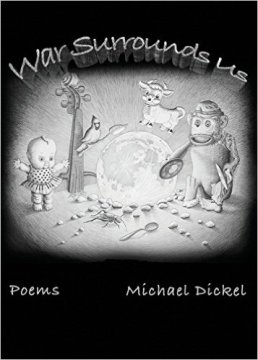
5182N5cYeEL._SX355_BO1,204,203,200_“That some of those labelled as enemies
have crossed the lines to offer condolences
at the mourning tents; that the mourning
families spoke to each other as parents
and cried on each others’ shoulders;
that we cried for the children who died
on both sides of the divide; that the
war began anyway; that hope must
still remain with those who cross
borders, ignore false lines and divisions;
that children should be allowed to live;
that we must cry for all children who die”

– Michael Dickel, (Mosquitos) War Surrounds Us

Jerusalem, Summer 2014: Michael Dickel and his family including Moshe (3 years) and Naomi (1 year) hear the air raid sirens, find safety in shelters, and don’t find relief during vacation travels.  In a country smaller than New Jersey, there is no escaping the grumbling wars that encircle. So Michael did what writers and poets do. He bore witness. He picked up his pen and recorded thoughts, feelings, sounds, fears, colors, events and concerns in poetry. The result is his third collection of poems, a chapbook, War Surrounds Us.

While some use poetry to galvanize war, Michael’s poetry is a cry for peace. He watched the provocations between Israel and Hamas that resulted in war in 2014 and he illustrates the insanity.

            And the retaliation
Continues, reptilian and cold,
retaliation the perpetrator
of all massacres.

Though the poems change their pacing and structure, they present a cohesive logical and emotional flow, one that takes you blood and bone into the heart of Michael’s experience as a human being, a poet, a Jew, a father and husband. He touches the humanity in all of us with his record of the tension between summer outings and death tolls, life as usual and the omnipresence of war.  Both thumbs up on this one. Bravo, Michael.

– Jamie Dedes

Poems from War Surrounds Us:
Again
Musical Meditations
The Roses

TLV1 Interview and Poetry Reading

813UAJBTpUL._UX250_

MY INTERVIEW WITH MICHAEL DICKEL:

Jamie: Putting together a poetry collection and ordering the work in a way that enhances the meaning and clarity of poems included is not easy. One of the first things to strike me about the collection as a whole is how it flows, so well in fact that it reads almost like one long poem. I found that quality contributed to the work’s readability. How did you work out the order? Was it consciously ordered or did it arise organically out of the experience of the war?

Michael: I’m very gratified that you noticed this about my book. I hadn’t thought of it quite in that sense, of being one poem, but I like that it reads that way. The sense of a book holding together, a collection of poems having some coherence, is important to me. I don’t think my first book achieved this very well, although it has some flow poem to poem. The whole is not focused, though. My second book has a sense of motion and narrative, from the Midwest where I grew up to arriving and living in Israel, and now being part of the Mid-East. However, War Surrounds Us, my third book, finally has a sense of focus that the other two did not.

Unfortunately, I probably can’t take too much credit for that coherence. Even more unfortunate, a real war raged in Gaza, with rockets also hitting the Jerusalem area, not that far from where I live. As we know now, thousands died, most apparently civilians, many children. Just across the border to the Northeast, diagonally opposite of Gaza, a much larger scale conflict burned and still burns through Syria—with even larger death tolls and even more atrocities over a longer time. These wars had, and still have, a huge impact on me and my family.

During last summer, the summer of 2014, this reality of war surrounding us had all of my attention. And it came out in my writing as obsession with the war, my family, the dissonance between living everyday life and the reality of death and destruction a missile’s throw away. So the topic filled my poems those months, as it did my thoughts. And the poems emerged as events unfolded over time, so a sort of narrative wove into them—not a plot, mind you, not exactly, anyway.

This gives a chronological structure to the book. However, not all of the poems appear in the order I wrote them. I did move some around, seeing connections in a theme or image—if it did not jar the sense of the underlying chronology of the war. Some of the events in our life could move around, and I did move some poems to places where I thought they fit better. I also revised the poems, reading from beginning to end several times, trying to smooth out the flow. A few of the poems I actually wrote or started before this phase of the ongoing conflict broke out—but where they also fit into a pattern, I included them. In the end, I moved and revised intuitively, following my own sense of flow and connection. I’m glad that it seems to have worked for you, as a reader, too.

Jamie: What is the place of the poet and poetry in war? Can poetry, art and literature move us to peace? How and why?

Michael: This is a difficult question. Historically, one place of poets was to call the soldiers to war, to rile them up and denounce the enemy. There is a famous poem from the Hebrew Scriptures. Balaam is called by Balak to curse Jacob and his army. The story sets a talking donkey who sees an angel with a sword and other obstacles in his way, but long story short, he arrives and raises his voice. He is the poet who is supposed to curse the enemy. Instead, he begins, “How beautiful your tents, O Jacob…” and recites a poem that is now part of the Jewish liturgy. This is not necessarily a peace poem, but it shows words and their power to curse of bless. I think the place of the poet is to bless and, rather than curse, to witness with clear sight.

There is a long history of poet as witness and observer. Czeslaw Milosz in The Witness of Poetry and Carolyn Forché, following him, in her books Against Forgetting: Twentieth Century Poetry of Witness and Poetry of Witness, which goes back to the 16th Century, argue that the poet’s role is to observe and bear witness to the world—to the darkness, the atrocities, genocide, war… Forché quotes Bertolt Brecht: “In these dark times, will there also be singing? / Yes, there will be singing. / About the dark times.” I think that is what we do as poets. That’s what I hope that War Surrounds Us does at its best, albeit as much a witnessing of my own family and context as of the Other. Then, as feminist theory has taught me, the personal is political, the political personal.

A1oKsOxRrJL._UY200_Can art and literature move us to peace? I don’t know. I hope it can move us to see more clearly, to feel more acutely, and to embrace our humanity and the humanity of others. Perhaps that will move us toward peace. There is so much to do, and it is as the rabbinic wisdom says about healing creation: it may not be ours to see the work completed, but that does not free us from the responsibility to do the work. As poets, we make a contribution. I hope the songs about the dark times will also be blessings for us all.

Jamie: Tell us about your life as a poet. When did you start and how did you pursue the path? How do you carve out time for it in a life that includes work, children and community responsibilities. You live on a kibbutz, I think.

Michael: Well, starting at the end, no, I don’t live on a kibbutz, I live in Jerusalem (the pre-1967 side of the Green Line). I do teach English at a college that was started by the Kibbutz Movement as a teacher’s college in the 1960s, now Kibbutzim College of Education, Arts and Technology. That appears in my email signature and confuses some people outside of Israel, who think I teach as part of living at a kibbutz. I’m actually more like adjunct faculty, but no one at the college works directly for a kibbutz as far as I know, and the college is open to anybody who qualifies.

While I only have a short day, from when the kids of my current family go to pre-school until I pick them up, I also usually only teach part-time. Some semesters I teach full-time or even more, but usually not. And, many of my courses in the past couple of years have been online, meeting only a few times during the semester. This helps.

My wife works full-time in high tech, which allows us to survive on my irregular, adjunct pay. She also has some flexibility, which allows her to usually be free to pick up the kids as needed around my teaching schedule, and we have on occasion hired someone to help with the kids so I could teach, not so much for my writing. But that has allowed writing time on other days.

Mostly, I write during those few hours when the kids are at pre-school, after the kids have gone to bed, or even later, after my wife has also gone to bed. If I’m working on a deadline or a large project, such as some of the freelance work I do for film production companies, I write after my wife gets home from work even if the kids are still awake. Usually, though, I write when I find time, and I find time when I don’t have other obligations.

Perhaps of relevance to this book, the writing took over. I was late in getting papers back to students and delayed other obligations and deadlines, even canceling a couple of other projects—although it was not just the writing, but the whole experience of the war, dealing with it and wanting to be very present with my children. As the poems relate, we went to the Galilee, in the North, for a month, a vacation we have taken before. Last summer, though, it had extra urgency because of the war. Unfortunately, during an outing picking apples in the Golan Heights, we heard artillery across the border in Syria, and that’s when I wrote the title poem of the book, “War Surrounds Us.”

The summer before, on that same month-long getaway, I wrote a lot of flash fiction, which makes up most of my next book, which should come out by the end of the year. I wrote during both summers when the kids were napping or after their bedtime, mostly. The place we stay in, a friend’s house (he travels every summer), has a lovely courtyard, and after the children went to bed, Aviva and I would sit out in it, usually with a glass of wine. She would read or work online and I would write on my laptop into the night. It was lovely and romantic.

I have to say that I almost don’t remember a time when I didn’t write poetry or stories. I recall trying to stop on a few occasions, either to work in some other aspect of my life, or when I did a different kind of writing, such as for my dissertation (which devolved into creative writing for more than half of it). But really, going back into my early years, I wrote stories or poems of some sort—influenced I suppose by A. A. Milne, Sol Silverstein, Kenneth Grahame and, later, Mark Twain and even Shakespeare. I had books of Roman and Greek myths, the Lambs’ bowdlerized Shakespeare for children, and some Arthurian tales as a child, not to mention shelves of Golden Books. Later, I read Madeleine L’Engle and a lot of science fiction. And everything I read made me also want to write.

I owe the earliest of my poems that I can remember to exercises from grade school teachers, one in 3rd grade, maybe 4th, the other in 6th grade. However, I’m sure that I wrote stories and possibly “poems” earlier. My first sense that I could become a poet arrived via a junior high school teacher, who encouraged me to submit some poetry to a school contest. I tied for first place.

So, I started writing forever ago. By the time of the junior high contest, I had read e e cummings, Emily Dickinson, some Whitman. By 9th grade, I discovered the Beats through a recording of Ginsberg reading “Kaddish” and other poems. Hearing him read the poems, then reading them myself, changed everything.

Alongside this development, one of my brothers brought Dylan records home that I listened to. All three of my brothers, with my parents’ tacit approval, played folk music and protest music in the form of songs of Woody Guthrie; The Weavers; Joan Baez; Peter, Paul and Mary; in addition to Dylan. These influenced both my writing and my world view. The same year that I came across Ginsberg’s work, I was involved in anti-war activity in my high school. That spring, four students were shot at Kent State. In another way, that changed everything, too.

Writing, activism, and politics, for me have always been interwoven. I also heard that year about “The Woman’s Movement,” which today we call Feminism. Later, much later, I would read and take to heart the idea of the personal being political, the body being political. I think my poems, even the most personal, always have a political and theoretical lens. And the most philosophical or political or theoretical, also have a personal lens. I don’t think that we can help but do that, but I try to be aware of the various lenses, of using their different foci deliberately as part of my craft. I’m not sure that is the current trend, and much of my work doesn’t fit well in spoken word or slam settings (some of it fits). However, this is my poetry and poetics—and they arise from a specific cultural context, the complexity of which I could not begin to convey in less than a lifetime of writing.

My development from those awakening moments looked like this: I read. I wrote. I shared my work with other people who wrote. Sometimes I talked with others about writing. My first degree in college was in psychology, not English, because I naively thought that psych would help me understand the human condition and that English would “ruin” – suppress – my writing voice. However, I took a lot of literature courses and my study abroad term focused entirely on literature.

After college, I had a career as a counselor working with runaways, with street teens, with children undergoing in-patient psych evaluations, and in a crisis intervention and suicide prevention center—a career that taught me a lot about politics, gender, race, and justice. I continued to write, often about some of the most disturbing realities that I encountered, but not well.

I had been out of college nearly a decade when I took some courses in creative writing at the University of Minnesota, at the suggestion of some friends in a writing group who had also taken some. One of the professors encouraged me to apply to the Creative Writing Program, where I was accepted. The acceptance was a poignant moment—I was out of state at my father’s burial. My now ex-wife remained back with our then 2 year-old daughter. She saw the letter in the mail, so called and read it to me. It was also my 32nd birthday. So many emotions all at the same time. Mostly, I remember wishing I could have told my father—from when he first heard that I’d applied, every phone call we had included his asking if I had heard yet if I had been accepted. It was the most direct way he had of saying he was proud.

IMG_1250

Jamie: Tell us a little about 100,000 Poets for Change (100TPC) in Israel and how people can get in touch with you if they want to participate this year. Are you able to manage a mix of Arabs and Jews?

Michael: The thing about 100TPC is that it’s pretty loose, as an organization, and very anarchic in governance. Which is to say, I’m not sure there is something I could call 100TPC in Israel. There’s a wonderful poet in Haifa who does some events, I don’t think every year. She is very active in peace activism and poetry. There’s an Israeli mentor of mine, Karen Alkalay-Gut, who has organized 100TPC events in Tel Aviv since the first year. For the past two years, I organized a poetry reading in Jerusalem. The first one was small, a few people I knew and cajoled into reading. The second one was much larger, over 25 poets. We had one Arab writer, who writes in English, at the second reading. Her poetry is powerful and personal, written as an Arab woman, a mother, and an Israeli. An Arab musician was going to join us, but he had a conflict arise with a paying gig. It is difficult to manage the practical, political, and social barriers, but people do it here. I am just learning a bit how to do this now.

For this year, I am working with two other organizations—the Lindberg Peace Foundation, which has held annual Poetry for Peace events. This year will be the 40th anniversary (yartzheit, in Hebrew) of Miriam Lindberg’s tragic death at the age of 18. She wrote poetry, was a peace activist, and also an environmental activist. Her mother was a poet and professor, and passed away a few years ago. Joining us in planning the Jerusalem event will be the Interfaith Center for Sustainable Development. Their mission as I understand it is to develop interfaith leadership for common goals related to eco-justice that would also provide a model for solving the Middle East conflicts.

The Jerusalem events won’t be the same date as the national event (26 September)—our dates will be 15–16 October, to honor the 40th anniversary of Miriam Lindberg’s death. Dorit Weissman, a Hebrew-language poet and playwright, also has become part of 100TPC this year, and she and I are having a smaller reading on 8 October with other poets.

We are just setting up a Facebook page for organizing with the three groups, 100TPC, the foundation, and the center. People could look for me on FB and send me a chat message there to be in touch. I hope that we will have the events posted on FB in the next few weeks, but we are still working on the details. The devil is always in the details, as the saying goes.

Michael will host The BeZine‘s virtual 100TPC this 26 September 2015.

Be the peace.

© 2015, book review, Jamie Dedes, All rights reserved; words, poetry, photographs of Michael, Michael Dickel, All rights reserved; cover illustration, The Evolution of Music, by Jerry Ingeman, All rights reserved

Posted in General Interest

Further Discussions on Poverty – Hunger! – 100,000 Poets for Change

Note: On our (The Bardo Group and Beguine Again, publishers of The BeZine) 2015 Facebook Page for 100,000 Poets for Change, we’ve been discussing poverty, which is our theme for September. I’m sharing some of the conversation there. If you’d like to join us on Facebook, please let us know. All are welcome. For the September 2015 issue of The BeZine, we’ll be exploring poverty and on September 26, we’ll hold our virtual event and we invite reader participation. Instructions will be in our blog that day. Links to everyone’s work will be collected and posted as a Page and also incorporated into a PDF that will be archived at 100,000 Poets (writers, artists, photographers, musicians and friends) for Change; i.e., peace and sustainability.

IMG_0997

Thanks to Terri Stewart (Beguine Again) and Michael Dickel (Fragments of Michael Dickel) for encouraging thought and discussion around poverty and homelessness. How about exploring poverty and hunger, often referred to these days as “food insecurity?” (Better, I think, to call it by its true name.)

One question, for example: How do our consumption patterns contribute to hunger? We first started thinking about and taking action on this (those of us who have been around long enough) with the publication of Frances Moore Lappe’s Diet for a Small Planet in 1971 in which she explored the roots of hunger, poverty and environmental crises.

Here is part of an overview of the UN’s 1998 report on inequity in consumption courtesy of Anup Shah of Global Issues :

“Today’s consumption is undermining the environmental resource base. It is exacerbating inequalities. And the dynamics of the consumption-poverty-inequality-environment nexus are accelerating. If the trends continue without change — not redistributing from high-income to low-income consumers, not shifting from polluting to cleaner goods and production technologies, not promoting goods that empower poor producers, not shifting priority from consumption for conspicuous display to meeting basic needs — today’s problems of consumption and human development will worsen.
… The real issue is not consumption itself but its patterns and effects.
… Inequalities in consumption are stark. Globally, the 20% of the world’s people in the highest-income countries account for 86% of total private consumption expenditures — the poorest 20% a minuscule 1.3%. More specifically, the richest fifth:
Consume 45% of all meat and fish, the poorest fifth 5%
Consume 58% of total energy, the poorest fifth less than 4%
Have 74% of all telephone lines, the poorest fifth 1.5%
Consume 84% of all paper, the poorest fifth 1.1%
Own 87% of the world’s vehicle fleet, the poorest fifth less than 1%
Runaway growth in consumption in the past 50 years is putting strains on the environment never before seen.”
Human Development Report 1998 Overview, United Nations Development Programme (UNDP) — Emphasis Added. Figures quoted use data from 1995

Posted by me last night on The BeZine 100 100TPC 2015 Facebook Public Group Page

Here is some of the discussion that followed. Please add your own thoughts in the comments section below.  

There was a report by Oxfam, a couple of years ago I think, that produced even more extreme statistics regarding the very small percentage of those who own the vast majority of the world’s assets! I shall have to dig it out.”  John Anstie 

“interesting and arresting….but let’s not forget waste….have you ever seen what supermarkets throw away each day? It’s criminal.” Jacqueline Dick

“In a number of urban areas, groups collect “waste” from groceries and even restaurants to distribute to those in need. It should be done more widely. And, for the environment, what is beyond salvage should be composted, not tossed into landfills or incinerators.Michael Dickel

“I wonder how many of us are vegan or willing to go go vegan because land used to feed and raise meat and poultry can be put to better use – and more environmentally sound use – to sufficiently feed the earth’s population on plants? Lappe first brought this to our attention in ’71 followed by many others including John Robbins and Will Tuttle*. There is sufficient body of study to support this, which along with animal cruelty and human health is driving the trend to plant-based food consumption.” Jamie Dedes

* If people don’t have enough to eat, don’t have clean water, and don’t have employment, their anger will foster hostilities. So, for those who feel disconnected from hunger issues because it’s not in front of them and they have enough to eat, I would submit that in the interest of self-preservation world hunger needs to be faced and addressed compassionately and pragmatically.  I don’t know how many people outside the vegan community are familiar with Will Tuttle’s work.  Dr. Tuttle is professional pianist and composer, he’s an eloquent spokesperson for the vegan imperative.  I strongly recommend his book The World Peace Diet: Eating for Spiritual Health and Harmony.

The reference to “Earthlings” in the video is about the movie, which I reviewed in 2011 and which I have scheduled to post here tomorrow.

May all sentient beings find peace.

May all beings be peaceful.
May all beings be happy.
May all beings be safe.
May all beings awaken to
the light of their true nature.
May all beings be free.
– Metta (amity, good will) Prayer (Buddhist)

Photo credit: Jamie Dedes

Posted in 100,000 Poets, Musicians, Artists and Activists for Change, Artists and Activists for Change, General Interest, justice, Peace & Justice, The BeZine

Conversations on Poverty and Homelessness (Part 2)~ The BeZine, 100,000 Poets for Change

On our 2015 Facebook Page for 100,000 Poets for Change, we’ve been discussing poverty and homelessness.  I’m sharing some of the conversation there.  If you’d like to join us on Facebook, please let us know.  All are welcome. For the September 2015 issue of The BeZine, we’ll be exploring poverty and on September 26, we’ll hold our virtual event and we invite reader participation.  Instructions will be in our blog that day.  Links to everyone’s work will be collected and posted as a Page and also incorporated into a PDF that will be archived at 100,000 Poets (writers, artists, photographers, musicians and friends) for Change; i.e., peace and sustainability. 

image

This conversation was started on our The BeZine 100TPC 2015 Facebook Group Page by Michael Dickel (Fragments of Michael Dickel):

It’s only a little more than a month until 100 Thousand Poets for Change—Fifth Anniversary—26 September! Time to start some provocations…

Just to get us thinking abou the Poverty Theme next month—this was posted in a FB group, “Philosophy,” a while back but just appeared in my timeline.

The question I have is, does the standing man reach into his pocket because of empathy? Does he see that the beggar could be him? Or is it narcissism, that he sees an extension of himself (rather than seeing the person himself as separate)? Is he only giving b/c it is another version of himself (white male)? Would he reach into his pocket if he saw the Other?

I don’t ask these questions to be cynical, but because I think the cartoon suggests all of this and possibly more. Who do we see when we see poverty? Who do we help? Who do we wonder why they are not “making something” of their lives (as one commenter on the posted photo said he would ask “himself”—the beggar self—in this situation)?

Jamie asked me to take the lead for the poverty-100TPC page, if I understood correctly, so consider this a first provocation. I hope to put out a couple of more in the next couple of weeks.

Are they prompts? Inspiration? Irritants? I like the idea of provoking thoughts, creativity, ideas. So I call them provocations. Mainly, just use what generates something for you, ignore the rest or all if you’ve got your own excitement rolling.

– Michael Dickel

Some of the discussion that resulted from Michael’s prompt follows:

“Would he reach into his pocket if he saw the Other?” Heartbreaking that we even have to ask. And we know the artist’s perspective, he is not seeing the other.” Terri Stewart (Beguine Again)

“I’d like to think in the spiritual sense he’s seeing himself but that is wishful thinking, eh? Jamie Dedes (The Poet by Day)

“The ‘but for the grace of God, go I’ response. Maybe. I was more cynical…I was seeing the ego. Ego demands giving to look good. Ugh. I’ve been doing justice work too long.” Terri Stewart

“I think the cartoon suggest all of this—the empathy of “there but for the Grace of God” likely the intent of the artist. The ego the reflection in the mirror, and possibly also intent? Who knows, I guess about intent… and that sense of I will help those like me. And what about those not like me? Terri Stewart

The drawing is provocative. And privileged. And as such, regardless of intent, draws attention to our own privilege, those like me anyway, white male, sitting at my expensive computer writing on FaceBook, drinking good coffee, and not worrying about where my next meal will come from, just whether I can afford to install central AC.” Michael Dickel

What are YOUR thoughts? Please feel free to share them below.

The August issue of The BeZine will be published online on August 15. The theme for August is music.