Posted in Bardo News, General Interest, The B Zine, The BeZine Table of Contents

The BeZine, June 2015, Vol.1, Issue 8 – Table of Contents with Links

June 15, 2015

 DIVERSITY/INCLUSION

The evolution will be poemed, painted, photographed, documented, blogged, set to music and told in story.

The evolution will be delivered by a rainbow of human beings, everyday sort of folk ….  

The evolution will not be televised.

There are people for whom the arts exists almost exclusively as an aid to social change, to political discourse– not as some sort of didacticism – but as a discussion, a wake up call, a way of approaching some truth, finding some meaning, encouraging resolution. Many of us here number among them. All of us hope for kind, just and rational social change.

We write and dream about an inclusive appreciation of diversity that will promote a world without war, a world that respects all sentient life, all humans no matter their race or national origin, religion or lack thereof, economic or social status, mental or physical disability, age or sex, or sexual preference or gender orientation. We dream of a humanity that recognizes itself as an element of the natural environment not something apart from and over it.

We may be inspired by personal experience like Colin Stewart – our youngest ever contributor – who bravely articulates his experience of being bullied and marginalized in school in No Child Is Safe. Michael Watson, a therapist, a Native American shaman and a polio victim brings us  Still Here: Meditations on Disabilism and Lara/Trace Writes About Residential Schools, those schools established ” to save the person by removing the Indian.”

For some people the impetus is the direct experience of war, which is the ultimate expression of hate and exclusion. Silva Merjanian gifts us with an essay this month, As with any war …  Silva grew up in a war-torn Beirut. And, new to us is Michael Dickel, an American-Israeli who offers three poems from his new book War Surrounds Us.

Priscilla Galasso, whose appreciation for nature has birthed so many wonderful essays here, askes us to consider the diversity in nature, worthy of nurture and celebration not for ourselves but for its very isness in her essay Diversity and Car(ry)ing Capacity — Spiritual Lessons from Nature. 

The love of our children is a sure motivation to write about and work for respect and inclusion. We see this in Naomi Baltuck’s touching Mine (yours, ours), the second of our two lead features.

The muse is inspired by empathy and ideals, observation and proximity. Terri Stewart gives us one of our lead pieces this month, a moving poem, Created to Be Included. Sharon Frye shows a tender understanding of a Vietnamese refugee in her poem At Model Nails. This is the first time Sharon’s work is included here, but her poetry has found a home in many other publications including The Galway Review, The Portuguese journal, “O Equador das Coisas,” Mad Swirl, and The Blue Max Review (Ireland).

Sometimes the lives and work of  people who lived at other times and/or other places resonates for us. Roses and Their Homilies is an homage to Sor Juana Inez de la Cruz, the stellar poet of 17th Century New Spain. The clerical authority of her day simply could not put  her intellect together with her womanhood. Tragically for her and for us, this caused her to give up her writing five years before her death.

Each month the core team picks a theme.  We don’t dictate the slant.  We give everyone free rein. It’s always a surprise to see how the theme is addressed, who will hammer the theme dead on and who will address it obliquely. This month, when all the work was read, sorted and organized, most of us chose to “celebrate” diversity by illustrating just how slow and insufficient are the reforms and just how resistant humanity can be to inclusion. There is some deeply passionate work here.

I can’t help but think that the justice so many of us seek is rooted in transforming values. Hence, it is more evolutionary than revolutionary. Perhaps it is most evident in our blogosphere and social networking, in the heart-born prose and poems of simple folk like you and me with nary a politician or corporatist among us.

Perhaps the true evolution – the one that will foster permanent transformation – is a bottom-up thing, more likely to be blogged than broadcast, rising from homespun poetry and outsider art – sometimes rudimentary and awkward, but always quiet and true and slow like a secret whispered from one person to the next. It is something stewing even as we write, paint, make music, read and encourage one another. There is bone and muscle in what we do. Individually we have small “audiences.” Collectively we speak to enormous and geographically diverse populations.

I think I hear keyboards clicking and bare feet marching. Or perhaps poetic fancy has caught my spirit tonight and all is dream …I hope not. Write on … Read on … and be the peace …

So let some impact from my words echo resonance 
lend impulse to the bright looming dawn

Dennis Brutus (1924-2009), South African poet, journalist, activist and educator

In the spirit of peace, love and community,
Jamie Dedes

TABLE OF CONTENTS WITH LINKS

Diversity/Inclusion

Lead Features

Created To Be Included, Terri Stewart
Mine (yours, ours), Naomi Baltuck

LGBT

Darkness,  Colin Jon david Stewart
No Child Is Safe, Terri Stewart and Colin Jon david Stewart

Nature

Diversity and Car(ry)ing Capacity, Priscilla Galasso
Putting the “Action” in Activism, Corina Ravenscraft
The Clearest Way to the Universe, James Cowles

Native American

Lara/Trace Writes About Residential Schools, Michael Watson

Disabled

Still Here: Writing Against Disablism, Michael Watson

Refugee

At Model Nails, Sharon Frye

War/Conflict

Again, Michael Dickel
Musical Meditations, Michael Dickel
The Roses, Michael Dickel
As with any war …, Silva Merjanian
Borrowed Sugar, Silva Merjanian

Women

Roses and Their Homilies, Jamie Dedes

General Interest

Essay

British Bulldogs, Great Speeches … and poetry, John Anstie

Poetry

Rooftop Icarus, Joeseph Hesch
Prelude, Voice Aquiver, Sharon Frye
Growth Ring, Sharon Frye
Time Lapse, Liliana Negoi
for us, Liliana Negoi
dancing toward infinity, Jamie Dedes

Photo Stories

An Open Book, Naomi Baltuck
If Not for His Wife, Naomi Baltuck

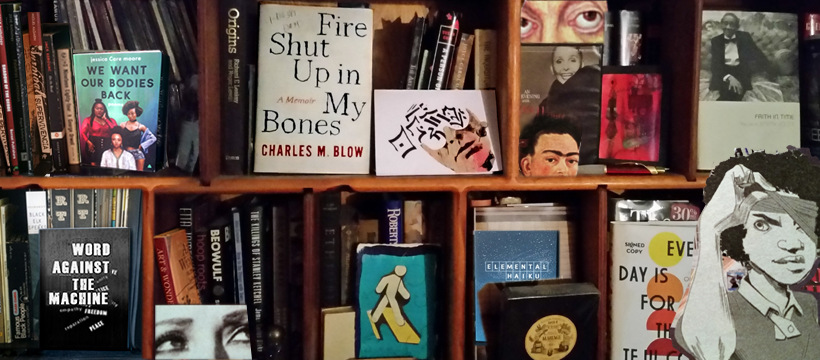
OUR FABULOUS HEADER PHOTOGRAPH THIS MONTH IS THE WORK OF TERRI STEWART UNDER CC (BY-NC) LICENSE.

BIOS WITH LINKS TO OTHER WORKS BY OUR CORE TEAM AND GUEST WRITERS

FOR UPDATES AND INSPIRATION “LIKE” OUR FACEBOOK PAGE, THE BARDO GROUP/BEGUINE AGAIN
MISSION STATEMENT

Back Issues Archive
October/November 2014, First Issue
December 2014, Preparation
January 2015, The Divine Feminine
February 2015, Abundance/Lack of Abundance
March 2015, Renewal
April 2015, interNational Poetry Month
May 2015, Storytelling

Posted in  Mya Schneider, General Interest, poem, Poems/Poetry, poetry

The Real Mrs. Beeton

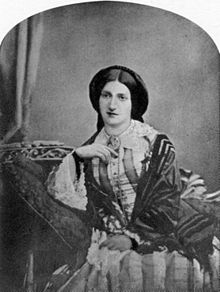
Isabella Beeton (1836-1865), known as the first and "best" cookbook author
Isabella Beeton (1836-1865), known as the first and “best” cookbook author

 Originally published by Second Light Live in ARTEMISpoetry  and shared here with the permission of both publisher and poet.

Heaving her enormous bulk onto a bookshelf high
above my bed, then pushing until she was out of sight
took all my strength and it didn’t dislodge her from my mind.

But I rebelled against the weight of her disapproval,
shut myself away every morning in that small room
of my own, the room which is me, to let imagination

run wild as brambles and grasses in an untended garden,
coaxed visions into scribblings on paper until desk
and floor were littered, until unblinking as owl eyes,

words stared from my screen. Of course, the moment
I emerged I came face to face with her large a life
on the landing. For years this matron, large-bosomed

and with a voluminous knowledge gathered from decades
of managing a household, followed me around tutting
because I hadn’t blanched or basted, couldn’t pluck a duck.

She snorted at unruly children sliding down the stairs,
at dust rollicking along skirting boards, rounded on me
for failing to keep a properly stocked linen cupboard.

Then the day I found out this paragon was Isabella Beeton,
a young woman who instead of devoting her life to home
and family like other Victorian wives, travelled by train

with her publisher husband to his London office, wrote
books fat with information, mostly magpied from other books,
about household management, became a money-spinner,

an authority for later generations. I also learnt she’d suffered
several miscarriages, bore two children who died in infancy,
two who survived, died herself after the second –

thanks to Mr Beeton’s syphilis. Yet for years books
in her name continued to appear. The matron’s ghost
still persists in my mind but what troubles me is Isabella.

For all the thousands of pages this woman produced
in her short life, the real Mrs Beeton didn’t leave
a single word about what she thought, felt, endured.

.

– Myra Schneider

© 2014, poem and poet’s portrait (below), Myra Schneider, All rights reserved, posted here with Myra’s permission; Mrs. Beeton’s photograph is in the public domain.

.

IMG_0032-1circling_the_coreMYRA SCHNEIDER (Myra Schneider’s Poetry Website) ~ Myra’s long poems have been featured in Long Poem Magazine and Domestic Cherry. She co-edited with Dilys WoodParents, an anthology of poems by 114 women about their own parents. Myra started out writing fiction for children and teens. We first discovered Myra through her much-loved poem about an experience with cancer, The Red Dresswhich she generously shared with readers here in our Perspectives on Cancer series in 2011.

Currently Myra lives in North London, but she grew up in Scotland and in other parts of England. She lives with her husband and they have one son. Myra tutors through Poetry School, London. Her schedule of poetry readings is HERE. A video of Myra’s interview at Poetry East in London is HERE. The sound leaves something to be desired, so ear-buds or earphones are helpful. Other videos are of poems: The Red Dress and Goulash. Myra’s Amazon UK page is HERE and US is HERE.

Myra’s eleventh poetry collection, The Door to Color, will launch this September by Enitharmon Press, UK at their gallery in London.

Posted in Essay, Terri Stewart

Christine de Pizan, Part 3 of 3

This series is an academic article that I wrote on the life of Christine de Pizan, an extraordinary woman of the medieval era. This is part 3. Part 1 is here. Part 2 is here.

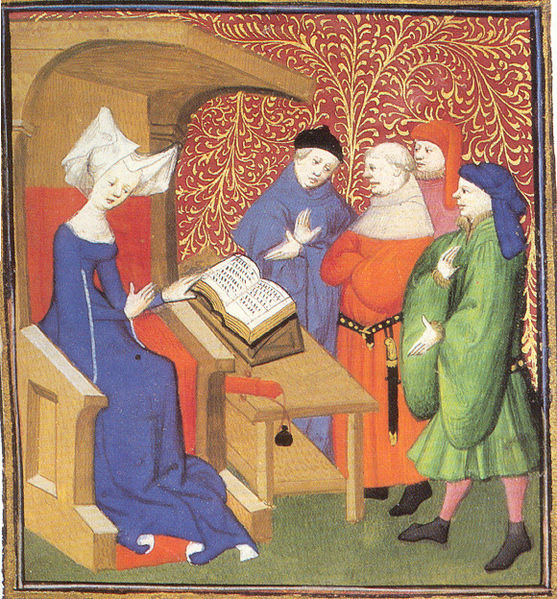
Christine de Pizan lecturing men Image from Wikimedia Commons
Christine de Pizan lecturing men
Image from Wikimedia Commons

In her poems on courtly love, she was able to express her deeply held conviction that “society obliged a woman to pay far too high a price for any momentary pleasure experienced from love outside marriage.”[1] So begins her championship of women aptly captured in “Cupid’s Letter.” During this time of growth for Christine, misogynistic attitudes abounded in the Universities, in court, and in the clergy. Aristotle’s influence held sway over the common understanding of what it was to be female. Every ill of the world was laid at the feet of women. As Christine aptly said in “Cupid’s Letter,”

There are women vilely named,

And often without cause are blamed,

And even those of noble race,

However fair and full of grace.

Lord, what company, what talk—

Women’s honor they freely mock.[2]

“Cupid’s Letter” enjoyed immediate success and was translated into English by Chaucer’s disciple, Thomas Hoccleve.[3] Her work of defending women and removing the tarnish that had been applied to their honor continued in other works including “The Debate of Two Lovers” which showed that true love is joyful, not deceitful or jealous, The Book of the City of Ladies that showed women’s contributions to history through time, The Book of the Three Virtues that sought to inculcate feminine virtues to counteract the misogyny of the time, and concluded with a eulogy poem in honor of Joan of Arc, “Ditie de Jehanne dArc.”

Throughout the time of her writing of poems and books, Christine became embroiled in a literary feud with Jean de Meun who wrote the second half of “The Romance of the Rose.” This became the “first recorded literary quarrel in France.”[4] Christine was inclined to blame the deceit and trickery of the men of her day at the feet of Jean de Meun.[5] “The Romance of the Rose” encouraged men to use whatever means necessary to acquire the woman they wanted in whatever way they wanted.  Jean de Meun belonged to another generation, another social world (not the courtly world of Christine de Pizan), and was primarily a philosopher.[6] He is crude and rude in his references to women and their body parts and advises “opportunism in relations with women, who are seldom virtuous, debauchery being the least of their crimes. The fine clothes of women do not really enhance them, for a dungheap covered with a silken cloth is still a dungheap.”[7] It is with this man and his very popular poem that Christine feels compelled to specifically defend womankind. Interestingly, she counters both in a poetic literary form, written letters, and politically through the official circle of Tignonville and the queen.[8] The chancellor of the University of Paris, Jean Gerson eventually entered the fray, siding with Christine de Pizan.[9]  Eventually, he wrote a treatise against “The Romance of the Rose.”[10] Chancellor Gerson and Christine de Pizan as literary allies were unbeatable and the argument ended (although it was not resolved.)[11] Christine was able to, for the first time, remove the discussion of women “from intellectual circles and [make] it possible for a lay-person, and a woman at that, to take part.”[12] From this point on, she leveraged her fantastic intellect, writing skill, and fame to continue writing about her major concern-“the defense of women against…unjust slander and…hypocrisies of contemporary society.”[13]

Christine de Pizan was a child and woman of privilege. She moved in circles that most people could not enter. She was affected by Petrarch, the University of Bologna, the University of Paris, and by the French Court of Charles V. Typically, a woman of her lifestyle would marry a man, have children, and live on. If her husband died, her task would be to re-marry. Christine did not do this. She educated herself, honed her literary skills and became an unlikely champion of women.

© 2013, post, Terri Stewart, All rights reserved

Terri StewartTERRI STEWART is Into the Bardo’s chaplain, senior content editor, and site co-administrator. You can expect a special post from her each week. She comes from an eclectic background and considers herself to be grounded in contemplation and justice. She is the Director and Founder of the Youth Chaplaincy Coalition that serves youth affected by the justice system. As a recent graduate of Seattle University’s School of Theology and Ministry, she earned her Master’s of Divinity and a Post-Master’s Certificate in Spiritual Direction with honors and is a rare United Methodist student in the Jesuit Honor Society, Alpha Sigma Nu. She is a contributing author to the Abingdon Worship Annual.
Her online presence is “Cloaked Monk.” This speaks to her grounding in contemplative arts (photography, mandala, poetry) and the need to live it out in the world. The cloak is the disguise of normalcy as she advocates for justice and peace. You can find her at www.cloakedmonk.com, www.twitter.com/cloakedmonk, and www.facebook.com/cloakedmonk.  To reach her for conversation, send a note to cloakedmonk@outlook.com.

[1] Willard, Christine de Pizan: Her Life and Works, 61.
[2] Ibid, 62.
[3] Ibid 63-64.
[4] Ibid, 73.
[5] Ibid, 63.
[6] Ibid, 75.
[7] Ibid, 75-76.
[8] Ibid, 77.
[9] Ibid, 80.
[10] Ibid, 84.
[11] Ibid, 86.
[12] Ibid.
[13] Ibid.

Posted in Essay, Terri Stewart

Christine de Pizan, Part 2 of 3

This series is an academic article that I wrote on the life of Christine de Pizan, an extraordinary woman of the medieval era. This is part 2. Part 1 is here.

Christine Presenting Her Book to Queen Isabeau, WikiCommons Images

Christine married Etienne de Castel, a son of a court official, in 1380.[1] It was a love match. Then things took a turn for Christine and her family. Charles V died and the crown’s close association with the academic world came to a close.[2] Tommaso became embroiled in a controversial cure that he had prescribed that “went awry.”[3] This caused the de Pizan family’s economic situation to deteriorate. Tommaso died in 1387.[4] Then in 1390, Christine’s husband died in an epidemic.[5] Christine became the head of a family with three children (one would die in childhood), a widowed mother, and a niece that was living with them. Furthermore, when she tried to settle the estate of her husband, she was met with deception, dishonesty, and lawsuits trying to strip her of her property.[6] Adding to her grief, money that had been reserved for her children’s future and invested was stolen.[7]To make matters worse, she became very ill, describing it as succumbing “like Job.”[8]

Given that Christine was now the head of her family, in France away from other relatives, without income, she had to create a way to support her household. Christine was still welcome at court and witnessed the frivolity of the court of Queen Isabeau and Louis of Orleans.[9] Here, poetry was one of the “principal social accomplishments”[10] and Christine turned her hand to poetry that reflected the Parisian social scene in its glory and ugliness. She proceeded to write poetry that reflected that scene, the grief she was still experiencing, and fond reminiscing of the reign of Charles V. Slowly, her poetry began to gather attention in the rarefied air of the court. Her fortunes began to turn when she was able to meet the earl of Salisbury in 1398.[11] They formed a bond based on love of poetry and he took her son into his own home to raise him with his own son. Then, in 1397, through Charles VI’s aunt, Marie de Bourbon, she was able to secure a place for her daughter at the Abbey of Poissy.[12]

Christine started writing poetry as early as 1394, but speaks of her literary career starting in 1399 after several years spent on self-education.[13] She studied ancient history, sciences, and the books of poets.[14] When she started studying the poets, she said to herself, “Child, be consoled, for you have found the thing that is your natural aspiration.”[15] She found her place. However, she did not take her early poetry very seriously. Her early poetry consisted of ballades, rondeaus, and the virelay.[16] These were well respected forms during her day. In addition, she started growing her own library of books by copying books in her own hand.[17] Christine also started writing letters purely for literary purposes.[18] She was becoming skilled at poetry, letter writing, and at common rhetorical devices used among the educated and courtly elite. Leaning on Plato’s view of women, Christine wrote in “The Mutation of Fortune,” that her change in status caused her to “become a man.”[19] It is this educated, courtly-adept woman that became a powerful voice for the fair and honorable treatment of women.

Christine’s poetry began to be known beyond the French court by approximately the year 1400.[20] She claims that it was because she was such a novelty—being a woman poet—that her work spread widely and rapidly.[21] However, it was probably because she wrote from her own point-of-view, a widowed woman. Her early poems used the court and its characters for the basis of her stories. She discovered that she had a particular talent for working with words and fitting them into poetic forms.[22] But her most striking skill was in expressing her own emotions and experience via literary devices.[23] The theme of grief and widowhood arises frequently in her writing.

© 2013, post, Terri Stewart, All rights reserved

Terri StewartTERRI STEWART is Into the Bardo’s  Sunday chaplain, senior content editor, and site co-administrator. She comes from an eclectic background and considers herself to be grounded in contemplation and justice. She is the Director and Founder of the Youth Chaplaincy Coalition that serves youth affected by the justice system. As a recent graduate of Seattle University’s School of Theology and Ministry, she earned her Master’s of Divinity and a Post-Master’s Certificate in Spiritual Direction with honors and is a rare United Methodist student in the Jesuit Honor Society, Alpha Sigma Nu. She is a contributing author to the Abingdon Worship Annual.

Her online presence is “Cloaked Monk.” This speaks to her grounding in contemplative arts (photography, mandala, poetry) and the need to live it out in the world. The cloak is the disguise of normalcy as she advocates for justice and peace. You can find her at www.cloakedmonk.com, www.twitter.com/cloakedmonk, and www.facebook.com/cloakedmonk.  To reach her for conversation, send a note to cloakedmonk@outlook.com.


[1] Willard, Christine de Pizan: Her Life and Works, 34-35.
[2] Ibid.
[3] Ibid, 38.
[4] Ibid, 39.
[5] Ibid.
[6] Ibid.
[7] Ibid, 40.
[8] Ibid.
[9] Ibid, 42.
[10] Ibid.
[11] Ibid.
[12] Ibid, 43.
[13] Ibid, 44.
[14] Ibid.
[15] Ibid.
[16] Ibid.
[17] Ibid, 45.
[18] Ibid.
[19] Ibid, 48.
[20] Ibid, 51.
[21] Ibid.
[22] Ibid, 53.
[23] Ibid.

Posted in Essay, Terri Stewart

Christine de Pizan, Part 1 of 3

This series is an academic article that I wrote on the life of Christine de Pizan, an extraordinary woman of the medieval era.

Christine de Pizan from Wikispaces.com
Christine de Pizan
from Wikispaces.com

During the lifetime of Christine de Pizan (1364-1430),[1] women were not well respected.[2] However, Christine managed to carve out a unique spot for herself among authors of poetry and rhetorical letters. Along her journey, she also became an unlikely champion of women, women’s roles, and the honorable treatment of women. Unlikely champion because Christine came from a privileged, comfortable background and was discouraged from stepping outside of traditional female roles by her mother.[3] I am going to show that Christine’s background peculiarly gave her the gifts to become not only a gifted author, but the unlikely champion of women. Then, a brief exploration of the misogynistic attitudes present during her lifetime that called forth a response and thrust her into the role of France’s first woman of letters.[4]

Christine de Pizan was born in Venice, Italy.[5] At the time she was born, the city was just recovering from two horrific events – an earthquake followed by the first outbreak of the bubonic plague in 1348.[6] It was thought that these events were punishments from God for Venice’s wickedness at warring with its neighbors and with Genoa.[7] Venice was a port city that was among the first cities hit by the plague due to its status as a maritime trader.[8] As the downfall of Venice was seen to be attributable to the movement of the planets and stars (earthquake), astronomy and astrology were respected and revered sciences.[9] The potential for ad4vanced study in these fields is what drew Tommaso da Pizzano to Venice.

Tommaso da Pizzano arrived in Venice in 1357 from Bologna. He had been studying there towards his degree of doctor in medical studies which would have included studying astrology.[10] Bologna had a reputation as an intellectual center of Europe, a book production center, and a center of secular thought.[11] That is the rarified air that Christine de Pizan’s father came from. Here, Tommaso met Christine’s mother, they married and soon had Christine. It is also in Venice that Tommaso became acquainted with Petrarch, one of the most influential poets[12] of his day.[13] Here the thoughts of Bologna-based on Aristotle’s writings-collided with Petrarch’s thoughts that were grounded in Plato.[14] Plato believed that women had a place in society—they had strengths that differed from men, but strengths none-the-less. Aristotle, however, had a much more subservient view of women.

In the Republic, Plato argues that women must be assigned social roles in the ideal state equal to those of men. Only one generation later, Aristotle, in his Politics, returns women to their traditional roles in the home, subserving men. Plato’s position in the Republic is based upon his view that “women and men have the same nature in respect to the guardianship of the state, save insofar as the one is weaker and the other is stronger.” Nature provides no such equality in Aristotle; in the Politics he flatly declares, “as regards the sexes, the male is by nature superior and the female inferior, the male ruler and the female subject.”[15]

I must say that Plato was not perfect on women, but he was more charitable in his views that Aristotle. Women, for Plato, degenerated from perfection while for Aristotle, they were inferior by nature.[16] Christine de Pizan was born into an environment more influenced by Petrarch and Platonic thought than by the University center’s reliance upon Aristotelian thoughts on women.

Tommaso soon re-established his family in Bologna because of the prestige that being at University brought him.[17] However, he was soon invited to join the courts of both Paris and Hungary. He chose Paris.[18] He left his family for two years in Bologna while he established himself at the French court of Charles V. This allowed him to have the prestige of being at court and being near the University of Paris. In December 1368, Charles V “received at the Louvre the newly arrived family of Tommaso, now transformed into Thomas de Pizan.”[19]

In the courts of Charles V, Christine was given quite a lot of freedom. Charles V has a propensity for intellectual interests.  He cultivated contacts with the University of Paris and built an impressive library. He contracted Nicole Oresme to translate the entire works of Aristotle into French.[20] Christine had access to the king’s library and to his personal study.[21] She later recalled the king with fondness saying, “In my youth and childhood, with my parents, I was nourished by his hand.”[22] Christine was enthralled with intellectual pursuits from a young age.[23] Her father encouraged her in her studies (he had very liberal views on the education of women) while her mother was more traditional.[24] Christine managed to walk a line between her two parents—tending to her traditional roles as a female and pursuing intellectual curiosities at every opportunity.

© 2013, post, Terri Stewart, All rights reserved

Terri StewartTERRI STEWART is Into the Bardo’s  Sunday chaplain, senior content editor, and site co-administrator. She comes from an eclectic background and considers herself to be grounded in contemplation and justice. She is the Director and Founder of the Youth Chaplaincy Coalition that serves youth affected by the justice system. As a recent graduate of Seattle University’s School of Theology and Ministry, she earned her Master’s of Divinity and a Post-Master’s Certificate in Spiritual Direction with honors and is a rare United Methodist student in the Jesuit Honor Society, Alpha Sigma Nu. She is a contributing author to the Abingdon Worship Annual.

Her online presence is “Cloaked Monk.” This speaks to her grounding in contemplative arts (photography, mandala, poetry) and the need to live it out in the world. The cloak is the disguise of normalcy as she advocates for justice and peace. You can find her at www.cloakedmonk.com, www.twitter.com/cloakedmonk, and www.facebook.com/cloakedmonk.  To reach her for conversation, send a note to cloakedmonk@outlook.com.

[1] Danuta Bois, “Christine de Pisan,” Distinguished Women of Past and Present, http://www.distinguishedwomen.com/biographies/pisan.html (accessed March 12, 2013).
[2] Charity Cannon Willard, Christine de Pizan: Her Life and Works (NY, Persea Books, 1984), 15.
[3] Willard, Christine de Pizan: Her Life and Works, 33.
[4] Ibid, 15.
[5] Ibid, 16.
[6] Ibid.
[7] Ibid.
[8] Cara Murphy, “The Bubonic Plague and the Impact on Venice,” FluTrackers, http://www.flutrackers.com/forum/showthread.php?t=23196 (accessed March 12, 2013).
[9] Willard, Christine de Pizan: Her Life and Works, 17-18.
[10] Ibid, 17.
[11] Ibid.
[12] Petrarch was an Italian humanist.
[13] Willard, Christine de Pizan: Her Life and Works, 19.
[14] Ibid.
[15] Nicholas D. Smith, “Plato and Aristotle on the Nature of Women,” Journal of the History of Philosophy 21.4 (1983): 467-478. Project MUSE. http://muse.jhu.edu/ (accessed March 13, 2013).
[16] John Wijngaards, “Greek Philosophy on the Inferiority of Women,WomenPriests.org, http://www.womenpriests.org/traditio/infe_gre.asp (accessed March 13, 2013).
[17] Willard, Christine de Pizan: Her Life and Works, 20.
[18] Ibid.
[19] Ibid.
[20] Ibid, 21.
[21] Ibid, 28-29.
[22] Ibid, 23.
[23] Ibid, 33.
[24] Ibid.

Posted in Essay, General Interest, Jamie Dedes, Writing

INTERNATIONAL WOMEN’S DAY: Celebrating and Empowering Women

CELEBRATING WOMEN
·
by
·
Jamie Dedes 
·
INTERNATIONAL WOMEN’S DAY is on March 8. If you are searching for blogging themes this month (festivities are month-long and not restricted to the one day), you’ve got them here. This global event creates space to celebrate economic, political, and social contributions of women. Governments, organizations, charities, and women’s groups choose themes that reflect gender issues, which may have a global or a local focus. No reason why you can’t choose a theme for a post or poem that relates to issues most significant to you. Or, you can stick with a theme that is the focus in your community. You’ll find the themes listed in the blog roll HERE along with lists of events in your area. Some of the themes being explored this year are:
  • Empower Rural Women – End Hunger and Poverty (United Nations)
  • Connecting Girls, Inspiring Futures (International Women’s Day 2012 Website)
  • Equal pay for work of equal value (European Parliament)
  • Strong Leadership. Strong Women. Strong World: Equality (Canada)
  • Unite to End Violence Against Women (Australia, UNIFEM)
  • Our Women, Our State (Australia, Queensland Government Office for Women
  • Sharing the Caring for the Future (Australia, WA Department for Communities)
  • Success in Globally Integrated Enterprise (USA, Woment@ IBM)
  • Women’s Voices and Influence (UK, Doncaster Council)
  • Stretch Yourself: Achieving 50:50 in the boardroom by 2020 (UK, Accenture)
  • Bridging the Generational Gap (UK, Doncaster Council: Women’s Voices and Influence)
For more information on this event link to International Women’s Day 2012.
·
♥ ♥ ♥
·
AND SINCE WE ARE CELEBRATING WOMEN, WHY NOT TWO OF OUR OWN?: Two poets and writers in our blogging community recently had new books accepted for publication. They are Victoria C. Slotto (an Into the Bardo contributing writer) and Heather Grace Stewart. Congratulations ladies!
·
Meet and greet Victoria on March 21 if you are in Southern California:
  • Victoria will be at a book fair in Rancho Mirage on March 21st at the Rancho Mirage Library 10AM to 2PM.
·
If you live in Quebec, mark your calendar’s for Heather’s launch party in May.
  • Carry On Dancing Launch Party  May 8, 2012: 4873 St. Laurent Blvd. Doors open 8:30 p.m. Bar & coffee bar Music by Kimberly Beyea & Jim Bland. Can’t wait to celebrate with you! Details HERE.
·
♥ ♥ ♥
·

Related articles on International Women’s Day: