
Posted in Christianity, Essay, Terri Stewart

Creating room and transformation at Christmas …

800px-Nativity_tree2011Originally published in Rethink Church. Published here with permission.

IT’S ALMOST CHRISTMAS!!! I hear this echoing in my head from years past—from my children’s years, from my own cries, and from my crazy Aunt Nancy (I love you!) who still calls me at zero-dark-thirty to wish me a Merry Christmas.

What I also remember is making lists of what I have bought for the in-laws to make sure everybody got the same quantity and the same monetary value. Making lists for my children so one was not valued in presents more than the other. And stressing out over finding that “perfect gift” for my oldest son who seemed to be unable to express desire for anything. ANYTHING. That is stressful.

But maybe he had the right idea all along! He was unattached to things.

Non-attachment to things of this world is a value greatly revered by the world’s great traditions. What if we slowed down, let non-attachment suffuse the Christmas* season, and began again? What would that mean? What would it look like in our lives?

What if we emptied our lives of the values of materialism, comparison to others, and over-abundance and instead filled it up with the values of spiritualism, self-inventory, and enough? What if we took a journey of emptying rather than filling?

The dichotomy is pretty stark. Empty vs. full. Nobody really wants to run around on empty or having nothing. But there is a trick. By slowing down our lives and refocusing our lives, we can begin again with an attitude pointed towards spiritualism, self-inventory, and being satisfied with enough. Adopting these three counter-cultural traits, creates freedom for new things to happen.

Simplifying creates room for more!

More what? More interior room to listen to that which calls you. More room to see those around you. More room to understand great joy. And more room to feel the world’s great grief. After listening, seeing, understanding, and feeling, there is one more thing—by simplifying, there is more room to offer great love in action to a hurting world.

By emptying, we create room. By making room, the possibility of personal transformation is created. By being transformed, the possibility of action is created. By committing acts of love, mercy, and justice, the possibility of world renovation is created.

And before long, we who were emptied have been filled with love.

Shalom,
Chaplain Terri Stewart

*Christmas season in the secular sense of the word as that time from the day after Thanksgiving to January 1.

©2013, essay, Terry Stewart, All rights reserved
Photo credit ~ Jeff Weese via Wikipedia and under Creative Commons Attribution 2.0 Generic license

terriREV. TERRI STEWART is The Bardo Group  Sunday chaplain, senior content editor, and site co-administrator. She comes from an eclectic background and considers herself to be grounded in contemplation and justice. She is the Director and Founder of the Youth Chaplaincy Coalition that serves youth affected by the justice system. As a graduate of Seattle University’s School of Theology and Ministry, she earned her Master’s of Divinity and a Post-Master’s Certificate in Spiritual Direction. She is a contributing author to the Abingdon Worship Annual.

Her online presence is “Cloaked Monk.” This speaks to her grounding in contemplative arts and the need to live it out in the world. The cloak is the disguise of normalcy as she advocates for justice and peace. You can find her at www.cloakedmonk.comwww.twitter.com/cloakedmonk, and www.facebook.com/cloakedmonk.  To reach her for conversation, send a note to cloakedmonk@outlook.com
Posted in Essay, Michael Watson, theatre/spoken word

Beyond Godot

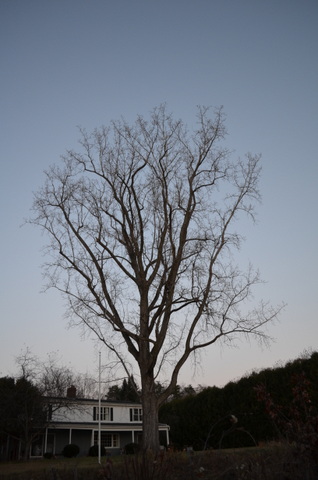
Winter TreeI first encountered Kandinski’s Concerning The Spiritual In Art while in college. While I did not necessarily experience his sense of the mystical nature of line and color, I did share, in my way, his passionate hope that art could be a vehicle for spirituality and social change. Over the years those ideas have informed my visual and performance work.

Although I no longer perform often, I continue to think about issues of theatre and performance. At the center of my theorizing, aesthetics meets concerns about ethnicity, race, class, gender and disability. In all my years of university training (BFA, two MA’s, and a Ph.D.) discussions of the power relationships inherent in aesthetic standards rarely arose. I venture to say that they never arose in my arts courses. Even those anthropology and psychology courses devoted to consideration of race, class, or gender largely ignored aesthetics as culturally mediated. Now I routinely explore the cultural construction of aesthetics with students in my courses, although they are not always comfortable with the material.

Recently I have been engaged in discussions about the societal and political dimensions of aesthetics with a variety of performance practitioners. These folks tend to land in one of three groups: teacher/artists, performance venue administrators, or performer/directors. Clearly, these categories frequently overlap, yet they remain useful. When in conversations with performer/directors I find we can usually comfortably discuss integrating persons of diverse races/ethnicities and genders into troupes, as long as the performers share an aesthetic. Perhaps not surprisingly in our present economic climate, they seem more concerned with audience than inclusion. Often, this means that performers are excluded based on disability or class. (Interestingly, some performance space administrators seem more interested in the narrative and performative power of pieces, and book innovative, inclusive companies, seek out audiences.)

Disability becomes an issue when performers bring physical or cognitive challenges to theatre. Performance making requires the creation of narrative structure if the piece is to convey meaning. The director shapes the narrative, and in so doing privileges some aesthetic choices over others. (The performance space can also shape the narrative; many stages are inaccessible!) The result is either more, or less, inclusive of both performers and audience members. (One may argue that the history of the Avante Guard, in which I was trained and participate, is one of theorizing inclusion while establishing ever more restrictive cultural elites.) Generally, directors seem to feel more comfortable making accommodations for performers who contribute to the director’s formal choices, rather than building performance around the considerable skills of the disabled, or other performers who demonstrate difference. This is understandable, yet problematic. After all, performance is about storytelling, and aesthetic choices inevitably convey the subtext for the director’s (and often the culture’s/society’s) preferred narrative. Exclusion is inevitable and it matters.

An example of  the exclusionary capacities of aesthetics took place in New Orleans a couple of years ago when a famous director from the Northeast brought his version of Waiting for Godot to town, ostensibly to make a statement about the plight of local people immediately following Katrina. Godot is a centerpiece of the Western theatre cannon, and the play in question was greeted with much critical applause. Yet the commentary about the play largely ignored the conditions of the performances. One of my acquaintances, a theatre person from the Big Easy, critiqued the play thus (my paraphrase) : “The piece sold out the Dome, but there were almost no people of color inside. Many people of color and local theater and performance artists were in the lobby trying to purchase tickets. It was embarrassing. On top of that, the play is about doing nothing, about futility. Here in New Orleans people were active after the storm, trying to help one another. We still are. Neither the media nor the play showed that. Local theatre people here have made a lot of performances showing the bravery and generosity of the people here during and after the storm, but those performances get little attention in the national media. Yet the production of Godot was in all the national media.”

Clearly the Avante Guard’s use of social engagement can be highly problematic, especially when performance is done for (some say “to”) culturally specific audiences, for instance, the New Orleans experience of Godot. Or consider a group of non-disabled actors creating and performing a show with disability themes to an audience of disabled persons. Let’s say many of  the stories utilized to create the performance had been gleaned from persons who were now in the audience. When asked why there are no disabled performers, the director responds, “We could find no disabled performers who could this physically demanding piece.” The performance may have been visually stunning and spiritually uplifting, but also conveyed a strong message of inaccessibility. The medium is, ultimately, the message. (Interestingly, in the Eighties, Bill T. Jones was harshly criticized for including persons with life threatening illnesses in his performances of Still Here, even thought those participants publicly praised Bill and spoke about the work as life changing.)

I’ve been exploring spirituality in the arts, and issues of inclusion and aesthetics since the 1960’s. There are now many people of color, disabled artists, and folks across a diversity of classes, ethnicities, and genders thinking, speaking, and writing about cultural coding in performance. That’s good; we need those voices. Many of those folks are making art that arises out of their thoughtful exploration of these issues. Often, these works are filled with spirit. I like to think we are, like the good folks of New Orleans, no longer waiting for Monsieur Godot.

Next time you attend a theatre or other performance event, consider paying attention to the cultural codes being enacted. What are the values implicit and explicit in the piece? Whose on stage and who isn’t? What description of reality is given preference? Are you invited to drink deeply from the well of Spirit? I hope you’ll let me know what you discover.

– Michael Watson, Ph.D.

© 2013, essay and photographs (includes the one below), Michael Watson, All rights reserved

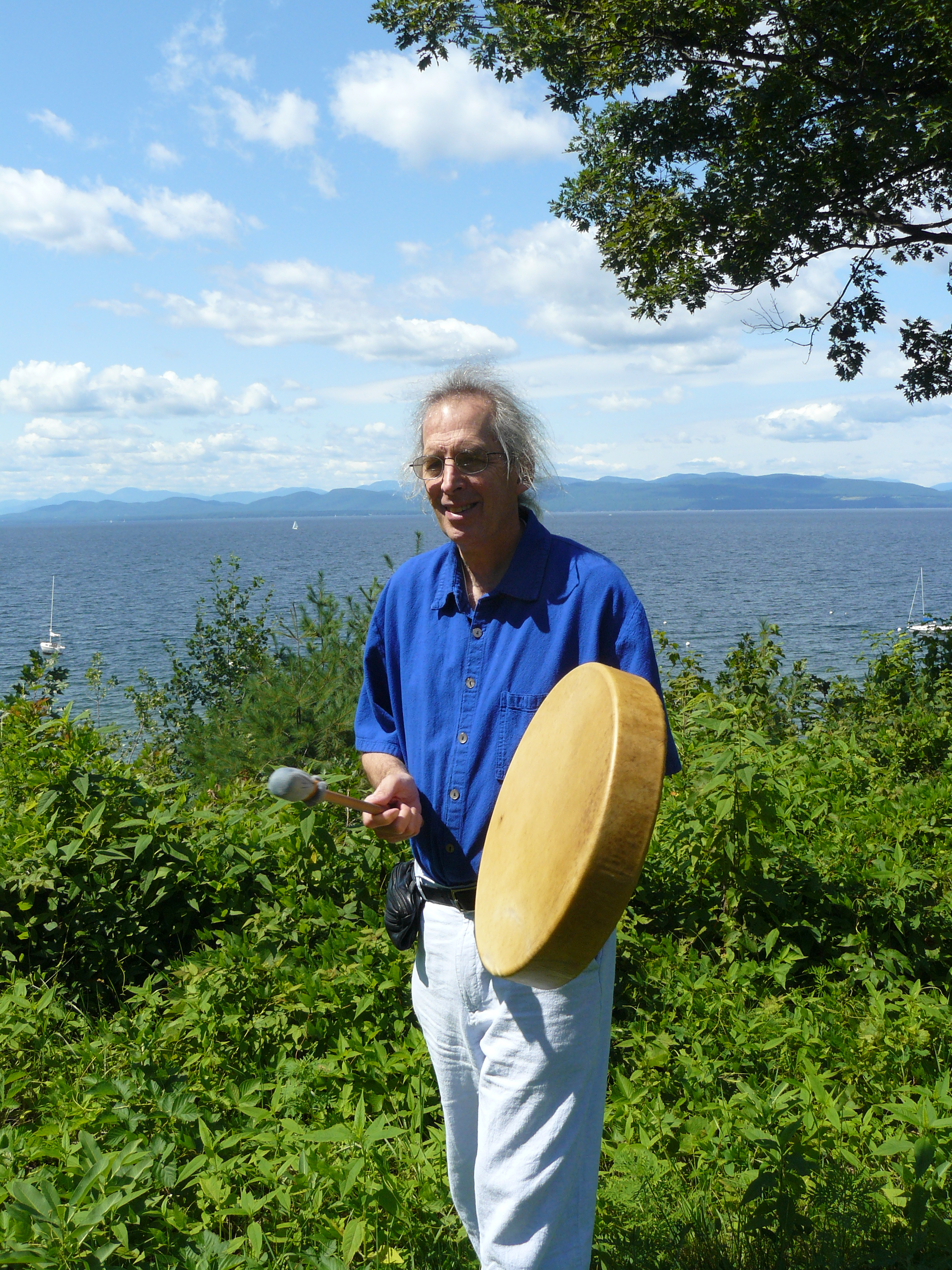
michael drumMICHAEL WATSON, M.A., Ph.D., LCMHC (Dreaming the World) ~ is a contributing editor to Into the Bardo, an essayist and a practitioner of the Shamanic arts, psychotherapist, educator and artist of Native American and European descent. He lives and works in Burlington, Vermont, where he teaches in undergraduate and graduate programs at Burlington College,. He was once Dean of Students there. Recently Michael has been teaching in India and Hong Kong. His experiences are documented on his blog. In childhood he had polio, an event that taught him much about challenge, struggle, isolation, and healing.

Posted in Essay, poem, Spiritual Practice, Terri Stewart, Uncategorized

Sacred Space at Disneyland

I am at Disneyland right now! On vacation! Sometimes I find myself frustrated at the crowds around me and at certain comments from my family (just as I’m sure they are frustrated with me at times!). But my husband said something very wise as we cued up for the Haunted Mansion – he said, “It is like a labyrinth.”

It was! The difference being the labyrinth leads to a holy space and returns you on the same path. And a cue leads to an event and you exist on a different path. But do we really need a bunch of tools in our tool kit to create sacred space? Do I need my Mary Oliver book, my Bible, my candles, a labyrinth? Or do I need to simply be open? In this instant, in this place, simply being open became enough.

I proceeded down the path towards the Haunted Mansion with my heart stretched and my ears open to the sounds of conversation, of the mechanisms of the ride, of the water nearby, or the staff. And I felt the connectivity with the cosmos. The sacred was there. In the cue at the Haunted Mansion in Disneyland.

Of course, intellectually, I know this. But experientially, I forget. I get caught up in being right (if it is my family or politics) or caught up in impatience (a 45 minute cue?!). But if I slow down and begin again, I can recall myself to the center and extend my consciousness outward from my body into the world around me. Greeting my loved ones, strangers, trees, all of it – the cosmos.

The cosmos is also within us, we’re made of star stuff. ~Carl Sagan

We just have to remember!

star stuff drifts

through the cosmos

salvation’s quest

It's A Small World (c) 2013, T. Stewart Cell Phone
It’s A Small World
(c) 2013, T. Stewart
Cell Phone

Shalom & Amen!

Terri

P.S. – I’d love for you to drop by www.BeguineAgain.com and see some of the Advent reflections taking place. Today’s reflection is on World AIDS Day from an unsung hero, Tracy Daugherty.

© 2013, post and photos, Terri Stewart, All rights reserved

terriREV. TERRI STEWART is The Bardo Group  Sunday chaplain, senior content editor, and site co-administrator. She comes from an eclectic background and considers herself to be grounded in contemplation and justice. She is the Director and Founder of the Youth Chaplaincy Coalition that serves youth affected by the justice system. As a graduate of Seattle University’s School of Theology and Ministry, she earned her Master’s of Divinity and a Post-Master’s Certificate in Spiritual Direction. She is a contributing author to the Abingdon Worship Annual.

Her online presence is “Cloaked Monk.” This speaks to her grounding in contemplative arts and the need to live it out in the world. The cloak is the disguise of normalcy as she advocates for justice and peace. You can find her at www.cloakedmonk.comwww.twitter.com/cloakedmonk, and www.facebook.com/cloakedmonk.  To reach her for conversation, send a note to cloakedmonk@outlook.com
Posted in Christianity, Essay, Jamie Dedes, Peace & Justice

THE TIPPING POINT: Good will from and toward women and men everywhere!

Nativité_de_CostaThis is simultaneously blogged on Rev. Terri Stewart’s blog and my own personal blog.

Today begins the first day of our Terri Stewart’s Advent event. There are many bloggers participating in this event. Each day of the Christian celebration of Advent will be sponsored by a different blogger who will post appropriately on his or her site. Their posts will also go up on Terri’s site and the kick-off is on Into the Bardo today.

If you follow Into the Bardo  regularly, you know that we share work here that is not necessarily religious but is reflective of diverse cultures and spiritual paths and representative of universal human values, however differently they might be expressed. This is a space where we hope you’ll delight in learning how much you have in common with “other” peoples.

We acknowledge that there are enormous theological differences and historical resentments that carve wedges among and within the traditions, but we believe that ultimately self-preservation, common sense, and human solidarity will empower connections and collaboration and overcome division and disorder. We work for the tipping point when compromise – an admittedly imperfect peace – will overcome war and respect for life will topple resentment. That may not happen in our time, but it has to start somewhere and sometime and this is our modest contribution toward an end for which diverse people the world over are working.

For those who are not Christian, Advent is the period of time leading up to the Nativity of Christ (Christmas). It is celebrated somewhat differently by different Christian sects and by Roman and Eastern Catholics and Eastern Orthodox churches. I think the details of the celebrations are less important than the scriptural quote for the day …

James 4:1-3
1 Those conflicts and disputes among you, where do they come from? Do they not come from your cravings that are at war within you? 2 You want something and do not have it; so you commit murder. And you covet something and cannot obtain it; so you engage in disputes and conflicts. You do not have, because you do not ask. 3 You ask and do not receive, because you ask wrongly, in order to spend what you get on your pleasures.

Indeed, where do the conflicts and disputes originate: in the cravings that make us restless within ourselves, in coveting things or situations we don’t have (and may not really need), and in not using right means for just ends? These are appropriate considerations as we approach the annual celebration of the “Prince of Peace,” a celebration which is in the end a call for compassion and understanding.

May our compassion have legs.

PEACE ON EARTH
The tipping point:
GOOD WILL FROM AND TOWARD WOMEN
AND MEN EVERYWHERE!

… and Happy Thanksgiving and Happy Hanukkah to those who are celebrating  …

Follow the entire Advent season
with Terri Stewart HERE.

… If you are so inclined, we would be grateful to have this post reblogged. Thank you! …

– Jamie Dedes

© 2013, essay, Jamie Dedes, All rights reserved
Photo credit ~ Pramzan via Wikipedia under CC A-SA 3.0 Unported 2.5 Generic, 2.0 Generic, 1.0 Generic license

Photo on 2012-09-19 at 20.00JAMIE DEDES ~ Poetry remains a gift in disability and medical retirement. It’s a compact thing that I can still manage. I am the founder and host of Into the Bardo, a spirited international collaborative of word-play, music, art and photography where our core team members function independently and yet with a remarkable synergy. They do everything. They are the stars. I have simply created a space in which to share.

For the past five years I’ve blogged at The Poet by Day, the journey in poem, formerly titled Musing by Moonlight (hence the url). Poetry is my spiritual practice.

Posted in Corina L. Ravenscraft, Essay, Nature, Photography/Photographer, Poems/Poetry

Elder Box Elder

DunbarCaveTree

Editor’s Note: Terri Stewart’s regular Sunday posts are always a surprise. She doesn’t pop them into the blog until near midnight on Saturday, so we don’t get to see them until Sunday a.m….no editorial sneak-preview. In an interesting coincidence (synchronicity?), Corina L. Ravenscraft popped this one to Bardo before Terri’s post for this Sunday went up. It rather serves to reinforce Terri’s message, which we think makes it synchronicity and not coincidence. Like Terri’s post, it’s richly evocative. Enjoy…

.

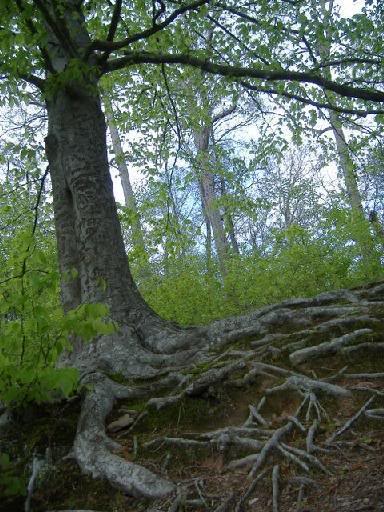
Gnarled persistence, drove its thick roots down,

Conquered the rocks and divided the dirt.

Spread out its branches, claimed this piece of ground,

When people etched into its bark, it hurt.

.

It survived such scars from their careless blades,

Grew taller, stronger, bore fruit for the birds.

None picnicked beneath to enjoy its shades,

Hard roots ran rampant, to escape the words

.

Carved for all time on its beautiful skin.

There, by the cave, it was brave; weathered storms,

Bent branches without and strong spirit within,

The world demands change and the soul transforms.

.

Soft  spirit deep inside this elder tree,

Expanded, extended life through its roots.

The Native Americans set it free,

And chose its sacred heart wood for their flutes.

– Corina L. Ravenscraft

~ C.L.R. ~ © 2012, photo, poem, essay, All rights reserved

This is a photograph I took some time ago, of a really neat Box Elder tree in the Dunbar Cave Natural Area near my home. This tree has always fascinated me and it makes me sad to see how many people have carved their initials or names into its bark. My friends and I used to call it the “Ringwraith Tree” because it reminded us of the tree where Frodo hid from the Ringwraith, but Box Elders also have a very special place in Native American culture.

The Anasazi flutes were carved from these trees, and the originals were only carved from these trees. It was believed that the tree’s unique, sacred spirit was imparted into each flute carved.

The Anasazi flute is the flute played by Kokopelli, a Native American Indian fertility god. It is also said that the hunch on his back depicted the sacks of seeds and songs he carried. Legend also has it that the flute playing symbolized the transition of winter to spring. Kokopelli’s flute is said to be heard in the spring’s breeze, while bringing warmth. It is also said that he was the source of human conception. Legend has it, everyone in the village would sing and dance throughout the night when they heard Kokopelli play his flute. The next morning, every maiden in the village would be with child.“ For anyone who has never heard the beautiful, haunting sound of this flute, I invite you to watch and listen to the video below.  Enjoy!

Corina-1CORINA L. RAVENSCRAFT (Dragon’s Dreams) ~ is a regular contributor to Into the Bardo. She is a poet and writer, artist and librarian who has been charming us through her blog since 2000, longer than any blogger in our little blogging community.

Posted in Essay, Spiritual Practice, Terri Stewart

Sacred Space in Particles

I am fascinated with astrophysics. And I am probably just skilled enough to be dangerously inept! One thing that just makes my heart flutter is the idea that all matter is already created! We can neither destroy or create matter. (Except that we can, according to the Higgs Boson discovery – but that will be for another discussion!)

In general terms, matter is neither destroyed or created so that essentially the particles we immerse ourselves in are the same particles that have been around forever and ever. The Oxygen molecule I breathe in was perhaps breathed in by some semi-ancient ancestor. Who would I choose to share breath with? Maybe I would connect to some fabulously wonderful pioneering women such as Christine de Pizan or Joan of Arc. Or maybe with some substantial spiritual leaders like Jesus of Nazareth, Gautama Siddartha, or Mary of Magdala. I could be breathing their particles!

I am also breathing the particles that were created at the moment of birth of the cosmos. That rapid expansion of the universe when it really did somehow go from nothing to something. Pushed outward in a violent burst of matter, light, and waves. Culminating in this moment. This time. At least for us. This moment is the culmination. Until the next moment, that is!

So, I was thinking cosmologically in this way and I stumbled across a book called, The Tree. It is a children’s book written by a Pacific Northwest author. I imagined the particularity of matter as residing in the tree. And then I read the story of how this book came about. The author received this story while sitting underneath a Douglas Fir in the Pacific Northwest. He received it as a song, not as a story. He sang it often for various events. Half-heartedly claiming that the tree wrote it.

Later, he was invited to a celebration to celebrate the return of the Madrona Point burial ground to the Lummi people. The tribal chief wanted to hear his song. He sang it. And then offered the story of the song’s origins with the additional wondering, “Did it really come from that ancient Douglas Fir?”

The tribal chief said, “It did. I recognize the tune.” He went on. “It is known in our tradition that each tree has its own song. Our music comes from them. We show our respect for the great trees by singing their songs and playing them on the flute. We must all work to save the ancient groves in our territory.”

Hmm. That is really quite beautiful.

And so, for this offering in the quest towards finding sacred space, I invite you to connect with the particles of the cosmos, the particles of the tree, and to sit back and enter into the story of The Tree.

Shalom and Amen,

Terri

© 2013, post and video, Terri Stewart, All rights reserved

terriREV. TERRI STEWART is Into the Bardo’s  Sunday chaplain, senior content editor, and site co-administrator. She comes from an eclectic background and considers herself to be grounded in contemplation and justice. She is the Director and Founder of the Youth Chaplaincy Coalition that serves youth affected by the justice system. As a graduate of Seattle University’s School of Theology and Ministry, she earned her Master’s of Divinity and a Post-Master’s Certificate in Spiritual Direction. She is a contributing author to the Abingdon Worship Annual. (The 2014 issue just released!)

Her online presence is “Cloaked Monk.” This speaks to her grounding in contemplative arts and the need to live it out in the world. The cloak is the disguise of normalcy as she advocates for justice and peace. You can find her at www.cloakedmonk.com, www.twitter.com/cloakedmonk, and www.facebook.com/cloakedmonk.  To reach her for conversation, send a note to terri@cloakedmonk.com

Posted in Essay, Photography/Photographer, Priscilla Galasso, Spiritual Practice

Habit

Habit might be the enemy of Awareness or Mindfulness.  Doing things routinely without thinking is a practice that allows our mind to wander into the past or the future or the make believe without really being present.  Sometimes, this is just what I want to do!  Yes, I admit to blowing up Mah Jong tiles and Free Cell rows when I want to veg out.  But if I want to be truly alive, I try to pay attention to each present moment.

Thich Nhat Hahn gives a wonderful lesson to Oprah Winfrey on drinking tea mindfully in this clip.  Oprah, out of habit, takes a sip of her tea before the meditation even begins.  I smile, thinking, “how embarrassing!” and noting that I probably would have done the same thing if I wasn’t careful.

Habits can be comforting…and they can lull us to sleep.  Do you want to be awake?  Do you feel like there will be plenty of time to be dead later on?  I do.  Except when I don’t.  It takes a lot of psychic energy to be alive!  Think about all that’s involved when you do a simple thing like climb up a short flight of stairs.  Your weight is shifting, balancing, your muscles are contracting, your toes are gripping, your hand may reach out to the banister, your eyes are measuring the height of each step, you’re breathing with the exertion, and all while trying to remember what you’re going upstairs for!  Walking meditation, tea meditation, stairs meditation…it’s all the same practice of mindfulness.

This picture adds another aspect: Steve in meditation.  I see him every day.  I want to be mindful of that miracle.  He’s alive, different, changing, dynamic, and important.  So am I, but I have a long way to go on that one. Appreciating myself is the hardest practice for me.

Habit

– Priscilla Galasso

© 2013, essay and photographs (above and below), Priscilla Galasso, All rights reserved

004PRISCILLA GALASSO ~  started her blog at scillagrace.com to mark the beginning of her fiftieth year. Born to summer and given a name that means ‘ancient’, her travel through seasons of time and landscape has inspired her to create visual and verbal souvenirs of her journey.

Currently living in Wisconsin, she considers herself a lifelong learner and educator. She gives private voice lessons, is employed by two different museums and runs a business (Scholar & Poet Books, via eBay and ABE Books) with her partner, Steve.

Posted in Essay, Spiritual Practice, Terri Stewart

Finding Sacred Space In the Other

This week in my church, it has been filled with conflict and dissension. That makes for a tough week! Let me clarify – structurally, from the upper echelon of the decision-making bodies, there has been a reinforcement of codified discrimination and what I think is just pig-headed wrongness. Ha! I am not feeling very charitable at all. I always have the choice of staying within the system or leaving. But leaving does not really move the ball forward for me. Why? Because my basic anthropology is that we are all connected. Even if I left this system and surrounded myself with folks that were just like me (how irritating that would be!), I am still connected to the people that I find the most frustrating.

Harrumph.

Then, I discovered this exercise written by Troy Bronson in his book Drawn In. It is an exercise for integration and forgiveness. Or perhaps forgiveness and integration. I am fairly certain that full integration is not possible without forgiveness! At any rate, I have adapted his exercise and now I offer it to you as a spiritual practice to aid in integrating those people that drive us bananas.

Take a piece of paper and fold it in half twice so that you have four quadrants. In the bottom right list your enemies: those who mean harm to you and your family; those who are politically opposed to what you are for; those who persecute you and others associated with your causes and passions.

In the bottom left list your friends: advocates for those associated with your religious, political, or social causes. Write all of this so that both groups are at the bottom of the page, with only a crease separating them.

On the Horizon (c) 2013, Terri Stewart
On the Horizon
(c) 2013, Terri Stewart

Now, draw a horizontal line to separate both groups from the empty top half of the page. Read this adapted version of Psalm 121.

I look to the hills!
Where will I find help?
It will come from the immense force
that created the stars, sun, sky,
And earth.

You are protected by Love,
And Love will not sleep
Or stumble
Or snooze.
Love always is.
Protecting you,
Standing at your right side,

The Tree shades us from the sun
The sun will not harm you
Nor will the
Moon.
Protecting you,
Keeping you safe from
All
Dangers.

The incredible creative force
That was, that is, that shall be
Is with you.
Now and always.
Wherever you go.

Reflect on the line, “I look to the hills!” and imagine that the line you’ve drawn is a horizon line made by hills way off at the distance. Imagine your friends and your enemies looking into a future where all things are met with love, justice, and mercy. Where the separating walls between these two groups are healed and taken down. Where the grievances are forgiven. Where they gaze lightly upon one another and see beloved rather than the other.

Now, offer your thoughts to love and reconciliation choosing to step forward into the hills that were once a divider, but now, as we all step into them, cocoon us in beauty.

Adapted from Ephesians 2:11-22

Don’t forget that you used to be the other! The enemy! They used to call you crude and rude. You were a foreigner in this land with no understanding of tradition. You had no hope and were held far away from life giving love.

Creative, responsive love unites all in peace! Breaking down the laws that separate us – that separated us. Following religious rules that are not grounded in loving kindness is not helpful! We all suffer, feel pain. But we are all one, one body united together. We are in this one life together.

You are no longer a stranger or an enemy! You are beloved. Just as those you persecute are beloved. All who went before you are the foundation for who you are today. And it is held together by Love and grown into holy ground where Loving Kindness dwells.

You are part of that holy ground.
You are holy ground.
They are holy ground.
We are
Holy
Ground.

There is no near and no far.
There is only here.
Be one.

Shalom and Amen,

Terri

© 2013, post , Terri Stewart, All rights reserved

terriREV. TERRI STEWART is Into the Bardo’s  Sunday chaplain, senior content editor, and site co-administrator. She comes from an eclectic background and considers herself to be grounded in contemplation and justice. She is the Director and Founder of the Youth Chaplaincy Coalition that serves youth affected by the justice system. As a graduate of Seattle University’s School of Theology and Ministry, she earned her Master’s of Divinity and a Post-Master’s Certificate in Spiritual Direction. She is a contributing author to the Abingdon Worship Annual. (The 2014 issue just released!)

Her online presence is “Cloaked Monk.” This speaks to her grounding in contemplative arts and the need to live it out in the world. The cloak is the disguise of normalcy as she advocates for justice and peace. You can find her at www.cloakedmonk.com, www.twitter.com/cloakedmonk, and www.facebook.com/cloakedmonk.  To reach her for conversation, send a note to cloakedmonk@outlook.com

Posted in Environment/Deep Ecology/Climate Change, Essay, First Peoples, Michael Watson, Music

Emergent Universe Oratorio Blues

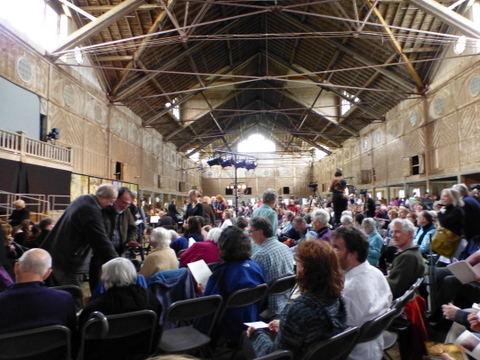
Breeding Barn, Shelburne at FarmsRecently we traveled down to Shelburne Farms for the world premiere of the Emergent Universe Oratorio, composed by Sam Guarnaccia.  The Oratorio is a work that re-imagines the dominant culture’s physics-based creation narrative, and seeks to universalize the story. Before the Oratorio we were treated to the soulful playing of Eugene Friesen, of Paul Winter Consort fame. New Paintings, created for the event,by our friend, the marvelous artist, Cameron Davis, graced the walls in the remarkable, “cathedral-like” Breeding Barn.

Just prior to the performance, Mary Evelyn Tucker and John Grim, Co-Directors of the Forum on Religion and Ecology at Yale, and whose film of the same title was the inspiration for the oratorio, spoke. They acknowledged, and expressed appreciation for, Indigenous friends and adopted family. (No Indigenous people spoke.) They then spoke about a vision they hold, in which all of the Earth’s people have one creation story, a story that leads us to an Earthly paradise.

The Oratorio draws on texts from many Western traditions, but appears to include no Indigenous authors. This is problematic and, unfortunately, common in the Deep Ecology world. ( I have been reviewing Ecopsychology texts in preparation for teaching and have noticed a paucity of Indigenous voices, even in texts published this year.)

Of more concern is the notion that any narrative should be the ONLY narrative. This is an idea Indigenous people know well, whether presented in the guise of religious or economic dogma. The very idea of a universal point of view is imperial and colonizing, and alien to Native American cultures. We have many creation stories, each loved and valued.

I was feeling rather blue as I read the text and listened to the lovely melodies of the oratorio. I imagined myself to be the only one in the audience of hundreds who was discomforted. Then intermission came and others stopped by to share their concerns. As so often happens following such events, the concert has remained a topic of conversation at our house.

A few days ago I was having coffee with a Six Nations friend. Out of the blue he looked me in the eye and said, “I am so appreciative of time with you. It’s such a relief to not have to explain myself.” When I asked what he meant, he replied that I understood his struggles and, although we are from different tribal backgrounds, we share a similar ethos. Sometimes I forget how wide the divide between cultures can be in one geographically defined country. To be reminded, as I was at the concert, of the chasm we cross daily can be painful indeed.

– Michael Watson, Ph.D.

© 2013, essay and photographs (includes the one below), Michael Watson, All rights reserved

michael drumMICHAEL WATSON, M.A., Ph.D., LCMHC (Dreaming the World) ~ is a contributing editor to Into the Bardo, an essayist and a practitioner of the Shamanic arts, psychotherapist, educator and artist of Native American and European descent. He lives and works in Burlington, Vermont, where he teaches in undergraduate and graduate programs at Burlington College,. He was once Dean of Students there. Recently Michael has been teaching in India and Hong Kong. His experiences are documented on his blog. In childhood he had polio, an event that taught him much about challenge, struggle, isolation, and healing.

Posted in Essay, Spiritual Practice, Terri Stewart

Finding the Sacred in Impermanence

Today I have been thinking about the beauty of impermanence. These thoughts were inspired by an artwork installation I saw recently called Shimmering Tree. Shimmering Tree is a projection of a digital tree onto a huge wall in a gallery. The tree is shimmery, animated, and changes seasons. But it is digital! I wondered about this digital artwork media installment sitting next to traditional portraiture or other more concrete forms of art. Shimmering Tree is art from digital artist Jennifer Steinkamp. An earlier piece of hers is Dervish:

It is a fascinating thing. Steinkamp’s work may be a valuable lesson to not become too attached to a physical manifestation and to embrace the beauty of what is.The inherent contradiction is that this temporary art is captured forever kn a digital form!

I think there may be a deeper spiritual practice lurking in the embrace of impermanence. This is more than recognizing that things change-it is a deep-seated gratitude for impermanence. A recognition of the beauty inherent in change, impermanence, evolution.

I wonder, what have I been holding onto that I need to let go of? Usually those things are behavioral for me. But it could be something else. Shoes. Books. Things. Sometimes I get this fleeting impression of impermanence when I wish I had my camera with me to capture a particularly beautiful vision. But I am forced, in that moment, to receive the image and to release it-with gratitude.

Thinking of impermanence and developing a greater appreciation for it led me to remember a video I saw from Ukraine’s Got Talent. This art is the epitome of grace, beauty, and impermanence.

Of course, life has always been impermanent. Art decays. But usually it is with us more than 5 minutes! Much art outlasts people! What are we going to do when everything has a lifespan tied to the technology cycle?

We better learn to master this! I wonder if there is one word you would like to offer as a movement towards seeing the beauty of impermanence? My word is: ego.

How about you?

Shalom and Amen,

Terri

© 2013, post , Terri Stewart, All rights reserved

terriREV. TERRI STEWART is Into the Bardo’s  Sunday chaplain, senior content editor, and site co-administrator. She comes from an eclectic background and considers herself to be grounded in contemplation and justice. She is the Director and Founder of the Youth Chaplaincy Coalition that serves youth affected by the justice system. As a graduate of Seattle University’s School of Theology and Ministry, she earned her Master’s of Divinity and a Post-Master’s Certificate in Spiritual Direction. She is a contributing author to the Abingdon Worship Annual. (The 2014 issue just released!)

Her online presence is “Cloaked Monk.” This speaks to her grounding in contemplative arts and the need to live it out in the world. The cloak is the disguise of normalcy as she advocates for justice and peace. You can find her at www.cloakedmonk.com, www.twitter.com/cloakedmonk, and www.facebook.com/cloakedmonk.  To reach her for conversation, send a note to cloakedmonk@outlook.com

Posted in Art, Essay, Imen Benyoub, memoir

very private thoughts

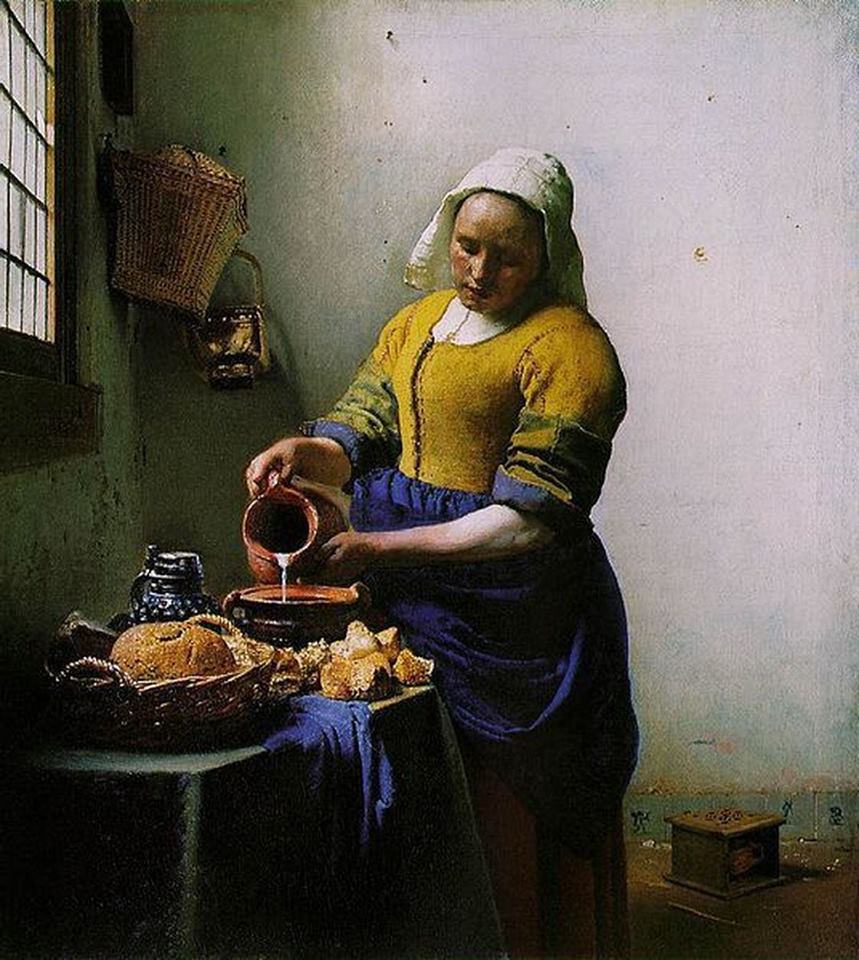
The Milkmaid, oil-on-canvas painting by Johannes Vermeer (1632-1675), Dutch

My first memory of art was in a dictionary, when I used to gaze dreamily at a portrait by Johannes Vermeer, The Milkmaid, a woman wearing a white cap, standing by a table covered with a blue cloth pouring milk…I was so fascinated by the painting, by the humble tranquil atmosphere and the basket of bread that resembled ours…and the dancing light on the maid’s face and arm. I knew nothing about this Vermeer but the few lines in the dictionary that never satisfied my curiosity: “a Dutch painter, born in Delft, his paintings, mostly about everyday life and domestic scenes were characterized by use of subtle light ”

Johannes Vermeer was my first inspiration, even his name had poetry or so I thought. After The Milkmaid I started a notebook and wrote about every painter I discovered. I made sure I kept it well hidden from my family.

My mother never understood why I spent most of my day holding that heavy dictionary just staring at paintings, I was a mercurial child and a picture could easily define and change my mood!! So my discoveries continued with Dutch art, some paintings by a mysterious looking guy called Rembrandt and another with an ironic look called Van Gogh.

My friends outside were so far from my world as a million star years. I remember their looks, half sarcastic half pitiful on a girl always lost in reverie, befriending ghostly figures in a dictionary and talking about places they never heard of.
I was always asking: how can this famous Van Gogh paint such a naïve painting like les douze tournesols? I can do it better!! What was le jeune homme au gilet rouge of Cézanne thinking?

Of course my childish mind always separated and catalogued them: the cheerful ones like the only painting by Rénoir that made me so fond of Paris le Moulin de la galette and those beautiful ballerinas in la classe de dance by Degas. The sad ones like femmes de Tahiti by Gauguin. Eespite the suggestive earthy colours of those exotic women I couldn’t miss the touch of melancholy on their faces. Géricault frightened me with his méduse so did the painting of Goya el tres de Mai that reminded me of my history classes about the Algerian revolution. Les mendiants made me cry and have nightmares (with all respect to Bruegel l’ancien). I hated the dismembered people and the cruelty of the act, but those who evoked me the most were those that made my fertile imagination drift even more.

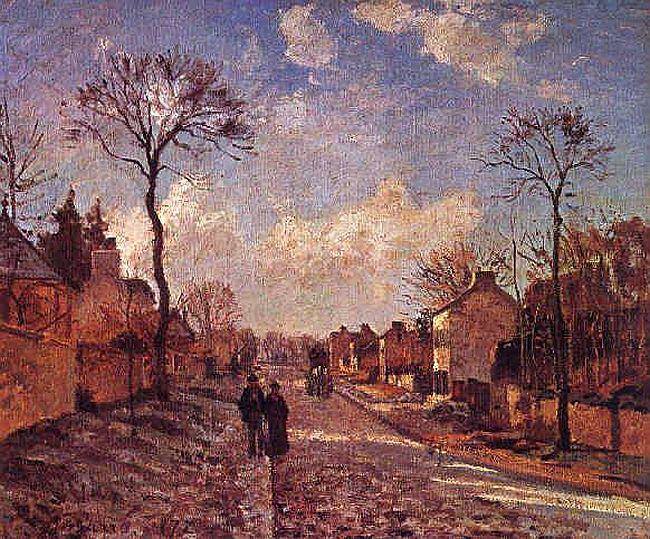
La route de Louveciennes,  oil on canvas by Camille Pissarro (1830-1903), French
La route de Louveciennes, oil on canvas by Camille Pissarro (1830-1903), French

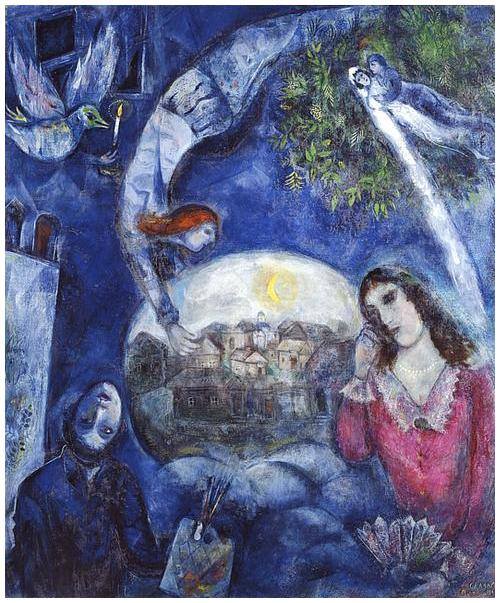
When I walk back home from school I close my eyes and imagine myself walking with the couple in la route de Louveciennes despite the difference between Pissaro’s perfect painting and my village disappointed me, it gave me extreme pleasure, only equaled by floating with Chagal.’s women in autour d’elle a name I found extremely romantic. Nothing matched that serene blue bathed in moonlight and those strange looking women I wanted so bad to look like.

I loved the fantasy in autour d’elle but another painting made me laugh and cemented the impression that this Picasso used squares and triangles only!! Because I always loved the light sprinkled on Rénoir’s canvas…Musiciens aux masques was as funny as humorous, because I never knew any instrument but the guitar, or who those three men were and never saw the dog under the table until recently.

I was drowning bit-by-bit in this world of colours, I knew Kandinsky, Caravaggio, Durer and Poussin and their names had a sensual sonority for my Arabic ear, not that I could pronounce them correctly because I could only manage the French ones. I continued to dream about the Louvre and cities I can visit when I become older. I continued to have my nocturnal conversations with Vermeer, Cézanne and Rénoir and make my own versions of la route de louveciennes and

Autour d'elle, oil on fabric by Marc Chagall (1887-1985), French artisit, Belarusian ethnic
Autour d’elle, oil on fabric by Marc Chagall (1887-1985), French artisit,

Vlaminck’s nature morte, this widened the gap between me and my friends who thought that I was weird and treated me suspiciously, my mother still couldn’t understand my attachment to this dictionary I wasn’t using to explain difficult words.

These memories came rushing back the moment I finished reading Tracy Chevalier’s novel Girl With a Pearl Earing, a gift from my beloved uncle who lives in Italy.I am still faithful to my Vermeer but through another equally mesmerizing painting la Joconde du Nord, and I know more about the art world now, my childish impressions and convictions are dramatically changed now. I can pronounce those names perfectly and I have wonderful friends who share my enthusiasm and passion.

But…despite internet and the thick art catalogues of le Figaro in my aunt’s library, despite the documentaries, TV shows and the long biographies I can read for hours, that dictionary still has the favour and a dear place in my heart, heavy, torn in places with its red cover and a single Arabic word written in black…

that was my first art class.

– Imen Benyoub

© 2013, essay and photograph(below), Imen Benyoub, All rights reserved
Illustrations courtesy of Imen Benyoub

pictureIMEN BENYOUB ~ is a milti-lingual, multi-talented essayist, poet, and artist living in Guelma, Algeria. She is a regular contributor to Into the Bardo.

Posted in Essay, grief, Spiritual Practice, story, Terri Stewart

Sacred Grief: Shabbat Shalom

Leningrad_Codex_Carpet_page_eThe power is out! I am sharing something I wrote in November 2010. I think it speaks to the spiritual practice of grief work and for preparing for difficult seasons of life. I am going to let it stand as a piece and not edit it on my phone! I hope you enjoy this glimpse into my past.

Often we think of Sabbath as Sunday. In fact, traditionally, Sunday is the Day of the Lord and sundown Friday to sundown Saturday remains the Sabbath time. Recently I went to Shabbat service at Kol Ami to experience the beginning of Sabbath, a dedicated time of reflecting on giving our lives and all there is to God. Going to a Jewish service is a little unnerving as it is generally in Hebrew, however, the Siddur (what would be like a hymnal) is written in Hebrew and English. It also has the transliteration so you can follow along. Whew! That allowed me to sort of keep up.

When I entered the Narthex to join Kol Ami during Shabbat, I was a little nervous. After all, I know what we think when new people come and visit us! Often it is “Hooray!” How odd would it be to become the new person again? And how odd is it to become the new person within a building that I know so well? When I entered, Rabbi Glickman almost recognized me. I said hello and put myself into context for him. He introduced me to a lovely couple in the congregation. I got there just in time to hear their tales of recent loss to Rabbi Glickman. My heart tugged because I know those tales of loss. It has been an entire year devoted to loss for me and to the dangerous work of going through this liminal time in my life. Late last summer we had to put down Sarah, our dog of fourteen years. In October I finally did some very heavy grief work for my mother. In February, a good friend at school died. And not only did he die, but I was the one who had to break the news to my school community. I presided over his memorial service. And then, the capper for me was the loss of my brother in May. Oy vey! And then there have been smaller losses since then. But these were the big boulders for me. The interesting thing that I learned was that each time a smaller loss, it taps into that bigger well of grief that has built up. So even a smaller thing like the ROTC soldier at Seattle U who was killed in Iraq recently, brings up the bigger grief and you have to deal with it again. Then I met Maria and her husband.

Maria shared with me at the Shabbos service recent news they have had of a close friend dying. And this was layered on top of huge challenges they have had over the last year. They are an older couple and have had to face challenging health situations that seem to be coming at them in waves. On top of that, they lost their grandson seven years ago. So these smaller challenges and griefs are tapping into that huge loss in their life. I was so very aware that even though there were many differences between us (religion, culture, age), that coming together in our grief to share the loss together on Shabbat as we recite the Kaddish together was an amazing experiment. Kaddish is recited for all who grieve and is an amazing response of faith. In the deepest grief, the responsive prayer is one of praise to God. It is:

Glorified and sanctified be God’s great name throughout the world which He has created according to His will. May He establish His kingdom in your lifetime and during your days, and within the life of the entire House of Israel, speedily and soon; and say, Amen.

May His great name be blessed forever and to all eternity.

Blessed and praised, glorified and exalted, extolled and honored, adored and lauded be the name of the Holy One, blessed be He, beyond all the blessings and hymns, praises and consolations that are ever spoken in the world; and say, Amen.

May there be abundant peace from heaven, and life, for u and for all Israel; and say, Amen. He who creates peace in His celestial heights, may He create peace for us and for all Israel; and say, Amen.

I am also reminded of all the hurts that can come to us during this upcoming Advent and Christmas season. For children of alcoholic parents, for recovering addicts, for people undergoing the birth of a new way of having family, for those suddenly without family, for those who are alone, even for those of us who very much need to watch our food intake—it can be challenging at best and a minefield at worst. I think my wish for advent, for this time of growth, is that we all can embrace change and loss where we need to knowing that it is gestating into something new that may bring forth a beautiful new life. And in this time of gestation, that we may claim together, the magnificence and glory of our creator who creates peace for us all.

Love,
Terri

© 2013, post , Terri Stewart, All rights reserved
Illustration ~ Leningrad Codex cover. This is from a very old mauscript of the Hebrew bible. A former possession of Karaïte Jews written circa 1010 C.E. The photograph by Shmuel ben Ya’akov is in the United States public domain.

WP_20131026_034REV. TERRI STEWART is Into the Bardo’s  Sunday chaplain, senior content editor, and site co-administrator. She comes from an eclectic background and considers herself to be grounded in contemplation and justice. She is the Director and Founder of the Youth Chaplaincy Coalition that serves youth affected by the justice system. As a graduate of Seattle University’s School of Theology and Ministry, she earned her Master’s of Divinity and a Post-Master’s Certificate in Spiritual Direction. She is a contributing author to the Abingdon Worship Annual. (The 2014 issue just released!)

Her online presence is Cloaked Monk. This speaks to her grounding in contemplative arts and the need to live it out in the world. The cloak is the disguise of normalcy as she advocates for justice and peace. You can find her at www.cloakedmonk.com, www.twitter.com/cloakedmonk, and www.facebook.com/cloakedmonk.  To reach her for conversation, send a note to cloakedmonk@outlook.com

Posted in Essay, Spiritual Practice, Terri Stewart

Finding Sacred Space Within Our Own Skin

I am attending a retreat this weekend. I have done two exercises today that stretched my own perception of myself. I’d like to offer one to you as a Spiritual Practice geared towards finding sacred space within your own skin and being willing to see yourself.

I don’t know about you, but that can be the most difficult spot for me to discover. Somehow, I can look at others and see their beauty, but acknowledging my own beauty seems at once terrifying, bold, and that I may fall short of being that … what? That person. That human. That woman. That mother. That chaplain. That presence of comfort. Oh, I think it is true that I fall short – we all do – but failing myself at simply just seeing myself is not okay!

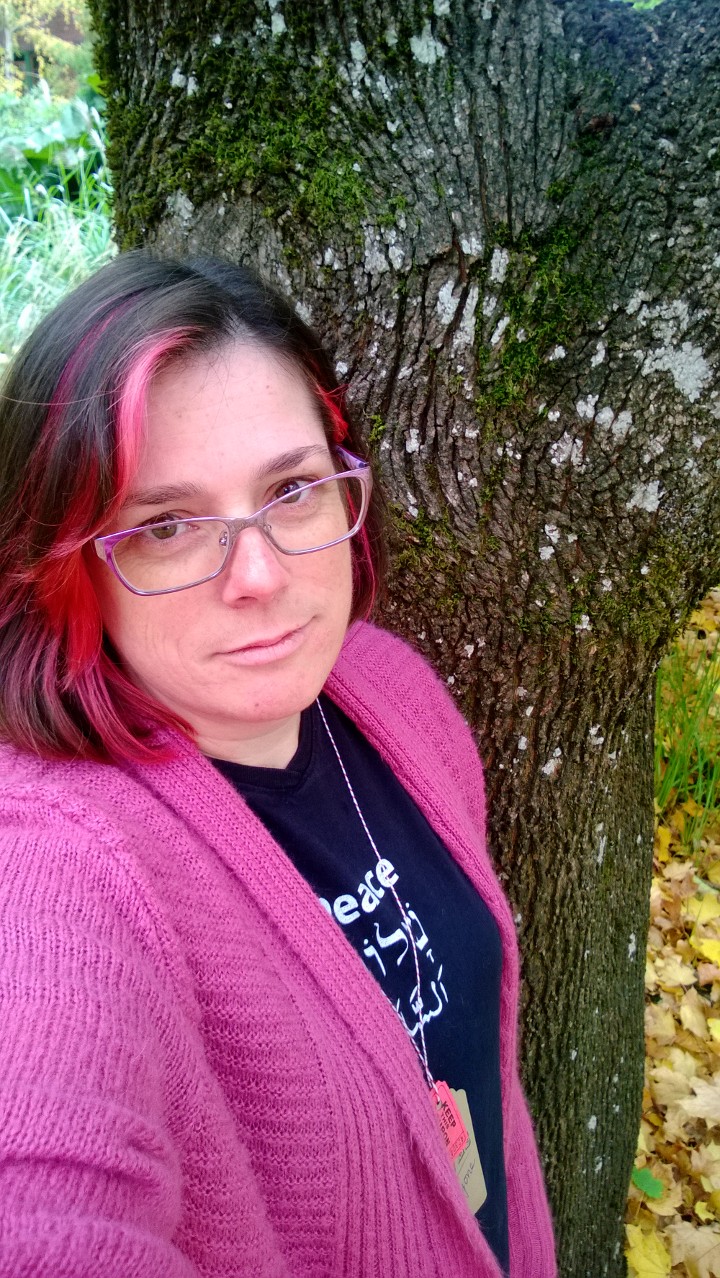
Nowhere is that more present than in the myriad of photos I have of family and family vacations. Where am I? Behind the camera. I may be in 1 in a thousand photos. Seriously. It’s not okay! This Spiritual Practice is geared at self portraiture. It is a series of photos. (None of these photos are touched up. I am intentionally resisting the temptation!)

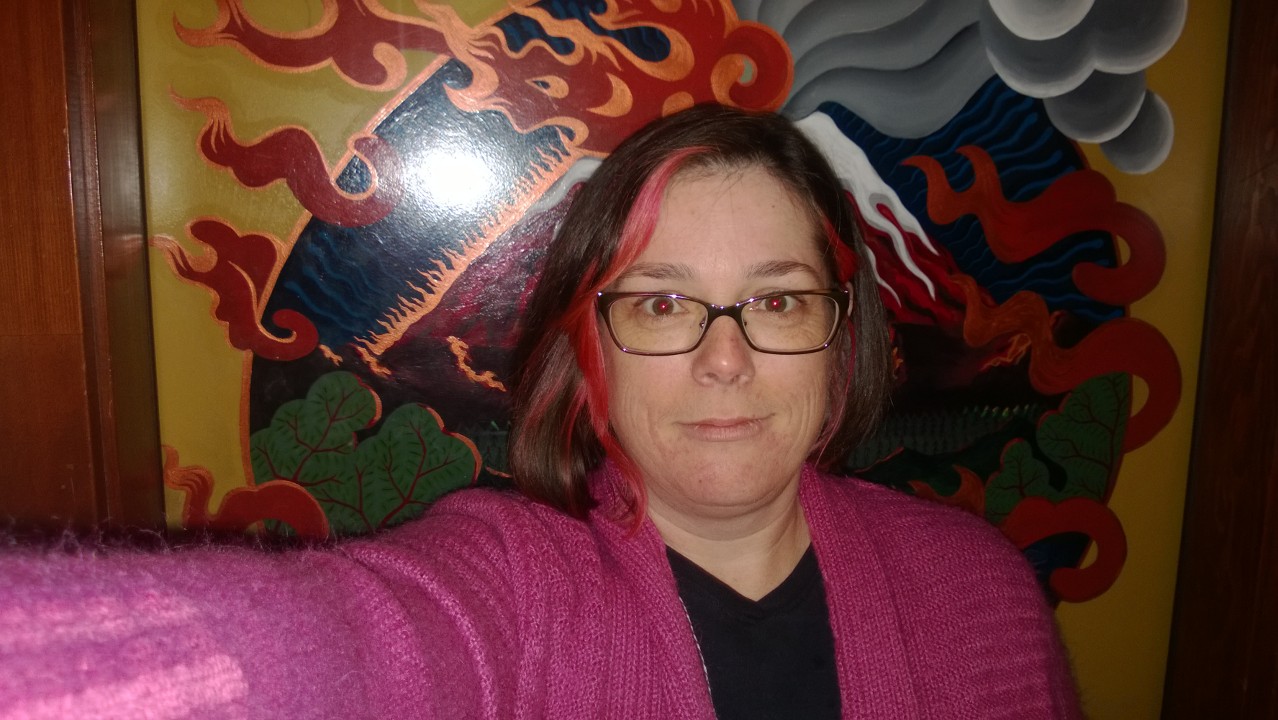
First exercise … find a place where you can intentionally photo bomb yourself with a weird background. I thought this was fun with a mural in the background. I think I can use this one when I am mad! This will let you have a humorous, gentle start!

WP_20131026_019

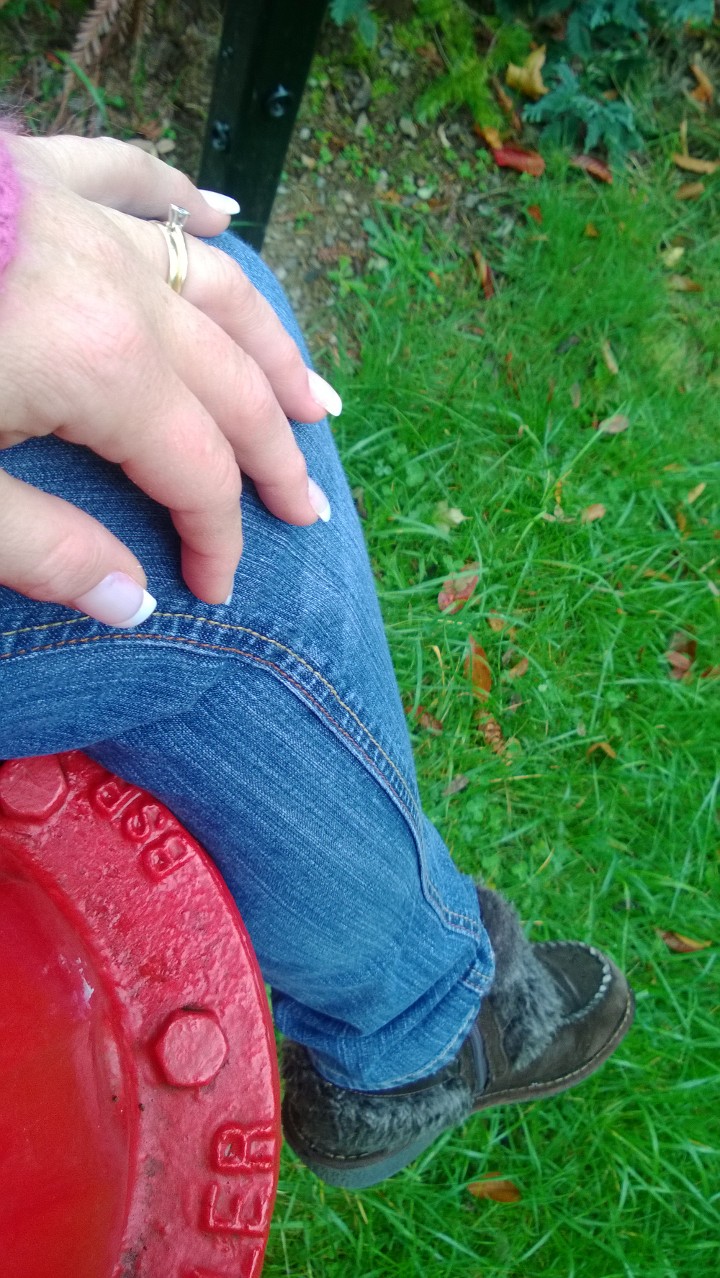
Next, consider what a self-portrait consists of … it is any part of you that is in a picture. Gather photos of you reaching for something, holding something, stepping onto a path, you name it! Hands, feet, hair!

WP_20131026_031

WP_20131026_028

WP_20131026_025

Next, learn to use that timer on your camera! I understand that iPhones have Gorilla and Windows phones have Auto Timer Camera. Now take full shots of yourself doing different things.

3_jpg

5_jpg (1)

12_jpg (1)

Last, look into the camera and be love. You may think of someone you love and gaze into the camera or think of loving yourself or think of loving the world. Start here. Be an image of love.

WP_20131026_034

I spend a lot of time “being love” in the world. Working with incarcerated and homeless youth. But without a loving foundation that includes spiritual practices that let me see and be myself, I won’t be able to sustain compassionate action. Even the healthiest egos need times of sustenance.

Shalom and Amen,

Terri

© 2013, post , Terri Stewart, All rights reserved

terriREV. TERRI STEWART is Into the Bardo’s  Sunday chaplain, senior content editor, and site co-administrator. She comes from an eclectic background and considers herself to be grounded in contemplation and justice. She is the Director and Founder of the Youth Chaplaincy Coalition that serves youth affected by the justice system. As a graduate of Seattle University’s School of Theology and Ministry, she earned her Master’s of Divinity and a Post-Master’s Certificate in Spiritual Direction. She is a contributing author to the Abingdon Worship Annual. (The 2014 issue just released!)

Her online presence is “Cloaked Monk.” This speaks to her grounding in contemplative arts and the need to live it out in the world. The cloak is the disguise of normalcy as she advocates for justice and peace. You can find her at www.cloakedmonk.com, www.twitter.com/cloakedmonk, and www.facebook.com/cloakedmonk.  To reach her for conversation, send a note to cloakedmonk@outlook.com
“A person with ubuntu is open and available to others, affirming of others, does not feel threatened that others are able and good, for he or she has a proper self-assurance that comes from knowing that he or she belongs in a greater whole and is diminished when others are humiliated or diminished, when others are tortured or oppressed.”
― Desmond Tutu

Posted in Essay, Spiritual Practice, Terri Stewart

It’s All Sacred Space II

"I AM" Sacred Space
“I AM”
Sacred Space

Following up on last week’s “It’s All Sacred Space.”

Two pastors that I know are extraordinary. They both pastor homeless people. One lived as a homeless person for two weeks so he could understand what was going on. The other is homeless. She refuses to live in a home and sleeps on the streets every night of her life. She takes this so seriously that given the opportunity to sleep inside at a convocation, she made special arrangements to sleep in the doorstep-declining housing thousands of miles away from her people. She is the only one who would have known! And nobody would have judged her in error for sleeping inside at a conference she was attending.

I am amazed at the depth of commitment they both have.

In my context, that would be sleeping in a detention center. I am not sure I am prepared to be locked up in order to be one with the people that I am committed to walking with.

But maybe that is because I am not viewing all space as sacred. If I imagine that a jail cell is the Cathedral of Notre Dame with an air of mystery, sacrament, and holiness…does that change the context? Maybe. But could I put on the blue scrubs, white t-shirt, white socks, and orange plastic flip-flops? Using harsh soaps, eating questionable food, everything? Hmmm. I am not sure I could ever do that. I am also not sure that it is a requirement to do so. But, perhaps what is a requirement is the holy imagination it takes to think of what this walk would be.

That is the spiritual practice I’d like to invite you into today, holy imagination. I believe that we are all called to support the least among us. In other words, those who cannot take care of themselves. Those our societies often label “other.” People who are “other” than us—outside the norm—impoverished, imprisoned, hungry, sick, non-gender conforming—whoever is being “othered.”

Who is your other?

Could it be someone from a different faith tradition? A different political point-of-view? Or any of those I listed above? Generally, there is always someone we “other-ize.” Even though I am working with people every day that are affected by incarceration, I found myself in a spot today where I felt the person I was sitting with was totally “other” from me. She is telling me flat-out that when she returns to her community, she will return to drug use and gang involvement. Period. She sees no other way. No other hope. That is hard for me to fathom. She says, “I will probably be dead by 21” without blinking. Wow. And sheesh. I need to find a way to sit with her in a way that is hopeful and not descend into other-izing her even though her current ideas are so foreign to my mind and heart.

If I use holy imagination, maybe I can put myself into her life and feel where her self-imposed traps come from. And seeing where the traps are, maybe I can point out a way she can negotiate the traps and bring herself greater freedom. I don’t know. I will continue to work on it.

Today, using your own holy imagination, can you take five minutes (really, 20 minutes is more like it!) to do some visualization work?

First, relax as much as you can. Keep working at it until you have quieted the monkey mind (or brain chatter—but my inner chatter is more like a monkey!).

When you have fully relaxed, set your intention. Here, I am suggesting your intention should be a conversation with whoever you “other-ize.” (Could it be yourself?)

Next, focus on what you want. Today, our desire is closer understanding. How can you begin to understand the figurative foreigner across from you? What questions can you ask in order to bring you deeper understanding? I am always amazed at my own capacity to carry assumptions. How can we leave assumptions and expectations behind so that there is room for increased understanding?

As realizations and understandings grow, there may be a struggle. Give your struggle up. It is like the monkey-brain. Keep offering both of these things away. I usually visualize putting these on a cloud and whooshing them out of my space. Don’t struggle too hard. If it isn’t happening, it isn’t happening. Then, don’t be too hard on yourself. There will be another day, another try.

Finally, don’t get tangled in negative thoughts—whoosh them away on that cloud! Experience your highest self—the one that sits in loving kindness, compassion, and hope.

When your conversation is complete (and you may get horrible answers, let’s be honest), hold onto the highest self for a moment and see yourself. See the person who took a risk today of entering scary, sacred space. A person who was willing to love. Look at yourself and see the sacred space within.

Shalom and Amen,

Terri

© 2013, post , Terri Stewart, All rights reserved

terriREV. TERRI STEWART is Into the Bardo’s  Sunday chaplain, senior content editor, and site co-administrator. She comes from an eclectic background and considers herself to be grounded in contemplation and justice. She is the Director and Founder of the Youth Chaplaincy Coalition that serves youth affected by the justice system. As a graduate of Seattle University’s School of Theology and Ministry, she earned her Master’s of Divinity and a Post-Master’s Certificate in Spiritual Direction. She is a contributing author to the Abingdon Worship Annual. (The 2014 issue just released!)

Her online presence is “Cloaked Monk.” This speaks to her grounding in contemplative arts and the need to live it out in the world. The cloak is the disguise of normalcy as she advocates for justice and peace. You can find her at www.cloakedmonk.com, www.twitter.com/cloakedmonk, and www.facebook.com/cloakedmonk.  To reach her for conversation, send a note to cloakedmonk@outlook.com

Posted in Creative Nonfiction, Essay, find yourself, memoir, Mortality, Priscilla Galasso

Claiming Rites of Passage

St. Luke's columbarium
St. Luke’s columbarium

A few years ago, I went to an exhibit on mummies at the Milwaukee Public Museum.  It was fascinating.  Listening to the whispered comments and questions of other patrons was fascinating as well.  We have a very scattered cultural approach to death, with so many various ways of marking the rite of passage, including not really marking it at all.

American culture, as a whole, has been dominated by technology to the point that important parts of our lives are relegated to “experts” and taken out of our hands completely.   My mother fought against this trend in the late 50s when she insisted on breastfeeding her babies instead of allowing the “experts” to convince her that artificial formula on an artificial schedule was better for them.

Birth experiences have become sterilized, institutionalized, and anesthetized as well in the mainstream. My 4 were all born in a hospital under the HMO system (but not under any pain killers!) because in my 20s, I wasn’t brave enough to seek more creative options.   However, my sister birthed one of her children at home, and I once assisted a friend who had a home birth.  It’s not impossible to choose to take full responsibility in this event.

Death is another part of life that more and more people deal with by proxy. The hospice movement is a wonderful example of the purposeful effort to maintain the grace and dignity of this stage of life by bringing it back into the home, away from institutions.  I recently watched an Ingmar Bergman movie set at the turn of the century, called Cries & Whispers (well, it’s actually called something in Swedish, but that’s the English title).  This intense family drama deals with the death of a spinster sister from cancer.  The action all takes place at home, in this case an elegant manor.  The doctor’s largest role is in an affair with one of the sisters, in flashback.  When I think of the family drama of my husband’s death, experts and technology played a huge part.  Unfortunately, that became a distraction from entering into the rite of passage, from experiencing the more intimate aspects of the dynamics that were changing my family.  What I mean to say is that it enabled denial.

The last photo taken of me & my husband
The last photo taken of my husband: 11 days before he died at home.

What does it mean to choose to take responsibility for my life?  Not to delegate the more painful or complicated bits to an “expert”, not to live by proxy or by representative?  In which situations do I most often abdicate my ability to decide a course of action?  Are they likely to be mostly financial, political, medical, social, spiritual, emotional or physical?  I am only beginning to wake up and ask myself these questions.  Steve often puts it to me this way: in every situation, you have at least 3 options:  1) Run away or hide  2) Try to change the situation  3) Change yourself.

This is a good time for me to think about aging, about how I want to live and address the changes that are happening now and will continue to happen.  What do I want?  I want to experience life in a more authentic way, not behind a duck blind or a proxy, not behind a curtain of denial or dogma, not by avoiding discomfort or hard work.  I want to make decisions about who I am and how to live proactively.  How do I embody this?  At this point, I am still figuring out who I am and want to be and recognizing places where that has been dictated and I have responded without looking deeper.   My father and my husband took great care of me.  I want to learn to do that myself.   I often dream about Jim returning as if he’d never died.

Last night, I had a powerful dream about him, set in the house I sold, with my young children around.  My consciousness struggled with it; I knew that the house was emptied and I’d moved.  I couldn’t understand why the furniture was back and the place looked so “lived in”.  I couldn’t understand why Jim was there.  He told me he was going out to work because he wanted to support me and the kids.  In a choked whisper, I closed the door behind him and said, “Don’t come back.”  I woke up crying.  Talking about this dream with Steve, I realized that I do want him to come back and float through my subconscious and consciousness without confusing me, without affirming me or correcting me, just visiting.  I suppose when I gain the confidence to affirm and care for myself, my dreams will change and Jim’s place in them as well.  Then we will both move beyond this Bardo and into a different sphere.

—- Priscilla Galasso

© 2013, essay and photograph, Priscilla Galasso, All rights reserved

004PRISCILLA GALASSO ~  started her blog at scillagrace.com to mark the beginning of her fiftieth year. Born to summer and given a name that means ‘ancient’, her travel through seasons of time and landscape has inspired her to create visual and verbal souvenirs of her journey.

Currently living in Wisconsin, she considers herself a lifelong learner and educator. She gives private voice lessons, is employed by two different museums and runs a business (Scholar & Poet Books, via eBay and ABE Books) with her partner, Steve.

Posted in Essay, Spiritual Practice, Terri Stewart

It’s All Sacred Space

Star Trek, Captain Kirk and “Bones” (Dr. McCoy) using Universal Translators

Sometimes I think that we all need universal translators when we are trying to understand each other across cultures, belief systems, and personal social locations.

Often, though, it takes someone yelling at us to knock us out of our system of thinking and gives us the ability to see things in a new and visionary way that connects rather than divides. All too often we cannot get to this point because we walk away when we things are uncomfortable, challenging, or abrasive.

And no doubt, abrasive is yucky. Witness: the US government interactions right now.

What to do?

Enter deeply into the story of the other person. This is a spiritual practice. I call it Extreme Accompaniment (should I trademark that?). I was contemplating this further today as I was researching another article. My reading revealed to me that we get to radical acceptance of the other when:

  1. Everyone goes to uncomfortable places
  2. Step outside of social norms, forget what you think you know about the other
  3. Everyone involved becomes open to conversion
  4. Keep dialoguing past the rhetoric and abrasiveness
  5. Then, transformation and acceptance may occur (Congress, are you listening??)

Of course, there are limitations. You should not be in situations that may cause harm.  But I am more and more convinced that this deep listening is a spiritual practice. And it is a practice that our world does not do well right now. It is up to the artists and the contemplatives to lead a new revolution! A revolution of extreme accompaniment or of walking with other people. A practice of deeply listening and working with the other’s deepest desires. A practice of loving each other. Love is the universal translator.

If we listen and love, maybe we will all be able to see past the space debris and see the cosmos in each other’s souls.

Shalom and Amen,

Terri

© 2013, post , Terri Stewart, All rights reserved

terriREV. TERRI STEWART is Into the Bardo’s  Sunday chaplain, senior content editor, and site co-administrator. She comes from an eclectic background and considers herself to be grounded in contemplation and justice. She is the Director and Founder of the Youth Chaplaincy Coalition that serves youth affected by the justice system. As a graduate of Seattle University’s School of Theology and Ministry, she earned her Master’s of Divinity and a Post-Master’s Certificate in Spiritual Direction. She is a contributing author to the Abingdon Worship Annual. (The 2014 issue just released!)

Her online presence is “Cloaked Monk.” This speaks to her grounding in contemplative arts and the need to live it out in the world. The cloak is the disguise of normalcy as she advocates for justice and peace. You can find her at www.cloakedmonk.com, www.twitter.com/cloakedmonk, and www.facebook.com/cloakedmonk.  To reach her for conversation, send a note to cloakedmonk@outlook.com

Posted in Contributing Writer, Creative Nonfiction, Essay, General Interest, Karen Fayeth, memoir, Poets/Writers, Writing

Inspiration Takes Flight

Editorial note and reminder: In two weeks, Wednesday, October 23, at 7 p.m. we will host a second writing challenge (Writer’s Fourth Wednesday) featuring Victoria C. Slotto, novelist and poet. The subject of this next challenge-yourself exercise is stream-of-consciousness. So writers read on, enjoy, write and mark your calendars for next week’s event. Mr Linky, which enables you to share your work with everyone, will remain open for seventy-two hours. Victoria and Jamie will visit all participants to read and comment.

Here an accomplished story-teller, Karen Fayeth (pronounced “faith” by the way), shares her experience of inspiration, story, and the NYC Midnight Flash Fiction competition.  

Each year I enjoy participating in the NYC Midnight Flash Fiction contest. The challenge is to write a 1,000 word story over the course of one weekend.

But there’s more! The approximately 700 participants are divided up into groups and each group is given a genre, location and an object. All three must be incorporated in the resulting story. The tale must truly be in the genre, the majority of the story must take place in the location and the object must show up at some point.

It’s always amazing to see the wide array of stories that come from the same genesis. This assignment of genre, location and object can either be entirely freeing, allowing the writer a head start to leap from, or it can be incredibly constraining. It all depends on what genre, location and object gets assigned.

For the first round of the 2013 contest, I was assigned the romance genre. Bleah. Not my favorite but not awful. The location was a haunted house. Hmm. Possibilities abound, but not really for a romance? Hmm. Ok. And my object was marshmallows.

That was my place to start. Over the course of many of these contests I find the judges tend to like if you use the location and object in unique ways, so I always try to think of a twist or a different facet to use in my story.

I was quite busy over this first weekend of competition, doing some work for my employer and taking care of personal business, so there I found myself Sunday morning with nary a word written and a deadline of 9pm that night.

I opened the windows to my studio and let the light pour in. I felt the breeze through the screens and sat down at my computer to make magic.

Magic. Ha! There I sat looking at the curser on my computer screen, willing the magic to begin. It blinked. I blinked.

No magic was happening.

So I subscribed to the “just write something” theory and got started. I began typing words and thoughts and a character sketch. It was going. The magic was not quite lifting off, but it was certainly gaining speed.

That is when something caught my eye outside of the window. A little splash of orange on that first day of Autumn.

I was surprised to see a Monarch butterfly resting on the bush just to the side of the building where I live.

I rushed to get my camera, attached the longest lens I have, popped the screen out of my window, and began taking photographs.

I’m sure glad I did.

Photo Copyright 2013, Karen Fayeth

This gorgeous lone Monarch Butterfly was hanging out in the warm sun, using the ol’ proboscis to drink some nectar and gathering pollen on spindly legs. You know, general butterfly business.

As I watched, a couple of bees were highly displeased at the presence of the butterfly and kept strafing him (I say him but I looked up Monarch butterflies online and I think this might actually be a female, but I’m not sure).

These bees were executing deep aggressive fly-bys that only caused the butterfly to flap his wings a bit but stay put. The bees were quite persistent. They dive-bombed and I kept snapping away. I have some crazy action shots that I’m still editing.

After a while, the butterfly flew off and I downloaded and looked through my photos, very pleased with the results.

Then I sat back in my chair and smiled. After the visit from Mr. (Ms?) Butterfly, I felt totally motivated and completely creative. I turned back to my story and banged out about 1,300 words in one sitting.

Then I set the story aside and let it percolate while my husband and I went to explore a local street fair.

When we came back I had fresh eyes and gave the story a hard edit. I managed to pare it down to 999 words and submitted it about 45 minutes before the deadline.

Man-oh-man, hitting send on that story sure felt good.

I owe an awesome creative surge to a visit from a pretty orange butterfly on the first day of Autumn.

© 2013, essay and photo, Karen Fayeth, All rights reserved

webheadshotKaren Fayeth ~ is one of our regular writers. She is our tech manager, site co-administrator along with Jamie and Terri, and fiction and creative nonfiction editor. She blogs at Oh Fair New Mexico. Born with the writer’s eye and the heart of a story-teller, Karen Fayeth’s work is colored by the Mexican, Native American, and Western influences of her roots in rural New Mexico complemented by a growing urban aesthetic. Karen now lives in the San Francisco Bay area. When she’s not spinning a tale, she works as a senior executive for a science and technology research organization.

Karen has won awards for her writing, photography, and art. Recent publication credits include a series of three features in New Mexico magazine, an essay in the online magazine Wild Violet, and a short story in Foliate Oak. Her story “What Leibniz Never Learned” will appear in the Fall edition of The Storyteller.

Posted in Essay, Niamh Clune, Poems/Poetry

Defining Metaphysical Literature

John Donne 1572- 1631

The term, Metaphysical literature, originally referred to poetic works from the 17th century and defined intellectually challenging poetry.

Striving to incorporate the incorporeal, the transcendental, the noumenal, the subject matter itself posed a problem and poses it still. According to philosophers such as Nietzsche and Kant, nothing can be known about noumenal reality, not even that it exists. Yet, throughout the ages, humankind has striven to express the notion of soul, the fervour and truth accompanying vision and revelation, the divinity that speaks from within.

Early metaphysical poets such as John Donne extended metaphors that compared very dissimilar things. This was to make us think, to try to express the paradoxical nature of all things metaphysical. After all, in the search for truth and meaning, a truth is only considered a truth if it expresses both opposites and everything in between. Such is the struggle of the writer of metaphysics who attempts to clothe philosophical ideas plucked from the ethers of universal thought.

T.S. Eliot is a fine example of a more modern metaphysical poet. He wrestles with noumenal experiences using extended metaphor, as the Things of God’s cannot be known in any other way.

Hermann Hesse 1877 – 1962

In terms of modern metaphysical literature, writers such as Paolo Coelho, Herman Hesse, and Jean Paul Sartre weave philosophical concepts into simple stories to which most can relate. These stories make us think. They make us question the meaning of life. They ask us to reach beyond the world of tangible reality and allow soul into life.

These days, modern metaphysical/visionary literature often crosses genres and enters into the little celebrated field of magic realism. In this genre, the supernatural is part of tangible reality; spirit and nature are interwoven, inseparable, and unquestioned, and the extraordinary is made ordinary. Metaphysical literature tells tales of the inner life. Usually these tales are told simply, in prose that reaches to express the beauty inherent in us and in the world about us. Its task is to give voice to soul and its yearning to transcend the suffering of everyday reality.

430564_3240554249063_1337353112_n-1orange-petals-cover_page_001DR. NIAMH CLUNE (On the Plum Tree) ~ is the author of the Skyla McFee series: Orange Petals in a Storm, and Exaltation of a Rose. She is also the author of The Coming of the Feminine Christ: a ground-breaking spiritual psychology. Niamh received her Ph.D. from Surrey University on Acquiring Wisdom Through The Imagination and specialises in The Imaginal Mind and how the inborn, innate wisdom hidden in the soul informs our daily lives and stories. Niamh’s books are available in paperback (children’s books) and Kindle version (The Coming of the Feminine Christ). Her Amazon page is HERE.