When I remember you
I remember the amber moon
the burnished brown of the old oaks
their leaves like hands waving goodbye
As dusk transitioned to dark, stars alight,
we sat on the beach by slow cooking-fires,
their coals gone from hard black to gray dust
I cherished your warm hug in the chill of the night
and falling asleep, safe
I stopped loving you,
but I never stopped loving the memory of you
I carry that with me on lunatic trips of the heart ~
though my preference is to rest solitary on forest logs
with their stunning imperfections and
the secret-lives swirling in the sunless damp on which they rest
I think of the path that led from then to now,
a mix of smooth and rough along a rocky coast
I live near the sea to breath
I imagine you living, wherever you are –
by an ocean with your skin still smelling of Old Spice,
with your well-formed hands, the hands of a pianist and surgeon,
and the high-tensile strength of your mind
In the odd geography of life, no one knows where we came from
or how it was, how it felt to be us in the days of promise
when the spell of Hudson Bay felt like a prayer to St. Christopher
That bay is no longer our safe harbor,
but it gave us our sturdy roots and strong wings
and so the nights, the nights by this bay are good
When I smile at the amber moon, it smiles at you
JAMIE DEDES ~ My worldly tags are poet and writer. For the past five years I’ve blogged at The Poet by Day,the journey in poem, formerly titled Musing by Moonlight. Through the gift of poetry (mine and that of others), I enter sacred space.
The term, Metaphysical literature, originally referred to poetic works from the 17th century and defined intellectually challenging poetry.
Striving to incorporate the incorporeal, the transcendental, the noumenal, the subject matter itself posed a problem and poses it still. According to philosophers such as Nietzsche and Kant, nothing can be known about noumenal reality, not even that it exists. Yet, throughout the ages, humankind has striven to express the notion of soul, the fervour and truth accompanying vision and revelation, the divinity that speaks from within.
Early metaphysical poets such as John Donne extended metaphors that compared very dissimilar things. This was to make us think, to try to express the paradoxical nature of all things metaphysical. After all, in the search for truth and meaning, a truth is only considered a truth if it expresses both opposites and everything in between. Such is the struggle of the writer of metaphysics who attempts to clothe philosophical ideas plucked from the ethers of universal thought.
T.S. Eliot is a fine example of a more modern metaphysical poet. He wrestles with noumenal experiences using extended metaphor, as the Things of God’s cannot be known in any other way.
Hermann Hesse 1877 – 1962
In terms of modern metaphysical literature, writers such as Paolo Coelho, Herman Hesse, and Jean Paul Sartre weave philosophical concepts into simple stories to which most can relate. These stories make us think. They make us question the meaning of life. They ask us to reach beyond the world of tangible reality and allow soul into life.
These days, modern metaphysical/visionary literature often crosses genres and enters into the little celebrated field of magic realism. In this genre, the supernatural is part of tangible reality; spirit and nature are interwoven, inseparable, and unquestioned, and the extraordinary is made ordinary. Metaphysical literature tells tales of the inner life. Usually these tales are told simply, in prose that reaches to express the beauty inherent in us and in the world about us. Its task is to give voice to soul and its yearning to transcend the suffering of everyday reality.
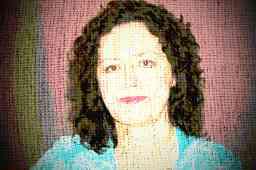
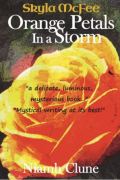
DR. NIAMH CLUNE (On the Plum Tree) ~ is the author of the Skyla McFee series: Orange Petals in a Storm, and Exaltation of a Rose. She is also the author of The Coming of the Feminine Christ: a ground-breaking spiritual psychology. Niamh received her Ph.D. from Surrey University on Acquiring Wisdom Through The Imagination and specialises in The Imaginal Mind and how the inborn, innate wisdom hidden in the soul informs our daily lives and stories. Niamh’s books are available in paperback (children’s books) and Kindle version (The Coming of the Feminine Christ). Her Amazon page is HERE.
chippy charmed blade in Moira’s hand
cries for blood,
begs for blood,
slashing carmine canopies
for the sake of the flow,
grinning its ivory fang
at the lavish crimson gush
drenching sands and drowning wills.
on the red river
crucified Jesus floats,
watching clouds on skies in flames
twinning the boulders of coagulated sins
crawling along the muddy shores,
wondering if those were the sins
for which he drank the cup.
in the meantime carnivorous swords
keep fueling the flood,
making sure that the river’s level stays always high enough,
as if that would get the floating cross closer to the skies.
not that it mattered anyway –
after all, there’s plenty of that bloody slime
smelling like putrid faith
to fuel a thousand more crusades
– conjugating wars is one of the poems included in Liliana Negoi’s poetry volume The Hidden Well, and can be heard in the author’s own reading on SoundCloud at the following link: conjugating wars
Invitation: We’d like you to join us – not only as readers – but as writers by putting links to your own anti-war or pro-peace poems in the comment sections. Next week we’ll gather the links together in one post and put them up as a single page headed “Poets Against War.” Thank you!
LILIANA NEGOI (Endless Journey and in Romaniancurcubee în alb şi negru) ~ is a member of our core team on Into the Bardo. She is the author of three published volumes of poetry in English, which is not her mother tongue but one that she came to love especially because of writing: Sands and Shadows,Footsteps on the San – tanka collection and The Hidden Well. The last one can also be heard in audio version, read by the author herself on her SoundCloud site HERE. Many of her creations, both poetry and prose, have been published in various literary magazines.
they have come to bury the war dead with the same precision as a soldier’s march step-by-step grave-by-grave with each movement of the minute hand another is interred into mother earth step-by-step grave-by-grave minute-by-minute tear-by-tear
Invitation: We’d like you to join us – not only as readers – but as writers by putting links to your own anti-war or pro-peace poems in the comment sections. Next week we’ll gather the links together in one post and put them up as a single page headed “Poets Against War.” Thank you!
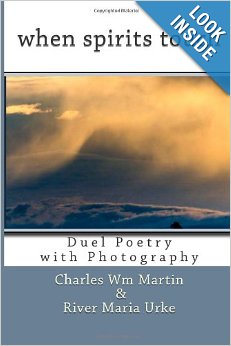
. CHARLES W. MARTIN(Reading Between the Minds) — earned his Ph.D. in Speech and Language Pathology with an emphasis in statistics. Throughout Charlie’s career, he maintained a devotion to the arts (literature/poetry, the theater, music and photography). Since his retirement in 2010, he has turned his full attention to poetry and photography. He publishes a poem and a photographic art piece each day at Read Between the Minds, Poetry, Photograph and Random Thoughts of Life. He is noted as a poet of social conscience. Charlie has been blogging since January 31, 2010. He has self-published a book of poetry entitled The Hawk Chronicles and will soon publish another book called A Bea in Your Bonnet: First Sting, featuring the renown Aunt Bea. In The Hawk Chronicles, Charlie provides a personification of his resident hawk with poems and photos taken over a two-year period. The newly published When Spirits Touchrecently became available on Amazon.
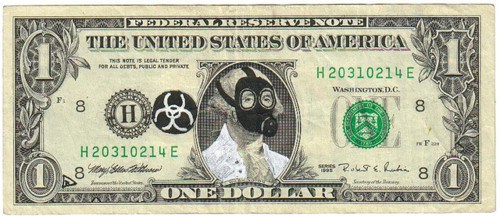
There is no profit in peace, you know.
White Horse or Red, the blood must flow.
Human constructs, like Conquest or War,
Benefit the rich and bury the poor.
I think the Draft should be reinstated;
So that ALL might witness the horror created.
Send the war-mongers’ sons first,
To hold the Front Line’s Hell.
Watch them die, or even worse,
Return home, as a shell.
If politician’s kids are killed or maimed,
Will war then taste as good as they claimed?
Tell me:
What’s the magic, almighty dollar amount?
To make endless war worth the body count?
If Corporations are people, now, too,
Let’s send them to war, and see if it’s true.
Will those corporations scream in pain as they bleed?
Will they writhe in agony for a rich man’s greed?
Will they lose their limbs, and maybe their minds?
Does the Machine care about the bones, the bodies it grinds?
In the end:
There is no prophet of peace, you know.
The love of money is Greed: War’s C.E.O.
The wars will continue, the innocents will still fall.
And the Pale Horse’s rider will someday claim all.
– Corina L. Ravenscraft
Invitation: We’d like you to join us – not only as readers – but as writers by putting links to your own anti-war or pro-peace poems in the comment sections. Next week we’ll gather the links together in one post and put them up as a single page headed “Poets Against War.” Thank you!
CORINA L. RAVENSCRAFT (Dragon’s Dreams) ~ is a guest writer on Into the Bardo. She is a poet and writer, artist and librarian who has been charming us through her blog since 2000, longer than any blogger in our little blogging community. She tends to keep herself in the background, but in a 2011 Jingle Poetry interview with Blaga Todorova (Between the Shadows and the Soul) she revealed, “Dragon’s Dreams ~ The name comes from my love-affairs with both Dragons and Dreams (capital Ds). It’s another extension of who I am, a facet for expression; a place and way to reach other like-minded, creative individuals. I post a lot of poetry and images that fascinate or move me, because that’s my favorite way to view the world. I post about things important to me and the world in which we live, try to champion extra important political, societal and environmental issues, etc. Sometimes I wax philosophical, because it’s also a place where I always seem to learn about myself, too, by interacting with some of the brightest minds, souls and hearts out there. It’s all about ‘connection(s)’ and I don’t mean “net-working” with people for personal gain, but the expansion of the 4 L’s: Light, Love, Laughter, Learning.” The samples of Cornina’s art work, her popular Infinity-Möbius dragon, is copyright”Möbius Ouroboros.” If you click on them, you can view enlarged versions.
In the name of Love I sue for peace
I reach out with branch of olive
Sign your treaties that fighting may cease
Open wide the cage and free the dove
Remove iron fist from silken glove
From servitude and bondage release
Be the Leaders we are worthy of
In the name of Love I sue for peace
How many palms do I have to grease?
Sandbox antics, games of push and shove
Be ruled not by chaos and caprice
I reach out with branch of olive
Singing in a different octave
Place your armor on the mantelpiece
By whatever God hereinabove
Sign your treaties that fighting may cease
Or find your fate as did Sparta of Greece
In a goblet of blood and foxglove
The future of human-kind you lease
Open wide the cage and free the dove
Turn other cheek when push comes to shove
There is no golden fleece, no golden geese
Be the Leaders we are worthy of
Melt down all weapons, sign armistice
In the name of Love
– T.J. Therien
Invitation: We’d like you to join us – not only as readers – but as writers by putting links to your own anti-war or pro-peace poems in the comment sections. Next week we’ll gather the links together in one post and put them up as a single page headed “Poets Against War.” Thank you!
TIMOTHY JAMES “TJ” THERIEN (Liars, Hypocrites & The Development of Human Emotions) ~ is a contributing writer to Into the Bardo. He has been blogging since November 2012 and has garnered a significant and loyal following. He says in another poem “I am not a writer … I am possessed by unseen spirit/And my hand is so moved/Words dictated to me by inner voice/Muse speaks when she wants to speak…” That sounds an awful lot like work coming from sacred space. TJ tells us that he was born 1968 in Toronto, Ontario, Canada and current resides in The Eastern Townships, Quebec, Canada. He’s lived briefly in Calgary, Alberta, Canada, and Parry Sound, Ontario Canada. He participates in Poet’s Corner. His “About” is posted HERE.
He wore no smile. Square jaw, set firm,
taut muscles. Skin like latte, stubble-covered,
(more like fuzz.)
Skin too soft for who he was,
who he pretended to be.
Salvadoran sun backlit the scene
set on the borders of insanity.
Not a game he played that day,
a game his peers in other lands
and other times still play.
This was a game of war.
He stared at us, each one, with eyes
too full of sadness for an almost-child.
Compared our passport photos with reality.
And there, upon the submachine gun’s butt—
a smiley face, a message, too.
I wonder–can he smile today,
and can he still believe?
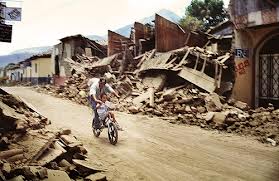
Earthquake–El Salvador 1986
At the height of the civil war in El Salvador, the country suffered a massive earthquake that resulted in much loss of life and many injuries. I spent close to a month there, helping to nurse the wounded not requiring hospitalization. We flew into Guatemala and drove to San Salvador, the capital. On the way, we had to pass through numerous military checkpoints. At one of these stops I observed a young soldier. I’d guess he wasn’t much older than 15 or 16, perhaps younger. There on the butt of his huge machine gun was a smiley face sticker with the words in English that I’ve chosen for the title of this poem.
When will we ever learn?
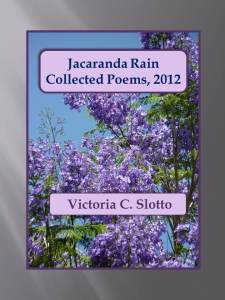
– Victoria C. Slotto
Invitation: We’d like you to join us – not only as readers – but as writers by putting links to your own anti-war or pro-peace poems in the comment sections. Next week we’ll gather the links together in one post and put them up as a single page headed “Poets Against War.” Thank you!
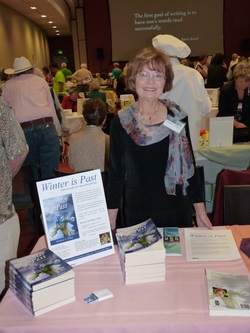
Victoria at the Palm Springs Writer’s Expo March 2012
Wow, the first in the series of Poets Against War or Poets for Peace. Hopefully I can do it justice! In riffing on peace and war, several things came together in my mind – or rather, many things came hopping through it! I hope the resulting series of images, words, and music will act as a meditation for you on this first day of Poets Against War. This will be synchro-posted at my blog, http://www.cloakedmonk.com. Feel free to reblog or synchropost elsewhere just link back to here.
First, a meme (my new favorite weird thing to do – make memes)…
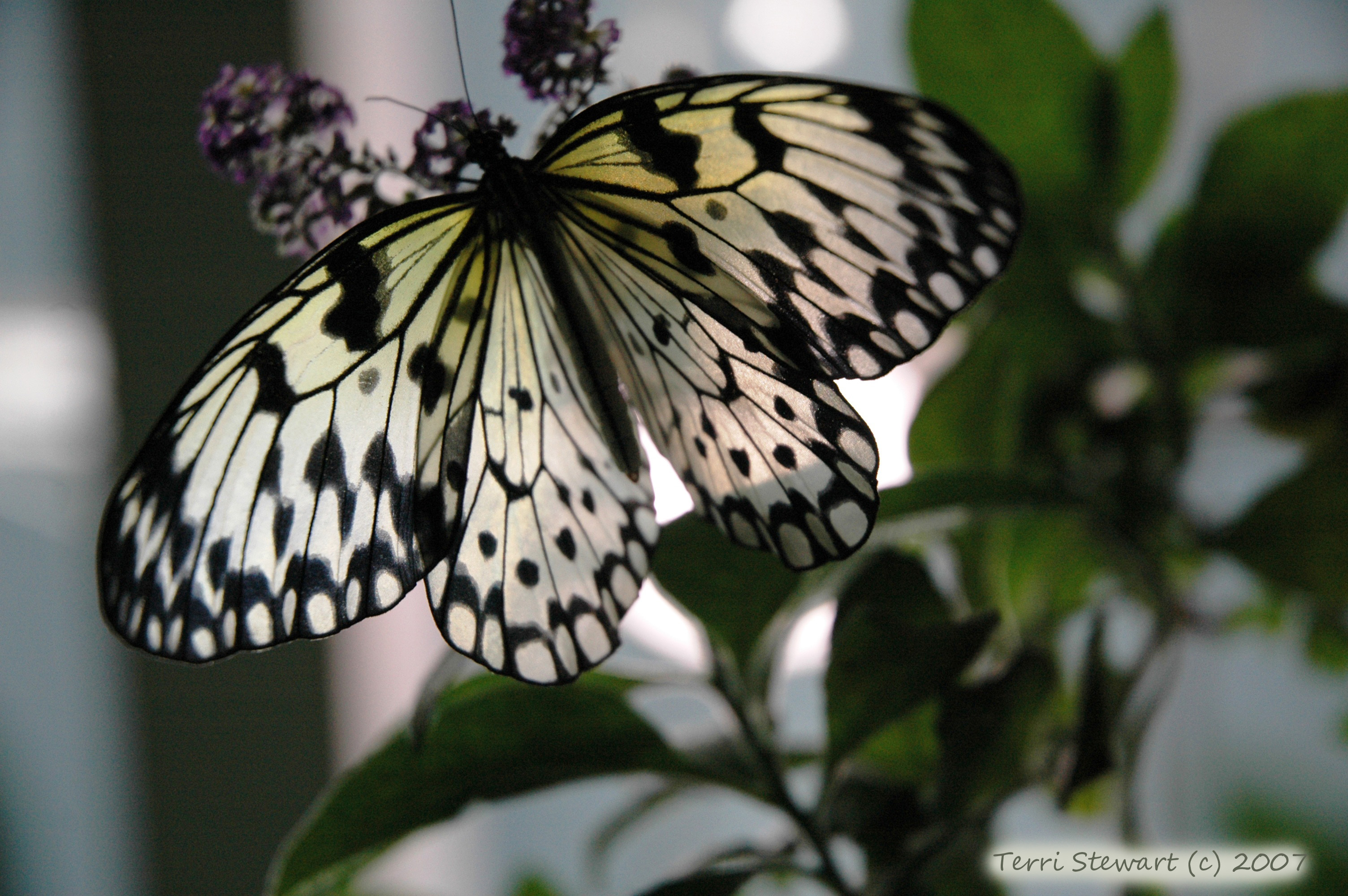
Second, I have been noodling this around and the predominant thought I had was to sing a duet with my son, Colin Stewart. Colin is 17 and much more talented than I! But we held it together in order to sing an old church song, Peace Give I to Thee. Colin is playing the ukelele and singing. I confess that our sound system is not wonderful, so we both tempered ourselves to not blow out the microphones. It is accompanied by photos I took in the Bellevue Botanical Garden which bring me incredible peace.
Finally, the nature of the quest: Poets Against War or Poets for Peace. So black and white, it begs a reflection.
dichotomy
war destroys peace
hate destroys love
butterfly destroys chrysalis
child destroys dandelion
lion destroys lamb
lamb redeems lion
dandelion redeems child
chrysalis redeems butterfly
love redeems hate
peace redeems war
unity
And another old favorite, “Breathe Deep” by the Lost Dogs which speaks to the unity of all-even when we are uncomfortable with that unity.
REV. TERRI STEWART is Into the Bardo’s Sunday chaplain, senior content editor, and site co-administrator. She comes from an eclectic background and considers herself to be grounded in contemplation and justice. She is the Director and Founder of the Youth Chaplaincy Coalition that serves youth affected by the justice system. As a graduate of Seattle University’s School of Theology and Ministry, she earned her Master’s of Divinity and a Post-Master’s Certificate in Spiritual Direction. She is a contributing author to the Abingdon Worship Annual. (The 2014 issue just released!)
Her online presence is “Cloaked Monk.” This speaks to her grounding in contemplative arts and the need to live it out in the world. The cloak is the disguise of normalcy as she advocates for justice and peace. You can find her at www.cloakedmonk.com, www.twitter.com/cloakedmonk, and www.facebook.com/cloakedmonk.
Please unite with us on Into the Bardo for Poets Against War, which is really saying Poets for Peace.
We will start with something special tomorrow (it may or may not include a poem, Terri Stewart will surprise us) and then each of the next six days we’ll host poems from six different poets. Throughout the week, we’d like you to join us – not only as readers – but as writers by putting links to your own anti-war or pro-peace poems in the comment sections. We’ll gather the links together in one post and put them up as a single special page. Please don’t worry about questions like whether you’ve been published or whether you think the work is good. These questions are irrelevant. It’s your heart in the work that counts. That’s where the power is. So please unite with us in this one thing. Let’s put that energy out into the world. If you are so inclined, please also reblog this post and help us get the word out about our week of Poets Against War. Thank you!
A Heart Without Borders was originally published in On the Plum Tree and is shared here with the permission of author, Imen Benyoub, and publisher, Niamh Clune.
“Algerian, Imen Benyoub is a poet I have long admired. She writes with such feeling and movement. There is something veiled about her poems that entices you to want to dive into an underlying mystery.” Niamh Clune, Ph.D. (On the Plum Tree), creator of Plum Tree Books
Editorial Note: We are pleased to welcome Niamh Clune and Imen Benyoub to the Bardo community of readers and contributors. Niamh has joined us as one of the Core Team members and Imen as a guest writer. As a member of the Core Team, Niamh’s prophetic and mystical writing and art will regularly grace our pages and our hope is that Imen will share more of her work with us as well. Here Imen tells us of her love of poetry and her admiration for one of the poets of the more recent Palestinian diaspora, Nathalie Handal.
***
Nathalie Handal, Palestinian-American poet and playwright
When I write, I surrender.
Surrender my senses to a delicious chaos – my soul to reach a deeper abyss and my heart to travel outside its borders.
It is the freedom that comes with writing that made me live through my pen and left me endlessly caught between worlds and words.
It is the freedom that sent Nathalie Handal on a journey from New York to Andalucia – full of colours, textures, and fragrant with history, to recreate the journey of her favourite poet, Federico Garcia Lorca, in reverse, and reconnect with her Mediterranean Eastern roots.
I was confused about what to call a woman whose soul stretches across four continents, a woman with many identites and many homes. But after reading “Poet in Andalucia,” I realized she is a woman who does not recognize borders. Like a gypsy, she moves, collects memories, scents, music, visions of landscapes and secret longings and fuses them into poems.
Nathalie Handal, a poet, playwright, translator and editor was born to Palestinian parents from Bethelehem. She travelled extensively through the United States, Europe, Latin America and the Middle East. Like Mahmoud Darwish and many exiled Palestinian poets, she tries to give a new meaning and shape to the word “home,” and Andalucia with the richness and the complexity of its cultural and religious heritage reminds her of her own country, where Muslims, Christians and Jews live together in harmony and peace. Drowning in nostalgia for a beautiful yet sad past, Handal tries to revive traditions of Andalusian poets, along with the spirit of Lorca who inspires her work.
Her poems drip with sensuality and longing, woven in English, Arabic, French and Spanish, languages she grew up speaking as a result of her displacement, a special feature that gave her work a multi-layered depth and musicality.
Along with “Poet in Andalucia,” Handal published “The Lives Of Rain,” “The Neverfield” and “Love And Strange Horses.” She won numerous awards and she lectures worldwide.
Nathalie Handal is a universal poet; her poetry is a mirror to her lifestyle as a beautiful nomad in search for an identity. Her voice is honest and passionate, where the East embraces the West in a beautiful harmony.
IMEN BENYOUB – As indicated by Namh Clune in the introductory statement, Imenis a talented poet in her own right, hence this video that provides a sample. The poem is Imen’s. It is read by Eabha Rose (theartre of words). The music is by Trian Kayhatu (band camp).
The first and only time, in my life so far, that a piece of music has inspired me to write a poem directly about it, was when I heard a piece of music, composed by Sir John Tavener in 1982 and performed by Harry Christophers’ The Sixteen, whose eighteen members produce the most sublime choral sound I’ve ever heard. It was only by listening to the music, not particularly paying much attention to the words, that I was inspired to write this piece, which is a Haiku Triplet. It wasn’t until a little time after completing the poem, which was originally intended as a devotion to my wife, that I discovered an interesting connection between the music and a famous poet, who inspired Tavener to compose it in the first place. Only when I listened to the words, did I discover that Tavener had based his composition on William Blake‘s poem The Lamb, part of Blake’sSongs of Innocence and Experience, published in 1789. A full circle had thus turned, from poem to music and back again. I find it quite stirring that William Blake’s poem inspired John Tavener to write music to it and, in turn, Tavener’s music alone, my own poem, whose theme turns back to Blake’s original, perhaps because I think the wording of my poem can also be interpreted as devotional in a religious sense. My original title was in fact The Lamb, because that is the title of Tavener’s composition.
John Tavener
The most significant feature of this composition, which had the greatest impact on my poetic inspiration, is the way that the music cycles alternately between a seemingly discordant, if not quite atonal, series of musical passages and delicious, heart melting harmonies. It had the most striking effect on me. I should confess that I didn’t particularly like the piece at first, but now, every time I listen to it, I am transfixed and cannot help myself tearing up and choking at its beauty. It seems simply to mirror the cycles of life’s experience – from its hardest and most difficult periods to its happiest and most joyous moments and, with it, our responsibility to stay strong, particularly for those we love, through good times and bad, from the discordant times to the harmonious ones.
I cannot find a YouTube recording of The Sixteen singing this piece, but because of its brevity and simplicity, it is important to hear it with the purity and perfection of the best voices, in order to capture its depth and spirit, and the Tenebrae Choir, founded by Nigel Short of the famous King’s Singers, here provide the nearest thing I can find to this quality:
I think I’ve captured the essence of the Japanese poetic form of haiku, which is the seventeen-syllable 5-7-5 three-line verse structure with a requirement to contain “season words,” or Kigo. The choice of this poetic form was very deliberate, not least because it is, by its very nature, capable of distilling the essence of its subject and because Tavener’s composition is also brief, at only three and a half minutes.
Notwithstanding the background, the fascinating influences, coincidences and connections, this poem was and is dedicated to my wife, with whom I have shared a few highs and lows during our nearly forty years together.
This may seem an odd thing to suggest you do, but, in spite of the fact that the choir is singing Blake’s words, I do like to read my poem (contemplatively), whilst listening to the music at the same time …
I leave it to you.
Devotion
(aka “The Lamb”)
From the coldest snow
To the warmest sun you go
And I go with you
From blossom of spring
To golden leaves of autumn
I bathe in your light
From the beginning
To ending of the seasons
I am ever yours.
[The poem was also published on the Marriott Love Poems Competition website in March 2011; it didn’t win any prizes, but gave me a bit of a buzz for a short while].
Photo credits ~ Blake sketch by by John Flaxman circa 1804 and in the U.S. public domain; Tavener by Clestur via Wikipedia and under Creative Commons Attribution 3.0 Unported license
You Tube video uploaded by shawshank4u
JOHN ANSTIE (My Poetry Library and 42) ~ is a British poet and writer, a contributing editor here at Bardo, and multi-talented gentleman self-described as a “Family man, Grandfather, Oc casional Musician, Amateur photographer and Film-maker, Apple-MAC user, Implementation Manager, and Engineer. John participates in d’Verse Poet’s Pub and is a player in New World Creative Union. He’s been blogging since the beginning of 2011. John is also an active member of The Poetry Society (UK).
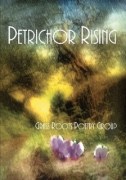
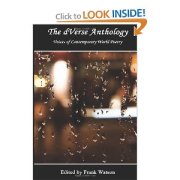
John has been involved in the recent publication of two anthologies that are the result of online collaborations among two international groups of amateur and professional poets. One of these is The Grass Roots Poetry Group, for which he produced and edited their anthology, “Petrichor* Rising“. The other group is d’Verse Poet Pub, in which John’s poetry also appears The d’Verse Anthology: Voices of Contemporary World Poetry, produced and edited by Frank Watson.
* Petrichor – from the Greek pɛtrɨkər, the scent of rain on the dry earth.
Editorial note and reminder: Next Wednesday, September 25, at 7 p.m. we will host a second writing challenge (Writer’s Fourth Wednesday) featuring Victoria C. Slotto, novelist and poet. The subject of next week’s challange is Literary Allusion. So writers read on, enjoy, write and mark your calendars for next week’s event. Mr Linky, which enables you to share your work with everyone, will remain open for seventy-two hours. Victoria will visit all participants to read and comment.
Here British poet, author and poetry teacher, Myra Schneider offers some thoughts on the possibilities and pitfalls of narrative poetry …
Myra Schneider
Narrative poetry is so different from lyrical that in many respects it is like another medium. A narrative poem needs to be structured as carefully as a novel and is likely to be less dense than a short poem yet it must still carry a sense of poetry, be more than condensed prose. What excites me most about this form is the chance to use voices very different from my own, to explore character, viewpoints and situations over a period of time. A narrative can express an idea in graphic action rather than in presenting it as an argument. Importantly, this medium can offer a route to writing about material which couldn’t be tackled in any other way.
Narrative poems are often rooted in difficult childhood and family experience. The great pitfall here is the danger of simply relating events as they happened intermixed with an outpouring of feelings. Releasing every detail of a painful memory on paper may be essential as a starting point but of course raw writing needs to be transformed to communicate to others. Selection, structuring and sometimes a measure of fictionalizing are necessary to convey the underlying truth to the reader. Widening the context beyond the narrator’s own reactions is likely to be a valuable contribution to the poem.
Donald Atkinson in his semi-autobiographical book-length A Sleep of Drowned Fathers and Kate Foley in her much shorter poem The Don’t Touch Garden have both written brilliant narratives with lively dialogue and sharp imagery showing different viewpoints in telescoped scenes which feature key moments or situations. Atkinson presents family life and traces his relationship with a violent and abusive father to a climactic incident when he is in his teens. His mother, who is trying to stand up for the children, calls him to help when her husband attacks her. The boy punches his father who collapses and it comes home to the reader that in reality the brutal man is very weak. The last sections show him as rich, isolated, sad and dying by accident in an appalling sex parlour. Yet what emerges is the narrator’s compassion and love for his father.
In The Don’t Touch Garden the narrator is an adopted child trying to make sense of the feeling that she didn’t fit with her mother. The climax of her story is the discovery of a bundle papers which reveal her identity. The adoptive mother is as much a focus as the child and there are graphic scenes which depict sympathetically the story of her background, marriage, and longing to have a child. Foley’s father, with whom she had a much easier relationship, is characterized in telling scenes. Important too is the wartime period in which the child grew up. There are very poignant moments in this many-stranded narrative which is told with wit, humour and economy.
The memory of childhood and relationships with parents can bring up such a welter of material it is difficult to find a route to a poetic narrative even though there is a strong urge to do so. This was my experience. I wanted to write about the way I was dominated by my father during my childhood and adult life and decided to create a fictional parallel with a main character whose life was very different life from mine. However, I couldn’t keep the fictional equivalent of my father under control. He ‘demanded’ sections in his voice which showed him behaving exactly as my father did. The result was he blotted out the daughter character and the poem didn’t develop properly. Discouraged after six months, I almost abandoned the poem but Mimi Khalvati gave me some encouraging feedback and I saw how to proceed. Looking back I realize I needed to write these ‘father scenes’ to clear an overwhelming anger out of my head. When I began again I confined the father to a few short scenes and fleshed out the narrative, widening the canvas with characters all of whom had difficulties to face in their lives. After about eighteen months the compressed novel Becoming found its shape.
Of course childhood and difficult personal relationships connected with it is only one source of personal subject matter for poems with a narrative element. Many poets (and non-poets) feel the need to write about the death of someone close and such poems often have a narrative drive. Understandably there is a desire to record every detail of a last illness but, as magazine editors and poetry judges are all too aware, writers often fall into the trap of offering a sad but drawn out story in which the material hasn’t been transformed.
Douglas Dunn’s moving book-length sequence, Elegies, about his wife Lesley’s illness and his own life after she died has a narrative thread but it is worth noting it barely touches on medical details and it doesn’t hammer out the harrowing day to day decline of his wife’s strength. What Dunn does is to make skilful shifts in chronology so that poems which recall incidents when Lesley was well are juxtaposed with graphic moments during the illness such as the couple looking at a hanging mobile of three seagulls made by a friend, the night before she died. These poems are sad yet celebratory and reveal the kind of person she was. The later part of the book traces the stages of grief and mourning which Dunn goes through as he re-lives events and finds ways of continuing to connect with his lost wife. Very controlled language and different kinds of strict form counterpoint the overwhelm of grief in this very moving sequence.
Many different kinds of personal material can trigger narrative poems. Gwyneth Lewis’s book-length Hospital Odysseywas inspired by her husband’s serious cancer illness and the frustration and fear she endured while he was undergoing treatment in an NHS hospital with all its inadequacies. Lewis turned the experience not into a painful account but a hugely inventive epic in nine books. She drew on the quest tradition, in particular Dante, but also created an extraordinary world in which matrons and consultants turn into creatures, diseases are personified, and microbes hold a manic ball. Maris, the heroine, is accompanied by two helpers rather as Dorothy was in the Wizard of Oz. Her search for her husband, Hardy, and for a way to find a cure that would save his life, takes her deeper and deeper into the underworld of hospital which perhaps is also a metaphor for the space in the human body. Lewis, following the literary tradition, sometimes addresses the reader and she is speaking for herself when she says the odyssey is one of healing that takes place in the head:
…….I won’t feel well
till this poem’s finished and I find what I mean
about health and loving. It’s a hospital,
this place I am constructing line by line.
There is satire and burlesque, as well as extremes of feeling in this complex and ambitious story. The whole, written in five line rhyming stanzas, is an extraordinary achievement and a wonderful illustration of how trauma can be transformed into a work of art which universalizes it.
Life experiences which have no direct connection with personal difficulties can also be the basis of narrative. I found it exciting to draw on my years of teaching disabled adults in writing Voicebox. The poem is entirely fiction but the trigger for the pivotal character, William, was a composite of clients I worked with, each of whom was wheelchair-bound and had speech problems. William, frustrated by his disabilities and his over-protective mother, is intelligent but antagonistic towards his mother, generally obstreperous and he lives mostly in fantasy. His outlet for self-expression is via his computer. Inventing him was liberating, great fun and extended my writing. Here is a brief excerpt from a poem he wrote after he’s seen a heron in a local park he went to with Katie, a neighbour and teacher, who’s taken an interest in him.
At middnight when the moon
berns whitely in the sky
William kreeps out to kiss his grilfrend
and heron snaps his beek at Mum
awders her to come to the park…
The thirty page poem is written in the voices of the four main characters, one of whom is Millie, William’s mother. All of them are in one sense or another finding their voices. I had already delved into this subject which has been an issue in my life. In Voicebox I found a new way to explore it.
Drawing on myth or fable also offers possibilities for narrative poems. In her book-length sequence, Meadowland, Louise Gluck harnessed the Odysseus story in a remarkable way. She interweaves poems in which Penelope, Telemachus (the son of Odysseus and Penelope) and Circe, in particular, put forward their own views. These offer a modern interpretation of the legend which connects with the story, also told in voice, of two contemporary un-named characters, whose marriage is falling apart. There is cutting humour as well as tenderness and pain in these poems which clearly reflect on personal experience. Gluck often draws on myth. In her book-length sequence Vita Nova, which has a strong sense of mourning, she turns to the Orpheus and Eurydice story. Classical stories, when used effectively as a base, heighten and universalize subject matter. Anne Cluysenaar makes the narrative of The Epic of Gilgamesh a frame for Clay, a long poem with different strands of reference including a strong meditative element.
I found re-telling the Orpheus story in contemporary terms and placing it in the London Underground offered surprising opportunities. With its many escalators, corridors and dark tunnels the Underground always fills me with a sense of drama and often seems to equate with Hades and other metaphorical underworlds. Details about the buskers, the dreadful suicides on the line, individuals I’d observed such as a thin pale girl with syringe marks all the way up her arm, gathered in my head. I pictured Eurydice following Orpheus up a long escalator before collapsing and envisaged him as a flute-playing busker who falls for a drug addict. Then I saw the drug pusher on whom Eurydice had been dependent, as the underworld king who would separate the couple. Other parallels suggested themselves. The myth seemed to strengthen my story and it allowed me to treat contemporary material I would not otherwise have dared to touch.
Historical characters and events can also be potent subject matter for narrative poems. It is crucial, however, in using this kind of material or classical stories that the poet brings something new to it. If there isn’t a re-interpretation or if the poet hasn’t found in the original material a driving point which gives the poem an illuminating focus the result is likely to be little more than a re-telling and will fail because it has no life of its own.
Elaine Feinstein was drawn to Lorenzo da Ponte, Mozart’s librettist, because she identified strongly with his sense of always being an outsider. His story was a strange one. The son of a poor Jewish tanner he was assimilated into European culture by the accident of family baptism and education, managed to move from a profligate life in Venice to the Emperor’s Court in Vienna and then, when out of favour, he made his way to New York. Amazed by his nerve and his ability to live on his wits as much as his talent, she conceived the narrative as a dramatic monologue, making da Ponte look back over his past with all its ironies at the point when he is living a humdrum life in America. The skilfully written poem, a salute to the librettist’s survival, points up the ironies of his ever-changing fortunes. It moves swiftly through his story but with graphic detail and the teller sometimes steps out of chronological order to make comments. The five line rhyming verses in iambics are a marvellous counterpoint to the subject matter. Form, of course, whether strict or free is as crucial in a narrative poem as any other.
Dilys Wood
Dilys Wood’s poem, The South Pole Inn, was triggered by a desire to write about early Antarctic exploration but she knew she must find an indirect approach to this well-documented subject. She hit on the idea of a dramatic narrative set in Ireland long after the main expeditions, intending to show the heroism of the men through the eyes of a woman. She chose Nell, wife of Tom Crean one of the participants, set the action in the Creans’ inn in Ireland and interwove the expedition material with references to the Irish troubles. She also invented a love-affair between Nell and Frank Worsley, another member of the expeditions, presenting him as a man who was more understanding of women than Tom. Combining fact and fiction was a challenge. There were others, in particular researching into the Irish Troubles and life in Western Ireland in the 1920s and later. She went to Ireland to see the South Pole Inn and the area round it. She also had to make sure the voices of its characters, were authentic. Nell was perceived as a capable woman frustrated by the way her husband sidelines her from ‘male’ action and as her story developed the theme of woman’s role became a major one. It was a tussle to control the plot and integrate the themes but after several drafts a remarkable poem emerged.
Carolyn Norton, a long narrative poem is included in this collection
Research, which is often essential when using known sources for a narrative poem, can also be a pitfall. It is all too easy to be carried away by fascinating information and include it without considering whether it is really relevant. Driven by anger that 150 years ago women were so powerless and that many women in the world still are, I wanted to write a poem about Caroline Norton. She was the first person in Victorian times to gain some rights for married woman and my intention was to highlight this as I felt she should be much better known. The problem was how to select details from her complicated life which would show how much she had to fight against and endure so that the reader would recognize the significance of her achievements. To do this, however carefully I selected, many facts needed to be included but the danger was the poem would read simply as an account. It was only when I hit upon the idea of a repeat with variations such as “What she did”, “What she didn’t do” to give a rhythm and act as a hook for selecting material, that I could begin.
In the last twenty years or so narrative poetry has reassumed its place as an important genre for some leading poets writing in English, including Derek Walcott and Les Murray. There isn’t space here to examine the wide canvasses of their epics, Omeros and Fredy Neptune. Omeros is set mainly in St. Lucia and Walcott weaves together fictional narratives based on the island’s present, past and his own experiences, creating some parallels with the Iliad. The island has played a crucial part in Walcott’s life and in this poem, among others, it features as a dominant character. I should mention that place often plays key role in narrative and this applies to several of the poems I’ve written about in this essay – Hospital Odyssey, for example. In Fredy Neptune Murray writes in an alter ego as a rough and ready Australian of German origin to produce a verse novel written as Fredy’s fantasy adventures. These take him to many parts of the world and incorporate the history of the period from the end of World War 1 to soon after the end of World War 2. Early in the story the shock of seeing Armenian women burnt to death by a mob makes him his lose his sense of touch, a condition which has metaphorical implications. In the later part of book he rescues a mentally disabled German boy. This strand of the story, which is haunting, was a way for Murray to write about his autistic son.
Omeros and Fredy Neptune are among the highest poetic achievements of our age. There are many pitfalls to be faced in writing poetic narrative but I hope I’ve shown the possibilities of the mode are unending.
Publications:
A Sleep of Drowned Fathers, Donald Atkinson, Peterloo 1989
Migrations, Anne Cluysenaar, Cinnamon Press 2011
Elegies, Douglas Dunn, Faber 1985
Gold, Elaine Feinstein, Carcanet 2000
Night & Other Animals, Kate Foley, The Green Lantern Press 2002
Meadowlands, Louise Gluck, Carcanet 1998; Vita Nova, Carcanet 2009
A Hospital Odyssey, Gwyneth Lewis, Bloodaxe 2010
Fredy Neptune, Les Murray, Carcanet 1998
Becoming, Myra Schneider 2007; Multiplying The Moon (Voicebox, Orpheus in the Underground), Enitharmon 2004, What Women Want, Second Light Publications 2012
Omeros, Derek Walcott, Faber 1990
Antarctica, Dilys Wood, Greendale Press 2008
The illustrations were not included in the original article and were added here by me. The portraits are the property of Myra Schneider and Dilys Wood and copyrighted. Book cover art is copyrighted and used here under fair use. J.D.
chopped and chewed and swallowed –
down we go
on eternity’s throat,
one bite of salty clay after another
to be recycled
and become the burnt sienna skies
of some obscure tomorrow.
fate chimes its’ eyelashes
like some odalisque its’ coin belt –
the boatman’s pockets are always full
with tradition’s eye seals.
we are but stairs
for humanity’s pretended
e-volution,
we circle meanings
like eagles circle unseen angels
up-above,
without ever touching them,
we live to ignore
and ignore to learn
the reason why history is repeating –
and talking tall
we show our real essence –
the spoiled mud flowing in our veins
keeps bringing bitter smiles
on god’s resigned mouth: ever non-grown-ups, these earthlings…
– fautly darwinism is the opening poem from Liliana Negoi’s poetry volume The Hidden Well, and can be heard in the author’s own reading on SoundCloud HERE.
.
LILIANA NEGOI (Endless Journey and in Romaniancurcubee în alb şi negru) is the author of three published volumes of poetry in English, which is not her mother tongue but one that she came to love especially because of writing: Sands and Shadows,Footsteps on the San – tanka collection and The Hidden Well. The last one can also be heard in audio version, read by the author herself on her SoundCloud site HERE. Many of her creations, both poetry and prose, have been published in various literary magazines.
boots heels strike hard against city streets beneath their weight lies the blood of children caught in the crossfire of human greed boots heels strike hard chiraq to la gang border wars death’s small bags sold and bought this is civil war where are our troops boots heels strike hard spin doctors’ barrage has replaced truth all is well ask the dead but they have no voice so listen to me boots heels strike hard against your eardrums the dead call out this is war and we are losing the battle to save children’s lives
. CHARLES W. MARTIN (Reading Between the Minds) — earned his Ph.D. in Speech and Language Pathology with an emphasis in statistics. Throughout Charlie’s career, he maintained a devotion to the arts (literature/poetry, the theater, music and photography). Since his retirement in 2010, he has turned his full attention to poetry and photography. He publishes a poem and a photographic art piece each day at Read Between the Minds, Poetry, Photograph and Random Thoughts of Life. He is noted as a poet of social conscience. Charlie has been blogging since January 31, 2010. He has self-published a book of poetry entitled The Hawk Chronicles and will soon publish another book called A Bea in Your Bonnet: First Sting, featuring the renown Aunt Bea. In The Hawk Chronicles, Charlie provides a personification of his resident hawk with poems and photos taken over a two-year period.
Jalāl ad-Dīn Muhammad Rumi (1207-1273), Persian poet, jurist and theologian, and Sufi mystic
I’m trying to follow the theme of an essay, which I wrote for Into the Bardo, “Fortes Fortuna Adiuvat (Fortune Favours The Bold)”, which was published here at the beginning of August. It was a deeply thoughtful piece that probably comes from my own anxieties at the state of the world. In consequence, it became an overly long and involved treatise, in which I tried to encapsulate my understanding of what needs to happen to rescue the human race from itself.
An impossible dream, you might say, and you could be right. However, a couple of weeks after publishing it, I stumbled upon something that struck me between the eyes! It was an eight hundred year old poem, which felt as if it were a personal message from somewhere unknown! Also, another article that was posted here on Into The Bardo, last Saturday,A Biassed Mind Cannot Grasp Reality: A Message from the Dalai Lama, (Excerpts from His Holiness the Dalai Lama’s address to the inter-faith seminar organised by the International Association for Religious Freedom, Ladakh Group, in Leh on 25 August), spoke of how human ‘agitation’ was the cause of many of our woes. This was a particularly enlightening read; I recommend it to you highly.
The first three verses of this poem, appeared from Rumi’s Facebook page and struck me in a number of ways, not least of all because it represents a special milestone in the recognition of so much that I believe about the human condition, which is to recognise our own individuality, our own convictions and that, I would argue, we should take responsibility for our own actions. I had, therefore to seek out its source and find the rest of the poem, written by that much revered Thirteenth Century Persian poet, jurist, theologian and Sufi mystic, Jalāl ad-Dīn Muhammad Rūmī.
“Everything you see has its roots in the unseen world” – isn’t this the space between our ears?
“Why do you weep? The source is within you” – ditto
I have, for a long time, recognised that, whilst we may cover ourselves with a veneer of sophistication, we cannot hide from the frailty of our very human condition. The Industrial Revolution, the engineering and technology, which has resulted over the following two hundred and fifty years, may have produced some remarkable examples of our ingenuity, but the problems of the world that remain, which are, for the most part, of our own making, are the same in essence as they were when this poem was written nearly eight hundred years ago, when humans were still humans, but without the technology. It seems a strange irony that this could be a sign that our resultant wealth, which is far more widely distributed than it was eight hundred years ago, has blurred our vision of life’s purpose, whilst at the same time (certainly in the case of this post) aided it, with computer technology.
When we’ve learned this lesson, when we’ve learned, not just how to recognise this fact, but how to respond to it, to imbue the young minds of future generations with the knowledge that they need to discover how they are going to embrace all cultures, all religions and all manner of human personalities (because we adults have not made a great job of it so far and are clearly not entirely capable of teaching them) then, and only then, will we be truly able to move on as a race … and awaken to that much vaunted new dawn, that enlightenment.
I give you the words of one, who probably knew much more and was more qualified than most of us living today to understand the human condition …
A Garden Beyond Paradise
Everything you see has its roots
in the unseen world.
The forms may change,
yet the essence remains the same.
Every wondrous sight will vanish,
every sweet word will fade.
But do not be disheartened,
The Source they come from is eternal—
growing, branching out,
giving new life and new joy.
Why do you weep?—
That Source is within you,
and this whole world
is springing up from it.
The Source is full,
its waters are ever-flowing;
Do not grieve,
drink your fill!
Don’t think it will ever run dry—
This is the endless Ocean!
From the moment you came into this world,
a ladder was placed in front of you
that you might transcend it.
From earth, you became plant,
from plant you became animal.
Afterwards you became a human being,
endowed with knowledge, intellect and faith.
Behold the body, born of dust—
how perfect it has become!
Why should you fear its end?
When were you ever made less by dying?
When you pass beyond this human form,
no doubt you will become an angel
and soar through the heavens!
But don’t stop there.
Even heavenly bodies grow old.
Pass again from the heavenly realm
and plunge into the ocean of Consciousness.
Let the drop of water that is you
become a hundred mighty seas.
But do not think that the drop alone
becomes the Ocean—
the Ocean, too, becomes the drop!
JOHN ANSTIE (My Poetry Library and 42) ~ is a British poet and writer, a contributing editor here at Bardo, and multi-talented gentleman self-described as a “Family man, Grandfather, Oc casional Musician, Amateur photographer and Film-maker, Apple-MAC user, Implementation Manager, and Engineer. John participates in d’Verse Poet’s Pub and is a player in New World Creative Union. He’s been blogging since the beginning of 2011. John is also an active member of The Poetry Society (UK).
John has been involved in the recent publication of two anthologies that are the result of online collaborations among two international groups of amateur and professional poets. One of these is The Grass Roots Poetry Group, for which he produced and edited their anthology, “Petrichor* Rising“. The other group is d’Verse Poet Pub, in which John’s poetry also appears The d’Verse Anthology: Voices of Contemporary World Poetry, produced and edited by Frank Watson.
* Petrichor – from the Greek pɛtrɨkər, the scent of rain on the dry earth.
. CHARLES W. MARTIN (Reading Between the Minds) — earned his Ph.D. in Speech and Language Pathology with an emphasis in statistics. Throughout Charlie’s career, he maintained a devotion to the arts (literature/poetry, the theater, music and photography). Since his retirement in 2010, he has turned his full attention to poetry and photography. He publishes a poem and a photographic art piece each day at Read Between the Minds, Poetry, Photograph and Random Thoughts of Life. He is noted as a poet of social conscience. Charlie has been blogging since January 31, 2010. He has self-published a book of poetry entitled The Hawk Chronicles and will soon publish another book called A Bea in Your Bonnet: First Sting, featuring the renown Aunt Bea. In The Hawk Chronicles, Charlie provides a personification of his resident hawk with poems and photos taken over a two-year period.
“The apricot throws itself on the ground. It is crushed and trampled for its next life.” Yang Mija “sees” while walking through an orchard and takes notes in her poetry notebook
This movie speaks quietly about life and art, devastation and redemption. Like the most refined poetry, it is nuanced, honest and dramatic without being melodramatic or manipulative. It is a spare work, whittled down to essentials. It whispers. It never shouts. Its pacing is leisurely and thoughtful. There is no suggestive music here to help you grasp the story’s progression. There are no stars who have been nipped, tucked, brushed, trussed and boosted. These people are real. They could be me or you or our next-door neighbor. The story could be anyone’s story anywhere in the world. Indeed, Director Lee Chang-dong got the basic idea for the screenplay from a news report..
“ … this story was finally born from a combination of different elements: the sexual assault case, the suicide of a girl, and the lady in her 60s writing a poem.” Lee Chang-dong in an interview HERE
Yoon Jeong-hee stars in the leading role (Yang Mija) and it is the lean script (though the movie is over two hours long) and Jeon-hee’s exquisitely understated acting that transfix us. Watch her face. Watch her body movements. These also are a kind of poetry.
“I’m quite a poet. I do like flowers and say odd things.” Yang Mija
Yang Mija is a sixty-six year-old grandmother charged with the care of a teenaged grandson, Jongwook – or Wook – whose mother is divorced and living in Busan. Wook is lazy and ungrateful and shows no respect for his grandmother or sensitivity to her age and her loneliness.
“You’re sprouting a mustache but acting like a child.” Yang Mija to Wook
Wook is part of a “gang” of male friends, fellow students, who over the course of six months repeatedly rape a young woman who subsequently drowns herself. News of this comes coincident with Yang Mija’s diagnosis of Alzheimer’s disease and her first poetry class. It is her poetry classes and effort to write a poem that provide the through-line for this story.
“The most important thing is seeing.” the poetry instructor to the class on the first day
We walk alongside Yang Mija as she struggles with these multiple challenges – not without some humor – and sorts through her emotions regarding her grandson’s actions, her sympathy for the drowned girl, and the desire of other parents to hide the boys’ culpability by buying off the drowned girl’s mother. While Yang Mija may be suffering the early stages of memory loss, she hasn’t lost her moral compass.
As she moves from one experience to the next, Yang Mija questions: How do you write a poem? Where does the poetry come from? When she decides how she is going to handle her grandson, she is finally able to write her poem.
Agnes’s Song
How is it over there?
How lonely is it?
Is it still glowing red at sunset?
Are the birds still singing on
the way to the forest?
Can you receive the letter
I dared not send?
Can I convey the confession
I dared not make?
Will time pass and roses fade?
Now it is time to say goodbye,
Like the wind that lingers
And then goes, just like shadows.
To promises that never came,
To the love sealed till the end,
To the grass kissing my weary ankles,
and to the tiny footsteps following me,
It is time to say goodbye.
Now as darkness falls
will a candle be lit again?
Here I pray nobody shall cry
and for you to know
how deeply I loved you.
The long wait in the middle
of a hot summer day.
An old path resembling my father’s face.
Even the lonesome wild flower
shyly turning away.
How deeply I loved.
How my heart fluttered at
hearing your faint song.
I bless you
before crossing the black river
with my soul’s last breath.
I am beginning to dream…
A bright sunny morning again I awake,
blinded by the light and meet you
standing by me.
– Yang Mija
“It is not difficult to write a poem. It is difficult to have the heart to write a poem.” the poetry instructor on the last day of class. Yang Meja is not in attendance but has left a bouquet of flowers and her poem
Both thumbs up on this one.
There are probably a lot of places you can go to rent or buy this, but I streamed it from Amazon.
JAMIE DEDES ~ My worldly tags are poet and writer. For the past five years I’ve blogged at The Poet by Day,the journey in poem, formerly titled Musing by Moonlight. Through the gift of poetry (mine and that of others), I enter sacred space.
Archetypal Gothic Lady of Sorrows from a triptych by the Master of the Stauffenberg Altarpiece, Alsace c. 1455
I had written a poem for Mothering Sunday, or Mother’s Day as it is commercially known, which was a few months ago, now. However, I somehow felt it an appropriate story to raise here on Into The Bardo. This is because of the meaning I understand the word ‘Bardo’ has; that is to say a ‘transitional state’ that the Stabat Mater must have entered whilst having to process the extreme emotions provoked by such a harrowing experience, perhaps not the transitional state intended by Buddhist groups, who conceived of this condition, but a transitional state that will, more likely, have provided a protective blanket to help her through the pain.
The poem A Ballad for Stabat Mater struck me on several levels. I had already previously written a poem for my son’s thirtieth birthday (The Fourth Age of Man), basing it on William Shakespeare’s Seven Ages of Man (a monologue, which he wrote to open his play, “As You Like It”). Incidentally, I found it particularly poignant to note that my son had almost reached the same age as Jesus Christ was alleged to be, when his own mortal life ended. So, the latter never had the chance to taste the next three ages; or, perhaps, he lived all seven in that short span of life?
This poem, written in the form of a ballad, was, once again, influenced by Shakespeare’s “Seven Ages of Man”, but this time includes all seven ages. Also, it was, perhaps not surprisingly, heavily influenced by the Stabat Mater, that unforgettable and extraordinarily moving image of this religious icon, Mary, the mother of all mothers, as she stood and watched her own son die, painfully. Stabat mater dolorosa, meaning the sorrowful mother stood, is a masterful understatement. How many mothers could submit themselves to such unbelievable pain! And yet all mothers do, albeit mostly to a lesser extreme, for as long as they live.
I salute all mothers, however good or bad a mother you may think you are, you have still had to suffer for your children.
JOHN ANSTIE (My Poetry Library and 42) ~ is a British poet and writer, a contributing editor here at Bardo, and multi-talented gentleman self-described as a “Family man, Grandfather, Oc casional Musician, Amateur photographer and Film-maker, Apple-MAC user, Implementation Manager, and Engineer. John participates in d’Verse Poet’s Pub and is a player in New World Creative Union. He’s been blogging since the beginning of 2011. John is also an active member of The Poetry Society (UK).
John has been involved in the recent publication of two anthologies that are the result of online collaborations among two international groups of amateur and professional poets. One of these is The Grass Roots Poetry Group, for which he produced and edited their anthology, “Petrichor* Rising“. The other group is d’Verse Poet Pub, in which John’s poetry also appears The d’Verse Anthology: Voices of Contemporary World Poetry, produced and edited by Frank Watson.
* Petrichor – from the Greek pɛtrɨkər, the scent of rain on the dry earth.
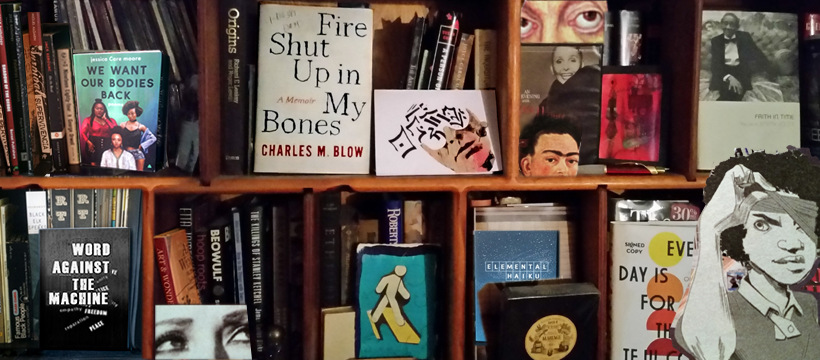
 When I remember you
 JAMIE DEDES ~ My worldly tags are poet and writer. For the past five years I’ve blogged at The Poet by Day,the journey in poem, formerly titled Musing by Moonlight. Through the gift of poetry (mine and that of others), I enter sacred space.


















,_oeuvre_du_Maître_du_retable_de_Stauffenberg,_actif_au_15ème_siècle_(Musée_d%27Unterlinden,_Colmar).jpg)
 The BeZine