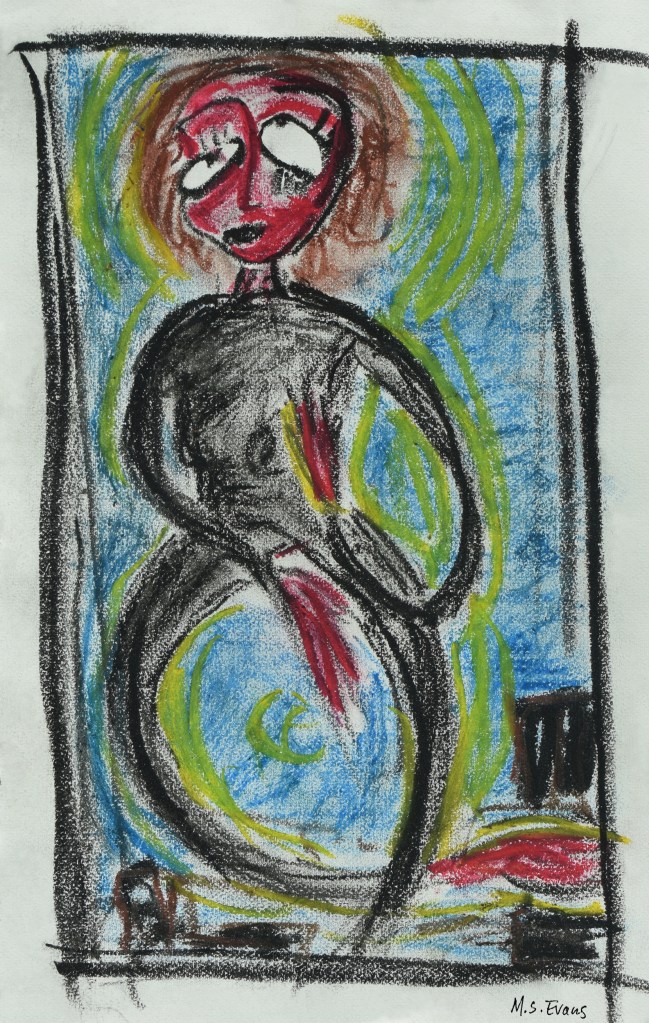
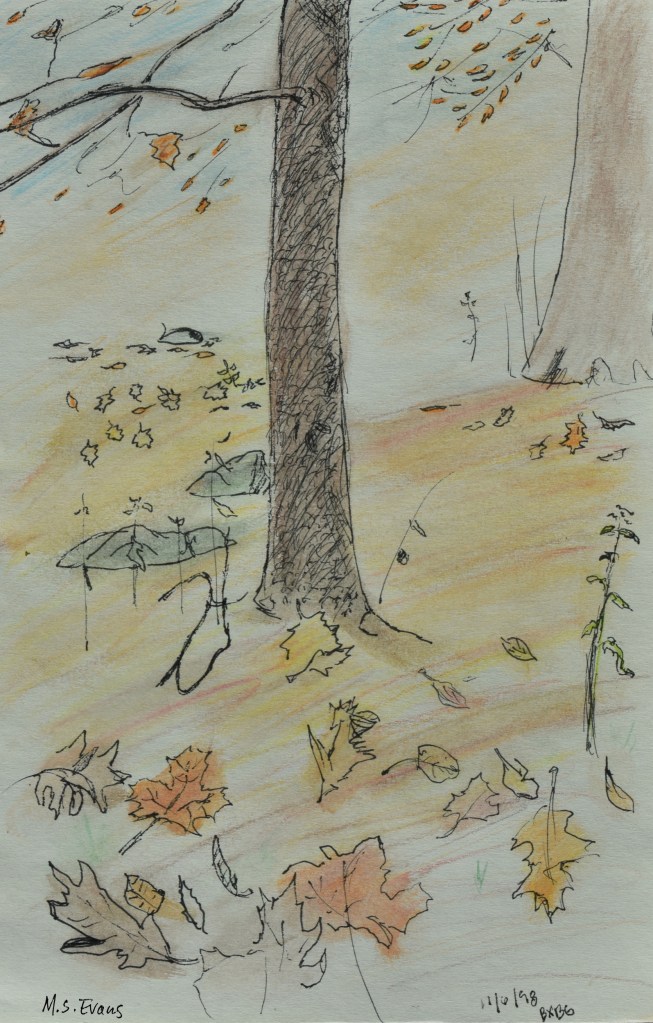
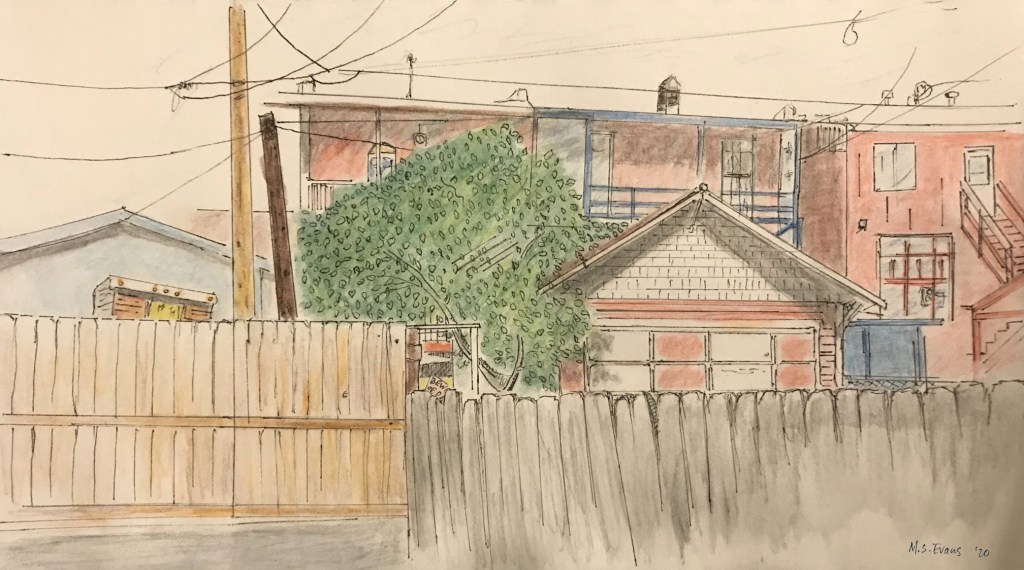
Aware that M.S. Evans paints and draws, as well as writing poetry, The BeZine invited her to submit artwork to accompany these poems when we accepted this blog post. We asked M.S. Evans for artwork to accompany and complement the words on the screen (we used to say “on the page”), not to “illustrate| the poems. The result is this blog post, which The BeZine presents here as separate yet interconnected works of art by M.S. Evans.
—Michael Dickel, Editor
Spare Guardian Floating
Spare Change
Spare Change
Sidewalk, slouched.

My eyes circle the rim of a crumpled
paper cup.

Puddles cooly stare up;
too sure of an answer.

Strangers offer me
naked cigarettes;
slim-boned solidarity.

My softness wrapped
in copper wire,

I learned to smoke.
Floating Away oil pastel
Guardian of Keepsakes
The weight of boxes ease; released,
forgotten, re-homed.

A guardian of  keepsakes,
I carry the irreplaceable,
sentimental.

Not naive enough to trust
my home will last

this time.
Bronx Botanical Garden watercolor and ink
Kicked Out
They gave my room away
when I became pregnant

You’re welcome to pay for the basement;
uneven floodplain.

First trimester: missed period, tender,
insulted.
Backdoor tercolor and ink
—Poetry and Art by M.S. Evans
Artist’s Notes
“Floating Away” is an oil pastel piece I did in the early 2000s, when my housing was very unstable. There is a lot of yearning in this piece: for stability, but generally for a future.
“Bronx Botanical Garden” is a watercolor and ink piece from my time in NY, in the late ’90s. At that time I was doing a work-exchange for a room in the house of an elderly Yiddish poet and artist.
“Backdoor” is a watercolor and ink piece from my current living situation in Butte, Montana. There are signs of decay, but also of continuity and intent.
For the past five years, September has been the month of 100,000 Poets for Change (100TPC). All over the world, poets (musicians, artists, and, yes, mimes) have organized events on or near a Saturday in September each of those years, this year, on the 26th. For this, the fifth anniversary of 100TPC, there are over 500 events scheduled throughout the world. The readers of, contributors to and publishers of The BeZine have participated with a virtual event in the past and will again this year on the 26th.
Meanwhile, The BeZine’s theme for September also supports the 100TPC call for peace, sustainability, and social justice, with our focus on poverty in general and homelessness in particular. This focus relates to social justice in an obvious way. Yet, how could we speak of sustainability without social justice? If we still have poverty and homelessness, what is sustained other than inequality? And, without social justice could there be peace? For that matter, could peace be sustained without both justice and environmental plus economic sustainability? Our choice is not to put one of these three above the other, but to recognize that all of these three important themes, necessary areas of change, interrelate in complex ways. So we chose one aspect to focus on, and in so doing, this issue clearly points to all three themes through the lens of poverty.
We open by featuring three incredibly powerful poems by Sylvia Merjanian, Refugee, Second Chance, and Collateral Damage. Refugee and Collateral Damage come from her collection, Rumor (Cold River Press—proceeds go to help Syrian refugees). Second Chance debuts here. These poems show the relationship of war to poverty, oppression, and sexual abuse. In reading these, one senses the immense personal costs of war, especially to women and children. They provide an important window into the staggering worldwide refugee crisis, currently the largest human migration since World War II. Refugees are homeless in so many ways, even when they have a house to live in. And, the world seems to conspire to keep them destitute.
That war directly and indirectly causes poverty does not surprise. You might not know, until you read James Cowles’ essay, The Roots of Institutionalized Poverty, that something called The Compromise of 1877, which ended the post-Civil War Reconstruction Era, provided the political and economic structures of poverty that continued strong through the Civil Rights Era and, in many ways, still exist today. Certainly we know that poverty is not new in the United States, and neither is homelessness. In this issue you will hear music of the Depression Era that sounds too familiar today. The first time I personally participated in an editorial process and writing publication related to homelessness was in 1989, for the University of Minnesota student paper, the Minnesota Daily. We produced a special finals’ week issue, Ivory Tower, dedicated to the theme.
Poverty and homelessness are evergreen issues historically, but issues also embedded in social and political complexity. They benefit the rich, whose economic system keeps most of the rest of us as, at best, “wage slaves,” and all too many of us in poverty, without enough to provide for basic needs or housing (including the “working poor,” who hold low-paying jobs while CEOs are paid record-breaking salaries and bonuses). Our second feature, Jamie Dedes’ poem, Some Kind of Hell to Pay, cries out against the structures of injustice, where the rich act as demigods and demagogues, and it asks of what use will all their riches be in the Hellish realm of the inevitable backlash from the marginalized and disenfranchised.
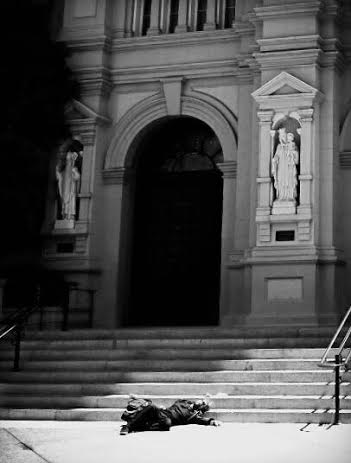
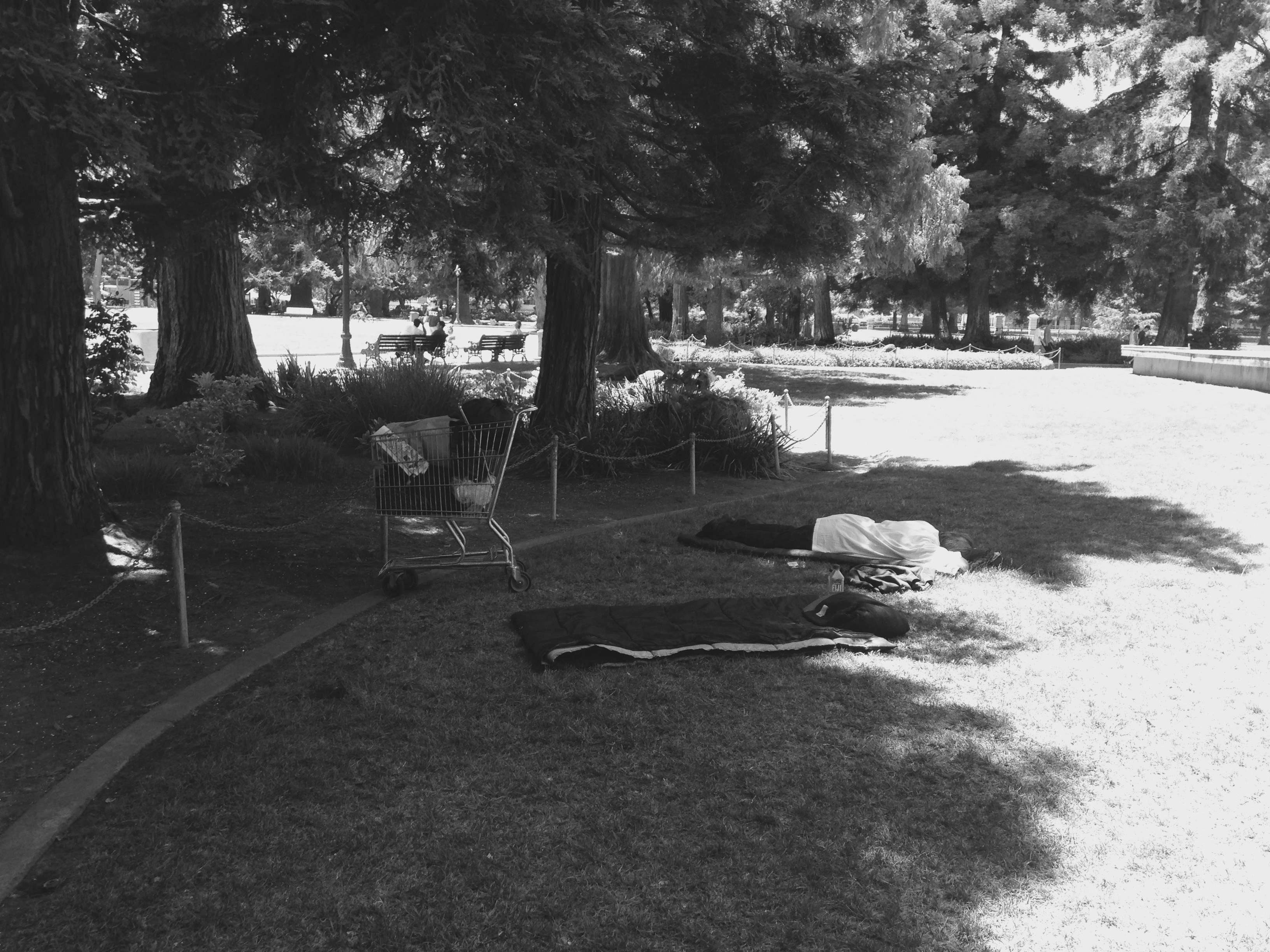
photo credit: Sharon Frye
The poems, prose, photo essay, and art in the rest of the September BeZine will ask you to feel, to see with empathy, to hope defiantly, and always to resist the status quo. The writers often look beyond the borders of the U.S. or Western Europe to see the injustices of a world-wide economic system of war, greed and injustice that makes it difficult to live outside of its oppressive realities—and for those pushed out, the available choices do not sustain their lives, their dreams, or their spirits.
Yet, people live, they dream, and they hope with spirit—often in defiance, sometimes by dying (see John Anstie’s As if and Sharon Frye’s Jacob’s Ladder in this issue), sometimes by living despite all of the forces lined up against their lives. Victoria C. Slotto’s Homeless Man tells of a “destitute” man whose story reveals that he may in fact have the most rich life of any of us. Always, there is more than what we see.
Read these words. Think about the change that could help to heal creation as Michael Yost’s poem Who Am I to Judge and Michael Watson’s essay The Realm of the Unimaginable speak to. Remember the admonition to think globally but act locally. And, most of all, imagine.
Then, join us on 26 September 2015, on our blog. Add your own thoughts, your own poems, your own essays. Join in our virtual, worldwide 100TPC event from wherever you live. We will post a page with instructions on our blog on the 26th. The posts will go up live. And, after the 26th, we will organize and archive the event (see the 2013 and 2014 pages in the tabs at the top of the page).
—Michael Dickel, Jerusalem
My poem from the 1989 Minnesota Daily Ivory Tower
Soil
i The plow cuts, disk or chisel? How much of what lies below to bring up leave exposed to dry in the wind? What residue of last years’ crop to leave upon the soil, cover over to rot, return to the fertile land?
What fetish draws me along this furrow? Street and curb meet here.Step up or down into slime. Dust, trash tossed around and dropped by the blind wind. What fate ties strings to which embedded hooks, Pulls my flesh forward forever forward towards the street?
The Spring fete begins, seeds in muck anticipating dilettante dance of the chosen few. Weed out the hungry whose appetite starves wind-pressed grain shafts; water the rows of the obedient who face slick harvest, brittleness in the searing sun and death with Winter.
I move, farmer in these city streets, man among the chaff, I offer to fetch my elegant plow-tongue, to stop the wind, describe the deep earth and the rotted residue, the dry grasses and newspaper blown by, salvaged for shelter by the quick grasp of an old hand, pulled on top of gray hair to keep rain out.
ii I would pull the plow, but a voice from under the newspaper covers my shoes in mud and mire.
What d’you know ’bout all this? He spit
from mown rye-stubble fields, fetid earthen face Cracked crumbled creased
Caressed once, long ago
All you see’s a bum. Fuck you, you son of a whore.
At home I do not wash the dirt from me,
I scrape it off, place it in a box with a key I open my belly and
secure the box within, sated.
On our 2015 Facebook Page for 100,000 Poets for Change, we’ve been discussing poverty and homelessness. I’m sharing some of the conversation there. If you’d like to join us on Facebook, please let us know. All are welcome. For the September 2015 issue of The BeZine, we’ll be exploring poverty and on September 26, we’ll hold our virtual event and we invite reader participation. Instructions will be in our blog that day. Links to everyone’s work will be collected and posted as a Page and also incorporated into a PDF that will be archived at 100,000 Poets (writers, artists, photographers, musicians and friends) for Change; i.e., peace and sustainability.
This conversation was started on our The BeZine 100TPC 2015 Facebook Group Page by Michael Dickel (Fragments of Michael Dickel):
It’s only a little more than a month until 100 Thousand Poets for Change—Fifth Anniversary—26 September! Time to start some provocations…
Just to get us thinking abou the Poverty Theme next month—this was posted in a FB group, “Philosophy,” a while back but just appeared in my timeline.
The question I have is, does the standing man reach into his pocket because of empathy? Does he see that the beggar could be him? Or is it narcissism, that he sees an extension of himself (rather than seeing the person himself as separate)? Is he only giving b/c it is another version of himself (white male)? Would he reach into his pocket if he saw the Other?
I don’t ask these questions to be cynical, but because I think the cartoon suggests all of this and possibly more. Who do we see when we see poverty? Who do we help? Who do we wonder why they are not “making something” of their lives (as one commenter on the posted photo said he would ask “himself”—the beggar self—in this situation)?
Jamie asked me to take the lead for the poverty-100TPC page, if I understood correctly, so consider this a first provocation. I hope to put out a couple of more in the next couple of weeks.
Are they prompts? Inspiration? Irritants? I like the idea of provoking thoughts, creativity, ideas. So I call them provocations. Mainly, just use what generates something for you, ignore the rest or all if you’ve got your own excitement rolling.
– Michael Dickel
Some of the discussion that resulted from Michael’s prompt follows:
“Would he reach into his pocket if he saw the Other?” Heartbreaking that we even have to ask. And we know the artist’s perspective, he is not seeing the other.” Terri Stewart (Beguine Again)
“I’d like to think in the spiritual sense he’s seeing himself but that is wishful thinking, eh? Jamie Dedes (The Poet by Day)
“The ‘but for the grace of God, go I’ response. Maybe. I was more cynical…I was seeing the ego. Ego demands giving to look good. Ugh. I’ve been doing justice work too long.” Terri Stewart
“I think the cartoon suggest all of this—the empathy of “there but for the Grace of God” likely the intent of the artist. The ego the reflection in the mirror, and possibly also intent? Who knows, I guess about intent… and that sense of I will help those like me. And what about those not like me? Terri Stewart
The drawing is provocative. And privileged. And as such, regardless of intent, draws attention to our own privilege, those like me anyway, white male, sitting at my expensive computer writing on FaceBook, drinking good coffee, and not worrying about where my next meal will come from, just whether I can afford to install central AC.” Michael Dickel
What are YOUR thoughts? Please feel free to share them below.
The August issue of The BeZine will be published online on August 15. The theme for August is music.
On our 2015 Facebook Page for 100,000 Poets for Change, we’ve been discussing poverty and homelessness. I’m sharing some of the conversation here. If you’d like to join us on Facebook, please let us know. All are welcome. For the September 2015 issue of The BeZine, we’ll be exploring poverty and on September 26, we’ll hold our virtual event and we invite reader participation. Instructions will be in our blog that day. Links to everyone’s work will be collected and posted as a Page and also incorporated into a PDF that will be archived at 100,000 Poets (writers, artists, photographers, musicians and friends) for Change; i.e., peace and sustainability.
This portion of the discussion was begun by Terri Stewart (Beguine Again) with this video:
“If you want change, let me throw it at you as hard as I can at your dirty face…”
Let me throw justice at you, let it hit your face
and wake us up. Let me throw opportunity at you,
let it hit your face and give us a chance.
Let me throw change at you, change in the world,
change creating justice and freedom,
change creating opportunity, real change
for all. Let me throw democracy at you, let it
hit us in the face so hard that it cracks open
and spills out into the land, everywhere, change—
real democracy, real hope, real opportunity.
Let me throw change and the stinking, rotten
carcass of consumer capitalism and greed at
those so privileged and shallow as to think white
teeth are more important than your humanity.
And then, god help me, let me find love
and compassion to throw as hard as I can
into our faces, into our lives, into the hearts
of us all, of us all standing here watching
in voyeuristic pleasures of despair.
“I want to shake all of those people who wrote those mean things and ask them what happened to their compassion? I want to ask them if their judgment makes them feel better about themselves and what they would do if they ever found themselves in such dire circumstances.”

 The BeZine